
At difficult time for Cuba, UN General Assembly again condemns US blockade / By W. T. Whitney

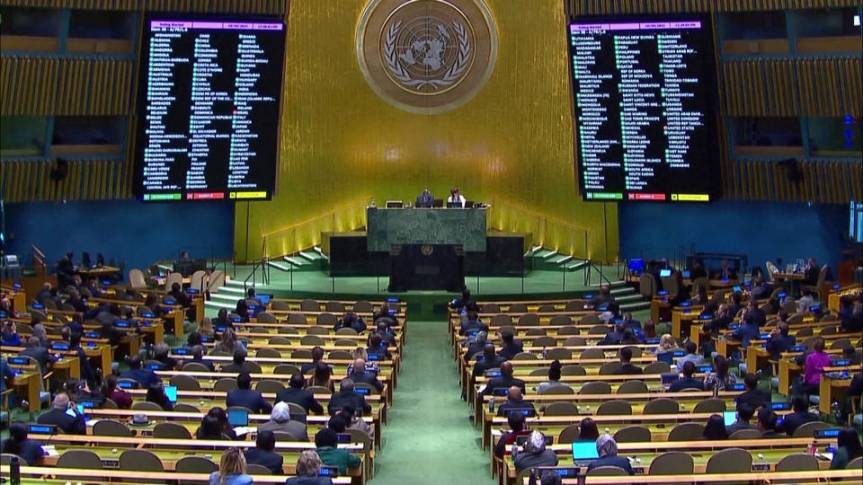
The United Nations General Assembly has voted to condemn the United States’ embargo on Cuba for the 32nd consecutive year. On Wednesday, 187 countries voted in favor of lifting the decades-old sanctions; only the U.S. and Israel voted against the nonbinding resolution | via Democracy Now!

South Paris, Maine


By a 187-nation majority, The United Nations General Assembly on October 30 voted to approve a Cuba Resolution calling for the “Necessity of ending the economic, commercial and financial embargo imposed by the United States of America against Cuba.” The United States and Israel voted no; Moldova abstained.

The same motion has been approved overwhelmingly every year since 1991. No vote took place in 2020 because of the Covid-19 pandemic. For over 20 years, only Israel and the United States have voted down the Resolution; annually one or more states have abstained.

In remarks to the Assembly’s delegates, Cuban Foreign minister Bruno Rodríguez explained that the U.S. economic blockade restricts Cuba’s importation of goods and access to international financial resources, also that shortages hurt every aspect of Cubans’ lives. Cuba’s foreign ministry on September 12 issued a comprehensive summary of adverse effects of the blockade.” Appearing here, it supplements this report.

The UN vote this year has special significance. It took place immediately following both Hurricane Oscar, which devastated eastern Cuba, and an island-wide electrical outage lasting several days. Its cause was lack of oil for generating electricity, restrictions on the shipping of petroleum products, and limited access to international financing, all owing to the blockade.

Now is an extraordinarily difficult time for Cubans and their government. Basic supplies and materials needed for day-to-day functioning are not readily available. Money is short and inflation mounts. The twin culprits are a fall-off in tourism, Cuba’s main source of foreign currency, and U.S. designation of Cuba as a state sponsor of terrorism. The latter entails regulations that persuade international financial institutions and corporations to steer clear of Cuba.

Every year in preparation for its vote on the Resolution, the General Assembly arranges for two days of discussion of the Resolution’s pros and cons. Perhaps reflecting extra stresses weighing on Cuba, commentary during this year’s discussion period came from an unprecedently large group of delegates.

In brief interventions, 59 of them offered reasons why the Resolution should pass; almost 30 international organizations or alliances did likewise. These included the Group of 77 and China, the Association of Southeast Asian Nations (ASEAN), the Community of Latin American and Caribbean States (CELAC), the Organization of Islamic Cooperation (OIC), the Non-Aligned Movement (NAM), and the Caribbean Community (CARICOM).

The speakers made frequent reference to the SSOT designation and to Title III of the U.S. Helms-Burton law (which discourages foreign investment in Cuba). Many of them variously denounced the blockade as violating international law and Cubans’ human rights, for inhibiting Cuba’s development, and for sticking around as a Cold War left-over. Several delegates extolled South-to-South cooperation and multipolarity. Others offered thanks for Cuba’s assistance during the Covid-19 pandemic

Meanwhile, U.S. activists and organizations, rallying against the blockade and in defense of Cuba, joined in vigorous demonstrations taking place in Washington DC, New York, Los Angeles, Chicago and elsewhere.

The International US-Cuba Normalization Coalition Committee on October 27-28 again staged its annual “24 Hour Global Picket” to accompany the UN vote. The effort made for a continuous presentation of commentary, advocacy, video presentations, and music from 61 countries. Hats off to Vancouver-based activists Tamara Hansen and Alison Brodine, and others, for devising a remarkable phenomenon.

One oddity of the discussion on the Cuban Resolution was the contrast between multiples viewpoints offered by nations of the Global South and silence from their northern counterparts, specifically Japan, Canada and all European nations, save Hungary. (The U.S. representative did speak). The divide may represent dismissal of the proceedings by nations identifying with U.S. interests, or a fundamental cleavage within the community of nations, or both.

A standout anomaly was that of Argentinian foreign minister Diana Mondino having been fired from her job shortly after she voted in favor of the Cuban Resolution. Her boss, extremist rightwing President Javier Milei, was displeased.

After the vote in New York, China’s ambassador in Cuba issued a statement qualifying the result as a “just call from the international community that must be applied immediately and effectively.” He added that, “It’s disappointing and outrageous that the United States voted against the Resolution while refusing to end its sanctions against Cuba and insisting on including Cuba on its list state sponsors of terrorism … [And besides] China and Cuba are good friends, comrades and brothers.”


W.T. Whitney Jr. is a political journalist whose focus is on Latin America, health care, and anti-racism. A Cuba solidarity activist, he formerly worked as a pediatrician, lives in rural Maine. W.T. Whitney Jr. es un periodista político cuyo enfoque está en América Latina, la atención médica y el antirracismo. Activista solidario con Cuba, anteriormente trabajó como pediatra, vive en la zona rural de Maine.
US Labor Must Weigh in on Cuba / By W.T. Whitney

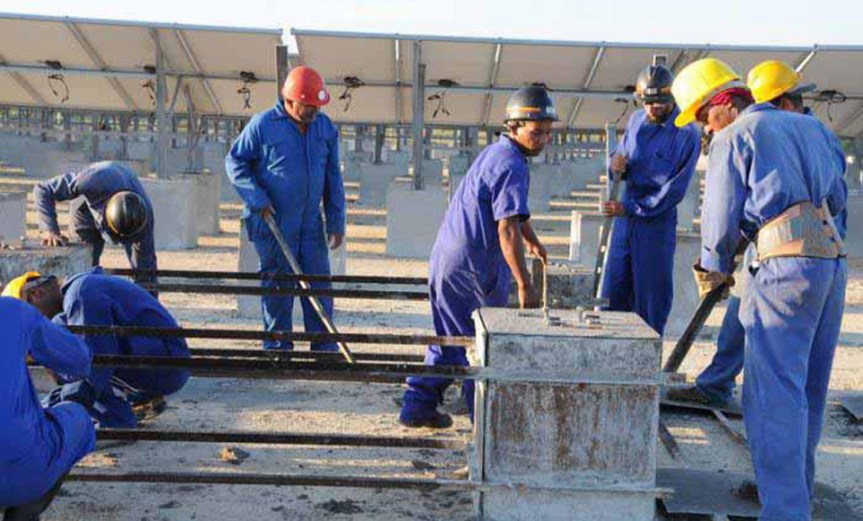
Photo credit: Juan Carlos Dorado

South Paris, Maine


Taking note of International Workers’ Day, several Latin American news sources this year cited José Martí’s 1886 essay “A Terrible Drama;” two of them republished it, here and here.  There Martí reports on events in Chicago in 1886 and the fate of the so-called Haymarket Martyrs – seven labor journalists and agitators railroaded to prison and given death sentences.  Another received a 15-year prison term.

Martí, who would become Cuba’s national hero, was living in exile in the United States. He relates how strikes for the eight-hour day were underway on May 1, 1886 in Chicago and nationwide, how the Chicago police killed one striker and wounded others on May 3, and how a mass protest against police violence took place the next day in the Haymarket area. There, a bomb exploded, seven policemen and four workers were killed, and dozens were wounded. 

The court lacked evidence that the defendants, anarchist by inclination, were involved in the violence of May 4. Martí describes the execution of four of them and the suicide of another. An appeals court judge commuted the sentences of two defendants to life in prison. In 1893, Illinois Governor John Altgeld pardoned those two and the remaining prisoner.

The Socialist International in 1889 declared May Day to be an annual celebration of labor militancy.

José Martí’account, “A Terrible Drama,” is a foundational contribution to the history of the U.S. labor movement. Martí defended working people – U.S. workers in his writings, and Cuban workers in words and deeds, from 1886 on. The combination of author and story points to a connection between U.S. labor activism and workers’ struggles in Cuba. Its time has come.

The U.S. economic blockade of Cuba, lasting decades, has led to shortages, misery, and despair. Nations of the world voting annually in the United Nations General Assembly overwhelmingly condemn the blockade. It violates international law.

Domestic opposition to U.S. policies on Cuba, while persistent, vigorous at times, principled, on-target, and diverse, has fallen short. U.S. government measures aimed at destabilization remain in force.  Upping power of the people with labor combativeness would make a difference.

Unions and labor activists know how to organize and how to confront recalcitrant political and economic leaders. They will be active on Cuba’s side, once they realize that working people’s struggles in the two countries are linked, or so our theory goes. In addition:

·        Labor unionists involved in struggle count on unity, the power of numbers, and sometimes solidarity from counterparts, often from abroad.

·        The current Cuban Revolution is the product of a revolutionary tradition. U.S. workers confronting their own government on Cuba would be expressing solidarity with a revolution whose progenitor, Jose Martí, defended U.S. workers fighting for the eight-hour day.  They would be paying back. 

·        Social revolution and ordinary labor struggles are battles of ideas. The writings of Martí, maximum leader of Cuba’s early revolution, speak to Cuban and U.S. workers alike. In that way they are connected.

Martí wrote about working people and their lives.  He contributed greatly to the ideas and substance of revolutionary struggle in Cuba and also defended African-descended and poverty-stricken Cubans with a seemingly unqualified egalitarianism. For example:

·        “And let us place around the star of our new flag this formula of love triumphant: ‘With all, and for the good of all.’”

·        “A nation having a few wealthy men is not rich, only the one where each of its inhabitants shares a little of the common wealth. In political economy and in good government, distribution is the key to prosperity.”

·        “In Cuba there is no fear whatever of racial conflict. A man is more than white, black, or mulatto. A Cuban is more than mulatto, black, or white … True men, black or white, will treat each other with loyalty and tenderness for the sake of merit alone.”

Workers are oppressed

Responding to the Haymarket affair in his “A Terrible Drama,” Martí reflects upon the situation of U.S. working people:

“The nation is terrified by the increased organization among the lower classes … Therefore the Republic decided … to use a crime born of its own transgressions as much as the fanaticism of the criminal in order to strike terror by holding them up as an example …. Because of its unconscionable cult of wealth, and lacking any of the shackles of tradition, this Republic has fallen into monarchical inequality, injustice, and violence …

“In the recently emerging West … where the same astounding rapidity of growth, accumulating mansions and factories on the one hand, and wretched masses of people on the other, clearly reveals the evil of a system that punishes the most industrious with hunger, the most generous with persecution, the useful father with the misery of his children – there the unhappy working man has been making his voice heard.”

Martí’s “A Terrible Drama” appeared in La Nación newspaper in Buenos Aires in January 1888, some 19 months after the Haymarket events. The delay may have stemmed from Martí’s ambivalence about the anarchist leanings of the accused. Previously published segments of his report do appear under the title “The First of May, 1886” in historian Philip Foner’s anthology of Martí’s writings published in 1977. Excerpts follow:

“Enormous events took place in Chicago, but rebellion exists throughout the nation. In the United States … a firm and active struggle has been in preparation for years … …[T]hings are not right when an honest and intelligent man who has worked tenaciously and humbly all his life does not have at the end of it a loaf of bread … or a dollar put away, or the right to take a tranquil stroll in the sunlight… Things are not right when the one who in the cities … lives a contemplative life of leisure so exasperating to the miner, the stevedore, the switchman, the mechanic, and to every wretched person who must be content with seventy-five cents day, in raw winter weather …Things are not right if shabby women and their pallid children must live in tenement cubicles in foul-smelling neighborhoods. …The reasons are the same. The rapid and evident concentration of public wealth, lands, communication lines, enterprises in the hands of the well-to-do caste that rules and governs has given rise to a rapid concentration of workers. Merely by being gathered together in a formidable community which can, at one stroke, extinguish the fires in the boiler and let the grass grow under the wheels of the machinery, the workers are able successfully to defend their own rights against the arrogance and indifference with which they are regarded by those who derive all their wealth from the products of the labor they abuse.”

Deeds and words

Martí acted on behalf of working people. He organized Cuba’s independence struggle that culminated in war with Spain in early 1895. Under his leadership, the process became a social revolution.

From exile in New York, Martí outlined goals, strategies, and methods. Traveling widely, he arranged for Cuban exiles in the United States, Central America, and the Caribbean – many of them workers, many African-descended – to select the revolution’s leadership, provide funding and supplies, and approve goals and proposals. Martí persuaded the military heads to accept civilian leadership. He created and edited the independence movement’s newspaper Patria.

Aware of U.S. aspirations to dominate Cuba and the entire region, Martí led in confronting U.S. imperialism – never good for workers. In 1891 he wrote “Our America,” an essay demonstrating commonalities among diverse peoples inhabiting all the land extending from the Rio Bravo (the Rio Grande) south to Patagonia. Martí highlighted their shared cultural and political orientations that set them apart from U.S. and European societies.

In a letter to a friend shortly before he was killed in battle on May 19, 1895, Martí insisted that: “It is my duty … to prevent, by the independence of Cuba, the United States from spreading over the West Indies and falling, with that added weight, upon the other lands of Our America.”

Attacking military installations of the Batista regime on July 26, 1953, revolutionaries led by Fidel Castro were honoring José Martí, born 100 years earlier. For Castro, Martí was “the Apostle of Independence … whose ideas inspired the Centennial Generation and today inspire and will continue to inspire all of our people more and more.”

For the sake of justice and in view of connections with Cuban workers, U.S. working people would do well to press upon their government the necessity to end the blockade of Cuba. Labor unions, the principal means for expression of workers’ sentiment and power, have prime responsibility in this regard.

They would be acting as did West Coast dockworkers who blocked arms shipments to Chile under the Pinochet dictatorship, cargo arriving from apartheid-ridden South Africa, and, recently, arms shipments bound for Israel. U.S. unionists actively opposed their government’s support for authoritarian El Salvador in the 1980s and supported Iraqi workers after the U.S. invasion there. They collaborated with Mexican miners and other workers over many years. Recently U.S. unions issued statements and approved resolutions calling for a ceasefire in Gaza.  


W.T. Whitney is a political journalist whose focus is on Latin America, health care, and anti-racism. A Cuba solidarity activist, he formerly worked as a pediatrician, lives in rural Maine. W.T. Whitney Jr. es un periodista político cuyo enfoque está en América Latina, la atención médica y el antirracismo. Activista solidario con Cuba, anteriormente trabajó como pediatra, vive en la zona rural de Maine.

Cuba Scores Big Victory in the UN General Assembly / By W. T. Whitney

South Paris, Maine


The United Nations General Assembly on November 2 voted to approve
a Cuban resolution that, unchanged over 31 consecutive years, calls for
an end to the U.S. economic blockade of Cuba. Approval once more
was overwhelming: 187 nations voted in favor and two against, the
United States and Israel. Ukraine abstained.

Reacting to the vote, Cuban President Miguel Díaz-Canel proclaimed a
“new victory for the Cuban people and their Revolution!” He pointed to
“the triumph of dignity and the fearlessness of our people,” and
expressed gratitude for “the international community’s recognition of and
support for Cuba’s heroism and resistance.”

For over 20 years, the only nations opposing the Cuban resolution, apart
from the United States, have been Israel and, formerly, a few U.S.-
dependent Pacific island-nations. The blockade began in 1962, and now
80% of Cubans have lived under its sway.

Prior to the vote this year, dozens of delegates representing member
states spoke out against the blockade. Cuba’s Minister of Foreign
Relations Bruno Rodríguez addressed the General Assembly, insisting
that the U.S. blockade interferes with “the right to life, health, progress
and welfare of every Cuban family.”

He explained that Cuba’s financial losses from the blockade reflect
factors like the high cost of substituting for goods excluded under the
blockade with more expensive goods and/or those with higher
transportation costs. Losses take the form also of an overall lack of
necessary materials, goods, and services. And “barriers Cuba faces in
gaining access to advanced technology” lead to monetary loss.

The chancellor emphasized that “sectors like agriculture and energy face
serious obstacles to acquiring spare parts or machinery.” He cited
examples of blockade-related shortages such as extreme shortages of
gasoline and oil, cancer patients being denied “first line treatments and
drugs,” and healthcare providers and their patients lacking respiratory
ventilators and medicinal oxygen normally available from abroad.

The blockade’s assault against the Cuban people shows up clearly and
dramatically in money lost to Cuba’s economy. Rodríguez claimed that
Cuba’s GDP would have grown by 9% in 2022 without the blockade, and
that the $4.87 billion in losses occurring between March, 2023 and
February 2023 correlated with “pain and suffering.”

Cuba’s monetary loss in over 60 years of blockade now totals $159.8
billion, according to one account. What with inflationary change, that’s
$1.3 trillion.

Another report indicates that between August 2021 and February 2022,
losses in the energy and mining sectors added up to $185.5 million, in
the agricultural sector, $270.9 million; and in banking and finance,
$280.8 million. Between January and July in 2021, losses were $113.5
million in the healthcare sector; $30.6 million in education; and $31.3
million in the transport sector.

Cubans’ lives are affected:

* During the last school year, Cuba’s government lacked paper
sufficient to “print and assemble books and notebooks for students,”
in part because a Canadian paper manufacturer did not extend credit.

* Presently, according to Granma news service, no school books are
being produced due to a lack of supplies and spare parts.

* Lack of access to high-performance brands and equipment, as well
as spare parts, serves to handicap Cuba’s telecommunications
sector, thus easing the way for U.S. and European competitors to
reach Cuban users.

Laws authorizing the U.S. blockade include the 1917 Trading with the
Enemy Act, the 1992 Cuban Democracy Act (Torricelli Law), and the
1996 Cuban Liberty and Democratic Solidarity Act (Helms-Burton Law).
Executive actions taken to implement the blockade have been central to
how that policy affects Cuba. The Obama administration eased many
blockade regulations. President Trump added 243 new measures, with
disastrous effect. The Biden administration continues them.

The U.S. Treasury Department imposes large fines on third-country
exporters failing to comply with its rules and so they often do not sell to
Cuba. Because the Treasury Department forbids foreign banks from
using U.S. dollars, international financial institutions rarely make loans to
entities in Cuba and are reluctant to handle U.S. dollars in transactions
involving Cuba.

The U.S. government has recently been weaponizing its false
declarations that Cuba is a terrorist-sponsoring state. The enabling
legislation on the matter granted the U.S. government authority to
penalize any international financial and banking sectors bold enough to
have dealings with states so designated.

Conveniently enough, Cuban analyst Claudia Fonseca Sosa recently
provide President Biden with advice as to “substantive modifications” of
methods for carrying out his policy. He could authorize “the export of
U.S. products to key branches of Cuba’s economy” and of medical
supplies and equipment to the island to help with the manufacture of
biotechnical products. Biden could allow U.S. companies to invest in
Cuba and enable U.S. citizens to receive medical treatment there.

The prospects for changed policies toward Cuba perhaps have
improved; a recent report documented the major role of the blockade in
propelling Cuban emigration to the United States – and sending
Venezuelans and Nicaragua there too. Those three blockaded countries
presently supply most of the migrants crossing into the United States.

U.S. sanctions cause desperate living conditions, and so people leave.
End all three blockades. Relieve the pressure on people, and maybe
they’d stay home. Who could object?


W.T. Whitney Jr. is a political journalist whose focus is on Latin America, health care, and anti-racism. A Cuba solidarity activist, he formerly worked as a pediatrician, lives in rural Maine. W.T. Whitney Jr. es un periodista político cuyo enfoque está en América Latina, la atención médica y el antirracismo. Activista solidario con Cuba, anteriormente trabajó como pediatra, vive en la zona rural de Maine.

UN Condemns US Blockade as Crisis Builds in Cuba / by W. T. Whitney Jr

Cuba thanks universal support against the US blockade | Image: Prensa Latina

A long-running show played out in the United Nations General Assembly once more on November 3 as nations of the world for the thirtieth year voted overwhelming to approve a Cuban resolution calling for an end to the U.S. economic blockade of Cuba. The vote was 185 nations favoring the resolution, two nations opposing (The United States and Israel, as usual), and Ukraine and Brazil abstaining.

Cuba has withstood the blockade for 60 years, so long as to equal one fourth of the years of U.S. national existence.  In that time, Cuba has lacked the resources and powerful allies that might have forced the U.S. government to backtrack. 

Cuba instead has had to rely on ideals, high principles, and widespread consensus in its favor, epitomized by the yearly votes in the General Assembly The blockade is cruel, immoral, unfair, and illegal the under international law. Even so, an opportunistic and powerful U.S. ruling class has not budged. 

The U.S. blockade will not end soon inasmuch as U.S. law assigns that task to the Congress. Another way for the blockade to go is for outcomes  envisioned by U.S. State Department official Lester Mallory in April 1960 to have worked their way. The U.S. government, through the blockade, was seeking “economic dissatisfaction and hardship,” “hunger,” “desperation,” and “overthrow of government.”

Except for the last one, these policy goals are far advanced in being realized and a crisis may be at hand in Cuba.

Disruption

At a press conference on October 19, Cuban foreign minister Bruno Rodriguez explained how the workings of the blockade led to those results. He noted that Cuba had suffered the loss between August 2021 and February 2022 of $3.8 billion, which “is a historical record for such a short time.”  Losses over six decades amount to $154 billion. With inflation, that’s $1.391 trillion.

The U.S. government designates Cuba as a terrorist-sponsoring nation. That means foreign companies and financial institutions face severe U. S. penalties if they handle dollars in transactions with Cuba. Dollars are the principal currency used in international monetary transactions. As a result, Cuba’s income from exports is reduced and international loans are largely unavailable. 

Without much money to pay for imports, Cuba experiences shortages of food, spare parts, raw materials for drug manufacture, and all kinds of supplies and equipment. Rodriguez mentioned long lines and “anxiety among the population.” The blockade affects “every Cuban family” and the government cannot “guarantee medicines that an ill person requires.”

“Cuba can in no way … buy technologies, equipment, spare parts, digital technologies or software containing more than 10 per cent US components.” The blockade has aggravated difficulties caused by “international crises,” inflation, and lingering effects of the Covid-19 pandemic.

Blockade restrictions “gravely hinder our fuel purchases by making them … [up to] 50 percent more expensive.” Electrical power generation “is going through an extremely serious situation” because of unavailable replacement parts. Blackouts bedevil Cubans every day and restoration of electrical power in hurricane-damaged Pinar del Rio has been slow.

First hand report

Richard Grassl, friend and political colleague, visited Cuba recently with his wife, who is Cuban. He recalls conversations touching on shortages, distress, and uncertainty as to who is to blame. 

10/16      Talked to first cousin of wife …  He told me I will learn the real Cuba this time.  He says not to believe what the Cuban government says about the US blockade.  There are many lies.  My wife’s nephew says the economy is “nothing. Many Cubans think the blockade [itself] is secondary to issues of daily living like [shortages of] food, medicine, water and lack of opportunity because there is no money. 

10/17     I asked him from where most food for Cubans comes from and about food imports.  He said most food comes from Miami.  [President] Diaz-Canel gets some blame for the situation.

10/18    There is not much social distancing as the times are urgent.  Food, consumer goods, fuel, construction materials are very expensive.  Eggs are $8USD / dozen.  The exchange rate is 80 CUP / USD which is 4x higher than before Covid-19.   No one talks about the blockade.  The problem is scarcity of money. 

10/19     I talked with a friend.  He says the US has so much and we have so little.  He asks why cannot there be trade?  …  At several bodegas and public markets, many people, perhaps hundreds, waited all day for cooking oil, rice, beans, chicken etc. at prices subsidized by government. 

10/20     I talked to another cousin from Matanzas who said the economy is “on the floor”.  It is very hard with little money.  A round trip from Matanzas to Havana (500 km) was $500 CUP/person one way or $2000 round trip for both persons by bus.

Corruption and blockade

Former Cuban President Fidel Castro delivered wide-ranging speech on November 17, 2005 notable for his highlighting of corruption: “This country can self-destruct; this Revolution can destroy itself, but they can never destroy us; we can destroy ourselves, and it would be our fault.”

Similarly, President Miguel Díaz-Canel on October 26 convoked a meeting of Cuba’s Council of Ministers at which a plan was unveiled with “more than 40 directives aimed at confronting crime, corruption, and lack of social discipline.” The report appearing on the presidential website characterized the President’s remarks as “a forthright analysis of illegalities, stealing and price-gouging imposed on a population with no economic means.”

Both earlier and now, the toxic mixture of shortages of goods and money has led to stealing and lawlessness. The progression suggests that shortages of both are sufficient to exert a destabilizing effect on society. That evolution of blockade effects, which have reached crisis proportions, is consistent with how the blockade was supposed to operate.

President Díaz-Canel explained to the Council that, “neither the Party or the government can remain on the sidelines of what’s happening in society.” Therefore, “we must not allow those who neither work nor contribute, and are beyond the law, to acquire more and have more possibilities for life than do those who actually contribute. We have it backwards now and are breaking with the ideas of socialism.”

He pointed out that, “Many of these things are the result of us not attending to the powers and responsibilities assigned to our institutions.” [Corrupt activities] “take place in full view of the Party centers, the administrative institutions, and leadership bodies.”

The President asserted that anyone able to work who is not doing so is not so vulnerable as to require “welfare assistance.” In fact, “the building of socialism does not depend upon a welfare system. What we have to seek out, instead, is social transformation.” 

Díaz-Canel observed that, “We don’t do away with taxes here so that the rich get richer and poorer people have less. Here, we do have taxes so that those who have more give something up so that those who have less are better off.”  “That’s socialism,” he explained. 

While celebrating another Cuban victory in the UN General Assembly, supporters of revolutionary Cuba, we think, ought to recognize that

the survival of Cuba’s government is now at unprecedented risk, thanks to the U.S. blockade. U.S. supporters of Cuba’s revolutionary project would do well to elevate actions of resistance against their own government to a new level, with new intensity. That’s because realities in Cuba appear to have altered, ominously so. 

Already new mobilization may be underway. In the days prior to the General Assembly’s vote on November 3, dozens of rallies for ending the blockade took place in cities and towns throughout the United States (two of them in Maine, the author’s home state), with particularly big ones in Los Angeles, Portland Oregon; and New York. There, an impressive march took place between Times Square and the United Nations Plaza.    


W.T. Whitney Jr. is a political journalist whose focus is on Latin America, health care, and anti-racism. A Cuba solidarity activist, he formerly worked as a pediatrician, lives in rural Maine. W.T. Whitney Jr. es un periodista político cuyo enfoque está en América Latina, la atención médica y el antirracismo. Activista solidario con Cuba, anteriormente trabajó como pediatra, vive en la zona rural de Maine.