Review: Being Aware is First Step to Resisting US Militarization / by W.T. Whitney Jr.

Photograph Source: Jason Eppink – CC BY 2.0

The military draft in the United States has disappeared. There’s no major U.S. war and military affairs rate little attention in the media. The U.S. public embraces the pervasive influence of the military-industrial complex across U.S. society. The U.S. Congress seems never to hold back on wildly exorbitant military spending.

Travelers entering North Carolina on Interstate 95 almost immediately see a sign proclaiming “Nation’s most military friendly state” – a sign paid for, in part, by the N.C. Bankers Association.  In high schools, military recruiters “insinuate themselves into school life at every level.” Loudspeakers at sports events sound out tributes to veterans and active-duty troops. The latter may receive free tickets to performances, preferential parking, and discounts on merchandise.

Unveiling of the new “Welcome to North Carolina” sign for interstate highways in the state – Fayetteville Observer

Clarity Press, 2023
978-1949762587

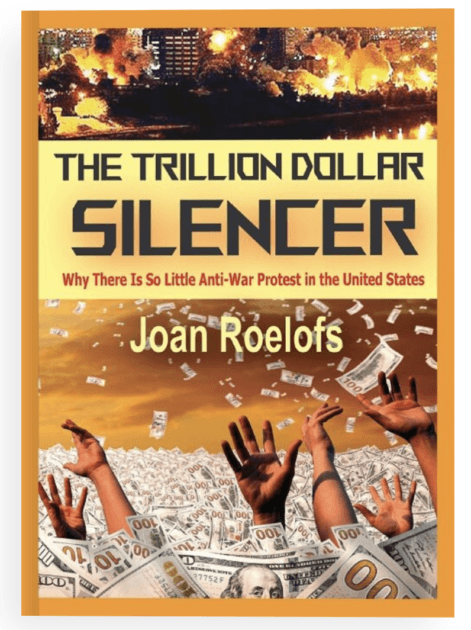
Author Joan Roelofs has written a new and much needed book that explains much about praise and support for the U.S. military. The Trillion Dollar Silencer, provides atravelogue of sorts through the U.S. military-industrial complex. It moves from the military establishment and big corporations to colleges, universities, NGOs, philanthropies, foundations research institutes, and other kinds of defense contractors.

Her thesis is that dependency on the part of civilian institutions involved with the military establishment has the effect of shielding the military from widespread popular outrage at war-making and big spending. She asks, “Why is there so much acceptance of and so little protest against our government’s illegal and immoral wars and other military opera­tions?”

The author shows her anti-war perspective in rejecting NATO and in criticizing U.S. military interventions, subversion, and covert military actions as violations of international law. She condemns U.S war-makers’ use of Cold War and anti-terrorism pretexts to have free rein to maim and destroy.

Roelofs, a retired professor of political science, is the author also of Foundations and Public Policy: The Mask of Pluralism (SUNY Press) and Greening Cities (Rowman and Littlefield).

She argues that the incentive for civilian institutions and private companies to support military funding and U.S. military purpose lies in their interests being satisfied. Propaganda, distractions, and fear of repression, she points out, are other persuaders. Her new book is about “the interests created by [the] military’s penetration into so many aspects of civilian life.”

Roelofs writes about large and small defense contractors and private, public, and non-profit ones. They are colleges, universities, research foundations, healthcare organizations, and groups working on political and legal issues and the environment.  They provide the military with supplies, logistics, weapons development, human services, defense against atypical threats.

She indicates that, “75% of the [Defense Department] budget is paid to contractors.” These had enough funds, she reports, to financially support dozens of think tanks and foundations. Money, we suggest, is basic to the “interests” cited by the author.

Other observers point out that U.S. companies in 2019 accounted for 57% of the arms sold by the world’s 100 top weapons manufactures. The world’s five biggest weapons manufacturers are U.S. corporations.

Lockheed Martin took in $58.2 billion in revenues in 2020 and showed profits of $9.1 billionin 2021. Raytheon Technologies reported arms sales of $36.8 billion in 2020 and profits of $5 billion in 2021. Boeing’s profits in 2021 were $5.19 billion. Northrop Grumman sold arms worth $30.4 billion in 2021 with $7.0 billion in net income. General Dynamics’s arms sales totaled $25.8 billion; its 2021 profits were $3.3 billion.  The average salary of the CEOs of these companies was $20,795,527, according to inequality.org.

According to the book, defense contracts provide economic rescue even for next-door operations.  In 2012 an $866,000 three-year contract for making cribs for childcare centers helped to revive a children’s furniture manufacturer in the author’s hometown Keene, New Hampshire. Granite Industries of Vermont was declining until it received a contract for making up to 4000 headstones a year for Arlington National Cemetery.

Surprises turn up as to who are the big defense contractors. The for-profit health insurance company Humana is the seventh largest of all of them, according to Roelofs. Massachusetts Institute of Technology ranks in 38th place.

Relationships are tight within the military industrial complex. Upper-level employees of universities, philanthropies, and non-government organizations and the top military brass and Defense Department officials oscillate between one sphere and the other. According to the author, Defense Department grants to philanthropies, foundations, and to environmental and civil rights groups are oriented to reforms and not so much to basic social change.

The single-issue orientation of most of the contracting philanthropies and NGOs fits with military and official preferences; their fear would be that different issues seen as connected might encourage critical thinking and even dissent. Roelofs looks at the role of state and local government entities in reaching out to youth to serve military needs such as ROTC units, recruitment, and encouragement of scientific and technical educational paths.

Roelofs’ purpose has been to make “the extent and implications of the military industrial complex more visible.” But, as she notes, “many look away, and the mountain is huge to move.” Additionally, “Our political system …  does not afford citizens much democratic control over policies, and hardly any over foreign policy.” The question is: “What can be done.”

Roelofs is alluding to the powerful forces attached to the economic and political status quo, among them the civilian enablers of the military establishment. She is saying, in essence, that the process of consciousness-raising that does lead to useful political action would be a long and arduous one.

Her book, which is written in a readable, accessible style, would have us start out at the beginning. The first item on the agenda is that of persuading ordinary people to say “No.” They would stand up, test the waters, be active in some way, and make a few gains.

She calls upon her readers to speak out, write to editors, contact elected officials, join and work with antiwar organizations. She advocates for a Green New Deal, a “national service program,” and “conversion to a civilian economy.” She is evidently hoping that masses of people will build a resistance movement, score some victories, gain confidence, and learn.

If Roelofs had presented all-encompassing themes like past U.S. military misadventures and the evils of a profit-driven political system, her call to action would have yielded almost nothing. Instead, more promisingly, she is lending support to a protest movement in its infancy. Now is exactly the right time for her highly recommended book.


W.T. Whitney Jr. is a retired pediatrician and political journalist living in Maine.

Counterpunch, November 18, 2022, https://www.counterpunch.org/

UN Condemns US Blockade as Crisis Builds in Cuba / by W. T. Whitney Jr

Cuba thanks universal support against the US blockade | Image: Prensa Latina

A long-running show played out in the United Nations General Assembly once more on November 3 as nations of the world for the thirtieth year voted overwhelming to approve a Cuban resolution calling for an end to the U.S. economic blockade of Cuba. The vote was 185 nations favoring the resolution, two nations opposing (The United States and Israel, as usual), and Ukraine and Brazil abstaining.

Cuba has withstood the blockade for 60 years, so long as to equal one fourth of the years of U.S. national existence.  In that time, Cuba has lacked the resources and powerful allies that might have forced the U.S. government to backtrack. 

Cuba instead has had to rely on ideals, high principles, and widespread consensus in its favor, epitomized by the yearly votes in the General Assembly The blockade is cruel, immoral, unfair, and illegal the under international law. Even so, an opportunistic and powerful U.S. ruling class has not budged. 

The U.S. blockade will not end soon inasmuch as U.S. law assigns that task to the Congress. Another way for the blockade to go is for outcomes  envisioned by U.S. State Department official Lester Mallory in April 1960 to have worked their way. The U.S. government, through the blockade, was seeking “economic dissatisfaction and hardship,” “hunger,” “desperation,” and “overthrow of government.”

Except for the last one, these policy goals are far advanced in being realized and a crisis may be at hand in Cuba.

Disruption

At a press conference on October 19, Cuban foreign minister Bruno Rodriguez explained how the workings of the blockade led to those results. He noted that Cuba had suffered the loss between August 2021 and February 2022 of $3.8 billion, which “is a historical record for such a short time.”  Losses over six decades amount to $154 billion. With inflation, that’s $1.391 trillion.

The U.S. government designates Cuba as a terrorist-sponsoring nation. That means foreign companies and financial institutions face severe U. S. penalties if they handle dollars in transactions with Cuba. Dollars are the principal currency used in international monetary transactions. As a result, Cuba’s income from exports is reduced and international loans are largely unavailable. 

Without much money to pay for imports, Cuba experiences shortages of food, spare parts, raw materials for drug manufacture, and all kinds of supplies and equipment. Rodriguez mentioned long lines and “anxiety among the population.” The blockade affects “every Cuban family” and the government cannot “guarantee medicines that an ill person requires.”

“Cuba can in no way … buy technologies, equipment, spare parts, digital technologies or software containing more than 10 per cent US components.” The blockade has aggravated difficulties caused by “international crises,” inflation, and lingering effects of the Covid-19 pandemic.

Blockade restrictions “gravely hinder our fuel purchases by making them … [up to] 50 percent more expensive.” Electrical power generation “is going through an extremely serious situation” because of unavailable replacement parts. Blackouts bedevil Cubans every day and restoration of electrical power in hurricane-damaged Pinar del Rio has been slow.

First hand report

Richard Grassl, friend and political colleague, visited Cuba recently with his wife, who is Cuban. He recalls conversations touching on shortages, distress, and uncertainty as to who is to blame. 

10/16      Talked to first cousin of wife …  He told me I will learn the real Cuba this time.  He says not to believe what the Cuban government says about the US blockade.  There are many lies.  My wife’s nephew says the economy is “nothing. Many Cubans think the blockade [itself] is secondary to issues of daily living like [shortages of] food, medicine, water and lack of opportunity because there is no money. 

10/17     I asked him from where most food for Cubans comes from and about food imports.  He said most food comes from Miami.  [President] Diaz-Canel gets some blame for the situation.

10/18    There is not much social distancing as the times are urgent.  Food, consumer goods, fuel, construction materials are very expensive.  Eggs are $8USD / dozen.  The exchange rate is 80 CUP / USD which is 4x higher than before Covid-19.   No one talks about the blockade.  The problem is scarcity of money. 

10/19     I talked with a friend.  He says the US has so much and we have so little.  He asks why cannot there be trade?  …  At several bodegas and public markets, many people, perhaps hundreds, waited all day for cooking oil, rice, beans, chicken etc. at prices subsidized by government. 

10/20     I talked to another cousin from Matanzas who said the economy is “on the floor”.  It is very hard with little money.  A round trip from Matanzas to Havana (500 km) was $500 CUP/person one way or $2000 round trip for both persons by bus.

Corruption and blockade

Former Cuban President Fidel Castro delivered wide-ranging speech on November 17, 2005 notable for his highlighting of corruption: “This country can self-destruct; this Revolution can destroy itself, but they can never destroy us; we can destroy ourselves, and it would be our fault.”

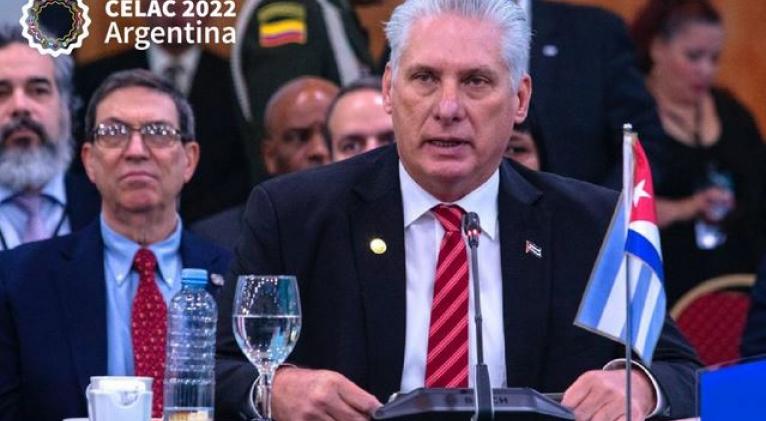
Similarly, President Miguel Díaz-Canel on October 26 convoked a meeting of Cuba’s Council of Ministers at which a plan was unveiled with “more than 40 directives aimed at confronting crime, corruption, and lack of social discipline.” The report appearing on the presidential website characterized the President’s remarks as “a forthright analysis of illegalities, stealing and price-gouging imposed on a population with no economic means.”

Both earlier and now, the toxic mixture of shortages of goods and money has led to stealing and lawlessness. The progression suggests that shortages of both are sufficient to exert a destabilizing effect on society. That evolution of blockade effects, which have reached crisis proportions, is consistent with how the blockade was supposed to operate.

President Díaz-Canel explained to the Council that, “neither the Party or the government can remain on the sidelines of what’s happening in society.” Therefore, “we must not allow those who neither work nor contribute, and are beyond the law, to acquire more and have more possibilities for life than do those who actually contribute. We have it backwards now and are breaking with the ideas of socialism.”

He pointed out that, “Many of these things are the result of us not attending to the powers and responsibilities assigned to our institutions.” [Corrupt activities] “take place in full view of the Party centers, the administrative institutions, and leadership bodies.”

The President asserted that anyone able to work who is not doing so is not so vulnerable as to require “welfare assistance.” In fact, “the building of socialism does not depend upon a welfare system. What we have to seek out, instead, is social transformation.” 

Díaz-Canel observed that, “We don’t do away with taxes here so that the rich get richer and poorer people have less. Here, we do have taxes so that those who have more give something up so that those who have less are better off.”  “That’s socialism,” he explained. 

While celebrating another Cuban victory in the UN General Assembly, supporters of revolutionary Cuba, we think, ought to recognize that

the survival of Cuba’s government is now at unprecedented risk, thanks to the U.S. blockade. U.S. supporters of Cuba’s revolutionary project would do well to elevate actions of resistance against their own government to a new level, with new intensity. That’s because realities in Cuba appear to have altered, ominously so. 

Already new mobilization may be underway. In the days prior to the General Assembly’s vote on November 3, dozens of rallies for ending the blockade took place in cities and towns throughout the United States (two of them in Maine, the author’s home state), with particularly big ones in Los Angeles, Portland Oregon; and New York. There, an impressive march took place between Times Square and the United Nations Plaza.    


W.T. Whitney Jr. is a political journalist whose focus is on Latin America, health care, and anti-racism. A Cuba solidarity activist, he formerly worked as a pediatrician, lives in rural Maine. W.T. Whitney Jr. es un periodista político cuyo enfoque está en América Latina, la atención médica y el antirracismo. Activista solidario con Cuba, anteriormente trabajó como pediatra, vive en la zona rural de Maine.

Cuban Adjustment Act of US Still Privileges Cuban Migrants, Hurts Cuba / by W. T. Whitney Jr.

The Cuban Adjustment Act of 1966, the only one of its kind in the world, continues to encourage irregular emigration, the repeal of which will be essential to achieve normal migratory relations between the two countries | Credit: Granma – en.granma.cu

“Maybe if you had printed more about the operation, you would have saved us from a colossal mistake.” President John Kennedy was berating New York Times editor Turner Catledge. The Times and the U.S. media generally had glossed over widely-known preparations for the Bay of Pigs attack in April 1961. Catledge had removed the revealing substance of reporter Tad Szulc’s detailed news story 10 days beforehand.

Media silence has attended other Cuba -related developments over the years. Many U.S. progressives and liberals also tend to mention little about U.S-Cuban affairs, the U.S. economic blockade of Cuba being one example.

The Cuban Adjustment Act (CAA), which is about Cubans migrating to the United States, receives little attention, while fuss and fury grow over an unprecedented number of migrants, Cubans among them, crossing the U.S. southern border now. Officials there apprehended 1.8 million migrants between October 2021 and August 2022.

Most respondents to an NPR/Ipsos poll believe an “invasion” is taking place. Anti-migrant measures have led to political division and stalemate. Senators Lindsay Graham and Ted Cruz sent a letter to Department of Homeland Security Secretary Alejandro Mayorkas on October 5. The Biden administration’s migration policies, they claimed, represent “gross dereliction of duty … violation of your oath of office …[and] grounds for impeachment.”

Cubans, enabled by the CAA, find welcome in the United States. That 1966 law allows Cuban immigrants and their immediate families to become permanent U.S. residents. To be eligible, the Cuban migrant on arrival has to be “inspected, admitted or paroled.” He or she waits for one year, while receiving social services, and then applies for permanent residency, and gains a work permit. Other immigrants must wait five years to apply.

Why is Cuban immigration encouraged? The idea may have been that of displaying the failure of a Communist government through Cubans leaving, or of fracturing popular unity in Cuba through emigration, or of strengthening the Cuban-American voting bloc through new Cuban arrivals.

Numbers of Cuban migrants have increased recently. There were 9,822 “southwest border encounters” of border officials with Cubans in fiscal year 2020, 38,674 in FY 2021, and 174,674 Cubans in the FY ending on October 1, 2022. Between October 2021 and June border officials detained more than 1300 Cubans arriving by sea in Florida.

Cubans have been enduring shortages, high prices, and low income due mostly to the U.S. economic blockade and cut-backs on the remittances Cuban-Americans send to family members on the island. That’s one set of reasons for leaving Cuba.

Additionally, Nicaragua in November, 2021 began allowing Cubans to enter without an entry visa. Migrants can now start on their trip closer to the border than, as before, having to travel through South America.

And most of the 20,000 Cubans who would have entered the United States annually, as authorized by a 1994 bi-national agreement, have not done so. That’s because almost no processing of entry visas has taken place since 2017, when the State Department recalled most of its Embassy staff in Havana. That was in response to a mysterious neurological syndrome afflicting U.S. diplomats and staff.

Few Cubans have been able to afford travel to U.S. embassies in other countries to secure visas. Consequently, departing Cubans have resorted to irregular means. The State Department has recently begun to send diplomatic staff back to its Havana Embassy.

New rules are in place. The Obama administration in 2017 ended the government’s “wet foot, dry foot” policy, in force since 1995. During that period, Cubans apprehended at sea were returned to Cuba. Those who arrived and touched U.S. soil could stay and eventually gain permanent residency status.

Cuban migrants crossing at the U.S. southern border still receive preferential treatment. Unable to show the required evidence of “lawful entry,” they benefit from creative arrangements that convert an irregular entry into a legal one.

Presently, “nearly 98 %” of Cuban migrants entering the United States stay. Border officials apply public health (anti-Covid 19) regulations known as Title 42 to all would-be immigrants. They immediately exclude half of them, but not the Cubans. Excluded migrants wait in Mexico or elsewhere for immigration judges to decide on their applications for asylum.

Some of the entering Cubans receive “humanitarian parole.” Under CAA regulations, that status qualifies as “lawful entry” and the migrant is able to wait for a year in the United States and then apply for permanent residency – and usually receive it.

Other Cubans not receiving humanitarian parole also remain in the United States by means of a “bond” requiring them to appear before immigration judges “where they can launch a defense for staying.” Most migrants in this group whose appeals are successful can count on gaining permanent residency.

A few have been unsuccessful and that group received good news on February 23, 2022. The U.S. Citizenship and Immigration Services announced that Cuban migrants whose appeal for permanent residence had failed now may try again, with likely success. The agency was responding to an immigration court ruling in 2021 that any release of Cuban migrants from custody at the border, whatever the circumstances, actually does represent “lawful entry” or parole, as required by the CAA.

Most of the Cubans exiting from their country are young adults and children. They benefited from the high-quality education, healthcare, and social support that was their birthright. Their energy, talents, labor, and potential commitment would no longer be contributing to Cuba’s national project of development and recovery. Their departure, one supposes, weakens the bonds of family life in Cuba and thereby makes Cuban society less cohesive.

The U.S. leadership class likely has little regret. The U.S. intention, after all, is to cause distress in Cuba leading to regime change. Moreover, U.S. economic blockade of Cuba, occupation of territory in Guantanamo, destabilizing interventions inside Cuba, and the CAA, taken together, add up to attack on Cuba’s independence and national sovereignty. The silence of the media and of political activists on these matters takes on an ominous quality, that of complicity with crimes.

The community of nations enabled the United Nations to deal with international crimes. Under the United Nations Charter, the Security Council may confront “any threat to the peace, breach of the peace, or act of aggression” of one nation against another. The General Assembly in 1965 unanimously approved Resolution 2131 which states that, “No State has the right to intervene, directly or indirectly, for any reason whatever, in the internal or external affairs of any State.”

What situations would these authorizations be applied to, if not to the instances recited here of U.S. aggression against Cuba?


W.T. Whitney Jr. is a political journalist whose focus is on Latin America, health care, and anti-racism. A Cuba solidarity activist, he formerly worked as a pediatrician, lives in rural Maine. W.T. Whitney Jr. es un periodista político cuyo enfoque está en América Latina, la atención médica y el antirracismo. Activista solidario con Cuba, anteriormente trabajó como pediatra, vive en la zona rural de Maine.
U.S. eyes military intervention in Haiti, again / by W.T. Whitney Jr.

Protesters calling for the resignation of Haitian Prime Minister Ariel Henry run after police fired tear gas to disperse them in the Delmas area of Port-au-Prince, Haiti, Monday, Oct. 10, 2022. | Odelyn Joseph / AP

The news story begins: “The Council of Ministers [on October 8 in Haiti] authorized the prime minister to seek the presence in the country of a specialized military force in order to end the humanitarian crisis provoked by insecurity caused by gangs and their sponsors.”

The circumstances are these:

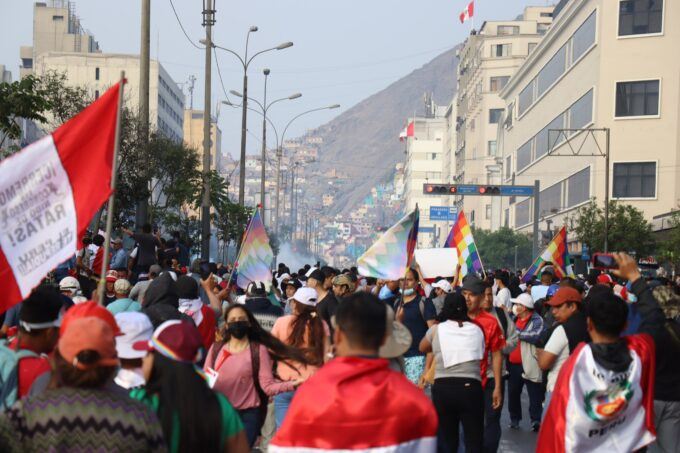
Masses of Haitians have been in the streets protesting intermittently since August. Their grievances are high costs—thanks to the International Monetary Fund—and shortages of food and fuel. Banks and stores are closed. Students are demonstrating. Labor unions have been on strike.

The pattern has continued intermittently for ten years. Pointing to corruption, demonstrators have called for the removal, in succession, of Presidents Michel Martelly and Jovenel Moïse, and now de facto prime minister Ariel Henry.

Recently, violence has aggravated the situation, and foreign powers, including the United States, have paid attention. That’s significant because U.S military interventions and other kinds of U.S. intrusions have worked to trash Haiti’s national sovereignty, and, with an assist from Haiti’s elite, deprive ordinary people of control of their lives.

Presently, 40% of Haitians are food insecure. Some 4.9 million of them (43%) need humanitarian assistance. Life expectancy at birth is 63.7 years. Haiti’s poverty rate is 58.5%, with 73.5% of adult Haitians living on less than $5.50 per day.

Electoral politics is fractured. It was Secretary of State Hillary Clinton who arranged for Martelly to be a presidential candidate in 2011. Moïse in 2017 was the choice of 600,000 voters—out of six million eligible citizens. He illegally extended his presidential term by a year. As of now, there have been no presidential elections for six years, no elected mayors or legislators in office for over a year, and no scheduled elections ahead.

Washington’s man: De facto Haitian Prime Minister Ariel Henry holds power, even though he wasn’t elected. Some believe he may have been involved in the murder of the previous president and now he’s seeking U.S. troops to stem protests against his government. | Odelyn Joseph / AP

Gangs mushroomed in recent years, and violence has worsened. Moïse’s election in 2017 prompted turf wars, competing appeals to politicians, narcotrafficking, kidnappings, and deadly violence in most cities, predominately in the capital, Port-au-Prince. Violence escalated further after Moise’s murder in July 2021. Hundreds have been killed and thousands displaced, wounded, or kidnapped.

The U.S. Global Fragility Act of 2019 authorizes multi-agency intervention in “fragile” countries like Haiti, the U.S. military being one such agency designated to do the intervening. The influential Council of Foreign Relations (CFR) wants U.S. soldiers instructing Haitian police on handling gangs. Luis Almagro, head of the Organization of American States, calls for military occupation. U.N. Secretary General Antonio Guterres wants international support for training Haitian police.

Former U.S. Special Envoy to Haiti Daniel Foote weighs in with a choice: Either “send a company of special forces trainers to teach the police and set up an anti-gang task force, or send 25,000 troops at some undetermined but imminent period in the future.” The Dominican Republic has stationed troops at its border with Haiti and calls for international military intervention.

Meanwhile, foreign actors intrude as Haitians try to reconstruct a government. Their tool is the Core Group, formed in 2004 following the U.S.-led coup against progressive Haitian President Jean-Bertrand Aristide. The Core Group consists of the ambassadors of Brazil, Canada, France, Germany, Spain, the United States, and representatives of the United Nations and Organization of American States.

Haiti’s government is now in the hands of Ariel Henry, whom the Core Group approved as acting prime minister, overruling Moïse’s choice made before he died. Some believe Henry, a U.S. government favorite, may even be complicit in Moïse’s murder.

Henry insists he will arrange for presidential elections at some point in the future. Prevailing opinion, however, holds that conditions don’t favor elections any time soon.

The Core Group backs an important agreement announced by the so-called Montana Group on Aug. 30, 2021. It provides for a National Transition Council that would prepare for national elections in two years and govern the country in the meantime. The Council in January 2022 chose banker Fritz Jean as transitional president and former senator Steven Benoit as prime minister. They have still not assumed those jobs.

The Montana Group consists of “civil society organizations and powerful political figures,” plus representatives of political parties in Haiti. One leader of the Group is Magali Comeau Denis, who allegedly participated in the U.S-organized coup that removed Aristide in 2004. Henry also has a connection to coup-plotting, having worked with the Democratic Convergence that in 2000 was already planning the overthrow of Aristide.

The CFR wants the U.S. government to persuade Henry to join the Montana Group’s transition process. U.S. Envoy Foote supports the Montana agreement because it shows off Haitians acting on their own. Recently, some member organizations have defected, among them the right-wing PHTK Party of Henry and of Presidents Martelly and Moïse.

The weakness of Haiti’s government in the face of dictates from abroad was on display during Moïse’s era. The perpetrators of his murder, who had been recruited by a Florida-based military contractor, were 26 Colombian paramilitaries and two Haitian-Americans. Their motives remain unclear, and there is no apparent movement toward a trial.

Moïse, the wealthy head of an industrial-scale agricultural operation, became president through fraudulent elections in 2017. He was the target of massive protests a year later. Prompting them were fuel and food shortages and revelations that the president and others had stolen billions of dollars from the fund created through the Venezuela’s PetroCaribe program of cheap oil for Caribbean nations.

Foreign governments, the United States in particular, may now be on the verge of intervening in Haiti. But the ostensible pretext—gang violence—turns out to be muddled. Progressive Haitian academic and economist Camille Chalmers makes the point. He claims that “gangsterism” in Haiti actually serves U.S. purposes.

Interviewed in May 2022, Chalmers explains that the “principal [U.S.] objective is to block the process of social mobilization, to impede all real political participation … through these antidemocratic methods, through force using the police … and above all these paramilitary bands.” Terror is useful for “breaking the social fabric, ties of trust, and any possible resistance process.”

By means of gang violence, the Haitian people “are removed from any political role, and the economic project of plundering resources from the country is facilitated.” Also, Haiti becomes “an appendage of the interests of the North Americans and Europeans.” Chalmers refers to gold deposits on Haiti’s border with the Dominican Republic and big investments by multinational corporations.

He sees a bond between reactionary elements in Haiti and the gangs. The gangs “have financing and weapons that come from the United States. Many of their leaders are Haitians who have been repatriated by the United States.”

A U.S. Army soldier arrests a Haitian man during the U.S. military occupation following the overthrow of President Jean-Bertrand Aristide, Port-au-Prince, Haiti, Oct. 3, 1994. | John Gaps III / AP

Within this framework, Haiti’s police must be ready and able to fight the gangs in order to achieve maximum turmoil. The U.S. government provided Haiti’s police with $312 million in weapons and training between 2010 and 2020, and with $20 million in 2021. The State Department contributed $28 million for SWAT training in July. As of 2019, there were illegal arms in Haiti worth half-a-million dollars, mostly from the United States.

In view of U.S. tolerance or even support of the gangs, the zeal to suppress them now is a mystery. Perhaps some gangs have changed their colors and now really do pose danger to U.S. interests.

The so-called “G-9 Family and Allies,” an alliance of armed neighborhood groups led by former policeman Jimmy Cherizier, may qualify. Not only has it emerged as the Haitian gang most capable of destabilization, but the words “Revolutionary Forces” are a new part of its name.

Cherizier observed in 2021 that, “the country has been controlled by a small group of people who decide everything …They put guns into the poor neighborhoods for us to fight with one another for their benefit.” He noted that, “We have to overturn the whole system, where 12 families have taken the nation hostage.” That system “is not good, stinks, and is corrupt.”

Referring to a mural depicting Che Guevara, Cherizier declared, “we made that mural, and we intend to make murals of other figures like … Thomas Sankara and … Fidel Castro, to depict people who have engaged in struggle.”

These are words of social revolution suggestive of the kind of political turn that repeatedly has prompted serious U.S. reaction. Beyond that, the words of Haitian journalist Jean Waltès Bien-Aimé represent for Washington officials the worst kind of nightmare.

He told People’s Dispatch: “Activation of gangs is part of a strategy to prevent Haitian people from taking to the streets.” He scorns Ariel Henry “as a present from the U.S. embassy,” adding that the “Haitian people do not need a leader at the moment. Haitian people need a socialist state … We have a bourgeois state. What we need now is a people’s state.”

In the background are U.S. racist attitudes. They flourished initially as a consequence of the slavery system’s central role in developing the U.S. economy. They still show up, it seems, as discomfort with the ideas of formerly enslaved Haitians gaining autonomy and securing independence for their own nation.

W.T. Whitney Jr. is a political journalist whose focus is on Latin America, health care, and anti-racism. A Cuba solidarity activist, he formerly worked as a pediatrician, lives in rural Maine. W.T. Whitney Jr. es un periodista político cuyo enfoque está en América Latina, la atención médica y el antirracismo. Activista solidario con Cuba, anteriormente trabajó como pediatra, vive en la zona rural de Maine.
Peoples World, October 12, 2022, https://peoplesworld.org/

Migration as Sign of Climate-Change Impact in the Global South / by W. T. Whitney Jr.

Source: The African Union Mission in Somalia

U.S. government programs for migrants who crossed the U.S. southern border are punitive and disjointed. Left-leaning political groupings may criticize, but they too have fallen short in conceptualizing lives of dignity for migrants in the United States. Nor do they adequately take into account adverse circumstances weighing on migrants’ lives in their home countries.

First among forces pushing masses of people northward is the environmental crisis. The role of climate change in reducing soil productivity and food availability and in predisposing already beleaguered people to migrate is of great concern.  

One assumption here is that capitalist systems of production and consumption have been central to causing the climate to change for the worse. Another is the need for war on capitalism so as to stave off more climate change and cope with its fallout. That hasn’t happened in the industrialized northern countries.

Southern regions may be different. The excesses of capitalist globalization have hurt masses of people there. They were never afforded the relief northern peoples gained from welfare-state remedies. They may be ready to take up the climate-change fight.

Northern climate-change warriors who are anti-capitalist ought to be establishing linkages of support with their southern counterparts. One precedent for them is Spain.  Anti-fascists in 1936 joined the International Brigades to defend the Spanish Republic.  Now, in one way or another, northerners would be joining a faraway fight, this time against climate change.  One locality is Guatemala. 

Storytelling

Author Ilka Oliva Corado describes herself as an “indigenous, undocumented immigrant in the United States.” An English-language version of her story, which is situated in Guatemala and titled “The Plum,” appears here. Excepts follow: 

Guillermina leaves the grocery bags on the table and hurriedly takes out a plum, washes it and takes a bite … She is grateful for the hands that cared for it from the time the seed of the tree was planted. Ever since she was a child, her peasant grandparents taught her to be thankful for the labor of those who work on the land.

She was from Parramos, Chimaltenango, in Guatemala. When she arrived in the United States, she was speaking only her mother tongue, Cakchiquel. … She spent 20 years working as a domestic worker in New York. … Guillermina left Guatemala with her brother Jacobo to help her parents raise her younger siblings … She was on the eve of her fifteenth birthday when she left her indigenous clothing behind and packed two pairs of pants and two T-shirts in her backpack …

(Oliva Corado writes that the traffickers sexually abused Guillermina and her brother as they traveled in Mexico, from Chiapas to Tijuana.) “She doesn’t know what happened to her memory. But she managed to block all recall of the journey after they arrived in Tapachula [in Chiapas].” (The author writes that Jacobo was similarly abused. He remembers, has nightmares, and sleeps fitfully at night.)  

He works three jobs. Every Friday they collect their money so that Guillermina can send off the remittance. Neither of the two will allow their younger siblings to emigrate. At home … they work the land of their grandparents, but Miguel, the youngest, didn’t listen to them and emigrated with another group of friends. He wanted to leave to help his older siblings deal with the economic burden of the house. Now he’s been missing for three years. 

Guillermina bites into the plum that takes her back to remembering the bean fields, shade from the avocado and orange trees, and furrows in the cornfields.  It was there she saw her younger siblings beginning to walk while her parents were working.

Plum juice drips from the corner of her lips. … But tasting the fruit that Miguel loved so much sets off the pain that for three years has been knotted in her throat and she begins to cry inconsolably.

It was in the supermarket that she received the call from Jacobo. There is news of Miguel. A forensic team did tests and they have confirmed his identity. A humanitarian rescue team searching months ago for a missing migrant woman found his bones in a dry river in Sonora. Her parents will be able to bury their young son in the town cemetery, finally.

Context

The family’s land may not have been producing enough food to satisfy nutritional needs, nor enough to sell and provide cash. International agencies concerned about food shortages use a scale that registers severity. It consists of phase 1 – no significant problem; phase 2 – stress; phase 3 – crisis; phase 4 – emergency; and phase 5 – widespread acute malnutrition.

The 2022 Global Report on Food Crises, assembled by United Nations agencies, reported on trends in Guatemala, population 16.9 million. In November, 2018, 2.12 million Guatemalans were classified as experiencing food “crisis.” The corresponding figures in August, 2000 and in May, 2021 were 3.24 million and 3.29, respectively.  As of those dates, there were 4.67 million, 7.21 million, and 7.78 million people, respectively, who endured food stress. A recent report indicates that, as of September 2021, 4.6 million Guatemalans were facing food crisis (phase 3) or food emergency (phase 4).

The World Meteorological Organization, reporting in July on the impact of climate change in Latin America and the Caribbean, points out that, “Droughts, heat waves, periods of cold, more tropical storms and floods have led to loss of life, serious damage to agricultural production and infrastructure, and displaced populations.” 

The authors of another detailed report on the region’s “Climate Change Emergency” state that, “the present bimodal pattern of precipitation in Central America may be distorted in the coming decades … Extreme phenomena like droughts, hurricanes, and the Niño Southern Oscillation will be recurring … and their intensity will increase with climate change .. These phenomena magnify social-economic vulnerability in the region.” 

A survey of the impact of changing climate in Guatemala claims that drought “mostly afflicts the semi-arid region of the country known as the “dry corridor,” and that “in the coming years, that area is expected to extend to higher elevations.” Recently rain has been uncharacteristically scarce or absent during heat waves.

Rural families in Guatemala grow or produce food from their own land. Family members may also work seasonally on big farms to be able to purchase additional food, or they fish or hunt. High poverty rates underscore the vulnerability of their lives – 70% in Guillermina’s Chimaltenango department and nearly 80 percent among Guatemala’s indigenous population. Now the impact on food supplies of droughts, storms, and floods – which are more severe now because of climate-change – adds to their plight.

Many Guatemalans and others in the Global South have to move. They go to big cities or they cross national borders to begin new lives, and/or earn money to support families at home. Plenty of other reasons to migrate do exist such as land grabs, governmental chaos, and violence from criminals, gangs, paramilitaries, and soldiers. 

But migration undertaken in response to climate-change effects is highly significant, so much so that victims are everywhere, and in the millions. On that account, the prospect emerges of mass political mobilization and of growing awareness along the way of capitalism as enemy.

Capitalist-inspired intrusions already fill the landscape with mines and oil-extraction facilities, dams and flooded rivers, pollution, mega land-holdings and mono-culture farming operations. U.S. political interference, debt owed foreign banks, privatizations, and cuts in social spending have provoked opposition movements.  Growing appreciation of linkage between these manifestations of global capitalism and capitalism’s contribution to climate change may serve to stimulate anti-capitalist resistance movements that are ready to take on the environmental crisis.

This possible scenario in the Global South ought to resonate with anti-capitalist activists in the North. The great need is for international solidarity. Author, editor, and eco-socialist John Bellamy Foster offers perspective in his recently published article titled “Ecology and the Future of History.” Excerpts follow:

“The agent of revolution is increasingly a class that is not to be conceived in its usual sense as a purely economic force but as an environmental (and cultural) force: an environmental proletariat …[and] Most of the major class struggles and revolutionary movements over the centuries of capitalist expansion have been animated in part by what could be called ecological imperatives – such as struggles over land, food and environmental conditions.”

He adds: “In general, Third World liberation movements have been aimed at both the environment and economy and have been struggles in which peasants and Indigenous peoples have played central roles, together with nascent proletarian and petty bourgeois forces …[and] All material struggles are now environmental-class as well as economic-class struggles, with the separation between the two fading.”

Finally, “The objective consequence of the changing social and ecological environment, the product of uncontrolled capitalist globalization and accumulation, arising from forces at the center of the system, is inevitably to create a more globally interconnected revolutionary struggle: a new eco-revolutionary wave emanating primarily from the Global South.”


W. T. Whitney Jr. is a political journalist whose focus is on Latin America, health care, and anti-racism. A Cuba solidarity activist, he formerly worked as a pediatrician, lives in rural Maine. W.T. Whitney Jr. es un periodista político cuyo enfoque está en América Latina, la atención médica y el antirracismo. Activista solidario con Cuba, anteriormente trabajó como pediatra, vive en la zona rural de Maine.

The United States Uses and Abuses Migration from Cuba and Elsewhere / by W. T. Whitney Jr.

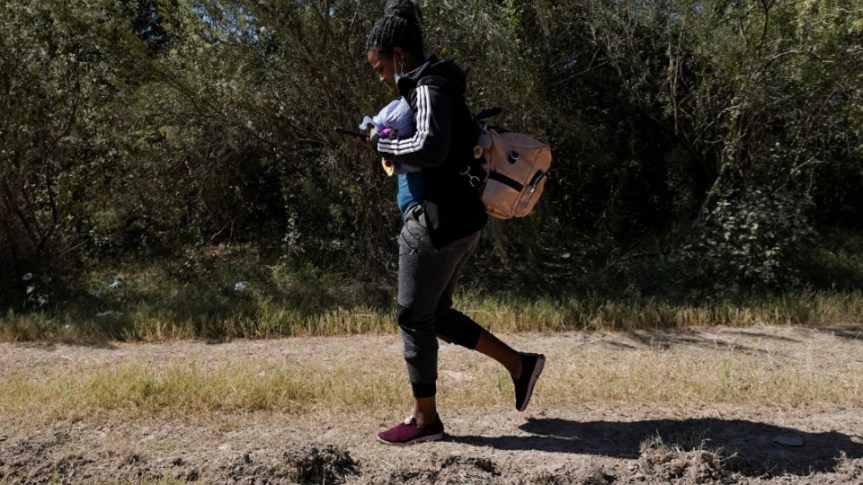
A Cuban national walks along a road after crossing the Mexico-Texas border at the Rio Grande, Sept. 23, 2021, in Del Rio, Texas. | Julio Cortez / AP

Presently 3.6% of the world’s people live in a country other than their own. They move to escape wars, oppression, poverty, hunger, climate-change effects, or to find new work, or because they were forced to move. The story is also about nations weaponizing or exploiting migration. 

After a decade or so of relatively few Cubans arriving in the United States, their numbers are up. Between 2018 and 2021, some 2,000 Cubans emigrated to the United States. But in January almost 15,000 Cubans crossed the U.S. southern border; the daily average in February was 1500. U.S. border officials are seeing “a twelvefold increase over 2020,” according to the Washington Post.

Contributing to migration is the increasingly dismal state of Cuba’s economy. At work has been U.S. economic blockade, fallout from the Covid-19 pandemic, and unresolved domestic issues including: inflation, corruption, cumbersome implementation of reforms, shortfalls in domestic food production, and fallout from converting two currencies into one. 

U.S. officials deported only 20 arriving Cubans in the past five months, and only 95 during 2021. That’s because Cuban immigrants arriving without papers are privileged, thanks to the 1966 Cuban Adjustment Act (CAA).  That law enables unauthorized Cuban migrants automatically to gain permanent residence after a stay of two years, which in 1976 became one year. By contrast, non-Cuban arrivals have to apply for permanent residence and then wait. 

President Obama in January 2017 repealed an administrative regulation allowing those Cuban migrants who entered the United States after sea-travel to stay, while sending Cubans apprehended at sea back to Cuba. No longer could Cubans arriving by water remain. Migrants reacted by resorting to the arduous Central American land route to the U.S. border. 

When the migrants of other countries travel that route, cross the border, and are apprehended, they are either quickly deported, allowed to wait in Mexico or in immigration prisons for asylum decisions, or are released to await court appointments.  By contrast, Cubans crossing the border usually gain so-called “humanitarian parole” and are released. Or they are released after brief detentions to await immigration-court rulings on asylum requests. After a year they become eligible for permanent residence, as per the CAA. 

The CAA-mediated enticement of early permanent residence has served the U.S. purpose of encouraging a flood of Cuban immigrants who, by fleeing, are living proof of alleged Communist oppression. Maybe the purpose of a relatively relaxed treatment of a new generation of Cuban migrants, who also arrive after great travail, is to revive that salutary example of escape from Communism. 

But paradoxically, the U.S. government acts also as if to impede travel by Cubans to the United States, as if to keep them away.   For example, the U.S. government in 2017 removed personnel from its Embassy in Havana. This was in response to the neurologic syndrome, still unexplained, that afflicted diplomats stationed there. Doing so, the State Department deprived Cubans of consular services needed for legal travel to the United States.

They’ve been forced to visit U.S. embassies elsewhere to obtain entry visas, in Bogota, Colombia and in Guyana.  The travel costs are prohibitive for most travelers. The U.S. government indicated in March that its Havana Embassy would soon be processing visas for entry into the United States, but only for parents of U.S. citizens.  

The two governments agreed in 1994 on a mechanism for legal emigration of Cubans to the United States. The U.S. government would authorize at least 20,000 lottery-chosen Cubans every year to move permanently to the United States.  But U.S. immigration officials almost never issue the required number of entry visas. 

Cubans without papers who want to reach the U.S. border via the Central American land route must start their trek in a country not requiring an entry visa. Now Nicaragua remains as the only visa-free country for Cubans. That’s because Panama, Colombia, and Costa Rica recently began demanding them, possibly at the behest of the U.S. government. 

Why does the U.S. government try to keep Cubans away from the United States even as it encourages them to establish permanent residence? Maybe officials want to show off the difficulties Cubans put up with so as to highlight Cubans’ ardor to leave a country that, in the official U.S. version, is troubled and oppressive.  Or maybe they want distressed Cubans to remain at home so they will end up joining destabilization campaigns there.  

But U.S. unease does prevail over the possibility of large numbers of Cuban migrants arriving and overwhelming U.S. abilities to absorb them.  Tens of thousands of Cubans did present that still-remembered threat as they departed for the United States via the “Mariel boatlift” (1980) and the “Cuban rafter crisis” (1994).  

One aspect of Cuban migration is shared with worldwide migration patterns, as explained by Cuban scientist and close political observer Agustín Lage.  In regard to increasing Cuban emigration to the United States, Lage emphasizes “the emigration of young people with university education.” 

That phenomenon reflects “changing migratory processes during the twentieth century” that affect economies and jeopardize “states with compromised social and economic development.” He is alluding to underdeveloped societies in the Global South and presumably to the legions of scientists and physicians Cuba has prepared over many years. They are “human capital” and are a major resource for Cuba’s economy.

Lage points out that immigrants of the “professional” classes entering the United States have increased from 3% in 1930 to 40% now, at which point most have been educated in Asia and Latin America. One third of all scientists prepared in the under-developed world now live in developed nations.  What’s crucial is that “the segment of migrants with a university education grows more rapidly than the quantity of migrants in general.”

The United States is the “principal beneficiary of this migratory flow.”  Of all scientists who emigrated from under-developed countries, 76% are in the United States. Lage cites U.S. legislation favoring migrants with “academic degrees” as indicative of U.S. purpose. 

“The countries of the South invest in the formation of human capital. But part of that human capital emigrates.” Economies in the North gain “value-added” benefit. Underdeveloped countries lose twice. They pay the cost of educating qualified people who leave and pay for “high-technology products they must import,” and which represent “an undeniable contribution from those same migrants.”  

For Lage, the United States shapes immigration policies according to economic self-interest and readily subjects the needs of lesser countries to its own requirements. Clearly, U.S. manipulation of Cuban migration for counter-revolutionary purposes is in the same vein.  

Lage concludes: “Against us has been operating economic aggression for more than six decades that has affected the population’s material living conditions. In any historical moment and in any place on the planet, prolonged economic difficulties have given rise to migratory pressures. And Cuba is on this planet. “But our history and our culture are in our favor. The Cuban national consciousness is the basis for our capacity of resistance. Our culture and our history are deeply rooted here and also in the consciousness of Cubans who don’t live here.”  Nevertheless, “our project of a socialist society, one ‘with all and for the good of all’ (Jose Marti’s words), is at real risk.  We must not underestimate that.”

W.T. Whitney Jr. is a political journalist whose focus is on Latin America, health care, and anti-racism. A Cuba solidarity activist, he formerly worked as a pediatrician, lives in rural Maine. W.T. Whitney Jr. es un periodista político cuyo enfoque está en América Latina, la atención médica y el antirracismo. Activista solidario con Cuba, anteriormente trabajó como pediatra, vive en la zona rural de Maine.
People’s World, April 12, 2022, https://www.peoplesworld.org/

Nepal accepts U.S. aid despite protests, Chinese objections / by W.T. Whitney, Jr.

Police moved in to disperse protesters who are against the U.S. infrastructure grant. AP

Nepal’s Parliament on February 27 ratified an aid package provided through the Millennium Challenge Corporation (MCC), an “independent agency” located in the United States. The $500 million to be dispensed, plus $130 million from Nepal, will pay for roadway improvements and transmission lines conveying hydro-generated electricity to India and to domestic users.

Nepal’s acceptance process was long and tortuous due to the country’s layered, fractured, and unwieldy political system. China’s government opposed the MMC funding.

Massive protests unfolded outside the parliament building in Kathmandu prior to parliamentary approval. Joining the demonstrators were those representing student and peasant groups and sections of Nepal’s two Communist Parties. They were protesting the government’s alleged disrespect for Nepal’s sovereignty.

The U.S. Congress passed legislation creating the MCC in January 2004. The intention was that of providing economic aid to low and middle-income countries via “threshold programs” and “compacts” lasting five years. The MMC website highlights “cost-effective projects, a lean staff, an evidence-based approach …[and] a good investment for the American people.”

The aid is tailored to reducing investment risk and promoting “growth …[and] economic freedom.” MMC officials look for “good economic policies in recipient countries, such as free markets and low corruption.”

After first awarding a threshold grant, the MMC in 2014 offered Nepal a compact. The agreement signed in 2017 represented the largest foreign assistance grant ever received by Nepal, and the first MMC compact with a South Asia nation.

The MMC has offered 83 compacts and threshold programs to 51 countries in Africa, Asia, Eastern Europe, Latin America, and the Pacific. Some MMC agreements have ended abruptly – with Madagascar in 2009, Tanzania in 2016, and Sri Lanka in 2020. The MMC complained of election irregularities in the first two situations, while Sri Lanka objected to violations of sovereignty.

The almost six-year hiatus between the agreement being signed and Nepal’s ratification of the compact stems from governance problems in Nepal. Two factors contribute. One is institutional immaturity, the result of decades of political turmoil prior to 2015 when Nepal’s present Constitution took effect. The other is parliamentary dysfunction associated with wrangling over disparate caste, ethnic, and regional interests.

A constitutional monarchy, in place between 1990 and 2006, had succeeded decades of absolutist minority rule. A 10-year-old armed Maoist insurgency ended in 2006, coincident with the king’s departure. From then until 2015, strife over the dissolution of the Maoists’ army, regional demands, and the shape of a new constitution weakened the Maoist political party as it tried to exercise political power. All the while, it was contending with internal schisms, another Communist party, and Nepal’s Congress Party.

Following the institution of the new Constitution in 2015 and the general elections two years later, the Communist Party of Nepal–Unified Marxist-Leninist (CPN-UML) and the Communist Party of Nepal–Maoist Centre were positioned to jointly form a government. They did so, and, having united in May 2018, they established the Nepal Communist Party.

The Supreme Court nullified the unification. Afterwards, the CPN-UML headed a shaky government amid continuing factionalism. It exited in early 2021 after a no-confidence vote. The Supreme Court named Congress Party head Sher Bahadur Deuba as prime minister, and he remains.

The picture is of a government that is precarious and rudderless. In particular, according to The Statesman news service in New Delhi, “With the leadership of the executive practically non-functional … the onus of making the system work lay upon Parliament. Sadly, the legislature has become almost dysfunctional.” Adding to the chaos is the matter of corruption.

Reports the Kathmandu Post: “Nepal’s position on the latest Corruption Perception Index remained unchanged at 117th out of 180 countries … Nepal’s score also remained unchanged at 33 …[and a] score below 50 is considered as having a relatively higher level of corruption.”

Once more The Statesman: “The biggest “achievement” of Parliament is that it had succeeded in ratifying the Millennium Challenge Corporation … Compact in the face of considerable resistance from the constituent political parties in government itself.”

It would be miraculous, so it seems, if mechanisms of accountability are in place as to where and to whom the money goes, and if the 28% of rural Nepalese who were poor in 2019 find that, with the money, their lives improve. Only through wishful thinking might one expect China to rest easy with Nepal’s half-billion-dollar bonanza. Perhaps that’s the U.S. purpose: to provoke and to intrude.

Chinese Foreign Minister Wang Yi will visit Nepal on March 25 to deal with Nepal’s ratification of the MMC compact. According to a Chinese official quoted by India’s ANI news: “Implementation of the BRI projects in Nepal is important for Beijing … But this time Beijing is more worried about the security challenges emanating from the compact’s approval.”

Nepal’s government in 2017 had signed an agreement with China’s Belt and Road Initiative (BRI) for a railway project linking Kathmandu to Central Asia.

“We tried hard to stop the MCC compact’s parliamentary approval,” declared another Chinese official, who remarked also that, “[Nepalese] leaders who had earlier assured us of the compact’s failure started shaking under US pressure.”

W.T. Whitney Jr. is a political journalist whose focus is on Latin America, health care, and anti-racism. A Cuba solidarity activist, he formerly worked as a pediatrician, lives in rural Maine. W.T. Whitney Jr. es un periodista político cuyo enfoque está en América Latina, la atención médica y el antirracismo. Activista solidario con Cuba, anteriormente trabajó como pediatra, vive en la zona rural de Maine.

People’s World, March 23, 2022, https://www.peoplesworld.org/article/nepal-accepts-u-s-aid-despite-protests-chinese-objections/

Ukraine War Unveils US Preparations for Biological Warfare / by W. T. Whitney Jr.

Biological warfare | Image: Wikipedia

War in Ukraine is turning people’s lives and affairs upside down. Governmental functioning is confounded. Unsurprisingly, dirty laundry, previously hidden, is on display. A Russian communication March 6 mentions “evidence of an emergency clean-up performed by the Kiev regime was found – aimed at eradicating traces of the military-biological program in Ukraine, financed by @DeptofDefense.” 

A Chinese Foreign ministry spokesperson two days later spoke of “26 [U.S.] bio-labs and other related facilities in Ukraine.”  

WASHINGTON, DC – MARCH 08: Undersecretary of State for Political Affairs Victoria Nuland testifies before a Senate Foreign Relation Committee hearing on Ukraine on March 08, 2022 in Washington, DC. (Photo by Kevin Dietsch/Getty Images)

White House press secretary Jen Psaki responded, saying that that the United States “does not develop or possess such weapons anywhere.” Undersecretary of State Victoria Nuland indicated “Ukraine has biological research facilities …[and] so we are working with the Ukrainians [to] prevent any of those research materials from falling into the hands of Russian forces.” 

The Bulletin of Atomic Scientists reported that, as of February 25, “a network of US-linked labs [existed] in Ukraine that work with dangerous pathogens.” Those 26 such facilities are “public and animal health labs.” 

The gist of the Chinese and Russian communications is their claim that the U.S. Government is doing biowarfare. In that regard, the large “Richard Lugar Center for Public Health Research” in Tbilisi, Georgia, comes into view. The U.S. Defense Department’s Defense Threat Reduction Agency (DTRA) paid for the Center’s construction and for its operation, between 2011 and 2018.

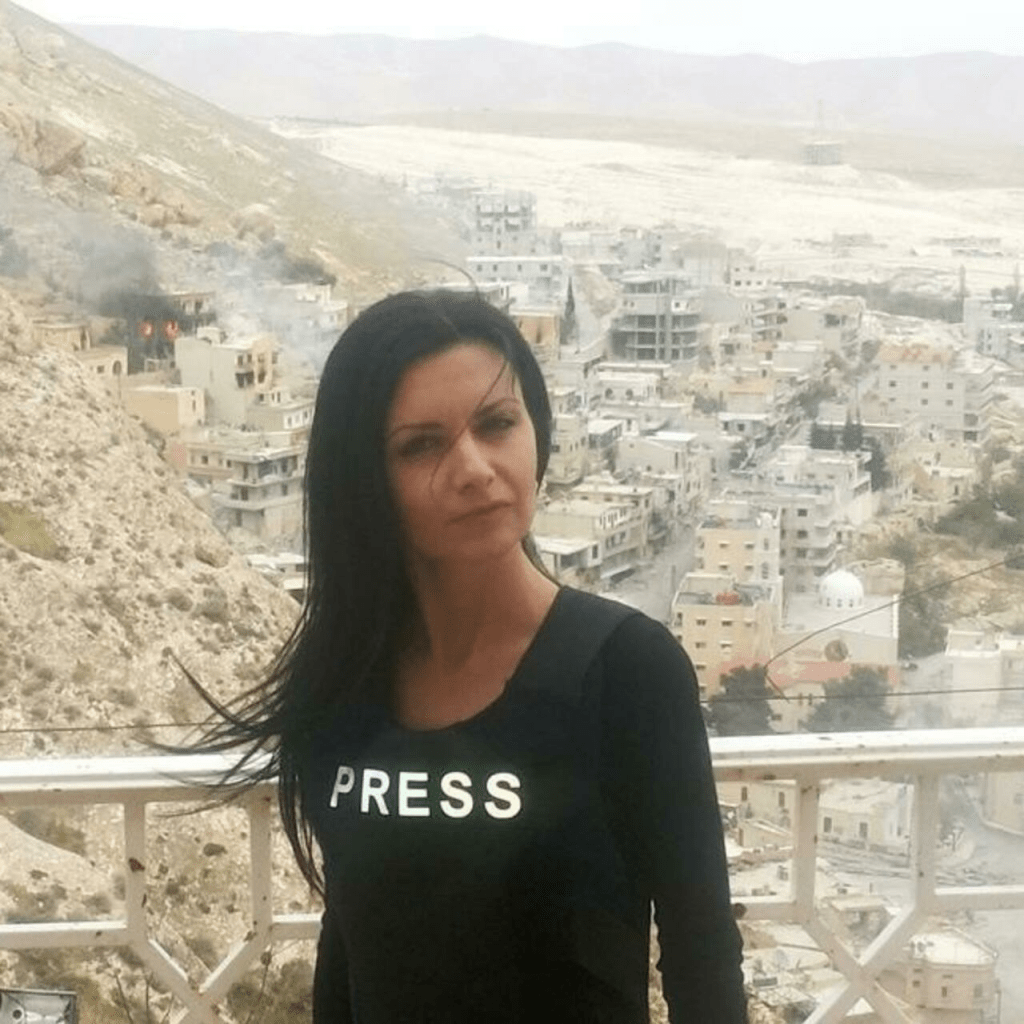
Bulgarian investigative journalist Dilyana Gaytandzhieva produced a report in 2018 alleging the Center had bioweapons capabilities. She claimed that most of the Center’s staff were U.S. citizens enjoying diplomatic immunity and that at least three U.S. companies were doing bio-weapons research there. She indicates elsewhere that biologic specimens arrive by diplomatic pouch

Richard G. Lugar Center for Public Health Research

Gaytandzhieva’s extraordinarily detailed report displays dozens of official U.S. documents and graphics. She points out that DTRA-funded private companies carry out bio-weapons research and testing in laboratories and facilities located in Georgia, Ukraine, in the Middle East, South East Asia, Africa, and at Fort Detrick, Maryland, and the Dugway Proving Ground in Utah. U.S. government apologists have dismissed the report as Russian-inspired propaganda.

The distinction between offense and defensive preparations has been clear as regards Fort Detrick. A “biological weapons program” existed there until 1969, when, as ordered by President Richard Nixon, it became a “biological defense program.” U.S. research installations elsewhere in the world lack clear demarcation between offensive and defensive purposes. 

One of the U.S. bio-laboratories abroad is Battelle Corporation, “a $59 million subcontractor at Lugar Center,” that, according to Gaytandzhieva, operates laboratories in eight countries across the globe and, as of 2018 “has been awarded some $2 billion [in] federal contracts” and ranks 23rd among US government contractors. 

As of that year, the Southern Research Institute, Black & Veatch, and Metabiota company were operating one or more of the 11 Defense Department-funded bio-laboratories in Ukraine. In a report published in January, 2022, Gaytandzhieva mentions the “US Federal contracts registry” as documenting that “DTRA allocated $80 million [to Black & Veatch company] for biological research in Ukraine as of 30 July 2020.” 

Dilyana Gaytandzhieva

She charges that the contractor did more than merely fund the labs – as suggested by Victoria Nuland – but instead has been responsible for their day-to-day operation. Cited as evidence are “internal documents” showing that “independent experts were denied even a visit” to the laboratories. 

Ominously, scientists funded by the Defense Department have developed a new way of transmitting viruses to plants. According to a Science magazine article in 2018, the Defense Department initiated a program named “Insect Allies” in 2017 and would continue it for four years. Biting insects are being studied at the Luger Center in Georgia and presumably in other laboratories included in the multi-national U.S. bio-weapons network, such as those in Ukraine.  

The scientists have arranged for genetically-modified viruses to infect insects that then go on to transmit the fixed-up viruses to plants where they alter the plants’ properties.  Critics, mainly in Europe, doubt the peaceful purposes of the new methodology.  They fear that the technique of “lab-modified self-spreading viruses” will soon be applied to humans and animals.  

Commentary from the Max-Planck Institute interprets the Science magazine article as arguing “that the findings of the Insect Allies Program could be more easily used for biological warfare than for routine agricultural use.” It cites a legal opinion saying that, “The Insect Allies Program could be seen to violate the Biological Weapons Convention” (BWC),” which took effect in 1975. 

This photo shows corn leaf aphids used in a study to modify crop plants through engineered viruses. | Meena Haribal – Boyce Thompson Institute via AP

Information presented here suggests it’s at least possible that the United States really has been developing bio-weapons for offensive use at facilities throughout the world and particularly in countries along Russia’s western periphery. 

But questions crop up of mission overlap. Bio-medical and bio-industrial products are developed for both peaceful and war-making uses. In the latter case, a given product may be used for offensive or defensive purposes. A representative statement from officials in The Netherlands in 2013 testifies to a merging of purposes:

“On the one hand, many pathogenic organisms are very important to research and development in the fields of medicine, biology and agriculture. However, some of these organisms can also be used to develop biological weapons that may pose a threat to public health and the environment. The term ‘dual-use research’ can be extended … ‘Dual-use research of concern’ is the type of research that could be misused directly and whereby such misuse would have major consequences.”

Ambiguity cries out.  That ambiguity demands that, in regard to Ukraine, and elsewhere, we view the likelihood of the United States preparing for biowarfare as probable, not as possible. 

One more set of circumstances now boosts that likelihood up to near certainty. In furtherance of its goals, the U.S. government easily accepts the reality that masses of humans are going to suffer and die. We recall:

  • The nuclear bombing of Hiroshima and Nagasaki and the conventional bombing of Dresden that sickened and killed hundreds of thousands.
  • Pursuit of wars, in Korea and Vietnam, in which millions died, plus wars and occupation in Iraq and Afghanistan that took the lives of hundreds of thousands.
  • Complicity in massacres in Indonesia and Latin America. 
  • Institution of economic sanctions that killed or incapacitated hundreds of thousands in Iraq, Cuba and Venezuela.
  • Support for repressive regimes like apartheid South Africa and Saudi Arabia that killed and maimed.    

W.T. Whitney Jr. is a political journalist whose focus is on Latin America, health care, and anti-racism. A Cuba solidarity activist, he formerly worked as a pediatrician, lives in rural Maine.