US Pirate Attacks in the Caribbean Will Aggravate Emergency in Cuba / By W. T. Whitney Jr.

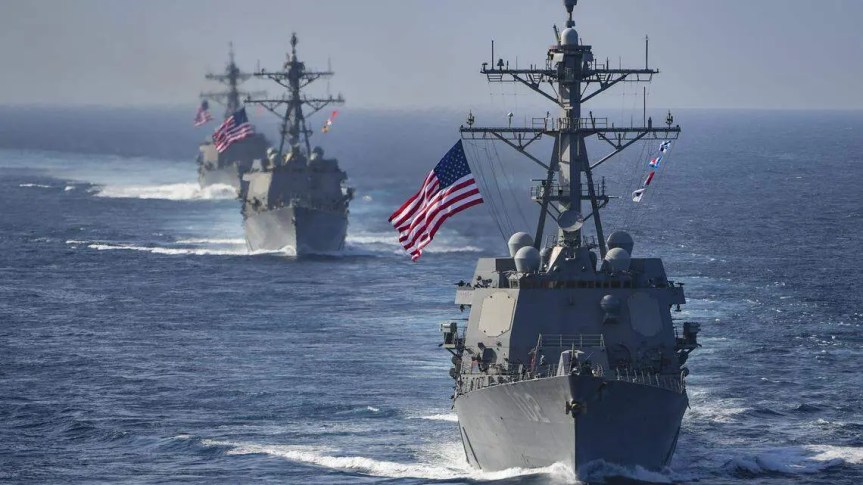
At least eight US warships have been deployed to the Caribbean Sea | Source: venezuelanalysis.com

South Paris, Maine


Hitting two birds with one stone, the U.S. government, top-level disturber of the peace now brandishing a Caribbean armada, strikes out against Venezuela – and Cuba too, indirectly. The U.S. military on December 10 seized a large oil tanker in the Caribbean bound for China. The ship carrying Venezuelan oil had previously offloaded 50,000 barrels of oil to a smaller ship for delivery to Cuba.

Cuba depends on oil supplied by Venezuela. High U.S. officials want to cut off Cuba’s access to oil from Venezuela and thereby deliver a decisive blow against Cuba’s government. Presently six other tankers sanctioned by the U.S. government and carrying Venezuelan oil are at high risk of being seized.

Cuba’s Foreign Relations Ministry issued a statement saying in part that, This act of piracy and maritime terrorism … represents U.S. escalation against Venezuela’s legitimate right freely to use and to trade its natural resources with other nations, including hydrocarbon supplies to Cuba …[Such] actions have a negative impact on Cuba and intensify the United States’ policy of maximum pressure and economic suffocation, with a direct impact on the national energy system and, consequently, on the daily lives  our people.”

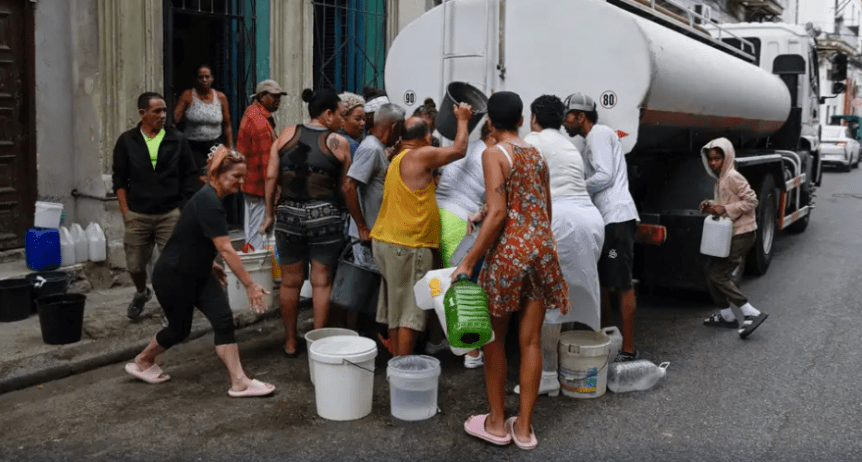
This reference to a “policy of maximum pressure” invites a look at ominous developments unfolding in Cuba as the maritime drama plays out.  Cuba’s government has recently resorted to measures that are extraordinary enough as to indicate worsening crisis in Cuba. The U.S economic blockade has led to shortages of supplies, food, and income. The impact over the course of decades has been wearing and cumulative. Now death rates are up and newer generations are decimated by migration.

Recent measures taken by Cuba’s government, explored below, strongly suggest Cubans face an emergency. U.S. activists responding to their government’s warlike preparations in the Caribbean – another emergency – have good reason to urgently build their solidarity not only with Venezuela but with Cuba too.  What follows here is a report on extreme measures recently taken by Cuba’s government. The object is to portray these measures as so unusual as to confirm the existence of Cuba’s last-ditch situation and, that way, motivate Cuba’s U.S. supporters toward action.

Dollarization

Cuba’s government recently introduced monetary regulations allowing citizens to buy and sell some goods and services using the U.S. dollar.  A report published by a government-oriented news service refers to a “pragmatic recognition of today’s reality” and to “a partial and controlled dollarization of [Cuba’s] economy.” The government will be “allowing certain economic actors to trade in foreign currencies under specific circumstances.”

The new regulations apply to transactions with foreign manufacturers, investors, traders, shippers, financial institutions – and to families abroad sending remittances. The immediate goal is “to directly incentivize the generation of foreign exchange earnings, allowing those who contribute to this generation to keep a significant portion of their earnings in hard currency.” 

The broader purpose is “to increase national production, improve the availability of goods and services, and create conditions for a future return to the strengthened Cuban peso.” Policy-makers want to stimulate exports, augment the supply of goods available in Cuba, and increase both national production and foreign investment. Another goal, referred to as “[r]eduction of distortions,” is elimination of informal or illegal foreign currency markets.

The new regulations allow “authorized commercial establishments … [and those] domestic suppliers supporting export or import substitution activities to use dollars and other foreign currencies in international transactions.” Parties permitted to use dollars are authorized self-employed workers, privately owned businesses, cooperatives, and state enterprises.

These parties have permission to deposit dollars in Cuban banks – dollars accumulated from exports of goods and services, from on-line sales and from sales realized through the Mariel Special Development Zone. Banks will accept dollars purchased from foreign currency traders and dollars sent as remittances from families abroad.

The government’s new authorization of the U.S. dollar as a national currency may well be unsettling to Cubans perceiving implications of a dependency relationship with the northern neighbor. The necessity to have done so reflects the urgency of Cuba’s current situation.     

Pressing needs

Overtones of a new situation entered into the decision of the Cuban Communist Party’s Central Committee at its meeting on December 13 to postpone the 9th Party Congress set for April 2026. Party Congresses have taken place every five years.

Making the announcement, Leader of the Revolution Raul Castro emphasized the need to “dedicate all the country’s resources, as well as the effort and energy of the Party, Government, and State cadres, to resolving current problems, and to dedicate 2026 to recovering as much as possible.” 

Likewise, Cuba’s Council of State announced on December 10 that the upcoming session of the National Assembly of People’s Power set to begin on December 18 would be meeting for that day only, by video conference. In 2024, Assembly delegates met in person for two sessions for a total of  24 days.

A spokesperson explaining the shift stated that, as is “known by all, the electricity situation and the current state of the economy, and also difficulties with the [multi-virus] pandemic and the health situation … create a complex situation for carrying out the Assembly. There is the problem too of the rational use of resources.” 

The 11th plenum of the Communist Party’s Central Committee taking place on December 13 was also a one-day session; video conferencing provided access for members living outside Havana. Concluding the meeting, First Secretary Miguel Díaz-Canel, president of Cuba, mentioned particularly that:

At the end of the third quarter, GDP has fallen by more than 4%, inflation is skyrocketing, the economy is partially paralyzed, thermal power generation is critical, prices remain high, deliveries of rationed food are not being met, and agricultural and food industry production is not meeting the needs of the population. There are also the costly losses caused by the devastating passage of Hurricane Melissa …

Donald Trump has just launched his pirates onto a Venezuelan oil tanker, shamelessly seizing the cargo like a common thief. This was the latest episode in an alarming series of attacks on small boats and extrajudicial executions of more than eighty people, based on unproven accusations and amid an unprecedented and threatening military deployment in a declared Zone of Peace …

[However,] we are the children of a people who carried out a revolution 90 miles from the greatest imperial power on the planet and who have successfully defended it for more than six decades … Only a heroic people who defend a Revolution, who have the example of the history of that Revolution, are capable of enduring what we have been living through all these years.”

Henry Lowendorf of the U.S. Peace Council, queried for this article, highlights the central role of the U.S. government. He states via email that, “The U.S. has been trying to crush the Cuban revolution for over 60 years. So far it has failed. But with new intensity and the newly accelerated war on Venezuela, the U.S. is desperately working to cut off all life support to Cuba.”

A dark setting brightens a bit with good news out of California, as reported in the Cuban press. The Los Angeles Hands off Cuba Committee led in organizing a shipment from Los Angeles to Cuba by way of Jacksonville, Florida of a 40-foot container with medical supplies worth $1 million.  Participating were members of the International Longshore and Warehouse Union and International Association of Machinists, along with Global Health Partners and the PanAmerican Medical Association.


W.T. Whitney Jr. is a retired pediatrician and political journalist living in Maine.

Brazilian Workers Lead in Offering Solidarity to Venezuelans under US Attack / By W.T. Whitney Jr.

The leader of Brazil’s Landless Rural Workers’ Movement (MST), João Pedro Stédile, declares solidarity with the Venezualan government and people as they are threantened by a U.S. military intervention | Photo credit: brasildefato.com

South Paris, Maine


Since August, U.S. warships, fighter planes, and troops have deployed in Caribbean waters off Venezuela and in Puerto Rico. Venezuela’s neighboring countries in Latin America and the Caribbean area are reacting variously. Many oppose U.S. aggression, but at a distance.  Others are either non-committal or accepting.

Colombia and Brazil are backing Venezuela – or soon will be –  in very different ways. Recent remarks of João Pedro Stédile, co-founder and a director of Brazil’s Landless Workers’ Movement (MST), warrant special attention.

U.S. attacks from the air have killed dozens of crew members of boats alleged to be carrying illicit drugs. U.S. accusations against Venezuelan President Nicolás Maduro that he is a top-level drug dealer, serve as pretext. The U.S. government now offers a $50 million reward for his capture. The allegation that he heads the drug-dealing Cartel de los Soles is false. The cartel doesn’t exist, according to a United Nations report. A U.S. coup plotter recently claimed the CIA created the cartel.

President Trump recently indicated the CIA would be operating inside Venezuela. It’s widely assumed that the U.S. government wants control of Venezuela’s oil and other resources and is contriving to remove a government heading towards socialism.

Venezuela’s government is training militia troops by the millions. Venezuelan defense minister Vladimir Padrino López announced on October 21 that Venezuela’s’ military will cooperate with Colombian counterparts to fight narcotrafficking. Relations between the two nations are quickly improving.

They had deteriorated after Colombia’s government backed accusations that Venezuela’s 2024 presidential elections were fraudulent. But on August 10, Colombian President Gustavo Petro stated on social media that, “Colombia and Venezuela are the same people, the same flag, the same history. Any military operation that does not have the approval of our sister countries is an act of aggression against Latin America and the Caribbean.” Petro recently announced the Colombian military will be sharing military intelligence with Venezuela.

U.S. vilification extends to Petro who, speaking at the United Nations General Assembly on September 23, condemned U.S. support of Israel’s war on Gaza and U.S. imperialism generally. He railed against the U.S. at a rally outside the UN Headquarters. In response, the U.S. government revoked his visa.  Petro had previously refused to accept Colombian deportees sent handcuffed from the United States in a military plane.

International solidarity

On October 18, Petro accused the United States of killing a Colombian fisherman and violating Colombian sovereignty. Responding, President Trump called Petro “an illegal drug dealer … [who] does nothing to stop” drug production. He imposed import tariffs and suspended subsidies granted Colombia for drug-war activities. Petro recalled Colombia’s ambassador in Washington.

Colombia may be on Venezuela’s side, but that’s not clear with other countries in the region. Colombia, president pro tempore of the CELAC group of nations, arranged for a virtual meeting of CELAC foreign ministers to reach a common position. In 2014, the Community of Latin American and Caribbean States – CELAC –had declared the entire region to be a “zone of peace.”  

At the meeting taking place on September 1, representatives of the 23 CELAC nations present (out of 33) considered a general statement that filed to mention the U.S. -Venezuela confrontation. It expressed support for “principles such as: the abolition of the threat or use of force, the peaceful resolution of disputes, the promotion of dialogue and multilateralism, and unrestricted respect for sovereignty and territorial integrity.”

Most of the countries voting approved, but Argentina, Ecuador, Paraguay, Perú, Costa Rica, El Salvador, Guyana, Jamaica, and Trinidad and Tobago did not.

Member nations of the Bolivarian Alliance for the Peoples of Our America–Peoples’ Trade Treaty (ALBA-TCP) did condemn US military action in the Caribbean. The CARICOM group of Caribbean nations, meeting in late October, expressed support “for the sovereignty and territorial integrity of countries in the region,” again without reference to  the United States and Venezuela. Trinidad and Tobago was an outlier: Prime Minister Kamla Persad-Bissessar insisted that, “I have no sympathy for traffickers; the US military should kill them all violently.”

Regional presidents spoke out against U.S. intervention, specifically: Mexican president Claudia Sheinbaum; Honduras’s president  Xiomara Castro, Daniel Ortega, co-president of Nicaragua, and Brazilian president Luiz Inácio Lula da Silva.

Brazilian workers, especially those associated with Brazil’s Landless Workers’ Movement (MST) are taking matters into their own hands. Their leader João Pedro Stédile was interviewed October 16 on Rádio Brasil de Fato. (The interview is accessible here.)  He points out that:

“The United States has been threatening Venezuela for quite some time. The process was accelerated by the Trump administration, a mixture of madness and fascism. He thinks that, with brute force, he can overthrow the Maduro government and hand it over to María Corina [Machado] on a silver platter. Part of this tactic was awarding her the Nobel Prize …The United States is making a tragic mistake because it is basing its actions solely on information from the far right….

“Never before has the Maduro government had so much popular support … It is time for Lula’s government to take more decisive action and show more active solidarity with Venezuela.

“If the United States is exerting all this military pressure to try to recover Venezuela’s oil, and … [if] María Corina … comes to power after the invasion, her first act will be to privatize PDVSA [Petróleos de Venezuela] and hand over other Venezuelan resources—I imagine iron, aluminum, gold, which they have a lot of—to American companies for exploitation. …

“At this event I attended in Venezuela, the World Congress in Defense of Mother Earth, … we agreed … to organize, as soon as possible, internationalist brigades of activists from each of our countries to go to Venezuela and place ourselves at the disposal of the Venezuelan government and people.

“We want to repeat that historic epic that the global left achieved during the Spanish Civil War of 1936, when thousands of militants from around the world went to Spain to defend the Republic and the Spanish people.”

The MST webpage testifies to the class consciousness and anti-imperialism inspiring MST solidarity with the Venezuelans:

“Brazil’s Landless Worker’s Movement was born from the concrete, isolated struggles for land that rural workers were developing in southern Brazil at the end of the 1970’s. … Brazilian capitalism was not able to alleviate the existing contradictions that blocked progress in the countryside … Little by little, the MST began to understand that winning land was important, but not enough. They also need access to credit, housing, technical assistance, schools, healthcare and other needs that a landless family must have met…. the MST discovered that the struggle was not just against the Brazilian latifundio (big landowners), but also against the neoliberal economic model.”

The MST “is the largest social movement in Latin America with an estimated 1.5 million landless members organized in 23 out 27 states.”

Stédile himself articulates a rationale for calling the U.S. government to account. In a recent New Year’s greeting, he noted that, The world and Brazil are experiencing serious crises, such as the structural crisis of capitalism, the environmental crisis and the crisis of the bankruptcy of states that are unable to solve the problems of the majority … A good 2024 to all Brazilian people!”

His recent interview with Monthly Review is revealing:

“The MST has drawn on two key concepts from the historical experience of the working class in general and campesinos in particular: mass struggle and solidarity.

“Our strength does not come from our arguments or ideas; it comes from the number of people we can mobilize … I believe there has been a process of integration and mutual learning among Venezuelans, Brazilians, and Latin Americans in general. … The MST … has promoted brigades in various countries … and a permanent brigade here in Venezuela.”


W.T. Whitney, Jr., is a political journalist whose focus is on Latin America, health care, and anti-racism. A Cuba solidarity activist, he formerly worked as a pediatrician and lives in rural Maine.

U.S. military meddles in Venezuela-Guyana dispute, on behalf of imperialism / By  W. T. Whitney Jr.

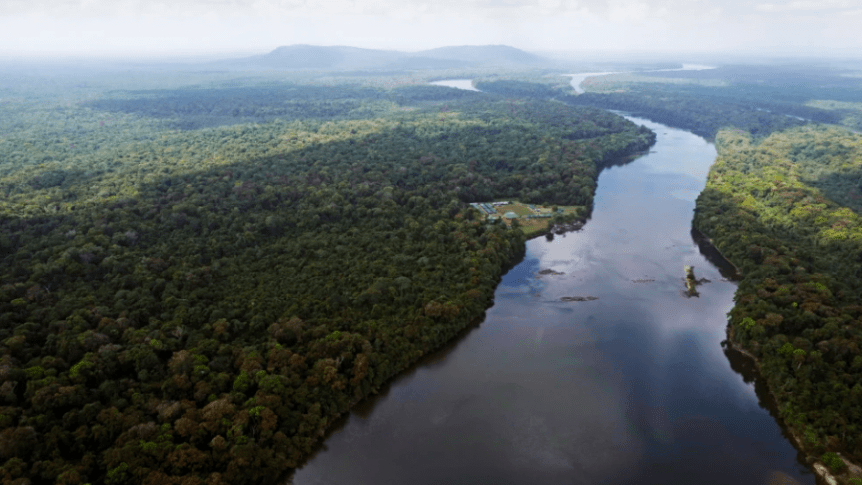
The Essequibo River flows through Kurupukari crossing in Guyana. The boundary was drawn by an international commission back in 1899, which Guyana argues is legal and binding, while Venezuela is disputing it. The U.S., meanwhile, is interfering on behalf of oil interests. | Juan Pablo Arraez / AP

Reposted from Peoples World


Venezuelan President Nicolás Maduro warned recently that “the Southern Command is provoking our region…[as it]  tries to set up U.S. military bases in our Essequibo Guyana.” Venezuelan diplomat José Silva Aponte earlier had observed that, “the United States is intent upon both countries arriving at confrontation.”

Dispute between Venezuela and Guyana over the Essequibo district originated in the early 19th century as Venezuela defied British Guinea in claiming jurisdiction over Essequibo. That territory borders on Venezuela’ eastern frontier and accounts for two thirds of Guyana’s land mass. British Guinea became Guyana in 1966 with the end of Britiah colonialism.

An arbitration tribunal in Paris rejected Venezuela’s claim in 1899. Venezuela and newly independent Guyana agreed in 1966 that the earlier decision was unfounded and that negotiations would continue. The case remains in limbo; the International Court of Justice is involved.

The U.S. government has taken Guyana’s side—no surprise in that Exxon Mobil Corporation is well ensconced there. Oil discovered in 2015 has Guyana, including Essequibo, on track to soon become the world’s fourth largest offshore oil producer.

Venezuela’s government in 2023 created a “Zone of Comprehensive Defense of Guyanese Essequibo.” It’s made plans for the “exploration and exploitation of oil, gas, and minerals” in the region.  Venezuelans voting on Dec. 3, 2023 overwhelmingly approved a referendum allowing their government to establish sovereignty over the contested territory. Essequibo would become a new Venezuelan state.

CIA head William Burns visited Guyana in March 2024. Reacting, Venezuela’s vice president Delcy Rodríguez explained that, “In the history of this U.S. intelligence agency, there is not a single positive milestone; but only death, violence and destruction.” Foreign minister Yvan Gil condemned the visit as “an escalation of provocations against our country and meddling, together with the U.S. Southern Command.”

U.S. resort to military power via the Southern Command suggests that powerbrokers in Washington see the possibility of accomplishing two missions with the same stroke. They want Essequibo to remain within the orbit of Guyana and Exxon Mobil. And, having found a pretext for introducing military power, they would be moving toward the forced removal of a despised left-leaning government.

The Southern Command is responsible for U.S. military operations and “security cooperation” throughout Latin America and the Caribbean.

The Guyana media follows local U.S. military activities. Reporting on December 1, Bernardo de la Fuente detailed Southern Command assistance to the Guyanese Defense Force (GDF). It includes:

  • The upgrading of four Coast Guard River stations, plus additions to the port structure at the Ramp Road Ruimveldt Naval Station in Georgetown.
  • Constructing an outboard motor boat launching ramp and interceptor boat storage yard at a naval facility.
  • Supplying U.S.- constructed “Metal Shark Defiant” patrol boats.
  • Refurbishing a naval headquarters, constructing a new hangar and “expanding the existing facilities of the Air Wing of the Defense Force”
  • Developing “a network of radio repeater stations and a Jungle Amphibious Training School.”

The Southern Command is “helping the GDF strengthen its technological capabilities, as well as directly supporting strategic planning, policy development and coordination of military and security cooperation to strengthen the interoperability of its services in the face of new threats.”

Rehabilitation of a jungle airstrip in Essequibo is icing on the cake. At a cost of $688 million, the now fully-fledged airfield has been extended to 2,100 feet; it will “withstand all weather conditions and ensure 24-hour accessibility.”  According to reporter Sharda Bacchus, the GDF provided $214.5 million. The U.S. taxpayer presumably supplies the rest.

Bernardo de la Fuente notes the airfield’s location adjacent to the west-to-east running Cuyuni River. For Guyana, but not for Venezuelans, that river marks the northern border of both Guyana and Essequibo and the southern border of eastern Venezuela.

Immediate across the river, on the Venezuela side, construction is underway of a jungle command school, ambulatory medical center, training field, and more. Venezuelan General Elio Estrada Paredes and colleagues arrived on Dec. 6 for an inspection visit. A refurbished airstrip provides access to the area.

Officials in Washington have long sought to destroy a Venezuelan government that offends in two ways. It exerts control over huge oil reserves and has aspired to be a model for people-centered political change. Governments led by Presidents Chávez and Maduro, after Chávez’s death in 2013, have had to contend with multiple U.S. intrusions.

They include: an unsuccessful coup in 2002 facilitated by the State Department, tens of millions of dollars delivered to dissident groups, painful economic sanctions from 2015 on, U.S. backing for a puppet Venezuelan president, and the stealing of Venezuelan assets located abroad. U.S. military interventions have been trivial. There was the tiny, U.S.- led seaborn invasion in 2020 (“Operation Gideon”). U.S.-allied Colombian paramilitaries cause mischief inside Venezuela. The U.S. Navy’s Fourth Fleet monitors air and sea approaches to Venezuela.

A U.S. turn to military force directed at Venezuela may not elicit the criticism from U.S. progressives that might have obtained during the Chávez era. Their attachment to Venezuela’s Bolivarian project appears to have weakened.

President Maduro shows less charisma than did President Chávez; he does not match Chávez’s personification of the cause of regional unity, of “Our America.” According to Venezuela’s Communist Party, his government in 2018 “flattened the wages for all sectors and unilaterally canceled all the collective bargaining agreements of…workers.” It later “strengthened its alliance with sectors of big capital, particularly the new bourgeoisie.”

Controversy surrounding Maduro’s re-election to office on July 28, 2024 centers on incomplete reporting of voting tallies. Gustavo Petro, Colombia’s first-ever progressive president, expressed skepticism at the election results.  Alleging over-dependence on oil exports for the financing of development, Petro claimed on Dec. 5 that “Venezuelans now don’t know if they are a democracy, or if they have a revolution.”

The Maduro government recently excluded Venezuela’s Communist Party (PCV) from effective electoral participation, perhaps in order to gain favor in Washington.

Some U.S. progressives disenchanted with the Maduro government may be unaware of its achievement of having built urban and rural communes. They may not have adequately factored in heavy U.S. funding of a divided opposition or recent destabilization inside Venezuela caused by Colombian paramilitaries.

Anti-imperialists may find that assessing the virtues and shortcomings of U.S.-targeted governments doesn’t work well as guidance for action. They might recall their primary vocation of opposition to capitalism.

They would surely derive ample inspiration from there to oppose maneuvering in defense of Exxon Mobil in Essequibo—and enough too to reject U.S. military meddling, whether in a dispute between two nations or against Venezuela itself.


We hope you appreciated this article. At People’s World, we believe news and information should be free and accessible to all, but we need your help. Our journalism is free of corporate influence and paywalls because we are totally reader-supported. Only you, our readers and supporters, make this possible. If you enjoy reading People’s World and the stories we bring you, please support our work by donating or becoming a monthly sustainer today. Thank you!


W.T. Whitney Jr. is a political journalist whose focus is on Latin America, health care, and anti-racism. A Cuba solidarity activist, he formerly worked as a pediatrician, and lives in rural Maine.

US military meddles in Venezuela-Guyana dispute, on behalf of imperialism / By W. T. Whitney

Venezuela has called for direct dialogue to solve the longstanding territorial dispute. (Archive) | venezuelanalysis.com

South Paris, Maine


Venezuelan President Nicolás Maduro warned recently that “the Southern Command is provoking our region …[as it]  tries to set up U.S. military bases in our Essequibo Guyana.” Venezuelan diplomat José Silva Aponte earlier had observed that, “the United States is intent upon both countries arriving at confrontation.”

Dispute between Venezuela and Guyana over the Essequibo district originated in the early 19th century as Venezuela defied British Guinea in claiming jurisdiction over Essequibo. That territory borders on Venezuela’ eastern frontier and accounts for two thirds of Guyana’s land mass. British Guinea became Guyana in 1966 with the end of Britiah colonialism.

An arbitration tribunal in Paris rejected Venezuela’s claim in 1899. Venezuela and newly independent Guyana agreed in 1966 that the earlier decision was unfounded and that negotiations would continue. The case remains in limbo; the International Court of Justice is involved.

The U.S. government has taken Guyana’s side – no surprise in that Exxon Mobil Corporation is well ensconced there. Oil discovered in 2015 has Guyana, including Essequibo, on track to soon become the world’s fourth largest offshore oil producer.

Venezuela’s government in 2023 created a “Zone of Comprehensive Defense of Guyanese Essequibo.” It’s made plans for the “exploration and exploitation of oil, gas, and minerals” in the region.  Venezuelans voting on December 3, 2023 overwhelmingly approved a referendum allowing their government to establish sovereignty over the contested territory. Essequibo would become a new Venezuelan state.

CIA head William Burns visited Guyana in March 2024. Reacting, Venezuela’s vice president Delcy Rodríguez explained that, “In the history of this US intelligence agency, there is not a single positive milestone; but only death, violence and destruction.” Foreign minister Yvan Gil condemned the visit as “an escalation of provocations against our country and meddling, together with the U.S. Southern Command.” 

U.S. resort to military power via the Southern Command suggests that powerbrokers in Washington see the possibility of accomplishing two missions with the same stroke. They want Essequibo to remain within the orbit of Guyana and Exxon Mobil. And, having found a pretext for introducing military power, they would be moving toward the forced removal of a despised left-leaning government.

The Southern Command is responsible for U.S. military operations and “security cooperation” throughout Latin America and the Caribbean.

The Guyana media follows local U.S. military activities. Reporting on December 1, Bernardo de la Fuente detailed Southern Command assistance to the Guyanese Defense Force (GDF). It includes:

·        The upgrading of four Coast Guard River stations, plus additions to the port structure at the Ramp Road Ruimveldt Naval Station in Georgetown.

·        Constructing an outboard motor boat launching ramp and interceptor boat storage yard at a naval facility.

·        Supplying U.S.- constructed “Metal Shark Defiant” patrol boats.

·        Refurbishing a naval headquarters, constructing a new hangar and “expanding the existing facilities of the Air Wing of the Defense Force”

·        Developing “a network of radio repeater stations and a Jungle Amphibious Training School.”

The Southern Command is “helping the GDF strengthen its technological capabilities, as well as directly supporting strategic planning, policy development and coordination of military and security cooperation to strengthen the interoperability of its services in the face of new threats.”

Rehabilitation of a jungle airstrip in Essequibo is icing on the cake. At a cost of $688 million, the now fully-fledged airfield has been extended to 2100 feet; it will “withstand all weather conditions and ensure 24-hour accessibility.”   According to reporter Sharda Bacchus, the GDF provided $214.5 million. The U.S. taxpayer presumably supplies the rest.     

Bernardo de la Fuente notes the airfield’s location adjacent to the west-to-east running Cuyuni River. For Guyana, but not for Venezuelans, that river marks the northern border of both Guyana and Essequibo and the southern border of eastern Venezuela.

Immediate across the river, on the Venezuela side, construction is underway of a jungle command school, ambulatory medical center, training field, and more. Venezuelan general Elio Estrada Paredes and colleagues arrived on December 6 for an inspection visit. A refurbished airstrip provides access to the area.

Officials in Washington have long sought to destroy a Venezuelan government that offends in two ways. It exerts control over huge oil reserves and has aspired to be a model for people-centered political change. Governments led by Presidents Chávez and Maduro, after Chávez’s death in 2013, have had to contend with multiple U.S. intrusions.

They include: an unsuccessful coup in 2002 facilitated by the State Department, tens of millions of dollars delivered to dissident groups, painful economic sanctions from 2015 on, U.S. backing for a puppet Venezuelan president, and the stealing of Venezuelan assets located abroad. U.S. military interventions have been trivial. There was the tiny, U.S.- led seaborn invasion in 2020 (“Operation Gideon”). U.S.-allied Colombian paramilitaries cause mischief inside Venezuela. The U.S. Navy’s Fourth Fleet monitors air and sea approaches to Venezuela. 

A U.S. turn to military force directed at Venezuela may not elicit the criticism from U.S. progressives that might have obtained during the Chávez era. Their attachment to Venezuela’s Bolivarian project appears to have weakened.

President Maduro shows less charisma than did President Chávez; he does not match Chávez’s personification of the cause of regional unity, of “Our America.” According to Venezuela’s Communist Party, his government in 2018 “flattened the wages for all sectors and unilaterally canceled all the collective bargaining agreements of … workers.” It later “strengthened its alliance with sectors of big capital, particularly the new bourgeoisie.”  

Controversy surrounding Maduro’s reelection to office on July 28, 2024 centers on incomplete reporting of voting tallies. Gustavo Petro, Colombia’s first-ever progressive president, expressed skepticism at the election results.  Alleging over-dependence on oil exports for the financing of development, Petro claimed on December 5 that “Venezuelans now don’t know if they are a democracy, or if they have a revolution.”

The Maduro government recently excluded Venezuela’s Communist Party (PCV) from effective electoral participation, perhaps in order to gain favor in Washington.

Some U.S. progressives disenchanted with the Maduro government may be unaware of its achievement of having built urban and rural communes. They may not have adequately factored in heavy U.S. funding of a divided opposition or recent destabilization inside Venezuela caused by Colombian paramilitaries.

Anti-imperialists may find that assessing the virtues and shortcomings of U.S. – targeted governments doesn’t work well as guidance for action. They might recall their primary vocation of opposition to capitalism.

They would surely derive ample inspiration from there to oppose maneuvering in defense of Exxon Mobil in Essequibo– and enough too to reject U.S. military meddling, whether in a dispute between two nations or against Venezuela itself.


W.T. Whitney Jr. is a political journalist whose focus is on Latin America, health care, and anti-racism. A Cuba solidarity activist, he formerly worked as a pediatrician, and lives in rural Maine.

Anti-Petro Coup Imperils Historic Pact Government in Colombia / by W.T. Whitney Jr.

Colombians protest outside the Attorney General’s Office in Bogota, Feb. 8, 2024. | Photo: X/ @hugomilenio

South Paris, Maine


President Gustavo Petro, head of the left-leaning Historic Pact coalition, took office on August 8, 2022. He is Colombia’s most progressive president ever. Now he faces a coup. The fate of Petro’s government connects with prospects for peace in Colombia

On social media Petro indicated that, “Unions have been raided and witnesses have been tortured and otherwise pressured so as to accuse the president (himself)  …  Narcotrafficking sectors, perpetrators of crimes against humanity, corrupt politicians and sections of the attorney general’s office are desperately looking to remove him from … office.”  

The lead coup-plotters have been former Attorney General Francisco Barbosa and Vice-Attorney General Martha Mancera, hold-overs from previous administrations.  Peculiarities of Colombian governmental arrangements have officials installed in the top levels of government whom the president did not select and does not control.  

Barbosa is the public face of the opposition. He ended his four-year term of office on February 12. The Supreme Court of Justice, charged with replacing him, failed to choose one of the three candidates Petro offered for the post. The Court named Mancera as temporary attorney general.

According to one commentator, Mancera has long had actual charge of the attorney general’s office; Francisco Barbosa was “a façade.” She is accused of protecting corrupt officials and drug traffickers.

Provocateur

Barbosa charged the Colombian Federation of Educators with illegally providing Petro’s presidential campaign with funds amounting to the equivalent of $128,000. Searching for evidence on January 22, his agents trashed the union’s headquarters.

Barbosa announced December 1, 2023 he would detain young people whom Petro had released from prison, praising their dedication to peace.  The release would occur long after they had been jailed originally following participation in protest rallies in mid-2021.

Barbosa in January visited the Justice Department in Washington. He reported on “his stewardship [as attorney general] and sought U.S. support for Martha Mancera to become Colombia’s new attorney-general.”

Inspector general Margarita Cabello on February 2 ordered a three-month suspension of Chancellor Álvaro Leyva Duran. His ministry, she charged, had illegally contracted the preparation of passports to a new company. A defender claimed he was breaking a monopoly in passport preparation held by an “old Bogota family.”

In street demonstrations taking place throughout Colombia on February 8, unionists, students, and teachers demanded that the Supreme Court name a Petro nominee as Colombia’s new attorney general.

Military intelligence reports revealed plans for expanded use of social media to broadcast news of destabilizing activities. Reserve and retired army officers, a powerful sector, have held anti-government protests.

Commentators liken Colombia’s evolving coup to the other “soft coups,” or exercise of “lawfare,” that removed Paraguayan President Fernando Lugo (2012), Brazilian President Dilma Rousseff (2016), Bolivian President Evo Morales (2019), and Peruvian President Pedro Castillo (2023).

Distant dream

For the Petro government to disappear would deliver a major blow to Colombians who for decades have sought and struggled for peace in their country. Petro had campaigned for “total peace.” It was a signature cause for him.

The signing of a Peace Agreement between the Revolutionary Armed Forces of Colombia (FARC) and the Colombian government in 2014 came close to satisfying the longings of peace advocates. From then on, however, it was downhill. In that very year, rightwing political forces engineered a watered-down version of the Agreement reached months earlier. Subsequently, the governments of Presidents Juan Manuel Santos and Iván Duque, Petro’s predecessor as president, failed to implement crucial parts of the Agreement.  

Beginning in 2015, 419 former FARC combatants and 1596 social and community leaders have been assassinated – 188 of them in 2023, while Petro was president.  Continuing armed conflict has led to 154 instances of “massive forced displacement” affecting 56,665 persons.

Dissident FARC groups, the National Army of Liberation, and paramilitaries – often in the service of narco-traffickers – account for most of the killings and turmoil.  The current government is negotiating with the remaining insurgencies.

Information from the historical record, recent and remote, suggests that causative factors accounting for violent conflict and the incipient coup are identical.

September 26, 2016 saw a revealing moment. The Peace Agreement was being signed in Cartegena, Colombia. “Timochenko,” the FARC leader, was speaking to notables assembled from several continents. At precisely that point, fighter planes of the Colombian Air Force zoomed by overhead. As noted by an observer: “The face of ‘Timo’ gave the impression of being under a bombardment.” 

Colombia’s U.S.-supported military was weighing in. The nation’s military forces have long been at the disposal of the established sectors of Colombian society. A well-to-do landowning, religious, and commercial elite has charge of Colombia, now and ever since the Europeans’ arrival. That sector is not happy with either Petro or with peace in the countryside.

Analyst Carlos Rangel Cárdenas sees Petro’s “total peace” as “constructing peace by involving civil society in binding dialogues.” He points out that violence in the countryside increased so much during the presidency of Iván Duque as to approach the excesses of earlier eras.  Dialogues do not thrive in conditions of war, presumably. The coup plotters and their soulmates who tolerate war in the countryside are linked.

An urban-based oligarchy, with cooperation from big landowners, controls the financial, commercial, business and media entities in Colombia that shepherd economic development in rural areas. The heavy hitters there, economically, are industrial-scale agriculture, mining operations, energy production, and narcotrafficking. These activities attract investment and enable wealth accumulation.

Colombia’s majority population is different. They are marginalized urban inhabitants, often refugees from an inhospitable countryside.  They are rural people, overwhelmingly poverty-stricken and poorly-educated, who, most of them, have limited access to social services and to land that would allow for subsistence farming.

Defenders of the Historic Pact government confront a set of rulers equipped with money power, a big army, ample police, and ready access to U.S. military resources. They have been on the losing side of struggle between one social class and another. They are quite unable to project the appearance or reality of the kind of political power that matters.

Social movements have more of a hold on Colombians, especially in rural areas, than do political parties. Writer Sidney Tarrow concludes that parties “seek to gain or retain power” while “Movements are more ideological.” The latter, he implies, are weaker. 

In a 2021 interview, Petro suggested that, “The necessities of Colombian society are not based on building socialism, but on building democracy and peace, period.” He is pondering the matter, evidently. On February 9, he indicated that, “We believe and desire that the means of production are in the hands of the people and not the state.”

In any event, an opinion survey shows young Colombians turning increasingly to “rightwing ideological views,” from “7% in May, 2021 to 37% in October, 2023.” 


W.T. Whitney Jr. is a political journalist whose focus is on Latin America, health care, and anti-racism. A Cuba solidarity activist, he formerly worked as a pediatrician, lives in rural Maine. W.T. Whitney Jr. es un periodista político cuyo enfoque está en América Latina, la atención médica y el antirracismo. Activista solidario con Cuba, anteriormente trabajó como pediatra, vive en la zona rural de Maine.

Oil Wealth, US Intervention Aggravate Venezuela – Guyana Border Conflict / By W. T. Whitney Jr.

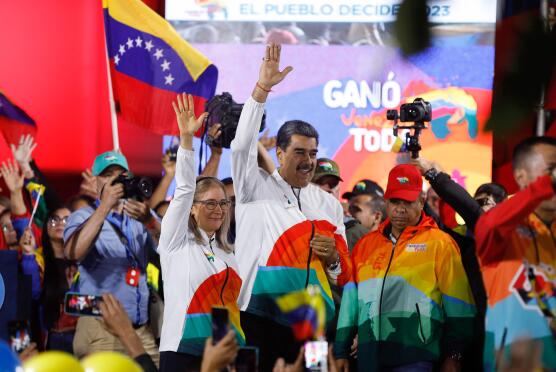
Venezuelan president Nicolas Maduro just before his speech celebrating the “Yes” vote in the Essequibo referendum, in Caracas, December 3, 2023 | Pedro Rances Mattey / AFP

South Paris, Maine


Venezuela’s National Assembly on December 6 began deliberation on President Nicolás Maduro’s plan for incorporating Essequibo into the Venezuelan nation.  The region lying between Guyana to the East and Venezuela to the West has long been claimed by both nations.

Maduro’s plan involves creation of a “Zone of Comprehensive Defense of Guyanese Essequibo,” the naming of General Alexis Rodríguez Cabello to direct the project, designation of state agencies for licensing the “exploration and exploitation of oil, gas, and minerals,” distribution of a revised map of Venezuela, and, importantly, creation of “an organic law for formation of Guyanese Essequibo and all the decisions [voted upon] last Sunday.”

Venezuelans on December 3 did approve a referendum calling upon their government to establish sovereignty over the contested territory. Over 95% of those voting backed each of the referendum’s five points;  50% of Venezuelans did not vote.  The upshot was a big majority in favor of Essequibo being a new Venezuelan state and of its 125,000 inhabitants becoming Venezuelan citizens and receiving social support.

An old border dispute is now a conflict impinging on the very fabric of the Venezuelan nation.  Prime responsibility lies with U.S.-based ExxonMobil Corporation, its activities and acquisitive purposes.

Guyana became a British colony after the Napoleonic wars. Britain was uncertain about the boundary between their new colony and newly independent Venezuela. A survey carried out under British auspices in 1835 put the colony’s western boundary close to or at Venezuela’s Orinoco River.

However, Venezuela’s eastern border during its colonial period extended beyond the Orinoco, to the East, to the Essequibo River, flowing from south to north. During the 19th century, Venezuela’s leaders adhered to that version of the border.

President Antonio Guzmán Blanco initiated negotiations with Great Britain. Assuming that the Monroe Doctrine represented a barrier against European designs, as advertised, Venezuela’s government allowed two U.S. diplomats to negotiate on Venezuela’s behalf.

They colluded with their British counterparts. The negotiations ended with an agreement signed in Paris in 1899 that assigned the disputed Essequibo region to Guyana, the British colony.

Essequibo’s gold-mining potential was evident at the time. Now, according to a recent report, “Gold mining generates Guyana’s main export product, and such mining is carried out mainly in the Essequibo.”

Britain granted independence to Guyana in 1966. Earlier that year representatives of the Venezuelan and British governments, meeting in Geneva, agreed to submit the continuing dispute over Essequibo to arbitration. Venezuela’s government subsequently presumed that the 1899 Paris agreement no longer applied.

With no resolution in sight, the two sides in 1987 submitted the issue to United Nations mediation. Nothing happened.  In 2018, in response to a request from Guyana, UN Secretary General Antonio Guterres referred the issue to the International Court of Justice located in The Hague.

Although Venezuela denies the Court’s jurisdiction, representatives of both nations appeared before the Court in November 2023. At issue was a Guyanese demand that Venezuela cancel the referendum that did take place on December 3.

The recent urgency of resolving the Essequibo quandary has everything to do with actions taken by ExxonMobil Corporation.

In 2015 ExxonMobil discovered copious off-shore oil reserves under Essequibo’s territorial waters. Guyana’s government expanded the bidding process for oil explorations. A previously humdrum territorial dispute had turned into a momentous contest with potentially far-reaching consequences.

ExxonMobil epitomizes power and wealth. Profits in 2022 were $56 billion. ExxonMobil revenues of $413.7 billion for 2022 were greater than the GDPs that year of all but 34 countries in the world; it ranked seventh for income-generating capacity among the world’s corporations.  ExxonMobil sees Guyana as its potentially most productive oil-producing region, a place accounting for more than 25% of ExxonMobil’s total hydrocarbon production.

According to analyst Vishay Prashad, “ExxonMobil … signed an agreement with the government of Guyana in 1999 to develop the Stabroek block, which is off the coast of the disputed Essequibo region.” He adds that, “ExxonMobil was given 75% of the oil revenue toward cost recovery, with the rest shared 50-50 with Guyana; the oil company, in turn, is exempt from any taxes.”


W.T. Whitney Jr. is a political journalist whose focus is on Latin America, health care, and anti-racism. A Cuba solidarity activist, he formerly worked as a pediatrician, lives in rural Maine. W.T. Whitney Jr. es un periodista político cuyo enfoque está en América Latina, la atención médica y el antirracismo. Activista solidario con Cuba, anteriormente trabajó como pediatra, vive en la zona rural de Maine.

Worker Empowerment Stalls in Venezuela as Left Unity Fractures / By W. T. Whitney Jr.

Indigenous spokespeople, Venezuela (archive) | venezuelanalysis.com/


Hugo Chavez, Venezuela’s president from 1999 until 2013, inspired and led a “Bolivarian Revolution” that sought independence from U.S. domination, regional integration and so-called socialism of the 21st century. Obstacles are many: capitalism in control of the national economy, unrelenting rightwing political opposition, U.S. intervention – and longstanding political divisions among left forces.

Worker empowerment languishes in such a context. We offer an explanation, and doing so, attribute the divisions to differing approaches to the predicament of Venezuelan workers.

Several months ago, union workers in many sectors were vigorously protesting low wages and demanding that wages be paid in dollars, to counter inflation. Nicolas Maduro, Venezuela’s president after Chavez’s death in 2013, reprimanded them for not “understanding the effects of the blockade and the oligarchy’s economic war.”

The government faces terrible challenges. Contributing to economic disaster are U.S. sanctions and depressed oil prices over ten years or so. Oil exports have accounted for most of Venezuela’s export income. Economic crisis surely diminishes prospects for worker empowerment.

Impact of economic crisis

Recent developments tell much of that story. The U.S. Justice Department on May 4 lifted restraints on the sale of Citgo company’s assets to the creditors of the Venezuelan state and of Venezuela’s state -owned oil company, PDVSA. Citgo is PDVSA’s U.S.-based oil company. Worth $13 billion, it owns three oil refineries and 4000 gasoline stations.

U.S. authorities confiscated Citgo in 2019. It gave Citgo to those rightwing opponents of the Maduro government who between 2015 and 2021 constituted a majority in Venezuela’s National Assembly. This group will be managing the sales of Citgo shares to the company’s high-rolling creditors worldwide.

Rather than retrieve annual Citgo profits of a billion dollars or so, the government has lost them. Income from the sales of oil products had enabled the government to pay for healthcare, schools, housing, and more. The larger picture is that $30 billion in Venezuelan assets have been “blocked, retained, or confiscated.”

The U.S. State Department on May 3 announced that $347 million in Venezuelan funds now frozen in U.S. banks will be returned, not to Venezuela’s government, but to that former opposition bench in the National Assembly. For the United States, that’s Venezuela’s government.

Meanwhile, Venezuelan workers are struggling to survive; worker empowerment is a distant dream.  Presently, one third of Venezuelan children are undernourished. The poverty rate has fallen a little but remains at 50%. In one of the world’s most unequal societies, wealthy Venezuelans have access to imported goods, dollars, and the proceeds from illegal businesses. The latter make up 20% of the national economy.

The economic crisis hurts Venezuela’s working class. It impedes efforts to strengthen it. We must know the extent to which Venezuela’s government supports workers.

Shifting alliances and labor rights

President Maduro in February 2018 was seeking support in presidential elections that year from the Communist Party of Venezuela (PCV).  He appeared at the PCV headquarters and declared the PCV “to be the principal party in founding and defending democracy in the 20th century.”

The government’s political party, the United Socialist Party of Venezuela (PSUV) and the PCV signed a “Unitary Framework Agreement,” which backed “the rights of the working class and the working people.”  The PCV did support Maduro in elections in May 2018.

Within months, however, the government introduced its “Program of Recuperation, Growth, and Economic Prosperity,” which, according to labor historian Omar Vázquez Heredia, provided for “major devaluation of the official exchange rate, elimination of price controls and import tariffs …[and] regressive labor reforms … [such as] elimination of the right to strike.”  He adds that dollars had already been disappearing through smuggling, hoarding, import fraud, and governmental corruption.

The new anti-worker measures showed up in the government’s “Memorandum 2792” of October 2018. ThePCV critiqued the government’s ready support for business interests and questioned its delivery of scarce dollars to foreign creditors and to Venezuela’s business sectors to help them import and distribute foreign goods.

Analyst Héctor Alejo Rodríguez notes that the government, through its October memorandum, “flattened the wages for all sectors and unilaterally cancelled all the collective bargaining agreements of the workers.” Workers, he points out, were already dealing with “acute shortages, loss of social gains, deterioration of public services and the systematic destruction of [their] incomes and rights.”

At a May Day rally in 2023, former labor leader Maduro told workers that funds were unavailable for salary increases, also that their “economic war bonus” would continue and their monthly food bonuses increase. The minimum wage would be equivalent to $5.25 per month – and lose value due to inflation.    

President Chavez created the “Great Patriotic Pole” electoral coalition. The PCV joined, and backed Chavez in the 2006 and 2012 elections, and Maduro in the 2013 elections. Chavez created the United Socialist Party of Venezuela (PSUV) in 2007. He counted on smaller leftist parties to relinquish their identity and join the PSUV.

The PCV and other parties refused, provoking Chavez in 2008 to threaten the PCV’s destruction.  PCV leader Oscar Figuera declared that his Party would still affiliate with the Patriotic Pole, but would remain independent. After all, as he noted, “We have just completed 77 years struggling for socialism in Venezuela.”

The PCV broke with the PSUV in 2020 and formed a new electoral coalition, the People’s Revolutionary Alternative (APR). Party leaders say they are “Chavista” and anti-imperialist, but want oil monies used more for industrial development and rural productivity and less for paying on foreign debt or for capitalists to use as they wish.  

Meanwhile, the government stepped up “criminalization of labor protests” and forced the retirement of many labor leaders. APR candidates have been dismissed from jobs, or jailed. The PSUV presented speakers who denounce the PCV and at the same time falsely claim to have been PCV members or to have been expelled by the PCV.

Some clarity

Mostly tellingly, a flurry of killings has recently taken the lives of PCV activists. In Apure state alone, in 2023, thugs murdered Communist journalist José Urbina and Communist community leader Juan de Dios Hernández.

In Venezuela presently the prospects for worker empowerment, not to speak of working-class political power, are dismal. A distant observer lacks full knowledge of local realities and is ill-equipped to assign blame. In any case caution is the watchword in passing judgment that might detract from unity in the broader political movement.

Now a neighbor weighs in.  Writing May 8 in Seminario Voz, the Colombian Communist Party’s newspaper, Ricardo Arenalescriticizes the PSUV. He cites the killings and false PSUV accusations.

Arenales cites a communication from the PCV Political Bureau to Colombian President Gustavo Petro, who on April 1 met with   

representatives of Venezuela’s rightwing political opposition and who was about to meet with regional foreign ministers. Petro is seeking to ease political conflict within Venezuela and somehow to end U.S. economic sanctions against Venezuela.

The PCV letter calls for negotiators to attend to “the political and social forces that are on the fringes of the polarizing diatribe.” The PCV rejects “a pact among the elites … [which] is built on the ruin of the popular majorities” and which represents “the interference of foreign powers in the solution of conflicts that exclusively concern Venezuelans.”

Arenales implies that rightwing powerbrokers in Venezuela and abroad use negotiations to incapacitate the PCV. He mentions that, “under the heading of sovereign resolution of conflicts in the brother country, … the right of the Venezuelan Communists to exist and struggle cannot be denied. For that to happen would be a serious contradiction in the building of democracy.”

Arenales reports that “parties and intellectuals of the world” and regional groupings in Latin America like the Sao Paulo Forum are proposing mediation processes for the sake of “rapprochement among the PCV, PSUV and Venezuelan government.”


W.T. Whitney Jr. is a political journalist whose focus is on Latin America, health care, and anti-racism. A Cuba solidarity activist, he formerly worked as a pediatrician, lives in rural Maine. W.T. Whitney Jr. es un periodista político cuyo enfoque está en América Latina, la atención médica y el antirracismo. Activista solidario con Cuba, anteriormente trabajó como pediatra, vive en la zona rural de Maine.

US General Hypes China as Threat in Latin America / By W.T. Whitney Jr.


The U.S. government has long intervened in Latin America and the Caribbean (LAC). Now the U.S. military is paying attention to China’s economic activities there. 

General Laura Richardson on March 8 reported to the Armed Services Committee of the U.S. House of Representatives on actions and needs of the Southern Command, which she heads. She has charge of all U.S. military operations in the region. 

Citing the 2022 National Security Strategy, Richardson declared that “no region impacts the United States more directly than the Western Hemisphere …. [There] autocrats are working overtime to undermine democracy.” And security there “is critical to homeland defense.”

Richardson stated that “the PRC (People’s Republic of China) has both the capability and intent to eschew international norms, advance its brand of authoritarianism, and amass power and influence at the expense of the existing and emerging democracies in our hemisphere.” The Southern Command’s “main priority … is to expose and mitigate PRC malign activity.”

She sees a “myriad of ways in which the PRC is spreading its malign influence, wielding its economic might, and conducting gray zone activities to expand its military and political access and influence.” A “grey zone,” according to the NATO-friendly Atlantic Council, is a “set of activities … [like] nefarious economic activities, influence operations, … cyberattacks, mercenary operations, assassinations, and disinformation campaigns.”

Richardson highlighted China’s trade with LAC that is heading toward “$700 billion [annually] by 2035.” The United States, in her view, will be facing intense competition and presently “its comparative trade advantage is eroding.”

She added that, “The PRC’s efforts to extract South America’s natural resources to support its own population … are conducted at the expense of our partner nations and their citizens.” And opportunities for “quality private sector investment” are disappearing.

Competition extends to space: “11 PRC-linked space facilities across five countries in this region [enable] space tracking and surveillance capabilities.” Richardson complained of “24 countries [that] have existing Chinese telecommunication infrastructure (3G/4G), increasing their potential to transition to Chinese 5G.” 

She expressed concern both about surveillance networks supplied by China that represent a “potential counterintelligence threat” and about Latin Americans going to China “to receive training on cybersecurity and military doctrine.” Richardson denounced China’s role in facilitating environmental crimes and pointed to “potential dual use for malign commercial and military activities.”

“Relationships absolutely matter,” she insisted, “and our partner democracies are desperate for assistance from the United States.” Plus, “if we’re not there in time, they … take what’s available, creating opportunities for the PRC.”

Moving beyond China, Richardson indicated that “many partner nations …  see TCOs (transnational criminal organizations) as their primary security challenge.” That’s because drug-cartel violence leads to deaths and poverty and “illicit funds exacerbate regionalcorruption, insecurity, and instability.”

Her report avoids mention of particular countries other than offering brief references to Haiti, Cuba, Nicaragua, and Venezuela. She criticized Russia for “military engagements with Venezuela and Nicaragua” and for spreading “false narratives.” Richardson praised Colombia for providing military training in other countries. 

The Southern Command gains “exponential return” on supplying various countries with U.S. weapons and supplies. It conducts joint military exercises, and “provides professional military education to personnel from 28 countries.”

Richardson reported at length on processes she sees as fostering useful relationships between her command and the various governments and military services. The tone of urgency characterizing her discussion on China was entirely lacking. 

Economic intervention

General Richardson’s view that China has greatly expanded its economic involvement with the LAC nations is on target.

Since 2005, China’s state-owned banks have arranged for 117 loans in the region worth, in all, more than $140 billion. They averaged over $10 billion annually. Since 2020, China has made fewer loans.

Chinese trade with Latin America grew from $12 billion in 2000 to $448 billion in 2021. China’s imports of “ores (42%), soybeans (16%), mineral fuels and oils (10%), meat (6%), and copper (5%)” totaled $221 billion in 2021. The value of exported manufactured goods that year was $227 billion. By 2022, China had become the biggest trading partner in four Latin American countries and the second-largest in many others.  

China’s foreign direct investment (FDI) has long represented China’s strongest economic tie to the region. FDI signifies funding of projects abroad directed at long-term impact. China’s FDI from 2005 to mid-2022 was $143 billion. Energy projects and “metals/mining” accounted for 59% and 24% of the total, respectively. Of that total, Brazil and Peru received 45% and 17%, respectively. 

The FDI flow since 2016 has averaged $4.5 billion annually; worldwide, China’s FDI has contracted.

Chinese banks and corporations have invested heavily in lithium production in Argentina, Bolivia, and Chile, which, together, account for 56% of the world’s lithium deposits. China is the largest investor in Peru’s mining sector, controlling seven large mines and owning two of Peru’s biggest copper mines. Brazil is the world’s largest recipient of Chinese investments.  

China’s government has linked FDI to its Belt and Road Initiative (BRI) that began in 2013. As of May 2022, 21 Latin American and Caribbean countries were cooperating with the BRI and 11 of them had formally joined.

On the ground

U.S. military intervention in LAC is far from new. Analyst Sergio Rodríguez Gelfenstein complements Richardson’s report with a three-part survey, accessible herehere, and here, of recent U.S. military activities in the region.

He indicates the United States now has “12 military bases in Panamá, 12 in Puerto Rico, 9 in Colombia, 8 in Perú, 3 in Honduras, 2 in Paraguay, as well as similar installations in Aruba, Costa Rica, El Salvador, Cuba (Guantánamo), and in other countries.”

Rodríguez maintains that, “levels of aggressive interference by Washington in the region have increased dramatically” and that U.S. embassies there are supplied with more military, Cuba, Nicaragua, and CIA personnel than ever before.

Rodríguez notes features of the LAC region that attract U.S. attention, among them: closeness to strategically-important Antarctica; reserves of fresh water and biodiversity in Amazonian regions; the Guarani Aquifer near the triple frontier of Brazil, Paraguay, and Argentina, the largest in the world; and huge reserves of valuable natural resources.

Among ongoing or recent U.S. military interventions are these:

·        The U.S. Army Corps of Engineers is implementing a “master plan” for navigability of the Paraguay River and Plata River Basin. The nearby Triple Frontier area supposedly harbors international terrorism and drug-trafficking.

·        The U.S. military facility in Neuquén, Argentina is turning from its alleged humanitarian mission to activities in line with local preparations for oil extraction.            

·        U.S. officials on October 13, 2022 announced that 95 military vehicles were being donated to Guatemala for drug-war activities.   

·        In Brazil in September 2022, General Richardson indicated that U.S. forces would join Brazilian counterparts to fight fires in the Amazon..

·        The Southern Command’s fostering of good relations with Peru’s military has borne fruit. Under consideration in Peru’s Congress is a proposal to authorize the entry of foreign military forces. To what nation would they belong? Hint: former CIA operative and U.S. Ambassador Lisa Kenna met with Peru’s Defense Minister the day before President Pedro Castillo was removed in a parliamentary coup on December 7, 2022.

·        In March 2023, two U.S. congresspersons proposed that U.S. troops enter Mexico to carry out drug-war operations.

·        Presently the United States is making great efforts to establish a naval base on Gorgona island off Colombia’s Pacific coast. It would be the ninth U.S. base in Colombia, a NATO “global partner.”

·        In Colombia, U.S. troops acting on behalf of NATO, are active in that country’s Amazon region supposedly to protect the environment and combat drug-trafficking.

·        The U.S. National Defense Authorization Act of December 2022 awarded the Southern Command $858 million for military operations in Ecuador.

·        In a second visit, the US Coast Guard Cutter Stone was plying Uruguayan waters in February ostensibly to train with local counterparts for search and rescue operations. The ship was also monitoring the nearby Chinese fishing fleet.

Rodríguez does not comment on U.S. interventions in Cuba, Nicaragua, and Venezuela. That’s because they’ve persisted for “more than 60, 40, and 20 years, respectively” and each requires a “special report.”

John Quincy Adams returns

Proclaiming the Monroe Doctrine 200 years ago, Secretary of State Adams informed European powers that the United States regarded “any attempt on their part to extend their system to any portion of this hemisphere as dangerous to our peace and safety.”

General Richardson would apply the warning of that era to the PRC. Yet signs of hegemonic aspirations from that quarter are absent.

Commenting recently, Argentinian economist and academician Claudio Katz notes that, “China concentrates its forces in the economic arena while avoiding confrontations at the political or military level … Investments are not accompanied by troops and bases, useful for guaranteeing return on investments.”

Besides, China “does business with all governments, without regard to their internal politics.” That tendency, Katz writes, stems from the PRC having “arisen from a socialist experience, having hybrid characteristics, and not completing a passage to capitalism.” He maintains that China, with its economic involvement, contributes nothing to advancing socialism in the region.   


W.T. Whitney Jr. is a political journalist whose focus is on Latin America, health care, and anti-racism. A Cuba solidarity activist, he formerly worked as a pediatrician, lives in rural Maine. W.T. Whitney Jr. es un periodista político cuyo enfoque está en América Latina, la atención médica y el antirracismo. Activista solidario con Cuba, anteriormente trabajó como pediatra, vive en la zona rural de Maine.

Colombian Intelligence Operations, with US Backing, Are Bad for Peace / by W. T. Whitney Jr.

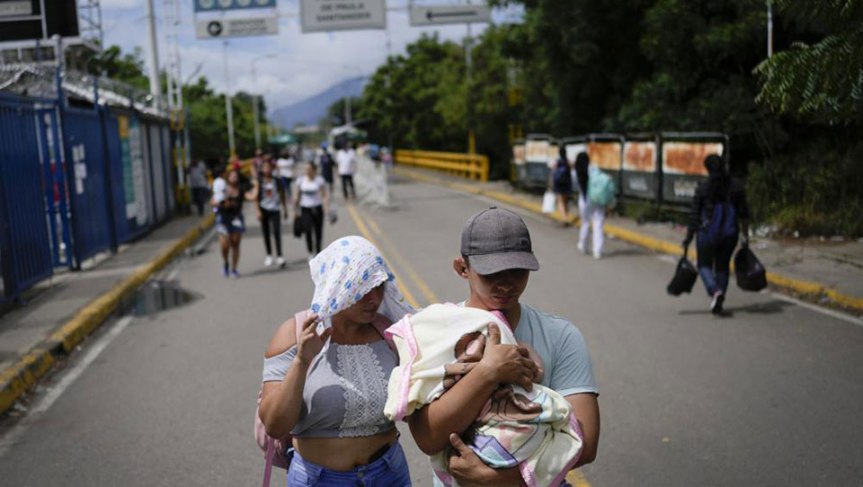
A Venezuelan couple use the Francisco De Paula Santander Bridge to cross between Urena, Venezuela, and Cucuta, Colombia, Aug. 6, 2022. | Matias Delacroix / AP

Colombia’s new president Gustavo Petro wants peace. Colombia’s military, the largest in Latin America, except for that of Brazil, stands in the way. It benefits from U.S. largesse while attending to U.S. needs. Its intelligence branch, discussed here, is not about peace and reconciliation.

The U.S. government, militarily involved in Colombia for decades is likewise an obstacle to peace. As explained recently by analyst Hernando Calvo Ospina, military cooperation has been central to the U.S.-Colombian alliance. He details how since World War II the United States has partnered with Colombia in dominating the entire region to maintain access to strategic resources, exclude Communism, and suppress left-wing movements. Calvo Ospina mentions Colombian-U.S. drug-war operations and the two countries’ addiction to military and ruling-class power. This is the setting for the intelligence operations described below.

Colombian intelligence operations serve U.S. imperialist objectives as they target Cuba and Venezuela. Colombian governing authorities appear to have forgotten the legacy of independence hero Simón Bolívar who, up against Spanish rule and U.S. pretentions, fought for Latin American unity. In 1829 he remarked that, “The United States appear to be destined by Providence to plague America with misery in the name of liberty.” He was denouncing unencumbered U.S. license to control Spanish America, as proclaimed in the Monroe Doctrine of 1823 and still in force. 

Trump-era national security advisor John Bolton recently boasted he had planned coups to unseat the Maduro government in Venezuela. Current White House advisor on Western Hemisphere affairs Juan González took a different tack while speaking in Colombia in August: “40 years ago the United States would have done everything possible to avoid the election of Gustavo Petro and, once elected would have done everything possible to sabotage his policies.”  Now, says González, the United States wants to collaborate and “navigate that change.” 

Meanwhile, Petro wants young people to choose social service and not do military service. His government will be negotiating peace with National Liberation Army (ELN) guerrillas. He rejects the U.S.-promoted drug war and has re-established diplomatic relations with Venezuela, the object of U.S. hybrid war. On August 12, Petro named new military chiefs and replaced 40 generals and admirals because of corruption and human rights violations.

This report turns to Colombian military intelligence. The Revista Raya website, directed by Edinson Bolaños, recently published three articles on Colombian intelligence operations that began in 2016 and continued for almost six years. (See the end note for possible translations in English of “raya.”)

Face-off against Cuba

The first article, titled “International Espionage: Operation Cuba,” appeared on the website on August 19.  One learns that, “Revista Raya had access to thousands of classified Colombian military intelligence documents where evidence appears of spying on Cuban diplomats and officials, left-leaning [Colombian] political leaders, journalists, and social leaders.” The folders contained “profiles of targeted personnel, photographs, videos of subjects being followed, maps, sketches and drawings.”

Agents posing as journalists or photographers mapped routes to facilities used by diplomats. They photographed the interiors of the Cuban embassy, consulates, and diplomats’ quarters, and also diplomats’ automobiles and license plates. They monitored diplomats’ encounters with Colombian activists and politicians. Operatives gained access to phones, computers and on-line communications.

They were able to alter the text of the Cubans’ email communications. Colombian intelligence operatives communicated their findings with U.S. counterparts. U.S. documents with responses and commentary show up in the files.

Operatives attended solidarity gatherings in Colombia and farther afield – at a Sao Paolo Forum of leftist political parties, for example. At these venues, they identified attendees, monitored conversations, gained access to email communications, and informed intelligence agencies in home countries of their citizens’ participation in leftist or pro-Cuba activities. They spied on solidarity gatherings at the Julio Antonio Mella International Camp near Havana.

People attending various events had their phone calls intercepted, among them: Cuban ambassador José Luis Ponce and Vice Consul Kendry Sosa, leftist senators Iván Cepeda and Gloria Flórez; Communist Party leaders Jaime Caycedo and Carlos Lozano Guillén; and FARC lawyer Diego Martínez. Among attendees monitored at the Sao Paolo Forum in 2019 were Communist Party member Gloria Inés Ramírez, now President Petro’s labor minister, and leftist senator Piedad Córdoba.

One purpose for the phone monitoring, according to Revista Raya, was to unearth or install material suggesting that Cuban operatives were promoting the protest demonstrations that rocked Colombia in 2019 and later, and contributed to the election of President Petro. The intelligence units also sought to connect Cuba’s government with leftist insurgents in Colombia, particularly the National Liberation Army (ELN).

According to documents in the report, agents “sewed” information in the computers of ELN guerrilla leaders suggesting the “complicity of Cuba’s government with the ELN in manufacturing the violence associated with the social protests.”  Nothing appeared in the files indicating that Cuba’s government actually did promote anti-government activities, according to Revista Raya.

Agents planted “evidence” of alleged terrorism undertaken by ELN guerrilla leader Andrés Vanegas Londoño, alias “Uriel,” and sent it to Colombian prosecutors and to Interpol. They communicated his location in Choco department. Uriel died in a bombardment of his camp 20 days later, on October 25, 1920.

Targeting Venezuela

Encouraged by its U.S. partner, Colombia’s government has long taken steps to destabilize Venezuelan society and government operations, and more so recently. Secret operations have taken place in Venezuela’s border region with Colombia. Colombian narco-traffickers are active there, and also Colombian paramilitaries. A small U.S.-Colombian force, Operation Gideon, carried out a maritime invasion of Venezuela in 2020.

Colombian military intelligence engaged with agencies and personnel of Venezuela’s government. On August 24, Revista Raya published “International Espionage: Objective Venezuela. The survey covers destabilization plans and monitoring of Colombian and Venezuelan politicians and Venezuelan diplomats.

Colombia’s intelligence service secreted 28 spies within various branches of Venezuela’s military. As part of so-called “Operation Vengeance,” operatives “tried to encourage the Venezuelan Army to carry out military operations against the ELN,” whose detachments were active in Venezuelan territory. They created hostile pamphlets and audio recordings and attributed them to the ELN.The spies “totally infiltrated” the communications of a Venezuelan press attaché in Bogota and monitored his contacts with prominent Colombian politicians of the left. Colombian officials later expelled him. 

Citing “another hundred documents,” Revista Raya shows that, during the presidency of President Iván Duque (2018 -2022), Colombian spies entered, photographed, and took material from the Venezuela’s consulate in Cartagena. The Colombian intelligence operatives attended primarily to consul Ayskel Torres.  

Under “Operation Sunset,” they “monitored her contacts with leftist social leaders in the region and her “sentimental relationship” with the “military attaché of a Caribbean country.” They were blackmailed and the latter provided a list of “cooperating” contacts.

Spying ceased after February 23, 2019, when The Maduro government broke relations with Colombia. The spies had monitored Venezuelan diplomats’ communications about the safety of money and sensitive documents lodged in an Embassy strong box. After the Venezuelans had departed, spies entered the building, took photographs, opened the strong box and stole documents and money. 

Responsibility

The last section of this three-part Revista Raya series is titled “International Espionage: Massive Profiling.” Documents were cited that contained “telephone numbers, homes addresses, political preferences, work places, email addresses, nationalities, and date of identification” for 450 persons. The article presents political profiles of eight individuals as examples of other profiles that were created. Dozens of images appear.

The targeted individuals included “political, social, and union leaders and also diplomats and officials of the Cuban and Venezuelan governments.” Intelligence agents descended on them when they attended “commemorations and political events relating to socialist countries,” or “peaceful mobilizations and … political events in Colombia.”

This last article in the series identifies the chief of Navy Intelligence as the individual primarily responsible for the illegal spying.

Rear Admiral Norman Iván Cabrera Martínez heads that agency now. He served as naval attaché at the Colombian Embassy in Washington and the U.S government awarded him a Meritorious Service Medal. Cabrera Martínez assumed his post on August 27, 2022. 

Colombian Communist Party secretary general Jaime Caycedo, the object of spying, commented to Revista Raya: “We … think this is a violation flagrant of our rights and constitutional liberties …[We] attach great importance to the journalistic work you are doing. You showed how we fell into their hands. You explained how public resources and public entities were used to maltreat citizens with this illegal profiling and to spy on diplomats of friendly countries with diplomatic relations.”

Note: The meaning in English of “raya,” as used in the website’s name, is mysterious here. We opt for “line-by-line review.” “Raya” may signify victim or despised person in that a “tienda de raya” in Mexico was a store operated by a company or hacienda relying on a laborer’s written line for a signature. A possibility from Colombia is “detective.”  Another commentator suggests “memorable happenings.”


W.T. Whitney Jr. is a political journalist whose focus is on Latin America, health care, and anti-racism. A Cuba solidarity activist, he formerly worked as a pediatrician, lives in rural Maine. W.T. Whitney Jr. es un periodista político cuyo enfoque está en América Latina, la atención médica y el antirracismo. Activista solidario con Cuba, anteriormente trabajó como pediatra, vive en la zona rural de Maine.

For Cuba and Venezuela, US Silence May Not Be Golden – W.T. Whitney – May 16th, 2020

The U. S. President and his Secretary of State frequently expound about the supposed failings of enemies abroad. Recently they’ve blasted China’s response to the pandemic, Venezuela’s dictatorship, Cuba’s “slave doctors” overseas, and even Iranian border guards beating up on Afghan migrants. But they’ve been mostly silent about two recent disruptions of the imperialist status quo.

Firing his AK-47 automatic rifle, an apparently mentally-ill Cuban émigré on April 30 caused serious damage to the Embassy building and the bronze stature of Cuban national hero Jose Marti. The only peep of official reaction came from the U.S. Embassy in Havana.  Charge daffaires Mara Tekach stated that, “the U.S. Embassy condemns the shooting” and “the United States takes its Vienna Convention responsibilities very seriously.”  

Her reference was to the multi-lateral United Nations agreement of 1961 that converted national customs into international norms for conducting diplomatic relations. The requirement emerged for host governments to protect the envoys of enemy countries and to respect “the inviolability of mission premises.” 

Assailant Alexander Alazo told investigators that if Ambassador José Ramón Cabañas had appeared at the door, he would have killed him. There were no injuries.  Washington authorities detained the shooter and charged him with assault with intent to kill and possession of an unregistered firearm. The incident was characterized as a hate crime. That it was: generations of U.S. politicians and Cuban – American political leaders have been railing against Cuba.  

Ambassador Cabañas declared that, “Neither State Department officials nor the Secretary of State Mike Pompeo has issued even one formal public condemnation of the attack.” Instead, “the Secretary inveighed against the Cuban medical brigades that today are offering assistance in dozens of countries in the world.” 

At a press conference May 13, Cuban Foreign Minister Bruno Rodríguez blamed the U.S. government for “complicit silence” in regard to “a grave terrorist attack” and for using “hate speech” that is a “permanent instigation to violence.”  

Rodríguez mentioned the accused shooter’s attendance at the Doral Jesus Worship Center in Florida. Frank López, the pastor there, is friendly toward “Senator Mark Rubio … and other known extremist figures.” Plus, the “U.S. Vice President … recently visited that church,” and in 2019 gave a speech there “openly hostile to Cuba.”  

Clearly, the U. S. blind eye toward Cuban-American paramilitary conspiracies, the U.S. turn to germ warfare, and a U.S. economic blockade directed at causing human misery are all manifestations of hatred. That’s so also with the impunity awarded arch-conspirators like Luis Posada and Orlando Bosch.

Cuba’s representatives serving abroad are no strangers to hatred manifesting as terrorism. A recent historical survey provided by Cuba’s security services cites: “83 attacks against Cuban embassies throughout the world and 29 attacks against Cuban diplomats with eight deaths as the result of terrorism encouraged, financed, or allowed by Washington.” 

Another mission of hate and terror emerged on May 3-4; a small invasion force of mainly Venezuelan Army deserters attempted to invade Venezuela from the sea. As with the Embassy affair, U.S. leaders said very little.

Venezuela’s Army and civilian militia quickly finished off the expedition, which had departed from northeastern Colombia. One of their number, a former U.S. Special Forces soldier, told his captors that the purpose of the force had been to seize President Nicolas Maduro and take him to the United States. Florida-based company Silvercorps USA had charge of the operation. 

The company’s owner is U.S. Special Forces veteran Jordan Goudreau.

Goudreau had recruited former Green Berets to supervise the training of the dissident Venezuelan troops. Two of them are now prisoners in Venezuela.  

Venezuelan opposition figures had contracted with Goudreau and Silvercorps USA to carry out the invasion. A contract worth $212.9 million was signed in an expensive condo in Miami. Venezuelan oil resources stolen by the U.S. government served as guarantee for the transaction.  

U.S. leaders said little about the assault. Secretary of State Pompeo indicated that, if necessary, “We will use every tool that we have” to retrieve the two captured U.S. mercenaries. President Trump remarked only that he “wouldn’t send a small, little group. No, no, no. It would be called an army. It would be called an invasion.”  

Trump might have remained totally silent in view of his personal connection with Silvercorps USA.  President Maduro on May 4 declared that two of the Silvercorps invaders were “members of the security team of the president of the United States.” Goudreau reportedly “worked as security at Trump rallies” – one in Charlotte, NC , for example – and “Silvercorp USA also apparently provided security for a Trump rally in Houston.” 

According to the company’s website, “We provide governments and corporations with realistic and timely solutions to irregular problems.” Jordan Goudreau has “planned and led international security teams for the president of the United States as well as the secretary of defense.” 

A mix of nefarious connections, hatred, and terrorism contributed to these irregular attacks on Cuba and Venezuela. Such material does not lend itself to official pronouncements. That nothing is said about the incentive for the two actions also makes sense.

Cuba and Venezuela put people and people’s basic needs first. They exemplify an alternative to U.S. purposes. Those in charge in Washington, imperialists to the core, seek to preserve the profiteering, market-based political and economic system that holds most of the world in its grip. Employing terrorism and military aggression, they stop at nothing.