
The United Arab Emirates Enables Human Catastrophe in Sudan, with the US in Tow / By W. T. Whitney, Jr.

Photo credit Z

South Paris, Maine


Beginning in April 2023, war between Sudan’s army and the paramilitary Rapid Support Forces (RSF) has caused humanitarian disaster of epic proportions. Some 150,000 people have died and 14 million Sudanese – Sudan’s population is 51 million – are displaced internally or in neighboring countries. Over 24 million suffer acute food insecurity. Famine is rampant in Darfur, the district in northwestern Sudan most afflicted by war and hunger.

We look at causes, foreign intervention in particular. The Sudanese people are victims of top-down oppression inflicted by big imperialists, lesser ones, and Sudan’s elite.  

The Bashir government in 2013 created the Rapid Support Forces from the Janjaweed formations and installed General Mohamed Hamdan Dagalo, known as “Hemedti,” as leader.

Protests by democratic forces beginning in December 2018 led to joint civilian-military rule. A coup in April 2019 removed Bashir from power. Subsequently, General Abdel Fattah al-Burhan, head of the armed forces and now the country’s president, and deputy military commander Hemedti became co-leaders of a transitional military council.

Turmoil continued, as did agitation for democratic change. In October, 2021, the two generals, having instigated another coup, established themselves as the country’s sole rulers. Al-Burhan and Hemedti subsequently disagreed on how to incorporate the RSF into Sudan’s army and on who would command the RSF. Reacting, Hemedti in April, 2023 provoked yet another coup. The RSF was soon occupying Khartoum, Sudan’s capitol city.

The Sudanese army recaptured a devastated Khartoum in March 2025. The RSF, having laid siege to El Fasher for 18 months and defeated the Sudanese army, took over that city of 700,000 inhabitants in October, 2025. Killings skyrocketed.

As of November 6, the Rapid Support Forces have agreed to a “humanitarian ceasefire” for three months proposed by the U.S., Egypt, the UAE and Saudi Arabia. The Sudanese army rejected the truce, demanding  that the RSF withdraw from civilian areas and surrender their weapons.

Origins

African nations emerging from colonialism endured varying degrees of continuing oppression and differing kinds of instability. Even so, humanitarian catastrophe in Sudan and the killings seem to be unprecedented.

The country’s vulnerability shows in a destitute, divided population, military rule, and societal collapse. It stems from a long history of autocratic rulers and recurring coups before independence and afterwards, division between an Arab-oriented North and non-Arab South (leading to an independent South Sudan in 2011), and susceptibility to manipulation by outside actors.

The United Arab Emirates (UAE) has interests in Sudan. Mohammad Khansa, writing for al-akhbar.commentions that, “Sudanese gold fuels the RSF, and the UAE.” Newly discovered gold deposits account for 60% of the country’s exports. The UAE imported $2.29 billion worth of Sudanese gold in 2022. Ninety percent of the gold Sudan produces goes to the UAE.

Sudan, the “leading agricultural producer in both Africa and the Middle East” is the “breadbasket of the Arab world.” The UAE imports 90% of its food. UAE investors have fostered land grabs in Sudan and industrialized Sudan’s agricultural production.

Other UAE interests are:  management of key Sudanese ports on the Red Sea, UAE control of many Sudanese banks and the UAE’s use of the RSF as its proxy in competing with Saudi Arabian influence in Africa.

UAE intrusion

Explaining the UAE’s relationship with Sudan and the RSF, Husam Mahjoub, writing in Spectre Journal, states that, “The UAE’s role in Sudan is … part of a coherent, well-financed, and regionally expansive project: a sub-imperialist agenda that combines economic extraction, authoritarian alliance-building, and counterrevolutionary politics.” The UAE “viewed the Arab Spring [of 2011] as an existential threat to both the authoritarian regimes in the region and its own model of governance. …[The] UAE became an active counterrevolutionary force.”

The Sudanese people’s uprising in December 2018, prior to Bashir’s removal, continued “even after the October 2021 coup.” It was “democratic, civilian-led, and explicitly antimilitary.” Demands were “freedom, peace, social justice, civilian governance, and accountability.” According to Mahjoub, this “grassroots resistance posed a threat to both Sudan’s own elites and regional powers like the UAE.”  

The RSF has helped the UAE in two ways: its “capacity for violence—that is, a force willing to suppress protests, fight wars, and eliminate rivals” and “economic access, especially to Sudan’s lucrative gold trade, which the RSF increasingly controlled.”

“[N]ow the regional leader in the defense sector,” according to the Simpson Center, the UAE imports weapons and makes its own. UAE support for the RSF shows in weapons transferred to the paramilitaries.  Gold from the RSF allows the UAE to buy weapons from many countries, with a portion of them ending up with the RSF.

The weapons enter Sudan by irregular means across several borders, and the gold arrives in the UAE the same way.

The UK’s Campaign against Arms Trade points out that, although the UAE allows the RSF to commit genocide by providing weapons, “there have been no efforts to pressure the UAE or hold it to account, and massive US and French arms supplies to the Gulf dictatorship continue unabated.”

Back in the US

The Biden administration in January 2025 accused the Rapid Support Forces of genocide. In March, New York Representative Gregory Meeks introduced legislation prohibiting arms sales to countries supplying arms to the RSF or the Sudanese Army. The bill has 27 co-sponsors.

Maryland Senator Chris Van Hollen and California Representative Sara Jacobs reintroduced legislation in March prohibiting U.S. arms sales to the UAE for as long as that country sends arms to the RSF. There are no co-sponsors.

The Trump administration in May announced a $1.4 billion sale of weapons and military equipment to the UAE. In 2024, the UAE received U.S. weapons worth $1.2 billion.

Husam Mahjoub explains that the UAE, as a “strategic partner of the West, … a buyer of arms, a major collaborator with Israel’s genocidal regime, a conduit for intelligence, and a financial hub, … is too useful to punish.”

Useful indeed! Reporter Dan Alexander claims the UAE “has become a hub for the Trump Organization’s international expansion. …[The] president and his family have entered into at least nine agreements with ties to the gulf nation. Together, the ventures … will provide an estimated $500 million in 2025—and about $50 million annually for years into the future …The president’s offspring are plotting novel ways to use crypto mania to squeeze more money from their real-estate assets.”

Alexander quotes Eric Trump: “The UAE is the developers’ greatest dream because they never say ‘no’ to anything, …. There’s no place that has been more fun to work in than the UAE. I mean, if you want to build it, if you can dream it up, they allow you to do it.” Alexander’s article is titled “This Gulf Nation Is Powering Trump’s Moneymaking Machine.”

The Sudanese Communist Party issued a statement on October 29. Speaking for the victims, it says in part:

“Our Party stands clearly and decisively against the horrifying massacres being committed against civilians in the cities of El Fasher and Bara … [We] always affirm that what is happening is not merely a military struggle for power; rather, it represents a complex scene of conflict between the parasitic wings of capitalism within the country over power and resources …  The war is, at the same time, a regional/international/imperialist scheme aimed at weakening the Sudanese state and creating conditions for disintegration and division to deplete the capabilities of the people, the wealth of the country, and violate national sovereignty.” 


W.T. Whitney, Jr., is a political journalist whose focus is on Latin America, health care, and anti-racism. A Cuba solidarity activist, he formerly worked as a pediatrician and lives in rural Maine.

U.S. war on China, a long time coming / By W. T. Whitney Jr.

A still image from John Pilger’s documentary, “The Coming War on China”

South Paris, Maine


Movement toward war with China accelerates. The public, focused on troubles currently upending U.S. politics, does not pay much attention to a war on the way for decades. The watershed moment came in 1949 with the victory of China’s socialist revolution. Amid resurgent anticommunism in the United States, accusations flourished of “Who “lost” China.”

Loss in U.S. eyes was in China the dawning of national independence and promise of social change. In 1946, a year after the Japanese war ended, U.S. Marines, allied with Chinese Nationalist forces, the Kuomintang, were fighting the People’s Liberation Army in Northeast China.

The U.S. government that year was delaying the return home of troops who fought against Japan. Soldier Erwin Marquit, participant in “mutinies” opposing the delay, explained that the U.S. wanted to “keep open the option of intervention by U.S. troops … [to support] the determination of imperialist powers to hold on to their colonies and neocolonies,” China being one of these.

These modest intrusions previewed a long era of not-always muted hostility and, eventually, trade relations based on mutual advantage. The defeated Kuomintang and their leader, the opportunistic General Chiang Kai-shek, had decamped to Taiwan, an island China’s government views as a “breakaway province.”

Armed conflict in 1954 and 1958 over small Nationalist-held islands in the Taiwan Strait prompted U.S. military backing for the Nationalist government that in 1958 included the threat of nuclear weapons.

Preparations

U.S. allies in the Western Pacific – Japan and South Korea in the North, Australia and Indonesia in the South, and The Philippines and various islands in between – have long hosted U.S. military installations and/or troop deployments. Nuclear-capable planes and vessels are at the ready.  U.S. naval and air force units regularly carry out joint training exercises with the militaries of other nations.

The late journalist and documentarian John Pilger in 2016 commented on evolving U.S. strategies:

“When the United States, the world’s biggest military power, decided that China, the second largest economic power, was a threat to its imperial dominance, two-thirds of US naval forces were transferred to Asia and the Pacific. This was the ‘pivot to Asia’, announced by President Barack Obama in 2011. China, which in the space of a generation had risen from the chaos of Mao Zedong’s ‘Cultural Revolution’ to an economic prosperity that has seen more than 500 million people lifted out of poverty, was suddenly the United States’s new enemy…. [Presently] 400 American bases surround China with ships, missiles and troops.”

Analyst Ben Norton pointed out recently that, “the U.S. military is setting the stage for war on China. … The Pentagon is concentrating its resources in the Asia-Pacific region as it anticipates fighting China in an attempt to exert U.S. control over Taiwan.” Norton was reacting to a leaked Pentagon memo indicating, according to Washington Post, that “potential invasion of Taiwan” would be the “exclusive animating scenario” taking precedence over other potential threats elsewhere, including in Europe.  

New reality

Norton suggests that the aggressive trade war launched against China by the two Trump administrations, and backed by President Biden during his tenure in office, represents a major U.S. provocation. According to Jake Werner, director of the East Asia Program at the Quincy Institute, “Trump’s top military and economic advisers are almost without exception committed to confrontation with China.”

He adds that, “In a context of mounting economic pain on both sides, with surging nationalism in both countries becoming a binding force on leaders, both governments are likely to choose more destructive responses to what they regard as provocations from the other side. A single misstep around Taiwan or in the South China Sea could end in catastrophe.

Economic confrontation is only one sign of drift to a war situation. Spending on weapons accelerates. U.S. attitudes shift toward normalization of war. Ideological wanderings produce old and new takes on anticommunism.

Money for weapons

The annual report of the Stockholm International Peace Research Institute, released in April, says that in 2024 the world’s military spending increased by 9.4% in one year to a $2718 billion; it increased 37% between 2015 and 2024.

U.S. military spending in 2024 was $997 billion, up 5.9% in a year and 19% since 2015. For China, the comparable figures are $314 billion, 7.0%, and 59%, respectively; for Russia, $149 billion, 38%, and 100%; for Germany, $88.5 billion, 29% and 89%. The U.S. accounts for 37% of the world’s total military spending; China,12 %; Russia, 5.5%; and Germany, 3.3%. They are the world’s top spenders on arms.

In the United States,competition from new weapons manufacturers threatens the monopoly long enjoyed by five major defense contractors. These receive most of the $311 billion provided in the last U.S. defense budget for research, development, and production of weapons. That amount exceeds all the defense spending of all other countries in the world.

A new species of weapons manufacturer appears with origins in the high-tech industry. Important products are unmanned aircraft and surveillance equipment, each enabled by artificial intelligence.

Professor Michael Klare highlights one of them, California’s Anduril Industries, as providing the “advanced technologies … needed to overpower China and Russia in some future conflict.” Venture capital firms are investing massively.  The valuation of Anduril, formed in 2017, now approaches $4.5 billion.

Palmer Luckey, the Anduril head, claims the older defense contractors lack “the software expertise or business model to build the technology we need.” Multi-billionaire Peter Thiel, investor in Anduril and other companies, funded the political campaigns of Vice President J.D. Vance and other MAGA politicians. Klare implies that Theil and his kind exert sufficient influence over government decision-making as to ensure happy times for the new breed of weapon-producers.

Giving up

Waging war looks like a fixture within U.S. politics. Support for war and the military comes easily. Criticism that wars do harm is turned aside. Broadening tolerance of war is now a blight on prospects for meaningful resistance to war against China.    

Recent history is not encouraging. After the trauma of the Vietnam War subsided, anti-war resistance in the United States has been unsuccessful in curtailing wars in Yugoslavia, Iraq, Afghanistan, and Libya – and proxy wars in Ukraine and Gaza –despite massive destruction in all of them and more dead and wounded than can be accounted for.

Official language testifies to routinization of U.S. military aggression. Defense Secretary Hegseth, visiting at the Army War College in Pennsylvania, started with, “Well, good morning warriors. …We’re doing the work of the American people and the American warfighter. [And] the president said to me, I want you to restore the warrior ethos of our military.”

Hegseth traveled recently in the Pacific region, presumably with war against China on his mind. In the Philippines, he remarked, “I defer to Admiral Paparo and his war plans. Real war plans.” In Guam, he insists, “We are not here to debate or talk about climate change, we are here to prepare for war.” In Tokyo, he spoke of “reorganizing U.S. Forces Japan into a war-fighting headquarters.”

Ben Norton writes that, “In his 2020 book American Crusade: Our Fight to Stay Free, Hegseth vowed that, if Trump could return to the White House and Republicans could take power, “Communist China will fall—and lick its wounds for another two hundred years.”

Ideas as weapons

Proponents and publicists of off-beat ideas have long disturbed U.S. politics. Brandishing fantasies and myths, the Trump administrations have fashioned a new brand of resentment-inspired politics. Even so, familiar ideas continue as motivators, notably anticommunism.

Writing in Monthly Review, John Bellamy Foster recently explored ideology contributing to Donald Trump’s hold on to power. Much of it, he reports, derives from California’s Claremont Institute, its office in Washington, and Hillsdale College in Michigan. A leading feature is a kind of anticommunism that targets so-called cultural Marxism. But China and its Communist Party are not immune from condemnation.

Michael Anton is a “senior researcher” at the Claremont Institute and director of policy planning at the State Department. According to Foster, Anton suggested that “China was the primary enemy, while peace should be made with Russia [which] belonged to the same ‘civilizational sect’ as the United States and Europe, ‘in ways that China would never be.’”

Former Claremont Institute president Brian Kennedy, quoted by Foster, notes that, “We are at risk of losing a war today because too few of us know that we are engaged with an enemy, the Chinese Communist Party … that means to destroy us.”

The matter of no ideas comes to the fore. Recognized international law authority Richard Falk, writing on May 6, states that, “I am appalled that the Democratic establishment continues to adopt a posture of total silence with regard to US foreign policy.” Viewing the Democrats as “crudely reducing electoral politics to matters of raising money for electoral campaigns,” he adds that, I find this turn from ideas to money deeply distressing.”

The Democrats’ posture recalls a 1948 message from Michigan Senator Arthur Vandenburg, a Republican. During congressional debate on President Truman’s Marshall Plan, Vandenburg stated that, “Politics stops at the water’s edge.” This U.S. tradition lapses only occasionally.

Will resistance to war against China end up stronger and more effective than earlier anti-war mobilizations in the post-Vietnam War era?  A first step toward resisting would be to build awareness of the reality that war with China may come soon. General knowledge of relevant history would be broadened, with emphasis on how U.S. imperialism works and on its capitalist origins. Anyone standing up for peace and no war ought to be reaching out in solidarity with socialist China.  

John Pilger, moralist and exemplary documentarian and reporter, died on December 23, 2023. His 60th documentary film, The Coming War on China, first appeared in 2016. Pilger’s website states that, “the film investigates the manufacture of a ‘threat’ and the beckoning of a nuclear confrontation.” Please view the film on his website.


W.T. Whitney Jr. is a political journalist whose focus is on Latin America, health care, and anti-racism. A Cuba solidarity activist, he formerly worked as a pediatrician, and lives in rural Maine.

US misperceptions about Russia feed into war-making in Ukraine / By W.T. Whitney

Waving a Russian flag, Moscow, September 2023 Stringer / Reuters

South Paris, Maine


Indian peace advocate Bharat Dogra recently noted the near impossibility of raising the “issue of improving relations with Russia or stopping the disastrous, destructive Ukraine war.”He sees the Ukrainian people as “victims of an entirely avoidable proxy war that started way back in 2014 with a USA-instigated coup in Ukraine.” He condemns “[t]he mobilization of almost the entire military might of the West and the NATO to encircle and defeat Russia.”

Russia “has to be considered … in an unbiased way,” he insists. U.S. publicists have created “the devilish image of Putin” and “policymakers are forced to respond not to realties but to the false notions.”

The U.S. people and many public officials may indeed be uninformed generally about realities in Russia. The situation would be due to U.S. government actions, recent educational trends, and biases of a subservient media.

In penalizing Russian media personnel, the U.S. government interferes with the transmission of news from Russia to the United States. FBI agents recently raided the homes of Scott Ritter and Dimitri Simes. Ritter is a former United Nations weapons inspector who writes for the Russian news service Russia Today (RT). Simes, a U.S. resident born in Russia, hosts a Russian television talk show. They allegedly violated the Foreign Agents Registration Act

The Justice Department on September 4 indicted RT employees Kostiantyn Kalashnikov and Elena Afanasyeva under the same charge and issued sanctions against RT editor Margarita Simonyan and several colleagues. The New York Times in 2022 reported that its own journalists and those of other U.S. news outlets were being withdrawn from Russia.

On September 16 Rachel Maddow interviewed former Democratic Party presidential candidate Hillary Clinton on MSNBC. One topic was Russian interference in U.S. elections. Asserted Clinton: “I think it’s important to indict the Russians [and] I also think there are Americans who are engaged in this kind of propaganda. [Perhaps] they should be civilly or even in some cases criminally charged.”

Schools and universities have skimped on teaching and research about Russia.  An academicians’ group in 2015 reported that Russian studies in universities were in “unmistakable decline in interest and numbers in terms of both faculty and graduate students.” Enrollment levels are presently down by “30 to 50 percent.” College and university students studying Russian dropped 20% between 2007 and 2016.

According to the Carnegie Endowment for Peace, “U.S. policy toward Russia has largely ignored such crucial factors as Russia’s history, culture, geography, and security requirements—as they are seen from Moscow.”

Dogra laments that, the space for hearing and considering differing points of views [is] shrinking fast in the West,” adding that, “[m]ature democracies are supposed to be keen to hear to hear all points of view, including those of opponents.”

The U.S. people, he notes, don’t realize that“Putin tried repeatedly earlier to avoid conflict and to find a place of self-respect for Russia within Europe, … [and] made huge investments in ensuring cheap energy supply to Europe. … [H]e repeatedly pleaded with the West to honor commitments made earlier regarding not moving the NATO and its weapon systems too close to Russia … [and] took the Minsk accords very seriously.”

Dogra asks, “What kind of democracy is this, what kind of free media? What is wrong with people hearing the views of a leader even though he is widely regarded to be hostile by the West?”

Opinion polls have demonstrated high approval ratings for Putin. The U.S. and European public, says Dogra, ought to appreciate the successes of Russian governments under his leadership. They need “to examine his role as a national leader of Russia, whether he has been good for Russia and for the welfare of Russian people.”

In the 1990s, “western advisers had been active in Russia, leading to sale of Russian assets to private businesses, including foreigners as well as Russian oligarchs, at cheap rates, resulting in huge profits for a few but also in terrible disruptions in the economy.” Life expectancy plummeted.

Dogra highlights a “remarkable recovery in terms of human development indicators, to the extent that some of these are now better than or almost equal to those of the USA.”He cites data:

·        In 2021, child mortality under five years of age per 1000 live births “was 5.1 in the Russian federation, while it was 6.2 in the USA,” down from 20 deaths and 8 deaths, respectively. 

·        “Infant mortality under 1 year of age per 1000 births in Russia declined in a big way,” from 19 deaths in 2000 to 4.8 deaths in 2023, the comparable U.S. figures being 7.2 and 5.4, respectively.

·        UN data indicates that, “In the case of maternal mortality rate (reported per 100,000 births), this declined … in Russia” from 52 in 2000 to 14 in 2020, “while that of the USA actually increased from 12 to 21” in those years.

·        “During 2000-2019 according to UN data the life-expectancy in the Russian Federation increased significantly from 65.3 years to 73.2 years.”

·        “The increase of income or GNI per capita in Russia during this period was very significant—from $1710 in year 2000 to $4450 in 2005 to $9980 in 2010 to $11,610 in 2021. The literacy rate for the Russian Federation is around 99% … The Human Development Index of Russia has improved from 720 in 2000 to 822 in 2021”.

There are two conclusions. One, U.S. citizens certainly need to know more about Russia. Two, information blockade accompanies the supplying of weapons as the U.S. prolongs Russia’s war in Ukraine.

Dogra presumes that with more U.S. appreciation of realities in Russia, U.S. prolongation of the war might lose its appeal. He overlooks key factors: the economic boost provided by war-spending, U.S. habituation over a century to anti-Russian hostility, the official view that Russia is ganging up with China against the U.S. and Europe, and the distracting effect of war in the face of seemingly unsolvable U.S. problems. These include an economy mired in debt, apparently intractable inequalities, and a dysfunctional system of democratic governance.


W.T. Whitney Jr. is a political journalist whose focus is on Latin America, health care, and anti-racism. A Cuba solidarity activist, he formerly worked as a pediatrician, lives in rural Maine. W.T. Whitney Jr. es un periodista político cuyo enfoque está en América Latina, la atención médica y el antirracismo. Activista solidario con Cuba, anteriormente trabajó como pediatra, vive en la zona rural de Maine.

U.S. Deaths Highlight Need for Far-Reaching Change / By W. T. Whitney Jr.

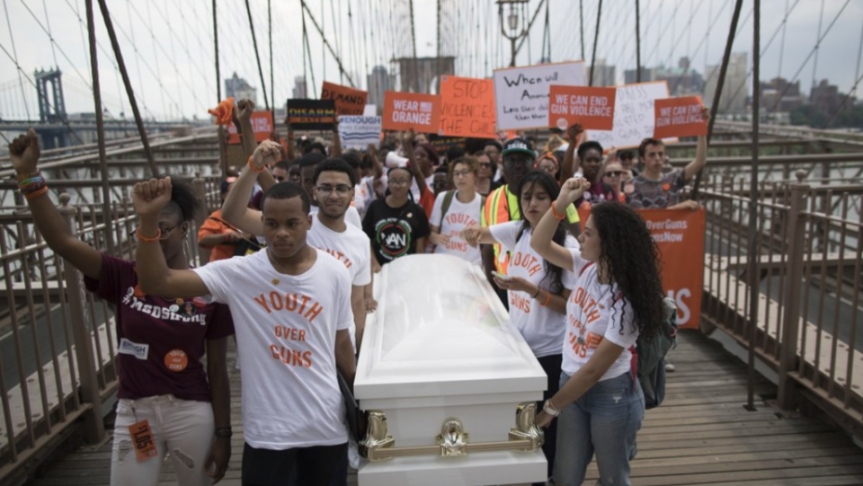
Demonstrators carry a coffin over Brooklyn Bridge during a march against gun violence, 06.02.18, in NY. | Mary Altaffer – AP

Under U.S. capitalism, industrial production and consumerism expand. Greenhouse gases increase, the climate changes, and people die. U.S. imperialism leads to wars and potentially nuclear war.

U.S. life expectancy has fallen. According to government statistics released in December, 2022, life expectancy at birth (LEB) for 2021 was 76.4 years. LEB was 77.0 years in 2020 and 78.8 years in 2019. Public health officials claimed this “was the biggest two-year decline in life expectancy since 1921-1923.”

Mothers fare badly. In 2020,19.1 mothers in general and 55.3 Black mothers died per 100,000 live births. They died from illnesses related to childbearing, most of them preventable. In the Netherlands that year, the maternal mortality rate was 1.2 mothers per 100,000 live births. In 2018, 55 nations showed a rate more favorable than that of the United States. 

Americans, mostly working-age adults, die from “diseases of despair” – substance abuse, accidental drug overdose, alcoholism, and suicide. They also died of Covid 19 infection, the U.S. rate of 332.81 Covid deaths per 100,000 population being the 16th highest in the world.

During most of the pandemic, Black people died at two or more times the rate of infected white people. Now the cumulative death rates of each group are similar, with 355 deaths of whites and 369 deaths of Blacks per 100,000 population. Cumulative Covid deaths for American indigenous peoples register at 478 deaths per 100,000 population. Vaccine skepticism may account for increased vulnerability of whites. 

The pandemic aside, Blacks and American Indians live far shorter lives than white people do. As of October 2022, LEB for Hispanics was 77.7 years; white people, 76.6 years; Blacks, 70.8 years; and American Indians, 65.2 years. In 2020, 65 nations showed longer LEB than did the United States.

Healthcare failings may have contributed to the high U.S death rates. Proposals for reform, especially for universal healthcare, center on its financing. The United States is the top healthcare spender among all nations.

Paying  $12,914 per capita for healthcare in 2021, the United States outspent second-place spender Germany whose outlay was $7383 per capita. Total spending on health that year amounted to $4.3 trillion –18.3% of the U.S. GDP. The United States accounted for 42% of healthcare spending in the world in 2018.

Healthcare in the United States is a profit center. The pricing of drugs, medical equipment, medical insurance, and services provided by hospitals and outpatient facilities in general is exorbitant.  Executives of medical supply and pharmaceutical companies, specialty physicians, and administrators of hospitals and healthcare networks receive enormous salaries.

Profitmaking hospital chains, health insurance companies, and pharmaceutical companies generate enough revenue to allow for stock buybacks and dividend payments. Over nine recent years 14 pharmaceutical companies spent $747 billion on stock buybacks. Payments to private insurance companies and private hospital networks are large enough to cover astronomically high administrative costs and profit-taking.

Some healthcare and health-promotion activities produce no revenue, or very little. They tend to receive relatively little support and skimpy funding.

  • The U.S. public health sector, charged with health education and illness prevention, is a low-priority item. Inadequate preparation and preventative measures largely accounted for the U.S. Covid-19 debacle. 
  • Insurance companies dedicate effort to denying coverage for particular diagnostic and therapeutic interventions.
  • Multi-hospital, multi-service conglomerates are cutting back on health services in rural and economical depressed areas because of decreased “productivity.” 
  • Many hospitals have recently dropped children’s hospital services as being less remunerative than care for hospitalized adults.
  • Small rural hospitals unable to pay bills have been closing down in droves throughout the nation, depriving area residents of care.
  • Specialty practitioners and hospitals often prioritize expensive medical procedures and high-technology diagnostic modes over care centering on provider – patient interaction and communication.
  • Many physicians during training opt for a specialty rather than a primary-care career, often because of income considerations. Primary care physicians now comprise only 20% of all U.S. physicians.
  • Diminished emphasis on a “medical home,” that hallmark of primary care, opens the door to inefficient, low-quality care.

Other capitalist countries have achieved long life expectancies.  The average life expectancy for 2021 in eight European countries plus Australia and Japan was 82.4 years. Their average per- capita health spending was $6,003. Japan spent $4,666 per capita on healthcare; LEB was 84.5 years.

Those countries protect healthcare as a public good, mainly because labor unions and social democratic or labor political parties apply pressure. Universal access to care is the norm. 

Universal care in the United States is but a dream. U.S. unions are weak and there is no working people’s political party. Some 25 million working age adults had no health insurance in 2021; insurance for 23% of them was inadequate. Too many have no care or fragmented care.

Reform efforts will continue in the United States, propelled perhaps by worsening life expectancy. But healthcare has its limitations. Steven Woolf, retired director of Virginia Commonwealth University’s Center on Society and Health, told an interviewer recently that better healthcare is “only a partial answer” to extending life expectancy, accounting “for about 10 to 20 percent of health outcomes.”

He explained: “Our health is really shaped by our living conditions, jobs, the wages we earn, our wealth accumulation, the education that enables us to get those jobs … The country that we live in is the richest in the world, but we have the highest level of income inequality. So, much of the resources that we need for a healthy population are not available to most of the population.”

Woolf is saying, in effect, that people die early because of inequalities, oppression, and organized greed. The United States appears as different from other rich capitalist counties. Social guarantees are fragile. The wealthy have few restraints on satisfying their wants. A besieged working class lacks voice and agency.

The prospect that reforms, alone, will restore justice and decent lives for working people is nil. They confront a voracious, extreme kind of capitalism.  Its rulers tolerate, promote, and seek out collaborators for actions and policies leading to die-offs. Think climate catastrophe, wars, and nuclear war.

In response to impending disaster, Americans desiring better and more secure lives for everyone would adjust their forward vision. Working for reforms, they would aim at something new, which is top-to-bottom social and political change. New motivation, determination and hope would be a shot in the arm.

Revolutionary change is a worldwide project, and not to be left to one people – except in special circumstances. One such was pre-1917 Czarist Russia and another would be that anomaly among capitalist nations which is the death-dealing U.S. nation.


W.T. Whitney Jr. is a political journalist whose focus is on Latin America, health care, and anti-racism. A Cuba solidarity activist, he formerly worked as a pediatrician, lives in rural Maine. W.T. Whitney Jr. es un periodista político cuyo enfoque está en América Latina, la atención médica y el antirracismo. Activista solidario con Cuba, anteriormente trabajó como pediatra, vive en la zona rural de Maine.

Peace Forces Mobilize as NATO Summit in Madrid Plans for War / by W.T Whitney Jr.

‘Yes to peace, No to NATO’: Anti-imperialist activists organized by the World Federation of Democratic Youth march against the NATO Summit that opens in Madrid on June 29. | via WFDY

The NATO Summit taking place in Madridon June 29-30 “will be transformative,”  asserted NATO Secretary General Jens Stoltenberg; it will project “a new Strategic Concept for a new security reality.” At its 50th anniversary summit, in Washington in 1999, NATO had expanded its Cold-War era mission of collective defense of Europe to include protection for democracy “within and beyond our borders.”

According to Stoltenberg on June 27, NATO will provide “support to Ukraine now, and for the future.” The “Allies consider Russia as the most significant and direct threat to our security.” NATO “will address China for the first time …[and also] the challenges that Beijing poses to our security, interests, and values.” Pacific nations – Australia, Japan, the Republic of Korea and New Zealand – will be attending a NATO summit for the first time.

The Summit provoked opposition beforehand. A “Peace Summit,” described as “the People’s Alternative to NATO and War,” gathered in Madrid on June 24-25. A conglomeration of Spanish and European anti-capitalists, environmentalists, feminists, anti-imperialists, peace activists, and spokespersons for struggles in the global South attended workshops, panel discussions, cultural presentations, and plenary sessions.

The Peace Summit made demands. First, NATO will be disbanded: “NATO violates the UN Charter … authoritarian, fascist, and colonial regimes are included in its alliance …NATO’s military interventions have destabilized and destroyed Yugoslavia, Afghanistan, and Libya. Now NATO pursues a new Cold War against China and Russia. … NATO leads the worldwide arms race … NATO’s nuclear agenda greatly endangers our survival.” Regarding environmental contamination: “The U.S. army “is the most contaminating institution on the planet … NATO generates poverty and inequalities.”

The Summit then declared, “Yes, to Peace … we need a non-militarized system of security, without nuclear arms, without foreign bases, and with a drastic reduction of military expenses. We defend a politics of active peace … [We want] investment in social progress, not in war … Europe and North America must commit to disarmament.”

The statement concluded with an invitation: “March with us against NATO and for building a world of peace.” Indeed, on June 26 thousands marched through central Madrid, their banners flying. Organizers claimed 30,000 marchers. The government reported considerably less. 

The Communist Party of Spain (PCE) and the United Left (Izquierda Unida) were the only political parties that joined with dozens of Spanish and international organizations endorsing the declaration and march. The PCE belongs to the United Left electoral coalition that, after the November 2019 general election, combined with the larger United We Can alliance (Unidas Podemos) to form a government under the leadership of Prime Minister Pedro Sánchez, head of the Socialist Party.

Sánchez issued a statement welcoming the NATO summit to Madrid. He mentioned concerns about Spain’s “southern flank,” a reference, presumablyto migrants from Africa.

PCE member Yolanda Díaz serves as labor minister and second deputy prime minister in Sánchez’s government. Even so, Enrique Santiago, secretary general of her party, on June 7 offered ideas at odds with those of the prime minister: “We don’t want the NATO summit in Madrid. The story of the Ukraine conflict is of a war foretold, what with the continuing expansion of NATO to the East … And in wars, the peoples, the workers, always lose out.” Santiago cited the risk of “nuclear confrontation” and commended the upcoming Peace Summit and “international demonstration against war on June 26.” 

In remarks two days prior to the Summit, NATO Secretary-General Jens Stoltenberg greatly heightened the urgency of the peace proponents’ fears. “At the summit,” he said, “we will strengthen our forward defenses. We will enhance our battle groups in the eastern part of the alliance.”

One report predicted that, “NATO allies will decide at a summit this week to increase the strength of their rapid reaction force nearly eightfold to 300,000 troops …  The NATO response force …currently numbers around 40,000 soldiers.” As part of efforts “to shore up the defenses on Europe’s eastern flank,” the NATO Summit will speed up arrangements for the entry of Finland and Sweden’s into the alliance

Stoltenberg spoke of a “strengthened Comprehensive Assistance Package for Ukraine” and “about the military build-up in Kaliningrad … with highly advanced weapon systems.” Partly because of Kaliningrad, “we have modernized our armed forces, our capabilities, and also increased our presence in that part of the region”.

According to the Brookings Institute, Kaliningrad, a tiny Baltic Sea, Russian-controlled enclave, located between Poland and Lithuania, “could become a new flashpoint in Russia’s war on Ukraine.” That’s because Lithuania is blocking the passage of EU-sanctioned Russian goods into the territory for delivery beyond.


W.T. Whitney Jr. is a political journalist whose focus is on Latin America, health care, and anti-racism. A Cuba solidarity activist, he formerly worked as a pediatrician, lives in rural Maine. W.T. Whitney Jr. es un periodista político cuyo enfoque está en América Latina, la atención médica y el antirracismo. Activista solidario con Cuba, anteriormente trabajó como pediatra, vive en la zona rural de Maine.

The original version of the article appeared in People’s World, June 28, 2022, http://www.peoplesworld.org/