
Colombia Opts for Peace in Rural areas, No More Drug-trafficking / by William T. Whitney Jr.

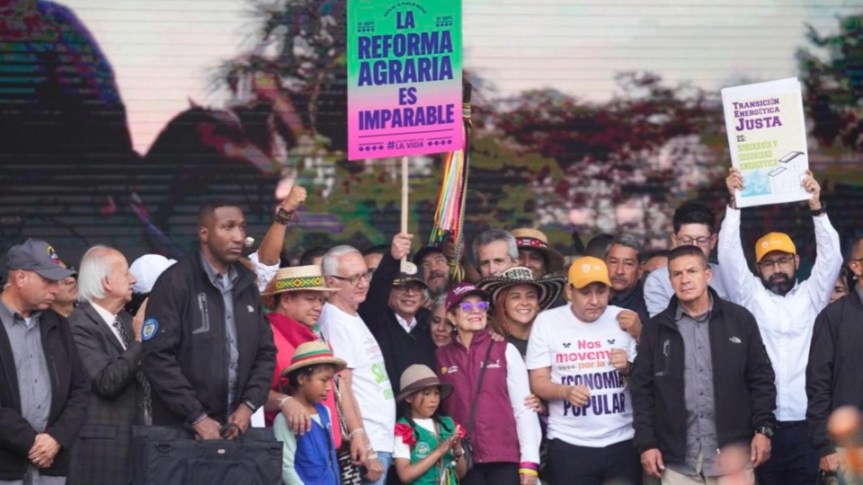
Surrounded by supporters, Colombia’s President Gustavo Petro, center, holds a sign that reads in Spanish, ‘The Agrarian Reform is Unstoppable,’ during a rally to show support for his proposed reforms, in Bogota, Colombia, Sept. 27, 2023. | Fernando Vergara / AP

South Paris, Maine


Colombian president Gustavo Petro on October 3 attended a big meeting of mostly small farmers in El Tambo, in Cauca, where “the coca economy is the main way of life for thousands of peasants.” Colombia’s first progressive president ever was presenting his government’s National Drug Policy for 2023. Petro had insisted earlier that “war on drugs has failed.” He recently expressed support for “phased decriminalization.”

His government is evidently prioritizing the present initiative, which is part of its far-reaching program for social and political reforms, now stumbling due to strong right-wing political opposition. The drug plan attends to main features of Colombian’s longstanding social disaster. They include:  dispossession leading to consolidation of large land holdings, agricultural underdevelopment, migrations leading to precarious lives often in cities, widespread lethal violence; and great wealth accumulated by top-level distributers and their financial backers.

The government’s new plan promises much, especially to working people both in Colombia and abroad. Freed of the monopolization of illegal drug production and commercialization, rural areas might shift to diversified agricultural production and expanded support systems. Prospects for community-development programs might improve and those rural Colombians forced into cities might return.  

By reducing that fraction of the domestic and international economy represented by drug production and marketing, the government would, in effect, be redistributing wealth, to a degree. And any success the new plan achieves in cutting back on drug commercialization might translate into reduced visibility abroad and, consequently, into lessened appeal to U.S. interventionists who have often justified military intrusions on that basis.

The plan calls for 27 “territorial spaces” in 16 departments and in Bogota, along with 51 “inter-institutional or bilateral technical working-groups.” Each one would hold three conferences with strategic allies, five with sectors drawn from the Joint Committee on Coordination and Follow-up. Other gatherings would involve women, young people, and prevention specialists.

Government spokespersons focused on the program’s two pillars. One of them, called “oxygenation,” supports those “territories, communities, people and ecosystems” adversely affected by drug-trafficking. It would support the transition to legal economies and reduce “vulnerabilities of regions and populations.” Measures would be taken that advance “environmental management and climate action toward … restoring regions” adversely affected by the narco-economy. The personal use of “psychoactive substances” will be dealt with on the basis of public health and human rights.

The other pillar, called “asphyxiation,” targets “the strategic nodes of the criminal system that generates violence” and “profits most from this illegal economy.”  The object would be to interfere with the “capacities and income” of the strongest drug-trafficking organizations and to do so so “systematically” and with consideration “of their complexity and relation with other economies both legal and illegal.”  Persons involved in production and trafficking would benefit from destigmatization and social justice.

The new plan has a slogan: “sewing life and burying narco-trafficking.” The aim is to remove 222,400 acres from coca and marihuana cultivation, reduce cocaine production by 43%, and block at least $55 billion in illegal financial gains. The plan would interfere with irregular banking and financial maneuvers and reduce both deforestation and greenhouse gas emissions.

Colombia’s illegal drug industry remains well entrenched, despite the drug war waged from 2000 on under the auspices of US Plan Colombia, a venture that absorbed billions of U.S. taxpayer dollars. A United Nations report cites a 13% one-year increase in land given over to illegal crops, as of 2022. It takes note of a recent “summit meeting [in Bogota] of narcotrafficking capos from Albania, Poland, Spain and Colombia.” 

The relentlessness of cocaine and marihuana production in Colombia may have led the U.S. government to recently stop monitoring the acreage of illegal crop cultivation. Indeed, after four decades of involvement, the U.S. government has abandoned its war against narco-trafficking in Colombia, according to analyst Aram Aharonian. Still, he reports, “weapons manufacturers” are benefiting, along with workers whose livelihood depends on narco-trafficking.

Petro’s new drug policy is significant mostly because it pursues objectives of the 2016 Peace Agreement which ended armed conflict between Colombia’s government and the FARC insurgency. Important parts of the new drug plan coincide with major provisions of that Agreement that were never implemented.

Agrarian reform matches with improving rural life generally. Solving the illicit drug problem was a goal of the Peace Agreement and now is the essence of Petro’s plan. The guarantee under the Peace Agreement of safety for former combatants never took root. The attacks against them are largely related to drug-trafficking, and now that will be dealt with.

Violence has been, and remains, pervasive. During just 13 months of the Petro government, assassins took the lives of 198 community and human-rights leaders and 43 former combatants.

A comprehensive report on the Petro government’s shepherding of  the peace process highlights the association of continuing violence with narco-trafficking. Indeed, “broad regions of the country” see persisting collusion of the police and military with paramilitaries and with “smaller narco-trafficking gangs and narco-trafficking structures.”  

Affirmation of the Petro government’s new campaign against drug trafficking comes from the report in June of the United Nations Mission to Verify the Peace Agreement. It emphasizes “the importance of peace initiatives and of efforts being made to expand the presence of the state so that vulnerable communities may be protected, especially in rural areas.”

Much is at stake as a government undertakes to control and end the production and marketing of illegal drugs. According to the UN’s Economic Commission for Latin America, “Problems associated with the production, trafficking, and consumption of drugs in Latin America affect the population’s quality of life, contribute to forms of social exclusion and institutional weakness, generate much insecurity and violence, and corrode governance in some countries.”  


W.T. Whitney Jr. is a political journalist whose focus is on Latin America, health care, and anti-racism. A Cuba solidarity activist, he formerly worked as a pediatrician, lives in rural Maine. W.T. Whitney Jr. es un periodista político cuyo enfoque está en América Latina, la atención médica y el antirracismo. Activista solidario con Cuba, anteriormente trabajó como pediatra, vive en la zona rural de Maine.

Prisoner Simón Trinidad Is Victim of Toxic US – Colombia Alliance / by W. T. Whitney Jr

In this Jan. 13, 2002 photo, the Commander of the Revolutionary Armed Forces of Colombia (FARC), Simón Trinidad, reads a declaration during a press conference in Los Pozos, Colombia. | AP

Simón Trinidad’s 72nd birthday is July 30. Don’t think about sending him a card. U.S. prison authorities have blocked his mail since 2004. Extradited from Colombia, he would remain in solitary confinement until 2018. He is lodged in a maximum-security federal prison in Colorado.

As a leader of the Revolutionary Armed Forces of Colombia (FARC), Trinidad was in charge of political education and propaganda. He was captured in Ecuador in 2003, with CIA assistance. He had been conferring there with a United Nations official about the release of FARC-held prisoners.

Transferred to Colombia, Trinidad was a high-profile prisoner.  He had family connections with upper elements of Colombian society and had been a lead FARC negotiator in peace talks with Colombia’s government from 1998 to 2002. The Colombian government and its U.S. ally might have detected a propaganda advantage in a public trial and severe punishment. Putting him away, out of sight, as a prisoner of war in Colombia would have offered little gain.

Ideas may also have cropped up that Trinidad extradited would be an object lesson for Colombia’s political dissidents, display damage done to the FARC, and advertise the newly strengthened U.S. – Colombian alliance. Colombian officials asked the U.S. government to request his extradition.

U.S. Plan Colombia took effect in the early 2000s. At the cost eventually of more than $10 billion, the U.S government provided military equipment, intelligence services, and funding for Colombia’s military, police, and prisons. The purpose, claims the U.S. Global Leadership Coalition was “to provide security and economic development assistance to help combat the spread of narcotics … and promote economic growth.”

Narco-trafficking was a secondary matter. Plan Colombia was mainly about fighting leftist insurgents, primarily the FARC. A stiffened alliance was background to the targeting of Trinidad and to enhanced political oppression in Colombia.

Interviewed recently, Colombian historian Renán Vega Cantor mentions “80 years, during which Colombia became the main US ally in the region.” He cites seven U.S. military bases, “a U.S. presence in 50 [other] places …[and] 25 secret U.S. agencies” operating in Colombia.  Crucially, the paramilitaries, long notorious as agents of deadly violence, are “Colombian Army proxies sponsored, financed, trained, and supported by the United States, which have carried out all kinds of atrocities that the Armed Forces, openly, cannot legally carry out.”  

Says Vega Cantor, “Plan Colombia militarized [Colombian] society in an impressive way, propelling the growth of the Colombian Armed Forces to unthinkable levels.” Colombia presently fields 500,000 troops; its army is one of the world’s largest. Some 50,000 Colombian military and police officers received training at the U.S. Army’s School of the Americas in Georgia, referred to by some as the “school of assassins.”

The U.S. government has readily accepted the cruelty marking its partner’s civil war. Cruelty was on display recently. The Truth Commission, set up via the 2016 Peace agreement between the FARC and Colombian government released its ten-volume Final Report on June 28, 2022. Cruelty portrayed there is vast enough to have infected the criminal justice system of its ally, or so it seems.    

Analyst Camilo Rengifo Marín, referring to the Report, takes note of “an armed conflict of more than 60 years that goes on still and led to more than 10 million victims of whom 80 percent were civilians.” He writes that, “50.770 were kidnapped, 121.768 disappeared, 450.664 murdered and 7.7 million forcibly disappeared.” Another observer indicates that, “The report is critical of the role played by various U.S. administrations in developing security policies, in militarizing society, and in hiding relations between paramilitary groups and the Colombian Army.”

The Final Report itself states that, “During many years, the victims got little attention and often were defended only by human rights organizations or by churches. From torture victims and kidnappings by guerrillas … to victims belonging to political movements like the Patriot Union and other opposition groups, those victims were invisible to most Colombians over the course of decades.” 

Simón Trinidad has been all but invisible in the United States. U.S. authorities sought his extradition solely because of alleged narco-trafficking. After all, international law does forbid extradition on political grounds, like rebellion. The indictment greeting Trinidad on arrival in Washington charged him with providing material support to terrorists, taking hostages, and dealing in illicit drugs.

It took four trials between 2006 and 2008 to exonerate him on the charges of narco-trafficking and providing material support for terrorists, and to convict him of conspiring to capture three U.S. drug-war contractors.  FARC gunfire had brought down their plane. The idea of conspiracy derived exclusively from Trinidad’s status as a FARC member. 

In 2008, 57-year-old Trinidad received a 60 -year sentence. Since 2018, he’s been allowed to eat a midday meal in a dining hall. Phone calls are rare. Emails and periodicals are prohibited, along with letters. Trinidad’s only visitors are his lawyers and rarely his brother and Colombians conferring about Peace-Agreement arrangements.

Trinidad faces charges in Colombia relating to possible crimes committed during the Civil War. The Peace Agreement provided for a “Special Jurisdiction for Peace” (JEP in Spanish) whose role is to decide on punishment or pardon for former combatants on both sides charged with crimes. To be pardoned they must tell the truth.

Simón Trinidad is eligible to appear before the JEP. Trinidad’s U.S. lawyer Mark Burton indicated via email that a first step towards his virtual appearance there is for Colombia’s Foreign Ministry to ask the U.S. Justice Department to approve of Trinidad’s appearance before the JEP.

Burton is hopeful. The new foreign minister of the incoming Gustavo Petro government may be receptive; Álvaro Leyva Duran “worked on the negotiating team of the FARC in Havana” during the peace talks, Burton recalls. The JEP could pardon Trinidad or require court appearances in Colombia. Either way, pressure would mount for the U.S. government to commute his sentence to allow for deportation.

President-elect Gustavo Petro, campaigning, protested the ongoing killings of community leaders and former FARC combatants. A central demand of his Historical Pact coalition has been full implementation of the 2016 peace agreement. Ultimately, relief for Trinidad rests on realizing peace in Colombia.

Any affinity of the U.S. government with the goals of the new Historical Pact government would be good news for Trinidad. For the United States to back away, even a little, from intervening in Colombia would also be good news.  Secretary of State Blinken, speaking with Petro, “underscored our countries’ shared democratic values and pledged to further strengthen the 200-year U.S.-Colombia friendship,” according to an announcement on June 20. The mouthing of hypocrisy is bad news.

Peace in Colombia, and Trinidad’s fate, depends on the U.S. relaxing its cop-on-the-beat posture for an entire region, that of monitoring any and all stirrings of fundamental political and social change. A new kind of U.S. openness, however, doesn’t jibe with U.S. determination to protect the interests of corporations and the moneyed classes at home and abroad.

Until a new anti-imperialist consciousness has inspired a meaningful and potentially effective, all-points opposition, collective effort is in order now towards organizing and fighting for Simón Trinidad’s return to Colombia. Even so, that struggle would have to fit within a larger context of anti-imperialism, peace now in Colombia, and support for the new government there.


W. T. Whitney Jr. is a political journalist whose focus is on Latin America, health care, and anti-racism. A Cuba solidarity activist, he formerly worked as a pediatrician, lives in rural Maine. W.T. Whitney Jr. es un periodista político cuyo enfoque está en América Latina, la atención médica y el antirracismo. Activista solidario con Cuba, anteriormente trabajó como pediatra, vive en la zona rural de Maine.

People’s World, July 18, 2022, https://peoplesworld.org/