
Image via OWP
South Paris, Maine
Powerful forces weighing on the Haitian people keep rebellion in check. Predators armed with guns, and others with economic tools, have free rein. The U.S. government, recently rededicated to regional control – see the 2025 National Security Strategy – has long beat up on Haiti. All the while, Haitians’ lives and living are precarious.
U.S.-based Vectus Global is fighting gangs in Haiti. Its head is Eric Prince, well-positioned U.S. impresario of war-for-hire. His company’s drones killed 1,243 gang members and bystanders during a 10-month period. How can that be?
Haiti’s last elections took place in 2016. President Jovenel Moïse was murdered in 2021. Parliament closed down on 2023. The “Core Group” of nations appointed Ariel Henry as prime minister in early 2022, shortly after Moïse’s still unsolved murder. Escalating gang violence and delay in arranging for elections forced Henry’s resignation in 2024.
The U.S. government and the CARICOM group of nations replaced him with the Transitional Presidential Council (TPC), charging it with preparing for elections. Parliamentary elections projected for August 2026 probably won’t happen. Prime Minister Alix Didier Fils-Aime, a TPC appointee, had invited Vectus Global to Haiti.
A faction within the nine-person TPC defied U.S. pressure to seek Fils-Aime’s dismissal on grounds of corruption and weak response to gang violence. Three U.S. naval vessels arrived off Port-au-Prince four days before the TPC was scheduled to expire, on February 7. The TPC did go out of existence, and Prime Minister Fils-Aime did keep his job. He and his ministers constitute the entire Haitian government.
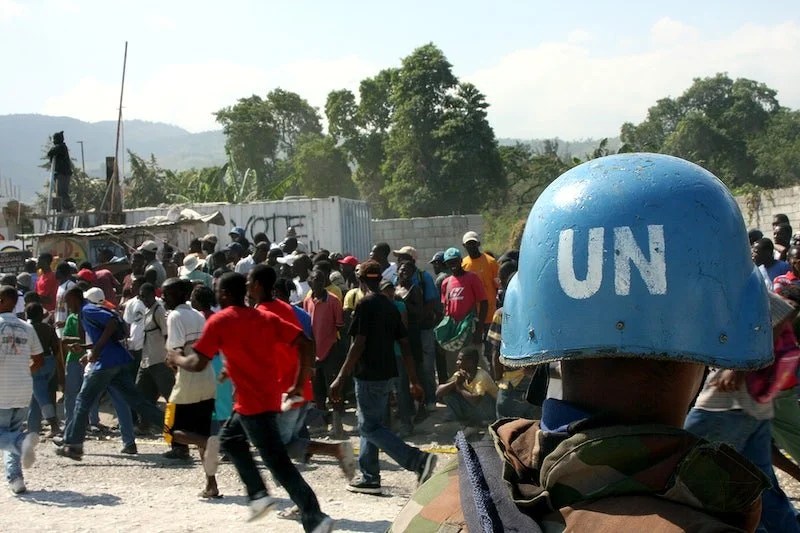
Gang violence had been expanding and, with UN Security Council endorsement, the U.S. government in 2024 arranged for, and partially funded, the Kenya-led Multinational Security Support (MSS) mission to Haiti. Funding and troop contributions lagged, and the Security Council in late 2025 approved a U.S-proposed resolution for transforming the MSS nto a 5,500 troop “Gang Suppression Force.” It will be collaborating with Haiti’s police.
The theme so far here has been foreign control of Haiti and her people, especially U.S. control. The U.S. government is well-versed in this, what with military occupation (1915-1934), backing of the father-and-son Duvalier dictatorship (1957-1986), and U.S.- inspired coups in 1991 and 2004.
Haitians’ interaction with the United States these days is mediated mostly through migration. As of March 2025, 330,735 undocumented Haitians were living legally in the United States by virtue of Temporary Protected Status (TPS). That program, established in 1990, provides relief for irregular migrants to the United States facing deportation to a dangerous homeland. The Trump administration determined that TPS for Haiti would end on February 3, 2016. A federal judge in February 2 ruled against that action. An appeals court agreed on March 6, and the Supreme Court will finally decide.
Dead end
If TPS ends, Haitians returning to their country will be in trouble. According to one report, “Many repatriated Haitians arrive with nowhere to go–nearly 20% were already internally displaced before leaving the country.” As of February 2025, 10% of Haiti’s population – 1,450,254 individuals – had already been displaced from their previous homes, and are living in make- shift housing and tents.”
Displacement has resulted from actual and/or threatened violence at the hands of gangs. Gangs now control large sections of Haiti’s cities – 90% of Port-au-Prince – and areas in rural Haiti, mostly in the North. Gangs killed nearly 6000 people in 2025 and more than 16,000 since 2022. They have unleashed a wave of sexual violence. Children, who are the primary victims, make up half of the gangs’ fighters.
Meanwhile, no sign appears of any moderate or left-leaning political movement or party actively pushing for democracy and social justice in Haiti. Although the social democratic Lavalas Party was the vehicle for Jean Bertrand Aristide serving as Haiti’s president off and on between 1990 and 2004 – and still surfaces on the Internet – its influence is nil. Our question is this: why are progressive resistance forces absent or inconsequential in circumstances of great danger for Haiti’s people?
Power plus
One determining element may be the fact of a political void. Opposition movements usually take aim at an objectionable government. Only a shell of government exists in Haiti. It so lacks substance as to hardly qualify as a target. On defeating Haiti’s powers-that-be, a progressive resistance movement would be charged with building entirely new governmental institutions and administrative components, not to speak of new vision and
commitment.
More fundamentally: realization of progressive aspirations would now entail confrontation with power so overwhelming as to render actual resistance as almost unthinkable. Part of that power is U.S. power, as examined above. But most certainly, power shows in Haiti too, specifically with gangs and with Haiti’s wealthy elite.
The gangs hold a near monopoly on lethal violence, as is evident in the numbers cited above. Gangs emerged during the presidencies of Michel Martelly (2011-2016) and Jovenel Moïse (2017-2021). Protesters intermittently filling the streets of Port-au-Prince were demanding relief from high prices, shortages, and governmental corruption. Haiti’s elite, seeking protection, paid the gangs and supplied weapons and ammunition.
The gangs multiplied, joined in competing alliances, and found their own generous sources of income. According to a United Nations report, “Gangs dominate supply chains and extort commerce and humanitarian transport routes, giving them huge power to siphon off Haiti’s resources and destabilize its economy.” They profit from “extortion, kidnapping, drug trafficking and arms sales … Firearms … are mostly trafficked to Haiti from the United States for local use.”
The Report says that money the gangs generate is “smuggled through bulk amounts of cash, unregulated money transfer services, or front companies – many of which are linked to politically-connected economic elites.”
Really big bourgeoisie
Wealthy oligarchs control Haiti’s commerce and industries. In a comprehensive report from 2025, journalist Eric Andrew-Gee refers to “the dozen or so families of European or Middle Eastern descent who largely control Haiti’s impoverished economy” and are known for “dodging taxes, financing politicians and funding gangs as private militias …[A] rapacious economic elite …own virtually everything of value in the country.” One powerful family’s wealth comes from “soap and oil,” another’s from “steel, telecom, banking, oil and food,” and another’s from “supermarkets, news outlets and agribusiness concerns.”
Victimization of Haiti’s workforce, and of all Haitians, by the rich and powerful complements oppression at the hands of gangs and U.S. interventionists. The scenario clearly is that of class against class. Struggle on that basis apparently has to wait. Prisonlike circumstances require that Haitians confine themselves to fighting for their own survival.
This combination of gang violence, U.S. intrusions, and exploitation by Haiti’s rich and powerful has to be crushing, especially for a people who are deprived and suffering. Two thirds of the population are poverty-stricken. More than half of the people require humanitarian assistance. According to the World Food Program, more than half of all Haitians suffered from “acute food insecurity” in mid-2025. Most Haitians are deprived of anything approaching adequate healthcare and housing.
Additionally, Haiti’s working people and certainly unionists play only a marginal role within Haiti’s overall economy. They are weak and ill-prepared for fight-back. Half of all workers labor in agriculture, fishing or forestry. Those occupations account for only 20% of the country’s GDP. Remittances produce another 20%. Industry in Haiti in 2023 did contribute
25% of the GDP. But only 12.4% of all workers had manufacturing jobs. And some of those are disappearing, notably in Haiti’s garment industry, source of 5% of the county’s GDP. Factories are closing. Haiti’s unemployment hovers around 15%.
Division
Haiti’s African-descended people, through the generations, have consistently harbored a big impediment to entering into struggle, one existing apart from current circumstances. From slavery times, through the period of rebellion and independence struggle (1791-1804), and subsequently into the present era, Haitians have splintered according to class and skin color. Throughout, a minority class of more privileged, lighter-skinned, and French-speaking mulattos have remained apart. Their antecedents collaborated with the French slave owners.
They gained dominance over Haiti’s Black working-class masses, as national life developed. The tension remains. In his writings, Communist leader Jacques Roumain (1907-44) put the population’s social-class divide ahead of color differences. Author Philippe-Richard Marius summarizes: “The Haitian Revolution defeated White supremacy and gave rise to a new ruling class divided into color categories but united in the subjugation, exclusion, denigration, and exploitation of the Black working classes.”
W.T. Whitney, Jr., is a political journalist whose focus is on Latin America, health care, and anti-racism. A Cuba solidarity activist, he formerly worked as a pediatrician and lives in rural Maine.
 COMMUNIST PARTY OF MAINE