
Why don’t the Haitian people rebel against non-stop oppression and distress? / By W.T. Whitney Jr.

Image via OWP

South Paris, Maine


Powerful forces weighing on the Haitian people keep rebellion in check. Predators armed with guns, and others with economic tools, have free rein. The U.S. government, recently rededicated to regional control – see the 2025 National Security Strategy – has long beat up on Haiti. All the while, Haitians’ lives and living are precarious.

U.S.-based Vectus Global is fighting gangs in Haiti. Its head is Eric Prince, well-positioned U.S. impresario of war-for-hire. His company’s drones killed 1,243 gang members and bystanders during a 10-month period. How can that be?

Haiti’s last elections took place in 2016. President Jovenel Moïse was murdered in 2021. Parliament closed down on 2023. The “Core Group” of nations appointed Ariel Henry as prime minister in early 2022, shortly after Moïse’s still unsolved murder. Escalating gang violence and delay in arranging for elections forced Henry’s resignation in 2024.

The U.S. government and the CARICOM group of nations replaced him with the Transitional Presidential Council (TPC), charging it with preparing for elections. Parliamentary elections projected for August 2026 probably won’t happen. Prime Minister Alix Didier Fils-Aime, a TPC appointee, had invited Vectus Global to Haiti.

A faction within the nine-person TPC defied U.S. pressure to seek Fils-Aime’s dismissal on grounds of corruption and weak response to gang violence. Three U.S. naval vessels arrived off Port-au-Prince four days before the TPC was scheduled to expire, on February 7. The TPC did go out of existence, and Prime Minister Fils-Aime did keep his job. He and his ministers constitute the entire Haitian government.

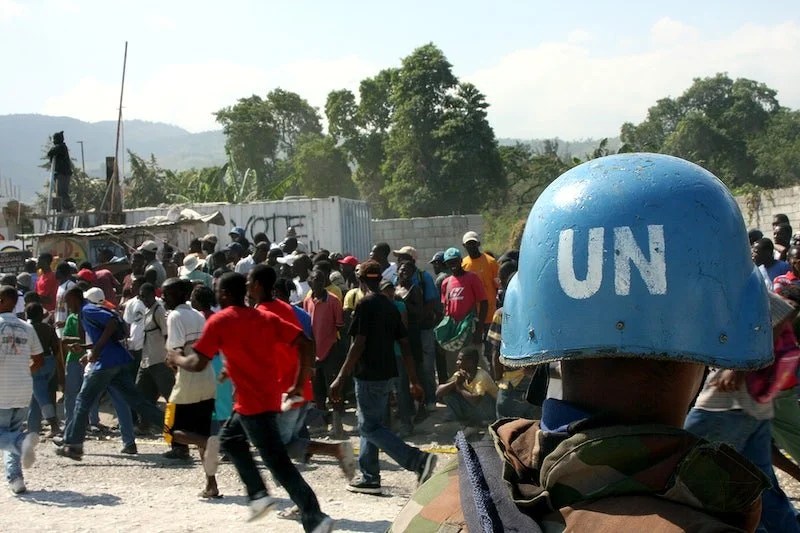
Gang violence had been expanding and, with UN Security Council endorsement, the U.S. government in 2024 arranged for, and partially funded, the Kenya-led Multinational Security Support (MSS) mission to Haiti. Funding and troop contributions lagged, and the Security Council in late 2025 approved a U.S-proposed resolution for transforming the MSS nto a 5,500 troop “Gang Suppression Force.” It will be collaborating with Haiti’s police.

The theme so far here has been foreign control of Haiti and her people, especially U.S. control. The U.S. government is well-versed in this, what with military occupation (1915-1934), backing of the father-and-son Duvalier dictatorship (1957-1986), and U.S.- inspired coups in 1991 and 2004.

Haitians’ interaction with the United States these days is mediated mostly through migration. As of March 2025, 330,735 undocumented Haitians were living legally in the United States by virtue of Temporary Protected Status (TPS). That program, established in 1990, provides relief for irregular migrants to the United States facing deportation to a dangerous homeland. The Trump administration determined that TPS for Haiti would end on February 3, 2016. A federal judge in February 2 ruled against that action. An appeals court agreed on March 6, and the Supreme Court will finally decide.

Dead end

If TPS ends, Haitians returning to their country will be in trouble. According to one report, “Many repatriated Haitians arrive with nowhere to go–nearly 20% were already internally displaced before leaving the country.” As of February 2025, 10% of Haiti’s population – 1,450,254 individuals – had already been displaced from their previous homes, and are living in make- shift housing and tents.”

Displacement has resulted from actual and/or threatened violence at the hands of gangs. Gangs now control large sections of Haiti’s cities – 90% of Port-au-Prince – and areas in rural Haiti, mostly in the North. Gangs killed nearly 6000 people in 2025 and more than 16,000 since 2022. They have unleashed a wave of sexual violence. Children, who are the primary victims, make up half of the gangs’ fighters.

Meanwhile, no sign appears of any moderate or left-leaning political movement or party actively pushing for democracy and social justice in Haiti. Although the social democratic Lavalas Party was the vehicle for Jean Bertrand Aristide serving as Haiti’s president off and on between 1990 and 2004 – and still surfaces on the Internet – its influence is nil. Our question is this: why are progressive resistance forces absent or inconsequential in circumstances of great danger for Haiti’s people?

Power plus

One determining element may be the fact of a political void. Opposition movements usually take aim at an objectionable government. Only a shell of government exists in Haiti. It so lacks substance as to hardly qualify as a target. On defeating Haiti’s powers-that-be, a progressive resistance movement would be charged with building entirely new governmental institutions and administrative components, not to speak of new vision and
commitment.

More fundamentally: realization of progressive aspirations would now entail confrontation with power so overwhelming as to render actual resistance as almost unthinkable. Part of that power is U.S. power, as examined above. But most certainly, power shows in Haiti too, specifically with gangs and with Haiti’s wealthy elite.

The gangs hold a near monopoly on lethal violence, as is evident in the numbers cited above. Gangs emerged during the presidencies of Michel Martelly (2011-2016) and Jovenel Moïse (2017-2021). Protesters intermittently filling the streets of Port-au-Prince were demanding relief from high prices, shortages, and governmental corruption. Haiti’s elite, seeking protection, paid the gangs and supplied weapons and ammunition.

The gangs multiplied, joined in competing alliances, and found their own generous sources of income. According to a United Nations report, “Gangs dominate supply chains and extort commerce and humanitarian transport routes, giving them huge power to siphon off Haiti’s resources and destabilize its economy.” They profit from “extortion, kidnapping, drug trafficking and arms sales … Firearms … are mostly trafficked to Haiti from the United States for local use.”

The Report says that money the gangs generate is “smuggled through bulk amounts of cash, unregulated money transfer services, or front companies – many of which are linked to politically-connected economic elites.”

Really big bourgeoisie

Wealthy oligarchs control Haiti’s commerce and industries. In a comprehensive report from 2025, journalist Eric Andrew-Gee refers to “the dozen or so families of European or Middle Eastern descent who largely control Haiti’s impoverished economy” and are known for “dodging taxes, financing politicians and funding gangs as private militias …[A] rapacious economic elite …own virtually everything of value in the country.” One powerful family’s wealth comes from “soap and oil,” another’s from “steel, telecom, banking, oil and food,” and another’s from “supermarkets, news outlets and agribusiness concerns.”

Victimization of Haiti’s workforce, and of all Haitians, by the rich and powerful complements oppression at the hands of gangs and U.S. interventionists. The scenario clearly is that of class against class. Struggle on that basis apparently has to wait. Prisonlike circumstances require that Haitians confine themselves to fighting for their own survival.

This combination of gang violence, U.S. intrusions, and exploitation by Haiti’s rich and powerful has to be crushing, especially for a people who are deprived and suffering. Two thirds of the population are poverty-stricken. More than half of the people require humanitarian assistance. According to the World Food Program, more than half of all Haitians suffered from “acute food insecurity” in mid-2025. Most Haitians are deprived of anything approaching adequate healthcare and housing.

Additionally, Haiti’s working people and certainly unionists play only a marginal role within Haiti’s overall economy. They are weak and ill-prepared for fight-back. Half of all workers labor in agriculture, fishing or forestry. Those occupations account for only 20% of the country’s GDP. Remittances produce another 20%. Industry in Haiti in 2023 did contribute
25% of the GDP. But only 12.4% of all workers had manufacturing jobs. And some of those are disappearing, notably in Haiti’s garment industry, source of 5% of the county’s GDP. Factories are closing. Haiti’s unemployment hovers around 15%.

Division

Haiti’s African-descended people, through the generations, have consistently harbored a big impediment to entering into struggle, one existing apart from current circumstances. From slavery times, through the period of rebellion and independence struggle (1791-1804), and subsequently into the present era, Haitians have splintered according to class and skin color. Throughout, a minority class of more privileged, lighter-skinned, and French-speaking mulattos have remained apart. Their antecedents collaborated with the French slave owners.

They gained dominance over Haiti’s Black working-class masses, as national life developed. The tension remains. In his writings, Communist leader Jacques Roumain (1907-44) put the population’s social-class divide ahead of color differences. Author Philippe-Richard Marius summarizes: “The Haitian Revolution defeated White supremacy and gave rise to a new ruling class divided into color categories but united in the subjugation, exclusion, denigration, and exploitation of the Black working classes.”


W.T. Whitney, Jr., is a political journalist whose focus is on Latin America, health care, and anti-racism. A Cuba solidarity activist, he formerly worked as a pediatrician and lives in rural Maine.
US imperialist war against Haiti / By W. T. Whitney Jr.

South Paris, Maine


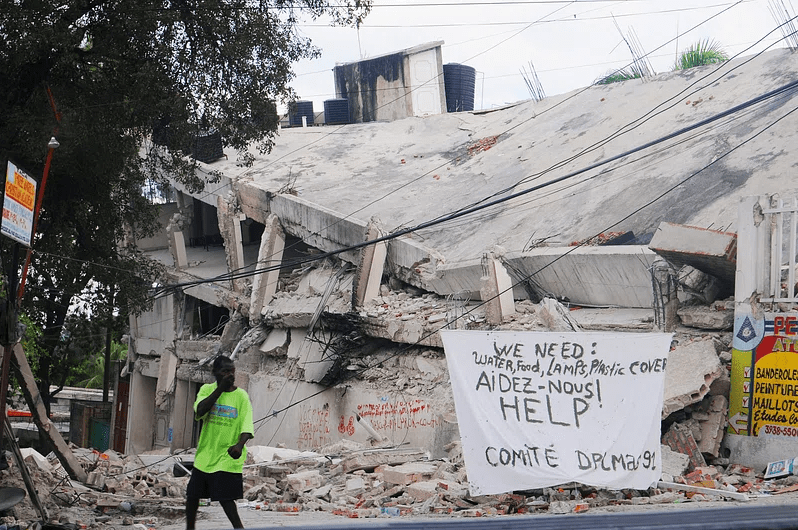
The Trump administration on June 27 announced that Temporary Protected Status (TPS) applying to half a million Haitians living in the United States will end on September 2. That total includes 300,000 people who, having fled unrest and violence, gained TPS in June 2024 under the Biden administration; 200,000 other Haitians who entered following a terrible earthquake in 2010 received TPS during Obama’s presidency.

Haitians not voluntarily returning to their country or not qualifying for legal immigration status otherwise face deportation. A spokesperson for the Department of Homeland Security was reassuring: “The environmental situation in Haiti has improved enough that it is safe for Haitian citizens to return home.” That is not so.

A State Department travel advisory on Haiti in September 2024 tells U.S. citizens, “Do not travel to Haiti due to kidnapping, crime, civil unrest … Crimes involving firearms are common in Haiti …” Lawyer Aaron Reichlin-Melnick of the American Immigration Council insists that, “This is NOT a safe place to send people. It’s a death sentence.”

Desperation

In truth, chaos and devastation are going to speed the deaths of many Haitians. According to a recent report from the International Organization for Migration of the United Nations, “Nearly 1.3 million people have been forced to flee gang violence in Haiti and seek refuge elsewhere within the Caribbean country … This represents a 24 per cent increase from December 2024.”

The report adds that, “Behind these numbers are so many individual people whose suffering is immeasurable; children, mothers, the elderly, many of them forced to flee their homes multiple times.” The gangs, unified under the name Viv Ansanm, engage in stealing, killing, extorsion, and destruction.

For a decade and more, Haitians have repeatedly protested and mobilized in the streets against high prices and shortages. Business owners and the wealthy have funded the gangs in order to protect their properties and interests against popular mobilizations. The U.S. government turns a blind eye to weapons entering Haiti from the U.S. Analyst Seth Donnelly speaks of “Death squads … financed by members of Haiti’s upper class and heavily armed by major weapons flowing into Haiti from Florida.”

This account of Haitians in distress and of the U.S. government covering up the truth points to U.S. domination there that that differs from the targeting of Gaza and Iran. However, each of these situations as varied as they are, have characteristics defining them as imperialist interventions.

Important here is the connection between imperialism and capitalism. It looks like this: at a certain stage in history, imperialism came to represent a way for nations to be able to improve the capabilities of corporations to generate wealth. Therefore, fight against imperialism is fight against capitalism, because imperialism derives from capitalism. It follows that opposition to the excesses of U.S. imperialism in Haiti fits within customary anti-capitalist struggle. But one needs to appreciate the imperialist nature of U.S. interventions in Haiti. That’s the object of what follows here.

Rule from afar

President Jovenel Moïse, wealthy and a major embezzler of public funds, was assassinated for uncertain reasons by US -organized mercenaries in 2021. Subsequently, a governing body appointed by the so-called Core Group has supervised Haiti’s affairs. The Core Group represents key North American and European governments.

Garry Conille, Haiti’s de facto prime minister, in June 2024 welcomed to Haiti 400 Kenyan troops who were the first contingent of the UN-authorized and partially-U.S.-funded Multinational Security Support Mission. They would be fighting the gangs.  Full funding and the full complement of 2500 troops sent by participating nations have fallen short. Meanwhile, killings and internal displacement continue.

According to the New York Times, Eric Prince has recently sent weapons to Haiti and will soon dispatch 150 mercenary troops there. He has introduced drones that have killed at least 200 people. Prince was a big donor to President Trumps’s 2016 campaign and is by far the lead U.S. empresario of mercenary warfare. Who pays Prince is unspecified.

As if Haiti’s government is the prime actor in this drama, the Times report portrays that government as “turning to private military contractors equipped with high-powered weapons, helicopters and sophisticated surveillance and attack drones to take on the well-armed gangs.” Haiti’s government, in fact, is on leave – is AOL.

History with a logic

Nothing about this train of grief is by chance. Powerful forces – imperialists abroad and oligarchs within – remain determined, it seems, that a people-centered government will never take root in Haiti. Once, there had been an opportunity.

Cooperating with Canada and France, the U.S. government in 2004 backed the paramilitaries who removed President Jean-Bertram Aristide from power, along with his progressive Lavalas political party. Earlier in 1991, CIA-affiliated paramilitaries did likewise.

President Aristide’s overwhelming electoral victory in 1990 and Lavalas presidential candidate René Préval’s victory in 1995 represented the first and second democratic elections, respectively, in Haiti’s history. They were the last ones, so far. U.S. Secretary of State Hilary Clinton engineered Michel Martelly’s election as president in 2010. Jovenel Moïse’s election in 2016 was marked by electoral corruption.  No elections of any kind have taken place since that year.

Following the U.S. coup against Aristide in 2004, the U.S. government, United Nations officials and the Core Group (of imperialist countries) together installed, the “United Nations Stabilization Mission in Haiti” (MINUSTAH).  Under Core Group supervision, MINUSTAH imposed a military occupation from 2004 until 2017.  Reports abounded of destruction, dying, disease – particularly cholera – and sexual violence on the part of occupying troops. The Haitian people’s real needs went begging.  

Enslaved workers in what would become Haiti rebelled in 1791 and established national independence in 1804. Between then and 1991, when Aristide first became president, Haiti was under steady assault from foreign powers. The result was foreclosure on the country’s political and social development.

France pressured independent Haiti into providing reimbursement for French plantation owners’ loss of enslaved labor. Haiti borrowed money to pay. Vast debt obligations continued into the 20th century. The U.S. government refused for decades to trade with Haiti or recognize her independence. It carried out a brutal military occupation from 1915 until 1934 and fully backed the Duvalier dictatorship (1957-1986).

A flexible imperialism

U.S. oppression of Haiti takes place in ways other than the devices imperialists usually rely on. Intent upon accumulating wealth, they go abroad to capture natural resources like oil and try to control strategically placed geographic locations. U.S. imperialists, partnering with Israel, are pursuing both of these objectives in Palestine and Iran.

Haiti offers nothing to compare. Low-wage industry beckons but garment manufacturing, active in Haiti, is only a weak draw. However, Haiti presents other attractions for imperialists that are very much in line with goals of extending control and generating wealth.

Haiti’s achievement of national independence surely represented a great upset of colonial trade arrangements, and these had prepared the way toward capitalist industrialization. Early U.S. capitalists condemned happenings in Haiti. That attitude undoubtedly assured Haiti a place on the U.S. blacklist.  Maybe the stigma remains.  

Karl Marx explains that, “direct slavery is as much the pivot of bourgeois industry as are machinery, credit, etc. Without slavery you would have no cotton; without cotton you have no modern industry. It is slavery that gave the colonies their value, it is the colonies that created world trade, and world trade is the precondition for large-scale industry.”

One reason why U.S. imperialists make Haitians miserable is that, in doing so, they create a model image of massed people of color desperate to survive. That image, widely accepted, has possible use in projecting social precariousness as a constant in the underdeveloped world. The object would be to persuade northern exploiters that workers in such regions are so cowed as to accept poor working conditions and stay away from social revolution.

Additionally, the image of black people in great distress may be pleasing to the imperialists for its power of persuading non-Black victims of oppression living precarious lives to value what little remains of their self-regard and worldly possessions and to go it alone, and not join peoples of African heritage in common struggle. 

Lastly, old habits die slowly. The successful rebellion of enslaved people in Haiti stoked fear within U.S. political life and the wider community, both being under the sway of slave-owning interests. Fear persisted and Haiti’s image surely gained no favor during the Jim Crow era. And even now, crucially, racists and their ideas have their place within official Washington circles.


W.T. Whitney Jr. is a political journalist whose focus is on Latin America, health care, and anti-racism. A Cuba solidarity activist, he formerly worked as a pediatrician, and lives in rural Maine.