
South Paris, Maine
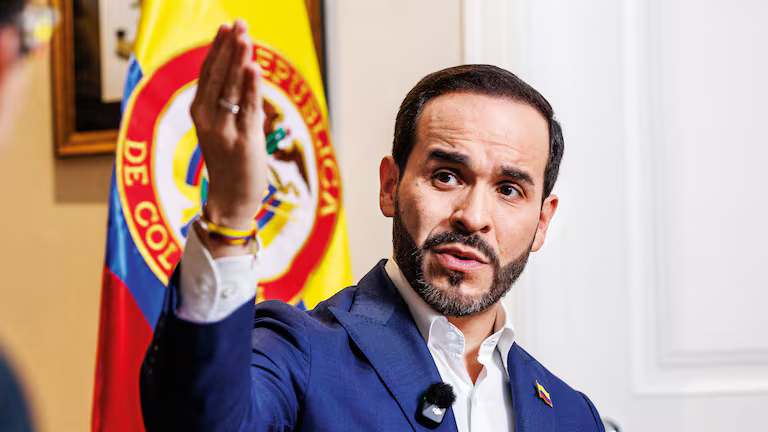
President Abelardo de la Espriella took office on August 7, in the process all but completing Latin America’s turn to rightwing governments to political power. Political arrangements in Colombia now are in sync with the US government’s reassertion of power over the region with its National Security Strategy announced in November, 2025.
In second-round presidential voting on June 21, 49.67% of the voters favored De la Espriella, candidate for Colombia’s political rightwing. Iván Cepeda, competing for the progressive Historic Pact Party, secured 48.7% of the vote. The first round of voting for 13 candidates on May 31 had given 43.7% of the vote to De la Espriella and 40.9% to Cepeda.
Cepeda is a senator, prominent human rights advocate, and son of a Communist party leader murdered by paramilitaries. Outgoing President Gustavo Petro had founded and led the Historic Pact Party. His government was the only progressive government ever to serve in Colombia since independence from Spain.
The Petro government’s record on advancing social programs was mixed. It failed to achieve Petro’s prime goal of “total peace.” Despite the 2016 peace agreement between Colombia’s government and the FARC leftist insurgents, armed insurgencies and criminal gangs, heirs to the former paramilitary plague, still ravage the countryside.
The current political background is of gigantic social and wealth inequalities, militarization, continuing narco-production and trafficking, and decades of massive killings and population displacements.
Rightwing forces had much at stake in the voting; For them, it was a watershed moment. Their intensity of purpose showed in the extraordinary measures taken to win the elections and keep another left-leaning government from taking power.
Fraudulent election
At a press conference on August 3, President Gustavo Petro charged that more than 120,000 handwritten electoral documents sent to national electoral officials from 1350 polling stations had been altered. Each polling station creates and fills out one such form, the so-called E-14 form, as a record of votes cast at each polling table. Petro indicated, in making this claim, that he was relying on investigations carried out at the polling stations by 70,000 individuals with the assistance of 1000 computer experts.
The investigators allegedly discovered that individual votes had been changed at the polling stations, supposedly by partisans of De la Espriella officiating there. They found that out of 350,000 E-14 forms that were examined and scanned, more than 122,000 of them had been “systematically reprocessed stripping them of their metadata and digital security seals—the hash locks.” The E-14 forms then materialized under the label “page not scanned” and were “published with different information and also with inconsistent signatures.”
According to Petro, the investigators discovered altered voter rolls showing municipalities claiming more voters than residents. These were located in Boyacá, Santander, Antioquia, and Cundinamarca departments and also in the “coffee growing axis”. These were precisely the regions that gave candidate De la Espriella his lead of 751,000 votes.
A text from Petro said that, “For the first time, electoral fraud is achieved through the use of software and algorithms. The world takes the message that [electoral] choice can be manipulated through such software. According to TeleSur, “Petro affirmed that the logistics and financing of this fraud involved foreign resources and interests … [also] that the National Electoral Council lacks the technical tools to identify these anomalies in the software.”
The now former president suggested that the Israeli cyber-intelligence firm BlackCore had carried out the electronic manipulation. He had earlier accused that firm of having “deployed 500,000 bots—fake profiles—to manipulate the Colombian electorate.” Colombian election officials defended the transparency and security of their election processes. Electoral observers from the Organization of American States and the European Union did likewise.
A different kind of guy
The rightwing political parties opposing presidential aspirant Cepeda had one other extraordinary tool in their bag, specifically, their own presidential candidate.
De la Espriella is a citizen of the US, Colombia, and Italy. He lived in Miami for ten years, until 2026. There he gained great wealth, from two sources. As a lawyer, he defended accused Colombian paramilitaries politicians accused of corruption, and other criminals. As a wine and rum impresario, he prospered greatly and then crashed in 2026; he owes almost $1 million. The new president owns homes in Miami, Italy, and Colombia.
De la Espriella is a defender and friend, a childhood buddy, of the renowned and death-dealing former paramilitary chieftain Salvatore Mancuso. He and his family have personal and political ties with the brutal and lawless former Colombian president Alvaro Uribe (2002-2012), himself accused of ties with narcotraffickers and paramilitaries. As a younger man, the now 48-year-old de la Espriella formed the Foundation for Peace Initiatives purposed for extolling and recruiting paramilitaries. As president he promises to set up 10 mega prisons as per Bukele of El Salvador
De La Espriella expands anyone’s image of a potential president. His business website proclaims that, “Defensor (Defender Rum) is art in the form of rum, created by Abelardo De La Espriella and Silvestre Dangond …This bottle of rum is a reminder that only those who dare to challenge history are the ones who write it. Are you ready?”
And this: “Charming, irreverent, passionate, and a true connoisseur, Abelardo De La Espriella—founder of Dominio (domain) De La Espriella and the law firm De La Espriella Lawyers—is synonymous with success, integrity, and determination … [T]his Renaissance man—with a Caribbean heart and a Mediterranean spirit—is an entrepreneur, writer, singer, lawyer, and public figure who has shattered all the conventions of fame to become a true role model for millions of people.”
Going the extra mile
De La Espriella as president may well notch a feat extraordinary in itself. The linkage between Colombia’s government and US imperialism is already exceedingly tight. But the new president’s personal disposition and record suggest he is well equipped for adding even more cement to US-Colombian relations.
He has a lot to build on. The US government for decades provided financial and material support for Colombia’s military operations against leftist insurgents ─ often under the pretense of fighting narcotraffickers. The US military had recommended that the Colombian government rely on paramilitaries to control the countryside. Thereafter, the US would be providing indirect support for the paramilitaries, while turning a blind eye to their murdering and mayhem. US Plan Colombia ((2000-2015) represented the high point of perennial US financial support and material aid for Colombia’s military. The US military has maintained up to eight air bases in Colombia, deployed troops and contractors there, and trained Colombian troops. The US helped design and finance Colombia’s prison system.
De La Espriella took the stage in 2023 when, living in Miami, he became a US citizen. He donated to the Republican Party and was invited to Mar-a-Lago.
As a candidate, he promised to end diplomatic relations with US-targeted Cuba and Nicaragua, and restore relations with Israel. In early 2026, De la Espriella met privately in Washington with Secretary of State Rubio; he indicated ominously on social media that, “important things are discussed in secret.” The State Department honored his ascent to power on August 7 by, on that day, awarding Colombia $1 billion; it goes toward “achievement of our shared objectives.”
He anticipates US (and Israeli) military forces joining Colombian counterparts in fighting crime and narco-trafficking. Colombia will be part of the US government-sponsored Shield of the Americas, a collection of rightwing Latin American and Caribbean governments cooperating with US plans for regional dominance.
De La Espriella’s investiture as president took place in Cali, not in the nation’s capital Bogota. He gave his inaugural address to soldiers assembled at a nearby army base, not to civilians. He thereby gave notice of his government’s “iron fist” and of Colombia as accomplice of aggressive US imperialism.
Colombian Communist Party organization secretary Jorge Gómez, interviewed by Party member Nelson Lombana Silva, summarizes:
· “[W]e …must understand that this is a new era … This has been the most important electoral result in all the history of the left.”
· “The inauguration is a new moment, one ushered in by fraud … but also fundamentally by something very special: the rise of a fascist far-right movement.”
· De la Espriella “will try to roll back social reforms—the gains the people have made in land ownership, health care, education, and the democratization of the state apparatus.”
· De la Espriella must “inform the country of the scope of the oath he took to become a U.S. citizen … [and] to disclose whether he is a member of any U.S. intelligence agency.”
· “We’re going to have to make significant progress toward the idea of a Broad Anti-Fascist Front that confronts authoritarianism, anti-human- rights forces, and anti-reform forces … And a second major strategy… is the concept of so-called Civil Disobedience.”
W.T. Whitney, Jr., is a political journalist whose focus is on Latin America, health care, and anti-racism. A Cuba solidarity activist, he formerly worked as a pediatrician and lives in rural Maine.

