
New Haven Declares an Emphatic No to US Blockade of Cuba / by W. T. Whitney Jr.

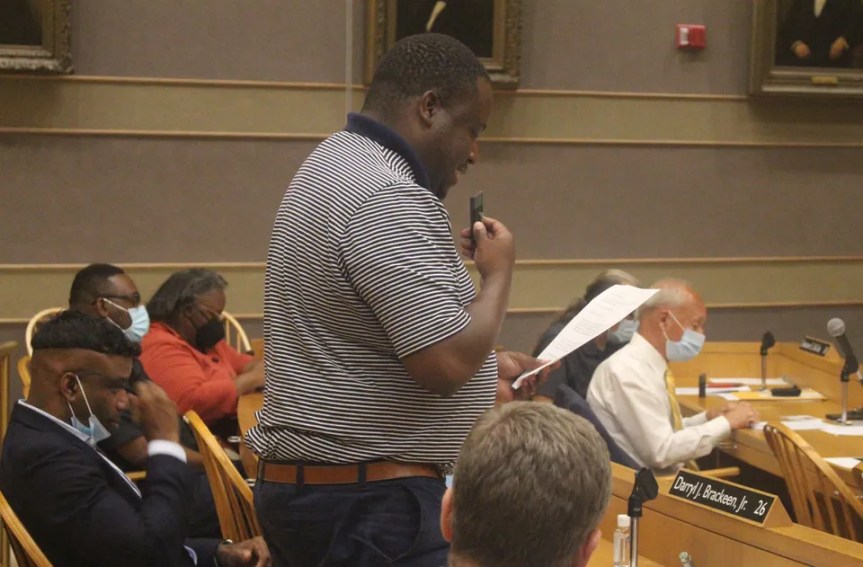
This resolution ​“speaks for itself,” Health and Human Services Committee Chair and Westville Alder Darryl Brackeen, Jr. said in support of the item as the New Haven Board of Alders Vote To End Cuba Embargo | Photo credit: New Haven Independent

A spirited and persistent campaign joined by peace activists in New Haven struck gold on July 6 as the Board of Alders of that large Connecticut city approved a resolution calling upon Biden administration to “to build a new cooperative relationship between the United States and Cuba and to immediately end all aspects of the United States economic, commercial and financial embargo against Cuba.”

The action this week followed testimony community members led by the New Haven Peace Coalition before the Board’s Health and Human Services Committee on June 24. That committee went on to recommend “without dissent” that the Board approve the anti-blockade resolution.

In written testimony read at the session, acting Peace Coalition head and veteran U.S. Communist Party activist Joelle Fishman, pointed out that. “As a city heavily invested in medicine, New Haven would gain from humanitarian exchanges about the most up-to-date treatments and medicines under development. Cuba is also pioneering in local sustainable food production.”

Cuba has gained enviable reputation internationally for its healthcare achievements, biomedical research, and ecologically sound agriculture.

The process toward the New Haven municipal authorities’ unanimous approval of their resolution had begun in September 2021 when the New Haven Peace Council and other groups first presented a proposed version of an anti-blockade resolution to the Board of Alders.

For many years, the Peace Council, affiliated with the New Haven-based U.S. Peace Council, and the New Haven Peace Coalition have jointly engaged in community-wide education and advocacy efforts on a wide range of human rights issues. The coalition enjoys the status of an official city commission.

In calling for an end to the U.S. economic blockade of Cuba, New Haven joins a bevy of other U.S. cities, and even states, in a grassroots campaign to get rid of this 60-year-old cruel, illegal, and immoral U.S. policy. The list now is long.

The most recent additions are Massachusetts cities Brookline on June 10 – a second time for that city – and Boston on May 16. The Bostonians defiantly called for “full restoration of trade and travel between the two countries.”

The Chicago city council’s unanimous passage of an anti- blockade resolution in February 2021 represented a major addition.  Chicago is the nation’s third largest city.

Other cities passing such resolutions are: Pittsburg, St. Paul Minneapolis, Cleveland, Detroit, Sacramento, and Hartford. The list includes Helena, MT; Cambridge, MA and Oakland, Berkeley, and Richmond – all in California.  States whose legislative bodies have passed resolutions are Alabama, Michigan, California and Minnesota.

Henry Lowendorf, president of the Greater New Haven Peace Council, outlined how actions taken against the U.S. blockade of Cuba contribute to peace. Commenting on the Human Service Committee’s approval on June 24 of the proposed resolution, Lowendorf declared that. “Despite the blockade no Cuban families, unlike in New Haven, are homeless. Despite the blockade all Cubans, unlike New Haveners, enjoy fully covered first-class healthcare.”

He added: “We have much to learn from how Cuba manages to guarantee its citizens these rights despite the US noose around its neck. That noose is intended not only to reverse these rights in Cuba but to prevent us from visiting Cuba, seeing for ourselves and demanding the same rights for ourselves from our own government.”


W. T. Whitney Jr. is a political journalist whose focus is on Latin America, health care, and anti-racism. A Cuba solidarity activist, he formerly worked as a pediatrician, lives in rural Maine. W.T. Whitney Jr. es un periodista político cuyo enfoque está en América Latina, la atención médica y el antirracismo. Activista solidario con Cuba, anteriormente trabajó como pediatra, vive en la zona rural de Maine.

Crisis in Cuba Requires End of US Blockade Now / by W. T. Whitney Jr.

Cuban Flag | Museum of the Revolution, Havana, Cuba, 2012. (Photo: Terry Feuerborn / Flickr)

Friends of socialist Cuba like good news about that country. Now bad news has its use. Grief and hardship currently are such that, clearly, the U.S. economic blockade of Cuba must end at once. The harsh details, appearing below, testify to potential destabilization in Cuba, danger to Cuba’s socialist project, and the nefarious role of the blockade. A major mobilization against the blockade is due. The need for action is obvious. 

The blockade, a 60-year-old relic of history, places few heavy demands on the U.S. public. No governmental funding is required. The Treasury Department issues fines and presidents make ritualistic declarations. People dodge travel restrictions. It’s a slow-motion affair. Distracted pro-Cuba activists may lose track of harassment details. Here they get a refresher course, for motivation toward action. It emphasizes blockade effects on people’s lives.

In the Beginning

Cuba’s vulnerability is the result mainly of U.S. policies directed at “denying money and supplies to Cuba … to bring about hunger, desperation, and overthrow of government.” The words are those of a State Department memorandum of April 6, 1960.

The flow of money to Cuba – international loans and export income –has long been feeble. International banks, financial institutions, and corporations handling dollars on Cuba’s behalf risk big U.S. Treasury Department fines. U.S. legislation blocks Cuba from importing the products of multi-national companies with branches in the United States – even food and medical supplies. For almost 30 years third-country ships docking in Cuba have been prohibited from entering a U.S. port for the following six months. Since 2019 the U.S. government has sanctioned Venezuelan ships carrying oil to Cuba.

The U.S. government harasses Cuba’s tourism industry, the source of most of Cuba’s foreign currency. Restrictions, variably regulated, operate against U.S citizens’ travel to the island. Why? They would spend money there. To discourage potential investors, U.S. legislation enables the heirs of properties nationalized in Cuba to take legal action in U.S. courts against investors who make use of such properties.

Cuba’s commerce with the United States has been nil for 60 years, except for heavily regulated Cuban agricultural exports. The northern neighbor used to be and still could be Cuba’s most convenient trading partner.

People are hurting

The U.S. blockade constitutes the main impediment to Cuba’s industrial production and overall economic development. Soviet Bloc nations formerly provided relief. Since then, strictures placed on imports have caused shortages of raw materials, replacement parts, consumer goods, new tools and machines, and reagents for drug and vaccine manufacture.

The blockade recently has complicated lives already beleaguered by the Covid-19 pandemic and an 11 percent economic recession resulting from the pandemic.

An Associated Press report of June 22 highlights a lack of new housing and impediments to repairing houses.  In 2019, 44,000 homes were built, in 2000, 32,000 homes, and in 2021,18,000. Building materials are in short supply. Hurricanes and the pandemic aggravated the situation.

Elderly Cubans experienced isolation and lack of supplies during the pandemic. For two years they’ve experienced weakened cultural and support services and reduced housing options. Fuel shortages in late 2021 led to fewer bus-runs in Havana. Wait-times were even longer.  Pharmacies in 2020 had available only 35 percent of their normal stock.

In recent times, infant death rates in Cuba matched the favorable rates of well-resourced countries, and were lower than U.S. rates. Astoundingly, Cuba’s infant mortality rate in 2021 was 7.6 infant deaths per 1000 births, up from 4.9 in 2000 and 5.0 in 2019. Cuba’s 2021 rate of mothers dying from pregnancy and childbirth difficulties was 176.6 – out of 100,000 mothers giving birth – up from 40.0 mothers in 2000 and 37.4 in 2019.

The increases stem from Covid-19 infection mortality added to deaths in non-Covid times. Experts say the deaths of children and mothers can reflect social factors – mothers’ low educational levels, reduced access to healthcare and other services, and poor nutrition. Therefore, the U.S. blockade, which does affect social well-being, may have taken a toll in this area too.

Cuba’s food supply is unstable what with reduced food production, inefficient distribution, marketing based on income levels, and quality variations.  At an annual cost of $2 billion, Cuba’s government still must import 60-70 percent of the food consumed in Cuba.

Production levels remain low despite reforms introduced after 2008, among them: land distribution, allowances for farmers’ permanent use of land, marketing reforms, governmental assistance to individual farmers and agricultural cooperatives, new distribution systems, local decision-making on assistance and policies, and ecologically sustainable methods.

The U.S. economic blockade is not responsible for soil deficiencies, officials’ inaction, drought conditions, overgrowth of invasive plants, and the appeal of urban life for rural youth. Blockade effects do show up in farmers’ reduced access to credit and lack of funds for fertilizer, seeds, breeding stock, spare parts, new equipment, and fuel.

Inflation holds sway in Cuba now. Prices, rising for two years, are up now by 70 percent and more. Access to essential goods is impaired. Frustration at high prices and shortages helped trigger island-wide protests on July 11, 2021 and has contributed to record emigration.

The U.S. blockade set the stage for inflation. After losing its commercial partnership with the Soviet Bloc, which disappeared in 1991, Cuba was in trouble.  The blockade blocked access to international loans and interfered with income derived from exports, the latter effect stemming from export restrictions. Consequently, funds have been short for importing essential products and for developing the economy.

Cuba desperately needed foreign currency and therefore brought tourists to the island to spend money that would end up with the government. From 1993 on, their money was captured via a new currency called the Cuban convertible peso (CUC). Tourists surrendered their own currencies in exchange for the CUCs.

Cubans, not all of them, acquired CUCs and were able to buy goods and dollars unavailable to Cubans without CUCs. Inequalities emerged. Responding, the government gradually withdrew CUCs from circulation, beginning in January 2021. Anticipating hardships, it raised salaries and pensions payable in Cuba’s “national peso.”

New money in circulation stimulates inflation, especially when goods for sale are in short supply, as in Cuba. The national currency lost value. Tourists, excluded during the pandemic, returned in late 2021. Their money, circulating, added to inflationary pressures. CUCs with a prominent role in Cuba’s informal economy, and still circulating, did likewise. The role of CUCs suggests the blockade’s indirect contribution to inflation.

Persevering

Those defenders of Cuba worried about diminished Cuban-government commitment to bettering people’s lives may need reassurance. Of note:

·        Cuban president Miguel Díaz-Canel Bermúdez on June 21 addressed a meeting which elevated the role of social work. Discussion centered on mothers living in cities in “situations of vulnerability.”

·         Support programs are in place for elderly Cubans experiencing isolation, for example, the “Accompany Me (Acompáñame) project of telephone assistance and the National Program for Comprehensive Attention to Elders.

·        As of 2021, 423 so-called Projects of Local Development promoted food production, small workplaces, and tourism along with socio-cultural, environmental, and research programs.

·        The government promotes its program known as “micro, small, and medium [size] businesses.” These mostly privately owned enterprises, numbering 1,188 last year, produce food products, building materials, furniture, textile products, footwear, cleaning supplies, computer accessories, recycling serves, and more.

·        The government in April 2021 approved 43 measures directed at increased agricultural production and food availability. Results are far from ideal, an observer notes.

The blockade, a 60-year-old relic of history, places few heavy demands on the U.S. public.

·        Prime Minister Manuel Marrero Cruz, on June 24 visited a district in Cardenas to assess progress toward “improvements of roads, water supply, housing construction and social work.”

What to do

Resistance to the U.S. blockade within the United States has been constant for decades, but to no avail. Thanks to the Helms-Burton Law of 1996, the hurdle now is forcing the Congress to act. For that to happen, masses of people must stand up together and weigh in.

But that won’t happen, it seems, as long as activists continue to view the blockade as an isolated issue. What’s needed is collective action on many issues toward changing the direction of the U.S. government itself. The common ground would be justice and decent lives for all people everywhere, Cubans among them.

Also required would be new understanding that U.S. assault on Cuba happens as part of the larger U.S. project of capitalism worldwide and imperialist domination. The big mobilization to end the blockade would be part of a larger mission to take apart that U.S. project. Oppressed and plundered nations would be rescued, Cuba among them.

One adjustment: U.S. progressives ought to reject that old dictum that “Politics stops at the water’s edge.” It sends the message that solidarity with and struggle for oppressed peoples overseas doesn’t matter. That’s not so.

By no means will these suggestions bear fruit in time to end the blockade soon. Hope and struggle will remain. U.S. public opinion favors ending the blockade. People in the United States now fighting the blockade are experienced and want to enlarge the movement. Maybe chaos attending capitalism’s failures, new wars, and international divisions will distract the U.S. government from bothering with Cuba. Maybe international solidarity with Cuba will continue growing. Revolutionary Cuba, with unity and effective leadership, is known for overcoming challenges.  


W. T. Whitney Jr. is a political journalist whose focus is on Latin America, health care, and anti-racism. A Cuba solidarity activist, he formerly worked as a pediatrician, lives in rural Maine. W.T. Whitney Jr. es un periodista político cuyo enfoque está en América Latina, la atención médica y el antirracismo. Activista solidario con Cuba, anteriormente trabajó como pediatra, vive en la zona rural de Maine.

Peace Forces Mobilize as NATO Summit in Madrid Plans for War / by W.T Whitney Jr.

‘Yes to peace, No to NATO’: Anti-imperialist activists organized by the World Federation of Democratic Youth march against the NATO Summit that opens in Madrid on June 29. | via WFDY

The NATO Summit taking place in Madridon June 29-30 “will be transformative,”  asserted NATO Secretary General Jens Stoltenberg; it will project “a new Strategic Concept for a new security reality.” At its 50th anniversary summit, in Washington in 1999, NATO had expanded its Cold-War era mission of collective defense of Europe to include protection for democracy “within and beyond our borders.”

According to Stoltenberg on June 27, NATO will provide “support to Ukraine now, and for the future.” The “Allies consider Russia as the most significant and direct threat to our security.” NATO “will address China for the first time …[and also] the challenges that Beijing poses to our security, interests, and values.” Pacific nations – Australia, Japan, the Republic of Korea and New Zealand – will be attending a NATO summit for the first time.

The Summit provoked opposition beforehand. A “Peace Summit,” described as “the People’s Alternative to NATO and War,” gathered in Madrid on June 24-25. A conglomeration of Spanish and European anti-capitalists, environmentalists, feminists, anti-imperialists, peace activists, and spokespersons for struggles in the global South attended workshops, panel discussions, cultural presentations, and plenary sessions.

The Peace Summit made demands. First, NATO will be disbanded: “NATO violates the UN Charter … authoritarian, fascist, and colonial regimes are included in its alliance …NATO’s military interventions have destabilized and destroyed Yugoslavia, Afghanistan, and Libya. Now NATO pursues a new Cold War against China and Russia. … NATO leads the worldwide arms race … NATO’s nuclear agenda greatly endangers our survival.” Regarding environmental contamination: “The U.S. army “is the most contaminating institution on the planet … NATO generates poverty and inequalities.”

The Summit then declared, “Yes, to Peace … we need a non-militarized system of security, without nuclear arms, without foreign bases, and with a drastic reduction of military expenses. We defend a politics of active peace … [We want] investment in social progress, not in war … Europe and North America must commit to disarmament.”

The statement concluded with an invitation: “March with us against NATO and for building a world of peace.” Indeed, on June 26 thousands marched through central Madrid, their banners flying. Organizers claimed 30,000 marchers. The government reported considerably less. 

The Communist Party of Spain (PCE) and the United Left (Izquierda Unida) were the only political parties that joined with dozens of Spanish and international organizations endorsing the declaration and march. The PCE belongs to the United Left electoral coalition that, after the November 2019 general election, combined with the larger United We Can alliance (Unidas Podemos) to form a government under the leadership of Prime Minister Pedro Sánchez, head of the Socialist Party.

Sánchez issued a statement welcoming the NATO summit to Madrid. He mentioned concerns about Spain’s “southern flank,” a reference, presumablyto migrants from Africa.

PCE member Yolanda Díaz serves as labor minister and second deputy prime minister in Sánchez’s government. Even so, Enrique Santiago, secretary general of her party, on June 7 offered ideas at odds with those of the prime minister: “We don’t want the NATO summit in Madrid. The story of the Ukraine conflict is of a war foretold, what with the continuing expansion of NATO to the East … And in wars, the peoples, the workers, always lose out.” Santiago cited the risk of “nuclear confrontation” and commended the upcoming Peace Summit and “international demonstration against war on June 26.” 

In remarks two days prior to the Summit, NATO Secretary-General Jens Stoltenberg greatly heightened the urgency of the peace proponents’ fears. “At the summit,” he said, “we will strengthen our forward defenses. We will enhance our battle groups in the eastern part of the alliance.”

One report predicted that, “NATO allies will decide at a summit this week to increase the strength of their rapid reaction force nearly eightfold to 300,000 troops …  The NATO response force …currently numbers around 40,000 soldiers.” As part of efforts “to shore up the defenses on Europe’s eastern flank,” the NATO Summit will speed up arrangements for the entry of Finland and Sweden’s into the alliance

Stoltenberg spoke of a “strengthened Comprehensive Assistance Package for Ukraine” and “about the military build-up in Kaliningrad … with highly advanced weapon systems.” Partly because of Kaliningrad, “we have modernized our armed forces, our capabilities, and also increased our presence in that part of the region”.

According to the Brookings Institute, Kaliningrad, a tiny Baltic Sea, Russian-controlled enclave, located between Poland and Lithuania, “could become a new flashpoint in Russia’s war on Ukraine.” That’s because Lithuania is blocking the passage of EU-sanctioned Russian goods into the territory for delivery beyond.


W.T. Whitney Jr. is a political journalist whose focus is on Latin America, health care, and anti-racism. A Cuba solidarity activist, he formerly worked as a pediatrician, lives in rural Maine. W.T. Whitney Jr. es un periodista político cuyo enfoque está en América Latina, la atención médica y el antirracismo. Activista solidario con Cuba, anteriormente trabajó como pediatra, vive en la zona rural de Maine.
The original version of the article appeared in People’s World, June 28, 2022, http://www.peoplesworld.org/

Indigenous Alliance’s National Strike Threatens Ecuador’s Conservative Government / by W. T. Whitney Jr

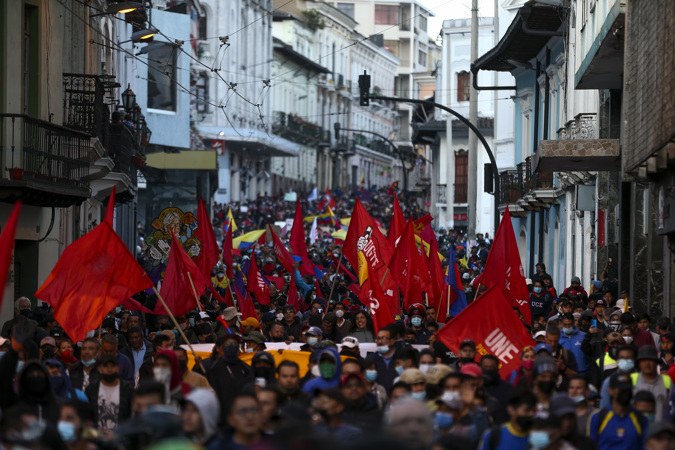
Thousands of people demonstrate against the Government of Guillermo Lasso, in Quito (Ecuador). | Photo: EFE/José Jácome

The entire Equadorian nation is presently experiencing a national strike, one that is strong particularly in Cotopaxi; Tungurahua; Chimborazo, and Pastaza provinces. Spearheading the action is the Ecuadorian Confederation of Indigenous Nationalities (CONAIE, as per its Spanish-language acronym).

The present writer’s friend and frequent correspondent Bob Shiers, based in Puyo, in Pastaza, reports that, as of June 18: “The only way one can get into Puyo is by foot, bicycle or motorcycle. …. Buses and taxi are not operating …This protest consists of 40 different indigenous groups who speak forty different languages … [T]he Ecuadorian media mainly shows photographs of people from Pichincha, Cotopaxi, and Imbabura provinces which primarily represent the Quichua people.”

“As of yesterday, the oil fields in the Amazona were shut down. Crude now selling at more than $110 a barrel. Everyday tens of thousands of dollars’ worth of flowers are lost as the union workers at the airport refuse to load them onto planes …  In Quito, all the large retail stores are closed.

”The National Teachers’ Union voted to strike … [President Guillermo] Lasso moved the government out of Quito. Much violence between police and students in Guayaquil. … in Quito, [there are] violent confrontations between the army and students. This is different from any other mass Ecuadorian indigenous protest since 1990 because the indigenous Pachakutik [Plurinational Unity Movement – New Country]Party controls the national parliament.”

Lasso’s ascent to Ecuador’s presidency in April 2021 pleased banking circles in the United States. As noted by a financial commentator: “The surprising victory for conservative Guillermo Lasso … increases the chances that public debt will be put onto a sustainable path” and that the country’s bonds will gain in value. Within months, revelations surfaced that monies Lasso accumulated as a banker had been stored in off-shore tax havens.

On May 20, an expanded council of CONAIE, approved resolutions centering on improved quality of rural life, protection of nature, sustainable agriculture, and repair of economic and political inequalities.

The basis for these resolutions, according to CONAIE, derives from “an analysis of the country’s problems agravated by a profound economic and instutional crisis, [which in turn stems from] dependence on the powers of the state, a pronounced widening of the inequality gap, and deepening of poverty generally. The national government turns its back on the majority population, favoring the big capitalists and submitting to the International Monetory Fund with its policies of privatization of strategic sectors and of plundering the country.”

Three weeks later, CONAIE announced the launching on June 13 of a “national mobilization of indigenous peoples,producing sectors, small farmers, and diverse social organizations.” The organization presented a ten-point agenda outlining a range of reforms addressing economic and human-rights injustices.  

Demands included: reduced gasoline and diesel prices; a one-year moratorium on family debts; better prices for agricultural products; more credit for farmers; improved education, transportation services and healthcare; labor rights; no mining in indigenous areas; protection of water sources; attention to the rights of nature and to collective rights; and controls on privatization, price-gouging, and speculation.

As of the strike’s sixth day, the Lasso government had decreed a State of Emergency and soldiers and police were deployed in Cotopaxi, Imbabura and Pichincha provinces. Pichincha is the location of Quito, Peru’s capital. Reports quickly surfaced of injuries and arrest of strikers.

The government has relented to the extent of declaring a public health emergency and providing Ecuadorians with a “human development” bonus, a subsidy covering 50 percent of farmers’ fertilizer costs, partial cancelation of debts owed the Central Bank, and small low-interest loans for farmers.

CONAIE leader Leónidas Iza welcomed the proposals, while pointing out their limited scope and lack of official validation. Iza “reiterated that CONAIE is preparing its entry into Quito in order to continue with anti-government demonstrations.” On June 18, his car came under attack. Bullets shattered one of its windows, but Iza escaped injury.  


W.T. Whitney Jr. is a political journalist whose focus is on Latin America, health care, and anti-racism. A Cuba solidarity activist, he formerly worked as a pediatrician, lives in rural Maine. W.T. Whitney Jr. es un periodista político cuyo enfoque está en América Latina, la atención médica y el antirracismo. Activista solidario con Cuba, anteriormente trabajó como pediatra, vive en la zona rural de Maine.

US Constitution – Bad Medicine for Children / by W. T. Whitney Jr.

Photo credit: Ariel Rakovitsky (@ARakovitsky) | twitter.com

Public health is about curative, rehabilitative, and especially preventative healthcare for everybody, no exclusions. Failed public health was on display during the Covid-19 pandemic. “The United States has the highest rate of COVID-19 deaths per capita” among 11 high-income countries, according to one infectious disease specialist.

Similarly, local authorities allowed dangerous levels of lead to persist in the drinking water of Flint, Michigan, and other cities. Lead damages the brain of young children and recently was shown to have contributed to lowered IQs in 170 million Americans who are now adults. 

The constitutions of only a few governments speak of people’s right to health or healthcare. Without offering specifics, the U.S. Constitution mentions a duty to “promote the general welfare.” The Constitution provides for political freedoms, but concentrates on devices aimed at diffusing political power. Examples are checks and balances, federalism, and separation of powers.

Its framers were fearful of political factions and their jostling for political power. In Federalist No. 10 (1787), James Madison explains: “A landed interest, a manufacturing interest, a mercantile interest, a moneyed interest, with many lesser interests, grow up of necessity in civilized nations, and divide … into different classes, actuated by different sentiments and views. The regulation of these various and interfering interests forms the principal task of modern legislation.”

The “common and durable source of factions has been the various and unequal distribution of property, he adds; “Those who hold and those who are without property have ever formed distinct interests in society.” 

Delegates to the Constitutional Convention (1787) sought to protect wealth and private property; they made suitable arrangements for governing. Public health was not on their agenda, not least because the scientific basis for preventing sickness, injuries and deaths did not yet exist.  Subsequently the U.S. government’s commitment to “promote the general welfare” remained weak. A tradition of healthcare as private enterprise has contributed to smothering public health.

Widespread disregard for public health and for teaching about prevention has contributed to sectors of the people embracing irregular views. Anti-vaccine bias is one of them. 

Similarly, agitators dealing with gunfire killings put forth skewed notions of constitutional law. By any rational standards, the killings represent a public health problem, just as do injuries and deaths from accidents, automobile accidents included.

In the same vein, abortion opponents obsess about prevention in the name of preserving life. Their position would be commendable from the public-health point of view, if their passion did not disappear once a baby was born.

A general weakening of child-health advocacy and ultimately of preventative programs exemplifies the current plight of public health endeavors in the United States. Serving to illustrate is the high U.S. incidence of preventable childhood deaths.

In comparison with young people in 16 other high-income countries, younger Americans experience the “highest age-specific mortality rates for every age group under age 25,” according to the Population Reference Bureau (PRB). Infant mortality in the United States ranks as the highest by far among 11 high-income nations; The U.S. infant mortality rate is greater than that of 49 other countries.

Childhood poverty in the United States is elevated. One current estimate is that 18% of U.S. children in the United States live in poverty; in 2019, 26% of Black children lived in poverty.

That’s important, because the more U.S. parents are afflicted by poverty, the more likely their babies will die.  The National Center for Biological Information notes that, “Higher infant mortality among low socioeconomic groups has been recognized as a societal problem in the US for 140 years.”

Epidemiologists cite the association of prematurity with infant death and the role of poverty in contributing to premature birth. But, according to one analyst, poverty also impinges upon full-term babies. These babies born to low-income parents die at a rate 1.4 to 1.8 times higher than do the babies of higher income families.

Babies are more likely to survive if their caretakers have material resources. The fact of governments or societies being well-resourced does not matter. That’s evident in a study showing that the U.S. “gross domestic product health expenditure,” which is the highest among 14 western nations, exerted no effect on reducing childhood deaths. However, the U.S. income-inequality gap, greater than that of any of those 14 nations, was “highly significant.”

Similarly, the United States registers the highest gross national income per capita among the 38 member-nations of the Organization for Economic Co-operation and Development. Even so, the U.S. infant mortality rate exceeds that of all but three of those states.

The United States has a money-distribution problem. Not enough ends up where it might “promote the general welfare.” Where does the money go?

Oxfam reports that, “global food giant” Cargill company, based in Minnetonka, Minnesota and owned, for the most part, by the world’s 11th richest family, has provided members of that family with $42.9 billion, up $14.4 billion since 2020; that the Walton family, owning half of Walmart’s shares, has gained $238 billion – up $8.8 billion since 2020; that Moderna company converted $10 billion in government funding for a Covid-19 vaccine into $12 billion in profits; that vaccine manufacturer Pfizer company last year paid $8.7 billion in shareholder dividends.

Wealth of the world’s billionaires grew “more in the first 24 months of COVID-19 than in 23 years combined.” Their total wealth is “equivalent to 13.9 percent of global GDP.”

The Constitution’s authors were in the dark when they were trying to discipline ruling-class factions. They could not know that European and North American capitalists would be plundering a new industrial and colonial world to accumulate wealth and enlist governments in their service.

U.S. governments would take on an increasingly prominent role in that project. To distribute wealth for the common good was not in the cards.

For one thing, the Constitution imposed rules aimed at blocking full democracy. These include two-thirds majority requirements, indirect elections of presidents (and, for a while, senators), the disproportionate electoral power of small states, voting limitations, and a powerful judicial branch. The framers of course made accommodations for slavery.

Some framers bemoaned the “danger of the leveling spirit” or saw an “excess of democracy.” For delegate Rufus King, “the unnatural Genius of Equality [was] the arch Enemy of the moral world.”

Architects of the Constitution used the ploy of divide and rule to control entities of their new government. They could not know how, later on, defenders of capitalism would use that tool to great effect while seeking to break apart the unity of people in resistance. Those in charge now create divisions through tension over guns, abortion, and equality for African-descended people.

Such is the setting for our fight for children’s lives, for universal healthcare, and more. The time is right for unity, yes, and for radical solutions.


W.T. Whitney Jr. is a political journalist whose focus is on Latin America, health care, and anti-racism. A Cuba solidarity activist, he formerly worked as a pediatrician, lives in rural Maine. W.T. Whitney Jr. es un periodista político cuyo enfoque está en América Latina, la atención médica y el antirracismo. Activista solidario con Cuba, anteriormente trabajó como pediatra, vive en la zona rural de Maine.

Petro wins first-round victory against right wing in Colombian presidential vote / by William T. Whitney, Jr.

Presidential candidate Gustavo Petro, left, and his running mate Francia Marquez, with the Historical Pact coalition, stand before supporters on election night in Bogota, Colombia, Sunday, May 29, 2022. Their ticket will advance to a runoff contest in June after none of the six candidates in Sunday’s first round got half the vote. | Fernando Vergara / AP

During 212 years of Colombia’s national independence, the propertied and wealthy classes, with military backing, have held the reins of power. Gustavo Petro and Francia Marquez, presidential and vice-presidential candidates of the Historical Pact coalition, scored a first-round victory in elections held on May 29. They are forerunners of a new kind of government for Colombia.

If they prevail in second-round voting on June 19, they will head Colombia’s first ever people-centered government. Petro’s opponent will be the May 29 runner-up Rodolfo Hernández.

The tallies were: Petro, 40.3 percent (8.333.338 votes); Hernández, 28.1 percent (5.815.377 votes); Federico Gutiérrez, 23.9 percent (4.939.579 votes). Other candidates shared the remaining votes. The voter participation rate was 54 percent, standard for Colombia.

Petro’s rightwing electoral opponents represented varying degrees of attachment to the extremist ex-President Alvaro Uribe (2002-2010) and his protegee, current President Ivan Duque, who was not a candidate.

Oscar Zuluaga, the early standard-bearer for the Uribe cause ended his non-prospering campaign in March in favor of Federico Gutiérrez and his “Team for Colombia” party. Opinion polls showed Gutiérrez losing ground while, coincidentally, the candidacy of the conservative Hernández was gaining support. 

Petro, 62 years old, was a leader of the radical April 19 Movement, mayor of Bogota, twice a presidential candidate, and has been a senator. As such, he led in calling to account ex- President Uribe for political corruption and ties with paramilitaries.  He defines his politics as “not based on building socialism, but on building democracy and peace, period.”

Vice-presidential candidate Francia Márquez projects what looks, from this vantage point, to be star-power. She is a 40-year-old African-descended lawyer and award-winning environmentalist who, from her rural base, organized against plunder of natural resources. As a presidential candidate in the primary elections in March, she gained 780,000 votes from Historical Pact electors – third place within that coalition. Her candidacy reflects a merger of sorts between social-movement and political-party kinds of activism.

Candidate Rodolfo Hernández is a special case. Analyst Horacio Duque claims that, “The Gringos’ Embassy and the [Colombian] ultraright are moving to catapult” this former mayor of Bucaramanga “onto a platform for existential salvation … by forcing a way toward a second round.”  The wealthy real estate profiteer and mega landlord for low-income renters faces bribery charges relating to a “brokerage contract” and trash disposal. With a slogan of “no lying, no stealing, and no treason,” Hernández is a self-described enemy of the “traditional clans.” He is a devotee of social media.

The Historical Pact campaign benefited from circumstances. The failings of 2016 Peace Agreement with the FARC insurgency are clear, namely: persisting violence, no agrarian reform, and continuing drug war in the countryside. Blame falls upon Uribe’s machinations and the Duque government.

The campaign follows two years of demonstrations that, led by young people, were violently repressed by the police. Protesters called for full access to healthcare and education, pension reforms and new labor legislation. They set an agenda for change.

Death threats greeting Petro and Francia Márquez on the campaign trail forced them to cancel some events and deliver speeches from behind protective shields. Earlier popular mobilizations had also triggered ugly reactions.   

Rodolfo Hernandez, presidential candidate of the right. | Mauricio Pinzon / AP

Commentators recalled the assassinations of four leftist or liberal presidential candidates between 1987 and 1990 and the murder of prospective presidential candidate Jorge Eliécer Gaitán on April 9, 1948. Petro and Gaitan are the only progressively-oriented political figures in Colombia’s history to have had realistic hopes for becoming president.

For a few days in early May the “Clan del Golfo” paramilitary group reacted to its leader’s extradition to the United States on drug-trafficking charges; paramilitaries “stole, threatened, killed, and burned trucks and taxis” throughout northern Colombia. They coordinated their mayhem with the police and soldiers, and “the Duque government didn’t move a finger to contain them.” Reasserting their role as enforcers and destabilizers, the paramilitaries disrupted the Historical Pact’s campaign.

Petro and Márquez promised much. They would to improve food security, education, healthcare, pensions and reverse the privatization of human services. Petro would rein in extractive industries, cut back on fossil-fuel use, and renegotiate free trade agreements. He called for land for small farmers, peace with insurgent National Liberation Army, and for restraining the paramilitaries. He promised to respect Venezuela’s sovereignty.

Colombia’s military is displeased about a prospective Petro government. In April, Petro criticized military commanders’ close ties with paramilitary bosses. In a revealing response that violated constitutional norms, General Eduardo Zapateiro accused Petro of harassing the military for political reasons and of having taken illegal campaign funds.

An interventionist U.S. government is uneasy about a change-oriented government in Colombia. U.S. General Laura Richardson, head of the U.S. Southern Command, met with Colombian General Luis Navarro in March. She sought assurance that a Petro victory would not lead to the dismantling of seven U.S. Air Force bases in Colombia. Navarro indicated military leaders and most congresspersons would oppose such a step. The Southern Command issued a press release confirming that “Colombia is a staunch security partner.”  

U.S. Ambassador Phillip Goldberg’s comment on electoral fraud, delivered to an interviewer in mid-May, had destabilizing potential. He mentioned the “real risk posed by the eventual interference in the elections by the Russians, Venezuelans, or Cubans.” Goldberg’s excessive zeal for U.S. interests had been on display in Bolivia. As ambassador there in 2008, he immersed himself in an unsuccessful coup attempt against President Evo Morales – and was expelled.  

 The U.S. impulse to determine who governs in Colombia was on display on May 13 with a debate involving Colombian vice-presidential candidates. It was staged in Washington, not in Colombia. The congressionally-funded U.S. Institute of Peace session hosted the session. The appearance was that of a junior partner auditioning, as in seeking approval from a boss.

Commenting on his victory, Petro remarked that “forces allied to Duque have been defeated … The message to the world is that an era is finished.” Reaching out to “fearful businesspersons,” he proposed that “social justice and economic stability are good for productivity.”

The Historical Pact faces an uphill battle as it approaches the voting on June 19. According to an observer, opposition candidate Rodolfo Hernández will inherit the institutional and personnel resources the Duque government dedicated to the Federico Gutiérrez campaign. First – round voters for the several rightwing candidates will now turn to Hernández. The Historical Pact will have to engage with Colombians who did not vote on May 29.


W.T. Whitney Jr. is a political journalist whose focus is on Latin America, health care, and anti-racism. A Cuba solidarity activist, he formerly worked as a pediatrician, lives in rural Maine. W.T. Whitney Jr. es un periodista político cuyo enfoque está en América Latina, la atención médica y el antirracismo. Activista solidario con Cuba, anteriormente trabajó como pediatra, vive en la zona rural de Maine.
People’s World, May 31, 2022, https://www.peoplesworld.org/

Mexico leads in opposing the Cuba blockade and U.S. imperialism / by William T. Whitney Jr.

Cuban President Miguel Diaz Canel, right, and his Mexican counterpart Andres Manuel Lopez Obrador, left, raise their arms during a ceremony to award the Jose Marti Order to Lopez Obrador, at Revolution Palace in Havana, Cuba, Sunday, May 8, 2022. El presidente cubano Miguel Díaz Canel, a la derecha, y su homólogo mexicano, Andrés Manuel López Obrador, a la izquierda, levantan los brazos durante una ceremonia de entrega de la Orden José Martí a López Obrador, en el Palacio de la Revolución en La Habana, Cuba, el 8 de mayo de 2022. | Yamil Lage / Pool Photo via AP

Mexican President Andrés Manuel López Obrador (AMLO) visited Cuba on May 8-9. He began by highlighting regional unity as good for equal promotion of economic development for all states. AMLO addressed themes he had discussed previously when Cuban President Miguel Diaz-Canel visited Mexico City in 2021.

At that time, AMLO, by virtue of Mexico serving as president pro tempore, presided over a summit meeting of the Community of Latin American and Caribbean states (CELAC). He proposed building “in the Western Hemisphere something similar to what was the economic community that gave rise to the current European Union.”

Two days later, AMLO included Diaz-Canel in a celebration of the 200th anniversary of Mexican independence. Praising Cuba’s dignity in resisting U.S. aggression, he called for an end to the blockade.

Months later in Havana, on May 8, 2022, AMLO, speaking before Cuban leaders and others, recalled “times when the United States wanted to own the continent…. They were at their peak in annexations, deciding on independence wherever, creating new countries, freely associated states, protectorates, military bases, and…invasions.”

U.S. leaders, he declared, need to be convinced “that a new relationship among the peoples of America…is possible.” He called for “replacing the OAS with a truly autonomous organism.” CELAC presumably would be that alternative alliance. Formed in 2011, CELAC includes all Western Hemisphere nations except for the United States and Canada.

The United States in 1948 established the Organization of American States (OAS) for Cold War purposes. When the OAS expelled Cuba in 1962, only Mexico’s government opposed that action, and later Mexico was one of two nations rejecting an OAS demand to break off diplomatic relations with Cuba.

AMLO predicted that “by 2051, China will exert domination over 64.8% of the world market and the United States only 25%, or even 10%.” He suggested that, “Washington, finding this unacceptable,” would be tempted “to resolve that disparity through force.”

AMLO rejected “growing competition and disunity that will inevitably lead to decline in all the Americas.” He called for “Integration with respect to sovereignties and forms of government and effective application of a treaty of economic-commercial development suiting everybody.” The “first step” would be for the United States “to lift its blockade of this sister nation.”

AMLO’s visit prompted agreements on practicalities. The two presidents determined that Cuba would supply Mexico with medications and vaccines—particularly Cuba’s anti-COVID Abdala vaccine for children. Mexico’s government will send almost 200 Mexican youths to Cuba to study medicine; 500 Cuban physicians will go to Mexico to work in underserved areas. The two presidents signed a general agreement providing for expanded cooperation in other areas.

Before arriving in Cuba, AMLO had visited Guatemala, El Salvador, Honduras, and Belize. Along the way, he reportedly complained that, “The United States may have awarded $40 billion in aid to Ukraine but doesn’t fulfill its promise of years ago of helping out Central America.”

The two presidents’ encounter in Havana raises the question of a long-term Mexican role in mobilizing collective resistance to U.S. domination and the U.S. blockade of Cuba. Mexico is well-positioned to lead that effort, what with strong economic and commercial connections with the United States. The United States, leaning on Mexico as an economic partner, may well be receptive to certain demands.

According to the White House-based Office of the U.S. Trade Representative, “Mexico is currently our largest goods trading partner with $614.5 billion in total (two way) goods trade during 2019.”

Beyond that, and in relation to Cuba, Mexico has its own revolutionary tradition and longstanding ties with Cuba. She is well-placed to lead a strong international campaign to undo the U.S. blockade.

In his major speech, AMLO cited support from Mexico in Cuba’s first War for Independence. He mentioned Cubans’ collaboration with Mexico’s much-admired President Benito Juárez and pointed out that Mexico in1956 hosted Cuban revolutionaries led by Fidel Castro as they prepared for their uprising against Batista. AMLO cited former Mexican President Lázaro Cárdenas’ solidarity visit to Cuba in 1961 after the CIA-organized Bay of Pigs invasion. In token of cultural ties between the two peoples, Mexico was the guest of honor at Havana’s recently concluded International Book Fair.

José Martí warrants special attention. In exile, Martí lived, taught, and wrote in Mexico from 1875 to 1877. Afterwards he stayed connected with Mexican friends. Martí would later write admiringly about the liberal reforms of Indian-descended President Juarez, whom he regarded as the “impenetrable guardian of America.”

That “America” would be “Our America,” which became the title of a Martí essay with deep meaning for unity and for separation from the United States. “Our America” proclaimed that the culture and history of lands south of the Rio Bravo (Rio Grande) originated autonomously, quite apart from European and U.S. influences. The essay appeared first in January 1891, in two journals simultaneously. One was El Partido Liberal, published in Mexico, the other being a New York periodical.

Unity among Latin American and Caribbean nations appears to be precarious as the U.S. government prepares to host the Ninth Summit of the Americas in Los Angeles, on June 6-10. The Summit is an offshoot of the OAS which, according to its website, “serves as the technical secretariat of the Summits process.”

The United States has indicated that the leftist governments of Cuba, Venezuela, and Nicaragua won’t be receiving invitations. AMLO, speaking in Havana, reiterated his objection and once more stated that if nations are left out, he will not attend. Nor will the presidents of Bolivia and Honduras, Luis Arce and Xiomara Castro, respectively.

The presidents of several Caribbean nations will also be staying away. They point to the hypocrisy of U.S.-appointed Venezuelan “president” Juan Guaidó being invited, but not Cuban President Miguel Díaz-Canel.  Unhappy with U.S. advice on transparency of elections and Russia-Brazil relations, Brazilian President Jair Bolsonaro will not attend.

The conclusion here is that the old system of regional alliances is unstable and that the timing may be right for renewed resistance to U.S domination and the blockade. Now would be the occasion for U.S. anti-imperialists and blockade opponents to align their strategizing and efforts with actions, trends, and flux in Latin America and the Caribbean. And, most certainly, they would be paying attention to actions and policies of Mexico’s government.

Martí had often corresponded with his Mexican friend Manuel Mercado.  His letter of May 18, 1895, the day before he died in battle, stated that, “The Cuban war…has come to America in time to prevent Cuba’s annexation to the United States.… And Mexico, will it not find a wise, effective, and immediate way of helping, in due time, its own defender?”


W.T. Whitney Jr. is a political journalist whose focus is on Latin America, health care, and anti-racism. A Cuba solidarity activist, he formerly worked as a pediatrician, lives in rural Maine. W.T. Whitney Jr. es un periodista político cuyo enfoque está en América Latina, la atención médica y el antirracismo. Activista solidario con Cuba, anteriormente trabajó como pediatra, vive en la zona rural de Maine.

People’s World, May 20, 2022, https://www.peoplesworld.org/

Mexico Leads in Opposing the Cuba Blockade and US Imperialism / by W.T. Whitney, Jr.

Photograph Source: Eneas De Troya – CC BY 2.0

Mexican president Andrés Manuel López Obrador (AMLO) visited Cuba on May 8-9. He began by highlighting regional unity as good for equal promotion of economic development for all states. AMLO addressed themes he had discussed previously when Cuban president visited Mexico City in 2021.

At that time AMLO, by virtue of Mexico serving as president pro tempore, presided over a summit meeting of the Community of Latin American and Caribbean states (CELAC). He proposed building “in the Western Hemisphere something similar to what was the economic community that gave rise to the current European Union.”

Two days later, AMLO included Diaz-Canel in a celebration of the 200th anniversary of Mexican independence. Praising Cuba’s dignity in resisting U.S. aggression, he called for an end to the blockade.

Months later in Havana, on May 8, 2022, AMLO, speaking before Cuban leaders and others, recalled “times when the United States wanted to own the continent …. They were at their peak in annexations, deciding on independence wherever, creating new countries, freely associated states, protectorates, military bases, and … invasions.”

U.S. leaders, he declared, need to be convinced “that a new relationship among the peoples of America … is possible.” He called for “replacing the OAS with a truly autonomous organism.” CELAC presumably would be that alternative alliance. Formed in 2011, CELAC includes all Western Hemisphere nations except for the United States and Canada.

The United States in 1948 established the Organization of American States (OAS) for Cold War purposes. When the OAS expelled Cuba in 1962, only Mexico’s government opposed that action and later Mexico was one of two nations rejecting an OAS demand to break off diplomatic relations with Cuba.

AMLO predicted that “by 2051, China will exert domination over 64.8% of the world market and the United States only 25%, or even 10%.” He suggested that, “Washington, finding this unacceptable,” would be tempted “to resolve that disparity through force.”

AMLO rejected “growing competition and disunity that will inevitably lead to decline in all the Americas.” He called for “Integration with respect to sovereignties and forms of government and effective application of a treaty of economic-commercial development suiting everybody.” The “first step” would be for the United States “to lift its blockade of this sister nation.”

AMLO’s visit prompted agreements on practicalities. The two presidents determined that Cuba would supply Mexico with medications and vaccines – particularly Cuba’s anti-Covid-19 Abdala vaccine for children. Mexico’s government will send almost 200 Mexican youths to Cuba to study medicine; 500 Cuban physicians will go to Mexico to work in underserved areas. The two presidents signed a general agreement providing for expanded cooperation in other areas.

Before arriving in Cuba, AMLO had visited Guatemala, El Salvador, Honduras, and Belize. Along the way he reportedly complained that, “The United States may have awarded $40 billion in aid to Ukraine but doesn’t fulfill its promise of years ago of helping out Central America.”

The two presidents’ encounter in Havana raises the question of a long-term Mexican role in mobilizing collective resistance to U.S. domination and the U.S. blockade of Cuba. Mexico is well-positioned to lead that effort, what with strong economic and commercial connections with the United States. The United States, leaning on Mexico as an economic partner, may well be receptive to certain demands.

According to the White House-based Office of the U.S. Trade Representative, “Mexico is currently our largest goods trading partner with $614.5 billion in total (two way) goods trade during 2019.”

Beyond that, and in relation to Cuba, Mexico has its own revolutionary tradition and longstanding ties with Cuba.  She is well-placed to lead a strong international campaign to undo the U.S. blockade.

In his major speech, AMLO cited support from Mexico in Cuba’s first War for Independence. He mentioned Cubans’ collaboration with Mexico’s much-admired president Benito Juárez and pointed out that Mexico in1956 hosted Cuban revolutionaries led by Fidel Castro as they prepared for their uprising against Batista. AMLO cited former Mexican President ,’s solidarity visit to Cuba in 1961 after the CIA -organized Bay of Pigs invasion. In token of cultural ties between the two peoples, Mexico was the guest of honor at Havana’s recently concluded International Book Fair.

José Martí warrants special attention. In exile, Martí lived, taught and wrote in Mexico City from 1875 to 1875. Afterwards he stayed connected with Mexican friends. Martí would later write admiringly about the liberal reforms of Indian-descended president Juarez, whom he regarded as the “impenetrable guardian of America.”

That “America” would be “Our America,” which became the title of a Martí essay with deep meaning for unity and for separation from the United States. “Our America” proclaimed that the culture and history of lands south of the Rio Bravo (Rio Grande) originated autonomously, quite apart from European and U.S. influences. The essay appeared first in January 1891, in two journals simultaneously.  One was El Partido Liberal, published in Mexico, the other being a New York periodical.

Unity among Latin American and Caribbean nations appears to be precarious as the U.S. government prepares to host the 9th Summit of the Americas in Los Angeles, on June 6-10. The Summit is an offshoot of the OAS which, according to its website, “serves as the technical secretariat of the Summits process.”

The United States has indicated that the leftist governments of Cuba, Venezuela, and Nicaragua won’t be receiving invitations. AMLO, speaking in Havana, reiterated his objection and once more stated that if nations are left out, he will not attend. Nor will the presidents of Bolivia and Honduras, Luis Arce and Xiomara Castro, respectively.

The presidents of several Caribbean nations will also be staying away. They point to the hypocrisy of U.S.-appointed Venezuelan president Juan Guaidó being invited, but not Cuban president Miguel Díaz-Canel.  Unhappy with U.S. advice on transparency of elections and Russia-Brazil relations, Brazilian president Jair Bolsonaro will not attend.

The conclusion here is that the old system of regional alliances is unstable and that the timing may be right for renewed resistance to U.S domination and the blockade. Now would be the occasion for U.S. anti-imperialists and blockade opponents to align their strategizing and efforts with actions, trends, and flux in Latin America and the Caribbean. And, most certainly, they would be paying attention to actions and policies of Mexico’s government.

Martí had often corresponded with his Mexican friend Manuel Mercado.  His letter of May 18, 1895, the day before he died in battle, stated that, “The Cuban war … has come to America in time to prevent Cuba’s annexation to the United States. …  And Mexico, will it not find a wise, effective and immediate way of helping, in due time, its own defender?”


W.T. Whitney Jr. is a political journalist whose focus is on Latin America, health care, and anti-racism. A Cuba solidarity activist, he formerly worked as a pediatrician, lives in rural Maine. W.T. Whitney Jr. es un periodista político cuyo enfoque está en América Latina, la atención médica y el antirracismo. Activista solidario con Cuba, anteriormente trabajó como pediatra, vive en la zona rural de Maine.

Counterpunch, May 19, 2022, https://www.counterpunch.org/

Building the Communist Movement is Women’s Work (and Men’s Too) / by W. T. Whitney Jr.

Analyst Taryn Fivek, in her recent article on the CPUSA website, offers explanations for women’s frequent reluctance to take part in progressive politics. She calls for more involvement of women in the struggle for socialism. Here we review some of her conclusions and argue that women’s role in struggle must be large, one reason reason being the nature of socialist struggle and another, women’s experience and special qualifications.

Fivek points to barriers of male prejudice and of misplaced disparagement of women’s work, both in the workplace and in “social reproduction.” Not only do woman work for relatively low wages “in the productive sphere of the economy,” but, as she claims, “they are also working unpaid in the reproductive sphere” and, indeed, are “35% more likely than men to live in poverty.”

She points out that, [w]omen’s economic well-being is often tied to their role as primary laborer in a male-dominated household” and economic dependency may lead to “difficulty in leaving abusive relationships.” Fivek attributes women’s hesitancy to act politically to the assumption by most women, shared by society at large, that as care-givers “the major site of their oppression — the interpersonal or reproductive sphere … [is] ‘private’ and ‘personal.’”

The prevailing version of social reproduction alluded to by Fivek centers on home-based activities concerned with nurturing, protecting, and preparing workers for the future. In fact, as she points out, “social reproduction is not a private affair.” But she is also embracing a more far-reaching definition such as this one: social reproduction has to do with ways “by which a society maintains and transforms its social order, formations, and relations across time and space”.  

She insists that, “To say that the personal is not political is to accept the gender gap in our political work.” Women are to be accommodated and “included in all areas of political work.” She asks: “What can the [Communist] Party do to increase participation and leadership of women in the struggle for socialism?”

At issue are the characteristics of the kind of social reproduction operating in the public sphere. Women and men are already politically involved in that arena, but more women are needed.   

Some assumptions intrude. With its mechanistic overtones and utilitarian implications of supplying future workers, the unattractive term social reproduction needs replacing. And the customary linkage of social reproduction with women’s major role in family life must evolve, as a work in progress, into a larger role for men. Lastly, capitalists will not soon view any kind of social-reproduction work as other than a “free gift,” or as deserving merely of crumbs.

As envisioned here, the social-reproduction project is huge, so much so that working-class women and men will reject injustices impinging on their lives; will listen, learn, collaborate, and teach; care for people and nature; and manage affairs. Confronting governments, local ones not least, they will continue to agitate for livable incomes, roofs over heads; access to schooling from infant day-care to universities, lifelong education, sicknesses prevented and treated, no hunger, solidarity with workers abroad. – with no one left out.

The premise is that family-based tasks of taking-care-of and caring-for are expandable, and are important in society.  In conversation long ago with an American Communist and poet (Pulitzer Prize!) of provocative bent, that message was clear. Hearing about a male, myself, learning to be a doctor, he exclaimed in mock horror something like, “Why, that’s women’s work!”

Those whose work is that of perpetuating the generations have a name, not a laughably awkward one like “social reproducer,” but rather “socialist,” that is to say, socialist men and socialist women. 

Many or most women have the experience, predisposition, and – as it seems – the skills to take care of people and things – in other words, to be socialists. Today, socialist parties and socialist organizations badly need women as colleagues and comrades. Tasks ahead are momentous and recruits are needed who are prepared.

According to Psychology Today, “Girls and women … have advantages for many basic language-related skills … [and most] 12-year-old girls were more skilled than the average same-age boy at making inferences about the thoughts, feelings, and social perspective of their peers.”

It’s no surprise that, as reported recently by pewresearch.org, “Young women are more likely to be enrolled in college today than young men, and among those ages 25 and older, women are more likely than men to have a four-year college degree. The gap in college completion is even wider among younger adults ages 25 to 34.”

A University of Zurich study in 2018 claims that: “Demand for high-skilled workers who perform cognitive tasks has increased dramatically in the United States … [We find that] the probability that a college-educated man was employed in such a job fell, while the prospects for college-educated women improved. The key driver seems to be growing demand for social skills, such as empathy, communication, emotion recognition and verbal expression, in which evidence from psychological research indicates that women have a comparative advantage.”

Camila Vallego, Karol Cariola, and Marisela Santibáñez of the Communist Party of Chile

Reporting on a United Nations-organized conference in Chile in 2015 about women and political power, Winnie Byanyima, then the executive-director of Oxfam International, states that, “[W]hen you have more women in public decision-making, you get policies that benefit women, children and families in general …There is already enough evidence in the world to show the positive impact of women’s leadership. Women have successfully built and run countries and cities, economies and formidable institutions.” 

Caretaking means peacemaking. UN-sponsored research looking at 40 peace processes between 1989 and 2014 showed in 2015 that, women have managed to make substantial contributions to peacemaking and constitution-making negotiations.”  The study showed that, “where women were able to exercise strong influence on a negotiation process, the chances of agreements being reached and implemented were much higher than when women’s groups exercised moderate, weak, or no influence.”

Former Cuban president Raúl Castro has the last word.  Reporting to a Cuban Communist Party Congress in 2016, Castro noted with regret that women occupied only “38% of positions in state bodies, government agencies, national entities.”  This was despite women representing 49% of Cuba’s workforce and “66.8% of the best technically and professionally qualified workforce of the country.”

He continued: “I stand by the strictest truth when I affirm, based on my experience in many years of Revolution, that women, generally, are more mature and better managers than men. Therefore, although I recognize the progress made, I believe that under the leadership of the Party, the promotion of our combative females should continue rising, especially to decision-making positions nationwide.”

W.T. Whitney Jr. is a political journalist whose focus is on Latin America, health care, and anti-racism. A Cuba solidarity activist, he formerly worked as a pediatrician, lives in rural Maine. W.T. Whitney Jr. es un periodista político cuyo enfoque está en América Latina, la atención médica y el antirracismo. Activista solidario con Cuba, anteriormente trabajó como pediatra, vive en la zona rural de Maine.

In a world of great disorder and extravagant lies, we look for compassion / by Vijay Prashad

Francisca Lita Sáez (Spain), An Unequal Fight, 2020.

Greetings from the desk of Tricontinental: Institute for Social Research.

These are deeply upsetting times. The COVID-19 global pandemic had the potential to bring people together, to strengthen global institutions such as the World Health Organisation (WHO), and to galvanise new faith in public action. Our vast social wealth could have been pledged to improve public health systems, including both the surveillance of outbreaks of illness and the development of medical systems to treat people during these outbreaks. Not so.

Studies by the WHO have shown us that health care spending by governments in poorer nations has been relatively flat during the pandemic, while out-of-pocket private expenditure on health care continues to rise. Since the pandemic was declared in March 2020, many governments have responded with exceptional budget allocations; however, across the board from richer to the poorer nations, the health sector received only ‘a fairly small portion’ while the bulk of the spending was used to bail out multinational corporations and banks and provide social relief for the population.

In 2020, the pandemic cost the global gross domestic product an estimated $4 trillion. Meanwhile, according to the WHO, the ‘needed funding … to ensure epidemic preparedness is estimated to be approximately U.S.$150 billion per year’. In other words, an annual expenditure of $150 billion could likely prevent the next pandemic along with its multi-trillion-dollar economic bill and incalculable suffering. But this kind of social investment is simply not in the cards these days. That’s part of what makes our times so upsetting.

S. H. Raza (India), Monsoon in Bombay, 1947–49.

On 5 May, the WHO released its findings on the excess deaths caused by the COVID-19 pandemic. Over the 24-month period of 2020 and 2021, the WHO estimated the pandemic’s death toll to be 14.9 million. A third of these deaths (4.7 million) are said to have been in India; this is ten times the official figure released by the Government of Prime Minister Narendra Modi, which has disputed the WHO’s figures. One would have thought that these staggering numbers–nearly 15 million dead globally in the two-year period–would be sufficient to strengthen the will to rebuild depleted public health systems. Not so.

According to a study on global health financing, development assistance for health (DAH) increased by 35.7 percent between 2019 and 2020. This amounts to $13.7 billion in DAH, far short of the projected $33 billion to $62 billion required to address the pandemic. In line with the global pattern, while DAH funding during the pandemic went towards COVID-19 projects, various key health sectors saw their funds decrease (malaria by 2.2 percent, HIV/AIDS by 3.4 percent, tuberculosis by 5.5 percent, reproductive and maternal health by 6.8 percent). The expenditure on COVID-19 also had some striking geographical disparities, with the Caribbean and Latin America receiving only 5.2 percent of DAH funding despite experiencing 28.7 percent of reported global COVID-19 deaths.

Sajitha R. Shankar (India), Alterbody, 2008.

While the Indian government is preoccupied with disputing the COVID-19 death toll with the WHO, the government of Kerala–led by the Left Democratic Front–has focused on using any and every means to enhance the public health sector. Kerala, with a population of almost 35 million, regularly leads in the country’s health indicators among India’s twenty-eight states. Kerala’s Left Democratic Front government has been able to handle the pandemic because of its robust public investment in health care facilities, the public action led by vibrant social movements that are connected to the government, and its policies of social inclusion that have minimised the hierarchies of caste and patriarchy that otherwise isolate social minorities from public institutions.

In 2016, when the Left Democratic Front took over state leadership, it began to enhance the depleted public health system. Mission Aardram (‘Compassion’), started in 2017, was intended to improve public health care, including emergency departments and trauma units, and draw more people away from the expensive private health sector to public systems. The government rooted Mission Aardram in the structures of local self-government so that the entire health care system could be decentralised and more closely attuned to the needs of communities. For example, the mission developed a close relationship with the various cooperatives, such as Kudumbashree, a 4.5-million-member women’s anti-poverty programme. Due to the revitalised public health care system, Kerala’s population has begun to turn away from the private sector in favour of these government facilities, whose use increased from 28 percent in the 1980s to 70 percent in 2021 as a result.

As part of Mission Aardram, the Left Democratic Front government in Kerala created Family Health Centres across the state. The government has now established Post-COVID Clinics at these centres to diagnose and treat people who are suffering from long-term COVID-19-related health problems. These clinics have been created despite little support from the central government in New Delhi. A number of Kerala’s public health and research institutes have provided breakthroughs in our understanding of communicable diseases and helped develop new medicines to treat them, including the Institute for Advanced Virology, the International Ayurveda Research Institute, and the research centres in biotechnology and pharmaceutical medicines at the Bio360 Life Sciences Park. All of this is precisely the agenda of compassion that gives us hope in the possibilities of a world that is not rooted in private profit but in social good.

Nguyễn tư Nghiêm (Vietnam), The Dance, 1968.

In November 2021, Tricontinental: Institute for Social Research worked alongside twenty-six research institutes to develop A Plan to Save the Planet. The plan has many sections, each of which emerged out of deep study and analysis. One of the key sections is on health, with thirteen clear policy proposals:

If even half of these policy proposals were to be enacted, the world would be less dangerous and more compassionate. Take point no. 6 as a reference. During the early months of the pandemic, it became normal to talk about the need to support ‘essential workers’, including health care workers (our dossier from June 2020, Health Is a Political Choice, made the case for these workers). All those banged pots went silent soon thereafter and health care workers found themselves with low pay and poor working conditions. When these health care workers went on strike–from the United States to Kenya–that support simply did not materialise. If health care workers had a say in their own workplaces and in the formation of health policy, our societies would be less prone to repeated healthcare calamities.

1. Advance the cause of a people’s vaccine for COVID-19 and for future diseases.
2. Remove patent controls on essential medicines and facilitate the transfer of both medical science and technology to developing countries.
3. De-commodify, develop, and increase investment in robust public health systems.
4. Develop the public sector’s pharmaceutical production, particularly in developing countries.
5. Form a United Nations Intergovernmental Panel on Health Threats.
6. Support and strengthen the role health workers’ unions play at the workplace and in the economy.
7. Ensure that people from underprivileged backgrounds and rural areas are trained as doctors.
8. Broaden medical solidarity, including through the World Health Organisation and health platforms associated with regional bodies.
9. Mobilise campaigns and actions that protect and expand reproductive and sexual rights.
10. Levy a health tax on large corporations that produce beverages and foods that are widely recognised by international health organisations to be harmful to children and to public health in general (such as those that lead to obesity or other chronic diseases).
11. Curb the promotional activities and advertising expenditures of pharmaceutical corporations.
12. Build a network of accessible, publicly funded diagnostic centres and strictly regulate the prescription and prices of diagnostic tests.
13. Provide psychological therapy as part of public health systems.

Roque Dalton

There’s an old Roque Dalton poem from 1968 about headaches and socialism that gives us a taste of what it will take to save the planet:

It is beautiful to be a communist,
even if it gives you many headaches.

The communists’ headache
is presumed to be historical; that is to say,
that it does not yield to painkillers,
but only to the realisation of paradise on earth.
That’s the way it is.

Under capitalism, we get a headache
and our heads are torn off.
In the revolution’s struggle, the head is a time-bomb.

In socialist construction,
we plan for the headache
which does not make it scarce, but quite the contrary.
Communism will be, among other things,
an aspirin the size of the sun.

Originally published: Tricontinental: Institute for Social Research on May 12, 2022

Vijay Prashad is an Indian historian, editor and journalist. He is a writing fellow and chief correspondent at Globetrotter, a project of the Independent Media Institute. He is the chief editor of LeftWord Books and the director of Tricontinental: Institute for Social Research. He has written more than twenty books, including The Darker Nations: A People’s History of the Third World (The New Press, 2007), The Poorer Nations: A Possible History of the Global South (Verso, 2013), The Death of the Nation and the Future of the Arab Revolution (University of California Press, 2016) and Red Star Over the Third World (LeftWord, 2017). He writes regularly for Frontline, the Hindu, Newsclick, AlterNet and BirGün.

MR Online, May 13, 2022, https://mronline.org/

Building the Communist Movement is Women’s Work (and Men’s Too) / by W. T. Whitney Jr.

Analyst Taryn Fivek, in her recent article on the CPUSA website, offers explanations for women’s frequent reluctance to take part in progressive politics. She calls for more involvement of women in the struggle for socialism. Here we review some of her conclusions and argue that women’s role in struggle must be large, one reason reason being the nature of socialist struggle and another, women’s experience and special qualifications.

Fivek points to barriers of male prejudice and of misplaced disparagement of women’s work, both in the workplace and in “social reproduction.” Not only do woman work for relatively low wages “in the productive sphere of the economy,” but, as she claims, “they are also working unpaid in the reproductive sphere” and, indeed, are “35% more likely than men to live in poverty.”

She points out that, [w]omen’s economic well-being is often tied to their role as primary laborer in a male-dominated household” and economic dependency may lead to “difficulty in leaving abusive relationships.” Fivek attributes women’s hesitancy to act politically to the assumption by most women, shared by society at large, that as care-givers “the major site of their oppression — the interpersonal or reproductive sphere … [is] ‘private’ and ‘personal.’”

The prevailing version of social reproduction alluded to by Fivek centers on home-based activities concerned with nurturing, protecting, and preparing workers for the future. In fact, as she points out, “social reproduction is not a private affair.” But she is also embracing a more far-reaching definition such as this one: social reproduction has to do with ways “by which a society maintains and transforms its social order, formations, and relations across time and space”.  

She insists that, “To say that the personal is not political is to accept the gender gap in our political work.” Women are to be accommodated and “included in all areas of political work.” She asks: “What can the [Communist] Party do to increase participation and leadership of women in the struggle for socialism?”

At issue are the characteristics of the kind of social reproduction operating in the public sphere. Women and men are already politically involved in that arena, but more women are needed.   

Some assumptions intrude. With its mechanistic overtones and utilitarian implications of supplying future workers, the unattractive term social reproduction needs replacing. And the customary linkage of social reproduction with women’s major role in family life must evolve, as a work in progress, into a larger role for men. Lastly, capitalists will not soon view any kind of social-reproduction work as other than a “free gift,” or as deserving merely of crumbs.

As envisioned here, the social-reproduction project is huge, so much so that working-class women and men will reject injustices impinging on their lives; will listen, learn, collaborate, and teach; care for people and nature; and manage affairs. Confronting governments, local ones not least, they will continue to agitate for livable incomes, roofs over heads; access to schooling from infant day-care to universities, lifelong education, sicknesses prevented and treated, no hunger, solidarity with workers abroad. – with no one left out.

The premise is that family-based tasks of taking-care-of and caring-for are expandable, and are important in society.  In conversation long ago with an American Communist and poet (Pulitzer Prize!) of provocative bent, that message was clear. Hearing about a male, myself, learning to be a doctor, he exclaimed in mock horror something like, “Why, that’s women’s work!”

Those whose work is that of perpetuating the generations have a name, not a laughably awkward one like “social reproducer,” but rather “socialist,” that is to say, socialist men and socialist women. 

Many or most women have the experience, predisposition, and – as it seems – the skills to take care of people and things – in other words, to be socialists. Today, socialist parties and socialist organizations badly need women as colleagues and comrades. Tasks ahead are momentous and recruits are needed who are prepared.

According to Psychology Today, “Girls and women … have advantages for many basic language-related skills … [and most] 12-year-old girls were more skilled than the average same-age boy at making inferences about the thoughts, feelings, and social perspective of their peers.”

It’s no surprise that, as reported recently by pewresearch.org, “Young women are more likely to be enrolled in college today than young men, and among those ages 25 and older, women are more likely than men to have a four-year college degree. The gap in college completion is even wider among younger adults ages 25 to 34.”

A University of Zurich study in 2018 claims that: “Demand for high-skilled workers who perform cognitive tasks has increased dramatically in the United States … [We find that] the probability that a college-educated man was employed in such a job fell, while the prospects for college-educated women improved. The key driver seems to be growing demand for social skills, such as empathy, communication, emotion recognition and verbal expression, in which evidence from psychological research indicates that women have a comparative advantage.”

Camila Vallego, Karol Cariola, and Marisela Santibáñez of the Communist Party of Chile

Reporting on a United Nations-organized conference in Chile in 2015 about women and political power, Winnie Byanyima, then the executive-director of Oxfam International, states that, “[W]hen you have more women in public decision-making, you get policies that benefit women, children and families in general …There is already enough evidence in the world to show the positive impact of women’s leadership. Women have successfully built and run countries and cities, economies and formidable institutions.” 

Caretaking means peacemaking. UN-sponsored research looking at 40 peace processes between 1989 and 2014 showed in 2015 that, women have managed to make substantial contributions to peacemaking and constitution-making negotiations.”  The study showed that, “where women were able to exercise strong influence on a negotiation process, the chances of agreements being reached and implemented were much higher than when women’s groups exercised moderate, weak, or no influence.”

Former Cuban president Raúl Castro has the last word.  Reporting to a Cuban Communist Party Congress in 2016, Castro noted with regret that women occupied only “38% of positions in state bodies, government agencies, national entities.”  This was despite women representing 49% of Cuba’s workforce and “66.8% of the best technically and professionally qualified workforce of the country.”

He continued: “I stand by the strictest truth when I affirm, based on my experience in many years of Revolution, that women, generally, are more mature and better managers than men. Therefore, although I recognize the progress made, I believe that under the leadership of the Party, the promotion of our combative females should continue rising, especially to decision-making positions nationwide.”

W.T. Whitney Jr. is a political journalist whose focus is on Latin America, health care, and anti-racism. A Cuba solidarity activist, he formerly worked as a pediatrician, lives in rural Maine. W.T. Whitney Jr. es un periodista político cuyo enfoque está en América Latina, la atención médica y el antirracismo. Activista solidario con Cuba, anteriormente trabajó como pediatra, vive en la zona rural de Maine.

The United States Uses and Abuses Migration from Cuba and Elsewhere / by W. T. Whitney Jr.

A Cuban national walks along a road after crossing the Mexico-Texas border at the Rio Grande, Sept. 23, 2021, in Del Rio, Texas. | Julio Cortez / AP

Presently 3.6% of the world’s people live in a country other than their own. They move to escape wars, oppression, poverty, hunger, climate-change effects, or to find new work, or because they were forced to move. The story is also about nations weaponizing or exploiting migration. 

After a decade or so of relatively few Cubans arriving in the United States, their numbers are up. Between 2018 and 2021, some 2,000 Cubans emigrated to the United States. But in January almost 15,000 Cubans crossed the U.S. southern border; the daily average in February was 1500. U.S. border officials are seeing “a twelvefold increase over 2020,” according to the Washington Post.

Contributing to migration is the increasingly dismal state of Cuba’s economy. At work has been U.S. economic blockade, fallout from the Covid-19 pandemic, and unresolved domestic issues including: inflation, corruption, cumbersome implementation of reforms, shortfalls in domestic food production, and fallout from converting two currencies into one. 

U.S. officials deported only 20 arriving Cubans in the past five months, and only 95 during 2021. That’s because Cuban immigrants arriving without papers are privileged, thanks to the 1966 Cuban Adjustment Act (CAA).  That law enables unauthorized Cuban migrants automatically to gain permanent residence after a stay of two years, which in 1976 became one year. By contrast, non-Cuban arrivals have to apply for permanent residence and then wait. 

President Obama in January 2017 repealed an administrative regulation allowing those Cuban migrants who entered the United States after sea-travel to stay, while sending Cubans apprehended at sea back to Cuba. No longer could Cubans arriving by water remain. Migrants reacted by resorting to the arduous Central American land route to the U.S. border. 

When the migrants of other countries travel that route, cross the border, and are apprehended, they are either quickly deported, allowed to wait in Mexico or in immigration prisons for asylum decisions, or are released to await court appointments.  By contrast, Cubans crossing the border usually gain so-called “humanitarian parole” and are released. Or they are released after brief detentions to await immigration-court rulings on asylum requests. After a year they become eligible for permanent residence, as per the CAA. 

The CAA-mediated enticement of early permanent residence has served the U.S. purpose of encouraging a flood of Cuban immigrants who, by fleeing, are living proof of alleged Communist oppression. Maybe the purpose of a relatively relaxed treatment of a new generation of Cuban migrants, who also arrive after great travail, is to revive that salutary example of escape from Communism. 

But paradoxically, the U.S. government acts also as if to impede travel by Cubans to the United States, as if to keep them away.   For example, the U.S. government in 2017 removed personnel from its Embassy in Havana. This was in response to the neurologic syndrome, still unexplained, that afflicted diplomats stationed there. Doing so, the State Department deprived Cubans of consular services needed for legal travel to the United States.

They’ve been forced to visit U.S. embassies elsewhere to obtain entry visas, in Bogota, Colombia and in Guyana.  The travel costs are prohibitive for most travelers. The U.S. government indicated in March that its Havana Embassy would soon be processing visas for entry into the United States, but only for parents of U.S. citizens.  

The two governments agreed in 1994 on a mechanism for legal emigration of Cubans to the United States. The U.S. government would authorize at least 20,000 lottery-chosen Cubans every year to move permanently to the United States.  But U.S. immigration officials almost never issue the required number of entry visas. 

Cubans without papers who want to reach the U.S. border via the Central American land route must start their trek in a country not requiring an entry visa. Now Nicaragua remains as the only visa-free country for Cubans. That’s because Panama, Colombia, and Costa Rica recently began demanding them, possibly at the behest of the U.S. government. 

Why does the U.S. government try to keep Cubans away from the United States even as it encourages them to establish permanent residence? Maybe officials want to show off the difficulties Cubans put up with so as to highlight Cubans’ ardor to leave a country that, in the official U.S. version, is troubled and oppressive.  Or maybe they want distressed Cubans to remain at home so they will end up joining destabilization campaigns there.  

But U.S. unease does prevail over the possibility of large numbers of Cuban migrants arriving and overwhelming U.S. abilities to absorb them.  Tens of thousands of Cubans did present that still-remembered threat as they departed for the United States via the “Mariel boatlift” (1980) and the “Cuban rafter crisis” (1994).  

One aspect of Cuban migration is shared with worldwide migration patterns, as explained by Cuban scientist and close political observer Agustín Lage.  In regard to increasing Cuban emigration to the United States, Lage emphasizes “the emigration of young people with university education.” 

That phenomenon reflects “changing migratory processes during the twentieth century” that affect economies and jeopardize “states with compromised social and economic development.” He is alluding to underdeveloped societies in the Global South and presumably to the legions of scientists and physicians Cuba has prepared over many years. They are “human capital” and are a major resource for Cuba’s economy.

Lage points out that immigrants of the “professional” classes entering the United States have increased from 3% in 1930 to 40% now, at which point most have been educated in Asia and Latin America. One third of all scientists prepared in the under-developed world now live in developed nations.  What’s crucial is that “the segment of migrants with a university education grows more rapidly than the quantity of migrants in general.”

The United States is the “principal beneficiary of this migratory flow.”  Of all scientists who emigrated from under-developed countries, 76% are in the United States. Lage cites U.S. legislation favoring migrants with “academic degrees” as indicative of U.S. purpose. 

“The countries of the South invest in the formation of human capital. But part of that human capital emigrates.” Economies in the North gain “value-added” benefit. Underdeveloped countries lose twice. They pay the cost of educating qualified people who leave and pay for “high-technology products they must import,” and which represent “an undeniable contribution from those same migrants.”  

For Lage, the United States shapes immigration policies according to economic self-interest and readily subjects the needs of lesser countries to its own requirements. Clearly, U.S. manipulation of Cuban migration for counter-revolutionary purposes is in the same vein.  

Lage concludes: “Against us has been operating economic aggression for more than six decades that has affected the population’s material living conditions. In any historical moment and in any place on the planet, prolonged economic difficulties have given rise to migratory pressures. And Cuba is on this planet. “But our history and our culture are in our favor. The Cuban national consciousness is the basis for our capacity of resistance. Our culture and our history are deeply rooted here and also in the consciousness of Cubans who don’t live here.”  Nevertheless, “our project of a socialist society, one ‘with all and for the good of all’ (Jose Marti’s words), is at real risk.  We must not underestimate that.”

W.T. Whitney Jr. is a political journalist whose focus is on Latin America, health care, and anti-racism. A Cuba solidarity activist, he formerly worked as a pediatrician, lives in rural Maine. W.T. Whitney Jr. es un periodista político cuyo enfoque está en América Latina, la atención médica y el antirracismo. Activista solidario con Cuba, anteriormente trabajó como pediatra, vive en la zona rural de Maine.
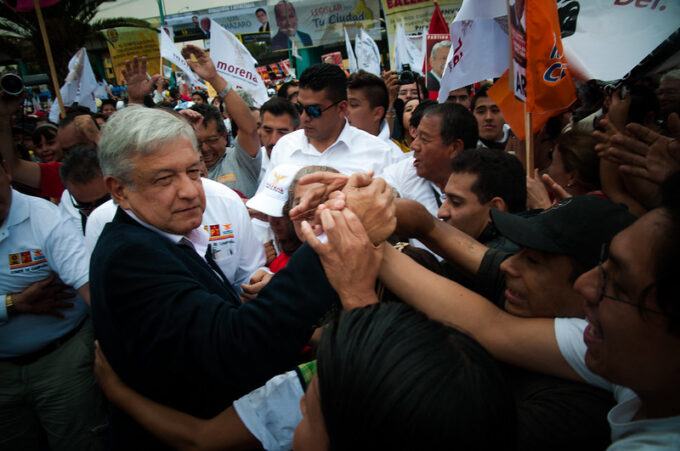
People’s World, April 12, 2022, https://www.peoplesworld.org/