

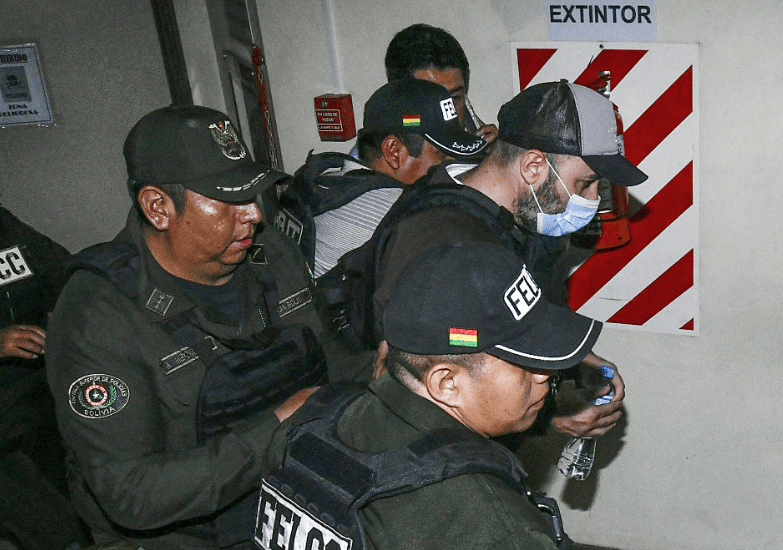
Fernando Cerimedo’s digitalized media blitz, shaping rightwing ascendency in Latin America

Image credit: Rodrigo Urzagasti / AFP via Getty Images

September 7, 2026

South Paris, Maine


An extended campaign of media disinformation contributed to the recent election victories of extreme rightwing presidential candidates in Latin America.  Massive, indiscriminate, and one-way digital communications took on a new prominence.

One individual and his associates took the lead. He and they served the wealthy and politically powerful across the region and farther afield. US influence lurked in the background. A new assertiveness of emboldened rightwing forces shows, both collectively and internationally.

On August 17 in Bolivia, two thugs shot and almost killed lawyer Nadia Beller outside a hotel in Santa Cruz de la Sierra, epicenter of rightwing reaction in the country. Hospitalized, she talked with reporters and the police. Her revelations led to the arrest the next day of Fernando Cerimedo, her partner, and to his preventive detention for 180 days.

Criminal investigation is underway. Charges so far are: attempted murder, domestic abuse, illicit enrichment, and narcotrafficking. Beller described Cerimedo as angry “about her pregnancy and concerned about her knowledge of illegal activities he was carrying out … [in various] countries, to promote conservative politicians and attack progressives.”

Her accusations aligned with messages on Cerimedo’s phone reviewed by investigators. They found at his residence “hundreds of thousands of dollars” and computer equipment used to run a “bots farm.”

Beller, a former parliamentary candidate, had worked in the socialist MAS government of Evo Morales (2007-2019). She recently was serving as an advisor in the conservative, US-supported government of President Rodrigo Paz, elected on November 8, 2025. She declared that María Elena Urquidi Barbery, President Paz’s wife, was engaged in illegal activity.

Cerimedo claimed he worked as an unpaid adviser in Paz’s government. His office adjoined that of the president. He told investigators that “outside consulting work” provides him with 1$ million per year, or per month; his accounts varied. His importance to President Paz shows in an photo of Secretary of State Marcio Rubio conferring with Paz at the Shield of the Americas Summit in Miami in March ─ with Cerimedo at the president’s side.

Cerimedo’s bots farm shaped Bolivian opinion prior to Paz’s electoral victory in 2025. A bot farm, as described by journalist Miguel Ángel San Martín, “is a network of many accounts or devices controlled automatically to generate fake likes, followers, comments, or views; to post or amplify messages en masse on social media; to click on ads or manipulate polls; to automatically create accounts; and to engage in spamming, fraud, or attempts to overwhelm [electronic] services. They are … extremely difficult to detect.”

Voting undermined in Honduras

Cerimedo’s central role in determining the outcome of Honduras’s recent presidential election came to light in August. The social democratic Libre Party held power. Prior to presidential voting on November 30, 2025, Marlon Ochoa, Libre’s representative on the National Election Council, publicized leaked audio recordings of conversations of the National and Liberal Parties’ representatives.  They were insisting that delivery of votes and the count should be delayed. They called for victory of either of their preferred candidates being announced well before all votes were tallied.

It happened: hundreds of thousands of votes were never counted. Millions of text messages warned that remittances would not arrive from the US, if the Libre Party’s Rixi Moncada won. Prior to the voting, President Trump released Juan Orlando Hernández, Honduras’s former president for the National Party, from a US prison. He had been serving 43 years for drug trafficking.  National Party candidate Nasry Asfura had placed third in opinion polls. Now he was Honduras’s new president.

On August 26, Marlon Ochoa, the former national election councilor currently living in exile, reported that Fernando Ceremedo’s voice was heard on leaked audio recordings he delivered to the attorney general’s office in December 2025. There, Cerimedo talked about stuffing votes for Asfura into ballot boxes, discarding votes, and not accepting a “vote-by-vote recount.”

In Chile

Cerimedo tried to disrupt the 2020 Chilean referendum on new Constitution that would have replaced one inherited from the Pinochet dictatorship. Socialist parliamentarian Juan Santana claimed recently that Cerimedo’s own consultancy firm had staged an opinion poll aimed at falsely showing that the “Yes” vote was losing ground. (It passed by 78%.) Cerimedo supported the “Reject” option.

Juan Santana accuses three officials in the government of current right-wing President José Antonio Kast of cooperating with Cerimedo in that endeavor. He claims that bots let loose by Cerimedo eased candidate Kast’s path to electoral victory in 2025, also that “artificial accounts and trolls” disparaged progressive presidential candidate Evelyn Matthei.

In Peru

The results of second-round presidential voting in Peru on June 7 were close. According to elciudadano.com, rightwing candidate Keiko Fujimori had included “Cerimedo as one of her main electoral campaign advisors.” In the first round of voting, “Cerimedo’s network … began to operate covertly in the country through bots, trolls, and false content.” He “launched a disinformation campaign against progressive candidate Roberto Sánchez,” who was ahead in the polls. Ultimately, “the dirty work of Cerimedo” was decisive in overcoming Sánchez’s lead.

To be able to intervene in Peru, Cerimedo and Spanish journalist Javier Negre (see below) built a relationship with Carlos Díaz-Rosillo. He has served in two Trump administrations, in the White House and then the Department of Defense. The Department’s website proclaims that Díaz-Rosillo advises the Secretary of Defense “in all matters related to defense policy and strategy in the Western Hemisphere.”

Díaz-Rosillo and Keiko Fujimori are acquainted. In 2025, Díaz-Rosillo honored her at the Florida-based Adam Smith Center, which he founded and directed. Fujimori must have been appreciative. She had only recently emerged from a failed prosecution on money-laundering chargesAccepting Díaz-Rosillo’s recommendation of Cerimedo, she might have been returning the favor.   

In Colombia

Following the June 21 election victory of Colombia’s new reactionary president Abelardo de la Espriella, outgoing President Gustavo Petro attributed leftist candidate Ivan Cepeda’s defeat to a plague of bots and internet-borne disinformation. The source, he suggested, was the Israeli cyber-intelligence company BlackCore.

Now, however, Petro relies on the forensic analysis of Fernando Cerimedo’s phone. It suggests he collaborated with Colombian electoral officials. Cerimedo refers to “more than two million bots and fake profiles managed by automated farms operating from abroad and the city of Medellín.” Petro called for annulment of the election results. He repeated the accusations in an interview with Mexico’s La Jornada newspaper.  

In Argentina and Brazil

Cerimedo had meddled in elections in Argentina. According to Nadia Beller, President Javier Milei paid Cerimedo $800,000 USD per month to carry out online disinformation. Serving as chief technology and communications officer for Milei’s successful campaign in 2023, he secured large donations and expanded his social media capabilities. Cerimedo informed La Nación newspaper that year that, “He controls ‘farms’ of thousands of trolls, bot accounts, and other digital tools put into service for Milei’s party.”

He exercised his technical and digital capabilities, and his scheming, in Brazil. Cerimedo joined Jair Bolsonaro’s presidential campaigns and provided assistance to Jair Bolsonaro’s failed coup attempt that ended in January, 2023.

Bolsonaro’s son Eduardo, now living in Florida, in February 2026 hosted the “Hispanic Prosperity Gala” held at Mar-a-Lago. Argentine President Milei delivered the keynote address. Bolsonaro presented Cerimedo with an award honoring him as the “Hispanic Political Consultant of the Year.”

Cast of characters

On being honored at the Mar-a-Lago Gala, Cerimedo began by saying that, “I want to say something in English; thank you to Brad Parscale!” US operative Parscale had tutored Cermedo in the uses of social media, trolls, bots, and algorithms for electioneering purposes. The latter told The New York Times that, “Brad set up all the infrastructure that I work with.” Their partnership continued.  

Parscale worked for Donald Trump, serving as digital media director for his 2016 presidential campaign and campaign manager for part of his 2020 campaign. Cerimedo’s collaboration with the well-connected Parscale may have allowed him to make connections of his own

Cerimedo partnered with the Argentinian-American Damián Merlo. This lobbyist owner of the Miami-based Latin America Advisory Group (LAAG) had worked at the US Interests Section in Havana and as program officer at the interventionist International Republican Institute.  Cerimedo’s connection to Merlo’s LAAG lobbying group provided him with indirect access to the Florida congressional delegation and to executive branch officials responsible for Latin America.

The duo formed the Numen publicity company, which undertook to generate US support for Javier Milei’s presidential campaign in 2023. They shaped publicity for the US, and advocated for Milei among US congressperson and with the media.

As noted by the Cubadebate Media Observatory, “Cerimedo built a corporate base in Miami and a transnational media network. The US would be its center of operations.  It benefited from privileged links with the top power structures within the Trump administration, in particular with Marco Rubio.”

After Milei’s electoral win, The Numan organization, helped along by Brad Parscale’s technical help and his travel to Bolivia, played important roles in the 2025 electoral victories of Paz in Bolivia and Asfura in Honduras. Numen also appears as an “academy” offering “digital and political marketing courses” in the region.

Cerimedo and two Argentinian journalists formed La Derecho Diario (Daily of the Right) prior to 2020. It’s a widely-read, pan-Hispanic source of news and views with a reactionary slant; there’s an English-language version. A recent story titled “Wave of Moroccan immigrants arrives in Brazil thanks to Lula” typifies its deceptive content.

The Spanish impresario Javier Negre, a “megaphone” for the far-right Vox political party, owns a far-right media conglomerate. In 2024 he purchased 50% interest in Cerimedo’s La Derecho Diario and took over as director. With Cerimedo now in trouble, he abandoned the platform.

Loose ends

On his digital rampage across Latin America, Cerimedo was a prominent soldier in war being carried out by Latin America’s extreme rightwing. He and others built a network of media and digital communications. It serves the wealthy and politically powerful in Latin America and farther afield. Cerimedo found friends and supporters in Washington and in the southern Florida, hotbed of emigre agitation.

The US government has probably provided support for his activities. Details are scarce. There’s no certainty.  Evo Morales, the former Bolivian president ousted in a US-supported coup in 2019, claims Cerimedo was working for the CIA. Cerimedo’s former partner Nadia Beller says likewise.

Lots of money cropped up along his path, as noted above. That may signal official US involvement. The US government directs vast sums to national security. That category includes undercover activities of all kinds. Some of Cerimedo’s projects may have been classified as such.  

report appearing on ciudadano.com on August 27 is relevant. Investigators looking at Cerimedo’s mobile phone found “codes linked to a network of digital wallets.” The report refers to a “cold wallet.” That’s something allowing for “the discreet transfer of large sums of money.” Investigators discovered “transactions totaling $44,100 … over the last six months.” They “uncovered accounts handling staggering sums, including one that holds $132 million.” 


W.T. Whitney, Jr., is a political journalist whose focus is on Latin America, health care, and anti-racism. A Cuba solidarity activist, he formerly worked as a pediatrician and lives in rural Maine.

Daniel Jadue, the acclaimed mayor of Recoleta in Chile, is victim of lawfare / by W.T. Whitney Jr.

Recoleta Mayor Daniel Jadue, at a 2022 May Day march in Chile. | People’s World

South Paris, Maine

Reposted from Peoples World


“After more than 10 years of corruption, crimes, and destroying the Rocoleta commune, finally the justice system begins to act and will make arrangements for the Communist mayor Daniel Jadue. I hope he goes to jail soon.” That was Richard Kast, speaking in April. Kast was the right-wing presidential candidate defeated by Chile’s President Gabriel Boric in December 2021. The food- manufacturing magnate is the son of a World War II German Army officer.

On June 3 Judge Paulina Moya ruled that Jadue would be imprisoned “preventively” on charges of bribery, mal-administration, tax fraud, and bankruptcy. Moya declared that “for Jadue to go free would endanger the safety of society.” The police in April had prevented him from boarding a flight to Caracas. She decreed “120 days of investigation” prior to Jadue’s appearance before an appeals court.  

Jadue, a former professor of architecture and urban sociology, has been mayor of Recoleta municipality in the northern part of Santiago since 2012. Responding on social media, he insisted that, “They are judging me for our transformative government. I don’t have a peso in my pocket, but they are handing out the maximum restriction.”  

The court’s decision had to do with the “people’s pharmacy” that Jadue devised for Recoleta in 2015. It also involves the spread of people’s pharmacies throughout Chile.Jadue is a national figure. His legal troubles take on added significance on that account.

Jadue is renowned for the reforms he inspired in Recoleta. In addition to the consumer-cooperative pharmacy project, Recoleta offers an “optician program,” a people’s dentistry program, an “open university,” and a “people’s bookstore.” The municipality invests $500,000 a year in 10 public libraries. It recruited physicians and constructed two medical office buildings. It builds architecturally-sophisticated apartment buildings with low-cost rentals. 

Jadue is the unusual Communist Party leader who participated in national elections at the highest level.  As presidential candidate of a left-leaning coalition in 2021, he almost defeated current president Gabriel Boric, head of a center-left coalition competing in the primary elections.

Jadue provokes the wrath of apologists of Israel.  He has participated  in pro-Palestine demonstrations outside Israel’s embassy and made public  statements interpreted by some as antisemitic. The grandson of Palestinian immigrants, he was president of Chile’s General Union of Palestinian Students and a top organizer for Latin America’s Palestinian Youth Organization.

Jadue’s bookPalestine: Chronicle of a Siege, appeared in 2013. HispanTV recently presented his 12-part documentary presentation “Window on Palestine.” Chile is home to half a million Palestinians, the largest concentration outside of the Middle East.

The prosecutor announced criminal charges against Jadue in November 2023.The people’s pharmacies, on which the prosecution of Jadue is based, are a phenomenon. Now there are 212 of them in 170 localities. Average savings on individuals’ drug purchases are between “64% and 68%.”

Recoleta and the other municipalities together formed a purchasing cooperative known as Chilean Association of Municipalities with People’s Pharmacies (Spanish initials are ACHIFARP). Jadue has been its head. At the time of the Covid-19 pandemic, ACHIFARP was under pressure to distribute healthcare supplies reliably and inexpensively.

In 2021 the Best Quality supply company complained to national g authorities that it was approaching bankruptcy, also that ACHIFARP had neither used or paid for large quantities of supplies it had ordered. A Best Quality salesman reported that Jadue had solicited a bribe. The terms were: donate to the Communist Party headquarters in Recoleta and ACHIFARP would give assurances that Best Quality would be called upon to restock the people’s supermarkets, initiated by the government.

Barbara Figueroa, secretary general of the Communist Party released a statement saying merely that, “the precautionary measure against comrade Daniel Jadue is regrettable and disproportionate, and we believe that it should be appealed. … we respect the Courts of Justice and we hope that this public stage of the investigation and trial will end up proving Daniel’s innocence”.

Some 1000 Chileans signed a letter of support for Jadue. They were “national prize winners, legislators, trade unions leaders, heads of social organizations, academics, human rights leaders, political party leaders, city councilors, jurists, and cultural personalities.” According to the letter, “This case represents not only a political and judicial persecution of a public figure, but also a potential threat to the fundamental principles of the rule of law in Chile.” 

As explained by analyst Ricardo Candia Cares,“The people’s pharmacies represent a real contribution to the health of the dispossessed who now have an alternative to the infamous pharmacy chains that collude in gouging the people … … [They] have caused the big pharmacies, or really the powerful forces powerful behind these deals, to lose huge amounts of money.”

Latin American political leaders, Daniel Jadue among them, discovered they can be removed from office or barred from electoral participation through judicial processes. In that regard, he joins presidents Fernando Lugo in Paraguay (2012), Lula da Silva in Brasil (2017), Cristina Fernández de Kirchner in Argentina (2022), Rafael Correa in Ecuador (2018), Evo Morales in Bolivia (2019), and Peru’s President Pedro Castillo (2022).  

They are victims of lawfare, described by Le Monde diplomatique in Spanish as “a new format of persecution and repression, but executed through the perverted use of the norm, mainly by using judges and prosecutors against opponents.”


We hope you appreciated this article. At People’s World, we believe news and information should be free and accessible to all, but we need your help. Our journalism is free of corporate influence and paywalls because we are totally reader-supported. Only you, our readers and supporters, make this possible. If you enjoy reading People’s World and the stories we bring you, please support our work by donating or becoming a monthly sustainer today. Thank you!


W.T. Whitney Jr. is a political journalist whose focus is on Latin America, health care, and anti-racism. A Cuba solidarity activist, he formerly worked as a pediatrician, lives in rural Maine. W.T. Whitney Jr. es un periodista político cuyo enfoque está en América Latina, la atención médica y el antirracismo. Activista solidario con Cuba, anteriormente trabajó como pediatra, vive en la zona rural de Maine.

Reactionaries and US Military Backers Prevail in Latin America – for Now / By W. T. Whitney

The commander of U.S. Southern Command, Army Gen. Laura Richardson, and Argentine Armed Forces Joint Command Chief Lt. Gen. Juan Martín Paleo, arrive at the Argentine Ministry of Defense. During her visit April 25-27, Richardson met with leaders, including Vice President Cristina Fernández de Kirchner. Richardson is a repeat visitor to Argentina since the election of right-wing President Milei. | Photo via U.S. Embassy Argentina

South Paris, Maine


U.S. Southern Command Chief Laura Richardson was visiting Argentina for the third time. On April 4 in Ushuaia, Tierra del Fuego – the world’s southernmost city – she and U. S. Ambassador Marc Stanley were received by President Javier Milei, his chief-of-staff, his cabinet chief, the defense minister, the interior minister, a military band, and an honor guard – at midnight.

Richardson announced her government would build an “integrated naval base” in Ushuaia that, close to the Strait of Magellan, looks to Antarctica. Both are strategically important. She “warned about China’s intention to build a multi-purpose port in Rio Grande, [Tierra del Fuego’s capitol city].”

Richardson, the U.S. military’s top leader for the region, had previously noted its attractions. She explained to the House Armed Services Committee in 2022 that Latin American and Caribbean area “accounts for $740 billion in annual trade with the U.S.; contains 60% of the world’s lithium and 31% of the world’s fresh water; has the world’s largest oil reserves” She insisted later that, “This region matters. It has a lot to do with national security, and we have to step up our game.”  

Testifying before a congressional committee on March 14, she remarked that, “The PRC (People’s Republic of China) is America’s pacing threat; countering their aggression and malign influence requires a whole-of-society approach.”

Information from an alleged leak from the U.S. Embassy in Bolivia suggests the U.S. government seeks to isolate non-aligned countries like Colombia, Bolivia, Venezuela and collaborate with “three bastions of U.S. support,” namely Peru, Ecuador and Argentina.

Analyst Sergio Rodríguez Gelfenstein claims U.S. “policies [in the region] are in the hands of the Pentagon … with the  State Department playing a secondary role…. The emphasis is on penetrating extreme rightwing governments.” 

U.S. troops and military advisors collaborate with regional military forces to confront narco-trafficking and other transnational crimes. Stories of good works have propaganda use in gaining support for their presence and for partnership with governments pushing back against popular protests. The survey below shows that U.S. military activities in the region are far-reaching and that long-term objectives and short-term needs are served.

Moving parts

The stated mission of the U.S. military installation in Argentina’s Neuquén province is to respond to humanitarian crises. That a Chinese satellite launch and tracking facility is nearby is no coincidence. The area has immense oil deposits.

U.S. troops based in Misiones, near Argentina’s borders with Brazil and Uruguay, ostensibly deals with narco-trafficking and other cross-border crimes. The U.S. government recently provided credit for Argentina to buy 24 F-16 fighter planes from Denmark.  

The largest U.S. bases in the region are the Guantanamo base in Cuba, with 6100 military and civilian personnel, and the one at Soto Cano in Honduras, with 500 U.S. troops and 500 civilian employees.TheU.S. Naval Medical Research Unit, active in several locations in Peru and overseen by the Southern Command, conducts “health science research” with Peruvian partners. It also serves to “build the capacity of special forces to survive in tropical forests.”

The U.S. Navy patrols South Atlantic waters and conducts joint training exercises with Argentina, Brazil, Chile, Colombia, Ecuador, Peru and Uruguay. The U.S. Coast Guard confronts illegal – read Chinese – fishing off South America’s Pacific coast.

The U.S. Army Corps of Engineers operates in 17 countries, fulltime in eight of them. It advises on river and estuary projects, notably on maintaining commercial flow from the Río de la Platabasin to the Atlantic.  

Ecuador and Peru each agreed recently to accept U.S. troop deployments. Colombia (2009) enabled the U.S. Air Force to utilize seven of its bases. Brazil and the United States (2019) cooperate in launching rockets, spacecraft, and satellites at Brazil’s Alcántara space center. The U.S. military cooperates with Brazil and Chile in conducting defense-related research.

The Southern Command annually holds CENTAM exercises with participation by U.S. National Guard troops and those of several Central American nations. They prepare for humanitarian crises and natural disasters.  The National Guards of 18 U.S. states carry out joint training exercises with the troops of 24 Latin American nations.

The United States supplies 94.9% of Argentina’s weapons, 93.4% of Colombia’s, 90.7% of México’s, and 82.7% of Brazil’s. Bolivia is the outlier, obtaining 66.2 % of its weapons from China.

The U.S. government authorized arms sales to Mexico in 2018 worth $1.3 million, to Argentina in 2022 worth $73 million, to Chile in 2020 worth $634 million, and to Brazil in 2022 worth $4 million.

The Southern Command operates schools for the region’s military and police forces. The Western Hemisphere Institute for Security Cooperation and the School of the Americas, its predecessor from 1946 on, account for almost 100,000 military graduates. The El Salvador-based International Law Enforcement Academy, “purposed to combat transnational crime,” trains police and other security personnel.

The Command in December 2023 undertook joint aerial training exercises with Guyana, where Exxon Mobil is preparing to extract offshore oil from huge deposits in Guyana’s Essequibo province.  Venezuela claims ownership of that area. Venezuelan President Maduro recently accused the U.S. government of establishing secret bases there.  

The story here is of installations and institutions, supply and support systems, and military interrelationships. The complexity of this U.S. undertaking signals fragility. The make-up of allied governments does likewise.

With friends like these

Raised in the United States and buoyed by his family’s great wealth, Ecuadorian president Daniel Noboa is inexperienced. The country faces environmental catastrophe and widespread violence. Indigenous peoples are politically mobilized and security forces cruelly repressive.

Raiding the residence of unelected Peruvian President Dina Boluarte, police on March 29 found jewelry worth $502,700. Establishment politicians appointed her as president after they railroaded progressive President Pedro Castillo, her predecessor, to prison.  Oligarchic rule and occasional dictatorships are customary in Peru, as is indigenous resistance.

Presidential rule in Argentina is bizarre. Eric Calcagno, distinguished sociologist, journalist, and diplomat, told an interviewer recently that President Milei is “asking to be part of NATO, which is the organization that occupied part of our territory, the Malvinas (Falkland Islands).” For Milei, “war is necessary.” The “regime … [is] “the figurehead of local and international monopolies [and] is taking Argentina to the point of no return.”

Argentina is “governed by a gentleman who decides things in consultation with a dead dog, or much worse, with General Richardson of the Southern Command.”  (A news report attributes to Milei devices “allowing him to enter into the spirit of Conan and calm his anxiety.” Conan, a dog, is dead.)

Meanwhile, 800,000 students, workers, unionists, the unemployed, and popular assemblies marched in Buenos Aires on April 23. Joined by 200,000 Argentinians demonstrating elsewhere in the country, they were protesting governmental attacks on public universities.

With popular resistance continuing in Argentina and elsewhere in the region, the precariousness of U.S. military intervention will show. Investigator Jason Hickel points to “imperial arrangement on which Western capitalism has always relied (cheap labor, cheap resources, control over productive capacities, markets on tap).”

He refers to the “Western ruling classes” and the “violence they perpetrate, the instability, the constant wars against a long historical procession of peoples and movements in the global South.” And yet: “[a]fter political decolonization, a wide range of movements and states across the South … sought economic liberation and sovereign industrial development.”

These are national liberation struggles that presumably will continue. Resistance under that banner may someday overwhelm military intrusions like the ones surveyed here.   


W.T. Whitney is a political journalist whose focus is on Latin America, health care, and anti-racism. A Cuba solidarity activist, he formerly worked as a pediatrician, lives in rural Maine. W.T. Whitney Jr. es un periodista político cuyo enfoque está en América Latina, la atención médica y el antirracismo. Activista solidario con Cuba, anteriormente trabajó como pediatra, vive en la zona rural de Maine.

Building the Communist Movement is Women’s Work (and Men’s Too) / by W. T. Whitney Jr.

Analyst Taryn Fivek, in her recent article on the CPUSA website, offers explanations for women’s frequent reluctance to take part in progressive politics. She calls for more involvement of women in the struggle for socialism. Here we review some of her conclusions and argue that women’s role in struggle must be large, one reason reason being the nature of socialist struggle and another, women’s experience and special qualifications.

Fivek points to barriers of male prejudice and of misplaced disparagement of women’s work, both in the workplace and in “social reproduction.” Not only do woman work for relatively low wages “in the productive sphere of the economy,” but, as she claims, “they are also working unpaid in the reproductive sphere” and, indeed, are “35% more likely than men to live in poverty.”

She points out that, [w]omen’s economic well-being is often tied to their role as primary laborer in a male-dominated household” and economic dependency may lead to “difficulty in leaving abusive relationships.” Fivek attributes women’s hesitancy to act politically to the assumption by most women, shared by society at large, that as care-givers “the major site of their oppression — the interpersonal or reproductive sphere … [is] ‘private’ and ‘personal.’”

The prevailing version of social reproduction alluded to by Fivek centers on home-based activities concerned with nurturing, protecting, and preparing workers for the future. In fact, as she points out, “social reproduction is not a private affair.” But she is also embracing a more far-reaching definition such as this one: social reproduction has to do with ways “by which a society maintains and transforms its social order, formations, and relations across time and space”.  

She insists that, “To say that the personal is not political is to accept the gender gap in our political work.” Women are to be accommodated and “included in all areas of political work.” She asks: “What can the [Communist] Party do to increase participation and leadership of women in the struggle for socialism?”

At issue are the characteristics of the kind of social reproduction operating in the public sphere. Women and men are already politically involved in that arena, but more women are needed.   

Some assumptions intrude. With its mechanistic overtones and utilitarian implications of supplying future workers, the unattractive term social reproduction needs replacing. And the customary linkage of social reproduction with women’s major role in family life must evolve, as a work in progress, into a larger role for men. Lastly, capitalists will not soon view any kind of social-reproduction work as other than a “free gift,” or as deserving merely of crumbs.

As envisioned here, the social-reproduction project is huge, so much so that working-class women and men will reject injustices impinging on their lives; will listen, learn, collaborate, and teach; care for people and nature; and manage affairs. Confronting governments, local ones not least, they will continue to agitate for livable incomes, roofs over heads; access to schooling from infant day-care to universities, lifelong education, sicknesses prevented and treated, no hunger, solidarity with workers abroad. – with no one left out.

The premise is that family-based tasks of taking-care-of and caring-for are expandable, and are important in society.  In conversation long ago with an American Communist and poet (Pulitzer Prize!) of provocative bent, that message was clear. Hearing about a male, myself, learning to be a doctor, he exclaimed in mock horror something like, “Why, that’s women’s work!”

Those whose work is that of perpetuating the generations have a name, not a laughably awkward one like “social reproducer,” but rather “socialist,” that is to say, socialist men and socialist women. 

Many or most women have the experience, predisposition, and – as it seems – the skills to take care of people and things – in other words, to be socialists. Today, socialist parties and socialist organizations badly need women as colleagues and comrades. Tasks ahead are momentous and recruits are needed who are prepared.

According to Psychology Today, “Girls and women … have advantages for many basic language-related skills … [and most] 12-year-old girls were more skilled than the average same-age boy at making inferences about the thoughts, feelings, and social perspective of their peers.”

It’s no surprise that, as reported recently by pewresearch.org, “Young women are more likely to be enrolled in college today than young men, and among those ages 25 and older, women are more likely than men to have a four-year college degree. The gap in college completion is even wider among younger adults ages 25 to 34.”

A University of Zurich study in 2018 claims that: “Demand for high-skilled workers who perform cognitive tasks has increased dramatically in the United States … [We find that] the probability that a college-educated man was employed in such a job fell, while the prospects for college-educated women improved. The key driver seems to be growing demand for social skills, such as empathy, communication, emotion recognition and verbal expression, in which evidence from psychological research indicates that women have a comparative advantage.”

Camila Vallego, Karol Cariola, and Marisela Santibáñez of the Communist Party of Chile

Reporting on a United Nations-organized conference in Chile in 2015 about women and political power, Winnie Byanyima, then the executive-director of Oxfam International, states that, “[W]hen you have more women in public decision-making, you get policies that benefit women, children and families in general …There is already enough evidence in the world to show the positive impact of women’s leadership. Women have successfully built and run countries and cities, economies and formidable institutions.” 

Caretaking means peacemaking. UN-sponsored research looking at 40 peace processes between 1989 and 2014 showed in 2015 that, women have managed to make substantial contributions to peacemaking and constitution-making negotiations.”  The study showed that, “where women were able to exercise strong influence on a negotiation process, the chances of agreements being reached and implemented were much higher than when women’s groups exercised moderate, weak, or no influence.”

Former Cuban president Raúl Castro has the last word.  Reporting to a Cuban Communist Party Congress in 2016, Castro noted with regret that women occupied only “38% of positions in state bodies, government agencies, national entities.”  This was despite women representing 49% of Cuba’s workforce and “66.8% of the best technically and professionally qualified workforce of the country.”

He continued: “I stand by the strictest truth when I affirm, based on my experience in many years of Revolution, that women, generally, are more mature and better managers than men. Therefore, although I recognize the progress made, I believe that under the leadership of the Party, the promotion of our combative females should continue rising, especially to decision-making positions nationwide.”

W.T. Whitney Jr. is a political journalist whose focus is on Latin America, health care, and anti-racism. A Cuba solidarity activist, he formerly worked as a pediatrician, lives in rural Maine. W.T. Whitney Jr. es un periodista político cuyo enfoque está en América Latina, la atención médica y el antirracismo. Activista solidario con Cuba, anteriormente trabajó como pediatra, vive en la zona rural de Maine.

Building the Communist Movement is Women’s Work (and Men’s Too) / by W. T. Whitney Jr.

Analyst Taryn Fivek, in her recent article on the CPUSA website, offers explanations for women’s frequent reluctance to take part in progressive politics. She calls for more involvement of women in the struggle for socialism. Here we review some of her conclusions and argue that women’s role in struggle must be large, one reason reason being the nature of socialist struggle and another, women’s experience and special qualifications.

Fivek points to barriers of male prejudice and of misplaced disparagement of women’s work, both in the workplace and in “social reproduction.” Not only do woman work for relatively low wages “in the productive sphere of the economy,” but, as she claims, “they are also working unpaid in the reproductive sphere” and, indeed, are “35% more likely than men to live in poverty.”

She points out that, [w]omen’s economic well-being is often tied to their role as primary laborer in a male-dominated household” and economic dependency may lead to “difficulty in leaving abusive relationships.” Fivek attributes women’s hesitancy to act politically to the assumption by most women, shared by society at large, that as care-givers “the major site of their oppression — the interpersonal or reproductive sphere … [is] ‘private’ and ‘personal.’”

The prevailing version of social reproduction alluded to by Fivek centers on home-based activities concerned with nurturing, protecting, and preparing workers for the future. In fact, as she points out, “social reproduction is not a private affair.” But she is also embracing a more far-reaching definition such as this one: social reproduction has to do with ways “by which a society maintains and transforms its social order, formations, and relations across time and space”.  

She insists that, “To say that the personal is not political is to accept the gender gap in our political work.” Women are to be accommodated and “included in all areas of political work.” She asks: “What can the [Communist] Party do to increase participation and leadership of women in the struggle for socialism?”

At issue are the characteristics of the kind of social reproduction operating in the public sphere. Women and men are already politically involved in that arena, but more women are needed.   

Some assumptions intrude. With its mechanistic overtones and utilitarian implications of supplying future workers, the unattractive term social reproduction needs replacing. And the customary linkage of social reproduction with women’s major role in family life must evolve, as a work in progress, into a larger role for men. Lastly, capitalists will not soon view any kind of social-reproduction work as other than a “free gift,” or as deserving merely of crumbs.

As envisioned here, the social-reproduction project is huge, so much so that working-class women and men will reject injustices impinging on their lives; will listen, learn, collaborate, and teach; care for people and nature; and manage affairs. Confronting governments, local ones not least, they will continue to agitate for livable incomes, roofs over heads; access to schooling from infant day-care to universities, lifelong education, sicknesses prevented and treated, no hunger, solidarity with workers abroad. – with no one left out.

The premise is that family-based tasks of taking-care-of and caring-for are expandable, and are important in society.  In conversation long ago with an American Communist and poet (Pulitzer Prize!) of provocative bent, that message was clear. Hearing about a male, myself, learning to be a doctor, he exclaimed in mock horror something like, “Why, that’s women’s work!”

Those whose work is that of perpetuating the generations have a name, not a laughably awkward one like “social reproducer,” but rather “socialist,” that is to say, socialist men and socialist women. 

Many or most women have the experience, predisposition, and – as it seems – the skills to take care of people and things – in other words, to be socialists. Today, socialist parties and socialist organizations badly need women as colleagues and comrades. Tasks ahead are momentous and recruits are needed who are prepared.

According to Psychology Today, “Girls and women … have advantages for many basic language-related skills … [and most] 12-year-old girls were more skilled than the average same-age boy at making inferences about the thoughts, feelings, and social perspective of their peers.”

It’s no surprise that, as reported recently by pewresearch.org, “Young women are more likely to be enrolled in college today than young men, and among those ages 25 and older, women are more likely than men to have a four-year college degree. The gap in college completion is even wider among younger adults ages 25 to 34.”

A University of Zurich study in 2018 claims that: “Demand for high-skilled workers who perform cognitive tasks has increased dramatically in the United States … [We find that] the probability that a college-educated man was employed in such a job fell, while the prospects for college-educated women improved. The key driver seems to be growing demand for social skills, such as empathy, communication, emotion recognition and verbal expression, in which evidence from psychological research indicates that women have a comparative advantage.”

Camila Vallego, Karol Cariola, and Marisela Santibáñez of the Communist Party of Chile

Reporting on a United Nations-organized conference in Chile in 2015 about women and political power, Winnie Byanyima, then the executive-director of Oxfam International, states that, “[W]hen you have more women in public decision-making, you get policies that benefit women, children and families in general …There is already enough evidence in the world to show the positive impact of women’s leadership. Women have successfully built and run countries and cities, economies and formidable institutions.” 

Caretaking means peacemaking. UN-sponsored research looking at 40 peace processes between 1989 and 2014 showed in 2015 that, women have managed to make substantial contributions to peacemaking and constitution-making negotiations.”  The study showed that, “where women were able to exercise strong influence on a negotiation process, the chances of agreements being reached and implemented were much higher than when women’s groups exercised moderate, weak, or no influence.”

Former Cuban president Raúl Castro has the last word.  Reporting to a Cuban Communist Party Congress in 2016, Castro noted with regret that women occupied only “38% of positions in state bodies, government agencies, national entities.”  This was despite women representing 49% of Cuba’s workforce and “66.8% of the best technically and professionally qualified workforce of the country.”

He continued: “I stand by the strictest truth when I affirm, based on my experience in many years of Revolution, that women, generally, are more mature and better managers than men. Therefore, although I recognize the progress made, I believe that under the leadership of the Party, the promotion of our combative females should continue rising, especially to decision-making positions nationwide.”

W.T. Whitney Jr. is a political journalist whose focus is on Latin America, health care, and anti-racism. A Cuba solidarity activist, he formerly worked as a pediatrician, lives in rural Maine. W.T. Whitney Jr. es un periodista político cuyo enfoque está en América Latina, la atención médica y el antirracismo. Activista solidario con Cuba, anteriormente trabajó como pediatra, vive en la zona rural de Maine.