Prospects for Chile: New President New Constitution, Continuing Turmoil / by W.T. Whitney. Jr.

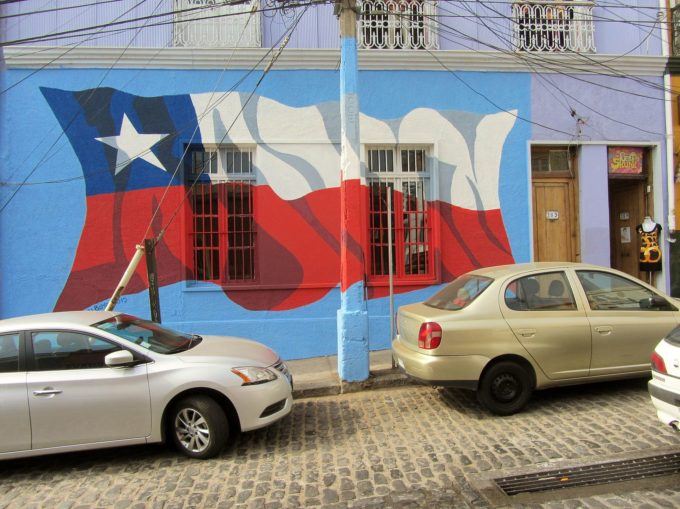
Photograph Source: Rodrigo Fernández – CC BY-SA 4.0

The 1973 U.S.-supported military coup against Chile’s socialist government, and the murder of president Allende, may be old history. The Pinochet dictatorship may have ended in1988 and democratic forms – elections, political parties, debate – are in place. And Chile’s economy, recovering from the pandemic, is booming. For the U. S. State Department, Chile is now “a leader in promoting respect for the rule of law, economic stability, education, environmental protection, human rights, and sustainable development.”  Besides, “Bilateral trade in goods and services between the United States and Chile were worth approximately $31.1 billion in 2020.”

But turmoil and volatility prevail, as evidenced in presidential elections taking place on November 21, continuing street demonstrations, and preparations for a new Constitution.

Elections at hand

Gabriel Boric, narrowly favored to win Chile’s presidency, was a leader in the student uprisings of 2011-2012. He’s been a parliamentary deputy since 2014 and the first to enter parliament without party affiliation. In 2016 Boric founded the Autonomous Movement.

Boric is the candidate of the newly formed Social Convergence party that absorbed the Autonomous Movement and three other small left-leaning parties. Social Convergence seeks a “socialist, democratic, libertarian, and feminist society.”

Boric scored a 60% plurality in primary elections in July. The Broad Front coalition, which supported Boric, was competing with the Communist Party-led coalition behind Daniel Jadue, mayor of Recoleta.  Jadue led in opinion polls during most of the campaign.  The Communist Party now supports Boric, candidate for Approve Dignity, a new and enlarged leftist coalition.

Presently Boric registers 29% approval in opinion polls. The extreme rightwing candidate José Antonio Kast has advanced rapidly to a 25% favorability rating, overcoming the conservative Sebastián Sichel, who has fallen to 14% approval.

A lawyer and former parliamentarian, Kast is said to be homophobic, an opponent of women’s rights, and a climate-change denier.  He supposedly admires Brazilian president Bolsonaro and former U.S. president Trump. Critics regularly characterize Kast as fascist or neo-fascist.

His father Miguel Kast, a German Army officer in World War II, emigrated to Chile, established a large family and, with his sons, founded a restaurant chain, a food-manufacturing company, and accumulated large landholdings. Family members have been politicians, economists, and bankers.

In 2006 lawyers in Panama, a so-called “fiscal paradise,” assisted the Kast family in reconstituting their assets.  José A. Kast departed from the family businesses with a “patrimony” of $4 billion.

Reports have surfaced alleging that immediately after the Pinochet-led military coup of 1973, Kast’s father and brother Miguel participated in, or failed to stop, the disappearances of leftist agrarian-rights agitators active in Paine, the Kasts’ rural home base.

Presumably the 20% of Chileans who accounted for 51% of income generated in 2017 overlap with the 20 % of the electorate who think favorably about the former dictatorship.  Presidential candidate Kast fits into at least one of these categories, maybe both.

Street Heat

On October 18, student-led demonstrations burst forth nationwide; 20,000 demonstrators gathered in Santiago and thousands more in 50 other cities. The carabineros, Chile’s notoriously brutal national police force, arrested 450 people, killed two, and wounded 56. The carabineros have enjoyed virtually free rein since the Pinochet dictatorship.

The demonstrators were memorializing October 18 in 2019. That day over a million people filled newly-named Dignity Plaza in Santiago. Large demonstrations took place throughout Chile. Violence at the hands of carabineros led to 34 deaths, and, bizarrely, 450 or so serious eye injuries. Onset of the Covid-19 pandemic ended regular protests five months later, although they’ve continued sporadically.

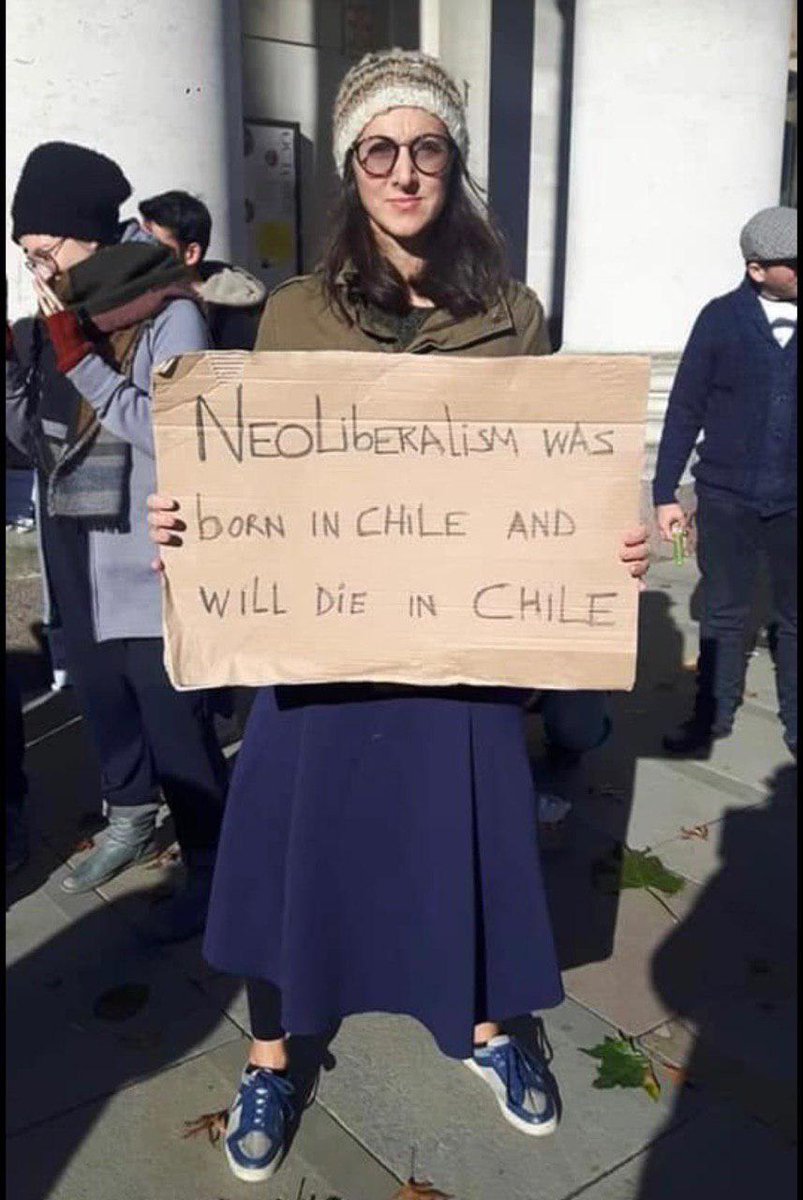
Then and now, demands center on social and economic opportunities for young people, women, and indigenous peoples, on pension reform and the release of political prisoners. Protesters have denounced neoliberal changes introduced during the dictatorship such as privatization of education, healthcare, and pensions, austerity, deregulation, and sell-offs of water rights and publicly-owned mineral, fishery, and forest resources.

All along, they’ve condemned the abuse of Chile’s indigenous peoples, a prime cause of instability in Chile. The Mapuche people, excluded from Chilean society, have suffered oppression since the late 19th century, when Chile’s military invaded the four southern provinces where they have lived. Oppression accentuated recently as corporations commandeered natural resources and carabineros cleared the way.

President Sebastian Piñera on October 12 announced a state of “emergency” as troops occupied Mapuche regions. The Mapuche demand autonomy and return of their land.

Protesters have called upon Piñera to resign. Piñera in mid-November, 2019 met with representatives of political parties. Rattled by the massive street demonstrations of the previous few weeks, he agreed to preparations for a new constitution, a longstanding demand.

New Magna Carta

In October, 2020, Chileans voted in favor of a constitutional convention. They elected delegates in May, 2021. The constitutional convention began its work in July, 2021, mainly on procedural matters. Deliberation on substance began in mid-October. There will be a referendum on approving a new constitution in 2022.

From the viewpoint of progressives, the Convention’s main burden is to remove or replace provisions of the Pinochet-era constitution. Targeted particularly are provisions authorizing neoliberal reforms. The hope also is that a new constitution will no longer enable the harsh policing and judicial measures used now to repress political dissent.

Delegates are divided equally between men and women.  A Mapuche woman, Elisa Loncón, is presiding. Seats are reserved for indigenous peoples. In elections in May, the center-right gained 37 seats; the leftist Approve Dignity coalition, 28 seats; a center-left coalition, 25 seats; and independents and the indigenous, 65 seats.

Opinion polls in Chile have shown massive popular distrust of political parties. Unaffiliated activists and others associated with social movements participated hugely in preparing for the referendum authorizing the Constitutional Convention. Insofar as a two thirds majority is required for approval of new constitutional provisions, and what with the unpredictability of unaffiliated delegates, it’s far from certain that the new constitution will bring about much progressive change.

Whether a new constitution leads to significant change or not, troubles won’t soon disappear. As harbinger of things to come, the “Reject” voting bloc, losers in the referendum authorizing the Convention, has launched a social media slander-barrage against delegates and the Convention’s president.

Class conflict will be continuing. The undiminished political strength of the extremely wealthy makes that so.

Incriminating information recently emerged from a new investigation of the “Pandora Papers” scandal involving money stored in various tax-free havens.  According to alainet.org, president Piñera during his first presidential term, in 2010, “sold his 33% ownership share in the Domino [mining] project to his friend, convict Carlos Alberto Délano, for $152 million …  He received $14 million which was deposited in his account in Santiago. The balance, $138 million, was deposited in a Virgin Islands fiscal paradise, along with most of his fortune.”

The amount included a of $10 million payment conditioned on “there being no modifications in environmental legislation that would reduce production.”

Mr. Piñera’s net worth as of October 27 was $2.8 billion. Chile seemingly incorporates two worlds different enough as to be irreconcilable. One is the world of students, unionists, teachers, women, indigenous people, and others protesting in the streets. The other is that of Piñera, J.A. Kast, the Harvard Economics Department, and the University of Chicago.

But why the Harvard Economics Department? The title of Piñera’s Ph.D. thesis presented there was: “The Economics of Education in Developing Countries: A Collection of Essays”. According to a biography produced by Chile’s government in 2013, the president “understood that this social science (economics) was a formidable tool to help improve the quality of life of the less fortunate.”

And why bring in the University of Chicago?  That was where graduate student Miguel Kast, J.A. Kast’s brother, learned about saddling Chile with neoliberalism; he was a “notable Chicago boy.”

Author: W.T. Whitney Jr. is a retired pediatrician and political journalist living in Maine.

Source: CounterPunch, October, 29, 2021, https://www.counterpunch.org/2021/10/29/prospects-for-chile-new-president-new-constitution-continuing-turmoil/
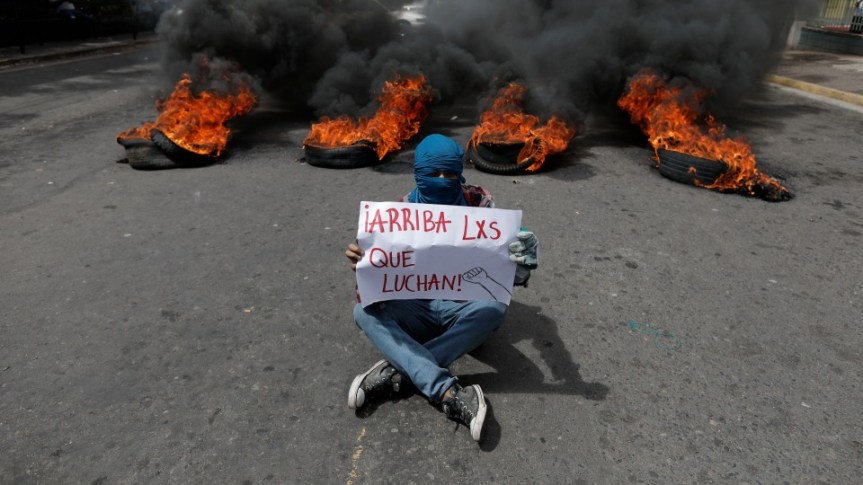
U.S. intervention and capitalism have created a monster in Honduras / by W.T. Whitney, Jr.

In this Oct. 24 2019, file photo, a man holds a sign that reads in Spanish “Hurray for those who fight” as he sits in front of a street blocked by a burning barricade, during a protest to demand the resignation of President Juan Orlando Hernández, in Tegucigalpa, Honduras. | Elmer Martinez / AP

Chilean author and human rights advocate Ariel Dorfman recently memorialized Orlando Letelier, former Chilean President Salvador Allende’s foreign minister. Agents of dictator Augusto Pinochet murdered Letelier in Washington in 1976. Dorfman noted that Chile and the United States were “on excellent, indeed obscenely excellent, terms (like they are today, shamefully, between the United States and the corrupt regime in Honduras).”

The Honduran government headed by President Juan Orlando Hernández does have excellent relations with the United States. The alliance is toxic, however, what with the continued hold of capitalism on an already unjust, dysfunctional society. Hondurans will choose a new president on Nov. 28.

Honduras, a dependent nation, is subject to U.S. expectations. These center on free rein for businesses and multi-national corporations, large foreign investment, low-cost export goods, low wages, foreigners’ access to land holdings and sub-soil resources, and a weakened popular resistance.

Meanwhile, the U.S. government casts a blind eye on Hernández’s many failings. These include: fraud and violence marking his second-term electoral victory in 2017, an illegal second term but for an improvised constitutional amendment, testimony in a U.S. court naming him as “a key player in Honduras’ drug-trafficking industry” and lastly, his designation by U.S.  prosecutors as a “co-conspirator” in the trial convicting his brother Tony on drug-trafficking charges.

Some 200 U. S. companies operate in Honduras. The United States accounted for 53% of Honduras’s $7.8 billion export total in 2019. U.S goods, led by petroleum products, made up 42.2% of Honduran imports.

Honduras’s Economic Development and Employment Zones (ZEDE) reflect planners’ exuberant imagination. They envision privately owned and operated “autonomous cities and special investment districts” attracting foreign investment and welcoming tourist and real estate ventures, industrial parks, commercial and financial services, and mining and forestry activities.

Banks and corporations active in the ZEDEs will appoint administrative officers, mostly from abroad and many from the United States. They, not Honduras’s government, will devise regulations and arrangements for taxation, courts, policing, education, and healthcare for residents.

The first ZEDEs are taking shape now. The idea for them cropped up following the military coup in 2009 that removed President Manuel Zelaya’s progressive government. Hernández, as congressional leader and as president from 2014 on, led in promoting them. Honduras’s Congress in 2013 amended the Constitution to legitimize legislation establishing the ZEDEs. The recent end of litigation before the Supreme Court resulted in their final authorization.

For most Hondurans, who are treated as if they were disposable, capitalism has its downside.

Honduras’s poverty rate is 70%, up from 59.3% in 2019. Of formally employed workers, 70% work intermittently; 82.6% of Honduran workers participate in the informal sector. The Covid-19 pandemic led to more than 50,000 businesses closing and almost half a million Hondurans losing their jobs. Some 30,000 small businesses disappeared in 2020 owing to floods caused by hurricanes.

Violence at the hands of criminal gangs, narco-traffickers, and the police is pervasive and usually goes unpunished. Victims are rival gang members, political activists, journalists, members of the LGBT community, and miscellaneous young people. According to insightcrime.org, Honduras was Latin America’s third-most violent country in 2019 and a year later it registered the region’s third-highest murder rate. Says Reuters: “Honduras has become a sophisticated state-sponsored narco-empire servicing Colombian cartels.”

Associated with indiscriminate violence, corruption, and narco-trafficking, Honduras’s police are dangerous. President Hernández eight years ago created the “Military Police for Public Order” (PMOP), the Interinstitutional National Security Force, and the “Tigres” (Tigers). These are police units staffed either by former soldiers or by “soldiers…specializing in police duties.” Police in Honduras numbered 13,752 in 2016 and 20,193 in 2020.

Honduras’s military has grown. Defense spending for 2019 grew by 5.3 %; troop numbers almost doubled. For Hernández, according to one commentator, “militarism has been his right arm for continuing at the head of the executive branch.” The military forces, like the police, are corrupt, traffic illicit drugs, and are “detrimental” to human rights. The looming presence of security forces is intimidating as they interfere, often brutally, with voting, protest demonstrations, and labor strikes.

According to Amnesty International, “The government of…Hernández has adopted a policy of repression against those who protest in the streets.… The use of military forces to control demonstrations across the country has had a deeply concerning toll on human rights.”

The U.S. government has provided training, supplies, and funding for Honduras’s police and military. Soto Cano, a large U.S. airbase in eastern Honduras, periodically receives from 500 to 1500 troops who undertake short-term missions throughout the region, supposedly for humanitarian or drug-war purposes.

Not only does serious oppression exist but, according to Reuters, severe drought over five years has decimated staple crops. “Nearly half a million Hondurans, many of them small farmers, are struggling to put food on the table.” The UN humanitarian affairs agency OCHA reports that as of February 2021, “The severity of acute food insecurity in Honduras has reached unprecedented levels.”

For the sake of survival, many Hondurans follow the path of family and friends: they leave. Among Central American countries, Honduras, followed by Guatemala and Mexico, registered the highest rate of emigration between 1990 and 2020. The rate increases were: 530%, 293%, and 154%, respectively. Between 2012 and 2019, family groups arriving from Honduras and apprehended at the U.S. border skyrocketed from 513 in 2012 to 188,368 in 2019.

Honduran President Juan Orlando Hernández. | Elmer Martinez / AP

The undoing of Honduras by U.S. imperialism follows a grim pattern but is also a special case. Rates of migration from Central American countries to the United States correlate directly with levels of oppression and deprivation in those countries. As regards hope, the correlation is reversed.

Differing rates of apprehension of Honduran and Nicaraguan migrants at the U.S. southern border are revealing: Capitalist-imbued Honduras specializes in oppression, while optimism is no stranger in a Nicaragua aspiring to socialism.

Department of Homeland Security figures show that between 2015 and 2018 the yearly average number of Nicaraguans apprehended at the border was 2292. The comparable figure for Hondurans was 63,741. Recently the number of Nicaraguan migrants has increased; 14,248 presented themselves at the border in 2019—as did 268,992 Honduran refugees. The difference cannot be explained by the two nations’ populations: This year the Honduran population reached 10,104,920, and the Nicaraguan population 6,724,836.

Recent reflections of Carlos Fonseca Terán, the Sandinista National Liberation Front (FSLN) international secretary, show why hope has persisted in Nicaragua. He points out that since 2007, poverty, inequality, illiteracy, infant mortality, and murders have dropped precipitously. Citizens’ safety, electrification, renewable energy sources, women in government, healthcare funding, and the minimum wage have increased markedly. Fonseca adds that the “percentage of GDP produced…under associative, cooperative, family and community ownership went from less than 40% to more than 50%.”

As they taught us in school, contrast and compare.

Author: W.T. Whitney Jr. is a political journalist whose focus is on Latin America, health care, and anti-racism. A Cuba solidarity activist, he formerly worked as a pediatrician, lives in rural Maine.

Source: People’s World, October 13, 2021, https://peoplesworld.org/article/u-s-intervention-and-capitalism-have-created-a-monster-in-honduras/

Cuban intelligence chief says ‘U.S. government preparing final blow’ to revolution / by W.T. Whitney, Jr.

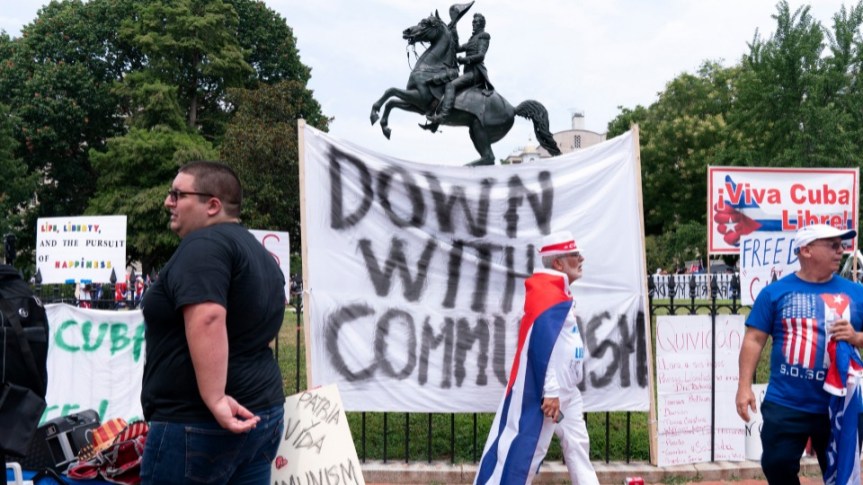
Anti-communist Cuban-Americans ask for U.S. military intervention in against Cuba, July 26, 2021, at Lafayette Park near the White House in Washington. | Jacquelyn Martin / AP

Fabián Escalante helped establish Cuba’s state security services. He headed Cuba’s Department of State Security from 1976 to 1996, served as vice minister of the Interior Ministry, and after 1993 led the Cuban Security Studies CenterHis views on threats from the U.S. government and on protecting Cuba’s Revolution carry weight.

Writing Sept. 23 on Cuba’s Pupila Insomne website, Escalante notes that “the internal counterrevolution is reorganizing its forces and is on the offensive.” They were “calling for a ‘national strike’ for October 11…to secure the ‘liberation of political prisoners.’” He insists that, afterwards, “a group of ‘activists,’ presumably counterrevolutionaries,” will be seeking authorization from Havana municipal authorities “for a peaceful march against ‘violence’ in November.”

He regards the timing as crucial, inasmuch as Cuba will be reopening its borders to international tourists in November; they’ve been excluded due to the COVID-19 pandemic. At issue is revival of Cuba’s economy.

Escalante cites a Miami periodical’s report asserting that “marchers will be calling for rights for all Cubans, liberation of political prisoners, and democratic and peaceful solutions of differences.” The story portrays island-wide marches as challenging Cuba’s government to honor a constitutional right to “public protest.”

He observes that “lies and half-truths, swarming around via social media, are disparaging government leaders, especially Cuban President Miguel Díaz-Canel. Accusations center on “failing to improve living conditions in deprived, vulnerable urban districts.”

Retired Cuban intelligence chief Fabián Escalante. | via Prensa Latina

Escalante notes that in Miami, “a sector of the Cuban community, manipulated by fundamentalist congresspersons Marco Rubio, María Elvira Salazar, and their acolytes, are readying their weapons, coordinating and paying local peons.” These are “in close touch with counterparts on the island and will assist in creating an environment of social destabilization.”

Adding substance to a grim scenario is the reality of long-term and bipartisan U.S. funding of counter-revolutionary activity in Cuba. Journalist Tracey Eaton reports that presently “the U.S. Agency for International Development is offering up to $2 million for new democracy-promotion programs in Cuba. USAID’s goals are to advance the effectiveness of independent civil society groups… [and to] develop broader coalitions to expand civil society’s impact.”

In July, the House Appropriations Committee “approved a bill that would authorize the State Department to spend $20 million on democracy promotion projects in Cuba during fiscal 2022…. Nearly half the money—$9.98 million—would go toward civil society; $4.78 million would be spent on independent media and free flow of information, and $5.24 million would be used to promote human rights.”

Regime-change fervor in official Washington is always intense. Miami congressperson Mario Diaz-Balart recently issued a statement praising “the many activists who have suffered or perished for simply daring to speak against the regime.” He recently introduced a resolution seeking international support for counterrevolution in Cuba.

Fabián Escalante is alarmed. He declares that “In circumstances like those at present—pandemic, escalation of the blockade, scarcities, etc.—we must not underestimate the enemy and if we want to transcend the impasse, we must accept the challenge, with MORE REVOLUTION, as Fidel taught us.”

Escalante calls for mass action, “local political and patriotic mobilizations.” And, “we will do what we know to do, which is to mobilize the people.” We will “strengthen the bases of our organizations with ‘new ideas’ [and] with concepts exceeding tired prescriptions for ‘change in style and working methods.’”

He calls upon “communists occupying the superstructure to come down…to organizations at the base and other area-based centers and, from there, [move on] to leadership elements of the remaining revolutionary forces.” They must “dialogue and hear about conflicts and local necessities and [then] undertake a counter-offensive.”

He believes that the “enemy of humanity, the U.S. government…is preparing to deliver the final blow to the Revolution.” He suggests that the Biden administration, presuming Cuba to be weakened, wants a “consolation prize” in view of recent U.S. defeats. Now, therefore, “The street belongs to the revolutionaries, as Díaz Canel has alerted us.”

Author: W.T. Whitney Jr. is a political journalist whose focus is on Latin America, health care, and anti-racism. A Cuba solidarity activist, he formerly worked as a pediatrician, lives in rural Maine.

Source: People’s World, October 12, 2021, https://peoplesworld.org/article/cuban-intelligence-chief-says-u-s-government-preparing-final-blow-to-revolution/

Cuban and Mexican Presidents Strengthen Solidarity in Remarkable Display / by W.T. Whitney Jr.

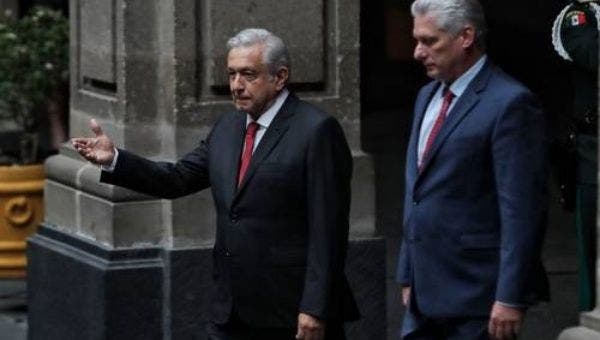
Presidents Miguel Diaz-Canel, Cuba and Andres Manuel Lopez-Obrador, Mexico | Photo: Twitter/@GerardoArreola

The independence of Mexico and of Cuba, got a big hearing in Mexico City on September 16.  On that day in 1810, in Dolores, Mexico, Catholic priest Miguel Hidalgo called upon parishioners to join him in rebelling against Spain’s viceregal government. Mexico finally gained independence in 1821. Every year, at 11 PM on September 15, and on September 16, Mexicans and their presidents pay homage to Hidalgo’s iconic Cry of Dolores (Grito de Dolores).

This year, President Andrés Manuel López Obrador, commemorating that important day, had a surprising guest. Cuba’s president Miguel Díaz-Canel was at his side and they both spoke. Shared goals and strong friendship were evident. The extraordinary encounter may portend new substance and heightened commitment for efforts to free Cuba, at long last, from aggressive U.S. interference with Cuba’s sovereignty.

The Cuban president later joined president López Obrador in reviewing Mexican armed forces assembled in the Zocalo, Mexico City’s central plaza. No visiting foreign president had ever done so.

Excerpts of their remarks appear below. What they actually said may more readily communicate concepts, reasoning, convictions, and deep feelings than would have been the case with summarization. The object here is to enhance appreciation of the nature and strength of the two nations’ friendship now and into the future.

To begin: President López Obrador observes that “[Hidalgo] who initiated independence matters more to Mexicans than Iturbide, who consummated it. The priest defended the common people while the royalist general represented the higher-ups … [But] his adversaries never forgave [Hidalgo’s] audacity in wanting to make poor people the equals of the most favored classes.”

“We Mexicans.” he adds, “feel pride in this hero and others, because here, like nowhere else, the independence movement did not begin by simply reaccommodating with the power elite, or act solely through nationalist feelings, but it was the fruit of a craving for justice and freedom. Indeed, the call for liberty and justice preceded the call for political independence.”

López Obrador turns to Cuba:

“Today we remember that heroic deed [of Hidalgo] and we celebrate it with the participation of the President of Cuba. He represents a people who resolved, like few others in the world, to defend with dignity their right to live free and Independent, without allowing the interference of any foreign power in their internal affairs. I have already said and I repeat: we may or may not agree with the Cuban Revolution and Cuba’s government, but to have resisted 62 years without surrender is a historical feat, undoubtedly.

“I believe, therefore, that through their struggle in defense of their country’s sovereignty, the people of Cuba deserve a prize for dignity. That island has to be considered as the new Numantia for its example of resistance. And I think for the same reason that the country has to be declared a patrimony of humanity. Now I only add that the government I represent respectfully calls upon the government of the United States to raise its blockade against Cuba, because no state has a right to subjugate another people, or another country. … ”

(Numantia was a hill fortress in northern Spain contested by Roman soldiers and the native Spaniards between 154 B.C. and 133 B.C. The latter did not surrender. Finally, Roman general Scipio Aemilianus and 60,000 soldiers surrounded the fortress with entrenchments. After 15 months, all 6000-8000 Iberian soldiers inside were dead of starvation.) 

The Mexican president continues: “I say with complete frankness: It looks very bad that the U.S. government uses the blockade to hurt the people of Cuba with the purpose of having them be forced by necessity to confront their own government. If this perverse strategy achieves success – something that doesn’t appear likely given the dignity we referred to – it would be a Pyrrhic victory, a vile and scoundrelly one. A stain like that is not washed away by all the water of the seas.

“Let President Biden, who possess much political sensitivity, take a wider view and put an end, for always, to the politics of grievances against Cuba. In the search for reconciliation, he must also help the U.S. Cuban community and put aside electoral and partisan issues …It’s a time of brotherhood and not of confrontation. As Jose Martí pointed out: “to avoid shock, we rely upon exquisite political tact that derives from the majesty of disinterest and the rule of love.”

President Miguel Díaz-Canel speaks:

“Among all the brothers Our America gave to us, Mexico counts for Cuba as one of the dearest ones, for many reasons. The affection that unites our lands begins with amazement at its diverse and deep traces in the literature and history of America.” Diaz Canel cites Cuban authors José María Heredia and particularly José Martí. He reads Martí’s portrayal of Hidalgo.

Díaz-Canel remarks that, “Through its characteristics, the independence process in Mexico … showed a remarkable component of social demands, on behalf of indigenous peoples especially. It differed in that way from other processes typical of the era of independence struggles. Without question, its impact on the freedom and anti-colonialist struggles of our region, particularly in Cuba, was extraordinary.”

He points out that Mexicans joined Cuba’s first War for Independence from Spain (1868-1878) that Mexico extended recognition to that leader’s insurgent government.  He mentions Cubans fighting with Mexicans in their wars against Texan Anglos and U.S. invaders in 1846-1848. Díaz-Canel refers to Martí, who “joined our two nations eternally in all his work, but especially in letters to his great Mexican friend Manuel Mercado.”

On the eve of Cuba’s Second War for Independence (1895-1898), Martí communicated to Mercado his idea of “Using the independence of Cuba to stop the United States in time from extending throughout the Antilles and falling with even more force upon our American lands.”

Díaz-Canel mentions the murder in Mexico City by Cuba’s Machado dictatorship of the young Cuban Communist leader Julio Antonio Mella in 1929. He praises Mexicans’ assistance to preparations there for the Granma expedition led by Fidel Castro in 1956. And, recalls the Cuban president, “faithful to its best traditions, Mexico was the only country in Latin America that did not break relations with Cuba when we were expelled by the OAS by imperial mandate.”

Díaz-Canel emphasizes that, “Mexico’s solidarity with Cuba has awakened in our people a greater admiration and the deepest gratitude … the decision to invite us has an immeasurably greater value, at a time when we are suffering the onslaught of a multidimensional war, with a criminal blockade, opportunistically intensified.” Because we are “under fire in a total war …Cuba will always remember your expressions of support, your permanent demand for the lifting of the blockade and for the annual United Nations vote to be converted into concrete deeds.”.

The Mexican-Cuban alliance has value for Cuba.  Mexico’s government has a U.S. ear, if only because disruption of amicable U.S.-Mexican relations might significantly destabilize aspects of life in the United States. Additionally, Mexico does provide material aid to Cuba and has the potential for promoting support for Cuba throughout her Latin America.

An analyst writing for Almayadeen.net offers perspective: “Mexico, during López Obrador’s presidency, has begun a process of winning back its regional influence… The U.S. – Cuba conflict is another relevant factor in Mexico’s position … [Already] documented is the mutual love between the Mexican and Cuban peoples … [Therefore,] the building of a new relation of the region with and Washington cannot exclude Havana, and on that López Obrador has been strong.”

Cuba’s friendship with Mexico hardly matches the importance of its alliance with the Soviet Bloc. Material aid from that source helped assure the revolutionary government’s survival. Soviet military might and worldwide influence discouraged U.S. excesses in regard to Cuba. But activated friendship with Mexico now may add tangible benefits for Cuba’s cause that are lacking with other solidarity efforts, for example: pro-Cuba votes in the United Nations, hit-and-miss material aid, various solidarity statements, and assistance from NGO’s.

Meanwhile reality intrudes. In front of Cuba’s Mexico City Embassy on September 16, a few anti-government activists, having arrived from Cuba, tussled with Cubans living in Mexico who support their government. The Mexican media carried critiques of Díaz-Canel’s presence in Mexico that López Obrador’s own political opposition had generated.

More significantly, the entire region on September 18 missed a fragile opportunity of gaining some independence from U.S. domination. The Community of Latin American and Caribbean States (CELAC), a regional organization to which the United States and Canada do not belong, was holding a summit meeting in Mexico City that day, The CELAC group refused to consider a proposal put forth by President López Obrador and others that member states abandon the Organization of American States (OAS) or alter its functioning. The U.S. government is accused of using OAS as a tool for controlling the region.

W.T. Whitney Jr. is a retired pediatrician and political journalist living in Maine.

Source: Counterpunch, September 23, 2021, https://www.counterpunch.org/2021/09/23/cuban-and-mexican-presidents-strengthen-solidarity-in-remarkable-display/

US Unionists and Their Cuba Problem / by W.T. Whitney, Jr.

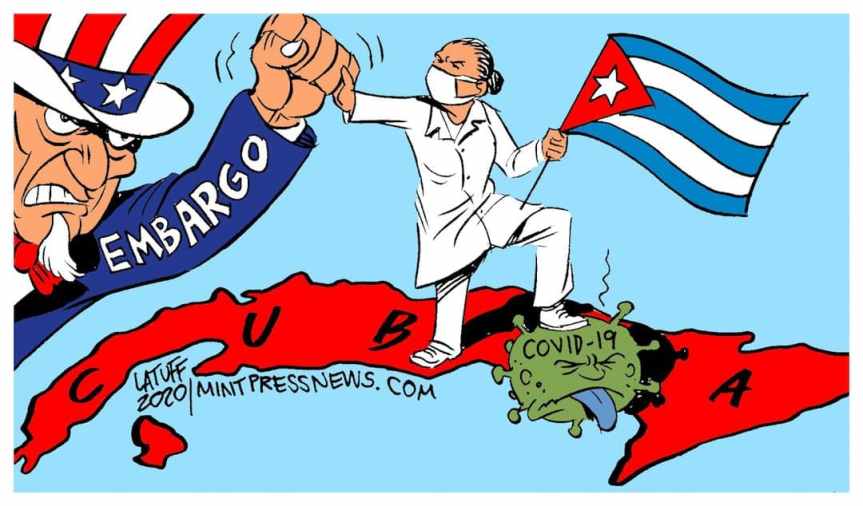
Longshore union backs Cuba’s fight against U.S. blockade / Carlos Latuff, Mint Press News

Marx and Engels asked workers to unite and thereby lose their chains. (Communist Manifesto) Nevertheless, according to a People’s World commentator in 2017, “organized labor in the U.S. has … steered clear of the issue of improved relations with Cuba.” On the whole, U.S. labor has remained hands-off in regard to the cruel and illegal U.S. economic blockade. Over the course of 60 years, the blockade has devastated the lives of Cuban workers. 

Presently, the San Francisco Labor Council and the International Longshore and Warehouse Union are seemingly alone among U.S. unions in protesting the blockade. The situation is different elsewhere: the British and Irish Unite federation, the French General Confederation of Labor, the Portuguese FEVICCOM union, the Building and Woodworkers’ International, and The World Federation of Trade Unions recently issued denunciations.

The ILWU Passed a Resolution Against US Blockade of Cuba, also donated syringes. Other unions should follow their lead, http://www.randomlengthsnews.com

An overwhelming majority of nations voting in the United Nations General Assembly, various regional alliances, religious leaders worldwide and in the United States19 U. S. municipal councils, and Cuba solidarity groups in the United States and abroad condemn the blockade.

The anomaly of the U.S. labor movement in regard to Cuba needs explaining. Marxist thinkers, primarily Lenin, lend a hand. Looking at the nature of unions, their internal workings, and situations within capitalist societies, Lenin found that trade unions are quiescent by and large as regards big political issues aggravating society.

In his What Is to Be Done (1909), Lenin looks at how union members gain political consciousness, whether through their own trade-union experience or as the result of outside influences. He proposes that for the most part, trade unionists’ exclusive attention to wages and working conditions leaves them with a stunted political awareness, so much so that their zeal for changing the factory system itself or fighting governmental oppression is weakened.

Lenin inveighs against the “traditional striving to degrade Social Democratic politics to the level of trade union politics.” (The reference is to the Russian SocialDemocratic Workers’ Party of which Lenin was a leader.) Instead of seeking economic reforms affecting only workers on the job, Lenin calls for “presenting to the government, not only demands for all sorts of measures, but also (and primarily) the demand that it cease to be an autocratic government.”

He adds that, “Revolutionary Social-Democracy has always included the struggle for reforms as part of its activities, but it … subordinates the struggle for reforms, as the part to the whole, to the revolutionary struggle for freedom and for socialism.” The danger lies in “strengthening of the influence of bourgeois ideology upon the workers.” Indeed, the “Social-Democrat’s ideal should not be the trade-union secretary, but the tribune of the people, who is able to react to every manifestation of tyranny and oppression.”

Attitudes of the “economists” targeted by Lenin resemble those of U.S. unionists today; they too may be leery of engaging in political problems outside of their own living and working circumstances. The U.S. blockade of Cuba is a prime example. Nevertheless, the precedent of “economism,” the name often assigned to the kind of union leadership criticized by Lenin, applies to unions other than those in the United States. Something more must be at work to explain U.S. unions’ silence on the blockade issue.

Describing a “labor aristocracy,” Lenin suggested that many labor leaders compromise and collude with the masters of society on the assumption that, as high union officials, they can share in the wealth their nation derives from imperialism. The concept suggests that U.S. labor leaders’ response to the blockade of Cuba reflects their more general approach to imperialism. 

Writing to Karl Kautsky in 1882, Frederick Engels exclaims, “You ask me what the English workers think about colonial policy. Well, exactly the same as they think about politics in general. There is no workers’ party here … and the workers gaily share the feast of England’s monopoly of the world market and the colonies.”

Lenin in 1916 (Imperialism and the Split in Socialism) left little to the imagination: “The capitalists [in England] can devote a part (and not a small one, at that!) of these superprofits to bribe their own workers, to create something like an alliance … between the workers of the given nation and their capitalists against the other countries.”

British historian Eric Hobsbawm elaborates, noting that: “the European proletariat has partly reached a situation where it is not its work that maintains the whole of society but that of the people of the colonies who are practically enslaved. . . . In certain countries these circumstances create the material and economic basis for infecting the proletariat of one country or another with colonial chauvinism.”

He adds that, “the aristocracy of labor … arises when the economic circumstances of capitalism make it possible to grant significant concessions to the proletariat, within which certain strata manage, by means of their special scarcity, skill, strategic position, organizational strength, etc., to establish notably better conditions for themselves than the rest [of the proletariat].” 

The message conveyed in these commentaries on “is that U.S. union leaders may be so attentive to their own union affairs and to their members’ interests as to ignore developments abroad, like the U.S. blockade. They may think that the labor movement benefits by accepting U.S. imperialism’s methods and purposes. In neither case is their attitude unique to the U.S. labor movement. Counterparts in other industrialized countries undoubtedly share similar priorities.

Some clarity emerges on our realizing that racial oppression, a matter of special U.S. experience, is an integral part of imperialism. In 1920, in “The Soul of White Folks,” W. E. B. Du Bois asks: “How many of us today fully realize the current theory of colonial expansion, of the relation of Europe which is white, to the world which is black and brown and yellow? Bluntly put, that theory is this: It is the duty of white Europe to divide up the darker world and administer it for Europe’s good.”

Du Bois sees a weakening of capitalism: “The day of the very rich is drawing to a close, so far as individual white nations are concerned. But there is a loophole. There is a chance for exploitation on an immense scale for inordinate profit, not simply to the very rich, but to the middle class and to the laborers. This chance lies in the exploitation of darker peoples. It is here that the golden hand beckons. Here are no labor unions or votes or questioning onlookers or inconvenient consciences.”

Formerly European nations bore most responsibility for injecting racial oppression into imperialist practice. These days the U.S. government is an imperialist giant, and the admixture of racism and imperialism is mostly a U.S. phenomenon.

U.S. anti-imperialists, mindful of consistency, might see, or worry about, an obligation to be fighting racial oppression as they fight imperialism. Battlelines are blurred, and frustration is in store for many U.S. unionists joining anti-imperialist efforts such as the blockade. To begin with, they have to be aware, as noted by one observer, that “the AFL-CIO [has] its own ugly history of assisting US imperialism.” Some of them might take comfort by recalling their fight against racism in their own unions.

Annoyance would be the least of their troubles. Fighting imperialism, U.S. union workers would also be taking a stand against capitalism itself. That’s the logic of studies pursued by sociologist Oliver Cromwell Cox. According to a recent observer, Cox “argued that racial antagonism and exploitation had only arisen in modern times, and developed along with the rise of capitalism in Europe and North America.”

According to Cox, (Race, a Study in Social Dynamics, MR Press, 2000) “racial exploitation is merely one aspect of the problem of proletarianization of labor, regardless of the color of the laborer. Hence racial antagonism is essentially political-class conflict. The capitalist, being opportunistic and practical, will utilize any convenience to keep his labor and other resources freely exploitable. He will devise and employ race prejudice when that becomes convenient.”

Cox continues: “The slave trade was simply a way of recruiting labor for the purpose of exploiting the great natural resources of America. This trade did not develop because Indians and Negros were red and black … but simply because they were the best workers to be found for the heavy labor in the mines and plantations across the Atlantic.  … This then is the beginning of modern race relations. It was not an abstract, natural, immemorial feeling of mutual antipathy between groups, but rather a practical exploitative relationship with its social-attitudinal facilitation.”

Proposing that racial oppression, capitalism, and imperialism are kindred phenomena, Cox tells us that fight against one is fight against the other two. If so, U.S. labor unions would be only too aware of the explosive potential of a scenario requiring them to oppose the capitalist system. The anti-labor Taft-Hartley Act of 1947 and other assaults have already sensitized them to accusations of “soft on communism.”

Definition of a slippery slope: first oppose the U.S. blockade of Cuba, then turn against imperialism, then take on racism, and ultimately oppose capitalism itself. And then what? Far better to leave ending the blockade to someone else.

Author: W.T. Whitney Jr. is a political journalist whose focus is on Latin America, health care, and anti-racism. A Cuba solidarity activist, he formerly worked as a pediatrician, lives in rural Maine.

Socialism in the mix as Haitians react to catastrophe / by W.T. Whitney, Jr.

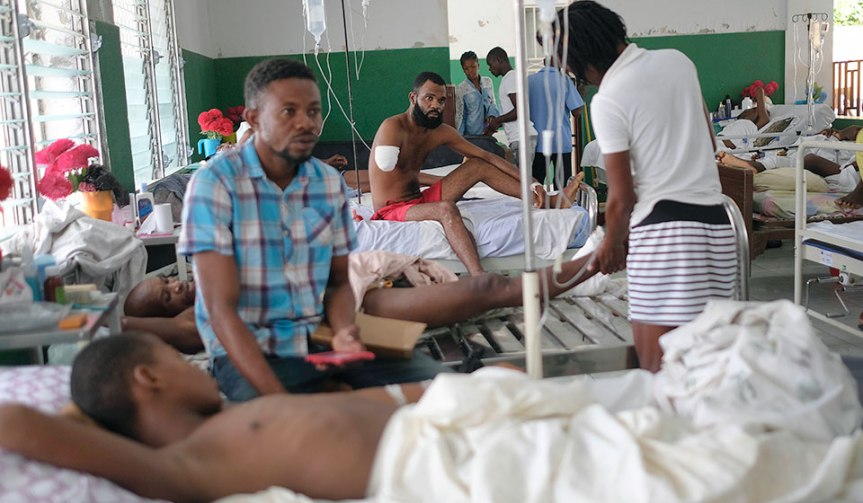
Photo: Felix Pierre Genel, 36, whose arm was amputated after he was injured in the earthquake, is treated at a hospital in Les Cayes, Haiti, Aug. 25, 2021, a week after a 7.2 magnitude quake. The disaster was just the latest in a string of catastrophes that have struck the Haitian people. | Matias Delacroix / AP

Plotters in Florida employing Colombian mercenary soldiers arranged to kill Haitian President Jovenel Moïse on July 7; rivalry among Haitian oligarchs may have played a role. A deadly earthquake followed and then flooding from a tropical storm. Amid the chaos, relief services are lacking in rural areas. U.S. Marines intruded, as the U.S. military had likewise done after the 2010 earthquake that killed some 230,000 people. Adverse effects of all these linger.

The marginalized descendants of rebellious slaves who founded independent Haiti in 1804 are resisting, however. Stirrings of socialist ideas and practice are evident.

The assassination of Moïse marked the end of ten years of corrupt and despotic rule. U.S. Secretary of State Hillary Clinton shoehorned President Michel Martelly into Haiti’s presidency in 2011. Moïse, his protégé, became president in 2017 on the strength of 500,000 votes drawn from six million eligible voters. Haitian political parties and their candidates serve a corrupt oligarchy.

Moïse had been ruling by decree, having refused to authorize parliamentary elections. His term was to have ended in February 2021, but supported by the U.S. government and the “Core Group,” he remained in office, thus defying Haiti’s 1987 constitution. He was calling for a new constitution that would allow agricultural conglomerates to swallow up small landholdings. Though he’s gone, the proposal is still alive.

Consisting of the U.S., Canadian, French, and Brazilian ambassadors and representatives of the United Nations, OAS, and the European Union, the Core Group came together in 2004, immediately after President Jean-Bertrand Aristide’s progressive government was removed by a U.S.- engineered coup. Aristide had been elected in 2000 with a 92% majority.

The Core Group supervises governance in Haiti and monitors political activities generally. Together with a United Nations military occupation force that remained until 2017, the entity is all about maintaining a Haitian status quo satisfactory to foreign powers.

For three years, aggrieved Haitians have periodically staged large protests. As described by economist and socialist Camille Chalmers, they have demanded, in succession: relief from shortages of fuel and other goods due to neoliberal-inspired withdrawal of subsidies, no more plunder of billons in funds derived from Venezuela’s PetroCaribe program, Moïse’s resignation, an end to U.S. interventionism, and cessation of Core Group backing of Moïse’s autocratic regime.

In August 2019, Haitian progressives drawn from 62 organizations met to discuss constitutional change and aspects of a transitional government. The business at hand, according to participant Chalmers, was to “establish the revolutionary left as a united force” and to develop a transition program for dealing with current political problems. They deliberated for three days and established the Patriotic Forum.

The Patriotic Forum gave rise to the “People’s Political Front” (PPF), which is now a potential vehicle for a six-party alliance prepared to compete in elections. The alliance includes the socialist party Rasin Kan Pèp La. (“Roots of the People’s Camp”) Functioning since 2015, that party has organized street mobilizations and released statements and analyses remarkable for their anti-imperialism.

Interviewed in 2018, party member Guerchang Bastia characterized his party’s role as “being present with the masses…developing real popular education…. So that when the masses are in the streets, they will recognize you as a leader [with] a proposal for a new society.” The purpose of the leftist organization, Bastia said, “is creating a new relationship with the masses [and] building the strength to fight against the capitalist system.”

Surveying Haiti’s situation prior to a March 2021 virtual meeting of international supporters, Chalmers outlined tasks ahead for the socialist cause and the PPF. A founding member of Rasin Kan Pèp La and a frequent spokesperson, he stated that “the Haitian people need to take their destiny into their own hands [with] a redefinition of the of the boss-slave relationship maintained between the international community and Haiti, and particularly between Haiti and the United States.”

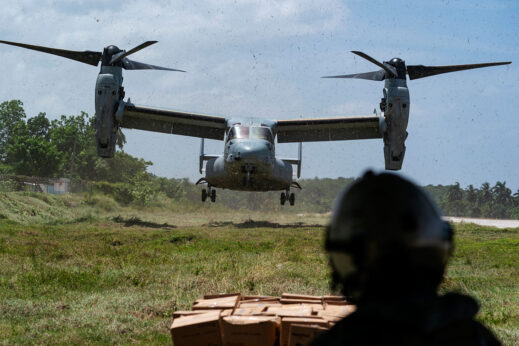
A U.S. Marine Corps VM-22 Osprey, with a load of aid, lands, at an airport on Aug. 28, 2021, in Jeremie, Haiti. The aircraft and its crew are based in Jacksonville, N.C. | Alex Brandon / AP

Chalmers regards international solidarity as an “overriding necessity [required] for the success of the Haitian people in their struggle for radical change of the mafioso system installed to guarantee…the political, economic, and social interests of the imperialist powers, the multinationals, and the corrupt local elites.”

According to sociologist Lautaro Rivara, a member of the Dessalines Brigade in Solidarity with Haiti: “The history of class struggle in Haiti is a history predominantly of rural workers, as seen presently in the protagonism of peasant organizations…in convening and organizing the Patriot Forum. Now, as the People’s Patriotic Front, it’s the best advocate for the popular classes in the country.”

Rivara indicates that more than half of the Haitian people live in rural areas and are engaged in subsistence farming. Rates of Illiteracy remain high and healthcare and schooling for them are rudimentary or absent. Great numbers of needy and fearful Haitians have moved to cities or, most recently, to countries like Chile, Brazil, and the Dominican Republic.

Following the lead of U.S. military occupiers (1915-1934) in combating a guerrilla insurgency, paramilitary enforcers allied to the Duvalier dictatorships (1957-1986), and to U.S. intelligence agencies later on, carried out massacres in the Haitian countryside. The now-ended United Nations occupying force likewise carried out an anti-insurgency mission, according to Chalmers. Privatized paramilitaries accounted for many killings during the Moïse era.

In regard to international solidarity, Chalmers extolled the contributions of Cuba’s government and people; Venezuela’s Bolivarian Revolution; Jubilee South, based in Latin America and the Caribbean; and the Dessalines Brigade formed by Brazil’s Landless Workers’ Movement and by Via Campesina.

Via Campesina recently published a report on grim Haitian realities. Accessible here in English, it describes factional fighting between adherents of former presidents Martelly and Moïse over disposition of funds stolen from PetroCaribe and from foreign reconstruction funds following the 2010 earthquake. Clearly, such politicians would work overtime to defeat any popular mobilization.

The U.S. government is similarly inclined. The report blames U.S. agencies for complicity with corrupt sections of Haiti’s government in turning a blind eye to profits from narco-trafficking. It claims that “imperialism wants a new Haitian Constitution for allowing transnationals to buy land legally and openly in Haiti so as to squander and steal the natural resources of the state.”

Author: W.T. Whitney Jr. is a political journalist whose focus is on Latin America, health care, and anti-racism. A Cuba solidarity activist, he formerly worked as a pediatrician, lives in rural Maine.

Source: People’s World, September 1, 2021, https://peoplesworld.org/article/socialism-in-the-mix-as-haitians-react-to-catastrophe/

Jesús Santrich explored utopian origins of Marxist and Bolivarian ideologies / by W.T. Whitney, Jr.

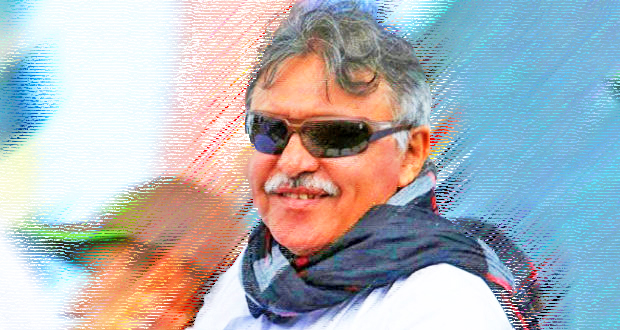
Colombian Army commandos on May 17, 2021 killed Jesús Santrich, a 30 -year veteran of the Revolutionary Armed Forces of Colombia (FARC). The ambush took place in Zulia Province, in northeastern Venezuela; six others died.  Santrich was a spokesperson for the FARC negotiating team in the talks in Havana with Colombia’s government that led to a peace agreement in 2016.

Because former FARC combatants were being killed despite the Agreement and because Colombia’s government and US agents were trying to extradite him to the United States on drug charges, Santrich went into hiding in 2019. He joined the “Second Marquetalia” offshoot of the original FARC insurgency, which was returning to armed conflict.

Santrich’s  22-page essay, written in 2009 in honor of legendary FARC commander Manuel Marulanda, carries the title:  “Bolivarianism and Marxism – a Commitment to the Impossible” (Bolivarismo y marxismo, un compromiso con lo imposible.) Santrich examines the utopian underpinnings of the Marxist movement and the liberation struggles of Simón Bolívar.

With his essay, Santrich challenges our own modes of anti-imperialist struggle and of creating socialism, impeded in both instances, we suggest, by a lack of long-term, visionary aspirations. That’s clear, for example, in the blunted response of progressives and radicals to recent developments in U.S. hybrid war involving Colombia, Haiti, and Cuba. With an expansive view, Santrich insists upon political leadership and political mobilization that attend to the future, embrace great purposes, and fight with determination and commitment.

His words

In his essay, Santrich writes about Simon Bolivar; the fight for independence from Spain; the FARC’s early years; leadership qualities of Manuel Marulanda, pioneer socialists of the French Revolution; Bolivar’s teacher Simón Rodríguez, an early socialist; and more. Along the way, Santrich provides ideas that, taken seriously, might greatly strengthen the revolutionary project in our own era.

For example: “Marxists must keep utopia foremost in their consciousness. It drives mass actions. They must assume that a revolutionary movement, whatever its origins, doesn’t qualify as such if it lacks that component manifesting as irrepressible effort towards change categorized as “impossible.” But utopia must always take off from a basis in realty. We humans have the duty to regard the world we want as another world that’s possible. Paraphrasing Bolívar, we are looking for the “impossible,” while leaving the possible up to everyone else, every day …

He continues: “To declare oneself Bolivarian and, as such, declare oneself a revolutionary on the Marxist path implies lifelong motivation derived from the hope of transforming society and finding justice. This is a constant and is strong enough with its broad vision as to point to utopia as a characteristic of political consciousness and the natural result of rational belief.”

He adds: “Utopia is a higher goal of commitment. That’s so because even at the beginning, the matter of possibility or impossibility is already uncertain due to extreme difficulties ahead, or uncertain survival of purpose as historical implementation evolves. But like history itself, utopia does not end.”

Moreover, “In the hopeful quest for realization of the “impossible,” the process calls upon a mixture of illusions, realism, magic, and love for people as a reason for life … The essential interest of the utopian is preservation of man and nature in absolute equilibrium, thus displaying the potentials of historical memory, faith, dignity, and our identity as vital factors for existence.

Confronting oppression and marching on the path of utopia, the revolutionary no longer is resigned. He or she is unconditionally, permanently, and creatively committed to the poor people of the world … Let’s say then that the Marxist-Bolivarian idea of a revolutionary is of someone who fixes on an ideology that, while encompassing reality, is not yet solidified and is perhaps uncertain. The goal is set of becoming absolutely convinced that this reality will be fulfilled, “impossible” though it may seem….

“The author of the Communist Manifesto, appealing to selfless purpose, was calling for struggle offering the possibility of risks. … Marx was calling for action needing to pass a test of fire in the face of historical commitment prompted by circumstances, even at the risk of death. He was clarifying a concept of living, whose own ethics intermeshed with the dialectics of reality that was moving, but always toward the future. …”

Santrich goes farther afield: “This kind of thinking envisions Marxists and Bolivarians alike as rising up, in our world, to the level of magical realism. And why not? Magical realism goes beyond mere rationalism. We have symbols, imagination, and creativity – all based on rich traditions rooted in indigenous experience in the Americas. It’s founded also on the syncretism of our mixed and oppressed mestizo peoples. Playing out, this proposition looks toward installing social justice, that is to say, accomplishes what’s ideal for the benefit of humankind.”

The stakes are high:“Perhaps one of the most fateful legacies for revolutionaries is apprehension on facing the danger that imperialism poses for the very existence of the planet with its catastrophic kind of developmentalism. In the face of great challenges, great resolve is necessary, really a triple boldness: action that overcomes determinism; recovery of the role of subjectivity, passion, audacity, and recklessness; and faith in the initiative of the masses, as they face the immediate prospect of “defeat.” In such circumstances, uncertainty and silence are worth nothing. …

What’s in play is the very survival of the human species, of life, of nature in general, all put at risk through the destructive power of capitalism. But we will not idle around patiently waiting for an automatic end to capitalism and for a communist alternative automatically to flourish. Humanity’s conscious intervention is necessary. It’s our immediate duty. Revolutionaries must connect utopia with liberation practice, at whatever cost …”

Meanwhile, on the ground

Next on our agenda is a survey of recent developments in Haiti, Colombia, and Cuba that are significant for the weak response they generated from anti-imperialists. Fragmentation and dwarfed ambitions seem to have paralyzed their fight against exploitation, plunder and militarization. We think the far-reaching aspirations of Santrich point to the alternative approach we need.

President Jovenal Moïse of Haiti was assassinated on July 7, presumably the result of rivalry among Haitian oligarchs, encouraged perhaps by leaders in Washington. All but two of the 28 perpetrators were former Colombian army regulars, now employed as mercenary soldiers. Many had received U.S. training. Colombia mercenaries have engaged militarily in the United Arab Emirates, Yemen, Afghanistan and Dubai, Honduras, Venezuela and elsewhere.

CTU Security, a Florida company owned by right-wing Venezuelan émigre Antonio Intriago arranged for the assassination.  Miami – based Intriago has ties to regressive Colombian President Ivan Duque; to Juan Guaidó, the U. S. puppet  president of Venezuela; and to Christian Sanon, a Haitian physician living in Florida and seeking to be president of Haiti. Intriago’s company in 2018 carried out a drone attack against Venezuelan President Nicolas Maduro.

The Cessna four-passenger plane owned by Helidosa company in the Dominican Republic is emblematic of imperialism’s convoluted presence in the region.  Intriago, Sanon, and two others traveled to Haiti on that plane to be on hand at the assassination. After surgical care in Florida for wounds suffered during the attack, Martine Moïse, the assassinated president’s widow, returned to Haiti on the same airplane. In 2019, it transported right-wing Venezuelans to Barbados for negotiations with President Nicolas Maduro’s representatives, and did so again the following year with Juan Guaidó aboard.

The U.S. blockade of Cuba comes into view. Campaigning in 2020, President Biden assured voters he would ease blockade-related restrictions on Cuba imposed by Donald Trump. Biden has added new sanctions. For 60 years, the U.S. government has blockaded Cuba in order to cause suffering there. Suffering is mounting now due to sanctions and adverse health and economic effects of the Covid-19 pandemic

On July 27 Biden met with Cuban-American elected officials in his office. He stated that, “I want Cuban Americans to know that we … hear the cries of freedom coming from the island … We’ve brought to bear the strength of our diplomacy, rallying nations to speak out and increase pressure on the regime.”

Correlations

The opportunistic Biden seeks electoral advantage in Florida. Bipartisan consensus remains as to replacing Cuba’s government. Opposition to the blockade is at the margins of U.S. politics.  No U.S. hand or hierarchy of control is evident in the assassination of Haiti’s president. Marking both cases is a mélange of private interests, transactional relationships, and profit-making opportunities.

The unpleasant details reported here likely will soon be forgotten. Many already distracted and pessimistic progressives probably prefer not to be reminded of politicians’ corrupt and faked behavioral patterns.

It could have been otherwise. A narrative might have been developed that, absorbing the incidents noted here, might have contributed to shaping a powerful indictment against the power structures. That in turn might have helped set the stage for a return of sustained political counter-attack – if, that is, a large and powerful movement actually existed.

That’s the contribution of Jesús Santrich. He traces out characteristics of political leadership and permanent mobilization needed now for fightback and revolutionary optimism. His prescription calls for a movement that satisfies the subjective needs of oppressed peoples. License would be created for great longings and dreams of fulfillment, for these to be normalized.

Santrich draws upon a world that now for many is off-limits. We honor his contribution, a rarity, as it seems, in our own time. But he is not alone. We remember:

Karl Marx, The Civil War in France, 1871 – “The Commune, they explain, intends to abolish property, the basis of all civilization!… Yes, gentlemen, the Commune [aims] at the expropriation of the expropriators … But this is communism, “impossible communism! …  [But] “if cooperative production is not to remain a sham and a snare; if it is to supersede the capitalist system …[W]hat else, gentlemen, would it be but communism, “possible” communism.”

José Mariátegui, founder of the Peruvian Communist Party, 1928 – “We certainly don’t want socialism in America to be a copy or tracing. It must be a heroic creation. We have to give life to Indian-American socialism with our own reality, in our own language.”

Ernesto Che Guevara, Socialism and Man in Cuba, 1965 – “[I]n moments of great peril it is easy to muster a powerful response with moral incentives. Retaining their effectiveness, however, requires the development of a consciousness in which there is a new scale of values. Society as a whole must be converted into a gigantic school.”

Fidel Castro (as recalled by Raul Castro) – “in the mountains of the Sierra Maestra, on Dec. 18, [1956], with seven rifles and a fist full of combatants, [he] stated, ’Now we have won the war!’”

Author: W.T. Whitney Jr. is a political journalist whose focus is on Latin America, health care, and anti-racism. A Cuba solidarity activist, he formerly worked as a pediatrician, lives in rural Maine.

The author translated the excerpts appearing here. Santrich’s entire essay may be read, in Spanish, at https://rebelion.org/bolivarismo-y-marxismo-un-compromiso-con-lo-imposible/

Source: Marxism-Leninism Today / The Electronic Journal of Marxist-Leninist Thought, Aug 15, 2021  | https://mltoday.com/jesus-santrich-outlines-the-utopian-fundamentals-of-marxist-and-bolivarian-ideologies/

Report from Maine: End the US Blockade against Cuba Now!

By W. T. Whitney Jr

The two struggles have continued for decades, even centuries. Cubans fight to end slavery; gain independence from Spain and the United States; and, for 60 years, protect their socialist revolution. Ruling classes in the United States sought to annex Cuba, then to control Cuba’s economy, and for those 60 years have clamped down on the audacity of Cubans who struggle for independence and socialism.

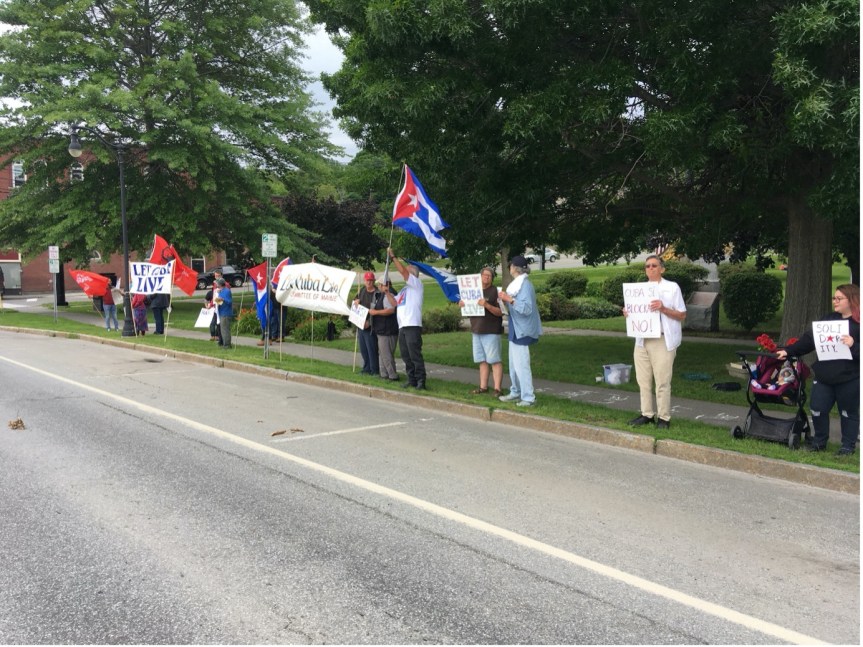
Justice-seeking peoples in the United States have joined in struggle to defend Cuban independence and/or Cuba’s revolution. This report from Maine takes note of two rainy day rallies on July 25, each of 25 or so people and each one held in protest of the U.S. blockade of Cuba. One was in Bangor, the other in Brunswick.

These protesters and other Maine people know that the blockade is purposed to overthrow of Cuba’s socialist government.  The author of a 1960 State Department memo – born in Houlton, Maine – made that perfectly clear.

These Mainers were joining in solidarity with demonstrations carried out on July 25 throughout the United States, for example, in Washington, Seattle, San Francisco, Fresno, Los Angeles, Phoenix, Albuquerque, Dallas, Milwaukee, and Pittsburgh. In Washington, Cuban-Americans calling for Puentes de Amor (Bridges of Love) gathered with supporters in Lafayette Park to protest the blockade. They had walked from Miami to Washington.

Lots of Maine people know that Cuba is at another watershed moment. Many recall the onset in the early 1990s of Cuba’s “Special Period,” which was resulted from the fall of the Soviet Bloc. The powers in Washington at that time sought to finish off Cuba’s revolution. The “Cuba Democracy Act” of 1992 was their big tool.

Similarly, the Biden presidency now takes advantage of three phenomena: economic and healthcare havoc wrought by the Covid 19 pandemic, the Trump administration’s intensified blockade restrictions, and mounting shortages in Cuba of money and goods essential for human survival.

Now Biden inveighs against supposed autocracy in Cuba. His administration remains silent when elected officials viciously threaten Cuban leaders. He and they follow a script fitted out for anti-government demonstrations like the ones playing out in Cuba on July 11. These surely reflected U.S. financial support provided over decades for internal subversion in Cuba. Accompanying them was a massive social-media assault against Cuba’s government orchestrated from abroad.

U.S. media have long cast a blind eye to the political movements in the United States mobilized on behalf of Cuban independence and Cuba’s revolution. Those rallying in Maine on July 25 were testifying to their relevance now.

In 1992, at the beginning of Cuba’s Special Period, veteran Maine activists traveled to the island. Sensing big troubles ahead for Cuba at the hands of the U.S. government, they formed the Let Cuba Live Committee of Maine. The new organization undertook to educate and activate fellow Mainers.

Let Cuba Live arranged for the Pastors for Peace leader Rev. Lucius Walker Jr, to speak before a large crowd in Monument Square, in Portland, Maine on July 21, 2001 – 20 years and four days prior to the protests reported here.

“In issue after issue, in area after area, Cuba lights the way,” Lucius Walker insisted; “Cuba has established the fact that it is the leader in the world community in the affirming of and guaranteeing the rights of the poor people of this world.”

That was not news for the ruling classes in the United States for whom revolutionary Cuba was a threat. Therefore, as pointed out by Lucius Walker: “if we really want to see the world continue to have hope and possibility for the creation of a new society, we must support Cuba.”

Let Cuba Live of Maine – see www.letcubelive.org – admits to gratification.  The slogan that is the group’s name now resonates widely. It’s the title of an appeal to President Biden that, endorsed by 400 prominent activists, may be viewed in a full-page advertisement appearing in the July 23 New York Times. To see the open letter to Biden, go to www.LetCubaLive.com.

The twin rallies putting forth the demand of no more blockade broke new ground in Maine.  They gained support from multiple statewide organizations that oppose U.S. imperialism and war-making and/or try to make good on socialist aspirations.

What follows are excerpts from remarks offered by some of the rally participants at talk-sessions that concluded the two affairs.  A listing appears below of the organizations claiming commentators and many participants as members.

Here’s Barbara West: “We are not gathered today simply to demand a reduction in the criminal measures the US has taken against Cuba for 61 years.  We are here to insist on respect for Cuba as a sovereign country … We insist that land in Guantanamo occupied in defiance of the Cuban people be vacated. … Our respect for Cuba as a sovereign nation, with its people fully able to chart their own path without any US interference, is really our agenda today.”

And Michael Mosely: “I do not believe that there is a difference between a Hispanic family in Maine and a Hispanic family in Cuba. Just like there is no difference between a Black family in Maine and a Black family in Africa. We are all under the same system fighting the same fight.”

And Daniel Carson: “In the over six decades that the United States has enforced such a cruel blockade, the Cuban government has reported that economic losses resulting directly from the blockade total $144.4 billion dollars. These figures are those of 2020. Excluded is an additional $5.4 billion in economic losses this year. When adjusted for dollar depreciation over the life of the blockade the number becomes $1.098 trillion … So when [U. S. leaders] proclaim Cuba to be a failed state or that the Cuban revolution has failed: this is a bold-faced lie. The truth lies in those numbers. That’s why we are here today to say, “End the blockade!”

And Bruce Gagnon: “The US has an MO (modus operandi), a way of repeating its regime change behavior as it desperately attempts to hang-on to its place as ‘king of the hill’. But due to $27 trillion in debt, more than 800 costly military bases around the world, and long-time disinvestment in our own nation, America’s ‘imperial project’ is destined to collapse. US efforts to force regime change in Cuba – like in Nicaragua, Venezuela, Bolivia and other nations – are destined to fail.”

And Ed Jurenas: “When the U.S. talks about democracy, it is hypocritical. It does not support the most basic democratic right to self-determination, but viciously opposes it. And in regard to the economic democracy championed by Cuba – free health care, free education, a right to housing, the just distribution of food – the U.S. is silent in its shame. Cuba ascribes to economic democracy, something the U.S. is incapable of practicing.”

Most of the participants in the Maine rallies belonged to one or more of these organizations: the Let Cuba Live Committee of Maine, The Global Network Against Weapons & Nuclear Power in Space, Maine Veterans for Peace, Maine Socialist Action, Maine Democratic Socialists of America, and the Maine Communist Party. The latter group had responsibility for organizing the rallies.

Lucius Walker has the last word (July 21, 2001): “We must name the powers. We must stand against the powers. And we must realize that in the course of doing so, we wrestle not just with flesh and blood, but with principalities and powers, against spiritual wickedness in high places. We cannot be deterred because they say evil things about us, because they revile us, because they put us in jail. We must continue to march, to work, to struggle, to be in solidarity no matter what obstacles they put in our way, because we are the future hope of the world! “

Report from Maine: End the US Blockade against Cuba Now!

By W. T. Whitney Jr

The two struggles have continued for decades, even centuries. Cubans fight to end slavery; gain independence from Spain and the United States; and, for 60 years, protect their socialist revolution. Ruling classes in the United States sought to annex Cuba, then to control Cuba’s economy, and for those 60 years have clamped down on the audacity of Cubans who struggle for independence and socialism.

Justice-seeking peoples in the United States have joined in struggle to defend Cuban independence and/or Cuba’s revolution. This report from Maine takes note of two rainy day rallies on July 25, each of 25 or so people and each one held in protest of the U.S. blockade of Cuba. One was in Bangor, the other in Brunswick.

These protesters and other Maine people know that the blockade is purposed to overthrow of Cuba’s socialist government.  The author of a 1960 State Department memo – born in Houlton, Maine – made that perfectly clear.

These Mainers were joining in solidarity with demonstrations carried out on July 25 throughout the United States, for example, in Washington, Seattle, San Francisco, Fresno, Los Angeles, Phoenix, Albuquerque, Dallas, Milwaukee, and Pittsburgh. In Washington, Cuban-Americans calling for Puentes de Amor (Bridges of Love) gathered with supporters in Lafayette Park to protest the blockade. They had walked from Miami to Washington.

Lots of Maine people know that Cuba is at another watershed moment. Many recall the onset in the early 1990s of Cuba’s “Special Period,” which was resulted from the fall of the Soviet Bloc. The powers in Washington at that time sought to finish off Cuba’s revolution. The “Cuba Democracy Act” of 1992 was their big tool.

Similarly, the Biden presidency now takes advantage of three phenomena: economic and healthcare havoc wrought by the Covid 19 pandemic, the Trump administration’s intensified blockade restrictions, and mounting shortages in Cuba of money and goods essential for human survival.

Now Biden inveighs against supposed autocracy in Cuba. His administration remains silent when elected officials viciously threaten Cuban leaders. He and they follow a script fitted out for anti-government demonstrations like the ones playing out in Cuba on July 11. These surely reflected U.S. financial support provided over decades for internal subversion in Cuba. Accompanying them was a massive social-media assault against Cuba’s government orchestrated from abroad.

U.S. media have long cast a blind eye to the political movements in the United States mobilized on behalf of Cuban independence and Cuba’s revolution. Those rallying in Maine on July 25 were testifying to their relevance now.

In 1992, at the beginning of Cuba’s Special Period, veteran Maine activists traveled to the island. Sensing big troubles ahead for Cuba at the hands of the U.S. government, they formed the Let Cuba Live Committee of Maine. The new organization undertook to educate and activate fellow Mainers.

Let Cuba Live arranged for the Pastors for Peace leader Rev. Lucius Walker Jr, to speak before a large crowd in Monument Square, in Portland, Maine on July 21, 2001 – 20 years and four days prior to the protests reported here.

“In issue after issue, in area after area, Cuba lights the way,” Lucius Walker insisted; “Cuba has established the fact that it is the leader in the world community in the affirming of and guaranteeing the rights of the poor people of this world.”

That was not news for the ruling classes in the United States for whom revolutionary Cuba was a threat. Therefore, as pointed out by Lucius Walker: “if we really want to see the world continue to have hope and possibility for the creation of a new society, we must support Cuba.”

Let Cuba Live of Maine – see www.letcubelive.org – admits to gratification.  The slogan that is the group’s name now resonates widely. It’s the title of an appeal to President Biden that, endorsed by 400 prominent activists, may be viewed in a full-page advertisement appearing in the July 23 New York Times. To see the open letter to Biden, go to www.LetCubaLive.com.

The twin rallies putting forth the demand of no more blockade broke new ground in Maine.  They gained support from multiple statewide organizations that oppose U.S. imperialism and war-making and/or try to make good on socialist aspirations.

What follows are excerpts from remarks offered by some of the rally participants at talk-sessions that concluded the two affairs.  A listing appears below of the organizations claiming commentators and many participants as members.

Here’s Barbara West: “We are not gathered today simply to demand a reduction in the criminal measures the US has taken against Cuba for 61 years.  We are here to insist on respect for Cuba as a sovereign country … We insist that land in Guantanamo occupied in defiance of the Cuban people be vacated. … Our respect for Cuba as a sovereign nation, with its people fully able to chart their own path without any US interference, is really our agenda today.”

And Michael Mosely: “I do not believe that there is a difference between a Hispanic family in Maine and a Hispanic family in Cuba. Just like there is no difference between a Black family in Maine and a Black family in Africa. We are all under the same system fighting the same fight.”

And Daniel Carson: “In the over six decades that the United States has enforced such a cruel blockade, the Cuban government has reported that economic losses resulting directly from the blockade total $144.4 billion dollars. These figures are those of 2020. Excluded is an additional $5.4 billion in economic losses this year. When adjusted for dollar depreciation over the life of the blockade the number becomes $1.098 trillion … So when [U. S. leaders] proclaim Cuba to be a failed state or that the Cuban revolution has failed: this is a bold-faced lie. The truth lies in those numbers. That’s why we are here today to say, “End the blockade!”

And Bruce Gagnon: “The US has an MO (modus operandi), a way of repeating its regime change behavior as it desperately attempts to hang-on to its place as ‘king of the hill’. But due to $27 trillion in debt, more than 800 costly military bases around the world, and long-time disinvestment in our own nation, America’s ‘imperial project’ is destined to collapse. US efforts to force regime change in Cuba – like in Nicaragua, Venezuela, Bolivia and other nations – are destined to fail.”

And Ed Jurenas: “When the U.S. talks about democracy, it is hypocritical. It does not support the most basic democratic right to self-determination, but viciously opposes it. And in regard to the economic democracy championed by Cuba – free health care, free education, a right to housing, the just distribution of food – the U.S. is silent in its shame. Cuba ascribes to economic democracy, something the U.S. is incapable of practicing.”

Most of the participants in the Maine rallies belonged to one or more of these organizations: the Let Cuba Live Committee of Maine, The Global Network Against Weapons & Nuclear Power in Space, Maine Veterans for Peace, Maine Socialist Action, Maine Democratic Socialists of America, and the Maine Communist Party. The latter group had responsibility for organizing the rallies.

Lucius Walker has the last word (July 21, 2001): “We must name the powers. We must stand against the powers. And we must realize that in the course of doing so, we wrestle not just with flesh and blood, but with principalities and powers, against spiritual wickedness in high places. We cannot be deterred because they say evil things about us, because they revile us, because they put us in jail. We must continue to march, to work, to struggle, to be in solidarity no matter what obstacles they put in our way, because we are the future hope of the world! “

Astounding Victory in Peru of Socialist Candidate for President by Tom Whitney

In voting on June 6, Pedro Castillo, candidate of the Perú Libre(Free Peru) political party, defeated three-time presidential candidate Keiko Fujimori, daughter of imprisoned former president Alberto Fujimori. Five days later, with all votes counted, Castillo claimed a victory margin of 69,546 votes, or 50.2 % of the votes. Keiko Fujimori, who gained 49.8% of all votes, is charging fraud and demanding that 200,000 votes from rural areas be recounted.

Castillo’s narrow victory, yet to be officially validated, represents an abrupt shift from Peru’s norm of corruption, right-wing ascendency, and political instability (such that in one week in November 2020, three presidents took office, one after the other.) Castillo’s unexpected first-round victory on April 11, with 18.5% of the votes, was unsettling enough to his competitors that almost all of them backed Keiko Fujimori in the recent voting. Each of Peru’s two Communist parties backed Castillo (as evidenced here and here).

In office, Castillo will face formidable obstacles: a hostile national press, a Congress that overwhelmingly opposes him, business and financial establishments in panic mode, and retired military figures threatening revolt. Additionally, Peru’s total of deaths attributed to climate change is the third highest in Latin America and its rate of deaths due to COVID-19 infection is tops in the world.

Under the auspices of dictator Alberto Fujimori (1990-2000), Peru turned to undiluted neoliberalism characterized by foreign profiteering from mining and oil and gas extraction and by privatization of healthcare and education. A long-established rural-urban gulf widened. Rural disadvantage, affecting Peru’s indigenous population in particular, provided the boost accounting for the victory of Pedro Castillo and his party. 

The divide separates Lima, with 40% of Peru’s population, from rural districts, where Castillo scored overwhelming pluralities, some in the 80-90% range. Political attention to rural life from national centers of power, from Lima, has been sparse. Candidate Fujimori campaigned only fitfully in Peru’s countryside. 

Pedro Castillo, born in 1969 of illiterate parents, has taught in a rural elementary school since 1995. In 2002, he was an unsuccessful mayoral candidate.  Earlier, Castillo had taken a leadership role in autonomous peasant patrols (known as “ronda campesina”) responding to thievery and political turmoil. He gained prominence in 2017 for his part in a teachers’ strike. He and his family operate a small subsistence farm.

The Perú LibreParty, established in 2012, calls for nationalization of extractive industries, a new constitution, and respect for women’s rights, including reproductive rights. It claims to be Marxist, socialist, and anti-imperialist – but not Communist.  Campaigning, Castillo called for “No more poor people in a rich country.” Keiko Fujimori based her campaign on fear as she associated Castillo with terrorism, communism, and Cuban and Venezuelan socialism. She extolled her father’s success in corralling the Shining Path guerrillas.

According to the Party’s website, Perú Libre “originates from the provinces, represents Deep Peru, and is committed to people who are most in need … Perú Libre has governed in the regions and [small] cities … and firmly defends decentralization … We are internationalists … The Party condemns all types of imperialism … interventionism, and foreign dependency.” 

Perú Libre calls for the departure of USAID and closure of U.S. military bases. Castillo supports solidarity alliances such as the Community of Latin American and Caribbean States and the Union of South American Nations.

Vladimir Cerrón, a neurosurgeon educated in Cuba and Peru, founded Perú Libre’s predecessor party in 2012.  He has served as governor of Junim Province, was briefly a presidential candidate in 2016, and continues as Peru Libre’s secretary general. Charged with corruption, Cerrón entered prison in August 2020.  A judge annulled the charges against him on June 9, coincident with the election of Pedro Castillo.

Defeated presidential candidate Keiko Fujimori was imprisoned briefly in 2018 on charges of taking bribes from Brazil’s Odebretch corporation to finance her presidential run in 2011. Presently she is under investigation on charges of money-laundering and obstruction of justice. From age 19 on, she served as “first lady” for her father who, having abandoned his presidency in 2000, is serving a 25-year presidential term on charges of corruption and human rights abuses.

The Perú Libre Party adopted the thinking of José Carlos Mariátegui, founder in 1928 of Peru’s Communist Party. Mariátegui endeavored to adapt Marxist thought to the rural and indigenous realities of Latin America.  As explained by Gilberto Calil, whose report appears on rebelion.org, Mariátegui held that Peru’s elite, concentrated in Lima, despised and oppressed indigenous peoples. The divide was such, according to Mariátegui, that Peru lacked a “national project” and a bourgeois revolution. Only indigenous peoples based on the land were potentially ready to advance social and democratic demands.

Mariátegui insisted that any socialist revolution in Peru and Latin America would have rural and indigenous origins. Accordingly, Calil regards Perú Libre’s program as “coherent … in centering on concrete demands of Peru’s rural population: agrarian reform, social rights, education and healthcare.”

Photo: Pedro Castillo’s supporters took to the streets in the capital, Lima. From: Reuters.

U.S. Imperialists Deprive Cuba of Syringes That Are Needed Now, by Tom Whitney

Editorial note

US stubbornness in hanging on to its economic blockade against Cuba annoys us. Sixty years is enough, don’t you think? We are joining the Let Cuba Live Committee of Maine as it collaborates with IFCO/Pastors for Peace of New York in the project of that group heading to Cuba this Fall.

Pastors for Peace will be taking aid material to Cuba and visiting there, both against US rules for its blockade. We want some Maine people once more to be on this trip.

Every year, for 30 years, these two groups undertake civil disobedience in order to mobilize wider support for ending a policy that, by any definition, is cruel, immoral, and illegal.

Go to these websites to learn more: www.letcubalive.org and   https://ifconews.org/.

The article below reviews aspects of this grim situation and reports on a new horror. We also post the CPUSA’s recent condemnation of President Biden’s failure to remove Cuba from the US list of terrorist sponsoring nations. Your dog presents as much national threat as does Cuba.

Cuba, the first Latin America country to develop its own COVID-19 vaccines, presently is short of syringes for immunizing its population against the virus. It’s not feasible for Cuba to make its own syringes. The U.S. blockade prevents Cuba from importing them from abroad.

Syringes are lacking all over. The New York Times estimates an overall need of between “eight billion and 10 billion syringes for Covid-19 vaccinations alone.” Manufacturing capabilities are increasing, but that’s of no use to Cuba. 

According to Global Health Partners,Cuba needs roughly 30 million syringes for their mass Covid vaccination campaign and they’re short 20 million.” Solidarity organizations are seeking donated funds to buy syringes and ship them to Cuba. (Readers may donate by contacting Global Health Partners or visiting here.) 

The shortage of syringes poses great hardship for the Cuban people. That’s not new. Calling for economic blockade in 1960, State Department official Lester Mallory was confident that making Cubans suffer would push them toward overthrowing their government.

The U.S. blockade causes shortages of basic materials. Buses lack fuel and spare parts; bus routes have been dropped. Food supplies are precarious. Cuban laboratories and production facilities have developed five kinds of COVID-19 vaccines despite short supplies of reagents and laboratory materials. 

Cuba can’t buy ventilators needed for critically ill COVID-19 patients. Two Swiss manufacturers stopped selling ventilators to Cuba after a U. S. company purchased them. But Cuban technicians devised their own ventilator model which is in production now.

The impact of the blockade is by no means haphazard. Institutionalized processes aimed at asserting U.S. domination involve laws, administrative decrees, regulations, officials’ interpretations of regulations, and caution on the part of third-country traders and financiers.

Authority for the ban on U.S. sales of goods to Cuba stems from legislation accumulating over many years. Then the Cuba Democracy Act of 1992 ensnared foreign companies into the blockade system. That law authorized the Treasury Department to license the foreign subsidiaries of U.S. corporations to export goods to Cuba. It actually created an opening for almost all applications for licensure to be denied.

Since then, the Treasury Department’s Office of Foreign Assets Control (OFAC), enforcer of the blockade, has found leeway to regulate the foreign corporations themselves. Foreign corporations contemplating sales to Cuba contend with U.S. sanctions if they have branches in the United States, partner with U.S. corporations, or handle U.S. dollars.

Most of the world’s syringes are manufactured by three U.S. companies and five companies elsewhere. Each of the latter has ties with a U.S. entity and is prohibited from exporting syringes to Cuba

For example, Germany’s B. Braun Melsungen Corporation partners with Concordance Healthcare Solutions, “one of the largest independent, healthcare distributors in the U.S.” Tokyo-based Terumo Corporation has a headquarters in New Jersey. Osaka-based Nipro Corporation recently “announce[d] the creation of a Vascular Division in the U.S.” “Healthcare heavyweight Cardinal Health” is headquartered in both Ireland and the United States.

Hindustan Syringes and Medical Devices, in India, came under OFAC purview  in January 2021 by virtue of associating with Envigo Global Products as its “digital marketing partner.” Envigo is headquartered in Indianapolis.

Officers of foreign companies presumably seek legal advice. One lawyers’ group maintains that, “OFAC has long held that if a non-U.S. company engages in business transactions in U.S. dollars, the foreign party is availing itself of the U.S. financial system and hence becomes subject to the U.S. sanctions laws.”

Another indicates sanctions are likely, if “the foreign party has a requisite level of contacts with the U.S., such as engaging [with] U.S. products, software or technology.” The National Law Review recommends that, “Foreign companies … need to be aware of board members, directors, or employees who hold U.S. citizenship or U.S. green cards.”

President Barack Obama eased many blockade regulations and re-established U. S. diplomatic relations with Cuba. He never pushed to end the blockade. The Biden Administration chooses not to prioritize improved relations with Cuba. Biden recently upheld the Trump Administration’s reassignment of Cuba to the U.S. list of terrorist-sponsoring nations.

The Helms-Burton Law of 1996 required, for the first time, that Congress determine the fate of the blockade. Except for legislation in 2000 allowing U.S. food products to be exported to Cuba, Congress has protected that policy. 

In February Oregon Senator Ron Wyden introduced his “United States-Cuba Trade Act of 2021,” which would end the blockade. The bill has four co-sponsors. SenatorsAmy Klobuchar of Minnesota, Jerry Moran of Kansas, and Patrick Leahy of Vermont on May 20 reintroduced the “Freedom to Export to Cuba Act.” That bill would facilitate U.S. exports to Cuba, especially agricultural products; allow some Cuban goods to enter the United States; and would retain sanctions imposed because of alleged human rights violations.

In March, 80 congresspersons sent a letter to President Biden urging him to use executive action to reverse restrictions imposed by President Trump.

The U.S. economic blockade of Cuba is calculated, systematic, all-encompassing, and savage. Opponents offer varying pleas. For some, the blockade is cruel and illegal. Others call for defending Cuba, because it’s a model both of human solidarity and of how to provide health care and education. Many insist on respect for Cuba’s sovereignty.

These arguments are disconnected, one from the other.  Blockade critics appear to lack a central focus on root causes. Having such would be essential, it seems, for fashioning a cohesive strategy. Were that in place, new possibilities might exist for recruitment and unity. Anti-racism struggle in the United States displays similar dynamics, and maybe offers lessons.

Reacting to various symptoms of oppression, defenders of racial equality have gone from pillar to post opposing police killings, an unjust criminal justice system, and Black people’s high poverty and death rates. Now, increasingly, analysts link manifestations of racial oppression with durable systems of repression involving capitalism. Writing about a notorious slave-trading firm, historian Joshua Rothman captures that association in the title of his new book, The Ledger and the Chain.

Similarly, if the campaign against the blockade paid more attention to the long history of U. S. ambition to dominate Cuba, it might gain strength by going to the heart of the matter. The premise would be that the European powers and the United States have long sought to draw Cuba and other dependent Latin American territories into their capitalist orbit.

The syringe story reflects U.S schemes in the 19th century to absorb Cuba, U.S. control of Cuba after Spain’s departure in 1902, and U.S. determination after 1959 to restore hegemony lost to the Revolution.

Chile’s Neoliberal nightmare, New Constitution, and Daniel Jadue, by Tom Whitney

Working and marginalized people in Chile can now see possibilities of relief from the political grief of decades.  A new constitution is in the works. And Daniel Jadue, author of an astonishingly progressive program as mayor of Rocoleta municipality, is a presidential candidate. The election is set for November 21, 2021.

Chileans will vote on May15-16 to select 155 members of a constitutional convention. They will also choose city council members, mayors and governors. The vote comes after months of political turbulence. Repeating anti-government demonstrations on a massive scale beginning in October 2019 persuaded the rightwing government of billionaire President Sabastian Pinero, and military leaders, that for the sake of peace in the streets they had better plan for a new Constitution.

After pandemic-related delay, the process started in October 2020 with a plebiscite for approving the convention. The next step, again delayed by the pandemic, is voting in May to select the convention delegates. 

The Communist Party’s electoral coalition, carrying the name Worthy, Green, and Sovereign Chile, Worthy Chile for short, has arranged with the center-left Broad Front coalition to jointly select the leftist candidate delegates to the convention. This will be Chile’s first constitutional convention with delegates being chosen by popular vote. Fifty percent of them will be women. 

Many leftists complain that the convention’s requirement for a two-thirds majority to approve constitutional provisions is a threshold so high as to stymy progressive change. Many are displeased that most delegates are tied to political parties, which are widely distrusted in Chile. They would have preferred more delegates representing social movements.

Working class Chileans have good reason to seek a new Constitution. The current one, instituted in 1980 by a military dictatorship to serve neoliberal purposes, lived on after dictator Pinochet departed in 1990. Subsequent governments, even socialist ones, have had to bend to its rules.

That Constitution instituted “radical neoliberalism,” according to the Council on Hemispheric Affairs. It “privatized fundamental aspects of the lives of Chileans, …  imbued principles of profit and capital investment in such key and sensitive sectors as education, healthcare, pensions, labor regulations, and other socially vital areas of the economy.”

According to the report, “Chile is now one of the most dramatic examples of social and economic inequality on the planet; … the richest 1% of Chileans hold 26% of the nation’s wealth … Chile ranks seventh among the most unequal countries on the planet.”

One observer notes that Chile “is the first country in the world to have privatized its sources and management of water.” Another claims that 4000 very wealthy families ultimately determine most of what happens in Chile, which necessarily would include actions of the notably cruel and corrupt militarized police known as carabineros.

Daniel Jadue represents a different Chile. The Communist Party’s Central Committee on April 24 announced that the Party would shortly be advancing Jadue as the most appealing candidate for left-leaning political parties in the upcoming presidential election.  Jadue “has aroused full, cross-the-board support from a large segment of our society,” remarked Communist Party President Guillermo Teillier.

Of Palestinian heritage, Jadue prepared in sociology, architecture, and urban planning; headed the Palestinian Youth Organization of Latin America until 1993; and that year joined Chile’s Communist Party. Born in Recoleta in 1967 and mayor since 2012, Jadue told an interviewer in 2019 that, “We are a very diverse and multicultural community [and] home to large portions of the Santiago’s informal sector.” Recoleta municipality or “commune,” population 162,000, is part of greater Santiago.

The interviewer praises Jadue as “one of the most important figures on the Latin American left.” He thinks “Jadue’s administration is building a laboratory for communism of today and of the future.” That seems to be Jadue’s intention: “In Recoleta, we want to form an open-door state, wherein all that matters are its citizens … We are nothing more than humble employees of the citizenry, those who truly constitute the state. Therefore, whenever our citizens come to us with a problem, we do everything in our power to solve it.”

Jadue describes what’s been done. About the “Open School,” for example, he reports that “some young men came to us, saying they wanted to get off the streets …So, we [are] keeping schools open until 10:00 PM daily, and over the weekend as well. This gave the whole community the opportunity to make use of the spaces as they saw fit …  Our plan is to create an open university that offers anyone in the community access to free university classes in every subject area. Almost 70 percent [of the activities] are self-directed, by both the older and younger people who attend.”

He turns to health care changes: “We had very few doctors in the community and just four medical offices …That’s one medical practice per every 40,000 inhabitants…. So, [we sought] to increase the number of doctors from eleven to forty. But we then ran into problems with overcrowding …We built two medical attention hubs for noninvasive primary care at each of Recoleta’s neighborhood councils. We were able to provide 75 percent of senior citizens with medical access within three blocks of their residence.”

About “the people’s pharmacy project,” Jadue recalls that, “Our residents told us scarcity and high prices were making medication the second biggest obstacle to proper care in Recoleta …Specialized medications were too expensive [and] Recoleta had only two pharmacies …Chilean law prohibits the state from engaging in any kind of commerce … [so we formed] a consumer’s cooperative, with the goal of driving down the cost of medication … Now, Communes of every stripe [throughout Chile] have people’s pharmacies.” 

Asked about the “optician program,” he states that, “we are selling 250 pairs [of glasses] a week now. And, “one last health-related service we offer is our people’s dentistry program. We have dentists who take mobile kits out into the community”

At “the people’s bookstore … all kinds of books are sold … all at an extremely low price. The municipality was able to cover all operational costs, paying for the location, salaries, and all the bills. We can then pass these savings on to the public, selling books at the same price we got them for from the publisher or distributor.”

The commune “invested in the promotion of reading. Our biggest resources are the ten public libraries in Recoleta, which make us the municipality with the most public libraries nationwide.” The municipality invests “about USD $500,000 a year in the public library system.”

To further accessible housing, Recoleta inaugurated its “Social Justice 1” condominium in June 2020. The structure, which cost $1.2 million USD to build, contains 38 rent-subsidized, three-bedroom apartments. “Today in the condominium, 95% of the beneficiaries of the project are women and, of them, 31 % were victims of family violence.” 

Reflecting on changes in Recoleta, Jadue maintains that, “A socialism that doesn’t govern any better than the Right has no future, nor any right to guide society’s destiny. If socialism wants an opportunity, it will have to be much more democratic, much more effective, and much more efficient.”

He points out that, “the Communist Party has been undergoing a resurgence. The accomplishments of local Communist governments have given citizens a renewed hope in the party.”  Overall, “The goal of our Communist administration is to fundamentally transform the state. As it currently exists, it functions purely as a vehicle for class domination. Its structures are completely impervious to the expectations and needs of its citizenry.

Presently Jadue is running second in presidential polling to the current favorite Pamela Jiles, a flamboyant journalist and legislator for the Humanist Party. She recently gained 21.7% approval in one tally and 18% in another, with Jadue scoring 10.3% and 11 %, respectively.