Colombia Opts for Peace in Rural areas, No More Drug-trafficking / by William T. Whitney Jr.

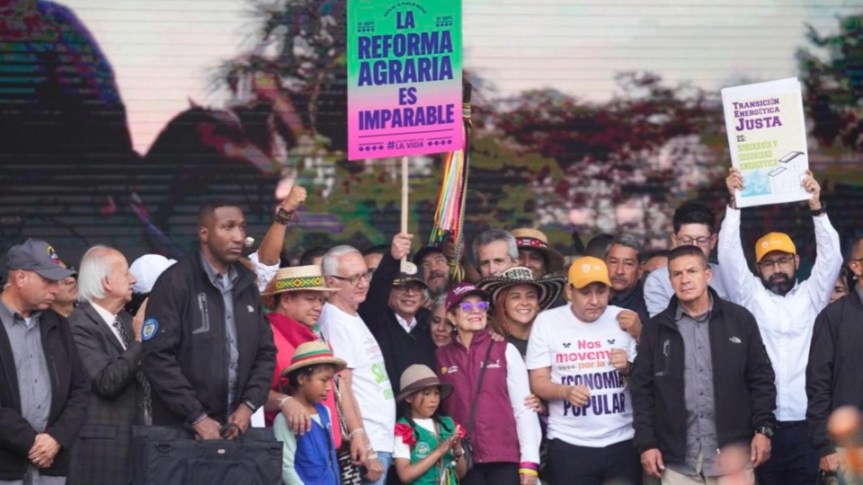
Surrounded by supporters, Colombia’s President Gustavo Petro, center, holds a sign that reads in Spanish, ‘The Agrarian Reform is Unstoppable,’ during a rally to show support for his proposed reforms, in Bogota, Colombia, Sept. 27, 2023. | Fernando Vergara / AP

South Paris, Maine


Colombian president Gustavo Petro on October 3 attended a big meeting of mostly small farmers in El Tambo, in Cauca, where “the coca economy is the main way of life for thousands of peasants.” Colombia’s first progressive president ever was presenting his government’s National Drug Policy for 2023. Petro had insisted earlier that “war on drugs has failed.” He recently expressed support for “phased decriminalization.”

His government is evidently prioritizing the present initiative, which is part of its far-reaching program for social and political reforms, now stumbling due to strong right-wing political opposition. The drug plan attends to main features of Colombian’s longstanding social disaster. They include:  dispossession leading to consolidation of large land holdings, agricultural underdevelopment, migrations leading to precarious lives often in cities, widespread lethal violence; and great wealth accumulated by top-level distributers and their financial backers.

The government’s new plan promises much, especially to working people both in Colombia and abroad. Freed of the monopolization of illegal drug production and commercialization, rural areas might shift to diversified agricultural production and expanded support systems. Prospects for community-development programs might improve and those rural Colombians forced into cities might return.  

By reducing that fraction of the domestic and international economy represented by drug production and marketing, the government would, in effect, be redistributing wealth, to a degree. And any success the new plan achieves in cutting back on drug commercialization might translate into reduced visibility abroad and, consequently, into lessened appeal to U.S. interventionists who have often justified military intrusions on that basis.

The plan calls for 27 “territorial spaces” in 16 departments and in Bogota, along with 51 “inter-institutional or bilateral technical working-groups.” Each one would hold three conferences with strategic allies, five with sectors drawn from the Joint Committee on Coordination and Follow-up. Other gatherings would involve women, young people, and prevention specialists.

Government spokespersons focused on the program’s two pillars. One of them, called “oxygenation,” supports those “territories, communities, people and ecosystems” adversely affected by drug-trafficking. It would support the transition to legal economies and reduce “vulnerabilities of regions and populations.” Measures would be taken that advance “environmental management and climate action toward … restoring regions” adversely affected by the narco-economy. The personal use of “psychoactive substances” will be dealt with on the basis of public health and human rights.

The other pillar, called “asphyxiation,” targets “the strategic nodes of the criminal system that generates violence” and “profits most from this illegal economy.”  The object would be to interfere with the “capacities and income” of the strongest drug-trafficking organizations and to do so so “systematically” and with consideration “of their complexity and relation with other economies both legal and illegal.”  Persons involved in production and trafficking would benefit from destigmatization and social justice.

The new plan has a slogan: “sewing life and burying narco-trafficking.” The aim is to remove 222,400 acres from coca and marihuana cultivation, reduce cocaine production by 43%, and block at least $55 billion in illegal financial gains. The plan would interfere with irregular banking and financial maneuvers and reduce both deforestation and greenhouse gas emissions.

Colombia’s illegal drug industry remains well entrenched, despite the drug war waged from 2000 on under the auspices of US Plan Colombia, a venture that absorbed billions of U.S. taxpayer dollars. A United Nations report cites a 13% one-year increase in land given over to illegal crops, as of 2022. It takes note of a recent “summit meeting [in Bogota] of narcotrafficking capos from Albania, Poland, Spain and Colombia.” 

The relentlessness of cocaine and marihuana production in Colombia may have led the U.S. government to recently stop monitoring the acreage of illegal crop cultivation. Indeed, after four decades of involvement, the U.S. government has abandoned its war against narco-trafficking in Colombia, according to analyst Aram Aharonian. Still, he reports, “weapons manufacturers” are benefiting, along with workers whose livelihood depends on narco-trafficking.

Petro’s new drug policy is significant mostly because it pursues objectives of the 2016 Peace Agreement which ended armed conflict between Colombia’s government and the FARC insurgency. Important parts of the new drug plan coincide with major provisions of that Agreement that were never implemented.

Agrarian reform matches with improving rural life generally. Solving the illicit drug problem was a goal of the Peace Agreement and now is the essence of Petro’s plan. The guarantee under the Peace Agreement of safety for former combatants never took root. The attacks against them are largely related to drug-trafficking, and now that will be dealt with.

Violence has been, and remains, pervasive. During just 13 months of the Petro government, assassins took the lives of 198 community and human-rights leaders and 43 former combatants.

A comprehensive report on the Petro government’s shepherding of  the peace process highlights the association of continuing violence with narco-trafficking. Indeed, “broad regions of the country” see persisting collusion of the police and military with paramilitaries and with “smaller narco-trafficking gangs and narco-trafficking structures.”  

Affirmation of the Petro government’s new campaign against drug trafficking comes from the report in June of the United Nations Mission to Verify the Peace Agreement. It emphasizes “the importance of peace initiatives and of efforts being made to expand the presence of the state so that vulnerable communities may be protected, especially in rural areas.”

Much is at stake as a government undertakes to control and end the production and marketing of illegal drugs. According to the UN’s Economic Commission for Latin America, “Problems associated with the production, trafficking, and consumption of drugs in Latin America affect the population’s quality of life, contribute to forms of social exclusion and institutional weakness, generate much insecurity and violence, and corrode governance in some countries.”  


W.T. Whitney Jr. is a political journalist whose focus is on Latin America, health care, and anti-racism. A Cuba solidarity activist, he formerly worked as a pediatrician, lives in rural Maine. W.T. Whitney Jr. es un periodista político cuyo enfoque está en América Latina, la atención médica y el antirracismo. Activista solidario con Cuba, anteriormente trabajó como pediatra, vive en la zona rural de Maine.
Potential disaster awaits Haiti as U.S. prepares for armed intervention / by William T. Whitney Jr

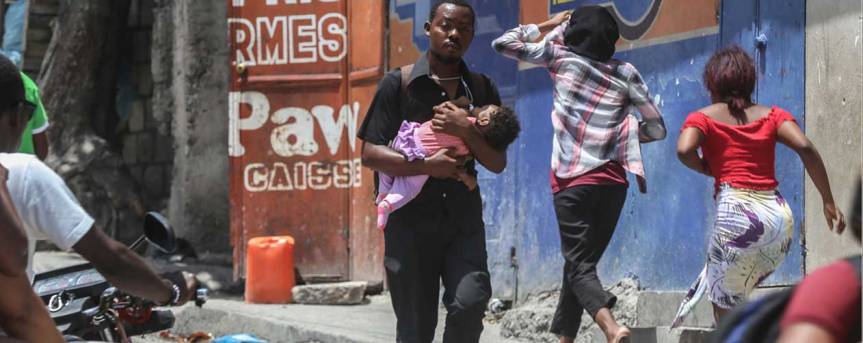
Residents flee their homes to escape clashes between armed gangs in the Carrefour-Feuilles district of Port-au-Prince, Haiti, Aug. 15, 2023. | Odelyn Joseph / AP

Reposted from People’s World


NEW YORK—On Monday, the United Nations Security Council voted to send a foreign “security mission” to Haiti—an armed intervention force. The body adopted a resolution, drafted by the United States and Ecuador, that authorizes the so-called Multinational Security Support mission—“to take all necessary measures”—code for the use of force.

Officials from Haiti, the U.N., and the U.S. say the intervention will be aimed at helping Haiti’s police suppress armed bands, or gangs, that cause deadly violence and have overrun the capital, Port-au-Prince. The U.N. reports that, as of Aug. 15, 2,439 Haitians had been killed this year.

“More than just a simple vote, this is in fact an expression of solidarity with a population in distress,” Haiti’s Foreign Minister Jean Victor Geneus told the council. “It’s a glimmer of hope for the people that have for too long been suffering.”

China and Russia, however, abstained from the vote, expressing reluctance about granting a blanket authorization for the use of force under Chapter 7 of the founding U.N. Charter. The remaining 13 members voted in favor.

Senior U.S. diplomat Jeffrey DeLaurentis justified the blank check for intervention, saying, “We have stepped up to create a new way of preserving global peace and security, answering the repeated calls of a member state facing a multi-dimensional crisis amid alarming spiraling gang violence.”

In mid-September, at the U.N. General Assembly, U.S. President Joe Biden and Ariel Henry, Haiti’s acting president, issued a call for a multinational militarized occupation of Haiti. U.N. Secretary-General António Guterres had already done so earlier. Secretary of State Antony Blinken promised “robust financial and logistical assistance” from the United States for a military intervention.

U.S. spokespersons say that $100 million is being sought from both Congress and the Pentagon to back the mission.

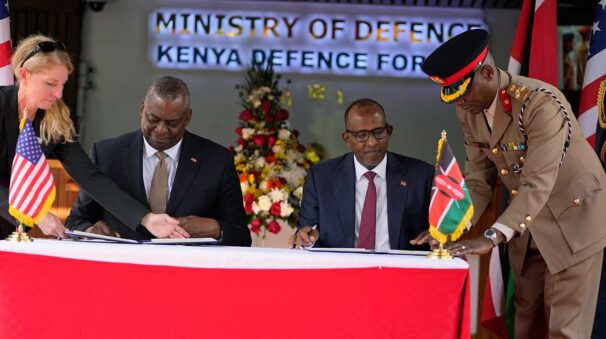
Meeting in Nairobi on Sept. 25, U.S. Defense Secretary Lloyd Austin and his Kenyan counterpart agreed that Kenya will provide 1000 “security officers” and will “lead a multi-national peacekeeping mission to Haiti.” According to the U.N., 12 countries have committed to being part of the mission.

The newly approved international intervention into Haiti will be officially ‘led’ by Kenya, providing some cover for the U.S. military, which will likely be calling the shots behind the scenes. Here, U.S. Secretary of Defense Lloyd J. Austin, left and Kenya Cabinet Secretary for Defense Aden Duale, sign a bilateral defense cooperation agreement in Nairobi on Sept. 25, 2023. The defense agreement will see Kenya get resources and support for security deployments in exchange for ‘leading’ the intervention in Haiti to combat gang violence. | Khalil Senosi / AP

The Communist Party of Kenya issued a statement condemning its government’s participation. It pointed out that U.S. power derives from “the enslavement of millions of African people, whose labor laid the foundation for [U.S.] economic prosperity.”

The United Nations itself is neither leading nor organizing the intervention, as the organization doesn’t exactly have a good reputation among the people of Haiti. For good reason: The U.N. force occupying Haiti in 2004-17 violated Haitians’ human rights, abused women and children, and introduced a cholera epidemic that killed 40,000 Haitians.

We offer four explanations for why the planned armed intervention will harm Haiti’s already beleaguered majority population.

One, previous foreign interventions have brought trouble. Nothing suggests this one will be different. Here’s the record:

  • The aforementioned U.N. occupation.
  • NGOs invaded after the 2010 earthquake. They wasted donated funds.
  • S.-assisted military coups in 1991 and 2004 removed the progressive Haitian President Jean-Bertrand Aristide.
  • The U.S. “Operation Uphold Democracy” reinserted Aristide in 1994 on the condition that he enforce neoliberal economic “reform.”
  • The U.S. government provided vital support to the father-and-son Duvalier dictatorship from 1957 to 1986
  • The U.S. military occupation of Haiti from 1915 to 1934 was brutal.
  • France, upon being kicked out of its Haitian colony, required payback with interest for slaves having gone free, in all, $560 million (in 2022 dollars) and up to $115 billion in lost development.
  • The U.S. responded to Haitian independence, proclaimed in 1804, with a trade embargo and diplomatic isolation, each lasting for decades.
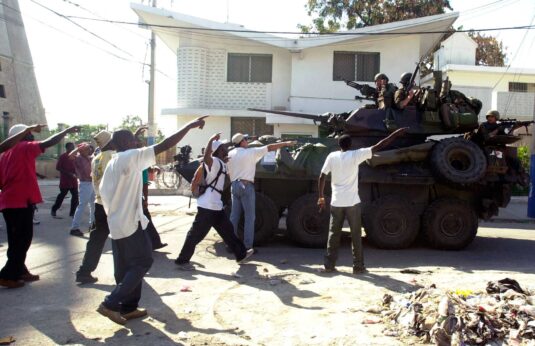
In this March 7, 2004, file photo, people demand that occupying U.S. Marines take action to protect them after shooting erupted during a march in Port-au-Prince, Haiti. In 2004, a coup d’état occurred after conflicts lasting for several weeks in Haiti. It resulted in the second removal from office of President Jean-Bertrand Aristide, preventing him from finishing his second term. Aristide claimed that his departure was a kidnapping, accusing the U.S. of orchestrating a coup d’état against him. Now, almost 20 years later, the country is still engulfed by violence. | Pablo Aneli / AP

Two, Haiti’s oppressed majority population needs a government, not a façade of one. A government in Haiti that served the people might provide a buffer between an imported, militarized foreign police and the Haitian people. Haiti has no functioning government today, much less one friendly to the people’s cause.

Michel Martelly became president in 2011, courtesy of U.S. manipulation. The last general election in Haiti, in 2016, allowed Jovenel Moïse to be president. The two wealthy politicians belonged to the rightwing PHTK political party. The elections they won were thoroughly corrupt and saw abysmally low-turnouts.

Moïse and others embezzled billions of dollars taken from the low-interest loans that President Hugo Chavez’s Venezuelan government made available to the Haitian state. The funds were supposed to have supported Haiti’s development and allowed the government to purchase low-cost oil under Chavez’s Petrocaribe program and to provide subsidized fuel and food for Haiti’s impoverished people. The U.S. government sanctioned Venezuela in 2015, and the loans and cheap oil stopped.

In response, massive protests erupted against government corruption and waste of the Petrocaribe funds. With increasing shortages and rising prices, they’ve continued since 2018. In a context of multifaceted conflict among Haiti’s oligarchs, Moïse was assassinated in July 2021.

There has been no president since, other than acting president Ariel Henry, whom the U.S., Canada, several European countries, and the EU—the so-called “Core Group” that oversees Haiti’s affairs—made prime minister shortly after the assassination. And as for the country’s parliament, it hasn’t functioned for over three years.

The distressed Haitian masses have no political party that reliably or effectively speaks for them. They have no say in foreign governments’ plans for them. They have no institutional resources or constitutional protections against potential abuse at the hands of foreign occupation forces.

Three, the gangs have ties with Haiti’s wealthy powerbrokers. It’s a relationship inconsistent with a simple story of interventionists taking on gangs. The association grew out of the recurring outbursts of social protest.

Haiti’s establishment sought protection from disorder and destruction triggered by the ongoing protests, primarily in Port-au-Prince. In the absence of an army, and with the police unable to cope, gangs came into existence.

They were supposedly going to bring order to city neighborhoods, even leading some protesters to join. Behind them, with funds the whole time, however, have been a number of wealthy Haitians. So of course, the gangs took on the additional role of blocking agitation for political change. Funds flowed from local oligarchs and from abroad for that specific purpose.

There’s a sea of contradictions. In suppressing the gangs, the interventionist forces would be defying the wealthy classes that pay them. But those same wealthy classes, as represented by their political boss Ariel Henry, are calling for a foreign security force to defeat them. The struggling people of Haiti may not readily follow such convoluted scheming, but they are familiar with the likely outcome.

Four, the timing of the intervention coincides with movement within the gangs toward a new kind of politics. One suspects that the proposed intervention represents a heavy-handed response to stirrings for political change.

Some leaders of some gangs appear to be disenchanted with inter-gang fighting and with dependence on the rich and powerful. They are making alliances and mouthing revolutionary sentiments.

Press reports center on veteran gang leader Jimmy Cherizier. They’ve latched onto his nickname “Barbecue,” assigned to him as a small boy; it evokes the specter of fiery violence. This former highly-regarded policeman brought other gangs into his “G9” alliance and now is reaching out to other gangs.

Cherizier, quoted by journalist Kim Ives, speaks his mind:

“We are a great people. Our national motto is ‘Union makes strength.’ Our objective is to once and for all overthrow the system that exists in Haiti and achieve the dream of [Haitian founding father Jean-Jacques] Dessalines, which is for the nation’s wealth to be shared by all its citizens…. Our battle isn’t just going to be to demonstrate with people in the streets. We have guns, and we will fight with them…. We took our independence with arms.”

Cherizier told Ives earlier, “This is a corrupt system; these people are using us to fight their political battles, and we do not want to be their cannon fodder anymore.”

Sabine Manigat, a sociologist at Haiti’s Quisqueya University, has the last word: The “image of Haiti portrayed in the foreign press, which highlights misery and insecurity, does not paint the full picture of a country where a social movement survives, people who are standing up and fighting and who require international solidarity, not intervention.”


W.T. Whitney Jr. is a political journalist whose focus is on Latin America, health care, and anti-racism. A Cuba solidarity activist, he formerly worked as a pediatrician, lives in rural Maine. W.T. Whitney Jr. es un periodista político cuyo enfoque está en América Latina, la atención médica y el antirracismo. Activista solidario con Cuba, anteriormente trabajó como pediatra, vive en la zona rural de Maine.
New Anti-Cuba Terror Attack Hits at Cuban Embassy in Washington / by William T. Whitney Jr.

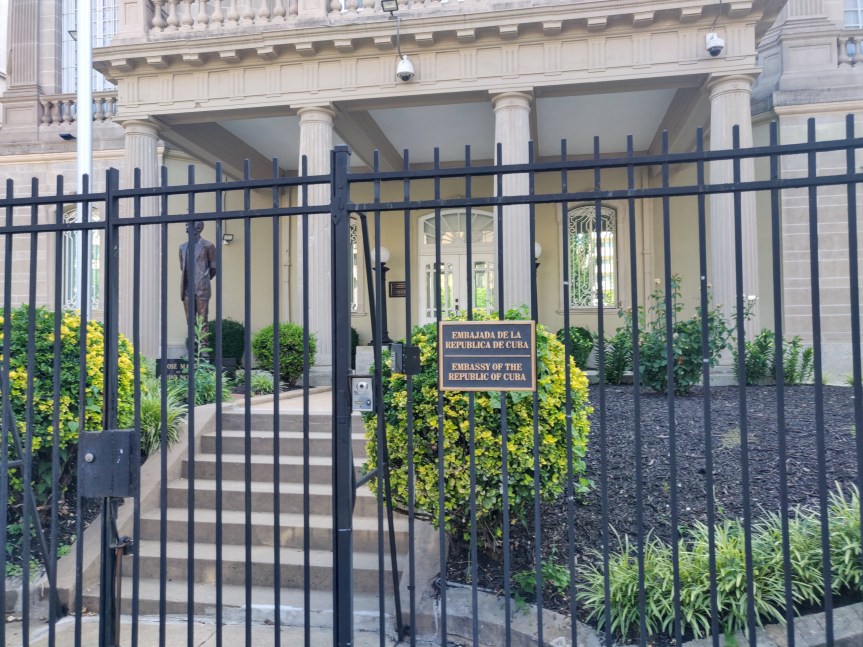
Embassy of Cuba, Washington, D.C | Photo: Wikimedia Commons

South Paris, Maine


Cuban Foreign Minister Bruno Rodriguez on Monday, September 25, indicated on social media that late the previous day, someone threw two Molotov cocktails at Cuba’s embassy building in Washington. Referring to “At least one Molotov cocktail,” an AP report indicated no one was injured and no damage occurred, also that “U.S. law enforcement officials were investigating.”

Condemnation of the attacks quickly emerged, in the United States from the Puentes de Amor (Bridges of Love) group, the People’s Forum in New York, Madea Benjamin, co-founder of CODEPINK, and the Washington DC chapter of the CPUSA. The governments of Mexico and Venezuela joined in denouncing the attack.

The National Network on Cuba issued a call for a protest demonstration in front of the Cuban Embassy at 5PM on September 25.

Within hours, President Díaz-Canel “expressed his firm condemnation of the act, attributing it to hate and underlining the possible consequences if forceful measures are not taken to deal with these acts of terrorism,” according to cubadebate.cu.

Outrage at the recent attack recalls national and global abhorrence to the assault-rifle attack on Cuba’s Embassy on April 30, 2020, which caused much damage.  The 42-year-old suspect Alexander Alazo, a 42-year-old undocumented immigrant from Cuba, was arrested, imprisoned, and, three months later, indicted by a federal grand jury on multiple charges relating to the attack. An Internet search reveals no subsequent disposition of Alazo’s case. 

Such incidents in Washington understandably are of the utmost concern to Cubans. Their experience is joining their country’s diplomatic missions abroad has too often put them in the way of U.S.-inspired terror attacks against their government.

Hostile parties used “petrol bombs” in causing damage to Cuba’s Embassy in Paris on July 27, 2021. As of 2020, “various Cuba representatives located abroad” between 1959 and 2018 experienced 581 incidents leading to 365 of them being killed and 721 wounded, according to Cuba’s Foreign Ministry.  This toll includes non-Cubans associated with the diplomatic facilities.

The timing of September 25 attack may relate to recent developments in U.S. Cuban Relations. One in particular was the high-profile visit to New York of Cuban President Miguel Díaz-Canel who addressed the United Nations General Assembly. He was speaking for the G77+China bloc of nations, which he currently serves as chairperson, and for his own country.

Díaz-Canel in New York reached out. He attended a solidarity event on behalf of Cuba and Venezuela, met with Cubans living in the United States, talked with New Yorkers on the street, visited Harlem to honor Malcom X, appeared at a gathering at the People’s Forum, and joined Catholic leaders to remember Cuban independence leader Father Félix Varela.

Perhaps the hatred on display with the attack on the Cuban Embassy represents a twisted attempt to counter any assumption that Cuba is on the side of decency, solidarity, and peace in a troubled world. What with the Cuban President’s visit in New York, U.S. Americans, reasonably enough, may have latched onto that idea.

Possibly the attack was also a signaling that no let-up in counter-revolutionary maneuvering was likely in the United States, despite the federal prosecution and political opprobrium now aimed at Bob Menendez. The New Jersey Senator, an anti-Cuba heavy hitter, faces charges of bribery and corruption on a massive scale. 


W.T. Whitney Jr. is a political journalist whose focus is on Latin America, health care, and anti-racism. A Cuba solidarity activist, he formerly worked as a pediatrician, lives in rural Maine. W.T. Whitney Jr. es un periodista político cuyo enfoque está en América Latina, la atención médica y el antirracismo. Activista solidario con Cuba, anteriormente trabajó como pediatra, vive en la zona rural de Maine.
Libya Catastrophe is Double Whammy, Capitalism to Blame / By W. T. Whitney Jr.

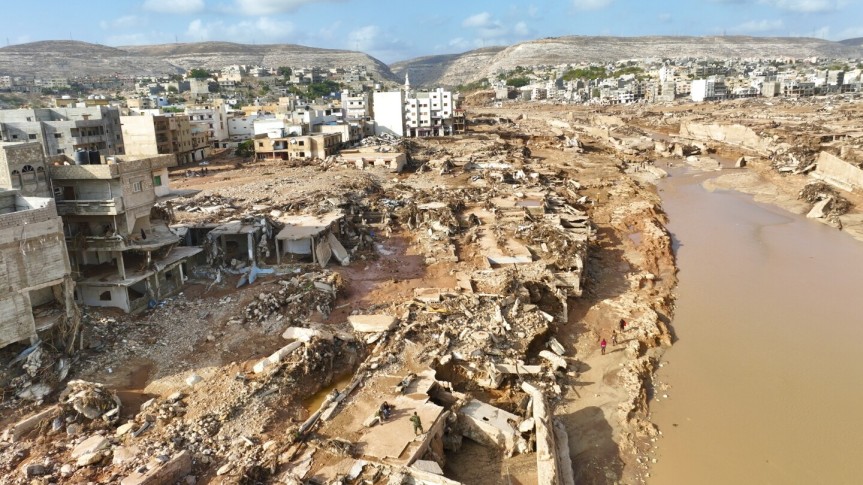
Darna, Libya after dams collapsed in the wake of storm Daniel. (Photo: AP/Jamal Alkomaty)

South Paris, Maine


Prodigious rainfall and the failure of long-deteriorated earthen dams caused a rush of waters through Derna, in Libya, on September 11.  Thousands of residents died, infrastructure was destroyed, and buildings ended up in the Mediterranean. Failure to protect residents, maintain the dams, and sustain the lives of all Libyans point to societal collapse.  

There is also the environmental crisis. Climate change provoked the enormity of storm Daniel that had drenched the eastern Mediterranean area ahead of the disaster. The association of climate change and terrible storms is known and so too is the role of human activities in causing great amounts of greenhouse gases to be released into the atmosphere.

The focus here is on the social disruption that transformed Libya. That’s because predisposing factors may not be clear. There are lessons to be learned.  The two crises are actually joined by virtue of both having developed out of a single impulse for domination.

Nationalist rebels led by Muammar Gaddafi deposed the embattled Libyan regime of King Idris on Sept. 1, 1969. Between 1973 and 1977, a Yugoslavian company contracted by the new government built two dams on the Wadi Derna River for the sake of flood control and irrigation. Maintenance of the dam would be lax.

A 1998 study revealed cracks and deterioration. After delays, a Turkish company began repairs on the dams in 2010. When the Gaddafi government was ousted in the following year, the work stopped.  Some $2.3 million was on hand for finishing the project. It disappeared.

Anti-government protests ─ the   Arab Spring ─ had broken out throughout the region in 2010. An anti-Gaddafi insurgency making headway in early 2011 prompted the military forces of the United States France, Great Britain, and a host of other countries to carry out a self-styled humanitarian intervention in March. Gaddafi’s murder seven months later ended the intrusion.  

U.S complaints had centered on an “opaque political and economic system,” widespread corruption, and Gaddafi’s autocratic proclivities. There had been mutual, and occasionally lethal, provocations.  Gaddafi’s increasing financial and banking influence in Africa raised eyebrows.

Gaddafi had offended by nationalizing 51% of oil companies’ assets in 1973.  According to one expert, “in 2006 the oil sector in Libya … made up ninety-five percent of export earnings, ninety-two percent of government revenue, and seventy-three percent of GDP.”  

The foreign assailants could not have overlooked the reality that a government with tight control over oil was in trouble with an insurgency.  It was no mean prize. Libya’s oil reserves now rank first in Africa and nineth in the world.  

Their forces carried out air operations, inflicted civilian casualties, assisted with the rebels’ ground actions, blockaded ports and embargoed weapons deliveries. They had a convenient tool.

Writer Eve Ottenberg a decade later accuses NATO, instrument for intervention, of fattening the wallets of war profiteers and weapons moguls and wreaking havoc in places like Yugoslavia, Afghanistan, Libya, now Ukraine.” Today France , Holland, and the United States are looking at French Guyana as a “forward-operating base for NATO” in Latin America, reports Guyanese activist Maurice Pindard. 

In its own review of “past and present” missions, NATO, with planetwide ambitions and unlimited potential for destruction, is, as expected, bereft of even a hint at repairing places left in chaos after its wars.

NATO departed from Libya, and ever since a government in the West of the country has been vying with a militarized counterpart in the East, where Derna is located. Cities have been bombed and occupied; Derna was subject to Islamic State rule from 2014 to 2016. Mercenaries, militias, and tribes jostle with one other. Milita groups control oil fields and extort vast sums. There’s “pillage on a vast scale,” plus drug-trafficking and exploitation of migrants heading to Europe.

Now one third of Libyans live in poverty; 13% of them require humanitarian aid, according to one estimate. By 2016, oil production, the source of social spending, had fallen to 75% below Gaddafi-era levels. It’s risen recently. 

The troubles experienced by Libya’s people were new. The Ghaddafi government had achieved much. The  2010 UN Human Development Index, a composite measure of health, education and income, ranked Libya 53rd in the world and first in Africa. By then, Libya was registering the highest per capita income in Africa, the lowest infant mortality, and the highest life expectancy. Schooling and healthcare were provided without Libyans having to pay.

Under Gaddafi, more than 95% of Libyans were adequately nourished; the government had abolished taxes on food. Literacy increased from 25% to 87% during the Gaddafi era. Almost 10% of Libya’s youth received scholarships for study abroad. Beginning in 1983 the government developed a massive water-delivery system with 1,100 new wells and 4,000 kilometers of pipelines.

Had the Gaddafi government not disappeared, the social advances and protection might have remained. Some of the progress might have continued under another government, if there had been no intervention. 

What’s certain is that previous arrangements for sustaining the population disappeared following NATO’s military action. Adverse conditions now allowed for the dams to disintegrate and for Libya’s people to not be rescued.

Pointing to a planetary “double crisis,” an ecological crisis and a social one, analyst Jason Hickle insisted recently that the two crises be dealt with simultaneously: “Attempting to address one without the other leaves fundamental contradictions entrenched.” He adds that, “the two dimensions are symptoms of the same underlying pathology … [which is] the capitalist system of production.”

Derner is witness to Hickle’s double crisis. The unprecedently heavy rainfall reflects climate crisis. A decade of turmoil and neglect of the dams attests to social crisis. The two share the same root cause. 

Capitalism requires perpetually increasing production of goods, which led to overuse of fossil fuels, which has translated into climate change. Under capitalism, natural resources in the world’s peripheral regions are plundered. Popular forces may be suppressed. Devices like NATO come into their own. If it had occurred a little earlier, Jason Hickle could have used the catastrophe to illustrate the main point of his article.


W.T. Whitney Jr. is a political journalist whose focus is on Latin America, health care, and anti-racism. A Cuba solidarity activist, he formerly worked as a pediatrician, lives in rural Maine. W.T. Whitney Jr. es un periodista político cuyo enfoque está en América Latina, la atención médica y el antirracismo. Activista solidario con Cuba, anteriormente trabajó como pediatra, vive en la zona rural de Maine.
Ecuador vote shows contrasting roles of political parties and social movements / By W.T. Whitney, Jr.

An electoral official shows the ballot for a presidential election in Ayora, Ecuador, Sunday, Aug. 20, 2023. The election was called after President Guillermo Lasso dissolved the National Assembly by decree in May to avoid being impeached. | Dolores Ochoa / AP

Originally posted in People’s World on August 31, 2023


On Aug. 20 in Ecuador, 45-year-old lawyer Luisa González of the Citizen’s Revolution movement political party (RC) gained 33.6% of the votes in first-round balloting for eight presidential candidates. Second-place candidate Daniel Noboa of the National Democratic Action, a 35-year-old business man and political neophyte, took 23.4% of the vote. González and Noboa will be competing in second round voting on Oct. 15.

As for the elections to the National Assembly, the RC accounted for 39.4% of the votes, three other parties for 45% of those votes, and five smaller parties for the remaining ballots.

The voters also considered referendums, one on halting oil extraction from Ecuador’s huge Yasuní National Park and the other on prohibiting mining activities in a biosphere region northeast of Quito. The referendums were approved by 59% and 68% of the voters, respectively.

The circumstances were unusual. Two processes played out on parallel tracks and culminated together. These were political parties taking part in elections and social movements pursuing referendums. Contradictions emerged along with the promise of troubles ahead and signs of commitment and hope.

The new president will serve only the 18 months that remain in the term of Guillermo Lasso, elected in 2021 for a five-year term. When confronted with impeachment proceedings in May 2023 on corruption charges, Lasso dissolved the National Assembly and thereby, as provided by the Constitution, set in motion preparations for a new election and his own departure.

Nationwide Indigenous protests in 2022 accelerated the transition now taking place amidst violence attributed to narco-trafficking that took 4,671 lives during the past year. The election campaign itself provoked killings, those of presidential candidate Fernando Villavicencio, a legislator, journalist, and labor leader; the mayor of Manta, Agustín Intriago, and others.

The Citizen’s Revolution movement political party, represented by presidential candidate Luisa González, defends policies of social assistance and national development introduced under the leadership of former President Rafael Correa during his tenure from 2007 to 2017. The CR took shape in reaction to the neoliberal turn taken by the government of Lenin Moreno, Correa’s former vice president and successor.

Its predecessor party, under Correa’s democratic-socialist leadership, managed the national economy so as to preserve funds for social programs through reliance on petroleum exports and foreign credit. The RC led left-leaning forces in opposing the neoliberal government of Guillermo Lasso, in power since 2021.

With his second-place finish in the recent voting, candidate Daniel Noboa surpassed expectations, due in part to a stellar TV debate performance. He represents wealth and power. His father, a five-time presidential candidate, and his uncle preside over an agro-export and real estate conglomerate made up of 200 business entities. They owe the government $1 billion in back taxes.

Now campaigning for the second round of presidential elections, RC candidate González would seem to differ greatly from the prince of such an empire. “We are going to deal with the basic causes of violence and criminality which are hunger, poverty, lack of education, and the absence of opportunity,” she noted as she was accepting her party’s nomination.

But all is not as it appears. The positions taken by the various presidential candidates on the referendums were revealing. Only four of the eight candidates unambiguously supported the Yasuní referendum; three of them represented right-wing parties. Noboa justified leaving oil underground based on his conclusion that the financial yield is low and that over-reliance on oil exports impedes diversification of the economy.

The Correa-inspired RC movement and its candidate Gonzalez rejected the Yasuní referendum. Previous governments, governments headed by Correa in particular, took the position that income from oil exports is crucial to continued funding of social advances.

The contrast between approval at the polls shown for the candidates of political parties and for approval of the referendums was striking─33.6% and 23.4%, respectively, versus 68% and 59%, respectively. One set of the voting results testified to activists’ enthusiasm and commitment.

Approval of the two referendums reflects the advocacy and hard work of environmentalists, Indigenous activists, and supporters of women’s rights. According to NACLA.org: “The vote marks a triumph for the country’s grassroots anti-extractivist, ecological, and Indigenous movements, whose road to victory comes from a decade of social and political conflicts over extractive industry policies.”

Journalist Gabriela Barzallo surveys collective efforts toward restraining oil extraction. Highlighting the persistent participation of social movements, she quotes Ecuadorian sociologist Gregorio Páez:

“This upcoming referendum … serves as an inspiration for all Ecuadorians to have the agency to decide over our natural resources, and to empower people to see that grassroots activism really can have changes in policies.”

Páez sees activism in Ecuador as “inspiring social movements on a global scale.”

Analyst Santiago Kingman explores the impact of social movements on the elections:

“The triumph of the social movements is understood as a positive response from cities and areas far removed from the oil-producing world. At least 59% of Ecuador’s citizens…are alienated from the electoral system and political parties and say they have another way of doing politics. Those who voted for Noboa [who favored the referendum’s approval] are against politics, but they are not anti-capitalists. The social organizations behind the referendums are anti-capitalists and are anti-political parties.” 

Social movements have shaped political resistance throughout Latin America, in some countries more than others. They flourish, it seems, in situations of grief at the hands of international capitalism. Resonating there is contention over control of land and sub-soil resources, provision of energy, debt owed to foreign creditors, and prescriptions for domestic economies from abroad.

Capitalist-oriented political parties, often enablers of foreign predators, offer little resistance. Social movements active in Peru, Chile, Bolivia, Colombia, and now Ecuador have partially filled the void. Social movements operating in conjunction with anti-capitalist governments have different job descriptions.

Imaginings lead to speculation about an expanded role for social movements in the capitalist powerhouse nations. One recalls U.S. labor uprisings in the 1930s and the civil rights movement that peaked a few decades later.


We hope you appreciated this article. At People’s World, we believe news and information should be free and accessible to all, but we need your help. Our journalism is free of corporate influence and paywalls because we are totally reader-supported. Only you, our readers and supporters, make this possible. If you enjoy reading People’s World and the stories we bring you, please support our work by donating or becoming a monthly sustainer today. Thank you!


W. T. Whitney Jr.

W.T. Whitney Jr. is a political journalist whose focus is on Latin America, health care, and anti-racism. A Cuba solidarity activist, he formerly worked as a pediatrician, lives in rural Maine. W.T. Whitney Jr. es un periodista político cuyo enfoque está en América Latina, la atención médica y el antirracismo. Activista solidario con Cuba, anteriormente trabajó como pediatra, vive en la zona rural de Maine.

Anticommunism in Ukraine as Gift to U.S. Interventionists / by W.T. Whitney Jr.

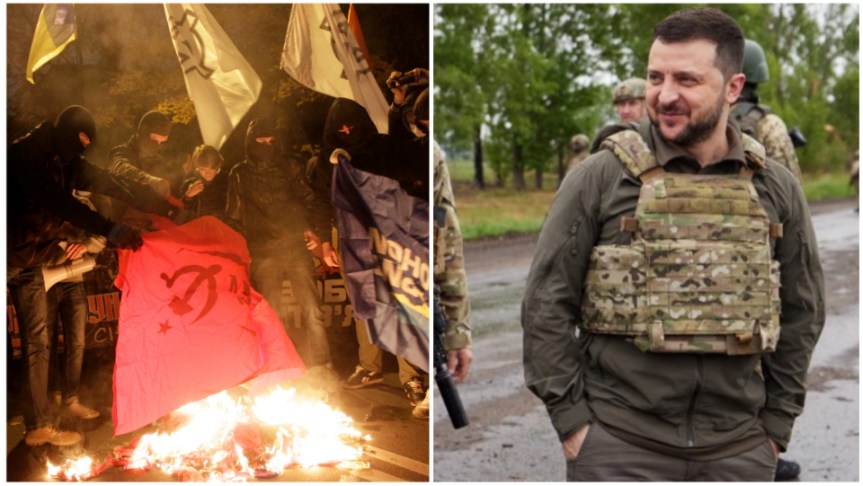
Left: Supporters of the neo-Nazi Svoboda (Freedom) Party burn the flags of the Communist Party of Ukraine and the Party of Regions of Ukraine. Right: Ukrainian President Vladimir Zelensky. | AP photos

South Paris, Maine. August 24, 2023


The arrest on August 16 of Georgi Buiko, a Communist leader, represents the latest and perhaps most significant action taken by Ukraine’s government to rid the country of the Communist Party of Ukraine (KPU). The charges, according to People’s Dispatch, referred to anti-Ukrainian activities and possession of pro-Russian and communist printed material.

Buiko, a key KPU leader, had been a youth leader within the Soviet Union’s Communist Party. Subsequently he was a Party and municipal leader in the Donbass area, secretary of the KPU’s Central Committee, member of the Ukrainian parliament, and a journalist.  Buiko heads the Anti-Fascist Committee of Ukraine.

The Communist Party of Spain condemned Buiko’s arrest and also other government attacks on the KPU. Its statement referred to the report in June from the UN’s High Commissioner for Human Rights which denounced violations of “international humanitarian law” in Ukraine along with arbitrary arrests, secret prisons, and torture.

Buiko’s arrest testifies to a definitive crackdown on Ukraine’s Communists. It began in tandem with an appeals court judgment on July 5, 2022 that confirmed a 2015 court decision declaring the KPU to be illegal. The appeals court ruling authorized the seizing of KPU properties and funds. That it quickly followed the onset of the Ukraine-Russia war on February 24, 2022 was probably not accidental.

The atmosphere turned toxic. Ukrainian President Zelensky on May 14, 2022 banned left-leaning political groups and parties and parties regarded as pro-Russian. The prohibitions did not apply to rightwing and neo-Nazi organizations.

In March of that year, the police in Kiev had already arrested the brothers Aleksander and Mikhail Kononovich on vague charges of pro-Russian attitudes. A court has been deliberating on their case intermittently ever since. The brothers have remained under house arrest for 17 months. They report having received death threats from the police.  

Mikhail Kononovich, addressing the General Assembly of the World Federation of Democratic Youth (WFDY) in Cyprus on December 3, 2019, identified and denounced a rightwing terror campaign against Communists and other opposition groups in Ukraine. Neo-Nazis had brutally attacked the Kononovich brothers a year earlier.

WFDY members have spearheaded demonstrations on their behalf in many countries, particularly in front of U.S. embassies. The Greek Communist Party has prominently defended the imprisoned brothers. 

The KPU’s impact had waned considerably even before wholesale persecution began.  Petro Symonenko, the Party’s former top leader and a prominent member of Ukraine’s Parliament, had been runner-up in presidential voting in 1999. Later, after the so-called Orange Revolution in 2004, the KPU lost most of its electoral appeal. Symonenko ended up supporting Russia in the burgeoning conflict between the two countries. In 2022, in the wake of police raids on his home, he left Ukraine for Russia.

Repression of the KPU manifested in the early stages of that conflict.  A stridently anti-Russian government took power in 2014, with U.S. assistance. Receiving U.S. material aid, Ukraine’s government initiated brutal military action against Russia-friendly separatist forces in southeastern Ukraine’s Donbass region.

Under those circumstances, KPU members experienced physical attacks and Party offices were ransacked. The government produced laws in 2015 requiring that symbols and reminders of Soviet-era Ukraine be removed and prohibiting communist advocacy. The teaching of history in schools would be altered and KGB archives would be newly accessible. 

The legislation promoted recognition of Ukrainian independence leaders extending back to World War II. The honored groups and individuals were predominately fascist in orientation, among them the nationalist leader Stephen Bandera.

Regulations announced in 2019 prohibited the KPU from participating in elections. A court that year banned the pro-communist Workers’ Newspaper (Rabochaya Gazeta), established in 1897.  The newspaper had offended by publishing articles with quotations from Marx and Lenin.

The confluence of vigorous anti-Communism showing up as Ukrainian state policy and U.S. participation in Ukraine’s war against Russia is no mere coincidence. Waging war against a powerful, well-resourced state, Ukraine needs U.S. assistance, and on that account would endeavor to please its essential ally. And the U.S. government sought to make use of Ukraine in order to cut Russia down to size for reasons presumably of global security. There was a meeting of the minds. 

It’s an arrangement that has Ukraine mounting a display of anti-communism for U.S. tastes and its ally relying on red-scare in order to shore up domestic support for its Ukrainian venture, as with past overseas interventions.

Surely Ukraine’s government was aware of its special gift on tap for the U.S. partner.  Anti-communism was the convenient pretext for the U.S. removal of Iran’s Mosaddegh government in 1953, for the CIA-staged coup in Guatemala in 1954, for discarding the Dominican Republic’s “constitutionalist” uprising in 1965, for removing Salvador Allende’s socialist government in Chile in 1973, and so on.

Foreign powerbrokers themselves have benefited from the anti-communist disposition of U.S. governments. The Cuban bourgeoisie and their heirs have relied on U.S. determination to relieve their island of a Communist revolution. Even a progressive Venezuelan government might appreciate the possible usefulness of its current assault on Venezuela’s Communist Party for persuading U.S. officials to ease their economic sanctions.


W.T. Whitney Jr. is a political journalist whose focus is on Latin America, health care, and anti-racism. A Cuba solidarity activist, he formerly worked as a pediatrician, lives in rural Maine. W.T. Whitney Jr. es un periodista político cuyo enfoque está en América Latina, la atención médica y el antirracismo. Activista solidario con Cuba, anteriormente trabajó como pediatra, vive en la zona rural de Maine.
‘Worse than the Special Period’: Cuba’s food situation more desperate by the day / By W.T. Whitney Jr.

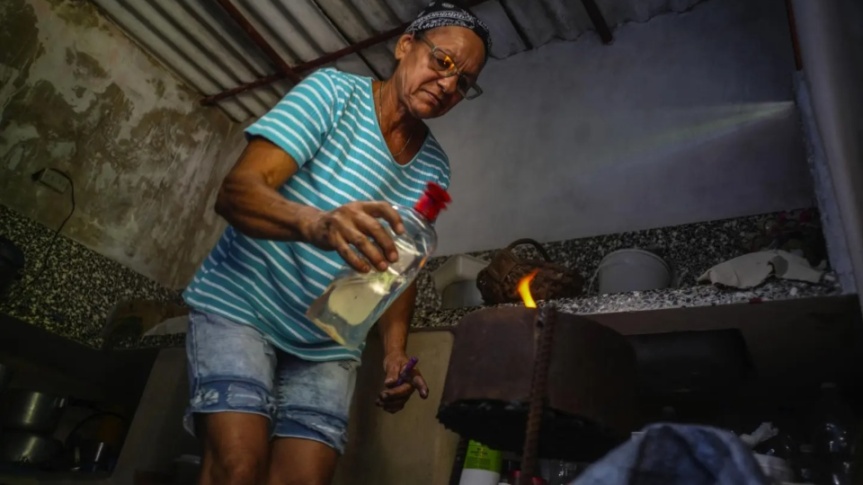
Mariel resident Rosa Lopez lights a charcoal stove to boil sweet potatoes and prepare scrambled eggs with tomatoes for her grandchildren on May 18, 2023. She had just returned from picking up her food rations from a government-run market. At the time, it had been more than a month since any cooking gas had been delivered to the city, so Lopez cooks using charcoal and a wood burning oven. Low agricultural yields, exploding inflation, a lack of gasoline for transportation, and the U.S. blockade have all contributed to soaring food prices. | Ramon Espinosa / AP

Originally posted in People’s World on August 16, 2023


Addressing a meeting of government ministers and the press in Havana on Aug. 11, Cuba’s Vice Prime Minister Jorge Luis Tapia Fonseca exploded when discussing the food crisis gripping the nation.

“It takes work to produce food. Everyone wants food deliveries, but we do nothing to produce it. We lack a culture of production … We don’t need all these papers, or words. When do we begin to plant? Who will do it?”

He was reporting on implementation of Cuba’s 2022 law on Food Sovereignty and Food and Nutritional Security. He noted that food self-sufficiency in local areas is disastrously lagging. Crop yields are low; plant diseases and the lack of inputs has hampered grain production.

The food situation in Cuba is growing more desperate by the day. Residents of the island individually consumed only 438 grams of animal protein per month in 2022, and in May 2023, only 347 grams; recommendations call for ingestion of 5 kg monthly. Not enough chickens were raised last year; poultry meat and eggs remain scarce.

Yields of corn, soy, sorghum and other crops have dropped, and animal feed is mostly unavailable. Therefore, pork production is also down, milk is unavailable to adults, and fewer cattle are being raised. Pasturage is poor, due to drought and no fertilizer.

Farm workers carry a tank of fresh milk to deliver it to a government-run food store in San Nicolas, Cuba, May 19, 2023. Milk is in short supply and reserved for children these days. | Ramon Espinosa / AP

Failures mount

Tapia pointed to the many failures exacerbating the situation. The output of state-controlled food producers is low. Producers, distributers, and institutional consumers don’t regularly contract with one another to facilitate food distribution. Producers aren’t being paid, because credit isn’t available. Cattle-stealing has reached new heights, 44,318 head so far this year.

The Ministry of Finances and Prices issued a report prior to the National Assembly session that recognized high inflation, widespread popular dissatisfaction, and the need for “concrete solutions.” Minister Vladimir Regueiro Ale indicated prices skyrocketed by 39% during 2022 and 18% more so far in 2023.

Inflation, he explained, varies from province to province and may manifest as abusive price-fixing, especially when agricultural supplies and products are in short supply.

Commenting on the report, National Assembly President Esteban Lazo, reminded delegates that diminished production and inflation were connected: “If there is no production and supply, we will not achieve effective control of prices.” He complained that “practically 100% of the food basket is being imported.”

The Assembly’s Food and Agricultural Commission analyzed organizational and management problems and reported that only 68% of expected diesel fuel has arrived so far in 2023, 14,700 tons less than in the similar period a year before; 28,900 tons of imported fertilizer were ordered, but only 168 tons arrived. Cuba’s fertilizer production has been nil this year in contrast to 9,600 tons produced in the same months in 2022.

Lazo communicated a message to Cuba’s Minister of Agriculture from the Assembly, whose recent session ended on July 22. The ministry, he said, would be “transforming and strengthening the country’s agricultural production,” to initiate “a political and participatory movement that would unleash a productive revolution in the agricultural sector.”

Nothing less than a revolution will do

A revolution appears to be exactly what’s needed. The recent National Assembly session dealt almost entirely with Cuba’s present food disaster. The lives of many Cubans are becoming more precarious due to unending food shortages, high prices, and low incomes.

Information emerging from the Assembly’s deliberations attests to the reality of crisis in Cuba, and it means that urgency is building for Cuba’s friends in the United States to resist U.S. policies in new ways, strongly and assertively. Their own government accounts for new suffering and destitution in Cuba.

President Miguel Díaz-Canel emphasized resistance when addressing the National Assembly. He dedicated his remarks to two revolutionary heroes who were present. Admiring how they kept “their foot in the stirrup of difficulties” and their “rifle pointed at mistakes,” he may have been thinking of hard work ahead.

He mentioned “problems of our difficult daily life, such as food production, electricity generation, water availability, crime, rising inflation, abusive prices.”

The president criticized behaviors “that reinforce the omnipresent blockade through inaction, apathy, insensitivity, incapacity, or simple tiredness and lack of faith.”

Díaz-Canel noted approvingly that delegates discussed “closer ties between deputies and the population,” “better management and allocation of the currency,” “greater direct participation of the non-state sector in national production,” “municipal autonomy,” and “downward pressure on prices.”

But it’s not enough. “Above all,” he said, “we must devote ourselves to creating wealth, first of all, by producing food.”

Trouble in the countryside

Cuba’s rural communities are troubled—and shrinking. Soon, “we won’t have any people left in the countryside,” one delegate said. Another called for improved “roadways, housing, and connectivity.”

No fuel means most people in rural areas are resorting to bicycles or horse carts to travel short distances. | Ramon Espinosa / AP

Regarding the low level of agricultural skills among the rural population, someone called for teaching in “agroecological techniques” and “good practices for the producing, processing, and commercialization of food.”

The idea has been circulating for a while now that greater local autonomy might help spur food production, but efforts at prompting that devolution of initiative have seen a slow uptake. As of April 2023, aspiring farmers had not yet taken possession of 258,388 hectares of idle land made available to them without cost under land-tenure reforms in 2008.

Frei Betto, Brazilian friend of revolutionary Cuba and adviser to Cuba’s Food Sovereignty and Nutritional Education Plan, visited Cuba in June. In his assessment, the “current shortages are more severe than in the Special Period (1990-95),” when Cuba’s economy nearly collapsed following the withdrawal of Soviet aid and the contraction of trade with the socialist bloc of nations.

He indicated that Cuba now imports 80% of the food it consumes, up from 70% five or so years ago, and that it costs $4 billion annually, up from $2 billion. For corn, soy, and rice alone, the outlay now is $1.5 billion annually.

He indicated, too, that a ton of imported chicken meat now costs $1.3 million, up from $900,000 a year ago, that “the wheat supply has worsened,” that milk production is down 38 million liters in one year, and that less oil from Venezuela, thanks to U.S. sanctions there, means further reduced food production in Cuba.

Blame the blockade, but not only

The origins of food shortages in Cuba and the mode of U.S. intervention are highly relevant in understanding the current situation, as every Cuban knows.

To be sure, the shortages plaguing the people are not solely due to U.S. policies. Drought, hurricane damage, marabou shrub infestation, soil erosion, high soil acidity, poor drainage, and lack of organic material soil have all contributed.

The still-prevailing bureaucratic and centralizing tendencies of the Cuban government’s economic management also play a role.

The U.S. economic blockade, however, remains central to understanding what’s happening. The creation of a food crisis was among the original proposals put forward by State Department official Lestor Mallory in 1960 for how to overthrow Cuba’s revolutionary government. The program: Use “hunger and desperation” to spark the “overthrow of government.”

Aid from and trade with the socialist world frustrated U.S. efforts and kept disaster at bay for decades, but eventually the Soviet Union and socialist Eastern Europe fell. The U.S. government seized the moment and passed legislation tightening the economic blockade in 1992 and 1996 and, later, designated Cuba a terrorist-sponsoring nation.

Beyond bans on products manufactured or sold by U.S. companies, proscribed categories soon included products manufactured by foreign companies associated with U.S. ones and products containing 10% or more components of U.S. origin. Now, foreign enterprises active in Cuba faced possible U.S. court action.

International loans and international transactions in dollars are usually off-limits. Payments abroad don’t reach destinations. Income from exports doesn’t arrive.

Think imports of seeds, fertilizers, herbicides, pesticides, breeding stock, veterinary supplies and drugs, new equipment, spare parts, exports of coffee, rum, and nickel. Think loans for purchasing food and more, loans for agricultural development. Think impediments to restoring rural infrastructure.

Farm workers wait in line to refuel their tractors on the highway to Pinar del Rio, Guanajay, Cuba, May 18, 2023. Cuba is in the midst of a major fuel shortage that has drivers and farmers waiting in line for days or even weeks to gas up their vehicles and tractors. | Ramon Espinosa / AP

The blockade, the U.S. tool of choice, has hit food production in Cuba hard. It is far along in achieving its ultimate purpose. Cuba needs a new order of support from friends in the United States─Marti’s “belly of the beast.”

Cuba needs friends more than ever

Many have so admired Cuba’s brand of socialism as to assume that Cuba’s social gains and exuberant international solidarity would fire up such enthusiasm that, along with considerations of fairness, legality, neighborliness, and revulsion against U.S. cruelty, would make U.S. policymakers think anew about Cuba. It never happened.

Now at a watershed moment in Cuba, a new direction is necessary, one all about persuading, organizing, and unifying left-leaning political groups and anti-war, anti-empire activists of all stripes. Leadership is needed.

Frei Betto says that, “It is time for all of us, in solidarity with the Cuban Revolution, to intensify the struggle against the U.S. blockade and mobilize international cooperation with the island that dared to conquer its independence and sovereignty against the most powerful and genocidal empire in the history of mankind.”


We hope you appreciated this article. At People’s World, we believe news and information should be free and accessible to all, but we need your help. Our journalism is free of corporate influence and paywalls because we are totally reader-supported. Only you, our readers and supporters, make this possible. If you enjoy reading People’s World and the stories we bring you, please support our work by donating or becoming a monthly sustainer today. Thank you!


W.T. Whitney Jr. is a political journalist whose focus is on Latin America, health care, and anti-racism. A Cuba solidarity activist, he formerly worked as a pediatrician, lives in rural Maine. W.T. Whitney Jr. es un periodista político cuyo enfoque está en América Latina, la atención médica y el antirracismo. Activista solidario con Cuba, anteriormente trabajó como pediatra, vive en la zona rural de Maine.
A Plea for Simón Trinidad / By W. T. Whitney Jr.

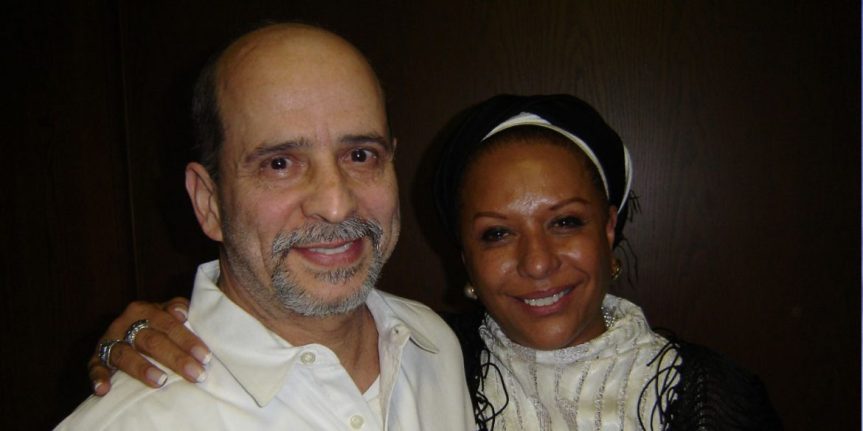
“Simon Trinidad” and Piedad Cordoba (Image: Piedad Cordoba)

South Paris, Maine


The title recalls the title of Henry David Thoreau’s essay “A Plea for Captain John Brown.” Trinidad, like John Brown, is remarkable for his implacable resolve and regard for justice.

Trinidad was 58 years of age when a U.S. court in 2008 sentenced him to 60 years in prison. His alleged crime was that of conspiracy to hold hostage three U.S. drug-war contractors operating in Colombia. In effect, he is serving a life sentence. He had nothing to do with the hostage-taking.

The contractors, captured in 2003, went free in 2008. U.S. drug war in Colombia has obscured the big U.S. role in Colombia’s war against leftist insurgents, primarily the Revolutionary Armed Forces of Colombia (FARC).

Simon Trinidad

Simón Trinidad was a FARC leader. The FARC and Colombia’s government signed a peace agreement in 2016 and Trinidad and other ex-combatants expected to be part of a peace process. Now he is a prisoner in a super-max prison in the United States and is confined to his cell for all but two hours per day, receives no mail, and is allowed very few visitors.

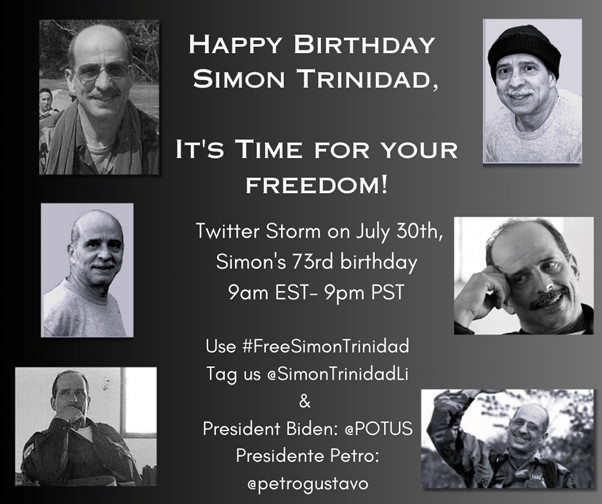
On July 27, Simón Trinidad unexpectedly was a featured item in the news in Colombia. An undated letter he had written to Colombian chancellor Álvaro Leyva requesting repatriation to Colombia had appeared on social media. News reports were reproducing it.

Observers associated Trinidad’s letter with the U.S. government’s announcement the day before that the bloodthirsty former paramilitary chieftain Salvatore Mancuso, also jailed in the United States, soon would be extradited to Colombia. President Gustavo Petro designated Mancuso as a “promotor of peace.”

Trinidad, not so favored as this, in his letter wrote of his determination to testify before the Special Jurisdiction for Peace, as other former FARC combatants have done, and Mancuso too, virtually. This court, established under the Peace Agreement of 2016, offers former combatants an opportunity to tell the truth about crimes they may have committed during the civil war and, having done so, to be pardoned or punished.

Trinidad apparently hopes not only that that Chancellor Leyva will inform the U.S. Secretary of State of his request to be repatriated but also that his message will be passed on to President Biden, who has the power to release him from prison.

Progressive Colombian Senator Iván Cepeda, “one of the people who speaks of peace on behalf of President Gustavo Petro,” welcomed “Simón Trinidad’s proposal [and] sent it directly to Chancellor Álvaro Leyva.”

Trinidad had joined the left-leaning Patriotic Union (UP) electoral coalition after it formed in 1985. A year later, paramilitaries began their massacre of UP adherents that, with impunity from Colombia’s government, lasted for years. In response, Trinidad in 1987 joined the FARC and, in the process, dropped his name Ricardo Palmera Pineda. For the FARC, Trinidad was responsible for political education and propaganda and was a negotiator.

The U.S. government in 2000 introduced its “Plan Colombia” through which Colombia’s military secured U.S. weapons and training assistance; U.S. troops and military contractors were deployed in Colombia. The appearance of Plan Colombia doomed peace negotiations between the FARC and Colombia’s government that were in progress at the time.

As a lead FARC negotiator in those talks, Simón Trinidad became known to international observers. His course with the FARC ended abruptly on January 2, 2004, when Colombian military personnel and the CIA seized him in Quito. Trinidad was there seeking UN assistance for a proposed prisoner exchange.

Colombia’s government extradited Trinidad to the United States on New Year’s Eve, 2004. According to his U.S. lawyer Mark Burton, Trinidad’s U.S. captors regarded him as a “trophy prisoner.”

Trinidad’s U.S. handlers had to stage four trials for them to finally gain a conviction. His capture and his multiple appearances in U.S. courtrooms from 2005 to 2008 served as real-time advertising that testified to U.S. commitment to anti-insurgency war and drug war in Colombia.

Trinidad’s misfortune was to have fallen into the clutches of a nation whose record on prisoners is horrific. After all, “The United States stands alone as the only nation that sentences people to life without parole for crimes committed before turning 18.” (No wonder: of 196 countries, only the United States has yet to ratify the UN’s Convention on the Rights of the Child.)

As a U.S. political prisoner, Simón Trinidad harks back to the Scottsboro Boys, who in Alabama faced death penalties in the 1930s; to Communist Party members jailed under the Smith Act; to Black Panther Party members caught up in the U.S. government’s COINTELPRO project. Simón Trinidad is also representative of prisoners gathered up in U.S. wars and other interventions abroad. They include: Ricardo Flores Magón, Mexican revolutionary who died in Leavenworth Federal Prison in 1922; the “Cuban Five” prisoners who resisted U.S. hostilities against Cuba; and the unfortunates ending up in the U.S. prison in Guantanamo during and after the Iraq War.

Despite the Peace Agreement, paramilitaries or other thugs have since killed almost 400 former FARC fighters; 300 FARC prisoners of war are still in prison almost seven years later.

Violence in the countryside persists. Colombia’s military is unable or unwilling to suppress a new breed of paramilitaries. One report highlights the paramilitaries’ “symbiotic relationship with Colombian state actors.” Declassified State Department and CIA documents from George Washington University’s National Security Archives say the same. The plot thickens: the tight relationship between the U.S. and Colombian militaries and the U.S. alliance with Colombia’s government together suggest U.S. complicity with a violence that Colombia’s Army and state are unable or unwilling to control.

The bad news for Simón Trinidad is that the U.S. government is betting not on peace in Colombia, but on continuing war. For that reason, Simón Trinidad confronts formidable barriers in satisfying his need to join Colombia’s peace process. Mark Burton’s words end this report: “Simón Trinidad is a man with a clear vision for a new Colombia, a Colombia in peace and with social justice. Colombia needs to listen to his voice, his vision, his proposals for peace. His continued imprisonment in the United States on false charges is an insult to Colombia, its history, and its people.”

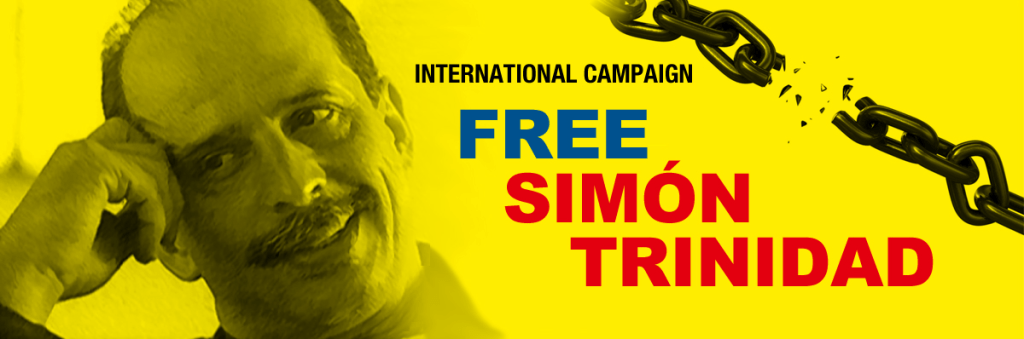
Burton’s comments appear in a remarkable new eBook, accessible here. It contains commentary, in Spanish, from activists, writers, and intellectuals seeking Trinidad’s repatriation. The announcement of this book offers a video presentation, here, of reflections and documentary material.


W.T. Whitney Jr. is a political journalist whose focus is on Latin America, health care, and anti-racism. A Cuba solidarity activist, he formerly worked as a pediatrician, lives in rural Maine. W.T. Whitney Jr. es un periodista político cuyo enfoque está en América Latina, la atención médica y el antirracismo. Activista solidario con Cuba, anteriormente trabajó como pediatra, vive en la zona rural de Maine.
US Has a Favorite in Tumultuous Elections in Guatemala / By W. T. Whitney Jr.

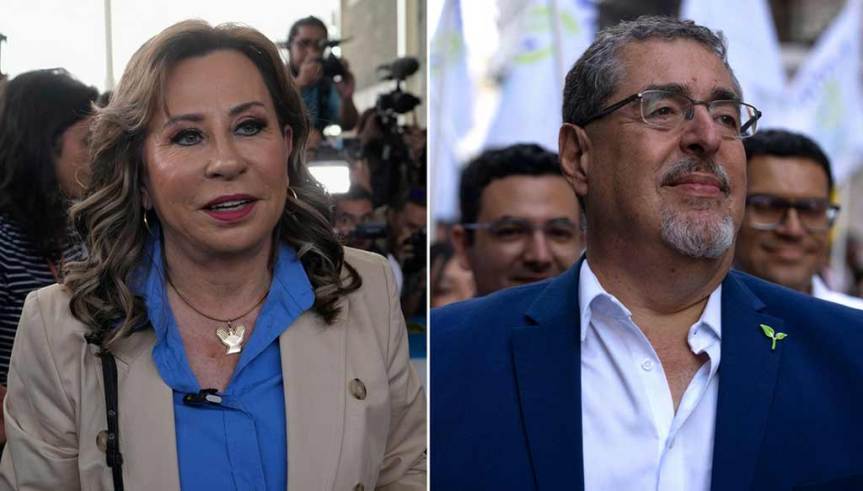
Sandra Torres of the center-right National Unity of Hope (UNE) party and Bernardo Arévalo of the center-left Semilla Movement party will face off in the second round of presidential elections in Guatemala on August 20. (Photo: Prensa Latina)

South Paris, Maine


Bernardo Arévalo scored a big surprise in first-round presidential voting in Guatemala on June 25. Prior to the vote, Arévalo, candidate of the Seed Movement political party had been lagging badly in opinion polls. But he went on to secure 11.8% of the vote, second place behind the 15.8% tally for Sandra Torres of the National Unity for Hope Party (UNE). Second-round voting takes place on August 20, possibly.

The Seed Party quadrupled its congressional delegation to become the third largest with 23 delegates. That party formed in 2015 with a mission of fighting corruption. Critics refer to political forces associated with Guatemala’s last three presidents, including incumbent President Alejandro Giammattei, as the “Pact of the Corrupt.”

Conservative politicians “together with the evangelical churches” campaigned vigorously against Arévalo, “presenting him as a leftist extremist.” Unnerved by his unexpected success, those forces took vigorous action.

The UNE and eight other political parties complained. On July 8 Guatemala’s Constitutional Court (CC), backed by the Supreme Judicial Court, ordered the country’s Supreme Electoral Tribunal (TSE) to suspend certification of the results pending a recount.

When it was completed on July 12, the CC authorized the TSE to certify. But Fredy Orellana, a judge with the so-called Seventh Instance Court, then authorized the Special Prosecutor against Corruption to invalidate the “judicial personhood” of the Seed Party, the effect being to prevent the Party from competing for votes.

Looking for evidence of alleged voter fraud, agents of various agencies carried out intrusive searches at the Seed Party headquarters and TSE offices.

The TSE on July 21 announced it was seeking CC protection from the “imminent threat” against democracy and the electoral process posed by various government ministries and particularly the Public Ministry, in charge of criminal investigations and prosecution.

Almost simultaneously, the CC reiterated that the Seed Party was provisionally protected and that the TSE must allow it to compete in the elections on August 20. Even so, “harassing, intimidating, pressuring and blocking of the electoral process” continued.

Condemning the shenanigans were the Catholic Church, social movements and even business sectors. Electoral observers from the European Union weighed in as did the Organization of American States and its Inter-American Commission on Human Rights. The OAS generally aligns with U.S. purposes. Indeed, Brian Nichols of the U.S. State Department twittered that we “look forward to the Aug 20 vote on the announced top two presidential candidates.”

Congresspersons Raúl Grijalva, Norma Torres, James McGovern and Eleonor Holmes Norton often oppose State Department positions on Latin America, but on July 21 they wrote to Secretary of State Blinken, urging him to pressure Guatemala’s government to allow second-round voting to proceed.

By implicitly supporting Bernardo Arévalo, the U.S. government seems to have reversed course to the extent that it was now speaking up for progressive political leadership ─ far from its usual practice as regards Latin America. Given its long immersion in Guatemalan affairs, however, U.S. actions there probably are coherent, if not always just or legal. The United States has recently applied economics sanctions to Guatemalans accused of political corruption. The Defense Department now and then supplies Guatemala’s security forces with military equipment. In October, 2022 military vehicles worth $4.4 million were donated, supposedly for use against drug-trafficking and for control of migrants. Over many years, the U.S. and Guatemalan militaries have carried out joint exercises.

Really, U.S. intervention is part of Guatemala’s DNA. Cuban investigator Hedelberto López Blanch states that: Before World War II, “Guatemala was in the hands of a few big landowners and U.S. companies… Workers were reduced to conditions of semi-slavery … The government of Jacobo Arbenz tried to change this political, economic and social system, but in June 1954 he was overthrown by the intervention of the CIA and large U.S. landowning companies.”

For 34 years ending in 1996, the U.S. government ─ the CIA in particular ─ was a constant presence. This was a time of rural insurgency, war against indigenous peoples, and 200,000 deaths. Analyst Marc Weisbrot explained in 1999: “[O]ur government had extensive and up-to-date knowledge of massacres and other atrocities, while they maintained a close working relationship with the Guatemalan military at all levels. The United States supplied weapons, training, and other aid to the military …  Through some of the worst periods of killings, our government provided crucial political support.”

Seed Party candidate Bernardo Arévalo has coexisted with U.S. interference for a lifetime. He was abroad during his youth after his father, President Juan José Arévalo, went into exile due to the U.S.- assisted 1954 coup. He served Guatemala’s government as a diplomat and mainstay in the Ministry of Foreign Affairs in the closing years of the civil war. He later taught in the United States and worked at the federally-funded United States Institute of Peace.

That the Seed Movement represents a new kind of rightwing politics for Guatemala, as suggested by commentator Félix Alvarado, may appeal to the U.S. government. In power, Arévalo supposedly would embrace business competition, be less corrupt, and not be beholden to rabid anti- communists and evangelicals.

In a recent interview Arévalo spoke about governing: to deal with corruption, one needs “a process of convergence of social forces” and “recuperation of institutions.” As regards poverty: “The government can’t help everyone but we can begin to create policies for the medium and long term.” As regards “backwardness, discrimination, and racism … we are setting the foundation for the beginning of a process in which institutions begin to function and serve the common good.”

For the U.S. government, Arévalo’s evident deliberation, caution, and limited expectations identify him as an entirely safe would-be Guatemalan president. But a time of testing, a social explosion, is at hand. Maybe for U.S. purposes, Arévalo would be the right president to ward it off, or deal with it.

Numbers speak: 260, number of millionaires; $95 billion GDP, highest in Central America; 47%, rate of undernutrition among under-age-five children (6th highest in the world); 61.6 %, rate of persons living in multidimensional poverty. Also, 2.5% of farms use 65% of the agricultural land, 45% of Guatemalans are indigenous, 79% of the indigenous live in poverty, 80% of rural people are indigenous and Guatemala’s human development index ranks 127th out of 189 counties.

In the recent first-round voting, 17% of the ballots were left blank, and 40% of eligible voters abstained. Non-participation surely points to social and political exclusion ─ of Guatemala’s indigenous people in particular. They don’t figure into current media reports on election difficulties, but they are the fuse for a potential social explosion.

The reflections of Silvel Elías appearing March 1, 2023 on debatesindigenas.org make this point: “The colonialist obsession of the Guatemalan State is evident in …setbacks in human rights and indigenous rights, denial of indigenous demands; violent repression … the granting of extractive licenses on ancestral territories, and practices of structural racism and social and political exclusion.

“Inequality continues to deepen … There are no laws, public policies or targeted programs that serve indigenous peoples. “Although indigenous Guatemalans represent 45 percent of the population, their representation in the Congress has never exceeded 10 percent. Indigenous people there don’t represent indigenous interests, but rather those of the traditional political parties that nominate them.”

U.S. government probably takes the region’s history into consideration as it deals with elections in Guatemala. The mix of extreme poverty, indigenous uprising and rebellion in Bolivia and Peru is a warning.


W.T. Whitney Jr. is a political journalist whose focus is on Latin America, health care, and anti-racism. A Cuba solidarity activist, he formerly worked as a pediatrician, lives in rural Maine. W.T. Whitney Jr. es un periodista político cuyo enfoque está en América Latina, la atención médica y el antirracismo. Activista solidario con Cuba, anteriormente trabajó como pediatra, vive en la zona rural de Maine.

Right-wing forces in European Parliament torpedo EU-Cuba relations / W.T. Whitney Jr.

The fascist and anti-communist VOX Party of Spain is leading the effort to sink EU-Cuba relations in the European Parliament. Here, VOX leader Santiago Abascal makes a speech in Madrid, March 19, 2022. Repeating typical right-wing falsehoods, party banners at the rally allege the media and the government are controlled by communists. | Paul White / AP

Originally published in the People’s World on July 20, 2023


The Cuban musical duo Buena Fe (Good Faith) toured Spain in May. Thugs disrupted their concerts, forcing the cancelation of a few.  A month later in Paris, protests orchestrated by a Cuban émigré university professor forced a prestigious poetry festival to take away the honorary presidency it had bestowed upon Cuban poet Nancy Morejón.

On July 12, Cuba’s relations with European governments went from unstable to possibly disastrous. The European Parliament (EP) approved a “Resolution on the State of the EU-Cuba PDCA.” The vote was 359 in favor, 226 against, and 50 abstentions—signaling trouble ahead for Cuba.

The PDCA is the Political Dialogue and Cooperation Agreement that, signed in 2016, committed individual European countries to rely upon consensus and “constructive engagement” in their dealings with Cuba. It replaced the EU’s “Common Position” that, from 1998 on, promoted “interventionist, selective, and discriminatory” relations with Cuba.

Josep Borrell, the top EU diplomatic representative, visited Cuba in May. He was advocating for the PDCA as a means of “support for the increasingly important Cuban private sector” and for “the expanding economic reform taking place” in Cuba.

With its 60 items, the resolution’s scope was vast. False allegations of human rights violations appeared throughout. The resolution “condemn[ed] the Cuban regime’s support for the Russian war of aggression against Ukraine and its defense of Russia and Belarus.” It called for sanctions by the European Council “against those responsible for the persistent human rights violations in Cuba, starting by sanctioning [President] Miguel Díaz-Canel.”

If the resolution is any indication, EU-Cuba relations are going to be stormy. That was the whole point, surely, for those parliamentarians linked up, says one observer, “with CIA officers and diplomats stationed at the U.S. embassy in Brussels and Luxembourg.”

Spanish EP delegate and Communist Party member Manuel Pineda claimed that the EP “has become a loudspeaker for the most reactionary and extreme right-wing positions, contaminating and clouding what should be the house of Europe’s sovereignty.”

The resolution had been the project of the “Euroskeptic and anti-federalist” European Conservatives and Reformists Group (ECR) within the EP. ECR member Herman Tertsch, belonging to Spain’s fascist-leaning Vox Party, explained that, “The resolution is a further step towards ending the EU’s intolerable complicity with the Cuban dictatorship and that of its High Representative, Josep Borrell.”

He denounced Cuba’s Communists, “communists all over the world,” and “their accomplices in the democracies of America and Europe.”

Meanwhile, the European Union is Cuba’s biggest trading partner and EU countries account for most foreign investment in Cuba and one-third of all tourists visiting there. The EU has donated most of the developmental assistance received by Cuba over many years ─ €100 million as of 2021.

The timing was significant. The vote missed by one day the two-year anniversary of large anti-government protests occurring in Cuba on July 11, 2021. U.S. Secretary of State Blinken used that anniversary to insist that “the United States stands in solidarity with those in Cuba who continue to desire a free democracy.”

Additionally, a heads-of-state summit meeting between the EU and the Community of Latin American and Caribbean States (CELAC) took place soon after the vote, on July 17-18 in Brussels. CELAC includes all Western Hemisphere nations except the United States and Canada,

Preceding this summit were EU meetings with pre-CELAC regional alliances and CELAC-EU summit meetings in 2013 and 2015. The recent hiatus resulted from EU displeasure with “popularly elected governments and leaders” in Latin America. Now the object is to foster “respectful interchange” and to “acknowledge mutual interests.”

Chinese competition with Europe in Latin America and the Caribbean over trade, access to natural resources, and investment opportunities may have provided encouragement.

Reflecting official Cuban sentiment ahead of the summit, journalist Claudia Fonseca Sosa stated, “For Cuba, it’s important that … dialogue in Brussels be serious, participative, and diverse.” However, the EP’s resolution was aimed directly at aspirations of “consensus and bridge-building.”

The Foreign Relations Commission of Cuba’s National Assembly charged that “The EP Resolution represents harassment of European businesses investing in Cuba or seeking to do so. It also expresses the will of extreme right-wing political forces to deprive the EU of its own independent policy toward Cuba.”

As new grief falls on Cuba, the role of a newly evolving version of counterrevolution, fully evident elsewhere in the world, is hitting at the island. For Cuban political analyst Iramís Rosique Cárdenas, that kind of conservative politics with “known liberal discourse of private property, market fundamentals, a minimum state…and with social democratic cooperation” is disappearing.

He describes “a series of movements and organizations of the right and extreme right” with ideas of national chauvinism, reliance on strong states, economic protectionism, provincialism instead of multi-culturalism, xenophobia, “centrality of the traditional family,” exclusion of minorities, nationalism, and religious fundamentalism.

He adds, “The right-wing extremism active in the West displays virulent hostility against Latin American progressivism, especially the Bolivarian process, and against movements and states…like China and Cuba, [that resist] European and North American centers of power.


We hope you appreciated this article. At People’s World, we believe news and information should be free and accessible to all, but we need your help. Our journalism is free of corporate influence and paywalls because we are totally reader-supported. Only you, our readers and supporters, make this possible. If you enjoy reading People’s World and the stories we bring you, please support our work by donating or becoming a monthly sustainer today. Thank you!


W.T. Whitney Jr. is a political journalist whose focus is on Latin America, health care, and anti-racism. A Cuba solidarity activist, he formerly worked as a pediatrician, lives in rural Maine. W.T. Whitney Jr. es un periodista político cuyo enfoque está en América Latina, la atención médica y el antirracismo. Activista solidario con Cuba, anteriormente trabajó como pediatra, vive en la zona rural de Maine.

Ocasio-Cortez Would Block US Military Intervention in Peru / By W. T. Whitney Jr.

Rep. Alexandria Ocasio-Cortez, D-N.Y., is proposing a halt to Defense Department funding over intervention in Peru. | AP

Originally published in the People’s World on July 11, 2023


According to a report appearing July 8 on a Peruvian website—and apparently not yet in any English-language internet news source—Rep. Alexandria Ocasio-Cortez, D-N.Y., introduced an amendment to the National Defense Authorization Act requiring that, until conditions are met, a hold be put on Defense Department funding for its activities in Peru during fiscal year 2024.

Ocasio-Cortez introduced her amendment on June 29; the House Rules Committee will take it up on July 11.

As long as any suspension of funding remains, the U.S. military would not be permitted to “provide, authorize, or assist in any way in the transfer of defense articles, defense services, crowd-control supplies, or any other supplies, to [Peru’s] Government, or to coordinate joint exercises with the military or police forces of [Peru’s] Government.”

Ocasio-Cortez introduced her amendment six weeks after additional U.S. troops with weapons began to arrive in Peru. That was two months after Peru’s military and police reached a crescendo of violence marking repressive actions for weeks against mostly Indigenous peoples. They were demanding elections, a new constitution, and the removal of President Dina Boluarte.

The protests were in response to the parliamentary coup that deposed President Pedro Castillo on Dec. 7, replacing him with Boluarte, vice president at the time. Castillo remains in prison.

Elected in July 2021 on the strength of rural and Indigenous votes, the inexperienced and often isolated Castillo tried to bring about progressive change. Opposing him was a well-entrenched oligarchy accustomed to holding political power and benefiting from foreign investments in Peru’s plentiful natural resources.

Ocasio-Cortez’s amendment calls for no funding until “the Secretary of Defense submits to the appropriate congressional committees the certification…that each of the following criteria has been met.” These include free elections in Peru, no repression of “peaceful protesters and indigenous communities,” investigation of “the killings of protesters in Peru on Dec. 14, 2022,” prosecution of those responsible, the return of free speech, respect for civil liberties, and more.

The ‘‘appropriate congressional committees’’ are the Armed Services and Foreign Affairs Committees of the House and the same two committees in the Senate.

Peru’s Congress on May 19 authorized the entry of U.S. troops who will undertake “training activities” throughout the country and stay until Dec. 31, 2023. On May 26, Peru’s Congress approved additional authorization for 1,172 U.S. troops, who will be collaborating with Peruvian counterparts in an exercise called “Resolute Sentinel 2023” that will end on Aug. 29.

Legislation is on the books: the particular Leahy Law that applies to the Defense Department “requires that [funds appropriated to the Defense Department] may not be used for any training, equipment, or other assistance for a foreign security force unit if the Secretary of Defense has credible information that such unit has committed a gross violation of human rights.”

With 19 other congresspersons, Ocasio-Cortez signed a letter to President Joe Biden on Jan. 30 expressing “alarm regarding the human rights violations committed by Peruvian state security forces.” The letter called upon the Biden administration to halt “security assistance funding from the United States” to Peru until this “pattern of repression has ended.”

That Ocasio-Cortez signed this letter and introduced her amendment suggests an attitude on her part that is unusual among her progressively inclined congressional colleagues and even among her progressively-inclined fellow citizens. She is apparently one of the relatively few in both categories who take upon themselves the obligation to stand up against U.S. interventions abroad serving the high and mighty.

The time required for mobilizing support for Ocasio-Cortez’s amendment before it was presented to the Rules Committee was entirely lacking.  The appearance on that account has been one of low expectations and of hopes for the future, maybe.

The consciousness-raising effect of the effort is important. But the evident lack of supporters mobilized on behalf of the amendment has meaning, too. Clearly, there’s much work ahead for the anti-imperialist cause in the United States, and recruits are badly needed.


W.T. Whitney Jr. is a political journalist whose focus is on Latin America, health care, and anti-racism. A Cuba solidarity activist, he formerly worked as a pediatrician, lives in rural Maine. W.T. Whitney Jr. es un periodista político cuyo enfoque está en América Latina, la atención médica y el antirracismo. Activista solidario con Cuba, anteriormente trabajó como pediatra, vive en la zona rural de Maine.

UN forcefully hits at US blockade of Cuba, at prison in Guantanamo / By W. T. Whitney Jr.

The control tower of Camp VI detention facility is seen in Guantánamo Bay in April 2019. Photograph: Alex Brandon/AP

South Paris, Maine


Nothing on the horizon now threatens the end of the U.S. economic
blockade of Cuba. Critical voices inside the United States and beyond
fall flat; nothing is in the works, it seems. Recently, however, the United
Nations put forth a denunciation that carries unusual force, mainly
because of the UN’s legal authority and its practical experience in Cuba.
Criticism of U.S. policies on Cuba from within the United States is
usually brushed aside due in large measure to the low priority
Washington officials assign to Cuban affairs. Coalitions of nations that
condemn the blockade may lack staying power and surely have no
means for enforcement. The anti-blockade opinions of nations or
individuals, alone or together, are useful mainly for consciousness-
raising.
The United Nations is different on account of its institutional capacity. It’s
on display when the UN General Assembly annually votes on a Cuban
resolution calling for an end to the blockade. Every year word of its
overwhelming and inevitable approval goes worldwide, because of the
UN connection.
The United Nations is unique on account of its Charter, which took effect
on October 24, 1945. This founding instrument outlines purposes as to
peace, no war, and human rights. It is legally binding on participating
nations, like a treaty. Additionally, the history and expectations
associated with the United Nations endow that organization with
institutional power. That’s something that neither NGOs operating in
Cuba or the time-limited projects of various governments on the scene
there can claim.
Another element emerges. The United Nations works within Cuba and
participates in Cuban affairs. On that account, UN complaints about
U.S. all-but-war against Cuba take on special authority.

On the ground

UN workers and technical specialists since 2015 have been
implementing the UN’s “National Plan[s] for Sustainable Economic and
Social Development” in dozens of countries since 2015, including Cuba.
Work is carried out inside countries and territories in order to fulfill a
“Development Agenda [for] 2030.” The main goals are: government
efficiency, transformation of production, protecting natural resources and
the environment, and human development with equity.
The Cuba section of the so-called “United Nations System” consists of
22 “agencies, funds, and programs,” 11 of which are physically present
on the island. That section recently issued a report on its activities in
2022.
Francisco Pichón is a Colombia native serving as the UN program’s
“resident coordinator.” In comments to the Cuban News Agency, Pichón
noted that in Cuba his teams participated with Cubans in dealing with
disaster situations and introducing developmental assistance.
Collaboration was impaired, he observed, by the “the economic,
commercial, and financial blockade imposed by the United States.”
Pichón testified to the constant necessity for making adjustments. What
with the impact of Covid-19; the increase of prices of food, sources of
energy, and more; and the war in Ukraine, his associates had to
“circumvent U.S. economic sanctions” and work around Cuba’s
exclusion from “international financing mechanisms”. UN personnel
found it necessary to divert funds in order to mount special assistance
programs after Hurricane Ian and in response to problems in Pinar del
Rio.
He indicated that “pre-positioning of essential resources for emergency
situations” was essential in order to mount quick and efficient responses.
That was helpful in reacting to the Hotel Santiago explosion in Havana
and the terrible fire at an oil storage facility in Matanzas.
Pichón highlighted the complexity of making any kind of payments,
especially because costs go up when resources are imported from far-
distant countries and because Cuba is excluded from international
lending agencies and banking services.

Guantanamo

The idea that the United Nations is a potentially capable partner in
warding off U.S. aggression against Cuba gains additional strength

following the recently concluded visit to Cuba of the UN Special
Rapporteur on Human Rights and Counterterrorism. Through her visit
and report, the United Nations was asserting legal norms.
Law professor Fionnuala Ni Aolain examined the plight of prisoners at
the U.S. naval base in Guantanamo in Cuba. The U.S. government
occupied land there as a condition of its approval in 1902 of a
constitution for newly-independent Cuba. Cuba’s government denounces
the occupation as violating international law.
Of the almost 800 men imprisoned there at one time or another since
2002, 30 prisoners remain, of whom 16 have been cleared for release
and represent no danger.
In an interview, Aolain testified to U.S. violation of human rights: “Men
are shackled as they move within the facility. They were shackled when
they met me.” She referred to “enormous deficits … in health care, in the
standard operating procedures … [Men] are called by numbers, not by
name.
She added that, “Those who tortured betrayed the rights of victims …
[W]hat they ensured is that you couldn’t have [a] fair trial … [And
therefore] it would be impossible for the victims of terrorism to redeem
their rights.” And, “let me be clear. Torture is the most egregious and
heinous of crimes.”
Quoted in a Cuban news report, Aolain referred to “cumulative
aggravating effects on the dignity, freedom and fundamental rights of
each detainee, which I think amounts to cruel, inhuman and degrading
treatment, according to international law.”


W.T. Whitney Jr. is a political journalist whose focus is on Latin America, health care, and anti-racism. A Cuba solidarity activist, he formerly worked as a pediatrician, lives in rural Maine. W.T. Whitney Jr. es un periodista político cuyo enfoque está en América Latina, la atención médica y el antirracismo. Activista solidario con Cuba, anteriormente trabajó como pediatra, vive en la zona rural de Maine.