
Fighting for Land and Independence in Jujuy, Argentina / By W. T. Whitney Jr.

South Paris, Maine, June 27, 2023


In Jujuy province, in Argentina’s extreme Northeast, poor people’s discontent, the provincial government’s overreach, and popular resistance recently contributed to a crisis that portends grief and struggle ahead.  Setting the stage were: free rein for local reactionaries, indigenous peoples’ oppression, foreign plundering of natural resources, and a U.S. eye over the whole affair.

June was a month of turmoil.  Governor Gerardo Morales had proposed reforming the province’s Constitution. Teachers’ unions were agitating for higher salaries.

Discussion for 50 days that should have preceded the Constitutional Convention never happened. The Convention, presided over by Morales himself, played out over three weeks.  He had timed the electing of delegates to coincide with provincial government elections and thereby assure enough voter turnout to elect delegates who backed constitutional reform.

The proposed changes included new provisions for criminalizing public protests and new restrictions on “freedom of expression, petition, and association.” There would be revised legal mechanisms for regulating access to land, this so as to deliver land to lithium-producing multi-national companies. Indigenous peoples would face the probability that untitled plots of land crucial to their survival, for generations, would no longer be available. Jujuy province is the center of lithium extraction in Argentina, the world’s fourth largest lithium producer.  

Elected in 2015, Morales cut back governmental support for education, and teachers lost jobs. Teacher salaries in Jujuy are the lowest in Argentina. Teachers’ unions in nearby Salta province had recently carried out strikes and won pay increases.

On June 5, a Jujuy teachers’ union struck for better pay. On June 9, several teachers’ unions and the municipal employee union marched on Jujuy city, population 375,000. Soon healthcare workers and a miners’ union would join the mobilization. Morales decreed “increased penalties against individuals and organizations participating in any protests or social mobilization.” 

On June 14 indigenous people marched on the city “to demonstrate their rejection of the [constitutional] reforms … being devised behind closed doors.”  City streets were teeming with protesters on June 15 when word came that agreement was near on constitutional reforms. Soon indigenous groups and others were maintaining roadblocks on highways throughout the province. Police, assisted by unidentifiable enforcers using unmarked vehicles, stepped up arrests of demonstrators and journalists.  Calls went out for Morales’s resignation.

The Constitutional Convention on June 20 approved alterations of 66 of the provincial Constitution’s 212 articles. Street pressure had caused two reforms involving indigenous rights and access to land to be withdrawn temporarily.  Restrictions on protesting and free expression remained. The Constitution now provides for “automatic majority in the legislature for the governing party” and no longer requires that provincial elections be held every two years.

Massed demonstrators responded by assaulting the Government House with projectiles. Police turned them back using tear gas, rubber bullets and arrests.

The provincial government’s repressive methods elicited criticism from elsewhere in Argentina and from the Inter -American Commission on Human Rights, Amnesty International, and the United Nations High Commissioner for Human Rights. 

Governor Morales exceeds boundaries. Early in his first term, for example, he enlarged the top provincial court from five to nine judges. Consequently, provincial courts have endorsed illegal searches, illegal evictions, and persecution of social leaders. By 2018, 25 family members were serving as provincial government officeholders.

One presumes that the governor’s evident lack of restraint is bad news farther afield. He leads Argentina’s rightwing Radical Civic Union party and now is a vice-presidential candidate on one of two tickets aiming to represent the rightwing Unite for Change electoral coalition in upcoming elections.

It’s clear: he stops at nothing. Morales’s government in 2016 arrested Milagro Sala, leader of the Tupac Amaru Organization that at the time was assisting indigenous families as they looked for food, housing, basic education and more. The government was interfering and the Organization resisted. The police arrested Sala on flimsy pretexts and seven years later she is still detained.

Continuing his efforts to waylay indigenous independence, Gerado Morales took part in the November 2019 coup that deposed Bolivian President Evo Morales. That Morales was an indigenous president of a multi-national republic. Governor Morales was instrumental in arranging for U.S. assistance.

Around September 4, 2019, Gerardo Morales supposedly joined a meeting in Jujuy held to organize the coup against Evo Morales. Present was Luis Camacho who, based in Santa Cruz in Bolivia, was leading the coup in progress. Later on, Governor Morales himself traveled to Santa Cruz to confer with plotters. 

On that September 4, Ivanka Trump and State Department, CIA, and USAID personnel arrived in Jujuy ostensibly to support local women’s initiatives. Trump had brought $400 million.  A Hercules C 130 aircraft was deployed on the runway close to the recently arrived U.S. plane.  Almost at once that plane departed for Santa Cruz, without a flight plan. Camacho was on board. 

He may have been conveying the U.S. funds that would be used to bribe the senior Bolivian Army officers who pressured Evo Morales to resign. Later on, Gerardo Morales surely was not blind to that same airplane carrying weapons to plotters in Santa Cruz.

The governor’s zeal in serving U.S. interests shows up now as he cultivates U.S. official representatives for the sake of U.S. investment in the extraction and processing of lithium. He met with U.S. ambassador Marc Stanley in May 2022, and later Stanley was in Jujuy as Morales acquainted him with “a portfolio of projects in development.” Stanley and his family attended an indigenous festival.

Together with governors of other lithium-producing provinces, Morales in 2022 visited European countries and the United States. There he met with Washington officials, bankers, and industrial leaders, among them Elon Musk, owner of Tesla Corporation.

Morales’s friendship with Argentinian-government economic minister Sergio Massa is surprising – President Alberto Fernandez’s government is on the other side of the political divide – but understandable:  Massa is  a favorite in U.S. official circles, a lead promotor of foreign investment in Argentina’s natural resources, and a likely presidential candidate in elections later this year.

The story here centers on Morales’s doings as an individual. But people respond to circumstances collectively and engage collectively in social change. Morales is representative, it seems, of that class of well-paid intermediaries who have long arranged for the transfer of wealth from wherever to a waiting set of plunderers.

The history of the Americas has them freeing up land so as to get at wealth that is there. They must dispose of the set of people living on the land. Military force is made available. Morales becomes an updated conquistador.

Writing for the Argentinian Club of Journalist Friends of Cuba (capac-web.org), Alberto Mas provides specifics. In a report entitled “Jujuy is the North American Laboratory for Argentina,” he states that, “The visit of General Laura Richardson of the U.S. Southern Command [on April 17, 2023] did not in the least hide intentions of controlling the production and exportation of Argentina’s lithium. This is part of a strategic plan for the region which they have implemented over the course of time: the coup against Evo Morales in Bolivia had the smell of lithium.”


W.T. Whitney Jr. is a political journalist whose focus is on Latin America, health care, and anti-racism. A Cuba solidarity activist, he formerly worked as a pediatrician, lives in rural Maine. W.T. Whitney Jr. es un periodista político cuyo enfoque está en América Latina, la atención médica y el antirracismo. Activista solidario con Cuba, anteriormente trabajó como pediatra, vive en la zona rural de Maine.

Reports on a Possible Spy Base in Cuba Miss the Main Point / By W.T. Whitney Jr.

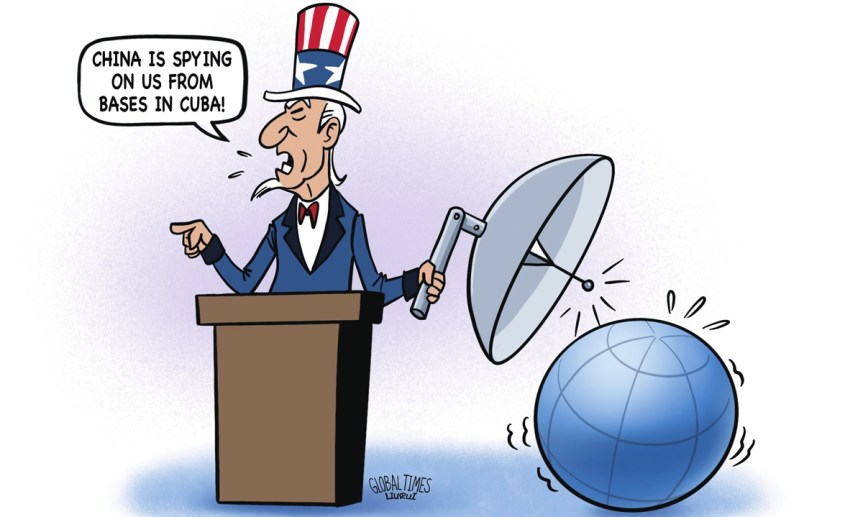
Illustration: Liu Rui/GT


The Wall Street Journal reported on June 8 that Cuba would receive “several billion” dollars in return for China building a “spy base” in Cuba. The story mentions an “electronic eavesdropping” facility that would represent “a brash new geopolitical challenge by Beijing to the US.” Other news platforms offered their own versions of the story.

Chinese, Cuban and U.S.  spokespersons took exception to the report, but none of them specifically denied the existence of such an installation on the island.  The spokesperson for the U.S. National Security Council indicated merely that the reports were “not accurate.”

Asked about a “Chinese espionage facility” in Cuba, Chinese Foreign Ministry spokesperson Wang Wenbin stated that he “was not aware of what you mentioned.” He quickly moved on to U.S. interventionist activities throughout the world. Cuban Foreign Ministry official Carlos Fernández de Cossío recalled his familiarity with “this kind of slander” having been employed to justify anti-Cuban aggression and to manipulate public opinion.

However, a U.S. Defense Department spokesperson on June 8  declared that, “we are not aware of China and Cuba developing a new type of spy station.” He was introducing the possibility that a spy station already existed.

The New York Times two days later indicated that, indeed, such a facility had been “up and running since or before 2019.” The Associated Press reported the same. 

U.S. anti-Cuban counter-revolutionaries pounced, specifically Senate Intelligence Committee Chairman Mark Warner, Vice Chairman Marco Rubio and Senator Bob Menendez, chairperson of the Senate foreign relations committee. Menendez condemned the alleged spying facility as “a direct assault upon the United States.”  A constant theme in their complaints was Chinese influence expanding in Latin America.

Florida Congresspersons Debbie Wasserman Schultz and Mario Diaz-Balart sent a letter to Secretary of State Blinken and Defense Secretary Austin.  They requested a briefing for Members of Congress. “This escalation,” they insisted, was “the latest step in a long series of Chinese interventions in the Western Hemisphere.” They mentioned an “increasingly symbiotic relationship between Cuba and China.”

Fallout from the report may adversely affect U.S. solidarity efforts on behalf of Cuba. The possibility of Chinese spying on the United States from a base in Cuba, reminiscent of the Cuban Missile crisis of 1962, may end up discouraging any intentions of the Biden administration to deal with anti-Cuban measures in force now. Solidarity activists are demanding an end to the U.S. designation of Cuba as a state sponsor of terrorism and the easing of regulations imposed under the U.S. economic blockade.

The possibility of a spy station in Cuba somewhat darkens the atmosphere ahead of solidarity demonstrations set for Washington and nationwide on June 24.

The timing of the news report on a Chinese spy base in Cuba may have been calculated. Bad news about China can be useful to the U.S. government. The spy-base story represents an opportunity for corroborating supposed Chinese perversity evident recently in fruitless contacts between officials of the two countries.

Exploration of the possibility of arms-control talks apparently yielded very little.  Recently the two countries’ defense ministers were unable to agree on meeting on the sidelines of a security conference in Singapore. A proposal for talks on regulating artificial intelligence is going nowhere. And a report surfaced recently on Chinese attempts to gather public information on U.S. military affairs.

Additionally, speculation is flourishing that news about a Chinese spy base in Cuba may irretrievably complicate Secretary of State Andrew Blinken’s plans to visit Beijing on June 18. He had canceled a trip there in February in the wake of the Chinese balloon sailing across North America. Elements of the U.S. government may, in fact, have little enthusiasm for improved U.S. relations with China. They may prefer that Blinken’s visit not take place.

The New York Times reports that “the Biden administration … has been trying to normalize relations with China after a protracted period of heightened tensions.” Even so, “several diplomatic, military and climate engagements between the two countries were frozen” in the wake of Speaker Nancy Pelosi’s visit to Taiwan in 2022.

As reported, the fuss over possible Chinese spying in Cuba looks to be a kind of replay of familiar themes. One is the myth about Cuba as failed state and oppressive society. The other has the United States and China jostling over Taiwan and for regional control.  One looks in vain for reporting that deals with those aspects of U.S. relations with Cuba and China that are of immense concern worldwide.

Masses of people everywhere know something, or a lot, about U. S. determination to control the world’s political and economic affairs. Many admire Cuba for resisting for so long.  The agenda of media bosses and U.S. powerbrokers is otherwise.

More immediately, peoples of the world don’t want world war. That prospect, associated as it is with nuclear war, hovers over potential U.S. conflict with China. It’s acceptable, surely, to subscribe to the truism that working people everywhere, and multitudes who are abandoned and marginalized, do want peace. 

The main message to be taken from the China-spy-base story is that readers of news reports deserve more than they are often getting. Reports they encounter ought, at least, to touch upon those aspects of a story that matter most.  Questions of war and peace amply qualify.


W.T. Whitney Jr. is a political journalist whose focus is on Latin America, health care, and anti-racism. A Cuba solidarity activist, he formerly worked as a pediatrician, lives in rural Maine. W.T. Whitney Jr. es un periodista político cuyo enfoque está en América Latina, la atención médica y el antirracismo. Activista solidario con Cuba, anteriormente trabajó como pediatra, vive en la zona rural de Maine.
The Implications of New US Troop Arrivals in Peru / By W. T. Whitney Jr.

Starting from June 1, the United States will deploy its regular military units in Peru | Photo:gestion.pe. / https://orinocotribune.com/


Beginning in June, detachments of U.S. troops will be arriving in Peru and staying until December 31, 2023. Peru’s Congress, supported by only 6% of Peruvians, on May 26 approved a resolution introduced in January that “authorized the entry of naval units and foreign military personnel with weapons of war.”

U.S. military personnel are heading for Peru on a training and advisory mission.  U.S. Army, Navy and Air Force troops will be active throughout that country. Most of them apparently will stay for less than the allotted seven months. They are bringing weapons and equipment. The U.S. Southern Command appointed a Peruvian general as “deputy commanding general-interoperability.”

They arrive following massive popular protests that erupted in reaction to Peru’s rightwing Congress on December 7, 2022 having ordered the arrest of the democratically-elected President Pedro Castillo. His politics were progressive. The protests provoked violent military and police repression; over 70 Peruvians were killed. Demonstrations peaked in February, but will revive in July, according to reports.

Castillo remains in prison, and his replacement, former Vice-President President Dina Boluarte, is widely reviled. The Inter-American Commission on Human Rights recently issued a report documenting “serious violations by the police and military” that took place shortly after she became president.  Peru’s Public Ministry, investigating “the presumed crime of genocide,” required that Boluarte testify on June 6.   

The U.S. troops will be arriving amid an upsurge of Peru’s underclass. Peru’s mostly rural, poor, and indigenous majority did elect the inexperienced Castillo as president in July 2021. They are now calling for Boluarte’s removal, new presidential elections, and a Constituent Assembly. Six of ten Peruvians regard the current political crisis as stemming from “racism and anti-indigenous discrimination,” according to a recent poll.

Resumen Latinoamericano reports that the U.S. forces heading to Peru will include 25 Special Forces troops arriving with weapons and equipment and 42 other Special Forces troops charged with preparing Peru’s intelligence command for “joint special operations;” 160 additional U.S. troops will be utilizing nine U.S. airplanes.

Eventually, 970 U.S. Air Force and Special Forces personnel will have taken part in the U.S. Southern Command’s so-called “Resolute Sentinel 23.” Previous U.S. military interventions in Latin America have been similarly named. The phrasing of this intervention’s official purpose is odd: “to “integrate combat interoperability and disaster response training in addition to medical exchanges, training and aid and construction projects.”

The coup government, under whose auspices the U.S. troops will be operating, is a creature of conservative political parties and the business establishment. In April it announced plans to privatize lithium mining, thus reversing President Castillo’s efforts to nationalize the processing of lithium. The government is easing the authorization procedures that enable foreign corporations to extract copper. Lawyer and former Castillo advisor Raúl Noblecilla cites control over Peru’s mineral wealth as to why U.S. troops are in Peru; their presence there indicates “how lackey and sell-out governments function.”   

Academician Jorge Lora Cam states that “the usurper government” seeks to “deepen extractive plunder with blood and fire … unify the right with left-leaning elements infected by neoliberalism … and prepare for permanent political power.”  He adds that under the auspices of “political criminals,” the country’s economy is newly “at risk because Peru’s foreign debt now amounts to $100 billion dollars.”

The imminent arrival of U.S. military forces provoked other criticism. Former foreign Minister Héctor Béjar insisted that, “the spurious government was using the presence of these troops to intimidate the Peruvian people who have announced new protests for July.” 

A spokesperson for the Communist Party of Peru – “Patria Roja” explained that, “the entry of U.S. troops in Peru is an affront to our sovereignty and represents explicit backing by the U.S. government of the nefarious Boluarte regime, which is responsible for repression against the Peruvian people.” 

The U.S. military, of course, has long interacted with its Peruvian counterpart. Instances include: military exercises in 2017, “Regional Emergency Operations Centers” in 2018, a “naval mission in 1920,” U.S. Army involvement “from 1946 to 1969,” and U.S. training of thousands of Peruvian military personnel from the 1940s on.  TeleSur in 2015 reported that, “Hundreds of Peruvians protested Wednesday … against the [anticipated] arrival of 3,200 [U.S.]soldiers with ships, airplanes, and various kinds of weapons.”

Peruvians are hardly alone as a targeted people.  Some 800 U.S. bases are distributed throughout the world, and “173,000 troops [were] deployed in 159 countries as of 2020.” The setting is of military intrusion extending over decades in Peru and now across the world.  What’s the cost and how are payments arranged for?

The projected U.S. military budget for FY 2024 exceeds $1.5 trillion, according to a recent analysis. There are two sets of military activities and each requires its own funding approach. The U.S. government has to pay for potential war against enemies like China and Russia and for military operations elsewhere.

To portray China and Russia as threats to the U.S. status quo garners so much attention as to spark fellow-feeling for the military- industrial complex, and the funding flows.  Rationales for the other kinds of involvement may lack crowd appeal. They are: shoring up the worldwide capitalist economy, serving corporate interests, and countering leftist insurgencies. 

We conclude that congressional and tax-payer generosity in response to exaggerated threats to the U.S. status quo and to the worldwide capitalist system may translate into so much funding that enough is left over to pay for U.S. meddling in the other countries.

Panama may be one of them: The Biden administration may be on the verge of sending U.S. troops to the Darién region of Panama “to counter illicit drug trafficking, human trafficking, and irregular immigration.”  


W.T. Whitney Jr. is a political journalist whose focus is on Latin America, health care, and anti-racism. A Cuba solidarity activist, he formerly worked as a pediatrician, lives in rural Maine. W.T. Whitney Jr. es un periodista político cuyo enfoque está en América Latina, la atención médica y el antirracismo. Activista solidario con Cuba, anteriormente trabajó como pediatra, vive en la zona rural de Maine.
Worker Empowerment Stalls in Venezuela as Left Unity Fractures / By W. T. Whitney Jr.

Indigenous spokespeople, Venezuela (archive) | venezuelanalysis.com/


Hugo Chavez, Venezuela’s president from 1999 until 2013, inspired and led a “Bolivarian Revolution” that sought independence from U.S. domination, regional integration and so-called socialism of the 21st century. Obstacles are many: capitalism in control of the national economy, unrelenting rightwing political opposition, U.S. intervention – and longstanding political divisions among left forces.

Worker empowerment languishes in such a context. We offer an explanation, and doing so, attribute the divisions to differing approaches to the predicament of Venezuelan workers.

Several months ago, union workers in many sectors were vigorously protesting low wages and demanding that wages be paid in dollars, to counter inflation. Nicolas Maduro, Venezuela’s president after Chavez’s death in 2013, reprimanded them for not “understanding the effects of the blockade and the oligarchy’s economic war.”

The government faces terrible challenges. Contributing to economic disaster are U.S. sanctions and depressed oil prices over ten years or so. Oil exports have accounted for most of Venezuela’s export income. Economic crisis surely diminishes prospects for worker empowerment.

Impact of economic crisis

Recent developments tell much of that story. The U.S. Justice Department on May 4 lifted restraints on the sale of Citgo company’s assets to the creditors of the Venezuelan state and of Venezuela’s state -owned oil company, PDVSA. Citgo is PDVSA’s U.S.-based oil company. Worth $13 billion, it owns three oil refineries and 4000 gasoline stations.

U.S. authorities confiscated Citgo in 2019. It gave Citgo to those rightwing opponents of the Maduro government who between 2015 and 2021 constituted a majority in Venezuela’s National Assembly. This group will be managing the sales of Citgo shares to the company’s high-rolling creditors worldwide.

Rather than retrieve annual Citgo profits of a billion dollars or so, the government has lost them. Income from the sales of oil products had enabled the government to pay for healthcare, schools, housing, and more. The larger picture is that $30 billion in Venezuelan assets have been “blocked, retained, or confiscated.”

The U.S. State Department on May 3 announced that $347 million in Venezuelan funds now frozen in U.S. banks will be returned, not to Venezuela’s government, but to that former opposition bench in the National Assembly. For the United States, that’s Venezuela’s government.

Meanwhile, Venezuelan workers are struggling to survive; worker empowerment is a distant dream.  Presently, one third of Venezuelan children are undernourished. The poverty rate has fallen a little but remains at 50%. In one of the world’s most unequal societies, wealthy Venezuelans have access to imported goods, dollars, and the proceeds from illegal businesses. The latter make up 20% of the national economy.

The economic crisis hurts Venezuela’s working class. It impedes efforts to strengthen it. We must know the extent to which Venezuela’s government supports workers.

Shifting alliances and labor rights

President Maduro in February 2018 was seeking support in presidential elections that year from the Communist Party of Venezuela (PCV).  He appeared at the PCV headquarters and declared the PCV “to be the principal party in founding and defending democracy in the 20th century.”

The government’s political party, the United Socialist Party of Venezuela (PSUV) and the PCV signed a “Unitary Framework Agreement,” which backed “the rights of the working class and the working people.”  The PCV did support Maduro in elections in May 2018.

Within months, however, the government introduced its “Program of Recuperation, Growth, and Economic Prosperity,” which, according to labor historian Omar Vázquez Heredia, provided for “major devaluation of the official exchange rate, elimination of price controls and import tariffs …[and] regressive labor reforms … [such as] elimination of the right to strike.”  He adds that dollars had already been disappearing through smuggling, hoarding, import fraud, and governmental corruption.

The new anti-worker measures showed up in the government’s “Memorandum 2792” of October 2018. ThePCV critiqued the government’s ready support for business interests and questioned its delivery of scarce dollars to foreign creditors and to Venezuela’s business sectors to help them import and distribute foreign goods.

Analyst Héctor Alejo Rodríguez notes that the government, through its October memorandum, “flattened the wages for all sectors and unilaterally cancelled all the collective bargaining agreements of the workers.” Workers, he points out, were already dealing with “acute shortages, loss of social gains, deterioration of public services and the systematic destruction of [their] incomes and rights.”

At a May Day rally in 2023, former labor leader Maduro told workers that funds were unavailable for salary increases, also that their “economic war bonus” would continue and their monthly food bonuses increase. The minimum wage would be equivalent to $5.25 per month – and lose value due to inflation.    

President Chavez created the “Great Patriotic Pole” electoral coalition. The PCV joined, and backed Chavez in the 2006 and 2012 elections, and Maduro in the 2013 elections. Chavez created the United Socialist Party of Venezuela (PSUV) in 2007. He counted on smaller leftist parties to relinquish their identity and join the PSUV.

The PCV and other parties refused, provoking Chavez in 2008 to threaten the PCV’s destruction.  PCV leader Oscar Figuera declared that his Party would still affiliate with the Patriotic Pole, but would remain independent. After all, as he noted, “We have just completed 77 years struggling for socialism in Venezuela.”

The PCV broke with the PSUV in 2020 and formed a new electoral coalition, the People’s Revolutionary Alternative (APR). Party leaders say they are “Chavista” and anti-imperialist, but want oil monies used more for industrial development and rural productivity and less for paying on foreign debt or for capitalists to use as they wish.  

Meanwhile, the government stepped up “criminalization of labor protests” and forced the retirement of many labor leaders. APR candidates have been dismissed from jobs, or jailed. The PSUV presented speakers who denounce the PCV and at the same time falsely claim to have been PCV members or to have been expelled by the PCV.

Some clarity

Mostly tellingly, a flurry of killings has recently taken the lives of PCV activists. In Apure state alone, in 2023, thugs murdered Communist journalist José Urbina and Communist community leader Juan de Dios Hernández.

In Venezuela presently the prospects for worker empowerment, not to speak of working-class political power, are dismal. A distant observer lacks full knowledge of local realities and is ill-equipped to assign blame. In any case caution is the watchword in passing judgment that might detract from unity in the broader political movement.

Now a neighbor weighs in.  Writing May 8 in Seminario Voz, the Colombian Communist Party’s newspaper, Ricardo Arenalescriticizes the PSUV. He cites the killings and false PSUV accusations.

Arenales cites a communication from the PCV Political Bureau to Colombian President Gustavo Petro, who on April 1 met with   

representatives of Venezuela’s rightwing political opposition and who was about to meet with regional foreign ministers. Petro is seeking to ease political conflict within Venezuela and somehow to end U.S. economic sanctions against Venezuela.

The PCV letter calls for negotiators to attend to “the political and social forces that are on the fringes of the polarizing diatribe.” The PCV rejects “a pact among the elites … [which] is built on the ruin of the popular majorities” and which represents “the interference of foreign powers in the solution of conflicts that exclusively concern Venezuelans.”

Arenales implies that rightwing powerbrokers in Venezuela and abroad use negotiations to incapacitate the PCV. He mentions that, “under the heading of sovereign resolution of conflicts in the brother country, … the right of the Venezuelan Communists to exist and struggle cannot be denied. For that to happen would be a serious contradiction in the building of democracy.”

Arenales reports that “parties and intellectuals of the world” and regional groupings in Latin America like the Sao Paulo Forum are proposing mediation processes for the sake of “rapprochement among the PCV, PSUV and Venezuelan government.”


W.T. Whitney Jr. is a political journalist whose focus is on Latin America, health care, and anti-racism. A Cuba solidarity activist, he formerly worked as a pediatrician, lives in rural Maine. W.T. Whitney Jr. es un periodista político cuyo enfoque está en América Latina, la atención médica y el antirracismo. Activista solidario con Cuba, anteriormente trabajó como pediatra, vive en la zona rural de Maine.

Haiti’s Choice Is Social Revolution or Foreign Intervention / By W. T. Whitney Jr.

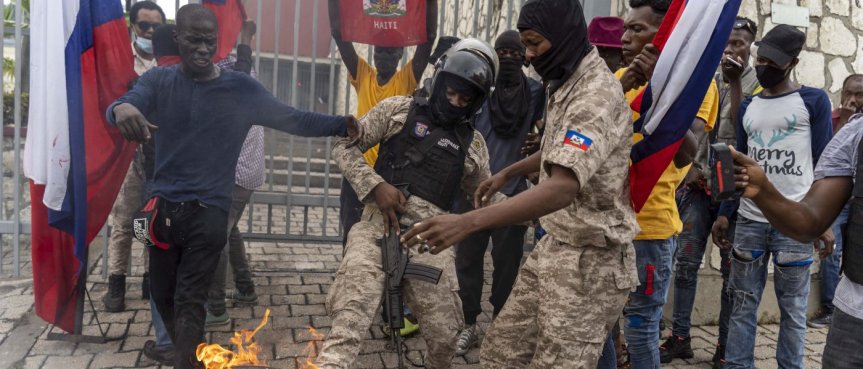
Photo: RICHARD PIERRIN/AFP via Getty Images

With long experience of chaos, violence, and dysfunctional governance, Haiti looks now to be on the verge of new crisis in the form of foreign military intervention. U.S. and United Nations decision-makers have held back, but now they look to be moving, again. 

The need all the while has been for change so that all Haitians might live decent lives. Whatever is in the works now offers little prospect for rearrangement of political and social hierarchies in Haiti. 

Haitians for several years have faced high prices, recurring shortages of essential supplies, and deadly gang violence in cities that has converted Haiti into a war zone and is the focus of media and political attention from abroad.   

Left-leaning political activist Camille Chalmers insists “there is a clear connection between these gangs and sectors of power, [which include] the far right” and the U.S. government. In an interview published on May 7, Henry Boisrolin agrees. This Haitian analyst living in Argentina states that: 

We have entered … a new phase in a spiral of violence characteristic of a crumbling neo- colonial system … The armed gangs are frankly death squads that are instruments in the hands of the Haitian oligarchy and the international community, mainly the United States. They want to subdue the popular movement in Haiti, sew terror, and put off an uprising.

The government headed by Prime Minister Ariel Henry, appointed by President Jovenel Moïse just days before his murder on July 7, 2021, is a façade. The U.S. government and the supervising “Core Group” of foreign nations put him in office and are backing him now. 

The last national elections were in 2016; the National Assembly has no legislators. Those elections, remarkable for minimal voter turn-out, gave the presidency to Moise, a wealthy businessman.  

Moïse overstayed his term of office, was accused of massive corruption, and was killed by paramilitaries who prepared in the United States. His predecessor, millionaire Michel Moise, became president in 2011 only after U.S. Secretary of State Hillary Clinton intruded in the elections.

Affecting Haiti’s situation now are: death and destruction from earthquakes and hurricanes; UN military occupation for 13 years that that introduced cholera, killing tens of thousands; and billions of dollars stolen that were set aside to pay for oil from Venezuela’s Petrocaribe program.

The distant background shows U.S diplomatic and commercial barriers during Haiti’s first 50 years, unjust and massive debt obligations to France for over a century, U.S. military occupation and U.S. support for the Duvalier dictatorships during the twentieth century, and subsequently a U.S. hand in two coups that removed the progressively-inclined President Jean-Bertrand Aristide. 

The United Nations Security Council  on October 21, 2022, “demanded an immediate cessation of gang violence and criminal activity” and declared itself ready “to take appropriate measures … against those engaged in or supporting gang violence.”  In January, 2023,U.N. Secretary General António Guterres called for “deployment of an international specialized armed force to Haiti.” 

On April 26 the Security Council deliberated on Haiti;19 speakers were heard. Maria Isabel Salvador, Head of the UN’s “Integrated Office in Haiti,” indicated that almost 50% of Haitians require humanitarian assistance. “The Haitian people cannot wait,” she declared; a “specialized international armed force” is needed. Jean Victor Geneus, Haiti’s Minister for Foreign Affairs, agreed.

The U.S. government is ready to act, it seems, with plans aimed at implementing the 2019 Global Fragility Act. That law would prevent and reduce violent conflict” abroad by means of “negotiating bilateral, 10-year-long “security assistance” arrangements with  “fragile states.”

The State Department on April 1, 2022, released a document explaining rationale and methods for implementing the GFA. A year later, on March 27, the State Department explained that the GFA would be implemented through 10-year plans … in partnership with Haiti, Libya, Mozambique, Papua New Guinea, and Coastal West Africa, including Benin, Côte d’Ivoire, Ghana, Guinea, and Togo.” 

An accessory document reveals that Haiti was being prioritized. It mentions a “sequenced approach for U.S. efforts” that will depend upon “political and security openings in the country.”

Kim Ives, veteran defender of Haiti’s sovereignty, commented that the plan “is essentially a new alliance of USAID ‘know-how’ with Pentagon muscle.” He foresees that the United States will be “returning the country from a neo-colony back into a virtual colony as it was from 1915 to 1934, when U.S. Marines occupied and ran it. Nonetheless, the U.S. would try to keep some Haitian window-dressing.” 

Vassily A. Nebenzia, the Russian Federation’s Permanent Representative on the UN Security Council, received a letter on April 24 from 58 individual Haitians and representatives of Haitian political organizations.  Russia is currently serving as the Security Council’s president.

The letter claims that U.S. plans for Haiti’s future would violate the United Nations Charter. It calls for an independent commission to evaluate U.S. interventions in Haiti since 1993. The authors fear “a grave attack on the sovereignty, independence, territorial integrity, and unity of Haiti.” 

They also object to U.S. occupation since 1856 of the Haitian island Navase, the U.S. government’s manipulations in the 2010 presidential elections, and U.S. failure to prevent the weapons being shipped to Haiti for use in killings and crimes. 

A month after President Moise’s murder in 2021, the “Montana group” of civic leaders proposed a two-year provisional government that would prepare for elections.  The results have been nil.  

De facto Prime Minister Ariel Henry in December 2022 announced a “High Transition Council” set up to arrange for elections. But eight political parties soon vetoed the project and very little has been achieved. Already in October, Henry had requested the U.S. government and/or United Nations to intervene militarily. 

Whatever happens in Haiti promises little help for a severely distressed underclass; 59 percent of Haitians live on less than $2 a day, the poverty rate is 60%, a quarter of the population has no access to electricity, 50% of Haitians are food insecure, 50% of Haitians must drink polluted water, 50% Haitian children do not attend school, and two thirds of adult Haitians are unemployed or informally employed. 

No social revolution is on the horizon and most Haitians, individually and collectively, are powerless. Power lies with Haiti’s business class whose impulse is for “invasion and occupation.” 

These would be the richest ten percent of Haitians who control 61.7% of the country’s wealth. The billionaires in that class are conglomerate owners Gregory Mevs and Gilbert Bigio, worth $1.0 billion and $1.2 Bіllіоn, respectively, and Irishman Denis O’Brien, who is worth $6.8 billion and controls Haiti’s telephone services.  

Henry Boisrolin, cited above, sees U.S. hypocrisy when he looks at U.S. sanctions against ten powerful families in Haiti that buy “tons of arms and munitions” for use in Haiti. This is a U.S. government that “does not allow a single syringe to make its way to Cuba” while claiming ignorance as to who sells those arms or that they come from the United States.


W.T. Whitney Jr. is a political journalist whose focus is on Latin America, health care, and anti-racism. A Cuba solidarity activist, he formerly worked as a pediatrician, lives in rural Maine. W.T. Whitney Jr. es un periodista político cuyo enfoque está en América Latina, la atención médica y el antirracismo. Activista solidario con Cuba, anteriormente trabajó como pediatra, vive en la zona rural de Maine.
Cuba’s President Extolls the Cuban People, Discusses Problems / By W.T. Whitney Jr.

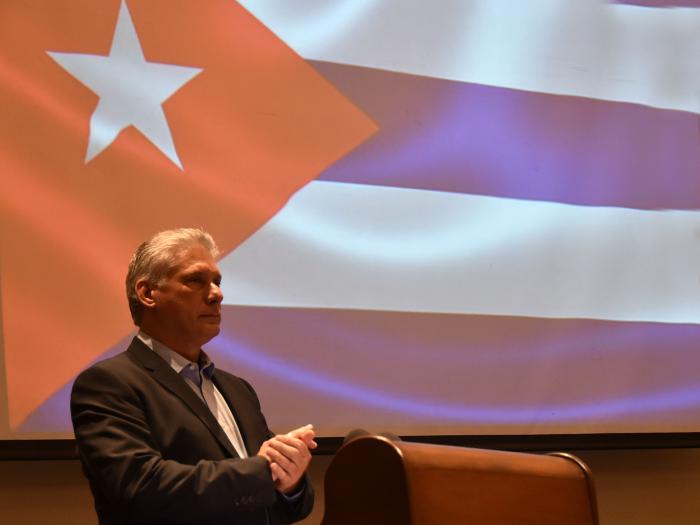
President of the Republic of Cuba, Miguel Díaz-Canel Bermúdez | Photo: Estudios Revolución


Addressing Cuba’s recently-convened National Assembly on April 19, President Miguel Díaz-Canel expressed confidence that the Cuban People would overcome warlike measures imposed by the United States.

“Congratulations to everyone on the Day of Victory!” he proclaimed. “On April 19 in 1961 on the sands of Playa Girón (Girón Beach) Cuba won the right to celebrate this day in providing for the first great defeat of imperialism in America. It was the triumph of the just against the unjust, of little David against the giant Goliath, of a socialist Revolution under the nose of the empire.”

“Thanks to this victory we today, on the tenth such occasion, install the People’s Assembly.” He declared that each of the 470 deputies “defends the interests of the majority,” that none of them won their seat through money or from the backing of an electoral party.

Referring to the Cuban Revolutionary Party founded by José Martíhe extolled “the single party that is the guarantee of unity” and through which, “the forces of a little nation do not disintegrate or fight each other.”

Díaz-Canel catalogued manifestations of U.S. all-but-war: invaders “working out of their caves on social networks,” and the “perennial cruelty of a blockade reinforced during the pandemic,” and “millions of dollars offered to those preparing to subvert Cuba’s internal order,” and “inclusion of Cuba on a list of supposed sponsors of terrorism that blocks access to financing.”

He stated that, “someday, earlier than later, the politics of hegemony will have to cease; multilateralism will take its place, and Cuba will be able to show how far a noble creative and talented people can go if they are united around clear objectives and if they are freed from pressures and blockades.”

Offering praise, Díaz-Canel maintained that “elections to the National Assembly are aimed at choosing the best people. That’s difficult … [because] there are many more good Cubans than there are seats in parliament.”

He expressed “certainty that no simulation of artificial intelligence could match the Cuban people’s achievements in recent years and their creative resistance. Their resilience exceeds the limits of any simulation or prediction. There is no algorithm capable of reflecting what we have lived through.”

Díaz-Canel highlighted the transparency of recent election campaigns, noting that voter participation was ample enough to waylay “hate-inspired” foreign-media expectations of low voter turnout indicative of a failed Cuban state. The recent elections included the Family Code referendum on September 25, 2022, elections for delegates to municipal assemblies on November 27, 2022, and voting for National Assembly deputies on March 27.

The Cuban president noted that the 75.8% of Cubans who voted on the last occasion was “above average for the other models of democracy in the world and [represented] “a show of citizenship, … patriotism, and above all, of political consciousness.”

The recently elected National Assembly overwhelmingly approved new terms for the Council of Ministers, the Council of State, and for Díaz-Canel, who will be serving his second and last five-year presidential term, as prescribed by recent constitutional changes.

Díaz-Canel outlined difficulties and unfinished tasks, observing that:

The world economy, uncertain and unstable in all latitudes, poses the first and greatest challenge for the new Council of Ministers … Leadership should focus on food production, the use of idle productive capacities, increased reliance on foreign-currency income, transformations required by the socialist state enterprise, enhanced efficiency of the investment process, and synergy of our economic actions and foreign investment. We do all this to increase the supply of goods and services and control inflation, which is the main priority in the economic battle. 

Even as he acknowledged “obstacles external to our economy that present profound difficulties,” the President “condemned bureaucratism, indifference, and corruption” in Cuba. He expressed confidence in the deputies’ “commitment and dedication,” while insisting that, “we will overcome the blockade without waiting for them to lift it.”

Díaz-Canel extolled Cuban youth “as the best revolutionaries because, dealing with every-day difficulties, they confront, try to fix, and achieve much. Despite adversity, they keep on smiling, loving, and believing in the possibility of a better country.” In fact, “socialism is closest to youth because it too is unfinished work.”

A persisting undertone of Díaz-Canel’s presentation was that of values, particularly those of solidarity and revolutionary service. Coinciding with the April 20 presentation of Díaz-Canel’s speech on resumenlatinoamericano.org were two news reports that exhibited diverse Cuban and U.S. purposes as regards Ukraine and expressed values.

report from Argentina announced a public television showing on April 23 of the Cuban film “Sacha, a child of Chernobyl,” first viewed in 2021. Living in Ukraine, Sacha was one year old and living in Ukraine on April 28, 1986 when the Chernobyl nuclear power installation exploded and radioactivity and radiation-caused diseases spread far and wide.

Sacha, un niño de Chernobyl, película completa

He was one of 26,000 children in Ukraine, Belarus, and Russia who received sophisticated medical care and rehabilitation in Cuba for their illnesses between 1990 and 2011, at no cost to families or governments. In the 1990s, Cuba was suffering the economic disaster of its “Special Period.” The film may be viewed here; Spanish language subtitles are provided.

Also on that day, a report appeared indicating that “The United States announced … the sending of another package of military aid worth $325 million for the fight against Russian forces. The U.S. Defense Department highlighted through a communique that this aid ‘will allow Ukraine to continue bravely defending itself in a brutal war against Russia, unprovoked and unjustified.’”

During another April, 200 years ago, an early warning sign cropped of a reality that would from then on plague Cuba, provoke revolution and bolster counter-revolution.  In his speech, Díaz-Canel recalled that John Quincy Adams, as secretary of state, statedon April 28,1823 that, “if an apple severed by the tempest from its native tree cannot choose but to fall to the ground, Cuba, forcibly disjoined from its own unnatural connection with Spain, and incapable of self-support, can gravitate only to the North American Union.”


W.T. Whitney Jr. is a political journalist whose focus is on Latin America, health care, and anti-racism. A Cuba solidarity activist, he formerly worked as a pediatrician, lives in rural Maine. W.T. Whitney Jr. es un periodista político cuyo enfoque está en América Latina, la atención médica y el antirracismo. Activista solidario con Cuba, anteriormente trabajó como pediatra, vive en la zona rural de Maine.

China, Brazil Lead in Chipping Away at U.S. Economic Power Abroad / By W. T. Whitney Jr.

United States hegemony in Latin America is in question | credit Prensa Latina


The United States proclaimed the Monroe Doctrine 200 years ago and ever since has arranged Latin American and Caribbean affairs to its advantage. Nevertheless, struggles for national and regional independence did continue and the poor and marginalized classes did resist. Eventually there would be indigenous movements, labor mobilizations, and progressive and socialist-inclined governments. Cuba’s revolutionary government has endured for 63 years.

The U.S. political hold may have weakened, but U.S. control over the region’s economies remains strong; after World War II it extended worldwide.  Now cracks are showing up. In particular, the U.S. dollar’s role as the world economy’s dominant currency may have run its course. 

In 1944, 44 allied nations determined that the value of their various currencies would correlate with the value of the U.S. dollar instead of the value of gold. The nations since then have relied on the U.S. dollar for their reserve currencies, for foreign trade and in banking transactions.

There seemed to be good reason. The United States was supreme in producing and marketing goods and so, presumably, the dollar’s value would remain stable and predictable. The dollar would be readily accessible to bankers and traders and its valuation would be unambiguous. Nations could also build their currency reserves through the dollars they accumulated in the form of bonds sold by an increasingly indebted United States.  

The United States has benefited. In currency exchanges involving the dollar, U.S. companies and individuals experience only minor add-on costs. U.S. importers know that the more the dollar strengthens in value, the less expensive will be products they buy abroad. U.S. borrowing costs overseas are relatively low because U.S. bonds, and the investments they represent in dollars, are appealing abroad, for a variety of reasons.

Dollar dominance has caused pain abroad. Exporters to the United States take a hit when the exchange value of the dollar weakens. Importers of U.S. goods are hurt when the dollar strengthens.

Most importantly, the U.S. government gains an opening to punish enemy countries through their use of dollars in international transactions. It imposes economic sanctions requiring that dollars not be used in a targeted country’s overseas transactions. The U.S. Treasury Department penalizes foreign banks and companies that disobey. Sanctioned nations have included Cuba, Iran, North Korea, Syria, Venezuela, Nicaragua, and more recently, China and Russia.

The U.S. government’s frequent resort to economic sanctions has greatly contributed to new stirrings on behalf of a new international currency system. Confiscation of currency reserves deposited in U.S. and European banks that belong to Iran, Venezuela, and Afghanistan have likewise encouraged calls for change.

On March 29 China and Brazil announced they would use their own currencies in trading with each other. China is Brazil’s biggest trade partner.  China’s renminbi currency presently constitutes a major share of Brazil’s currency reserves.

Earlier in 2023, Brazil and Argentina proposed cooperation toward creating a common currency for themselves.  At the January meeting of the Community of Latin American and Caribbean States (CELAC), Brazilian President Lula da Silva opined that, “If it were up to me, I would promote a single currency for the region.” He would call it the “SUR” (South).  The ALBA regional alliance in 2009 proposed an electronic currency called the “Sucre” aimed at reducing dollar dependency.

Former Brazilian President Dilma Rousseff is the recently named head of the New Development Bank which, headquartered in Shanghai, serves the BRICS nations (Brazil, Russia, India, China, and South Africa). The bank represents an alternative to the U.S. -dominated International Monetary Fund and the World Bank.

The shift away from dollar dependency is evident elsewhere. At a Russian-Indian “Strategic Partnership …Forum” recently, a Russian official announced that the BRICS states would be creating a new currency and that the formal announcement would be made at the BRICS summit meeting in Durban South Africa in August.

The BRICS countries account for “40% of the global population and one-fourth of the global GDP.” According to People’s Dispatch, Iran and Saudi Arabia, having recently signed a peace accord, will soon be joining BRICS.  Egypt, Algeria, the UAE, Mexico, Argentina, and Nigeria apparently are giving consideration.  The values of new currencies will rest not on another currency but on the value of “products, rare-earth minerals, or soil.”  

Iran and Russia in January agreed on methods useful for bypassing the SWIFT banking system, the U.S. tool for servicing its dollar dominance.  To evade U.S. sanctions, the two countries reply on their own currencies for most transactions.

At their summit in March, Russian and Chinese leaders reiterated their intention to expand bilateral trade and utilize their own currencies. China increasingly is using its own currency in transactions with Asian, African, and Latin American countries. The yuan “has become the world’s fifth-largest payment currency, third-largest currency in trade settlement and fifth-largest reserve currency,” according to Global Times.

Saudi Arabia is on the verge of selling oil and natural gas in currencies other than the dollar, and China occasionally pays Arabian Gulf nations in yuan for those products.   

The finance ministers and governors of the central banks of the member states of the Association of Southeast Asian Nations (ASEAN) met in Indonesia on March 28. At the top of their agenda were “discussions to reduce dependence on the US Dollar, Euro, Yen, and British Pound from financial transactions and move to settlements in local currencies”. The ASEAN nations, an alliance of 10 southeast Asian nations, are developing a digital payment system for member states’ transactions.

Dollar dominance may be losing its appeal closer to home.  Former Goldman Sachs chief economist Jim O’Neill claims that, The U. S. dollar plays a far too dominant role in global finance … Whenever the Federal Reserve Board has embarked on periods of monetary tightening, or the opposite, loosening, the consequences on the value of the dollar and the knock-on effects have been dramatic.”

Gillian Tell, chair of the Financial Times’ editorial board notes that, “concerns are afoot that this month’s US banking turmoil, inflation and looming debt ceiling battle is making dollar-based assets less attractive.” Plus, “a multipolar pattern could come as a shock to American policymakers, given how much external financing the US needs.”

There are wider implications. Argentinian economist Julio Gambina bemoans “disorder in the world economy …[and] this attitude of unilateralism represented by the US sanctions.” Interviewed on March 29, Gambina points out that “wealth has a father and a mother: labor and nature.”

He adds that, “Latin America and the Caribbean … where inequality is growing the most …  have a highly skilled working class, willing to carry forward the production of wealth. We have the resource of assets held in common for sovereign development through which the interests of our peoples and the reproduction of nature, life and society are defended.”


W.T. Whitney Jr. is a political journalist whose focus is on Latin America, health care, and anti-racism. A Cuba solidarity activist, he formerly worked as a pediatrician, lives in rural Maine. W.T. Whitney Jr. es un periodista político cuyo enfoque está en América Latina, la atención médica y el antirracismo. Activista solidario con Cuba, anteriormente trabajó como pediatra, vive en la zona rural de Maine.

U.S. Congress terrorizes Cuba: GOP seeks power to designate island a terrorism sponsor / W. T. Whitney Jr.

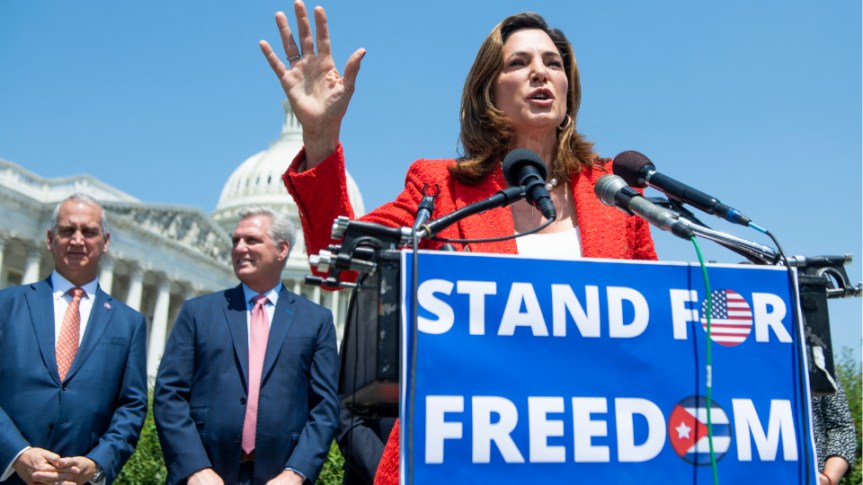
Rep. Maria Elvira Salazar, R-Fla., speaks during a news conference to highlight ‘Cuban Independence Day’ outside the Capitol on Thursday, May 20, 2021. Rep. Mario Diaz-Balart, R-Fla., left, and House Minority Leader Kevin McCarthy, R-Calif., also appear. | Tom Williams / CQ Roll Call via AP

Originally published in the People’s World on April 6, 2023


Although Cuba’s Revolution survived military invasion, guerrilla actions, terrorist attacks, and bacteriologic warfare, enough was not enough. Now, there are pay-offs to dissidents, manipulation of worldwide media coverage, and weaponization of social media capabilities. And of course, the U.S. economic and financial blockade persists, after 60 years, with no sign of stopping any time soon.

That’s mostly because power to end the blockade switched from the executive branch to Congress, courtesy of the Helms-Burton Law of 1996. Now, the House of Representatives will be considering a bill that, similarly, would have Congress and no longer the president decide on removing Cuba from the U.S. list of terrorism-sponsoring nations.

Miami’s Republican Rep. María Elvira Salazar introduced H.R. 314, the so-called FORCE Act, on Jan. 12, 2023. Its aim is to “prohibit the removal of Cuba from the list of state sponsors of terrorism until Cuba satisfies certain conditions, and for other purposes.”

GOP Sen. Marco Rubio introduced a companion bill in the U.S. Senate on March 16. The House bill has 24 co-sponsors; five are Floridians. The House Foreign Affairs Committee sent the bill to the House floor on March 28.

Meanwhile, a revived campaign is pressuring President Joe Biden to end the designation of Cuba as a state sponsor of terrorism. That campaign takes on urgency now, inasmuch as Congress may soon co-opt Biden’s power to do so.

The designation represents a false account of Cuba’s facilitation of peace talks between Colombia’s government and leftist guerrillas. It traces back to old accusations that Cuba was harboring fugitives from the United States.

The designation persisted from the 1980s until 2015, when President Barack Obama removed it, only to be reinstated by White House occupant Donald Trump in 2021. The effect is to broaden economic war and bring new grief to the people of Cuba.

U.S. dollars are weaponized; they are still the de facto currency in all international financial dealings, anywhere, by anyone. A convenient choke point exists, as pointed out recently by Cuban diplomat José Ramón Cabañas: “The issue is the clearing system based in New York. 90% of [Cuba’s] international transactions with U.S. dollars go through that system … [and are] automatically frozen.”

U.S. regulations, introduced through executive action, long ago prohibited state sponsors of terrorism from using U.S. dollars in international transactions. Consequently, payments that Cuban exporters expect from foreign buyers may not arrive, and Cuban importers have difficulties paying foreign suppliers. International loan payments are blocked, and grants from international agencies go astray.

The U.S. Treasury Department may impose heavy fines on those international banks and foreign corporations that do handle dollars in transactions with Cuba. Non-offenders avoid Cuba, out of caution. The connection between the terrorism-sponsoring designation and prohibition on the use of U.S. currency has led to shortages and economic distress in Cuba.

Massachusetts Peace Action has spearheaded the necessary campaign against H.R 314. A recent communication provides information and shows how to contact members of the House of Representatives.

The extended Cuban exile community provides the main political support for the anti-Cuba legislative proposals in the House and Senate. The Cuba part of U.S. foreign policy is regularly farmed out to the population sector with the most to lose or gain. That approach is dysfunctional, irrational, and unfair.

The text of the proposed bill assigns Cuba goals, fulfillment of which would signal that the country is no longer to be designated as a sponsor of terrorism. These are the very goals that, as specified in the Helms-Burton Law, need to be achieved so that the blockade may be ended.

The goals are:

  • Release all political prisoners and allow for investigations of Cuban prisons by appropriate international human rights organizations.
  • Transition away from the “Castro regime” to a system that guarantees the rights of the Cuban people to express themselves freely.
  • Commit to holding free and fair elections.

Perspective reveals contradictions in all of this. The subject of political prisoners demands consideration of the fate of U.S. prisoners held at the U.S. military base in Guantánamo Bay.

It’s worthwhile also to recall that neither Fidel nor Raul Castro now plays a part in Cuba’s government. As for Fidel, he’s dead. And when it comes to the retired Raul, his influence may persist, just as does that of former presidents in the United States, but he occupies no leadership role. His thinking is sought from time to time in Cuba when, for instance, organized discussion among wide sectors of the population precedes the introduction of important initiatives. The last such occasion was the discussion period in 2022 prior to the vote on the Constitutional Amendment for a Family Code.

And, lastly, Cuba’s conduct of elections is exemplary. In voting on March 26 for Cuba’s National Assembly, 75% of the voting population took part. The portion of those who vote in U.S. national elections is far smaller. Plus, the make-up of delegates to the Assembly actually reflects the demographics of Cuba’s population, unlike the U.S. Congress.

The National Assembly then chooses from among its members to be Cuba’s leaders. That’s the standard process followed in the parliamentary systems of many countries.


W.T. Whitney Jr. is a political journalist whose focus is on Latin America, health care, and anti-racism. A Cuba solidarity activist, he formerly worked as a pediatrician, lives in rural Maine. W.T. Whitney Jr. es un periodista político cuyo enfoque está en América Latina, la atención médica y el antirracismo. Activista solidario con Cuba, anteriormente trabajó como pediatra, vive en la zona rural de Maine.

Proposal in Congress Would Prolong Designation of Cuba as Terrorism Supporter – Biden Dithers / By W. T. Whitney Jr.

Cuba is not a state sponsor of terrorism but a state sponsor of global well-being | credit: People’s Dispatch


Although Cuba’s Revolution survived military invasion, guerrilla actions, terrorist attacks, and bacteriologic warfare, enough was not enough. Now there are pay-offs to dissidents, manipulation of worldwide media coverage, and weaponization of social media capabilities. The U.S. economic and financial blockade persists, after 60 years, and will continue.

That’s mostly because power to end the blockade switched from the executive branch to Congress, courtesy of the Helms Burton Law of 1996. Now the House of Representatives will be considering a bill that, similarly, would have Congress and no longer the president decide on removing Cuba from the U.S. list of terrorism-sponsoring nations.

Miami representative María Elvira Salazar introduced H.R. 314, the so-called FORCE Act, on January 12,2023.  Its aim is “To prohibit the removal of Cuba from the list of state sponsors of terrorism until Cuba satisfies certain conditions, and for other purposes.”

Senator Marco Rubio introduced a companion bill in the U.S. Senate on March 16. The House bill has 24 co-sponsors; five are Floridians. The House Foreign Affairs Committee sent the bill to the House floor on March 28.

Meanwhile, a revived campaign is pressuring President Biden to end the designation of Cuba as terrorism-sponsoring nation. That campaign takes on urgency now inasmuch as Congress may co-opt Biden’s power to do so.

The designation represents a false account of Cuba’s facilitation of peace talks between Colombia’s government and leftist guerrillas. It traces back to old accusations that Cuba was harboring fugitives from the United States.

The designation persisted from the 1980s until 2015, when President Obama removed it, only to be reinstated by President Trump in 2021. The effect is to broaden economic war and bring new grief to Cuba.

U. S. dollars are weaponized; they the de facto currency in all international financial dealings, anywhere, by anyone. A convenient choke point exists, as pointed out recently by Cuban diplomat José Ramón Cabañas: “The issue is the clearing system based in New York. 90% of [Cuba’s] international transactions with US dollars go through that system … [and are] automatically frozen.”

U.S. regulations, introduced through executive action, long ago prohibited state sponsors of terrorism from using U.S. dollars in international transactions. Consequently, payments that Cuban exporters expect from foreign buyers may not arrive, and Cuban importers have difficulties paying foreign suppliers. International loan payments are blocked and grants from international agencies go astray.

The U.S. Treasury Department may impose heavy fines on those international banks and foreign corporations that do handle dollars in transactions with Cuba.  Non-offenders avoid Cuba, out of caution. The connection between the terrorism-sponsoring designation and prohibition on the use of U.S. currency has led to shortages and distress in Cuba.

Massachusetts Peace Action has spearheaded the necessary campaign against H.R 314. A recent communication provides information and shows how to contact members of the House of Representatives.

The extended Cuban exile community provides the main support for the legislative proposal. The Cuba part of U.S. foreign policy is regularly farmed out to the population sector with the most to lose or gain. That approach is dysfunctional, irrational, and unfair.

The text of the proposed bill assigns Cuba goals, fulfillment of which would signal that Cuba no longer is be designated as a sponsor of terrorism. These are the very goals that, as specified in the Helms-Burton Law, need to be achieved so that the blockade may be ended.  The goals are:

·        Release all political prisoners and allow for investigations of Cuban prisons by appropriate international human rights organizations.

·        Transition away from the Castro regime to a system that guarantees the rights of the Cuban people to express themselves freely.

·        Commit to holding free and fair elections.

Perspective reveals contradictions.  The subject of political prisoners demands consideration of the fate of U.S. prisoners held in Guantanamo. It’s worthwhile also to recall that neither Fidel or Raul Castro now plays a part in Cuba’s government; that their influence may persist, just as did Abraham Lincoln’s in the United States; and that in Cuba organized discussion among wide sectors of the population invariably precedes the introduction of important initiatives. The last such occasion was the discussion period in 2022 prior to the vote on the Constitutional Amendment for a Family Code.

And, lastly, Cuba’s conduct of elections is exemplary. In voting on March 26 for Cuba’s National Assembly, 75% of the voting population took part. The portion of those who vote in U.S. national elections is far smaller. The make-up of delegates to the Assembly reflects the demographics of Cuba’s population. As delegates, they choose Cuba’s leaders, who are themselves members of the National Assembly. That’s a process followed in the parliamentary systems of many countries.


W.T. Whitney Jr. is a political journalist whose focus is on Latin America, health care, and anti-racism. A Cuba solidarity activist, he formerly worked as a pediatrician, lives in rural Maine. W.T. Whitney Jr. es un periodista político cuyo enfoque está en América Latina, la atención médica y el antirracismo. Activista solidario con Cuba, anteriormente trabajó como pediatra, vive en la zona rural de Maine.

A U.S. general hypes China as threat in Latin America / by W.T. Whitney Jr.

General Laura Richardson, Commander of United States Southern Command testifies before the Senate Armed Services Committee. | Jose Luis Magana / AP

Published in the People’s World on March 29, 2023


The U.S. government has long intervened in Latin America and the Caribbean (LAC). Now, the U.S. military is paying attention to China’s economic activities there.

Gen. Laura Richardson on March 8 reported to the Armed Services Committee of the U.S. House of Representatives on the actions and needs of the Southern Command, which she heads. She has charge of all U.S. military operations in the region.

Citing the 2022 National Security Strategy, Richardson declared that “no region impacts the United States more directly than the Western Hemisphere… [There,] autocrats are working overtime to undermine democracy.” And security there “is critical to homeland defense.”

Richardson stated that “the PRC (People’s Republic of China) has both the capability and intent to eschew international norms, advance its brand of authoritarianism, and amass power and influence at the expense of the existing and emerging democracies in our hemisphere.” The Southern Command’s “main priority…is to expose and mitigate PRC malign activity.”

She sees a “myriad of ways in which the PRC is spreading its malign influence, wielding its economic might, and conducting gray zone activities to expand its military and political access and influence.” A “gray zone,” according to the NATO-friendly Atlantic Council, is a “set of activities…[like] nefarious economic activities, influence operations, …cyberattacks, mercenary operations, assassinations, and disinformation campaigns.”

Richardson highlighted China’s trade with LAC that is heading toward “$700 billion [annually] by 2035.” The United States, in her view, will be facing intense competition, and presently “its comparative trade advantage is eroding.”

She added that “The PRC’s efforts to extract South America’s natural resources to support its own population…are conducted at the expense of our partner nations and their citizens.” And opportunities for “quality private sector investment” are disappearing.

Competition extends to space: “11 PRC-linked space facilities across five countries in this region [enable] space tracking and surveillance capabilities.” Richardson complained of “24 countries [that] have existing Chinese telecommunication infrastructure (3G/4G), increasing their potential to transition to Chinese 5G.”

She expressed concern both about surveillance networks supplied by China that represent a “potential counterintelligence threat” and about Latin Americans going to China “to receive training on cybersecurity and military doctrine.” Richardson denounced China’s role in facilitating environmental crimes and pointed to “potential dual use for malign commercial and military activities.”

“Relationships absolutely matter,” she insisted, “and our partner democracies are desperate for assistance from the United States.” Plus, “if we’re not there in time, they…take what’s available, creating opportunities for the PRC.”

Moving beyond China, Richardson indicated that “many partner nations…see TCOs [transnational criminal organizations] as their primary security challenge.” That’s because drug-cartel violence leads to deaths and poverty, and “illicit funds exacerbate regional corruption, insecurity, and instability.”

Her report avoids mention of particular countries other than offering brief references to Haiti, Cuba, Nicaragua, and Venezuela. She criticized Russia for “military engagements with Venezuela and Nicaragua” and for spreading “false narratives.” Richardson praised Colombia for providing military training in other countries.

The Southern Command gains “exponential return” on supplying various countries with U.S. weapons and supplies. It conducts joint military exercises, and “provides professional military education to personnel from 28 countries.”

Richardson reported at length on processes she sees as fostering useful relationships between her command and the various governments and military services. The tone of urgency characterizing her discussion on China was entirely lacking.

Economic intervention

Gen. Richardson’s view that China has greatly expanded its economic involvement with the LAC nations is on target.

Since 2005, China’s state-owned banks have arranged for 117 loans in the region worth, in all, more than $140 billion. They averaged over $10 billion annually. Since 2020, China has made fewer loans.

Chinese trade with Latin America grew from $12 billion in 2000 to $448 billion in 2021. China’s imports of “ores (42%), soybeans (16%), mineral fuels and oils (10%), meat (6%), and copper (5%)” totaled $221 billion in 2021. The value of exported manufactured goods that year was $227 billion. By 2022, China had become the biggest trading partner in four Latin American countries and the second-largest in many others.

China’s foreign direct investment (FDI) has long represented China’s strongest economic tie to the region. FDI signifies funding of projects abroad directed at long-term impact. China’s FDI from 2005 to mid-2022 was $143 billion. Energy projects and “metals/mining” accounted for 59% and 24% of the total, respectively. Of that total, Brazil and Peru received 45% and 17%, respectively.

The FDI flow since 2016 has averaged $4.5 billion annually; worldwide, China’s FDI has contracted.

Chinese banks and corporations have invested heavily in lithium production in Argentina, Bolivia, and Chile, which, together, account for 56% of the world’s lithium deposits. China is the largest investor in Peru’s mining sector, controlling seven large mines and owning two of Peru’s biggest copper mines. Brazil is the world’s largest recipient of Chinese investments.

China’s government has linked FDI to its Belt and Road Initiative (BRI) that began in 2013. As of May 2022, 21 Latin American and Caribbean countries were cooperating with the BRI and 11 of them had formally joined.

On the ground

U.S. military intervention in LAC is far from new. Analyst Sergio Rodríguez Gelfenstein complements Richardson’s report with a three-part survey, accessible herehere, and here, of recent U.S. military activities in the region.

He indicates the United States now has “12 military bases in Panamá, 12 in Puerto Rico, 9 in Colombia, 8 in Perú, 3 in Honduras, 2 in Paraguay, as well as similar installations in Aruba, Costa Rica, El Salvador, Cuba (Guantánamo), and in other countries.”

Rodríguez maintains that “levels of aggressive interference by Washington in the region have increased dramatically,” and that U.S. embassies there are supplied with more military, National Security Council, and CIA personnel than ever before.

Honduran Foreign Minister Eduardo Enrique Reina Garcia, left, and Chinese Foreign Minister Qin Gang shake hands following the establishment of diplomatic relations between the two countries, at a ceremony in the Diaoyutai State Guesthouse in Beijing Sunday, March 26, 2023. Honduras formed diplomatic ties with China on Sunday after breaking off relations with Taiwan, which is increasingly isolated and now recognized by only 13 sovereign states, including Vatican City. The U.S., meanwhile, is upset about China’s growing ties of cooperation and trade in Latin America. | Greg Baker / Pool Photo via AP

Rodríguez notes features of the LAC region that attract U.S. attention, among them: closeness to strategically important Antarctica; reserves of fresh water and biodiversity in Amazonian regions; the Guarani Aquifer near the triple frontier of Brazil, Paraguay, and Argentina, the largest in the world; and huge reserves of valuable natural resources.

Among ongoing or recent U.S. military interventions are these:

  • The U.S. Army Corps of Engineers is implementing a “master plan” for the navigability of the Paraguay River and Plata River Basin. The nearby Triple Frontier area supposedly harbors international terrorism and drug trafficking.
  • The U.S. military facility in Neuquén, Argentina, is turning from its alleged humanitarian mission to activities in line with local preparations for oil extraction.
  • S. officials on Oct. 13, 2022, announced that 95 military vehicles were being donated to Guatemala for drug-war activities.
  • In Brazil in September 2022, General Richardson indicated that U.S. forces would join Brazilian counterparts to fight fires in the Amazon.
  • The Southern Command’s fostering of good relations with Peru’s military has borne fruit. Under consideration in Peru’s Congress is a proposal to authorize the entry of foreign military forces. To what nation would they belong? Hint: former CIA operative and U.S. Ambassador Lisa Kenna met with Peru’s Defense Minister the day before President Pedro Castillo was removed in a parliamentary coup on Dec. 7, 2022.
  • In March 2023, two U.S. congresspersons proposed that U.S. troops enter Mexico to carry out drug-war operations.
  • Presently the United States is making great efforts to establish a naval base on Gorgona island off Colombia’s Pacific coast. It would be the ninth U.S. base in Colombia, a NATO “global partner.”
  • In Colombia, U.S. troops acting on behalf of NATO, are active in that country’s Amazon region supposedly to protect the environment and combat drug trafficking.
  • The U.S. National Defense Authorization Act of December 2022 awarded the Southern Command $858 million for military operations in Ecuador.
  • In a second visit, the U.S. Coast Guard cutter Stone was plying Uruguayan waters in February ostensibly to train with local counterparts for search and rescue operations. The ship was also monitoring the nearby Chinese fishing fleet.

Rodríguez does not comment on U.S. interventions in Cuba, Nicaragua, and Venezuela. That’s because they’ve persisted for “more than 60, 40, and 20 years, respectively” and each requires a “special report.”

John Quincy Adams returns

Proclaiming the Monroe Doctrine 200 years ago, Secretary of State Adams informed European powers that the United States regarded “any attempt on their part to extend their system to any portion of this hemisphere as dangerous to our peace and safety.”

Gen. Richardson would apply the warning of that era to the PRC. Yet signs of hegemonic aspirations from that quarter are absent.

Commenting recently, Argentinian economist and academician Claudio Katz notes that “China concentrates its forces in the economic arena while avoiding confrontations at the political or military level.… Investments are not accompanied by troops and bases, useful for guaranteeing return on investments.”

Besides, China “does business with all governments, without regard to their internal politics.” That tendency, Katz writes, stems from the PRC having “arisen from a socialist experience, having hybrid characteristics, and not completing a passage to capitalism.” He maintains that China, with its economic involvement, contributes nothing to advancing socialism in the region.


W.T. Whitney Jr. is a political journalist whose focus is on Latin America, health care, and anti-racism. A Cuba solidarity activist, he formerly worked as a pediatrician, lives in rural Maine. W.T. Whitney Jr. es un periodista político cuyo enfoque está en América Latina, la atención médica y el antirracismo. Activista solidario con Cuba, anteriormente trabajó como pediatra, vive en la zona rural de Maine.

US General Hypes China as Threat in Latin America / By W.T. Whitney Jr.


The U.S. government has long intervened in Latin America and the Caribbean (LAC). Now the U.S. military is paying attention to China’s economic activities there. 

General Laura Richardson on March 8 reported to the Armed Services Committee of the U.S. House of Representatives on actions and needs of the Southern Command, which she heads. She has charge of all U.S. military operations in the region. 

Citing the 2022 National Security Strategy, Richardson declared that “no region impacts the United States more directly than the Western Hemisphere …. [There] autocrats are working overtime to undermine democracy.” And security there “is critical to homeland defense.”

Richardson stated that “the PRC (People’s Republic of China) has both the capability and intent to eschew international norms, advance its brand of authoritarianism, and amass power and influence at the expense of the existing and emerging democracies in our hemisphere.” The Southern Command’s “main priority … is to expose and mitigate PRC malign activity.”

She sees a “myriad of ways in which the PRC is spreading its malign influence, wielding its economic might, and conducting gray zone activities to expand its military and political access and influence.” A “grey zone,” according to the NATO-friendly Atlantic Council, is a “set of activities … [like] nefarious economic activities, influence operations, … cyberattacks, mercenary operations, assassinations, and disinformation campaigns.”

Richardson highlighted China’s trade with LAC that is heading toward “$700 billion [annually] by 2035.” The United States, in her view, will be facing intense competition and presently “its comparative trade advantage is eroding.”

She added that, “The PRC’s efforts to extract South America’s natural resources to support its own population … are conducted at the expense of our partner nations and their citizens.” And opportunities for “quality private sector investment” are disappearing.

Competition extends to space: “11 PRC-linked space facilities across five countries in this region [enable] space tracking and surveillance capabilities.” Richardson complained of “24 countries [that] have existing Chinese telecommunication infrastructure (3G/4G), increasing their potential to transition to Chinese 5G.” 

She expressed concern both about surveillance networks supplied by China that represent a “potential counterintelligence threat” and about Latin Americans going to China “to receive training on cybersecurity and military doctrine.” Richardson denounced China’s role in facilitating environmental crimes and pointed to “potential dual use for malign commercial and military activities.”

“Relationships absolutely matter,” she insisted, “and our partner democracies are desperate for assistance from the United States.” Plus, “if we’re not there in time, they … take what’s available, creating opportunities for the PRC.”

Moving beyond China, Richardson indicated that “many partner nations …  see TCOs (transnational criminal organizations) as their primary security challenge.” That’s because drug-cartel violence leads to deaths and poverty and “illicit funds exacerbate regionalcorruption, insecurity, and instability.”

Her report avoids mention of particular countries other than offering brief references to Haiti, Cuba, Nicaragua, and Venezuela. She criticized Russia for “military engagements with Venezuela and Nicaragua” and for spreading “false narratives.” Richardson praised Colombia for providing military training in other countries. 

The Southern Command gains “exponential return” on supplying various countries with U.S. weapons and supplies. It conducts joint military exercises, and “provides professional military education to personnel from 28 countries.”

Richardson reported at length on processes she sees as fostering useful relationships between her command and the various governments and military services. The tone of urgency characterizing her discussion on China was entirely lacking. 

Economic intervention

General Richardson’s view that China has greatly expanded its economic involvement with the LAC nations is on target.

Since 2005, China’s state-owned banks have arranged for 117 loans in the region worth, in all, more than $140 billion. They averaged over $10 billion annually. Since 2020, China has made fewer loans.

Chinese trade with Latin America grew from $12 billion in 2000 to $448 billion in 2021. China’s imports of “ores (42%), soybeans (16%), mineral fuels and oils (10%), meat (6%), and copper (5%)” totaled $221 billion in 2021. The value of exported manufactured goods that year was $227 billion. By 2022, China had become the biggest trading partner in four Latin American countries and the second-largest in many others.  

China’s foreign direct investment (FDI) has long represented China’s strongest economic tie to the region. FDI signifies funding of projects abroad directed at long-term impact. China’s FDI from 2005 to mid-2022 was $143 billion. Energy projects and “metals/mining” accounted for 59% and 24% of the total, respectively. Of that total, Brazil and Peru received 45% and 17%, respectively. 

The FDI flow since 2016 has averaged $4.5 billion annually; worldwide, China’s FDI has contracted.

Chinese banks and corporations have invested heavily in lithium production in Argentina, Bolivia, and Chile, which, together, account for 56% of the world’s lithium deposits. China is the largest investor in Peru’s mining sector, controlling seven large mines and owning two of Peru’s biggest copper mines. Brazil is the world’s largest recipient of Chinese investments.  

China’s government has linked FDI to its Belt and Road Initiative (BRI) that began in 2013. As of May 2022, 21 Latin American and Caribbean countries were cooperating with the BRI and 11 of them had formally joined.

On the ground

U.S. military intervention in LAC is far from new. Analyst Sergio Rodríguez Gelfenstein complements Richardson’s report with a three-part survey, accessible herehere, and here, of recent U.S. military activities in the region.

He indicates the United States now has “12 military bases in Panamá, 12 in Puerto Rico, 9 in Colombia, 8 in Perú, 3 in Honduras, 2 in Paraguay, as well as similar installations in Aruba, Costa Rica, El Salvador, Cuba (Guantánamo), and in other countries.”

Rodríguez maintains that, “levels of aggressive interference by Washington in the region have increased dramatically” and that U.S. embassies there are supplied with more military, Cuba, Nicaragua, and CIA personnel than ever before.

Rodríguez notes features of the LAC region that attract U.S. attention, among them: closeness to strategically-important Antarctica; reserves of fresh water and biodiversity in Amazonian regions; the Guarani Aquifer near the triple frontier of Brazil, Paraguay, and Argentina, the largest in the world; and huge reserves of valuable natural resources.

Among ongoing or recent U.S. military interventions are these:

·        The U.S. Army Corps of Engineers is implementing a “master plan” for navigability of the Paraguay River and Plata River Basin. The nearby Triple Frontier area supposedly harbors international terrorism and drug-trafficking.

·        The U.S. military facility in Neuquén, Argentina is turning from its alleged humanitarian mission to activities in line with local preparations for oil extraction.            

·        U.S. officials on October 13, 2022 announced that 95 military vehicles were being donated to Guatemala for drug-war activities.   

·        In Brazil in September 2022, General Richardson indicated that U.S. forces would join Brazilian counterparts to fight fires in the Amazon..

·        The Southern Command’s fostering of good relations with Peru’s military has borne fruit. Under consideration in Peru’s Congress is a proposal to authorize the entry of foreign military forces. To what nation would they belong? Hint: former CIA operative and U.S. Ambassador Lisa Kenna met with Peru’s Defense Minister the day before President Pedro Castillo was removed in a parliamentary coup on December 7, 2022.

·        In March 2023, two U.S. congresspersons proposed that U.S. troops enter Mexico to carry out drug-war operations.

·        Presently the United States is making great efforts to establish a naval base on Gorgona island off Colombia’s Pacific coast. It would be the ninth U.S. base in Colombia, a NATO “global partner.”

·        In Colombia, U.S. troops acting on behalf of NATO, are active in that country’s Amazon region supposedly to protect the environment and combat drug-trafficking.

·        The U.S. National Defense Authorization Act of December 2022 awarded the Southern Command $858 million for military operations in Ecuador.

·        In a second visit, the US Coast Guard Cutter Stone was plying Uruguayan waters in February ostensibly to train with local counterparts for search and rescue operations. The ship was also monitoring the nearby Chinese fishing fleet.

Rodríguez does not comment on U.S. interventions in Cuba, Nicaragua, and Venezuela. That’s because they’ve persisted for “more than 60, 40, and 20 years, respectively” and each requires a “special report.”

John Quincy Adams returns

Proclaiming the Monroe Doctrine 200 years ago, Secretary of State Adams informed European powers that the United States regarded “any attempt on their part to extend their system to any portion of this hemisphere as dangerous to our peace and safety.”

General Richardson would apply the warning of that era to the PRC. Yet signs of hegemonic aspirations from that quarter are absent.

Commenting recently, Argentinian economist and academician Claudio Katz notes that, “China concentrates its forces in the economic arena while avoiding confrontations at the political or military level … Investments are not accompanied by troops and bases, useful for guaranteeing return on investments.”

Besides, China “does business with all governments, without regard to their internal politics.” That tendency, Katz writes, stems from the PRC having “arisen from a socialist experience, having hybrid characteristics, and not completing a passage to capitalism.” He maintains that China, with its economic involvement, contributes nothing to advancing socialism in the region.   


W.T. Whitney Jr. is a political journalist whose focus is on Latin America, health care, and anti-racism. A Cuba solidarity activist, he formerly worked as a pediatrician, lives in rural Maine. W.T. Whitney Jr. es un periodista político cuyo enfoque está en América Latina, la atención médica y el antirracismo. Activista solidario con Cuba, anteriormente trabajó como pediatra, vive en la zona rural de Maine.

Indigenous rebellion continues as post-coup Peruvian government flounders / By William T. Whitney Jr.

Anti-government protesters chant slogans against Peru’s President Dina Boluarte, on the shore of lake Titicaca in Puno, Peru, Tuesday, March 7. | Juan Karita / AP


Revived democratic struggle in Peru is well along into a second act. There was the parliamentary coup on Dec. 7 that removed democratically-elected President Pedro Castillo and the “First Taking of Lima” in mid-January, when embittered and excluded Peruvians occupied Lima and faced violent repression. Then, on March 1, protests renewed as the Indigenous inhabitants of Peru’s extreme southern regions prepared once more to demonstrate in Lima and would shortly be protesting in their own regions.

The resistance’s make-up was fully on display.

Protesters throughout Peru were rejecting a replacement president and an elite-dominated congress and calling for early elections and a new constitution. They belonged for the most part belonged to Aymara communities in districts south of Lima extending from Lake Titicaca both west and northeast, into the Andes region.

Their complaints centered on wealth inequities, rule by a Lima-based elite, inadequate means for decent lives, and non-recognition of their cultural autonomy. Their support and that of other rural Peruvians had brought about the surprise election to Peru’s presidency in 2021 of the inexperienced Pedro Castillo. He had defeated Keiko Fujimori, daughter of a now imprisoned dictator and favorite of Peru’s neo-liberal enablers.

By March 1, residents of provinces close to the city of Puno were arriving in Lima to carry out the so-called “Second Wave of the Taking of Lima.” Demanding the de facto President Dina Boluarte resign, as of March 4 protesters had not been able to break through police lines surrounding key government buildings. The main action, however, was going on in the epicenter of police and military repression ever since Boluarte had taken office on Dec. 7.

That would be the Puno area, where most of the 60 deaths caused by violent repression have occurred, with 19 protesters having been killed on Jan. 9 in Juliaca, a town 27 miles north of Puno city.

On March 5, violence was again playing out in Juli, a town 58 miles south of Puno, also on the shore of Lake Titicaca. Demonstrations along with roadblocks were in progress throughout the extended region, all in sympathy with the concurrent protests in Lima. Involved were Indigenous groups, small farmer organizations, and social movements.

In July, the demonstrators, confronted by military units and police in civilian dress, set fire to judicial office buildings and the police headquarters. The troops fired, shots came from open windows, and tear gas was released from a helicopter; 18 demonstrators were wounded.

Demonstrators blocking a bridge over a river prevented the entry of troops into the nearby town of Llave. Rains had caused flooding and in the process of swimming across the river, one of them drowned and five others disappeared.

Protesters captured 12 soldiers; community leader Nilo Colque indicated they were released after they admitted to trying to break the “strikes” but that they too opposed the military’s actions. Colque predicted that soon 30,000 Aymaras would be descending on Juli and nearby population centers.

Aymara activists in Llave announced a strike of indefinite duration. A “committee of struggle” in Cusco announced the beginning as of March 7 of an indefinite strike in 10 provinces. The president of the national “Rondas Campesinas” (peasant patrols), said to represent two million Peruvians in all, announced a big march on Lima from all regions set for March 13.

Meanwhile, Peru’s chief prosecutor has embarked upon an investigation of President Boluarte and other officials for crimes of “genocide, homicide resulting from circumstances, and causing serious injury,” that allegedly took place mostly in southern regions in the weeks immediately after her taking office.

There are these other developments:

  • Peru’s Supreme Court on March 3 heard proposal that the “preventive imprisonment of ex-President Castillo be extended from 18 to 36 months. Another court had previously denied his appeal for habeas corpus.
  • The Congress as of March 6looked to be on the verge of, for the fourth time, refusing to advance new presidential elections from April 2024 to sometime in 2013.
  • The UN High Commissioner for Human Rights has released a preliminary report accusing the new Peruvian government of excessive use of force against protesters.
  • Polling results currently go one way: 77% of Peruvians reject the Dina Boluarte government, 70% say she should resign, 90% denounce Peru’s Congress. 69% favor moving general elections ahead to 2023, and 58% support the demonstrations. Most of those making up these majorities live in rural areas, according to the report.

The opposing sides in the Peruvian conflict are stalemated. Powerbrokers presently lack a government capable—willing though it may be—of providing structure and organization adequate for protecting their political and economic interests.

Marginalized Peruvians are without any effective historical experience from which revolutionary leadership and strategies might have developed, such that now they might have direction and focus. The people’s movement there is not as lucky as its counterparts were in Cuba, Venezuela, and Nicaragua.

Now, the U.S. government meddles with this state of precarious balance in Peru. And not surprisingly: it has long intruded militarily and is competing with China economically.

Speaking on March 1, State Department Ned Price did insist that in Peru, “our diplomats do not take sides in political disputes … They recognize that these are sovereign decisions.” He added that the United States backs “Peru’s constitution and Peru’s constitutional processes.”

But political intervention was on the agenda already. Assistant Secretary of State Brian Nichols on February 28 urged Peru’s Congress to expedite early elections and Peru’s president to promptly end the crisis caused by ex-President Castillo’s “self-coup”—whatever that was.


People’s World has an enormous challenge ahead of it—to raise $200,000 from readers and supporters in 2023, including $125,000 during the Fund Drive, which runs Feb. 1 to May 1.

Please donate to help People’s World reach our $200,000 goal. We appreciate whatever you can donate: $5, $10, $25, $50, $100, or more.


W.T. Whitney Jr. is a political journalist whose focus is on Latin America, health care, and anti-racism. A Cuba solidarity activist, he formerly worked as a pediatrician, lives in rural Maine. W.T. Whitney Jr. es un periodista político cuyo enfoque está en América Latina, la atención médica y el antirracismo. Activista solidario con Cuba, anteriormente trabajó como pediatra, vive en la zona rural de Maine.

People’s World, March 9, 2023