
Fernando Cerimedo’s digitalized media blitz, shaping rightwing ascendency in Latin America

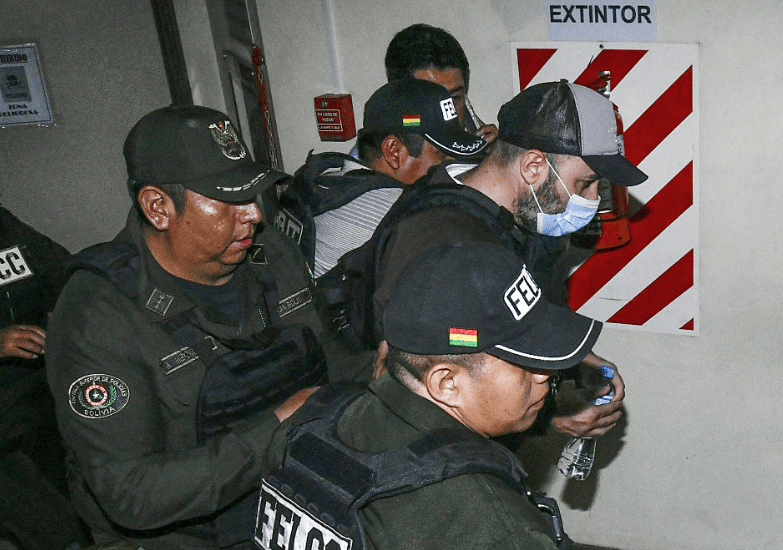
Image credit: Rodrigo Urzagasti / AFP via Getty Images

September 7, 2026

South Paris, Maine


An extended campaign of media disinformation contributed to the recent election victories of extreme rightwing presidential candidates in Latin America.  Massive, indiscriminate, and one-way digital communications took on a new prominence.

One individual and his associates took the lead. He and they served the wealthy and politically powerful across the region and farther afield. US influence lurked in the background. A new assertiveness of emboldened rightwing forces shows, both collectively and internationally.

On August 17 in Bolivia, two thugs shot and almost killed lawyer Nadia Beller outside a hotel in Santa Cruz de la Sierra, epicenter of rightwing reaction in the country. Hospitalized, she talked with reporters and the police. Her revelations led to the arrest the next day of Fernando Cerimedo, her partner, and to his preventive detention for 180 days.

Criminal investigation is underway. Charges so far are: attempted murder, domestic abuse, illicit enrichment, and narcotrafficking. Beller described Cerimedo as angry “about her pregnancy and concerned about her knowledge of illegal activities he was carrying out … [in various] countries, to promote conservative politicians and attack progressives.”

Her accusations aligned with messages on Cerimedo’s phone reviewed by investigators. They found at his residence “hundreds of thousands of dollars” and computer equipment used to run a “bots farm.”

Beller, a former parliamentary candidate, had worked in the socialist MAS government of Evo Morales (2007-2019). She recently was serving as an advisor in the conservative, US-supported government of President Rodrigo Paz, elected on November 8, 2025. She declared that María Elena Urquidi Barbery, President Paz’s wife, was engaged in illegal activity.

Cerimedo claimed he worked as an unpaid adviser in Paz’s government. His office adjoined that of the president. He told investigators that “outside consulting work” provides him with 1$ million per year, or per month; his accounts varied. His importance to President Paz shows in an photo of Secretary of State Marcio Rubio conferring with Paz at the Shield of the Americas Summit in Miami in March ─ with Cerimedo at the president’s side.

Cerimedo’s bots farm shaped Bolivian opinion prior to Paz’s electoral victory in 2025. A bot farm, as described by journalist Miguel Ángel San Martín, “is a network of many accounts or devices controlled automatically to generate fake likes, followers, comments, or views; to post or amplify messages en masse on social media; to click on ads or manipulate polls; to automatically create accounts; and to engage in spamming, fraud, or attempts to overwhelm [electronic] services. They are … extremely difficult to detect.”

Voting undermined in Honduras

Cerimedo’s central role in determining the outcome of Honduras’s recent presidential election came to light in August. The social democratic Libre Party held power. Prior to presidential voting on November 30, 2025, Marlon Ochoa, Libre’s representative on the National Election Council, publicized leaked audio recordings of conversations of the National and Liberal Parties’ representatives.  They were insisting that delivery of votes and the count should be delayed. They called for victory of either of their preferred candidates being announced well before all votes were tallied.

It happened: hundreds of thousands of votes were never counted. Millions of text messages warned that remittances would not arrive from the US, if the Libre Party’s Rixi Moncada won. Prior to the voting, President Trump released Juan Orlando Hernández, Honduras’s former president for the National Party, from a US prison. He had been serving 43 years for drug trafficking.  National Party candidate Nasry Asfura had placed third in opinion polls. Now he was Honduras’s new president.

On August 26, Marlon Ochoa, the former national election councilor currently living in exile, reported that Fernando Ceremedo’s voice was heard on leaked audio recordings he delivered to the attorney general’s office in December 2025. There, Cerimedo talked about stuffing votes for Asfura into ballot boxes, discarding votes, and not accepting a “vote-by-vote recount.”

In Chile

Cerimedo tried to disrupt the 2020 Chilean referendum on new Constitution that would have replaced one inherited from the Pinochet dictatorship. Socialist parliamentarian Juan Santana claimed recently that Cerimedo’s own consultancy firm had staged an opinion poll aimed at falsely showing that the “Yes” vote was losing ground. (It passed by 78%.) Cerimedo supported the “Reject” option.

Juan Santana accuses three officials in the government of current right-wing President José Antonio Kast of cooperating with Cerimedo in that endeavor. He claims that bots let loose by Cerimedo eased candidate Kast’s path to electoral victory in 2025, also that “artificial accounts and trolls” disparaged progressive presidential candidate Evelyn Matthei.

In Peru

The results of second-round presidential voting in Peru on June 7 were close. According to elciudadano.com, rightwing candidate Keiko Fujimori had included “Cerimedo as one of her main electoral campaign advisors.” In the first round of voting, “Cerimedo’s network … began to operate covertly in the country through bots, trolls, and false content.” He “launched a disinformation campaign against progressive candidate Roberto Sánchez,” who was ahead in the polls. Ultimately, “the dirty work of Cerimedo” was decisive in overcoming Sánchez’s lead.

To be able to intervene in Peru, Cerimedo and Spanish journalist Javier Negre (see below) built a relationship with Carlos Díaz-Rosillo. He has served in two Trump administrations, in the White House and then the Department of Defense. The Department’s website proclaims that Díaz-Rosillo advises the Secretary of Defense “in all matters related to defense policy and strategy in the Western Hemisphere.”

Díaz-Rosillo and Keiko Fujimori are acquainted. In 2025, Díaz-Rosillo honored her at the Florida-based Adam Smith Center, which he founded and directed. Fujimori must have been appreciative. She had only recently emerged from a failed prosecution on money-laundering chargesAccepting Díaz-Rosillo’s recommendation of Cerimedo, she might have been returning the favor.   

In Colombia

Following the June 21 election victory of Colombia’s new reactionary president Abelardo de la Espriella, outgoing President Gustavo Petro attributed leftist candidate Ivan Cepeda’s defeat to a plague of bots and internet-borne disinformation. The source, he suggested, was the Israeli cyber-intelligence company BlackCore.

Now, however, Petro relies on the forensic analysis of Fernando Cerimedo’s phone. It suggests he collaborated with Colombian electoral officials. Cerimedo refers to “more than two million bots and fake profiles managed by automated farms operating from abroad and the city of Medellín.” Petro called for annulment of the election results. He repeated the accusations in an interview with Mexico’s La Jornada newspaper.  

In Argentina and Brazil

Cerimedo had meddled in elections in Argentina. According to Nadia Beller, President Javier Milei paid Cerimedo $800,000 USD per month to carry out online disinformation. Serving as chief technology and communications officer for Milei’s successful campaign in 2023, he secured large donations and expanded his social media capabilities. Cerimedo informed La Nación newspaper that year that, “He controls ‘farms’ of thousands of trolls, bot accounts, and other digital tools put into service for Milei’s party.”

He exercised his technical and digital capabilities, and his scheming, in Brazil. Cerimedo joined Jair Bolsonaro’s presidential campaigns and provided assistance to Jair Bolsonaro’s failed coup attempt that ended in January, 2023.

Bolsonaro’s son Eduardo, now living in Florida, in February 2026 hosted the “Hispanic Prosperity Gala” held at Mar-a-Lago. Argentine President Milei delivered the keynote address. Bolsonaro presented Cerimedo with an award honoring him as the “Hispanic Political Consultant of the Year.”

Cast of characters

On being honored at the Mar-a-Lago Gala, Cerimedo began by saying that, “I want to say something in English; thank you to Brad Parscale!” US operative Parscale had tutored Cermedo in the uses of social media, trolls, bots, and algorithms for electioneering purposes. The latter told The New York Times that, “Brad set up all the infrastructure that I work with.” Their partnership continued.  

Parscale worked for Donald Trump, serving as digital media director for his 2016 presidential campaign and campaign manager for part of his 2020 campaign. Cerimedo’s collaboration with the well-connected Parscale may have allowed him to make connections of his own

Cerimedo partnered with the Argentinian-American Damián Merlo. This lobbyist owner of the Miami-based Latin America Advisory Group (LAAG) had worked at the US Interests Section in Havana and as program officer at the interventionist International Republican Institute.  Cerimedo’s connection to Merlo’s LAAG lobbying group provided him with indirect access to the Florida congressional delegation and to executive branch officials responsible for Latin America.

The duo formed the Numen publicity company, which undertook to generate US support for Javier Milei’s presidential campaign in 2023. They shaped publicity for the US, and advocated for Milei among US congressperson and with the media.

As noted by the Cubadebate Media Observatory, “Cerimedo built a corporate base in Miami and a transnational media network. The US would be its center of operations.  It benefited from privileged links with the top power structures within the Trump administration, in particular with Marco Rubio.”

After Milei’s electoral win, The Numan organization, helped along by Brad Parscale’s technical help and his travel to Bolivia, played important roles in the 2025 electoral victories of Paz in Bolivia and Asfura in Honduras. Numen also appears as an “academy” offering “digital and political marketing courses” in the region.

Cerimedo and two Argentinian journalists formed La Derecho Diario (Daily of the Right) prior to 2020. It’s a widely-read, pan-Hispanic source of news and views with a reactionary slant; there’s an English-language version. A recent story titled “Wave of Moroccan immigrants arrives in Brazil thanks to Lula” typifies its deceptive content.

The Spanish impresario Javier Negre, a “megaphone” for the far-right Vox political party, owns a far-right media conglomerate. In 2024 he purchased 50% interest in Cerimedo’s La Derecho Diario and took over as director. With Cerimedo now in trouble, he abandoned the platform.

Loose ends

On his digital rampage across Latin America, Cerimedo was a prominent soldier in war being carried out by Latin America’s extreme rightwing. He and others built a network of media and digital communications. It serves the wealthy and politically powerful in Latin America and farther afield. Cerimedo found friends and supporters in Washington and in the southern Florida, hotbed of emigre agitation.

The US government has probably provided support for his activities. Details are scarce. There’s no certainty.  Evo Morales, the former Bolivian president ousted in a US-supported coup in 2019, claims Cerimedo was working for the CIA. Cerimedo’s former partner Nadia Beller says likewise.

Lots of money cropped up along his path, as noted above. That may signal official US involvement. The US government directs vast sums to national security. That category includes undercover activities of all kinds. Some of Cerimedo’s projects may have been classified as such.  

report appearing on ciudadano.com on August 27 is relevant. Investigators looking at Cerimedo’s mobile phone found “codes linked to a network of digital wallets.” The report refers to a “cold wallet.” That’s something allowing for “the discreet transfer of large sums of money.” Investigators discovered “transactions totaling $44,100 … over the last six months.” They “uncovered accounts handling staggering sums, including one that holds $132 million.” 


W.T. Whitney, Jr., is a political journalist whose focus is on Latin America, health care, and anti-racism. A Cuba solidarity activist, he formerly worked as a pediatrician and lives in rural Maine.

Pre-election turmoil in Bolivia ─ is US ready to pounce? / By W. T. Whitney Jr.

Evo Morales March, 2025. Photo: Evo Morales/X

South Paris, Maine


In advance of presidential elections on August 17,2025, Bolivia’s Supreme Electoral Council on April 17 registered 11 political parties and five electoral coalitions. It will soon announce the final list of presidential candidates. Incumbent President Luis Arce, elected in 2020, candidate for the Movement to Socialism Party (MAS) and former economics minister under President Evo Morales, (2006-2019) will head the list.

Longtime MAS leader Morales is a presidential candidate too. The new “Evo, the People” (Evo Pueblo) party held a three-day gathering in Chapare state, Morales’s home base, in late March; attendance topped 70,000.

Here we look at divisions in Bolivia and various social and political instabilities. Clearly, socialist beginnings in Bolivia are vulnerable, most Bolivians may be returning to lives of misery, and U.S. intervention is waiting in the wings.

Downhill course

Morales’s presidency achieved much. A new Constitution established the pluri-national state and gave political rights to indigenous peoples. By nationalizing oil and gas production, the government gained funding for expanded education, healthcare, and support for mothers, children, and the elderly. The GDP tripled, poverty fell, wealth inequalities diminished, and international currency reserves accumulated. Morales became symbol and spokesperson for environmental sustainability.

Then came troubles. They’ve worsened amid political divisions and destabilization episodes. The selling price for exported natural gas fell. Deposits turned out to be limited. (However, discovery of a huge natural gas field was announced in July, 2024.) Funding for social programs and for imports of gasoline, diesel fuel, and food went downhill.  

Government agencies borrowed from the central bank to maintain programs and access to supplies. The bank drew upon the nation’s currency reserves, which have almost disappeared. Dollars, in demand to pay for everyday items, are scarce. Inflation, shortages, and discontent continue. 

Old political divisions took on new life. Having accused U.S. ambassador Philip Goldberg of conspiring with the opposition, Morales expelled him in 2008, along with the U.S. Drug Enforcement Administration. He expelled USAID in 2013.

Big landowners, oil and gas producers, and their proxies in Bolivia’s four eastern states, particularly in Santa Cruz, in 2008 mounted a rebellion with separatist and racist overtones. It failed. Sections of the Bolivian Workers Confederation opposed certain government initiatives. Indigenous groups fought against a new government highway passing through a large preserve.

Morales had faced controversy over the legitimacy of his third presidential term and the fourth one that would have followed his electoral victory in October 2019.  But a coup led by rightwing conspirators, including the Santa Cruz rebels of 2008, took down his government in November, 2019. Morales escaped to Mexico. U.S. support enabled the coup.

Schism and new instabilities

The coup government named Jeanine Áñez as president and arranged for elections. From exile in Argentina, Morales nominated former economics minister Luis Arce as the MAS presidential candidate in elections set for October 18, 2020. Arce took 55% of the vote. His new government jailed Áñez and the other plotters.  

Returning from exile, Morales retained administrative control of the MAS Party. He urged his loyalists serving in Parliament to oppose Arce’s policies. He is said to have “pressure[d] Arce by influencing government nominees to reaffirm his political … authority.” Morales led a march in 2021 that defended Arce against far-right attacks.

By 2023 Morales was actively seeking re-election, even though a Constitutional Court ruled against another Morales term. He was facing charges of sexual abuse of a minor.  Morales abandoned the MAS party in 2024 after Arce-supporting Grover Garcia replaced him as party president.

By late 2024, the split between the two former MAS colleagues was profound. In September, Morales marched with supporters from Caracollo in Oruro Department to La Paz, led protests and vigils against Arce’s policies, encouraged highway blockades, and carried out a five-day hunger strike. Ethnic division may be playing a role, with Arce supposedly speaking for Bolivia’s mestizo population and Morales, Bolivia’s first indigenous president, representing indigenous peoples. 

Destabilization returned. In June 2024 Gen. Juan José Zúñiga sought to arrest Morales for his presidential ambitions. He later led troops and armored vehicles in attacking government office buildings in La Paz, in the process demanding freedom for the jailed 2019 coup leaders. In doing so, according to one report, he revealed his rightwing political orientation and longing for U.S. intervention.

Stirrring the pot of mutual accusations, the now-imprisoned General Zúñiga recently told an interviewer that, in attacking the government, he and his associates had been following President Arce’s instructions to carry out a “self-coup” that would promote discontent in military ranks and ultimately an armed uprising. Zúñiga accused Arce of manipulating the list of potential voters ahead of the upcoming elections.

The overflow of complaints on social media about shortages of basic supplies is also destabilizing. The apparent object is to create panic and generate demand for black-market dollars.

Plot thickens

Observer Pablo Meriguet notes refusal by the strongest center-right opposition candidates to unite in a single campaign, specifically veteran politicians Samuel Doria, Manfred Reyes, and Jorge Quiroga. He sees an effect of improvement of the electoral prospects of either Arce or Morales. The young senate president and former MAS politician Andrónico Rodrigues, also running for president, has confusedly made overtures to rightwing business leaders.

U.S. government officials have long categorized the ascendency of the MAS government in Bolivia with dangers they perceive from Cuba, Venezuela, and Nicaragua. They may regard the upcoming contest as a watershed moment marking disaster for the MAS party and/or worsening chaos; in any case they would be ready to assist in re-ordering the situation. 

Their minds would have turned to lithium. According to analyst José A. Amesty Rivera, the “big agro-industrial capitalists and other powerful sectors [in Bolivia] allied with the United States” want Bolivia to control its own lithium deposits. That’s because “internal divisions favor easy access to the sought-after mineral.” He perceives a quickening of U.S. interest once the Bolivian government contracted with two Chinese companies and a Russian one to develop production facilities in the Uyuni salt flats. 

Amesty Rivera observes that, “the Bolivian lithium contracts are being obstructed by local NGOs, financed by international NGOs. These respond to economic and political interests related to the United States and also to European countries opposing the Chinese and Russian governments.” He adds that “the contracts stipulate that 51% % of the income obtained through lithium sales will go to the Bolivian state.”


W.T. Whitney Jr. is a political journalist whose focus is on Latin America, health care, and anti-racism. A Cuba solidarity activist, he formerly worked as a pediatrician, and lives in rural Maine.

In Bolivia gigantic march reveals socialist divide, elections are ahead / By W. T. Whitney

Hundreds of people take part in the so-called ‘March to Save Bolivia’ against leftist leader Luis Arce, on September 17, 2024. [Photo by Aizar Raldes / AFP]

South Paris, Maine


Beginning on September 17, marchers proceeded north for 118 miles from Caracollo in Oruro department to La Paz, Bolivia’s capital city, arriving there on September 24. Numbering from 5000 to 15,000 – estimates vary – they were supporting former President Evo Morales. They called their march a “National March to Save Bolivia; for Life, Democracy, and Revolution.” The had signs saying “Evo President” and “Lucho Traitor” – in reference to current Bolivian president Luis Arce.

The Movement against Socialism (MAS) Party, the party of both presidents, has split into two warring factions. Arce served for 12 years under Morales as minister of the economy and finances. Morales served three presidential terms, from 2006 to 2019. He had led a federation of unionized coca growers, was Bolivia’s first indigenous president, and been president of MAS since 1998.

Protesting shortages of food, fuel, and dollars and demanding that Morales be president, the marchers twice encountered resistance from hundreds of Arce loyalists.  Security forces made arrests and dozens were wounded.

Meetings and attempts at dialogue in La Paz were inconclusive.  Morales was no-show at one meeting.  Speaking out elsewhere, he revived an old demand, insisting that Arce change his “corrupt, drug-trafficking, and racist” ministers if he wants to continue governing.”  

The Arce government sought to forestall new mobilizations that might “prejudice the normal development of the country.” A Morales spokesperson confirmed that highway blockades would resume on September 30. His forces for two years had been carrying out blockades, strikes, and demonstrations – with 200 days of blockades in 2023.

On learning that the government would replace Justice Minister Iván Lima, the Morales side called off further blockades. Morales announced that “extreme poverty has returned and blockades will make it worse.” He also prioritized fire-fighting. The Morales side demanded that marchers who had been arrested be released.

Meeting in El Alto on September 27, the “Unity Pact” – the name given to government supporters – heard from social movement groups. Concerned about shortages, along with Morales’s partisans, they demanded a “response and solution” from the government. Arce, who was present, charged that he was being forced to resign.

If he did so, the Constitution would require that Senate President and Morales ally Andrónico Rodríguez be installed as temporary president.  Then will come elections set for August 17, 2025, and Morales would be running.

From Cochabamba, Morales proposed a “great national meeting on October 12 where we will be making other decisions.” He accused Arce of “selling out to the rightwing, seeking to diminish the state, and following recommendations of the World Bank and International Monetary Fund.”

In late 2019 Morales, having won the first-round in presidential voting, was heading for a fourth term. Then came a U.S. assisted coup; he was deposed and went into exile. The responsible parties were big landowners, oil and natural gas empresarios, and assorted racists in Santa Cruz and other eastern departments. Jeanine Áñez became provisional president. She’s now in prison,

From exile, Morales named Luis Arce as the MAS candidate in presidential elections in 2020. He scored a 55% plurality. Morales returned to Bolivia and signs of division emerged. Arce maintained popular support for a while, helped along by a successful response to an uprising in October, 2022 carried out by reactionaries in the eastern departments.

At a MAS Party Congress in October 2023, delegates expelled Arce from the party and endorsed Morales as a presidential candidate for the upcoming elections. The Constitutional Court ruled in December 2023 that Morales may not serve another presidential term.   

In May, 2024, another MAS Congress took place, with a different set of delegates. It backed Arce as presidential candidate and named Grover García, government office-holder and former union leader, as president of the MAS Party to replace Morales.

President Arce blames Evo Morales’s ambition: “[T]he personal and individual appetite of one person cannot drag the Bolivian people into again violating the Constitution.” Arce’s approval rating fell from 42% to 22% between January and September, according to one poll. “The main reason is the economic; basically the increase in prices,” the report says.

Deterioration from an earlier state of affair is remarkable. From 2006 on, the MAS-led government carried out reforms that uplifted one of the most poverty-stricken populations in the Western Hemisphere.

According to one summary, Bolivia became a “Plurinational State” representing 36 indigenous cultures. Land was redistributed and the production of oil, natural gas, and electricity nationalized. The minimum wage and per capita income each tripled; roads, schools, and hospitals were built. The elderly, mothers, and children received generous social support. Health care expanded and schools multiplied.  The economy grew at twice the average rate of Latin American countries. International currency reserves mounted to US$15 billion in 2014.  

Then natural gas production fell. International reserve funds were down to US$139 million in 2024. According to a BBC report, these were the sources of funds used by governments under Morales and Arce to pay for social programs, including fuel subsidies. Now income from natural gas exports, paid in dollars, is short, more so because fuel imports are paid for in dollars. Bolivia imports 56% of the gasoline and 86% of the diesel fuel it uses. 

Dollars were in short supply to pay for the needs of Bolivian society. Borrowing shot up. But shortages persist, and inflation. Foreign debt as a portion of GDP rose from 10% in 2008 to 30% in 2022.

Economics is not the whole story. According to one account, “The main cleavage between Arce and Evo is the increasing inequality of state resources between the factions they represent.” Informal employment in Bolivia is high. But “the government’s executive branch employs half a million people … Control over people and agencies represents power that is available to the Arce administration and not to the other side.

For commentator Luis Vega Gonzalez, racial identity is a factor. On one side of “the abyss that separates them” are the Morales forces who are largely indigenous. On the other side are the “white mestizos represented by those who govern in conjunction with those whose power comes from perks.”

He adds that, “[I]n three years the Indians were displaced from power … the economy was handed over to the market … and the collective aspirations of the plurinational state had to be replaced by individual entrepreneurship and social climbing.”


W.T. Whitney Jr. is a political journalist whose focus is on Latin America, health care, and anti-racism. A Cuba solidarity activist, he formerly worked as a pediatrician, lives in rural Maine. W.T. Whitney Jr. es un periodista político cuyo enfoque está en América Latina, la atención médica y el antirracismo. Activista solidario con Cuba, anteriormente trabajó como pediatra, vive en la zona rural de Maine.

Fighting for Land and Independence in Jujuy, Argentina / By W. T. Whitney Jr.

South Paris, Maine, June 27, 2023


In Jujuy province, in Argentina’s extreme Northeast, poor people’s discontent, the provincial government’s overreach, and popular resistance recently contributed to a crisis that portends grief and struggle ahead.  Setting the stage were: free rein for local reactionaries, indigenous peoples’ oppression, foreign plundering of natural resources, and a U.S. eye over the whole affair.

June was a month of turmoil.  Governor Gerardo Morales had proposed reforming the province’s Constitution. Teachers’ unions were agitating for higher salaries.

Discussion for 50 days that should have preceded the Constitutional Convention never happened. The Convention, presided over by Morales himself, played out over three weeks.  He had timed the electing of delegates to coincide with provincial government elections and thereby assure enough voter turnout to elect delegates who backed constitutional reform.

The proposed changes included new provisions for criminalizing public protests and new restrictions on “freedom of expression, petition, and association.” There would be revised legal mechanisms for regulating access to land, this so as to deliver land to lithium-producing multi-national companies. Indigenous peoples would face the probability that untitled plots of land crucial to their survival, for generations, would no longer be available. Jujuy province is the center of lithium extraction in Argentina, the world’s fourth largest lithium producer.  

Elected in 2015, Morales cut back governmental support for education, and teachers lost jobs. Teacher salaries in Jujuy are the lowest in Argentina. Teachers’ unions in nearby Salta province had recently carried out strikes and won pay increases.

On June 5, a Jujuy teachers’ union struck for better pay. On June 9, several teachers’ unions and the municipal employee union marched on Jujuy city, population 375,000. Soon healthcare workers and a miners’ union would join the mobilization. Morales decreed “increased penalties against individuals and organizations participating in any protests or social mobilization.” 

On June 14 indigenous people marched on the city “to demonstrate their rejection of the [constitutional] reforms … being devised behind closed doors.”  City streets were teeming with protesters on June 15 when word came that agreement was near on constitutional reforms. Soon indigenous groups and others were maintaining roadblocks on highways throughout the province. Police, assisted by unidentifiable enforcers using unmarked vehicles, stepped up arrests of demonstrators and journalists.  Calls went out for Morales’s resignation.

The Constitutional Convention on June 20 approved alterations of 66 of the provincial Constitution’s 212 articles. Street pressure had caused two reforms involving indigenous rights and access to land to be withdrawn temporarily.  Restrictions on protesting and free expression remained. The Constitution now provides for “automatic majority in the legislature for the governing party” and no longer requires that provincial elections be held every two years.

Massed demonstrators responded by assaulting the Government House with projectiles. Police turned them back using tear gas, rubber bullets and arrests.

The provincial government’s repressive methods elicited criticism from elsewhere in Argentina and from the Inter -American Commission on Human Rights, Amnesty International, and the United Nations High Commissioner for Human Rights. 

Governor Morales exceeds boundaries. Early in his first term, for example, he enlarged the top provincial court from five to nine judges. Consequently, provincial courts have endorsed illegal searches, illegal evictions, and persecution of social leaders. By 2018, 25 family members were serving as provincial government officeholders.

One presumes that the governor’s evident lack of restraint is bad news farther afield. He leads Argentina’s rightwing Radical Civic Union party and now is a vice-presidential candidate on one of two tickets aiming to represent the rightwing Unite for Change electoral coalition in upcoming elections.

It’s clear: he stops at nothing. Morales’s government in 2016 arrested Milagro Sala, leader of the Tupac Amaru Organization that at the time was assisting indigenous families as they looked for food, housing, basic education and more. The government was interfering and the Organization resisted. The police arrested Sala on flimsy pretexts and seven years later she is still detained.

Continuing his efforts to waylay indigenous independence, Gerado Morales took part in the November 2019 coup that deposed Bolivian President Evo Morales. That Morales was an indigenous president of a multi-national republic. Governor Morales was instrumental in arranging for U.S. assistance.

Around September 4, 2019, Gerardo Morales supposedly joined a meeting in Jujuy held to organize the coup against Evo Morales. Present was Luis Camacho who, based in Santa Cruz in Bolivia, was leading the coup in progress. Later on, Governor Morales himself traveled to Santa Cruz to confer with plotters. 

On that September 4, Ivanka Trump and State Department, CIA, and USAID personnel arrived in Jujuy ostensibly to support local women’s initiatives. Trump had brought $400 million.  A Hercules C 130 aircraft was deployed on the runway close to the recently arrived U.S. plane.  Almost at once that plane departed for Santa Cruz, without a flight plan. Camacho was on board. 

He may have been conveying the U.S. funds that would be used to bribe the senior Bolivian Army officers who pressured Evo Morales to resign. Later on, Gerardo Morales surely was not blind to that same airplane carrying weapons to plotters in Santa Cruz.

The governor’s zeal in serving U.S. interests shows up now as he cultivates U.S. official representatives for the sake of U.S. investment in the extraction and processing of lithium. He met with U.S. ambassador Marc Stanley in May 2022, and later Stanley was in Jujuy as Morales acquainted him with “a portfolio of projects in development.” Stanley and his family attended an indigenous festival.

Together with governors of other lithium-producing provinces, Morales in 2022 visited European countries and the United States. There he met with Washington officials, bankers, and industrial leaders, among them Elon Musk, owner of Tesla Corporation.

Morales’s friendship with Argentinian-government economic minister Sergio Massa is surprising – President Alberto Fernandez’s government is on the other side of the political divide – but understandable:  Massa is  a favorite in U.S. official circles, a lead promotor of foreign investment in Argentina’s natural resources, and a likely presidential candidate in elections later this year.

The story here centers on Morales’s doings as an individual. But people respond to circumstances collectively and engage collectively in social change. Morales is representative, it seems, of that class of well-paid intermediaries who have long arranged for the transfer of wealth from wherever to a waiting set of plunderers.

The history of the Americas has them freeing up land so as to get at wealth that is there. They must dispose of the set of people living on the land. Military force is made available. Morales becomes an updated conquistador.

Writing for the Argentinian Club of Journalist Friends of Cuba (capac-web.org), Alberto Mas provides specifics. In a report entitled “Jujuy is the North American Laboratory for Argentina,” he states that, “The visit of General Laura Richardson of the U.S. Southern Command [on April 17, 2023] did not in the least hide intentions of controlling the production and exportation of Argentina’s lithium. This is part of a strategic plan for the region which they have implemented over the course of time: the coup against Evo Morales in Bolivia had the smell of lithium.”


W.T. Whitney Jr. is a political journalist whose focus is on Latin America, health care, and anti-racism. A Cuba solidarity activist, he formerly worked as a pediatrician, lives in rural Maine. W.T. Whitney Jr. es un periodista político cuyo enfoque está en América Latina, la atención médica y el antirracismo. Activista solidario con Cuba, anteriormente trabajó como pediatra, vive en la zona rural de Maine.