Press Coverage of Declining US Life Expectancy Evades the Truth / by W.T. Whitney Jr.

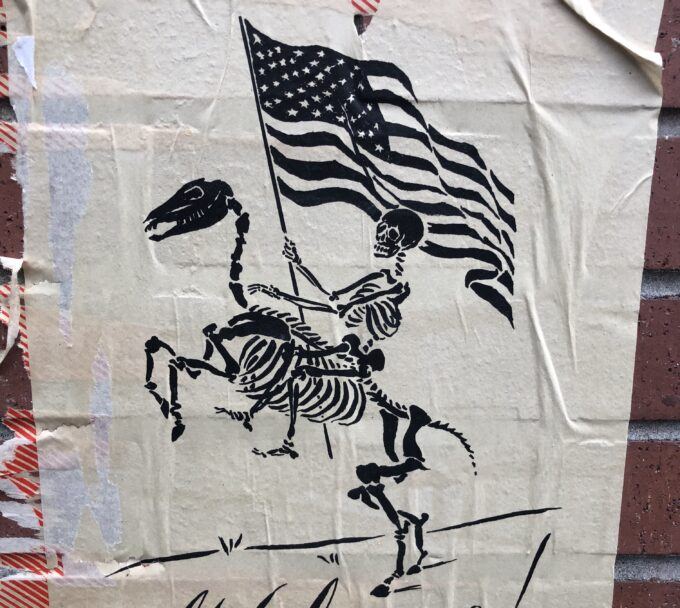
Photograph by Nathaniel St. Clair

Reporting by the U.S. news services frequently takes China to task for its strict preventative measures imposed to prevent Covid-19 infection. Reports point to economic instability and people’s distress supposedly generated by this uncompromising attitude. The slant of New York Times reporting, which skirts over Chinese lives saved, earned a sharp rebuke on September 9 from the fair.org website, a self-styled “national media watch group.”

Reporter Jim Naureckas imagines the lament of Times writers that, “China has had theenormous misfortune of avoiding mass death.” He is sarcastically contrasting lives saved in China with lives unnecessarily lost in the United States, where Covid-19 deaths now exceed one million. He reminds us that China now exceeds the United States in life expectancy.

U.S. reporting on the downhill turn of U.S. life expectancy is

fertile ground for the emergence of press bias that agrees with establishment leanings. 

The U.S. government recently released statistics indicating that U.S. life expectancy at birth is now 76.1 years That’s a return to the life expectancy level of 1996.  The 2021 figures, down from 77.0 years in 2020 and from 78.8 in 2019 represented the greatest multi-year life expectancy decline in 100 years. Life expectancy for men in 2021 was 73.2 years. That level signified an unprecedented male-female gap of almost six years.

U.S. press coverage of bad news on life expectancy barely mentions international comparisons and neglects the political and economic context of the drop in life expectancy.

Reports in the Washington Post, New York Times, and elsewhere have identified adverse biological or medical phenomena. They point to suicides, alcoholism and drug- overdose victims – “diseases of despair” – and spotty distribution of healthcare services. The reporting attributes the life-expectancy decline mostly to excess deaths from Covid-19 infection. 

In explaining deaths during the pandemic, The New York Times and Washington Post focus on disaster befalling indigenous peoples in the United States. The combined male-female life expectancy of indigenous peoples as of 2021 registers at 65.2 years. Indigenous deaths rates have recently exceeded those of white people by a factor of 10.  

These articles, and others throughout the period of the pandemic, have pointed to the particular risk Covid 19 infection poses for non-white populations. Press reports have cited Black and Hispanic mortality rates that are from two to four times higher than those for white people. Reports have leaned on public health data showing that “communities of color” had suffered from much chronic illness beforehand that compound difficulties in recovering from Covid-19 infection. 

Reporters have described medical care for these chronic diseases as poorly accessible or of low-quality. They imply that racism is the factor that largely accounts for the increased Covid-19 death rates among ethnic minorities. If so, getting rid of racial oppression would be the best way to reduce human loss from the pandemic and restore decent life-expectancy figures.

The reports also cast blame for Covid-19 deaths on unhealthy living habits, environmental pollution, and access to guns. Recent articles attribute now deceasing death rates from Covid-19 among Black people to protective actions taken by people themselves (not government action). The Times article, seemingly alone, does mention “a fragmented, profit-driven health care system.”

Otherwise, inquiry into the nature of U.S. healthcare is missing. Unsurprisingly, there are no calls for universal access to healthcare, improved preventative care, additional first-contact care providers, removal of financial barriers, and higher quality of care.  Lacking too is discussion of steps taken on behalf of education, housing, adequate nutrition, and safe retirement; all of these, taken together, promote good health.

Not much appears about the disjointed, inaccessible, unavailable care for illnesses, chronic or otherwise, that white people may experience together with Black people. The overall emphasis in the reporting is the special vulnerably of non-white people and, recently, the apparent role of racism in accounting for lowered life expectancy.

There is silence on social class. Seemingly alone among the major U.S. media, Newsweek highlighted the contrast between reduced U.S. life expectancy and Chinese and Cuban gains. The 2021 life expectancy of both countries, 78.2 years and 79 years, respectively, was higher that year than that of the United States

China and Cuba are socialist countries that redistributed wealth and opted for working-class political power. U.S. media and elected officials are reluctant to acknowledge successes of socialist countries, that by nature are oriented toward the good of working people.

Writing in 1991, Vicente Navarro, public policy and public health expert, notes that “class is rarely discussed in the scientific and mainstream media in the United States.” He adds that, “even if blacks and whites died at the same rates, most blacks would still have higher mortality rates.”

He elaborated in 2004:

“The United States is one of the very few countries that do not include class in its national health and vital statistics. It collects health and vital statistics by race and gender but not by class, even though, as I have shown, class mortality differentials are far larger than race or gender differentials. Class discrimination is the most frequent and least spoken of type of discrimination in the United States.”

Navarro’s remarks provide perspective to the biases in press coverage that are described here. Presumably press silence on developments in which working people have a stake does suit opinion-shapers for whom red-scare is a time-tested tool. Anti-Cuban sentiment and China bashing may play a role, but those postures too may stem from red-scare.  Navarro has the last word: “The capitalist class is extremely powerful.”

The heroic journalist John Pilger once explained that, “Journalists can help people by telling the truth, or by as much truth as they can find, and acting not as agents of governments, of power, but of people.” He asked recently: “do we live in a Media Society where brainwashing is insidious and relentless, and perception is filtered according to the needs and lies of state and corporate power?”


W.T. Whitney Jr. is a political journalist whose focus is on Latin America, health care, and anti-racism. A Cuba solidarity activist, he formerly worked as a pediatrician, lives in rural Maine. W.T. Whitney Jr. es un periodista político cuyo enfoque está en América Latina, la atención médica y el antirracismo. Activista solidario con Cuba, anteriormente trabajó como pediatra, vive en la zona rural de Maine.

Colombian Intelligence Operations, with US Backing, Are Bad for Peace / by W. T. Whitney Jr.

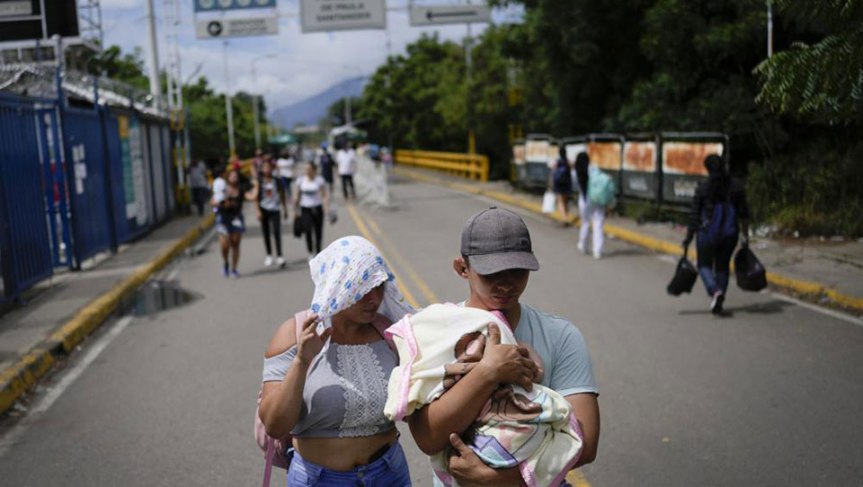
A Venezuelan couple use the Francisco De Paula Santander Bridge to cross between Urena, Venezuela, and Cucuta, Colombia, Aug. 6, 2022. | Matias Delacroix / AP

Colombia’s new president Gustavo Petro wants peace. Colombia’s military, the largest in Latin America, except for that of Brazil, stands in the way. It benefits from U.S. largesse while attending to U.S. needs. Its intelligence branch, discussed here, is not about peace and reconciliation.

The U.S. government, militarily involved in Colombia for decades is likewise an obstacle to peace. As explained recently by analyst Hernando Calvo Ospina, military cooperation has been central to the U.S.-Colombian alliance. He details how since World War II the United States has partnered with Colombia in dominating the entire region to maintain access to strategic resources, exclude Communism, and suppress left-wing movements. Calvo Ospina mentions Colombian-U.S. drug-war operations and the two countries’ addiction to military and ruling-class power. This is the setting for the intelligence operations described below.

Colombian intelligence operations serve U.S. imperialist objectives as they target Cuba and Venezuela. Colombian governing authorities appear to have forgotten the legacy of independence hero Simón Bolívar who, up against Spanish rule and U.S. pretentions, fought for Latin American unity. In 1829 he remarked that, “The United States appear to be destined by Providence to plague America with misery in the name of liberty.” He was denouncing unencumbered U.S. license to control Spanish America, as proclaimed in the Monroe Doctrine of 1823 and still in force. 

Trump-era national security advisor John Bolton recently boasted he had planned coups to unseat the Maduro government in Venezuela. Current White House advisor on Western Hemisphere affairs Juan González took a different tack while speaking in Colombia in August: “40 years ago the United States would have done everything possible to avoid the election of Gustavo Petro and, once elected would have done everything possible to sabotage his policies.”  Now, says González, the United States wants to collaborate and “navigate that change.” 

Meanwhile, Petro wants young people to choose social service and not do military service. His government will be negotiating peace with National Liberation Army (ELN) guerrillas. He rejects the U.S.-promoted drug war and has re-established diplomatic relations with Venezuela, the object of U.S. hybrid war. On August 12, Petro named new military chiefs and replaced 40 generals and admirals because of corruption and human rights violations.

This report turns to Colombian military intelligence. The Revista Raya website, directed by Edinson Bolaños, recently published three articles on Colombian intelligence operations that began in 2016 and continued for almost six years. (See the end note for possible translations in English of “raya.”)

Face-off against Cuba

The first article, titled “International Espionage: Operation Cuba,” appeared on the website on August 19.  One learns that, “Revista Raya had access to thousands of classified Colombian military intelligence documents where evidence appears of spying on Cuban diplomats and officials, left-leaning [Colombian] political leaders, journalists, and social leaders.” The folders contained “profiles of targeted personnel, photographs, videos of subjects being followed, maps, sketches and drawings.”

Agents posing as journalists or photographers mapped routes to facilities used by diplomats. They photographed the interiors of the Cuban embassy, consulates, and diplomats’ quarters, and also diplomats’ automobiles and license plates. They monitored diplomats’ encounters with Colombian activists and politicians. Operatives gained access to phones, computers and on-line communications.

They were able to alter the text of the Cubans’ email communications. Colombian intelligence operatives communicated their findings with U.S. counterparts. U.S. documents with responses and commentary show up in the files.

Operatives attended solidarity gatherings in Colombia and farther afield – at a Sao Paolo Forum of leftist political parties, for example. At these venues, they identified attendees, monitored conversations, gained access to email communications, and informed intelligence agencies in home countries of their citizens’ participation in leftist or pro-Cuba activities. They spied on solidarity gatherings at the Julio Antonio Mella International Camp near Havana.

People attending various events had their phone calls intercepted, among them: Cuban ambassador José Luis Ponce and Vice Consul Kendry Sosa, leftist senators Iván Cepeda and Gloria Flórez; Communist Party leaders Jaime Caycedo and Carlos Lozano Guillén; and FARC lawyer Diego Martínez. Among attendees monitored at the Sao Paolo Forum in 2019 were Communist Party member Gloria Inés Ramírez, now President Petro’s labor minister, and leftist senator Piedad Córdoba.

One purpose for the phone monitoring, according to Revista Raya, was to unearth or install material suggesting that Cuban operatives were promoting the protest demonstrations that rocked Colombia in 2019 and later, and contributed to the election of President Petro. The intelligence units also sought to connect Cuba’s government with leftist insurgents in Colombia, particularly the National Liberation Army (ELN).

According to documents in the report, agents “sewed” information in the computers of ELN guerrilla leaders suggesting the “complicity of Cuba’s government with the ELN in manufacturing the violence associated with the social protests.”  Nothing appeared in the files indicating that Cuba’s government actually did promote anti-government activities, according to Revista Raya.

Agents planted “evidence” of alleged terrorism undertaken by ELN guerrilla leader Andrés Vanegas Londoño, alias “Uriel,” and sent it to Colombian prosecutors and to Interpol. They communicated his location in Choco department. Uriel died in a bombardment of his camp 20 days later, on October 25, 1920.

Targeting Venezuela

Encouraged by its U.S. partner, Colombia’s government has long taken steps to destabilize Venezuelan society and government operations, and more so recently. Secret operations have taken place in Venezuela’s border region with Colombia. Colombian narco-traffickers are active there, and also Colombian paramilitaries. A small U.S.-Colombian force, Operation Gideon, carried out a maritime invasion of Venezuela in 2020.

Colombian military intelligence engaged with agencies and personnel of Venezuela’s government. On August 24, Revista Raya published “International Espionage: Objective Venezuela. The survey covers destabilization plans and monitoring of Colombian and Venezuelan politicians and Venezuelan diplomats.

Colombia’s intelligence service secreted 28 spies within various branches of Venezuela’s military. As part of so-called “Operation Vengeance,” operatives “tried to encourage the Venezuelan Army to carry out military operations against the ELN,” whose detachments were active in Venezuelan territory. They created hostile pamphlets and audio recordings and attributed them to the ELN.The spies “totally infiltrated” the communications of a Venezuelan press attaché in Bogota and monitored his contacts with prominent Colombian politicians of the left. Colombian officials later expelled him. 

Citing “another hundred documents,” Revista Raya shows that, during the presidency of President Iván Duque (2018 -2022), Colombian spies entered, photographed, and took material from the Venezuela’s consulate in Cartagena. The Colombian intelligence operatives attended primarily to consul Ayskel Torres.  

Under “Operation Sunset,” they “monitored her contacts with leftist social leaders in the region and her “sentimental relationship” with the “military attaché of a Caribbean country.” They were blackmailed and the latter provided a list of “cooperating” contacts.

Spying ceased after February 23, 2019, when The Maduro government broke relations with Colombia. The spies had monitored Venezuelan diplomats’ communications about the safety of money and sensitive documents lodged in an Embassy strong box. After the Venezuelans had departed, spies entered the building, took photographs, opened the strong box and stole documents and money. 

Responsibility

The last section of this three-part Revista Raya series is titled “International Espionage: Massive Profiling.” Documents were cited that contained “telephone numbers, homes addresses, political preferences, work places, email addresses, nationalities, and date of identification” for 450 persons. The article presents political profiles of eight individuals as examples of other profiles that were created. Dozens of images appear.

The targeted individuals included “political, social, and union leaders and also diplomats and officials of the Cuban and Venezuelan governments.” Intelligence agents descended on them when they attended “commemorations and political events relating to socialist countries,” or “peaceful mobilizations and … political events in Colombia.”

This last article in the series identifies the chief of Navy Intelligence as the individual primarily responsible for the illegal spying.

Rear Admiral Norman Iván Cabrera Martínez heads that agency now. He served as naval attaché at the Colombian Embassy in Washington and the U.S government awarded him a Meritorious Service Medal. Cabrera Martínez assumed his post on August 27, 2022. 

Colombian Communist Party secretary general Jaime Caycedo, the object of spying, commented to Revista Raya: “We … think this is a violation flagrant of our rights and constitutional liberties …[We] attach great importance to the journalistic work you are doing. You showed how we fell into their hands. You explained how public resources and public entities were used to maltreat citizens with this illegal profiling and to spy on diplomats of friendly countries with diplomatic relations.”

Note: The meaning in English of “raya,” as used in the website’s name, is mysterious here. We opt for “line-by-line review.” “Raya” may signify victim or despised person in that a “tienda de raya” in Mexico was a store operated by a company or hacienda relying on a laborer’s written line for a signature. A possibility from Colombia is “detective.”  Another commentator suggests “memorable happenings.”


W.T. Whitney Jr. is a political journalist whose focus is on Latin America, health care, and anti-racism. A Cuba solidarity activist, he formerly worked as a pediatrician, lives in rural Maine. W.T. Whitney Jr. es un periodista político cuyo enfoque está en América Latina, la atención médica y el antirracismo. Activista solidario con Cuba, anteriormente trabajó como pediatra, vive en la zona rural de Maine.

Birthday Celebration – “Fidel is a country, is this people.” / by W. T. Whitney Jr.

Credit: rebelión.org

Many people here in Maine have traveled to Cuba. Together with our Cuba solidarity group Let Cuba Live, some of them celebrate on August 13. That’s today; it’s the 96th anniversary of Fidel Castro’s birth. But we hear you saying: “isn’t a social revolution supposed be to something collective and not a cult of personality?”

True, we would reply, revolutions do need masses of people who, amid hardship and oppression, have visions of decent lives and can come together. But revolutions are not spontaneous. There is a place for leaders, someone like Fidel Castro. Just as with Jose Martí, Cuba’s great leader in an earlier era, Fidel Castro communicated goals and hope and offered strategic insight and plans. So it’s OK.

Some reflections on this anniversary date make the point. In her article appearing August 13 on cubadebate.orgDaily Sánchez Lemus claims that, “Fidel is a country, is this people, who see in him the architect of their highest dreams.” She asks, “How can we explain what it meant [for him] to be close to the humblest people, to feel them, interpret them and share the same fate?”.

She cites a long letter Fidel wrote on July 21, 1957 to Frank País, his martyred young comrade based in Santiago de Cuba in the early days of the Revolution. She states that Castro’s “concept of people” is displayed there. At that time Castro and his band of guerrilla insurgents, were fighting in the Sierra Maestro mountains. Castro writes:

“Now I do know what a people is: I see it in that invincible force that surrounds us everywhere. I see it in those caravans of thirty and forty men, with torches for light, going down muddy slopes, at two and three in the morning, with seventy pounds of weight on their shoulders, bringing supplies for us.

Where did they come from? Who organized them so marvelously? Where did they get so much skill, so much cunning, so much courage, so much self-sacrifice? Nobody knows! … They organize themselves, spontaneously! When the animals get tired and lie down on the ground, unable to keep on, men appear everywhere and bring the stuff along. [Deadly] force can’t do anything against them. They would have to kill them all, down to the last peasant, and that’s impossible. No tyranny can do that and the people realize it, and are more and more aware of their immense strength.”

From Spain’s Basque region, Paco Azanza Telletxikiwrote in 2008 about Fidel Castro’s decision then not to seek Cuba’s presidency. He cites Haydée Santamaría’s remarks spoken at the University of Havana in 1967. That hero of Cuba’s Revolution declared that, “for me, being a communist is not being a member of a party: for me, being a communist is having an attitude towards life. Fidel is a communist with an attitude; he is more than a Party member. Fidel is the unequivocable communist who is so scarce today and who is needed to bring to fruition the just causes of the whole world.

She adds that, “In the 80’s Fidel commented that if one day the USSR disappeared and Cuba was alone, Cuba would still be socialist. Then came 1991, and the Soviet Union collapsed. When that happened, many “friends” of Cuba disappeared. In this new and complicated situation, the color red was fading. The reds of some countries faded little by little; others, devoid of shame, did so quickly. …Fidel and his Revolution continued walking along the same ideological path as always, flying the same flag.”

Mumia Abu-Jamal, a political prisoner serving a life sentence in a Pennsylvania jail, in 2008 also weighed in on Fidel Castro’s withdrawal from political life.  In his commentsMumia Abu-Jamal points out that:

“Fidel’s nearly 50 years as Cuba’s head of state have had a far-reaching impact not only in Cuba, but in Latin America, and beyond. … Latin America, in large part due to Cuba’s strong and tenacious example, has distanced itself from the draconian governments of U.S.-supported generals and is opting for democratic governments and populist leftists.

“In the field of education, Cuba’s achievements have been exemplary. In Central and South America, the average literacy rate is 86.4 percent. Cuba’s average literacy rate is 98 percent …

“Under its socialist system, education in Cuba is free. Indeed, Cuba is the school of choice for thousands of students from all over the world, especially in higher education and medicine. …  In fact, in 1961 more than one million Cubans (mostly from rural areas of the nation) were illiterate. More than 100,000 children over the age of 10 voluntarily participated in “literacy brigades” and spread throughout the country to teach the poor and peasants to read and write …

“In foreign affairs, Cuba brought its considerable military power to the fore in the struggle against South Africa’s racist apartheid system. Cuba, supporting the Angolan armed forces, …caus[ed] such losses to the South African army that it ushered in a long road of negotiations, compromise, and [eventually] the dissolution of apartheid.”

Lastly, Patricio Montecinos offers reflections that appear today on rebelion.org

These days Cubans are paying special tributer to the historical leader of their Revolution, Fidel Castro. They speak of him with a mixture of admiration, respect, and longing, but for them, he is always present, even now when, physically, he is gone.

For millions of admirers on the island, Fidel – the Commander in Chief, as they always will always call him – lives on, inside all of them.  He is there in every part of the Island where he used to show up to plant ideas and hopes, and listen to his people.

Most Cubans have an anecdote they tell of their maximum leader and guide, and now on his 96th birthday celebration, this August 13, they are proud to have him with them in their various activities. Many say they still talk with Fidel, ask his advice and help with their personal decisions. Sometimes, one hears them saying this in tears, as if he were their closest and most beloved family member

He is the man the CIA tried to assassinate more that 600 times and that successive U.S. administrations tried to being down but couldn’t do so. He is present in every moment of happiness and victory for Cubans and there too in moments of adversity and sadness.

The leader of Cuba’s Revolution of January 1, 1959 is with his people always, and will be for generations, including people who never knew him.  For most young people and children, he is a guardian angel and the idol of the island that deserves the name “island of dignity.” 

Fidel is also remembered on every continent. He always extended hands of solidarity to the dispossessed peoples of this world, and never asked for anything in exchange. He taught his compatriots to continue on that path and always lend a hand to anyone who needs help.


W. T. Whitney Jr. is a political journalist whose focus is on Latin America, health care, and anti-racism. A Cuba solidarity activist, he formerly worked as a pediatrician, lives in rural Maine. W.T. Whitney Jr. es un periodista político cuyo enfoque está en América Latina, la atención médica y el antirracismo. Activista solidario con Cuba, anteriormente trabajó como pediatra, vive en la zona rural de Maine.

Migration as Sign of Climate-Change Impact in the Global South / by W. T. Whitney Jr.

Source: The African Union Mission in Somalia

U.S. government programs for migrants who crossed the U.S. southern border are punitive and disjointed. Left-leaning political groupings may criticize, but they too have fallen short in conceptualizing lives of dignity for migrants in the United States. Nor do they adequately take into account adverse circumstances weighing on migrants’ lives in their home countries.

First among forces pushing masses of people northward is the environmental crisis. The role of climate change in reducing soil productivity and food availability and in predisposing already beleaguered people to migrate is of great concern.  

One assumption here is that capitalist systems of production and consumption have been central to causing the climate to change for the worse. Another is the need for war on capitalism so as to stave off more climate change and cope with its fallout. That hasn’t happened in the industrialized northern countries.

Southern regions may be different. The excesses of capitalist globalization have hurt masses of people there. They were never afforded the relief northern peoples gained from welfare-state remedies. They may be ready to take up the climate-change fight.

Northern climate-change warriors who are anti-capitalist ought to be establishing linkages of support with their southern counterparts. One precedent for them is Spain.  Anti-fascists in 1936 joined the International Brigades to defend the Spanish Republic.  Now, in one way or another, northerners would be joining a faraway fight, this time against climate change.  One locality is Guatemala. 

Storytelling

Author Ilka Oliva Corado describes herself as an “indigenous, undocumented immigrant in the United States.” An English-language version of her story, which is situated in Guatemala and titled “The Plum,” appears here. Excepts follow: 

Guillermina leaves the grocery bags on the table and hurriedly takes out a plum, washes it and takes a bite … She is grateful for the hands that cared for it from the time the seed of the tree was planted. Ever since she was a child, her peasant grandparents taught her to be thankful for the labor of those who work on the land.

She was from Parramos, Chimaltenango, in Guatemala. When she arrived in the United States, she was speaking only her mother tongue, Cakchiquel. … She spent 20 years working as a domestic worker in New York. … Guillermina left Guatemala with her brother Jacobo to help her parents raise her younger siblings … She was on the eve of her fifteenth birthday when she left her indigenous clothing behind and packed two pairs of pants and two T-shirts in her backpack …

(Oliva Corado writes that the traffickers sexually abused Guillermina and her brother as they traveled in Mexico, from Chiapas to Tijuana.) “She doesn’t know what happened to her memory. But she managed to block all recall of the journey after they arrived in Tapachula [in Chiapas].” (The author writes that Jacobo was similarly abused. He remembers, has nightmares, and sleeps fitfully at night.)  

He works three jobs. Every Friday they collect their money so that Guillermina can send off the remittance. Neither of the two will allow their younger siblings to emigrate. At home … they work the land of their grandparents, but Miguel, the youngest, didn’t listen to them and emigrated with another group of friends. He wanted to leave to help his older siblings deal with the economic burden of the house. Now he’s been missing for three years. 

Guillermina bites into the plum that takes her back to remembering the bean fields, shade from the avocado and orange trees, and furrows in the cornfields.  It was there she saw her younger siblings beginning to walk while her parents were working.

Plum juice drips from the corner of her lips. … But tasting the fruit that Miguel loved so much sets off the pain that for three years has been knotted in her throat and she begins to cry inconsolably.

It was in the supermarket that she received the call from Jacobo. There is news of Miguel. A forensic team did tests and they have confirmed his identity. A humanitarian rescue team searching months ago for a missing migrant woman found his bones in a dry river in Sonora. Her parents will be able to bury their young son in the town cemetery, finally.

Context

The family’s land may not have been producing enough food to satisfy nutritional needs, nor enough to sell and provide cash. International agencies concerned about food shortages use a scale that registers severity. It consists of phase 1 – no significant problem; phase 2 – stress; phase 3 – crisis; phase 4 – emergency; and phase 5 – widespread acute malnutrition.

The 2022 Global Report on Food Crises, assembled by United Nations agencies, reported on trends in Guatemala, population 16.9 million. In November, 2018, 2.12 million Guatemalans were classified as experiencing food “crisis.” The corresponding figures in August, 2000 and in May, 2021 were 3.24 million and 3.29, respectively.  As of those dates, there were 4.67 million, 7.21 million, and 7.78 million people, respectively, who endured food stress. A recent report indicates that, as of September 2021, 4.6 million Guatemalans were facing food crisis (phase 3) or food emergency (phase 4).

The World Meteorological Organization, reporting in July on the impact of climate change in Latin America and the Caribbean, points out that, “Droughts, heat waves, periods of cold, more tropical storms and floods have led to loss of life, serious damage to agricultural production and infrastructure, and displaced populations.” 

The authors of another detailed report on the region’s “Climate Change Emergency” state that, “the present bimodal pattern of precipitation in Central America may be distorted in the coming decades … Extreme phenomena like droughts, hurricanes, and the Niño Southern Oscillation will be recurring … and their intensity will increase with climate change .. These phenomena magnify social-economic vulnerability in the region.” 

A survey of the impact of changing climate in Guatemala claims that drought “mostly afflicts the semi-arid region of the country known as the “dry corridor,” and that “in the coming years, that area is expected to extend to higher elevations.” Recently rain has been uncharacteristically scarce or absent during heat waves.

Rural families in Guatemala grow or produce food from their own land. Family members may also work seasonally on big farms to be able to purchase additional food, or they fish or hunt. High poverty rates underscore the vulnerability of their lives – 70% in Guillermina’s Chimaltenango department and nearly 80 percent among Guatemala’s indigenous population. Now the impact on food supplies of droughts, storms, and floods – which are more severe now because of climate-change – adds to their plight.

Many Guatemalans and others in the Global South have to move. They go to big cities or they cross national borders to begin new lives, and/or earn money to support families at home. Plenty of other reasons to migrate do exist such as land grabs, governmental chaos, and violence from criminals, gangs, paramilitaries, and soldiers. 

But migration undertaken in response to climate-change effects is highly significant, so much so that victims are everywhere, and in the millions. On that account, the prospect emerges of mass political mobilization and of growing awareness along the way of capitalism as enemy.

Capitalist-inspired intrusions already fill the landscape with mines and oil-extraction facilities, dams and flooded rivers, pollution, mega land-holdings and mono-culture farming operations. U.S. political interference, debt owed foreign banks, privatizations, and cuts in social spending have provoked opposition movements.  Growing appreciation of linkage between these manifestations of global capitalism and capitalism’s contribution to climate change may serve to stimulate anti-capitalist resistance movements that are ready to take on the environmental crisis.

This possible scenario in the Global South ought to resonate with anti-capitalist activists in the North. The great need is for international solidarity. Author, editor, and eco-socialist John Bellamy Foster offers perspective in his recently published article titled “Ecology and the Future of History.” Excerpts follow:

“The agent of revolution is increasingly a class that is not to be conceived in its usual sense as a purely economic force but as an environmental (and cultural) force: an environmental proletariat …[and] Most of the major class struggles and revolutionary movements over the centuries of capitalist expansion have been animated in part by what could be called ecological imperatives – such as struggles over land, food and environmental conditions.”

He adds: “In general, Third World liberation movements have been aimed at both the environment and economy and have been struggles in which peasants and Indigenous peoples have played central roles, together with nascent proletarian and petty bourgeois forces …[and] All material struggles are now environmental-class as well as economic-class struggles, with the separation between the two fading.”

Finally, “The objective consequence of the changing social and ecological environment, the product of uncontrolled capitalist globalization and accumulation, arising from forces at the center of the system, is inevitably to create a more globally interconnected revolutionary struggle: a new eco-revolutionary wave emanating primarily from the Global South.”


W. T. Whitney Jr. is a political journalist whose focus is on Latin America, health care, and anti-racism. A Cuba solidarity activist, he formerly worked as a pediatrician, lives in rural Maine. W.T. Whitney Jr. es un periodista político cuyo enfoque está en América Latina, la atención médica y el antirracismo. Activista solidario con Cuba, anteriormente trabajó como pediatra, vive en la zona rural de Maine.

Prisoner Simón Trinidad Is Victim of Toxic US – Colombia Alliance / by W. T. Whitney Jr

In this Jan. 13, 2002 photo, the Commander of the Revolutionary Armed Forces of Colombia (FARC), Simón Trinidad, reads a declaration during a press conference in Los Pozos, Colombia. | AP

Simón Trinidad’s 72nd birthday is July 30. Don’t think about sending him a card. U.S. prison authorities have blocked his mail since 2004. Extradited from Colombia, he would remain in solitary confinement until 2018. He is lodged in a maximum-security federal prison in Colorado.

As a leader of the Revolutionary Armed Forces of Colombia (FARC), Trinidad was in charge of political education and propaganda. He was captured in Ecuador in 2003, with CIA assistance. He had been conferring there with a United Nations official about the release of FARC-held prisoners.

Transferred to Colombia, Trinidad was a high-profile prisoner.  He had family connections with upper elements of Colombian society and had been a lead FARC negotiator in peace talks with Colombia’s government from 1998 to 2002. The Colombian government and its U.S. ally might have detected a propaganda advantage in a public trial and severe punishment. Putting him away, out of sight, as a prisoner of war in Colombia would have offered little gain.

Ideas may also have cropped up that Trinidad extradited would be an object lesson for Colombia’s political dissidents, display damage done to the FARC, and advertise the newly strengthened U.S. – Colombian alliance. Colombian officials asked the U.S. government to request his extradition.

U.S. Plan Colombia took effect in the early 2000s. At the cost eventually of more than $10 billion, the U.S government provided military equipment, intelligence services, and funding for Colombia’s military, police, and prisons. The purpose, claims the U.S. Global Leadership Coalition was “to provide security and economic development assistance to help combat the spread of narcotics … and promote economic growth.”

Narco-trafficking was a secondary matter. Plan Colombia was mainly about fighting leftist insurgents, primarily the FARC. A stiffened alliance was background to the targeting of Trinidad and to enhanced political oppression in Colombia.

Interviewed recently, Colombian historian Renán Vega Cantor mentions “80 years, during which Colombia became the main US ally in the region.” He cites seven U.S. military bases, “a U.S. presence in 50 [other] places …[and] 25 secret U.S. agencies” operating in Colombia.  Crucially, the paramilitaries, long notorious as agents of deadly violence, are “Colombian Army proxies sponsored, financed, trained, and supported by the United States, which have carried out all kinds of atrocities that the Armed Forces, openly, cannot legally carry out.”  

Says Vega Cantor, “Plan Colombia militarized [Colombian] society in an impressive way, propelling the growth of the Colombian Armed Forces to unthinkable levels.” Colombia presently fields 500,000 troops; its army is one of the world’s largest. Some 50,000 Colombian military and police officers received training at the U.S. Army’s School of the Americas in Georgia, referred to by some as the “school of assassins.”

The U.S. government has readily accepted the cruelty marking its partner’s civil war. Cruelty was on display recently. The Truth Commission, set up via the 2016 Peace agreement between the FARC and Colombian government released its ten-volume Final Report on June 28, 2022. Cruelty portrayed there is vast enough to have infected the criminal justice system of its ally, or so it seems.    

Analyst Camilo Rengifo Marín, referring to the Report, takes note of “an armed conflict of more than 60 years that goes on still and led to more than 10 million victims of whom 80 percent were civilians.” He writes that, “50.770 were kidnapped, 121.768 disappeared, 450.664 murdered and 7.7 million forcibly disappeared.” Another observer indicates that, “The report is critical of the role played by various U.S. administrations in developing security policies, in militarizing society, and in hiding relations between paramilitary groups and the Colombian Army.”

The Final Report itself states that, “During many years, the victims got little attention and often were defended only by human rights organizations or by churches. From torture victims and kidnappings by guerrillas … to victims belonging to political movements like the Patriot Union and other opposition groups, those victims were invisible to most Colombians over the course of decades.” 

Simón Trinidad has been all but invisible in the United States. U.S. authorities sought his extradition solely because of alleged narco-trafficking. After all, international law does forbid extradition on political grounds, like rebellion. The indictment greeting Trinidad on arrival in Washington charged him with providing material support to terrorists, taking hostages, and dealing in illicit drugs.

It took four trials between 2006 and 2008 to exonerate him on the charges of narco-trafficking and providing material support for terrorists, and to convict him of conspiring to capture three U.S. drug-war contractors.  FARC gunfire had brought down their plane. The idea of conspiracy derived exclusively from Trinidad’s status as a FARC member. 

In 2008, 57-year-old Trinidad received a 60 -year sentence. Since 2018, he’s been allowed to eat a midday meal in a dining hall. Phone calls are rare. Emails and periodicals are prohibited, along with letters. Trinidad’s only visitors are his lawyers and rarely his brother and Colombians conferring about Peace-Agreement arrangements.

Trinidad faces charges in Colombia relating to possible crimes committed during the Civil War. The Peace Agreement provided for a “Special Jurisdiction for Peace” (JEP in Spanish) whose role is to decide on punishment or pardon for former combatants on both sides charged with crimes. To be pardoned they must tell the truth.

Simón Trinidad is eligible to appear before the JEP. Trinidad’s U.S. lawyer Mark Burton indicated via email that a first step towards his virtual appearance there is for Colombia’s Foreign Ministry to ask the U.S. Justice Department to approve of Trinidad’s appearance before the JEP.

Burton is hopeful. The new foreign minister of the incoming Gustavo Petro government may be receptive; Álvaro Leyva Duran “worked on the negotiating team of the FARC in Havana” during the peace talks, Burton recalls. The JEP could pardon Trinidad or require court appearances in Colombia. Either way, pressure would mount for the U.S. government to commute his sentence to allow for deportation.

President-elect Gustavo Petro, campaigning, protested the ongoing killings of community leaders and former FARC combatants. A central demand of his Historical Pact coalition has been full implementation of the 2016 peace agreement. Ultimately, relief for Trinidad rests on realizing peace in Colombia.

Any affinity of the U.S. government with the goals of the new Historical Pact government would be good news for Trinidad. For the United States to back away, even a little, from intervening in Colombia would also be good news.  Secretary of State Blinken, speaking with Petro, “underscored our countries’ shared democratic values and pledged to further strengthen the 200-year U.S.-Colombia friendship,” according to an announcement on June 20. The mouthing of hypocrisy is bad news.

Peace in Colombia, and Trinidad’s fate, depends on the U.S. relaxing its cop-on-the-beat posture for an entire region, that of monitoring any and all stirrings of fundamental political and social change. A new kind of U.S. openness, however, doesn’t jibe with U.S. determination to protect the interests of corporations and the moneyed classes at home and abroad.

Until a new anti-imperialist consciousness has inspired a meaningful and potentially effective, all-points opposition, collective effort is in order now towards organizing and fighting for Simón Trinidad’s return to Colombia. Even so, that struggle would have to fit within a larger context of anti-imperialism, peace now in Colombia, and support for the new government there.


W. T. Whitney Jr. is a political journalist whose focus is on Latin America, health care, and anti-racism. A Cuba solidarity activist, he formerly worked as a pediatrician, lives in rural Maine. W.T. Whitney Jr. es un periodista político cuyo enfoque está en América Latina, la atención médica y el antirracismo. Activista solidario con Cuba, anteriormente trabajó como pediatra, vive en la zona rural de Maine.

People’s World, July 18, 2022, https://peoplesworld.org/

New Haven Declares an Emphatic No to US Blockade of Cuba / by W. T. Whitney Jr.

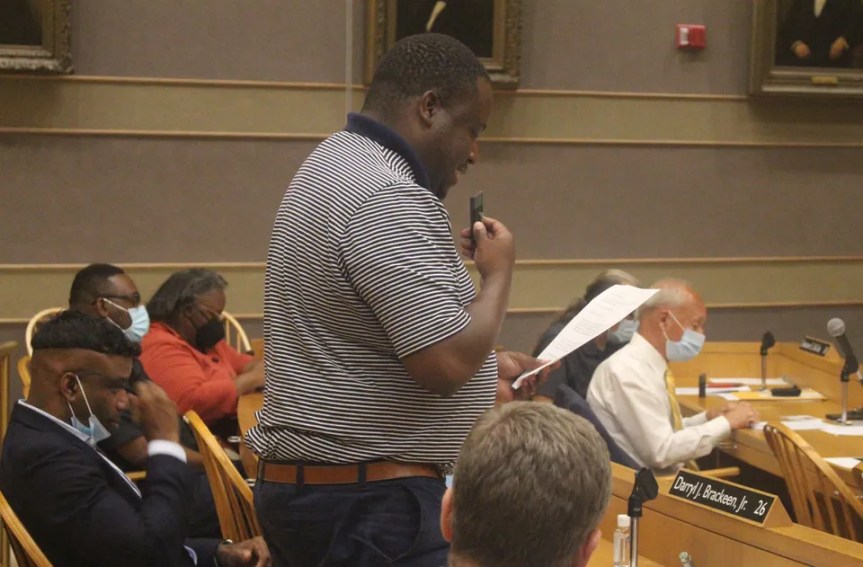
This resolution ​“speaks for itself,” Health and Human Services Committee Chair and Westville Alder Darryl Brackeen, Jr. said in support of the item as the New Haven Board of Alders Vote To End Cuba Embargo | Photo credit: New Haven Independent

A spirited and persistent campaign joined by peace activists in New Haven struck gold on July 6 as the Board of Alders of that large Connecticut city approved a resolution calling upon Biden administration to “to build a new cooperative relationship between the United States and Cuba and to immediately end all aspects of the United States economic, commercial and financial embargo against Cuba.”

The action this week followed testimony community members led by the New Haven Peace Coalition before the Board’s Health and Human Services Committee on June 24. That committee went on to recommend “without dissent” that the Board approve the anti-blockade resolution.

In written testimony read at the session, acting Peace Coalition head and veteran U.S. Communist Party activist Joelle Fishman, pointed out that. “As a city heavily invested in medicine, New Haven would gain from humanitarian exchanges about the most up-to-date treatments and medicines under development. Cuba is also pioneering in local sustainable food production.”

Cuba has gained enviable reputation internationally for its healthcare achievements, biomedical research, and ecologically sound agriculture.

The process toward the New Haven municipal authorities’ unanimous approval of their resolution had begun in September 2021 when the New Haven Peace Council and other groups first presented a proposed version of an anti-blockade resolution to the Board of Alders.

For many years, the Peace Council, affiliated with the New Haven-based U.S. Peace Council, and the New Haven Peace Coalition have jointly engaged in community-wide education and advocacy efforts on a wide range of human rights issues. The coalition enjoys the status of an official city commission.

In calling for an end to the U.S. economic blockade of Cuba, New Haven joins a bevy of other U.S. cities, and even states, in a grassroots campaign to get rid of this 60-year-old cruel, illegal, and immoral U.S. policy. The list now is long.

The most recent additions are Massachusetts cities Brookline on June 10 – a second time for that city – and Boston on May 16. The Bostonians defiantly called for “full restoration of trade and travel between the two countries.”

The Chicago city council’s unanimous passage of an anti- blockade resolution in February 2021 represented a major addition.  Chicago is the nation’s third largest city.

Other cities passing such resolutions are: Pittsburg, St. Paul Minneapolis, Cleveland, Detroit, Sacramento, and Hartford. The list includes Helena, MT; Cambridge, MA and Oakland, Berkeley, and Richmond – all in California.  States whose legislative bodies have passed resolutions are Alabama, Michigan, California and Minnesota.

Henry Lowendorf, president of the Greater New Haven Peace Council, outlined how actions taken against the U.S. blockade of Cuba contribute to peace. Commenting on the Human Service Committee’s approval on June 24 of the proposed resolution, Lowendorf declared that. “Despite the blockade no Cuban families, unlike in New Haven, are homeless. Despite the blockade all Cubans, unlike New Haveners, enjoy fully covered first-class healthcare.”

He added: “We have much to learn from how Cuba manages to guarantee its citizens these rights despite the US noose around its neck. That noose is intended not only to reverse these rights in Cuba but to prevent us from visiting Cuba, seeing for ourselves and demanding the same rights for ourselves from our own government.”


W. T. Whitney Jr. is a political journalist whose focus is on Latin America, health care, and anti-racism. A Cuba solidarity activist, he formerly worked as a pediatrician, lives in rural Maine. W.T. Whitney Jr. es un periodista político cuyo enfoque está en América Latina, la atención médica y el antirracismo. Activista solidario con Cuba, anteriormente trabajó como pediatra, vive en la zona rural de Maine.

Crisis in Cuba Requires End of US Blockade Now / by W. T. Whitney Jr.

Cuban Flag | Museum of the Revolution, Havana, Cuba, 2012. (Photo: Terry Feuerborn / Flickr)

Friends of socialist Cuba like good news about that country. Now bad news has its use. Grief and hardship currently are such that, clearly, the U.S. economic blockade of Cuba must end at once. The harsh details, appearing below, testify to potential destabilization in Cuba, danger to Cuba’s socialist project, and the nefarious role of the blockade. A major mobilization against the blockade is due. The need for action is obvious. 

The blockade, a 60-year-old relic of history, places few heavy demands on the U.S. public. No governmental funding is required. The Treasury Department issues fines and presidents make ritualistic declarations. People dodge travel restrictions. It’s a slow-motion affair. Distracted pro-Cuba activists may lose track of harassment details. Here they get a refresher course, for motivation toward action. It emphasizes blockade effects on people’s lives.

In the Beginning

Cuba’s vulnerability is the result mainly of U.S. policies directed at “denying money and supplies to Cuba … to bring about hunger, desperation, and overthrow of government.” The words are those of a State Department memorandum of April 6, 1960.

The flow of money to Cuba – international loans and export income –has long been feeble. International banks, financial institutions, and corporations handling dollars on Cuba’s behalf risk big U.S. Treasury Department fines. U.S. legislation blocks Cuba from importing the products of multi-national companies with branches in the United States – even food and medical supplies. For almost 30 years third-country ships docking in Cuba have been prohibited from entering a U.S. port for the following six months. Since 2019 the U.S. government has sanctioned Venezuelan ships carrying oil to Cuba.

The U.S. government harasses Cuba’s tourism industry, the source of most of Cuba’s foreign currency. Restrictions, variably regulated, operate against U.S citizens’ travel to the island. Why? They would spend money there. To discourage potential investors, U.S. legislation enables the heirs of properties nationalized in Cuba to take legal action in U.S. courts against investors who make use of such properties.

Cuba’s commerce with the United States has been nil for 60 years, except for heavily regulated Cuban agricultural exports. The northern neighbor used to be and still could be Cuba’s most convenient trading partner.

People are hurting

The U.S. blockade constitutes the main impediment to Cuba’s industrial production and overall economic development. Soviet Bloc nations formerly provided relief. Since then, strictures placed on imports have caused shortages of raw materials, replacement parts, consumer goods, new tools and machines, and reagents for drug and vaccine manufacture.

The blockade recently has complicated lives already beleaguered by the Covid-19 pandemic and an 11 percent economic recession resulting from the pandemic.

An Associated Press report of June 22 highlights a lack of new housing and impediments to repairing houses.  In 2019, 44,000 homes were built, in 2000, 32,000 homes, and in 2021,18,000. Building materials are in short supply. Hurricanes and the pandemic aggravated the situation.

Elderly Cubans experienced isolation and lack of supplies during the pandemic. For two years they’ve experienced weakened cultural and support services and reduced housing options. Fuel shortages in late 2021 led to fewer bus-runs in Havana. Wait-times were even longer.  Pharmacies in 2020 had available only 35 percent of their normal stock.

In recent times, infant death rates in Cuba matched the favorable rates of well-resourced countries, and were lower than U.S. rates. Astoundingly, Cuba’s infant mortality rate in 2021 was 7.6 infant deaths per 1000 births, up from 4.9 in 2000 and 5.0 in 2019. Cuba’s 2021 rate of mothers dying from pregnancy and childbirth difficulties was 176.6 – out of 100,000 mothers giving birth – up from 40.0 mothers in 2000 and 37.4 in 2019.

The increases stem from Covid-19 infection mortality added to deaths in non-Covid times. Experts say the deaths of children and mothers can reflect social factors – mothers’ low educational levels, reduced access to healthcare and other services, and poor nutrition. Therefore, the U.S. blockade, which does affect social well-being, may have taken a toll in this area too.

Cuba’s food supply is unstable what with reduced food production, inefficient distribution, marketing based on income levels, and quality variations.  At an annual cost of $2 billion, Cuba’s government still must import 60-70 percent of the food consumed in Cuba.

Production levels remain low despite reforms introduced after 2008, among them: land distribution, allowances for farmers’ permanent use of land, marketing reforms, governmental assistance to individual farmers and agricultural cooperatives, new distribution systems, local decision-making on assistance and policies, and ecologically sustainable methods.

The U.S. economic blockade is not responsible for soil deficiencies, officials’ inaction, drought conditions, overgrowth of invasive plants, and the appeal of urban life for rural youth. Blockade effects do show up in farmers’ reduced access to credit and lack of funds for fertilizer, seeds, breeding stock, spare parts, new equipment, and fuel.

Inflation holds sway in Cuba now. Prices, rising for two years, are up now by 70 percent and more. Access to essential goods is impaired. Frustration at high prices and shortages helped trigger island-wide protests on July 11, 2021 and has contributed to record emigration.

The U.S. blockade set the stage for inflation. After losing its commercial partnership with the Soviet Bloc, which disappeared in 1991, Cuba was in trouble.  The blockade blocked access to international loans and interfered with income derived from exports, the latter effect stemming from export restrictions. Consequently, funds have been short for importing essential products and for developing the economy.

Cuba desperately needed foreign currency and therefore brought tourists to the island to spend money that would end up with the government. From 1993 on, their money was captured via a new currency called the Cuban convertible peso (CUC). Tourists surrendered their own currencies in exchange for the CUCs.

Cubans, not all of them, acquired CUCs and were able to buy goods and dollars unavailable to Cubans without CUCs. Inequalities emerged. Responding, the government gradually withdrew CUCs from circulation, beginning in January 2021. Anticipating hardships, it raised salaries and pensions payable in Cuba’s “national peso.”

New money in circulation stimulates inflation, especially when goods for sale are in short supply, as in Cuba. The national currency lost value. Tourists, excluded during the pandemic, returned in late 2021. Their money, circulating, added to inflationary pressures. CUCs with a prominent role in Cuba’s informal economy, and still circulating, did likewise. The role of CUCs suggests the blockade’s indirect contribution to inflation.

Persevering

Those defenders of Cuba worried about diminished Cuban-government commitment to bettering people’s lives may need reassurance. Of note:

·        Cuban president Miguel Díaz-Canel Bermúdez on June 21 addressed a meeting which elevated the role of social work. Discussion centered on mothers living in cities in “situations of vulnerability.”

·         Support programs are in place for elderly Cubans experiencing isolation, for example, the “Accompany Me (Acompáñame) project of telephone assistance and the National Program for Comprehensive Attention to Elders.

·        As of 2021, 423 so-called Projects of Local Development promoted food production, small workplaces, and tourism along with socio-cultural, environmental, and research programs.

·        The government promotes its program known as “micro, small, and medium [size] businesses.” These mostly privately owned enterprises, numbering 1,188 last year, produce food products, building materials, furniture, textile products, footwear, cleaning supplies, computer accessories, recycling serves, and more.

·        The government in April 2021 approved 43 measures directed at increased agricultural production and food availability. Results are far from ideal, an observer notes.

The blockade, a 60-year-old relic of history, places few heavy demands on the U.S. public.

·        Prime Minister Manuel Marrero Cruz, on June 24 visited a district in Cardenas to assess progress toward “improvements of roads, water supply, housing construction and social work.”

What to do

Resistance to the U.S. blockade within the United States has been constant for decades, but to no avail. Thanks to the Helms-Burton Law of 1996, the hurdle now is forcing the Congress to act. For that to happen, masses of people must stand up together and weigh in.

But that won’t happen, it seems, as long as activists continue to view the blockade as an isolated issue. What’s needed is collective action on many issues toward changing the direction of the U.S. government itself. The common ground would be justice and decent lives for all people everywhere, Cubans among them.

Also required would be new understanding that U.S. assault on Cuba happens as part of the larger U.S. project of capitalism worldwide and imperialist domination. The big mobilization to end the blockade would be part of a larger mission to take apart that U.S. project. Oppressed and plundered nations would be rescued, Cuba among them.

One adjustment: U.S. progressives ought to reject that old dictum that “Politics stops at the water’s edge.” It sends the message that solidarity with and struggle for oppressed peoples overseas doesn’t matter. That’s not so.

By no means will these suggestions bear fruit in time to end the blockade soon. Hope and struggle will remain. U.S. public opinion favors ending the blockade. People in the United States now fighting the blockade are experienced and want to enlarge the movement. Maybe chaos attending capitalism’s failures, new wars, and international divisions will distract the U.S. government from bothering with Cuba. Maybe international solidarity with Cuba will continue growing. Revolutionary Cuba, with unity and effective leadership, is known for overcoming challenges.  


W. T. Whitney Jr. is a political journalist whose focus is on Latin America, health care, and anti-racism. A Cuba solidarity activist, he formerly worked as a pediatrician, lives in rural Maine. W.T. Whitney Jr. es un periodista político cuyo enfoque está en América Latina, la atención médica y el antirracismo. Activista solidario con Cuba, anteriormente trabajó como pediatra, vive en la zona rural de Maine.

US Constitution – Bad Medicine for Children / by W. T. Whitney Jr.

Photo credit: Ariel Rakovitsky (@ARakovitsky) | twitter.com

Public health is about curative, rehabilitative, and especially preventative healthcare for everybody, no exclusions. Failed public health was on display during the Covid-19 pandemic. “The United States has the highest rate of COVID-19 deaths per capita” among 11 high-income countries, according to one infectious disease specialist.

Similarly, local authorities allowed dangerous levels of lead to persist in the drinking water of Flint, Michigan, and other cities. Lead damages the brain of young children and recently was shown to have contributed to lowered IQs in 170 million Americans who are now adults. 

The constitutions of only a few governments speak of people’s right to health or healthcare. Without offering specifics, the U.S. Constitution mentions a duty to “promote the general welfare.” The Constitution provides for political freedoms, but concentrates on devices aimed at diffusing political power. Examples are checks and balances, federalism, and separation of powers.

Its framers were fearful of political factions and their jostling for political power. In Federalist No. 10 (1787), James Madison explains: “A landed interest, a manufacturing interest, a mercantile interest, a moneyed interest, with many lesser interests, grow up of necessity in civilized nations, and divide … into different classes, actuated by different sentiments and views. The regulation of these various and interfering interests forms the principal task of modern legislation.”

The “common and durable source of factions has been the various and unequal distribution of property, he adds; “Those who hold and those who are without property have ever formed distinct interests in society.” 

Delegates to the Constitutional Convention (1787) sought to protect wealth and private property; they made suitable arrangements for governing. Public health was not on their agenda, not least because the scientific basis for preventing sickness, injuries and deaths did not yet exist.  Subsequently the U.S. government’s commitment to “promote the general welfare” remained weak. A tradition of healthcare as private enterprise has contributed to smothering public health.

Widespread disregard for public health and for teaching about prevention has contributed to sectors of the people embracing irregular views. Anti-vaccine bias is one of them. 

Similarly, agitators dealing with gunfire killings put forth skewed notions of constitutional law. By any rational standards, the killings represent a public health problem, just as do injuries and deaths from accidents, automobile accidents included.

In the same vein, abortion opponents obsess about prevention in the name of preserving life. Their position would be commendable from the public-health point of view, if their passion did not disappear once a baby was born.

A general weakening of child-health advocacy and ultimately of preventative programs exemplifies the current plight of public health endeavors in the United States. Serving to illustrate is the high U.S. incidence of preventable childhood deaths.

In comparison with young people in 16 other high-income countries, younger Americans experience the “highest age-specific mortality rates for every age group under age 25,” according to the Population Reference Bureau (PRB). Infant mortality in the United States ranks as the highest by far among 11 high-income nations; The U.S. infant mortality rate is greater than that of 49 other countries.

Childhood poverty in the United States is elevated. One current estimate is that 18% of U.S. children in the United States live in poverty; in 2019, 26% of Black children lived in poverty.

That’s important, because the more U.S. parents are afflicted by poverty, the more likely their babies will die.  The National Center for Biological Information notes that, “Higher infant mortality among low socioeconomic groups has been recognized as a societal problem in the US for 140 years.”

Epidemiologists cite the association of prematurity with infant death and the role of poverty in contributing to premature birth. But, according to one analyst, poverty also impinges upon full-term babies. These babies born to low-income parents die at a rate 1.4 to 1.8 times higher than do the babies of higher income families.

Babies are more likely to survive if their caretakers have material resources. The fact of governments or societies being well-resourced does not matter. That’s evident in a study showing that the U.S. “gross domestic product health expenditure,” which is the highest among 14 western nations, exerted no effect on reducing childhood deaths. However, the U.S. income-inequality gap, greater than that of any of those 14 nations, was “highly significant.”

Similarly, the United States registers the highest gross national income per capita among the 38 member-nations of the Organization for Economic Co-operation and Development. Even so, the U.S. infant mortality rate exceeds that of all but three of those states.

The United States has a money-distribution problem. Not enough ends up where it might “promote the general welfare.” Where does the money go?

Oxfam reports that, “global food giant” Cargill company, based in Minnetonka, Minnesota and owned, for the most part, by the world’s 11th richest family, has provided members of that family with $42.9 billion, up $14.4 billion since 2020; that the Walton family, owning half of Walmart’s shares, has gained $238 billion – up $8.8 billion since 2020; that Moderna company converted $10 billion in government funding for a Covid-19 vaccine into $12 billion in profits; that vaccine manufacturer Pfizer company last year paid $8.7 billion in shareholder dividends.

Wealth of the world’s billionaires grew “more in the first 24 months of COVID-19 than in 23 years combined.” Their total wealth is “equivalent to 13.9 percent of global GDP.”

The Constitution’s authors were in the dark when they were trying to discipline ruling-class factions. They could not know that European and North American capitalists would be plundering a new industrial and colonial world to accumulate wealth and enlist governments in their service.

U.S. governments would take on an increasingly prominent role in that project. To distribute wealth for the common good was not in the cards.

For one thing, the Constitution imposed rules aimed at blocking full democracy. These include two-thirds majority requirements, indirect elections of presidents (and, for a while, senators), the disproportionate electoral power of small states, voting limitations, and a powerful judicial branch. The framers of course made accommodations for slavery.

Some framers bemoaned the “danger of the leveling spirit” or saw an “excess of democracy.” For delegate Rufus King, “the unnatural Genius of Equality [was] the arch Enemy of the moral world.”

Architects of the Constitution used the ploy of divide and rule to control entities of their new government. They could not know how, later on, defenders of capitalism would use that tool to great effect while seeking to break apart the unity of people in resistance. Those in charge now create divisions through tension over guns, abortion, and equality for African-descended people.

Such is the setting for our fight for children’s lives, for universal healthcare, and more. The time is right for unity, yes, and for radical solutions.


W.T. Whitney Jr. is a political journalist whose focus is on Latin America, health care, and anti-racism. A Cuba solidarity activist, he formerly worked as a pediatrician, lives in rural Maine. W.T. Whitney Jr. es un periodista político cuyo enfoque está en América Latina, la atención médica y el antirracismo. Activista solidario con Cuba, anteriormente trabajó como pediatra, vive en la zona rural de Maine.

Building the Communist Movement is Women’s Work (and Men’s Too) / by W. T. Whitney Jr.

Analyst Taryn Fivek, in her recent article on the CPUSA website, offers explanations for women’s frequent reluctance to take part in progressive politics. She calls for more involvement of women in the struggle for socialism. Here we review some of her conclusions and argue that women’s role in struggle must be large, one reason reason being the nature of socialist struggle and another, women’s experience and special qualifications.

Fivek points to barriers of male prejudice and of misplaced disparagement of women’s work, both in the workplace and in “social reproduction.” Not only do woman work for relatively low wages “in the productive sphere of the economy,” but, as she claims, “they are also working unpaid in the reproductive sphere” and, indeed, are “35% more likely than men to live in poverty.”

She points out that, [w]omen’s economic well-being is often tied to their role as primary laborer in a male-dominated household” and economic dependency may lead to “difficulty in leaving abusive relationships.” Fivek attributes women’s hesitancy to act politically to the assumption by most women, shared by society at large, that as care-givers “the major site of their oppression — the interpersonal or reproductive sphere … [is] ‘private’ and ‘personal.’”

The prevailing version of social reproduction alluded to by Fivek centers on home-based activities concerned with nurturing, protecting, and preparing workers for the future. In fact, as she points out, “social reproduction is not a private affair.” But she is also embracing a more far-reaching definition such as this one: social reproduction has to do with ways “by which a society maintains and transforms its social order, formations, and relations across time and space”.  

She insists that, “To say that the personal is not political is to accept the gender gap in our political work.” Women are to be accommodated and “included in all areas of political work.” She asks: “What can the [Communist] Party do to increase participation and leadership of women in the struggle for socialism?”

At issue are the characteristics of the kind of social reproduction operating in the public sphere. Women and men are already politically involved in that arena, but more women are needed.   

Some assumptions intrude. With its mechanistic overtones and utilitarian implications of supplying future workers, the unattractive term social reproduction needs replacing. And the customary linkage of social reproduction with women’s major role in family life must evolve, as a work in progress, into a larger role for men. Lastly, capitalists will not soon view any kind of social-reproduction work as other than a “free gift,” or as deserving merely of crumbs.

As envisioned here, the social-reproduction project is huge, so much so that working-class women and men will reject injustices impinging on their lives; will listen, learn, collaborate, and teach; care for people and nature; and manage affairs. Confronting governments, local ones not least, they will continue to agitate for livable incomes, roofs over heads; access to schooling from infant day-care to universities, lifelong education, sicknesses prevented and treated, no hunger, solidarity with workers abroad. – with no one left out.

The premise is that family-based tasks of taking-care-of and caring-for are expandable, and are important in society.  In conversation long ago with an American Communist and poet (Pulitzer Prize!) of provocative bent, that message was clear. Hearing about a male, myself, learning to be a doctor, he exclaimed in mock horror something like, “Why, that’s women’s work!”

Those whose work is that of perpetuating the generations have a name, not a laughably awkward one like “social reproducer,” but rather “socialist,” that is to say, socialist men and socialist women. 

Many or most women have the experience, predisposition, and – as it seems – the skills to take care of people and things – in other words, to be socialists. Today, socialist parties and socialist organizations badly need women as colleagues and comrades. Tasks ahead are momentous and recruits are needed who are prepared.

According to Psychology Today, “Girls and women … have advantages for many basic language-related skills … [and most] 12-year-old girls were more skilled than the average same-age boy at making inferences about the thoughts, feelings, and social perspective of their peers.”

It’s no surprise that, as reported recently by pewresearch.org, “Young women are more likely to be enrolled in college today than young men, and among those ages 25 and older, women are more likely than men to have a four-year college degree. The gap in college completion is even wider among younger adults ages 25 to 34.”

A University of Zurich study in 2018 claims that: “Demand for high-skilled workers who perform cognitive tasks has increased dramatically in the United States … [We find that] the probability that a college-educated man was employed in such a job fell, while the prospects for college-educated women improved. The key driver seems to be growing demand for social skills, such as empathy, communication, emotion recognition and verbal expression, in which evidence from psychological research indicates that women have a comparative advantage.”

Camila Vallego, Karol Cariola, and Marisela Santibáñez of the Communist Party of Chile

Reporting on a United Nations-organized conference in Chile in 2015 about women and political power, Winnie Byanyima, then the executive-director of Oxfam International, states that, “[W]hen you have more women in public decision-making, you get policies that benefit women, children and families in general …There is already enough evidence in the world to show the positive impact of women’s leadership. Women have successfully built and run countries and cities, economies and formidable institutions.” 

Caretaking means peacemaking. UN-sponsored research looking at 40 peace processes between 1989 and 2014 showed in 2015 that, women have managed to make substantial contributions to peacemaking and constitution-making negotiations.”  The study showed that, “where women were able to exercise strong influence on a negotiation process, the chances of agreements being reached and implemented were much higher than when women’s groups exercised moderate, weak, or no influence.”

Former Cuban president Raúl Castro has the last word.  Reporting to a Cuban Communist Party Congress in 2016, Castro noted with regret that women occupied only “38% of positions in state bodies, government agencies, national entities.”  This was despite women representing 49% of Cuba’s workforce and “66.8% of the best technically and professionally qualified workforce of the country.”

He continued: “I stand by the strictest truth when I affirm, based on my experience in many years of Revolution, that women, generally, are more mature and better managers than men. Therefore, although I recognize the progress made, I believe that under the leadership of the Party, the promotion of our combative females should continue rising, especially to decision-making positions nationwide.”

W.T. Whitney Jr. is a political journalist whose focus is on Latin America, health care, and anti-racism. A Cuba solidarity activist, he formerly worked as a pediatrician, lives in rural Maine. W.T. Whitney Jr. es un periodista político cuyo enfoque está en América Latina, la atención médica y el antirracismo. Activista solidario con Cuba, anteriormente trabajó como pediatra, vive en la zona rural de Maine.

Building the Communist Movement is Women’s Work (and Men’s Too) / by W. T. Whitney Jr.

Analyst Taryn Fivek, in her recent article on the CPUSA website, offers explanations for women’s frequent reluctance to take part in progressive politics. She calls for more involvement of women in the struggle for socialism. Here we review some of her conclusions and argue that women’s role in struggle must be large, one reason reason being the nature of socialist struggle and another, women’s experience and special qualifications.

Fivek points to barriers of male prejudice and of misplaced disparagement of women’s work, both in the workplace and in “social reproduction.” Not only do woman work for relatively low wages “in the productive sphere of the economy,” but, as she claims, “they are also working unpaid in the reproductive sphere” and, indeed, are “35% more likely than men to live in poverty.”

She points out that, [w]omen’s economic well-being is often tied to their role as primary laborer in a male-dominated household” and economic dependency may lead to “difficulty in leaving abusive relationships.” Fivek attributes women’s hesitancy to act politically to the assumption by most women, shared by society at large, that as care-givers “the major site of their oppression — the interpersonal or reproductive sphere … [is] ‘private’ and ‘personal.’”

The prevailing version of social reproduction alluded to by Fivek centers on home-based activities concerned with nurturing, protecting, and preparing workers for the future. In fact, as she points out, “social reproduction is not a private affair.” But she is also embracing a more far-reaching definition such as this one: social reproduction has to do with ways “by which a society maintains and transforms its social order, formations, and relations across time and space”.  

She insists that, “To say that the personal is not political is to accept the gender gap in our political work.” Women are to be accommodated and “included in all areas of political work.” She asks: “What can the [Communist] Party do to increase participation and leadership of women in the struggle for socialism?”

At issue are the characteristics of the kind of social reproduction operating in the public sphere. Women and men are already politically involved in that arena, but more women are needed.   

Some assumptions intrude. With its mechanistic overtones and utilitarian implications of supplying future workers, the unattractive term social reproduction needs replacing. And the customary linkage of social reproduction with women’s major role in family life must evolve, as a work in progress, into a larger role for men. Lastly, capitalists will not soon view any kind of social-reproduction work as other than a “free gift,” or as deserving merely of crumbs.

As envisioned here, the social-reproduction project is huge, so much so that working-class women and men will reject injustices impinging on their lives; will listen, learn, collaborate, and teach; care for people and nature; and manage affairs. Confronting governments, local ones not least, they will continue to agitate for livable incomes, roofs over heads; access to schooling from infant day-care to universities, lifelong education, sicknesses prevented and treated, no hunger, solidarity with workers abroad. – with no one left out.

The premise is that family-based tasks of taking-care-of and caring-for are expandable, and are important in society.  In conversation long ago with an American Communist and poet (Pulitzer Prize!) of provocative bent, that message was clear. Hearing about a male, myself, learning to be a doctor, he exclaimed in mock horror something like, “Why, that’s women’s work!”

Those whose work is that of perpetuating the generations have a name, not a laughably awkward one like “social reproducer,” but rather “socialist,” that is to say, socialist men and socialist women. 

Many or most women have the experience, predisposition, and – as it seems – the skills to take care of people and things – in other words, to be socialists. Today, socialist parties and socialist organizations badly need women as colleagues and comrades. Tasks ahead are momentous and recruits are needed who are prepared.

According to Psychology Today, “Girls and women … have advantages for many basic language-related skills … [and most] 12-year-old girls were more skilled than the average same-age boy at making inferences about the thoughts, feelings, and social perspective of their peers.”

It’s no surprise that, as reported recently by pewresearch.org, “Young women are more likely to be enrolled in college today than young men, and among those ages 25 and older, women are more likely than men to have a four-year college degree. The gap in college completion is even wider among younger adults ages 25 to 34.”

A University of Zurich study in 2018 claims that: “Demand for high-skilled workers who perform cognitive tasks has increased dramatically in the United States … [We find that] the probability that a college-educated man was employed in such a job fell, while the prospects for college-educated women improved. The key driver seems to be growing demand for social skills, such as empathy, communication, emotion recognition and verbal expression, in which evidence from psychological research indicates that women have a comparative advantage.”

Camila Vallego, Karol Cariola, and Marisela Santibáñez of the Communist Party of Chile

Reporting on a United Nations-organized conference in Chile in 2015 about women and political power, Winnie Byanyima, then the executive-director of Oxfam International, states that, “[W]hen you have more women in public decision-making, you get policies that benefit women, children and families in general …There is already enough evidence in the world to show the positive impact of women’s leadership. Women have successfully built and run countries and cities, economies and formidable institutions.” 

Caretaking means peacemaking. UN-sponsored research looking at 40 peace processes between 1989 and 2014 showed in 2015 that, women have managed to make substantial contributions to peacemaking and constitution-making negotiations.”  The study showed that, “where women were able to exercise strong influence on a negotiation process, the chances of agreements being reached and implemented were much higher than when women’s groups exercised moderate, weak, or no influence.”

Former Cuban president Raúl Castro has the last word.  Reporting to a Cuban Communist Party Congress in 2016, Castro noted with regret that women occupied only “38% of positions in state bodies, government agencies, national entities.”  This was despite women representing 49% of Cuba’s workforce and “66.8% of the best technically and professionally qualified workforce of the country.”

He continued: “I stand by the strictest truth when I affirm, based on my experience in many years of Revolution, that women, generally, are more mature and better managers than men. Therefore, although I recognize the progress made, I believe that under the leadership of the Party, the promotion of our combative females should continue rising, especially to decision-making positions nationwide.”

W.T. Whitney Jr. is a political journalist whose focus is on Latin America, health care, and anti-racism. A Cuba solidarity activist, he formerly worked as a pediatrician, lives in rural Maine. W.T. Whitney Jr. es un periodista político cuyo enfoque está en América Latina, la atención médica y el antirracismo. Activista solidario con Cuba, anteriormente trabajó como pediatra, vive en la zona rural de Maine.

The United States Uses and Abuses Migration from Cuba and Elsewhere / by W. T. Whitney Jr.

A Cuban national walks along a road after crossing the Mexico-Texas border at the Rio Grande, Sept. 23, 2021, in Del Rio, Texas. | Julio Cortez / AP

Presently 3.6% of the world’s people live in a country other than their own. They move to escape wars, oppression, poverty, hunger, climate-change effects, or to find new work, or because they were forced to move. The story is also about nations weaponizing or exploiting migration. 

After a decade or so of relatively few Cubans arriving in the United States, their numbers are up. Between 2018 and 2021, some 2,000 Cubans emigrated to the United States. But in January almost 15,000 Cubans crossed the U.S. southern border; the daily average in February was 1500. U.S. border officials are seeing “a twelvefold increase over 2020,” according to the Washington Post.

Contributing to migration is the increasingly dismal state of Cuba’s economy. At work has been U.S. economic blockade, fallout from the Covid-19 pandemic, and unresolved domestic issues including: inflation, corruption, cumbersome implementation of reforms, shortfalls in domestic food production, and fallout from converting two currencies into one. 

U.S. officials deported only 20 arriving Cubans in the past five months, and only 95 during 2021. That’s because Cuban immigrants arriving without papers are privileged, thanks to the 1966 Cuban Adjustment Act (CAA).  That law enables unauthorized Cuban migrants automatically to gain permanent residence after a stay of two years, which in 1976 became one year. By contrast, non-Cuban arrivals have to apply for permanent residence and then wait. 

President Obama in January 2017 repealed an administrative regulation allowing those Cuban migrants who entered the United States after sea-travel to stay, while sending Cubans apprehended at sea back to Cuba. No longer could Cubans arriving by water remain. Migrants reacted by resorting to the arduous Central American land route to the U.S. border. 

When the migrants of other countries travel that route, cross the border, and are apprehended, they are either quickly deported, allowed to wait in Mexico or in immigration prisons for asylum decisions, or are released to await court appointments.  By contrast, Cubans crossing the border usually gain so-called “humanitarian parole” and are released. Or they are released after brief detentions to await immigration-court rulings on asylum requests. After a year they become eligible for permanent residence, as per the CAA. 

The CAA-mediated enticement of early permanent residence has served the U.S. purpose of encouraging a flood of Cuban immigrants who, by fleeing, are living proof of alleged Communist oppression. Maybe the purpose of a relatively relaxed treatment of a new generation of Cuban migrants, who also arrive after great travail, is to revive that salutary example of escape from Communism. 

But paradoxically, the U.S. government acts also as if to impede travel by Cubans to the United States, as if to keep them away.   For example, the U.S. government in 2017 removed personnel from its Embassy in Havana. This was in response to the neurologic syndrome, still unexplained, that afflicted diplomats stationed there. Doing so, the State Department deprived Cubans of consular services needed for legal travel to the United States.

They’ve been forced to visit U.S. embassies elsewhere to obtain entry visas, in Bogota, Colombia and in Guyana.  The travel costs are prohibitive for most travelers. The U.S. government indicated in March that its Havana Embassy would soon be processing visas for entry into the United States, but only for parents of U.S. citizens.  

The two governments agreed in 1994 on a mechanism for legal emigration of Cubans to the United States. The U.S. government would authorize at least 20,000 lottery-chosen Cubans every year to move permanently to the United States.  But U.S. immigration officials almost never issue the required number of entry visas. 

Cubans without papers who want to reach the U.S. border via the Central American land route must start their trek in a country not requiring an entry visa. Now Nicaragua remains as the only visa-free country for Cubans. That’s because Panama, Colombia, and Costa Rica recently began demanding them, possibly at the behest of the U.S. government. 

Why does the U.S. government try to keep Cubans away from the United States even as it encourages them to establish permanent residence? Maybe officials want to show off the difficulties Cubans put up with so as to highlight Cubans’ ardor to leave a country that, in the official U.S. version, is troubled and oppressive.  Or maybe they want distressed Cubans to remain at home so they will end up joining destabilization campaigns there.  

But U.S. unease does prevail over the possibility of large numbers of Cuban migrants arriving and overwhelming U.S. abilities to absorb them.  Tens of thousands of Cubans did present that still-remembered threat as they departed for the United States via the “Mariel boatlift” (1980) and the “Cuban rafter crisis” (1994).  

One aspect of Cuban migration is shared with worldwide migration patterns, as explained by Cuban scientist and close political observer Agustín Lage.  In regard to increasing Cuban emigration to the United States, Lage emphasizes “the emigration of young people with university education.” 

That phenomenon reflects “changing migratory processes during the twentieth century” that affect economies and jeopardize “states with compromised social and economic development.” He is alluding to underdeveloped societies in the Global South and presumably to the legions of scientists and physicians Cuba has prepared over many years. They are “human capital” and are a major resource for Cuba’s economy.

Lage points out that immigrants of the “professional” classes entering the United States have increased from 3% in 1930 to 40% now, at which point most have been educated in Asia and Latin America. One third of all scientists prepared in the under-developed world now live in developed nations.  What’s crucial is that “the segment of migrants with a university education grows more rapidly than the quantity of migrants in general.”

The United States is the “principal beneficiary of this migratory flow.”  Of all scientists who emigrated from under-developed countries, 76% are in the United States. Lage cites U.S. legislation favoring migrants with “academic degrees” as indicative of U.S. purpose. 

“The countries of the South invest in the formation of human capital. But part of that human capital emigrates.” Economies in the North gain “value-added” benefit. Underdeveloped countries lose twice. They pay the cost of educating qualified people who leave and pay for “high-technology products they must import,” and which represent “an undeniable contribution from those same migrants.”  

For Lage, the United States shapes immigration policies according to economic self-interest and readily subjects the needs of lesser countries to its own requirements. Clearly, U.S. manipulation of Cuban migration for counter-revolutionary purposes is in the same vein.  

Lage concludes: “Against us has been operating economic aggression for more than six decades that has affected the population’s material living conditions. In any historical moment and in any place on the planet, prolonged economic difficulties have given rise to migratory pressures. And Cuba is on this planet. “But our history and our culture are in our favor. The Cuban national consciousness is the basis for our capacity of resistance. Our culture and our history are deeply rooted here and also in the consciousness of Cubans who don’t live here.”  Nevertheless, “our project of a socialist society, one ‘with all and for the good of all’ (Jose Marti’s words), is at real risk.  We must not underestimate that.”

W.T. Whitney Jr. is a political journalist whose focus is on Latin America, health care, and anti-racism. A Cuba solidarity activist, he formerly worked as a pediatrician, lives in rural Maine. W.T. Whitney Jr. es un periodista político cuyo enfoque está en América Latina, la atención médica y el antirracismo. Activista solidario con Cuba, anteriormente trabajó como pediatra, vive en la zona rural de Maine.

People’s World, April 12, 2022, https://www.peoplesworld.org/

Book Review: The Struggles and Travail of Anti-Colonialist W. Alphaeus Hunton / by W. T. Whitney Jr.

Alphaeus Hunton, second from left in the foreground, along with Petitioners Julian Mayfield, Alice Windom, W.A. Jeanpierre, and Maya Angelou Make, deliver a petition to the U.S. Embassy in Accra, Ghana, in 1963. | New York Public Library

Tony Pecinovsky, Edited by and Introduction by; The Cancer of Colonialism – “W. Alphaeus Hunton, Black Liberation, and the Daily Worker, 1944-1946;” (International Publishers, New York, 2021); https://www.intpubnyc.com; ISBN- 9780717808816, pp 355, $19.99

Political movements and activists seeking to serve the people move toward unity of purpose and action. Separate struggles come together. Beginning in the mid-1930s, W. Alphaeus Hunton was constantly widening the scope of his work and teaching. From a grounding in labor activism and fight for racial and economic equality, he embraced national liberation in Africa and peace and cooperation among nations.

Hunton grew up in Brooklyn, his family’s refuge from racist violence in Atlanta. As professor of English literature at Howard University, he organized a faculty labor union. Anticipating the National Negro Congress (NNC), Hunton arranged for a large meeting at Howard. Anti-communists attacked him. That was in 1935.

Alphaeus Hunton addressing four thousand people at Abyssinian Baptist Church to open the famine relief campaign. Josh Lawrence, Paul Robeson, Rev. Shelton Bishop, and Adam C. Powell Sr. are seated behind the cans and bags of food. | Photographs and Prints Division, Schomburg Center for Research in Black Culture, The New York Public Library, Astor, Lenox and Tilden Foundations.

Hunton joined the U.S. Communist Party (CPUSA) in 1936. That year he organized the first national conference of the NNC, an offshoot of the Party. As suggested by historian and labor educator Tony Pecinovsky, “The CPUSA was the only organization on the left to make Africa -American equality a centerpiece of its work.” 

The central theme of Pecinovsky’s new book is Hunton’s contribution, now mostly forgotten, to ongoing resistance against economic and political oppression of Africans and African Americans alike. His internationalist perspective was exemplary.  The book, The Cancer of Colonialism, is clearly written, well-organized, and full of information. Detailed footnotes are a side-benefit. 

The book’s first section, modestly labeled “Introduction,” is a stand-alone resource. It covers intersecting historical features of the inter-war, wartime, and post-World War II periods. Figuring prominently are national liberation struggles playing out in Africa, and also in Vietnam, Indonesia, the Philippines, and Korea. The author traces the twists and turns of U.S. Communists in dealing with racism at home and independence struggles abroad.

The reader learns how the Communist International, and later the Soviet Union, stimulated, prodded, facilitated, and provided material support for national liberation struggles. The author cites the complicity of U.S. imperialism with mass murders, take-downs of newly independent governments, harassment of liberation movements, and anti-communist provocations. He touches upon the prolonged debate within the CPUSA as to whether African Americans constitute an oppressed nation.

Spreading the word  

The second section of Pecinovsky’s book tells about Hunton’s political life. From 1936 on, he organized national conventions for the NNC, edited its publications, and planned education programs. Hunton gained recognition nationwide and in Washington as a leader in opposing racial discrimination and police violence against Black people. 

With chapters in 26 cities, the NNC established the Southern Negro Youth Congress that would set up chapters in 11 southern states and recruit more than 10,000 members. Both organizations were typical of “popular front” groups promoted by the CPUSA. Joining were Communists and, according to the author, “anyone willing to fight for workers’ rights and African American equality.”  The Communist International had launched its popular-front strategy in 1935 in order to fight fascism.

Under fire from anti-communists, Hunton in 1941 was forced to testify before the House Un-American Activities (“Dies”) Committee. He resigned his professorship at Howard in 1943. The NNC merged with the CPUSA-backed Civil Rights Congress (CRC) in 1947, and disappeared. 

Alphaeus Hunton was “the administrative and intellectual mainstay” of the Council on African Affairs (CAA) between 1942, when it began, until its demise in 1955. Paul Robeson was the organization’s co-founder and chairperson and W.E.B DuBois, its vice-chairperson. According to Pecinovsky, The CAA “brought together African Americans fighting for equality with Black liberation movements in Africa while both sought allies within ascendent socialism.” Historian Gerald Horne regards the CAA as “the vanguard organization in the U.S. campaigning against colonialism.” 

Hunton was the CAA’s education director. He edited and wrote for its publications, organized events, mentored young activists, arranged for humanitarian aid deliveries to Africa, and, with Paul Robeson, was a “fixture” at the United Nations. Time and again, he returned to South Africa’s freedom movement. 

International Publishers, 2021

Anti-communist harassment was a constant. Having refused to provide federal investigators the names of donors to the CRC bail fund, Hunton went to prison for six months in 1951. Rather than turn over CAA correspondence to the government in 1955, Hunton dissolved the organization. 

Hunton in 1957 published his book Decision in Africa. He traveled to Ghana, to the Soviet Union, and to Guinea, where he taught and wrote. He moved to Ghana in 1962 to work on DuBois’s Encyclopedia Africana. A CIA-assisted coup forced Hunton to leave Ghana in 1966 for Zambia. He died there in 1970 at the age of 67.

Daily Worker

“The Cancer of Colonialism” concludes with a collection of columns Hunton wrote for the Daily Worker from July 20,1944 to January 19, 1946. A present-day reader of the columns becomes his or her own historian in tracing a transition from optimism to frustration.   

Vice President Henry Wallace is quoted as anticipating “freedom everywhere … under just and democratic principles.” Hunton applies the example of the Soviet Union to the problem of colonies. What Britain failed to do in 100 years, he notes, the USSR did in 25 years. 

Hunton expects that the United States, Britain and Soviet Union would collaborate in shaping a new world and the new United Nations. The worldwide labor movement in the works would help out.

He praises Churchill and Roosevelt’s Atlantic Charter agreement (1941) and the outcome of the Teheran and Yalta conferences in 1943 and 1945, when Stalin joined the other two.  He assumes that agreements on the right of all nations to self-government and on collaboration in securing world peace would last.

Hunton lauds conferences in 1944 at Dunbarton Oaks and Bretton Woods where new trade and financial arrangements were fashioned that, as he expected, would assure the development even of small nations. 

International Publishers, ©1965

He reports on the 1945 San Francisco conference and the agreement there on a United Nations Charter. He offers several columns on South Africa, where the job remained of “liquidating fascism.”

Now Hunton is uncertain. He sees colonialism returning to Korea, Indonesia, Malaya, and Indochina (think Vietnam). He critiques U.S. aggressiveness in demanding to exercise UN-sanctioned trusteeship over Japanese islands and the Pacific islands that had hosted allied bases. Signs crop up of U.S. anti-Soviet hostility. The Cold War is beginning.

Finally, Hunton comments on a Daily Worker article on “Leninism” by William Z. Foster. Having returned to head the CPUSA, Foster, as quoted by Hunton, mentions “dangerous illusions as to exaggerated possibilities” associated with “New Dealism” (Hunton’s term). Hunton cites “reformist illusions [that] act as, [in Foster’s words], a ‘barrier to the movement to socialism.’” 

Hunton’s world had shifted. CPUSA leaders had shared his optimism, so much so that they had taken the CPUSA out of commission – which Foster’s return had remedied. And Hunton’s expectation of continuing amity between the capitalist powers and the Soviet Union was splintering. 

Ultimately, Pecinovsky’s narrative testifies to the commanding role of anti-communism in Hunton’s political life. Pecinovsky borrows from analyst Michael Parenti to say that anti-communism is “the most powerful political force in the world.”

Concluding, we recognize the contribution of International Publishers for not only having presented The Cancer of Colonialism, but also for having republished Alphaeus Hunton’s 1957 book Decision in Africa and Alphaeus Hunton: The Unsung Valiant, Dorothy Hunton’s 1986 biography of her husband.

W.T. Whitney Jr. is a political journalist whose focus is on Latin America, health care, and anti-racism. A Cuba solidarity activist, he formerly worked as a pediatrician, lives in rural Maine.