Medical Doctors Seek Social and Political Solutions for COVID 19 Crisis, W. T. Whitney Jr.

By W. T. Whitney Jr.

It didn’t seem to fit. The website of the Colombian Communist Party on October 5 published an article in which author Félix León Martínez MD recharacterizes a disease. Martínez quotes extensively from an editorial appearing in the famous British medical journal Lancet. There, editor Richard Horton MD claims that COVID 19 is a “syndemic” rather than a disease. 

A disease manifests signs and symptoms. Usually causation and treatment of a disease are familiar. COVID 19 has signs and symptoms too, but Martínez and Horton say that as a syndemic, COVID 19 has causes and treatment methods that are still unknown. In his article, Martínez draws from Horton’s editorial to study the COVID 19 situation in Colombia. The present report aspires to do likewise in regard to the United States. We explore how the insights of both authors apply to managing the disease.   

Martínez, who is an academic investigator specializing in social protection and public health, maintains that “the [COVID 19] pandemic, although in principle a phenomenon of biological origin, affects each nation differently, according to the political, economic and social organization it has established.” His article’s title is “From Pandemic to Syndemic: Poor Prognosis.”  

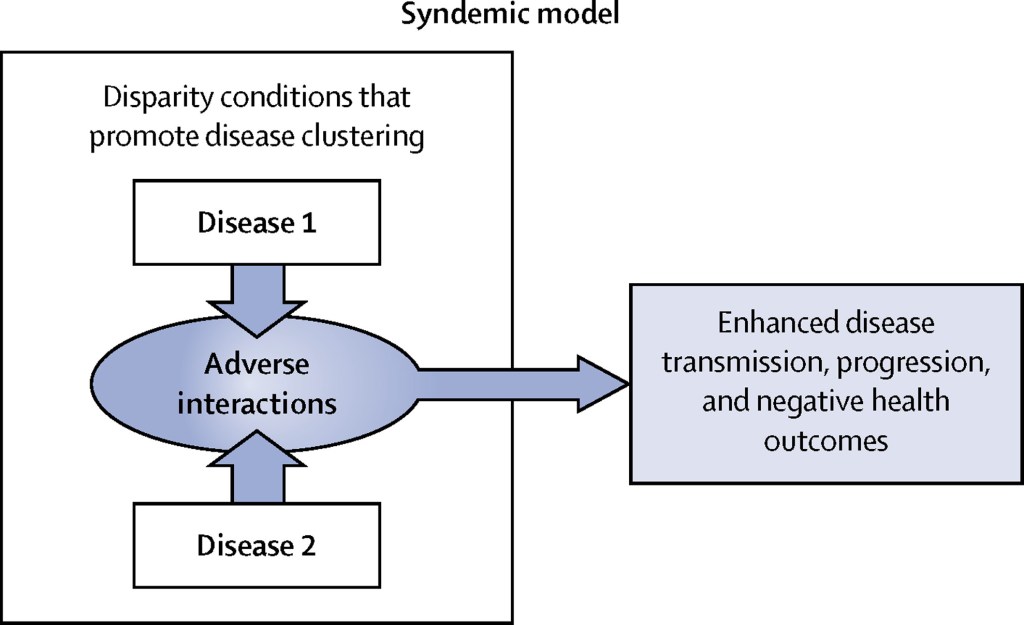
(Singer et. al, “Syndemics and the Biosocial Conception of Health”, 2017)

Horton, as quoted by Martínez, states that, “We have viewed the cause of this crisis as an infectious disease … But … the story of COVID-19 is not so simple. Two categories of disease are interacting within specific populations—infection with severe acute respiratory syndrome coronavirus 2 (SARS-CoV-2) and an array of non-communicable diseases (NCDs). These conditions are clustering within social groups according to patterns of inequality deeply embedded in our societies. The aggregation of these diseases on a background of social and economic disparity exacerbates the adverse effects of each separate disease.”

As described by Horton, “Syndemics are characterized by biological and social interactions between conditions and states, interactions that increase a person’s susceptibility to harm or worsen their health outcomes … The hallmark of a syndemic is the presence of two or more pathological states that interact adversely with each other, adversely affecting the mutual course of each disease trajectory.” COVID-19, is more than a pandemic.

Horton observes that, “For the world’s poorest billion people today, Noncommunicable Diseases (NCDs) account for more than one-third of their disease burden.” And, “The most important consequence of seeing COVID-19 as a syndemic is to highlight its social origins. The vulnerability of older citizens, black, Asian and minority ethnic communities, and key workers, who are commonly underpaid and have fewer social protections, points to a hitherto barely recognized truth, namely that no matter how effective a treatment or protective vaccine is, the search for a purely biomedical solution to COVID-19 will fail.”

In his article Martínez highlights Colombia’s extreme economic inequalities. For example, 10% of landholders own 82% of the productive land, and soon “three of every five persons in Colombia will be living in a state of precariousness or poverty,” and “24% of the vulnerable middle class will fall again into poverty.”  

He notes that even before COVID 19 appeared in Colombia, mortality was increasing from heart attacks, cerebrovascular illnesses, and hypertension – the three major causes of death – and from diabetes. And these conditions, plus obesity, had become more frequent. Too many Colombians were finding healthcare to be inaccessible and/or of poor quality. Martínez points out that on being infected with COVID 19, the chronically ill are highly susceptible to terrible sickness and even death.

At this writing, nearly 29,000 Colombians have died from COVID 19, The case fatality rate is 3.1%, the 10th highest in the world. Martínez cites a recent poll indicating that 16% of people in Bogota lack food and that 65% of households there include at least one person who is unemployed due to COVID 19.

Similarly in the United States, societal dynamics determine the likelihood of dying from COVID 19.  According to the CDC, Blacks, Indians, and Latinxs face at least 2.6 times the risk of being infected by COVID 19 as do white people. And COVID 19 death rates for Indians and Blacks are 1.4% and 2.1% greater, respectively, than the rate for white people.

But according to epidemiologist Sharrelle Barber, writing in the Lancet, “Blacks comprise 13% of the US population but roughly one quarter of COVID-19 deaths and are nearly four times more likely to die from COVID-19 compared to whites … Blacks across all age groups are nearly three times more likely than white people to contract COVID-19.”

Prior to the arrival of the virus, Black people and Latinxs were already more likely than whites to die from cancer, diabetes, hypertension, chronic respiratory disease, and other noncommunicable diseases. Their life expectancy at age 50 is significantly reduced, compared to U.S. whites.  As with Colombians, their burden of chronic ill health becomes dangerous on being infected with COVID 19. Multiple studies highlight the racial discrimination and racist attitudes that often limit their access to healthcare or the quality of care they receive.

The average African American family income in 2018 was $41,361; for white families, $70,642. The poverty rate for African Americans that year was 20.8%, more than twice that of whites. Indeed, poverty alone predisposes Blacks and Latinxs to serious illness or death from COVID 19. Low income often translates into lack of insurance or inability to pay; African-Americans may have no regular healthcare provider. Their work and housing situations frequently allow for easy exposure to the virus. Nevertheless, effects of low income and racism often merge, and are not easily separated for study.

Ideally, healthcare practice is collaborative. Physicians regularly seek help from colleagues knowledgeable about unusual medical conditions or skilled in special treatment methods. They seek consultation. Editor Richard Horton was advising infectious disease specialists themselves to seek consultation as they deal with COVID 19. Specifically: “Limiting the harm caused by SARS-CoV-2 will demand far greater attention to NCDs and socioeconomic inequality than has hitherto been admitted [and] Unless governments design policies and programs to reverse the deep disparities, our societies will never be truly safe from COVID-19.”

Both Horton and Martínez were inviting political practitioners – politicians and the people’s movement – to participate in fashioning all-encompassing programs of prevention and treatment. Also, in publishing Martínez’s article, the editors of the Colombian Communist Party website were, in effect, calling upon healthcare workers to attend to a sick society and, doing so, know who their consultants would be. These would include Communists and socialists who have advanced skills in this area.

Socialists win big in Bolivia; Morales expected to return from exile by W. T. Whitney Jr.

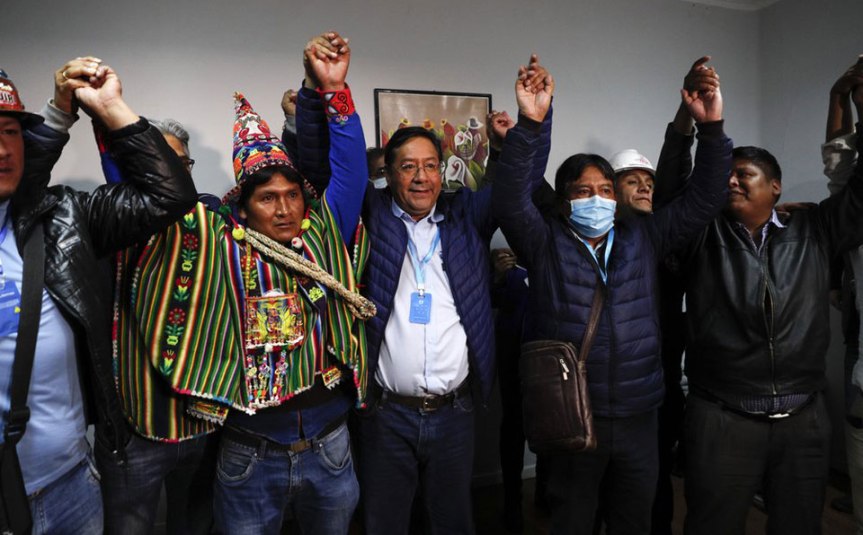
Luis Arce, center, Bolivian presidential candidate for the Movement Towards Socialism Party, MAS, and running mate David Choquehuanca, second right, celebrate during a press conference where they claim victory after general elections in La Paz, Bolivia, Monday, Oct. 19, 2020. Early results indicate Bolivian voters massively rejected the right-wing policies of the government that took power after former President Evo Morales was overthrown in a coup last year.| Juan Karita / AP

Luis Arce and David Choquehuanca, presidential and vice-presidential candidates, respectively, for Bolivia’s Movement Toward Socialism Party (MAS), scored an overwhelming first-round election victory on Oct. 18. They won 53% of the vote, showing strength in cities and rural areas alike. MAS was formerly headed by deposed President Evo Morales.

The Supreme Election Tribunal certified the voting results based on exit polls. Right-wing presidential candidate Carlos Mesa, president of Bolivia from 2003 to 2005, garnered only 31.2% of the vote. Right-wing nationalist Luis Fernando Camacho accounted for another 14.1% of the total. Some 7.3 million Bolivians cast ballots.

An Indigenous supporter of presidential candidate Luis Arce stands outside the headquarters of the Movement Towards Socialism (MAS) party one day after elections in La Paz, Bolivia, Monday, Oct. 19, 2020, amid the COVID-19 pandemic. | Martin Mejia / AP

From Buenos Aires, where he lives in exile, former President Morales proclaimed, “We have recovered democracy.” MAS gained control of both houses of parliament. At a Monday morning press conference, Morales said the ending of his exile was imminent. “Sooner or later we are going to return to Bolivia, that is not in debate.”

Morales, in power from 2006 until being overthrown in 2019, was Bolivia’s first Indigenous president. On his watch, Bolivia’s poor and mostly Indigenous majority secured rights and economic gains. Nationalization of oil and natural gas production turned into a revenue bonanza for social programs. Bolivia’s government was put on a secure financial footing. Morales gained worldwide attention for espousing Indigenous rights and for bringing attention to the global environmental crisis.

A military coup backed by the United States and the Organization of American States brought down Morales’s government on Nov. 10, 2019. In the process, Luis Fernando Camacho, a lead plotter and a recent presidential candidate, displayed fascist-like ideology and own brand of Protestant fundamentalism. Jeanine Añez, the coup government’s interim president, did not run in the recently completed elections.

Late on election day, the Supreme Election Tribunal and government officials for several hours delayed the release of early election results. A spokesperson for MAS  leveled the accusation that they sought a period of uncertainty that “might yield a climate of violence leading to the elections being nullified.”

Following the coup of 2019, the government of Añez canceled presidential elections set for May and for September. Her pretext was danger from COVID-19; though many viewed it as an effort to stall a bad outcome for the right wing. An observer suggested the delays actually gave time to Bolivians, allowing them to experience “[White] supremacist, racist, fascist-like politics [and] to make comparisons with what had been a revolutionary process that over 14 years changed the face and whole nature of this Bolivia.”

Indeed, unemployment moved from 3.9% in mid-2019 to 11.8% a year later; poverty increased markedly in 2020, and the rate of economic growth fell almost 6%.

Luis Arce served as economics minister under Morales from 2006 until the November 2019 coup. He arranged for nationalization of hydrocarbon extraction and the financing of social programs. He was chiefly responsible for Bolivia achieving the highest rate of GDP growth for Latin America and accumulating great amounts of foreign cash reserves.

Former Bolivian President Evo Morales speaks at a press conference in Buenos Aires, Argentina, after general elections in his home country, Monday, Oct. 19. 2020. | Marcos Brindicci / AP

Arce has proposed new taxation on Bolivia’s very wealthy. He recently claimed that MAS was “the only political party that guarantees that natural resources, including lithium, will not be privatized and handed over to transnationals.”

Many technology companies, including those that manufacture batteries for electric cars and mobile phones, have an interest in controlling the country’s lithium reserves, believed to be among the world’s largest.

Bolivia’s incoming vice president, David Choquehuanca, whose heritage is Indigenous and who is experienced in union organizing among rural workers, served as President Morales’s foreign minister from 2006 until January 2017.

Bolivian journalist and educator Mario Rodríguez saluted, “a victory in enemy territory, in a conservative enclave where the most fascist politics that can be are concentrated. [It’s] … a triumph over money, media power, and the dominant powers.”

In his own remarks, Luis Arce said nothing about inevitable speculation among democratic forces worldwide that his victory might strengthen resistance against recently installed neoliberal, U.S.–aligned governments in Latin America.

“We are recovering hope,” he declared, plus “the certainty that small, medium-sized, and big businesses will benefit, as will the public sectors and Bolivian families. I will govern for all Bolivians and, above all, with work to revamp efforts at achieving economic stability for the country.”

W. T. Whitney Jr.
W.T. Whitney Jr. grew up on a dairy farm in Vermont and now lives in rural Maine. He practiced and taught pediatrics for 35 years and long ago joined the Cuba solidarity movement, working with Let Cuba Live of Maine, Pastors for Peace, and the Venceremos Brigade. He writes on Latin America and health issues for the People’s World.

Labor Voices: A vision of true democracy – Organizing the vast majority to take collective control of their lives / by E. Martin Schotz, MD

I am writing for anyone who is concerned about the lack of a serious worldwide approach to climate chaos, anyone who is concerned about racism, poverty, patriarchy, violence, poor health of so many, anyone who is concerned about peace — anyone who wants to participate in and see political change on these issues.

The great German physician Rudolph Virkow, a pioneer in the field of public health, once remarked, “Politics should be practiced as if it was medicine on a grand scale.”  I am thinking about this as I ponder the weakness of the labor movement in the United States, the weakness of the peace movement, and the left in general.  What is the diagnosis?  And where does a cure lie?

If these questions concern you, I am writing to request that you gather a group of like-minded people in order to explore three  books and how the wisdom in them can be developed and applied.  These three books were written by the same author, Jane McAlevey.  Their subject is complex and of the utmost importance. — how the vast majority can be organized to take collective control of their lives.  The books are entitled in order of their appearance Raising Expectations and Raising Hell: My Decade Fighting for the Labor Movement; No Shortcuts: Organizing for Power in the New Gilded Age; and A Collective Bargain:  Unions, Organizing, and the Fight for Democracy.

Who is Jane McAlevey?  She has a long history as a leader and political organizer beginning in high school and college around issues of women’s equality, the dangers of nuclear power, and the struggle against apartheid in South Africa.  After traveling and working in Central America she worked for the Earth Island Institute educating the environmental movement in the US about ecological consequences of US military and economic policies in Central America and then worked at the Highlander Research and Education Center in New Market, Tennessee on environmental issues.  From there the New Voices leadership of the AFL-CIO recruited her for an experimental AFL-CIO organizing in Stamford Connecticut.   The Stamford Organizing Project was working on a model for rank and file worker-based social movement unionism.  In this project, in addition to focusing on workplace issues, unions connected workers to non-workplace issues that affected their communities.  Union members utilized their connections to churches and faith based institutions, sports clubs, and social groups of all kinds to build alliances between labor struggles and community struggles.  Following this work she joined the SEIU where she worked as Director of Strategic Campaigns and then as Executive Director and Chief Negotiator for SEIU Nevada in the process demonstrating the power of the Stamford approach.

The reason I recommend reading all three books is that taken together you get a rounded picture of McAlevey’s background, development, experience in and practice of an approach to union organizing and community organizing that is needed, if the vast majority are to be effectively engaged in tackling the pressing problems that confront us as capitalism collapses.  If three books seems like too much, start with one.   I want to emphasize that although union organizing and community organizing are not the same thing, what McAlevey discusses seems to me to be of great relevance to community organizing as well as union organizing.

The roots of McAlevey’s approach go back to the industry-wide organizing that was critical to the emergence of the CIO in the 1930’s.    The books focus on the most difficult kinds of labor struggles, in which it is necessary to organize 90% of the shop floor and 90% of the community in support of the union, if the union is to be able to win. As described above, in order to accomplish this, it is not enough to approach workers as just people on a job.  It is also necessary to see workers as whole people, as community members whose needs and interests extend beyond just wages and benefits.   For McAlevey the union is there to aid in the struggle for wages and benefits, but it is there primarily as a means by which workers can take collective control of their lives.  McAlevey’s approach is radically democratic with no such thing as a “labor aristocracy” or “labor bureaucracy”.  There are the workers and there are the employers.  The union belongs to the workers completely.

It is not by accident that this approach, which communists helped develop, was largely abandoned after World War II.    Coming out of World War II “the powers-that-be” in the United States wanted to quiet the unrest that had developed in the 1930’s and to be able to pursue US corporate imperial interests at home and throughout the world.  The population had to be propagandized to support the “Cold War” and to see the Soviet Union as their enemy.  And there was a determined effort during the McCarthy Period to demonize communists and exclude them not only from the labor movement but from the life of our society generally.  The “powers-that-be” needed to turn the US labor movement away from class struggle and toward what McAlevey calls “class snuggle”.   “Class snuggle” is a process in which employers and certain labor leaders collaborate to narrowly define workers’ interests and in the process help labor bureaucrats become powerful, wealthy and corrupt.

Fortunately the approach that McAlevey describes was not completely abandoned, and where it is still being practiced, it has yielded some big wins.  As examples amongst other campaigns McAlevey discusses the recent teachers’ union organizing and strikes in Chicago and Los Angeles.

As I read through McAlevey’s books I was stunned by the fact that what she was talking about was completely new to me despite years working within the left.  Of the many things that impressed me I will mention here only four.

First, McAlevey emphasizes the importance of setting concrete goals so that you can know if you are succeeding or not.  Contrary to this,  most of the organizations, with which I have been associated, have pursued a line of action that could never fail and consequently could never succeed, because the goals of the organization’s activity were always vaguely defined.

Second McAlevey discusses the importance of making a power analysis of the community or group you are hoping to organize.  Who knows whom?  Who influences whom?  Who are the community’s “organic leaders”, the people to whom others listen.  These “organic leaders” often don’t see themselves as activists or leaders, but their opinions carry great weight with many others.  If you are going to organize 90%,  reaching these “organic leaders” and winning their active involvement is critical.

Third, McAlevey describes in detail what she calls the “Structured Organizing Conversation”, a specific way an organizer can go about connecting with organic leaders and uniting with them in the organizing effort.

Fourth, McAlevey makes a clear distinction between what she calls “advocacy”, “mobilizing” , and “organizing.”  Advocacy involves advocating for something.  This essay is an example of advocacy.   Mobilizing involves calling out the people who are already on your side.  Organizing involves reaching and involving in the struggle the vast majority, those who don’t yet understand that they have a vital interest in being actively involved.  From this perspective, the organizations, with which I have worked, have been involved in education, advocacy, and mobilization, but not really organizing.  This is why what these books can teach us is so critical.

Becoming an accomplished organizer is no small achievement.  It is every bit as complex as becoming a true artist in any field.  So reading these books won’t turn anyone into an accomplished organizer.  But they can provide crucial insight into the science and art of organizing.  Reading them as a group may ignite a desire in some to begin experimenting with organizing in a different way.  Such an endeavor will need the support of a group.   At the very least these books will help partisans of a people’s movement to more concretely conceive of how radically democratic labor unions and communities can be organized for the political battle that is needed.

Dr. Schotz is a child psychiatrist who is active in the peace movement in Western Massachusetts

Remembering Claudia Jones, Communist leader who spoke for black women

By W. T. Whitney Jr. 

Source: https://www.peoplesworld.org/article/remembering-claudia-jones-communist-leader-who-spoke-for-black-women/

December 24 marks the death in 1964 of Claudia Jones. A member of the U.S. Communist Party’s National Committee and executive secretary for its Women’s Commission, Jones died in England, nine years after her deportation there. We recall her life and contributions. Her analysis of black women’s oppression and her vision of black women as political activists are meaningful today.

Her 16 – page article titled “An End to the Neglect of the Problems of Negro Women” appeared in the June 1949 issue of “Political Affairs.” (1) There, Jones describes the origins and varieties of oppression against black women. What with continuing subjugation of black women, her message is relevant now. The ripple effect of what happens to women adds to the staying power of Jones’ ideas: children’s education, health, and even survival depend on women flourishing. Men who no longer dominate women may themselves gain a measure of liberation.

Jones begins: “Negro women – as workers, as Negros, and as women – are the most oppressed stratum of the whole society.”   There is “growth in the militant participation of Negro women in all aspects of the struggle for peace, civil rights, and economic security.” In fact, “the capitalists know, far better than most progressives seem to know, that once Negro women take action, the militancy of the whole Negro people, and thus of the anti-imperialist coalition, is greatly enhanced.” 

Jones identifies black women’s special capabilities. “From the days of the slave traders down to the present,” they’ve been the guardians, protectors, and advocates for their children and families. Thus, “it is not accidental that the American bourgeoisie has intensified its oppression, not only of the Negro people in general, but of Negro women in particular.” She observes black women organizing their own mass organizations; they “are the real active forces – the organizers and workers – in all the institutions of the Negro people.” 

Claudia Jones sees “a developing consciousness on the women question today.”  Therefore, “the Negro woman who combines in her status the worker, the Negro, and the woman, is the vital link to this heightened political consciousness.”  But “the Negro question is prior to and not equal to the woman question,” she states. 

Jones points to economic abuse of black people.  She examines the plight of domestic workers and organized labor’s exclusion of black workers. But she finds the line separating race – based oppression from oppression as workers to be blurred. That’s natural, because black women “far out of proportion to other women workers, are the main breadwinners in their families.” She calls upon unions to take in black women and for domestic workers to be organized. 

Employed white women, she notes, were receiving twice the hourly wage granted to black women workers. The median family income of whites in northern cities exceeded that of black families by 60 percent. (In 2015, the average hourly income for white and black women workers was $17 and $13, respectively; white families’ median income that year was 70 percent higher than black families’ income.)

Jones laments that, “The maternity death rate for Negro women is triple that of white women.”  She points to high death rates for black children. (Death rates for black mothers in our own era – in 2012 – are almost four times that of white mothers. Yes, death rates for black infants and older children in Jones’ era were twice those for white children, and that hasn’t changed.) 

Jones castigates white chauvinism.  She objects to the label “girl” applied to older black women, to progressives’ and even Communists’ hesitation at socializing with black women associates, and to Communists’ reluctance to recruit black women, alleging they are “too backward.” She denounces “bourgeoisie ideologists” for relegating all women to “kitchen, church, and home,” but also for ignoring the presence of black domestic workers “in other people’s homes.”  She thinks black men have “a special responsibility in rooting out attitudes of male superiority as regards women in general.”  

Included in Jones’ survey are emblematic news stories of assaults on black women and snippets of dialogue highlighting regressive attitudes. She identifies individual black women who resisted and/or organized labor actions. Jones argues for black women – the “most exploited” women – joining progressive organizations and the Communist Party. 

Through “active participation” as workers in the “national liberation movement,” black women will “contribute to the entire American working class, whose historic mission is the achievement of a Socialist America – the final and full guarantee of women’s emancipation.” 

Her essay concludes: “The strong capacities, militancy, and organizational talents of Negro women can … be a powerful lever for bringing forth Negro workers – men and women – as the leading forces of the Negro people’s liberation movement, for cementing Negro and white unity in the struggle against Wall Street imperialism.”  

Claudia Jones wrote and acted by the light of her own life experience. Extreme poverty forced her family’s emigration from Trinidad to New York. Her over-worked mother died there, and living conditions for Claudia and her sisters deteriorated. Jones spent a year recuperating in a tuberculosis sanatorium. She was a superior high – school student, but instead of college, she worked in laundries and factories to support her family.  

Soon – in 1936 – she was organizing for the Young Communist League and working for the Communist Party’s “Daily Worker” newspaper. She moved to writing and editorial assignments with other Party publications and to the Party’s “Negro Commission.” Her “Half the World” column – meaning women – appeared regularly in the Daily Worker. 

Claudia Jones’ life took a tragic turn.  Tried and imprisoned under the anti-communist Smith Act, she was deported to England in 1955. She died prematurely at age 49. Elements of Caribbean culture and politics, and of black people’s nationalism, had informed Claudia Jones’ activism and writings in the United States.  In London, she founded and edited the West Indian Gazette. To counter “white racists,” she organized the Notting Hill Caribbean Carnival, which continues. 

(1) Jones’ 1949 article “An end to the neglect…” may be read at: https://palmm.digital.flvc.org/islandora/object/ucf%3A4865  On December 2, 2016, Rebelion.org featured a version in Spanish of Jones’ article. It had appeared on the Basque Communist Party platform (Boltxe Kolektiboa) at: https://www.boltxe.eus/acabar-abandono-los-problemas-las-mujeres-negras/