Brazilian Workers Lead in Offering Solidarity to Venezuelans under US Attack / By W.T. Whitney Jr.

The leader of Brazil’s Landless Rural Workers’ Movement (MST), João Pedro Stédile, declares solidarity with the Venezualan government and people as they are threantened by a U.S. military intervention | Photo credit: brasildefato.com

South Paris, Maine


Since August, U.S. warships, fighter planes, and troops have deployed in Caribbean waters off Venezuela and in Puerto Rico. Venezuela’s neighboring countries in Latin America and the Caribbean area are reacting variously. Many oppose U.S. aggression, but at a distance.  Others are either non-committal or accepting.

Colombia and Brazil are backing Venezuela – or soon will be –  in very different ways. Recent remarks of João Pedro Stédile, co-founder and a director of Brazil’s Landless Workers’ Movement (MST), warrant special attention.

U.S. attacks from the air have killed dozens of crew members of boats alleged to be carrying illicit drugs. U.S. accusations against Venezuelan President Nicolás Maduro that he is a top-level drug dealer, serve as pretext. The U.S. government now offers a $50 million reward for his capture. The allegation that he heads the drug-dealing Cartel de los Soles is false. The cartel doesn’t exist, according to a United Nations report. A U.S. coup plotter recently claimed the CIA created the cartel.

President Trump recently indicated the CIA would be operating inside Venezuela. It’s widely assumed that the U.S. government wants control of Venezuela’s oil and other resources and is contriving to remove a government heading towards socialism.

Venezuela’s government is training militia troops by the millions. Venezuelan defense minister Vladimir Padrino López announced on October 21 that Venezuela’s’ military will cooperate with Colombian counterparts to fight narcotrafficking. Relations between the two nations are quickly improving.

They had deteriorated after Colombia’s government backed accusations that Venezuela’s 2024 presidential elections were fraudulent. But on August 10, Colombian President Gustavo Petro stated on social media that, “Colombia and Venezuela are the same people, the same flag, the same history. Any military operation that does not have the approval of our sister countries is an act of aggression against Latin America and the Caribbean.” Petro recently announced the Colombian military will be sharing military intelligence with Venezuela.

U.S. vilification extends to Petro who, speaking at the United Nations General Assembly on September 23, condemned U.S. support of Israel’s war on Gaza and U.S. imperialism generally. He railed against the U.S. at a rally outside the UN Headquarters. In response, the U.S. government revoked his visa.  Petro had previously refused to accept Colombian deportees sent handcuffed from the United States in a military plane.

International solidarity

On October 18, Petro accused the United States of killing a Colombian fisherman and violating Colombian sovereignty. Responding, President Trump called Petro “an illegal drug dealer … [who] does nothing to stop” drug production. He imposed import tariffs and suspended subsidies granted Colombia for drug-war activities. Petro recalled Colombia’s ambassador in Washington.

Colombia may be on Venezuela’s side, but that’s not clear with other countries in the region. Colombia, president pro tempore of the CELAC group of nations, arranged for a virtual meeting of CELAC foreign ministers to reach a common position. In 2014, the Community of Latin American and Caribbean States – CELAC –had declared the entire region to be a “zone of peace.”  

At the meeting taking place on September 1, representatives of the 23 CELAC nations present (out of 33) considered a general statement that filed to mention the U.S. -Venezuela confrontation. It expressed support for “principles such as: the abolition of the threat or use of force, the peaceful resolution of disputes, the promotion of dialogue and multilateralism, and unrestricted respect for sovereignty and territorial integrity.”

Most of the countries voting approved, but Argentina, Ecuador, Paraguay, Perú, Costa Rica, El Salvador, Guyana, Jamaica, and Trinidad and Tobago did not.

Member nations of the Bolivarian Alliance for the Peoples of Our America–Peoples’ Trade Treaty (ALBA-TCP) did condemn US military action in the Caribbean. The CARICOM group of Caribbean nations, meeting in late October, expressed support “for the sovereignty and territorial integrity of countries in the region,” again without reference to  the United States and Venezuela. Trinidad and Tobago was an outlier: Prime Minister Kamla Persad-Bissessar insisted that, “I have no sympathy for traffickers; the US military should kill them all violently.”

Regional presidents spoke out against U.S. intervention, specifically: Mexican president Claudia Sheinbaum; Honduras’s president  Xiomara Castro, Daniel Ortega, co-president of Nicaragua, and Brazilian president Luiz Inácio Lula da Silva.

Brazilian workers, especially those associated with Brazil’s Landless Workers’ Movement (MST) are taking matters into their own hands. Their leader João Pedro Stédile was interviewed October 16 on Rádio Brasil de Fato. (The interview is accessible here.)  He points out that:

“The United States has been threatening Venezuela for quite some time. The process was accelerated by the Trump administration, a mixture of madness and fascism. He thinks that, with brute force, he can overthrow the Maduro government and hand it over to María Corina [Machado] on a silver platter. Part of this tactic was awarding her the Nobel Prize …The United States is making a tragic mistake because it is basing its actions solely on information from the far right….

“Never before has the Maduro government had so much popular support … It is time for Lula’s government to take more decisive action and show more active solidarity with Venezuela.

“If the United States is exerting all this military pressure to try to recover Venezuela’s oil, and … [if] María Corina … comes to power after the invasion, her first act will be to privatize PDVSA [Petróleos de Venezuela] and hand over other Venezuelan resources—I imagine iron, aluminum, gold, which they have a lot of—to American companies for exploitation. …

“At this event I attended in Venezuela, the World Congress in Defense of Mother Earth, … we agreed … to organize, as soon as possible, internationalist brigades of activists from each of our countries to go to Venezuela and place ourselves at the disposal of the Venezuelan government and people.

“We want to repeat that historic epic that the global left achieved during the Spanish Civil War of 1936, when thousands of militants from around the world went to Spain to defend the Republic and the Spanish people.”

The MST webpage testifies to the class consciousness and anti-imperialism inspiring MST solidarity with the Venezuelans:

“Brazil’s Landless Worker’s Movement was born from the concrete, isolated struggles for land that rural workers were developing in southern Brazil at the end of the 1970’s. … Brazilian capitalism was not able to alleviate the existing contradictions that blocked progress in the countryside … Little by little, the MST began to understand that winning land was important, but not enough. They also need access to credit, housing, technical assistance, schools, healthcare and other needs that a landless family must have met…. the MST discovered that the struggle was not just against the Brazilian latifundio (big landowners), but also against the neoliberal economic model.”

The MST “is the largest social movement in Latin America with an estimated 1.5 million landless members organized in 23 out 27 states.”

Stédile himself articulates a rationale for calling the U.S. government to account. In a recent New Year’s greeting, he noted that, The world and Brazil are experiencing serious crises, such as the structural crisis of capitalism, the environmental crisis and the crisis of the bankruptcy of states that are unable to solve the problems of the majority … A good 2024 to all Brazilian people!”

His recent interview with Monthly Review is revealing:

“The MST has drawn on two key concepts from the historical experience of the working class in general and campesinos in particular: mass struggle and solidarity.

“Our strength does not come from our arguments or ideas; it comes from the number of people we can mobilize … I believe there has been a process of integration and mutual learning among Venezuelans, Brazilians, and Latin Americans in general. … The MST … has promoted brigades in various countries … and a permanent brigade here in Venezuela.”


W.T. Whitney, Jr., is a political journalist whose focus is on Latin America, health care, and anti-racism. A Cuba solidarity activist, he formerly worked as a pediatrician and lives in rural Maine.

Reactionaries and US Military Backers Prevail in Latin America – for Now / By W. T. Whitney

The commander of U.S. Southern Command, Army Gen. Laura Richardson, and Argentine Armed Forces Joint Command Chief Lt. Gen. Juan Martín Paleo, arrive at the Argentine Ministry of Defense. During her visit April 25-27, Richardson met with leaders, including Vice President Cristina Fernández de Kirchner. Richardson is a repeat visitor to Argentina since the election of right-wing President Milei. | Photo via U.S. Embassy Argentina

South Paris, Maine


U.S. Southern Command Chief Laura Richardson was visiting Argentina for the third time. On April 4 in Ushuaia, Tierra del Fuego – the world’s southernmost city – she and U. S. Ambassador Marc Stanley were received by President Javier Milei, his chief-of-staff, his cabinet chief, the defense minister, the interior minister, a military band, and an honor guard – at midnight.

Richardson announced her government would build an “integrated naval base” in Ushuaia that, close to the Strait of Magellan, looks to Antarctica. Both are strategically important. She “warned about China’s intention to build a multi-purpose port in Rio Grande, [Tierra del Fuego’s capitol city].”

Richardson, the U.S. military’s top leader for the region, had previously noted its attractions. She explained to the House Armed Services Committee in 2022 that Latin American and Caribbean area “accounts for $740 billion in annual trade with the U.S.; contains 60% of the world’s lithium and 31% of the world’s fresh water; has the world’s largest oil reserves” She insisted later that, “This region matters. It has a lot to do with national security, and we have to step up our game.”  

Testifying before a congressional committee on March 14, she remarked that, “The PRC (People’s Republic of China) is America’s pacing threat; countering their aggression and malign influence requires a whole-of-society approach.”

Information from an alleged leak from the U.S. Embassy in Bolivia suggests the U.S. government seeks to isolate non-aligned countries like Colombia, Bolivia, Venezuela and collaborate with “three bastions of U.S. support,” namely Peru, Ecuador and Argentina.

Analyst Sergio Rodríguez Gelfenstein claims U.S. “policies [in the region] are in the hands of the Pentagon … with the  State Department playing a secondary role…. The emphasis is on penetrating extreme rightwing governments.” 

U.S. troops and military advisors collaborate with regional military forces to confront narco-trafficking and other transnational crimes. Stories of good works have propaganda use in gaining support for their presence and for partnership with governments pushing back against popular protests. The survey below shows that U.S. military activities in the region are far-reaching and that long-term objectives and short-term needs are served.

Moving parts

The stated mission of the U.S. military installation in Argentina’s Neuquén province is to respond to humanitarian crises. That a Chinese satellite launch and tracking facility is nearby is no coincidence. The area has immense oil deposits.

U.S. troops based in Misiones, near Argentina’s borders with Brazil and Uruguay, ostensibly deals with narco-trafficking and other cross-border crimes. The U.S. government recently provided credit for Argentina to buy 24 F-16 fighter planes from Denmark.  

The largest U.S. bases in the region are the Guantanamo base in Cuba, with 6100 military and civilian personnel, and the one at Soto Cano in Honduras, with 500 U.S. troops and 500 civilian employees.TheU.S. Naval Medical Research Unit, active in several locations in Peru and overseen by the Southern Command, conducts “health science research” with Peruvian partners. It also serves to “build the capacity of special forces to survive in tropical forests.”

The U.S. Navy patrols South Atlantic waters and conducts joint training exercises with Argentina, Brazil, Chile, Colombia, Ecuador, Peru and Uruguay. The U.S. Coast Guard confronts illegal – read Chinese – fishing off South America’s Pacific coast.

The U.S. Army Corps of Engineers operates in 17 countries, fulltime in eight of them. It advises on river and estuary projects, notably on maintaining commercial flow from the Río de la Platabasin to the Atlantic.  

Ecuador and Peru each agreed recently to accept U.S. troop deployments. Colombia (2009) enabled the U.S. Air Force to utilize seven of its bases. Brazil and the United States (2019) cooperate in launching rockets, spacecraft, and satellites at Brazil’s Alcántara space center. The U.S. military cooperates with Brazil and Chile in conducting defense-related research.

The Southern Command annually holds CENTAM exercises with participation by U.S. National Guard troops and those of several Central American nations. They prepare for humanitarian crises and natural disasters.  The National Guards of 18 U.S. states carry out joint training exercises with the troops of 24 Latin American nations.

The United States supplies 94.9% of Argentina’s weapons, 93.4% of Colombia’s, 90.7% of México’s, and 82.7% of Brazil’s. Bolivia is the outlier, obtaining 66.2 % of its weapons from China.

The U.S. government authorized arms sales to Mexico in 2018 worth $1.3 million, to Argentina in 2022 worth $73 million, to Chile in 2020 worth $634 million, and to Brazil in 2022 worth $4 million.

The Southern Command operates schools for the region’s military and police forces. The Western Hemisphere Institute for Security Cooperation and the School of the Americas, its predecessor from 1946 on, account for almost 100,000 military graduates. The El Salvador-based International Law Enforcement Academy, “purposed to combat transnational crime,” trains police and other security personnel.

The Command in December 2023 undertook joint aerial training exercises with Guyana, where Exxon Mobil is preparing to extract offshore oil from huge deposits in Guyana’s Essequibo province.  Venezuela claims ownership of that area. Venezuelan President Maduro recently accused the U.S. government of establishing secret bases there.  

The story here is of installations and institutions, supply and support systems, and military interrelationships. The complexity of this U.S. undertaking signals fragility. The make-up of allied governments does likewise.

With friends like these

Raised in the United States and buoyed by his family’s great wealth, Ecuadorian president Daniel Noboa is inexperienced. The country faces environmental catastrophe and widespread violence. Indigenous peoples are politically mobilized and security forces cruelly repressive.

Raiding the residence of unelected Peruvian President Dina Boluarte, police on March 29 found jewelry worth $502,700. Establishment politicians appointed her as president after they railroaded progressive President Pedro Castillo, her predecessor, to prison.  Oligarchic rule and occasional dictatorships are customary in Peru, as is indigenous resistance.

Presidential rule in Argentina is bizarre. Eric Calcagno, distinguished sociologist, journalist, and diplomat, told an interviewer recently that President Milei is “asking to be part of NATO, which is the organization that occupied part of our territory, the Malvinas (Falkland Islands).” For Milei, “war is necessary.” The “regime … [is] “the figurehead of local and international monopolies [and] is taking Argentina to the point of no return.”

Argentina is “governed by a gentleman who decides things in consultation with a dead dog, or much worse, with General Richardson of the Southern Command.”  (A news report attributes to Milei devices “allowing him to enter into the spirit of Conan and calm his anxiety.” Conan, a dog, is dead.)

Meanwhile, 800,000 students, workers, unionists, the unemployed, and popular assemblies marched in Buenos Aires on April 23. Joined by 200,000 Argentinians demonstrating elsewhere in the country, they were protesting governmental attacks on public universities.

With popular resistance continuing in Argentina and elsewhere in the region, the precariousness of U.S. military intervention will show. Investigator Jason Hickel points to “imperial arrangement on which Western capitalism has always relied (cheap labor, cheap resources, control over productive capacities, markets on tap).”

He refers to the “Western ruling classes” and the “violence they perpetrate, the instability, the constant wars against a long historical procession of peoples and movements in the global South.” And yet: “[a]fter political decolonization, a wide range of movements and states across the South … sought economic liberation and sovereign industrial development.”

These are national liberation struggles that presumably will continue. Resistance under that banner may someday overwhelm military intrusions like the ones surveyed here.   


W.T. Whitney is a political journalist whose focus is on Latin America, health care, and anti-racism. A Cuba solidarity activist, he formerly worked as a pediatrician, lives in rural Maine. W.T. Whitney Jr. es un periodista político cuyo enfoque está en América Latina, la atención médica y el antirracismo. Activista solidario con Cuba, anteriormente trabajó como pediatra, vive en la zona rural de Maine.

China, Brazil Lead in Chipping Away at U.S. Economic Power Abroad / By W. T. Whitney Jr.

United States hegemony in Latin America is in question | credit Prensa Latina


The United States proclaimed the Monroe Doctrine 200 years ago and ever since has arranged Latin American and Caribbean affairs to its advantage. Nevertheless, struggles for national and regional independence did continue and the poor and marginalized classes did resist. Eventually there would be indigenous movements, labor mobilizations, and progressive and socialist-inclined governments. Cuba’s revolutionary government has endured for 63 years.

The U.S. political hold may have weakened, but U.S. control over the region’s economies remains strong; after World War II it extended worldwide.  Now cracks are showing up. In particular, the U.S. dollar’s role as the world economy’s dominant currency may have run its course. 

In 1944, 44 allied nations determined that the value of their various currencies would correlate with the value of the U.S. dollar instead of the value of gold. The nations since then have relied on the U.S. dollar for their reserve currencies, for foreign trade and in banking transactions.

There seemed to be good reason. The United States was supreme in producing and marketing goods and so, presumably, the dollar’s value would remain stable and predictable. The dollar would be readily accessible to bankers and traders and its valuation would be unambiguous. Nations could also build their currency reserves through the dollars they accumulated in the form of bonds sold by an increasingly indebted United States.  

The United States has benefited. In currency exchanges involving the dollar, U.S. companies and individuals experience only minor add-on costs. U.S. importers know that the more the dollar strengthens in value, the less expensive will be products they buy abroad. U.S. borrowing costs overseas are relatively low because U.S. bonds, and the investments they represent in dollars, are appealing abroad, for a variety of reasons.

Dollar dominance has caused pain abroad. Exporters to the United States take a hit when the exchange value of the dollar weakens. Importers of U.S. goods are hurt when the dollar strengthens.

Most importantly, the U.S. government gains an opening to punish enemy countries through their use of dollars in international transactions. It imposes economic sanctions requiring that dollars not be used in a targeted country’s overseas transactions. The U.S. Treasury Department penalizes foreign banks and companies that disobey. Sanctioned nations have included Cuba, Iran, North Korea, Syria, Venezuela, Nicaragua, and more recently, China and Russia.

The U.S. government’s frequent resort to economic sanctions has greatly contributed to new stirrings on behalf of a new international currency system. Confiscation of currency reserves deposited in U.S. and European banks that belong to Iran, Venezuela, and Afghanistan have likewise encouraged calls for change.

On March 29 China and Brazil announced they would use their own currencies in trading with each other. China is Brazil’s biggest trade partner.  China’s renminbi currency presently constitutes a major share of Brazil’s currency reserves.

Earlier in 2023, Brazil and Argentina proposed cooperation toward creating a common currency for themselves.  At the January meeting of the Community of Latin American and Caribbean States (CELAC), Brazilian President Lula da Silva opined that, “If it were up to me, I would promote a single currency for the region.” He would call it the “SUR” (South).  The ALBA regional alliance in 2009 proposed an electronic currency called the “Sucre” aimed at reducing dollar dependency.

Former Brazilian President Dilma Rousseff is the recently named head of the New Development Bank which, headquartered in Shanghai, serves the BRICS nations (Brazil, Russia, India, China, and South Africa). The bank represents an alternative to the U.S. -dominated International Monetary Fund and the World Bank.

The shift away from dollar dependency is evident elsewhere. At a Russian-Indian “Strategic Partnership …Forum” recently, a Russian official announced that the BRICS states would be creating a new currency and that the formal announcement would be made at the BRICS summit meeting in Durban South Africa in August.

The BRICS countries account for “40% of the global population and one-fourth of the global GDP.” According to People’s Dispatch, Iran and Saudi Arabia, having recently signed a peace accord, will soon be joining BRICS.  Egypt, Algeria, the UAE, Mexico, Argentina, and Nigeria apparently are giving consideration.  The values of new currencies will rest not on another currency but on the value of “products, rare-earth minerals, or soil.”  

Iran and Russia in January agreed on methods useful for bypassing the SWIFT banking system, the U.S. tool for servicing its dollar dominance.  To evade U.S. sanctions, the two countries reply on their own currencies for most transactions.

At their summit in March, Russian and Chinese leaders reiterated their intention to expand bilateral trade and utilize their own currencies. China increasingly is using its own currency in transactions with Asian, African, and Latin American countries. The yuan “has become the world’s fifth-largest payment currency, third-largest currency in trade settlement and fifth-largest reserve currency,” according to Global Times.

Saudi Arabia is on the verge of selling oil and natural gas in currencies other than the dollar, and China occasionally pays Arabian Gulf nations in yuan for those products.   

The finance ministers and governors of the central banks of the member states of the Association of Southeast Asian Nations (ASEAN) met in Indonesia on March 28. At the top of their agenda were “discussions to reduce dependence on the US Dollar, Euro, Yen, and British Pound from financial transactions and move to settlements in local currencies”. The ASEAN nations, an alliance of 10 southeast Asian nations, are developing a digital payment system for member states’ transactions.

Dollar dominance may be losing its appeal closer to home.  Former Goldman Sachs chief economist Jim O’Neill claims that, The U. S. dollar plays a far too dominant role in global finance … Whenever the Federal Reserve Board has embarked on periods of monetary tightening, or the opposite, loosening, the consequences on the value of the dollar and the knock-on effects have been dramatic.”

Gillian Tell, chair of the Financial Times’ editorial board notes that, “concerns are afoot that this month’s US banking turmoil, inflation and looming debt ceiling battle is making dollar-based assets less attractive.” Plus, “a multipolar pattern could come as a shock to American policymakers, given how much external financing the US needs.”

There are wider implications. Argentinian economist Julio Gambina bemoans “disorder in the world economy …[and] this attitude of unilateralism represented by the US sanctions.” Interviewed on March 29, Gambina points out that “wealth has a father and a mother: labor and nature.”

He adds that, “Latin America and the Caribbean … where inequality is growing the most …  have a highly skilled working class, willing to carry forward the production of wealth. We have the resource of assets held in common for sovereign development through which the interests of our peoples and the reproduction of nature, life and society are defended.”


W.T. Whitney Jr. is a political journalist whose focus is on Latin America, health care, and anti-racism. A Cuba solidarity activist, he formerly worked as a pediatrician, lives in rural Maine. W.T. Whitney Jr. es un periodista político cuyo enfoque está en América Latina, la atención médica y el antirracismo. Activista solidario con Cuba, anteriormente trabajó como pediatra, vive en la zona rural de Maine.

US General Hypes China as Threat in Latin America / By W.T. Whitney Jr.


The U.S. government has long intervened in Latin America and the Caribbean (LAC). Now the U.S. military is paying attention to China’s economic activities there. 

General Laura Richardson on March 8 reported to the Armed Services Committee of the U.S. House of Representatives on actions and needs of the Southern Command, which she heads. She has charge of all U.S. military operations in the region. 

Citing the 2022 National Security Strategy, Richardson declared that “no region impacts the United States more directly than the Western Hemisphere …. [There] autocrats are working overtime to undermine democracy.” And security there “is critical to homeland defense.”

Richardson stated that “the PRC (People’s Republic of China) has both the capability and intent to eschew international norms, advance its brand of authoritarianism, and amass power and influence at the expense of the existing and emerging democracies in our hemisphere.” The Southern Command’s “main priority … is to expose and mitigate PRC malign activity.”

She sees a “myriad of ways in which the PRC is spreading its malign influence, wielding its economic might, and conducting gray zone activities to expand its military and political access and influence.” A “grey zone,” according to the NATO-friendly Atlantic Council, is a “set of activities … [like] nefarious economic activities, influence operations, … cyberattacks, mercenary operations, assassinations, and disinformation campaigns.”

Richardson highlighted China’s trade with LAC that is heading toward “$700 billion [annually] by 2035.” The United States, in her view, will be facing intense competition and presently “its comparative trade advantage is eroding.”

She added that, “The PRC’s efforts to extract South America’s natural resources to support its own population … are conducted at the expense of our partner nations and their citizens.” And opportunities for “quality private sector investment” are disappearing.

Competition extends to space: “11 PRC-linked space facilities across five countries in this region [enable] space tracking and surveillance capabilities.” Richardson complained of “24 countries [that] have existing Chinese telecommunication infrastructure (3G/4G), increasing their potential to transition to Chinese 5G.” 

She expressed concern both about surveillance networks supplied by China that represent a “potential counterintelligence threat” and about Latin Americans going to China “to receive training on cybersecurity and military doctrine.” Richardson denounced China’s role in facilitating environmental crimes and pointed to “potential dual use for malign commercial and military activities.”

“Relationships absolutely matter,” she insisted, “and our partner democracies are desperate for assistance from the United States.” Plus, “if we’re not there in time, they … take what’s available, creating opportunities for the PRC.”

Moving beyond China, Richardson indicated that “many partner nations …  see TCOs (transnational criminal organizations) as their primary security challenge.” That’s because drug-cartel violence leads to deaths and poverty and “illicit funds exacerbate regionalcorruption, insecurity, and instability.”

Her report avoids mention of particular countries other than offering brief references to Haiti, Cuba, Nicaragua, and Venezuela. She criticized Russia for “military engagements with Venezuela and Nicaragua” and for spreading “false narratives.” Richardson praised Colombia for providing military training in other countries. 

The Southern Command gains “exponential return” on supplying various countries with U.S. weapons and supplies. It conducts joint military exercises, and “provides professional military education to personnel from 28 countries.”

Richardson reported at length on processes she sees as fostering useful relationships between her command and the various governments and military services. The tone of urgency characterizing her discussion on China was entirely lacking. 

Economic intervention

General Richardson’s view that China has greatly expanded its economic involvement with the LAC nations is on target.

Since 2005, China’s state-owned banks have arranged for 117 loans in the region worth, in all, more than $140 billion. They averaged over $10 billion annually. Since 2020, China has made fewer loans.

Chinese trade with Latin America grew from $12 billion in 2000 to $448 billion in 2021. China’s imports of “ores (42%), soybeans (16%), mineral fuels and oils (10%), meat (6%), and copper (5%)” totaled $221 billion in 2021. The value of exported manufactured goods that year was $227 billion. By 2022, China had become the biggest trading partner in four Latin American countries and the second-largest in many others.  

China’s foreign direct investment (FDI) has long represented China’s strongest economic tie to the region. FDI signifies funding of projects abroad directed at long-term impact. China’s FDI from 2005 to mid-2022 was $143 billion. Energy projects and “metals/mining” accounted for 59% and 24% of the total, respectively. Of that total, Brazil and Peru received 45% and 17%, respectively. 

The FDI flow since 2016 has averaged $4.5 billion annually; worldwide, China’s FDI has contracted.

Chinese banks and corporations have invested heavily in lithium production in Argentina, Bolivia, and Chile, which, together, account for 56% of the world’s lithium deposits. China is the largest investor in Peru’s mining sector, controlling seven large mines and owning two of Peru’s biggest copper mines. Brazil is the world’s largest recipient of Chinese investments.  

China’s government has linked FDI to its Belt and Road Initiative (BRI) that began in 2013. As of May 2022, 21 Latin American and Caribbean countries were cooperating with the BRI and 11 of them had formally joined.

On the ground

U.S. military intervention in LAC is far from new. Analyst Sergio Rodríguez Gelfenstein complements Richardson’s report with a three-part survey, accessible herehere, and here, of recent U.S. military activities in the region.

He indicates the United States now has “12 military bases in Panamá, 12 in Puerto Rico, 9 in Colombia, 8 in Perú, 3 in Honduras, 2 in Paraguay, as well as similar installations in Aruba, Costa Rica, El Salvador, Cuba (Guantánamo), and in other countries.”

Rodríguez maintains that, “levels of aggressive interference by Washington in the region have increased dramatically” and that U.S. embassies there are supplied with more military, Cuba, Nicaragua, and CIA personnel than ever before.

Rodríguez notes features of the LAC region that attract U.S. attention, among them: closeness to strategically-important Antarctica; reserves of fresh water and biodiversity in Amazonian regions; the Guarani Aquifer near the triple frontier of Brazil, Paraguay, and Argentina, the largest in the world; and huge reserves of valuable natural resources.

Among ongoing or recent U.S. military interventions are these:

·        The U.S. Army Corps of Engineers is implementing a “master plan” for navigability of the Paraguay River and Plata River Basin. The nearby Triple Frontier area supposedly harbors international terrorism and drug-trafficking.

·        The U.S. military facility in Neuquén, Argentina is turning from its alleged humanitarian mission to activities in line with local preparations for oil extraction.            

·        U.S. officials on October 13, 2022 announced that 95 military vehicles were being donated to Guatemala for drug-war activities.   

·        In Brazil in September 2022, General Richardson indicated that U.S. forces would join Brazilian counterparts to fight fires in the Amazon..

·        The Southern Command’s fostering of good relations with Peru’s military has borne fruit. Under consideration in Peru’s Congress is a proposal to authorize the entry of foreign military forces. To what nation would they belong? Hint: former CIA operative and U.S. Ambassador Lisa Kenna met with Peru’s Defense Minister the day before President Pedro Castillo was removed in a parliamentary coup on December 7, 2022.

·        In March 2023, two U.S. congresspersons proposed that U.S. troops enter Mexico to carry out drug-war operations.

·        Presently the United States is making great efforts to establish a naval base on Gorgona island off Colombia’s Pacific coast. It would be the ninth U.S. base in Colombia, a NATO “global partner.”

·        In Colombia, U.S. troops acting on behalf of NATO, are active in that country’s Amazon region supposedly to protect the environment and combat drug-trafficking.

·        The U.S. National Defense Authorization Act of December 2022 awarded the Southern Command $858 million for military operations in Ecuador.

·        In a second visit, the US Coast Guard Cutter Stone was plying Uruguayan waters in February ostensibly to train with local counterparts for search and rescue operations. The ship was also monitoring the nearby Chinese fishing fleet.

Rodríguez does not comment on U.S. interventions in Cuba, Nicaragua, and Venezuela. That’s because they’ve persisted for “more than 60, 40, and 20 years, respectively” and each requires a “special report.”

John Quincy Adams returns

Proclaiming the Monroe Doctrine 200 years ago, Secretary of State Adams informed European powers that the United States regarded “any attempt on their part to extend their system to any portion of this hemisphere as dangerous to our peace and safety.”

General Richardson would apply the warning of that era to the PRC. Yet signs of hegemonic aspirations from that quarter are absent.

Commenting recently, Argentinian economist and academician Claudio Katz notes that, “China concentrates its forces in the economic arena while avoiding confrontations at the political or military level … Investments are not accompanied by troops and bases, useful for guaranteeing return on investments.”

Besides, China “does business with all governments, without regard to their internal politics.” That tendency, Katz writes, stems from the PRC having “arisen from a socialist experience, having hybrid characteristics, and not completing a passage to capitalism.” He maintains that China, with its economic involvement, contributes nothing to advancing socialism in the region.   


W.T. Whitney Jr. is a political journalist whose focus is on Latin America, health care, and anti-racism. A Cuba solidarity activist, he formerly worked as a pediatrician, lives in rural Maine. W.T. Whitney Jr. es un periodista político cuyo enfoque está en América Latina, la atención médica y el antirracismo. Activista solidario con Cuba, anteriormente trabajó como pediatra, vive en la zona rural de Maine.

Colombian Intelligence Operations, with US Backing, Are Bad for Peace / by W. T. Whitney Jr.

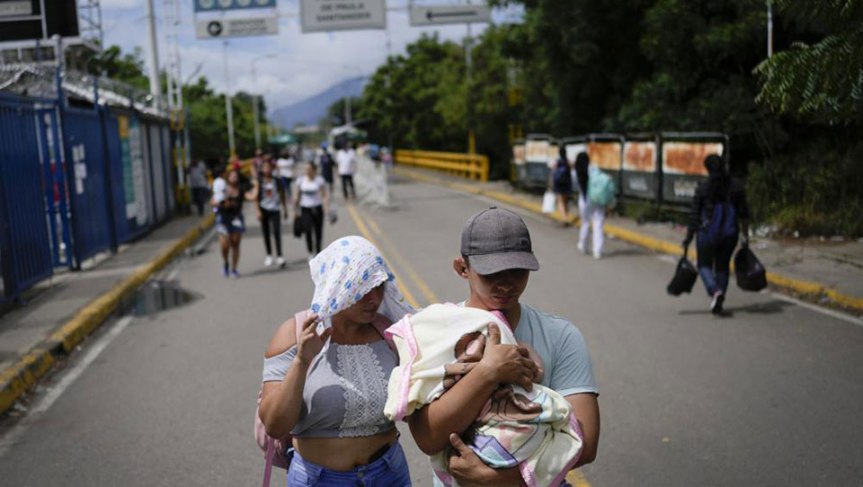
A Venezuelan couple use the Francisco De Paula Santander Bridge to cross between Urena, Venezuela, and Cucuta, Colombia, Aug. 6, 2022. | Matias Delacroix / AP

Colombia’s new president Gustavo Petro wants peace. Colombia’s military, the largest in Latin America, except for that of Brazil, stands in the way. It benefits from U.S. largesse while attending to U.S. needs. Its intelligence branch, discussed here, is not about peace and reconciliation.

The U.S. government, militarily involved in Colombia for decades is likewise an obstacle to peace. As explained recently by analyst Hernando Calvo Ospina, military cooperation has been central to the U.S.-Colombian alliance. He details how since World War II the United States has partnered with Colombia in dominating the entire region to maintain access to strategic resources, exclude Communism, and suppress left-wing movements. Calvo Ospina mentions Colombian-U.S. drug-war operations and the two countries’ addiction to military and ruling-class power. This is the setting for the intelligence operations described below.

Colombian intelligence operations serve U.S. imperialist objectives as they target Cuba and Venezuela. Colombian governing authorities appear to have forgotten the legacy of independence hero Simón Bolívar who, up against Spanish rule and U.S. pretentions, fought for Latin American unity. In 1829 he remarked that, “The United States appear to be destined by Providence to plague America with misery in the name of liberty.” He was denouncing unencumbered U.S. license to control Spanish America, as proclaimed in the Monroe Doctrine of 1823 and still in force. 

Trump-era national security advisor John Bolton recently boasted he had planned coups to unseat the Maduro government in Venezuela. Current White House advisor on Western Hemisphere affairs Juan González took a different tack while speaking in Colombia in August: “40 years ago the United States would have done everything possible to avoid the election of Gustavo Petro and, once elected would have done everything possible to sabotage his policies.”  Now, says González, the United States wants to collaborate and “navigate that change.” 

Meanwhile, Petro wants young people to choose social service and not do military service. His government will be negotiating peace with National Liberation Army (ELN) guerrillas. He rejects the U.S.-promoted drug war and has re-established diplomatic relations with Venezuela, the object of U.S. hybrid war. On August 12, Petro named new military chiefs and replaced 40 generals and admirals because of corruption and human rights violations.

This report turns to Colombian military intelligence. The Revista Raya website, directed by Edinson Bolaños, recently published three articles on Colombian intelligence operations that began in 2016 and continued for almost six years. (See the end note for possible translations in English of “raya.”)

Face-off against Cuba

The first article, titled “International Espionage: Operation Cuba,” appeared on the website on August 19.  One learns that, “Revista Raya had access to thousands of classified Colombian military intelligence documents where evidence appears of spying on Cuban diplomats and officials, left-leaning [Colombian] political leaders, journalists, and social leaders.” The folders contained “profiles of targeted personnel, photographs, videos of subjects being followed, maps, sketches and drawings.”

Agents posing as journalists or photographers mapped routes to facilities used by diplomats. They photographed the interiors of the Cuban embassy, consulates, and diplomats’ quarters, and also diplomats’ automobiles and license plates. They monitored diplomats’ encounters with Colombian activists and politicians. Operatives gained access to phones, computers and on-line communications.

They were able to alter the text of the Cubans’ email communications. Colombian intelligence operatives communicated their findings with U.S. counterparts. U.S. documents with responses and commentary show up in the files.

Operatives attended solidarity gatherings in Colombia and farther afield – at a Sao Paolo Forum of leftist political parties, for example. At these venues, they identified attendees, monitored conversations, gained access to email communications, and informed intelligence agencies in home countries of their citizens’ participation in leftist or pro-Cuba activities. They spied on solidarity gatherings at the Julio Antonio Mella International Camp near Havana.

People attending various events had their phone calls intercepted, among them: Cuban ambassador José Luis Ponce and Vice Consul Kendry Sosa, leftist senators Iván Cepeda and Gloria Flórez; Communist Party leaders Jaime Caycedo and Carlos Lozano Guillén; and FARC lawyer Diego Martínez. Among attendees monitored at the Sao Paolo Forum in 2019 were Communist Party member Gloria Inés Ramírez, now President Petro’s labor minister, and leftist senator Piedad Córdoba.

One purpose for the phone monitoring, according to Revista Raya, was to unearth or install material suggesting that Cuban operatives were promoting the protest demonstrations that rocked Colombia in 2019 and later, and contributed to the election of President Petro. The intelligence units also sought to connect Cuba’s government with leftist insurgents in Colombia, particularly the National Liberation Army (ELN).

According to documents in the report, agents “sewed” information in the computers of ELN guerrilla leaders suggesting the “complicity of Cuba’s government with the ELN in manufacturing the violence associated with the social protests.”  Nothing appeared in the files indicating that Cuba’s government actually did promote anti-government activities, according to Revista Raya.

Agents planted “evidence” of alleged terrorism undertaken by ELN guerrilla leader Andrés Vanegas Londoño, alias “Uriel,” and sent it to Colombian prosecutors and to Interpol. They communicated his location in Choco department. Uriel died in a bombardment of his camp 20 days later, on October 25, 1920.

Targeting Venezuela

Encouraged by its U.S. partner, Colombia’s government has long taken steps to destabilize Venezuelan society and government operations, and more so recently. Secret operations have taken place in Venezuela’s border region with Colombia. Colombian narco-traffickers are active there, and also Colombian paramilitaries. A small U.S.-Colombian force, Operation Gideon, carried out a maritime invasion of Venezuela in 2020.

Colombian military intelligence engaged with agencies and personnel of Venezuela’s government. On August 24, Revista Raya published “International Espionage: Objective Venezuela. The survey covers destabilization plans and monitoring of Colombian and Venezuelan politicians and Venezuelan diplomats.

Colombia’s intelligence service secreted 28 spies within various branches of Venezuela’s military. As part of so-called “Operation Vengeance,” operatives “tried to encourage the Venezuelan Army to carry out military operations against the ELN,” whose detachments were active in Venezuelan territory. They created hostile pamphlets and audio recordings and attributed them to the ELN.The spies “totally infiltrated” the communications of a Venezuelan press attaché in Bogota and monitored his contacts with prominent Colombian politicians of the left. Colombian officials later expelled him. 

Citing “another hundred documents,” Revista Raya shows that, during the presidency of President Iván Duque (2018 -2022), Colombian spies entered, photographed, and took material from the Venezuela’s consulate in Cartagena. The Colombian intelligence operatives attended primarily to consul Ayskel Torres.  

Under “Operation Sunset,” they “monitored her contacts with leftist social leaders in the region and her “sentimental relationship” with the “military attaché of a Caribbean country.” They were blackmailed and the latter provided a list of “cooperating” contacts.

Spying ceased after February 23, 2019, when The Maduro government broke relations with Colombia. The spies had monitored Venezuelan diplomats’ communications about the safety of money and sensitive documents lodged in an Embassy strong box. After the Venezuelans had departed, spies entered the building, took photographs, opened the strong box and stole documents and money. 

Responsibility

The last section of this three-part Revista Raya series is titled “International Espionage: Massive Profiling.” Documents were cited that contained “telephone numbers, homes addresses, political preferences, work places, email addresses, nationalities, and date of identification” for 450 persons. The article presents political profiles of eight individuals as examples of other profiles that were created. Dozens of images appear.

The targeted individuals included “political, social, and union leaders and also diplomats and officials of the Cuban and Venezuelan governments.” Intelligence agents descended on them when they attended “commemorations and political events relating to socialist countries,” or “peaceful mobilizations and … political events in Colombia.”

This last article in the series identifies the chief of Navy Intelligence as the individual primarily responsible for the illegal spying.

Rear Admiral Norman Iván Cabrera Martínez heads that agency now. He served as naval attaché at the Colombian Embassy in Washington and the U.S government awarded him a Meritorious Service Medal. Cabrera Martínez assumed his post on August 27, 2022. 

Colombian Communist Party secretary general Jaime Caycedo, the object of spying, commented to Revista Raya: “We … think this is a violation flagrant of our rights and constitutional liberties …[We] attach great importance to the journalistic work you are doing. You showed how we fell into their hands. You explained how public resources and public entities were used to maltreat citizens with this illegal profiling and to spy on diplomats of friendly countries with diplomatic relations.”

Note: The meaning in English of “raya,” as used in the website’s name, is mysterious here. We opt for “line-by-line review.” “Raya” may signify victim or despised person in that a “tienda de raya” in Mexico was a store operated by a company or hacienda relying on a laborer’s written line for a signature. A possibility from Colombia is “detective.”  Another commentator suggests “memorable happenings.”


W.T. Whitney Jr. is a political journalist whose focus is on Latin America, health care, and anti-racism. A Cuba solidarity activist, he formerly worked as a pediatrician, lives in rural Maine. W.T. Whitney Jr. es un periodista político cuyo enfoque está en América Latina, la atención médica y el antirracismo. Activista solidario con Cuba, anteriormente trabajó como pediatra, vive en la zona rural de Maine.