
Awareness of capitalists’ use of colonialism invites rethinking of solidarity commitment / By W. T. Whitney Jr. 

Mural by Dan Manrique Arias | Photo by Terence Faircloth, CC BY-SA 4.0

South Paris, Maine


Studying capitalism, Karl Marx examined the Industrial Revolution in Europe. He explored conflict between worker and employer. In their book Capital and Imperialism (Monthly Review Press, 2021), authors Utsa Patnaik and Prabhat Patnaik emphasize that Marx’s followers believed that, with the onset of capitalism, “accumulation [has] occurred only on the basis of the generation of surplus value.” (Surplus value signifies that part of a product’s commercial yield which labor generates and employers keep.)

Many U.S. political activists oppose the overseas wars and interventions their government uses to maintain worldwide political and economic domination. More than a few know about stealing in the peripheral regions of the world at the hands of capitalism. They are aware of U.S. imperialism.

The stolen goods include: land, bodies, raw materials, food crops, forests, water, extractable underground resources, exorbitant interest on debt, and funding owed the world’s poor for subsistence. Non-payment for social reproduction is a kind of stealing.

The more these activists learn that capitalism from its start did call for oppression in the undeveloped regions of the world, the more likely might be their inclination to build an anti-capitalist international solidarity movement. The book authored by the Patnaiks contributes to this end by documenting that colonialism and, implicitly, imperialism have been essential to the development of capitalism.

In describing India’s colonial experience, their book – by no means reviewed here in its entirety – provides an explanation taken from Marx as to why capitalism needed colonialism. It details the workings of capitalist-inspired colonialism in India.      

The Patnaiks declare that, “not only has capitalism always been historically ensconced within a pre-capitalist setting from which it emerged, with which it interacted, and which it modified for its own purposes, but additionally that its very existence and expansion is conditioned upon such interaction.” Capitalists sought “appropriation of surplus by the metropolis, under colonialism.” (“Metropolis” is defined as “the city or state of origin of a colony.”)

They explain that “Marx’s basic concept of capitalism [as expressed] in Capital is of an isolated capitalist sector … consisting only of workers and capitalists,” also that an isolated sector implies a capitalism “stuck forever in a stationary state or a state of simple reproduction … [and] with zero growth.” They insist that “a closed self-contained capitalism in the metropolis is a logical impossibility.”

There is “nothing within the system to pull it out of that state.” The economy “will necessarily get to that state in the absence of exogenous stimuli.” 

The Patnaiks envision three kinds of exogenous stimuli: “pre-capitalist markets, state expenditure, and innovations.” The first of these represents the colonialism that would be essential to capitalists as they built the economies of European industrial centers. 

Inflation a concern

Outlining how British capitalism dealt with colonial India, the authors highlight money as a device for holding and transferring wealth. The object has been to preserve its value. The system had these features:  

·        Officials in London used the surplus derived from Indian exports of primary commodities to finance the export of capital to other capitalist countries.

·        British officials taxed the land of small producers in India, using the revenue to pay the colony’s administrative expenses and purchase commodities for export to Britain; some were re-exported to other countries.

·        Britain exported manufactured goods. The flood of them arriving in India led to “deindustrialization of the colonial economy.” Displaced artisan manufacturers became “petty producers” of commodities.

·        British officials dealing with “increasing supply prices” for commodities exported from the colonies, faced “metropolitan money-wage or profit margin increases.” Seeking to “stabilize the value of money,” they imposed “income deflation … [on Indian] suppliers of wage goods and inputs to the capitalist sector.”

·        The claims of heavily-taxed agricultural producers in India were “compressible” especially because they were located “in the midst of vast labor reserves.”  

Colonialism provided British capitalists the option of cutting pay or jobs in India so as to carry out the currency exchanges the system required and to “accommodate increases in money wages” in Britain, both “without jeopardizing the value of money.”

Global economy

The book outlines post-colonial developments. Colonial arrangements persisted throughout the 19th century and collapsed after World War I, due in part, say the authors, to a worldwide agricultural crisis that peaked in 1926. The circumstances gave rise to the Great Depression. Spending for World War II led to recovery, mostly in the United States.

These were “boom years” for capitalism. The United States, confronted with increasing military expenses, turned to deficit financing. Western European countries took up social democracy and the welfare state. Some former colonies, now independent nations, sponsored agricultural and industrial initiatives aimed at relieving economic inequalities.

At that point, the centers could no longer impose income deflation on working people in the periphery to ward off loss of monetary value. Bank holdings increased and lending pressures mounted. In 1973 “the Bretton Woods system collapsed because of the emergence of inflation.” “The capitalist world of the stable medium of holding wealth …[through] the gold-dollar link” took a hit.

Next came worldwide take-over by global finance capital and neoliberalism. The Patnaiks explain that, with “barriers to capital flows” down, “state intervention in demand management becomes impossible.” “[A] regime of income deflation on the working people of the periphery” returned in order to “control inflation and stabilize the value of money.” 

Concluding

This story is of continuities. One is capitalism at its start taking up with colonialism. Another is capitalism using colonialism to preserve the value of money in cross-border commercial and financial dealings. One more is the oppression and beggaring of the world’s working people to prevent inflation.

Karl Marx may have found data and other information on colonialism scarce as he studied capitalism. Additionally, his life of research and political activism may have been so full as to distract him from investigation of the colonial connection. Even so he championed international worker solidarity.  

He and Engels supported India’s independence struggle. Marx defended “heroic Poland” beset by Czarist Russia. He writes to Engels that, “In my view, the most momentous thing happening in the world today is, on the one hand, the movement among the slaves in America, started by the death of [John] Brown and on the other the movement of the serfs in Russia.”

Addressing the International Working Men’s Association – the First International – in 1864, Marx reported that events “have taught the working classes the duty to master themselves the mysteries of international politics; to watch the diplomatic acts of their respective governments.”

The wreckage of people’s lives caused by capitalism now extends widely. The venue of capitalism is global, by its nature. Political support for workers and their political formations in the Global South hits at the essence of capitalist power. The promise of basic change lies in that direction, and that’s so too with alternatives to the capitalist system.

Those struggles for social justice and equality that are confined to the world’s industrial centers do target aspects of capitalism, but without far-reaching expectations. The full effort consists of: pushing for reforms that ease burdens placed upon working people, building mass opposition, and – crucially – advancing the international solidarity movement.


W.T. Whitney Jr. is a political journalist whose focus is on Latin America, health care, and anti-racism. A Cuba solidarity activist, he formerly worked as a pediatrician, lives in rural Maine. W.T. Whitney Jr. es un periodista político cuyo enfoque está en América Latina, la atención médica y el antirracismo. Activista solidario con Cuba, anteriormente trabajó como pediatra, vive en la zona rural de Maine.

U.S. imperialism arranges Black-majority occupation force for Haiti intervention / by W.T. Whitney Jr.

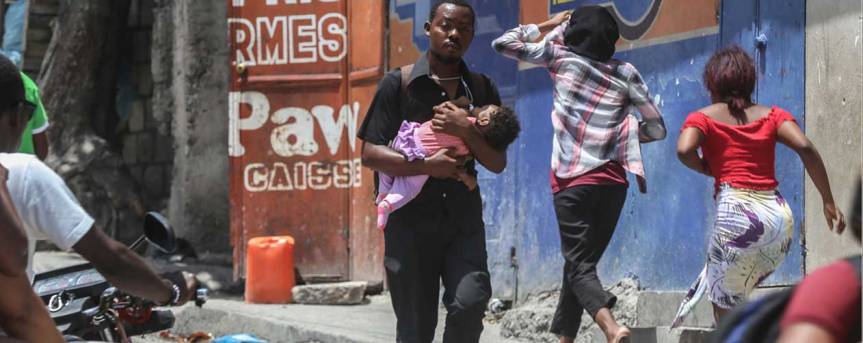
Residents walk past a burnt car as they evacuate the Delmas 22 neighborhood the morning after an attack amid gang violence in Port-au-Prince, Haiti, May 2, 2024. | Ramon Espinosa / AP

Reposted from Peoples World


Under U.S. arrangements, a so-called Multinational Security Support (MSS) force will soon be descending on Haiti. Its mission is suppressing gang violence. With their experience of earlier U.S. interventions, however, beleaguered Haitians can likely expect an aggravation of oppression, social disaster, and dependency.

Supplies will arrive from the United States, and a U.S. military base is taking shape near the Port-au-Prince airport for the task. Joining the 2,500-member police force on the way will be another 1,000 troops from Kenya and others from Benin, Chad, Jamaica, Barbados, Bahamas, and Bangladesh. Kenyan officers will provide leadership.

The United Nations Security Council approved the occupation force in October 2023, but U.N. organizational responsibility is lacking. The U.S. government is providing $300 million in financing plus administrative capabilities and supplies. During a three-day state visit to Washington by Kenyan President William Ruto in mid-May, Kenya was declared officially a non-NATO U.S. ally. There are 18 other such nations.

Haiti’s government barely functions. Authority centered on Prime Minister Ariel Henry from July 2021 until his forced resignation in April. The “Core Group” of nations appointed him to that office immediately after President Juvenal Moïse was assassinated. The Core Group has supervised Haiti’s affairs since 2004. It consists of the United States, France, Canada, other European states, and an EU representative.

With U.S. encouragement, the CARICOM alliance of Caribbean nations in April established the Temporary Presidential Council to provide Haiti with governance and prepare for elections in early 2026. National elections last took place in 2017.

Presidents Michel Martelly and Jovenel Moïse held office between 2011 and 2021. They took advantage of low turnout, corrupt elections, and, in Martelly’s case, help from U.S. Secretary of State Hillary Clinton. They presided over the massive plundering of the PetroCaribe oil funds.

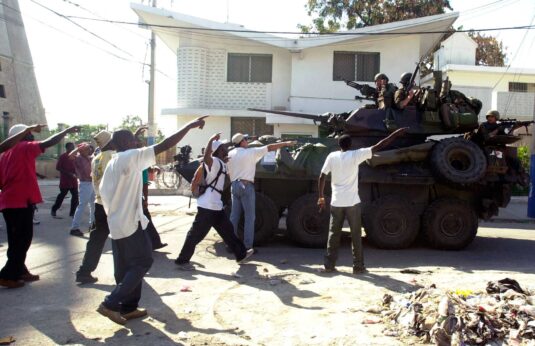
The upcoming multinational intervention has antecedents: occupation by the U.S. Army from 1915 to 1934; U.S. military occupation from mid-1994 until March 1995, and a U.S.-endorsed U.N. multinational occupation force occupying Haiti between 2004 and 2017.  A militarized United Nations mission with U.S. participation remained there from 1995 until 2000.

The police personnel from Black-majority nations making up the new occupation force will be racially similar to the cruel security force serving Haiti’s Duvalier father-and-son dictatorship, in power from 1957 to 1986. The deadly Tonton Macoute paramilitary repressors operated with funds presumably taken from the $900 million the regime received from Washington in the name of anti-communism.

In Haiti, the U.S. government is again relying on proxy enforcers who are African-descended.

The rationale for the MSS occupation may go beyond gang violence. That some gang members are thinking about justice and new arrangements for Haitian society suggests stirrings of resistance.

Haitians carried out large street protests in 2018 and 2019 against high prices, fuel and food shortages, and governmental corruption. The rich and powerful, concerned about disarray and threats to their privileges, recruited gangs of impoverished, alienated young men to clear the streets. Arms arrived from the United States.

According to analyst Jemima Pierre, “The Haitian oligarchs have always used armed groups to settle business and political scores.” Some gangs later took up drug trafficking and now receive arms from Latin American cartels.

Critical thinking shows in at least one gang member. High-profile leader Jimmy Cherizier warned that Ariel Henry before he resigned, “will plunge Haiti into chaos.… We are making a bloody revolution in the country because this system is an apartheid system, a wicked system.”

Cherizier had already insisted that the gangs are seeking “stability in our communities, … stability for businesses to function without fear so that people in our community can live without fear and feel secure, potable water for everyone in the poor neighborhoods, good healthcare, and good schools for everybody in the poor neighborhoods.”

Aspirations for social change, worrisome to authorities, rate scant coverage in the Haitian and U.S. media. That’s no surprise, given the U.S. treatment of Jean-Bertrand Aristide.

An opening for democratically-elected political leadership culminated in Aristide’s inauguration as president of Haiti on Feb. 7, 1991. His social-democratic political movement took power. The Heritage Foundation four days later mentioned that “The new government in Port-au-Prince may be steering Haiti toward a communist dictatorship, hostile to the United States.”

U.S. intelligence operatives and other agents engineered successful coups against Aristide and his governments in 1991, 1994, and in 2004. Then came the 13-year-long United Nations military occupation.

An enduring theme resurfaces, that of repetition of occupations and coups and no end in sight. U.S. interventions usually do not resolve the social and political problems of either country. In Haiti, they firm up a terrible status quo. U.S. relations with other Western Hemisphere nations are different.

In dealings with many of those nations, the region’s self-appointed boss often succeeds in accomplishing its political and economic purposes. The U.S. government even adjusts to mildly progressive political changes in a few countries. In others, it suppresses social and political ferment through reliance on psychological war, undercover actions, and/or intervention, either directly or with proxies. Some sort of resolution results in most instances.

Relations with Haiti are stuck, and for good reason. Interventions don’t prosper because potential allies naturally aligned with the United States may be reluctant. For one thing, their other transnational allegiances tend to distract Haiti’s business owners and wealthy class from building U.S. relationships.  Many have family, investments, and enterprises elsewhere overseas.

The population’s division by mulatto and Black identity has historically weakened ruling-class integrity. U.S. decision-makers might have found allies among Haiti’s mulattos, a minority like themselves that is associated with political power and wealth. But recruitment may have stumbled because, as in the past, mulatto attachment to the white establishment gets push-back from Haiti’s impoverished, restive Black majority.

U.S. interventionists may not warm to Haiti’s business and political class because of supposed corruption tendencies. Anti-Black prejudice infecting U.S. society also causes trouble. Stories linger of anti-white violence accompanying slave rebellion in Haiti.

By contrast, the existence in Latin America of a well-established, institutionally-attached, self-sustaining, and culturally-aligned wealthy elite encourages collaboration. That sector can lean upon U.S. counterparts for rescue from their own dispossessed, aroused, and rebellious compatriots. Similar possibilities in Haiti are stymied. U.S. intrusions are blundering, and society itself is hurt.


W.T. Whitney Jr. is a political journalist whose focus is on Latin America, health care, and anti-racism. A Cuba solidarity activist, he formerly worked as a pediatrician, lives in rural Maine. W.T. Whitney Jr. es un periodista político cuyo enfoque está en América Latina, la atención médica y el antirracismo. Activista solidario con Cuba, anteriormente trabajó como pediatra, vive en la zona rural de Maine.
U.S. military appears to favor Israeli plan for permanent Gaza occupation / By W.T. Whitney Jr.

Israeli soldiers eye their targets at the Israel-Gaza border on Monday, Dec. 18, 2023. | AP

Reposted from the People’s World


Nearly 20,000 Gaza civilians, mostly children and women, have died from bombs and gunfire in Israel’s war so far. Many more will be dying soon from lack of medical care, food, water, and the spread of infectious diseases. Healthcare and social service facilities—along with the homes of a million or more—have been reduced to rubble.

The U.S. government provides the support for all of this to happen, as it continues to financially and militarily back Israel in its war against Hamas in Gaza in retaliation for the latter’s attacks of Oct. 7.

Prospects for Gazans who survive the war are grim, or worse. The families of many are gone, and international aid agencies have mostly disappeared. Dire shortages of necessities are on the horizon.  Repairing the physical damage won’t happen anytime soon, and Israeli settlers are already eyeing prime Gaza lands.

With humanitarian disaster on full display, Human Rights Watch points out that, “by continuing to provide Israel with weapons and diplomatic cover as it commits atrocities…the U.S. risks complicity in war crimes.”

Either the charge or the fact of complicity will very likely bedevil the United States for as long as Gazan civilians are dying in large numbers or being removed to camps somewhere else and, all the while, the U.S. goes on supplying Israeli occupiers with weapons.

A recently released Israeli military analysis raises the possibility that the U.S. government courts very serious condemnation if it provides material support for a permanent Israeli occupation of Gaza.

Dr. Omer Dostri, the study’s author, is associated with the Jerusalem Institute for Strategy and Security and the Israel Defense and Security Forum. Each is oriented to Israel’s military establishment. His study appeared Nov. 7 in the Military Review, the self-described “Professional Journal of the U.S. Army.”

As reported by journalist Dan Cohen, Dostri declared on social media that, he “authored [the study] on behalf of the U.S. Department of Defense and the U.S. Army’s Military Review journal.” For the Military Review’s editors to have invited Dostri’s submission suggests they already knew about and were at least tolerant of, Dostri’s iron-fist approach toward Gaza.

The author and editors alike presumably expected their respective military superiors to accept some or all of the views expressed in the paper. Perhaps, then, the two military leaderships have common ground regarding Gaza. Publication of this Israeli analysis becomes a straw in the wind as to future U.S.-Israel military collaboration on Gaza, and, on that score, to U.S. war crimes.

The title of Dostri’s article reads in part, “The End of the Deterrence Strategy in Gaza.” He notes the failure of Israeli military intelligence, Israel’s lack of combat readiness, and Hamas’s “exceptional military and professional approach.” Referring to Israel’s “disregard for the fundamentalist religious dimension of Hamas as an extreme Islamic terrorist organization,” he diagnoses faulty “political perception”

Dostri reviews options for control of Gaza following the envisioned defeat of Hamas. They are: a local Gazan administration, the Palestinian Authority taking charge, a mandate exercised by another government or an international agency, or occupation and governance by Israel’s military. He favors the latter, “from a security perspective.”

The main reason for establishing Israeli settlements in Gaza, he states, is that “seizing and securing land constitutes a more substantial blow to radical Islamist terror groups than the elimination of terrorist operatives and high-ranking leaders.”

Summarizing, Dostri indicates that:

“[A] robust ground campaign in the Gaza Strip, encompassing the occupation of territories, the creation of new Israeli settlements, and the voluntary relocation of hundreds of thousands of Palestinians to Egypt with no option for return will greatly fortify Israeli deterrence and project influence throughout the entire Middle East.”

Dostri examines Israel’s conduct in the ongoing Gaza war. He calls for a military strategy aimed at securing “a swift surrender of the enemy” that would allow “political maneuverability to make decisions.” The goal “is to defeat Hamas and assume control of the Gaza Strip for the benefit of future generations.”

Israel, he says though, runs “the risk of a multifront war.” Planners are “in the process of altering…policy and military strategy, not only concerning Gaza but also across other fronts.” The Gaza experience is instructive: “Successive Israeli governments…regarded Hamas in the Gaza Strip as a legitimate governing entity that could be managed and engaged through diplomatic and economic means. Not anymore.”

Now “Israel should shift from a strategy of deterrence…[to a] strategy of unwavering decisiveness and victory.” In particular, “Israel will have no choice but to invade Lebanon and defeat Hezbollah.” In addition, “Israel cannot afford to allow the Houthis [in Yemen] to significantly bolster their military strength over time.”

U.S. political leaders for the most part have yet to weigh in on the fate of Gazan civilians in the post-war period. Dostri’s view of Gaza’s future, seemingly acceptable, more or less, to the militaries of the two countries, leaves no room for the niceties of civilians being abused and dying as part of the coming occupation.

By Dec. 1, the U.S. Congress was considering a proposal for assisting Israeli forces as they clear Gaza of Gazans:  Egypt, Turkey, Yemen, and Iraq would receive U.S. monetary support for taking in Gazans fleeing from Israeli attacks.

The next day, however, Vice President Kamala Harris indicated that “Under no circumstances will the United States permit the forced relocation of Palestinians from Gaza or the West Bank.”

At issue for U.S. policymakers are competing realities: the suffering of Gaza civilians, obligations to U.S. ally Israel, the prospect of a region-wide war, and the control of oil, whether Israeli or Palestinian.

Reporting on counterpunch.org, Charlotte Dennett cites “oil and natural gas, discovered off the coast of Gaza, Israel, and Lebanon in 2000 and 2010 and estimated to be worth $500 billion.” The Palestinians in 2000 claimed that the “gas fields…belonged to them.”

Yasser Arafat, the then-President of the Palestinian National Authority, “learned they could provide $1 billion in badly needed revenue. For him, this [was] a Gift of God for our people and a strong foundation for a Palestinian state.”

Dennett adds that “In December 2010, prospectors discovered a much larger gas field off the Israeli coast, dubbed Leviathan.” In addition, “work has already begun on…the so-called Ben Gurion Canal, from the tip of northern Gaza south into the Gulf of Aqaba, connecting Israel to the Red Sea and providing a competitor to Egypt’s Suez Canal.”

Israeli Prime Minister Benjamin Netanyahu wants to “convince international lenders to support his long-held scheme of turning Israel into an energy corridor.”

With such riches at stake, does anyone really believe that a truly free Palestinian state will be allowed to come into existence?


We hope you appreciated this article. At People’s World, we believe news and information should be free and accessible to all, but we need your help. Our journalism is free of corporate influence and paywalls because we are totally reader-supported. Only you, our readers and supporters, make this possible. If you enjoy reading People’s World and the stories we bring you, please support our work by donating or becoming a monthly sustainer today. Thank you!


W.T. Whitney Jr. is a political journalist whose focus is on Latin America, health care, and anti-racism. A Cuba solidarity activist, he formerly worked as a pediatrician, lives in rural Maine. W.T. Whitney Jr. es un periodista político cuyo enfoque está en América Latina, la atención médica y el antirracismo. Activista solidario con Cuba, anteriormente trabajó como pediatra, vive en la zona rural de Maine.
Potential disaster awaits Haiti as U.S. prepares for armed intervention / by William T. Whitney Jr

Residents flee their homes to escape clashes between armed gangs in the Carrefour-Feuilles district of Port-au-Prince, Haiti, Aug. 15, 2023. | Odelyn Joseph / AP

Reposted from People’s World


NEW YORK—On Monday, the United Nations Security Council voted to send a foreign “security mission” to Haiti—an armed intervention force. The body adopted a resolution, drafted by the United States and Ecuador, that authorizes the so-called Multinational Security Support mission—“to take all necessary measures”—code for the use of force.

Officials from Haiti, the U.N., and the U.S. say the intervention will be aimed at helping Haiti’s police suppress armed bands, or gangs, that cause deadly violence and have overrun the capital, Port-au-Prince. The U.N. reports that, as of Aug. 15, 2,439 Haitians had been killed this year.

“More than just a simple vote, this is in fact an expression of solidarity with a population in distress,” Haiti’s Foreign Minister Jean Victor Geneus told the council. “It’s a glimmer of hope for the people that have for too long been suffering.”

China and Russia, however, abstained from the vote, expressing reluctance about granting a blanket authorization for the use of force under Chapter 7 of the founding U.N. Charter. The remaining 13 members voted in favor.

Senior U.S. diplomat Jeffrey DeLaurentis justified the blank check for intervention, saying, “We have stepped up to create a new way of preserving global peace and security, answering the repeated calls of a member state facing a multi-dimensional crisis amid alarming spiraling gang violence.”

In mid-September, at the U.N. General Assembly, U.S. President Joe Biden and Ariel Henry, Haiti’s acting president, issued a call for a multinational militarized occupation of Haiti. U.N. Secretary-General António Guterres had already done so earlier. Secretary of State Antony Blinken promised “robust financial and logistical assistance” from the United States for a military intervention.

U.S. spokespersons say that $100 million is being sought from both Congress and the Pentagon to back the mission.

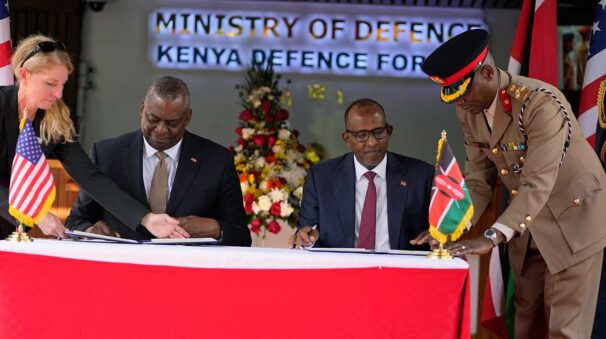
Meeting in Nairobi on Sept. 25, U.S. Defense Secretary Lloyd Austin and his Kenyan counterpart agreed that Kenya will provide 1000 “security officers” and will “lead a multi-national peacekeeping mission to Haiti.” According to the U.N., 12 countries have committed to being part of the mission.

The newly approved international intervention into Haiti will be officially ‘led’ by Kenya, providing some cover for the U.S. military, which will likely be calling the shots behind the scenes. Here, U.S. Secretary of Defense Lloyd J. Austin, left and Kenya Cabinet Secretary for Defense Aden Duale, sign a bilateral defense cooperation agreement in Nairobi on Sept. 25, 2023. The defense agreement will see Kenya get resources and support for security deployments in exchange for ‘leading’ the intervention in Haiti to combat gang violence. | Khalil Senosi / AP

The Communist Party of Kenya issued a statement condemning its government’s participation. It pointed out that U.S. power derives from “the enslavement of millions of African people, whose labor laid the foundation for [U.S.] economic prosperity.”

The United Nations itself is neither leading nor organizing the intervention, as the organization doesn’t exactly have a good reputation among the people of Haiti. For good reason: The U.N. force occupying Haiti in 2004-17 violated Haitians’ human rights, abused women and children, and introduced a cholera epidemic that killed 40,000 Haitians.

We offer four explanations for why the planned armed intervention will harm Haiti’s already beleaguered majority population.

One, previous foreign interventions have brought trouble. Nothing suggests this one will be different. Here’s the record:

  • The aforementioned U.N. occupation.
  • NGOs invaded after the 2010 earthquake. They wasted donated funds.
  • S.-assisted military coups in 1991 and 2004 removed the progressive Haitian President Jean-Bertrand Aristide.
  • The U.S. “Operation Uphold Democracy” reinserted Aristide in 1994 on the condition that he enforce neoliberal economic “reform.”
  • The U.S. government provided vital support to the father-and-son Duvalier dictatorship from 1957 to 1986
  • The U.S. military occupation of Haiti from 1915 to 1934 was brutal.
  • France, upon being kicked out of its Haitian colony, required payback with interest for slaves having gone free, in all, $560 million (in 2022 dollars) and up to $115 billion in lost development.
  • The U.S. responded to Haitian independence, proclaimed in 1804, with a trade embargo and diplomatic isolation, each lasting for decades.
In this March 7, 2004, file photo, people demand that occupying U.S. Marines take action to protect them after shooting erupted during a march in Port-au-Prince, Haiti. In 2004, a coup d’état occurred after conflicts lasting for several weeks in Haiti. It resulted in the second removal from office of President Jean-Bertrand Aristide, preventing him from finishing his second term. Aristide claimed that his departure was a kidnapping, accusing the U.S. of orchestrating a coup d’état against him. Now, almost 20 years later, the country is still engulfed by violence. | Pablo Aneli / AP

Two, Haiti’s oppressed majority population needs a government, not a façade of one. A government in Haiti that served the people might provide a buffer between an imported, militarized foreign police and the Haitian people. Haiti has no functioning government today, much less one friendly to the people’s cause.

Michel Martelly became president in 2011, courtesy of U.S. manipulation. The last general election in Haiti, in 2016, allowed Jovenel Moïse to be president. The two wealthy politicians belonged to the rightwing PHTK political party. The elections they won were thoroughly corrupt and saw abysmally low-turnouts.

Moïse and others embezzled billions of dollars taken from the low-interest loans that President Hugo Chavez’s Venezuelan government made available to the Haitian state. The funds were supposed to have supported Haiti’s development and allowed the government to purchase low-cost oil under Chavez’s Petrocaribe program and to provide subsidized fuel and food for Haiti’s impoverished people. The U.S. government sanctioned Venezuela in 2015, and the loans and cheap oil stopped.

In response, massive protests erupted against government corruption and waste of the Petrocaribe funds. With increasing shortages and rising prices, they’ve continued since 2018. In a context of multifaceted conflict among Haiti’s oligarchs, Moïse was assassinated in July 2021.

There has been no president since, other than acting president Ariel Henry, whom the U.S., Canada, several European countries, and the EU—the so-called “Core Group” that oversees Haiti’s affairs—made prime minister shortly after the assassination. And as for the country’s parliament, it hasn’t functioned for over three years.

The distressed Haitian masses have no political party that reliably or effectively speaks for them. They have no say in foreign governments’ plans for them. They have no institutional resources or constitutional protections against potential abuse at the hands of foreign occupation forces.

Three, the gangs have ties with Haiti’s wealthy powerbrokers. It’s a relationship inconsistent with a simple story of interventionists taking on gangs. The association grew out of the recurring outbursts of social protest.

Haiti’s establishment sought protection from disorder and destruction triggered by the ongoing protests, primarily in Port-au-Prince. In the absence of an army, and with the police unable to cope, gangs came into existence.

They were supposedly going to bring order to city neighborhoods, even leading some protesters to join. Behind them, with funds the whole time, however, have been a number of wealthy Haitians. So of course, the gangs took on the additional role of blocking agitation for political change. Funds flowed from local oligarchs and from abroad for that specific purpose.

There’s a sea of contradictions. In suppressing the gangs, the interventionist forces would be defying the wealthy classes that pay them. But those same wealthy classes, as represented by their political boss Ariel Henry, are calling for a foreign security force to defeat them. The struggling people of Haiti may not readily follow such convoluted scheming, but they are familiar with the likely outcome.

Four, the timing of the intervention coincides with movement within the gangs toward a new kind of politics. One suspects that the proposed intervention represents a heavy-handed response to stirrings for political change.

Some leaders of some gangs appear to be disenchanted with inter-gang fighting and with dependence on the rich and powerful. They are making alliances and mouthing revolutionary sentiments.

Press reports center on veteran gang leader Jimmy Cherizier. They’ve latched onto his nickname “Barbecue,” assigned to him as a small boy; it evokes the specter of fiery violence. This former highly-regarded policeman brought other gangs into his “G9” alliance and now is reaching out to other gangs.

Cherizier, quoted by journalist Kim Ives, speaks his mind:

“We are a great people. Our national motto is ‘Union makes strength.’ Our objective is to once and for all overthrow the system that exists in Haiti and achieve the dream of [Haitian founding father Jean-Jacques] Dessalines, which is for the nation’s wealth to be shared by all its citizens…. Our battle isn’t just going to be to demonstrate with people in the streets. We have guns, and we will fight with them…. We took our independence with arms.”

Cherizier told Ives earlier, “This is a corrupt system; these people are using us to fight their political battles, and we do not want to be their cannon fodder anymore.”

Sabine Manigat, a sociologist at Haiti’s Quisqueya University, has the last word: The “image of Haiti portrayed in the foreign press, which highlights misery and insecurity, does not paint the full picture of a country where a social movement survives, people who are standing up and fighting and who require international solidarity, not intervention.”


W.T. Whitney Jr. is a political journalist whose focus is on Latin America, health care, and anti-racism. A Cuba solidarity activist, he formerly worked as a pediatrician, lives in rural Maine. W.T. Whitney Jr. es un periodista político cuyo enfoque está en América Latina, la atención médica y el antirracismo. Activista solidario con Cuba, anteriormente trabajó como pediatra, vive en la zona rural de Maine.