

Court Says Colombian State Responsible for Patriotic Union “Extermination” – No Mention of US Role / By W.T. Whitney Jr.

The survivors and family members of the victims of the genocide against the Patriotic Union party celebrated the IACHR Court’s ruling, which declared the Colombian State responsible for the extermination of UP militants and members in the mid-1980s. Photo: Corporación Reiniciar/Twitter

Rubí Andrea Forero, 52 years old, talked to Prensa Latina about the recent court ruling in the Patriotic Union’s case against Colombia’s government. She felt relief. She has coped with her father’s murder on February 27, 1989 and her awareness of “impunity and continuing crimes”. She recalls “silent longings and frustrated dreams from the war” and the “fears, absences, and frustrations” of families and friends. 

Teofilo Forero, Rubí’s father, was a union president, a deputy in the Cundinamarca legislature, and Bogota City councilor. Nationally, he was a leader of the CTC Labor Federation and organization secretary of Colombia’s Communist Party. That party, the interviewer explains, was the “vertebral column of the Patriotic Union (UP in Spanish-language initials).” The UP dates from 1985.

On January 30, the Inter-American Court of Human Rights (IACHR Court) announced its long-anticipated ruling in the UP case. The Court named the Colombian state as responsible “for violations of human rights committed against more than 6000 members of the Patriotic Union political party during a period that began in 1984 and lasted for more than 20 years.”

(The Special Jurisdiction for Peace, established under the 2016 Peace Agreement between the FARC and Colombian government, indicated in 2022 that “5,733 persons were assassinated or disappeared in attacks directed against the UP.”)  

The Court ruling cites a “plan of systematic extermination … relying on participation by state agents and acquiescence by authorities.” It cites “forced disappearances, massacres, extrajudicial executions, assassinations … [and] impunity.”

The peace agreement between the Revolutionary Armed Forces of Colombia (FARC) and Colombia’s government in 1984 enabled demobilized FARC insurgents, Communist Party activists, and others to create the UP. The organization undertook to “promote the social, economic, and political transformations necessary for building a peace with social justice,” according to the Reiniciar Corporation, stalwart defender of the UP since 1992.

As 1985 closed, the UP had established “2,229 grassroots organizations” in more than 200 municipalities and rural districts. In early 1986, 15 UP candidates were elected to Colombia’s Congress, 18 to departmental legislatures, and 335 to city councils; there were 23 UP mayors. In elections a few weeks later, UP candidate Jaime Pardo Leal proved to be the third most popular presidential candidate. The UP was a powerful political force.

Then came catastrophe. Assassins killed “nine congresspersons, 70 city council members, and dozens of deputies, mayors, and grassroots leaders,” and also “labor leaders, students, artists, activists, and sympathizers” from all sectors. Two presidential candidates would be murdered. 

The IACHR Court ordered reparations. The state must pursue investigations of “gross violations of human rights and [that way] determine penal responsibilities.”  In addition, disappeared victims must be located, victims cared for, and the Court’s decision publicized. The Court called for protecting UP activists now, a national educational campaign, recompense for “material and immaterial damages” and a national day of commemorating UP victims.

The Reiniciar Corporation in 1993 led in submitting the UP case to the Inter-American Commission on Human Rights (IACHR). That agency collected evidence and collaborated  with the Colombian government to reach a settlement, but to no avail. The case moved to the IACHR Court in 2017.

No longer able to field electoral candidates, the UP in 2002 lost its “judicial personhood” and state recognition of its status as a political party. Reacting to IACHR verification of persecution, election officials in 2013 restored the UP’s former status.

UP participation in elections was evident recently in the party having joined the victorious Historic Pact coalition of President Gustavo Petro. Former UP activist Germán Umaña serves as minister of commerce in the Petro government. He had abandoned political life after the assassination in 1998 of his brother Eduardo Umaña, law professor and defender of human rights.

Revival of the UP and its distancing from a violent past go along with Colombia’s tentative turn to peace. In that regard, the government on January 1 announced a ceasefire among combatant groups; among them the Colombian Army, National Liberation Army guerrillas, two groups of narco-trafficking paramilitaries, and two dissident insurgencies formerly part of the now defunct FARC.  

However, the UP story is about U.S. military intervention as well as peace in Colombia.

Journalist Nelson Lombana Silva sees the IACHR Court decision as “not solely applying to the Colombia state, but also to Colombia’s liberal-conservative, criminal oligarchy that decided to remove this political movement,” and did so “with U.S. participation.”

Historian Ivan David Ortiz, investigating the failure of the 1984 peace agreement, notes the FARC’s explanation at the time, that “hegemonic political and economic sectors continued the warlike policies of the United States.” He cites the FARC’s claim that, “the anti-peace offensive in Colombia came from the Pentagon.” (1)

An Amnesty International report of 2005 covers the same ground:

Efforts by the government of President Belisario Betancur (1982-1986) to initiate peace talks with guerrilla groups in the mid-1980s heightened concern that any peace agreement would have entailed land and other socio-economic reforms. This dynamic strengthened the alliance between the traditional economic elites and the armed forces and spurred on the development of paramilitary structures under the coordination of the armed forces.

Accessory information points to U.S. involvement within this context. Paramilitaries bore most of the direct responsibly for massacring the Patriotic Union. Paramilitaries coordinate their operations with Colombia’s military, which has a supervisory role, as documented here and here. The impetus for the paramilitary phenomenon derived from recommendations of a U.S. “Special Warfare” consulting team in 1962. 

Secondly, Colombia’s military, the paramilitaries’ senior partner, thrives due in part to the U.S. government’s generous support and financing. The flow of billions of dollars to Colombia’s military is notable.  It began in 2000 under U.S. Plan Colombia and continued for more than ten years. Drug war, the usual justification for U.S. partnering with Colombia’s military, has been useful as a cover for war against leftist guerrillas and against left-leaning political groups and social movements.

Ultimately, it seems, there was a big element of U.S. proxy war in the deadly suppression of the UP. U.S. would-be masters of global affairs have long manifested instant readiness to blot out popular risings viewed as threatening to their accustomed ways. Viewed like this, perpetrators of the anti-UP violence were kin to Bay of Pigs assailants in Cuba, Contra warriors in Nicaragua and Ukraine’s military fighting against Russians now.

Note: (1) Iván David Ortiz Palacios, “El Genocidio Político contra la Unión Patriótica,” (Universidad Nacional de Colombia, Bogotá, 2007), p. 17


W.T. Whitney Jr. is a political journalist whose focus is on Latin America, health care, and anti-racism. A Cuba solidarity activist, he formerly worked as a pediatrician, lives in rural Maine. W.T. Whitney Jr. es un periodista político cuyo enfoque está en América Latina, la atención médica y el antirracismo. Activista solidario con Cuba, anteriormente trabajó como pediatra, vive en la zona rural de Maine.

Prospects Ahead for the Fighting Communist Party of Swaziland / by W. T. Whitney Jr.

CPS

Life expectancy in Swaziland, in southern Africa, is the world’s 7th lowest; its HIV/AIDS prevalence is the world’s highest at 26%. Unemployment is 41%, and wages for 80% of workers are less than $2 dollars per day. Swaziland is an autocracy ruled by a king.

A Communist party has existed in Swaziland since 2011. Political parties are illegal there. Many activists, Communists, live abroad, mainly in South Africa. What follows is information about the Communist Party of Swaziland (CPS), its activities and goals, aspects of Swazi history, and current realities. The CPS needs international solidarity.

Its recent story begins in early May 2021 with the mysterious death, presumably at police hands, of law student Thabani Nkomonye. The police violently disrupted his memorial services.

The National Union of Students mobilized masses of young people and the police retaliated repeatedly with tear gas and bullets. The CPS called for legalization of political parties, overthrow of the “tinkhundla system” [of control by chiefs in rural areas] and removal of the king.

During May and into June, the National Union of Students organized additional marches; 3,000 students advancing on a police station met with tear gas and arrests. Anti-government protesters prevented 30,000 textile workers from entering their factories. The government banned demonstrations.

The CPS called for a National Democracy Conference at which “a common minimum program could be achieved for transform[ing] the state from a monarchy into a republic.” There was no conference. Writing a year later, analyst Joseph Mullen explains:

In this moment … the anti-monarchy forces were themselves deeply divided. While the CPS represented the radical force pushing for the abolition of the monarchy and the prosecution of the King, some opposition forces expressed willingness to settle for a constitutional monarchy with an elected government … They afforded too much power to bourgeois forces, who sought simply to reform the monarchy.

Nationwide anti-government protests, continuing for weeks, climaxed on June 29, 2021. Swazi police and soldiers initiated violent repression. Within days, 70 people were dead and hundreds wounded.

Nationwide agitation returned almost a year later as opposition groups prepared for the one-year anniversary of the massacre. The CPS, playing a leading role, was targeted early. The police captured and tortured member Bongi Nkumbula on March 23. On July 13 they were surrounding and approaching his house. He escaped.

CPS cadres organized weekly “sunset rallies.” They urged communities to form “security councils” to protect against police incursions and organized “welfare councils” to deal with unmet housing, food, education, and healthcare needs.

In cooperation with the People’s United Democratic Movement (PUDEMO) and the Multi-Stakeholder Forum, “a platform of political parties, trade unions, civil society and other groups,” the CPS carried out vigils, set barricades and called for schools and businesses to be closed on June 29, the anniversary day.

Police attacks continued. Security “forces shot live bullets at CPS members and activists” on June 26. Descending on sections of Mastapha municipality on June 28, they raided two houses CPS members were using as organizing centers.

The anniversary passed without killings, as was the case with an earlier period of turmoil connected to the Party’s experience. In 2011, days of anti-government agitation by students, unions, and democracy organizations anticipated the fateful day of April 12. That was the day in 1973 when King Sobhuza II, father of the present king, banned political parties and repealed the Constitution the British colonial power had granted in 1968. He ruled thereafter by decree. The CPS chose April 11, 2011 as the day for announcing its presence in Swaziland.

King Sobhuza II ruled from 1921 until he died in 1982. His reign is the longest in human history. On becoming king in 1986, his son Mswati III reinstated parliament. His government devised a constitution that went into effect in 2006 and continues. It enables the king power to appoint the prime minister, cabinet, all judges, two thirds of the upper-house members, and 12% of lower-house members. The remaining legislators require approval from tribal chiefs, appointed by the King. A harsh Suppression of Terrorism Act took effect in 2008.
A writer in 2011 summarizes: The Swazi monarchy “crushed the ambitions of all Swazis, [except for] a small parasitic elite based within the monarchy. The ambitions of the middle classes were curtailed by banning political parties and those of the working classes by suppressing the labor movement. The monarchy also enhanced its power grip … by controlling mineral royalties, business, and land administration.”
According to MRonline.org, “the royal family receives a 25% cut of all the mining deals … and as of 2016 has a budget of $69.8 million. The King, Mswati, has a net worth of $200 million and he controls a trust worth $10 billion.”

The Swaziland monarchy has enjoyed absolute power for centuries, even during the period of European colonial domination during the late 19th century. A British commissioner governed Swaziland from 1902 until Swazi independence in 1968. Even so, the monarchy exercised complete control over 33% of Swaziland known as the “native reserve.” On April 19, 2018, the 50th anniversary of Swazi independence,
King Mswati III renamed Swaziland. Now, officially, it’s “the Kingdom of Eswatini”.

The People’s United Democratic Movement (PUDEMO), formed in 1983 and a member of the Socialist International, plays a major role in Swazi opposition politics. Others are: the Political Parties Assembly, the Ngwane National Liberatory Congress, the Economic Freedom Fighters of Swaziland, and the Swaziland Liberation Movement.

United States, Taiwan, and a few other nations provide the monarchy with military supplies. Two Taiwan-supplied and U.S.- built helicopters were used for firing upon protesters in June, 2021. The United States annually hosts 15 Swazi police officers at its International Law Enforcement Academy in Botswana, and trains security personnel in the United States. The U.S.-based World Bank and Taiwan have provided Swaziland with generous loans. Swaziland is the only African country that recognizes Taiwan diplomatically.

South Africa’s government loaned 355 million euros to the cash-strapped monarchy in 2011 and maintains supportive relations. Swaziland looks to South Africa for 85% of its imports and 60% of its exports. The Congress of South African Trade Unions and the South African Communist Party have expressed support for democracy efforts in Swaziland, without taking strenuous action.

CPS goals and strategies are evident in the statement the Party issued on its first appearance in Swaziland in 2011. These sections are revealing:

We join Swaziland’s mass democratic movement for change and pledge our full support to building that movement, led by PUDEMO, to bring about a National Democratic Revolution in Swaziland … [But] We do not want see the monarchic autocracy reformed or dressed in democratic trappings to appease the liberal sensibilities of any interest group or the imperialist international community.

The CPS calls for the “ending of the monarchic autocracy and the transfer of much of its wealth to the immediate tasks of fighting disease and the worst aspects of poverty (such as access to water and sanitation) [and] the confiscation of all crown property.”

Also: the “demand for democracy [as] a first step in an ongoing struggle to set our country on a totally different development path towards meeting all the needs of our people and creating a socialist system.”

In a statement appearing on Solidnet.org on July 6, 2021, the CPS
urges Communist Parties of the world to pay attention to “news of what is happening in our country, to pressure the authorities in your respective countries to condemn the Mswati regime, … to lobby South Africa … to take more decisive positions against the lack of democracy and human rights in Swaziland.”

Our concluding emphasis is on Swaziland’s youth. They are many. Of 1.18 million Swazi people, 36.6% are less than 15 years of age. Young people have loomed large in opposing the regime, especially activist youth organizations like the National Union of Students and the Swaziland Youth Congress, PUDEMO’s youth group.

A report appearing on the CPS website highlights the plight of young people. Students had refused to take university exams. They claimed inability to study due to economic hardship. University authorities postponed the exams, but backtracked. Students protested, the police attacked, and the students sat for the exams on July 4. Afterwards student Sphelele returned to his room and killed himself. The report notes that eight Swazi university students had recently committed suicide.

The CPS reporter cites the “Condition of the Working Class in England” (1845) written by “Comrade Frederick Engel.” He quotes: “[O]nce a system has placed the working class under conditions in which they can neither retain health nor live long, and thus gradually undermine the vital force of the working class, little by little, and so hurry them to the grave before their time, such is nothing but social murder.”


W. T. Whitney Jr. is a political journalist whose focus is on Latin America, health care, and anti-racism. A Cuba solidarity activist, he formerly worked as a pediatrician, lives in rural Maine. W.T. Whitney Jr. es un periodista político cuyo enfoque está en América Latina, la atención médica y el antirracismo. Activista solidario con Cuba, anteriormente trabajó como pediatra, vive en la zona rural de Maine.

People’s World, July 27, 2022, https://www.peoplesworld.org/

New Haven Declares an Emphatic No to US Blockade of Cuba / by W. T. Whitney Jr.

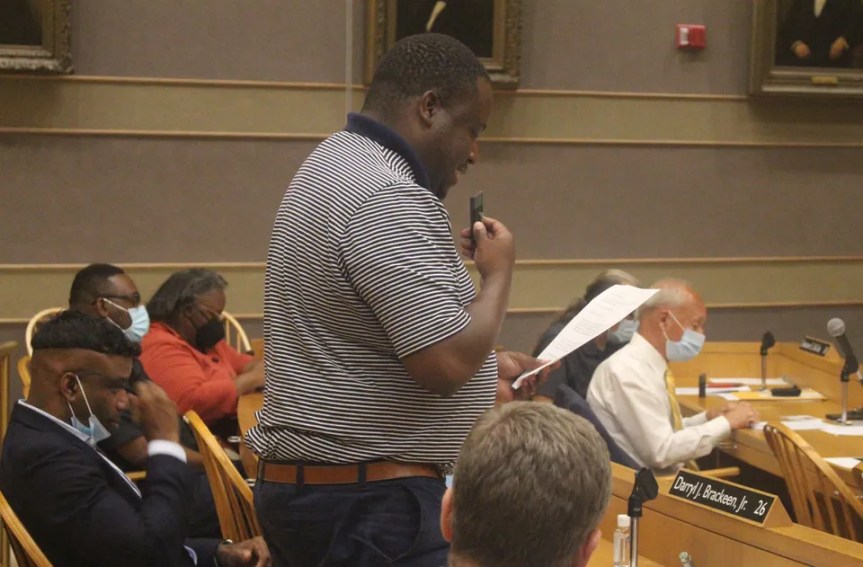
This resolution ​“speaks for itself,” Health and Human Services Committee Chair and Westville Alder Darryl Brackeen, Jr. said in support of the item as the New Haven Board of Alders Vote To End Cuba Embargo | Photo credit: New Haven Independent

A spirited and persistent campaign joined by peace activists in New Haven struck gold on July 6 as the Board of Alders of that large Connecticut city approved a resolution calling upon Biden administration to “to build a new cooperative relationship between the United States and Cuba and to immediately end all aspects of the United States economic, commercial and financial embargo against Cuba.”

The action this week followed testimony community members led by the New Haven Peace Coalition before the Board’s Health and Human Services Committee on June 24. That committee went on to recommend “without dissent” that the Board approve the anti-blockade resolution.

In written testimony read at the session, acting Peace Coalition head and veteran U.S. Communist Party activist Joelle Fishman, pointed out that. “As a city heavily invested in medicine, New Haven would gain from humanitarian exchanges about the most up-to-date treatments and medicines under development. Cuba is also pioneering in local sustainable food production.”

Cuba has gained enviable reputation internationally for its healthcare achievements, biomedical research, and ecologically sound agriculture.

The process toward the New Haven municipal authorities’ unanimous approval of their resolution had begun in September 2021 when the New Haven Peace Council and other groups first presented a proposed version of an anti-blockade resolution to the Board of Alders.

For many years, the Peace Council, affiliated with the New Haven-based U.S. Peace Council, and the New Haven Peace Coalition have jointly engaged in community-wide education and advocacy efforts on a wide range of human rights issues. The coalition enjoys the status of an official city commission.

In calling for an end to the U.S. economic blockade of Cuba, New Haven joins a bevy of other U.S. cities, and even states, in a grassroots campaign to get rid of this 60-year-old cruel, illegal, and immoral U.S. policy. The list now is long.

The most recent additions are Massachusetts cities Brookline on June 10 – a second time for that city – and Boston on May 16. The Bostonians defiantly called for “full restoration of trade and travel between the two countries.”

The Chicago city council’s unanimous passage of an anti- blockade resolution in February 2021 represented a major addition.  Chicago is the nation’s third largest city.

Other cities passing such resolutions are: Pittsburg, St. Paul Minneapolis, Cleveland, Detroit, Sacramento, and Hartford. The list includes Helena, MT; Cambridge, MA and Oakland, Berkeley, and Richmond – all in California.  States whose legislative bodies have passed resolutions are Alabama, Michigan, California and Minnesota.

Henry Lowendorf, president of the Greater New Haven Peace Council, outlined how actions taken against the U.S. blockade of Cuba contribute to peace. Commenting on the Human Service Committee’s approval on June 24 of the proposed resolution, Lowendorf declared that. “Despite the blockade no Cuban families, unlike in New Haven, are homeless. Despite the blockade all Cubans, unlike New Haveners, enjoy fully covered first-class healthcare.”

He added: “We have much to learn from how Cuba manages to guarantee its citizens these rights despite the US noose around its neck. That noose is intended not only to reverse these rights in Cuba but to prevent us from visiting Cuba, seeing for ourselves and demanding the same rights for ourselves from our own government.”


W. T. Whitney Jr. is a political journalist whose focus is on Latin America, health care, and anti-racism. A Cuba solidarity activist, he formerly worked as a pediatrician, lives in rural Maine. W.T. Whitney Jr. es un periodista político cuyo enfoque está en América Latina, la atención médica y el antirracismo. Activista solidario con Cuba, anteriormente trabajó como pediatra, vive en la zona rural de Maine.

Building the Communist Movement is Women’s Work (and Men’s Too) / by W. T. Whitney Jr.

Analyst Taryn Fivek, in her recent article on the CPUSA website, offers explanations for women’s frequent reluctance to take part in progressive politics. She calls for more involvement of women in the struggle for socialism. Here we review some of her conclusions and argue that women’s role in struggle must be large, one reason reason being the nature of socialist struggle and another, women’s experience and special qualifications.

Fivek points to barriers of male prejudice and of misplaced disparagement of women’s work, both in the workplace and in “social reproduction.” Not only do woman work for relatively low wages “in the productive sphere of the economy,” but, as she claims, “they are also working unpaid in the reproductive sphere” and, indeed, are “35% more likely than men to live in poverty.”

She points out that, [w]omen’s economic well-being is often tied to their role as primary laborer in a male-dominated household” and economic dependency may lead to “difficulty in leaving abusive relationships.” Fivek attributes women’s hesitancy to act politically to the assumption by most women, shared by society at large, that as care-givers “the major site of their oppression — the interpersonal or reproductive sphere … [is] ‘private’ and ‘personal.’”

The prevailing version of social reproduction alluded to by Fivek centers on home-based activities concerned with nurturing, protecting, and preparing workers for the future. In fact, as she points out, “social reproduction is not a private affair.” But she is also embracing a more far-reaching definition such as this one: social reproduction has to do with ways “by which a society maintains and transforms its social order, formations, and relations across time and space”.  

She insists that, “To say that the personal is not political is to accept the gender gap in our political work.” Women are to be accommodated and “included in all areas of political work.” She asks: “What can the [Communist] Party do to increase participation and leadership of women in the struggle for socialism?”

At issue are the characteristics of the kind of social reproduction operating in the public sphere. Women and men are already politically involved in that arena, but more women are needed.   

Some assumptions intrude. With its mechanistic overtones and utilitarian implications of supplying future workers, the unattractive term social reproduction needs replacing. And the customary linkage of social reproduction with women’s major role in family life must evolve, as a work in progress, into a larger role for men. Lastly, capitalists will not soon view any kind of social-reproduction work as other than a “free gift,” or as deserving merely of crumbs.

As envisioned here, the social-reproduction project is huge, so much so that working-class women and men will reject injustices impinging on their lives; will listen, learn, collaborate, and teach; care for people and nature; and manage affairs. Confronting governments, local ones not least, they will continue to agitate for livable incomes, roofs over heads; access to schooling from infant day-care to universities, lifelong education, sicknesses prevented and treated, no hunger, solidarity with workers abroad. – with no one left out.

The premise is that family-based tasks of taking-care-of and caring-for are expandable, and are important in society.  In conversation long ago with an American Communist and poet (Pulitzer Prize!) of provocative bent, that message was clear. Hearing about a male, myself, learning to be a doctor, he exclaimed in mock horror something like, “Why, that’s women’s work!”

Those whose work is that of perpetuating the generations have a name, not a laughably awkward one like “social reproducer,” but rather “socialist,” that is to say, socialist men and socialist women. 

Many or most women have the experience, predisposition, and – as it seems – the skills to take care of people and things – in other words, to be socialists. Today, socialist parties and socialist organizations badly need women as colleagues and comrades. Tasks ahead are momentous and recruits are needed who are prepared.

According to Psychology Today, “Girls and women … have advantages for many basic language-related skills … [and most] 12-year-old girls were more skilled than the average same-age boy at making inferences about the thoughts, feelings, and social perspective of their peers.”

It’s no surprise that, as reported recently by pewresearch.org, “Young women are more likely to be enrolled in college today than young men, and among those ages 25 and older, women are more likely than men to have a four-year college degree. The gap in college completion is even wider among younger adults ages 25 to 34.”

A University of Zurich study in 2018 claims that: “Demand for high-skilled workers who perform cognitive tasks has increased dramatically in the United States … [We find that] the probability that a college-educated man was employed in such a job fell, while the prospects for college-educated women improved. The key driver seems to be growing demand for social skills, such as empathy, communication, emotion recognition and verbal expression, in which evidence from psychological research indicates that women have a comparative advantage.”

Camila Vallego, Karol Cariola, and Marisela Santibáñez of the Communist Party of Chile

Reporting on a United Nations-organized conference in Chile in 2015 about women and political power, Winnie Byanyima, then the executive-director of Oxfam International, states that, “[W]hen you have more women in public decision-making, you get policies that benefit women, children and families in general …There is already enough evidence in the world to show the positive impact of women’s leadership. Women have successfully built and run countries and cities, economies and formidable institutions.” 

Caretaking means peacemaking. UN-sponsored research looking at 40 peace processes between 1989 and 2014 showed in 2015 that, women have managed to make substantial contributions to peacemaking and constitution-making negotiations.”  The study showed that, “where women were able to exercise strong influence on a negotiation process, the chances of agreements being reached and implemented were much higher than when women’s groups exercised moderate, weak, or no influence.”

Former Cuban president Raúl Castro has the last word.  Reporting to a Cuban Communist Party Congress in 2016, Castro noted with regret that women occupied only “38% of positions in state bodies, government agencies, national entities.”  This was despite women representing 49% of Cuba’s workforce and “66.8% of the best technically and professionally qualified workforce of the country.”

He continued: “I stand by the strictest truth when I affirm, based on my experience in many years of Revolution, that women, generally, are more mature and better managers than men. Therefore, although I recognize the progress made, I believe that under the leadership of the Party, the promotion of our combative females should continue rising, especially to decision-making positions nationwide.”

W.T. Whitney Jr. is a political journalist whose focus is on Latin America, health care, and anti-racism. A Cuba solidarity activist, he formerly worked as a pediatrician, lives in rural Maine. W.T. Whitney Jr. es un periodista político cuyo enfoque está en América Latina, la atención médica y el antirracismo. Activista solidario con Cuba, anteriormente trabajó como pediatra, vive en la zona rural de Maine.

Building the Communist Movement is Women’s Work (and Men’s Too) / by W. T. Whitney Jr.

Analyst Taryn Fivek, in her recent article on the CPUSA website, offers explanations for women’s frequent reluctance to take part in progressive politics. She calls for more involvement of women in the struggle for socialism. Here we review some of her conclusions and argue that women’s role in struggle must be large, one reason reason being the nature of socialist struggle and another, women’s experience and special qualifications.

Fivek points to barriers of male prejudice and of misplaced disparagement of women’s work, both in the workplace and in “social reproduction.” Not only do woman work for relatively low wages “in the productive sphere of the economy,” but, as she claims, “they are also working unpaid in the reproductive sphere” and, indeed, are “35% more likely than men to live in poverty.”

She points out that, [w]omen’s economic well-being is often tied to their role as primary laborer in a male-dominated household” and economic dependency may lead to “difficulty in leaving abusive relationships.” Fivek attributes women’s hesitancy to act politically to the assumption by most women, shared by society at large, that as care-givers “the major site of their oppression — the interpersonal or reproductive sphere … [is] ‘private’ and ‘personal.’”

The prevailing version of social reproduction alluded to by Fivek centers on home-based activities concerned with nurturing, protecting, and preparing workers for the future. In fact, as she points out, “social reproduction is not a private affair.” But she is also embracing a more far-reaching definition such as this one: social reproduction has to do with ways “by which a society maintains and transforms its social order, formations, and relations across time and space”.  

She insists that, “To say that the personal is not political is to accept the gender gap in our political work.” Women are to be accommodated and “included in all areas of political work.” She asks: “What can the [Communist] Party do to increase participation and leadership of women in the struggle for socialism?”

At issue are the characteristics of the kind of social reproduction operating in the public sphere. Women and men are already politically involved in that arena, but more women are needed.   

Some assumptions intrude. With its mechanistic overtones and utilitarian implications of supplying future workers, the unattractive term social reproduction needs replacing. And the customary linkage of social reproduction with women’s major role in family life must evolve, as a work in progress, into a larger role for men. Lastly, capitalists will not soon view any kind of social-reproduction work as other than a “free gift,” or as deserving merely of crumbs.

As envisioned here, the social-reproduction project is huge, so much so that working-class women and men will reject injustices impinging on their lives; will listen, learn, collaborate, and teach; care for people and nature; and manage affairs. Confronting governments, local ones not least, they will continue to agitate for livable incomes, roofs over heads; access to schooling from infant day-care to universities, lifelong education, sicknesses prevented and treated, no hunger, solidarity with workers abroad. – with no one left out.

The premise is that family-based tasks of taking-care-of and caring-for are expandable, and are important in society.  In conversation long ago with an American Communist and poet (Pulitzer Prize!) of provocative bent, that message was clear. Hearing about a male, myself, learning to be a doctor, he exclaimed in mock horror something like, “Why, that’s women’s work!”

Those whose work is that of perpetuating the generations have a name, not a laughably awkward one like “social reproducer,” but rather “socialist,” that is to say, socialist men and socialist women. 

Many or most women have the experience, predisposition, and – as it seems – the skills to take care of people and things – in other words, to be socialists. Today, socialist parties and socialist organizations badly need women as colleagues and comrades. Tasks ahead are momentous and recruits are needed who are prepared.

According to Psychology Today, “Girls and women … have advantages for many basic language-related skills … [and most] 12-year-old girls were more skilled than the average same-age boy at making inferences about the thoughts, feelings, and social perspective of their peers.”

It’s no surprise that, as reported recently by pewresearch.org, “Young women are more likely to be enrolled in college today than young men, and among those ages 25 and older, women are more likely than men to have a four-year college degree. The gap in college completion is even wider among younger adults ages 25 to 34.”

A University of Zurich study in 2018 claims that: “Demand for high-skilled workers who perform cognitive tasks has increased dramatically in the United States … [We find that] the probability that a college-educated man was employed in such a job fell, while the prospects for college-educated women improved. The key driver seems to be growing demand for social skills, such as empathy, communication, emotion recognition and verbal expression, in which evidence from psychological research indicates that women have a comparative advantage.”

Camila Vallego, Karol Cariola, and Marisela Santibáñez of the Communist Party of Chile

Reporting on a United Nations-organized conference in Chile in 2015 about women and political power, Winnie Byanyima, then the executive-director of Oxfam International, states that, “[W]hen you have more women in public decision-making, you get policies that benefit women, children and families in general …There is already enough evidence in the world to show the positive impact of women’s leadership. Women have successfully built and run countries and cities, economies and formidable institutions.” 

Caretaking means peacemaking. UN-sponsored research looking at 40 peace processes between 1989 and 2014 showed in 2015 that, women have managed to make substantial contributions to peacemaking and constitution-making negotiations.”  The study showed that, “where women were able to exercise strong influence on a negotiation process, the chances of agreements being reached and implemented were much higher than when women’s groups exercised moderate, weak, or no influence.”

Former Cuban president Raúl Castro has the last word.  Reporting to a Cuban Communist Party Congress in 2016, Castro noted with regret that women occupied only “38% of positions in state bodies, government agencies, national entities.”  This was despite women representing 49% of Cuba’s workforce and “66.8% of the best technically and professionally qualified workforce of the country.”

He continued: “I stand by the strictest truth when I affirm, based on my experience in many years of Revolution, that women, generally, are more mature and better managers than men. Therefore, although I recognize the progress made, I believe that under the leadership of the Party, the promotion of our combative females should continue rising, especially to decision-making positions nationwide.”

W.T. Whitney Jr. is a political journalist whose focus is on Latin America, health care, and anti-racism. A Cuba solidarity activist, he formerly worked as a pediatrician, lives in rural Maine. W.T. Whitney Jr. es un periodista político cuyo enfoque está en América Latina, la atención médica y el antirracismo. Activista solidario con Cuba, anteriormente trabajó como pediatra, vive en la zona rural de Maine.