
Press Coverage of Declining US Life Expectancy Evades the Truth / by W.T. Whitney Jr.

Photograph by Nathaniel St. Clair

Reporting by the U.S. news services frequently takes China to task for its strict preventative measures imposed to prevent Covid-19 infection. Reports point to economic instability and people’s distress supposedly generated by this uncompromising attitude. The slant of New York Times reporting, which skirts over Chinese lives saved, earned a sharp rebuke on September 9 from the fair.org website, a self-styled “national media watch group.”

Reporter Jim Naureckas imagines the lament of Times writers that, “China has had theenormous misfortune of avoiding mass death.” He is sarcastically contrasting lives saved in China with lives unnecessarily lost in the United States, where Covid-19 deaths now exceed one million. He reminds us that China now exceeds the United States in life expectancy.

U.S. reporting on the downhill turn of U.S. life expectancy is

fertile ground for the emergence of press bias that agrees with establishment leanings. 

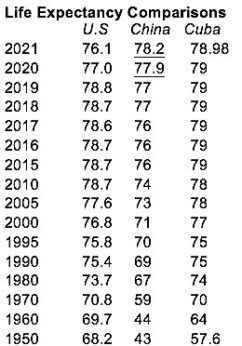
The U.S. government recently released statistics indicating that U.S. life expectancy at birth is now 76.1 years That’s a return to the life expectancy level of 1996.  The 2021 figures, down from 77.0 years in 2020 and from 78.8 in 2019 represented the greatest multi-year life expectancy decline in 100 years. Life expectancy for men in 2021 was 73.2 years. That level signified an unprecedented male-female gap of almost six years.

U.S. press coverage of bad news on life expectancy barely mentions international comparisons and neglects the political and economic context of the drop in life expectancy.

Reports in the Washington Post, New York Times, and elsewhere have identified adverse biological or medical phenomena. They point to suicides, alcoholism and drug- overdose victims – “diseases of despair” – and spotty distribution of healthcare services. The reporting attributes the life-expectancy decline mostly to excess deaths from Covid-19 infection. 

In explaining deaths during the pandemic, The New York Times and Washington Post focus on disaster befalling indigenous peoples in the United States. The combined male-female life expectancy of indigenous peoples as of 2021 registers at 65.2 years. Indigenous deaths rates have recently exceeded those of white people by a factor of 10.  

These articles, and others throughout the period of the pandemic, have pointed to the particular risk Covid 19 infection poses for non-white populations. Press reports have cited Black and Hispanic mortality rates that are from two to four times higher than those for white people. Reports have leaned on public health data showing that “communities of color” had suffered from much chronic illness beforehand that compound difficulties in recovering from Covid-19 infection. 

Reporters have described medical care for these chronic diseases as poorly accessible or of low-quality. They imply that racism is the factor that largely accounts for the increased Covid-19 death rates among ethnic minorities. If so, getting rid of racial oppression would be the best way to reduce human loss from the pandemic and restore decent life-expectancy figures.

The reports also cast blame for Covid-19 deaths on unhealthy living habits, environmental pollution, and access to guns. Recent articles attribute now deceasing death rates from Covid-19 among Black people to protective actions taken by people themselves (not government action). The Times article, seemingly alone, does mention “a fragmented, profit-driven health care system.”

Otherwise, inquiry into the nature of U.S. healthcare is missing. Unsurprisingly, there are no calls for universal access to healthcare, improved preventative care, additional first-contact care providers, removal of financial barriers, and higher quality of care.  Lacking too is discussion of steps taken on behalf of education, housing, adequate nutrition, and safe retirement; all of these, taken together, promote good health.

Not much appears about the disjointed, inaccessible, unavailable care for illnesses, chronic or otherwise, that white people may experience together with Black people. The overall emphasis in the reporting is the special vulnerably of non-white people and, recently, the apparent role of racism in accounting for lowered life expectancy.

There is silence on social class. Seemingly alone among the major U.S. media, Newsweek highlighted the contrast between reduced U.S. life expectancy and Chinese and Cuban gains. The 2021 life expectancy of both countries, 78.2 years and 79 years, respectively, was higher that year than that of the United States

China and Cuba are socialist countries that redistributed wealth and opted for working-class political power. U.S. media and elected officials are reluctant to acknowledge successes of socialist countries, that by nature are oriented toward the good of working people.

Writing in 1991, Vicente Navarro, public policy and public health expert, notes that “class is rarely discussed in the scientific and mainstream media in the United States.” He adds that, “even if blacks and whites died at the same rates, most blacks would still have higher mortality rates.”

He elaborated in 2004:

“The United States is one of the very few countries that do not include class in its national health and vital statistics. It collects health and vital statistics by race and gender but not by class, even though, as I have shown, class mortality differentials are far larger than race or gender differentials. Class discrimination is the most frequent and least spoken of type of discrimination in the United States.”

Navarro’s remarks provide perspective to the biases in press coverage that are described here. Presumably press silence on developments in which working people have a stake does suit opinion-shapers for whom red-scare is a time-tested tool. Anti-Cuban sentiment and China bashing may play a role, but those postures too may stem from red-scare.  Navarro has the last word: “The capitalist class is extremely powerful.”

The heroic journalist John Pilger once explained that, “Journalists can help people by telling the truth, or by as much truth as they can find, and acting not as agents of governments, of power, but of people.” He asked recently: “do we live in a Media Society where brainwashing is insidious and relentless, and perception is filtered according to the needs and lies of state and corporate power?”


W.T. Whitney Jr. is a political journalist whose focus is on Latin America, health care, and anti-racism. A Cuba solidarity activist, he formerly worked as a pediatrician, lives in rural Maine. W.T. Whitney Jr. es un periodista político cuyo enfoque está en América Latina, la atención médica y el antirracismo. Activista solidario con Cuba, anteriormente trabajó como pediatra, vive en la zona rural de Maine.
Cuba and China Exceed US in Life Expectancy, Send Message to the World – Socialism is the Difference / by W.T. Whitney Jr.


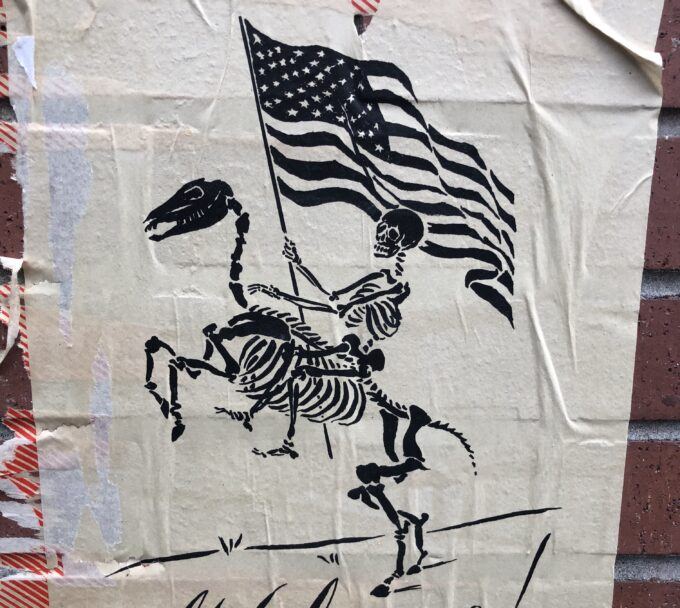
Children born in socialist Cuba and China can expect to live longer than children born in the capitalist United States. | AP photos

To extend a population’s life expectancy at birth (LEB) requires capabilities that are scarce in the United States. The U.S. LEB has fallen in the recent period, quite abruptly. Meanwhile, life expectancy in China and Cuba continues its long-term rise. To understand why we should explore nations’ varying capabilities to achieve social change and promote social gains.

Medical and sociological causes of death that relate to life expectancy and are specific to the United States will not be explored here. A subsequent report will cover that ground.

The U.S. National Center for Health Statistics on Aug. 31 set U.S. LEB for 2021 at 76.1 years, the same figure as in 1996. The decline from 77.0 years in 2020 and from 78.8 in 2019 was the greatest continuous U.S. fall in LEB in 100 years. Life expectancy for men in 2021, 73.2 years, represented an unprecedented male-female gap of almost six years (increased male mortality is routine).

Life expectancy for people in Cuba and for China now exceeds that for people born in the United States. Cuba’s LEB rose from 57.6 years in 1950 to 79 years in 2021—an advance of over 21 years. In those years, China’s LEB moved from 43 years to 78.2 years—a 35.2-year increase—and LEB for Americans rose by 7.9 years. The Cuban and Chinese achievements of drastically improving life expectancy in a few years and from very low levels are remarkable.

Policies put in place following the two countries’ socialist revolutions led to wide-ranging social initiatives that are protective of all people’s lives and, incidentally, crucial for long life expectancy. Capitalist governments, less oriented to social change, are prone to tolerating gaps in social development.

The two socialist countries pursued particular objectives to achieve social gains. Specifically, they have endeavored to establish working-class political power, promote decent and healthy lives for all working people, eradicate major economic inequalities, and build unity.

Some capitalist countries have also attempted to fulfill a few of these objectives when under left-wing governance, with mixed success. A look at how well they may have succeeded, and at some of the consequences when they have not, may shed light on the failings of capitalist states to support the lives of their people, particularly the U.S.’ failure to sustain a LEB that in 2020 was already lower than that of 53 other countries.

The subject of providing social support is, of course, vast. On that account, the discussion here pays more attention to health care and less to other areas. It draws on the insights of Vicente Navarro, professor of public health and public policy at universities in Baltimore and Barcelona.

As regards working-class political power, Navarro maintains that “countries with strong labor movements, with social democratic and socialist parties…have developed stronger redistribution policies and inequality-reducing measures…. These worker-friendly countries consequently have better health indicators [including LEB] than those countries where labor movements are very weak, as is the case in the United States.”

Navarro blames the lack of universal health care in the United States, unique among industrialized nations, on the lack there of a strong labor movement and/or a labor or socialist party. Political power exerted by the organized working class in industrialized nations may vary, but it almost always exceeds workers’ power in the United States, where statistical markers of health outcome are decidedly less favorable.

The political weakness of the organized workers’ movement in the United States is clear. “The working class,” Navarro writes in 2021, does not appear anywhere in the Cabinet nor the Senate, and only appears in the House with an extremely limited representation of 1.3 percent.” Most “members of these institutions belong to the corporate class, closely followed by upper-middle class.” He condemns the “privatization of the electoral process,” in which “there is no limit to how much money can go to the Democratic or Republican party or their candidates.”

Decent and healthy lives are far from routine in capitalist countries, where poor health is associated with low social-economic status. Navarro reports that, in the United States, the “blue-collar worker has a mortality rate from heart conditions double that of the professional class. Mortality differentials by social class are much larger in the United States than in Western Europe.”

He notes that “top level British civil servants live considerably longer than do lower level ones,” and that “members of the [Spanish] bourgeoisie…live an average of two years longer than the petit bourgeoisie…who live two years longer than the middle class, who live two years longer than the skilled working class, who live two years longer than members of the unskilled working class, who live two years longer than the unskilled [and unemployed] working class.”

Alienation under capitalism exacerbates health problems. According to Navarro, “the distance among social groups and individuals and the lack of social cohesion that this distance creates is bad for people’s health and quality of life.” The social isolation he describes adds to challenges faced by social support systems and detracts from the usefulness of interventions.

Attempts by capitalist countries to remove wealth inequalities, especially in the health care arena, show mixed success. As commercialization of healthcare advances, difficulties mount. As the result of profit-taking in that sector, society-wide inequalities are aggravated, and working people lose equal access to quality care.

And yet some form of public overview of, or support for, health care sectors is more or less routine in the various capitalist countries. In many, public authorities operate and pay for hospitals, nursing homes, staffing, drugs, equipment, and training. But the infiltration of market prerogatives and privatization in the health care systems of richer countries now threatens long established goals of accessible health care for all.

In Europe, austerity campaigns under neoliberal auspices have led to cutbacks in publicly provided care. Privatization inroads blunted the institutional response in Europe to the COVID-19 pandemic. Investor groups have been eyeing the hospital and nursing home sectors as profit-making opportunities. According to the Lancet medical journal, privatization within the British National Health Service contributed to an increase in preventable deaths from all causes between 2013 and 2020.

The United States is the poster child of war in defense of privilege. There are stories, from health care:

In 2020 salary and benefits for William J. Caron, Jr., CEO of MaineHealth, a major care provider in the author’s locality, were $1,992,044; for Richard W. Petersen, Maine Medical Center CEO, they were $1,822,185. A commentator notes that “Hospital CEOs are compensated primarily for the volume of patients that pass through their doors—so-called “heads in beds.” Average annual income for U.S. primary care physicians was $260,000 in 2021; for specialists, $368,000.

According to bain.com, “Medtech companies are among the most profitable in the healthcare industry, with margins averaging 22%…profit pools [will] grow to $72 billion in 2024.” And “HME (home medical equipment) retail companies average 45 percent gross profit margin (GPM).”

Researchers found that between 2000 and 2018, the “median annual gross profit margin” (gross profit is revenue minus costs) of 35 pharmaceutical companies was 39.1% higher than that of 357 non-pharmaceutical companies. The CEOs of three major pharmaceutical companies” increased their wealth by “a total of $90 million” in 2018. As for COVID-19 vaccine manufacturers: “Moderna’s and BioNTech’s 2021 net profit margins reached 66% and 54%, respectively.”

The matter of creating unity to establish socialism and arrange for the common good needs little comment. Unity within society is a near impossibility under capitalism, inasmuch as divisions there are inherent to a world of greed and individualism. Meanwhile, China, opting in favor of life, put on a magnificent display of socialist unity as its people grappled with the pandemic.

The government imposed strong preventative measures and accepted the inevitability of economic disruption and loss. China’s COVID-19 mortality rate is 1.07 deaths per 100,000 persons. Its U.S. counterpart never seemed to choose and, that way protected economic growth. The U.S. COVID-19 mortality rate is 319.59 deaths per 100,000 persons.

It is important, finally, to lay to rest any suggestion that the riches of the United States and other capitalist nations automatically enable them to offer long life expectancies. Individualized entitlement to wealth is basic to how they operate, and that’s a contradiction and an obstacle.

A society aiming to pursue social initiatives that are comprehensive and directed to all population groups equally is a society that has to redistribute wealth. Wealth redistribution is the necessary adjunct to the objectives already discussed. The message here is that capitalist-inspired measures don’t make the grade and that socialist programs, as in Cuba and China, do work and do offer the promise of decent and secure lives to entire populations.

As with all op-eds published by People’s World, this article reflects the opinions of its author.

W.T. Whitney Jr. is a political journalist whose focus is on Latin America, health care, and anti-racism. A Cuba solidarity activist, he formerly worked as a pediatrician, lives in rural Maine. W.T. Whitney Jr. es un periodista político cuyo enfoque está en América Latina, la atención médica y el antirracismo. Activista solidario con Cuba, anteriormente trabajó como pediatra, vive en la zona rural de Maine.
People’s World, September 21, 2022, https://www.peoplesworld.org/

Mexico leads in opposing the Cuba blockade and U.S. imperialism / by William T. Whitney Jr.

Cuban President Miguel Diaz Canel, right, and his Mexican counterpart Andres Manuel Lopez Obrador, left, raise their arms during a ceremony to award the Jose Marti Order to Lopez Obrador, at Revolution Palace in Havana, Cuba, Sunday, May 8, 2022. El presidente cubano Miguel Díaz Canel, a la derecha, y su homólogo mexicano, Andrés Manuel López Obrador, a la izquierda, levantan los brazos durante una ceremonia de entrega de la Orden José Martí a López Obrador, en el Palacio de la Revolución en La Habana, Cuba, el 8 de mayo de 2022. | Yamil Lage / Pool Photo via AP

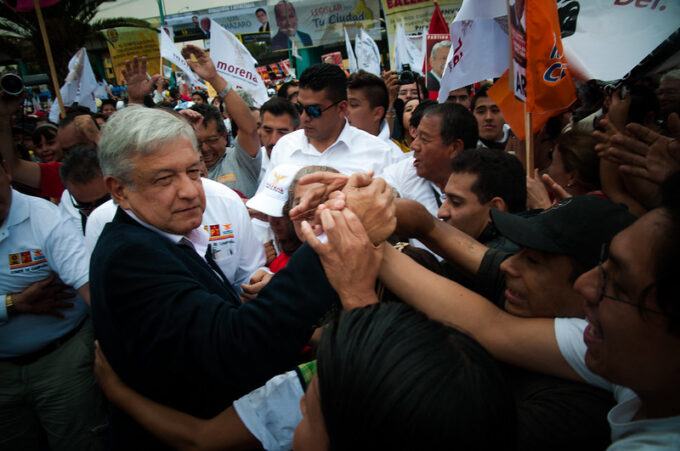
Mexican President Andrés Manuel López Obrador (AMLO) visited Cuba on May 8-9. He began by highlighting regional unity as good for equal promotion of economic development for all states. AMLO addressed themes he had discussed previously when Cuban President Miguel Diaz-Canel visited Mexico City in 2021.

At that time, AMLO, by virtue of Mexico serving as president pro tempore, presided over a summit meeting of the Community of Latin American and Caribbean states (CELAC). He proposed building “in the Western Hemisphere something similar to what was the economic community that gave rise to the current European Union.”

Two days later, AMLO included Diaz-Canel in a celebration of the 200th anniversary of Mexican independence. Praising Cuba’s dignity in resisting U.S. aggression, he called for an end to the blockade.

Months later in Havana, on May 8, 2022, AMLO, speaking before Cuban leaders and others, recalled “times when the United States wanted to own the continent…. They were at their peak in annexations, deciding on independence wherever, creating new countries, freely associated states, protectorates, military bases, and…invasions.”

U.S. leaders, he declared, need to be convinced “that a new relationship among the peoples of America…is possible.” He called for “replacing the OAS with a truly autonomous organism.” CELAC presumably would be that alternative alliance. Formed in 2011, CELAC includes all Western Hemisphere nations except for the United States and Canada.

The United States in 1948 established the Organization of American States (OAS) for Cold War purposes. When the OAS expelled Cuba in 1962, only Mexico’s government opposed that action, and later Mexico was one of two nations rejecting an OAS demand to break off diplomatic relations with Cuba.

AMLO predicted that “by 2051, China will exert domination over 64.8% of the world market and the United States only 25%, or even 10%.” He suggested that, “Washington, finding this unacceptable,” would be tempted “to resolve that disparity through force.”

AMLO rejected “growing competition and disunity that will inevitably lead to decline in all the Americas.” He called for “Integration with respect to sovereignties and forms of government and effective application of a treaty of economic-commercial development suiting everybody.” The “first step” would be for the United States “to lift its blockade of this sister nation.”

AMLO’s visit prompted agreements on practicalities. The two presidents determined that Cuba would supply Mexico with medications and vaccines—particularly Cuba’s anti-COVID Abdala vaccine for children. Mexico’s government will send almost 200 Mexican youths to Cuba to study medicine; 500 Cuban physicians will go to Mexico to work in underserved areas. The two presidents signed a general agreement providing for expanded cooperation in other areas.

Before arriving in Cuba, AMLO had visited Guatemala, El Salvador, Honduras, and Belize. Along the way, he reportedly complained that, “The United States may have awarded $40 billion in aid to Ukraine but doesn’t fulfill its promise of years ago of helping out Central America.”

The two presidents’ encounter in Havana raises the question of a long-term Mexican role in mobilizing collective resistance to U.S. domination and the U.S. blockade of Cuba. Mexico is well-positioned to lead that effort, what with strong economic and commercial connections with the United States. The United States, leaning on Mexico as an economic partner, may well be receptive to certain demands.

According to the White House-based Office of the U.S. Trade Representative, “Mexico is currently our largest goods trading partner with $614.5 billion in total (two way) goods trade during 2019.”

Beyond that, and in relation to Cuba, Mexico has its own revolutionary tradition and longstanding ties with Cuba. She is well-placed to lead a strong international campaign to undo the U.S. blockade.

In his major speech, AMLO cited support from Mexico in Cuba’s first War for Independence. He mentioned Cubans’ collaboration with Mexico’s much-admired President Benito Juárez and pointed out that Mexico in1956 hosted Cuban revolutionaries led by Fidel Castro as they prepared for their uprising against Batista. AMLO cited former Mexican President Lázaro Cárdenas’ solidarity visit to Cuba in 1961 after the CIA-organized Bay of Pigs invasion. In token of cultural ties between the two peoples, Mexico was the guest of honor at Havana’s recently concluded International Book Fair.

José Martí warrants special attention. In exile, Martí lived, taught, and wrote in Mexico from 1875 to 1877. Afterwards he stayed connected with Mexican friends. Martí would later write admiringly about the liberal reforms of Indian-descended President Juarez, whom he regarded as the “impenetrable guardian of America.”

That “America” would be “Our America,” which became the title of a Martí essay with deep meaning for unity and for separation from the United States. “Our America” proclaimed that the culture and history of lands south of the Rio Bravo (Rio Grande) originated autonomously, quite apart from European and U.S. influences. The essay appeared first in January 1891, in two journals simultaneously. One was El Partido Liberal, published in Mexico, the other being a New York periodical.

Unity among Latin American and Caribbean nations appears to be precarious as the U.S. government prepares to host the Ninth Summit of the Americas in Los Angeles, on June 6-10. The Summit is an offshoot of the OAS which, according to its website, “serves as the technical secretariat of the Summits process.”

The United States has indicated that the leftist governments of Cuba, Venezuela, and Nicaragua won’t be receiving invitations. AMLO, speaking in Havana, reiterated his objection and once more stated that if nations are left out, he will not attend. Nor will the presidents of Bolivia and Honduras, Luis Arce and Xiomara Castro, respectively.

The presidents of several Caribbean nations will also be staying away. They point to the hypocrisy of U.S.-appointed Venezuelan “president” Juan Guaidó being invited, but not Cuban President Miguel Díaz-Canel.  Unhappy with U.S. advice on transparency of elections and Russia-Brazil relations, Brazilian President Jair Bolsonaro will not attend.

The conclusion here is that the old system of regional alliances is unstable and that the timing may be right for renewed resistance to U.S domination and the blockade. Now would be the occasion for U.S. anti-imperialists and blockade opponents to align their strategizing and efforts with actions, trends, and flux in Latin America and the Caribbean. And, most certainly, they would be paying attention to actions and policies of Mexico’s government.

Martí had often corresponded with his Mexican friend Manuel Mercado.  His letter of May 18, 1895, the day before he died in battle, stated that, “The Cuban war…has come to America in time to prevent Cuba’s annexation to the United States.… And Mexico, will it not find a wise, effective, and immediate way of helping, in due time, its own defender?”


W.T. Whitney Jr. is a political journalist whose focus is on Latin America, health care, and anti-racism. A Cuba solidarity activist, he formerly worked as a pediatrician, lives in rural Maine. W.T. Whitney Jr. es un periodista político cuyo enfoque está en América Latina, la atención médica y el antirracismo. Activista solidario con Cuba, anteriormente trabajó como pediatra, vive en la zona rural de Maine.
People’s World, May 20, 2022, https://www.peoplesworld.org/

Mexico Leads in Opposing the Cuba Blockade and US Imperialism / by W.T. Whitney, Jr.

Photograph Source: Eneas De Troya – CC BY 2.0

Mexican president Andrés Manuel López Obrador (AMLO) visited Cuba on May 8-9. He began by highlighting regional unity as good for equal promotion of economic development for all states. AMLO addressed themes he had discussed previously when Cuban president visited Mexico City in 2021.

At that time AMLO, by virtue of Mexico serving as president pro tempore, presided over a summit meeting of the Community of Latin American and Caribbean states (CELAC). He proposed building “in the Western Hemisphere something similar to what was the economic community that gave rise to the current European Union.”

Two days later, AMLO included Diaz-Canel in a celebration of the 200th anniversary of Mexican independence. Praising Cuba’s dignity in resisting U.S. aggression, he called for an end to the blockade.

Months later in Havana, on May 8, 2022, AMLO, speaking before Cuban leaders and others, recalled “times when the United States wanted to own the continent …. They were at their peak in annexations, deciding on independence wherever, creating new countries, freely associated states, protectorates, military bases, and … invasions.”

U.S. leaders, he declared, need to be convinced “that a new relationship among the peoples of America … is possible.” He called for “replacing the OAS with a truly autonomous organism.” CELAC presumably would be that alternative alliance. Formed in 2011, CELAC includes all Western Hemisphere nations except for the United States and Canada.

The United States in 1948 established the Organization of American States (OAS) for Cold War purposes. When the OAS expelled Cuba in 1962, only Mexico’s government opposed that action and later Mexico was one of two nations rejecting an OAS demand to break off diplomatic relations with Cuba.

AMLO predicted that “by 2051, China will exert domination over 64.8% of the world market and the United States only 25%, or even 10%.” He suggested that, “Washington, finding this unacceptable,” would be tempted “to resolve that disparity through force.”

AMLO rejected “growing competition and disunity that will inevitably lead to decline in all the Americas.” He called for “Integration with respect to sovereignties and forms of government and effective application of a treaty of economic-commercial development suiting everybody.” The “first step” would be for the United States “to lift its blockade of this sister nation.”

AMLO’s visit prompted agreements on practicalities. The two presidents determined that Cuba would supply Mexico with medications and vaccines – particularly Cuba’s anti-Covid-19 Abdala vaccine for children. Mexico’s government will send almost 200 Mexican youths to Cuba to study medicine; 500 Cuban physicians will go to Mexico to work in underserved areas. The two presidents signed a general agreement providing for expanded cooperation in other areas.

Before arriving in Cuba, AMLO had visited Guatemala, El Salvador, Honduras, and Belize. Along the way he reportedly complained that, “The United States may have awarded $40 billion in aid to Ukraine but doesn’t fulfill its promise of years ago of helping out Central America.”

The two presidents’ encounter in Havana raises the question of a long-term Mexican role in mobilizing collective resistance to U.S. domination and the U.S. blockade of Cuba. Mexico is well-positioned to lead that effort, what with strong economic and commercial connections with the United States. The United States, leaning on Mexico as an economic partner, may well be receptive to certain demands.

According to the White House-based Office of the U.S. Trade Representative, “Mexico is currently our largest goods trading partner with $614.5 billion in total (two way) goods trade during 2019.”

Beyond that, and in relation to Cuba, Mexico has its own revolutionary tradition and longstanding ties with Cuba.  She is well-placed to lead a strong international campaign to undo the U.S. blockade.

In his major speech, AMLO cited support from Mexico in Cuba’s first War for Independence. He mentioned Cubans’ collaboration with Mexico’s much-admired president Benito Juárez and pointed out that Mexico in1956 hosted Cuban revolutionaries led by Fidel Castro as they prepared for their uprising against Batista. AMLO cited former Mexican President ,’s solidarity visit to Cuba in 1961 after the CIA -organized Bay of Pigs invasion. In token of cultural ties between the two peoples, Mexico was the guest of honor at Havana’s recently concluded International Book Fair.

José Martí warrants special attention. In exile, Martí lived, taught and wrote in Mexico City from 1875 to 1875. Afterwards he stayed connected with Mexican friends. Martí would later write admiringly about the liberal reforms of Indian-descended president Juarez, whom he regarded as the “impenetrable guardian of America.”

That “America” would be “Our America,” which became the title of a Martí essay with deep meaning for unity and for separation from the United States. “Our America” proclaimed that the culture and history of lands south of the Rio Bravo (Rio Grande) originated autonomously, quite apart from European and U.S. influences. The essay appeared first in January 1891, in two journals simultaneously.  One was El Partido Liberal, published in Mexico, the other being a New York periodical.

Unity among Latin American and Caribbean nations appears to be precarious as the U.S. government prepares to host the 9th Summit of the Americas in Los Angeles, on June 6-10. The Summit is an offshoot of the OAS which, according to its website, “serves as the technical secretariat of the Summits process.”

The United States has indicated that the leftist governments of Cuba, Venezuela, and Nicaragua won’t be receiving invitations. AMLO, speaking in Havana, reiterated his objection and once more stated that if nations are left out, he will not attend. Nor will the presidents of Bolivia and Honduras, Luis Arce and Xiomara Castro, respectively.

The presidents of several Caribbean nations will also be staying away. They point to the hypocrisy of U.S.-appointed Venezuelan president Juan Guaidó being invited, but not Cuban president Miguel Díaz-Canel.  Unhappy with U.S. advice on transparency of elections and Russia-Brazil relations, Brazilian president Jair Bolsonaro will not attend.

The conclusion here is that the old system of regional alliances is unstable and that the timing may be right for renewed resistance to U.S domination and the blockade. Now would be the occasion for U.S. anti-imperialists and blockade opponents to align their strategizing and efforts with actions, trends, and flux in Latin America and the Caribbean. And, most certainly, they would be paying attention to actions and policies of Mexico’s government.

Martí had often corresponded with his Mexican friend Manuel Mercado.  His letter of May 18, 1895, the day before he died in battle, stated that, “The Cuban war … has come to America in time to prevent Cuba’s annexation to the United States. …  And Mexico, will it not find a wise, effective and immediate way of helping, in due time, its own defender?”


W.T. Whitney Jr. is a political journalist whose focus is on Latin America, health care, and anti-racism. A Cuba solidarity activist, he formerly worked as a pediatrician, lives in rural Maine. W.T. Whitney Jr. es un periodista político cuyo enfoque está en América Latina, la atención médica y el antirracismo. Activista solidario con Cuba, anteriormente trabajó como pediatra, vive en la zona rural de Maine.

Counterpunch, May 19, 2022, https://www.counterpunch.org/

Building the Communist Movement is Women’s Work (and Men’s Too) / by W. T. Whitney Jr.

Analyst Taryn Fivek, in her recent article on the CPUSA website, offers explanations for women’s frequent reluctance to take part in progressive politics. She calls for more involvement of women in the struggle for socialism. Here we review some of her conclusions and argue that women’s role in struggle must be large, one reason reason being the nature of socialist struggle and another, women’s experience and special qualifications.

Fivek points to barriers of male prejudice and of misplaced disparagement of women’s work, both in the workplace and in “social reproduction.” Not only do woman work for relatively low wages “in the productive sphere of the economy,” but, as she claims, “they are also working unpaid in the reproductive sphere” and, indeed, are “35% more likely than men to live in poverty.”

She points out that, [w]omen’s economic well-being is often tied to their role as primary laborer in a male-dominated household” and economic dependency may lead to “difficulty in leaving abusive relationships.” Fivek attributes women’s hesitancy to act politically to the assumption by most women, shared by society at large, that as care-givers “the major site of their oppression — the interpersonal or reproductive sphere … [is] ‘private’ and ‘personal.’”

The prevailing version of social reproduction alluded to by Fivek centers on home-based activities concerned with nurturing, protecting, and preparing workers for the future. In fact, as she points out, “social reproduction is not a private affair.” But she is also embracing a more far-reaching definition such as this one: social reproduction has to do with ways “by which a society maintains and transforms its social order, formations, and relations across time and space”.  

She insists that, “To say that the personal is not political is to accept the gender gap in our political work.” Women are to be accommodated and “included in all areas of political work.” She asks: “What can the [Communist] Party do to increase participation and leadership of women in the struggle for socialism?”

At issue are the characteristics of the kind of social reproduction operating in the public sphere. Women and men are already politically involved in that arena, but more women are needed.   

Some assumptions intrude. With its mechanistic overtones and utilitarian implications of supplying future workers, the unattractive term social reproduction needs replacing. And the customary linkage of social reproduction with women’s major role in family life must evolve, as a work in progress, into a larger role for men. Lastly, capitalists will not soon view any kind of social-reproduction work as other than a “free gift,” or as deserving merely of crumbs.

As envisioned here, the social-reproduction project is huge, so much so that working-class women and men will reject injustices impinging on their lives; will listen, learn, collaborate, and teach; care for people and nature; and manage affairs. Confronting governments, local ones not least, they will continue to agitate for livable incomes, roofs over heads; access to schooling from infant day-care to universities, lifelong education, sicknesses prevented and treated, no hunger, solidarity with workers abroad. – with no one left out.

The premise is that family-based tasks of taking-care-of and caring-for are expandable, and are important in society.  In conversation long ago with an American Communist and poet (Pulitzer Prize!) of provocative bent, that message was clear. Hearing about a male, myself, learning to be a doctor, he exclaimed in mock horror something like, “Why, that’s women’s work!”

Those whose work is that of perpetuating the generations have a name, not a laughably awkward one like “social reproducer,” but rather “socialist,” that is to say, socialist men and socialist women. 

Many or most women have the experience, predisposition, and – as it seems – the skills to take care of people and things – in other words, to be socialists. Today, socialist parties and socialist organizations badly need women as colleagues and comrades. Tasks ahead are momentous and recruits are needed who are prepared.

According to Psychology Today, “Girls and women … have advantages for many basic language-related skills … [and most] 12-year-old girls were more skilled than the average same-age boy at making inferences about the thoughts, feelings, and social perspective of their peers.”

It’s no surprise that, as reported recently by pewresearch.org, “Young women are more likely to be enrolled in college today than young men, and among those ages 25 and older, women are more likely than men to have a four-year college degree. The gap in college completion is even wider among younger adults ages 25 to 34.”

A University of Zurich study in 2018 claims that: “Demand for high-skilled workers who perform cognitive tasks has increased dramatically in the United States … [We find that] the probability that a college-educated man was employed in such a job fell, while the prospects for college-educated women improved. The key driver seems to be growing demand for social skills, such as empathy, communication, emotion recognition and verbal expression, in which evidence from psychological research indicates that women have a comparative advantage.”

Camila Vallego, Karol Cariola, and Marisela Santibáñez of the Communist Party of Chile

Reporting on a United Nations-organized conference in Chile in 2015 about women and political power, Winnie Byanyima, then the executive-director of Oxfam International, states that, “[W]hen you have more women in public decision-making, you get policies that benefit women, children and families in general …There is already enough evidence in the world to show the positive impact of women’s leadership. Women have successfully built and run countries and cities, economies and formidable institutions.” 

Caretaking means peacemaking. UN-sponsored research looking at 40 peace processes between 1989 and 2014 showed in 2015 that, women have managed to make substantial contributions to peacemaking and constitution-making negotiations.”  The study showed that, “where women were able to exercise strong influence on a negotiation process, the chances of agreements being reached and implemented were much higher than when women’s groups exercised moderate, weak, or no influence.”

Former Cuban president Raúl Castro has the last word.  Reporting to a Cuban Communist Party Congress in 2016, Castro noted with regret that women occupied only “38% of positions in state bodies, government agencies, national entities.”  This was despite women representing 49% of Cuba’s workforce and “66.8% of the best technically and professionally qualified workforce of the country.”

He continued: “I stand by the strictest truth when I affirm, based on my experience in many years of Revolution, that women, generally, are more mature and better managers than men. Therefore, although I recognize the progress made, I believe that under the leadership of the Party, the promotion of our combative females should continue rising, especially to decision-making positions nationwide.”

W.T. Whitney Jr. is a political journalist whose focus is on Latin America, health care, and anti-racism. A Cuba solidarity activist, he formerly worked as a pediatrician, lives in rural Maine. W.T. Whitney Jr. es un periodista político cuyo enfoque está en América Latina, la atención médica y el antirracismo. Activista solidario con Cuba, anteriormente trabajó como pediatra, vive en la zona rural de Maine.
Building the Communist Movement is Women’s Work (and Men’s Too) / by W. T. Whitney Jr.

Analyst Taryn Fivek, in her recent article on the CPUSA website, offers explanations for women’s frequent reluctance to take part in progressive politics. She calls for more involvement of women in the struggle for socialism. Here we review some of her conclusions and argue that women’s role in struggle must be large, one reason reason being the nature of socialist struggle and another, women’s experience and special qualifications.

Fivek points to barriers of male prejudice and of misplaced disparagement of women’s work, both in the workplace and in “social reproduction.” Not only do woman work for relatively low wages “in the productive sphere of the economy,” but, as she claims, “they are also working unpaid in the reproductive sphere” and, indeed, are “35% more likely than men to live in poverty.”

She points out that, [w]omen’s economic well-being is often tied to their role as primary laborer in a male-dominated household” and economic dependency may lead to “difficulty in leaving abusive relationships.” Fivek attributes women’s hesitancy to act politically to the assumption by most women, shared by society at large, that as care-givers “the major site of their oppression — the interpersonal or reproductive sphere … [is] ‘private’ and ‘personal.’”

The prevailing version of social reproduction alluded to by Fivek centers on home-based activities concerned with nurturing, protecting, and preparing workers for the future. In fact, as she points out, “social reproduction is not a private affair.” But she is also embracing a more far-reaching definition such as this one: social reproduction has to do with ways “by which a society maintains and transforms its social order, formations, and relations across time and space”.  

She insists that, “To say that the personal is not political is to accept the gender gap in our political work.” Women are to be accommodated and “included in all areas of political work.” She asks: “What can the [Communist] Party do to increase participation and leadership of women in the struggle for socialism?”

At issue are the characteristics of the kind of social reproduction operating in the public sphere. Women and men are already politically involved in that arena, but more women are needed.   

Some assumptions intrude. With its mechanistic overtones and utilitarian implications of supplying future workers, the unattractive term social reproduction needs replacing. And the customary linkage of social reproduction with women’s major role in family life must evolve, as a work in progress, into a larger role for men. Lastly, capitalists will not soon view any kind of social-reproduction work as other than a “free gift,” or as deserving merely of crumbs.

As envisioned here, the social-reproduction project is huge, so much so that working-class women and men will reject injustices impinging on their lives; will listen, learn, collaborate, and teach; care for people and nature; and manage affairs. Confronting governments, local ones not least, they will continue to agitate for livable incomes, roofs over heads; access to schooling from infant day-care to universities, lifelong education, sicknesses prevented and treated, no hunger, solidarity with workers abroad. – with no one left out.

The premise is that family-based tasks of taking-care-of and caring-for are expandable, and are important in society.  In conversation long ago with an American Communist and poet (Pulitzer Prize!) of provocative bent, that message was clear. Hearing about a male, myself, learning to be a doctor, he exclaimed in mock horror something like, “Why, that’s women’s work!”

Those whose work is that of perpetuating the generations have a name, not a laughably awkward one like “social reproducer,” but rather “socialist,” that is to say, socialist men and socialist women. 

Many or most women have the experience, predisposition, and – as it seems – the skills to take care of people and things – in other words, to be socialists. Today, socialist parties and socialist organizations badly need women as colleagues and comrades. Tasks ahead are momentous and recruits are needed who are prepared.

According to Psychology Today, “Girls and women … have advantages for many basic language-related skills … [and most] 12-year-old girls were more skilled than the average same-age boy at making inferences about the thoughts, feelings, and social perspective of their peers.”

It’s no surprise that, as reported recently by pewresearch.org, “Young women are more likely to be enrolled in college today than young men, and among those ages 25 and older, women are more likely than men to have a four-year college degree. The gap in college completion is even wider among younger adults ages 25 to 34.”

A University of Zurich study in 2018 claims that: “Demand for high-skilled workers who perform cognitive tasks has increased dramatically in the United States … [We find that] the probability that a college-educated man was employed in such a job fell, while the prospects for college-educated women improved. The key driver seems to be growing demand for social skills, such as empathy, communication, emotion recognition and verbal expression, in which evidence from psychological research indicates that women have a comparative advantage.”

Camila Vallego, Karol Cariola, and Marisela Santibáñez of the Communist Party of Chile

Reporting on a United Nations-organized conference in Chile in 2015 about women and political power, Winnie Byanyima, then the executive-director of Oxfam International, states that, “[W]hen you have more women in public decision-making, you get policies that benefit women, children and families in general …There is already enough evidence in the world to show the positive impact of women’s leadership. Women have successfully built and run countries and cities, economies and formidable institutions.” 

Caretaking means peacemaking. UN-sponsored research looking at 40 peace processes between 1989 and 2014 showed in 2015 that, women have managed to make substantial contributions to peacemaking and constitution-making negotiations.”  The study showed that, “where women were able to exercise strong influence on a negotiation process, the chances of agreements being reached and implemented were much higher than when women’s groups exercised moderate, weak, or no influence.”

Former Cuban president Raúl Castro has the last word.  Reporting to a Cuban Communist Party Congress in 2016, Castro noted with regret that women occupied only “38% of positions in state bodies, government agencies, national entities.”  This was despite women representing 49% of Cuba’s workforce and “66.8% of the best technically and professionally qualified workforce of the country.”

He continued: “I stand by the strictest truth when I affirm, based on my experience in many years of Revolution, that women, generally, are more mature and better managers than men. Therefore, although I recognize the progress made, I believe that under the leadership of the Party, the promotion of our combative females should continue rising, especially to decision-making positions nationwide.”

W.T. Whitney Jr. is a political journalist whose focus is on Latin America, health care, and anti-racism. A Cuba solidarity activist, he formerly worked as a pediatrician, lives in rural Maine. W.T. Whitney Jr. es un periodista político cuyo enfoque está en América Latina, la atención médica y el antirracismo. Activista solidario con Cuba, anteriormente trabajó como pediatra, vive en la zona rural de Maine.

US Government Must Let Cubans Eat – W.T. Whitney Jr.

Food availability was the top concern of 21 percent of Cubans responding to a recent opinion survey. The U.S. economic blockade has promoted food shortages. In 1960 the idea of a blockade was appealing to the U.S. State Department because it would cause deprivation and suffering.  Those intentions resurfaced in 1992 with the so-called Cuban Democracy Act, which, still in force, restricts foreign partners of U.S. companies from exporting goods to Cuba. It covers exports of food and agricultural supplies. 

Cuba’s food-supply system is presently unstable, due in part to a fragile Cuban economy. How it functions in the future will depend on the government’s management of agriculture and on the impact of the U.S. economic blockade. Economic fallout from the COVID-19 pandemic will play a role.

Some problems won’t be fixed soon. Sugarcane monoculture took a toll on soil fertility. The woody marabou plant, useful only for making charcoal and removable only with heavy machinery, has invaded 4.2 million acres of Cuban land – 18 % of the total.  Cuba has recently experienced severe drought conditions interspersed with intense rains and flooding; 60 percent of the land is at risk of desertification. The agricultural sector accounts for 40 percent of hurricane-related financial losses.

According to one report, disempowerment of women in rural areas “impedes progress in the agricultural sector.” Many young people lack incentive to work in agriculture. The burden of feeding urban dwellers has increased. They accounted for 58 percent of the population in 1960, 77 percent in 2018. 

Cuba’s food –supply problem manifests in the perennial need to import 60-80 % of food consumed on the island – at an annual cost of $2 billion.  

Beginning in 2008, Cuba’s government instituted economic changes affecting the entire society, agriculture included. The government and Communist Party alike fashioned ambitious documents that outlined comprehensive reforms. The first was the Party’s 2011 “Guidelines for Economic and Social Policies.” 

In 2008, private individuals and collectives gained long-term usage rights to small tracts of land. Now some 500,000 new, independent farmers work 4.9 million acres of agricultural land. Private farmers in general, new and old, occupy 5.93 million acres, which yield almost 80 percent of Cuba’s food.  

The largest class of farmers, the UBPC cooperatives, heirs of the dismembered state farms, control 8.42 million acres of Cuba’s total of 15.56 million acres of arable land; 1.16 million acres remain idle and unfarmed.

The new private farmers ought to be producing “even more food,” says one observer.  Supplies, equipment, spare parts, fertilizers, and seeds provided by state agencies are often unavailable, delayed, or of low quality. Access to credit and insurance may be limited. 

Cuban farmers face gasoline and diesel fuel shortages, mainly because of drastically reduced shipments from Venezuelan oil producers, paralyzed by U.S. sanctions. The impact on food production in May 2019 led to increased food rationing. 

Food distribution is inefficient. The National Union of [food] Collection, otherwise known as the “Acopio” (“collection” in English) is the Agriculture Ministry entity responsible for distributing food. Problems include delayed payments to producers, inadequate storage facilities, transportation delays, regional variations in service, and “cumbersome” criteria for defining food quality. 

The Acopio operates 400 state agricultural markets and 1200 other food-selling facilities. Consumers experience long wait times, unavailability of desired food products, and variable quality. Vendors setting their own prices often reserve higher-quality food for consumers paying with the convertible currency used by foreign visitors. Cubans relying on rationed food may be left with lower quality food and smaller amounts – and forced to pay high prices for food they still lack.

Some government efforts at bolstering food supplies look like the ecologically-oriented initiatives for feeding urban populations that appeared during the Special Period, after the fall of the Soviet Bloc. They bear names like “Program for Municipal Self-supply;” “the Program of Urban, Suburban, and Family Agriculture” (focused on growing food in small spaces), and the “Program of Local Support for Agricultural Modernization,” for 37 municipalities. 

Speaking in February, President Miguel Díaz-Canel called for local self-sufficiency and for the Acopio to collect farm products promptly and thoroughly. With more food arriving at markets, he suggested, the state could regain control over food sales and prices, and thereby push out speculators and black marketeers.  Later Díaz-Canel spoke approvingly of producers bypassing the Acopio and selling at local markets. There’s discussion of “participation of other state and non-state actors” in the Acopio system.

Citing the examples of Vietnam and China – socialist countries that export food – reformers propose using remittances from Cubans living abroad for investing in food production, thus promoting farmer autonomy. Díaz-Canel recently advocated greater involvement of scientists and academicians in food production, just as with the coronavirus pandemic. 

Overall, the official response to food-supply problems seems to lack focus and coherence. If so, maybe it’s because planners are stymied as they deal with a regimen of shortages cemented in place and intractable. 

The imagination sees a specter-like U.S. presence as government officials deliberate and as farmers and consumers complain. It’s in the room as officials look abroad to transfer money, secure credit, import food, and seek investment in agriculture, or when they want to import farm machinery, tools, spare parts, premium seeds, fertilizers, pesticides, purebred livestock. and hydrocarbon fuels. 

U.S. pressures on foreign financial institutions are unrelenting. Foreign suppliers face merciless penalties if they ship agricultural supplies to Cuba, especially if they have associations with U.S. companies or if their goods contain some tiny U.S. component. 

When agricultural projects end up badly in Cuba or when food is short, surely recriminations crop up and perhaps animosities and anti-government ideas also. These would be exactly what the U.S. doctor ordered. 

For Cuba and Venezuela, US Silence May Not Be Golden – W.T. Whitney – May 16th, 2020

The U. S. President and his Secretary of State frequently expound about the supposed failings of enemies abroad. Recently they’ve blasted China’s response to the pandemic, Venezuela’s dictatorship, Cuba’s “slave doctors” overseas, and even Iranian border guards beating up on Afghan migrants. But they’ve been mostly silent about two recent disruptions of the imperialist status quo.

Firing his AK-47 automatic rifle, an apparently mentally-ill Cuban émigré on April 30 caused serious damage to the Embassy building and the bronze stature of Cuban national hero Jose Marti. The only peep of official reaction came from the U.S. Embassy in Havana.  Charge daffaires Mara Tekach stated that, “the U.S. Embassy condemns the shooting” and “the United States takes its Vienna Convention responsibilities very seriously.”  

Her reference was to the multi-lateral United Nations agreement of 1961 that converted national customs into international norms for conducting diplomatic relations. The requirement emerged for host governments to protect the envoys of enemy countries and to respect “the inviolability of mission premises.” 

Assailant Alexander Alazo told investigators that if Ambassador José Ramón Cabañas had appeared at the door, he would have killed him. There were no injuries.  Washington authorities detained the shooter and charged him with assault with intent to kill and possession of an unregistered firearm. The incident was characterized as a hate crime. That it was: generations of U.S. politicians and Cuban – American political leaders have been railing against Cuba.  

Ambassador Cabañas declared that, “Neither State Department officials nor the Secretary of State Mike Pompeo has issued even one formal public condemnation of the attack.” Instead, “the Secretary inveighed against the Cuban medical brigades that today are offering assistance in dozens of countries in the world.” 

At a press conference May 13, Cuban Foreign Minister Bruno Rodríguez blamed the U.S. government for “complicit silence” in regard to “a grave terrorist attack” and for using “hate speech” that is a “permanent instigation to violence.”  

Rodríguez mentioned the accused shooter’s attendance at the Doral Jesus Worship Center in Florida. Frank López, the pastor there, is friendly toward “Senator Mark Rubio … and other known extremist figures.” Plus, the “U.S. Vice President … recently visited that church,” and in 2019 gave a speech there “openly hostile to Cuba.”  

Clearly, the U. S. blind eye toward Cuban-American paramilitary conspiracies, the U.S. turn to germ warfare, and a U.S. economic blockade directed at causing human misery are all manifestations of hatred. That’s so also with the impunity awarded arch-conspirators like Luis Posada and Orlando Bosch.

Cuba’s representatives serving abroad are no strangers to hatred manifesting as terrorism. A recent historical survey provided by Cuba’s security services cites: “83 attacks against Cuban embassies throughout the world and 29 attacks against Cuban diplomats with eight deaths as the result of terrorism encouraged, financed, or allowed by Washington.” 

Another mission of hate and terror emerged on May 3-4; a small invasion force of mainly Venezuelan Army deserters attempted to invade Venezuela from the sea. As with the Embassy affair, U.S. leaders said very little.

Venezuela’s Army and civilian militia quickly finished off the expedition, which had departed from northeastern Colombia. One of their number, a former U.S. Special Forces soldier, told his captors that the purpose of the force had been to seize President Nicolas Maduro and take him to the United States. Florida-based company Silvercorps USA had charge of the operation. 

The company’s owner is U.S. Special Forces veteran Jordan Goudreau.

Goudreau had recruited former Green Berets to supervise the training of the dissident Venezuelan troops. Two of them are now prisoners in Venezuela.  

Venezuelan opposition figures had contracted with Goudreau and Silvercorps USA to carry out the invasion. A contract worth $212.9 million was signed in an expensive condo in Miami. Venezuelan oil resources stolen by the U.S. government served as guarantee for the transaction.  

U.S. leaders said little about the assault. Secretary of State Pompeo indicated that, if necessary, “We will use every tool that we have” to retrieve the two captured U.S. mercenaries. President Trump remarked only that he “wouldn’t send a small, little group. No, no, no. It would be called an army. It would be called an invasion.”  

Trump might have remained totally silent in view of his personal connection with Silvercorps USA.  President Maduro on May 4 declared that two of the Silvercorps invaders were “members of the security team of the president of the United States.” Goudreau reportedly “worked as security at Trump rallies” – one in Charlotte, NC , for example – and “Silvercorp USA also apparently provided security for a Trump rally in Houston.” 

According to the company’s website, “We provide governments and corporations with realistic and timely solutions to irregular problems.” Jordan Goudreau has “planned and led international security teams for the president of the United States as well as the secretary of defense.” 

A mix of nefarious connections, hatred, and terrorism contributed to these irregular attacks on Cuba and Venezuela. Such material does not lend itself to official pronouncements. That nothing is said about the incentive for the two actions also makes sense.

Cuba and Venezuela put people and people’s basic needs first. They exemplify an alternative to U.S. purposes. Those in charge in Washington, imperialists to the core, seek to preserve the profiteering, market-based political and economic system that holds most of the world in its grip. Employing terrorism and military aggression, they stop at nothing.