
Reactionaries and US Military Backers Prevail in Latin America – for Now / By W. T. Whitney

The commander of U.S. Southern Command, Army Gen. Laura Richardson, and Argentine Armed Forces Joint Command Chief Lt. Gen. Juan Martín Paleo, arrive at the Argentine Ministry of Defense. During her visit April 25-27, Richardson met with leaders, including Vice President Cristina Fernández de Kirchner. Richardson is a repeat visitor to Argentina since the election of right-wing President Milei. | Photo via U.S. Embassy Argentina

South Paris, Maine


U.S. Southern Command Chief Laura Richardson was visiting Argentina for the third time. On April 4 in Ushuaia, Tierra del Fuego – the world’s southernmost city – she and U. S. Ambassador Marc Stanley were received by President Javier Milei, his chief-of-staff, his cabinet chief, the defense minister, the interior minister, a military band, and an honor guard – at midnight.

Richardson announced her government would build an “integrated naval base” in Ushuaia that, close to the Strait of Magellan, looks to Antarctica. Both are strategically important. She “warned about China’s intention to build a multi-purpose port in Rio Grande, [Tierra del Fuego’s capitol city].”

Richardson, the U.S. military’s top leader for the region, had previously noted its attractions. She explained to the House Armed Services Committee in 2022 that Latin American and Caribbean area “accounts for $740 billion in annual trade with the U.S.; contains 60% of the world’s lithium and 31% of the world’s fresh water; has the world’s largest oil reserves” She insisted later that, “This region matters. It has a lot to do with national security, and we have to step up our game.”  

Testifying before a congressional committee on March 14, she remarked that, “The PRC (People’s Republic of China) is America’s pacing threat; countering their aggression and malign influence requires a whole-of-society approach.”

Information from an alleged leak from the U.S. Embassy in Bolivia suggests the U.S. government seeks to isolate non-aligned countries like Colombia, Bolivia, Venezuela and collaborate with “three bastions of U.S. support,” namely Peru, Ecuador and Argentina.

Analyst Sergio Rodríguez Gelfenstein claims U.S. “policies [in the region] are in the hands of the Pentagon … with the  State Department playing a secondary role…. The emphasis is on penetrating extreme rightwing governments.” 

U.S. troops and military advisors collaborate with regional military forces to confront narco-trafficking and other transnational crimes. Stories of good works have propaganda use in gaining support for their presence and for partnership with governments pushing back against popular protests. The survey below shows that U.S. military activities in the region are far-reaching and that long-term objectives and short-term needs are served.

Moving parts

The stated mission of the U.S. military installation in Argentina’s Neuquén province is to respond to humanitarian crises. That a Chinese satellite launch and tracking facility is nearby is no coincidence. The area has immense oil deposits.

U.S. troops based in Misiones, near Argentina’s borders with Brazil and Uruguay, ostensibly deals with narco-trafficking and other cross-border crimes. The U.S. government recently provided credit for Argentina to buy 24 F-16 fighter planes from Denmark.  

The largest U.S. bases in the region are the Guantanamo base in Cuba, with 6100 military and civilian personnel, and the one at Soto Cano in Honduras, with 500 U.S. troops and 500 civilian employees.TheU.S. Naval Medical Research Unit, active in several locations in Peru and overseen by the Southern Command, conducts “health science research” with Peruvian partners. It also serves to “build the capacity of special forces to survive in tropical forests.”

The U.S. Navy patrols South Atlantic waters and conducts joint training exercises with Argentina, Brazil, Chile, Colombia, Ecuador, Peru and Uruguay. The U.S. Coast Guard confronts illegal – read Chinese – fishing off South America’s Pacific coast.

The U.S. Army Corps of Engineers operates in 17 countries, fulltime in eight of them. It advises on river and estuary projects, notably on maintaining commercial flow from the Río de la Platabasin to the Atlantic.  

Ecuador and Peru each agreed recently to accept U.S. troop deployments. Colombia (2009) enabled the U.S. Air Force to utilize seven of its bases. Brazil and the United States (2019) cooperate in launching rockets, spacecraft, and satellites at Brazil’s Alcántara space center. The U.S. military cooperates with Brazil and Chile in conducting defense-related research.

The Southern Command annually holds CENTAM exercises with participation by U.S. National Guard troops and those of several Central American nations. They prepare for humanitarian crises and natural disasters.  The National Guards of 18 U.S. states carry out joint training exercises with the troops of 24 Latin American nations.

The United States supplies 94.9% of Argentina’s weapons, 93.4% of Colombia’s, 90.7% of México’s, and 82.7% of Brazil’s. Bolivia is the outlier, obtaining 66.2 % of its weapons from China.

The U.S. government authorized arms sales to Mexico in 2018 worth $1.3 million, to Argentina in 2022 worth $73 million, to Chile in 2020 worth $634 million, and to Brazil in 2022 worth $4 million.

The Southern Command operates schools for the region’s military and police forces. The Western Hemisphere Institute for Security Cooperation and the School of the Americas, its predecessor from 1946 on, account for almost 100,000 military graduates. The El Salvador-based International Law Enforcement Academy, “purposed to combat transnational crime,” trains police and other security personnel.

The Command in December 2023 undertook joint aerial training exercises with Guyana, where Exxon Mobil is preparing to extract offshore oil from huge deposits in Guyana’s Essequibo province.  Venezuela claims ownership of that area. Venezuelan President Maduro recently accused the U.S. government of establishing secret bases there.  

The story here is of installations and institutions, supply and support systems, and military interrelationships. The complexity of this U.S. undertaking signals fragility. The make-up of allied governments does likewise.

With friends like these

Raised in the United States and buoyed by his family’s great wealth, Ecuadorian president Daniel Noboa is inexperienced. The country faces environmental catastrophe and widespread violence. Indigenous peoples are politically mobilized and security forces cruelly repressive.

Raiding the residence of unelected Peruvian President Dina Boluarte, police on March 29 found jewelry worth $502,700. Establishment politicians appointed her as president after they railroaded progressive President Pedro Castillo, her predecessor, to prison.  Oligarchic rule and occasional dictatorships are customary in Peru, as is indigenous resistance.

Presidential rule in Argentina is bizarre. Eric Calcagno, distinguished sociologist, journalist, and diplomat, told an interviewer recently that President Milei is “asking to be part of NATO, which is the organization that occupied part of our territory, the Malvinas (Falkland Islands).” For Milei, “war is necessary.” The “regime … [is] “the figurehead of local and international monopolies [and] is taking Argentina to the point of no return.”

Argentina is “governed by a gentleman who decides things in consultation with a dead dog, or much worse, with General Richardson of the Southern Command.”  (A news report attributes to Milei devices “allowing him to enter into the spirit of Conan and calm his anxiety.” Conan, a dog, is dead.)

Meanwhile, 800,000 students, workers, unionists, the unemployed, and popular assemblies marched in Buenos Aires on April 23. Joined by 200,000 Argentinians demonstrating elsewhere in the country, they were protesting governmental attacks on public universities.

With popular resistance continuing in Argentina and elsewhere in the region, the precariousness of U.S. military intervention will show. Investigator Jason Hickel points to “imperial arrangement on which Western capitalism has always relied (cheap labor, cheap resources, control over productive capacities, markets on tap).”

He refers to the “Western ruling classes” and the “violence they perpetrate, the instability, the constant wars against a long historical procession of peoples and movements in the global South.” And yet: “[a]fter political decolonization, a wide range of movements and states across the South … sought economic liberation and sovereign industrial development.”

These are national liberation struggles that presumably will continue. Resistance under that banner may someday overwhelm military intrusions like the ones surveyed here.   


W.T. Whitney is a political journalist whose focus is on Latin America, health care, and anti-racism. A Cuba solidarity activist, he formerly worked as a pediatrician, lives in rural Maine. W.T. Whitney Jr. es un periodista político cuyo enfoque está en América Latina, la atención médica y el antirracismo. Activista solidario con Cuba, anteriormente trabajó como pediatra, vive en la zona rural de Maine.
U.S. Drug War Arrives in Ecuador, with Baggage / By W. T. Whitney Jr.

Photo via People’s Dispatch

South Paris, Maine


Joined by other U.S. officials, Laura Richardson, commander of the U.S. Army’s Southern Command, was in Ecuador January 22-25 to confer with government leaders there about U.S. military assistance. They included recently elected, and very wealthy, President Daniel Noboa. She mentioned to reporters an “investment portfolio…worth $93.4 million including not only military equipment … [but also] humanitarian assistance and disaster response, [and] professional military education.”

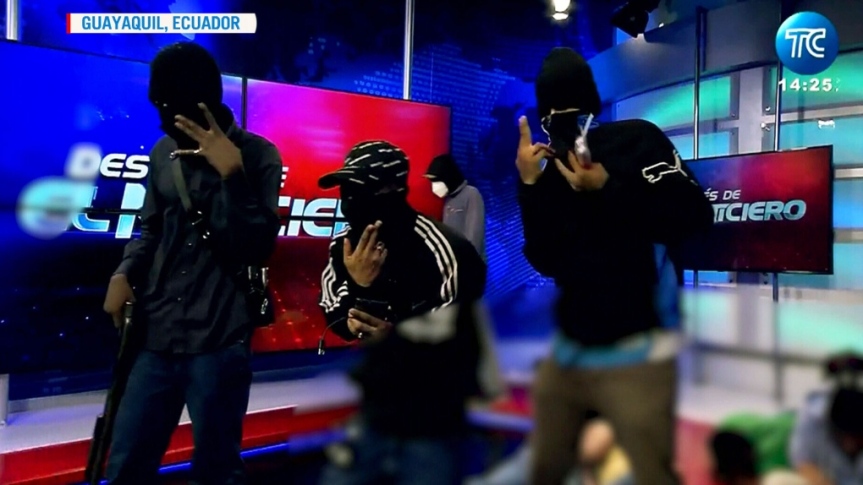
Prompting the visit was recently intensifying crime and turmoil manifesting as prison riots, escapes from prisons, and assassinations of political figures. A homicide rate of 5.8 per 100,000 persons in 2017 increased to 43 murders per 1000 Ecuadorians in 2023.

In the “grip of drug gangs,” Ecuador has been receiving cocaine and other illicit drugs produced and processed in countries such as Colombia, Peru, Bolivia, and Brazil. From Guayaquil and Esmeraldas, ports in Ecuador, the goods move on to U.S. and European consumers. The cartels’ former routes, through Central America and the Caribbean, are less active.

Ecuador’s government recently decreed a state of “internal armed conflict.” Its Army now has charge of domestic security.  From 2017 to 2023, governments under presidents Lenin Moreno and Guillermo Lasso arranged for privatizations, fiscal austerity, and a reduced package of state services. Resources are lacking to deal with powerful region-wide drug cartels now operating in the country.  U.S. military intervention would fill the gap.

The U.S. so-called drug war, as waged in Latin America and the Caribbean, began during the Nixon administration. Notable examples are Plan Colombia from 1999 until 2015 and the Merida Initiative, applied to Mexico from 2007 until 2021. The U.S. media provocatively associates drug cartels with international terrorism.  U.S. drug war spending has reached $1 trillion over four decades, says a report.

Ecuador’s situation has special features. Analyst Pablo Dávalos sees “convergence among political power, organized crime, and narcotrafficking to allow [Ecuador’s] use of the dollar as its national currency to enable money laundering.” Organized crime “controls vast areas” and Ecuadorians “refusing to pay extorsions are being systematically eliminated.”

Eloy Osvaldo Proaño of the Latin American Center of Strategic Analysis points out that the “neoliberal recipe reduces institutional presence, which weakens control of borders and facilitates penetration of criminal gangs.” What President Noboa has proposed “is part of a regional plan of paramilitaries occupying wide areas to instill terror, tear apart the social fabric and subdue populations.”   

The “22 organizations declared [by Noboa] to be ‘terrorist groups’ … have a capacity of maneuver and omnipresence enabling them to control territories and prisons, even to penetrate the institutions [of the state].”

Ecuador recently became the leading recipient of U.S. military assistance in Latin America and the Caribbean area. More is on the way. Ecuador’s defense minister indicated the U.S. government will be “investing” $3.1 billion in military assistance over seven years.  

Planning has been elaborate:

·        The FBI in 2017 assisted the “lawfare” campaign of President Guillermo Lasso against President Rafael Correa, his progressive predecessor.

·        The U.S. Congress on December 15, 2022, approved the United States-Ecuador Partnership Act of 2022.

·        A memorandum of understanding was signed in Washington in July 2023. It covers U.S. efforts to strengthen Ecuador’s military capacities and combat the drug trade.

·        A binational agreement was signed on August 16, 2023 for cooperation in building the capacity of Ecuador’s military, police, and judiciary.

·        President Lasso in Washington on September 28, 2023 signed agreements allowing U.S. troops and naval personnel to deploy in Ecuador.

·        Ecuador’s foreign minister signed a status of forces agreement with the U.S. ambassador on October 6, 2023 relating to privileges, immunities, and guarantees for U.S. armed forces personnel.

·        Ecuador’s Constitutional Court on January 11, 2024 ratified the U.S.- Ecuador security agreement.

Colombian President Gustavo Petro in September, 2022 recalled an earlier conversation with General Richardson about “the failure of [U.S.] anti-drug policies.” He mentioned to her that, “It’s our obligation … to say that and also to propose alternatives that don’t allow a million more Latin Americans to die.”  

Petro has company. Many progressives in the United States and elsewhere also regard the U.S. drug war as a failure. Facts are on their side:

·        Narcotrafficking has increased despite drug war.

·        Moneys spent on drug war is money not spent on preventative programs and poverty reduction.

·        U.S.-assisted militarization of targeted countries undermines democratic renewal.

·        Drug war means profits to weapons suppliers, narco-traffickers, and money-laundering banks and businesses.

·        The United States, the great consumer of illicit drugs, bears responsibility for not reducing consumption.

This consensus resonated at the Latin American and Caribbean Conference on Drugs – for Life, Peace, and Development that took place September 7-9, 2023 in Cali, Colombia. President Petro and Mexican President Andrés Manuel López Obrador had called for the gathering. Attending were officials of 19 regional nations and representatives both of observer countries and international social organizations.  

The object was “to rethink drug policies in response to the failure of the punitive strategy imposed by the United States.” The most impactful recommendations emerging were these:

·        Change basic assumptions by recognizing the failure of the U.S. war on drugs.

·        Contain the drug problem internally by dealing with structural causes of poverty, inequalities, lack of opportunities, and violence.

·        Block drug trafficking through “principles of justice and through development.” Fight poverty by giving people opportunities, youth especially.

·        Explore legal modes of drug consumption.

·        Reduce demand through “universal prevention” and attending to mental health problems.

Why does the U.S. government fight narcotrafficking in Ecuador? Its agenda is full already. Its prohibitions on narcotics use at home are less than effective.

Here’s a hint. Indigenous peoples organized by Ecuador’s Confederation of Indigenous Nationalities (CONAIE) carried out week-long national strike in June 2022.  At issue were labor rights, rescuing the environment, poor families’ unmet needs, and support for small farmers. A people’s political resistance movement evidently exists there.

Leonidas Iza, the CONAIE leader, now speaks out in regard to General Richardson’s visit. He told an interviewer that, “We struggle for the Ecuadorian people” and that, “We are ceding not only military sovereignty, sovereignty over our country but even more: we are submitting to their desire to control our resources.”

All is revealed. What’s happening is nationwide political resistance striking at U.S. economic and political interests abroad. The U.S. government characteristically takes protective action in such circumstances.

Drug war serves as a cover for putting U.S. troops and U.S. proxies on the ground for preventative purposes. In Colombia, under Plan Colombia, the U.S. military joined up with Colombia’s Army to confront leftist insurgencies. A U.S. military presence would have been handy in Peru and Bolivia to ward off indigenous mobilizations led, respectively, by former presidents Pedro Castillo and Evo Morales.


W.T. Whitney Jr. is a political journalist whose focus is on Latin America, health care, and anti-racism. A Cuba solidarity activist, he formerly worked as a pediatrician, lives in rural Maine. W.T. Whitney Jr. es un periodista político cuyo enfoque está en América Latina, la atención médica y el antirracismo. Activista solidario con Cuba, anteriormente trabajó como pediatra, vive en la zona rural de Maine.
Ecuador vote shows contrasting roles of political parties and social movements / By W.T. Whitney, Jr.

An electoral official shows the ballot for a presidential election in Ayora, Ecuador, Sunday, Aug. 20, 2023. The election was called after President Guillermo Lasso dissolved the National Assembly by decree in May to avoid being impeached. | Dolores Ochoa / AP

Originally posted in People’s World on August 31, 2023


On Aug. 20 in Ecuador, 45-year-old lawyer Luisa González of the Citizen’s Revolution movement political party (RC) gained 33.6% of the votes in first-round balloting for eight presidential candidates. Second-place candidate Daniel Noboa of the National Democratic Action, a 35-year-old business man and political neophyte, took 23.4% of the vote. González and Noboa will be competing in second round voting on Oct. 15.

As for the elections to the National Assembly, the RC accounted for 39.4% of the votes, three other parties for 45% of those votes, and five smaller parties for the remaining ballots.

The voters also considered referendums, one on halting oil extraction from Ecuador’s huge Yasuní National Park and the other on prohibiting mining activities in a biosphere region northeast of Quito. The referendums were approved by 59% and 68% of the voters, respectively.

The circumstances were unusual. Two processes played out on parallel tracks and culminated together. These were political parties taking part in elections and social movements pursuing referendums. Contradictions emerged along with the promise of troubles ahead and signs of commitment and hope.

The new president will serve only the 18 months that remain in the term of Guillermo Lasso, elected in 2021 for a five-year term. When confronted with impeachment proceedings in May 2023 on corruption charges, Lasso dissolved the National Assembly and thereby, as provided by the Constitution, set in motion preparations for a new election and his own departure.

Nationwide Indigenous protests in 2022 accelerated the transition now taking place amidst violence attributed to narco-trafficking that took 4,671 lives during the past year. The election campaign itself provoked killings, those of presidential candidate Fernando Villavicencio, a legislator, journalist, and labor leader; the mayor of Manta, Agustín Intriago, and others.

The Citizen’s Revolution movement political party, represented by presidential candidate Luisa González, defends policies of social assistance and national development introduced under the leadership of former President Rafael Correa during his tenure from 2007 to 2017. The CR took shape in reaction to the neoliberal turn taken by the government of Lenin Moreno, Correa’s former vice president and successor.

Its predecessor party, under Correa’s democratic-socialist leadership, managed the national economy so as to preserve funds for social programs through reliance on petroleum exports and foreign credit. The RC led left-leaning forces in opposing the neoliberal government of Guillermo Lasso, in power since 2021.

With his second-place finish in the recent voting, candidate Daniel Noboa surpassed expectations, due in part to a stellar TV debate performance. He represents wealth and power. His father, a five-time presidential candidate, and his uncle preside over an agro-export and real estate conglomerate made up of 200 business entities. They owe the government $1 billion in back taxes.

Now campaigning for the second round of presidential elections, RC candidate González would seem to differ greatly from the prince of such an empire. “We are going to deal with the basic causes of violence and criminality which are hunger, poverty, lack of education, and the absence of opportunity,” she noted as she was accepting her party’s nomination.

But all is not as it appears. The positions taken by the various presidential candidates on the referendums were revealing. Only four of the eight candidates unambiguously supported the Yasuní referendum; three of them represented right-wing parties. Noboa justified leaving oil underground based on his conclusion that the financial yield is low and that over-reliance on oil exports impedes diversification of the economy.

The Correa-inspired RC movement and its candidate Gonzalez rejected the Yasuní referendum. Previous governments, governments headed by Correa in particular, took the position that income from oil exports is crucial to continued funding of social advances.

The contrast between approval at the polls shown for the candidates of political parties and for approval of the referendums was striking─33.6% and 23.4%, respectively, versus 68% and 59%, respectively. One set of the voting results testified to activists’ enthusiasm and commitment.

Approval of the two referendums reflects the advocacy and hard work of environmentalists, Indigenous activists, and supporters of women’s rights. According to NACLA.org: “The vote marks a triumph for the country’s grassroots anti-extractivist, ecological, and Indigenous movements, whose road to victory comes from a decade of social and political conflicts over extractive industry policies.”

Journalist Gabriela Barzallo surveys collective efforts toward restraining oil extraction. Highlighting the persistent participation of social movements, she quotes Ecuadorian sociologist Gregorio Páez:

“This upcoming referendum … serves as an inspiration for all Ecuadorians to have the agency to decide over our natural resources, and to empower people to see that grassroots activism really can have changes in policies.”

Páez sees activism in Ecuador as “inspiring social movements on a global scale.”

Analyst Santiago Kingman explores the impact of social movements on the elections:

“The triumph of the social movements is understood as a positive response from cities and areas far removed from the oil-producing world. At least 59% of Ecuador’s citizens…are alienated from the electoral system and political parties and say they have another way of doing politics. Those who voted for Noboa [who favored the referendum’s approval] are against politics, but they are not anti-capitalists. The social organizations behind the referendums are anti-capitalists and are anti-political parties.” 

Social movements have shaped political resistance throughout Latin America, in some countries more than others. They flourish, it seems, in situations of grief at the hands of international capitalism. Resonating there is contention over control of land and sub-soil resources, provision of energy, debt owed to foreign creditors, and prescriptions for domestic economies from abroad.

Capitalist-oriented political parties, often enablers of foreign predators, offer little resistance. Social movements active in Peru, Chile, Bolivia, Colombia, and now Ecuador have partially filled the void. Social movements operating in conjunction with anti-capitalist governments have different job descriptions.

Imaginings lead to speculation about an expanded role for social movements in the capitalist powerhouse nations. One recalls U.S. labor uprisings in the 1930s and the civil rights movement that peaked a few decades later.


We hope you appreciated this article. At People’s World, we believe news and information should be free and accessible to all, but we need your help. Our journalism is free of corporate influence and paywalls because we are totally reader-supported. Only you, our readers and supporters, make this possible. If you enjoy reading People’s World and the stories we bring you, please support our work by donating or becoming a monthly sustainer today. Thank you!


W. T. Whitney Jr.

W.T. Whitney Jr. is a political journalist whose focus is on Latin America, health care, and anti-racism. A Cuba solidarity activist, he formerly worked as a pediatrician, lives in rural Maine. W.T. Whitney Jr. es un periodista político cuyo enfoque está en América Latina, la atención médica y el antirracismo. Activista solidario con Cuba, anteriormente trabajó como pediatra, vive en la zona rural de Maine.
Indigenous Alliance’s National Strike Threatens Ecuador’s Conservative Government / by W. T. Whitney Jr

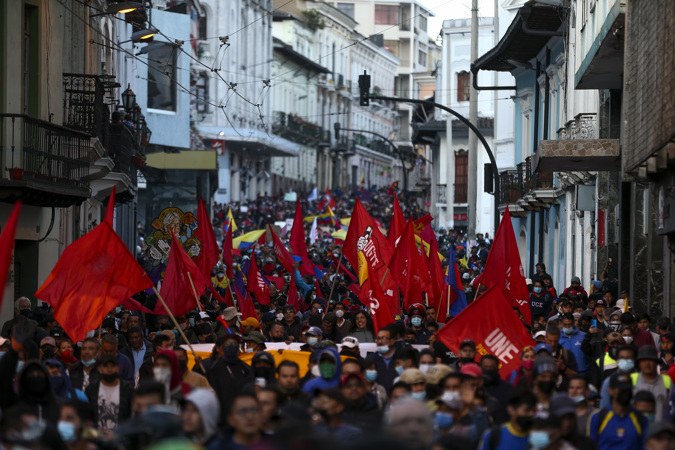
Thousands of people demonstrate against the Government of Guillermo Lasso, in Quito (Ecuador). | Photo: EFE/José Jácome

The entire Equadorian nation is presently experiencing a national strike, one that is strong particularly in Cotopaxi; Tungurahua; Chimborazo, and Pastaza provinces. Spearheading the action is the Ecuadorian Confederation of Indigenous Nationalities (CONAIE, as per its Spanish-language acronym).

The present writer’s friend and frequent correspondent Bob Shiers, based in Puyo, in Pastaza, reports that, as of June 18: “The only way one can get into Puyo is by foot, bicycle or motorcycle. …. Buses and taxi are not operating …This protest consists of 40 different indigenous groups who speak forty different languages … [T]he Ecuadorian media mainly shows photographs of people from Pichincha, Cotopaxi, and Imbabura provinces which primarily represent the Quichua people.”

“As of yesterday, the oil fields in the Amazona were shut down. Crude now selling at more than $110 a barrel. Everyday tens of thousands of dollars’ worth of flowers are lost as the union workers at the airport refuse to load them onto planes …  In Quito, all the large retail stores are closed.

”The National Teachers’ Union voted to strike … [President Guillermo] Lasso moved the government out of Quito. Much violence between police and students in Guayaquil. … in Quito, [there are] violent confrontations between the army and students. This is different from any other mass Ecuadorian indigenous protest since 1990 because the indigenous Pachakutik [Plurinational Unity Movement – New Country]Party controls the national parliament.”

Lasso’s ascent to Ecuador’s presidency in April 2021 pleased banking circles in the United States. As noted by a financial commentator: “The surprising victory for conservative Guillermo Lasso … increases the chances that public debt will be put onto a sustainable path” and that the country’s bonds will gain in value. Within months, revelations surfaced that monies Lasso accumulated as a banker had been stored in off-shore tax havens.

On May 20, an expanded council of CONAIE, approved resolutions centering on improved quality of rural life, protection of nature, sustainable agriculture, and repair of economic and political inequalities.

The basis for these resolutions, according to CONAIE, derives from “an analysis of the country’s problems agravated by a profound economic and instutional crisis, [which in turn stems from] dependence on the powers of the state, a pronounced widening of the inequality gap, and deepening of poverty generally. The national government turns its back on the majority population, favoring the big capitalists and submitting to the International Monetory Fund with its policies of privatization of strategic sectors and of plundering the country.”

Three weeks later, CONAIE announced the launching on June 13 of a “national mobilization of indigenous peoples,producing sectors, small farmers, and diverse social organizations.” The organization presented a ten-point agenda outlining a range of reforms addressing economic and human-rights injustices.  

Demands included: reduced gasoline and diesel prices; a one-year moratorium on family debts; better prices for agricultural products; more credit for farmers; improved education, transportation services and healthcare; labor rights; no mining in indigenous areas; protection of water sources; attention to the rights of nature and to collective rights; and controls on privatization, price-gouging, and speculation.

As of the strike’s sixth day, the Lasso government had decreed a State of Emergency and soldiers and police were deployed in Cotopaxi, Imbabura and Pichincha provinces. Pichincha is the location of Quito, Peru’s capital. Reports quickly surfaced of injuries and arrest of strikers.

The government has relented to the extent of declaring a public health emergency and providing Ecuadorians with a “human development” bonus, a subsidy covering 50 percent of farmers’ fertilizer costs, partial cancelation of debts owed the Central Bank, and small low-interest loans for farmers.

CONAIE leader Leónidas Iza welcomed the proposals, while pointing out their limited scope and lack of official validation. Iza “reiterated that CONAIE is preparing its entry into Quito in order to continue with anti-government demonstrations.” On June 18, his car came under attack. Bullets shattered one of its windows, but Iza escaped injury.  


W.T. Whitney Jr. is a political journalist whose focus is on Latin America, health care, and anti-racism. A Cuba solidarity activist, he formerly worked as a pediatrician, lives in rural Maine. W.T. Whitney Jr. es un periodista político cuyo enfoque está en América Latina, la atención médica y el antirracismo. Activista solidario con Cuba, anteriormente trabajó como pediatra, vive en la zona rural de Maine.