
U.S. Congress terrorizes Cuba: GOP seeks power to designate island a terrorism sponsor / W. T. Whitney Jr.

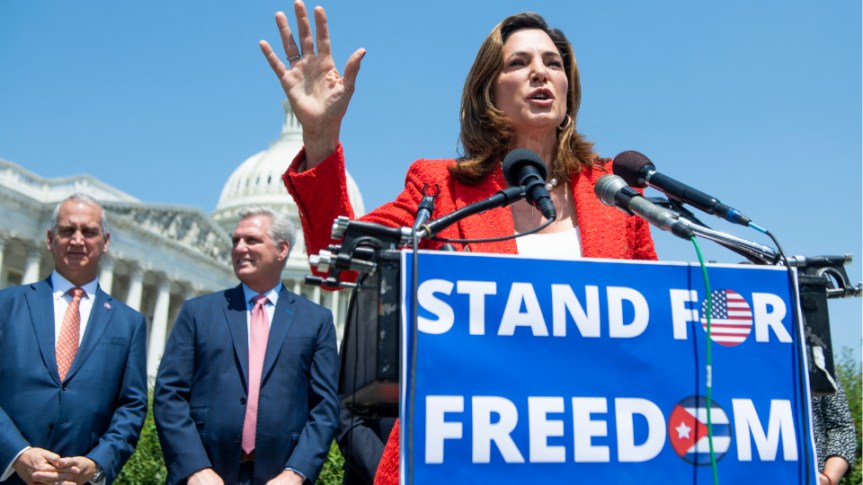
Rep. Maria Elvira Salazar, R-Fla., speaks during a news conference to highlight ‘Cuban Independence Day’ outside the Capitol on Thursday, May 20, 2021. Rep. Mario Diaz-Balart, R-Fla., left, and House Minority Leader Kevin McCarthy, R-Calif., also appear. | Tom Williams / CQ Roll Call via AP

Originally published in the People’s World on April 6, 2023


Although Cuba’s Revolution survived military invasion, guerrilla actions, terrorist attacks, and bacteriologic warfare, enough was not enough. Now, there are pay-offs to dissidents, manipulation of worldwide media coverage, and weaponization of social media capabilities. And of course, the U.S. economic and financial blockade persists, after 60 years, with no sign of stopping any time soon.

That’s mostly because power to end the blockade switched from the executive branch to Congress, courtesy of the Helms-Burton Law of 1996. Now, the House of Representatives will be considering a bill that, similarly, would have Congress and no longer the president decide on removing Cuba from the U.S. list of terrorism-sponsoring nations.

Miami’s Republican Rep. María Elvira Salazar introduced H.R. 314, the so-called FORCE Act, on Jan. 12, 2023. Its aim is to “prohibit the removal of Cuba from the list of state sponsors of terrorism until Cuba satisfies certain conditions, and for other purposes.”

GOP Sen. Marco Rubio introduced a companion bill in the U.S. Senate on March 16. The House bill has 24 co-sponsors; five are Floridians. The House Foreign Affairs Committee sent the bill to the House floor on March 28.

Meanwhile, a revived campaign is pressuring President Joe Biden to end the designation of Cuba as a state sponsor of terrorism. That campaign takes on urgency now, inasmuch as Congress may soon co-opt Biden’s power to do so.

The designation represents a false account of Cuba’s facilitation of peace talks between Colombia’s government and leftist guerrillas. It traces back to old accusations that Cuba was harboring fugitives from the United States.

The designation persisted from the 1980s until 2015, when President Barack Obama removed it, only to be reinstated by White House occupant Donald Trump in 2021. The effect is to broaden economic war and bring new grief to the people of Cuba.

U.S. dollars are weaponized; they are still the de facto currency in all international financial dealings, anywhere, by anyone. A convenient choke point exists, as pointed out recently by Cuban diplomat José Ramón Cabañas: “The issue is the clearing system based in New York. 90% of [Cuba’s] international transactions with U.S. dollars go through that system … [and are] automatically frozen.”

U.S. regulations, introduced through executive action, long ago prohibited state sponsors of terrorism from using U.S. dollars in international transactions. Consequently, payments that Cuban exporters expect from foreign buyers may not arrive, and Cuban importers have difficulties paying foreign suppliers. International loan payments are blocked, and grants from international agencies go astray.

The U.S. Treasury Department may impose heavy fines on those international banks and foreign corporations that do handle dollars in transactions with Cuba. Non-offenders avoid Cuba, out of caution. The connection between the terrorism-sponsoring designation and prohibition on the use of U.S. currency has led to shortages and economic distress in Cuba.

Massachusetts Peace Action has spearheaded the necessary campaign against H.R 314. A recent communication provides information and shows how to contact members of the House of Representatives.

The extended Cuban exile community provides the main political support for the anti-Cuba legislative proposals in the House and Senate. The Cuba part of U.S. foreign policy is regularly farmed out to the population sector with the most to lose or gain. That approach is dysfunctional, irrational, and unfair.

The text of the proposed bill assigns Cuba goals, fulfillment of which would signal that the country is no longer to be designated as a sponsor of terrorism. These are the very goals that, as specified in the Helms-Burton Law, need to be achieved so that the blockade may be ended.

The goals are:

  • Release all political prisoners and allow for investigations of Cuban prisons by appropriate international human rights organizations.
  • Transition away from the “Castro regime” to a system that guarantees the rights of the Cuban people to express themselves freely.
  • Commit to holding free and fair elections.

Perspective reveals contradictions in all of this. The subject of political prisoners demands consideration of the fate of U.S. prisoners held at the U.S. military base in Guantánamo Bay.

It’s worthwhile also to recall that neither Fidel nor Raul Castro now plays a part in Cuba’s government. As for Fidel, he’s dead. And when it comes to the retired Raul, his influence may persist, just as does that of former presidents in the United States, but he occupies no leadership role. His thinking is sought from time to time in Cuba when, for instance, organized discussion among wide sectors of the population precedes the introduction of important initiatives. The last such occasion was the discussion period in 2022 prior to the vote on the Constitutional Amendment for a Family Code.

And, lastly, Cuba’s conduct of elections is exemplary. In voting on March 26 for Cuba’s National Assembly, 75% of the voting population took part. The portion of those who vote in U.S. national elections is far smaller. Plus, the make-up of delegates to the Assembly actually reflects the demographics of Cuba’s population, unlike the U.S. Congress.

The National Assembly then chooses from among its members to be Cuba’s leaders. That’s the standard process followed in the parliamentary systems of many countries.


W.T. Whitney Jr. is a political journalist whose focus is on Latin America, health care, and anti-racism. A Cuba solidarity activist, he formerly worked as a pediatrician, lives in rural Maine. W.T. Whitney Jr. es un periodista político cuyo enfoque está en América Latina, la atención médica y el antirracismo. Activista solidario con Cuba, anteriormente trabajó como pediatra, vive en la zona rural de Maine.
A U.S. general hypes China as threat in Latin America / by W.T. Whitney Jr.

General Laura Richardson, Commander of United States Southern Command testifies before the Senate Armed Services Committee. | Jose Luis Magana / AP

Published in the People’s World on March 29, 2023


The U.S. government has long intervened in Latin America and the Caribbean (LAC). Now, the U.S. military is paying attention to China’s economic activities there.

Gen. Laura Richardson on March 8 reported to the Armed Services Committee of the U.S. House of Representatives on the actions and needs of the Southern Command, which she heads. She has charge of all U.S. military operations in the region.

Citing the 2022 National Security Strategy, Richardson declared that “no region impacts the United States more directly than the Western Hemisphere… [There,] autocrats are working overtime to undermine democracy.” And security there “is critical to homeland defense.”

Richardson stated that “the PRC (People’s Republic of China) has both the capability and intent to eschew international norms, advance its brand of authoritarianism, and amass power and influence at the expense of the existing and emerging democracies in our hemisphere.” The Southern Command’s “main priority…is to expose and mitigate PRC malign activity.”

She sees a “myriad of ways in which the PRC is spreading its malign influence, wielding its economic might, and conducting gray zone activities to expand its military and political access and influence.” A “gray zone,” according to the NATO-friendly Atlantic Council, is a “set of activities…[like] nefarious economic activities, influence operations, …cyberattacks, mercenary operations, assassinations, and disinformation campaigns.”

Richardson highlighted China’s trade with LAC that is heading toward “$700 billion [annually] by 2035.” The United States, in her view, will be facing intense competition, and presently “its comparative trade advantage is eroding.”

She added that “The PRC’s efforts to extract South America’s natural resources to support its own population…are conducted at the expense of our partner nations and their citizens.” And opportunities for “quality private sector investment” are disappearing.

Competition extends to space: “11 PRC-linked space facilities across five countries in this region [enable] space tracking and surveillance capabilities.” Richardson complained of “24 countries [that] have existing Chinese telecommunication infrastructure (3G/4G), increasing their potential to transition to Chinese 5G.”

She expressed concern both about surveillance networks supplied by China that represent a “potential counterintelligence threat” and about Latin Americans going to China “to receive training on cybersecurity and military doctrine.” Richardson denounced China’s role in facilitating environmental crimes and pointed to “potential dual use for malign commercial and military activities.”

“Relationships absolutely matter,” she insisted, “and our partner democracies are desperate for assistance from the United States.” Plus, “if we’re not there in time, they…take what’s available, creating opportunities for the PRC.”

Moving beyond China, Richardson indicated that “many partner nations…see TCOs [transnational criminal organizations] as their primary security challenge.” That’s because drug-cartel violence leads to deaths and poverty, and “illicit funds exacerbate regional corruption, insecurity, and instability.”

Her report avoids mention of particular countries other than offering brief references to Haiti, Cuba, Nicaragua, and Venezuela. She criticized Russia for “military engagements with Venezuela and Nicaragua” and for spreading “false narratives.” Richardson praised Colombia for providing military training in other countries.

The Southern Command gains “exponential return” on supplying various countries with U.S. weapons and supplies. It conducts joint military exercises, and “provides professional military education to personnel from 28 countries.”

Richardson reported at length on processes she sees as fostering useful relationships between her command and the various governments and military services. The tone of urgency characterizing her discussion on China was entirely lacking.

Economic intervention

Gen. Richardson’s view that China has greatly expanded its economic involvement with the LAC nations is on target.

Since 2005, China’s state-owned banks have arranged for 117 loans in the region worth, in all, more than $140 billion. They averaged over $10 billion annually. Since 2020, China has made fewer loans.

Chinese trade with Latin America grew from $12 billion in 2000 to $448 billion in 2021. China’s imports of “ores (42%), soybeans (16%), mineral fuels and oils (10%), meat (6%), and copper (5%)” totaled $221 billion in 2021. The value of exported manufactured goods that year was $227 billion. By 2022, China had become the biggest trading partner in four Latin American countries and the second-largest in many others.

China’s foreign direct investment (FDI) has long represented China’s strongest economic tie to the region. FDI signifies funding of projects abroad directed at long-term impact. China’s FDI from 2005 to mid-2022 was $143 billion. Energy projects and “metals/mining” accounted for 59% and 24% of the total, respectively. Of that total, Brazil and Peru received 45% and 17%, respectively.

The FDI flow since 2016 has averaged $4.5 billion annually; worldwide, China’s FDI has contracted.

Chinese banks and corporations have invested heavily in lithium production in Argentina, Bolivia, and Chile, which, together, account for 56% of the world’s lithium deposits. China is the largest investor in Peru’s mining sector, controlling seven large mines and owning two of Peru’s biggest copper mines. Brazil is the world’s largest recipient of Chinese investments.

China’s government has linked FDI to its Belt and Road Initiative (BRI) that began in 2013. As of May 2022, 21 Latin American and Caribbean countries were cooperating with the BRI and 11 of them had formally joined.

On the ground

U.S. military intervention in LAC is far from new. Analyst Sergio Rodríguez Gelfenstein complements Richardson’s report with a three-part survey, accessible herehere, and here, of recent U.S. military activities in the region.

He indicates the United States now has “12 military bases in Panamá, 12 in Puerto Rico, 9 in Colombia, 8 in Perú, 3 in Honduras, 2 in Paraguay, as well as similar installations in Aruba, Costa Rica, El Salvador, Cuba (Guantánamo), and in other countries.”

Rodríguez maintains that “levels of aggressive interference by Washington in the region have increased dramatically,” and that U.S. embassies there are supplied with more military, National Security Council, and CIA personnel than ever before.

Honduran Foreign Minister Eduardo Enrique Reina Garcia, left, and Chinese Foreign Minister Qin Gang shake hands following the establishment of diplomatic relations between the two countries, at a ceremony in the Diaoyutai State Guesthouse in Beijing Sunday, March 26, 2023. Honduras formed diplomatic ties with China on Sunday after breaking off relations with Taiwan, which is increasingly isolated and now recognized by only 13 sovereign states, including Vatican City. The U.S., meanwhile, is upset about China’s growing ties of cooperation and trade in Latin America. | Greg Baker / Pool Photo via AP

Rodríguez notes features of the LAC region that attract U.S. attention, among them: closeness to strategically important Antarctica; reserves of fresh water and biodiversity in Amazonian regions; the Guarani Aquifer near the triple frontier of Brazil, Paraguay, and Argentina, the largest in the world; and huge reserves of valuable natural resources.

Among ongoing or recent U.S. military interventions are these:

  • The U.S. Army Corps of Engineers is implementing a “master plan” for the navigability of the Paraguay River and Plata River Basin. The nearby Triple Frontier area supposedly harbors international terrorism and drug trafficking.
  • The U.S. military facility in Neuquén, Argentina, is turning from its alleged humanitarian mission to activities in line with local preparations for oil extraction.
  • S. officials on Oct. 13, 2022, announced that 95 military vehicles were being donated to Guatemala for drug-war activities.
  • In Brazil in September 2022, General Richardson indicated that U.S. forces would join Brazilian counterparts to fight fires in the Amazon.
  • The Southern Command’s fostering of good relations with Peru’s military has borne fruit. Under consideration in Peru’s Congress is a proposal to authorize the entry of foreign military forces. To what nation would they belong? Hint: former CIA operative and U.S. Ambassador Lisa Kenna met with Peru’s Defense Minister the day before President Pedro Castillo was removed in a parliamentary coup on Dec. 7, 2022.
  • In March 2023, two U.S. congresspersons proposed that U.S. troops enter Mexico to carry out drug-war operations.
  • Presently the United States is making great efforts to establish a naval base on Gorgona island off Colombia’s Pacific coast. It would be the ninth U.S. base in Colombia, a NATO “global partner.”
  • In Colombia, U.S. troops acting on behalf of NATO, are active in that country’s Amazon region supposedly to protect the environment and combat drug trafficking.
  • The U.S. National Defense Authorization Act of December 2022 awarded the Southern Command $858 million for military operations in Ecuador.
  • In a second visit, the U.S. Coast Guard cutter Stone was plying Uruguayan waters in February ostensibly to train with local counterparts for search and rescue operations. The ship was also monitoring the nearby Chinese fishing fleet.

Rodríguez does not comment on U.S. interventions in Cuba, Nicaragua, and Venezuela. That’s because they’ve persisted for “more than 60, 40, and 20 years, respectively” and each requires a “special report.”

John Quincy Adams returns

Proclaiming the Monroe Doctrine 200 years ago, Secretary of State Adams informed European powers that the United States regarded “any attempt on their part to extend their system to any portion of this hemisphere as dangerous to our peace and safety.”

Gen. Richardson would apply the warning of that era to the PRC. Yet signs of hegemonic aspirations from that quarter are absent.

Commenting recently, Argentinian economist and academician Claudio Katz notes that “China concentrates its forces in the economic arena while avoiding confrontations at the political or military level.… Investments are not accompanied by troops and bases, useful for guaranteeing return on investments.”

Besides, China “does business with all governments, without regard to their internal politics.” That tendency, Katz writes, stems from the PRC having “arisen from a socialist experience, having hybrid characteristics, and not completing a passage to capitalism.” He maintains that China, with its economic involvement, contributes nothing to advancing socialism in the region.


W.T. Whitney Jr. is a political journalist whose focus is on Latin America, health care, and anti-racism. A Cuba solidarity activist, he formerly worked as a pediatrician, lives in rural Maine. W.T. Whitney Jr. es un periodista político cuyo enfoque está en América Latina, la atención médica y el antirracismo. Activista solidario con Cuba, anteriormente trabajó como pediatra, vive en la zona rural de Maine.

The Cuban Revolution: Made by teachers and students / by W.T. Whitney Jr.

Teacher Graciela Lage gives an English lesson at the Cuban School of Foreign Languages in Havana. | Desmond Boylan / AP

Cuban education has long been ground zero for ending inequalities.

Schools on the island are places where doors opened up for all Cuban young people to learn and for students, even of oppressed classes, to prepare for one or another kind of work that would contribute to Cuba’s development as an independent nation.

Cuban literacy teachers, 123 of them, arrived in Honduras on Dec. 20. With Honduran colleagues, they will be utilizing Cuba’s special method, “Yo sí puedo” (Yes I can), to teach literacy. It’s a technique that has found worldwide application.

Dec. 22 in Cuba is Teacher’s Day. On that date in 1961—Cuba’s “Year of Education”—Fidel Castro, speaking before a large crowd in Havana, announced the end of Cuba’s literacy campaign of that year. He declared Cuba to be a “territory free of illiteracy.”

On hand were 100,000 young people who had volunteered to teach the rudiments of reading and writing to illiterate adults living in rural areas. These young people, mostly from Cuba’s cities, lived with families they were teaching and did farm work.

Joining them in the island-wide literacy campaign were tens of thousands of volunteer teachers, unionists, and other working people. In the end, 271,000 literacy volunteers enabled 707,000 Cubans (out of a population of 7,291,200) to learn how to read.

The figure of José Martí, Cuba’s national hero, epitomizes for Cubans the affinity of education and revolution. Introducing Martí’s book On Education (Monthly Review Press, 1978), editor Philip Foner observes that, “Basic to the foundation of liberty, in the eyes of José Martí, was the education of the people. Nothing guaranteed that a government was anxious to serve its citizens as much as the haste it displayed in educating its people.”

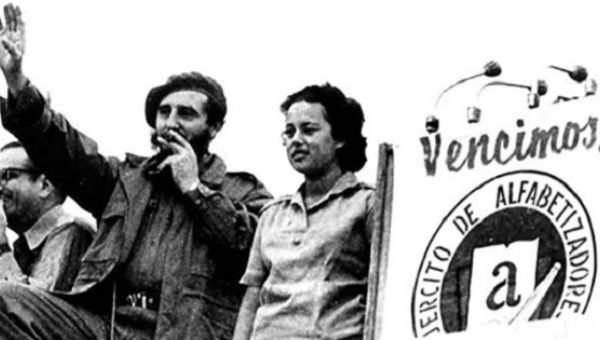
Fidel Castro waves at literacy teachers and students in Havana after declaring Cuba free of illiteracy, Dec. 22, 1961. | Cuba Debate

In comments in September 1961 about the literacy campaign, Castro updated Martí’s idea: “One does not conceive of a revolution without also a great revolution in the educational arena … revolution and education are almost two synonymous ideas … [The] Revolution will advance and be successful the more it works in the field of education, the more competent technicians there are, the more competent administrators, teachers, revolutionary cadre it has.”

Foner notes that in 1959, 23% of Cubans were illiterate, the “average school education was below third grade,” and “only a few thousand” children were attending secondary schools. By December 1961, according to Castro, the revolutionary government had created 15,000 schools while converting military installations into schools and building schools for handicapped children.

By 1973, literacy was all but universal. Some 1,898,000 children were attending primary school, and 470,000 were enrolled in secondary schools, according to Foner. By that time, a “second educational revolution” was in progress with the training of 20,000 additional teachers to handle waves of students now attending secondary and pre-university schools.

A third educational “revolution” was underway from 2000 on. Associated with what the Cuban state referred to as the “Battle of Ideas,” it called for teaching that emphasized social justice and equality and was accompanied by moral and social support for students. Education in the arts expanded, and there were new social-work schools. Visual, audio, and computer-based methods were newly available to teachers.

University enrollment increased as authorities extended instruction to students’ own localities while relying on computer-based and televised teaching aids. By 2015, 80% of university students were studying close to home.

Some problems emerged, however. Teaching programs in science and technology lost students to courses in the humanities and social sciences. University teaching was contributing less than before to the country’s economic development. Fewer students were preparing to be teachers, and 20,000 teachers had left their posts for the sake of better-paying jobs.

Reversing course, the government cut back on university teaching at the local level, made entrance exams more competitive, re-emphasized scientific and technical training, and shortened the university course of study. As of 2019, 241,000 students, or one in three Cubans between 18 and 24 years of age, were studying in 50 university centers. Almost 50% of them were taking medical-sciences courses; 8,542 were art students.

All along, the U.S. economic blockade was causing shortages and adding difficulties. A report presented by Cuba’s Education Ministry in early 2022 explains:

  • Under blockade rules, Cuba lacks access to the credit needed for buying goods abroad.
  • Importing is difficult due in part to price hikes resulting from high freight costs for importing goods from places other than the United States.
  • The inflated costs of goods purchased abroad from third-party intermediaries discourage imports.
  • Under blockade regulations, specific items manufactured anywhere with even tiny U.S. components are prohibited.

The list of necessary and often missing items is long: paper, books, notebooks, computers, audio-visual devices, laboratory supplies, laboratory equipment, writing materials, art supplies, sports equipment, special devices used by handicapped students, musical instruments, recording devices, English language texts and books, broadband internet connections, and replacement parts for equipment.

Nevertheless, as the result of sustained efforts over decades, students have been prepared to take on varied tasks aimed at developing Cuba’s economy and building socialism.

  • Between 1960 and 2017, Cuban universities graduated 1.2 million “professionals,” including 80,000 physicians. Women accounted for 64% of university graduates in 2010, up from 3% in 1959. University graduates in 2019 made up 2.2% of Cuban workers.
  • Spending on education in Cuba in 2012 represented 9% of the GDP. The comparable figure in the United States currently is 4.96% of GDP. Cuba in 2018 dedicated 13% of its national budget to education.

In Cuba in 1995, a Cuban woman hitched a ride on a small bus carrying Maine visitors, myself included, from Havana to Trinidad. “We Cubans want producers, not consumers,” we heard her say. Fidel Castro spoke similarly on that first Teachers Day in 1961.

He dismissed fellow University of Havana law students as “all those people with nothing to do but to study to be a lawyer.” At that time, “the ruling class was not teaching the children of workers.” That “half the population, the rural population, had no secondary school” he regarded as a “serious problem for any revolution in an underdeveloped country like ours. What few technical workers there are come from upper-income sectors … from the economically and politically dominant class, which, logically, is opposed to revolutionary change.”

Leftists in the United States and elsewhere often regard reform and revolution as separate projects. Cuba’s experience of preparing young citizens to work at what would become socialism may be relevant.

Small though they may be, certain reforms happening now within U.S. schools, rife with inequalities, could end up serving the revolution on the way, and in that way be revolutionary. Such reforms: the fostering of equality among students, the inculcation of real knowledge about societal problems, and students’ work projects that are oriented to the common good.


W.T. Whitney Jr. is a political journalist whose focus is on Latin America, health care, and anti-racism. A Cuba solidarity activist, he formerly worked as a pediatrician, lives in rural Maine. W.T. Whitney Jr. es un periodista político cuyo enfoque está en América Latina, la atención médica y el antirracismo. Activista solidario con Cuba, anteriormente trabajó como pediatra, vive en la zona rural de Maine.

People’s World, January 4, 2023, https://www.peoplesworld.org/

U.S. eyes military intervention in Haiti, again / by W.T. Whitney Jr.

Protesters calling for the resignation of Haitian Prime Minister Ariel Henry run after police fired tear gas to disperse them in the Delmas area of Port-au-Prince, Haiti, Monday, Oct. 10, 2022. | Odelyn Joseph / AP

The news story begins: “The Council of Ministers [on October 8 in Haiti] authorized the prime minister to seek the presence in the country of a specialized military force in order to end the humanitarian crisis provoked by insecurity caused by gangs and their sponsors.”

The circumstances are these:

Masses of Haitians have been in the streets protesting intermittently since August. Their grievances are high costs—thanks to the International Monetary Fund—and shortages of food and fuel. Banks and stores are closed. Students are demonstrating. Labor unions have been on strike.

The pattern has continued intermittently for ten years. Pointing to corruption, demonstrators have called for the removal, in succession, of Presidents Michel Martelly and Jovenel Moïse, and now de facto prime minister Ariel Henry.

Recently, violence has aggravated the situation, and foreign powers, including the United States, have paid attention. That’s significant because U.S military interventions and other kinds of U.S. intrusions have worked to trash Haiti’s national sovereignty, and, with an assist from Haiti’s elite, deprive ordinary people of control of their lives.

Presently, 40% of Haitians are food insecure. Some 4.9 million of them (43%) need humanitarian assistance. Life expectancy at birth is 63.7 years. Haiti’s poverty rate is 58.5%, with 73.5% of adult Haitians living on less than $5.50 per day.

Electoral politics is fractured. It was Secretary of State Hillary Clinton who arranged for Martelly to be a presidential candidate in 2011. Moïse in 2017 was the choice of 600,000 voters—out of six million eligible citizens. He illegally extended his presidential term by a year. As of now, there have been no presidential elections for six years, no elected mayors or legislators in office for over a year, and no scheduled elections ahead.

Washington’s man: De facto Haitian Prime Minister Ariel Henry holds power, even though he wasn’t elected. Some believe he may have been involved in the murder of the previous president and now he’s seeking U.S. troops to stem protests against his government. | Odelyn Joseph / AP

Gangs mushroomed in recent years, and violence has worsened. Moïse’s election in 2017 prompted turf wars, competing appeals to politicians, narcotrafficking, kidnappings, and deadly violence in most cities, predominately in the capital, Port-au-Prince. Violence escalated further after Moise’s murder in July 2021. Hundreds have been killed and thousands displaced, wounded, or kidnapped.

The U.S. Global Fragility Act of 2019 authorizes multi-agency intervention in “fragile” countries like Haiti, the U.S. military being one such agency designated to do the intervening. The influential Council of Foreign Relations (CFR) wants U.S. soldiers instructing Haitian police on handling gangs. Luis Almagro, head of the Organization of American States, calls for military occupation. U.N. Secretary General Antonio Guterres wants international support for training Haitian police.

Former U.S. Special Envoy to Haiti Daniel Foote weighs in with a choice: Either “send a company of special forces trainers to teach the police and set up an anti-gang task force, or send 25,000 troops at some undetermined but imminent period in the future.” The Dominican Republic has stationed troops at its border with Haiti and calls for international military intervention.

Meanwhile, foreign actors intrude as Haitians try to reconstruct a government. Their tool is the Core Group, formed in 2004 following the U.S.-led coup against progressive Haitian President Jean-Bertrand Aristide. The Core Group consists of the ambassadors of Brazil, Canada, France, Germany, Spain, the United States, and representatives of the United Nations and Organization of American States.

Haiti’s government is now in the hands of Ariel Henry, whom the Core Group approved as acting prime minister, overruling Moïse’s choice made before he died. Some believe Henry, a U.S. government favorite, may even be complicit in Moïse’s murder.

Henry insists he will arrange for presidential elections at some point in the future. Prevailing opinion, however, holds that conditions don’t favor elections any time soon.

The Core Group backs an important agreement announced by the so-called Montana Group on Aug. 30, 2021. It provides for a National Transition Council that would prepare for national elections in two years and govern the country in the meantime. The Council in January 2022 chose banker Fritz Jean as transitional president and former senator Steven Benoit as prime minister. They have still not assumed those jobs.

The Montana Group consists of “civil society organizations and powerful political figures,” plus representatives of political parties in Haiti. One leader of the Group is Magali Comeau Denis, who allegedly participated in the U.S-organized coup that removed Aristide in 2004. Henry also has a connection to coup-plotting, having worked with the Democratic Convergence that in 2000 was already planning the overthrow of Aristide.

The CFR wants the U.S. government to persuade Henry to join the Montana Group’s transition process. U.S. Envoy Foote supports the Montana agreement because it shows off Haitians acting on their own. Recently, some member organizations have defected, among them the right-wing PHTK Party of Henry and of Presidents Martelly and Moïse.

The weakness of Haiti’s government in the face of dictates from abroad was on display during Moïse’s era. The perpetrators of his murder, who had been recruited by a Florida-based military contractor, were 26 Colombian paramilitaries and two Haitian-Americans. Their motives remain unclear, and there is no apparent movement toward a trial.

Moïse, the wealthy head of an industrial-scale agricultural operation, became president through fraudulent elections in 2017. He was the target of massive protests a year later. Prompting them were fuel and food shortages and revelations that the president and others had stolen billions of dollars from the fund created through the Venezuela’s PetroCaribe program of cheap oil for Caribbean nations.

Foreign governments, the United States in particular, may now be on the verge of intervening in Haiti. But the ostensible pretext—gang violence—turns out to be muddled. Progressive Haitian academic and economist Camille Chalmers makes the point. He claims that “gangsterism” in Haiti actually serves U.S. purposes.

Interviewed in May 2022, Chalmers explains that the “principal [U.S.] objective is to block the process of social mobilization, to impede all real political participation … through these antidemocratic methods, through force using the police … and above all these paramilitary bands.” Terror is useful for “breaking the social fabric, ties of trust, and any possible resistance process.”

By means of gang violence, the Haitian people “are removed from any political role, and the economic project of plundering resources from the country is facilitated.” Also, Haiti becomes “an appendage of the interests of the North Americans and Europeans.” Chalmers refers to gold deposits on Haiti’s border with the Dominican Republic and big investments by multinational corporations.

He sees a bond between reactionary elements in Haiti and the gangs. The gangs “have financing and weapons that come from the United States. Many of their leaders are Haitians who have been repatriated by the United States.”

A U.S. Army soldier arrests a Haitian man during the U.S. military occupation following the overthrow of President Jean-Bertrand Aristide, Port-au-Prince, Haiti, Oct. 3, 1994. | John Gaps III / AP

Within this framework, Haiti’s police must be ready and able to fight the gangs in order to achieve maximum turmoil. The U.S. government provided Haiti’s police with $312 million in weapons and training between 2010 and 2020, and with $20 million in 2021. The State Department contributed $28 million for SWAT training in July. As of 2019, there were illegal arms in Haiti worth half-a-million dollars, mostly from the United States.

In view of U.S. tolerance or even support of the gangs, the zeal to suppress them now is a mystery. Perhaps some gangs have changed their colors and now really do pose danger to U.S. interests.

The so-called “G-9 Family and Allies,” an alliance of armed neighborhood groups led by former policeman Jimmy Cherizier, may qualify. Not only has it emerged as the Haitian gang most capable of destabilization, but the words “Revolutionary Forces” are a new part of its name.

Cherizier observed in 2021 that, “the country has been controlled by a small group of people who decide everything …They put guns into the poor neighborhoods for us to fight with one another for their benefit.” He noted that, “We have to overturn the whole system, where 12 families have taken the nation hostage.” That system “is not good, stinks, and is corrupt.”

Referring to a mural depicting Che Guevara, Cherizier declared, “we made that mural, and we intend to make murals of other figures like … Thomas Sankara and … Fidel Castro, to depict people who have engaged in struggle.”

These are words of social revolution suggestive of the kind of political turn that repeatedly has prompted serious U.S. reaction. Beyond that, the words of Haitian journalist Jean Waltès Bien-Aimé represent for Washington officials the worst kind of nightmare.

He told People’s Dispatch: “Activation of gangs is part of a strategy to prevent Haitian people from taking to the streets.” He scorns Ariel Henry “as a present from the U.S. embassy,” adding that the “Haitian people do not need a leader at the moment. Haitian people need a socialist state … We have a bourgeois state. What we need now is a people’s state.”

In the background are U.S. racist attitudes. They flourished initially as a consequence of the slavery system’s central role in developing the U.S. economy. They still show up, it seems, as discomfort with the ideas of formerly enslaved Haitians gaining autonomy and securing independence for their own nation.

W.T. Whitney Jr. is a political journalist whose focus is on Latin America, health care, and anti-racism. A Cuba solidarity activist, he formerly worked as a pediatrician, lives in rural Maine. W.T. Whitney Jr. es un periodista político cuyo enfoque está en América Latina, la atención médica y el antirracismo. Activista solidario con Cuba, anteriormente trabajó como pediatra, vive en la zona rural de Maine.

Peoples World, October 12, 2022, https://peoplesworld.org/

Mexico leads in opposing the Cuba blockade and U.S. imperialism / by William T. Whitney Jr.

Cuban President Miguel Diaz Canel, right, and his Mexican counterpart Andres Manuel Lopez Obrador, left, raise their arms during a ceremony to award the Jose Marti Order to Lopez Obrador, at Revolution Palace in Havana, Cuba, Sunday, May 8, 2022. El presidente cubano Miguel Díaz Canel, a la derecha, y su homólogo mexicano, Andrés Manuel López Obrador, a la izquierda, levantan los brazos durante una ceremonia de entrega de la Orden José Martí a López Obrador, en el Palacio de la Revolución en La Habana, Cuba, el 8 de mayo de 2022. | Yamil Lage / Pool Photo via AP

Mexican President Andrés Manuel López Obrador (AMLO) visited Cuba on May 8-9. He began by highlighting regional unity as good for equal promotion of economic development for all states. AMLO addressed themes he had discussed previously when Cuban President Miguel Diaz-Canel visited Mexico City in 2021.

At that time, AMLO, by virtue of Mexico serving as president pro tempore, presided over a summit meeting of the Community of Latin American and Caribbean states (CELAC). He proposed building “in the Western Hemisphere something similar to what was the economic community that gave rise to the current European Union.”

Two days later, AMLO included Diaz-Canel in a celebration of the 200th anniversary of Mexican independence. Praising Cuba’s dignity in resisting U.S. aggression, he called for an end to the blockade.

Months later in Havana, on May 8, 2022, AMLO, speaking before Cuban leaders and others, recalled “times when the United States wanted to own the continent…. They were at their peak in annexations, deciding on independence wherever, creating new countries, freely associated states, protectorates, military bases, and…invasions.”

U.S. leaders, he declared, need to be convinced “that a new relationship among the peoples of America…is possible.” He called for “replacing the OAS with a truly autonomous organism.” CELAC presumably would be that alternative alliance. Formed in 2011, CELAC includes all Western Hemisphere nations except for the United States and Canada.

The United States in 1948 established the Organization of American States (OAS) for Cold War purposes. When the OAS expelled Cuba in 1962, only Mexico’s government opposed that action, and later Mexico was one of two nations rejecting an OAS demand to break off diplomatic relations with Cuba.

AMLO predicted that “by 2051, China will exert domination over 64.8% of the world market and the United States only 25%, or even 10%.” He suggested that, “Washington, finding this unacceptable,” would be tempted “to resolve that disparity through force.”

AMLO rejected “growing competition and disunity that will inevitably lead to decline in all the Americas.” He called for “Integration with respect to sovereignties and forms of government and effective application of a treaty of economic-commercial development suiting everybody.” The “first step” would be for the United States “to lift its blockade of this sister nation.”

AMLO’s visit prompted agreements on practicalities. The two presidents determined that Cuba would supply Mexico with medications and vaccines—particularly Cuba’s anti-COVID Abdala vaccine for children. Mexico’s government will send almost 200 Mexican youths to Cuba to study medicine; 500 Cuban physicians will go to Mexico to work in underserved areas. The two presidents signed a general agreement providing for expanded cooperation in other areas.

Before arriving in Cuba, AMLO had visited Guatemala, El Salvador, Honduras, and Belize. Along the way, he reportedly complained that, “The United States may have awarded $40 billion in aid to Ukraine but doesn’t fulfill its promise of years ago of helping out Central America.”

The two presidents’ encounter in Havana raises the question of a long-term Mexican role in mobilizing collective resistance to U.S. domination and the U.S. blockade of Cuba. Mexico is well-positioned to lead that effort, what with strong economic and commercial connections with the United States. The United States, leaning on Mexico as an economic partner, may well be receptive to certain demands.

According to the White House-based Office of the U.S. Trade Representative, “Mexico is currently our largest goods trading partner with $614.5 billion in total (two way) goods trade during 2019.”

Beyond that, and in relation to Cuba, Mexico has its own revolutionary tradition and longstanding ties with Cuba. She is well-placed to lead a strong international campaign to undo the U.S. blockade.

In his major speech, AMLO cited support from Mexico in Cuba’s first War for Independence. He mentioned Cubans’ collaboration with Mexico’s much-admired President Benito Juárez and pointed out that Mexico in1956 hosted Cuban revolutionaries led by Fidel Castro as they prepared for their uprising against Batista. AMLO cited former Mexican President Lázaro Cárdenas’ solidarity visit to Cuba in 1961 after the CIA-organized Bay of Pigs invasion. In token of cultural ties between the two peoples, Mexico was the guest of honor at Havana’s recently concluded International Book Fair.

José Martí warrants special attention. In exile, Martí lived, taught, and wrote in Mexico from 1875 to 1877. Afterwards he stayed connected with Mexican friends. Martí would later write admiringly about the liberal reforms of Indian-descended President Juarez, whom he regarded as the “impenetrable guardian of America.”

That “America” would be “Our America,” which became the title of a Martí essay with deep meaning for unity and for separation from the United States. “Our America” proclaimed that the culture and history of lands south of the Rio Bravo (Rio Grande) originated autonomously, quite apart from European and U.S. influences. The essay appeared first in January 1891, in two journals simultaneously. One was El Partido Liberal, published in Mexico, the other being a New York periodical.

Unity among Latin American and Caribbean nations appears to be precarious as the U.S. government prepares to host the Ninth Summit of the Americas in Los Angeles, on June 6-10. The Summit is an offshoot of the OAS which, according to its website, “serves as the technical secretariat of the Summits process.”

The United States has indicated that the leftist governments of Cuba, Venezuela, and Nicaragua won’t be receiving invitations. AMLO, speaking in Havana, reiterated his objection and once more stated that if nations are left out, he will not attend. Nor will the presidents of Bolivia and Honduras, Luis Arce and Xiomara Castro, respectively.

The presidents of several Caribbean nations will also be staying away. They point to the hypocrisy of U.S.-appointed Venezuelan “president” Juan Guaidó being invited, but not Cuban President Miguel Díaz-Canel.  Unhappy with U.S. advice on transparency of elections and Russia-Brazil relations, Brazilian President Jair Bolsonaro will not attend.

The conclusion here is that the old system of regional alliances is unstable and that the timing may be right for renewed resistance to U.S domination and the blockade. Now would be the occasion for U.S. anti-imperialists and blockade opponents to align their strategizing and efforts with actions, trends, and flux in Latin America and the Caribbean. And, most certainly, they would be paying attention to actions and policies of Mexico’s government.

Martí had often corresponded with his Mexican friend Manuel Mercado.  His letter of May 18, 1895, the day before he died in battle, stated that, “The Cuban war…has come to America in time to prevent Cuba’s annexation to the United States.… And Mexico, will it not find a wise, effective, and immediate way of helping, in due time, its own defender?”


W.T. Whitney Jr. is a political journalist whose focus is on Latin America, health care, and anti-racism. A Cuba solidarity activist, he formerly worked as a pediatrician, lives in rural Maine. W.T. Whitney Jr. es un periodista político cuyo enfoque está en América Latina, la atención médica y el antirracismo. Activista solidario con Cuba, anteriormente trabajó como pediatra, vive en la zona rural de Maine.
People’s World, May 20, 2022, https://www.peoplesworld.org/

US Government Must Let Cubans Eat – W.T. Whitney Jr.

Food availability was the top concern of 21 percent of Cubans responding to a recent opinion survey. The U.S. economic blockade has promoted food shortages. In 1960 the idea of a blockade was appealing to the U.S. State Department because it would cause deprivation and suffering.  Those intentions resurfaced in 1992 with the so-called Cuban Democracy Act, which, still in force, restricts foreign partners of U.S. companies from exporting goods to Cuba. It covers exports of food and agricultural supplies. 

Cuba’s food-supply system is presently unstable, due in part to a fragile Cuban economy. How it functions in the future will depend on the government’s management of agriculture and on the impact of the U.S. economic blockade. Economic fallout from the COVID-19 pandemic will play a role.

Some problems won’t be fixed soon. Sugarcane monoculture took a toll on soil fertility. The woody marabou plant, useful only for making charcoal and removable only with heavy machinery, has invaded 4.2 million acres of Cuban land – 18 % of the total.  Cuba has recently experienced severe drought conditions interspersed with intense rains and flooding; 60 percent of the land is at risk of desertification. The agricultural sector accounts for 40 percent of hurricane-related financial losses.

According to one report, disempowerment of women in rural areas “impedes progress in the agricultural sector.” Many young people lack incentive to work in agriculture. The burden of feeding urban dwellers has increased. They accounted for 58 percent of the population in 1960, 77 percent in 2018. 

Cuba’s food –supply problem manifests in the perennial need to import 60-80 % of food consumed on the island – at an annual cost of $2 billion.  

Beginning in 2008, Cuba’s government instituted economic changes affecting the entire society, agriculture included. The government and Communist Party alike fashioned ambitious documents that outlined comprehensive reforms. The first was the Party’s 2011 “Guidelines for Economic and Social Policies.” 

In 2008, private individuals and collectives gained long-term usage rights to small tracts of land. Now some 500,000 new, independent farmers work 4.9 million acres of agricultural land. Private farmers in general, new and old, occupy 5.93 million acres, which yield almost 80 percent of Cuba’s food.  

The largest class of farmers, the UBPC cooperatives, heirs of the dismembered state farms, control 8.42 million acres of Cuba’s total of 15.56 million acres of arable land; 1.16 million acres remain idle and unfarmed.

The new private farmers ought to be producing “even more food,” says one observer.  Supplies, equipment, spare parts, fertilizers, and seeds provided by state agencies are often unavailable, delayed, or of low quality. Access to credit and insurance may be limited. 

Cuban farmers face gasoline and diesel fuel shortages, mainly because of drastically reduced shipments from Venezuelan oil producers, paralyzed by U.S. sanctions. The impact on food production in May 2019 led to increased food rationing. 

Food distribution is inefficient. The National Union of [food] Collection, otherwise known as the “Acopio” (“collection” in English) is the Agriculture Ministry entity responsible for distributing food. Problems include delayed payments to producers, inadequate storage facilities, transportation delays, regional variations in service, and “cumbersome” criteria for defining food quality. 

The Acopio operates 400 state agricultural markets and 1200 other food-selling facilities. Consumers experience long wait times, unavailability of desired food products, and variable quality. Vendors setting their own prices often reserve higher-quality food for consumers paying with the convertible currency used by foreign visitors. Cubans relying on rationed food may be left with lower quality food and smaller amounts – and forced to pay high prices for food they still lack.

Some government efforts at bolstering food supplies look like the ecologically-oriented initiatives for feeding urban populations that appeared during the Special Period, after the fall of the Soviet Bloc. They bear names like “Program for Municipal Self-supply;” “the Program of Urban, Suburban, and Family Agriculture” (focused on growing food in small spaces), and the “Program of Local Support for Agricultural Modernization,” for 37 municipalities. 

Speaking in February, President Miguel Díaz-Canel called for local self-sufficiency and for the Acopio to collect farm products promptly and thoroughly. With more food arriving at markets, he suggested, the state could regain control over food sales and prices, and thereby push out speculators and black marketeers.  Later Díaz-Canel spoke approvingly of producers bypassing the Acopio and selling at local markets. There’s discussion of “participation of other state and non-state actors” in the Acopio system.

Citing the examples of Vietnam and China – socialist countries that export food – reformers propose using remittances from Cubans living abroad for investing in food production, thus promoting farmer autonomy. Díaz-Canel recently advocated greater involvement of scientists and academicians in food production, just as with the coronavirus pandemic. 

Overall, the official response to food-supply problems seems to lack focus and coherence. If so, maybe it’s because planners are stymied as they deal with a regimen of shortages cemented in place and intractable. 

The imagination sees a specter-like U.S. presence as government officials deliberate and as farmers and consumers complain. It’s in the room as officials look abroad to transfer money, secure credit, import food, and seek investment in agriculture, or when they want to import farm machinery, tools, spare parts, premium seeds, fertilizers, pesticides, purebred livestock. and hydrocarbon fuels. 

U.S. pressures on foreign financial institutions are unrelenting. Foreign suppliers face merciless penalties if they ship agricultural supplies to Cuba, especially if they have associations with U.S. companies or if their goods contain some tiny U.S. component. 

When agricultural projects end up badly in Cuba or when food is short, surely recriminations crop up and perhaps animosities and anti-government ideas also. These would be exactly what the U.S. doctor ordered.