U.S. military meddles in Venezuela-Guyana dispute, on behalf of imperialism / By  W. T. Whitney Jr.

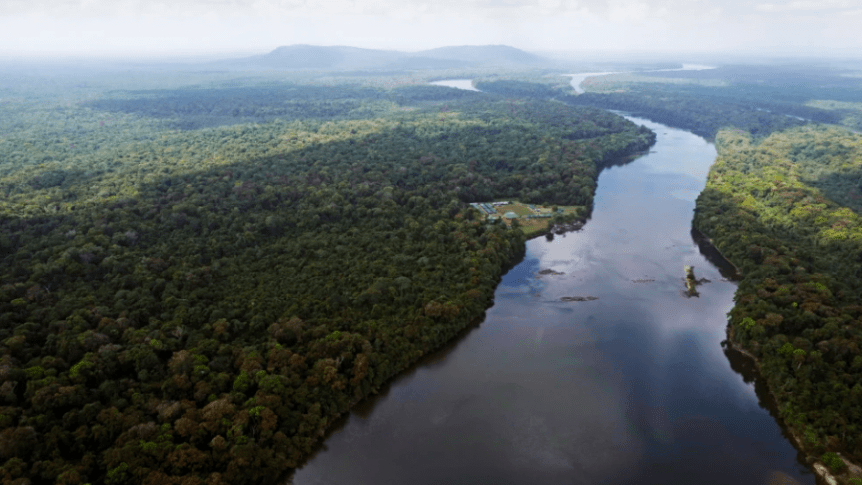
The Essequibo River flows through Kurupukari crossing in Guyana. The boundary was drawn by an international commission back in 1899, which Guyana argues is legal and binding, while Venezuela is disputing it. The U.S., meanwhile, is interfering on behalf of oil interests. | Juan Pablo Arraez / AP

Reposted from Peoples World


Venezuelan President Nicolás Maduro warned recently that “the Southern Command is provoking our region…[as it]  tries to set up U.S. military bases in our Essequibo Guyana.” Venezuelan diplomat José Silva Aponte earlier had observed that, “the United States is intent upon both countries arriving at confrontation.”

Dispute between Venezuela and Guyana over the Essequibo district originated in the early 19th century as Venezuela defied British Guinea in claiming jurisdiction over Essequibo. That territory borders on Venezuela’ eastern frontier and accounts for two thirds of Guyana’s land mass. British Guinea became Guyana in 1966 with the end of Britiah colonialism.

An arbitration tribunal in Paris rejected Venezuela’s claim in 1899. Venezuela and newly independent Guyana agreed in 1966 that the earlier decision was unfounded and that negotiations would continue. The case remains in limbo; the International Court of Justice is involved.

The U.S. government has taken Guyana’s side—no surprise in that Exxon Mobil Corporation is well ensconced there. Oil discovered in 2015 has Guyana, including Essequibo, on track to soon become the world’s fourth largest offshore oil producer.

Venezuela’s government in 2023 created a “Zone of Comprehensive Defense of Guyanese Essequibo.” It’s made plans for the “exploration and exploitation of oil, gas, and minerals” in the region.  Venezuelans voting on Dec. 3, 2023 overwhelmingly approved a referendum allowing their government to establish sovereignty over the contested territory. Essequibo would become a new Venezuelan state.

CIA head William Burns visited Guyana in March 2024. Reacting, Venezuela’s vice president Delcy Rodríguez explained that, “In the history of this U.S. intelligence agency, there is not a single positive milestone; but only death, violence and destruction.” Foreign minister Yvan Gil condemned the visit as “an escalation of provocations against our country and meddling, together with the U.S. Southern Command.”

U.S. resort to military power via the Southern Command suggests that powerbrokers in Washington see the possibility of accomplishing two missions with the same stroke. They want Essequibo to remain within the orbit of Guyana and Exxon Mobil. And, having found a pretext for introducing military power, they would be moving toward the forced removal of a despised left-leaning government.

The Southern Command is responsible for U.S. military operations and “security cooperation” throughout Latin America and the Caribbean.

The Guyana media follows local U.S. military activities. Reporting on December 1, Bernardo de la Fuente detailed Southern Command assistance to the Guyanese Defense Force (GDF). It includes:

  • The upgrading of four Coast Guard River stations, plus additions to the port structure at the Ramp Road Ruimveldt Naval Station in Georgetown.
  • Constructing an outboard motor boat launching ramp and interceptor boat storage yard at a naval facility.
  • Supplying U.S.- constructed “Metal Shark Defiant” patrol boats.
  • Refurbishing a naval headquarters, constructing a new hangar and “expanding the existing facilities of the Air Wing of the Defense Force”
  • Developing “a network of radio repeater stations and a Jungle Amphibious Training School.”

The Southern Command is “helping the GDF strengthen its technological capabilities, as well as directly supporting strategic planning, policy development and coordination of military and security cooperation to strengthen the interoperability of its services in the face of new threats.”

Rehabilitation of a jungle airstrip in Essequibo is icing on the cake. At a cost of $688 million, the now fully-fledged airfield has been extended to 2,100 feet; it will “withstand all weather conditions and ensure 24-hour accessibility.”  According to reporter Sharda Bacchus, the GDF provided $214.5 million. The U.S. taxpayer presumably supplies the rest.

Bernardo de la Fuente notes the airfield’s location adjacent to the west-to-east running Cuyuni River. For Guyana, but not for Venezuelans, that river marks the northern border of both Guyana and Essequibo and the southern border of eastern Venezuela.

Immediate across the river, on the Venezuela side, construction is underway of a jungle command school, ambulatory medical center, training field, and more. Venezuelan General Elio Estrada Paredes and colleagues arrived on Dec. 6 for an inspection visit. A refurbished airstrip provides access to the area.

Officials in Washington have long sought to destroy a Venezuelan government that offends in two ways. It exerts control over huge oil reserves and has aspired to be a model for people-centered political change. Governments led by Presidents Chávez and Maduro, after Chávez’s death in 2013, have had to contend with multiple U.S. intrusions.

They include: an unsuccessful coup in 2002 facilitated by the State Department, tens of millions of dollars delivered to dissident groups, painful economic sanctions from 2015 on, U.S. backing for a puppet Venezuelan president, and the stealing of Venezuelan assets located abroad. U.S. military interventions have been trivial. There was the tiny, U.S.- led seaborn invasion in 2020 (“Operation Gideon”). U.S.-allied Colombian paramilitaries cause mischief inside Venezuela. The U.S. Navy’s Fourth Fleet monitors air and sea approaches to Venezuela.

A U.S. turn to military force directed at Venezuela may not elicit the criticism from U.S. progressives that might have obtained during the Chávez era. Their attachment to Venezuela’s Bolivarian project appears to have weakened.

President Maduro shows less charisma than did President Chávez; he does not match Chávez’s personification of the cause of regional unity, of “Our America.” According to Venezuela’s Communist Party, his government in 2018 “flattened the wages for all sectors and unilaterally canceled all the collective bargaining agreements of…workers.” It later “strengthened its alliance with sectors of big capital, particularly the new bourgeoisie.”

Controversy surrounding Maduro’s re-election to office on July 28, 2024 centers on incomplete reporting of voting tallies. Gustavo Petro, Colombia’s first-ever progressive president, expressed skepticism at the election results.  Alleging over-dependence on oil exports for the financing of development, Petro claimed on Dec. 5 that “Venezuelans now don’t know if they are a democracy, or if they have a revolution.”

The Maduro government recently excluded Venezuela’s Communist Party (PCV) from effective electoral participation, perhaps in order to gain favor in Washington.

Some U.S. progressives disenchanted with the Maduro government may be unaware of its achievement of having built urban and rural communes. They may not have adequately factored in heavy U.S. funding of a divided opposition or recent destabilization inside Venezuela caused by Colombian paramilitaries.

Anti-imperialists may find that assessing the virtues and shortcomings of U.S.-targeted governments doesn’t work well as guidance for action. They might recall their primary vocation of opposition to capitalism.

They would surely derive ample inspiration from there to oppose maneuvering in defense of Exxon Mobil in Essequibo—and enough too to reject U.S. military meddling, whether in a dispute between two nations or against Venezuela itself.


We hope you appreciated this article. At People’s World, we believe news and information should be free and accessible to all, but we need your help. Our journalism is free of corporate influence and paywalls because we are totally reader-supported. Only you, our readers and supporters, make this possible. If you enjoy reading People’s World and the stories we bring you, please support our work by donating or becoming a monthly sustainer today. Thank you!


W.T. Whitney Jr. is a political journalist whose focus is on Latin America, health care, and anti-racism. A Cuba solidarity activist, he formerly worked as a pediatrician, and lives in rural Maine.

Promise and contradictions emerge from celebration of Cuba’s Latin American School of Medicine / By W. T. Whitney Jr

Photo credit: Prensa Latina

South Paris, Maine


The Latin American School of Medicine (ELAM for its Spanish language initials) is a masterpiece of Cuba’s remarkable healthcare system. A conference of ELAM graduates took place in Havana from November 11 to November 15; two sets of them attended. The gathering marked the 25th anniversary of ELAM’s founding in 1999.

What happened and what was said reflect Cuba’s healthcare achievements and ELAM’s special contribution. A focus on ELAM demonstrates for us the paradox, cruelty, and injustice of U.S. aggression against a people capable of producing such an unprecedented achievement as ELAM.

To be aware that ELAM exists and that its creation falls within the range of human capacity is to be reassured that, in fact, possibilities do exist other than U.S. warmaking, militarization, and complicity in anti-Palestine genocide.

ELAM evolved out of Cuba’s response in 1999 to the ravages of Hurricanes George and Mitch in the Caribbean area and in parts of Central America. Cuban physicians carrying out rescue missions discovered that local healthcare workers were overwhelmed by the catastrophe. Within weeks, Cuba’s political leaders opted to prepare young people to be physicians in their own countries and be ready for future disasters and much more 

Soon prospective medical students were heading to ELAM from hurricane-affected regions. Later they came from throughout Latin America, and eventually from Africa and farther afield, including from the United States.  They were motivated by idealism – enrollees dedicate themselves to serving the underserved – and the fact that no personal outlay is required.

ELAM has now prepared  31,180 physicians for service in 120 countries. Some 1800 medical students from many countries are presently studying there. ELAM provides the first two years of pre-clinical courses at a converted naval base immediately to the west of Havana. Clinical training over the next four years takes place at teaching hospitals throughout Cuba.

On hand in Havana 25 years after ELAM’s initiation were more than 300 ELAM graduates and students plus 250 guests, physicians and students, from 30 countries. The occasion combined the 1st International Congress of ELAM graduates and the 2nd International Assembly of the International Medical Society of Graduates of ELAM (SMI-ELAM).

Organizers assigned the theme “Guardians of life, creators of a better world.” They projected the assembly as “a space for scientific interchange … and a concrete step toward creation of an international medical and scientific organization whose members [are] ELAM graduates.” 

The gathering featured plenary sessions, round tables, panels, and presentations by clinical and research specialists. These took place in Havana’s teaching hospitals and Conventions Center. Topics were: primary health care, medical care during emergencies and natural disasters, postgraduate medical training, and higher education in the medical sciences. Presenters linked medical education, social impact, and international solidarity. Experts from abroad and from international organizations were participating.

Welcoming the delegates, ELAM’s rector Yoandra Muro insisted that, “Commander Fidel is here, standing up, fighting with the example he instilled in his children, the graduates of this project of love.” Here, “we have a space for [ELAM] graduates to continue strengthening our kind of work and projecting training programs for the guardians of the present and future.” She identified graduates as “invincible standard-bearers in the field of health, who from their quality preparation are steeped in the work of solidarity.”

Luther Castillo Harry, currently minister of science, technology, and innovation in the Honduran government, graduated from ELAM in 2007. He declared at the conference that, “We are looking at the possibility of building the greatest scientific organization in the world … Each one of us has to be an ambassador of the Cuban Revolution.” And, “We will only gain the possible, through struggle against the impossible.”

Cuban President Miguel Díaz-Canel sent a message welcoming graduates back to their “second homeland.” He indicated he would not attend the sessions because of duties with post-hurricane recovery efforts. Díaz-Canel cited Fidel Castro’s “deep conviction that a better world is possible if we fight tirelessly for that ideal.”  He speculated on “Fidel’s happiness had he been able to see you become guardians of the life and health of your people.”

Presiding over a plenary session, public health minister José Ángel Portal Miranda discussed healthcare in Cuba. The report has him outlining a system based on primary care that involves 69 medical specialties and three levels of care. Cuba’s medical network, he explained, consists of 451 polyclinics, 11,315 community health centers, 149 hospitals, and a work force of 400,000 people. There are eight physicians serving each cohort of 1000 Cubans, 80,000 in all. Maternity homes and homes for elders are part of the system.

The minister indicated that 40 different faculties or their affiliates are responsible for training physicians; medical sciences are taught in 13 universities. He identified “the development of science and technology as the fundamental pillar of the health system.” Presently 2,767 research projects and 82 clinical trials are underway.  

Portal highlighted Cuba’s international medical solidarity, mentioning the Comprehensive Health Program mediated through international missions, the Barrio Adentro program for Venezuela, Operation Miracle (for eye care), and the Henry Reeve Brigades. He cited some 600,000 Cuban health workers having cared for people in more than 160 countries over many years.

Concluding his remarks, he stated that, “Out of ELAM have emerged and will emerge galenos who will save humanity from the barbarism. Or, as leader of the Revolution Fidel Castro said – ‘Doctors, not bombs!’” (Claudius Galen was a Greek physician and researcher in the classical era. Spanish speakers often refer to physicians as “galenos.”)

Here is Castro speaking in Buenos Aires in 2003:

“Our country does not drop bombs on other peoples, nor does it send thousands of planes to bomb cities; Our country has no nuclear, chemical or biological weapons. The tens of thousands of scientists and doctors in our country have been educated in the idea of saving lives. It would be absolutely contradictory to their conception to put a scientist or a doctor to produce substances, bacteria or viruses capable of killing other human beings.”


W.T. Whitney Jr. is a political journalist whose focus is on Latin America, health care, and anti-racism. A Cuba solidarity activist, he formerly worked as a pediatrician, lives in rural Maine. W.T. Whitney Jr. es un periodista político cuyo enfoque está en América Latina, la atención médica y el antirracismo. Activista solidario con Cuba, anteriormente trabajó como pediatra, vive en la zona rural de Maine.

In Cuba’s report, US blockade comes off as weapon of war / by W.T. Whitney

Image credit: Prensa Latina

South Paris, Maine


Cuba’s foreign ministry annually reports on the U.S. economic blockade of Cuba and its recent impact mostly in order to enlighten delegates of the United Nations General Assembly prior to voting on a Cuban resolution.  For 31 consecutive years the General Assembly has overwhelmingly approved a resolution claiming “the necessity to put an end to the economic, commercial and financial blockade imposed by the United States of America against Cuba.”.

On September 12 in Havana, Cuba’s foreign minister Bruno Rodríguez held a press conference to introduce “Knock Down the Blockade – CUBA’S REPORT March 2023 – February 2024.” Providing information on blockade workings and the damage it causes, the 65-page Report is comprehensive and detailed.

Rodríguez cast the blockade as “the most comprehensive, far-reaching, and prolonged coercive economic measures [ever] applied against any country.” The yearly reports tally economic losses from blockade effects the year before and cumulatively since the blockade’s onset. The figures this year, cited by Rodríguez, are $5.057 billion and $164.14 billion, respectively. With inflation, the latter amount is $1.499 trillion.

Why the blockade has lasted for over 60 years is not clear. The linkage of planned healthcare difficulties and food shortages with the likelihood of some Cubans dying is reminiscent of war. The United States has trouble ending its wars.

The Report covers U.S. legislation, regulations, and policies reflected in the blockade. Three categories get top billing: requirements imposed by U.S legislation, regulations stemming from executive orders, and the designation of Cuba as a state sponsor of terrorism (SSOT).

The Cuba Democracy Act of 1992 requires that ships docking in Cuba don’t visit U.S. ports for six months afterwards, that companies abroad tied to U.S. corporations don’t trade with Cuba.  The 1996 Cuban Liberty and Democratic Solidarity Act enables the heirs of the former owners of properties nationalized by Cuba’s government to utilize U.S. courts to secure compensation from the third-country investors and companies presently involved with the properties. Consequently, many prospective investors are now hesitant about doing business in Cuba.

Regulations put in place by the U.S. government’s executive branch have long restricted U.S. travel and commercial arrangements with the island. One galling regulation disallows products from abroad containing more than 10% U.S. components from being exported to Cuba. The Trump administration issued dozens of new regulations restricting U.S. travel to Cuba, and they continue.  Regulations requiring “specific licenses or permits” and payments “in cash and in advance” diminish food imports from the United States, approved under legislation in 2000.

The SSOT designation entraps international banks and financial institutions in a system that already restricts the dealings of international corporations and traders with Cuba.  According to the Report, the SSOT label “has brought about serious difficulties to our country’s financial and banking transactions, foreign trade, sources of income and energy, [and] access to credit.”  

The U.S. offers its Visa Waiver Program to the travelers of 42 countries. Persons visiting Cuba are ineligible, because of its SSOT designation. Travelers protecting their waivers stay away from Cuba. Tourism takes a hit.

Indeed, “[t]he US government has used tourism, the main source of income for the country, as a political weapon against Cuba.” In 2023, Cuba … received 2,436,980 international visitors, which represents … 57 per cent of the figure achieved in 2019.”

The Report contains dozens of illustrative examples of harm, shortages, and/or diminished imports bedeviling agencies, activities, and individuals within the various sectors of Cuba’s economy. These are the education, sports, culture, biotechnology, and transport sectors, and the mining, energy, healthcare, agricultural, and food sectors.

According to the Report, “The US blockade against Cuba violates International Law. It is contrary to the purposes and principles of the Charter of the United Nations. It constitutes a violation of the right to peace, development and self-determination of a sovereign State.”  

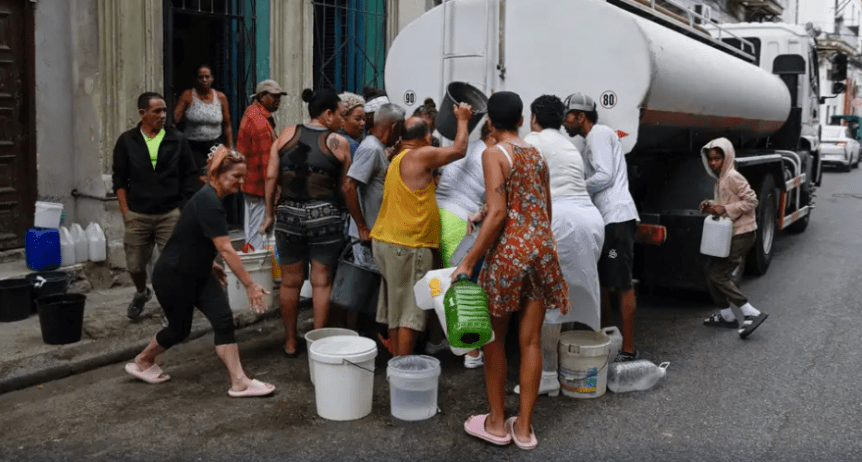
The blockade continues despite appeals to fundamental principles. A journalist in Havana portrays a “humanitarian crisis throughout Cuba.” Describing “hungry people scavenging through dumpsters and panhandling,” he indicates that, “With pharmacy shelves barren, the price of medicines on the black market has slipped beyond the reach of much of the population. Without money to repair old infrastructure, hundreds of thousands now live without running water.”

Humanitarian disaster in Cuba, the product of prohibitions and restrictions applying to Cuba’s healthcare, food, and agricultural sectors looks to be purposeful rather than accidental. 

Highlighted in the Report are shortages of spare parts for intensive care units and operating rooms, spare parts for a device that encapsulates medicines and fills vials, blood gas analyzers, reagents to diagnose immunodeficiency diseases, drugs used to treat cancers, new equipment for neonatal care.

Now 51% of drugs on a “national list of essential medicines … are not available … surgeries have dramatically decreased.”

Food production is down due to shortages of the “fuels, oils and lubricants needed to operate the existing agricultural machinery” and “a shortage of antibiotics, antiparasitic medications, vitamin supplements.” Significant too are: a “deteriorated fleet of agricultural equipment,” loss of “capacity to refrigerate 26,360 tons of products,” and “limited access to fertilizers and pesticides.”

According to Cuba’s Report, “The historical yields of several crops have deteriorated by almost 40 per cent … [leading to] a remarkable decrease, as compared to 2022 figures, in products such as rice, beans, bread, coffee, cooking oil, soybean yogurt, meat products, powdered milk, sugar, as well as in medical diets. As compared to 2019, the production of rice, egg and milk has decreased by 81 per cent, 61 per cent and 49 per cent respectively.”

The president of the Cuban Association of Animal Production indicates that, “The blockade makes it impossible for cooperatives and farmers to have access to inputs, such as spare parts for machinery, tractors, harvesters and other means of transportation that remain paralyzed and are obsolete, as well as raw materials and other products that would otherwise make it possible to use idle land for production.”

One assumes that, what with an intended humanitarian crisis, at least some Cubans are going to die due to the blockade. What one side intends – restrictions, prohibitions, and shortages – becomes coercion for the other side. Coercion bearing the risk of death, whether of one Cuban or more, is war, or something like it. 

The object of U.S. policy toward Cuba was clear in 1960, and remains so. In his famous memo a year after the victory of Cuba’s Revolution, State Department official Lestor Mallory writes of a “a line of action … [that would] bring about hunger, desperation and overthrow of government.”

To remove a governing system not to its liking, the U.S. government could have turned to diplomacy or to a coup mediated through proxies or agents. It opted for force, with lethal possibilities.

War against Cuba manifests in the U.S. feat, through its blockade, of helping to force a million Cubans out of the country – 10% of the population. It’s a re-worked version of aggressors’ “drain the swamp” theory.  

Prospects for ending the blockade correlate with why it exists and its warlike characteristics. Many U.S. wars seemingly possess a momentum of their own, for instance, the still-unsettled Korean war, U.S. troops still in Iraq, and the prolonged U.S. debacle in Afghanistan. Regime-change in Cuba is a long-term objective. For those in charge and the dominant U.S. media, getting rid of socialism is worth any amount of waiting.   


W.T. Whitney Jr. is a political journalist whose focus is on Latin America, health care, and anti-racism. A Cuba solidarity activist, he formerly worked as a pediatrician, lives in rural Maine. W.T. Whitney Jr. es un periodista político cuyo enfoque está en América Latina, la atención médica y el antirracismo. Activista solidario con Cuba, anteriormente trabajó como pediatra, vive en la zona rural de Maine.

Colombian paramilitaries encounter adverse US court decision and people’s resistance  / by W. T. Whitney

Paramilitary fighters hold their rifles during a ceremony to lay down their arms in Otu, northwest Colombia, on Dec. 12, 2005. Photo: Fernando Vergara/AP

South Paris, Maine


Away from industrialized countries, capitalism worked its way by means of enslavement, die-offs, wars, plunder, and thugs. Colombia specializes in thugs – since the 1970s. Paramilitaries, shock troops for Colombia’s rich and powerful, are an arm of Colombia’s military. A recent court decision in the United States provokes questions about the future of Colombia’s paramilitaries and about official U.S. reactions.

A trial jury in the U.S. District Court in West Palm Beach, Florida, determined June 10 that Chiquita Brands, formerly the United Fruit Corporation (UFC), was guilty of financially supporting the United Self-Defense Forces of Colombia (AUC). The paramilitary band has operated since the 1980s in Colombia’s northern banana-producing regions. The decision will be appealed.

Chiquita will pay $38.3 millionto 16 family members of eight individuals murdered by the AUC paramilitaries. Chiquita had supplied them with arms and ammunition. 

According to EarthRights, whose lawyers managed the case, “Chiquita knowingly financed the AUC, a designated terrorist organization, [as per the U.S. State Department], in pursuit of profit …These families, victimized by armed groups and corporations, asserted their power and prevailed in the judicial process.” No U.S. corporation has previously been punished for committing human rights abuses abroad

Testimony indicated AUC paramilitaries were active in suppressing labor activism, opposing leftist guerrillas, and enforcing company dictates against individual workers. With Chiquita support, “the paramilitaries successively extended their power in the region … by means of assassinations, disappearing people, and displacing thousands of them,” according to a report. 

The court’s ruling comes 17 years after Chiquita, in a 2007 plea-bargain agreement, acknowledged guilt in violating U.S. law prohibiting financial support for terrorist organizations. Acknowledging payments of $1.7 million to AUC paramilitaries for “security services” from 1997 to 2004,”Chiquita paid a $25 million fine. The company was spared having to reveal the identity of company executives approving the illegal payments.

Subsequently hundreds of claims against Chiquita descended on courts in Colombia. To secure relief for the victims’ families in U.S. courts, lawyers led by Terrence Collingwood, who represented 173 families, consolidated claims against Chiquita; they would pursue two “bellwether cases.” Favorable decisions would enable litigation to proceed on behalf of the other families. The second case opens on July 15.

Other companies have funded Colombian paramilitaries. A recent report indicates that Ecopetrol, Colombia’s largest oil company, paid paramilitaries up to 5% of the value of contracts it signed, that Bavaria brewery delivered to paramilitaries a portion of every dollar generated from sales along Colombia’s northern coast, and that distributers associated with Postobón, Colombia’s largest beverage company, gave paramilitaries boxes of bottled drinks to be sold for cash.

Only because the crimes occurred outside the United States did a U.S. court acquit Coca Cola companyon charges it contracted with paramilitaries to kill nine unionists in 1990-2002. Drummond coal-mining company, based in Alabama, beat back well-founded charges tried in a U.S. court that it paid paramilitaries to assassinate three labor leaders between 1996 and 2001. Del Monte and Dole food companies were charged in Colombian courts with “financing right-wing paramilitary groups,” according to a 2017 report.

With their own railroads, seaports, and ships, United Fruit Company and its offspring Chiquita have operated banana plantations in Panama, Colombia, Nicaragua, Costa Rica and Guatemala. Chiquita with a presence in 70 countries recently registered $7.59 billion in yearly revenue.

UFC, Chiquita’s parent and mentor, once claimed 42% of Nicaragua’s national territory. Agrarian reform impinging on UFC holdings there led to a CIA-mediated U.S. coup in 1954 that removed the left-leaning government of President Jacobo Árbenz.

In 1928 near Santa Marta on Colombia’s Caribbean coast, banana workers were on strike. UFC called upon an obliging Colombian government to send in troops. They machine-gunned strikers and their families. More than 1000 died. The pretext was Communist agitation.

In a poignant reminder almost a century later, on June 12, 2024, “5000 or so people undertaking a civic strike outside of Santa Marta blocked the Caribbean Trunk Route,” National Highway 90. According to the report, “The communities were asking the government for solutions for violence dispossession, displacement, and lockdown in their areas at the hands of paramilitary groups.” The strike lasted three days.

Nationwide mobilization organized by the Congress of the Peoples had begun on June 4. Activists representing “small farmers, African-descendants, Indigenous peoples, and urban representatives of the diversity of the Colombian people” blockaded four big highways. In Bogotá, they occupied the Interior Ministry and the Vatican Embassy.

Human rights leader Sonia Milena López, speaking at a press conference, declared that, “Paramilitarism has been and is a politics of the oligarchy enabled by the Colombian state.” She outlined measures for dismantling paramilitarism.

The government, she insisted, must recognize “that a national paramilitary strategy at the rural and urban level does exist and is oriented toward developing a genocidal process aimed against the people’s movement.” It must abandon “any pretension of political recognition of paramilitary elements” or of negotiating with them.  

She called for ‘investigating those who finance and direct [the paramilitaries], both state and private,” and for “removing …military officers when there are … accusations or evidence of connivance or lack of effective action against the paramilitaries.” 

In an interview, Esteban Romero, spokesperson for the Congress of the Peoples, reported that paramilitaries are absorbing territory, displacing populations, and threatening and harassing social leaders.  He suggested progressive president Gustavo Petro lacks the power needed to undo “a Colombian political regime that is a paramilitarized regime, one that created private armies to contain social changes.”

Paramilitaries are dangerous, as recalled by analyst Luis Mangrane: “Between 1985 and 2018, the paramilitary groups were the principal agents responsible for the killings associated with armed conflict [between the FARC and the Colombian government], having accounted for 45% of the total of 205.028victims. Through the ‘para-politics’ in the 2002 elections, they managed to coopt a third of the Congress.”

The paramilitaries’ base of support is strong, not least in the United States. There will be no new U.S. response to their actions, it seems, unless it is mediated through Colombia’s military. What with close ties between paramilitaries and the military, however, that possibility seems unlikely

The association shows in a memo from the U.S. Department of Justice in 2001: “Colombia has five divisions in its army, but paramilitaries are so fully integrated into the army’s battle strategy, coordinated with its soldiers in the field, and linked to government units … that they effectively constitute a sixth division of the army.”

Colombia’s labor minister, Communist Party member Gloria Inés Ramírez reflects on the staying power of the paramilitaries. “[P]aramilitaries came to the fore within the framework of the development of contemporary capitalism … Colombian capitalism turns out to be a complex socio-economic synthesis between a traditionalist and pre-modern tendency around land concentration, on the one hand, and a modernizing tendency in capital accumulation, on the other. This synthesis favored the authoritarianism of the political regime, the increasing militarization of politics and the growing role of paramilitary organizations.”


W.T. Whitney Jr. is a political journalist whose focus is on Latin America, health care, and anti-racism. A Cuba solidarity activist, he formerly worked as a pediatrician, lives in rural Maine. W.T. Whitney Jr. es un periodista político cuyo enfoque está en América Latina, la atención médica y el antirracismo. Activista solidario con Cuba, anteriormente trabajó como pediatra, vive en la zona rural de Maine.

Daniel Jadue, the acclaimed mayor of Recoleta in Chile, is victim of lawfare / by W.T. Whitney Jr.

Recoleta Mayor Daniel Jadue, at a 2022 May Day march in Chile. | People’s World

South Paris, Maine

Reposted from Peoples World


“After more than 10 years of corruption, crimes, and destroying the Rocoleta commune, finally the justice system begins to act and will make arrangements for the Communist mayor Daniel Jadue. I hope he goes to jail soon.” That was Richard Kast, speaking in April. Kast was the right-wing presidential candidate defeated by Chile’s President Gabriel Boric in December 2021. The food- manufacturing magnate is the son of a World War II German Army officer.

On June 3 Judge Paulina Moya ruled that Jadue would be imprisoned “preventively” on charges of bribery, mal-administration, tax fraud, and bankruptcy. Moya declared that “for Jadue to go free would endanger the safety of society.” The police in April had prevented him from boarding a flight to Caracas. She decreed “120 days of investigation” prior to Jadue’s appearance before an appeals court.  

Jadue, a former professor of architecture and urban sociology, has been mayor of Recoleta municipality in the northern part of Santiago since 2012. Responding on social media, he insisted that, “They are judging me for our transformative government. I don’t have a peso in my pocket, but they are handing out the maximum restriction.”  

The court’s decision had to do with the “people’s pharmacy” that Jadue devised for Recoleta in 2015. It also involves the spread of people’s pharmacies throughout Chile.Jadue is a national figure. His legal troubles take on added significance on that account.

Jadue is renowned for the reforms he inspired in Recoleta. In addition to the consumer-cooperative pharmacy project, Recoleta offers an “optician program,” a people’s dentistry program, an “open university,” and a “people’s bookstore.” The municipality invests $500,000 a year in 10 public libraries. It recruited physicians and constructed two medical office buildings. It builds architecturally-sophisticated apartment buildings with low-cost rentals. 

Jadue is the unusual Communist Party leader who participated in national elections at the highest level.  As presidential candidate of a left-leaning coalition in 2021, he almost defeated current president Gabriel Boric, head of a center-left coalition competing in the primary elections.

Jadue provokes the wrath of apologists of Israel.  He has participated  in pro-Palestine demonstrations outside Israel’s embassy and made public  statements interpreted by some as antisemitic. The grandson of Palestinian immigrants, he was president of Chile’s General Union of Palestinian Students and a top organizer for Latin America’s Palestinian Youth Organization.

Jadue’s bookPalestine: Chronicle of a Siege, appeared in 2013. HispanTV recently presented his 12-part documentary presentation “Window on Palestine.” Chile is home to half a million Palestinians, the largest concentration outside of the Middle East.

The prosecutor announced criminal charges against Jadue in November 2023.The people’s pharmacies, on which the prosecution of Jadue is based, are a phenomenon. Now there are 212 of them in 170 localities. Average savings on individuals’ drug purchases are between “64% and 68%.”

Recoleta and the other municipalities together formed a purchasing cooperative known as Chilean Association of Municipalities with People’s Pharmacies (Spanish initials are ACHIFARP). Jadue has been its head. At the time of the Covid-19 pandemic, ACHIFARP was under pressure to distribute healthcare supplies reliably and inexpensively.

In 2021 the Best Quality supply company complained to national g authorities that it was approaching bankruptcy, also that ACHIFARP had neither used or paid for large quantities of supplies it had ordered. A Best Quality salesman reported that Jadue had solicited a bribe. The terms were: donate to the Communist Party headquarters in Recoleta and ACHIFARP would give assurances that Best Quality would be called upon to restock the people’s supermarkets, initiated by the government.

Barbara Figueroa, secretary general of the Communist Party released a statement saying merely that, “the precautionary measure against comrade Daniel Jadue is regrettable and disproportionate, and we believe that it should be appealed. … we respect the Courts of Justice and we hope that this public stage of the investigation and trial will end up proving Daniel’s innocence”.

Some 1000 Chileans signed a letter of support for Jadue. They were “national prize winners, legislators, trade unions leaders, heads of social organizations, academics, human rights leaders, political party leaders, city councilors, jurists, and cultural personalities.” According to the letter, “This case represents not only a political and judicial persecution of a public figure, but also a potential threat to the fundamental principles of the rule of law in Chile.” 

As explained by analyst Ricardo Candia Cares,“The people’s pharmacies represent a real contribution to the health of the dispossessed who now have an alternative to the infamous pharmacy chains that collude in gouging the people … … [They] have caused the big pharmacies, or really the powerful forces powerful behind these deals, to lose huge amounts of money.”

Latin American political leaders, Daniel Jadue among them, discovered they can be removed from office or barred from electoral participation through judicial processes. In that regard, he joins presidents Fernando Lugo in Paraguay (2012), Lula da Silva in Brasil (2017), Cristina Fernández de Kirchner in Argentina (2022), Rafael Correa in Ecuador (2018), Evo Morales in Bolivia (2019), and Peru’s President Pedro Castillo (2022).  

They are victims of lawfare, described by Le Monde diplomatique in Spanish as “a new format of persecution and repression, but executed through the perverted use of the norm, mainly by using judges and prosecutors against opponents.”


We hope you appreciated this article. At People’s World, we believe news and information should be free and accessible to all, but we need your help. Our journalism is free of corporate influence and paywalls because we are totally reader-supported. Only you, our readers and supporters, make this possible. If you enjoy reading People’s World and the stories we bring you, please support our work by donating or becoming a monthly sustainer today. Thank you!


W.T. Whitney Jr. is a political journalist whose focus is on Latin America, health care, and anti-racism. A Cuba solidarity activist, he formerly worked as a pediatrician, lives in rural Maine. W.T. Whitney Jr. es un periodista político cuyo enfoque está en América Latina, la atención médica y el antirracismo. Activista solidario con Cuba, anteriormente trabajó como pediatra, vive en la zona rural de Maine.

Anti-Petro Coup Imperils Historic Pact Government in Colombia / by W.T. Whitney Jr.

Colombians protest outside the Attorney General’s Office in Bogota, Feb. 8, 2024. | Photo: X/ @hugomilenio

South Paris, Maine


President Gustavo Petro, head of the left-leaning Historic Pact coalition, took office on August 8, 2022. He is Colombia’s most progressive president ever. Now he faces a coup. The fate of Petro’s government connects with prospects for peace in Colombia

On social media Petro indicated that, “Unions have been raided and witnesses have been tortured and otherwise pressured so as to accuse the president (himself)  …  Narcotrafficking sectors, perpetrators of crimes against humanity, corrupt politicians and sections of the attorney general’s office are desperately looking to remove him from … office.”  

The lead coup-plotters have been former Attorney General Francisco Barbosa and Vice-Attorney General Martha Mancera, hold-overs from previous administrations.  Peculiarities of Colombian governmental arrangements have officials installed in the top levels of government whom the president did not select and does not control.  

Barbosa is the public face of the opposition. He ended his four-year term of office on February 12. The Supreme Court of Justice, charged with replacing him, failed to choose one of the three candidates Petro offered for the post. The Court named Mancera as temporary attorney general.

According to one commentator, Mancera has long had actual charge of the attorney general’s office; Francisco Barbosa was “a façade.” She is accused of protecting corrupt officials and drug traffickers.

Provocateur

Barbosa charged the Colombian Federation of Educators with illegally providing Petro’s presidential campaign with funds amounting to the equivalent of $128,000. Searching for evidence on January 22, his agents trashed the union’s headquarters.

Barbosa announced December 1, 2023 he would detain young people whom Petro had released from prison, praising their dedication to peace.  The release would occur long after they had been jailed originally following participation in protest rallies in mid-2021.

Barbosa in January visited the Justice Department in Washington. He reported on “his stewardship [as attorney general] and sought U.S. support for Martha Mancera to become Colombia’s new attorney-general.”

Inspector general Margarita Cabello on February 2 ordered a three-month suspension of Chancellor Álvaro Leyva Duran. His ministry, she charged, had illegally contracted the preparation of passports to a new company. A defender claimed he was breaking a monopoly in passport preparation held by an “old Bogota family.”

In street demonstrations taking place throughout Colombia on February 8, unionists, students, and teachers demanded that the Supreme Court name a Petro nominee as Colombia’s new attorney general.

Military intelligence reports revealed plans for expanded use of social media to broadcast news of destabilizing activities. Reserve and retired army officers, a powerful sector, have held anti-government protests.

Commentators liken Colombia’s evolving coup to the other “soft coups,” or exercise of “lawfare,” that removed Paraguayan President Fernando Lugo (2012), Brazilian President Dilma Rousseff (2016), Bolivian President Evo Morales (2019), and Peruvian President Pedro Castillo (2023).

Distant dream

For the Petro government to disappear would deliver a major blow to Colombians who for decades have sought and struggled for peace in their country. Petro had campaigned for “total peace.” It was a signature cause for him.

The signing of a Peace Agreement between the Revolutionary Armed Forces of Colombia (FARC) and the Colombian government in 2014 came close to satisfying the longings of peace advocates. From then on, however, it was downhill. In that very year, rightwing political forces engineered a watered-down version of the Agreement reached months earlier. Subsequently, the governments of Presidents Juan Manuel Santos and Iván Duque, Petro’s predecessor as president, failed to implement crucial parts of the Agreement.  

Beginning in 2015, 419 former FARC combatants and 1596 social and community leaders have been assassinated – 188 of them in 2023, while Petro was president.  Continuing armed conflict has led to 154 instances of “massive forced displacement” affecting 56,665 persons.

Dissident FARC groups, the National Army of Liberation, and paramilitaries – often in the service of narco-traffickers – account for most of the killings and turmoil.  The current government is negotiating with the remaining insurgencies.

Information from the historical record, recent and remote, suggests that causative factors accounting for violent conflict and the incipient coup are identical.

September 26, 2016 saw a revealing moment. The Peace Agreement was being signed in Cartegena, Colombia. “Timochenko,” the FARC leader, was speaking to notables assembled from several continents. At precisely that point, fighter planes of the Colombian Air Force zoomed by overhead. As noted by an observer: “The face of ‘Timo’ gave the impression of being under a bombardment.” 

Colombia’s U.S.-supported military was weighing in. The nation’s military forces have long been at the disposal of the established sectors of Colombian society. A well-to-do landowning, religious, and commercial elite has charge of Colombia, now and ever since the Europeans’ arrival. That sector is not happy with either Petro or with peace in the countryside.

Analyst Carlos Rangel Cárdenas sees Petro’s “total peace” as “constructing peace by involving civil society in binding dialogues.” He points out that violence in the countryside increased so much during the presidency of Iván Duque as to approach the excesses of earlier eras.  Dialogues do not thrive in conditions of war, presumably. The coup plotters and their soulmates who tolerate war in the countryside are linked.

An urban-based oligarchy, with cooperation from big landowners, controls the financial, commercial, business and media entities in Colombia that shepherd economic development in rural areas. The heavy hitters there, economically, are industrial-scale agriculture, mining operations, energy production, and narcotrafficking. These activities attract investment and enable wealth accumulation.

Colombia’s majority population is different. They are marginalized urban inhabitants, often refugees from an inhospitable countryside.  They are rural people, overwhelmingly poverty-stricken and poorly-educated, who, most of them, have limited access to social services and to land that would allow for subsistence farming.

Defenders of the Historic Pact government confront a set of rulers equipped with money power, a big army, ample police, and ready access to U.S. military resources. They have been on the losing side of struggle between one social class and another. They are quite unable to project the appearance or reality of the kind of political power that matters.

Social movements have more of a hold on Colombians, especially in rural areas, than do political parties. Writer Sidney Tarrow concludes that parties “seek to gain or retain power” while “Movements are more ideological.” The latter, he implies, are weaker. 

In a 2021 interview, Petro suggested that, “The necessities of Colombian society are not based on building socialism, but on building democracy and peace, period.” He is pondering the matter, evidently. On February 9, he indicated that, “We believe and desire that the means of production are in the hands of the people and not the state.”

In any event, an opinion survey shows young Colombians turning increasingly to “rightwing ideological views,” from “7% in May, 2021 to 37% in October, 2023.” 


W.T. Whitney Jr. is a political journalist whose focus is on Latin America, health care, and anti-racism. A Cuba solidarity activist, he formerly worked as a pediatrician, lives in rural Maine. W.T. Whitney Jr. es un periodista político cuyo enfoque está en América Latina, la atención médica y el antirracismo. Activista solidario con Cuba, anteriormente trabajó como pediatra, vive en la zona rural de Maine.

Cuba’s Government Analyzes and Responds to Economic Woes / By W. T. Whitney Jr.

People look at food prices at a private business in Havana on December 20, 2023. Cuba’s economy will shrink by up to 2 percent this year, Finance Minister Alejandro Gil estimated on Wednesday, after acknowledging that the country will not be able to achieve the projected economic growth of 3 percent by 2023 | Yamil Lage / AFP / Getty

Reposted from Counterpunch


“Our joy is immense … We don’t deceive ourselves thinking that everything ahead will be easy, when perhaps everything is going to be more difficult.” That was Fidel Castro, hours after the victory of Cuba’s Revolution.

Difficulties were center stage 65 years later, at a plenary session of the Central Committee of Cuba’s Communist Party on December 15 and 16 and at the National Assembly of People’s Power, meeting on December 20-22.

The views of Cuban leaders on problems now enveloping Cuba shed light on realities of a nation under siege and a revolution in trouble. The information is pertinent to the solidarity efforts of Cuba’s friends abroad. Addressing the Central Committee’s plenary session, Cuban President Miguel Díaz-Canel noted that, “We have discussed efforts that have not
yielded solutions, measures that did not prosper, and goals that were not fulfilled …The scenario is that of a war economy … [We] are all here to reverse the present situation … with consensus as to decisions and with collective work, with passion and energy.”

Díaz-Canel called for “creative resistance” and “confidence in victory,” while insisting that dissatisfaction “is a motor that moves revolutionary energies. It provokes embarrassment that ends up activating people’s full participation, without which socialism is impossible.”

“We would be surrendering beforehand, if we see this war as an insuperable calamity. We must see it … as the opportunity to grow and to overcome our own selves, while the adversary is nakedly evil before the world … On the eve of the 65th anniversary of the Cuban Revolution … we are called to act together for a common objective: Save the
homeland, the Revolution, socialism, and overcome.”

The Assembly meets

Speaking to the National Assembly were: Alejandro Gil Fernández, minister of the economy and planning; Prime Minister Manuel Marrero Cruz; and President Miguel Díaz-Canel. Gil Fernández regards the U.S. economic, commercial and financial blockade of Cuba as the principal obstacle Cuba faces in restoring its economy.

He indicated that in 2023 Cuba’s GDP will have fallen almost two percent. Exports were $770,000 million below predictions. Food production was less than that of 2022. Tourism income increased by $400 million in 2023 but represented only 69% of the yield in 2019.
Overall production was down due mainly to state enterprises held back by shortages of supplies and fuels. Currency shortages and loss of workers to migration hampered the healthcare and education sectors. Electricity generation was up 32% in 2023, according to Gil Fernández. Cuba’s 30% inflation rate for 2023 was lower than the 77.3% rate in 2021.

State business entities showed “gradual recuperation.” They employ 1.3 million workers while accounting for 92% of goods and services produced in Cuba and 75% of exported products. He attributed price inflation to international price hikes, the government’s release of money to finance its budget deficit, fewer goods being produced, and an agriculture sector burdened by labor shortage, high costs, and low yields.

“What isn’t being produced cannot be imported,” Gil Fernández lamented. His message is that importing goods is almost impossible what with “the effect of high prices on the international market.” But, paradoxically, “a lack of production resources” forces Cuba to import over 70% of the food that is being consumed.

He proposed measures for increasing food production, including:

+ Creation of a financial mechanism for bolstering production based on farmers using Cuban currency derived from agricultural sales to buy supplies they need.
+ Build a farm labor force through moonlighting, employing students, and having young people do agricultural work as part of their military service.
+ Use food produced in Cuba, not imported food, to fill the “normal family food basket.”

Prime Minister Manuel Marrero Cruz critiqued the government’s lack of control over production and distribution which “adversely affects production by state entities and lets currency exchanges on the illegal market determine the pricing of products from the non-state sector.” e reported that social inequalities are growing, and that the tendency exists while state subsidies continue to nourish less distressed sectors of the economy. Equally worrisome: “The former state monopoly in production is now consolidating in the private sector.”

He was referring to the recent appearance of 9000 or so mostly private small-and-medium-sized businesses and to independent farmers and cooperatives that took over land from the state under long-term usage arrangements. They now control 80% of Cuba’s agricultural land. Marrero Cruz called for “stimulation of government-operated small-and-
medium-size business entities.”

Both private businesses and the farming sector sell products at highly inflated prices with prices being set by black market operatives. The prime minister condemned the state subsidies such entities receive in the form of low prices assigned to the fuel, water, transportation and electricity they buy from the state. Similarly, the government pays high
prices to farmers for food that, under the rationing system, is sold inexpensively to the population.

Henceforth, according to Marrero Cruz, the government will be subsidizing people, not products. According to one report, “The Ministry of Work and Social Security will be charged with undertaking a survey of ‘vulnerable’ social sectors.” “Nobody will be abandoned,” Marrero Cruz insisted.

The government, he indicated, will increase sales taxes on final products such as water, gas, electricity, transport and reduce import tariffs by 50% on the “intermediate products” used in food production and manufacturing. More tourist dollars will be harvested. Municipal assemblies will present budgets and in the case of deficits will generate more income and reduce administrative expenses.

For the prime minister, “food production needs to be prioritized and by all sectors. Many countries are saying to us: ‘We’ll put up the money, you provide the land and then pay back the money with production.’” He pointed out that, despite the non-availability of imported fertilizer and pesticides, “there are many instances of countries producing food; an
agricultural country must produce its food.”

Marrero Cruz sees “speculative prices … and intermediaries earning a lot more than producers” and non-state entities now controlling imports rather than the government, the result being “abusive and speculative pricing.” He called for paying for imports with income from exports: “[W]e prefer importing supplies and products essential to the economy and
paying for them by offering other countries certain products and/or services.”

Responding to inflation, the government, collaborating with the Central Bank of Cuba, will change the official exchange rate for the peso. According to Marrero Cruz, the government will be restricting prices for goods and services with a system of “maximum prices.”

President Miguel Díaz-Canel, addressing the National Assembly on December 22, focused on Cuba’s “war economy … [It’s] a political scenario of maximum asphyxia, designed and applied against a small country by the most powerful empire in history.” He also attributed
economic problems to “the crisis in international economic relations and our own errors.”

Economic war takes the form of economic blockade aimed at “reduced supplies of goods used by the population, inflated prices, and low purchasing power for most Cubans.” “Together with constant acts of subversion and disinformation against Cuba, the goal is to break the country, provoke social decomposition, and make for ungovernability.”

Díaz-Canel spoke of errors as “part of the complexity of making decisions in a context of extreme tension … [and of] commitment to preserving social conquests.” He mentioned mistakes, particularly in the “design and implementation of currency unification” and in “approving new economic actors without performance norms having been established.”

The effectiveness of new measures will “depend on generating more wealth, more work incentives, and more distribution of resources.” The president promised there will be no “neoliberal package … no crusade against small businesses, no elimination of the basic food allocation.” The president highlighted: “food production, localities taking care of
more of their needs, the revival of tourism, rescue of the sugar industry, state control of currency and the exchange market, redesign of the financial system, and guarantees for self-financing, and managing currency so as to serve those whose production generates income.”

Díaz-Canel took note of Cubans’ high regard for healthcare workers and teachers, promising that “they will be the first to benefit from additional pay, which the prime minister announced in his intervention.” Testifying earlier before the Economics Commission of the National Assembly, Díaz-Canel emphasized “taking advantage of the facilities of the municipalities and articulating strategies of local development.” Recalling that the “[f]oundation of government is the municipal assembly of people’s power,” he insisted on “mapping out actors in the municipalities and integrating them with state and private businesses.”

In the end

The information and opinions provided by Cuban leaders and reviewed here clarify difficult realities, among them: adverse effects of diminished tourism, inflation, and emigration; social inequalities based on varying access to resources; production stymied by shortages of resources; inadequate food production; lack of buying-power for most Cubans, and
for importing necessary goods; and the near impossibility of securing foreign investment.

Cuba is fashioning responses. They are: decentralization of political and economic administration; cut backs on expenditure of central government funds, reduced subsidies for the purchase of water, fuel, transport, and electricity by business entities; adjustment of import tariffs to favor the availability of resources for production, capturing more tourist dollars, protecting state-operated production entities, fixing prices, and producing more food.

These will be palliative remedies unless basic causes are dealt with. A prime goal of U.S. policy has been to deprive Cuba of money, and that has come to pass. Revolutionary Cuba’s very survival depends on U.S. citizen activists forcing their government to shed its blockade of Cuba. There, the great need now is for Cuba to be removed from the U.S. list of terrorist-sponsoring nations. That designation causes most international financial institutions to refuse handle dollars on Cuba’s behalf.

There is a larger context. The U.S. use of economic sanctions everywhere rests on planet-wide dollar dependency. That emerged out of the Bretton Woods Conference of 1944 and has coincided since with unrelenting U.S. assertion of worldwide power. That’s the basis for a global constituency on Cuba’s behalf. How it will be set in motion is the
big question.


W.T. Whitney Jr. is a political journalist whose focus is on Latin America, health care, and anti-racism. A Cuba solidarity activist, he formerly worked as a pediatrician, lives in rural Maine. W.T. Whitney Jr. es un periodista político cuyo enfoque está en América Latina, la atención médica y el antirracismo. Activista solidario con Cuba, anteriormente trabajó como pediatra, vive en la zona rural de Maine.

How to Ease the Migration Crisis: End US Economic Sanctions / by W.T. Whitney Jr.

Migrants wait to be processed by US Border Patrol after crossing the US-Mexico border in Yuma, Arizona, July 2022. (Allison Dinner / AFP via Getty Images)

South Paris, Maine


Top officials of 11 Latin American and Caribbean governments met October 22 in Chiapas, Mexico to deal with the flood of migrants heading to the United States. There was agreement that U. S. interventions in their region fuel migration.  A report from Chicago, released two days earlier and discussed here, concluded similarly.  

The goal of the meeting called by Mexican president Andrés Manuel López Obrador was to form a regional block tasked with finding solutions. Presidents on hand, besides AMLO, were Xiomara Castro of Honduras, Miguel Díaz-Canel of Cuba, Gustavo Petro of Colombia, and Nicolás Maduro of Venezuela.

The joint statement emerging from the meeting outlined baseline assumptions: 

  • “The main structural causes of migration have political, economic, and social origins, to which the negative effects of climate change are added.” 
  • “Unilateral, coercive policies from the outside are by nature indiscriminate; they affect entire populations adversely.”

The statement concluded with an agreement covering 14 points, among them: further development of an action plan, mutual cooperation, attention to commercial relationships, demands put on destination countries, respect for human rights, protection of vulnerable populations, the special case of Haiti, and a plea that the Cuban and U.S. governments “comprehensively discuss their bilateral relations.”  

AMLO declared that “unilateral measures and sanctions imposed against countries in the region, particularly Venezuela and Cuba, contribute to instigating migration,” also that the U.S. government has to “dialogue with us.”  

The Great Cities Institute, a research center at the University of Illinois at Chicago, on Oct 20 released a report prepared by journalist Juan González. It analyzes recently-imposed economic sanctions and U.S. assaults over many years against regional governments.

The report concludes that “U.S. foreign policy toward Latin America …[and] sanctions directed at Venezuela, Cuba and Nicaragua, have played a major role in crippling theeconomies of those three nations, thus fueling for the past two years an unprecedented wave of migrants and asylum seekers from those countries that have appeared at our borders.”

Undocumented Mexican immigrants are shown to have represented 70% of all undocumented immigrants in 2008 but only 46 % in 2021. It appears that, later on, most unauthorized migrants entering the United States came from Honduras, Guatemala, and El Salvador.

Then Venezuelans “apprehended at the border” increased from 4,500 in 2020 to “more than 265,000 in the first 11 months FY 2023.” There were 3,164 undocumented Nicaraguans crossing the border in 2020 and 131,831 two years later. 14,000 Cubans crossed in 2020; 184,00 did so in 2023. In fact, “more Cubans have sought to enter the U.S. during the past two years than at any time in U.S. history.”

The report indicates that the three countries supplying these migrants “have been targeted by Washington for regime change through economic sanctions, a form of financial warfare that has only made life worse for their citizens.”

Note is taken of Venezuela’s GDP falling 74% over eight years and of $31 billion in oil revenues lost between 2017 and 2020. Venezuela must import most of the pharmaceuticals, medical supplies, and food it needs, according to the report. Funds for importing goods and for maintaining oil production derives from oil exports, which are blocked by U.S. sanctions. Shortages mounted, people suffered, and even died. Venezuelans reacted by leaving.

The Obama administration instituted sanctions in 2015 and President Trump added more afterwards. The sanctions block access to international credit, punish owners of foreign ships entering Venezuelan ports, and prevent income generated in the United States by Venezuela’s Citgo oil company from being repatriated.

The U.S government, according to the report, “is virtually alone in the world” in having unilaterally pursued such a lengthy economic blockade against Cuba. The U.S government punishes “an entire population for a political purpose.”  

The report notes that, “Cubans have garnered far less nationwide attention [than Venezuelan migrants] because they tend to settle in just one part of the country.” The real reason is that the Cuban Adjustment Act of 1966 provides undocumented Cubans with permanent residence a year after their arrival, and until then with work permits. The legislation, magnet-like, draws Cubans to the United States.

Cuban President Miguel Diaz-Canel, speaking at the Chiapas meeting denounced U.S. “coercive measures aimed, by definition, at depressing the standard of living of the Cuban population, reducing their real income and making them suffer hunger and misery.”

One learns that in Nicaragua after 2006, when the socialist-oriented Sandinistas returned to power, poverty diminished and food supplies increased.  Migration to the United States remained very low. Then, in 2018, protests erupted, with violence and deaths.

The report points out that “investigative journalists” viewed the uprising as “an attempted violent coup organized by U.S.- funded dissident groups.” But the U.S. government saw the Sandinista government as violating human rights and instituted sanctions, strengthening them in 2021.  International loans were now off limits and countries assisting Nicaragua would be punished. Emigration skyrocketed.

Juan González, who prepared the report, recalls having “documented in a previous study, [that] the largest migrations from Latin America over the past sixty years have come precisely from those countries the U.S. has repeatedly occupied and most controlled.”

The report catalogues U.S. interventions, among them: Guatemala, 1954; Cuba, Bay of Pigs, 1961; Dominican Republic, 1965; Chile, coup, 1973; Nicaragua, Contra war, 1980s; Panama, 1989; Venezuela, failed coup, 2002; Honduras, rightwing coup, 2009.

The report offers recommendations for easing the migration crisis. One is to end “economic warfare against Venezuela, Cuba and Nicaragua.” Another is to provide “expedited work permits” to recently arrived migrants and to long-term undocumented immigrants. The report asks that, “our government listen to the rest of the world community and end its destructive embargo against Cuba.”

The United Nations General Assembly will soon vote on a Cuban resolution calling for no more blockade. It has approved the resolution annually for 30 years, overwhelmingly so in recent years. The U.S. government does not listen.

Discussing his report on Democracy Now, Juan González provided a rationale for ending the various economic blockades that, based on cost-benefit analysis, ought to resonant with capitalists in charge of our national affairs.

He pointed to U.S. government spending of $333 billion between 2003 and 2021 “for immigration enforcement and for ICE and Border Patrol and fences.” It makes sense: ending U.S. economic sanctions would result in far fewer migrants at the southern border and, potentially, a big cost saving. 


W.T. Whitney Jr. is a political journalist whose focus is on Latin America, health care, and anti-racism. A Cuba solidarity activist, he formerly worked as a pediatrician, lives in rural Maine. W.T. Whitney Jr. es un periodista político cuyo enfoque está en América Latina, la atención médica y el antirracismo. Activista solidario con Cuba, anteriormente trabajó como pediatra, vive en la zona rural de Maine.

Ecuador vote shows contrasting roles of political parties and social movements / By W.T. Whitney, Jr.

An electoral official shows the ballot for a presidential election in Ayora, Ecuador, Sunday, Aug. 20, 2023. The election was called after President Guillermo Lasso dissolved the National Assembly by decree in May to avoid being impeached. | Dolores Ochoa / AP

Originally posted in People’s World on August 31, 2023


On Aug. 20 in Ecuador, 45-year-old lawyer Luisa González of the Citizen’s Revolution movement political party (RC) gained 33.6% of the votes in first-round balloting for eight presidential candidates. Second-place candidate Daniel Noboa of the National Democratic Action, a 35-year-old business man and political neophyte, took 23.4% of the vote. González and Noboa will be competing in second round voting on Oct. 15.

As for the elections to the National Assembly, the RC accounted for 39.4% of the votes, three other parties for 45% of those votes, and five smaller parties for the remaining ballots.

The voters also considered referendums, one on halting oil extraction from Ecuador’s huge Yasuní National Park and the other on prohibiting mining activities in a biosphere region northeast of Quito. The referendums were approved by 59% and 68% of the voters, respectively.

The circumstances were unusual. Two processes played out on parallel tracks and culminated together. These were political parties taking part in elections and social movements pursuing referendums. Contradictions emerged along with the promise of troubles ahead and signs of commitment and hope.

The new president will serve only the 18 months that remain in the term of Guillermo Lasso, elected in 2021 for a five-year term. When confronted with impeachment proceedings in May 2023 on corruption charges, Lasso dissolved the National Assembly and thereby, as provided by the Constitution, set in motion preparations for a new election and his own departure.

Nationwide Indigenous protests in 2022 accelerated the transition now taking place amidst violence attributed to narco-trafficking that took 4,671 lives during the past year. The election campaign itself provoked killings, those of presidential candidate Fernando Villavicencio, a legislator, journalist, and labor leader; the mayor of Manta, Agustín Intriago, and others.

The Citizen’s Revolution movement political party, represented by presidential candidate Luisa González, defends policies of social assistance and national development introduced under the leadership of former President Rafael Correa during his tenure from 2007 to 2017. The CR took shape in reaction to the neoliberal turn taken by the government of Lenin Moreno, Correa’s former vice president and successor.

Its predecessor party, under Correa’s democratic-socialist leadership, managed the national economy so as to preserve funds for social programs through reliance on petroleum exports and foreign credit. The RC led left-leaning forces in opposing the neoliberal government of Guillermo Lasso, in power since 2021.

With his second-place finish in the recent voting, candidate Daniel Noboa surpassed expectations, due in part to a stellar TV debate performance. He represents wealth and power. His father, a five-time presidential candidate, and his uncle preside over an agro-export and real estate conglomerate made up of 200 business entities. They owe the government $1 billion in back taxes.

Now campaigning for the second round of presidential elections, RC candidate González would seem to differ greatly from the prince of such an empire. “We are going to deal with the basic causes of violence and criminality which are hunger, poverty, lack of education, and the absence of opportunity,” she noted as she was accepting her party’s nomination.

But all is not as it appears. The positions taken by the various presidential candidates on the referendums were revealing. Only four of the eight candidates unambiguously supported the Yasuní referendum; three of them represented right-wing parties. Noboa justified leaving oil underground based on his conclusion that the financial yield is low and that over-reliance on oil exports impedes diversification of the economy.

The Correa-inspired RC movement and its candidate Gonzalez rejected the Yasuní referendum. Previous governments, governments headed by Correa in particular, took the position that income from oil exports is crucial to continued funding of social advances.

The contrast between approval at the polls shown for the candidates of political parties and for approval of the referendums was striking─33.6% and 23.4%, respectively, versus 68% and 59%, respectively. One set of the voting results testified to activists’ enthusiasm and commitment.

Approval of the two referendums reflects the advocacy and hard work of environmentalists, Indigenous activists, and supporters of women’s rights. According to NACLA.org: “The vote marks a triumph for the country’s grassroots anti-extractivist, ecological, and Indigenous movements, whose road to victory comes from a decade of social and political conflicts over extractive industry policies.”

Journalist Gabriela Barzallo surveys collective efforts toward restraining oil extraction. Highlighting the persistent participation of social movements, she quotes Ecuadorian sociologist Gregorio Páez:

“This upcoming referendum … serves as an inspiration for all Ecuadorians to have the agency to decide over our natural resources, and to empower people to see that grassroots activism really can have changes in policies.”

Páez sees activism in Ecuador as “inspiring social movements on a global scale.”

Analyst Santiago Kingman explores the impact of social movements on the elections:

“The triumph of the social movements is understood as a positive response from cities and areas far removed from the oil-producing world. At least 59% of Ecuador’s citizens…are alienated from the electoral system and political parties and say they have another way of doing politics. Those who voted for Noboa [who favored the referendum’s approval] are against politics, but they are not anti-capitalists. The social organizations behind the referendums are anti-capitalists and are anti-political parties.” 

Social movements have shaped political resistance throughout Latin America, in some countries more than others. They flourish, it seems, in situations of grief at the hands of international capitalism. Resonating there is contention over control of land and sub-soil resources, provision of energy, debt owed to foreign creditors, and prescriptions for domestic economies from abroad.

Capitalist-oriented political parties, often enablers of foreign predators, offer little resistance. Social movements active in Peru, Chile, Bolivia, Colombia, and now Ecuador have partially filled the void. Social movements operating in conjunction with anti-capitalist governments have different job descriptions.

Imaginings lead to speculation about an expanded role for social movements in the capitalist powerhouse nations. One recalls U.S. labor uprisings in the 1930s and the civil rights movement that peaked a few decades later.


We hope you appreciated this article. At People’s World, we believe news and information should be free and accessible to all, but we need your help. Our journalism is free of corporate influence and paywalls because we are totally reader-supported. Only you, our readers and supporters, make this possible. If you enjoy reading People’s World and the stories we bring you, please support our work by donating or becoming a monthly sustainer today. Thank you!


W. T. Whitney Jr.

W.T. Whitney Jr. is a political journalist whose focus is on Latin America, health care, and anti-racism. A Cuba solidarity activist, he formerly worked as a pediatrician, lives in rural Maine. W.T. Whitney Jr. es un periodista político cuyo enfoque está en América Latina, la atención médica y el antirracismo. Activista solidario con Cuba, anteriormente trabajó como pediatra, vive en la zona rural de Maine.

Ocasio-Cortez Would Block US Military Intervention in Peru / By W. T. Whitney Jr.

Rep. Alexandria Ocasio-Cortez, D-N.Y., is proposing a halt to Defense Department funding over intervention in Peru. | AP

Originally published in the People’s World on July 11, 2023


According to a report appearing July 8 on a Peruvian website—and apparently not yet in any English-language internet news source—Rep. Alexandria Ocasio-Cortez, D-N.Y., introduced an amendment to the National Defense Authorization Act requiring that, until conditions are met, a hold be put on Defense Department funding for its activities in Peru during fiscal year 2024.

Ocasio-Cortez introduced her amendment on June 29; the House Rules Committee will take it up on July 11.

As long as any suspension of funding remains, the U.S. military would not be permitted to “provide, authorize, or assist in any way in the transfer of defense articles, defense services, crowd-control supplies, or any other supplies, to [Peru’s] Government, or to coordinate joint exercises with the military or police forces of [Peru’s] Government.”

Ocasio-Cortez introduced her amendment six weeks after additional U.S. troops with weapons began to arrive in Peru. That was two months after Peru’s military and police reached a crescendo of violence marking repressive actions for weeks against mostly Indigenous peoples. They were demanding elections, a new constitution, and the removal of President Dina Boluarte.

The protests were in response to the parliamentary coup that deposed President Pedro Castillo on Dec. 7, replacing him with Boluarte, vice president at the time. Castillo remains in prison.

Elected in July 2021 on the strength of rural and Indigenous votes, the inexperienced and often isolated Castillo tried to bring about progressive change. Opposing him was a well-entrenched oligarchy accustomed to holding political power and benefiting from foreign investments in Peru’s plentiful natural resources.

Ocasio-Cortez’s amendment calls for no funding until “the Secretary of Defense submits to the appropriate congressional committees the certification…that each of the following criteria has been met.” These include free elections in Peru, no repression of “peaceful protesters and indigenous communities,” investigation of “the killings of protesters in Peru on Dec. 14, 2022,” prosecution of those responsible, the return of free speech, respect for civil liberties, and more.

The ‘‘appropriate congressional committees’’ are the Armed Services and Foreign Affairs Committees of the House and the same two committees in the Senate.

Peru’s Congress on May 19 authorized the entry of U.S. troops who will undertake “training activities” throughout the country and stay until Dec. 31, 2023. On May 26, Peru’s Congress approved additional authorization for 1,172 U.S. troops, who will be collaborating with Peruvian counterparts in an exercise called “Resolute Sentinel 2023” that will end on Aug. 29.

Legislation is on the books: the particular Leahy Law that applies to the Defense Department “requires that [funds appropriated to the Defense Department] may not be used for any training, equipment, or other assistance for a foreign security force unit if the Secretary of Defense has credible information that such unit has committed a gross violation of human rights.”

With 19 other congresspersons, Ocasio-Cortez signed a letter to President Joe Biden on Jan. 30 expressing “alarm regarding the human rights violations committed by Peruvian state security forces.” The letter called upon the Biden administration to halt “security assistance funding from the United States” to Peru until this “pattern of repression has ended.”

That Ocasio-Cortez signed this letter and introduced her amendment suggests an attitude on her part that is unusual among her progressively inclined congressional colleagues and even among her progressively-inclined fellow citizens. She is apparently one of the relatively few in both categories who take upon themselves the obligation to stand up against U.S. interventions abroad serving the high and mighty.

The time required for mobilizing support for Ocasio-Cortez’s amendment before it was presented to the Rules Committee was entirely lacking.  The appearance on that account has been one of low expectations and of hopes for the future, maybe.

The consciousness-raising effect of the effort is important. But the evident lack of supporters mobilized on behalf of the amendment has meaning, too. Clearly, there’s much work ahead for the anti-imperialist cause in the United States, and recruits are badly needed.


W.T. Whitney Jr. is a political journalist whose focus is on Latin America, health care, and anti-racism. A Cuba solidarity activist, he formerly worked as a pediatrician, lives in rural Maine. W.T. Whitney Jr. es un periodista político cuyo enfoque está en América Latina, la atención médica y el antirracismo. Activista solidario con Cuba, anteriormente trabajó como pediatra, vive en la zona rural de Maine.

China, Brazil Lead in Chipping Away at U.S. Economic Power Abroad / By W. T. Whitney Jr.

United States hegemony in Latin America is in question | credit Prensa Latina


The United States proclaimed the Monroe Doctrine 200 years ago and ever since has arranged Latin American and Caribbean affairs to its advantage. Nevertheless, struggles for national and regional independence did continue and the poor and marginalized classes did resist. Eventually there would be indigenous movements, labor mobilizations, and progressive and socialist-inclined governments. Cuba’s revolutionary government has endured for 63 years.

The U.S. political hold may have weakened, but U.S. control over the region’s economies remains strong; after World War II it extended worldwide.  Now cracks are showing up. In particular, the U.S. dollar’s role as the world economy’s dominant currency may have run its course. 

In 1944, 44 allied nations determined that the value of their various currencies would correlate with the value of the U.S. dollar instead of the value of gold. The nations since then have relied on the U.S. dollar for their reserve currencies, for foreign trade and in banking transactions.

There seemed to be good reason. The United States was supreme in producing and marketing goods and so, presumably, the dollar’s value would remain stable and predictable. The dollar would be readily accessible to bankers and traders and its valuation would be unambiguous. Nations could also build their currency reserves through the dollars they accumulated in the form of bonds sold by an increasingly indebted United States.  

The United States has benefited. In currency exchanges involving the dollar, U.S. companies and individuals experience only minor add-on costs. U.S. importers know that the more the dollar strengthens in value, the less expensive will be products they buy abroad. U.S. borrowing costs overseas are relatively low because U.S. bonds, and the investments they represent in dollars, are appealing abroad, for a variety of reasons.

Dollar dominance has caused pain abroad. Exporters to the United States take a hit when the exchange value of the dollar weakens. Importers of U.S. goods are hurt when the dollar strengthens.

Most importantly, the U.S. government gains an opening to punish enemy countries through their use of dollars in international transactions. It imposes economic sanctions requiring that dollars not be used in a targeted country’s overseas transactions. The U.S. Treasury Department penalizes foreign banks and companies that disobey. Sanctioned nations have included Cuba, Iran, North Korea, Syria, Venezuela, Nicaragua, and more recently, China and Russia.

The U.S. government’s frequent resort to economic sanctions has greatly contributed to new stirrings on behalf of a new international currency system. Confiscation of currency reserves deposited in U.S. and European banks that belong to Iran, Venezuela, and Afghanistan have likewise encouraged calls for change.

On March 29 China and Brazil announced they would use their own currencies in trading with each other. China is Brazil’s biggest trade partner.  China’s renminbi currency presently constitutes a major share of Brazil’s currency reserves.

Earlier in 2023, Brazil and Argentina proposed cooperation toward creating a common currency for themselves.  At the January meeting of the Community of Latin American and Caribbean States (CELAC), Brazilian President Lula da Silva opined that, “If it were up to me, I would promote a single currency for the region.” He would call it the “SUR” (South).  The ALBA regional alliance in 2009 proposed an electronic currency called the “Sucre” aimed at reducing dollar dependency.

Former Brazilian President Dilma Rousseff is the recently named head of the New Development Bank which, headquartered in Shanghai, serves the BRICS nations (Brazil, Russia, India, China, and South Africa). The bank represents an alternative to the U.S. -dominated International Monetary Fund and the World Bank.

The shift away from dollar dependency is evident elsewhere. At a Russian-Indian “Strategic Partnership …Forum” recently, a Russian official announced that the BRICS states would be creating a new currency and that the formal announcement would be made at the BRICS summit meeting in Durban South Africa in August.

The BRICS countries account for “40% of the global population and one-fourth of the global GDP.” According to People’s Dispatch, Iran and Saudi Arabia, having recently signed a peace accord, will soon be joining BRICS.  Egypt, Algeria, the UAE, Mexico, Argentina, and Nigeria apparently are giving consideration.  The values of new currencies will rest not on another currency but on the value of “products, rare-earth minerals, or soil.”  

Iran and Russia in January agreed on methods useful for bypassing the SWIFT banking system, the U.S. tool for servicing its dollar dominance.  To evade U.S. sanctions, the two countries reply on their own currencies for most transactions.

At their summit in March, Russian and Chinese leaders reiterated their intention to expand bilateral trade and utilize their own currencies. China increasingly is using its own currency in transactions with Asian, African, and Latin American countries. The yuan “has become the world’s fifth-largest payment currency, third-largest currency in trade settlement and fifth-largest reserve currency,” according to Global Times.

Saudi Arabia is on the verge of selling oil and natural gas in currencies other than the dollar, and China occasionally pays Arabian Gulf nations in yuan for those products.   

The finance ministers and governors of the central banks of the member states of the Association of Southeast Asian Nations (ASEAN) met in Indonesia on March 28. At the top of their agenda were “discussions to reduce dependence on the US Dollar, Euro, Yen, and British Pound from financial transactions and move to settlements in local currencies”. The ASEAN nations, an alliance of 10 southeast Asian nations, are developing a digital payment system for member states’ transactions.

Dollar dominance may be losing its appeal closer to home.  Former Goldman Sachs chief economist Jim O’Neill claims that, The U. S. dollar plays a far too dominant role in global finance … Whenever the Federal Reserve Board has embarked on periods of monetary tightening, or the opposite, loosening, the consequences on the value of the dollar and the knock-on effects have been dramatic.”

Gillian Tell, chair of the Financial Times’ editorial board notes that, “concerns are afoot that this month’s US banking turmoil, inflation and looming debt ceiling battle is making dollar-based assets less attractive.” Plus, “a multipolar pattern could come as a shock to American policymakers, given how much external financing the US needs.”

There are wider implications. Argentinian economist Julio Gambina bemoans “disorder in the world economy …[and] this attitude of unilateralism represented by the US sanctions.” Interviewed on March 29, Gambina points out that “wealth has a father and a mother: labor and nature.”

He adds that, “Latin America and the Caribbean … where inequality is growing the most …  have a highly skilled working class, willing to carry forward the production of wealth. We have the resource of assets held in common for sovereign development through which the interests of our peoples and the reproduction of nature, life and society are defended.”


W.T. Whitney Jr. is a political journalist whose focus is on Latin America, health care, and anti-racism. A Cuba solidarity activist, he formerly worked as a pediatrician, lives in rural Maine. W.T. Whitney Jr. es un periodista político cuyo enfoque está en América Latina, la atención médica y el antirracismo. Activista solidario con Cuba, anteriormente trabajó como pediatra, vive en la zona rural de Maine.

A U.S. general hypes China as threat in Latin America / by W.T. Whitney Jr.

General Laura Richardson, Commander of United States Southern Command testifies before the Senate Armed Services Committee. | Jose Luis Magana / AP

Published in the People’s World on March 29, 2023


The U.S. government has long intervened in Latin America and the Caribbean (LAC). Now, the U.S. military is paying attention to China’s economic activities there.

Gen. Laura Richardson on March 8 reported to the Armed Services Committee of the U.S. House of Representatives on the actions and needs of the Southern Command, which she heads. She has charge of all U.S. military operations in the region.

Citing the 2022 National Security Strategy, Richardson declared that “no region impacts the United States more directly than the Western Hemisphere… [There,] autocrats are working overtime to undermine democracy.” And security there “is critical to homeland defense.”

Richardson stated that “the PRC (People’s Republic of China) has both the capability and intent to eschew international norms, advance its brand of authoritarianism, and amass power and influence at the expense of the existing and emerging democracies in our hemisphere.” The Southern Command’s “main priority…is to expose and mitigate PRC malign activity.”

She sees a “myriad of ways in which the PRC is spreading its malign influence, wielding its economic might, and conducting gray zone activities to expand its military and political access and influence.” A “gray zone,” according to the NATO-friendly Atlantic Council, is a “set of activities…[like] nefarious economic activities, influence operations, …cyberattacks, mercenary operations, assassinations, and disinformation campaigns.”

Richardson highlighted China’s trade with LAC that is heading toward “$700 billion [annually] by 2035.” The United States, in her view, will be facing intense competition, and presently “its comparative trade advantage is eroding.”

She added that “The PRC’s efforts to extract South America’s natural resources to support its own population…are conducted at the expense of our partner nations and their citizens.” And opportunities for “quality private sector investment” are disappearing.

Competition extends to space: “11 PRC-linked space facilities across five countries in this region [enable] space tracking and surveillance capabilities.” Richardson complained of “24 countries [that] have existing Chinese telecommunication infrastructure (3G/4G), increasing their potential to transition to Chinese 5G.”

She expressed concern both about surveillance networks supplied by China that represent a “potential counterintelligence threat” and about Latin Americans going to China “to receive training on cybersecurity and military doctrine.” Richardson denounced China’s role in facilitating environmental crimes and pointed to “potential dual use for malign commercial and military activities.”

“Relationships absolutely matter,” she insisted, “and our partner democracies are desperate for assistance from the United States.” Plus, “if we’re not there in time, they…take what’s available, creating opportunities for the PRC.”

Moving beyond China, Richardson indicated that “many partner nations…see TCOs [transnational criminal organizations] as their primary security challenge.” That’s because drug-cartel violence leads to deaths and poverty, and “illicit funds exacerbate regional corruption, insecurity, and instability.”

Her report avoids mention of particular countries other than offering brief references to Haiti, Cuba, Nicaragua, and Venezuela. She criticized Russia for “military engagements with Venezuela and Nicaragua” and for spreading “false narratives.” Richardson praised Colombia for providing military training in other countries.

The Southern Command gains “exponential return” on supplying various countries with U.S. weapons and supplies. It conducts joint military exercises, and “provides professional military education to personnel from 28 countries.”

Richardson reported at length on processes she sees as fostering useful relationships between her command and the various governments and military services. The tone of urgency characterizing her discussion on China was entirely lacking.

Economic intervention

Gen. Richardson’s view that China has greatly expanded its economic involvement with the LAC nations is on target.

Since 2005, China’s state-owned banks have arranged for 117 loans in the region worth, in all, more than $140 billion. They averaged over $10 billion annually. Since 2020, China has made fewer loans.

Chinese trade with Latin America grew from $12 billion in 2000 to $448 billion in 2021. China’s imports of “ores (42%), soybeans (16%), mineral fuels and oils (10%), meat (6%), and copper (5%)” totaled $221 billion in 2021. The value of exported manufactured goods that year was $227 billion. By 2022, China had become the biggest trading partner in four Latin American countries and the second-largest in many others.

China’s foreign direct investment (FDI) has long represented China’s strongest economic tie to the region. FDI signifies funding of projects abroad directed at long-term impact. China’s FDI from 2005 to mid-2022 was $143 billion. Energy projects and “metals/mining” accounted for 59% and 24% of the total, respectively. Of that total, Brazil and Peru received 45% and 17%, respectively.

The FDI flow since 2016 has averaged $4.5 billion annually; worldwide, China’s FDI has contracted.

Chinese banks and corporations have invested heavily in lithium production in Argentina, Bolivia, and Chile, which, together, account for 56% of the world’s lithium deposits. China is the largest investor in Peru’s mining sector, controlling seven large mines and owning two of Peru’s biggest copper mines. Brazil is the world’s largest recipient of Chinese investments.

China’s government has linked FDI to its Belt and Road Initiative (BRI) that began in 2013. As of May 2022, 21 Latin American and Caribbean countries were cooperating with the BRI and 11 of them had formally joined.

On the ground

U.S. military intervention in LAC is far from new. Analyst Sergio Rodríguez Gelfenstein complements Richardson’s report with a three-part survey, accessible herehere, and here, of recent U.S. military activities in the region.

He indicates the United States now has “12 military bases in Panamá, 12 in Puerto Rico, 9 in Colombia, 8 in Perú, 3 in Honduras, 2 in Paraguay, as well as similar installations in Aruba, Costa Rica, El Salvador, Cuba (Guantánamo), and in other countries.”

Rodríguez maintains that “levels of aggressive interference by Washington in the region have increased dramatically,” and that U.S. embassies there are supplied with more military, National Security Council, and CIA personnel than ever before.

Honduran Foreign Minister Eduardo Enrique Reina Garcia, left, and Chinese Foreign Minister Qin Gang shake hands following the establishment of diplomatic relations between the two countries, at a ceremony in the Diaoyutai State Guesthouse in Beijing Sunday, March 26, 2023. Honduras formed diplomatic ties with China on Sunday after breaking off relations with Taiwan, which is increasingly isolated and now recognized by only 13 sovereign states, including Vatican City. The U.S., meanwhile, is upset about China’s growing ties of cooperation and trade in Latin America. | Greg Baker / Pool Photo via AP

Rodríguez notes features of the LAC region that attract U.S. attention, among them: closeness to strategically important Antarctica; reserves of fresh water and biodiversity in Amazonian regions; the Guarani Aquifer near the triple frontier of Brazil, Paraguay, and Argentina, the largest in the world; and huge reserves of valuable natural resources.

Among ongoing or recent U.S. military interventions are these:

  • The U.S. Army Corps of Engineers is implementing a “master plan” for the navigability of the Paraguay River and Plata River Basin. The nearby Triple Frontier area supposedly harbors international terrorism and drug trafficking.
  • The U.S. military facility in Neuquén, Argentina, is turning from its alleged humanitarian mission to activities in line with local preparations for oil extraction.
  • S. officials on Oct. 13, 2022, announced that 95 military vehicles were being donated to Guatemala for drug-war activities.
  • In Brazil in September 2022, General Richardson indicated that U.S. forces would join Brazilian counterparts to fight fires in the Amazon.
  • The Southern Command’s fostering of good relations with Peru’s military has borne fruit. Under consideration in Peru’s Congress is a proposal to authorize the entry of foreign military forces. To what nation would they belong? Hint: former CIA operative and U.S. Ambassador Lisa Kenna met with Peru’s Defense Minister the day before President Pedro Castillo was removed in a parliamentary coup on Dec. 7, 2022.
  • In March 2023, two U.S. congresspersons proposed that U.S. troops enter Mexico to carry out drug-war operations.
  • Presently the United States is making great efforts to establish a naval base on Gorgona island off Colombia’s Pacific coast. It would be the ninth U.S. base in Colombia, a NATO “global partner.”
  • In Colombia, U.S. troops acting on behalf of NATO, are active in that country’s Amazon region supposedly to protect the environment and combat drug trafficking.
  • The U.S. National Defense Authorization Act of December 2022 awarded the Southern Command $858 million for military operations in Ecuador.
  • In a second visit, the U.S. Coast Guard cutter Stone was plying Uruguayan waters in February ostensibly to train with local counterparts for search and rescue operations. The ship was also monitoring the nearby Chinese fishing fleet.

Rodríguez does not comment on U.S. interventions in Cuba, Nicaragua, and Venezuela. That’s because they’ve persisted for “more than 60, 40, and 20 years, respectively” and each requires a “special report.”

John Quincy Adams returns

Proclaiming the Monroe Doctrine 200 years ago, Secretary of State Adams informed European powers that the United States regarded “any attempt on their part to extend their system to any portion of this hemisphere as dangerous to our peace and safety.”

Gen. Richardson would apply the warning of that era to the PRC. Yet signs of hegemonic aspirations from that quarter are absent.

Commenting recently, Argentinian economist and academician Claudio Katz notes that “China concentrates its forces in the economic arena while avoiding confrontations at the political or military level.… Investments are not accompanied by troops and bases, useful for guaranteeing return on investments.”

Besides, China “does business with all governments, without regard to their internal politics.” That tendency, Katz writes, stems from the PRC having “arisen from a socialist experience, having hybrid characteristics, and not completing a passage to capitalism.” He maintains that China, with its economic involvement, contributes nothing to advancing socialism in the region.


W.T. Whitney Jr. is a political journalist whose focus is on Latin America, health care, and anti-racism. A Cuba solidarity activist, he formerly worked as a pediatrician, lives in rural Maine. W.T. Whitney Jr. es un periodista político cuyo enfoque está en América Latina, la atención médica y el antirracismo. Activista solidario con Cuba, anteriormente trabajó como pediatra, vive en la zona rural de Maine.