
Pre-election turmoil in Bolivia ─ is US ready to pounce? / By W. T. Whitney Jr.

Evo Morales March, 2025. Photo: Evo Morales/X

South Paris, Maine


In advance of presidential elections on August 17,2025, Bolivia’s Supreme Electoral Council on April 17 registered 11 political parties and five electoral coalitions. It will soon announce the final list of presidential candidates. Incumbent President Luis Arce, elected in 2020, candidate for the Movement to Socialism Party (MAS) and former economics minister under President Evo Morales, (2006-2019) will head the list.

Longtime MAS leader Morales is a presidential candidate too. The new “Evo, the People” (Evo Pueblo) party held a three-day gathering in Chapare state, Morales’s home base, in late March; attendance topped 70,000.

Here we look at divisions in Bolivia and various social and political instabilities. Clearly, socialist beginnings in Bolivia are vulnerable, most Bolivians may be returning to lives of misery, and U.S. intervention is waiting in the wings.

Downhill course

Morales’s presidency achieved much. A new Constitution established the pluri-national state and gave political rights to indigenous peoples. By nationalizing oil and gas production, the government gained funding for expanded education, healthcare, and support for mothers, children, and the elderly. The GDP tripled, poverty fell, wealth inequalities diminished, and international currency reserves accumulated. Morales became symbol and spokesperson for environmental sustainability.

Then came troubles. They’ve worsened amid political divisions and destabilization episodes. The selling price for exported natural gas fell. Deposits turned out to be limited. (However, discovery of a huge natural gas field was announced in July, 2024.) Funding for social programs and for imports of gasoline, diesel fuel, and food went downhill.  

Government agencies borrowed from the central bank to maintain programs and access to supplies. The bank drew upon the nation’s currency reserves, which have almost disappeared. Dollars, in demand to pay for everyday items, are scarce. Inflation, shortages, and discontent continue. 

Old political divisions took on new life. Having accused U.S. ambassador Philip Goldberg of conspiring with the opposition, Morales expelled him in 2008, along with the U.S. Drug Enforcement Administration. He expelled USAID in 2013.

Big landowners, oil and gas producers, and their proxies in Bolivia’s four eastern states, particularly in Santa Cruz, in 2008 mounted a rebellion with separatist and racist overtones. It failed. Sections of the Bolivian Workers Confederation opposed certain government initiatives. Indigenous groups fought against a new government highway passing through a large preserve.

Morales had faced controversy over the legitimacy of his third presidential term and the fourth one that would have followed his electoral victory in October 2019.  But a coup led by rightwing conspirators, including the Santa Cruz rebels of 2008, took down his government in November, 2019. Morales escaped to Mexico. U.S. support enabled the coup.

Schism and new instabilities

The coup government named Jeanine Áñez as president and arranged for elections. From exile in Argentina, Morales nominated former economics minister Luis Arce as the MAS presidential candidate in elections set for October 18, 2020. Arce took 55% of the vote. His new government jailed Áñez and the other plotters.  

Returning from exile, Morales retained administrative control of the MAS Party. He urged his loyalists serving in Parliament to oppose Arce’s policies. He is said to have “pressure[d] Arce by influencing government nominees to reaffirm his political … authority.” Morales led a march in 2021 that defended Arce against far-right attacks.

By 2023 Morales was actively seeking re-election, even though a Constitutional Court ruled against another Morales term. He was facing charges of sexual abuse of a minor.  Morales abandoned the MAS party in 2024 after Arce-supporting Grover Garcia replaced him as party president.

By late 2024, the split between the two former MAS colleagues was profound. In September, Morales marched with supporters from Caracollo in Oruro Department to La Paz, led protests and vigils against Arce’s policies, encouraged highway blockades, and carried out a five-day hunger strike. Ethnic division may be playing a role, with Arce supposedly speaking for Bolivia’s mestizo population and Morales, Bolivia’s first indigenous president, representing indigenous peoples. 

Destabilization returned. In June 2024 Gen. Juan José Zúñiga sought to arrest Morales for his presidential ambitions. He later led troops and armored vehicles in attacking government office buildings in La Paz, in the process demanding freedom for the jailed 2019 coup leaders. In doing so, according to one report, he revealed his rightwing political orientation and longing for U.S. intervention.

Stirrring the pot of mutual accusations, the now-imprisoned General Zúñiga recently told an interviewer that, in attacking the government, he and his associates had been following President Arce’s instructions to carry out a “self-coup” that would promote discontent in military ranks and ultimately an armed uprising. Zúñiga accused Arce of manipulating the list of potential voters ahead of the upcoming elections.

The overflow of complaints on social media about shortages of basic supplies is also destabilizing. The apparent object is to create panic and generate demand for black-market dollars.

Plot thickens

Observer Pablo Meriguet notes refusal by the strongest center-right opposition candidates to unite in a single campaign, specifically veteran politicians Samuel Doria, Manfred Reyes, and Jorge Quiroga. He sees an effect of improvement of the electoral prospects of either Arce or Morales. The young senate president and former MAS politician Andrónico Rodrigues, also running for president, has confusedly made overtures to rightwing business leaders.

U.S. government officials have long categorized the ascendency of the MAS government in Bolivia with dangers they perceive from Cuba, Venezuela, and Nicaragua. They may regard the upcoming contest as a watershed moment marking disaster for the MAS party and/or worsening chaos; in any case they would be ready to assist in re-ordering the situation. 

Their minds would have turned to lithium. According to analyst José A. Amesty Rivera, the “big agro-industrial capitalists and other powerful sectors [in Bolivia] allied with the United States” want Bolivia to control its own lithium deposits. That’s because “internal divisions favor easy access to the sought-after mineral.” He perceives a quickening of U.S. interest once the Bolivian government contracted with two Chinese companies and a Russian one to develop production facilities in the Uyuni salt flats. 

Amesty Rivera observes that, “the Bolivian lithium contracts are being obstructed by local NGOs, financed by international NGOs. These respond to economic and political interests related to the United States and also to European countries opposing the Chinese and Russian governments.” He adds that “the contracts stipulate that 51% % of the income obtained through lithium sales will go to the Bolivian state.”


W.T. Whitney Jr. is a political journalist whose focus is on Latin America, health care, and anti-racism. A Cuba solidarity activist, he formerly worked as a pediatrician, and lives in rural Maine.

In Bolivia gigantic march reveals socialist divide, elections are ahead / By W. T. Whitney

Hundreds of people take part in the so-called ‘March to Save Bolivia’ against leftist leader Luis Arce, on September 17, 2024. [Photo by Aizar Raldes / AFP]

South Paris, Maine


Beginning on September 17, marchers proceeded north for 118 miles from Caracollo in Oruro department to La Paz, Bolivia’s capital city, arriving there on September 24. Numbering from 5000 to 15,000 – estimates vary – they were supporting former President Evo Morales. They called their march a “National March to Save Bolivia; for Life, Democracy, and Revolution.” The had signs saying “Evo President” and “Lucho Traitor” – in reference to current Bolivian president Luis Arce.

The Movement against Socialism (MAS) Party, the party of both presidents, has split into two warring factions. Arce served for 12 years under Morales as minister of the economy and finances. Morales served three presidential terms, from 2006 to 2019. He had led a federation of unionized coca growers, was Bolivia’s first indigenous president, and been president of MAS since 1998.

Protesting shortages of food, fuel, and dollars and demanding that Morales be president, the marchers twice encountered resistance from hundreds of Arce loyalists.  Security forces made arrests and dozens were wounded.

Meetings and attempts at dialogue in La Paz were inconclusive.  Morales was no-show at one meeting.  Speaking out elsewhere, he revived an old demand, insisting that Arce change his “corrupt, drug-trafficking, and racist” ministers if he wants to continue governing.”  

The Arce government sought to forestall new mobilizations that might “prejudice the normal development of the country.” A Morales spokesperson confirmed that highway blockades would resume on September 30. His forces for two years had been carrying out blockades, strikes, and demonstrations – with 200 days of blockades in 2023.

On learning that the government would replace Justice Minister Iván Lima, the Morales side called off further blockades. Morales announced that “extreme poverty has returned and blockades will make it worse.” He also prioritized fire-fighting. The Morales side demanded that marchers who had been arrested be released.

Meeting in El Alto on September 27, the “Unity Pact” – the name given to government supporters – heard from social movement groups. Concerned about shortages, along with Morales’s partisans, they demanded a “response and solution” from the government. Arce, who was present, charged that he was being forced to resign.

If he did so, the Constitution would require that Senate President and Morales ally Andrónico Rodríguez be installed as temporary president.  Then will come elections set for August 17, 2025, and Morales would be running.

From Cochabamba, Morales proposed a “great national meeting on October 12 where we will be making other decisions.” He accused Arce of “selling out to the rightwing, seeking to diminish the state, and following recommendations of the World Bank and International Monetary Fund.”

In late 2019 Morales, having won the first-round in presidential voting, was heading for a fourth term. Then came a U.S. assisted coup; he was deposed and went into exile. The responsible parties were big landowners, oil and natural gas empresarios, and assorted racists in Santa Cruz and other eastern departments. Jeanine Áñez became provisional president. She’s now in prison,

From exile, Morales named Luis Arce as the MAS candidate in presidential elections in 2020. He scored a 55% plurality. Morales returned to Bolivia and signs of division emerged. Arce maintained popular support for a while, helped along by a successful response to an uprising in October, 2022 carried out by reactionaries in the eastern departments.

At a MAS Party Congress in October 2023, delegates expelled Arce from the party and endorsed Morales as a presidential candidate for the upcoming elections. The Constitutional Court ruled in December 2023 that Morales may not serve another presidential term.   

In May, 2024, another MAS Congress took place, with a different set of delegates. It backed Arce as presidential candidate and named Grover García, government office-holder and former union leader, as president of the MAS Party to replace Morales.

President Arce blames Evo Morales’s ambition: “[T]he personal and individual appetite of one person cannot drag the Bolivian people into again violating the Constitution.” Arce’s approval rating fell from 42% to 22% between January and September, according to one poll. “The main reason is the economic; basically the increase in prices,” the report says.

Deterioration from an earlier state of affair is remarkable. From 2006 on, the MAS-led government carried out reforms that uplifted one of the most poverty-stricken populations in the Western Hemisphere.

According to one summary, Bolivia became a “Plurinational State” representing 36 indigenous cultures. Land was redistributed and the production of oil, natural gas, and electricity nationalized. The minimum wage and per capita income each tripled; roads, schools, and hospitals were built. The elderly, mothers, and children received generous social support. Health care expanded and schools multiplied.  The economy grew at twice the average rate of Latin American countries. International currency reserves mounted to US$15 billion in 2014.  

Then natural gas production fell. International reserve funds were down to US$139 million in 2024. According to a BBC report, these were the sources of funds used by governments under Morales and Arce to pay for social programs, including fuel subsidies. Now income from natural gas exports, paid in dollars, is short, more so because fuel imports are paid for in dollars. Bolivia imports 56% of the gasoline and 86% of the diesel fuel it uses. 

Dollars were in short supply to pay for the needs of Bolivian society. Borrowing shot up. But shortages persist, and inflation. Foreign debt as a portion of GDP rose from 10% in 2008 to 30% in 2022.

Economics is not the whole story. According to one account, “The main cleavage between Arce and Evo is the increasing inequality of state resources between the factions they represent.” Informal employment in Bolivia is high. But “the government’s executive branch employs half a million people … Control over people and agencies represents power that is available to the Arce administration and not to the other side.

For commentator Luis Vega Gonzalez, racial identity is a factor. On one side of “the abyss that separates them” are the Morales forces who are largely indigenous. On the other side are the “white mestizos represented by those who govern in conjunction with those whose power comes from perks.”

He adds that, “[I]n three years the Indians were displaced from power … the economy was handed over to the market … and the collective aspirations of the plurinational state had to be replaced by individual entrepreneurship and social climbing.”


W.T. Whitney Jr. is a political journalist whose focus is on Latin America, health care, and anti-racism. A Cuba solidarity activist, he formerly worked as a pediatrician, lives in rural Maine. W.T. Whitney Jr. es un periodista político cuyo enfoque está en América Latina, la atención médica y el antirracismo. Activista solidario con Cuba, anteriormente trabajó como pediatra, vive en la zona rural de Maine.

CELAC Summit Offers Proposals, amid Divisions and Dissent / By W. T. Whitney Jr.

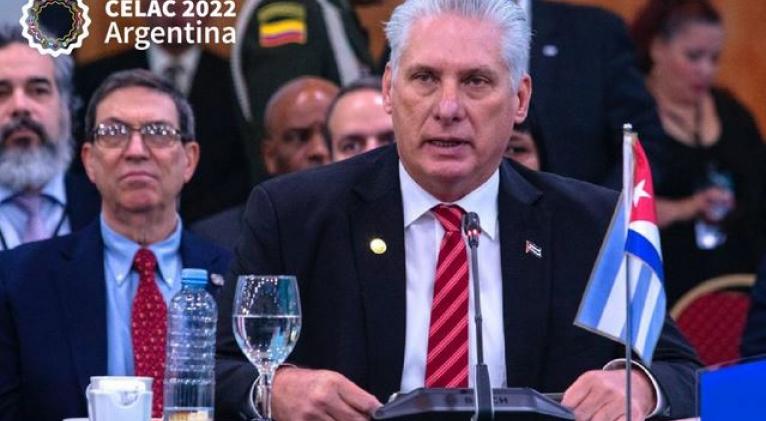
Cuban president denounces US interference at Celac Summit | Prensa Latina, 01.24.23

The 7th Summit Meeting of the Community of Latin and America States (CELAC) took place in Buenos Aires, Argentina on January 23. In their Declaration, representatives of 33 member nations, including 14 presidents, paid  homage to integration, unity, and  “political economic, social, and cultural diversity among member states.” They agreed “by consensus” to an all-embracing set of proposals and statements, 100 in all, and to 11 “special statements” on the situations of particular countries.

As is usual, host-country president Alberto Fernández made arrangements and set the agenda. The one-day meeting included closed- door discussions and brief presentations by representatives of the various country.

Participants at CELAC’s founding meeting in Caracas in 2013 declared  the region to be a “zone of peace.”  CELAC, it was hoped, would be promoting regional cooperation on social and economic development, agreement on common political goals, and progress toward integration and unity.

Preparations had begun in 2010 after U.S. interventions in Venezuela, Bolivia, Ecuador, Cuba, and other countries had intensified. CELAC would differ from Organization of American States (OAS), the regional organization serving U.S. interests since 1948. The United States and Canada are not members of CELAC. 

A gap separated the fifth CELAC Summit in 2017, in the Dominican Republic, from the sixth one, on September 16-18, 2021 in Mexico City. Instability in Venezuela, Bolivia, and Brazil was a likely factor.  Mexican President Andres Manuel Lopez Obrador (AMLO), presiding over CELAC VI, spoke of CELAC as the regional equivalent of the European Union. There was speculation about CELAC replacing the OAS. 

Brazilian President Luiz Inácio “Lula” Da Silva’s arrival at CELAC VII generated excitement. Brazil had rejoined CELEC after being removed by Former President Jair Bolsonaro in 2020. Lula supports closer ties of both CELAC and the Mercosur economic organization with the European Union.

In Buenos Aires, rightwing demonstrators from Argentina and elsewhere were noisily protesting against CELAC. They objected to the presence of leftist countries like Venezuela, Cuba, and Nicaragua. To avoid confrontation, Venezuelan President Nicolas Maduro and President Daniel Ortega of Nicaragua stayed away. AMLO also did not attend, claiming he was busy.

Crisis in Peru provoked divisions.  The Declaration was silent on the coup there and on repression of popular resistance. Colombian president Gustavo Petro, President Xiomara Castro of Honduras, and AMLO, in a video presentation, called for deposed President Pedro Castillo’s release from prison. Presidents Fernández of Argentina and Boric of Chile said nothing on that score. 

CELAC did not respond to Prime Minister Ariel Henry’s requests for  member states to “participate in a specialized multinational force requested by Haiti” to deal with gang warfare.

President Fernández, surprisingly, had invited U.S. President Biden, who sent former Senator Chris Dodd in his stead. Dodd spoke at the plenary session, as did European Council President Charles Michel.  President Droupadi Murmu of India participated virtually. Chinese President Xi Jinping sent a message of solidarity.

The Summit Declaration says little about implementing proposals and realization of earlier plans.  It refers to expected actions by United Nations agencies and by regional organizations with special experience and expertise.

The only CELAC actions mentioned are recent meetings of ministers of CELAC countries with international agencies dealing with healthcare and food-supply issues. The only CELAC initiatives underway soon are meetings of CELAC representatives with officials of the European Union, China, the African Union, and the ASEAN nations.

The website celacinternational.org mentions far-reaching plans as of 2013 for transportation, healthcare, and hunger-alleviation projects. A subsequent lack of follow-up information and references to other projects suggests flawed implementation.

Speaking at the Summit, Colombian President Gustavo Petro called for “building integration through concrete projects” and for action on the climate crisis, revitalizing the Amazonian forests particularly. He denounced “U.S. deficiencies in moving toward a carbon-free economy.” 

President Miguel Díaz-Canel of Cuba reminded his listeners of U.S. “efforts to divide us, stigmatize us and subordinate us to its interests.” The United States is isolated, he suggested, in its “strategy of hegemony and domination.”  And Cuba’s inclusion on the U.S. list of states that sponsor terrorism greatly impedes “our aspirations for development.

On video, President Maduro of Venezuela called upon CELAC to demand that the United States no longer intervene in the affairs of “free and sovereign nations” and “No more coup-plotting, no more sanctions against sovereign nations.” 

Uruguayan President Luis Lacalle, dissenting, charged that, “there are clearly countries here … that do not respect institutions, democracy or human rights.” He has drawn criticism for his push for a regional free trade zone and a Uruguayan -Chinese trade agreement. 

Speaking for El Salvador, Vice President Félix Ulloa urged CELAC to take on an executive secretary to preserve the alliance’s “institutional memory.” 

A CELAC “social summit” took place in Buenos Aires on the day prior to CELAC VII. Present were Argentinian trade unionists and leftist political parties and political leaders and activists from many countries. Former Bolivian President Evo Morales headed a panel of speakers.

Participants demonstrated outside the actual Summit against the rightwing protesters and “in support of our anti-imperialist presidents.”  Returning later, they demanded support for Peruvians’ resistance and called for non-recognition of the coup government. 

U.S. imperialism remained the perennial CELAC theme. Asked about U.S. designs on the region’s natural resources, Bolivian President Luis Arce was forthright: “[T]hese are our natural resources … We are not going to accept any imposition by anybody nor let anyone regard our natural resources as if it were theirs.”   

General Laura Richardson’s remarks before the Atlantic Council on January 19 had prompted the question. She is head of the U.S. Southern Command.

The next CELAC summit meeting will occur in Saint Vincent and the Grenadines, population 104,000 and the first Anglophone site for a CELAC meeting. Prime Minister Ralph Gon­salves will be presiding.


W.T. Whitney Jr. is a political journalist whose focus is on Latin America, health care, and anti-racism. A Cuba solidarity activist, he formerly worked as a pediatrician, lives in rural Maine. W.T. Whitney Jr. es un periodista político cuyo enfoque está en América Latina, la atención médica y el antirracismo. Activista solidario con Cuba, anteriormente trabajó como pediatra, vive en la zona rural de Maine.