Reactionaries and US Military Backers Prevail in Latin America – for Now / By W. T. Whitney

The commander of U.S. Southern Command, Army Gen. Laura Richardson, and Argentine Armed Forces Joint Command Chief Lt. Gen. Juan Martín Paleo, arrive at the Argentine Ministry of Defense. During her visit April 25-27, Richardson met with leaders, including Vice President Cristina Fernández de Kirchner. Richardson is a repeat visitor to Argentina since the election of right-wing President Milei. | Photo via U.S. Embassy Argentina

South Paris, Maine


U.S. Southern Command Chief Laura Richardson was visiting Argentina for the third time. On April 4 in Ushuaia, Tierra del Fuego – the world’s southernmost city – she and U. S. Ambassador Marc Stanley were received by President Javier Milei, his chief-of-staff, his cabinet chief, the defense minister, the interior minister, a military band, and an honor guard – at midnight.

Richardson announced her government would build an “integrated naval base” in Ushuaia that, close to the Strait of Magellan, looks to Antarctica. Both are strategically important. She “warned about China’s intention to build a multi-purpose port in Rio Grande, [Tierra del Fuego’s capitol city].”

Richardson, the U.S. military’s top leader for the region, had previously noted its attractions. She explained to the House Armed Services Committee in 2022 that Latin American and Caribbean area “accounts for $740 billion in annual trade with the U.S.; contains 60% of the world’s lithium and 31% of the world’s fresh water; has the world’s largest oil reserves” She insisted later that, “This region matters. It has a lot to do with national security, and we have to step up our game.”  

Testifying before a congressional committee on March 14, she remarked that, “The PRC (People’s Republic of China) is America’s pacing threat; countering their aggression and malign influence requires a whole-of-society approach.”

Information from an alleged leak from the U.S. Embassy in Bolivia suggests the U.S. government seeks to isolate non-aligned countries like Colombia, Bolivia, Venezuela and collaborate with “three bastions of U.S. support,” namely Peru, Ecuador and Argentina.

Analyst Sergio Rodríguez Gelfenstein claims U.S. “policies [in the region] are in the hands of the Pentagon … with the  State Department playing a secondary role…. The emphasis is on penetrating extreme rightwing governments.” 

U.S. troops and military advisors collaborate with regional military forces to confront narco-trafficking and other transnational crimes. Stories of good works have propaganda use in gaining support for their presence and for partnership with governments pushing back against popular protests. The survey below shows that U.S. military activities in the region are far-reaching and that long-term objectives and short-term needs are served.

Moving parts

The stated mission of the U.S. military installation in Argentina’s Neuquén province is to respond to humanitarian crises. That a Chinese satellite launch and tracking facility is nearby is no coincidence. The area has immense oil deposits.

U.S. troops based in Misiones, near Argentina’s borders with Brazil and Uruguay, ostensibly deals with narco-trafficking and other cross-border crimes. The U.S. government recently provided credit for Argentina to buy 24 F-16 fighter planes from Denmark.  

The largest U.S. bases in the region are the Guantanamo base in Cuba, with 6100 military and civilian personnel, and the one at Soto Cano in Honduras, with 500 U.S. troops and 500 civilian employees.TheU.S. Naval Medical Research Unit, active in several locations in Peru and overseen by the Southern Command, conducts “health science research” with Peruvian partners. It also serves to “build the capacity of special forces to survive in tropical forests.”

The U.S. Navy patrols South Atlantic waters and conducts joint training exercises with Argentina, Brazil, Chile, Colombia, Ecuador, Peru and Uruguay. The U.S. Coast Guard confronts illegal – read Chinese – fishing off South America’s Pacific coast.

The U.S. Army Corps of Engineers operates in 17 countries, fulltime in eight of them. It advises on river and estuary projects, notably on maintaining commercial flow from the Río de la Platabasin to the Atlantic.  

Ecuador and Peru each agreed recently to accept U.S. troop deployments. Colombia (2009) enabled the U.S. Air Force to utilize seven of its bases. Brazil and the United States (2019) cooperate in launching rockets, spacecraft, and satellites at Brazil’s Alcántara space center. The U.S. military cooperates with Brazil and Chile in conducting defense-related research.

The Southern Command annually holds CENTAM exercises with participation by U.S. National Guard troops and those of several Central American nations. They prepare for humanitarian crises and natural disasters.  The National Guards of 18 U.S. states carry out joint training exercises with the troops of 24 Latin American nations.

The United States supplies 94.9% of Argentina’s weapons, 93.4% of Colombia’s, 90.7% of México’s, and 82.7% of Brazil’s. Bolivia is the outlier, obtaining 66.2 % of its weapons from China.

The U.S. government authorized arms sales to Mexico in 2018 worth $1.3 million, to Argentina in 2022 worth $73 million, to Chile in 2020 worth $634 million, and to Brazil in 2022 worth $4 million.

The Southern Command operates schools for the region’s military and police forces. The Western Hemisphere Institute for Security Cooperation and the School of the Americas, its predecessor from 1946 on, account for almost 100,000 military graduates. The El Salvador-based International Law Enforcement Academy, “purposed to combat transnational crime,” trains police and other security personnel.

The Command in December 2023 undertook joint aerial training exercises with Guyana, where Exxon Mobil is preparing to extract offshore oil from huge deposits in Guyana’s Essequibo province.  Venezuela claims ownership of that area. Venezuelan President Maduro recently accused the U.S. government of establishing secret bases there.  

The story here is of installations and institutions, supply and support systems, and military interrelationships. The complexity of this U.S. undertaking signals fragility. The make-up of allied governments does likewise.

With friends like these

Raised in the United States and buoyed by his family’s great wealth, Ecuadorian president Daniel Noboa is inexperienced. The country faces environmental catastrophe and widespread violence. Indigenous peoples are politically mobilized and security forces cruelly repressive.

Raiding the residence of unelected Peruvian President Dina Boluarte, police on March 29 found jewelry worth $502,700. Establishment politicians appointed her as president after they railroaded progressive President Pedro Castillo, her predecessor, to prison.  Oligarchic rule and occasional dictatorships are customary in Peru, as is indigenous resistance.

Presidential rule in Argentina is bizarre. Eric Calcagno, distinguished sociologist, journalist, and diplomat, told an interviewer recently that President Milei is “asking to be part of NATO, which is the organization that occupied part of our territory, the Malvinas (Falkland Islands).” For Milei, “war is necessary.” The “regime … [is] “the figurehead of local and international monopolies [and] is taking Argentina to the point of no return.”

Argentina is “governed by a gentleman who decides things in consultation with a dead dog, or much worse, with General Richardson of the Southern Command.”  (A news report attributes to Milei devices “allowing him to enter into the spirit of Conan and calm his anxiety.” Conan, a dog, is dead.)

Meanwhile, 800,000 students, workers, unionists, the unemployed, and popular assemblies marched in Buenos Aires on April 23. Joined by 200,000 Argentinians demonstrating elsewhere in the country, they were protesting governmental attacks on public universities.

With popular resistance continuing in Argentina and elsewhere in the region, the precariousness of U.S. military intervention will show. Investigator Jason Hickel points to “imperial arrangement on which Western capitalism has always relied (cheap labor, cheap resources, control over productive capacities, markets on tap).”

He refers to the “Western ruling classes” and the “violence they perpetrate, the instability, the constant wars against a long historical procession of peoples and movements in the global South.” And yet: “[a]fter political decolonization, a wide range of movements and states across the South … sought economic liberation and sovereign industrial development.”

These are national liberation struggles that presumably will continue. Resistance under that banner may someday overwhelm military intrusions like the ones surveyed here.   


W.T. Whitney is a political journalist whose focus is on Latin America, health care, and anti-racism. A Cuba solidarity activist, he formerly worked as a pediatrician, lives in rural Maine. W.T. Whitney Jr. es un periodista político cuyo enfoque está en América Latina, la atención médica y el antirracismo. Activista solidario con Cuba, anteriormente trabajó como pediatra, vive en la zona rural de Maine.

How to Ease the Migration Crisis: End US Economic Sanctions / by W.T. Whitney Jr.

Migrants wait to be processed by US Border Patrol after crossing the US-Mexico border in Yuma, Arizona, July 2022. (Allison Dinner / AFP via Getty Images)

South Paris, Maine


Top officials of 11 Latin American and Caribbean governments met October 22 in Chiapas, Mexico to deal with the flood of migrants heading to the United States. There was agreement that U. S. interventions in their region fuel migration.  A report from Chicago, released two days earlier and discussed here, concluded similarly.  

The goal of the meeting called by Mexican president Andrés Manuel López Obrador was to form a regional block tasked with finding solutions. Presidents on hand, besides AMLO, were Xiomara Castro of Honduras, Miguel Díaz-Canel of Cuba, Gustavo Petro of Colombia, and Nicolás Maduro of Venezuela.

The joint statement emerging from the meeting outlined baseline assumptions: 

  • “The main structural causes of migration have political, economic, and social origins, to which the negative effects of climate change are added.” 
  • “Unilateral, coercive policies from the outside are by nature indiscriminate; they affect entire populations adversely.”

The statement concluded with an agreement covering 14 points, among them: further development of an action plan, mutual cooperation, attention to commercial relationships, demands put on destination countries, respect for human rights, protection of vulnerable populations, the special case of Haiti, and a plea that the Cuban and U.S. governments “comprehensively discuss their bilateral relations.”  

AMLO declared that “unilateral measures and sanctions imposed against countries in the region, particularly Venezuela and Cuba, contribute to instigating migration,” also that the U.S. government has to “dialogue with us.”  

The Great Cities Institute, a research center at the University of Illinois at Chicago, on Oct 20 released a report prepared by journalist Juan González. It analyzes recently-imposed economic sanctions and U.S. assaults over many years against regional governments.

The report concludes that “U.S. foreign policy toward Latin America …[and] sanctions directed at Venezuela, Cuba and Nicaragua, have played a major role in crippling theeconomies of those three nations, thus fueling for the past two years an unprecedented wave of migrants and asylum seekers from those countries that have appeared at our borders.”

Undocumented Mexican immigrants are shown to have represented 70% of all undocumented immigrants in 2008 but only 46 % in 2021. It appears that, later on, most unauthorized migrants entering the United States came from Honduras, Guatemala, and El Salvador.

Then Venezuelans “apprehended at the border” increased from 4,500 in 2020 to “more than 265,000 in the first 11 months FY 2023.” There were 3,164 undocumented Nicaraguans crossing the border in 2020 and 131,831 two years later. 14,000 Cubans crossed in 2020; 184,00 did so in 2023. In fact, “more Cubans have sought to enter the U.S. during the past two years than at any time in U.S. history.”

The report indicates that the three countries supplying these migrants “have been targeted by Washington for regime change through economic sanctions, a form of financial warfare that has only made life worse for their citizens.”

Note is taken of Venezuela’s GDP falling 74% over eight years and of $31 billion in oil revenues lost between 2017 and 2020. Venezuela must import most of the pharmaceuticals, medical supplies, and food it needs, according to the report. Funds for importing goods and for maintaining oil production derives from oil exports, which are blocked by U.S. sanctions. Shortages mounted, people suffered, and even died. Venezuelans reacted by leaving.

The Obama administration instituted sanctions in 2015 and President Trump added more afterwards. The sanctions block access to international credit, punish owners of foreign ships entering Venezuelan ports, and prevent income generated in the United States by Venezuela’s Citgo oil company from being repatriated.

The U.S government, according to the report, “is virtually alone in the world” in having unilaterally pursued such a lengthy economic blockade against Cuba. The U.S government punishes “an entire population for a political purpose.”  

The report notes that, “Cubans have garnered far less nationwide attention [than Venezuelan migrants] because they tend to settle in just one part of the country.” The real reason is that the Cuban Adjustment Act of 1966 provides undocumented Cubans with permanent residence a year after their arrival, and until then with work permits. The legislation, magnet-like, draws Cubans to the United States.

Cuban President Miguel Diaz-Canel, speaking at the Chiapas meeting denounced U.S. “coercive measures aimed, by definition, at depressing the standard of living of the Cuban population, reducing their real income and making them suffer hunger and misery.”

One learns that in Nicaragua after 2006, when the socialist-oriented Sandinistas returned to power, poverty diminished and food supplies increased.  Migration to the United States remained very low. Then, in 2018, protests erupted, with violence and deaths.

The report points out that “investigative journalists” viewed the uprising as “an attempted violent coup organized by U.S.- funded dissident groups.” But the U.S. government saw the Sandinista government as violating human rights and instituted sanctions, strengthening them in 2021.  International loans were now off limits and countries assisting Nicaragua would be punished. Emigration skyrocketed.

Juan González, who prepared the report, recalls having “documented in a previous study, [that] the largest migrations from Latin America over the past sixty years have come precisely from those countries the U.S. has repeatedly occupied and most controlled.”

The report catalogues U.S. interventions, among them: Guatemala, 1954; Cuba, Bay of Pigs, 1961; Dominican Republic, 1965; Chile, coup, 1973; Nicaragua, Contra war, 1980s; Panama, 1989; Venezuela, failed coup, 2002; Honduras, rightwing coup, 2009.

The report offers recommendations for easing the migration crisis. One is to end “economic warfare against Venezuela, Cuba and Nicaragua.” Another is to provide “expedited work permits” to recently arrived migrants and to long-term undocumented immigrants. The report asks that, “our government listen to the rest of the world community and end its destructive embargo against Cuba.”

The United Nations General Assembly will soon vote on a Cuban resolution calling for no more blockade. It has approved the resolution annually for 30 years, overwhelmingly so in recent years. The U.S. government does not listen.

Discussing his report on Democracy Now, Juan González provided a rationale for ending the various economic blockades that, based on cost-benefit analysis, ought to resonant with capitalists in charge of our national affairs.

He pointed to U.S. government spending of $333 billion between 2003 and 2021 “for immigration enforcement and for ICE and Border Patrol and fences.” It makes sense: ending U.S. economic sanctions would result in far fewer migrants at the southern border and, potentially, a big cost saving. 


W.T. Whitney Jr. is a political journalist whose focus is on Latin America, health care, and anti-racism. A Cuba solidarity activist, he formerly worked as a pediatrician, lives in rural Maine. W.T. Whitney Jr. es un periodista político cuyo enfoque está en América Latina, la atención médica y el antirracismo. Activista solidario con Cuba, anteriormente trabajó como pediatra, vive en la zona rural de Maine.

Mexico’s President Would Build Alliance to Counter Cuba Blockade / By William T. Whitney Jr.

Photo credit: People’s Dispatch

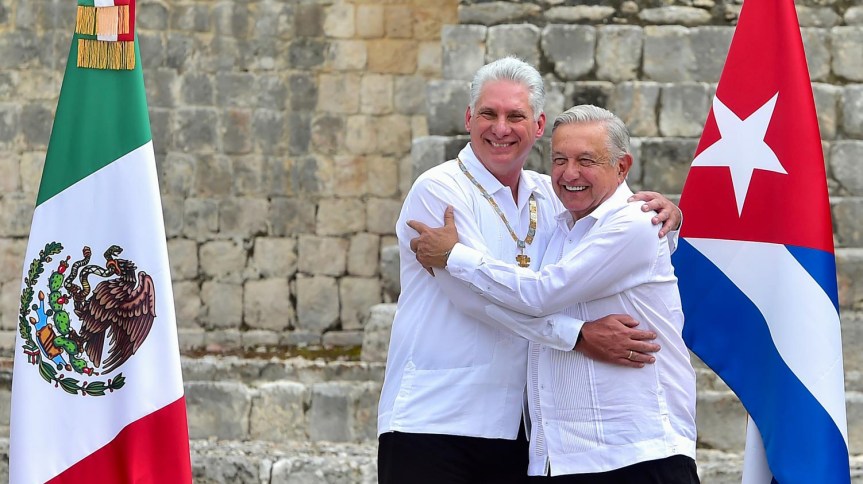
On the occasion of Cuban President Miguel Díaz-Canel’s visit recently to Mexico, Mexican President Andrés Manuel López Obrador (AMLO) raised the possibility of many nations cooperating to oppose the U.S blockade of Cuba. AMLO has become Cuba’s champion in the international arena, and perhaps not accidentally: the governments of the two nations each originated from social and political revolutions.

The two leaders have built a tight relationship.  Diaz-Canal visited to Mexico in September, 2021. AMLO was in Cuba in May, 2022. And AMLO refused to attend a U.S – organized Summit of the Americas in Los Angeles in June 2022 because Cuba had been excluded. 

Accompanied by Cuban government officials, Díaz-Canel on February 11 joined AMLO in the Mexican state of Campeche. That Cuban medical teams are working there now may have helped determine the meeting’s location.

In remarks at a medical center,  AMLO lauded Cuba’s medical solidarity and described his own people’s unmet social needs. He called upon the U.S. government to end its blockade of Cuba:

[Cuba] has our respect, our gratitude, our support, and we are going to continue demanding the removal, the elimination of the blockade against Cuba, which is inhumane. And there’s more than voting in the United Nations where the anti-blockade resolution is always approved overwhelmingly, and then it’s back to the way it was.

I promise President Miguel Díaz-Canel that Mexico will be leading a more active movement so that all countries come together and defend the independence and sovereignty of Cuba. No longer will there be anything about treating Cuba as a terrorist country or putting Cuba on the black list of supposed terrorists.

Cuba has been able to count on support from Mexico. As the Bay of Pigs invasion was unfolding in 1961, former Mexican President Lázaro Cárdenas spoke in defense of Cuba before 80,000 people in Mexico City’s Zocalo. Soon afterwards, Mexico’s government backed Cuba in the United Nations. Later Mexico rejected calls by the U.S. – dominated Organization of American States for member states to impose economic sanctions against Cuba and break off diplomatic ties.

AMLO visited Cuba in May, 2022. Speaking before Cuban leaders, he recalled “times when the United States wanted to own the continent …. They were annexing, deciding on independence wherever; creating new countries, freely associated states, protectorates, military bases; and … invading.”  The U.S. government, he declared, needs to know “that a new relationship among the peoples of America … is possible.”

While in Cuba he signed agreements for Mexican young people to study medicine in Cuba, for Cuba to provide Mexico with anti-Covid vaccines, and for hundreds of Cuban physicians to work in Mexico in underserved areas.

Months before, in September 2021, Díaz-Canel was the honored guest at celebrations in Mexico City of the 200th anniversary of Mexico’s national independence. Welcoming his guest, AMLO praised Cuba’s steadfastness in defending its revolution. Calling upon U.S. political leaders to lift the blockade on Cuba, he appealed to their good sense and rationality, saying nothing about nations uniting in opposition to the blockade. 

Photo credit: People’s Dispatch

[The U.S. government] must lift its blockade against Cuba, because no state has a right to subjugate another people, or another country … [And] It looks very bad that the U.S. government uses the blockade to hurt the people of Cuba in order to force them by necessity to confront their own government … President Biden, who shows political sensitivity, [must] take a wider view and put a permanent end to the politics of grievances against Cuba.

The emphasis was different, however, when the two leaders met recently, on February 11 in Campeche. AMLO unveiled an evolved and more forceful approach to ending the blockade. He bestowed upon Díaz-Canel Mexico’s highest recognition extended to foreign notables, the Aztec Eagle, and then praised Cuba as a special case for its strenuous resistance to U.S. enforcement of the Monroe Doctrine. He continued: 

I also maintain that it is time for a new coexistence among all the countries of America, because that model imposed more than two centuries ago is completely exhausted, it is anachronistic, it has no future. There is no way out, it no longer benefits anyone, we must put aside the trade-off imposed on us either to go along with the United States or be in opposition, courageously and defensively. 

It is time to express and explore another option, that of dialoguing with the leaders of all the countries and especially with U.S. leaders, and convince and persuade them that a new relationship between the countries of our continent, of all America, is possible. I believe that conditions are perfect now for achieving this goal of mutual respect.

In an interview later on, Mexican foreign minister Marcelo Ebrard offered some specifics:

President Lopez Obrador wants to bring the presidents of the progressive states of Latin America together to address food security, well-being and other issues that are important for our community of nations. This is something we have to discuss with other foreign ministers and move forward in the coming months. 

The progressive governments AMLO has in mind, according to Ebrard, are Mexico, Argentina, Brazil. Colombia, Cuba, Venezuela, Bolivia, Chile, and Honduras. They include “the three largest economies in Latin America.” The implication may be that these countries, collaborating on various issues, political ones included, have sufficient economic clout to pressure the United States on Cuba.

President Díaz-Canel himself has been building other bridges. In recent weeks he visited Belize, Saint Vincent and the Grenadines, and Barbados, for the 7th CARICOM (Caribbean Community) – Cuba Summit meeting.

AMLO’s focus on progressive nations is crucial. He has worked toward reviving the Community of Latin American and Caribbean States (CELAC) as a vehicle for collective action, despite participation there by conservatively-governed nations. Yet he did not attend the CELAC summit taking place in January and so may be discouraged as to prospects for CELAC serving his purposes. 

AMLO’s power to orchestrate regional support is limited. Only 18 months remain of his six-year term as president of a country dependent economically on the United States and divided geographically, ethnically, and by social class. Nevertheless, Cuba, whose external resources for ending the U.S. economic blockade are hardly infinite, badly needs international partnering that offers persuasive power. Lifelines thrown by AMLO are a start in that direction. 


W.T. Whitney Jr. is a political journalist whose focus is on Latin America, health care, and anti-racism. A Cuba solidarity activist, he formerly worked as a pediatrician, lives in rural Maine. W.T. Whitney Jr. es un periodista político cuyo enfoque está en América Latina, la atención médica y el antirracismo. Activista solidario con Cuba, anteriormente trabajó como pediatra, vive en la zona rural de Maine.

Mexico’s Left Takes to the Street, Celebrates Achievements / by W. T. Whitney Jr

Supporters of Mexican President Andrés Mexican President Andrés Manuel Lopez Obrador stand on a statue’s platform as they cheer him during a march in support of his administration, in Mexico City, Sunday, Nov. 27, 2022. | Fernando Llano/AP

“Sometimes there are revolutions but people keep on thinking the same way. But now we are seeing a peacetime transformation process and there is a change of mentality …  I said yesterday that we are winning the battle against racism, classism, discrimination. This is not about material things, not about welfare programs. There’s been a change of mentality”.

Mexican President Andrés Manuel López Obrador (AMLO) was commenting on events of November 27, which was the fourth anniversary of his taking office.  AMLO and his Moreno Party administration had staged a march and then a rally in the Zócalo plaza in Mexico City. They sought to demonstrate the Mexican people’s support for what AMLO calls Mexico’s Fourth Transformation.

Supporters gathered at the Angel of Independence Monument and walked three miles along Reforma Avenue to arrive at the Zócalo. The crowd was such that the walk, with AMLO walking too, lasted five hours. And, “Not even a window was broken,” according to Claudia Sheinbaum, who heads Mexico City’s government.

AMLO spoke before 1.2 million people. He highlighted what he regarded as outstanding achievements of his government and promised that work would be continuing “under the premise of attending first to the poorest and most vulnerable people.” He attached the name “Mexican humanism” to his government’s “socio-political model.” Noting the high representation of youth in the crowd, AMLO proclaimed a “generational change.”

In his remarks, AMLO catalogued achievements in providing for people’s needs. A report from La Jornada news service is the basis for the following summary.

Security is improvising, he indicated.  His government “on a daily basis has to confront the scourge of violence; corruption and impunity are not tolerated.   Crimes that fall within federal jurisdiction are down 27.3%.

AMLO listed social advances in various areas:

·        35 million families, 85% of the total, directly receive “at least a little portion of the national budget,” and the others benefit from reduced taxes and reduced costs for essentials.

·        The minimum salary has more than doubled, “something never seen in the last 40 years” – and will be increasing more in the coming year.

·        Labor reforms include secret voting in union elections, elimination of subcontracting, and a doubling of profit-sharing arrangements. 

·        Almost 28 million new workers are enrolled in social security, and the salaries of workers has reached “historically” high levels.  There are 1.3 million new government jobs.

·        Now 283,535 single mothers working outside of the home receive 800 pesos each month; 3.7 million families with children in elementary schools receive 1,680 pesos every two months; and 4.2 million upper-level students receive the same amount. Some 410,000 university students from poor families receive 2,450 pesos monthly, 128,950 postgraduate students and researchers receive scholarships.

AMLO emphasized the construction by his government of 145 free public universities where 1,168 professors are teaching and 45,581 young people studying. The aim is to establish 200 such institutions within the so-called “Benito Juárez System” which, according to a government website, is “dedicated to young people excluded by economic reasons” and those whose geographic access to higher education is limited. 

The president mentioned that funds are available that enable parents of school children to maintain and rehabilitate 113,971 school buildings. Teachers’ salaries are up 21%, and schools now provide a “labor base” for 650,000 education workers.   He noted that his government’s “relation with teachers is one of respect and gratitude … There have been no strikes or work stoppages in the public schools.”

AMLO emphasized that IMSS-Bienestar, the federal healthcare system, has extended into new regions where medical generalists and specialists are for the most part working “two shifts” every day. He is “committed to extending the IMSS-Bienestar system throughout the country to make people’s right to healthcare a reality.”

According to its website, “The IMSS-BIENESTAR Program provides first and second level health care services in its health units. The latter covers the specialties of gynecology-obstetrics, general surgery, internal medicine and pediatrics.” With “43 years of experience,” the program “combines medical care with health promotion actions in the community.”  Care is provided gratis to patients without social security benefits.

Mexico’s social security system has expanded; 300,000 handicapped people, mostly children, are receiving more generous pensions and 10.5 million seniors now receive 2,800 pesos bimonthly, with more on the way after January 1, 2023. In a program called “Young People Building the Future,” 2.4 million young people are apprenticing in preparation for future work.  The minimum wage they receive is a social security benefit.

AMLO’s reference to a “Fourth Transformation” raises the question of what about the first three transformations. These were three periods of significant change, specifically: independence from Spain 1810-1821; reforms, mainly separation of church and state, undertaken by President Benito Juárez in 1858-1861; and Mexico’s Revolution in 1910-1917 that accounts for the present Constitution.

The march and mass gathering of Moreno and AMLO supporters annoyed individuals such as Sandra Cuevas, the mayor of Cuauhtémoc. She denounced a “march of hate, division, inequality and corruption” while claiming that government officials at all levels and beneficiaries of social programs had been forced to participate.

One observer writes that for Morena to be “winning the streets” doesn’t detract from the advantage conservative political parties enjoy with an overwhelming presence on social media and on newspaper front pages.  Their power there, and in their organizations and the judiciary, enables them to “hinder, obstruct, and sabotage” Morena’s work of governing.   In any case, opinion polls are pointing to a large Morena Party victory in the elections of 2024.


W.T. Whitney Jr. is a retired pediatrician and political journalist living in Maine.

People’s World, November 29, 2022, https://www.peoplesworld.org/

Mexico leads in opposing the Cuba blockade and U.S. imperialism / by William T. Whitney Jr.

Cuban President Miguel Diaz Canel, right, and his Mexican counterpart Andres Manuel Lopez Obrador, left, raise their arms during a ceremony to award the Jose Marti Order to Lopez Obrador, at Revolution Palace in Havana, Cuba, Sunday, May 8, 2022. El presidente cubano Miguel Díaz Canel, a la derecha, y su homólogo mexicano, Andrés Manuel López Obrador, a la izquierda, levantan los brazos durante una ceremonia de entrega de la Orden José Martí a López Obrador, en el Palacio de la Revolución en La Habana, Cuba, el 8 de mayo de 2022. | Yamil Lage / Pool Photo via AP

Mexican President Andrés Manuel López Obrador (AMLO) visited Cuba on May 8-9. He began by highlighting regional unity as good for equal promotion of economic development for all states. AMLO addressed themes he had discussed previously when Cuban President Miguel Diaz-Canel visited Mexico City in 2021.

At that time, AMLO, by virtue of Mexico serving as president pro tempore, presided over a summit meeting of the Community of Latin American and Caribbean states (CELAC). He proposed building “in the Western Hemisphere something similar to what was the economic community that gave rise to the current European Union.”

Two days later, AMLO included Diaz-Canel in a celebration of the 200th anniversary of Mexican independence. Praising Cuba’s dignity in resisting U.S. aggression, he called for an end to the blockade.

Months later in Havana, on May 8, 2022, AMLO, speaking before Cuban leaders and others, recalled “times when the United States wanted to own the continent…. They were at their peak in annexations, deciding on independence wherever, creating new countries, freely associated states, protectorates, military bases, and…invasions.”

U.S. leaders, he declared, need to be convinced “that a new relationship among the peoples of America…is possible.” He called for “replacing the OAS with a truly autonomous organism.” CELAC presumably would be that alternative alliance. Formed in 2011, CELAC includes all Western Hemisphere nations except for the United States and Canada.

The United States in 1948 established the Organization of American States (OAS) for Cold War purposes. When the OAS expelled Cuba in 1962, only Mexico’s government opposed that action, and later Mexico was one of two nations rejecting an OAS demand to break off diplomatic relations with Cuba.

AMLO predicted that “by 2051, China will exert domination over 64.8% of the world market and the United States only 25%, or even 10%.” He suggested that, “Washington, finding this unacceptable,” would be tempted “to resolve that disparity through force.”

AMLO rejected “growing competition and disunity that will inevitably lead to decline in all the Americas.” He called for “Integration with respect to sovereignties and forms of government and effective application of a treaty of economic-commercial development suiting everybody.” The “first step” would be for the United States “to lift its blockade of this sister nation.”

AMLO’s visit prompted agreements on practicalities. The two presidents determined that Cuba would supply Mexico with medications and vaccines—particularly Cuba’s anti-COVID Abdala vaccine for children. Mexico’s government will send almost 200 Mexican youths to Cuba to study medicine; 500 Cuban physicians will go to Mexico to work in underserved areas. The two presidents signed a general agreement providing for expanded cooperation in other areas.

Before arriving in Cuba, AMLO had visited Guatemala, El Salvador, Honduras, and Belize. Along the way, he reportedly complained that, “The United States may have awarded $40 billion in aid to Ukraine but doesn’t fulfill its promise of years ago of helping out Central America.”

The two presidents’ encounter in Havana raises the question of a long-term Mexican role in mobilizing collective resistance to U.S. domination and the U.S. blockade of Cuba. Mexico is well-positioned to lead that effort, what with strong economic and commercial connections with the United States. The United States, leaning on Mexico as an economic partner, may well be receptive to certain demands.

According to the White House-based Office of the U.S. Trade Representative, “Mexico is currently our largest goods trading partner with $614.5 billion in total (two way) goods trade during 2019.”

Beyond that, and in relation to Cuba, Mexico has its own revolutionary tradition and longstanding ties with Cuba. She is well-placed to lead a strong international campaign to undo the U.S. blockade.

In his major speech, AMLO cited support from Mexico in Cuba’s first War for Independence. He mentioned Cubans’ collaboration with Mexico’s much-admired President Benito Juárez and pointed out that Mexico in1956 hosted Cuban revolutionaries led by Fidel Castro as they prepared for their uprising against Batista. AMLO cited former Mexican President Lázaro Cárdenas’ solidarity visit to Cuba in 1961 after the CIA-organized Bay of Pigs invasion. In token of cultural ties between the two peoples, Mexico was the guest of honor at Havana’s recently concluded International Book Fair.

José Martí warrants special attention. In exile, Martí lived, taught, and wrote in Mexico from 1875 to 1877. Afterwards he stayed connected with Mexican friends. Martí would later write admiringly about the liberal reforms of Indian-descended President Juarez, whom he regarded as the “impenetrable guardian of America.”

That “America” would be “Our America,” which became the title of a Martí essay with deep meaning for unity and for separation from the United States. “Our America” proclaimed that the culture and history of lands south of the Rio Bravo (Rio Grande) originated autonomously, quite apart from European and U.S. influences. The essay appeared first in January 1891, in two journals simultaneously. One was El Partido Liberal, published in Mexico, the other being a New York periodical.

Unity among Latin American and Caribbean nations appears to be precarious as the U.S. government prepares to host the Ninth Summit of the Americas in Los Angeles, on June 6-10. The Summit is an offshoot of the OAS which, according to its website, “serves as the technical secretariat of the Summits process.”

The United States has indicated that the leftist governments of Cuba, Venezuela, and Nicaragua won’t be receiving invitations. AMLO, speaking in Havana, reiterated his objection and once more stated that if nations are left out, he will not attend. Nor will the presidents of Bolivia and Honduras, Luis Arce and Xiomara Castro, respectively.

The presidents of several Caribbean nations will also be staying away. They point to the hypocrisy of U.S.-appointed Venezuelan “president” Juan Guaidó being invited, but not Cuban President Miguel Díaz-Canel.  Unhappy with U.S. advice on transparency of elections and Russia-Brazil relations, Brazilian President Jair Bolsonaro will not attend.

The conclusion here is that the old system of regional alliances is unstable and that the timing may be right for renewed resistance to U.S domination and the blockade. Now would be the occasion for U.S. anti-imperialists and blockade opponents to align their strategizing and efforts with actions, trends, and flux in Latin America and the Caribbean. And, most certainly, they would be paying attention to actions and policies of Mexico’s government.

Martí had often corresponded with his Mexican friend Manuel Mercado.  His letter of May 18, 1895, the day before he died in battle, stated that, “The Cuban war…has come to America in time to prevent Cuba’s annexation to the United States.… And Mexico, will it not find a wise, effective, and immediate way of helping, in due time, its own defender?”


W.T. Whitney Jr. is a political journalist whose focus is on Latin America, health care, and anti-racism. A Cuba solidarity activist, he formerly worked as a pediatrician, lives in rural Maine. W.T. Whitney Jr. es un periodista político cuyo enfoque está en América Latina, la atención médica y el antirracismo. Activista solidario con Cuba, anteriormente trabajó como pediatra, vive en la zona rural de Maine.

People’s World, May 20, 2022, https://www.peoplesworld.org/