
US imperialist war against Haiti / By W. T. Whitney Jr.

South Paris, Maine


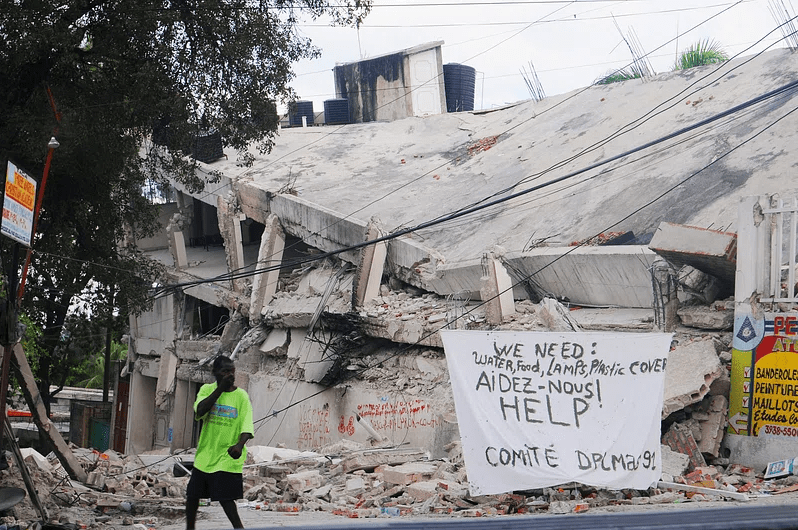
The Trump administration on June 27 announced that Temporary Protected Status (TPS) applying to half a million Haitians living in the United States will end on September 2. That total includes 300,000 people who, having fled unrest and violence, gained TPS in June 2024 under the Biden administration; 200,000 other Haitians who entered following a terrible earthquake in 2010 received TPS during Obama’s presidency.

Haitians not voluntarily returning to their country or not qualifying for legal immigration status otherwise face deportation. A spokesperson for the Department of Homeland Security was reassuring: “The environmental situation in Haiti has improved enough that it is safe for Haitian citizens to return home.” That is not so.

A State Department travel advisory on Haiti in September 2024 tells U.S. citizens, “Do not travel to Haiti due to kidnapping, crime, civil unrest … Crimes involving firearms are common in Haiti …” Lawyer Aaron Reichlin-Melnick of the American Immigration Council insists that, “This is NOT a safe place to send people. It’s a death sentence.”

Desperation

In truth, chaos and devastation are going to speed the deaths of many Haitians. According to a recent report from the International Organization for Migration of the United Nations, “Nearly 1.3 million people have been forced to flee gang violence in Haiti and seek refuge elsewhere within the Caribbean country … This represents a 24 per cent increase from December 2024.”

The report adds that, “Behind these numbers are so many individual people whose suffering is immeasurable; children, mothers, the elderly, many of them forced to flee their homes multiple times.” The gangs, unified under the name Viv Ansanm, engage in stealing, killing, extorsion, and destruction.

For a decade and more, Haitians have repeatedly protested and mobilized in the streets against high prices and shortages. Business owners and the wealthy have funded the gangs in order to protect their properties and interests against popular mobilizations. The U.S. government turns a blind eye to weapons entering Haiti from the U.S. Analyst Seth Donnelly speaks of “Death squads … financed by members of Haiti’s upper class and heavily armed by major weapons flowing into Haiti from Florida.”

This account of Haitians in distress and of the U.S. government covering up the truth points to U.S. domination there that that differs from the targeting of Gaza and Iran. However, each of these situations as varied as they are, have characteristics defining them as imperialist interventions.

Important here is the connection between imperialism and capitalism. It looks like this: at a certain stage in history, imperialism came to represent a way for nations to be able to improve the capabilities of corporations to generate wealth. Therefore, fight against imperialism is fight against capitalism, because imperialism derives from capitalism. It follows that opposition to the excesses of U.S. imperialism in Haiti fits within customary anti-capitalist struggle. But one needs to appreciate the imperialist nature of U.S. interventions in Haiti. That’s the object of what follows here.

Rule from afar

President Jovenel Moïse, wealthy and a major embezzler of public funds, was assassinated for uncertain reasons by US -organized mercenaries in 2021. Subsequently, a governing body appointed by the so-called Core Group has supervised Haiti’s affairs. The Core Group represents key North American and European governments.

Garry Conille, Haiti’s de facto prime minister, in June 2024 welcomed to Haiti 400 Kenyan troops who were the first contingent of the UN-authorized and partially-U.S.-funded Multinational Security Support Mission. They would be fighting the gangs.  Full funding and the full complement of 2500 troops sent by participating nations have fallen short. Meanwhile, killings and internal displacement continue.

According to the New York Times, Eric Prince has recently sent weapons to Haiti and will soon dispatch 150 mercenary troops there. He has introduced drones that have killed at least 200 people. Prince was a big donor to President Trumps’s 2016 campaign and is by far the lead U.S. empresario of mercenary warfare. Who pays Prince is unspecified.

As if Haiti’s government is the prime actor in this drama, the Times report portrays that government as “turning to private military contractors equipped with high-powered weapons, helicopters and sophisticated surveillance and attack drones to take on the well-armed gangs.” Haiti’s government, in fact, is on leave – is AOL.

History with a logic

Nothing about this train of grief is by chance. Powerful forces – imperialists abroad and oligarchs within – remain determined, it seems, that a people-centered government will never take root in Haiti. Once, there had been an opportunity.

Cooperating with Canada and France, the U.S. government in 2004 backed the paramilitaries who removed President Jean-Bertram Aristide from power, along with his progressive Lavalas political party. Earlier in 1991, CIA-affiliated paramilitaries did likewise.

President Aristide’s overwhelming electoral victory in 1990 and Lavalas presidential candidate René Préval’s victory in 1995 represented the first and second democratic elections, respectively, in Haiti’s history. They were the last ones, so far. U.S. Secretary of State Hilary Clinton engineered Michel Martelly’s election as president in 2010. Jovenel Moïse’s election in 2016 was marked by electoral corruption.  No elections of any kind have taken place since that year.

Following the U.S. coup against Aristide in 2004, the U.S. government, United Nations officials and the Core Group (of imperialist countries) together installed, the “United Nations Stabilization Mission in Haiti” (MINUSTAH).  Under Core Group supervision, MINUSTAH imposed a military occupation from 2004 until 2017.  Reports abounded of destruction, dying, disease – particularly cholera – and sexual violence on the part of occupying troops. The Haitian people’s real needs went begging.  

Enslaved workers in what would become Haiti rebelled in 1791 and established national independence in 1804. Between then and 1991, when Aristide first became president, Haiti was under steady assault from foreign powers. The result was foreclosure on the country’s political and social development.

France pressured independent Haiti into providing reimbursement for French plantation owners’ loss of enslaved labor. Haiti borrowed money to pay. Vast debt obligations continued into the 20th century. The U.S. government refused for decades to trade with Haiti or recognize her independence. It carried out a brutal military occupation from 1915 until 1934 and fully backed the Duvalier dictatorship (1957-1986).

A flexible imperialism

U.S. oppression of Haiti takes place in ways other than the devices imperialists usually rely on. Intent upon accumulating wealth, they go abroad to capture natural resources like oil and try to control strategically placed geographic locations. U.S. imperialists, partnering with Israel, are pursuing both of these objectives in Palestine and Iran.

Haiti offers nothing to compare. Low-wage industry beckons but garment manufacturing, active in Haiti, is only a weak draw. However, Haiti presents other attractions for imperialists that are very much in line with goals of extending control and generating wealth.

Haiti’s achievement of national independence surely represented a great upset of colonial trade arrangements, and these had prepared the way toward capitalist industrialization. Early U.S. capitalists condemned happenings in Haiti. That attitude undoubtedly assured Haiti a place on the U.S. blacklist.  Maybe the stigma remains.  

Karl Marx explains that, “direct slavery is as much the pivot of bourgeois industry as are machinery, credit, etc. Without slavery you would have no cotton; without cotton you have no modern industry. It is slavery that gave the colonies their value, it is the colonies that created world trade, and world trade is the precondition for large-scale industry.”

One reason why U.S. imperialists make Haitians miserable is that, in doing so, they create a model image of massed people of color desperate to survive. That image, widely accepted, has possible use in projecting social precariousness as a constant in the underdeveloped world. The object would be to persuade northern exploiters that workers in such regions are so cowed as to accept poor working conditions and stay away from social revolution.

Additionally, the image of black people in great distress may be pleasing to the imperialists for its power of persuading non-Black victims of oppression living precarious lives to value what little remains of their self-regard and worldly possessions and to go it alone, and not join peoples of African heritage in common struggle. 

Lastly, old habits die slowly. The successful rebellion of enslaved people in Haiti stoked fear within U.S. political life and the wider community, both being under the sway of slave-owning interests. Fear persisted and Haiti’s image surely gained no favor during the Jim Crow era. And even now, crucially, racists and their ideas have their place within official Washington circles.


W.T. Whitney Jr. is a political journalist whose focus is on Latin America, health care, and anti-racism. A Cuba solidarity activist, he formerly worked as a pediatrician, and lives in rural Maine.

U.S. migration policy change eases border rules but hurts Cuba / by W. T. Whitney Jr.

Migrants line up for processing in Eagle Pass, Texas. President Biden’s immigration policy allows a limited number of Cubans to enter the U.S. on so-called “humanitarian” grounds. The real aim is to hurt Cuba by decreasing its population of skilled workers. | Eric Gay/AP

Reposted from the People’s World


Undocumented Migrants crossing into the United States disturb U.S. politics. Cuban migrants, part of the mix, hard-pressed like the others, but privileged, are provocative in their own way.

For many years and even now displaced Cubans are portrayed as victims of a brutal dictatorship and as recipients of “rescue” by freedom-loving Americans. Cubans who have special skills are often lured out of the country with promises of “the good life” in the U.S. and with the intent of hurting Cuba as it loses people with skills needed their at home.

Changing U.S. regulations and new migration patterns highlight the anomaly of special U.S. dispensation for migrating Cubans.

U.S. district judge Drew Tipton on March 8 ruled that migrants from Cuba, Venezuela, Nicaragua, and Haiti may enter the United States via humanitarian parole. The plaintiffs had been 21 Republican-governed states that had unsuccessfully claimed that immigrants enabled by humanitarian parole required services they could not pay for.

Under humanitarian parole, a program the Biden administration announced on January 6, 2023, migrants entering from those four countries are assured of legal residence for two years – renewable at that point – and a work permit.

Humanitarian parole is limited to 30,000 immigrants arriving every month from the four countries. Migrants need sponsors in the United States.

Instituted under the Immigration and Nationality Act of 1952, the program allowed entry into the United States of refugees from the former Soviet Union, Afghanistan, Ukraine, and other countries. This time, 138,000 Haitians, 86,000 Venezuelans, 58,000 Nicaraguans, and 74,000 Cubans – a total 357,000 migrants –entered via humanitarian parole as of February, 2024.

The would-be migrants from the four countries travel by air to ports of entry inside the United States, pass quickly through immigration screening, and proceed to new homes. Before leaving their home country or a third country, they had found sponsors, presented documentation to U.S. immigration officials, and been approved– all via the Internet.

An analyst claims that, “Combined with the other parole process at the U.S.-Mexican border …, parole has transformed most migration from [the four] countries from mostly illegal to mostly legal in less than a year.” And, “This policy has transformed migration to the United States. By July 2023, parole had already redirected about 316,000 people away from long, perilous treks through Mexico.”

The Biden administration adopted the parole system in part because of difficulties associated with repatriating migrants from the four countries. They stemmed from a U.S. lack of full diplomatic relations and repatriation agreements with those countries. Normal relations with Mexico and the northern Central American countries allow for more convenient U.S. handling of refugees from those countries.

Humanitarian parole came into effect after the administration’s repeal of Title 42, its role having been to exclude migrants because of health risk. Many migrants saw an opening and attempted a border crossing. But many of those from the four countries opted for humanitarian parole.

Scoring political points

By diverting migrants to other locations and relieving pressures along the southern border, the administration might have scored political points, had not administrative delays with humanitarian parole led to big backlogs of migrants waiting to enter.

Cuban migrants to the United States are a special case. Immigration officials on the southern border have long used an “Order of Release on Recognizance,” the so-called “Form I-220A,” to release border-crossers from custody.  Officials dealing with Cubans being released ended up accommodating Form I-22A with the objectives of the Cuban Adjustment Act (CAA).

The aim of that legislation passed in 1966 was to legalize the already large population of Cubans who had arrived in the United States after Cuba’s Revolution in 1959 and the many who would follow, all presumed to be enemies of the Revolution. The CAA enables newly arrived Cubans immediately to receive social services and a work permit and, after a year, to be granted permanent-resident status, a pathway to citizenship.

No other migrant from any other country is so favored. The displaced Cubans are portrayed as victims of a brutal dictatorship, and the U.S. government and people as their rescuer.

To apply the CAA to the fate of those Cuban migrants released from custody according to Form I-220A is now off limits, as per a ruling by a U.S. immigration court in September 2023. But now they can make use of humanitarian parole.

Curiously, the governments of three of the countries whose migrants benefit from humanitarian parole – Cuba, Venezuela, and Nicaragua – are socialist in nature, and the U.S. government regularly harasses them.

Humanitarian parole entices migrants to the extent that great numbers of citizens depart for the United States. As a result, the human resources of Cuba and the other countries are depleted so much so as to impinge upon the countries’ future development.

The U.S. government with its humanitarian-parole policy, at the very least, has stumbled upon a tool that contributes to destabilizing three governments that variably represent the threat of a good example – Cuba’s government more than the others.

The 425.000 Cuban migrants who arrived in the United States in 2022 and 2023 constituted the greatest exodus since the one following the victory of the Revolution in 1959. Factors pushing Cubans to emigrate are low pay, inflation, and shortages of food, electrical power, medical supplies and drugs. These factors reflect the impact of the U.S. economic blockade, as aggravated by effects of the COVID pandemic and declining tourist income.

Emblematic of the great challenges to Cuba’s future development are the nine percent of  Cuba’s healthcare workers who departed in 2021 and 2022, and the loss of teachers at all levels of education – 17,278 posts being unfilled in October 2023.

Speaking at a multi-national meeting on migration taking place in Chiapas, Mexico in October, 2023, Cuban president Miguel Díaz-Canel declared that, “The hostile policy of the United States is what stimulates the potential of Cuban migration in a very significant way.” U.S. hostility is expressed, he indicated, primarily through “the economic blockade that, reinforced in recent years in a criminal manner, … is by definition aimed at depressing the standard of living of the Cuban population.”

He might have mentioned U.S. economic and political interventions in most of the region’s countries that leave their governments unable to serve and protect their people; their option is to leave home and head north.


We hope you appreciated this article. At People’s World, we believe news and information should be free and accessible to all, but we need your help. Our journalism is free of corporate influence and paywalls because we are totally reader-supported. Only you, our readers and supporters, make this possible. If you enjoy reading People’s World and the stories we bring you, please support our work by donating or becoming a monthly sustainer today. Thank you!


W.T. Whitney Jr. is a political journalist whose focus is on Latin America, health care, and anti-racism. A Cuba solidarity activist, he formerly worked as a pediatrician, lives in rural Maine. W.T. Whitney Jr. es un periodista político cuyo enfoque está en América Latina, la atención médica y el antirracismo. Activista solidario con Cuba, anteriormente trabajó como pediatra, vive en la zona rural de Maine.

Migration as Sign of Climate-Change Impact in the Global South / by W. T. Whitney Jr.

Source: The African Union Mission in Somalia

U.S. government programs for migrants who crossed the U.S. southern border are punitive and disjointed. Left-leaning political groupings may criticize, but they too have fallen short in conceptualizing lives of dignity for migrants in the United States. Nor do they adequately take into account adverse circumstances weighing on migrants’ lives in their home countries.

First among forces pushing masses of people northward is the environmental crisis. The role of climate change in reducing soil productivity and food availability and in predisposing already beleaguered people to migrate is of great concern.  

One assumption here is that capitalist systems of production and consumption have been central to causing the climate to change for the worse. Another is the need for war on capitalism so as to stave off more climate change and cope with its fallout. That hasn’t happened in the industrialized northern countries.

Southern regions may be different. The excesses of capitalist globalization have hurt masses of people there. They were never afforded the relief northern peoples gained from welfare-state remedies. They may be ready to take up the climate-change fight.

Northern climate-change warriors who are anti-capitalist ought to be establishing linkages of support with their southern counterparts. One precedent for them is Spain.  Anti-fascists in 1936 joined the International Brigades to defend the Spanish Republic.  Now, in one way or another, northerners would be joining a faraway fight, this time against climate change.  One locality is Guatemala. 

Storytelling

Author Ilka Oliva Corado describes herself as an “indigenous, undocumented immigrant in the United States.” An English-language version of her story, which is situated in Guatemala and titled “The Plum,” appears here. Excepts follow: 

Guillermina leaves the grocery bags on the table and hurriedly takes out a plum, washes it and takes a bite … She is grateful for the hands that cared for it from the time the seed of the tree was planted. Ever since she was a child, her peasant grandparents taught her to be thankful for the labor of those who work on the land.

She was from Parramos, Chimaltenango, in Guatemala. When she arrived in the United States, she was speaking only her mother tongue, Cakchiquel. … She spent 20 years working as a domestic worker in New York. … Guillermina left Guatemala with her brother Jacobo to help her parents raise her younger siblings … She was on the eve of her fifteenth birthday when she left her indigenous clothing behind and packed two pairs of pants and two T-shirts in her backpack …

(Oliva Corado writes that the traffickers sexually abused Guillermina and her brother as they traveled in Mexico, from Chiapas to Tijuana.) “She doesn’t know what happened to her memory. But she managed to block all recall of the journey after they arrived in Tapachula [in Chiapas].” (The author writes that Jacobo was similarly abused. He remembers, has nightmares, and sleeps fitfully at night.)  

He works three jobs. Every Friday they collect their money so that Guillermina can send off the remittance. Neither of the two will allow their younger siblings to emigrate. At home … they work the land of their grandparents, but Miguel, the youngest, didn’t listen to them and emigrated with another group of friends. He wanted to leave to help his older siblings deal with the economic burden of the house. Now he’s been missing for three years. 

Guillermina bites into the plum that takes her back to remembering the bean fields, shade from the avocado and orange trees, and furrows in the cornfields.  It was there she saw her younger siblings beginning to walk while her parents were working.

Plum juice drips from the corner of her lips. … But tasting the fruit that Miguel loved so much sets off the pain that for three years has been knotted in her throat and she begins to cry inconsolably.

It was in the supermarket that she received the call from Jacobo. There is news of Miguel. A forensic team did tests and they have confirmed his identity. A humanitarian rescue team searching months ago for a missing migrant woman found his bones in a dry river in Sonora. Her parents will be able to bury their young son in the town cemetery, finally.

Context

The family’s land may not have been producing enough food to satisfy nutritional needs, nor enough to sell and provide cash. International agencies concerned about food shortages use a scale that registers severity. It consists of phase 1 – no significant problem; phase 2 – stress; phase 3 – crisis; phase 4 – emergency; and phase 5 – widespread acute malnutrition.

The 2022 Global Report on Food Crises, assembled by United Nations agencies, reported on trends in Guatemala, population 16.9 million. In November, 2018, 2.12 million Guatemalans were classified as experiencing food “crisis.” The corresponding figures in August, 2000 and in May, 2021 were 3.24 million and 3.29, respectively.  As of those dates, there were 4.67 million, 7.21 million, and 7.78 million people, respectively, who endured food stress. A recent report indicates that, as of September 2021, 4.6 million Guatemalans were facing food crisis (phase 3) or food emergency (phase 4).

The World Meteorological Organization, reporting in July on the impact of climate change in Latin America and the Caribbean, points out that, “Droughts, heat waves, periods of cold, more tropical storms and floods have led to loss of life, serious damage to agricultural production and infrastructure, and displaced populations.” 

The authors of another detailed report on the region’s “Climate Change Emergency” state that, “the present bimodal pattern of precipitation in Central America may be distorted in the coming decades … Extreme phenomena like droughts, hurricanes, and the Niño Southern Oscillation will be recurring … and their intensity will increase with climate change .. These phenomena magnify social-economic vulnerability in the region.” 

A survey of the impact of changing climate in Guatemala claims that drought “mostly afflicts the semi-arid region of the country known as the “dry corridor,” and that “in the coming years, that area is expected to extend to higher elevations.” Recently rain has been uncharacteristically scarce or absent during heat waves.

Rural families in Guatemala grow or produce food from their own land. Family members may also work seasonally on big farms to be able to purchase additional food, or they fish or hunt. High poverty rates underscore the vulnerability of their lives – 70% in Guillermina’s Chimaltenango department and nearly 80 percent among Guatemala’s indigenous population. Now the impact on food supplies of droughts, storms, and floods – which are more severe now because of climate-change – adds to their plight.

Many Guatemalans and others in the Global South have to move. They go to big cities or they cross national borders to begin new lives, and/or earn money to support families at home. Plenty of other reasons to migrate do exist such as land grabs, governmental chaos, and violence from criminals, gangs, paramilitaries, and soldiers. 

But migration undertaken in response to climate-change effects is highly significant, so much so that victims are everywhere, and in the millions. On that account, the prospect emerges of mass political mobilization and of growing awareness along the way of capitalism as enemy.

Capitalist-inspired intrusions already fill the landscape with mines and oil-extraction facilities, dams and flooded rivers, pollution, mega land-holdings and mono-culture farming operations. U.S. political interference, debt owed foreign banks, privatizations, and cuts in social spending have provoked opposition movements.  Growing appreciation of linkage between these manifestations of global capitalism and capitalism’s contribution to climate change may serve to stimulate anti-capitalist resistance movements that are ready to take on the environmental crisis.

This possible scenario in the Global South ought to resonate with anti-capitalist activists in the North. The great need is for international solidarity. Author, editor, and eco-socialist John Bellamy Foster offers perspective in his recently published article titled “Ecology and the Future of History.” Excerpts follow:

“The agent of revolution is increasingly a class that is not to be conceived in its usual sense as a purely economic force but as an environmental (and cultural) force: an environmental proletariat …[and] Most of the major class struggles and revolutionary movements over the centuries of capitalist expansion have been animated in part by what could be called ecological imperatives – such as struggles over land, food and environmental conditions.”

He adds: “In general, Third World liberation movements have been aimed at both the environment and economy and have been struggles in which peasants and Indigenous peoples have played central roles, together with nascent proletarian and petty bourgeois forces …[and] All material struggles are now environmental-class as well as economic-class struggles, with the separation between the two fading.”

Finally, “The objective consequence of the changing social and ecological environment, the product of uncontrolled capitalist globalization and accumulation, arising from forces at the center of the system, is inevitably to create a more globally interconnected revolutionary struggle: a new eco-revolutionary wave emanating primarily from the Global South.”


W. T. Whitney Jr. is a political journalist whose focus is on Latin America, health care, and anti-racism. A Cuba solidarity activist, he formerly worked as a pediatrician, lives in rural Maine. W.T. Whitney Jr. es un periodista político cuyo enfoque está en América Latina, la atención médica y el antirracismo. Activista solidario con Cuba, anteriormente trabajó como pediatra, vive en la zona rural de Maine.