

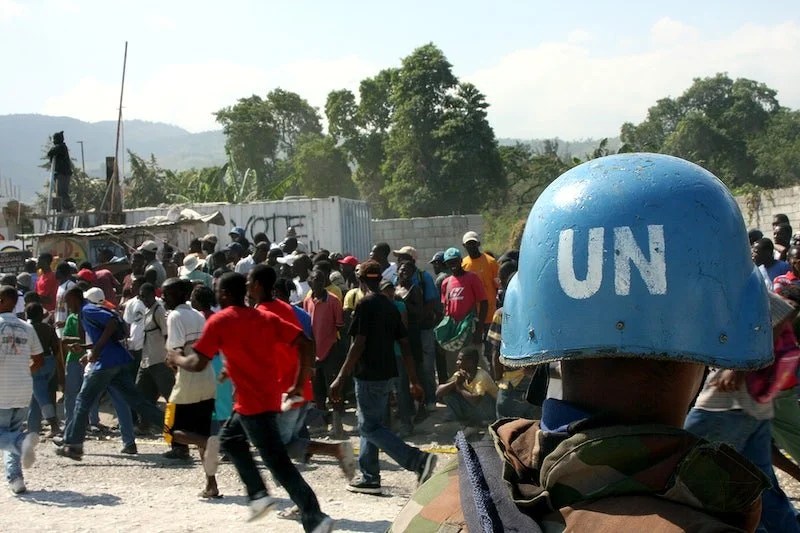
Why don’t the Haitian people rebel against non-stop oppression and distress? / By W.T. Whitney Jr.

Image via OWP

South Paris, Maine


Powerful forces weighing on the Haitian people keep rebellion in check. Predators armed with guns, and others with economic tools, have free rein. The U.S. government, recently rededicated to regional control – see the 2025 National Security Strategy – has long beat up on Haiti. All the while, Haitians’ lives and living are precarious.

U.S.-based Vectus Global is fighting gangs in Haiti. Its head is Eric Prince, well-positioned U.S. impresario of war-for-hire. His company’s drones killed 1,243 gang members and bystanders during a 10-month period. How can that be?

Haiti’s last elections took place in 2016. President Jovenel Moïse was murdered in 2021. Parliament closed down on 2023. The “Core Group” of nations appointed Ariel Henry as prime minister in early 2022, shortly after Moïse’s still unsolved murder. Escalating gang violence and delay in arranging for elections forced Henry’s resignation in 2024.

The U.S. government and the CARICOM group of nations replaced him with the Transitional Presidential Council (TPC), charging it with preparing for elections. Parliamentary elections projected for August 2026 probably won’t happen. Prime Minister Alix Didier Fils-Aime, a TPC appointee, had invited Vectus Global to Haiti.

A faction within the nine-person TPC defied U.S. pressure to seek Fils-Aime’s dismissal on grounds of corruption and weak response to gang violence. Three U.S. naval vessels arrived off Port-au-Prince four days before the TPC was scheduled to expire, on February 7. The TPC did go out of existence, and Prime Minister Fils-Aime did keep his job. He and his ministers constitute the entire Haitian government.

Gang violence had been expanding and, with UN Security Council endorsement, the U.S. government in 2024 arranged for, and partially funded, the Kenya-led Multinational Security Support (MSS) mission to Haiti. Funding and troop contributions lagged, and the Security Council in late 2025 approved a U.S-proposed resolution for transforming the MSS nto a 5,500 troop “Gang Suppression Force.” It will be collaborating with Haiti’s police.

The theme so far here has been foreign control of Haiti and her people, especially U.S. control. The U.S. government is well-versed in this, what with military occupation (1915-1934), backing of the father-and-son Duvalier dictatorship (1957-1986), and U.S.- inspired coups in 1991 and 2004.

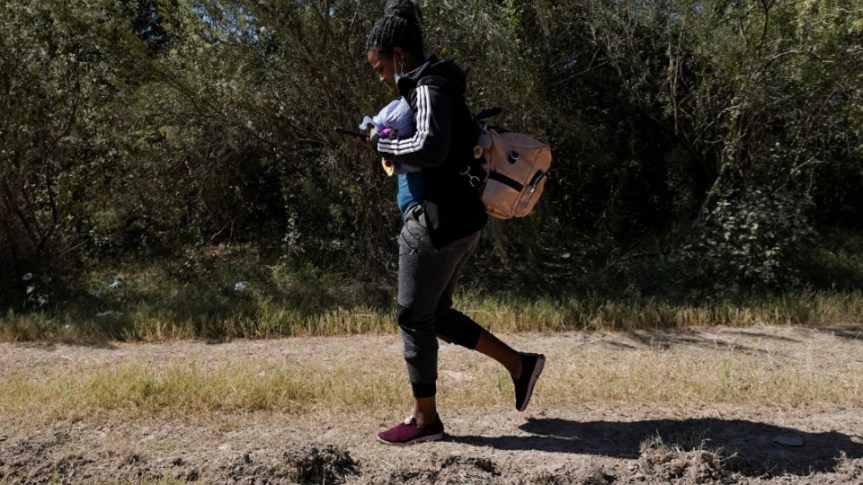
Haitians’ interaction with the United States these days is mediated mostly through migration. As of March 2025, 330,735 undocumented Haitians were living legally in the United States by virtue of Temporary Protected Status (TPS). That program, established in 1990, provides relief for irregular migrants to the United States facing deportation to a dangerous homeland. The Trump administration determined that TPS for Haiti would end on February 3, 2016. A federal judge in February 2 ruled against that action. An appeals court agreed on March 6, and the Supreme Court will finally decide.

Dead end

If TPS ends, Haitians returning to their country will be in trouble. According to one report, “Many repatriated Haitians arrive with nowhere to go–nearly 20% were already internally displaced before leaving the country.” As of February 2025, 10% of Haiti’s population – 1,450,254 individuals – had already been displaced from their previous homes, and are living in make- shift housing and tents.”

Displacement has resulted from actual and/or threatened violence at the hands of gangs. Gangs now control large sections of Haiti’s cities – 90% of Port-au-Prince – and areas in rural Haiti, mostly in the North. Gangs killed nearly 6000 people in 2025 and more than 16,000 since 2022. They have unleashed a wave of sexual violence. Children, who are the primary victims, make up half of the gangs’ fighters.

Meanwhile, no sign appears of any moderate or left-leaning political movement or party actively pushing for democracy and social justice in Haiti. Although the social democratic Lavalas Party was the vehicle for Jean Bertrand Aristide serving as Haiti’s president off and on between 1990 and 2004 – and still surfaces on the Internet – its influence is nil. Our question is this: why are progressive resistance forces absent or inconsequential in circumstances of great danger for Haiti’s people?

Power plus

One determining element may be the fact of a political void. Opposition movements usually take aim at an objectionable government. Only a shell of government exists in Haiti. It so lacks substance as to hardly qualify as a target. On defeating Haiti’s powers-that-be, a progressive resistance movement would be charged with building entirely new governmental institutions and administrative components, not to speak of new vision and
commitment.

More fundamentally: realization of progressive aspirations would now entail confrontation with power so overwhelming as to render actual resistance as almost unthinkable. Part of that power is U.S. power, as examined above. But most certainly, power shows in Haiti too, specifically with gangs and with Haiti’s wealthy elite.

The gangs hold a near monopoly on lethal violence, as is evident in the numbers cited above. Gangs emerged during the presidencies of Michel Martelly (2011-2016) and Jovenel Moïse (2017-2021). Protesters intermittently filling the streets of Port-au-Prince were demanding relief from high prices, shortages, and governmental corruption. Haiti’s elite, seeking protection, paid the gangs and supplied weapons and ammunition.

The gangs multiplied, joined in competing alliances, and found their own generous sources of income. According to a United Nations report, “Gangs dominate supply chains and extort commerce and humanitarian transport routes, giving them huge power to siphon off Haiti’s resources and destabilize its economy.” They profit from “extortion, kidnapping, drug trafficking and arms sales … Firearms … are mostly trafficked to Haiti from the United States for local use.”

The Report says that money the gangs generate is “smuggled through bulk amounts of cash, unregulated money transfer services, or front companies – many of which are linked to politically-connected economic elites.”

Really big bourgeoisie

Wealthy oligarchs control Haiti’s commerce and industries. In a comprehensive report from 2025, journalist Eric Andrew-Gee refers to “the dozen or so families of European or Middle Eastern descent who largely control Haiti’s impoverished economy” and are known for “dodging taxes, financing politicians and funding gangs as private militias …[A] rapacious economic elite …own virtually everything of value in the country.” One powerful family’s wealth comes from “soap and oil,” another’s from “steel, telecom, banking, oil and food,” and another’s from “supermarkets, news outlets and agribusiness concerns.”

Victimization of Haiti’s workforce, and of all Haitians, by the rich and powerful complements oppression at the hands of gangs and U.S. interventionists. The scenario clearly is that of class against class. Struggle on that basis apparently has to wait. Prisonlike circumstances require that Haitians confine themselves to fighting for their own survival.

This combination of gang violence, U.S. intrusions, and exploitation by Haiti’s rich and powerful has to be crushing, especially for a people who are deprived and suffering. Two thirds of the population are poverty-stricken. More than half of the people require humanitarian assistance. According to the World Food Program, more than half of all Haitians suffered from “acute food insecurity” in mid-2025. Most Haitians are deprived of anything approaching adequate healthcare and housing.

Additionally, Haiti’s working people and certainly unionists play only a marginal role within Haiti’s overall economy. They are weak and ill-prepared for fight-back. Half of all workers labor in agriculture, fishing or forestry. Those occupations account for only 20% of the country’s GDP. Remittances produce another 20%. Industry in Haiti in 2023 did contribute
25% of the GDP. But only 12.4% of all workers had manufacturing jobs. And some of those are disappearing, notably in Haiti’s garment industry, source of 5% of the county’s GDP. Factories are closing. Haiti’s unemployment hovers around 15%.

Division

Haiti’s African-descended people, through the generations, have consistently harbored a big impediment to entering into struggle, one existing apart from current circumstances. From slavery times, through the period of rebellion and independence struggle (1791-1804), and subsequently into the present era, Haitians have splintered according to class and skin color. Throughout, a minority class of more privileged, lighter-skinned, and French-speaking mulattos have remained apart. Their antecedents collaborated with the French slave owners.

They gained dominance over Haiti’s Black working-class masses, as national life developed. The tension remains. In his writings, Communist leader Jacques Roumain (1907-44) put the population’s social-class divide ahead of color differences. Author Philippe-Richard Marius summarizes: “The Haitian Revolution defeated White supremacy and gave rise to a new ruling class divided into color categories but united in the subjugation, exclusion, denigration, and exploitation of the Black working classes.”


W.T. Whitney, Jr., is a political journalist whose focus is on Latin America, health care, and anti-racism. A Cuba solidarity activist, he formerly worked as a pediatrician and lives in rural Maine.

Cuban Adjustment Act of US Still Privileges Cuban Migrants, Hurts Cuba / by W. T. Whitney Jr.

The Cuban Adjustment Act of 1966, the only one of its kind in the world, continues to encourage irregular emigration, the repeal of which will be essential to achieve normal migratory relations between the two countries | Credit: Granma – en.granma.cu

“Maybe if you had printed more about the operation, you would have saved us from a colossal mistake.” President John Kennedy was berating New York Times editor Turner Catledge. The Times and the U.S. media generally had glossed over widely-known preparations for the Bay of Pigs attack in April 1961. Catledge had removed the revealing substance of reporter Tad Szulc’s detailed news story 10 days beforehand.

Media silence has attended other Cuba -related developments over the years. Many U.S. progressives and liberals also tend to mention little about U.S-Cuban affairs, the U.S. economic blockade of Cuba being one example.

The Cuban Adjustment Act (CAA), which is about Cubans migrating to the United States, receives little attention, while fuss and fury grow over an unprecedented number of migrants, Cubans among them, crossing the U.S. southern border now. Officials there apprehended 1.8 million migrants between October 2021 and August 2022.

Most respondents to an NPR/Ipsos poll believe an “invasion” is taking place. Anti-migrant measures have led to political division and stalemate. Senators Lindsay Graham and Ted Cruz sent a letter to Department of Homeland Security Secretary Alejandro Mayorkas on October 5. The Biden administration’s migration policies, they claimed, represent “gross dereliction of duty … violation of your oath of office …[and] grounds for impeachment.”

Cubans, enabled by the CAA, find welcome in the United States. That 1966 law allows Cuban immigrants and their immediate families to become permanent U.S. residents. To be eligible, the Cuban migrant on arrival has to be “inspected, admitted or paroled.” He or she waits for one year, while receiving social services, and then applies for permanent residency, and gains a work permit. Other immigrants must wait five years to apply.

Why is Cuban immigration encouraged? The idea may have been that of displaying the failure of a Communist government through Cubans leaving, or of fracturing popular unity in Cuba through emigration, or of strengthening the Cuban-American voting bloc through new Cuban arrivals.

Numbers of Cuban migrants have increased recently. There were 9,822 “southwest border encounters” of border officials with Cubans in fiscal year 2020, 38,674 in FY 2021, and 174,674 Cubans in the FY ending on October 1, 2022. Between October 2021 and June border officials detained more than 1300 Cubans arriving by sea in Florida.

Cubans have been enduring shortages, high prices, and low income due mostly to the U.S. economic blockade and cut-backs on the remittances Cuban-Americans send to family members on the island. That’s one set of reasons for leaving Cuba.

Additionally, Nicaragua in November, 2021 began allowing Cubans to enter without an entry visa. Migrants can now start on their trip closer to the border than, as before, having to travel through South America.

And most of the 20,000 Cubans who would have entered the United States annually, as authorized by a 1994 bi-national agreement, have not done so. That’s because almost no processing of entry visas has taken place since 2017, when the State Department recalled most of its Embassy staff in Havana. That was in response to a mysterious neurological syndrome afflicting U.S. diplomats and staff.

Few Cubans have been able to afford travel to U.S. embassies in other countries to secure visas. Consequently, departing Cubans have resorted to irregular means. The State Department has recently begun to send diplomatic staff back to its Havana Embassy.

New rules are in place. The Obama administration in 2017 ended the government’s “wet foot, dry foot” policy, in force since 1995. During that period, Cubans apprehended at sea were returned to Cuba. Those who arrived and touched U.S. soil could stay and eventually gain permanent residency status.

Cuban migrants crossing at the U.S. southern border still receive preferential treatment. Unable to show the required evidence of “lawful entry,” they benefit from creative arrangements that convert an irregular entry into a legal one.

Presently, “nearly 98 %” of Cuban migrants entering the United States stay. Border officials apply public health (anti-Covid 19) regulations known as Title 42 to all would-be immigrants. They immediately exclude half of them, but not the Cubans. Excluded migrants wait in Mexico or elsewhere for immigration judges to decide on their applications for asylum.

Some of the entering Cubans receive “humanitarian parole.” Under CAA regulations, that status qualifies as “lawful entry” and the migrant is able to wait for a year in the United States and then apply for permanent residency – and usually receive it.

Other Cubans not receiving humanitarian parole also remain in the United States by means of a “bond” requiring them to appear before immigration judges “where they can launch a defense for staying.” Most migrants in this group whose appeals are successful can count on gaining permanent residency.

A few have been unsuccessful and that group received good news on February 23, 2022. The U.S. Citizenship and Immigration Services announced that Cuban migrants whose appeal for permanent residence had failed now may try again, with likely success. The agency was responding to an immigration court ruling in 2021 that any release of Cuban migrants from custody at the border, whatever the circumstances, actually does represent “lawful entry” or parole, as required by the CAA.

Most of the Cubans exiting from their country are young adults and children. They benefited from the high-quality education, healthcare, and social support that was their birthright. Their energy, talents, labor, and potential commitment would no longer be contributing to Cuba’s national project of development and recovery. Their departure, one supposes, weakens the bonds of family life in Cuba and thereby makes Cuban society less cohesive.

The U.S. leadership class likely has little regret. The U.S. intention, after all, is to cause distress in Cuba leading to regime change. Moreover, U.S. economic blockade of Cuba, occupation of territory in Guantanamo, destabilizing interventions inside Cuba, and the CAA, taken together, add up to attack on Cuba’s independence and national sovereignty. The silence of the media and of political activists on these matters takes on an ominous quality, that of complicity with crimes.

The community of nations enabled the United Nations to deal with international crimes. Under the United Nations Charter, the Security Council may confront “any threat to the peace, breach of the peace, or act of aggression” of one nation against another. The General Assembly in 1965 unanimously approved Resolution 2131 which states that, “No State has the right to intervene, directly or indirectly, for any reason whatever, in the internal or external affairs of any State.”

What situations would these authorizations be applied to, if not to the instances recited here of U.S. aggression against Cuba?


W.T. Whitney Jr. is a political journalist whose focus is on Latin America, health care, and anti-racism. A Cuba solidarity activist, he formerly worked as a pediatrician, lives in rural Maine. W.T. Whitney Jr. es un periodista político cuyo enfoque está en América Latina, la atención médica y el antirracismo. Activista solidario con Cuba, anteriormente trabajó como pediatra, vive en la zona rural de Maine.

The United States Uses and Abuses Migration from Cuba and Elsewhere / by W. T. Whitney Jr.

A Cuban national walks along a road after crossing the Mexico-Texas border at the Rio Grande, Sept. 23, 2021, in Del Rio, Texas. | Julio Cortez / AP

Presently 3.6% of the world’s people live in a country other than their own. They move to escape wars, oppression, poverty, hunger, climate-change effects, or to find new work, or because they were forced to move. The story is also about nations weaponizing or exploiting migration. 

After a decade or so of relatively few Cubans arriving in the United States, their numbers are up. Between 2018 and 2021, some 2,000 Cubans emigrated to the United States. But in January almost 15,000 Cubans crossed the U.S. southern border; the daily average in February was 1500. U.S. border officials are seeing “a twelvefold increase over 2020,” according to the Washington Post.

Contributing to migration is the increasingly dismal state of Cuba’s economy. At work has been U.S. economic blockade, fallout from the Covid-19 pandemic, and unresolved domestic issues including: inflation, corruption, cumbersome implementation of reforms, shortfalls in domestic food production, and fallout from converting two currencies into one. 

U.S. officials deported only 20 arriving Cubans in the past five months, and only 95 during 2021. That’s because Cuban immigrants arriving without papers are privileged, thanks to the 1966 Cuban Adjustment Act (CAA).  That law enables unauthorized Cuban migrants automatically to gain permanent residence after a stay of two years, which in 1976 became one year. By contrast, non-Cuban arrivals have to apply for permanent residence and then wait. 

President Obama in January 2017 repealed an administrative regulation allowing those Cuban migrants who entered the United States after sea-travel to stay, while sending Cubans apprehended at sea back to Cuba. No longer could Cubans arriving by water remain. Migrants reacted by resorting to the arduous Central American land route to the U.S. border. 

When the migrants of other countries travel that route, cross the border, and are apprehended, they are either quickly deported, allowed to wait in Mexico or in immigration prisons for asylum decisions, or are released to await court appointments.  By contrast, Cubans crossing the border usually gain so-called “humanitarian parole” and are released. Or they are released after brief detentions to await immigration-court rulings on asylum requests. After a year they become eligible for permanent residence, as per the CAA. 

The CAA-mediated enticement of early permanent residence has served the U.S. purpose of encouraging a flood of Cuban immigrants who, by fleeing, are living proof of alleged Communist oppression. Maybe the purpose of a relatively relaxed treatment of a new generation of Cuban migrants, who also arrive after great travail, is to revive that salutary example of escape from Communism. 

But paradoxically, the U.S. government acts also as if to impede travel by Cubans to the United States, as if to keep them away.   For example, the U.S. government in 2017 removed personnel from its Embassy in Havana. This was in response to the neurologic syndrome, still unexplained, that afflicted diplomats stationed there. Doing so, the State Department deprived Cubans of consular services needed for legal travel to the United States.

They’ve been forced to visit U.S. embassies elsewhere to obtain entry visas, in Bogota, Colombia and in Guyana.  The travel costs are prohibitive for most travelers. The U.S. government indicated in March that its Havana Embassy would soon be processing visas for entry into the United States, but only for parents of U.S. citizens.  

The two governments agreed in 1994 on a mechanism for legal emigration of Cubans to the United States. The U.S. government would authorize at least 20,000 lottery-chosen Cubans every year to move permanently to the United States.  But U.S. immigration officials almost never issue the required number of entry visas. 

Cubans without papers who want to reach the U.S. border via the Central American land route must start their trek in a country not requiring an entry visa. Now Nicaragua remains as the only visa-free country for Cubans. That’s because Panama, Colombia, and Costa Rica recently began demanding them, possibly at the behest of the U.S. government. 

Why does the U.S. government try to keep Cubans away from the United States even as it encourages them to establish permanent residence? Maybe officials want to show off the difficulties Cubans put up with so as to highlight Cubans’ ardor to leave a country that, in the official U.S. version, is troubled and oppressive.  Or maybe they want distressed Cubans to remain at home so they will end up joining destabilization campaigns there.  

But U.S. unease does prevail over the possibility of large numbers of Cuban migrants arriving and overwhelming U.S. abilities to absorb them.  Tens of thousands of Cubans did present that still-remembered threat as they departed for the United States via the “Mariel boatlift” (1980) and the “Cuban rafter crisis” (1994).  

One aspect of Cuban migration is shared with worldwide migration patterns, as explained by Cuban scientist and close political observer Agustín Lage.  In regard to increasing Cuban emigration to the United States, Lage emphasizes “the emigration of young people with university education.” 

That phenomenon reflects “changing migratory processes during the twentieth century” that affect economies and jeopardize “states with compromised social and economic development.” He is alluding to underdeveloped societies in the Global South and presumably to the legions of scientists and physicians Cuba has prepared over many years. They are “human capital” and are a major resource for Cuba’s economy.

Lage points out that immigrants of the “professional” classes entering the United States have increased from 3% in 1930 to 40% now, at which point most have been educated in Asia and Latin America. One third of all scientists prepared in the under-developed world now live in developed nations.  What’s crucial is that “the segment of migrants with a university education grows more rapidly than the quantity of migrants in general.”

The United States is the “principal beneficiary of this migratory flow.”  Of all scientists who emigrated from under-developed countries, 76% are in the United States. Lage cites U.S. legislation favoring migrants with “academic degrees” as indicative of U.S. purpose. 

“The countries of the South invest in the formation of human capital. But part of that human capital emigrates.” Economies in the North gain “value-added” benefit. Underdeveloped countries lose twice. They pay the cost of educating qualified people who leave and pay for “high-technology products they must import,” and which represent “an undeniable contribution from those same migrants.”  

For Lage, the United States shapes immigration policies according to economic self-interest and readily subjects the needs of lesser countries to its own requirements. Clearly, U.S. manipulation of Cuban migration for counter-revolutionary purposes is in the same vein.  

Lage concludes: “Against us has been operating economic aggression for more than six decades that has affected the population’s material living conditions. In any historical moment and in any place on the planet, prolonged economic difficulties have given rise to migratory pressures. And Cuba is on this planet. “But our history and our culture are in our favor. The Cuban national consciousness is the basis for our capacity of resistance. Our culture and our history are deeply rooted here and also in the consciousness of Cubans who don’t live here.”  Nevertheless, “our project of a socialist society, one ‘with all and for the good of all’ (Jose Marti’s words), is at real risk.  We must not underestimate that.”

W.T. Whitney Jr. is a political journalist whose focus is on Latin America, health care, and anti-racism. A Cuba solidarity activist, he formerly worked as a pediatrician, lives in rural Maine. W.T. Whitney Jr. es un periodista político cuyo enfoque está en América Latina, la atención médica y el antirracismo. Activista solidario con Cuba, anteriormente trabajó como pediatra, vive en la zona rural de Maine.

People’s World, April 12, 2022, https://www.peoplesworld.org/