
Trump’s Cuba Memorandum provokes strong criticism amid new US aggressiveness abroad / By W. T. Whitney Jr.

Photo via Resumen Latinoamericano 

South Paris, Maine


The Trump administration on June 30 released its “National Security Presidential Memorandum 5” on U.S. plans for Cuba. Criticism from Cuba’s government and international commentators welled up, as if entirely new forms of anti-Cuba aggression were in the works. That may or may not be so. Actually, the recent Memorandum was a re-issue of the document put forth by the first Trump administration on June 16, 2017.

The eruption of an unusually forceful reaction to a Memorandum that says nothing new seems odd. It’s not. For one thing, the Memorandum creates an opening for U.S. government departments and agencies to fashion entirely new devices aimed at destroying Cuba’s economy. The 2017 Memorandum did exactly that, and what happened was disastrous.

And more: the international context of U.S. assaults on Cuba has drastically changed. U.S. foreign intervention now shows as war from the sky against Iran and as U.S. support and military hardware for genocide against Gazans. Is Cuba next in line for extreme measures?

Prescriptions

The Memorandum’s ostensible use is as a directive to heads of the various departments making up the U.S. government’s executive branch. It requires them to send President Trump reports on new tools they have devised for beating up on Cuba, and to do so within 30 days. They must “adjust the current Cuba regulations in order to ensure adherence, so
that unauthorized transactions with Cuba and impermissible travel to Cuba are effectively banned.”

The document attests to the authority already vested in the departments to take action against Cuba. It cites the 1996 Helms-Burton Law as having legitimized the U.S. purpose of regime change for Cuba.

The Memorandum sets forth various U.S. goals and various ways to implement them. These include promotion of free enterprise in Cuba, channeling funds to the Cuban people and not to their government, “restructuring certain travel arrangements and [US] travel,” and ending supposed human rights abuses in Cuba. This year’s Memorandum once more calls for depriving Cuba’s military and intelligence services of money derived from U.S. tourism.

This Memorandum, as with the other one, bans U.S. tourism to the island. All U.S. citizens traveling to Cuba for permitted reasons must keep records of their transactions in Cuba and for five years ensure that they are available for potential Treasury Department inspection.

The Memorandum directs U.S. officials to expand Cubans’ access to the Internet and to a “free press” and to oppose efforts at the United Nations and “other international forums” aimed at blocking U.S. policies on Cuba. Annually, the secretaries of the various departments of the executive branch must report to the president “regarding the engagement of the United States with Cuba to ensure that engagement is advancing the
interests of the United States.”

President Biden never disavowed Trump’s 2017 Memorandum. As a result, actions adverse to Cuba carried out under its authority remain in force.

Reaction

In discussion on July 2 with Randy Alonso Falcón, host of Cuban TV’s “Round Table” (Mesa Rotunda), Cuban Vice Foreign Minister Carlos Fernández de Cossío portrayed the recent Memorandum as a “political platform, a political document that is propagandistic, but also one that is a political declaration of U.S. intentions serving as a cover for actions it will take and others already in effect.”

As examples of the latter, he cited both sanctions applied to ships of third countries bringing fuel to Cuba and denial of access to the U.S. Visa Waiver program to those otherwise eligible citizens of 40 named countries who have visited Cuba. Now, potential travelers to Cuba often choose not to visit Cuba so as to preserve their eligibility. The intended result has been damage to Cuba’s tourism industry.

Cossio claimed that U.S. measures prompted by the recent Memorandum pose extra danger from “the hand of [Secretary of State] Marco Rubio … [and] of that clique that has made money and political careers out of hostility towards Cuba.” He laments harassment against individuals and businesses licensed to export goods to Cuba’s private sector, suggesting that the U.S. government seeks to harm Cuba’s private sector. He worries that some Cuban-Americans visiting in Cuba may be barred from returning to the United States.

The foreign ministry official pointed to a big change. Cubans have been “receiving privileged treatment on crossing the US border.” They are now vulnerable to “all [U.S.] anti-migrant actions including the alligator prison in Florida.”

International criticism of the recent Trump Memorandum erupted promptly and from many quarters, beginning in Cuba. Cuban president Miguel Díaz-Canel condemned the U.S. “purpose of inflicting the greatest possible damage and suffering.” National Assembly President Esteban Lazo, predicted their “vile purpose will fail in the face of Cubans’
unity and determination. “Cuba will defeat this new aggression,” pronounced Prime Minister Manuel Marrero Cruz.

The Bolivarian Alliance for the Peoples of Our America (ALBA) judged the Memorandum to be “aimed at forcefully hitting at all sectors of Cuban society.” Argentina’s International Committee for Peace, Justice, and Dignity for the Peoples declared its support for U.S. opponents of the Memorandum. Brazil’s Landless Workers Movement (MST) on July 3
initiated an international fundraising campaign to send essential medicines to Cuba.

Mexican President Claudia Scheinbaum on July 2 denounced the Memorandum, while declaring that “Mexico is the country that for decades voted against the blockade of Cuba and that will always be our position.” Mao Ning, spokesperson for China’s Ministry of Foreign Affairs on July 2 stated that, “We exhort the USA to immediately raise the blockade and sanctions against Cuba, and eliminate the U.S. list of state sponsors of terrorism.”

The most explosive and revealing reaction came from Rosa Miriam Elizalde, editor of Cubadebate.cu. She was echoing Vice Minister Cossio’s observation that “Perhaps U.S. officials imbued with this euphoria over a new U.S. foreign policy of imposing peace through force are demanding something similar with Cuba.”

Writing for Mexico’s La Jornada news service on July 5, Elizalde points to “[D]éjà vu: More than 20 years after the United States invaded Iraq under false pretexts, we are witnessing the same warmongering operetta in South Florida … During the spring of 2003, while the missiles were falling on Baghdad, the ultra-sector of Cuban emigration took to the streets of Miami with a disturbing slogan: ‘Iraq now; Cuba later’”.

She notes that, “[T]he Miami propaganda machine is once again waving the flag of armed intervention [in Cuba], while the U.S. and Israel are escalating their military offensive in Iran.” She highlights Congresswoman María Elvira Salazar’s remark that, “This is how tyrants are confronted, not only in Iran, but also satraps in Cuba, Venezuela and
Nicaragua. Peace through force. That’s the American way.”

Elizalde regards as ominous that “Trump invokes as an American military success the sad memory of the Hiroshima and Nagasaki bombs.” She describes a volatile situation in which “[i]mmigrants are hunted down like beasts, just like communists and Jews before World War II.”

She views the current political climate as recalling that of 2003, when the United States invaded Iraq: “The logic is the same: misinform, isolate, demonize, justify sanctions and, if conditions are right, authorize intervention in the “dark places of the planet.”


W.T. Whitney Jr. is a political journalist whose focus is on Latin America, health care, and anti-racism. A Cuba solidarity activist, he formerly worked as a pediatrician, and lives in rural Maine.
US Labor Must Weigh in on Cuba / By W.T. Whitney

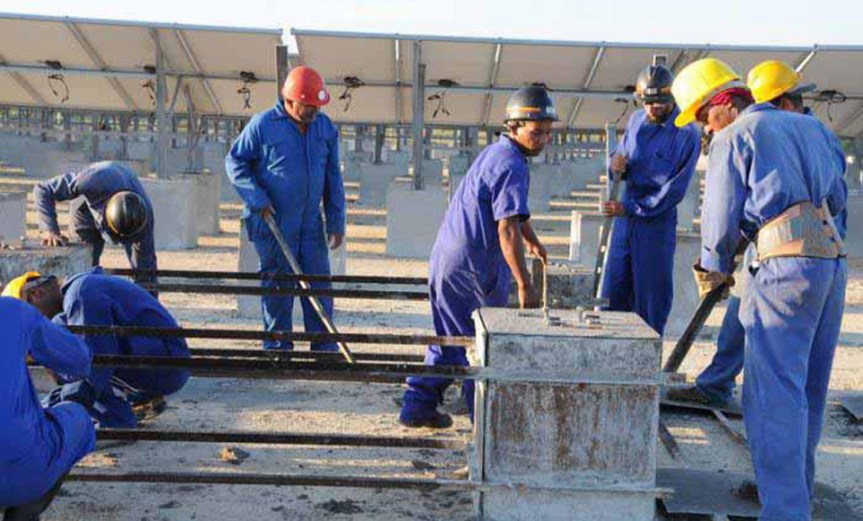
Photo credit: Juan Carlos Dorado

South Paris, Maine


Taking note of International Workers’ Day, several Latin American news sources this year cited José Martí’s 1886 essay “A Terrible Drama;” two of them republished it, here and here.  There Martí reports on events in Chicago in 1886 and the fate of the so-called Haymarket Martyrs – seven labor journalists and agitators railroaded to prison and given death sentences.  Another received a 15-year prison term.

Martí, who would become Cuba’s national hero, was living in exile in the United States. He relates how strikes for the eight-hour day were underway on May 1, 1886 in Chicago and nationwide, how the Chicago police killed one striker and wounded others on May 3, and how a mass protest against police violence took place the next day in the Haymarket area. There, a bomb exploded, seven policemen and four workers were killed, and dozens were wounded. 

The court lacked evidence that the defendants, anarchist by inclination, were involved in the violence of May 4. Martí describes the execution of four of them and the suicide of another. An appeals court judge commuted the sentences of two defendants to life in prison. In 1893, Illinois Governor John Altgeld pardoned those two and the remaining prisoner.

The Socialist International in 1889 declared May Day to be an annual celebration of labor militancy.

José Martí’account, “A Terrible Drama,” is a foundational contribution to the history of the U.S. labor movement. Martí defended working people – U.S. workers in his writings, and Cuban workers in words and deeds, from 1886 on. The combination of author and story points to a connection between U.S. labor activism and workers’ struggles in Cuba. Its time has come.

The U.S. economic blockade of Cuba, lasting decades, has led to shortages, misery, and despair. Nations of the world voting annually in the United Nations General Assembly overwhelmingly condemn the blockade. It violates international law.

Domestic opposition to U.S. policies on Cuba, while persistent, vigorous at times, principled, on-target, and diverse, has fallen short. U.S. government measures aimed at destabilization remain in force.  Upping power of the people with labor combativeness would make a difference.

Unions and labor activists know how to organize and how to confront recalcitrant political and economic leaders. They will be active on Cuba’s side, once they realize that working people’s struggles in the two countries are linked, or so our theory goes. In addition:

·        Labor unionists involved in struggle count on unity, the power of numbers, and sometimes solidarity from counterparts, often from abroad.

·        The current Cuban Revolution is the product of a revolutionary tradition. U.S. workers confronting their own government on Cuba would be expressing solidarity with a revolution whose progenitor, Jose Martí, defended U.S. workers fighting for the eight-hour day.  They would be paying back. 

·        Social revolution and ordinary labor struggles are battles of ideas. The writings of Martí, maximum leader of Cuba’s early revolution, speak to Cuban and U.S. workers alike. In that way they are connected.

Martí wrote about working people and their lives.  He contributed greatly to the ideas and substance of revolutionary struggle in Cuba and also defended African-descended and poverty-stricken Cubans with a seemingly unqualified egalitarianism. For example:

·        “And let us place around the star of our new flag this formula of love triumphant: ‘With all, and for the good of all.’”

·        “A nation having a few wealthy men is not rich, only the one where each of its inhabitants shares a little of the common wealth. In political economy and in good government, distribution is the key to prosperity.”

·        “In Cuba there is no fear whatever of racial conflict. A man is more than white, black, or mulatto. A Cuban is more than mulatto, black, or white … True men, black or white, will treat each other with loyalty and tenderness for the sake of merit alone.”

Workers are oppressed

Responding to the Haymarket affair in his “A Terrible Drama,” Martí reflects upon the situation of U.S. working people:

“The nation is terrified by the increased organization among the lower classes … Therefore the Republic decided … to use a crime born of its own transgressions as much as the fanaticism of the criminal in order to strike terror by holding them up as an example …. Because of its unconscionable cult of wealth, and lacking any of the shackles of tradition, this Republic has fallen into monarchical inequality, injustice, and violence …

“In the recently emerging West … where the same astounding rapidity of growth, accumulating mansions and factories on the one hand, and wretched masses of people on the other, clearly reveals the evil of a system that punishes the most industrious with hunger, the most generous with persecution, the useful father with the misery of his children – there the unhappy working man has been making his voice heard.”

Martí’s “A Terrible Drama” appeared in La Nación newspaper in Buenos Aires in January 1888, some 19 months after the Haymarket events. The delay may have stemmed from Martí’s ambivalence about the anarchist leanings of the accused. Previously published segments of his report do appear under the title “The First of May, 1886” in historian Philip Foner’s anthology of Martí’s writings published in 1977. Excerpts follow:

“Enormous events took place in Chicago, but rebellion exists throughout the nation. In the United States … a firm and active struggle has been in preparation for years … …[T]hings are not right when an honest and intelligent man who has worked tenaciously and humbly all his life does not have at the end of it a loaf of bread … or a dollar put away, or the right to take a tranquil stroll in the sunlight… Things are not right when the one who in the cities … lives a contemplative life of leisure so exasperating to the miner, the stevedore, the switchman, the mechanic, and to every wretched person who must be content with seventy-five cents day, in raw winter weather …Things are not right if shabby women and their pallid children must live in tenement cubicles in foul-smelling neighborhoods. …The reasons are the same. The rapid and evident concentration of public wealth, lands, communication lines, enterprises in the hands of the well-to-do caste that rules and governs has given rise to a rapid concentration of workers. Merely by being gathered together in a formidable community which can, at one stroke, extinguish the fires in the boiler and let the grass grow under the wheels of the machinery, the workers are able successfully to defend their own rights against the arrogance and indifference with which they are regarded by those who derive all their wealth from the products of the labor they abuse.”

Deeds and words

Martí acted on behalf of working people. He organized Cuba’s independence struggle that culminated in war with Spain in early 1895. Under his leadership, the process became a social revolution.

From exile in New York, Martí outlined goals, strategies, and methods. Traveling widely, he arranged for Cuban exiles in the United States, Central America, and the Caribbean – many of them workers, many African-descended – to select the revolution’s leadership, provide funding and supplies, and approve goals and proposals. Martí persuaded the military heads to accept civilian leadership. He created and edited the independence movement’s newspaper Patria.

Aware of U.S. aspirations to dominate Cuba and the entire region, Martí led in confronting U.S. imperialism – never good for workers. In 1891 he wrote “Our America,” an essay demonstrating commonalities among diverse peoples inhabiting all the land extending from the Rio Bravo (the Rio Grande) south to Patagonia. Martí highlighted their shared cultural and political orientations that set them apart from U.S. and European societies.

In a letter to a friend shortly before he was killed in battle on May 19, 1895, Martí insisted that: “It is my duty … to prevent, by the independence of Cuba, the United States from spreading over the West Indies and falling, with that added weight, upon the other lands of Our America.”

Attacking military installations of the Batista regime on July 26, 1953, revolutionaries led by Fidel Castro were honoring José Martí, born 100 years earlier. For Castro, Martí was “the Apostle of Independence … whose ideas inspired the Centennial Generation and today inspire and will continue to inspire all of our people more and more.”

For the sake of justice and in view of connections with Cuban workers, U.S. working people would do well to press upon their government the necessity to end the blockade of Cuba. Labor unions, the principal means for expression of workers’ sentiment and power, have prime responsibility in this regard.

They would be acting as did West Coast dockworkers who blocked arms shipments to Chile under the Pinochet dictatorship, cargo arriving from apartheid-ridden South Africa, and, recently, arms shipments bound for Israel. U.S. unionists actively opposed their government’s support for authoritarian El Salvador in the 1980s and supported Iraqi workers after the U.S. invasion there. They collaborated with Mexican miners and other workers over many years. Recently U.S. unions issued statements and approved resolutions calling for a ceasefire in Gaza.  


W.T. Whitney is a political journalist whose focus is on Latin America, health care, and anti-racism. A Cuba solidarity activist, he formerly worked as a pediatrician, lives in rural Maine. W.T. Whitney Jr. es un periodista político cuyo enfoque está en América Latina, la atención médica y el antirracismo. Activista solidario con Cuba, anteriormente trabajó como pediatra, vive en la zona rural de Maine.

On US Hesitation, Guy Philippe, and Saving Haiti / By W. T. Whitney Jr.

Coup leader Guy Philippe repatriated to Haiti from the U.S. | AP Archive [Youtube]

South Paris, Maine


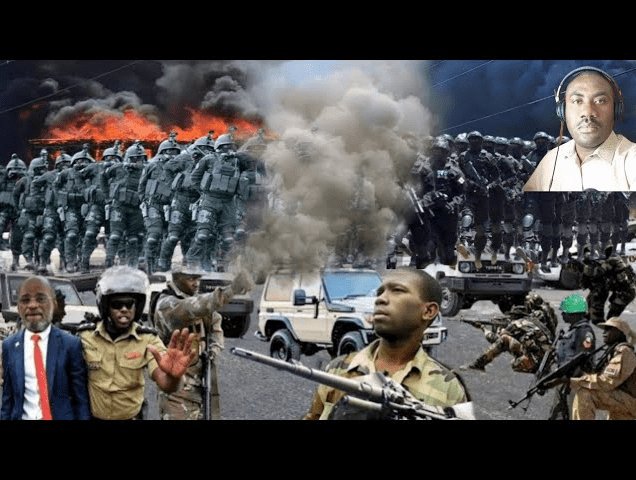
Reports have circulated of gang warfare in Port-au-Prince and other Haitian cities, and of killings, shortages, social catastrophe and a government gone AWOL.  Also entering the news cycle was the UN Security Council’s approval in October 2023 of plans for troops from nine nations, other than the United States, to jointly occupy Haiti

The U.S. Defense Department had arranged for 1000 Kenyan troops to lead the multi-national force. The international force did not arrive in Haiti pending a decision of Kenya’s High Court on Kenyan forces serving overseas. On January 26, that court prohibited the deployment, and plans for the international force are in disarray.

Less is known about U.S. planning on Haiti that takes into account the most acute of Haiti’s intractable problems. There are the well-known ones, but also political corruption, business-class financing of gangs, U.S. supply of weapons for the gangs, a government headed by the unelected and widely-reviled Aaron Henry, no workable plans for a transition government, and the murky circumstances of president Jovenel Moise’s murder in July, 2021.

Instructions

The U.S. government in April 2022 announced that a new relationship with Haiti was in the works. The description relies on generalities such as: “a long-term, holistic view,” “forward-thinking rather than reactive mindset,” “Seeking innovation while scaling success,” and “Prioritizing locally driven solutions.”

The statement offers ideas on ways to implement guidelines from the Global Fragility Act (GFA) of 2019. That legislation sets forth concepts informing a new U.S. strategy for dealing with nine troubled countries in the Global South. Haiti is the only one in the Western Hemisphere.

It’s a “comprehensive, integrated, ten-year strategy” for achieving “the stabilization of conflict-affected areas,” and with the purpose of “strengthen[ing] the capacity of the United States to be an effective leader of international efforts to prevent extremism and violent conflict.”

Another statement, also released in April 2022, is about overall GFA implementation, not specific to Haiti The GFA would “build peace across divided communities, leverage and enable societal resiliencies … anchor interventions in communities … [and be] informed by the insights of expert practitioners and academics.”  The United States is seeking “true mutual partners and [would] commit to multilateral solutions.”

The GFA represents for Haiti “a “repackaging” of U.S. interventionist policies.” Analyst Travis Ross also suggests that U.S. troops would encounter “fiercer resistance than they did in their 1915, 1994, and 2004 interventions.”

The package is new, but substance is scarce. Specific objectives and precise methods for influencing affairs inside Haiti are lacking. There’s no mention of military and/or police action. Policymakers’ hesitation may be due in part to the ill-defined, if tumultuous, nature of difficulties they anticipate.

Loose cannon

Guy Philippe may be a case in point. The former narco-trafficker, imprisoned in the United States for money laundering since 2017, finished his term and returned to Haiti in November 2023. He has been touring Haiti’s cities and towns.

He speaks to crowds about Haitians choosing their own government, building their economy, rejecting foreign oversight and intervention, removing de facto government head Ariel Henry, and restoring Haiti’s Army.

Heading a paramilitary force of hundreds, Guy Philippe’s destabilization campaign prepared the way for the coup in 2004 that removed the progressive and democratically-elected president Jean-Bertrand Aristide.

Trained by U.S. special forces in Ecuador, Philippe in the 1990s was a brutal police chief in two Haitian cities notable then for extra-judicial killings. In 2001 he organized a failed coup. Philippe ran for president in 2006, was elected senator in 2016, and heads his own political party.

Philippe has visited Haiti’s northeastern region, particularly Ouanaminthe, at least twice. This small city on the west side of the south-to-north flowing Massacre River, part of the boundary between Haiti and the Dominican Republic (DR), is a crossing point for binational commerce and for Haitians traveling to and from low-paying jobs in the DR.

The region is a display case for the hostility and racism experienced by Haitians in the DR. Dominican dictator Rafael Trujillo’s massacre of thousands of Haitians took place along the Massacre River in 1937. (The name derives from massacres in the 17th century.)

Guy Philippe has joined the fight local people are pursuing with Dominicans over a canal for diverting water from the Massacre River into Haiti for agricultural purposes. The process of building the Pittobert irrigationcanal has extended over years, but enthusiasm for completing it recently brought small farmers and agricultural workers together as voluntary work crews.

Although 10 diversion canals deliver water to the DR side, the government there denounces the Haitians’ canal as depriving DR farmers and nearby mines of needed water. The Dominican government, in protest, closed the border between September 15 and October 8, 2023.

Speaking “to a multitude” in Ouanaminthe on Jan 3, Philippe insisted that, “We can construct as many canals as we think are necessary. I come to salute the determination and the bravery of these men and women who say that we are independent and sovereign in our country.” Philippe was honoring canal workers and security officers who had stood up to Dominican troops entering Haitian territory on November 7.

The latter are members of the Brigade for Surveillance of Protected Spaces (BSAP), a police unit of 15,000 officers charged with protecting national parks.  Observer Kim Ives explains that, “Guy Philippe sees a future for [the BSAP] as a sort of popular militia that can be a surrogate or support for the PNH (Haitian National Police) and Haitian army.”

The incident [on November 7] didn’t happen by chance,” opined a pro-Haiti commentator; “it’s part of the US plan under the Global Fragility Act to set the DR against Haiti … to unite the entire island under a single government … [This] provocation by the United States, mediated by the racist government of the Dominican Republic, accompanies war and American imperialist domination in the Caribbean and Latin America.

On January 24, “Sympathizers of the revolution led by Guy Philippe” filled the streets of Ouanaminthe, according to a report. They attacked banks and public offices, and demanded protection for a BSAP leader.  

Taken as a whole, the account offered here is of a U.S. response to Haiti’s extreme difficulties that, apart from charitable sentiments, is directionless, lacking in specifics, and incomplete. As a dispensation from on high, it represents a kind of noblesse oblige.

Either the U.S. government is turning away from Haiti’s affairs – not bad news – or has other, unknown plans for Haiti, which is more likely. The U.S commercial and investing class will undoubtedly be weighing in.

From that quarter may come concern about lost opportunity in allowing  Haitians alone to decide what happens with deposits of gold and other minerals worth $20 billion. They lie in the mountainous areas of northern Haiti, not far from the Massacre River.


W.T. Whitney Jr. is a political journalist whose focus is on Latin America, health care, and anti-racism. A Cuba solidarity activist, he formerly worked as a pediatrician, lives in rural Maine. W.T. Whitney Jr. es un periodista político cuyo enfoque está en América Latina, la atención médica y el antirracismo. Activista solidario con Cuba, anteriormente trabajó como pediatra, vive en la zona rural de Maine.

The terror returns: Cuba discloses latest attacks by the U.S. / by W. T. Whitney Jr.

Some of the weapons seized from a Florida-based terrorist captured on Cuban soil after he snuck onto the island via jet ski. | Photo courtesy of Granma

Reposted from the People’s World


When the U.S. government launched its so-called “Global War on Terror” after the al Qaeda attacks of Sept. 11, 2001, U.S.-led terror attacks against Cuba had already been ongoing for over 40 years.

They included: military invasion (1961), CIA-sponsored counter-revolutionary paramilitaries in the countryside (1960s), a fully loaded Cuban airliner brought down by U.S. agents (1976), attacks on coastal towns and fishing boats, biowarfare, hundreds of killings in Cuba and abroad, sabotage, and bombings of hotels and tourist facilities (1997).

With the new century, however, violence and terror seemed to be on vacation. The Cuban media and sympathetic international media were reporting little or nothing about U.S.-based terror attacks that had been their stock in trade.

On Dec. 17, 2023, Cuban Chancellor Bruno Rodríguez released a statement harking back to the violent past. He insisted that the “U.S. government is very aware of the official, public, and repeated denunciations by the Cuban government of the assistance, protection, and tolerance that promotors and perpetrators of terrorist acts against Cuba enjoy in the United States.”

He added that, “Recently Cuba’s Interior Ministry has reported on the dismantling of destabilization plans developed in the United States by terrorists of Cuban origin in a security operation that led to the detention of several persons tied to this conspiracy.”

Rodríguez’s statement followed a report appearing on the Communist Party’s Granma newspaper on Dec. 9, 2023. A Florida resident, traveling on a jet ski, came ashore near Matanzas on Cuba’s northern coast in late 2023; no date was specified. Carrying pistols, ammunition, and loading clips, the individual headed for Cienfuegos, his province of origin, and was arrested.

The unnamed man “contacted several people in order to recruit them.” He allegedly had ties in South Florida with “terrorists who publicly promote violent actions against Cuba … [and who] have received military training with weapons, have the physical equipment … and other resources to carry out their plans.”

Granma stated that, “the terrorists, with their plans for actions aimed at undermining internal order, go beyond a virtual setting; they concentrated on promoting violence so as to cause pain, suffering, and death at the year’s end.”

These “instigators of hate and death … appear on [Cuba’s] National List … [Cuban security officials] have investigated actions they’ve taken in the national territory or in other countries.”

report on Jan. 4 from Mexican journalist Beto Rodríguez discusses the Interior Ministry’s “National List of persons and entities … associated with terrorism against Cuba.” Since 1999, they “have planned, carried out, and plotted acts of extreme violence in Cuban territory.’’

The List first appeared on Dec. 7 in Cuba’s Official Gazette as  Resolution 19/2023. It names 61 individuals and 19 terrorist organizations, all based in the United States, presumably most of them in South Florida. One of the names on the List belongs to the jet skier, but which one is unspecified.

According to Beto Rodríguez, criminal investigations in Cuba revealed that some of the listed persons targeted “governmental and tourist installations and carrying out sabotage, illegal incursions, human trafficking, and preparations for war.” They “made plans for assassinating leaders of the revolution.”

He also reported that the arrested jet skier “intended to recruit Cubans for burning sugarcane plantations, provoke disturbances, disturb tourist centers, and hand out propaganda.” “[C]itizen denunciation” led to his arrest.

Appearing on the List is Alexander Alazo Baró, who shot at Cuba’s embassy in Washington with a semiautomatic weapon on April 30, 2020. He is still “under investigation.” Two Molotov cocktails exploded at the embassy on Sept. 24, 2023. The perpetrator is unknown.

Beto Rodríguez notes that on Nov. 24, 2023, the U.S. State Department, warning prospective travelers to Cuba of “potential terrorist actions … against the United States,” advised them to avoid “sites commonly used for demonstrations.”

A day earlier, a large pro-Palestinian march headed by Cuban President Miguel Díaz-Canel passed by the U.S. embassy in Havana. Journalist Rodríguez surmises that, “Washington already knew beforehand that anti-Cuban groups were planning to enter onto the island to commit acts of terrorism.”

Hernando Calvo Ospina, veteran analyst of U.S. terror against Cuba, reported on Jan. 10 that Cuba’s government referred the National List to the International Criminal Police Organization (Interpol), which deals with crime extending across borders.

Describing activities of the listed persons, Calvo Ospina highlights their new use of social media to communicate propaganda and to “incite internal violence, the assassination of State personalities, the destruction of common goods and all kinds of sabotage.”

Ospina states that, “the objectives now being pursued are similar to those of the so-called ‘historical exile group.’ Only the method has changed. Both have one thing in common: they use terrorist methods.” Some of those whose names appear were carrying out terrorist activities in the 1990s.

He indicates that, “Many received direct funding from the U.S. State Department, and also from the CIA, which uses various entities and NGOs to deliver it.”

According to the Congressional Research Service, the government’s so-called “democracy and human rights funding” for Cuba, a reference to support provided for interventionist programming, amounted to $20 million annually from 2014 to 2022. In July 2023, Rep. Mario Diaz-Balart, R-Fla., chairman of the House Appropriations Subcommittee, sought “to boost funding by 50% for democracy promotion efforts in Cuba.”

What looks like a revival of the U.S. government’s former anti-Cuba terror campaign may point to one or more of several possibilities:

  • Terror attacks had actually continued during the past two decades, but Cuba’s government, for unknown reasons, opted not to publicize them.
  • Terror attacks did continue, but at a low ebb, and now the Cuban government, at a difficult time, seeks to inform world opinion of illegal and dangerous U.S. actions, the object being to promote multi-national mobilization against prolonged U.S. all-but-war against Cuba.
  • The U.S. government, taking advantage of Cubans’ discouragement aggravated by a terrible economic crisis, has successfully recruited dissidents and once more is capable of mounting terror attacks.
  • The U.S. government, true to its ideologic core, to its imperialist self, stops at nothing while dominating or beating up on lesser peoples of the world.

We hope you appreciated this article. At People’s World, we believe news and information should be free and accessible to all, but we need your help. Our journalism is free of corporate influence and paywalls because we are totally reader-supported. Only you, our readers and supporters, make this possible. If you enjoy reading People’s World and the stories we bring you, please support our work by donating or becoming a monthly sustainer today. Thank you!


W.T. Whitney Jr. is a political journalist whose focus is on Latin America, health care, and anti-racism. A Cuba solidarity activist, he formerly worked as a pediatrician, lives in rural Maine. W.T. Whitney Jr. es un periodista político cuyo enfoque está en América Latina, la atención médica y el antirracismo. Activista solidario con Cuba, anteriormente trabajó como pediatra, vive en la zona rural de Maine.

Letter from Congress to Biden: Cuba is No Sponsor of Terrorism / by William T. Whitney Jr.

South Paris, Maine


The Massachusetts congressional delegation was irritated. The Biden administration, taking office, had promised to remove Cuba from the U.S. list of State Sponsors of Terrorism (SSOT). Massachusetts Representative Jim McGovern, favoring the change, took comfort from Congress having been informed at some point that the process was underway. However, in a closed-door congress briefing in early December, 2023, State Department official Eric Jacobstein indicated no action had been taken.

McGovern and Representatives Ayanna Pressley, Lori Trahan, Seth Moulton and Stephen Lynch and Senators Elizabeth Warren and Edward Markey, all Democrats, were indignant. That any removal of Cuba from the list would require a six-month long review process beforehand aggravated their displeasure.

They wrote a letter to President Joe Biden on December 14, 2023. Unaccountably, it did not become public knowledge until January 2.

The letter credited “President Obama and yourself after thorough review” for having removed Cuba from the list of SSOT nations in 2015, for declaring “the designation is without merit.” The authors decry “vindictive action taken by the Trump Administration in January 2021” in restoring the designation. They inform Biden that, “We believe the time to act and remove Cuba from the SSOT list is now – not months from now.”

The congresspersons note that, “In fact, Cuba and the United States have a functioning bilateral cooperation agreement on counterterrorism.” They mention that Colombian President Gustavo Petro had called for lifting of the designation, thus shattering one argument favoring the designation, the allegation that Cuba had hosted Colombian terrorists.

These, of course, were the representatives of the FARC and ELN insurgencies who were negotiating peace agreements, in Havana.

They pointed to mounting humanitarian disaster in Cuba now: “From the poorest and most vulnerable to the struggling private sector to religious, humanitarian and cultural actors, the Cuban people are enduring the most dire deprivations in recent memory – everyone is suffering.”

The letter identified placement of Cuba on the SSOT list as a “significant contributing factor” to the suffering. To explain: under U.S. law, the U.S. Treasury Department penalizes international banks and lending institutions that handle dollars on behalf of presumed terrorism-sponsoring nations.

To avoid fines, often immense, international financial institutions steer clear of transactions with Cuba, more specifically, the large universe of transactions involving dollars, the dollar being the dominant currency in international banking and commercial activities. Cubans suffer because of a great wall that prevents borrowing, buying supplies, and sometimes receiving payments for exported goods, and so money is short.

In their letter, the congresspersons cite hardship in Cuba as contributing to irregular Cuban migration into the United States, that now is massive. Their implied message is that removing Cuba from the SSOT list will alleviate humanitarian crisis in Cuba and so will reduce migration.

Mexican President Andrés Manuel López, conferring recently with Secretary of State Antony Blinken on migration, asked that Cuba be removed from the list. But Secretary of State Anthony Blinken, in a congressional hearing in March, 2023, indicated that Cuba had not met “the requirements to be removed from the list.”

The idea that Cubans are suffering so much that they are going to rebel has long circulated in official Washington circles. That approach to Cuban affairs dates from a memorandum on suffering in Cuba presented by State Department official Lestor Mallory in 1960.

Interviewed by Prensa Latina, Merri Ansara, board member of Massachusetts Peace Action, associated the letter with “a campaign initiated eight months ago to unify the state of Massachusetts in calling for Cuba to be removed from the SSOT” list. She indicated “We will now ask our elected representatives and senators in the state legislature to send a similar letter to Biden, and then we will ask our governor.”

By no means is this people’s campaign for removing Cuba from the SSOT list new. By mid-September in 2022, “[m]ore than 10,000 people and 100 progressive advocacy groups” had signed the Code Pink advocacy group’s open letter demanding that Biden do exactly that.

Calling for definitive action to remove Cuba from the U.S. list, Chris McKinnon, Chair of the Communist Party of Maine, urged Maine people, and progressive organizations, to register their backing for the Massachusetts congresspersons’ letter to Biden.

The time is now, he explained, “for everyone to update their information on U.S. – Cuban relations, think through their positions, reach out to unions, faith-based social justice committees, and others willing to listen, and meet with the Maine congressional delegation, and other elected officials, to insist upon this policy change.”


W.T. Whitney Jr. is a political journalist whose focus is on Latin America, health care, and anti-racism. A Cuba solidarity activist, he formerly worked as a pediatrician, lives in rural Maine. W.T. Whitney Jr. es un periodista político cuyo enfoque está en América Latina, la atención médica y el antirracismo. Activista solidario con Cuba, anteriormente trabajó como pediatra, vive en la zona rural de Maine.

Cuba’s Government Analyzes and Responds to Economic Woes / By W. T. Whitney Jr.

People look at food prices at a private business in Havana on December 20, 2023. Cuba’s economy will shrink by up to 2 percent this year, Finance Minister Alejandro Gil estimated on Wednesday, after acknowledging that the country will not be able to achieve the projected economic growth of 3 percent by 2023 | Yamil Lage / AFP / Getty

Reposted from Counterpunch


“Our joy is immense … We don’t deceive ourselves thinking that everything ahead will be easy, when perhaps everything is going to be more difficult.” That was Fidel Castro, hours after the victory of Cuba’s Revolution.

Difficulties were center stage 65 years later, at a plenary session of the Central Committee of Cuba’s Communist Party on December 15 and 16 and at the National Assembly of People’s Power, meeting on December 20-22.

The views of Cuban leaders on problems now enveloping Cuba shed light on realities of a nation under siege and a revolution in trouble. The information is pertinent to the solidarity efforts of Cuba’s friends abroad. Addressing the Central Committee’s plenary session, Cuban President Miguel Díaz-Canel noted that, “We have discussed efforts that have not
yielded solutions, measures that did not prosper, and goals that were not fulfilled …The scenario is that of a war economy … [We] are all here to reverse the present situation … with consensus as to decisions and with collective work, with passion and energy.”

Díaz-Canel called for “creative resistance” and “confidence in victory,” while insisting that dissatisfaction “is a motor that moves revolutionary energies. It provokes embarrassment that ends up activating people’s full participation, without which socialism is impossible.”

“We would be surrendering beforehand, if we see this war as an insuperable calamity. We must see it … as the opportunity to grow and to overcome our own selves, while the adversary is nakedly evil before the world … On the eve of the 65th anniversary of the Cuban Revolution … we are called to act together for a common objective: Save the
homeland, the Revolution, socialism, and overcome.”

The Assembly meets

Speaking to the National Assembly were: Alejandro Gil Fernández, minister of the economy and planning; Prime Minister Manuel Marrero Cruz; and President Miguel Díaz-Canel. Gil Fernández regards the U.S. economic, commercial and financial blockade of Cuba as the principal obstacle Cuba faces in restoring its economy.

He indicated that in 2023 Cuba’s GDP will have fallen almost two percent. Exports were $770,000 million below predictions. Food production was less than that of 2022. Tourism income increased by $400 million in 2023 but represented only 69% of the yield in 2019.
Overall production was down due mainly to state enterprises held back by shortages of supplies and fuels. Currency shortages and loss of workers to migration hampered the healthcare and education sectors. Electricity generation was up 32% in 2023, according to Gil Fernández. Cuba’s 30% inflation rate for 2023 was lower than the 77.3% rate in 2021.

State business entities showed “gradual recuperation.” They employ 1.3 million workers while accounting for 92% of goods and services produced in Cuba and 75% of exported products. He attributed price inflation to international price hikes, the government’s release of money to finance its budget deficit, fewer goods being produced, and an agriculture sector burdened by labor shortage, high costs, and low yields.

“What isn’t being produced cannot be imported,” Gil Fernández lamented. His message is that importing goods is almost impossible what with “the effect of high prices on the international market.” But, paradoxically, “a lack of production resources” forces Cuba to import over 70% of the food that is being consumed.

He proposed measures for increasing food production, including:

+ Creation of a financial mechanism for bolstering production based on farmers using Cuban currency derived from agricultural sales to buy supplies they need.
+ Build a farm labor force through moonlighting, employing students, and having young people do agricultural work as part of their military service.
+ Use food produced in Cuba, not imported food, to fill the “normal family food basket.”

Prime Minister Manuel Marrero Cruz critiqued the government’s lack of control over production and distribution which “adversely affects production by state entities and lets currency exchanges on the illegal market determine the pricing of products from the non-state sector.” e reported that social inequalities are growing, and that the tendency exists while state subsidies continue to nourish less distressed sectors of the economy. Equally worrisome: “The former state monopoly in production is now consolidating in the private sector.”

He was referring to the recent appearance of 9000 or so mostly private small-and-medium-sized businesses and to independent farmers and cooperatives that took over land from the state under long-term usage arrangements. They now control 80% of Cuba’s agricultural land. Marrero Cruz called for “stimulation of government-operated small-and-
medium-size business entities.”

Both private businesses and the farming sector sell products at highly inflated prices with prices being set by black market operatives. The prime minister condemned the state subsidies such entities receive in the form of low prices assigned to the fuel, water, transportation and electricity they buy from the state. Similarly, the government pays high
prices to farmers for food that, under the rationing system, is sold inexpensively to the population.

Henceforth, according to Marrero Cruz, the government will be subsidizing people, not products. According to one report, “The Ministry of Work and Social Security will be charged with undertaking a survey of ‘vulnerable’ social sectors.” “Nobody will be abandoned,” Marrero Cruz insisted.

The government, he indicated, will increase sales taxes on final products such as water, gas, electricity, transport and reduce import tariffs by 50% on the “intermediate products” used in food production and manufacturing. More tourist dollars will be harvested. Municipal assemblies will present budgets and in the case of deficits will generate more income and reduce administrative expenses.

For the prime minister, “food production needs to be prioritized and by all sectors. Many countries are saying to us: ‘We’ll put up the money, you provide the land and then pay back the money with production.’” He pointed out that, despite the non-availability of imported fertilizer and pesticides, “there are many instances of countries producing food; an
agricultural country must produce its food.”

Marrero Cruz sees “speculative prices … and intermediaries earning a lot more than producers” and non-state entities now controlling imports rather than the government, the result being “abusive and speculative pricing.” He called for paying for imports with income from exports: “[W]e prefer importing supplies and products essential to the economy and
paying for them by offering other countries certain products and/or services.”

Responding to inflation, the government, collaborating with the Central Bank of Cuba, will change the official exchange rate for the peso. According to Marrero Cruz, the government will be restricting prices for goods and services with a system of “maximum prices.”

President Miguel Díaz-Canel, addressing the National Assembly on December 22, focused on Cuba’s “war economy … [It’s] a political scenario of maximum asphyxia, designed and applied against a small country by the most powerful empire in history.” He also attributed
economic problems to “the crisis in international economic relations and our own errors.”

Economic war takes the form of economic blockade aimed at “reduced supplies of goods used by the population, inflated prices, and low purchasing power for most Cubans.” “Together with constant acts of subversion and disinformation against Cuba, the goal is to break the country, provoke social decomposition, and make for ungovernability.”

Díaz-Canel spoke of errors as “part of the complexity of making decisions in a context of extreme tension … [and of] commitment to preserving social conquests.” He mentioned mistakes, particularly in the “design and implementation of currency unification” and in “approving new economic actors without performance norms having been established.”

The effectiveness of new measures will “depend on generating more wealth, more work incentives, and more distribution of resources.” The president promised there will be no “neoliberal package … no crusade against small businesses, no elimination of the basic food allocation.” The president highlighted: “food production, localities taking care of
more of their needs, the revival of tourism, rescue of the sugar industry, state control of currency and the exchange market, redesign of the financial system, and guarantees for self-financing, and managing currency so as to serve those whose production generates income.”

Díaz-Canel took note of Cubans’ high regard for healthcare workers and teachers, promising that “they will be the first to benefit from additional pay, which the prime minister announced in his intervention.” Testifying earlier before the Economics Commission of the National Assembly, Díaz-Canel emphasized “taking advantage of the facilities of the municipalities and articulating strategies of local development.” Recalling that the “[f]oundation of government is the municipal assembly of people’s power,” he insisted on “mapping out actors in the municipalities and integrating them with state and private businesses.”

In the end

The information and opinions provided by Cuban leaders and reviewed here clarify difficult realities, among them: adverse effects of diminished tourism, inflation, and emigration; social inequalities based on varying access to resources; production stymied by shortages of resources; inadequate food production; lack of buying-power for most Cubans, and
for importing necessary goods; and the near impossibility of securing foreign investment.

Cuba is fashioning responses. They are: decentralization of political and economic administration; cut backs on expenditure of central government funds, reduced subsidies for the purchase of water, fuel, transport, and electricity by business entities; adjustment of import tariffs to favor the availability of resources for production, capturing more tourist dollars, protecting state-operated production entities, fixing prices, and producing more food.

These will be palliative remedies unless basic causes are dealt with. A prime goal of U.S. policy has been to deprive Cuba of money, and that has come to pass. Revolutionary Cuba’s very survival depends on U.S. citizen activists forcing their government to shed its blockade of Cuba. There, the great need now is for Cuba to be removed from the U.S. list of terrorist-sponsoring nations. That designation causes most international financial institutions to refuse handle dollars on Cuba’s behalf.

There is a larger context. The U.S. use of economic sanctions everywhere rests on planet-wide dollar dependency. That emerged out of the Bretton Woods Conference of 1944 and has coincided since with unrelenting U.S. assertion of worldwide power. That’s the basis for a global constituency on Cuba’s behalf. How it will be set in motion is the
big question.


W.T. Whitney Jr. is a political journalist whose focus is on Latin America, health care, and anti-racism. A Cuba solidarity activist, he formerly worked as a pediatrician, lives in rural Maine. W.T. Whitney Jr. es un periodista político cuyo enfoque está en América Latina, la atención médica y el antirracismo. Activista solidario con Cuba, anteriormente trabajó como pediatra, vive en la zona rural de Maine.

U.S. military appears to favor Israeli plan for permanent Gaza occupation / By W.T. Whitney Jr.

Israeli soldiers eye their targets at the Israel-Gaza border on Monday, Dec. 18, 2023. | AP

Reposted from the People’s World


Nearly 20,000 Gaza civilians, mostly children and women, have died from bombs and gunfire in Israel’s war so far. Many more will be dying soon from lack of medical care, food, water, and the spread of infectious diseases. Healthcare and social service facilities—along with the homes of a million or more—have been reduced to rubble.

The U.S. government provides the support for all of this to happen, as it continues to financially and militarily back Israel in its war against Hamas in Gaza in retaliation for the latter’s attacks of Oct. 7.

Prospects for Gazans who survive the war are grim, or worse. The families of many are gone, and international aid agencies have mostly disappeared. Dire shortages of necessities are on the horizon.  Repairing the physical damage won’t happen anytime soon, and Israeli settlers are already eyeing prime Gaza lands.

With humanitarian disaster on full display, Human Rights Watch points out that, “by continuing to provide Israel with weapons and diplomatic cover as it commits atrocities…the U.S. risks complicity in war crimes.”

Either the charge or the fact of complicity will very likely bedevil the United States for as long as Gazan civilians are dying in large numbers or being removed to camps somewhere else and, all the while, the U.S. goes on supplying Israeli occupiers with weapons.

A recently released Israeli military analysis raises the possibility that the U.S. government courts very serious condemnation if it provides material support for a permanent Israeli occupation of Gaza.

Dr. Omer Dostri, the study’s author, is associated with the Jerusalem Institute for Strategy and Security and the Israel Defense and Security Forum. Each is oriented to Israel’s military establishment. His study appeared Nov. 7 in the Military Review, the self-described “Professional Journal of the U.S. Army.”

As reported by journalist Dan Cohen, Dostri declared on social media that, he “authored [the study] on behalf of the U.S. Department of Defense and the U.S. Army’s Military Review journal.” For the Military Review’s editors to have invited Dostri’s submission suggests they already knew about and were at least tolerant of, Dostri’s iron-fist approach toward Gaza.

The author and editors alike presumably expected their respective military superiors to accept some or all of the views expressed in the paper. Perhaps, then, the two military leaderships have common ground regarding Gaza. Publication of this Israeli analysis becomes a straw in the wind as to future U.S.-Israel military collaboration on Gaza, and, on that score, to U.S. war crimes.

The title of Dostri’s article reads in part, “The End of the Deterrence Strategy in Gaza.” He notes the failure of Israeli military intelligence, Israel’s lack of combat readiness, and Hamas’s “exceptional military and professional approach.” Referring to Israel’s “disregard for the fundamentalist religious dimension of Hamas as an extreme Islamic terrorist organization,” he diagnoses faulty “political perception”

Dostri reviews options for control of Gaza following the envisioned defeat of Hamas. They are: a local Gazan administration, the Palestinian Authority taking charge, a mandate exercised by another government or an international agency, or occupation and governance by Israel’s military. He favors the latter, “from a security perspective.”

The main reason for establishing Israeli settlements in Gaza, he states, is that “seizing and securing land constitutes a more substantial blow to radical Islamist terror groups than the elimination of terrorist operatives and high-ranking leaders.”

Summarizing, Dostri indicates that:

“[A] robust ground campaign in the Gaza Strip, encompassing the occupation of territories, the creation of new Israeli settlements, and the voluntary relocation of hundreds of thousands of Palestinians to Egypt with no option for return will greatly fortify Israeli deterrence and project influence throughout the entire Middle East.”

Dostri examines Israel’s conduct in the ongoing Gaza war. He calls for a military strategy aimed at securing “a swift surrender of the enemy” that would allow “political maneuverability to make decisions.” The goal “is to defeat Hamas and assume control of the Gaza Strip for the benefit of future generations.”

Israel, he says though, runs “the risk of a multifront war.” Planners are “in the process of altering…policy and military strategy, not only concerning Gaza but also across other fronts.” The Gaza experience is instructive: “Successive Israeli governments…regarded Hamas in the Gaza Strip as a legitimate governing entity that could be managed and engaged through diplomatic and economic means. Not anymore.”

Now “Israel should shift from a strategy of deterrence…[to a] strategy of unwavering decisiveness and victory.” In particular, “Israel will have no choice but to invade Lebanon and defeat Hezbollah.” In addition, “Israel cannot afford to allow the Houthis [in Yemen] to significantly bolster their military strength over time.”

U.S. political leaders for the most part have yet to weigh in on the fate of Gazan civilians in the post-war period. Dostri’s view of Gaza’s future, seemingly acceptable, more or less, to the militaries of the two countries, leaves no room for the niceties of civilians being abused and dying as part of the coming occupation.

By Dec. 1, the U.S. Congress was considering a proposal for assisting Israeli forces as they clear Gaza of Gazans:  Egypt, Turkey, Yemen, and Iraq would receive U.S. monetary support for taking in Gazans fleeing from Israeli attacks.

The next day, however, Vice President Kamala Harris indicated that “Under no circumstances will the United States permit the forced relocation of Palestinians from Gaza or the West Bank.”

At issue for U.S. policymakers are competing realities: the suffering of Gaza civilians, obligations to U.S. ally Israel, the prospect of a region-wide war, and the control of oil, whether Israeli or Palestinian.

Reporting on counterpunch.org, Charlotte Dennett cites “oil and natural gas, discovered off the coast of Gaza, Israel, and Lebanon in 2000 and 2010 and estimated to be worth $500 billion.” The Palestinians in 2000 claimed that the “gas fields…belonged to them.”

Yasser Arafat, the then-President of the Palestinian National Authority, “learned they could provide $1 billion in badly needed revenue. For him, this [was] a Gift of God for our people and a strong foundation for a Palestinian state.”

Dennett adds that “In December 2010, prospectors discovered a much larger gas field off the Israeli coast, dubbed Leviathan.” In addition, “work has already begun on…the so-called Ben Gurion Canal, from the tip of northern Gaza south into the Gulf of Aqaba, connecting Israel to the Red Sea and providing a competitor to Egypt’s Suez Canal.”

Israeli Prime Minister Benjamin Netanyahu wants to “convince international lenders to support his long-held scheme of turning Israel into an energy corridor.”

With such riches at stake, does anyone really believe that a truly free Palestinian state will be allowed to come into existence?


We hope you appreciated this article. At People’s World, we believe news and information should be free and accessible to all, but we need your help. Our journalism is free of corporate influence and paywalls because we are totally reader-supported. Only you, our readers and supporters, make this possible. If you enjoy reading People’s World and the stories we bring you, please support our work by donating or becoming a monthly sustainer today. Thank you!


W.T. Whitney Jr. is a political journalist whose focus is on Latin America, health care, and anti-racism. A Cuba solidarity activist, he formerly worked as a pediatrician, lives in rural Maine. W.T. Whitney Jr. es un periodista político cuyo enfoque está en América Latina, la atención médica y el antirracismo. Activista solidario con Cuba, anteriormente trabajó como pediatra, vive en la zona rural de Maine.

For Cuba and Venezuela, US Silence May Not Be Golden – W.T. Whitney – May 16th, 2020

The U. S. President and his Secretary of State frequently expound about the supposed failings of enemies abroad. Recently they’ve blasted China’s response to the pandemic, Venezuela’s dictatorship, Cuba’s “slave doctors” overseas, and even Iranian border guards beating up on Afghan migrants. But they’ve been mostly silent about two recent disruptions of the imperialist status quo.

Firing his AK-47 automatic rifle, an apparently mentally-ill Cuban émigré on April 30 caused serious damage to the Embassy building and the bronze stature of Cuban national hero Jose Marti. The only peep of official reaction came from the U.S. Embassy in Havana.  Charge daffaires Mara Tekach stated that, “the U.S. Embassy condemns the shooting” and “the United States takes its Vienna Convention responsibilities very seriously.”  

Her reference was to the multi-lateral United Nations agreement of 1961 that converted national customs into international norms for conducting diplomatic relations. The requirement emerged for host governments to protect the envoys of enemy countries and to respect “the inviolability of mission premises.” 

Assailant Alexander Alazo told investigators that if Ambassador José Ramón Cabañas had appeared at the door, he would have killed him. There were no injuries.  Washington authorities detained the shooter and charged him with assault with intent to kill and possession of an unregistered firearm. The incident was characterized as a hate crime. That it was: generations of U.S. politicians and Cuban – American political leaders have been railing against Cuba.  

Ambassador Cabañas declared that, “Neither State Department officials nor the Secretary of State Mike Pompeo has issued even one formal public condemnation of the attack.” Instead, “the Secretary inveighed against the Cuban medical brigades that today are offering assistance in dozens of countries in the world.” 

At a press conference May 13, Cuban Foreign Minister Bruno Rodríguez blamed the U.S. government for “complicit silence” in regard to “a grave terrorist attack” and for using “hate speech” that is a “permanent instigation to violence.”  

Rodríguez mentioned the accused shooter’s attendance at the Doral Jesus Worship Center in Florida. Frank López, the pastor there, is friendly toward “Senator Mark Rubio … and other known extremist figures.” Plus, the “U.S. Vice President … recently visited that church,” and in 2019 gave a speech there “openly hostile to Cuba.”  

Clearly, the U. S. blind eye toward Cuban-American paramilitary conspiracies, the U.S. turn to germ warfare, and a U.S. economic blockade directed at causing human misery are all manifestations of hatred. That’s so also with the impunity awarded arch-conspirators like Luis Posada and Orlando Bosch.

Cuba’s representatives serving abroad are no strangers to hatred manifesting as terrorism. A recent historical survey provided by Cuba’s security services cites: “83 attacks against Cuban embassies throughout the world and 29 attacks against Cuban diplomats with eight deaths as the result of terrorism encouraged, financed, or allowed by Washington.” 

Another mission of hate and terror emerged on May 3-4; a small invasion force of mainly Venezuelan Army deserters attempted to invade Venezuela from the sea. As with the Embassy affair, U.S. leaders said very little.

Venezuela’s Army and civilian militia quickly finished off the expedition, which had departed from northeastern Colombia. One of their number, a former U.S. Special Forces soldier, told his captors that the purpose of the force had been to seize President Nicolas Maduro and take him to the United States. Florida-based company Silvercorps USA had charge of the operation. 

The company’s owner is U.S. Special Forces veteran Jordan Goudreau.

Goudreau had recruited former Green Berets to supervise the training of the dissident Venezuelan troops. Two of them are now prisoners in Venezuela.  

Venezuelan opposition figures had contracted with Goudreau and Silvercorps USA to carry out the invasion. A contract worth $212.9 million was signed in an expensive condo in Miami. Venezuelan oil resources stolen by the U.S. government served as guarantee for the transaction.  

U.S. leaders said little about the assault. Secretary of State Pompeo indicated that, if necessary, “We will use every tool that we have” to retrieve the two captured U.S. mercenaries. President Trump remarked only that he “wouldn’t send a small, little group. No, no, no. It would be called an army. It would be called an invasion.”  

Trump might have remained totally silent in view of his personal connection with Silvercorps USA.  President Maduro on May 4 declared that two of the Silvercorps invaders were “members of the security team of the president of the United States.” Goudreau reportedly “worked as security at Trump rallies” – one in Charlotte, NC , for example – and “Silvercorp USA also apparently provided security for a Trump rally in Houston.” 

According to the company’s website, “We provide governments and corporations with realistic and timely solutions to irregular problems.” Jordan Goudreau has “planned and led international security teams for the president of the United States as well as the secretary of defense.” 

A mix of nefarious connections, hatred, and terrorism contributed to these irregular attacks on Cuba and Venezuela. Such material does not lend itself to official pronouncements. That nothing is said about the incentive for the two actions also makes sense.

Cuba and Venezuela put people and people’s basic needs first. They exemplify an alternative to U.S. purposes. Those in charge in Washington, imperialists to the core, seek to preserve the profiteering, market-based political and economic system that holds most of the world in its grip. Employing terrorism and military aggression, they stop at nothing.