US Pirate Attacks in the Caribbean Will Aggravate Emergency in Cuba / By W. T. Whitney Jr.

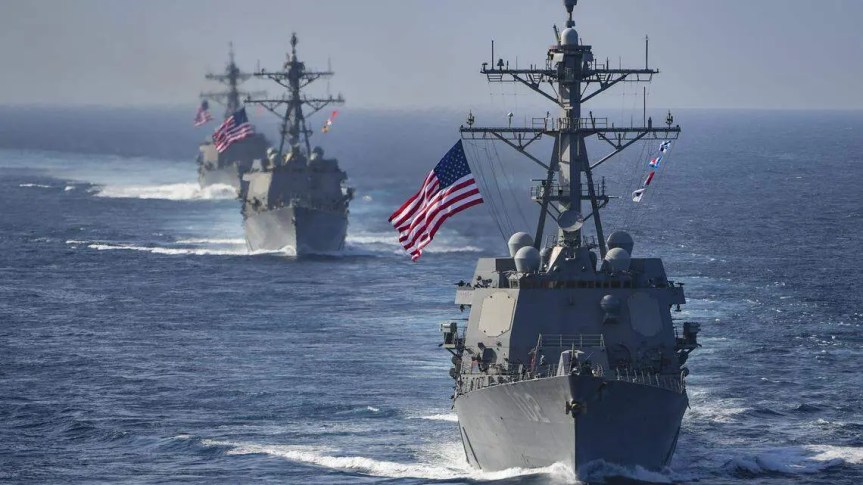
At least eight US warships have been deployed to the Caribbean Sea | Source: venezuelanalysis.com

South Paris, Maine


Hitting two birds with one stone, the U.S. government, top-level disturber of the peace now brandishing a Caribbean armada, strikes out against Venezuela – and Cuba too, indirectly. The U.S. military on December 10 seized a large oil tanker in the Caribbean bound for China. The ship carrying Venezuelan oil had previously offloaded 50,000 barrels of oil to a smaller ship for delivery to Cuba.

Cuba depends on oil supplied by Venezuela. High U.S. officials want to cut off Cuba’s access to oil from Venezuela and thereby deliver a decisive blow against Cuba’s government. Presently six other tankers sanctioned by the U.S. government and carrying Venezuelan oil are at high risk of being seized.

Cuba’s Foreign Relations Ministry issued a statement saying in part that, This act of piracy and maritime terrorism … represents U.S. escalation against Venezuela’s legitimate right freely to use and to trade its natural resources with other nations, including hydrocarbon supplies to Cuba …[Such] actions have a negative impact on Cuba and intensify the United States’ policy of maximum pressure and economic suffocation, with a direct impact on the national energy system and, consequently, on the daily lives  our people.”

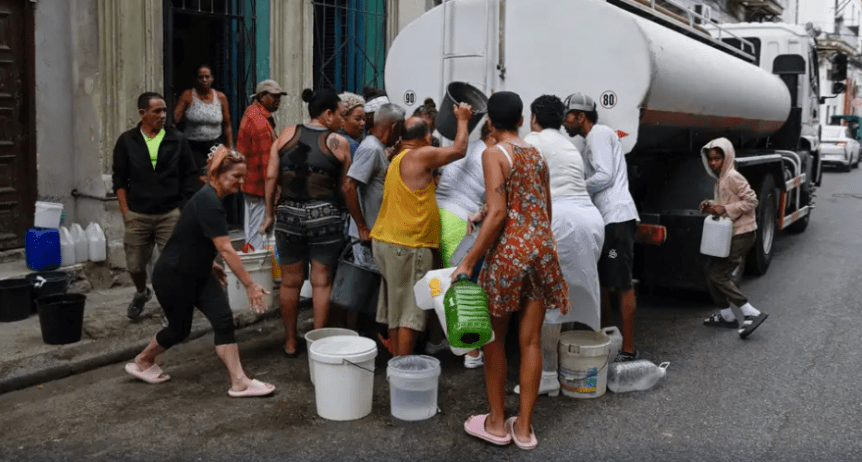
This reference to a “policy of maximum pressure” invites a look at ominous developments unfolding in Cuba as the maritime drama plays out.  Cuba’s government has recently resorted to measures that are extraordinary enough as to indicate worsening crisis in Cuba. The U.S economic blockade has led to shortages of supplies, food, and income. The impact over the course of decades has been wearing and cumulative. Now death rates are up and newer generations are decimated by migration.

Recent measures taken by Cuba’s government, explored below, strongly suggest Cubans face an emergency. U.S. activists responding to their government’s warlike preparations in the Caribbean – another emergency – have good reason to urgently build their solidarity not only with Venezuela but with Cuba too.  What follows here is a report on extreme measures recently taken by Cuba’s government. The object is to portray these measures as so unusual as to confirm the existence of Cuba’s last-ditch situation and, that way, motivate Cuba’s U.S. supporters toward action.

Dollarization

Cuba’s government recently introduced monetary regulations allowing citizens to buy and sell some goods and services using the U.S. dollar.  A report published by a government-oriented news service refers to a “pragmatic recognition of today’s reality” and to “a partial and controlled dollarization of [Cuba’s] economy.” The government will be “allowing certain economic actors to trade in foreign currencies under specific circumstances.”

The new regulations apply to transactions with foreign manufacturers, investors, traders, shippers, financial institutions – and to families abroad sending remittances. The immediate goal is “to directly incentivize the generation of foreign exchange earnings, allowing those who contribute to this generation to keep a significant portion of their earnings in hard currency.” 

The broader purpose is “to increase national production, improve the availability of goods and services, and create conditions for a future return to the strengthened Cuban peso.” Policy-makers want to stimulate exports, augment the supply of goods available in Cuba, and increase both national production and foreign investment. Another goal, referred to as “[r]eduction of distortions,” is elimination of informal or illegal foreign currency markets.

The new regulations allow “authorized commercial establishments … [and those] domestic suppliers supporting export or import substitution activities to use dollars and other foreign currencies in international transactions.” Parties permitted to use dollars are authorized self-employed workers, privately owned businesses, cooperatives, and state enterprises.

These parties have permission to deposit dollars in Cuban banks – dollars accumulated from exports of goods and services, from on-line sales and from sales realized through the Mariel Special Development Zone. Banks will accept dollars purchased from foreign currency traders and dollars sent as remittances from families abroad.

The government’s new authorization of the U.S. dollar as a national currency may well be unsettling to Cubans perceiving implications of a dependency relationship with the northern neighbor. The necessity to have done so reflects the urgency of Cuba’s current situation.     

Pressing needs

Overtones of a new situation entered into the decision of the Cuban Communist Party’s Central Committee at its meeting on December 13 to postpone the 9th Party Congress set for April 2026. Party Congresses have taken place every five years.

Making the announcement, Leader of the Revolution Raul Castro emphasized the need to “dedicate all the country’s resources, as well as the effort and energy of the Party, Government, and State cadres, to resolving current problems, and to dedicate 2026 to recovering as much as possible.” 

Likewise, Cuba’s Council of State announced on December 10 that the upcoming session of the National Assembly of People’s Power set to begin on December 18 would be meeting for that day only, by video conference. In 2024, Assembly delegates met in person for two sessions for a total of  24 days.

A spokesperson explaining the shift stated that, as is “known by all, the electricity situation and the current state of the economy, and also difficulties with the [multi-virus] pandemic and the health situation … create a complex situation for carrying out the Assembly. There is the problem too of the rational use of resources.” 

The 11th plenum of the Communist Party’s Central Committee taking place on December 13 was also a one-day session; video conferencing provided access for members living outside Havana. Concluding the meeting, First Secretary Miguel Díaz-Canel, president of Cuba, mentioned particularly that:

At the end of the third quarter, GDP has fallen by more than 4%, inflation is skyrocketing, the economy is partially paralyzed, thermal power generation is critical, prices remain high, deliveries of rationed food are not being met, and agricultural and food industry production is not meeting the needs of the population. There are also the costly losses caused by the devastating passage of Hurricane Melissa …

Donald Trump has just launched his pirates onto a Venezuelan oil tanker, shamelessly seizing the cargo like a common thief. This was the latest episode in an alarming series of attacks on small boats and extrajudicial executions of more than eighty people, based on unproven accusations and amid an unprecedented and threatening military deployment in a declared Zone of Peace …

[However,] we are the children of a people who carried out a revolution 90 miles from the greatest imperial power on the planet and who have successfully defended it for more than six decades … Only a heroic people who defend a Revolution, who have the example of the history of that Revolution, are capable of enduring what we have been living through all these years.”

Henry Lowendorf of the U.S. Peace Council, queried for this article, highlights the central role of the U.S. government. He states via email that, “The U.S. has been trying to crush the Cuban revolution for over 60 years. So far it has failed. But with new intensity and the newly accelerated war on Venezuela, the U.S. is desperately working to cut off all life support to Cuba.”

A dark setting brightens a bit with good news out of California, as reported in the Cuban press. The Los Angeles Hands off Cuba Committee led in organizing a shipment from Los Angeles to Cuba by way of Jacksonville, Florida of a 40-foot container with medical supplies worth $1 million.  Participating were members of the International Longshore and Warehouse Union and International Association of Machinists, along with Global Health Partners and the PanAmerican Medical Association.


W.T. Whitney Jr. is a retired pediatrician and political journalist living in Maine.

Electoral Coup Surfaces in Honduras amid Signs of US Intervention / By W.T. Whitney Jr.

Photo: Xiomara Castro de Zelaya/X

South Paris, Maine


Elections taking place November 30 in Honduras will decide the country’s next president and make-up of the national assembly. Current President Xiomara Castro of the democratic socialist Party of Liberty and Refoundation (Libre), in office since 2022, is limited to one term. Libre Party presidential candidate Rixi Moncada was finance minister and then defense minister in Castro’s government.

The mantra circulates that ten families rule in Honduras and hold most of its wealth. Their influence is such that left-leaning opposition forces can count on the most forceful kind of pushback.

Businessman Manuel Zelaya turned progressive politician was Honduras’ president from 2006 until June 2009, when a military coup deposed him, with U.S. help. He had called for a minimum wage, mild agrarian reform and a constituent assembly. Zelaya is now general coordinator of the Libre Party, founded in 2011 in reaction to the coup. He is President Xiomara Castro’s husband.

Xiomara Castro’s unsuccessful candidacies for president in 2013 and 2017 encountered electoral fraud and violent attacks orchestrated by the well-ensconced National and Liberal Parties. Her overwhelming electoral victory in 2021 resulted from the association of incumbent president Juan Orlando Hernández and his National Party with corruption and narcotrafficking. Hernández and his brother, convicted on narcotics and weapons charges, are serving long prison terms in the United States.Hernández’s second term was constitutionally illegal.

Current polls give the Libre Party candidate Rixi Moncada an even chance for victory, or a small majority. A plot emerged a month ahead of the voting.

On October 29, Attorney General Johel Zelaya reported he had transferred leaked audio recordings, with transcriptions, to the Public Minister for investigation. Libre Party’s Marlon Ochoa, one of three members of Honduras’ National Electoral Council, discovered them. Each councilor represents a political party. Voices on the recordings allegedly are those of Councilor Cossette López of the National Party; Tomas Zambrano, head of the National Party’s congressional bench; and an unnamed military officer.

According to Johel Zelaya, the conversations told of plans for hiring transportation companies and personnel to transfer voting results on election day, inserting agents among election observers, interrupting data transmission, prematurely announcing rightwing Liberal Party candidate Salvador Nasralla as the winner, sowing suspicion in the media about voting processes, and announcing favorable partial results as a potential “alibi for impugning and suspending the process.”

According to an observer, “The recordings revealed … a plan to pressure external actors, notably the US Embassy in Tegucigalpa, not to recognize any victories by Libre. This would turn an internal dispute into an international recognition crisis.” The report has councilor Cossette López-Osorio exclaiming, “We’ll use the tools that the people at the Embassy gave us.”

One Honduran observer says Salvador Nasralla is the “choice of the most reactionary spheres in Washington,” another that he has promised to “implement a security plan” similar to that of dictatorial Salvadoran president Nayib Bukele. Nasralla spent one third of the pre-election period traveling in the United States and Spain, presumably seeking support.

The Libre party on October 13 announced a “permanent mobilization … [against] the bipartisan plan to manipulate the coming elections.” The Party’s general coordinator Manuel Zelaya declared, “We must prepare ourselves to defeat the electoral coup … They know that we already reversed the coup in 2009 and that we will never go back!”

Rixi Moncada, speaking at a rally on November 9, reviewed gains achieved during Castro’s presidency, described her own program for governing, and highlighted a new twist in the coup saga. The National Election Council that day had carried out a nationwide simulation of election day processes. Only 1556 of 4362 voting locations actually transmitted voting records to a central location. Only 23.7% of biometric devices functioned. The results mirror the scenario presented by the recordings.  

Moncada outlined plans; 12 Libre Party activists from each of Honduras’s 18 departments would remain in Tegucigalpa until election day. They would constitute a “commission … our battlefront in defense of victory.” Party activists on that day would transfer voting records to the various Party headquarters where votes would be counted.

Context is important.  The U.S. government has long maintained hundreds of troops and several military units at Honduras’ Soto Cano airfield. They constitute the largest U.S. base in Central America, which facilitates U.S. interventions in regional affairs, as when the U.S. government in the 1980s sent supplies to Contra paramilitaries fighting in Nicaragua.

U.S. economic interests center on the mining, tourism, and agricultural export sectors. Honduras, regional center for narcotics transfer to the United States, qualifies as a target of U.S. drug war activities, but also as staging area for military interventions, for which drug war is a frequent pretext.  

President Castro has irritated U.S. officials. She cut ties with Taiwan in favor of the People’s Republic of China and supported Venezuelan President Maduro against U.S. accusations that his 2024 election victory was fraudulent.  Accusing the U.S. ambassador of meddling with Honduras’ military forces in August 2024, she mentioned cancelation of the binational extradition treaty.  Reacting to U.S. plans for massive deportation of migrants from Central America, Castro in January 2025 threatened to expel U.S. troops.

Her Libre Party government scored successes:  new highways, new hospitals, reforestation, subsidized electrical power, electricity for rural households, educational scholarships, loans for thousands of farmers, seeds and fertilizers for 450,000 of them, community orchards, 5000 refurbished education centers, and land redistribution.

Honduras’ murder rate per 100,000 inhabitants dropped from an average of 41.7 during President Hernández last term to 27.2 under Castro. Families living in poverty dropped from 73.6% to 62.9%. The previous government had promoted so-called “zones for employment and economic development.” Castro ended the scheme that gave control of municipalities to foreign investors and deprived residents of self-government and legal rights.

Candidate Rixi Moncada, 60 years old, came from a working-class family, taught in rural and city schools, studied law and became a practitioner and teacher of criminal law. She served the government of President Manuel Zelaya (2006-2009) as secretary of labor and social security. She managed the government-owned electric company.

Moncada indicated that, as president, she will “defend workers and state sovereignty and democratize the economic system.” She would “transform the justice system, combat impunity, reform the public ministry and strengthen the courts … [and revive] “strategic state enterprises.” She would support public healthcare and education – “without privatization.”

On November 12, Deputy Secretary of State Christopher Landau indicated  the U.S. government “will respond rapidly and firmly to any attack on the integrity of the electoral process in Honduras.” At once the U.S. Embassy broadly disseminated Landau’s message.

Interviewed on television that day, Salvador Nasralla asked “What would happen if these people (from the Libre Party) tried to steal votes?” His response: “Those ships that are soon going to take over Venezuela are going to come and target Honduras.”

U.S. interference in Honduras’ electoral processes is nothing new,” says veteran reporter Giorgio Trucchi. Quoting activist Luis Méndez, he adds that, “We are facing the old traditional politics, allied with US interference, large corporations, and business sectors attached to the neoliberal agenda with its project of dispossession and dismantling of the public sector …For Libre to continue governing is a setback for the geostrategic goals of U.S. domination in Latin America. We will somehow see this reflected in the elections.”


W.T. Whitney, Jr., is a political journalist whose focus is on Latin America, health care, and anti-racism. A Cuba solidarity activist, he formerly worked as a pediatrician and lives in rural Maine.

The United Arab Emirates Enables Human Catastrophe in Sudan, with the US in Tow / By W. T. Whitney, Jr.

Photo credit Z

South Paris, Maine


Beginning in April 2023, war between Sudan’s army and the paramilitary Rapid Support Forces (RSF) has caused humanitarian disaster of epic proportions. Some 150,000 people have died and 14 million Sudanese – Sudan’s population is 51 million – are displaced internally or in neighboring countries. Over 24 million suffer acute food insecurity. Famine is rampant in Darfur, the district in northwestern Sudan most afflicted by war and hunger.

We look at causes, foreign intervention in particular. The Sudanese people are victims of top-down oppression inflicted by big imperialists, lesser ones, and Sudan’s elite.  

The Bashir government in 2013 created the Rapid Support Forces from the Janjaweed formations and installed General Mohamed Hamdan Dagalo, known as “Hemedti,” as leader.

Protests by democratic forces beginning in December 2018 led to joint civilian-military rule. A coup in April 2019 removed Bashir from power. Subsequently, General Abdel Fattah al-Burhan, head of the armed forces and now the country’s president, and deputy military commander Hemedti became co-leaders of a transitional military council.

Turmoil continued, as did agitation for democratic change. In October, 2021, the two generals, having instigated another coup, established themselves as the country’s sole rulers. Al-Burhan and Hemedti subsequently disagreed on how to incorporate the RSF into Sudan’s army and on who would command the RSF. Reacting, Hemedti in April, 2023 provoked yet another coup. The RSF was soon occupying Khartoum, Sudan’s capitol city.

The Sudanese army recaptured a devastated Khartoum in March 2025. The RSF, having laid siege to El Fasher for 18 months and defeated the Sudanese army, took over that city of 700,000 inhabitants in October, 2025. Killings skyrocketed.

As of November 6, the Rapid Support Forces have agreed to a “humanitarian ceasefire” for three months proposed by the U.S., Egypt, the UAE and Saudi Arabia. The Sudanese army rejected the truce, demanding  that the RSF withdraw from civilian areas and surrender their weapons.

Origins

African nations emerging from colonialism endured varying degrees of continuing oppression and differing kinds of instability. Even so, humanitarian catastrophe in Sudan and the killings seem to be unprecedented.

The country’s vulnerability shows in a destitute, divided population, military rule, and societal collapse. It stems from a long history of autocratic rulers and recurring coups before independence and afterwards, division between an Arab-oriented North and non-Arab South (leading to an independent South Sudan in 2011), and susceptibility to manipulation by outside actors.

The United Arab Emirates (UAE) has interests in Sudan. Mohammad Khansa, writing for al-akhbar.commentions that, “Sudanese gold fuels the RSF, and the UAE.” Newly discovered gold deposits account for 60% of the country’s exports. The UAE imported $2.29 billion worth of Sudanese gold in 2022. Ninety percent of the gold Sudan produces goes to the UAE.

Sudan, the “leading agricultural producer in both Africa and the Middle East” is the “breadbasket of the Arab world.” The UAE imports 90% of its food. UAE investors have fostered land grabs in Sudan and industrialized Sudan’s agricultural production.

Other UAE interests are:  management of key Sudanese ports on the Red Sea, UAE control of many Sudanese banks and the UAE’s use of the RSF as its proxy in competing with Saudi Arabian influence in Africa.

UAE intrusion

Explaining the UAE’s relationship with Sudan and the RSF, Husam Mahjoub, writing in Spectre Journal, states that, “The UAE’s role in Sudan is … part of a coherent, well-financed, and regionally expansive project: a sub-imperialist agenda that combines economic extraction, authoritarian alliance-building, and counterrevolutionary politics.” The UAE “viewed the Arab Spring [of 2011] as an existential threat to both the authoritarian regimes in the region and its own model of governance. …[The] UAE became an active counterrevolutionary force.”

The Sudanese people’s uprising in December 2018, prior to Bashir’s removal, continued “even after the October 2021 coup.” It was “democratic, civilian-led, and explicitly antimilitary.” Demands were “freedom, peace, social justice, civilian governance, and accountability.” According to Mahjoub, this “grassroots resistance posed a threat to both Sudan’s own elites and regional powers like the UAE.”  

The RSF has helped the UAE in two ways: its “capacity for violence—that is, a force willing to suppress protests, fight wars, and eliminate rivals” and “economic access, especially to Sudan’s lucrative gold trade, which the RSF increasingly controlled.”

“[N]ow the regional leader in the defense sector,” according to the Simpson Center, the UAE imports weapons and makes its own. UAE support for the RSF shows in weapons transferred to the paramilitaries.  Gold from the RSF allows the UAE to buy weapons from many countries, with a portion of them ending up with the RSF.

The weapons enter Sudan by irregular means across several borders, and the gold arrives in the UAE the same way.

The UK’s Campaign against Arms Trade points out that, although the UAE allows the RSF to commit genocide by providing weapons, “there have been no efforts to pressure the UAE or hold it to account, and massive US and French arms supplies to the Gulf dictatorship continue unabated.”

Back in the US

The Biden administration in January 2025 accused the Rapid Support Forces of genocide. In March, New York Representative Gregory Meeks introduced legislation prohibiting arms sales to countries supplying arms to the RSF or the Sudanese Army. The bill has 27 co-sponsors.

Maryland Senator Chris Van Hollen and California Representative Sara Jacobs reintroduced legislation in March prohibiting U.S. arms sales to the UAE for as long as that country sends arms to the RSF. There are no co-sponsors.

The Trump administration in May announced a $1.4 billion sale of weapons and military equipment to the UAE. In 2024, the UAE received U.S. weapons worth $1.2 billion.

Husam Mahjoub explains that the UAE, as a “strategic partner of the West, … a buyer of arms, a major collaborator with Israel’s genocidal regime, a conduit for intelligence, and a financial hub, … is too useful to punish.”

Useful indeed! Reporter Dan Alexander claims the UAE “has become a hub for the Trump Organization’s international expansion. …[The] president and his family have entered into at least nine agreements with ties to the gulf nation. Together, the ventures … will provide an estimated $500 million in 2025—and about $50 million annually for years into the future …The president’s offspring are plotting novel ways to use crypto mania to squeeze more money from their real-estate assets.”

Alexander quotes Eric Trump: “The UAE is the developers’ greatest dream because they never say ‘no’ to anything, …. There’s no place that has been more fun to work in than the UAE. I mean, if you want to build it, if you can dream it up, they allow you to do it.” Alexander’s article is titled “This Gulf Nation Is Powering Trump’s Moneymaking Machine.”

The Sudanese Communist Party issued a statement on October 29. Speaking for the victims, it says in part:

“Our Party stands clearly and decisively against the horrifying massacres being committed against civilians in the cities of El Fasher and Bara … [We] always affirm that what is happening is not merely a military struggle for power; rather, it represents a complex scene of conflict between the parasitic wings of capitalism within the country over power and resources …  The war is, at the same time, a regional/international/imperialist scheme aimed at weakening the Sudanese state and creating conditions for disintegration and division to deplete the capabilities of the people, the wealth of the country, and violate national sovereignty.” 


W.T. Whitney, Jr., is a political journalist whose focus is on Latin America, health care, and anti-racism. A Cuba solidarity activist, he formerly worked as a pediatrician and lives in rural Maine.

José Martí Exposes U.S. Designs on Cuba / Prepared by W.T. Whitney

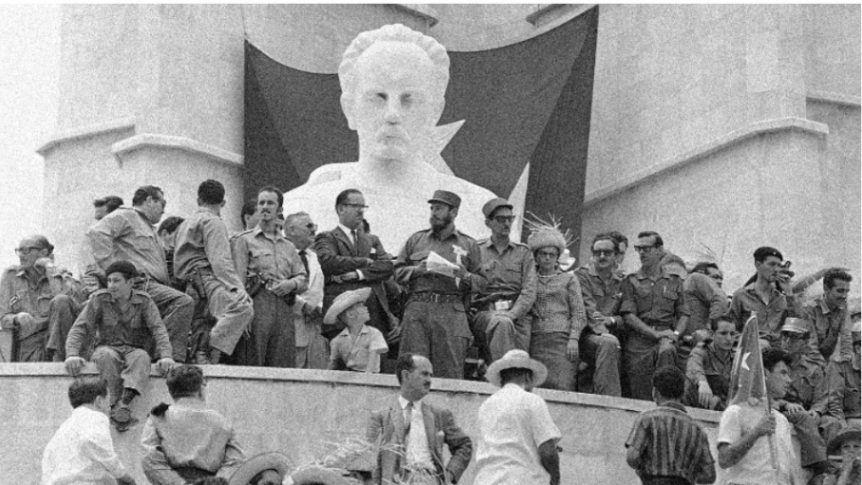
Photo: Fidel Castro, center, at the May Day 1960 parade in Havana at the Jose Marti Monument. | AP

South Paris, Maine


Introduction

While living in exile in the United States, José Martí dedicated the time between 1880 and 1895 to preparations for Cuba’s Second War for Independence from Spain, which ran from 1895 to 1898. Martí died as a martyr in Cuba on May 18, 1895. Our interest here is in Marti’s ideas on Cuba’s independence from the United States.

His writings are full of criticisms of the United States and U.S. pretentions for control of Cuba. Our object in presenting Martí’s ideas on the United States is to show that U.S. assault on Cuba, ongoing now for six decades as economic blockade, is hardly new. The U.S. has in fact sought domination over Cuba since the beginning of the 19 th century.

What follows is a sampling of Martí’s observation on the United States, written while he was living in New York between 1880 and early 1895. Martí, born in 1893, traveled frequently to Florida and even to Central America and the West Indies to educate, recruit, and raise funds for the coming independence struggle. In 1892, he founded the Cuban
Revolutionary Party and its newspaper Patria.

The Spanish colonial government arrested Martí for his writings in 1869 early in the course of Cuba’s First War for Independence (1868-1878). After one year in prison, Martí in 1871 left for exile in Spain where he remained for three years. Subsequently he was teaching and writing in Mexico and Guatemala until he returned to Cuba in 1878, only to be
exiled again to Spain. He moved on to New York, where, except for a six-month stay in Venezuela in 1881, he would remain until he left for Cuba in 1895.

Two themes dominate in his writings about the United States. He projected the idea of the idea of “our America,” which for him was all the territory lying between the Rio Bravo (Rio Grande) and Tierra del Fuego. That region had its own cultures, traditions, and history rather than those of North America and Europe. His essay “Our America” was published in
New York in 1991.

Warning about the U.S. threat to Cuban independence, Martí also mentioned the terms annexationism and annexationists to signify longings by U.S. Americans and by Cubans for U.S. possession of the island.

Excerpts of Martí’s writings follow:

José Martí’s letter to NY Evening Post, March 25, 1889 –

“It is probable that no self-respecting Cuban would like to see his country annexed to a nation where the leaders of opinion share towards him the prejudices excusable only to vulgar jingoism or rampant ignorance. There are some Cubans who … would like to see the island annexed to the United States. But those who have fought in war and learned in exile
… do not desire the annexation of Cuba to the United States. They do not need it; …they cannot honestly believe that excessive individualism, reverence for wealth, and the protracted exultation of a terrible victory are preparing the United States to be the typical nation of liberty.

José Martí’s letter to Gonzalo de Quesada on December 14, 1889 mentions this:

“On our land, Gonzalo, there is another [U.S.] plan even more sinister than what we have seen so far, and that is the wicked plan to force the island into war, to precipitate it, in order to have a pretext to intervene in it, and with the credit of mediator and guarantor, to take it over. There is nothing more cowardly in the annals of free peoples: nor any more cold- blooded evil.

The Washington Pan-American Congress — José Martí provided La Nación newspaper in Buenos Aires with a report (December 19-20, 1889) on the First International Conference of American States that took place in Washington from October,1889 to April,1890. Marti attended as consul for Uruguay. On the agenda were U.S. plans for bolstering commercial ties to the region and establishing a customs union.

“The parade of delegates is ending and the sessions of the Pan-American Congress are about to begin. Never in America, from its independence to the present, has there been a matter requiring more good judgment or more vigilance … than the invitation which the
powerful United States (glutted with unsaleable merchandise and determined to extend its dominions in America) is sending to the less powerful American nations (bound by free and useful commerce to the European nations) for purposes of arranging an alliance against Europe and cutting off transactions with the rest of the world. Spanish America
learned how to save itself from the tyranny of Spain; and now, after viewing with judicial eyes the antecedents, motives, and ingredients of the invitation, it is essential to say, for it is true, that the time has come for Spanish America to declare its second independence.”

The Inter-American Monetary Commission convened in Washington between January 7 and April 8, 1891. Its object was to fulfill instructions from the recent Pan-American International Conference to form an international monetary union and adopt a common silver currency. The Latin American delegates chose Martí, attending as Uruguay’s
representative, to present a report on their views.

“In every invitation among nations, one must look for hidden motives. No nation does anything against its interest; … Lesser nations, which are still in the throes of gestation, cannot safely join forces with those who seek a union with weaker nations as a solution for the excessive production of a compact and aggressive population, and a vent for their restless masses … They believe in the incontrovertible superiority of “the Anglo-Saxon
race over the Latin race”. They believe in the inferiority of the Black race, which they enslaved yesterday and continue to oppress today, and of the Indian race, which they are exterminating. They also believe that the peoples of Spanish America are composed principally of Indians and Blacks. … Does a political and economic alliance with the United States benefit Spanish America?

“Whoever says economic union, says political union. The nation that buys, rules. The nation that sells, serves.….

The Truth about the United States – Martí published this article in Patria, newspaper of the Cuban Revolutionary Party on March 23, 1894. “But it is certainly true that … in the United States, the reasons for unity are weakening, not solidifying; [that] the various localities are dividing and irritating national politics, not uniting with it; [that] democracy is
being corrupted and diminished, not strengthened and not saved from the hatred and wretchedness of monarchies … From the standpoint of justice and a legitimate social science it should be recognized that … the North American character has gone downhill since the winning of independence, and is today less human and virile; whereas the Spanish- American character today is in all ways superior, in spite of its confusion
and fatigue, to what it was when it began to emerge from the disorganized mass of grasping clergy, unskilled ideologists and ignorant or savage Indians.”

José Martí’s article “The Third Year of the Cuban Revolutionary Party” appeared in Patria on April 17, 1994. It contains this segment:
“Glory does not belong to those who look back, but to those who look forward. It is not merely two flower-covered islands (Cuba and Puerto Rico) … that we are going to bring forth, but we will save and serve them in such a way that the skills and vigor of their peoples, less isolated than those of the resentful and hungry European societies, ensures the independence of the happy archipelago that nature placed at the center of the world – despite the greed of a strong and unequal neighbor. … On the side of America are the Antilles, which, if enslaved, would be a mere pontoon in the war of an imperial republic against a jealous and superior world that is already preparing to deny it power—a mere fort of American Rome. If they were free … they would be the guarantee of balance between the continents, of independence for Spanish America, now under threat, and of honor for the great republic of the North.”

Martí’s article “Honduras and the Outsiders” appeared in Patria onDecember 15, 1894. There he explains that, “In America there are two peoples, and no more than two, with very
different souls due to their origins, backgrounds, and customs, and similar only in their fundamental human identity. On one side is our America, and all its peoples are of a similar or identical nature and background, and of an identical prevailing mix; on the other side is the America that is not ours, whose enmity it is neither sensible nor viable to foster, and with which it is not impossible, and indeed useful, to be friends, with firm decorum and shrewd independence. But we must live from our soul, cleansed of the evil church and the habits of mastery and undeserved luxury.”

José Martí’s letter to Manuel Mercado of May 18,1895
Mercado, living in Mexico, was Martí’s friend of many years. Martí, General Maximo Gomez and four others came ashore in eastern Cuba on April 11 1895. They had traveled from the Dominican Republic. Accompanied by rebel troops, they proceeded westward. Mari died in
battle on May 18, 1895, a day after writing this unfinished letter.

My dearest brother: Now I can write, now I can tell you how tenderly and gratefully and respectfully I love you and that home which I consider my pride and responsibility. I am in daily danger of giving my life for my country and duty. For I understand that duty and have the courage to carry it out – the duty of preventing the United States from spreading
through the Antilles as Cuba gains its independence and from overpowering our lands of America with that additional strength. All I have done so far, and all I will do, is for this purpose. … I have lived in the monster and I know its entrails; my sling is David’s. …

I am doing my duty here. The war in Cuba to prevent … the annexation of Cuba to the United States has come at the right time in America. It’s a reality greater than the vague and scattered desires of the annexationists among the Cubans and Spaniards, whose alliance with the Spanish government would only give them relative power.

Unless otherwise noted, Martí’s writings are taken from “Our America”, José Martí and Philip S. Foner, Monthly Review Press, 1977.


W.T. Whitney, Jr., is a political journalist whose focus is on Latin America, health care, and anti-racism. A Cuba solidarity activist, he formerly worked as a pediatrician and lives in rural Maine.


New Cuban Report Confirms US Blockade is War / By W.T. Whitney Jr.

South Paris, Maine


Cuba’s foreign ministry on September 17 released the nation’s annual report on adverse effects of the lengthy U.S. economic blockade of Cuba. It does so ahead of the yearly vote in the United Nations General Assembly on a Cuban resolution stating the “necessity of ending the economic, commercial and financial embargo imposed by the United States against Cuba.” Voting takes place on October 28-29.

For 32 years, member states have overwhelmingly approved Cuba’s resolution. At times recently, the U.S. and Israel have been alone inrejecting it.

The 55-page Report – accessible here – is remarkable for its detailed and far-ranging description of disarray and distress caused by the blockade. It exposes the cruelty and lawlessness of U.S. intrusion in the lives of a sovereign people.

This year’s version of the Report is convincing as to the urgency of opposing this U.S. policy. Showing that the blockade kills people, it casts the blockade as war. Struggle against the blockade might gain new strength with a new focus on the issue of peace over war.

The idea of the U.S. as war-maker is not new. Beginning with the Monroe Doctrine of 1823, the U.S. government has relied on military power as well as economic and political pressure to work its way in Latin America and the Caribbean area. Even now the U.S. wages war on Venezuela, Cuba’s close ally and fellow victim of U.S. economic sanctions.

A recent study adds precision to the notion of U.S. war against Cuba. The Lancet medical journal in August 2025 reported that economic sanctions imposed in 152 countries between 1971 and 2021 caused so many deaths annually as to exceed battle-related deaths and, often, to equal the annual toll of battlefield deaths plus civilian casualties.
This information removes any lingering surprise that the blockade might be lethal.

Awareness of that reality would be a big step toward recognition of the blockade as war against Cuba. The agenda here is to show the Report as backing these claims. The inquiry offers perspective as to Cuba’s place in the world system of wealth accumulation, conflict,
and oppression.

Big picture

The Report records damage affecting various sectors of Cuban society between March 2024 and February 2025. It surveys financial losses, shortages, and consequences. It shows that adverse effects themselves lead to far-ranging difficulties for individual Cubans and Cuban commercial and production entities.

Troubles stacked one upon another undermine strenuous efforts by Cuba’s government and people to encourage production and create living conditions that are sustaining and fulfilling. The Report is a story of institutions, production units, private enterprises, schools, healthcare entities, government agencies, and service organizations having to cope with frustrations and failed improvisations. A section appears on solidarity activities on Cuba’s behalf taking place in the United States and in the world.

The Report outlines two general categories of requirements under the blockade. Measures relating to Cuba’s finances make for low salaries, diminished flow of emittances, obstacles to investments from abroad, and inability to re-finance accumulated debt. Other measures block access to materials and commercial products. These include: food, hospital supplies, medicines, raw materials, new machinery, miscellaneous devices and tools, construction materials, replacement parts, fuel, chemicals, fertilizers, and more.

The categories overlap. According to the Report, “Dozens of banks suspended their operations with Cuba, including transfers for the purchase of food, medicines, fuel, materials, spare parts for the national power system, and other essential goods.”

The Report identifies the U.S. instruments that created regulations governing Cuba’s access to money and goods, among them:

  • Designation of Cuba as a state sponsor of terrorism, whereby Cuba
    loses access to international loans and payments due from abroad.
  • Lawsuits filed in US courts under Title III of the Helms-Burton Act.
    These seek damages from those foreign businesses making use of
    nationalized properties. The effect is to discourage future investments.
  • Hundreds of U.S. measures devised for weakening Cuba’s tourism
    industry, that until recently was the country’s leading source of income.
  • New sanctions aimed at foreign officials who enable Cuban doctors to
    work in their countries. They block income that formerly supported
    Cuba’s own healthcare system.
    +Threats and sanctions mounted against “shipping companies, carriers,
    insurers or reinsurers involved in supplying fuel to Cuba.”
  • The 1992 U.S. “Torricelli Law” that requires third-country enterprises
    affiliated with U.S. corporations to never sell goods to Cuba containing
    more than 10% U.S. components.
  • The legacy of 1996 Helms-Burton Act stipulating that the blockade
    would be altered or ended only by Congress and not by the U.S.
    president.

Money talks

The Report records monetary data relating to shortages. The term “damages” that crops up. It signifies a combination of costs, loss of income due to the blockade, and potential gains stymied by theblockade. Damages recorded for various sectors are:

Biotechnology – $129.3 million
Energy and mining – $496.1 million
Information and communication – $78 million
Industry (goods and services) – $5.1 billion
Construction – $161.9 million
Transportation – $353.0 million
Tourism – $2.5 billion
Education – $89.9 million
Sports – $4.1 million
Culture – $195.1 million
Healthcare – $288.8 million
Food supply and processing – $932.3 million
Agricultural production – $51.9million

Total damages during the period under study were $7.6 billion. That amount exceeds damages by 49%. The total since the blockade’s onset is $170.7 billion. With inflation, “quantifiable damages” over the years become $2.1 trillion. There are these additional realities:

* Cuba’s GDP was down 1.1% in 2024. “The economy …has recorded an 11 per cent downfall since 2018.”

* Exports of goods and services achieved 92.5% and 101.6%, respectively, of anticipated goals. Export income was $770 million less than expected. Domestic revenues were down $900 million from 2023.

* Food production was so reduced during the year that 100% of the food provided under the rationing system was imported food.

* The term “geographic relocation of trade” refers to trade displaced because of the blockade. That necessity leads to elevated transportation costs and inflated prices. Added costs are $1.2 billion.

* The year’s inflation rate of 24.9% stems from shortages of supplies, diminished access to hard currency, and state spending to finance its budget deficit.

* Overall spending on tourism was $2.5 billion in 2024; tourism was down 9.6%.

Sanctions as war

Presenting the Report to the press on September 17, Cuban chancellor Bruno Rodríguez observed that, “It is impossible to quantify the emotional damage, anguish, suffering, and deprivation that the blockade causes Cuban families. This has been the case for several generations, with more than 80% of Cubans on the island born after the blockade began.”
According to the Report, “The unprecedented tightening of the blockade in recent years has had a particular impact on the public health sector.

The tense situation created in our economy, the financial persecution of Cuba and the denial of access to the US market … have hampered the ability of our health system to obtain … supplies when needed and provide quality service to the population. This has, in turn, led to the deterioration of several health indicators, including those related to
mortality.”

Indeed, the “blockade imposed by the US government against Cuba is an act of genocide.”
Hospitals and doctors have trouble finding, or may not find, “first line medicines,” cancer drugs, specialized drugs, key surgical supplies, respiratory therapy equipment, imaging equipment, diagnostic agents and test kits, dialysis machines, anesthesia gear, endoscopy equipment, insulin pumps, pacemakers, defibrillators, and pediatric ventilators.

According to the Report, 94,729 people are on surgery waiting lists, including 4507 cancer patients and 9913 children. A benign treatment device for aortic stenosis is available elsewhere but not in Cuba for 158,800 unstable patients. Survival rates for childhood cancer have fallen.

In a recent interview, Paul Jonas, a physician associated with the University of Leiden and admirer of Cuban healthcare, stated that, “In recent years, the Cuban healthcare system has deteriorated significantly…. This leads to untreated illnesses, unnecessary suffering,
and sometimes even death … [T]he quality of nutrition in Cuba is currently very poor … there are also shortages of medicines and other medical supplies.”

Cuba’s infant mortality rate (IMR), the number of babies dying in their first year of life per 1,000 births, was 4.2 in 2014 and presently is 8.2. Cuban economist and demographer Juan Carlos Albizu-Campos, writing in 2023, notes that Cubans’ life expectancy registered a “decrease of 5.39 years” from 2012, also that the “decline … would not only have
continued, but would also have accelerated even if the [Covid-19] pandemic had not occurred.”

Food scarcity, mentioned in 2024 by Granma, the Cuban Communist Party’s newspaper, contributes to excess deaths. Blockade effects extend to food production. New machinery, livestock feed, credit, fuel, spare parts, fertilizer, veterinary supplies, and means of transportation are often lacking War characteristically disrupts societies and kills troops and/or civilians. Doing both, the U.S. blockade of Cuba is a weapon of war and manifestation of war.

What accounts for U.S. warmaking against Cuba? The U.S. has littlechoice. As chief honcho of the world capitalist order, the U.S. government must stick with capitalist rules. A big one requires that production always increase and expand. For that to happen, poorer and under-developed nations must cooperate and be subservient. Their job is to provide cheap labor and access to natural resources – and allow their wealth to be transferred to the centers. An outlier like Cuba is surely due for punishment.


W.T. Whitney, Jr., is a political journalist whose focus is on Latin America, health care, and anti-racism. A Cuba solidarity activist, he formerly worked as a pediatrician and lives in rural Maine.

Trump’s Cuba Memorandum provokes strong criticism amid new US aggressiveness abroad / By W. T. Whitney Jr.

Photo via Resumen Latinoamericano 

South Paris, Maine


The Trump administration on June 30 released its “National Security Presidential Memorandum 5” on U.S. plans for Cuba. Criticism from Cuba’s government and international commentators welled up, as if entirely new forms of anti-Cuba aggression were in the works. That may or may not be so. Actually, the recent Memorandum was a re-issue of the document put forth by the first Trump administration on June 16, 2017.

The eruption of an unusually forceful reaction to a Memorandum that says nothing new seems odd. It’s not. For one thing, the Memorandum creates an opening for U.S. government departments and agencies to fashion entirely new devices aimed at destroying Cuba’s economy. The 2017 Memorandum did exactly that, and what happened was disastrous.

And more: the international context of U.S. assaults on Cuba has drastically changed. U.S. foreign intervention now shows as war from the sky against Iran and as U.S. support and military hardware for genocide against Gazans. Is Cuba next in line for extreme measures?

Prescriptions

The Memorandum’s ostensible use is as a directive to heads of the various departments making up the U.S. government’s executive branch. It requires them to send President Trump reports on new tools they have devised for beating up on Cuba, and to do so within 30 days. They must “adjust the current Cuba regulations in order to ensure adherence, so
that unauthorized transactions with Cuba and impermissible travel to Cuba are effectively banned.”

The document attests to the authority already vested in the departments to take action against Cuba. It cites the 1996 Helms-Burton Law as having legitimized the U.S. purpose of regime change for Cuba.

The Memorandum sets forth various U.S. goals and various ways to implement them. These include promotion of free enterprise in Cuba, channeling funds to the Cuban people and not to their government, “restructuring certain travel arrangements and [US] travel,” and ending supposed human rights abuses in Cuba. This year’s Memorandum once more calls for depriving Cuba’s military and intelligence services of money derived from U.S. tourism.

This Memorandum, as with the other one, bans U.S. tourism to the island. All U.S. citizens traveling to Cuba for permitted reasons must keep records of their transactions in Cuba and for five years ensure that they are available for potential Treasury Department inspection.

The Memorandum directs U.S. officials to expand Cubans’ access to the Internet and to a “free press” and to oppose efforts at the United Nations and “other international forums” aimed at blocking U.S. policies on Cuba. Annually, the secretaries of the various departments of the executive branch must report to the president “regarding the engagement of the United States with Cuba to ensure that engagement is advancing the
interests of the United States.”

President Biden never disavowed Trump’s 2017 Memorandum. As a result, actions adverse to Cuba carried out under its authority remain in force.

Reaction

In discussion on July 2 with Randy Alonso Falcón, host of Cuban TV’s “Round Table” (Mesa Rotunda), Cuban Vice Foreign Minister Carlos Fernández de Cossío portrayed the recent Memorandum as a “political platform, a political document that is propagandistic, but also one that is a political declaration of U.S. intentions serving as a cover for actions it will take and others already in effect.”

As examples of the latter, he cited both sanctions applied to ships of third countries bringing fuel to Cuba and denial of access to the U.S. Visa Waiver program to those otherwise eligible citizens of 40 named countries who have visited Cuba. Now, potential travelers to Cuba often choose not to visit Cuba so as to preserve their eligibility. The intended result has been damage to Cuba’s tourism industry.

Cossio claimed that U.S. measures prompted by the recent Memorandum pose extra danger from “the hand of [Secretary of State] Marco Rubio … [and] of that clique that has made money and political careers out of hostility towards Cuba.” He laments harassment against individuals and businesses licensed to export goods to Cuba’s private sector, suggesting that the U.S. government seeks to harm Cuba’s private sector. He worries that some Cuban-Americans visiting in Cuba may be barred from returning to the United States.

The foreign ministry official pointed to a big change. Cubans have been “receiving privileged treatment on crossing the US border.” They are now vulnerable to “all [U.S.] anti-migrant actions including the alligator prison in Florida.”

International criticism of the recent Trump Memorandum erupted promptly and from many quarters, beginning in Cuba. Cuban president Miguel Díaz-Canel condemned the U.S. “purpose of inflicting the greatest possible damage and suffering.” National Assembly President Esteban Lazo, predicted their “vile purpose will fail in the face of Cubans’
unity and determination. “Cuba will defeat this new aggression,” pronounced Prime Minister Manuel Marrero Cruz.

The Bolivarian Alliance for the Peoples of Our America (ALBA) judged the Memorandum to be “aimed at forcefully hitting at all sectors of Cuban society.” Argentina’s International Committee for Peace, Justice, and Dignity for the Peoples declared its support for U.S. opponents of the Memorandum. Brazil’s Landless Workers Movement (MST) on July 3
initiated an international fundraising campaign to send essential medicines to Cuba.

Mexican President Claudia Scheinbaum on July 2 denounced the Memorandum, while declaring that “Mexico is the country that for decades voted against the blockade of Cuba and that will always be our position.” Mao Ning, spokesperson for China’s Ministry of Foreign Affairs on July 2 stated that, “We exhort the USA to immediately raise the blockade and sanctions against Cuba, and eliminate the U.S. list of state sponsors of terrorism.”

The most explosive and revealing reaction came from Rosa Miriam Elizalde, editor of Cubadebate.cu. She was echoing Vice Minister Cossio’s observation that “Perhaps U.S. officials imbued with this euphoria over a new U.S. foreign policy of imposing peace through force are demanding something similar with Cuba.”

Writing for Mexico’s La Jornada news service on July 5, Elizalde points to “[D]éjà vu: More than 20 years after the United States invaded Iraq under false pretexts, we are witnessing the same warmongering operetta in South Florida … During the spring of 2003, while the missiles were falling on Baghdad, the ultra-sector of Cuban emigration took to the streets of Miami with a disturbing slogan: ‘Iraq now; Cuba later’”.

She notes that, “[T]he Miami propaganda machine is once again waving the flag of armed intervention [in Cuba], while the U.S. and Israel are escalating their military offensive in Iran.” She highlights Congresswoman María Elvira Salazar’s remark that, “This is how tyrants are confronted, not only in Iran, but also satraps in Cuba, Venezuela and
Nicaragua. Peace through force. That’s the American way.”

Elizalde regards as ominous that “Trump invokes as an American military success the sad memory of the Hiroshima and Nagasaki bombs.” She describes a volatile situation in which “[i]mmigrants are hunted down like beasts, just like communists and Jews before World War II.”

She views the current political climate as recalling that of 2003, when the United States invaded Iraq: “The logic is the same: misinform, isolate, demonize, justify sanctions and, if conditions are right, authorize intervention in the “dark places of the planet.”


W.T. Whitney Jr. is a political journalist whose focus is on Latin America, health care, and anti-racism. A Cuba solidarity activist, he formerly worked as a pediatrician, and lives in rural Maine.

The Trump circus has a logic and it’s dangerous / By W.T. Whitney Jr

South Paris, Maine


As startling and far-reaching as they are, actions taken by the Trump administration are most impressive at first glance for their circus-like quality of no central purpose. Realization dawns, however, that measures hitting at the rule of law and democracy itself and promoting war and turmoil in the wider world are so politically disastrous that by no means would they have appeared accidentally.

The idea here is that present situation reflects the U.S. government’s last-ditch response to a crisis of capitalism. If so, any useful defense against unfolding catastrophe has to center, it seems here, on what needs to be done about capitalism.

The term signifies arrangements in effect since feudalism that give full rein to ruling classes everywhere to organize economic and political affairs to their advantage. Capitalism is an evolving process that, stumbling now and then, requires adjustments to its functioning. Presently, the masters of U.S. capitalism seem to be carrying out a major fix of old and new problems that impede profit-taking. The measures being employed are disruptive.

To get the job done, capitalist decision-makers recruited the MAGA crew as agents to take on the unpleasant job, among other, of removing protections against exploitation and abuse of U.S. working people. Lower-order capitalists having reservations will probably join the project, while holding their nose.

Some basic assumptions introduce the discussion here:

· To fix what’s wrong, you look for the cause.

· Focus on impaired personalities running the show does not fully explain the turmoil triggered by the Trump government’s recent actions.

· Preexisting political rules and arrangements for how to govern did nothing to prevent the present catastrophe.

· Wide sectors of the U.S. population are silent, stunned, and without hope. They are generally unconvinced that an alternative way of doing politics exists or is possible.

· The Trump administration regards political opposition as inconvenient, irrelevant, and disposable.

· Actions of his government result from rational decision-making. They are not the products of random impulses.

Beginnings

Capitalists cross established boundaries. Beginning centuries ago in Europe, they have been plundering distant parts of the world. Along the way, they added an exploitative factory system, great industrial monopolies, and, lastly, a world system of markets, cheap labor, and plunder of natural resources.

Overcoming challenges and contradictions, capitalists took charge of faraway peoples, fought wars against rival capitalist powers, confronted socialist governments and suppressed resistance movements at home and abroad. Periodically, they had to recover from economic crashes prompted by the impossibility of impoverished workers buying goods that were produced. The point here is that capitalists are used to dealing with challenges.

Capitalists after World War I were experiencing unprecedented difficulties, and fixing them was fraught with uncertainty. European and the U.S. economies were highly unstable even before the Great Depression arrived. Plus, the Soviet Union was attending to people’s social needs, was industrializing, and was little affected by the Great Depression. A socialist alternative to the capitalists’ faltering system had abruptly asserted itself.

Many capitalists in Germany and Italy reacted by tolerating or actively supporting the fascist political parties fighting for power in each of those countries. They claimed to offer protection for capitalist economies and fightback against the Soviet menace. Their restrained U.S. counterparts accepted palliative reforms mediated through New Deal social democracy.

U.S. capitalism took on new life after World War II when the United States took charge of inserting free trade and other neoliberal policies into the world economy, over which it presided. The system allowed rich nations and their capitalists to exploit low-wage workers abroad, take advantage of poor nations’ debt dependency, and profitably extract their underground resources.

New Troubles

The good times were not so good. Beginning in the 1970s, worldwide economic growth lagged and inflationary tendencies persisted. The U.S. economy was experiencing “long-term stagnation and deindustrialization.” Financial activities and financial assets now loom larger in the U.S. economy than do commodity production and trade.

Manipulation of debt instruments misfired in 2008 leading to serious economic crisis. These adverse, long-developing realities represent one impetus for capitalist leaders to move toward extraordinary corrective measures. The Trump administration is carrying them out.

The other big element marking the current disruption of national politics would be the expected unpredictability of the Trump administration’s conduct of foreign affairs. On the theory that the administration’s major task is to shore up capitalism, it will surely be acting so as to align U.S. overseas activities with capitalist norms.

Lenin and other authorities had a lot to say about these, mainly the notion that aggressive foreign interventions are crucial for capitalism to be able to function.

U.S. imperialism, a bipartisan project, expanded after post-World War II. U.S. imperialists have carried out interventions, wars, proxy wars, and devastating economic sanctions in country after country, mostly in the Global South. These activities will undoubtedly continue under the Trump administration in order to further capitalist purposes. Random remarks on Trump’s part suggestive of easing up on this or that foreign adversary contribute only to the current volatility of political affairs.

Anti-communism had long inspired U.S. overseas adventures, but U.S. warmaking continued even after the Soviet Bloc was no more. The U.S. government and its capitalist junior partners, for example, engineered devastating regime-change operations against Yugoslavia (1999), Iraq (2003), and Libya (2011) The cover of anti-communism was gone, and antiterrorism as justification barely sufficed. Subsequent U.S. foreign interventions have represented imperialism, pure and simple.

China and a few other underdeveloped nations are now major manufacturing centers. China continues to attract significant foreign investment and is investing, building infrastructure, and extracting subsoil resources throughout the Global South, in the process outstripping the United States. The BRICS+ nations, competitive with the Global North in banking, manufacturing and science, are seeking to replace the U.S. dollar as the main international currency.

What to do

U.S. capitalists, seemingly worried about uncertainties surrounding foreign interventions and about weaknesses of the faltering neoliberal free-trade system, are on the way to building something new. The suggestion here is that Trump circus riling U.S. politics is no accident and that a new kind of capitalism is on the horizon.

Under Trump the government is assertive, aggressively nationalistic, and insulated from progressive social and political currents from abroad. The U.S. has disconnected from international agreements and international organizations, notably the 2015 Paris Climate Accord and the World Health Organization. High import tariffs are landing on goods arriving from almost everywhere, with the highest ones reserved for Chinese products.

U.S. working people are, or soon will be, coping with price hikes stemming from high tariffs; assaults on labor organizing, healthcare, schools, and universities; selective food shortages; aggravated racism; and cruel and illegal deportation proceedings. New grief is compounding earlier unmet social and economic needs.

The changes are so far-reaching that progressive reforms introduced by President Franklin Roosevelt in the 1930s are at risk of disappearing. Breakdown of the New Deal consensus would be the crown jewel of the upcoming capitalist reformation.

Almost incidentally, war preparations are a major element of the new kind of capitalism. According to Monthly Review, “[R]earmament of U.S. allies, along with a massive increase in Pentagon spending and bellicose threats directed at designated enemies, could lead to the further proliferation of conflicts, heightening the chance of a Third World War.” A “Trump nationalist imperial policy” envisions a “New Cold War on China” involving a “limited nuclear war.”

Call in the specialists

A government embarking upon such far-reaching initiatives can expect troubles ahead. Vast numbers of U.S. Americans will be experiencing grief and abuse. They may rise up, prompting the need for their suppression and for maintenance of order. A major war would require the home front to be stabilized and controlled with vigor. A special brand of governance would come into play. Specialists are available for this kind of work.

They are MAGA crew, already on the job. Following a script, they hit at the rule of law, politicize the military, prepare for war, scapegoat immigrants and the racially oppressed as internal enemies, assault institutional centers of thought –universities, government research centers, and the independent press – and rip apart the fabric of democracy. Lying and disregard for the truth are nonstop.

You may have already made the association. Another bunch of fascists thugs almost a century ago in Germany and Italy did their reordering in ways similar to those adopted by the Trump administration in our era. Measures taken in both situations are similar, as are overall purposes.

The way out

Working-class resistance becomes important. Turning back the fascists – or protofascists, call them what you will – rests on alliances created between working people and other oppressed and marginalized sectors, especially in rural areas and among the lower ranks of the middle class, the so-called petit bourgeoisie. The MAGA movement’s electoral strength depends on support from both sectors and also, crucially, from elements of the working class.

The record shows that to defeat 20th century fascism, major elements of the Communist movement pursued the popular front strategy, the idea of worldwide alliance involving all democratic forces. That recipe fits today and, besides, no alternative political formation or remedy is waiting in the wings for rescue.

Communists are familiar through study and practice with the linkage between capitalism gone awry and the origins of fascism. Giving voice to that reality may be a first step in bringing unhappy, confused malcontents into political activism, and from there into mass mobilization, which is the essential tool for defeating fascism.

Communists and socialists will be educating and organizing, and asserting their places in public life. They would interact primarily, but not exclusively, with members of the working class. Their educational message would begin with the premise that capitalists unable to solve their big problems turn to fascism for rescue. They would highlight the connection between wars and imperialism.

Loose ends remain. First, U.S. capitalists’ reliance on the fascists is old hat for their kind. Business mogul Henry Ford and Charles Lindbergh of America First fame greatly admired the Nazis. Senator Harry S. Truman in 1941, commenting on war in Europe, stated that, “If we see that Germany is winning, we ought to help Russia, and if Russia is winning, we ought to help Germany, and that way let them kill as many as possible.” His message was that in the right circumstances Nazis are OK.

Secondly, U.S. capitalists, bent upon overcoming failures in how capitalism works, easily dismiss one of the greatest failures of worldwide capitalism, that of weak response to environmental crisis that threatens to destroy humankind and the natural world.


W.T. Whitney Jr. is a political journalist whose focus is on Latin America, health care, and anti-racism. A Cuba solidarity activist, he formerly worked as a pediatrician, and lives in rural Maine.

U.S. war on China, a long time coming / By W. T. Whitney Jr.

A still image from John Pilger’s documentary, “The Coming War on China”

South Paris, Maine


Movement toward war with China accelerates. The public, focused on troubles currently upending U.S. politics, does not pay much attention to a war on the way for decades. The watershed moment came in 1949 with the victory of China’s socialist revolution. Amid resurgent anticommunism in the United States, accusations flourished of “Who “lost” China.”

Loss in U.S. eyes was in China the dawning of national independence and promise of social change. In 1946, a year after the Japanese war ended, U.S. Marines, allied with Chinese Nationalist forces, the Kuomintang, were fighting the People’s Liberation Army in Northeast China.

The U.S. government that year was delaying the return home of troops who fought against Japan. Soldier Erwin Marquit, participant in “mutinies” opposing the delay, explained that the U.S. wanted to “keep open the option of intervention by U.S. troops … [to support] the determination of imperialist powers to hold on to their colonies and neocolonies,” China being one of these.

These modest intrusions previewed a long era of not-always muted hostility and, eventually, trade relations based on mutual advantage. The defeated Kuomintang and their leader, the opportunistic General Chiang Kai-shek, had decamped to Taiwan, an island China’s government views as a “breakaway province.”

Armed conflict in 1954 and 1958 over small Nationalist-held islands in the Taiwan Strait prompted U.S. military backing for the Nationalist government that in 1958 included the threat of nuclear weapons.

Preparations

U.S. allies in the Western Pacific – Japan and South Korea in the North, Australia and Indonesia in the South, and The Philippines and various islands in between – have long hosted U.S. military installations and/or troop deployments. Nuclear-capable planes and vessels are at the ready.  U.S. naval and air force units regularly carry out joint training exercises with the militaries of other nations.

The late journalist and documentarian John Pilger in 2016 commented on evolving U.S. strategies:

“When the United States, the world’s biggest military power, decided that China, the second largest economic power, was a threat to its imperial dominance, two-thirds of US naval forces were transferred to Asia and the Pacific. This was the ‘pivot to Asia’, announced by President Barack Obama in 2011. China, which in the space of a generation had risen from the chaos of Mao Zedong’s ‘Cultural Revolution’ to an economic prosperity that has seen more than 500 million people lifted out of poverty, was suddenly the United States’s new enemy…. [Presently] 400 American bases surround China with ships, missiles and troops.”

Analyst Ben Norton pointed out recently that, “the U.S. military is setting the stage for war on China. … The Pentagon is concentrating its resources in the Asia-Pacific region as it anticipates fighting China in an attempt to exert U.S. control over Taiwan.” Norton was reacting to a leaked Pentagon memo indicating, according to Washington Post, that “potential invasion of Taiwan” would be the “exclusive animating scenario” taking precedence over other potential threats elsewhere, including in Europe.  

New reality

Norton suggests that the aggressive trade war launched against China by the two Trump administrations, and backed by President Biden during his tenure in office, represents a major U.S. provocation. According to Jake Werner, director of the East Asia Program at the Quincy Institute, “Trump’s top military and economic advisers are almost without exception committed to confrontation with China.”

He adds that, “In a context of mounting economic pain on both sides, with surging nationalism in both countries becoming a binding force on leaders, both governments are likely to choose more destructive responses to what they regard as provocations from the other side. A single misstep around Taiwan or in the South China Sea could end in catastrophe.

Economic confrontation is only one sign of drift to a war situation. Spending on weapons accelerates. U.S. attitudes shift toward normalization of war. Ideological wanderings produce old and new takes on anticommunism.

Money for weapons

The annual report of the Stockholm International Peace Research Institute, released in April, says that in 2024 the world’s military spending increased by 9.4% in one year to a $2718 billion; it increased 37% between 2015 and 2024.

U.S. military spending in 2024 was $997 billion, up 5.9% in a year and 19% since 2015. For China, the comparable figures are $314 billion, 7.0%, and 59%, respectively; for Russia, $149 billion, 38%, and 100%; for Germany, $88.5 billion, 29% and 89%. The U.S. accounts for 37% of the world’s total military spending; China,12 %; Russia, 5.5%; and Germany, 3.3%. They are the world’s top spenders on arms.

In the United States,competition from new weapons manufacturers threatens the monopoly long enjoyed by five major defense contractors. These receive most of the $311 billion provided in the last U.S. defense budget for research, development, and production of weapons. That amount exceeds all the defense spending of all other countries in the world.

A new species of weapons manufacturer appears with origins in the high-tech industry. Important products are unmanned aircraft and surveillance equipment, each enabled by artificial intelligence.

Professor Michael Klare highlights one of them, California’s Anduril Industries, as providing the “advanced technologies … needed to overpower China and Russia in some future conflict.” Venture capital firms are investing massively.  The valuation of Anduril, formed in 2017, now approaches $4.5 billion.

Palmer Luckey, the Anduril head, claims the older defense contractors lack “the software expertise or business model to build the technology we need.” Multi-billionaire Peter Thiel, investor in Anduril and other companies, funded the political campaigns of Vice President J.D. Vance and other MAGA politicians. Klare implies that Theil and his kind exert sufficient influence over government decision-making as to ensure happy times for the new breed of weapon-producers.

Giving up

Waging war looks like a fixture within U.S. politics. Support for war and the military comes easily. Criticism that wars do harm is turned aside. Broadening tolerance of war is now a blight on prospects for meaningful resistance to war against China.    

Recent history is not encouraging. After the trauma of the Vietnam War subsided, anti-war resistance in the United States has been unsuccessful in curtailing wars in Yugoslavia, Iraq, Afghanistan, and Libya – and proxy wars in Ukraine and Gaza –despite massive destruction in all of them and more dead and wounded than can be accounted for.

Official language testifies to routinization of U.S. military aggression. Defense Secretary Hegseth, visiting at the Army War College in Pennsylvania, started with, “Well, good morning warriors. …We’re doing the work of the American people and the American warfighter. [And] the president said to me, I want you to restore the warrior ethos of our military.”

Hegseth traveled recently in the Pacific region, presumably with war against China on his mind. In the Philippines, he remarked, “I defer to Admiral Paparo and his war plans. Real war plans.” In Guam, he insists, “We are not here to debate or talk about climate change, we are here to prepare for war.” In Tokyo, he spoke of “reorganizing U.S. Forces Japan into a war-fighting headquarters.”

Ben Norton writes that, “In his 2020 book American Crusade: Our Fight to Stay Free, Hegseth vowed that, if Trump could return to the White House and Republicans could take power, “Communist China will fall—and lick its wounds for another two hundred years.”

Ideas as weapons

Proponents and publicists of off-beat ideas have long disturbed U.S. politics. Brandishing fantasies and myths, the Trump administrations have fashioned a new brand of resentment-inspired politics. Even so, familiar ideas continue as motivators, notably anticommunism.

Writing in Monthly Review, John Bellamy Foster recently explored ideology contributing to Donald Trump’s hold on to power. Much of it, he reports, derives from California’s Claremont Institute, its office in Washington, and Hillsdale College in Michigan. A leading feature is a kind of anticommunism that targets so-called cultural Marxism. But China and its Communist Party are not immune from condemnation.

Michael Anton is a “senior researcher” at the Claremont Institute and director of policy planning at the State Department. According to Foster, Anton suggested that “China was the primary enemy, while peace should be made with Russia [which] belonged to the same ‘civilizational sect’ as the United States and Europe, ‘in ways that China would never be.’”

Former Claremont Institute president Brian Kennedy, quoted by Foster, notes that, “We are at risk of losing a war today because too few of us know that we are engaged with an enemy, the Chinese Communist Party … that means to destroy us.”

The matter of no ideas comes to the fore. Recognized international law authority Richard Falk, writing on May 6, states that, “I am appalled that the Democratic establishment continues to adopt a posture of total silence with regard to US foreign policy.” Viewing the Democrats as “crudely reducing electoral politics to matters of raising money for electoral campaigns,” he adds that, I find this turn from ideas to money deeply distressing.”

The Democrats’ posture recalls a 1948 message from Michigan Senator Arthur Vandenburg, a Republican. During congressional debate on President Truman’s Marshall Plan, Vandenburg stated that, “Politics stops at the water’s edge.” This U.S. tradition lapses only occasionally.

Will resistance to war against China end up stronger and more effective than earlier anti-war mobilizations in the post-Vietnam War era?  A first step toward resisting would be to build awareness of the reality that war with China may come soon. General knowledge of relevant history would be broadened, with emphasis on how U.S. imperialism works and on its capitalist origins. Anyone standing up for peace and no war ought to be reaching out in solidarity with socialist China.  

John Pilger, moralist and exemplary documentarian and reporter, died on December 23, 2023. His 60th documentary film, The Coming War on China, first appeared in 2016. Pilger’s website states that, “the film investigates the manufacture of a ‘threat’ and the beckoning of a nuclear confrontation.” Please view the film on his website.


W.T. Whitney Jr. is a political journalist whose focus is on Latin America, health care, and anti-racism. A Cuba solidarity activist, he formerly worked as a pediatrician, and lives in rural Maine.

Pre-election turmoil in Bolivia ─ is US ready to pounce? / By W. T. Whitney Jr.

Evo Morales March, 2025. Photo: Evo Morales/X

South Paris, Maine


In advance of presidential elections on August 17,2025, Bolivia’s Supreme Electoral Council on April 17 registered 11 political parties and five electoral coalitions. It will soon announce the final list of presidential candidates. Incumbent President Luis Arce, elected in 2020, candidate for the Movement to Socialism Party (MAS) and former economics minister under President Evo Morales, (2006-2019) will head the list.

Longtime MAS leader Morales is a presidential candidate too. The new “Evo, the People” (Evo Pueblo) party held a three-day gathering in Chapare state, Morales’s home base, in late March; attendance topped 70,000.

Here we look at divisions in Bolivia and various social and political instabilities. Clearly, socialist beginnings in Bolivia are vulnerable, most Bolivians may be returning to lives of misery, and U.S. intervention is waiting in the wings.

Downhill course

Morales’s presidency achieved much. A new Constitution established the pluri-national state and gave political rights to indigenous peoples. By nationalizing oil and gas production, the government gained funding for expanded education, healthcare, and support for mothers, children, and the elderly. The GDP tripled, poverty fell, wealth inequalities diminished, and international currency reserves accumulated. Morales became symbol and spokesperson for environmental sustainability.

Then came troubles. They’ve worsened amid political divisions and destabilization episodes. The selling price for exported natural gas fell. Deposits turned out to be limited. (However, discovery of a huge natural gas field was announced in July, 2024.) Funding for social programs and for imports of gasoline, diesel fuel, and food went downhill.  

Government agencies borrowed from the central bank to maintain programs and access to supplies. The bank drew upon the nation’s currency reserves, which have almost disappeared. Dollars, in demand to pay for everyday items, are scarce. Inflation, shortages, and discontent continue. 

Old political divisions took on new life. Having accused U.S. ambassador Philip Goldberg of conspiring with the opposition, Morales expelled him in 2008, along with the U.S. Drug Enforcement Administration. He expelled USAID in 2013.

Big landowners, oil and gas producers, and their proxies in Bolivia’s four eastern states, particularly in Santa Cruz, in 2008 mounted a rebellion with separatist and racist overtones. It failed. Sections of the Bolivian Workers Confederation opposed certain government initiatives. Indigenous groups fought against a new government highway passing through a large preserve.

Morales had faced controversy over the legitimacy of his third presidential term and the fourth one that would have followed his electoral victory in October 2019.  But a coup led by rightwing conspirators, including the Santa Cruz rebels of 2008, took down his government in November, 2019. Morales escaped to Mexico. U.S. support enabled the coup.

Schism and new instabilities

The coup government named Jeanine Áñez as president and arranged for elections. From exile in Argentina, Morales nominated former economics minister Luis Arce as the MAS presidential candidate in elections set for October 18, 2020. Arce took 55% of the vote. His new government jailed Áñez and the other plotters.  

Returning from exile, Morales retained administrative control of the MAS Party. He urged his loyalists serving in Parliament to oppose Arce’s policies. He is said to have “pressure[d] Arce by influencing government nominees to reaffirm his political … authority.” Morales led a march in 2021 that defended Arce against far-right attacks.

By 2023 Morales was actively seeking re-election, even though a Constitutional Court ruled against another Morales term. He was facing charges of sexual abuse of a minor.  Morales abandoned the MAS party in 2024 after Arce-supporting Grover Garcia replaced him as party president.

By late 2024, the split between the two former MAS colleagues was profound. In September, Morales marched with supporters from Caracollo in Oruro Department to La Paz, led protests and vigils against Arce’s policies, encouraged highway blockades, and carried out a five-day hunger strike. Ethnic division may be playing a role, with Arce supposedly speaking for Bolivia’s mestizo population and Morales, Bolivia’s first indigenous president, representing indigenous peoples. 

Destabilization returned. In June 2024 Gen. Juan José Zúñiga sought to arrest Morales for his presidential ambitions. He later led troops and armored vehicles in attacking government office buildings in La Paz, in the process demanding freedom for the jailed 2019 coup leaders. In doing so, according to one report, he revealed his rightwing political orientation and longing for U.S. intervention.

Stirrring the pot of mutual accusations, the now-imprisoned General Zúñiga recently told an interviewer that, in attacking the government, he and his associates had been following President Arce’s instructions to carry out a “self-coup” that would promote discontent in military ranks and ultimately an armed uprising. Zúñiga accused Arce of manipulating the list of potential voters ahead of the upcoming elections.

The overflow of complaints on social media about shortages of basic supplies is also destabilizing. The apparent object is to create panic and generate demand for black-market dollars.

Plot thickens

Observer Pablo Meriguet notes refusal by the strongest center-right opposition candidates to unite in a single campaign, specifically veteran politicians Samuel Doria, Manfred Reyes, and Jorge Quiroga. He sees an effect of improvement of the electoral prospects of either Arce or Morales. The young senate president and former MAS politician Andrónico Rodrigues, also running for president, has confusedly made overtures to rightwing business leaders.

U.S. government officials have long categorized the ascendency of the MAS government in Bolivia with dangers they perceive from Cuba, Venezuela, and Nicaragua. They may regard the upcoming contest as a watershed moment marking disaster for the MAS party and/or worsening chaos; in any case they would be ready to assist in re-ordering the situation. 

Their minds would have turned to lithium. According to analyst José A. Amesty Rivera, the “big agro-industrial capitalists and other powerful sectors [in Bolivia] allied with the United States” want Bolivia to control its own lithium deposits. That’s because “internal divisions favor easy access to the sought-after mineral.” He perceives a quickening of U.S. interest once the Bolivian government contracted with two Chinese companies and a Russian one to develop production facilities in the Uyuni salt flats. 

Amesty Rivera observes that, “the Bolivian lithium contracts are being obstructed by local NGOs, financed by international NGOs. These respond to economic and political interests related to the United States and also to European countries opposing the Chinese and Russian governments.” He adds that “the contracts stipulate that 51% % of the income obtained through lithium sales will go to the Bolivian state.”


W.T. Whitney Jr. is a political journalist whose focus is on Latin America, health care, and anti-racism. A Cuba solidarity activist, he formerly worked as a pediatrician, and lives in rural Maine.

Unionized Maine Nurses reject reactionaries’ push for Medicaid cuts / By W. T. Whitney Jr.

Nicole Ogrysko / Maine Public

South Paris, Maine


U.S. healthcare, chronically afflicted with inequalities, has taken an acute turn for the worse. A proposal has emerged out of the U.S. government’s budget reconciliation process to reduce funding for healthcare and other national programs by $880 billion over the course of 10 years. Alleging fraud, proponents want to clear the way for “4.5 trillion in tax cuts through 2034.” Mostly the very wealthy would be benefitting.

Medicaid, the federal-state health insurance program established in 1965 to guarantee healthcare for low-come and/or disabled Americans, would take a big hit.

In Portland Maine on March 20, unionized nurses at Maine Medical Center, a big regional hub for sophisticated specialty care, staged a rally in defense of Medicaid outside Senator Susan Collins’s office. Their union, the Maine State Nurses Association/National Nurses Organizing Committee (MSNA/NNOC), made arrangements.

Emergency room nurse Kirsten Lane told the several dozen supporters on hand that, “People with chronic illnesses would not be getting the preventative care they need … We would see a lot of people showing up to the hospital sicker. We would see a lot of hospital crowding. We would see long wait times in the emergency room.”

Intensive care nurse Julianna Hansen remarked that, “The patients we see every day are some of the most vulnerable people in our state … “Our seniors, those with disabilities, and our young people are the ones who would most be hurt by cuts to MaineCare and CubCare … Union nurses stand against any cuts to our patients’ access to Medicaid.”  

(Medicaid in Maine is known as MaineCare; CubCare refers to children’s services provided under MaineCare.)

Some supporters of the nurses also spoke, including Dr. Julie Pease, longtime president of Maine AllCare, the Maine affiliate of Physicians for a National Health Program. The nurses then led the crowd in a march to Senator Collins’ office. They requested the senator’s surprised and grumpy staff to deliver their four-foot-long fake check to her.

According to pre-rally publicity, the check was “made out to the ‘Billionaire Class’ paid for by ‘Working People’ totaling $4,182,453,166 – the amount of Medicaid funding in Maine at risk if Sen. Collins votes to gut Medicaid to fund tax cuts for billionaires.”

The Maine Care program provides coverage for almost 400,000 Maine people─ 25% of the population ─ including two-thirds of Maine’s nursing home residents and half of Maine’s children. Nationally, 20% of all Americans and 40% of children receive healthcare through Medicaid. Medicaid covers 42 % of all births in the nation ─ almost 50% in Maine.

Maine has a Medicaid crisis of its own. The state government in early March was facing a $118 million shortfall in payments to providers for care covered under MaineCare. Many payments would be late in arriving. Spending on MaineCare consumed 32% of the state’s budget in 2023.

A supplemental budget aimed at meeting the shortfall did not survive Republican opposition in the legislature; a two thirds majority was required. The legislature then approved a two-year budget that provides for a one-year extension of MaineCare funding.

Apprehension exists that, if Medicaid funding is reduced, states will have to reduce expanded Medicaid services that were authorized under the Affordable Care Act, approved in 2014. Maine would have to remove 25,000 people enrolled in MaineCare, or else find $117 million more to replace lost federal funding.

According to the National Rural Health Association in February ─ Maine is a rural state ─“Medicaid funding is critical for sustaining rural healthcare systems, including hospitals, clinics, and community health centers.” The financial balances of almost half of rural hospitals are in the red.  Diminished flow of Medicaid funding threatens those hospitals’ existence. Their demise would lead to both preventable deaths in rural areas and significant job loss. All sorts of social and healthcare services of a preventative nature would disappear.

According to the KFF health policy news serviceMedicaid in 2023 covered 80% of children in poverty (and almost half of poverty-stricken adults). Medicaid also covers “nearly half of children with special health care needs.” Analyst Bruce Lesley reports that, “For millions of children with disabilities and chronic illnesses, Medicaid is the difference between survival and suffering.”

Studies of infant mortality in those states that chose expanded access to Medicaid under the Affordable Care Act show significantly reduced deaths of Black and Hispanic infants.  Mortality rates for them have been notoriously high in the United States for years.

Pressure on Senator Collins from the nurses’ union, MSNA/NNOC, reflects a wide vision. Indeed, the mission statement of National Nurses United starts out this way: “Through energetic advocacy we are organizing to: Win health care justice; accessible, quality health care for all, as a human right.”

Under the heading of sober reporting (we insist): the rally in Portland, Maine carried out by the unionized nurses represented something far beyond good news. Our collective prospects for the short and long terms took a sharp, upward turn.  


W.T. Whitney Jr. is a political journalist whose focus is on Latin America, health care, and anti-racism. A Cuba solidarity activist, he formerly worked as a pediatrician, and lives in rural Maine.

President Biden, release Simón Trinidad from prison now! Let him return to Colombia! / By W. T. Whitney

Simón Trinidad, leader of the former guerrilla organization Revolutionary Armed Forces of Colombia. File photo / via Orinoco Tribune

South Paris, Maine


President Biden recently pardoned his son Hunter Biden and commuted the sentences of 1499 drug offenders. Analyst Charles Pierce insists Biden should pardon Simón Trinidad also. Here we join this plea on behalf of the Colombian Ricardo Palmera, whose nom de guerre is Simón Trinidad. Biden indeed must release Trinidad and let him return to Colombia.

Trinidad, a former leader of the Revolutionary Armed Forces of Colombia (FARC), has been imprisoned since 2008. U.S. agents arranged for his capture in Ecuador in 2003. Charged with drug-trafficking, Trinidad was extradited from Colombia to the United States in late 2004. Juries in two of his four trials there failed to convict him of narco-trafficking. Two trials were required to convict Trinidad of terrorist conspiracy to hold hostage three U.S. military contractors operating in Colombia.

The Peace Agreement of 2016 between Colombia’s government and the FARC offered a process for combatants to leave war behind. The Agreement produced the Special Jurisdiction for Peace (JEP), a device whereby Trinidad, once he arrives in Colombia, would be able to tell the truth about participating in civil war and possibly gain immunity from further punishment.

Trinidad’s defenders claim that his earlier experience as a negotiator on behalf of the FARC amply qualify him to help with overcoming difficulties still damaging prospects for peace in Colombia.

Trinidad is presently serving a 60-year sentence – 20 years for each of the captured North Americans.  Early release from prison for Trinidad would make partial amends for an excessively long sentence and relieve him of the cruelty marking his prison experience.

President Gustavo Petro’s Colombia’s government is now finally pressuring the Biden administration to return Trinidad to Colombia. A note sent from the Colombian Embassy on November 12 proposes that “in a humanitarian spirit and for the purpose of [Trinidad] contributing to Colombia’s peace agenda, we present a request for a presidential pardon.”

In a request first made in early 2023, Colombia still seeks “necessary technical facilities” provided for Trinidad so that he might participate in “virtual sessions” of the Special Jurisdiction for Peace.  Once repatriated, he could then participate fully in “the search for total peace in Colombia.”

The U.S. government, ironically enough, has expressed support for the peace process in Colombia, both during four years of negotiation and subsequently after the Agreement was signed in 2016.

Simón Trinidad came from a wealthy, politically powerful, and landowning family in Cesar Department in northern Colombia. He prepared as an economist. Before he joined the FARC in 1987, he was managing an agricultural bank and his family’s estates, and teaching at a local university.

In reaction to accentuation of class-based bloody conflict in Colombia’s rural areas, ongoing for decades, his politics changed. Joining with others, he opposed the Colombian government’s tolerance of paramilitary killings of office-holders and adherents of the Patriotic Union electoral coalition, from 1985 on. They were Communist Party members, former FARC guerrillas, and other progressives. Well over 5000 of them would be massacred.

Within the FARC, Trinidad attended to political education, propaganda, and negotiations with foreign agencies and political leaders. He served as a lead negotiator and spokesperson during the failed FARC-Colombian government peace negotiations taking place in San Vicente del Caguen in 1998-2002.

Here are good reasons for Trinidad’s U.S. imprisonment to end, and for him to return to Colombia now:  

·        The federal prison in Florence, Colorado where Trinidad is held “is one of the strictest maximum-security prisons in the world.” He remained in solitary confinement for 12 years. Authorities restrict his outside communication to infrequent contacts with a very few family members. Visits are few and far between.

·        The conspiracy charge against him amounts to no more than membership in the FARC. That insurgency sought revolutionary social change. International law recognizes both the right of revolution, and rights for prisoners of war.

·        FARC guerrillas in 2003 shot down the plane carrying the three U.S. military contractors and took them hostage. They were “three retired military officers who provided intelligence services through private companies.” The FARC regarded them as enemy combatants. They went free in 2008. Simón Trinidad was far-removed geographically and command-wise from the decision to bring down their plane. In view of such circumstances, Trinidad’s 60-year jail sentence is wildly disproportionate.

·        Mind-reading has its hazards, but appearances may be suggestive. Pains taken to prosecute and persecute Simón Trinidad speak to his status as “trophy” prisoner for his U.S. captors – as indicated by Trinidad’s U.S. attorney Mark Burton. Under the pretext of drug war, the U.S. government in 2000 had introduced its “Plan Colombia” program of military assistance directed at ridding Colombia of leftist insurgents – to the tune eventually of $10 billion. Simón Trinidad’s prominent role in the recently failed Caguen peace talks showed off Plan Colombia as meeting expectations; an exalted prisoner like Trinidad was now in U.S. hands.

There would be the possibility too that Trinidad had earned the special ire of the entitled classes in both Colombia and the United States. Born with a silver spoon, he was indeed a traitor to his class. 

SimónTrinidad as a special case is clear on comparing his fate with that of major paramilitary boss Salvatore Mancuso, reliably accused of killing 1500 Colombians. Each faced trials in the United States after extradition on narco-trafficking charges. Mancuso served his 15-year sentence and in February 2024 was allowed to return to Colombia. President Gustavo Petro honored him through an appointment as “peace manager as part of’ [his] ‘Total Peace’ initiative.” Mancuso, but not Simón Trinidad, has testified before the JEP.

Attorney Mark Burton regards Trinidad as a friend: “To know him is to admire him, because he is an intelligent, human man, and also very firm in his political and social ideas. There are not many people like him in life. He is a person that in the worst prison in the United States they have not been able to break him. He is a person with firmness, ideas, and character. That alone is worth admiration.”


W.T. Whitney Jr. is a political journalist whose focus is on Latin America, health care, and anti-racism. A Cuba solidarity activist, he formerly worked as a pediatrician, and lives in rural Maine.

US military meddles in Venezuela-Guyana dispute, on behalf of imperialism / By W. T. Whitney

Venezuela has called for direct dialogue to solve the longstanding territorial dispute. (Archive) | venezuelanalysis.com

South Paris, Maine


Venezuelan President Nicolás Maduro warned recently that “the Southern Command is provoking our region …[as it]  tries to set up U.S. military bases in our Essequibo Guyana.” Venezuelan diplomat José Silva Aponte earlier had observed that, “the United States is intent upon both countries arriving at confrontation.”

Dispute between Venezuela and Guyana over the Essequibo district originated in the early 19th century as Venezuela defied British Guinea in claiming jurisdiction over Essequibo. That territory borders on Venezuela’ eastern frontier and accounts for two thirds of Guyana’s land mass. British Guinea became Guyana in 1966 with the end of Britiah colonialism.

An arbitration tribunal in Paris rejected Venezuela’s claim in 1899. Venezuela and newly independent Guyana agreed in 1966 that the earlier decision was unfounded and that negotiations would continue. The case remains in limbo; the International Court of Justice is involved.

The U.S. government has taken Guyana’s side – no surprise in that Exxon Mobil Corporation is well ensconced there. Oil discovered in 2015 has Guyana, including Essequibo, on track to soon become the world’s fourth largest offshore oil producer.

Venezuela’s government in 2023 created a “Zone of Comprehensive Defense of Guyanese Essequibo.” It’s made plans for the “exploration and exploitation of oil, gas, and minerals” in the region.  Venezuelans voting on December 3, 2023 overwhelmingly approved a referendum allowing their government to establish sovereignty over the contested territory. Essequibo would become a new Venezuelan state.

CIA head William Burns visited Guyana in March 2024. Reacting, Venezuela’s vice president Delcy Rodríguez explained that, “In the history of this US intelligence agency, there is not a single positive milestone; but only death, violence and destruction.” Foreign minister Yvan Gil condemned the visit as “an escalation of provocations against our country and meddling, together with the U.S. Southern Command.” 

U.S. resort to military power via the Southern Command suggests that powerbrokers in Washington see the possibility of accomplishing two missions with the same stroke. They want Essequibo to remain within the orbit of Guyana and Exxon Mobil. And, having found a pretext for introducing military power, they would be moving toward the forced removal of a despised left-leaning government.

The Southern Command is responsible for U.S. military operations and “security cooperation” throughout Latin America and the Caribbean.

The Guyana media follows local U.S. military activities. Reporting on December 1, Bernardo de la Fuente detailed Southern Command assistance to the Guyanese Defense Force (GDF). It includes:

·        The upgrading of four Coast Guard River stations, plus additions to the port structure at the Ramp Road Ruimveldt Naval Station in Georgetown.

·        Constructing an outboard motor boat launching ramp and interceptor boat storage yard at a naval facility.

·        Supplying U.S.- constructed “Metal Shark Defiant” patrol boats.

·        Refurbishing a naval headquarters, constructing a new hangar and “expanding the existing facilities of the Air Wing of the Defense Force”

·        Developing “a network of radio repeater stations and a Jungle Amphibious Training School.”

The Southern Command is “helping the GDF strengthen its technological capabilities, as well as directly supporting strategic planning, policy development and coordination of military and security cooperation to strengthen the interoperability of its services in the face of new threats.”

Rehabilitation of a jungle airstrip in Essequibo is icing on the cake. At a cost of $688 million, the now fully-fledged airfield has been extended to 2100 feet; it will “withstand all weather conditions and ensure 24-hour accessibility.”   According to reporter Sharda Bacchus, the GDF provided $214.5 million. The U.S. taxpayer presumably supplies the rest.     

Bernardo de la Fuente notes the airfield’s location adjacent to the west-to-east running Cuyuni River. For Guyana, but not for Venezuelans, that river marks the northern border of both Guyana and Essequibo and the southern border of eastern Venezuela.

Immediate across the river, on the Venezuela side, construction is underway of a jungle command school, ambulatory medical center, training field, and more. Venezuelan general Elio Estrada Paredes and colleagues arrived on December 6 for an inspection visit. A refurbished airstrip provides access to the area.

Officials in Washington have long sought to destroy a Venezuelan government that offends in two ways. It exerts control over huge oil reserves and has aspired to be a model for people-centered political change. Governments led by Presidents Chávez and Maduro, after Chávez’s death in 2013, have had to contend with multiple U.S. intrusions.

They include: an unsuccessful coup in 2002 facilitated by the State Department, tens of millions of dollars delivered to dissident groups, painful economic sanctions from 2015 on, U.S. backing for a puppet Venezuelan president, and the stealing of Venezuelan assets located abroad. U.S. military interventions have been trivial. There was the tiny, U.S.- led seaborn invasion in 2020 (“Operation Gideon”). U.S.-allied Colombian paramilitaries cause mischief inside Venezuela. The U.S. Navy’s Fourth Fleet monitors air and sea approaches to Venezuela. 

A U.S. turn to military force directed at Venezuela may not elicit the criticism from U.S. progressives that might have obtained during the Chávez era. Their attachment to Venezuela’s Bolivarian project appears to have weakened.

President Maduro shows less charisma than did President Chávez; he does not match Chávez’s personification of the cause of regional unity, of “Our America.” According to Venezuela’s Communist Party, his government in 2018 “flattened the wages for all sectors and unilaterally canceled all the collective bargaining agreements of … workers.” It later “strengthened its alliance with sectors of big capital, particularly the new bourgeoisie.”  

Controversy surrounding Maduro’s reelection to office on July 28, 2024 centers on incomplete reporting of voting tallies. Gustavo Petro, Colombia’s first-ever progressive president, expressed skepticism at the election results.  Alleging over-dependence on oil exports for the financing of development, Petro claimed on December 5 that “Venezuelans now don’t know if they are a democracy, or if they have a revolution.”

The Maduro government recently excluded Venezuela’s Communist Party (PCV) from effective electoral participation, perhaps in order to gain favor in Washington.

Some U.S. progressives disenchanted with the Maduro government may be unaware of its achievement of having built urban and rural communes. They may not have adequately factored in heavy U.S. funding of a divided opposition or recent destabilization inside Venezuela caused by Colombian paramilitaries.

Anti-imperialists may find that assessing the virtues and shortcomings of U.S. – targeted governments doesn’t work well as guidance for action. They might recall their primary vocation of opposition to capitalism.

They would surely derive ample inspiration from there to oppose maneuvering in defense of Exxon Mobil in Essequibo– and enough too to reject U.S. military meddling, whether in a dispute between two nations or against Venezuela itself.


W.T. Whitney Jr. is a political journalist whose focus is on Latin America, health care, and anti-racism. A Cuba solidarity activist, he formerly worked as a pediatrician, and lives in rural Maine.