Puerto Rico Elections show upswing of popular and independence forces / By W.T. Whitney

Supporters of Country Alliance. Photo: Patria Nueva PR

South Paris, Maine


The special significance of elections taking place in Puerto Rico on November 5 was evident beforehand. A commentator detected from opinion polls that, “This election already is historic. It already marks a before and an after.”

For the first time ever, a gubernatorial candidate of the Puerto Rican Independence Party (PIP) was successfully challenging the candidates of the pro-statehood New Progressive Party (PNP) and the pro-commonwealth Popular Democratic Party (PPD). The two parties have ruled the roost in Puerto Rico for decades.

As of November 6, with 91 precincts having reported, PNP candidate Jenniffer González was leading with 39% of the votes. Juan Dalmau, the PIP candidate for governor, had gained 33% and PPD candidate Jesús Manuel Ortiz only 21%. Conservative candidate Javier Jiménez of Project Dignity obtained 7% of the vote.

Preliminary results of voting for the resident commissioner show the PPD candidate with 44.4% of the vote followed by 35.7% for the PNP candidate and 9. 5% for Ana Irma Rivera Lassén of the MVC. The resident commissioner is Puerto Rico’s sole member of the U.S. Congress. He or she has no authority to vote on legislation.

The results of past voting for governor show a trend. Candidates of the PNP and PPD parties together shared 95% of the vote in 2012, 81% in 2016, and 65% in 2020. “These political parties have basically collapsed over the past ten years,” says Rafael Bernabe, gubernatorial candidate the Working People’s Party in 2012 and 2016.

The PIP has broadened its appeal. Its candidates for governor moved from 2.5% of the vote in 2012 to 2.1% in 2016, and up to 13.5% in 2020. That party is heir to a legacy of serious U.S. repression from police and the FBI directed at both the PIP and former Nationalist Party.

The improved electoral showing this of the PIP is due mainly to a creative work-around of the U.S. government’s prohibition of coalitions being utilized in Puerto Rican elections. By late 2023, the PIP and the Citizens’ Victory Movement (MVC) had joined in an alliance called the Country’s Alliance (Alianza de País).

The two parties created an arrangement whereby each partner would put forth its own candidate for all offices being contested, including governor and resident commissioner. The stipulation was that only one of the two candidates for each office is actually seeking votes. The other does not do so and has no intention of serving in office.

For example, PIP candidate[WW1] for governor Juan Dalmau received votes from MCV backers and they did not vote for the MCV candidate. Likewise, Ana Irma Rivera Lassén, the MCV candidate for resident commissioner (and general coordinator of the MVC) would gain PIP votes for her candidacy and none from her own party.

The MVC, formed in 2019 and joined by the Working People’s Party and the Hostosian National Independence Movement, claims in its Party program an “Urgent Agenda … [dealing with] the rescue of public institutions; social, environmental and economic reconstruction, and decolonization of Puerto Rico.”

The MVC, whose candidate for governor in 2020 took 14 % of the vote, proposes reforms addressing a wide range of social problems and relief of class and identity-based oppression. Its program emphasizes the importance of competence, efficiency, and freedom from U.S. interference in achieving these gains. The PIP, founded in 1946, has long advanced Puerto Rico’s struggle for national sovereignty while also pushing o for social reforms. The two parties are as one in fighting the corruption that they say permeates the PNP and PDR alike.

The PIP and MVC are each seeking a “constitutional assembly on status.” As described by Rafael Bernabe, the delegates to such an assembly would study, debate, and decide on future relations with the United States. The options would be independence, statehood, or commonwealth. The U.S. government characterizes the latter as “free association.” It represents the status quo. Bernabe insists that, “the process of self-determination … should start with us.”

Any political change on the way now in Puerto Rico is responding to a step-wise process that led to disaster. The downhill course began with the U.S. government in the 1990s having withdrawn tax incentives aimed at stimulating new industry. Businesses and factories disappeared; income from taxation decreased and so too much of the government’s social programming. Public borrowing spiked to replace the lost income. The accumulated debt was unpayable

In 2016 the federal government created its Financial Oversight and Management Board in order to deliver austerity and privatization to the island’s economy. Public expenditure for human needs was put on a short leash. Grief multiplied, and more so with the ravages of Hurricane Maria in 2017. The newly privatized electrical generation system has never fully recovered.

A recent New York Times report describes an island in “ruins,” specifically with “[s]huttered schoolscrumbling roads, a university gutted by budget cuts, a collapsing health system and relentless blackouts.”

This report concludes with commentary from analyst Jenaro Abraham, taken from NACLA.org: “As the naked interests of U.S. imperialism have become more evident, the conditions for political unity were forged … [The Alianza] is the product of the experiences anti-colonial movements have long endured under the brunt of U.S. imperialism…. [They have] compelled the PIP and the MVC to partake in a shared strategy that places … differences aside in service of a more immediate shared goal: uprooting the bipartisan pro-colonial stranglehold over Puerto Rico’s government.”


W.T. Whitney Jr. is a political journalist whose focus is on Latin America, health care, and anti-racism. A Cuba solidarity activist, he formerly worked as a pediatrician, lives in rural Maine. W.T. Whitney Jr. es un periodista político cuyo enfoque está en América Latina, la atención médica y el antirracismo. Activista solidario con Cuba, anteriormente trabajó como pediatra, vive en la zona rural de Maine.

At difficult time for Cuba, UN General Assembly again condemns US blockade / By W. T. Whitney

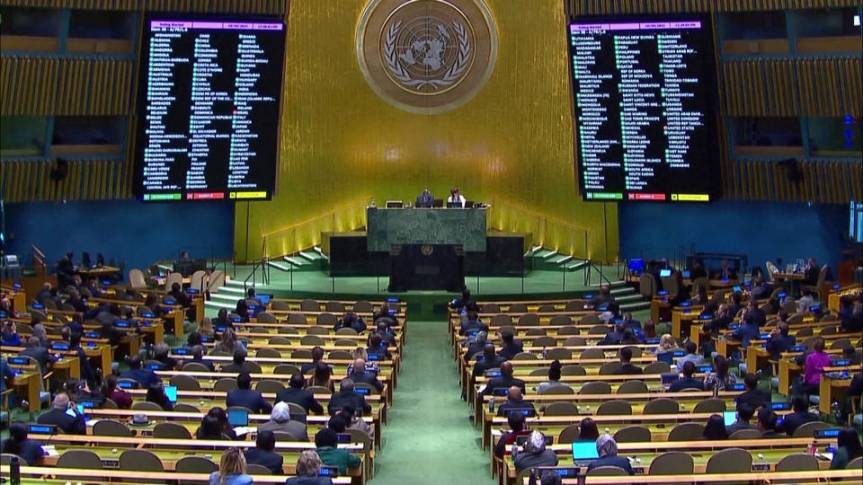
The United Nations General Assembly has voted to condemn the United States’ embargo on Cuba for the 32nd consecutive year. On Wednesday, 187 countries voted in favor of lifting the decades-old sanctions; only the U.S. and Israel voted against the nonbinding resolution | via Democracy Now!

South Paris, Maine


By a 187-nation majority, The United Nations General Assembly on October 30 voted to approve a Cuba Resolution calling for the “Necessity of ending the economic, commercial and financial embargo imposed by the United States of America against Cuba.” The United States and Israel voted no; Moldova abstained.

The same motion has been approved overwhelmingly every year since 1991. No vote took place in 2020 because of the Covid-19 pandemic. For over 20 years, only Israel and the United States have voted down the Resolution; annually one or more states have abstained.

In remarks to the Assembly’s delegates, Cuban Foreign minister Bruno Rodríguez explained that the U.S. economic blockade restricts Cuba’s importation of goods and access to international financial resources, also that shortages hurt every aspect of Cubans’ lives. Cuba’s foreign ministry on September 12 issued a comprehensive summary of adverse effects of the blockade.” Appearing here, it supplements this report.

The UN vote this year has special significance. It took place immediately following both Hurricane Oscar, which devastated eastern Cuba, and an island-wide electrical outage lasting several days. Its cause was lack of oil for generating electricity, restrictions on the shipping of petroleum products, and limited access to international financing, all owing to the blockade.

Now is an extraordinarily difficult time for Cubans and their government. Basic supplies and materials needed for day-to-day functioning are not readily available. Money is short and inflation mounts. The twin culprits are a fall-off in tourism, Cuba’s main source of foreign currency, and U.S. designation of Cuba as a state sponsor of terrorism. The latter entails regulations that persuade international financial institutions and corporations to steer clear of Cuba.

Every year in preparation for its vote on the Resolution, the General Assembly arranges for two days of discussion of the Resolution’s pros and cons. Perhaps reflecting extra stresses weighing on Cuba, commentary during this year’s discussion period came from an unprecedently large group of delegates.

In brief interventions, 59 of them offered reasons why the Resolution should pass; almost 30 international organizations or alliances did likewise. These included the Group of 77 and China, the Association of Southeast Asian Nations (ASEAN), the Community of Latin American and Caribbean States (CELAC), the Organization of Islamic Cooperation (OIC), the Non-Aligned Movement (NAM), and the Caribbean Community (CARICOM).

The speakers made frequent reference to the SSOT designation and to Title III of the U.S. Helms-Burton law (which discourages foreign investment in Cuba). Many of them variously denounced the blockade as violating international law and Cubans’ human rights, for inhibiting Cuba’s development, and for sticking around as a Cold War left-over. Several delegates extolled South-to-South cooperation and multipolarity. Others offered thanks for Cuba’s assistance during the Covid-19 pandemic

Meanwhile, U.S. activists and organizations, rallying against the blockade and in defense of Cuba, joined in vigorous demonstrations taking place in Washington DC, New York, Los Angeles, Chicago and elsewhere.

The International US-Cuba Normalization Coalition Committee on October 27-28 again staged its annual “24 Hour Global Picket” to accompany the UN vote. The effort made for a continuous presentation of commentary, advocacy, video presentations, and music from 61 countries. Hats off to Vancouver-based activists Tamara Hansen and Alison Brodine, and others, for devising a remarkable phenomenon.

One oddity of the discussion on the Cuban Resolution was the contrast between multiples viewpoints offered by nations of the Global South and silence from their northern counterparts, specifically Japan, Canada and all European nations, save Hungary. (The U.S. representative did speak). The divide may represent dismissal of the proceedings by nations identifying with U.S. interests, or a fundamental cleavage within the community of nations, or both.

A standout anomaly was that of Argentinian foreign minister Diana Mondino having been fired from her job shortly after she voted in favor of the Cuban Resolution. Her boss, extremist rightwing President Javier Milei, was displeased.

After the vote in New York, China’s ambassador in Cuba issued a statement qualifying the result as a “just call from the international community that must be applied immediately and effectively.” He added that, “It’s disappointing and outrageous that the United States voted against the Resolution while refusing to end its sanctions against Cuba and insisting on including Cuba on its list state sponsors of terrorism … [And besides] China and Cuba are good friends, comrades and brothers.”


W.T. Whitney Jr. is a political journalist whose focus is on Latin America, health care, and anti-racism. A Cuba solidarity activist, he formerly worked as a pediatrician, lives in rural Maine. W.T. Whitney Jr. es un periodista político cuyo enfoque está en América Latina, la atención médica y el antirracismo. Activista solidario con Cuba, anteriormente trabajó como pediatra, vive en la zona rural de Maine.

How US imperialism causes death and destruction in Gaza and Lebanon / By W. T. Whitney

Smoke billows over southern Lebanon following Israeli strikes, as seen from Tyre, southern Lebanon on 23 September, 2024 (Reuters)

South Paris, Maine


The Israeli military’s horrendous massacres in Gaza extend now to Lebanon. Housing, schools, and hospitals are destroyed.  Residents of Northern Gaza are being herded south, again. People starve. The U.S. government supplies the bombs, planes, and weapons.

The war’s continuation relates to U.S. strategic interests in the region and U.S. pretensions to world domination. War and humanitarian catastrophe will end with stopping U.S. assistance. Some of the war’s critics present views and emphases that distract and offer little toward ending it.

They commonly ascribe the carnage to the expansionist nature of Zionism. For a century and more, Zionism has indeed visited grief and loss upon Palestinians. But criticizing that record is more likely to reinforce intransigence than alter the course of events.  

Highlighting unprecedented humanitarian disaster will not by itself stop the killing, or bring about repair.  It needs to be the object of international consensus and cooperation, as mediated through the United Nations. Underfunding and Security Council vetoes are impediments.

Peace advocates may insist that the more humanitarian norms are violated, the more impactful moral, legal, and/or ethical criticism will be and the more telling will be personal witness or civil disobedience. Without mass pressure to accompany expectations, they become wishful thinking.   

The war won’t end just because the war should end. It continues as long as vital interests are being served. Israel’s interests are her own. Criticism from afar is likely ineffectual. U.S. interests do warrant attention, because the war serves U.S. purposes.

According to peoplesworld.org, “Israel is completely dependent on the U.S. It would be incapable of carrying out its campaigns of aggression without U.S. help.”

The United States is bound to Israel. The two major political parties support military aid for Israel. Prime Minister Netanyahu addressed the U.S. Congress on July 24 to rapturous applause. The U.S. tie to Isreal is worth a lot.  

U.S. commitment to Israel, and to assisting with Israel’s war, is measured in money: $251.2 billion (adjusted for inflation) in military aid to Israel during 66 years, $18 billion in the year prior to October 2024, and $20 billion approved by President Biden in August 2024 and being voted on in Congress in November. These are funds “that Israel must use to purchase U.S. military equipment and services.”

Commitment is such that U.S. military aid flows despite the Leahy Act (1997) requirement to “vet any foreign military unit to ensure it has a clean human rights record before it can receive U.S. assistance.”

Support for Israel is a crucial part of U.S. strategy for the entire Middle East. That strategy is one aspect of U.S. plans for arranging international affairs to its liking. U.S. backing of Israel and its war coincides with U.S. imperialist purposes.  

Formerly, U.S. reactions to the Holocaust were foremost in determining U.S. support for a Jewish state. Later, relations with Israel took on an additional transactional aspect. The U.S. government would indeed support Israel’s dealings with Palestinians. But Israel would facilitate U.S. policy objectives for the Middle East.

They are: control and supervision of the region’s production and distribution of oil and natural gas, maintenance of the Middle East role as “transit hub connecting Europe, Asia, and Africa,” military force ready to intervene against so-called terrorism, and pushback against “the influence of rival great powers.”

There are other favors. Israel serves as proxy warrior for the United States, for example, in Syria and Iraq, and in the UN General Assembly provides a yearly vote for the U.S. economic blockade of Cuba (there’s usually only one other such vote).

Israel furnishes U.S. rightwing allies in Latin America with military aid, training and equipment. Israel offers attractions: a proposed canal through the Negev Desert bypassing Egypt and offshore deposits of oil and natural gas.

A side note: money is also the measure of U.S. commitment to imperialism. Because imperialism involves conflict, military capabilities are crucial, and they cost. Overall U.S. military spending is exorbitant, dwarfing outlay for the U.S. population’s social needs. In the government’s discretionary budget for fiscal year 2023, military funding amounted to 62% of the $1.8 trillion total; 38% sufficed for everything else, including housing, education, healthcare, and restoration of infrastructure.

Another side note: unfathomable human suffering will not likely deter United States from enabling Israeli massacres in Gaza. The U.S. government has returned to a nuclear arms race. Doing so signals tolerance for the worst kind of catastrophe.  According to the New York Times: “General Dynamics will have “produced 12 nuclear ballistic missile submarines by 2042 — a job that’s projected to cost $130 billion … [and] the United States is set to spend an estimated $1.7 trillion over 30 years to revamp its [nuclear] arsenal.”

The U.S. government, with Israel’s help, pursues a new kind of imperialism. Distant from enslaved labor, die-offs of indigenous peoples, and occupation of foreign territories, it relies on debt dependency and cheap labor. Under neoliberalism, wealth is still being drained from the world’s peripheral regions to metropolitan centers.

Conflict remains. Rival powers are ever threatening, and the United States needs a hard-boiled and militarily competent factotum at its side. The U.S. government pays in-kind, with bombs, guns, planes and missiles.  

Neither war nor U.S. weaponization of Israel will end soon. What happens will depend on priorities serving U.S. imperialism. U.S. young people and others actively demanding justice for Palestinians would do well, it seems, to prepare themselves for the long haul. They are looking at U.S. imperialism now and would come to understand its origins and know what needs to be done.  

They would learn, first, that capitalism consolidated, turned aggressive, and then thrust modern-day imperialism upon the world. They would study worker exploitation and how it led to the profit-taking abundance fueling the growth of capitalism. They would explore division by social class, the necessary condition for exploitation.

Others, socialists in particular, reversed this sequence, and it doesn’t matter. Beginning with Marx and Engels’ reflections on the factory system under capitalism, they learned that workers lose out on the surplus value of the labor they provide. The inquirers became familiar with labor mobilizations and working-class struggles for political power. They arrived at Lenin’s Imperialism, the Highest Stage of Capitalism (1916), a study of capitalists monopolizing and making war.


W.T. Whitney Jr. is a political journalist whose focus is on Latin America, health care, and anti-racism. A Cuba solidarity activist, he formerly worked as a pediatrician, lives in rural Maine. W.T. Whitney Jr. es un periodista político cuyo enfoque está en América Latina, la atención médica y el antirracismo. Activista solidario con Cuba, anteriormente trabajó como pediatra, vive en la zona rural de Maine.

In Cuba’s report, US blockade comes off as weapon of war / by W.T. Whitney

Image credit: Prensa Latina

South Paris, Maine


Cuba’s foreign ministry annually reports on the U.S. economic blockade of Cuba and its recent impact mostly in order to enlighten delegates of the United Nations General Assembly prior to voting on a Cuban resolution.  For 31 consecutive years the General Assembly has overwhelmingly approved a resolution claiming “the necessity to put an end to the economic, commercial and financial blockade imposed by the United States of America against Cuba.”.

On September 12 in Havana, Cuba’s foreign minister Bruno Rodríguez held a press conference to introduce “Knock Down the Blockade – CUBA’S REPORT March 2023 – February 2024.” Providing information on blockade workings and the damage it causes, the 65-page Report is comprehensive and detailed.

Rodríguez cast the blockade as “the most comprehensive, far-reaching, and prolonged coercive economic measures [ever] applied against any country.” The yearly reports tally economic losses from blockade effects the year before and cumulatively since the blockade’s onset. The figures this year, cited by Rodríguez, are $5.057 billion and $164.14 billion, respectively. With inflation, the latter amount is $1.499 trillion.

Why the blockade has lasted for over 60 years is not clear. The linkage of planned healthcare difficulties and food shortages with the likelihood of some Cubans dying is reminiscent of war. The United States has trouble ending its wars.

The Report covers U.S. legislation, regulations, and policies reflected in the blockade. Three categories get top billing: requirements imposed by U.S legislation, regulations stemming from executive orders, and the designation of Cuba as a state sponsor of terrorism (SSOT).

The Cuba Democracy Act of 1992 requires that ships docking in Cuba don’t visit U.S. ports for six months afterwards, that companies abroad tied to U.S. corporations don’t trade with Cuba.  The 1996 Cuban Liberty and Democratic Solidarity Act enables the heirs of the former owners of properties nationalized by Cuba’s government to utilize U.S. courts to secure compensation from the third-country investors and companies presently involved with the properties. Consequently, many prospective investors are now hesitant about doing business in Cuba.

Regulations put in place by the U.S. government’s executive branch have long restricted U.S. travel and commercial arrangements with the island. One galling regulation disallows products from abroad containing more than 10% U.S. components from being exported to Cuba. The Trump administration issued dozens of new regulations restricting U.S. travel to Cuba, and they continue.  Regulations requiring “specific licenses or permits” and payments “in cash and in advance” diminish food imports from the United States, approved under legislation in 2000.

The SSOT designation entraps international banks and financial institutions in a system that already restricts the dealings of international corporations and traders with Cuba.  According to the Report, the SSOT label “has brought about serious difficulties to our country’s financial and banking transactions, foreign trade, sources of income and energy, [and] access to credit.”  

The U.S. offers its Visa Waiver Program to the travelers of 42 countries. Persons visiting Cuba are ineligible, because of its SSOT designation. Travelers protecting their waivers stay away from Cuba. Tourism takes a hit.

Indeed, “[t]he US government has used tourism, the main source of income for the country, as a political weapon against Cuba.” In 2023, Cuba … received 2,436,980 international visitors, which represents … 57 per cent of the figure achieved in 2019.”

The Report contains dozens of illustrative examples of harm, shortages, and/or diminished imports bedeviling agencies, activities, and individuals within the various sectors of Cuba’s economy. These are the education, sports, culture, biotechnology, and transport sectors, and the mining, energy, healthcare, agricultural, and food sectors.

According to the Report, “The US blockade against Cuba violates International Law. It is contrary to the purposes and principles of the Charter of the United Nations. It constitutes a violation of the right to peace, development and self-determination of a sovereign State.”  

The blockade continues despite appeals to fundamental principles. A journalist in Havana portrays a “humanitarian crisis throughout Cuba.” Describing “hungry people scavenging through dumpsters and panhandling,” he indicates that, “With pharmacy shelves barren, the price of medicines on the black market has slipped beyond the reach of much of the population. Without money to repair old infrastructure, hundreds of thousands now live without running water.”

Humanitarian disaster in Cuba, the product of prohibitions and restrictions applying to Cuba’s healthcare, food, and agricultural sectors looks to be purposeful rather than accidental. 

Highlighted in the Report are shortages of spare parts for intensive care units and operating rooms, spare parts for a device that encapsulates medicines and fills vials, blood gas analyzers, reagents to diagnose immunodeficiency diseases, drugs used to treat cancers, new equipment for neonatal care.

Now 51% of drugs on a “national list of essential medicines … are not available … surgeries have dramatically decreased.”

Food production is down due to shortages of the “fuels, oils and lubricants needed to operate the existing agricultural machinery” and “a shortage of antibiotics, antiparasitic medications, vitamin supplements.” Significant too are: a “deteriorated fleet of agricultural equipment,” loss of “capacity to refrigerate 26,360 tons of products,” and “limited access to fertilizers and pesticides.”

According to Cuba’s Report, “The historical yields of several crops have deteriorated by almost 40 per cent … [leading to] a remarkable decrease, as compared to 2022 figures, in products such as rice, beans, bread, coffee, cooking oil, soybean yogurt, meat products, powdered milk, sugar, as well as in medical diets. As compared to 2019, the production of rice, egg and milk has decreased by 81 per cent, 61 per cent and 49 per cent respectively.”

The president of the Cuban Association of Animal Production indicates that, “The blockade makes it impossible for cooperatives and farmers to have access to inputs, such as spare parts for machinery, tractors, harvesters and other means of transportation that remain paralyzed and are obsolete, as well as raw materials and other products that would otherwise make it possible to use idle land for production.”

One assumes that, what with an intended humanitarian crisis, at least some Cubans are going to die due to the blockade. What one side intends – restrictions, prohibitions, and shortages – becomes coercion for the other side. Coercion bearing the risk of death, whether of one Cuban or more, is war, or something like it. 

The object of U.S. policy toward Cuba was clear in 1960, and remains so. In his famous memo a year after the victory of Cuba’s Revolution, State Department official Lestor Mallory writes of a “a line of action … [that would] bring about hunger, desperation and overthrow of government.”

To remove a governing system not to its liking, the U.S. government could have turned to diplomacy or to a coup mediated through proxies or agents. It opted for force, with lethal possibilities.

War against Cuba manifests in the U.S. feat, through its blockade, of helping to force a million Cubans out of the country – 10% of the population. It’s a re-worked version of aggressors’ “drain the swamp” theory.  

Prospects for ending the blockade correlate with why it exists and its warlike characteristics. Many U.S. wars seemingly possess a momentum of their own, for instance, the still-unsettled Korean war, U.S. troops still in Iraq, and the prolonged U.S. debacle in Afghanistan. Regime-change in Cuba is a long-term objective. For those in charge and the dominant U.S. media, getting rid of socialism is worth any amount of waiting.   


W.T. Whitney Jr. is a political journalist whose focus is on Latin America, health care, and anti-racism. A Cuba solidarity activist, he formerly worked as a pediatrician, lives in rural Maine. W.T. Whitney Jr. es un periodista político cuyo enfoque está en América Latina, la atención médica y el antirracismo. Activista solidario con Cuba, anteriormente trabajó como pediatra, vive en la zona rural de Maine.

In Bolivia gigantic march reveals socialist divide, elections are ahead / By W. T. Whitney

Hundreds of people take part in the so-called ‘March to Save Bolivia’ against leftist leader Luis Arce, on September 17, 2024. [Photo by Aizar Raldes / AFP]

South Paris, Maine


Beginning on September 17, marchers proceeded north for 118 miles from Caracollo in Oruro department to La Paz, Bolivia’s capital city, arriving there on September 24. Numbering from 5000 to 15,000 – estimates vary – they were supporting former President Evo Morales. They called their march a “National March to Save Bolivia; for Life, Democracy, and Revolution.” The had signs saying “Evo President” and “Lucho Traitor” – in reference to current Bolivian president Luis Arce.

The Movement against Socialism (MAS) Party, the party of both presidents, has split into two warring factions. Arce served for 12 years under Morales as minister of the economy and finances. Morales served three presidential terms, from 2006 to 2019. He had led a federation of unionized coca growers, was Bolivia’s first indigenous president, and been president of MAS since 1998.

Protesting shortages of food, fuel, and dollars and demanding that Morales be president, the marchers twice encountered resistance from hundreds of Arce loyalists.  Security forces made arrests and dozens were wounded.

Meetings and attempts at dialogue in La Paz were inconclusive.  Morales was no-show at one meeting.  Speaking out elsewhere, he revived an old demand, insisting that Arce change his “corrupt, drug-trafficking, and racist” ministers if he wants to continue governing.”  

The Arce government sought to forestall new mobilizations that might “prejudice the normal development of the country.” A Morales spokesperson confirmed that highway blockades would resume on September 30. His forces for two years had been carrying out blockades, strikes, and demonstrations – with 200 days of blockades in 2023.

On learning that the government would replace Justice Minister Iván Lima, the Morales side called off further blockades. Morales announced that “extreme poverty has returned and blockades will make it worse.” He also prioritized fire-fighting. The Morales side demanded that marchers who had been arrested be released.

Meeting in El Alto on September 27, the “Unity Pact” – the name given to government supporters – heard from social movement groups. Concerned about shortages, along with Morales’s partisans, they demanded a “response and solution” from the government. Arce, who was present, charged that he was being forced to resign.

If he did so, the Constitution would require that Senate President and Morales ally Andrónico Rodríguez be installed as temporary president.  Then will come elections set for August 17, 2025, and Morales would be running.

From Cochabamba, Morales proposed a “great national meeting on October 12 where we will be making other decisions.” He accused Arce of “selling out to the rightwing, seeking to diminish the state, and following recommendations of the World Bank and International Monetary Fund.”

In late 2019 Morales, having won the first-round in presidential voting, was heading for a fourth term. Then came a U.S. assisted coup; he was deposed and went into exile. The responsible parties were big landowners, oil and natural gas empresarios, and assorted racists in Santa Cruz and other eastern departments. Jeanine Áñez became provisional president. She’s now in prison,

From exile, Morales named Luis Arce as the MAS candidate in presidential elections in 2020. He scored a 55% plurality. Morales returned to Bolivia and signs of division emerged. Arce maintained popular support for a while, helped along by a successful response to an uprising in October, 2022 carried out by reactionaries in the eastern departments.

At a MAS Party Congress in October 2023, delegates expelled Arce from the party and endorsed Morales as a presidential candidate for the upcoming elections. The Constitutional Court ruled in December 2023 that Morales may not serve another presidential term.   

In May, 2024, another MAS Congress took place, with a different set of delegates. It backed Arce as presidential candidate and named Grover García, government office-holder and former union leader, as president of the MAS Party to replace Morales.

President Arce blames Evo Morales’s ambition: “[T]he personal and individual appetite of one person cannot drag the Bolivian people into again violating the Constitution.” Arce’s approval rating fell from 42% to 22% between January and September, according to one poll. “The main reason is the economic; basically the increase in prices,” the report says.

Deterioration from an earlier state of affair is remarkable. From 2006 on, the MAS-led government carried out reforms that uplifted one of the most poverty-stricken populations in the Western Hemisphere.

According to one summary, Bolivia became a “Plurinational State” representing 36 indigenous cultures. Land was redistributed and the production of oil, natural gas, and electricity nationalized. The minimum wage and per capita income each tripled; roads, schools, and hospitals were built. The elderly, mothers, and children received generous social support. Health care expanded and schools multiplied.  The economy grew at twice the average rate of Latin American countries. International currency reserves mounted to US$15 billion in 2014.  

Then natural gas production fell. International reserve funds were down to US$139 million in 2024. According to a BBC report, these were the sources of funds used by governments under Morales and Arce to pay for social programs, including fuel subsidies. Now income from natural gas exports, paid in dollars, is short, more so because fuel imports are paid for in dollars. Bolivia imports 56% of the gasoline and 86% of the diesel fuel it uses. 

Dollars were in short supply to pay for the needs of Bolivian society. Borrowing shot up. But shortages persist, and inflation. Foreign debt as a portion of GDP rose from 10% in 2008 to 30% in 2022.

Economics is not the whole story. According to one account, “The main cleavage between Arce and Evo is the increasing inequality of state resources between the factions they represent.” Informal employment in Bolivia is high. But “the government’s executive branch employs half a million people … Control over people and agencies represents power that is available to the Arce administration and not to the other side.

For commentator Luis Vega Gonzalez, racial identity is a factor. On one side of “the abyss that separates them” are the Morales forces who are largely indigenous. On the other side are the “white mestizos represented by those who govern in conjunction with those whose power comes from perks.”

He adds that, “[I]n three years the Indians were displaced from power … the economy was handed over to the market … and the collective aspirations of the plurinational state had to be replaced by individual entrepreneurship and social climbing.”


W.T. Whitney Jr. is a political journalist whose focus is on Latin America, health care, and anti-racism. A Cuba solidarity activist, he formerly worked as a pediatrician, lives in rural Maine. W.T. Whitney Jr. es un periodista político cuyo enfoque está en América Latina, la atención médica y el antirracismo. Activista solidario con Cuba, anteriormente trabajó como pediatra, vive en la zona rural de Maine.

US misperceptions about Russia feed into war-making in Ukraine / By W.T. Whitney

Waving a Russian flag, Moscow, September 2023 Stringer / Reuters

South Paris, Maine


Indian peace advocate Bharat Dogra recently noted the near impossibility of raising the “issue of improving relations with Russia or stopping the disastrous, destructive Ukraine war.”He sees the Ukrainian people as “victims of an entirely avoidable proxy war that started way back in 2014 with a USA-instigated coup in Ukraine.” He condemns “[t]he mobilization of almost the entire military might of the West and the NATO to encircle and defeat Russia.”

Russia “has to be considered … in an unbiased way,” he insists. U.S. publicists have created “the devilish image of Putin” and “policymakers are forced to respond not to realties but to the false notions.”

The U.S. people and many public officials may indeed be uninformed generally about realities in Russia. The situation would be due to U.S. government actions, recent educational trends, and biases of a subservient media.

In penalizing Russian media personnel, the U.S. government interferes with the transmission of news from Russia to the United States. FBI agents recently raided the homes of Scott Ritter and Dimitri Simes. Ritter is a former United Nations weapons inspector who writes for the Russian news service Russia Today (RT). Simes, a U.S. resident born in Russia, hosts a Russian television talk show. They allegedly violated the Foreign Agents Registration Act

The Justice Department on September 4 indicted RT employees Kostiantyn Kalashnikov and Elena Afanasyeva under the same charge and issued sanctions against RT editor Margarita Simonyan and several colleagues. The New York Times in 2022 reported that its own journalists and those of other U.S. news outlets were being withdrawn from Russia.

On September 16 Rachel Maddow interviewed former Democratic Party presidential candidate Hillary Clinton on MSNBC. One topic was Russian interference in U.S. elections. Asserted Clinton: “I think it’s important to indict the Russians [and] I also think there are Americans who are engaged in this kind of propaganda. [Perhaps] they should be civilly or even in some cases criminally charged.”

Schools and universities have skimped on teaching and research about Russia.  An academicians’ group in 2015 reported that Russian studies in universities were in “unmistakable decline in interest and numbers in terms of both faculty and graduate students.” Enrollment levels are presently down by “30 to 50 percent.” College and university students studying Russian dropped 20% between 2007 and 2016.

According to the Carnegie Endowment for Peace, “U.S. policy toward Russia has largely ignored such crucial factors as Russia’s history, culture, geography, and security requirements—as they are seen from Moscow.”

Dogra laments that, the space for hearing and considering differing points of views [is] shrinking fast in the West,” adding that, “[m]ature democracies are supposed to be keen to hear to hear all points of view, including those of opponents.”

The U.S. people, he notes, don’t realize that“Putin tried repeatedly earlier to avoid conflict and to find a place of self-respect for Russia within Europe, … [and] made huge investments in ensuring cheap energy supply to Europe. … [H]e repeatedly pleaded with the West to honor commitments made earlier regarding not moving the NATO and its weapon systems too close to Russia … [and] took the Minsk accords very seriously.”

Dogra asks, “What kind of democracy is this, what kind of free media? What is wrong with people hearing the views of a leader even though he is widely regarded to be hostile by the West?”

Opinion polls have demonstrated high approval ratings for Putin. The U.S. and European public, says Dogra, ought to appreciate the successes of Russian governments under his leadership. They need “to examine his role as a national leader of Russia, whether he has been good for Russia and for the welfare of Russian people.”

In the 1990s, “western advisers had been active in Russia, leading to sale of Russian assets to private businesses, including foreigners as well as Russian oligarchs, at cheap rates, resulting in huge profits for a few but also in terrible disruptions in the economy.” Life expectancy plummeted.

Dogra highlights a “remarkable recovery in terms of human development indicators, to the extent that some of these are now better than or almost equal to those of the USA.”He cites data:

·        In 2021, child mortality under five years of age per 1000 live births “was 5.1 in the Russian federation, while it was 6.2 in the USA,” down from 20 deaths and 8 deaths, respectively. 

·        “Infant mortality under 1 year of age per 1000 births in Russia declined in a big way,” from 19 deaths in 2000 to 4.8 deaths in 2023, the comparable U.S. figures being 7.2 and 5.4, respectively.

·        UN data indicates that, “In the case of maternal mortality rate (reported per 100,000 births), this declined … in Russia” from 52 in 2000 to 14 in 2020, “while that of the USA actually increased from 12 to 21” in those years.

·        “During 2000-2019 according to UN data the life-expectancy in the Russian Federation increased significantly from 65.3 years to 73.2 years.”

·        “The increase of income or GNI per capita in Russia during this period was very significant—from $1710 in year 2000 to $4450 in 2005 to $9980 in 2010 to $11,610 in 2021. The literacy rate for the Russian Federation is around 99% … The Human Development Index of Russia has improved from 720 in 2000 to 822 in 2021”.

There are two conclusions. One, U.S. citizens certainly need to know more about Russia. Two, information blockade accompanies the supplying of weapons as the U.S. prolongs Russia’s war in Ukraine.

Dogra presumes that with more U.S. appreciation of realities in Russia, U.S. prolongation of the war might lose its appeal. He overlooks key factors: the economic boost provided by war-spending, U.S. habituation over a century to anti-Russian hostility, the official view that Russia is ganging up with China against the U.S. and Europe, and the distracting effect of war in the face of seemingly unsolvable U.S. problems. These include an economy mired in debt, apparently intractable inequalities, and a dysfunctional system of democratic governance.


W.T. Whitney Jr. is a political journalist whose focus is on Latin America, health care, and anti-racism. A Cuba solidarity activist, he formerly worked as a pediatrician, lives in rural Maine. W.T. Whitney Jr. es un periodista político cuyo enfoque está en América Latina, la atención médica y el antirracismo. Activista solidario con Cuba, anteriormente trabajó como pediatra, vive en la zona rural de Maine.

Colombian paramilitaries encounter adverse US court decision and people’s resistance  / by W. T. Whitney

Paramilitary fighters hold their rifles during a ceremony to lay down their arms in Otu, northwest Colombia, on Dec. 12, 2005. Photo: Fernando Vergara/AP

South Paris, Maine


Away from industrialized countries, capitalism worked its way by means of enslavement, die-offs, wars, plunder, and thugs. Colombia specializes in thugs – since the 1970s. Paramilitaries, shock troops for Colombia’s rich and powerful, are an arm of Colombia’s military. A recent court decision in the United States provokes questions about the future of Colombia’s paramilitaries and about official U.S. reactions.

A trial jury in the U.S. District Court in West Palm Beach, Florida, determined June 10 that Chiquita Brands, formerly the United Fruit Corporation (UFC), was guilty of financially supporting the United Self-Defense Forces of Colombia (AUC). The paramilitary band has operated since the 1980s in Colombia’s northern banana-producing regions. The decision will be appealed.

Chiquita will pay $38.3 millionto 16 family members of eight individuals murdered by the AUC paramilitaries. Chiquita had supplied them with arms and ammunition. 

According to EarthRights, whose lawyers managed the case, “Chiquita knowingly financed the AUC, a designated terrorist organization, [as per the U.S. State Department], in pursuit of profit …These families, victimized by armed groups and corporations, asserted their power and prevailed in the judicial process.” No U.S. corporation has previously been punished for committing human rights abuses abroad

Testimony indicated AUC paramilitaries were active in suppressing labor activism, opposing leftist guerrillas, and enforcing company dictates against individual workers. With Chiquita support, “the paramilitaries successively extended their power in the region … by means of assassinations, disappearing people, and displacing thousands of them,” according to a report. 

The court’s ruling comes 17 years after Chiquita, in a 2007 plea-bargain agreement, acknowledged guilt in violating U.S. law prohibiting financial support for terrorist organizations. Acknowledging payments of $1.7 million to AUC paramilitaries for “security services” from 1997 to 2004,”Chiquita paid a $25 million fine. The company was spared having to reveal the identity of company executives approving the illegal payments.

Subsequently hundreds of claims against Chiquita descended on courts in Colombia. To secure relief for the victims’ families in U.S. courts, lawyers led by Terrence Collingwood, who represented 173 families, consolidated claims against Chiquita; they would pursue two “bellwether cases.” Favorable decisions would enable litigation to proceed on behalf of the other families. The second case opens on July 15.

Other companies have funded Colombian paramilitaries. A recent report indicates that Ecopetrol, Colombia’s largest oil company, paid paramilitaries up to 5% of the value of contracts it signed, that Bavaria brewery delivered to paramilitaries a portion of every dollar generated from sales along Colombia’s northern coast, and that distributers associated with Postobón, Colombia’s largest beverage company, gave paramilitaries boxes of bottled drinks to be sold for cash.

Only because the crimes occurred outside the United States did a U.S. court acquit Coca Cola companyon charges it contracted with paramilitaries to kill nine unionists in 1990-2002. Drummond coal-mining company, based in Alabama, beat back well-founded charges tried in a U.S. court that it paid paramilitaries to assassinate three labor leaders between 1996 and 2001. Del Monte and Dole food companies were charged in Colombian courts with “financing right-wing paramilitary groups,” according to a 2017 report.

With their own railroads, seaports, and ships, United Fruit Company and its offspring Chiquita have operated banana plantations in Panama, Colombia, Nicaragua, Costa Rica and Guatemala. Chiquita with a presence in 70 countries recently registered $7.59 billion in yearly revenue.

UFC, Chiquita’s parent and mentor, once claimed 42% of Nicaragua’s national territory. Agrarian reform impinging on UFC holdings there led to a CIA-mediated U.S. coup in 1954 that removed the left-leaning government of President Jacobo Árbenz.

In 1928 near Santa Marta on Colombia’s Caribbean coast, banana workers were on strike. UFC called upon an obliging Colombian government to send in troops. They machine-gunned strikers and their families. More than 1000 died. The pretext was Communist agitation.

In a poignant reminder almost a century later, on June 12, 2024, “5000 or so people undertaking a civic strike outside of Santa Marta blocked the Caribbean Trunk Route,” National Highway 90. According to the report, “The communities were asking the government for solutions for violence dispossession, displacement, and lockdown in their areas at the hands of paramilitary groups.” The strike lasted three days.

Nationwide mobilization organized by the Congress of the Peoples had begun on June 4. Activists representing “small farmers, African-descendants, Indigenous peoples, and urban representatives of the diversity of the Colombian people” blockaded four big highways. In Bogotá, they occupied the Interior Ministry and the Vatican Embassy.

Human rights leader Sonia Milena López, speaking at a press conference, declared that, “Paramilitarism has been and is a politics of the oligarchy enabled by the Colombian state.” She outlined measures for dismantling paramilitarism.

The government, she insisted, must recognize “that a national paramilitary strategy at the rural and urban level does exist and is oriented toward developing a genocidal process aimed against the people’s movement.” It must abandon “any pretension of political recognition of paramilitary elements” or of negotiating with them.  

She called for ‘investigating those who finance and direct [the paramilitaries], both state and private,” and for “removing …military officers when there are … accusations or evidence of connivance or lack of effective action against the paramilitaries.” 

In an interview, Esteban Romero, spokesperson for the Congress of the Peoples, reported that paramilitaries are absorbing territory, displacing populations, and threatening and harassing social leaders.  He suggested progressive president Gustavo Petro lacks the power needed to undo “a Colombian political regime that is a paramilitarized regime, one that created private armies to contain social changes.”

Paramilitaries are dangerous, as recalled by analyst Luis Mangrane: “Between 1985 and 2018, the paramilitary groups were the principal agents responsible for the killings associated with armed conflict [between the FARC and the Colombian government], having accounted for 45% of the total of 205.028victims. Through the ‘para-politics’ in the 2002 elections, they managed to coopt a third of the Congress.”

The paramilitaries’ base of support is strong, not least in the United States. There will be no new U.S. response to their actions, it seems, unless it is mediated through Colombia’s military. What with close ties between paramilitaries and the military, however, that possibility seems unlikely

The association shows in a memo from the U.S. Department of Justice in 2001: “Colombia has five divisions in its army, but paramilitaries are so fully integrated into the army’s battle strategy, coordinated with its soldiers in the field, and linked to government units … that they effectively constitute a sixth division of the army.”

Colombia’s labor minister, Communist Party member Gloria Inés Ramírez reflects on the staying power of the paramilitaries. “[P]aramilitaries came to the fore within the framework of the development of contemporary capitalism … Colombian capitalism turns out to be a complex socio-economic synthesis between a traditionalist and pre-modern tendency around land concentration, on the one hand, and a modernizing tendency in capital accumulation, on the other. This synthesis favored the authoritarianism of the political regime, the increasing militarization of politics and the growing role of paramilitary organizations.”


W.T. Whitney Jr. is a political journalist whose focus is on Latin America, health care, and anti-racism. A Cuba solidarity activist, he formerly worked as a pediatrician, lives in rural Maine. W.T. Whitney Jr. es un periodista político cuyo enfoque está en América Latina, la atención médica y el antirracismo. Activista solidario con Cuba, anteriormente trabajó como pediatra, vive en la zona rural de Maine.

Bernard Lown’s political activism and medical achievements are celebrated in Maine / by W. T. Whitney

Photo: Anadolu Agency (AA)

South Paris, Maine


Bernard Lown was honored June 7 in Lewiston, Maine. The place was the massive Bates Mill, the former workplace for migrants mostly from Quebec who made textiles. The minting of the “American Innovation $1 Coin” in Lown’s honor had been announced in May. It was Lown’s birthday; he was born in Lithuania in 1921 and died in 2021.

The occasion featured the unveiling of a portrait of Lown painted by Robert Shetterly. Lown joins others honored by Shetterly in the series of portraits he calls “Americans Who Speak the Truth” (AWTT).

The event, attended by the writer, offered ample recognition of Bernard Lown’s medical accomplishments and his dedication to collective struggle for justice. A prime concern here is that celebration of Lown’s successes may have obscured how and why Lown did engage with the mass social and political movements of his era. Insight on that score may contribute to an understanding of how individuals now might involve themselves in big political and social catastrophes of our own time.

Maine-resident Shetterly explained to the gathering that individuals being honored through his portraits were, or are, heroes who exemplify creativity, courage, and/or passion for justice. Exhibitions of Shetterly’s portraits and educational programs based on his subjects have circulated throughout the country.

University of Maine President Joan Ferrini-Murphy, reported that Lown participated in and provided support for programs of the University’s Honors College. Doug Rawlings, a founder of the Veterans for Peace organization and head of its Maine chapter, praised Lown as an inspiration for peace advocacy.

Lown had strong connections with Maine. He arrived in Lewiston in 1935, attended high school there – at first not speaking English – and studied at the University of Maine. City officials of Lewiston and Auburn in 1988 renamed a bridge connecting the cities as the Bernard Lown Peace Bridge. Maine VFP staged a rededication of the Peace Bridge to Bernard Lown on the 2022 anniversary of the U.S. nuclear attack on Hiroshima.

Lown’s accomplishments were many: invention and introduction of the DC cardiac defibrillator (he chose not to apply for a patent), introduction of hospital cardiac care units, establishing that sick cardiac patients remain active, and urging physicians to be caring and empathetic with patients.

He founded the group Physicians for Social Responsibility in 1961.With Soviet cardiologist Evgeni Chazov, he founded International Physicians for the Prevention of Nuclear War in 1980. In 1985 they won the Nobel Peace Prize.

Lown became politically engaged with mass movements early, on the side of working people, and against headwinds.

He and his family had confronted the Hitlerite danger in Lithuania. High-school student Lown, according to AWTT, “was outraged at the sight of policemen arresting the unconscious, bleeding striker, while allowing his strike-breaking assailant walk free. Lown jeopardized his relationship with his family and joined the striking workers …The striking French-Canadian workers were accused of being part of an international communist conspiracy.”

This was the Lewiston–Auburn shoe strike of 1937. The Maine Army National Guard was called out. There was confrontation between strikers and police on what is now the Bernard Lown Peace Bridge.

Lown was briefly expelled from Johns Hopkins Medical School for violating the rule that no sick white person would receive a Black donor’s blood. He earned a suspension for inviting a Black physician to speak at the medical school.

He belonged to the Association of Internes and Medical Students (AIMS), a U.S. organization associated with the International Union of Students (IUS). Soviet Bloc students were members of the IUS, which weighed in on post-war peace, anticolonialism and more.  In 1947 Lown wrote “an effusive write-up of IUS’s founding” in the AIMS magazine The Interne.

Lown, an officer with the U.S. Army Reserve, was called up for the Korean War.  He defied the requirement that he indicate political affiliations. The Army allowed him an honorable discharge and drafted him as a private. He recalled that after receiving an undesirable discharge in 1954, “I was without a job and couldn’t get a job …wherever I’d go the FBI was one jump ahead.” 

Then, reports the Harvard Crimson, “[Frederick] Stare, [nutrition professor at the Harvard School of Public Health,] won notoriety for hiring … [Lown] who had been accused of holding communist sympathies.”

Lown’s attitude toward Cuba is revealing. He told an interviewer that, ““I have been to Cuba six times and learned much about doctoring in Cuba … If impoverished Cuba can provide first-class health care for its people so can other developing countries. Perhaps it is even possible for rich USA, if only it ceases viewing medicine as a marketable commodity.”

To return to the question posed at the start here: how do citizens focusing on their own lives and their own reactions to political happenings become part of mass movements the way Bernard Lown did? Do they identify as members of a social class?

New York Times columnist David Brooks, remarkably, seems qualified to explain. The U.S. mainstream media barely acknowledges the existence of social class. For a representative writer actually to examine the origins of class consciousness suggests he may know something.

Brooks stated recently that, “students at elite universities have different interests and concerns than students at less privileged places,” also that “the elite universities are places that attract and produce progressives.” Therefore, “American adults who identify as very progressive skew white, well-educated and urban and hail from relatively advantaged backgrounds.”

(We hold back on critiquing Brooks’ notion of “very progressive” and his idea that working-class and oppressed people are unlikely to identify as such.)    

Brooks, continuing, cites an authority who argues that, “[J]ust as economic capitalists use their resource — wealth — to amass prestige and power, people who form the educated class and the cultural elite … use … resources — beliefs, fancy degrees, linguistic abilities — to amass prestige, power and … money.” Brooks, presuming that the excluded may be resentful, envisions “a multiracial, multiprong, right/left alliance against the educated class.”

He describes a progression: individuals experience their own political awakenings, realize their perceptions are shared, and think of themselves as a larger whole. He pictures two sets of people, two social classes, who find they are at odds with each other. He provides a roadmap of sorts showing that politically-engaged individuals, in large numbers, may well become part of mass political and social movements.

In any case, Bernard Lown, involved with struggles that continue now, lauded for achievements that were extraordinary, does matter, and not least for the model he is now of dedicated political engagement. 


W.T. Whitney Jr. is a political journalist whose focus is on Latin America, health care, and anti-racism. A Cuba solidarity activist, he formerly worked as a pediatrician, lives in rural Maine. W.T. Whitney Jr. es un periodista político cuyo enfoque está en América Latina, la atención médica y el antirracismo. Activista solidario con Cuba, anteriormente trabajó como pediatra, vive en la zona rural de Maine.

US Interventionists Busy in Bolivia as Political Crisis Looms / by W.T. Whitney Jr.

Photograph Source: José Fuertes – https://creativecommons.org/licenses/by-sa/4.0/

Reposted from Counterpunch


Delegates loyal to President Luis Arce dominated the 10th Congress of Bolivia’s Movement toward Socialism (MAS) Party held in El Alto in early May. They selected Grover García, chief of a governmental agency and formerly of a farmworkers’ union, to be MAS’s new leader, replacing former president Evo Morales in that capacity.

Another MAS gathering on June 10 takes place in Cochabamba to elect other Party leaders. One more, a “unity congress,” happens there on July 10, in territory friendly to Morales. He conditions his participation on the MAS Party and his own presidential candidacy for 2025 not being eliminated.

Division within the MAS Party is good news for the U.S. government. It had opposed MAS political power from the beginning of Morales’ progressive rule in 2006 until a U.S.-backed coup ousted him in 2019.

Morales, Bolivia’s first indigenous president, retained popular support throughout his tenure. His government overcame repeated attacks from oligarchic, racist, separatist, and U.S.-allied political forces based largely in Bolivia’s eastern departments, notable for rich oil and gas deposits and industrial-scale agriculture. MAS governments, with Luis Arce as minister of economy and public finance, achieved social advances, reduced poverty, nationalized oil and gas extraction and production, carried out land reform, and elevated the status of Bolivia’s majority indigenous population.

The U.S. government has eyed immense lithium deposits in Bolivia and expressed concern about Chinese economic inroads; a commentator notes that, as of 2017, “China has become the principal contractor and financing source for Bolivia’s state-led national development project.”

That President Luis Arce’s secured a 55% majority vote on October 19, 2020 to restore the MAS Party to power is also worrisome to Washington officials. His government in October 2022 mobilized popular support to defeat an opposition uprising led by reactionary politicians in Santa Cruz and other eastern departments. The victory elevated Arce’s appeal to government officials and MAS activists alike.

Division between the Party’s two wings, widening over two years, is highly visible. Highway blockades, strikes and demonstrations carried out by “radical factions of the MAS movement led by former President Evo Morales” played out between January and March. Rising inflation, reduced gas and oil production, falling currency reserves, and shortages of fuel and food add to MAS’s vulnerability.

One goal of the 10th MAS Party Congress was that of meeting constitutional requirements of orderly party function. Observers were on hand whose reports to the Supreme Electoral Tribunal (TSE in Spanish) would allow the Tribunal to certify the “resolutions of the Arcista conclave.” But an adverse ruling now and two more in the future would deprive the MAS Party of its “judicial personhood,” and rule out future election participation.

Democracy is at risk. Journalist Tatiana Castro claims social movements, “pillars that sustain the MAS in power,” are “fundamental for guaranteeing governability … [and] part of the democratic dynamics.”  Within the MAS Party itself, social movements are divided.

Those made up of urban residents and indigenous Aymara people of Bolivia’s high plateau region lean towards President Arce. Others supportive of Morales consist of federations of indigenous peoples in Bolivia’s tropical regions. Castro sees the two factions competing within the state apparatus not about ideology but over “perks, advantages, benefits, and nominations.”

President Luis Arce on May 18 warned that “the right is sharpening up for next year’s elections.” He denounced as “economic blockade” the Bolivian Senate’s recent refusal to authorize foreign loans. Meeting recently in the United States, extreme right-wing opposition politicians were “unifying against MAS,” he claims.

Morales warned that TSE recognition of the Arce-inclined El Alto Congress would signify “genocide against the indigenous movement.” He urged followers to “have patience,” to no longer resort to blocking highways, and to expect legal struggles.

Interviewed, Morales referred to an audio-recording of statements of U.S. chargé d’affaires in Bolivia, Debra Hevia. Her remarks, supposedly leaked on April 27, may be head here. They include mention that, “We have been working for a long time to achieve change in Bolivia, time is vital for us, but for it to be a real change, Evo and Arce have to leave power and close that chapter.”  A subsequent report attributes Hevia’s voice to artificial intelligence.

Weeks earlier, an inflammatory article from the same leaking platform, El Radar, had already reverberated across Latin America. It explains that, “Information leaked from the U.S. Embassy in Bolivia, systematized… by the Center for Multidisciplinary Geopolitical Studies (CEGM) reveals a new U.S. plan.” The article includes a document titled: “Latin America in the Eye of the Storm. Possible Victory of the United States and Recolonization of Latin America (Plan Simón Bolívar).”

The origin of the Plan is unclear. Our Internet search for the CEGM provided no information. Article and document cite serious threats to U.S. worldwide hegemony posed by China, India, the BRICS alliance itself, and by “economic power [for Latin America] through trade with the two Asiatic giants, China and India.”

As regards the article’s recommendations for Bolivia: “the strategy would be focused on its natural resources and on consolidation of a servile, rightwing government,” and on break-up of the MAS political movement. It mentions “Debra Hevia, the new U.S. chargé d’affaires, who has been meeting with different parties and organizations throughout the country.”

A report elsewhere on the supposed Simón Bolívar Plan accuses Hevia of “having initiated a new phase of hybrid war whose politics are those of ‘regime change’ within the framework of the presidential elections of 2025.” Diplomat Hevia serves in place of a U.S. ambassador, absent in Bolivia since 2008. Evo Morales expelled the last ambassador Philip Goldberg, alleging interventionist activities.

Among revealing aspects of Hevia’s work and history are these:

  • She worked at the State Department Operations Center that handles intelligence and counter-insurgency work.
  • Stationed in Nicaragua, she helped arrange for opposition groups to join the failed coup attempt against the Daniel Ortega government in 2018.
  • During an earlier stay in Bolivia she “sought to reconstruct the armed wing of the [fascist-inclined] Santa Cruz Youth organization” and arranged for funding the activities of Svonko Matkovik, “formerly jailed for anti-Morales terrorist activities.”
  • Hevia’s husband, a Bolivian, is a former DEA agent.  He must have “reunited with his contacts and old acquaintances” on return to Bolivia,speculates reporter Martin Agüero. Morales expelled the DEA from Bolivia for interventionist activities in 2008.

Uncertainties prevail. The origin of revealing leaks attributed to the U.S. Embassy is obscure. With elections approaching, the two wings of the MAS Party are far apart.

Declaring the recently-completed MAS Congress to be invalid, the TSE on May 23 rejected the election of Grover García as party leader, leaving Morales in charge. The TSE had previously invalidated the Congress held by the Morales faction in October 2023.

García told a reporter that Evo Morales afterwards had been urged to join the more recent Congress. Morales reiterates that the gathering set for July 10 in Cochabamba will be a “unity congress,” although the TSE is unlikely to rule in its favor. Understating the matter, La Razón news service sees the MAS as “caught up in a vicious cycle.”


W.T. Whitney Jr. is a retired pediatrician and political journalist living in Maine.

War and Plunder in Eastern Congo and a US Hand / By W. T. Whitney

Congo’s borderlands with Rwanda have become one of the continent’s deadliest conflict zones | Credit: Guardian (UK)

South Paris, Maine


The United States Institute of Peace on February 27 awarded its “Women Building Peace” award to Pétronille Vaweka. She responded: “I weep because at this moment, in … Goma women and children are dying … [and] thousands of families are forced from their villages.”  Goma, population two million, is the capital of North Kivu province in eastern Democratic Republic of Congo (DRC).

For Guardian reporter Owen Jones, the DRC “is the site of the deadliest war since the fall of Adolf Hitler, and yet I doubt most people in the west are even aware of it.” Diminished U.S. and European press coverage of the region’s humanitarian crisis contributed to massive human suffering as, unwatched, lethal violence enabled the wholesale stealing of natural resources.

One million refugees entered eastern DRC from neighboring Ruanda during and after that country’s genocide in 1994. By early 2023 one million newly displaced people had arrived in the Goma region. Within months there would be half a million more. Of the 7.1 million displaced persons in the region now, 97% were displaced due to violent attacks by non-state military forces. The 1.1 million children and 605,000 women who are malnourished exemplify the suffering there.

The UN Refugee Agency describes “targeted attacks against civilians” with “killings, kidnappings, and the burning of homes.” The International Organization for Migration reports that “violence and brutal attacks …  loss of life, mass displacement, and increasing instability” are devastating and that “[a]cross the country, over 26 million people need humanitarian aid.”

War in the eastern DRC has killed six million people over 30 years, according to reporter James Rupert. He indicates that, “More than 250 local and 14 foreign armed groups are fighting for territory, mines or other resources in the DRC’s five easternmost provinces.” Troops fromUganda, Rwanda and Burundi are present. A United Nations peacekeeping contingent will be leaving soon.

The March 23 Movement (M23), formerly troops of the DRC army, figures prominently in the turmoil. This irregular military force, allegedly controlled by Ruanda, occupied Goma in late 2012 and was soon ejected by DRC and UN forces. Having broadened their operations after 2022, M23 detachments regularly execute civilians and force boys and men into their ranks. U.S. press coverage of this brutal war remains skimpy, and the U.S. public is largely uninformed.

The media also steers clear of humanitarian crises associated with war in Sudan and displacement of the Rohingya people from Myanma, in both instances perhaps because U.S. vital interests are not at risk. The U.S. approach toward Sudan apparently is one of watchful waiting, despite reports of growing Russian and Chinese influence and of combatants allying with extremists.

Israel’s war against Palestinians and humanitarian catastrophe in Gaza are different. The U.S. government and weapons manufacturers are unreservedly involved and the media and public pay close attention. Maybe there’s a correlation. As long as war, social catastrophe, and U.S. self-interest play out together, the U.S. public is informed. Drop the U.S. involvement, and they are not.

If that’s a rule, troubles in eastern DRC are an exception. U.S. powerbrokers are strongly attracted to the region, but even so, the U.S. public remains oblivious to the situation. James Rupert explains:

“The DRC is a treasury of minerals …, including an estimated 70 percent of the world’s known cobalt, a vital component of lithium-ion batteries for electric vehicles and other green energy products. …Since 2020, the U.S. Energy and Interior Departments have maintained a list of minerals, currently 50 of them, that they judge vital to America’s economy, energy grid or national defense. Many are difficult to access through reliable supply chains and many, including cobalt, copper, lithium, tantalum, tin and titanium, are mined in the DRC, often from illegal mines controlled by armed groups and smugglers, or in industrial mining that is significantly dominated by China.”

Rupert describes U.S. initiatives aimed at promoting mining in Africa, for example, securing investments for “building a $2.3 billion railroad to carry copper and cobalt from Congo and Zambia to Angola’s seaport of Lobito.”

He blames the multitude of “industrial and artisanal mines” in the DRC for human suffering. Paramilitary groups provide security and “hundreds of thousands … who are effectively enslaved” do the work. Importantly, “more than 250 local and 14 foreign armed groups are fighting for territory, mines or other resources in the DRC’s five easternmost provinces.”

With its cheery message of March 14, 2024, the International Trade Administration of the U.S. Department of Commerce wins points for salesmanship:

“The DRC offers opportunities large and small.  The DRC’s vast mining wealth attracts top mining companies from around the world … [and] is home to globally significant deposits of hard-rock lithium … Energy is another sector with huge potential for renewable energy, including hydropower and solar. The country has the potential to generate over 100,000 MW of hydropower, which is more than half of Africa’s total hydropower potential.”  

Continuing: “Oil and gas discoveries in the east of the country give the DRC the second largest crude oil reserves in Central and Southern Africa … The DRC has the highest agricultural potential in Africa … [and] the potential to feed over 2 billion people with appropriate investment …There are many infrastructure construction opportunities for U.S. companies, with most projects structured as public-private partnerships.” 

This U.S. presentation of opportunities for extraction and expropriation of resources does not explain how to pursue them.  A promotion piece, it is far removed from Pétronille Vaweka’s portrayal of, as she sees it, a system “based on brutal, illegal mining of these minerals from our soils and by people working in conditions of slavery.”

Wide dissemination of this grim news would likely shed light on the dark side of capitalism. Capitalism’s much-vaunted magic of the market and its autonomous mode of operating would turn out to be proxies for a kind of anarchy that, built on greed, assures that anything goes. This is a kind of insight that, for those in charge, is best avoided.    

To limit the flow of news on human suffering is offensive on other grounds.  Doing so violates “the commons,” items such as water, oxygen in the atmosphere, and knowledge that, essential to human living, must be accessible to everyone. The restriction also hits at the revolutionary notion of human solidarity, the idea that someone else’s pain is ours too.


W.T. Whitney is a political journalist whose focus is on Latin America, health care, and anti-racism. A Cuba solidarity activist, he formerly worked as a pediatrician, lives in rural Maine. W.T. Whitney Jr. es un periodista político cuyo enfoque está en América Latina, la atención médica y el antirracismo. Activista solidario con Cuba, anteriormente trabajó como pediatra, vive en la zona rural de Maine.

President Biden Must Remove the Designation of Cuba as Terrorist-Sponsoring Nation / By W. T. Whitney

Via Cuba Solidarity Campaign UK

South Paris, Maine


President Obama in 2015 removed Cuba from the U.S. list of state sponsors of terrorism (SSOT). President Trump reversed that action in January 2020, thereby aggravating economic difficulties for Cuba. President Joe Biden needs to end the designation. The time is now for representatives, senators, and other elected officials to pressure him.

Cuba is no terrorist-sponsoring nation. In accusing Cuba of hosting terrorists, the Trump administration disregarded Cuba’s invitation to Colombian guerrillas to join representatives of Colombia’s government on the island to negotiate peace.

The SSOT designation requires that targeted nations not use dollars in international transactions. The U.S. Treasury Department punishes institutional offenders. Dollars are the world’s dominant currency, and in normal circumstances, banks would use them in transactions involving Cuba. Now, however, foreign lenders steer clear of Cuba. Payments for exported goods and services may not arrive. Cuba is financially paralyzed.

Cubans are suffering. Food is short, as are spare parts, raw materials for domestic production, school and healthcare supplies, spare parts, consumer goods, and cash.  The aim of U.S. policy, as specified by a State Department memo of April 1960, is to cause shortages, despair and suffering serious enough to induce Cubans to overthrow their government.

The labeling of Cuba as a terrorist-sponsoring nation is part of the decades-long U.S. policy of embargo, which is more accurately characterized as an economic blockade, this in recognition of its worldwide reach. Reasons for removing the SSOT designation are the same ones for ending the blockade.

After all, ending the blockade is the Cuba solidarity movement’s prime goal. The campaign to persuade congresspersons to pressure the president to remove Cuba from the SSOT list must refer to the blockade, even as it pursues the more limited goal.

Congresspersons know that, as per the Helms-Burton Law of 1996 congressional action is required for the blockade’s end. They know that current political realities are unfavorable for such action.  Were they to agitate for presidential action on the SSOT matter, they would, in effect, be preparing for a fight against the whole blockade. That’s why it makes sense to use the one rationale to back up each fight.

Ending the blockade (and SSOT designation) has its uses

·        Producers and manufacturers would sell goods in Cuba.

·        With despair and discouragement having diminished, fewer Cubans would be heading to the United States; 425,000 Cuban migrants arrived in 2022 and 2023.

·        U.S. citizens could visit Cuba for recreation, cultural enrichment, and education. Their exposure to Cuban artists, scientists, and educators visiting in the United States would be gratifying.

·        For the blockade to end would disappoint proponents.  They should have been disappointed by the results of the decades-long experiment showing that the blockade did not work. Regime change did not happen. Blockade apologists could reasonably enough move on to something else.

·        An end to the U.S. blockade (and SSOT designation) would gratify nations in the UN General Assembly that annually, and all but unanimously, vote to approve a resolution calling for the blockade’s end. Critics of U.S. interventionist tendencies, wherever they are, would be pleased. The U.S. government would earn some love.

Ideals and values

·        The blockade is cruel. It causes human suffering.

·        It violates international law: “Whatever view is adopted, either that of coercion or aggression, it is quite evident that the imposition of the U.S. economic blockade of Cuba constituted an illegal act … the blockade is a fragrant violation of the contemporary standard which is founded on … sovereign equality between states.” (Paul A. Shneyer and Virginia Barta, The Legality of the U.S. Economic Blockade of Cuba under International Law, 13 Case W. Res. J. Int’l L. 451 (1981)

·        The blockade is immoral. It contributes to sickness and deaths: “By reducing access to medicines and medical supplies from other countries and preventing their purchase from US firms, the embargo contributes to this rise in morbidity and mortality.” (Richard Garfield, DrPH, RN, commenting on Cuba’s “Special Period” of shortages following the fall of the Soviet Bloc – Am. J. Public Health 1997, 877, 15-20.)

·        The blockade exposes certain failings of U.S. democracy. U.S. political leaders remain oblivious to polling data showing strong support for normal U.S.-Cuba relations and for ending the blockade. Leaders of the Cuban exile community have long exerted undue influence in determining U.S. policies toward Cuba. The appearance is that of an important aspect of foreign policy having been farmed out to a strident minority. 

Contradictions

The U.S. government claims the blockade serves as punishment of Cuba for allegedly violating human rights. But the United States has easily co-existed with governments famous for disregarding human rights, like Nicaragua’s Somoza regime, Chile under Pinochet, Haiti ruled by the Duvaliers, and the Kingdom of Saudi Arabia.

U.S. policymakers see Cuba as a Communist dictatorship and, on that account, as deserving of economic blockade. Even so, the United States trades with Vietnam and China, where Communist parties are in power.

Vice President Joe Biden presumably backed President Obama’s action in removing Cuba from the SSOT list. Contradicting himself, he refuses to reverse former President Trump’s placement of Cuba back on the list.

Contradictions point to Cuba as special case in the history of U.S. relations with other countries. Only Cubans find an open door on arrival in the United States as irregular migrants. Such red-carpet treatment stands alone in the record of how the U.S. government handles immigration. 

The Cuban Adjustment Act of 1966 ensured that Cubans arriving in the United States without documents would at once receive social services and a work permit and a year later be granted permanent residence and the opportunity for citizenship.

The fact of U.S. hegemonic intent and actions regarding Cuba for 200 years must be extraordinary in the history of international relations. From Thomas Jefferson’s time until the 20th century, leaders in Washington sought to own or annex Cuba. They would later on find other modalities.

U.S.- Cuba relations have long been on automatic pilot. Pursuing justice and fairness, elected officials in Washington would be moving beyond that history. They would go against the grain as they pressure a U.S. president to no longer designate Cuba as a state sponsor of terrorism. Persevering, they would fight to relieve Cuba of all U.S. harassment.


W.T. Whitney is a political journalist whose focus is on Latin America, health care, and anti-racism. A Cuba solidarity activist, he formerly worked as a pediatrician, lives in rural Maine. W.T. Whitney Jr. es un periodista político cuyo enfoque está en América Latina, la atención médica y el antirracismo. Activista solidario con Cuba, anteriormente trabajó como pediatra, vive en la zona rural de Maine.

In Distress, Niger Expels US Military, Resurrects Hope / By W. T. Whitney

Supporters of Niger’s governing military council, gather for a protest called to fight for the country’s freedom and push back against foreign interference, in Niamey, Niger, Aug. 3, 2023. A top Pentagon official says that the U.S. has not yet received a formal request from Niger’s rulers to depart the country. | Sam Mednick / AP

Reposted from the People’s World


On March 16, Amadou Abdramane, spokesperson for Niger’s governing military council, announced that Niger was dropping its 12-year-old military-cooperation agreement with the United States. Niger’s military council had assumed power following the coup in July, 2023 that removed Mohamed Bazoum, the elected president.

U.S. military intervention in Niger is now a poor fit with grim realities in the western Sahel region of Africa and with the Nigerien people’s needs and aspirations.

The U.S. military presence there co-exists with danger posed by Islamic extremist military groups. These expanded after 2011 when NATO destroyed the Libyan government, a stabilizing force in the region. Niger faces a humanitarian crisis worsened by environmental disaster. The military council is seeking alternative arrangements for security cooperation and looking to China for help with societal development.

Abdramane denounced “the attitude of the [recently visiting] U.S. delegation in denying the sovereign right of Niger’s people to choose partners and allies capable of really helping them fight terrorism.” General Michael Langley, delegation member and head of the U.S. Africa Command (AFRICOM), “expressed concerns” that Niger was pursuing close ties with Russia and Iran.

AFRICOM, headquartered in Stuttgart, Germany, operates 20 bases in Africa. The two largest are air bases in Djibouti, in East Africa, and Agadez, in central Niger. Niger hosts two other U.S. bases, an airbase nearNiamey, the capital city, and a CIA base in the northeast.

According to a report, the Agadez base cost $110 million to build and costs $30 million annually to maintain. It is “the largest Air Force-led construction project in history.” By means of these two large bases, the United States conducts air war, with drones, over a significant portion of the earth’s surface.

In moving to end U.S. military involvement, the coup government had backing “from the trade unions and the protest movement against French presence.”  The new government had already pressured France, Niger’s colonizer, to remove its military units from the country; the last of them departed in January, 2024. Coup governments in Mali and Burkina Faso expelled French troops in February 2022 and February 2023, respectively.

Also in January 2024, the three countries abandoned the Economic Community of West African States (ECOWAS). France had led in forming this trade bloc in 1975; it would include 15 African nations. Critics cited by the BBC claim that France, through ECOWAS, was able to “meddle … in the politics and economics of its former territories after independence.”

The French government failed in an attempt to mobilize an ECOWAS military force to punish Niger for leaving the trade bloc. Mali, Burkina Faso, and Niger reacted by forming their Alliance of Sahel States. They “are exploring alternative security relations, including with Russia.” Niger also looks to Iran for security assistance.  

Investigator Nick Turse points to U.S. failures to explain why Niger is looking elsewhere for military assistance. He documents the vast number of deaths in the western Sahel region at the hands of extremist Islamist groups over the course of 20 years. The killings skyrocketed despite the U.S. military presence in Niger.

Niger may have given up on the United States also on considering that U.S. and NATO military action in Libya in 2011 contributed to worsening living conditions in the region now. A commentator notes that, “The toppling of Gaddafi created a power vacuum that fostered civil war and terrorist infiltration, with disastrous regional ramifications.”

Additionally, in a Niger unable on its own to adequately fulfill human needs, U.S. focus on military advantage without attention to human suffering would have been disheartening. The scale of suffering is the Sahel region is immense, as evidenced by diminished food production and migration, with climate-change contributing to both.

The International Rescue Committee reports that, “The Central Sahel region of Africa, which includes Burkina FasoMali and Niger, is facing an unprecedented humanitarian crisis. Over 16 million people need assistance and protection, marking a 172 percent increase from 2016.”

China responded and Washington officials are perturbed. A report from Mali indicates that, “In Niger, the main areas of [Chinese] investment are energy ($5.12 million); mining ($620 million) and real estate ($140 million), other aspects of cooperation include: the construction of stadiums and schools, medical missions, military cooperation, infrastructure (roads, bridges, rolling stock, thermal power plants).”

A “Nigerien security analyst” told investigator Nick Turse that “the trappings of paternalism and neocolonialism” have marred Niger’s military-cooperation agreement with the United States. 

Expanding upon these polite words while commenting on Niger’s current situation, Casablanca academician Alex Anfruns observes that, “international capitalism has destroyed the hopes of entire generations of Africans while inflicting its policies like a thug with white gloves. Actors like the International Monetary Fund and World Bank are complicit as key functionaries of the neocolonial system.”

U.S. policy-makers, enablers of world capitalism, look longingly at Africa. Africa claims “98% of the world’s chromium, 90% of its cobalt, 90% of its platinum, 70% of its coltan, 70% of its tantalite, 64% of its manganese, 50% of its gold, and 33% of its uranium.” Even more: “The continent holds 30% of all mineral reserves, 12% of known oil reserves, 8% of known natural gas, and 65% of the world’s arable land.”

Alex Anfruns sees hope: the leaders of Niger, Mali, and Burkina Faso,  with their Alliance of Sahel States, “have sent a powerful message of solidarity to millions of Africans who share a vision and an emancipatory project, that of pan-African unity.” Indeed, “From now on neither the United States or France under the flag of NATO can destroy an isolated African country, as happened in Libya in 2011.” 

Burkina Faso president Thomas Sankara expressed a far-ranging kind of hope in 1984, at the United Nations: “We refuse simple survival. We want to ease the pressures, to free our countryside from medieval stagnation or regression. We want to democratize our society, to open up our minds to a universe of collective responsibility.”


We hope you appreciated this article. At People’s World, we believe news and information should be free and accessible to all, but we need your help. Our journalism is free of corporate influence and paywalls because we are totally reader-supported. Only you, our readers and supporters, make this possible. If you enjoy reading People’s World and the stories we bring you, please support our work by donating or becoming a monthly sustainer today. Thank you!


W.T. Whitney Jr. is a political journalist whose focus is on Latin America, health care, and anti-racism. A Cuba solidarity activist, he formerly worked as a pediatrician, lives in rural Maine. W.T. Whitney Jr. es un periodista político cuyo enfoque está en América Latina, la atención médica y el antirracismo. Activista solidario con Cuba, anteriormente trabajó como pediatra, vive en la zona rural de Maine.