
Vietnam Is Precedent as US Prepares for War with China / By W. T. Whitney

Near Da Nang, South Vietnam, Marines move through ankle-deep mud carry their poncho-covered comrade towards higher ground were, when the weather permits, he will be air-lifted to the rear areas, Jan. 16, 1968. (AP Photo/John T. Wheeler)

South Paris, Maine


Popular struggle for national independence under socialism has regularly provoked U.S. war or hostile interventions, as with Cuba, North Korea, China, Vietnam and other nations. We explore both the extreme danger of possible U.S. war with China and also the changing U.S rationale for fighting wars. This shows in the difference between why the U.S. war in Vietnam was fought and why U.S. war with China may be on the way.   

Vietnam recently commemorated agreements reached 70 years ago in Geneva that on July 21, 1954 ended war between Vietnamese revolutionary forces and the French military, defeated two months earlier at Dien Bien Phu. According to official media, the object of a “scientific conference” held on July 19 was “to emphasize the historical importance of the agreements for the struggle for national liberation of the Vietnamese people and the peoples of the world.”
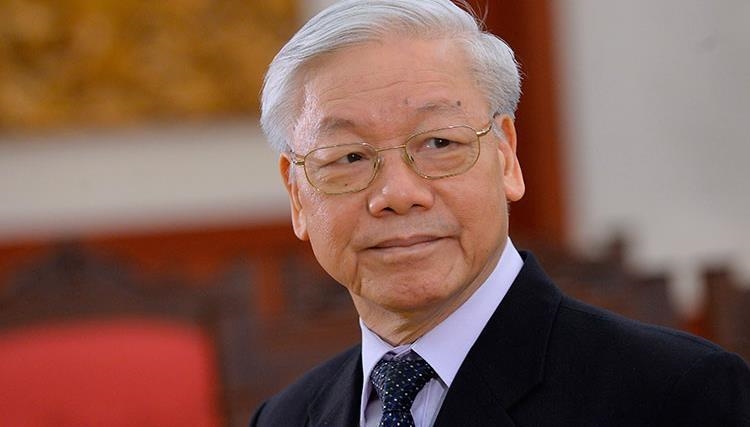
Nguyen Phu Trong | Photo: Anadolu Ajnsi

Also on July 19, Nguyen Phu Trong died. Once chairperson of the National Assembly and president of Vietnam, this paramount leader, a student and teacher of Marxist theory, had long served as general secretary of the Communist Party of Vietnam. His death is a reminder, if such is needed, that for Vietnam revolutionary socialism and national liberation were kindred struggles.

To prevent the unification of Vietnam as a socialist nation, the U.S. government went the last mile, first diplomatically and then militarily – from the 1954 Geneva agreements that established Vietnam’s national independence to the departure of defeated U.S. troops on April 30, 1975. The U.S. leadership class, involved in spreading U.S. power and influence across the globe, created and then defended South Vietnam, while attempting to defeat Vietnam’s Revolution, all at enormous human and material cost.

The enclave remaining after a U.S. victory might have ended up as a beachhead for counter-revolution and U.S. control in Southeast Asia. In their various situations, that’s the role performed by South Korea, Taiwan, and even Ukraine in relation to Russia, and Israel vis-a-vis the rest of the Middle East.

U.S. planners, in thinking about what to do about Vietnam, were not entirely devoid of reason. For U.S. imperialists, to beat back Vietnamese Communists – think “domino theory” – and heat up the Cold War against the Soviet Union had a certain logic, according to their own lights.

After the Vietnam disaster, official U.S. planning for war has built upon a variety of ostensible reasons for fighting. Having emerged from World War II well-resourced and strong, the U.S. government consistently demonstrated limited tolerance for the risings of oppressed, colonialized peoples. However, once newly formed independent states showed signs of strength, regional prominence, or even strategic rivalry, U.S. strategists turned to action.

War materialized as the ultimate U.S. fix, no matter the circumstances and under a variety of pretexts, as shown with U.S. war-making in Libya, Afghanistan, and Iraq. The rationales for fighting were more diffuse. The threat of U.S. war now looms over Iran and, more ominously, over China. Each is under the gun because they are strong, assertive states.  

Anti-communism was a safer kind of rationale. Vietnam won its “American War,” and the U.S. government backed off. That’s the story. Incidentally, the Vietnamese people scored a clear win. They live according to plans and socialist purpose in a free and independent nation.  

Vietnam has established diplomatic relations with 190 countries. A Vietnamese writer cites “important achievements with infrastructure gradually meeting the needs of industrialization and modernization.”  Since reforms in the 1980s, an economy resting mainly on foreign direct investment in manufacturing and tourism has expanded. Economic growth ranged between 9.5 and 5.5 percent between 1993 and 2022, save for sharp drops in 2020 and 2021. GDP rose 5.05 percent in 2023. By 2022, the poverty rate was down to 4.3%.

Vietnam’s government since 2008 has spent 20 percent of its budget on education. The same report mentions “high primary school completion rates, strong gender parity, low student/teacher ratios,” and school attendance rates that are high.  The British medical journal Lancet indicates that, “Along with the economic growth, the health of the Vietnamese people has significantly improved between 1990 and 2020, whereby the life expectancy grew from 69 to 75 years, and the under-five child mortality rate decreased from 30 to 21 per 1000 live births.” 
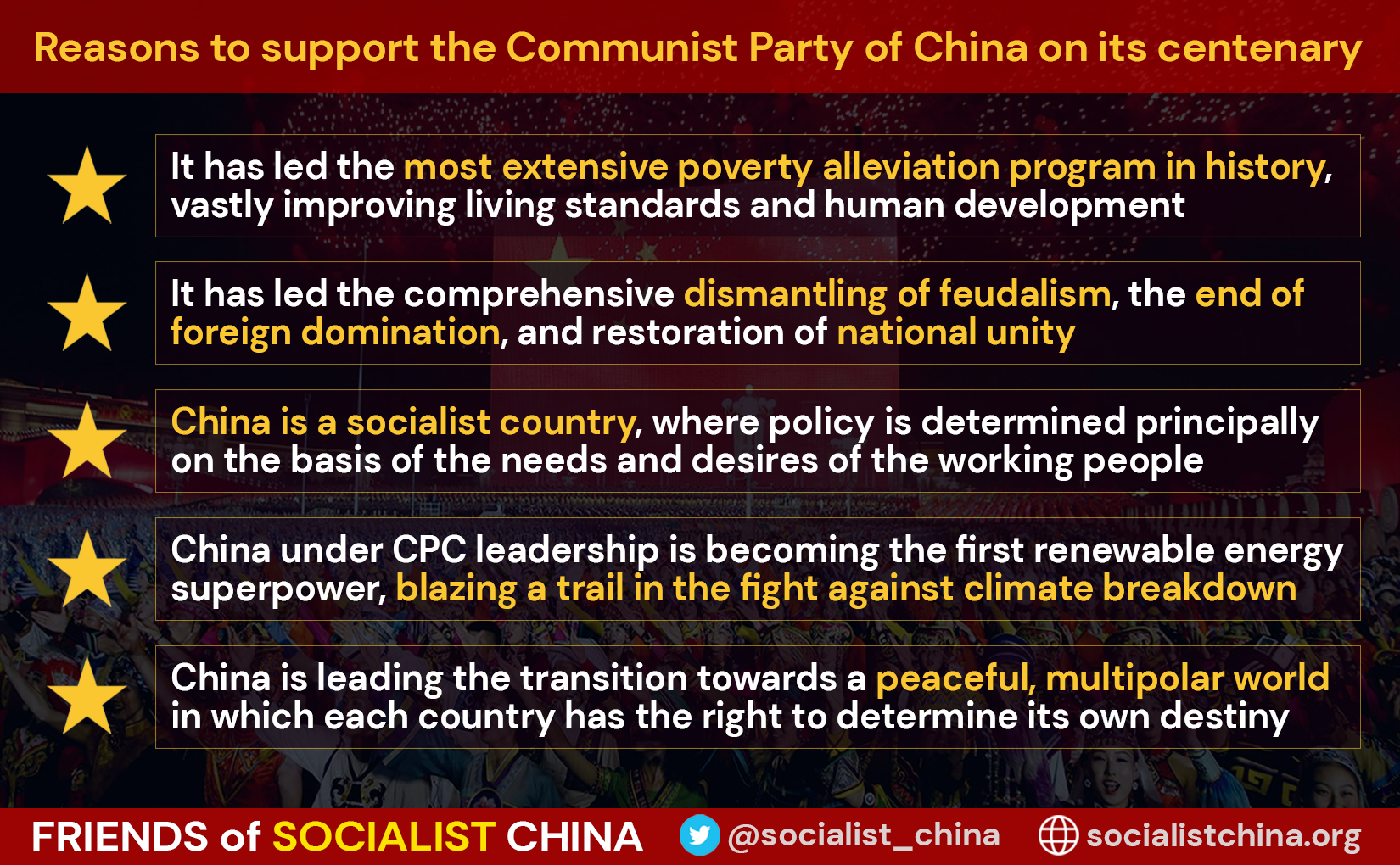
Socialist China restored dignity to the vast majority of its citizens, has afforded them decent lives, and created a well-functioning state that responds effectively to the climate crisis and other challenges. It too warrants a pass from the U.S. government.

That’s not happening: the U.S. government, in the hands of a divided leadership class, deals only haphazardly with major problems afflicting U.S. society. It satisfies the material wants of the upper echelons, and presides over war preparations as part of what is, in effect, a new Cold War.

Indeed, the USA has accumulated over 750 bases in 80 countries and posted 173,000 troops in 159 counties. The U.S. share of global arms exports in 2019-23 was 42 percent, up from 34 percent during the previous four-year period, according to sipri.org.
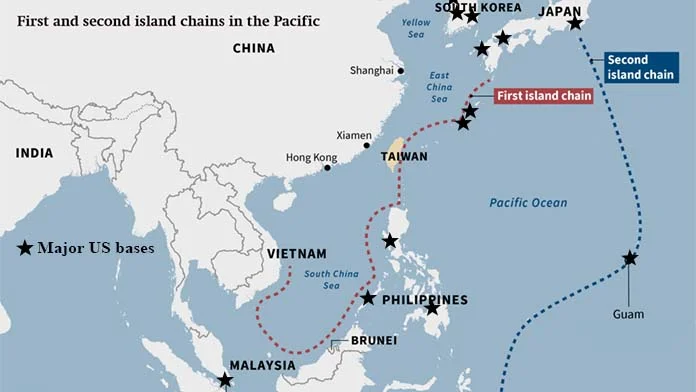
The US has two island chains around the coast of China. The stars indicate major US bases | via solidarity.net.au

In the Pacific waters surrounding China, the United States has expanded the capabilities of its bases; it operates nuclear-equipped naval vessels, arranges for multi-national naval exercises, has vessels engaging in provocative “freedom of navigation exercises,” and will be introducing nuclear-powered submarines.

The idea of multiple and varied reasons for fighting wars, presented above, folds neatly into the overarching notion of a new Cold War, something that by nature is ambitious, far-reaching, and long term.  Where is the justification for that?

Here is a guess: The United States decades ago turned to a great variety of activities related to military preparation, financing, and recovery. These now intrude massively in the U.S.  economy and in society itself, so much so that, in theory, something has to happen to explain and justify such a state of affairs. War provides meaning, without which the whole apparatus might disappear. What then of the economy and of the collective experience of a U.S population variously oriented to the military?

The Costs of War Project of the Watson Institute of Brown University weighs in. Author Heidi Peltier points out that:

Federal spending on the military and on veterans makes up more than half of the federal discretionary budget. Employment in the federal government is dominated by civilian defense workers and uniformed military personnel. Because the majority of taxpayer dollars and federal resources are devoted to the military and military industries, and most government jobs are in the defense sector, the political power of this sector has become more deeply entrenched and other alternatives have become harder to pursue. Instead of having a federal government that addresses various national priorities … the U.S. has a government that is largely devoted to war and militarism.
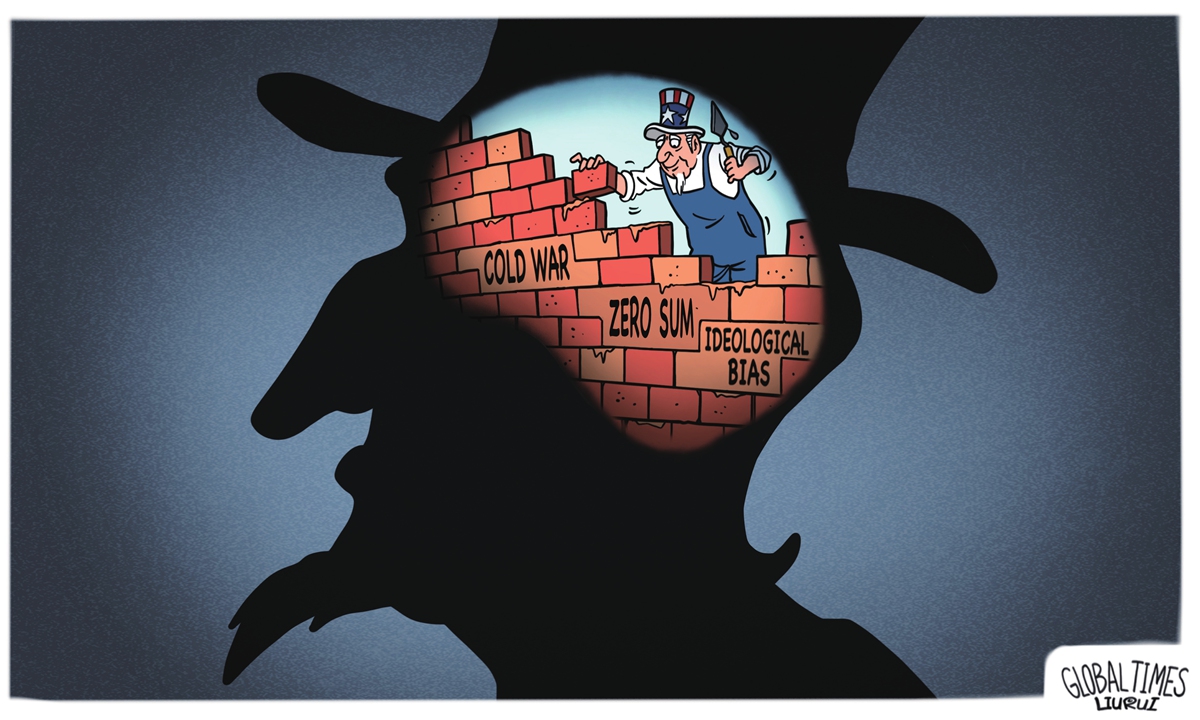
Illustration: Liu Rui/GT

Unfortunately, protecting both the U.S. economy and habituation to the military has its downside, specifically extreme danger to humanity itself. Writing in the most recent issue of Monthly Review magazine, John Bellamy Foster and Brett Clark explain, pointing to China. Discussing “Imperialism in the Indo-Pacific,” they state that:

“Most U.S. strategies for winning the New Cold War directed at China are aimed at a strategic-geopolitical defeat of the latter that would bring down Chinese President Xi Jinping and destroy the enormous prestige of the Communist Party of China, leading to regime change from within and the subordination of China to the U.S. imperium from without … (It) is the United States, which sees China’s rise as a threat to its own global preeminence, with the Indo-Pacific super-region increasingly being viewed as the pivotal site in the New Cold War, that is propelling all of humanity toward a Third World War.”


W.T. Whitney Jr. is a political journalist whose focus is on Latin America, health care, and anti-racism. A Cuba solidarity activist, he formerly worked as a pediatrician, lives in rural Maine. W.T. Whitney Jr. es un periodista político cuyo enfoque está en América Latina, la atención médica y el antirracismo. Activista solidario con Cuba, anteriormente trabajó como pediatra, vive en la zona rural de Maine.

How the Knowledge Economy and Science Bolster Cuba’s Socialist Revolution / By W. T. Whitney

via Radio Havana Cuba

South Paris, Maine


Cuba and Cuban science gained acclaim worldwide for producing their own very effective Covid-19 vaccines. The achievement stood out among nations of the Global South. The feat reflects Cuba’s development over decades of a formidable scientific establishment engaged in the development and marketing of biologic products oriented to healthcare mostly, and food production too.

The planning processes and strategizing involved were unique, and so too the resulting organizational forms. These special characteristics relate directly to Cuba’s version of socialism.

In a speech on January 15, 1960, a year after the Revolution came to power, Fidel Castro remarked that, “The future of Cuba will necessarily be a future of men (sic) of science.” The landscape would change dramatically.

The Cuban Academy of Sciences was reactivated in 1962. In succession came:  the National Center for Scientific Research (1965), the Center for Biological Research (1982); the Center of Genetic Engineering and Biotechnology (1986) with its 38 scientific institutions, the Immunoassay Center (1987), the vaccine-manufacturing Finlay Institute (1991), the National Center for Biopreparations (1992), and the Center for Molecular Immunology (1994).

The “Scientific Pole,” formed in the 1980s in Western Havana, now includes over 40 research centers that employ 30,000 workers employed. Established in 2012 to facilitate commercialization, BioCubaFarma  exports some 164 products from 65 centers. It operates 19 units abroad, as joint ventures or Cuba-owned entities.

Dr. Agustín Lage-Dávila, longtime head of the Center for Molecular Immunology, writes of “whole cycle institutions” that carry out research, product development, commercialization, and export, all under single management. Export income goes toward funding each institution’s activities and contributes to the national budget.

Exported products have included vaccines against meningitis B, hepatitis B, Hemophilus Influenza type B, Covid-19, lung cancer (CIMAvax-EGF), and many other infectious agents. Other products are:  interferons, erythropoietin, streptokinase, Heberprot-P (used to treat diabetic foot ulcers), diagnostic test kits, and six non-vaccine treatment modalities for Covid-19.

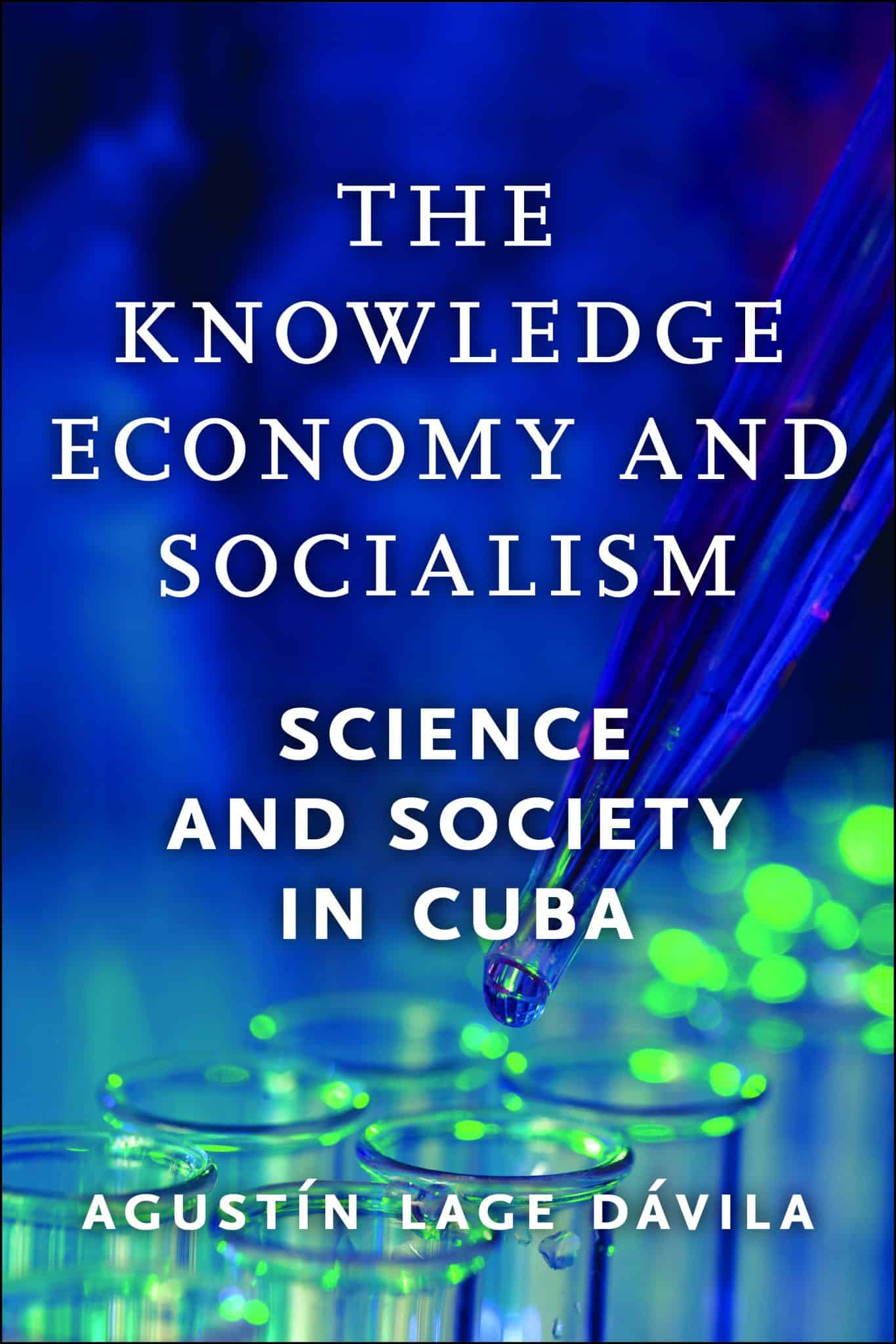
Lage’s book on the origins, development, and upkeep of Cuba’s immense bio-scientific network was published in Cuba in 2013 and again in 2016. Monthly Review Press recently issued a translated version of the book’s second edition titled The Knowledge Economy and Socialism – Science and Society in Cuba. The various chapters represent articles that Lage, an immunologist, biochemist, cancer expert, had written for Cuban journals. An additional chapter consists of Lage’s responses to questions provoked by first edition of the book. The clarity and readability of the book’s English translation is a plus.

The book overflows with information, opinions, analyses, historical references, and optimism balanced by ample recognition of big problems. Lage explains that, after the Revolution, Cuba at once embarked upon developing human capabilities and initiating social advances. There was no waiting for available funding, as is the practice of most nations.

As a result, circumstances were in place for the building of what Lage calls a knowledge economy. It would feature the export of scientific products, these in place of the natural resources and the industrial base that Cuba lacks. Lage notes that biologic products have to be new and novel in order to sell.

Cuba’s bio-technical industries function “without sterile fragmentation …[and] within inter-institution borders … [K]nowledge is captured and incorporated into negotiable assets.” Cooperation, according to Lage, works better than competition. Elimination of institutional boundaries promotes integration of knowledge. The system favors autonomy over centralized decision-making; it features “layered” decision-making, “crosspollination,” and a shared sense of responsibility.

The contrast with capitalist modes of bio-technical production is striking, he suggests. There, funding rests on venture capitalism. Products and their value end up in private hands through patents, intellectual-property protection, and regulatory barriers. Planning is for the short-term. Scientific creation is divorced from ownership of the results.

Lage repeatedly returns to the necessity of overcoming a contradiction pointed out by Karl Marx, that of the social character of production and the private character of appropriation of both the product’s value and the means of production. He refers to the “private appropriation of accumulated science and knowledge,” and to the appropriation of people in the form of brain drain.

As a socialist country, Cuba defends social ownership of the means of production and the accumulated value of products. Socialism is a prerequisite, he suggests, for science to be propelling a nation’s economy.

Lage emphasizes the contribution of Cuban culture and notions of sovereignty in bolstering the project. Culture shows in ethical values, motivation, solidarity, and inclination toward unity. There is an “indissoluble link between sovereignty and socialism” through which “our daily tasks are part of a larger historical task.”

He adds that, “We are getting closer … to the knowledge economy …[and] approaching Marti’s ideal of ‘whole justice’ daily through every social program we successfully implement … Thus we construct not only the spiritual and material well-being of our people but also the defense of national sovereignty.”

Lage discusses the knowledge economy as it manifests at the local level, specifically in Yaguajay, near Sancti Spiritus, the municipality he represents in Cuba’s National Assembly. He cites a “municipal socioeconomic developmental strategy” that, enlisting nearby universities and research centers in “knowledge management,” has led to “qualitative changes” in healthcare, tourism development, computing, housing promotion and agriculture.

The “levers of socialism” are helpful, in particular:  massive state investment in creating human capital, integration among institutions, linkages with social programs, exports connected to Cuba’s international agreements and solidarity programs, the capacity to innovate in managing institutions, and workers’ “political and social motivation.”

He recognizes risks. Time is one; “building a knowledge economy … is today’s task, not tomorrow’s.”  Rich countries use “their accumulated economic advantages … to enlarge those advantages and erect new development barriers in poor countries.” He cites residual damage from the Special Period, old habits of “centralized business management,” brain drain, and pressures exerted “by the most powerful empire that has ever existed.”

As regards U.S. aggression: “They know … the potential of socialism. A country that makes its material wealth grow based on the education and spiritual wealth of its people and on the equity that derives from the social ownership of the means of production and distributive justice would be too clear evidence that the solutions to the problems facing humanity today are not on the path of capitalism nor in the subordination to the interests of the developed capitalist countries. Thus, they need to show that our system ‘does not work,’ hence the blockade.”

A cautionary note: a report from Columbia Law School in 2021, eight years after Lage’s book was first published, cites Cuban statistics showing “a drop of almost 40% in exports of chemical products and related products between 2015 and 2019 … [And] medicinal and pharmaceutical products make up around 90% of the total exports of chemical products.” It seems that income derived from bio-technology exports is down.


Agustín Lage DávilaThe Knowledge Economy and Socialism: Science and Society in Cuba, (Monthly Review Press, NY, 03/31/2024), www.monthlyreview.org, pp320, $29.00 (PB) Paperback ISBN: 978-1-68590-042-7


W.T. Whitney Jr. is a political journalist whose focus is on Latin America, health care, and anti-racism. A Cuba solidarity activist, he formerly worked as a pediatrician, lives in rural Maine. W.T. Whitney Jr. es un periodista político cuyo enfoque está en América Latina, la atención médica y el antirracismo. Activista solidario con Cuba, anteriormente trabajó como pediatra, vive en la zona rural de Maine.
U.S. policy implicated in the economic crisis driving Cuban protests / by W.T. Whitney Jr.

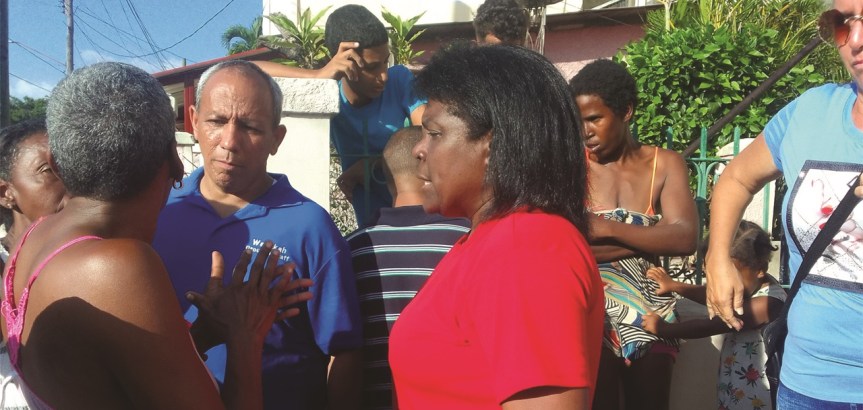
Beatriz Johnson Urrutia (center), the First Secretary of the Provincial Committee of the Communist Party in Santiago de Cuba, speaks directly with people demonstrating against food and electricity shortages on Sunday. | Photo via Juventud Rebelde

Reposted from the People’s World


This report takes advantage of the cogent observations (see below) of Professor Isaac Saney, former co-chairperson of the Canadian Network on Cuba and Coordinator at Dalhousie University for Black and African Diaspora Studies.

Hundreds of Cubans demonstrated peacefully in Santiago de Cuba and other cities across the island on March 17. Portrayed in some U.S. corporate media outlets as “anti-government” protests, the demonstrations were focused on electrical power outages and food shortages.

The protests were reacting to an accumulation of great economic difficulties that have assaulted Cubans and their government alike for decades.

Cuba is in the midst of a sharp economic crisis. Surging inflation is battering the economy, which shrank by almost 2% last year. Fuel prices rose by more than 500% just this month, while electricity rates climbed 25%.

Exports for 2023 were far below predictions, food production was less than 2022, and tourism income has only recovered to 69% of pre-COVID levels. Shortages of fuel and other supplies—largely because of the U.S. blockade—continues to hamper production in most sectors.

The dire circumstances are driving a mass exodus of Cubans; 425,000 migrants arrived in the United States in 2022 and 2023. Among those leaving are 9% of Cuba’s healthcare workers and thousands of educators. These departures have further aggravated the economic situation.

Responding to the Sunday demonstrations, Cuban President Miguel Díaz-Canel pointed out on social media that “enemies of the Revolution are trying to take advantage of a context [of shortages] for destabilizing purposes.” He noted, “In the last hours we have seen how terrorists based in the United States…are encouraging actions against the country’s internal order.”

On March 18, Cuba’s Foreign Ministry summoned U.S. chargé d’affaires Benjamin Ziff—there’s been no U.S. ambassador to Cuba since 1960—where he received a formal note of protest that referred to “interventionist behavior and slanderous messaging by the U.S. government and its embassy.”

While communicating the urgency of the situation, Díaz-Canel explained that his government’s approach would be “to attend to the complaints of our people, listen, dialogue, explain the numerous efforts that are being carried out to improve the situation, always in an atmosphere of tranquility and peace.”

In this screenshot from video circulating on social media, Cubans in the city of Santiago de Cuba protest food and electricity shortages on Sunday. | via X

The predicament for Cuba is evolving. It’s apparent that upcoming reactions from Cuba’s government, the international solidarity community, and by Cubans themselves will unfold according to economic and historical imperatives that are by no means new.

For insight, we turn to Isaac Saney’s analysis that was released on March 18. Excerpts follow:

Recent events in Cuba illustrate how intense the imperial pressures on the island nation are. It always bears underscoring that every effort to defy imperialism’s dictate and build a new society has faced unrelenting Western destabilization and sabotage: from the Haitian Revolution to numerous African, Asian, and Latin American national liberation projects. …

There is no doubt that Washington will spare no efforts to manipulate the current situation in Cuba through the use of various social media and digital platforms in order to further destabilize the situation. Moreover, it was recently revealed that U.S. intelligence agencies have been directly intervening in the Cuban economy to artificially inflate prices, stimulate inflation, and cause greater shortages of already scarce goods.

Cuba has faced—and is facing—the longest economic siege in history from the most powerful military and economic imperial power that has ever existed. Like the Haitian Revolution, the Cuban Revolution is the unforgivable example that must be destroyed. Washington’s overarching strategy aims at denying and eradicating Cuba’s right to self-determination, sovereignty, and independence.

The empire has never accepted the verdict of the Cuban people. It has waged an unceasing economic war and campaign of destabilization aimed at restoring U.S. imperialism’s domination and tutelage.

Cuba has repeatedly repelled the unceasing all-sided, military, economic, financial, and propagandistic assault by U.S imperialism.

Since the triumph of the Cuban Revolution in 1959, the United States has relentlessly pursued an ongoing assault on the Cuban people, employing both military and economic, including orchestrating invasions, assassinations, and terrorist attacks against civilians, as well as engaging in systematic economic sabotage. …

The sinister goal is to coerce the Cuban people into submission by strangling the economy, creating shortages, hardships, and exacerbating social inequalities—the very issues the Cuban Revolution has tirelessly worked to eliminate. This strategy seeks to instigate massive social unrest that would then serve as a pretext for U.S. intervention.

…The U.S. economic war against Cuba extends beyond U.S. borders, affecting businesses from other countries engaged in or seeking trade with Cuba. It stands as the primary impediment to Cuba’s social and economic progress, representing a blatant violation of the human rights of the Cuban people, costing the island nation more than $1 trillion U.S., underscoring its profound and detrimental effects.

A poignant testament on the criminality and immorality of the U.S. economic blockade was the Nov. 2, 2023, United Nations vote, when for the 31st time—with a vote of 187 to 2—the international community resoundingly rejected and condemned Washington’s economic war against Cuba.

Cuba faces significant—and what, for many, may seem overwhelming—challenges. However, the Cuban people have repeatedly shown themselves capable of meeting the challenges they take up.


We hope you appreciated this article. At People’s World, we believe news and information should be free and accessible to all, but we need your help. Our journalism is free of corporate influence and paywalls because we are totally reader-supported. Only you, our readers and supporters, make this possible. If you enjoy reading People’s World and the stories we bring you, please support our work by donating or becoming a monthly sustainer today. Thank you!


W.T. Whitney Jr. is a political journalist whose focus is on Latin America, health care, and anti-racism. A Cuba solidarity activist, he formerly worked as a pediatrician, lives in rural Maine. W.T. Whitney Jr. es un periodista político cuyo enfoque está en América Latina, la atención médica y el antirracismo. Activista solidario con Cuba, anteriormente trabajó como pediatra, vive en la zona rural de Maine.

Cuba’s Government Analyzes and Responds to Economic Woes / By W. T. Whitney Jr.

People look at food prices at a private business in Havana on December 20, 2023. Cuba’s economy will shrink by up to 2 percent this year, Finance Minister Alejandro Gil estimated on Wednesday, after acknowledging that the country will not be able to achieve the projected economic growth of 3 percent by 2023 | Yamil Lage / AFP / Getty

Reposted from Counterpunch


“Our joy is immense … We don’t deceive ourselves thinking that everything ahead will be easy, when perhaps everything is going to be more difficult.” That was Fidel Castro, hours after the victory of Cuba’s Revolution.

Difficulties were center stage 65 years later, at a plenary session of the Central Committee of Cuba’s Communist Party on December 15 and 16 and at the National Assembly of People’s Power, meeting on December 20-22.

The views of Cuban leaders on problems now enveloping Cuba shed light on realities of a nation under siege and a revolution in trouble. The information is pertinent to the solidarity efforts of Cuba’s friends abroad. Addressing the Central Committee’s plenary session, Cuban President Miguel Díaz-Canel noted that, “We have discussed efforts that have not
yielded solutions, measures that did not prosper, and goals that were not fulfilled …The scenario is that of a war economy … [We] are all here to reverse the present situation … with consensus as to decisions and with collective work, with passion and energy.”

Díaz-Canel called for “creative resistance” and “confidence in victory,” while insisting that dissatisfaction “is a motor that moves revolutionary energies. It provokes embarrassment that ends up activating people’s full participation, without which socialism is impossible.”

“We would be surrendering beforehand, if we see this war as an insuperable calamity. We must see it … as the opportunity to grow and to overcome our own selves, while the adversary is nakedly evil before the world … On the eve of the 65th anniversary of the Cuban Revolution … we are called to act together for a common objective: Save the
homeland, the Revolution, socialism, and overcome.”

The Assembly meets

Speaking to the National Assembly were: Alejandro Gil Fernández, minister of the economy and planning; Prime Minister Manuel Marrero Cruz; and President Miguel Díaz-Canel. Gil Fernández regards the U.S. economic, commercial and financial blockade of Cuba as the principal obstacle Cuba faces in restoring its economy.

He indicated that in 2023 Cuba’s GDP will have fallen almost two percent. Exports were $770,000 million below predictions. Food production was less than that of 2022. Tourism income increased by $400 million in 2023 but represented only 69% of the yield in 2019.
Overall production was down due mainly to state enterprises held back by shortages of supplies and fuels. Currency shortages and loss of workers to migration hampered the healthcare and education sectors. Electricity generation was up 32% in 2023, according to Gil Fernández. Cuba’s 30% inflation rate for 2023 was lower than the 77.3% rate in 2021.

State business entities showed “gradual recuperation.” They employ 1.3 million workers while accounting for 92% of goods and services produced in Cuba and 75% of exported products. He attributed price inflation to international price hikes, the government’s release of money to finance its budget deficit, fewer goods being produced, and an agriculture sector burdened by labor shortage, high costs, and low yields.

“What isn’t being produced cannot be imported,” Gil Fernández lamented. His message is that importing goods is almost impossible what with “the effect of high prices on the international market.” But, paradoxically, “a lack of production resources” forces Cuba to import over 70% of the food that is being consumed.

He proposed measures for increasing food production, including:

+ Creation of a financial mechanism for bolstering production based on farmers using Cuban currency derived from agricultural sales to buy supplies they need.
+ Build a farm labor force through moonlighting, employing students, and having young people do agricultural work as part of their military service.
+ Use food produced in Cuba, not imported food, to fill the “normal family food basket.”

Prime Minister Manuel Marrero Cruz critiqued the government’s lack of control over production and distribution which “adversely affects production by state entities and lets currency exchanges on the illegal market determine the pricing of products from the non-state sector.” e reported that social inequalities are growing, and that the tendency exists while state subsidies continue to nourish less distressed sectors of the economy. Equally worrisome: “The former state monopoly in production is now consolidating in the private sector.”

He was referring to the recent appearance of 9000 or so mostly private small-and-medium-sized businesses and to independent farmers and cooperatives that took over land from the state under long-term usage arrangements. They now control 80% of Cuba’s agricultural land. Marrero Cruz called for “stimulation of government-operated small-and-
medium-size business entities.”

Both private businesses and the farming sector sell products at highly inflated prices with prices being set by black market operatives. The prime minister condemned the state subsidies such entities receive in the form of low prices assigned to the fuel, water, transportation and electricity they buy from the state. Similarly, the government pays high
prices to farmers for food that, under the rationing system, is sold inexpensively to the population.

Henceforth, according to Marrero Cruz, the government will be subsidizing people, not products. According to one report, “The Ministry of Work and Social Security will be charged with undertaking a survey of ‘vulnerable’ social sectors.” “Nobody will be abandoned,” Marrero Cruz insisted.

The government, he indicated, will increase sales taxes on final products such as water, gas, electricity, transport and reduce import tariffs by 50% on the “intermediate products” used in food production and manufacturing. More tourist dollars will be harvested. Municipal assemblies will present budgets and in the case of deficits will generate more income and reduce administrative expenses.

For the prime minister, “food production needs to be prioritized and by all sectors. Many countries are saying to us: ‘We’ll put up the money, you provide the land and then pay back the money with production.’” He pointed out that, despite the non-availability of imported fertilizer and pesticides, “there are many instances of countries producing food; an
agricultural country must produce its food.”

Marrero Cruz sees “speculative prices … and intermediaries earning a lot more than producers” and non-state entities now controlling imports rather than the government, the result being “abusive and speculative pricing.” He called for paying for imports with income from exports: “[W]e prefer importing supplies and products essential to the economy and
paying for them by offering other countries certain products and/or services.”

Responding to inflation, the government, collaborating with the Central Bank of Cuba, will change the official exchange rate for the peso. According to Marrero Cruz, the government will be restricting prices for goods and services with a system of “maximum prices.”

President Miguel Díaz-Canel, addressing the National Assembly on December 22, focused on Cuba’s “war economy … [It’s] a political scenario of maximum asphyxia, designed and applied against a small country by the most powerful empire in history.” He also attributed
economic problems to “the crisis in international economic relations and our own errors.”

Economic war takes the form of economic blockade aimed at “reduced supplies of goods used by the population, inflated prices, and low purchasing power for most Cubans.” “Together with constant acts of subversion and disinformation against Cuba, the goal is to break the country, provoke social decomposition, and make for ungovernability.”

Díaz-Canel spoke of errors as “part of the complexity of making decisions in a context of extreme tension … [and of] commitment to preserving social conquests.” He mentioned mistakes, particularly in the “design and implementation of currency unification” and in “approving new economic actors without performance norms having been established.”

The effectiveness of new measures will “depend on generating more wealth, more work incentives, and more distribution of resources.” The president promised there will be no “neoliberal package … no crusade against small businesses, no elimination of the basic food allocation.” The president highlighted: “food production, localities taking care of
more of their needs, the revival of tourism, rescue of the sugar industry, state control of currency and the exchange market, redesign of the financial system, and guarantees for self-financing, and managing currency so as to serve those whose production generates income.”

Díaz-Canel took note of Cubans’ high regard for healthcare workers and teachers, promising that “they will be the first to benefit from additional pay, which the prime minister announced in his intervention.” Testifying earlier before the Economics Commission of the National Assembly, Díaz-Canel emphasized “taking advantage of the facilities of the municipalities and articulating strategies of local development.” Recalling that the “[f]oundation of government is the municipal assembly of people’s power,” he insisted on “mapping out actors in the municipalities and integrating them with state and private businesses.”

In the end

The information and opinions provided by Cuban leaders and reviewed here clarify difficult realities, among them: adverse effects of diminished tourism, inflation, and emigration; social inequalities based on varying access to resources; production stymied by shortages of resources; inadequate food production; lack of buying-power for most Cubans, and
for importing necessary goods; and the near impossibility of securing foreign investment.

Cuba is fashioning responses. They are: decentralization of political and economic administration; cut backs on expenditure of central government funds, reduced subsidies for the purchase of water, fuel, transport, and electricity by business entities; adjustment of import tariffs to favor the availability of resources for production, capturing more tourist dollars, protecting state-operated production entities, fixing prices, and producing more food.

These will be palliative remedies unless basic causes are dealt with. A prime goal of U.S. policy has been to deprive Cuba of money, and that has come to pass. Revolutionary Cuba’s very survival depends on U.S. citizen activists forcing their government to shed its blockade of Cuba. There, the great need now is for Cuba to be removed from the U.S. list of terrorist-sponsoring nations. That designation causes most international financial institutions to refuse handle dollars on Cuba’s behalf.

There is a larger context. The U.S. use of economic sanctions everywhere rests on planet-wide dollar dependency. That emerged out of the Bretton Woods Conference of 1944 and has coincided since with unrelenting U.S. assertion of worldwide power. That’s the basis for a global constituency on Cuba’s behalf. How it will be set in motion is the
big question.


W.T. Whitney Jr. is a political journalist whose focus is on Latin America, health care, and anti-racism. A Cuba solidarity activist, he formerly worked as a pediatrician, lives in rural Maine. W.T. Whitney Jr. es un periodista político cuyo enfoque está en América Latina, la atención médica y el antirracismo. Activista solidario con Cuba, anteriormente trabajó como pediatra, vive en la zona rural de Maine.

‘Worse than the Special Period’: Cuba’s food situation more desperate by the day / By W.T. Whitney Jr.

Mariel resident Rosa Lopez lights a charcoal stove to boil sweet potatoes and prepare scrambled eggs with tomatoes for her grandchildren on May 18, 2023. She had just returned from picking up her food rations from a government-run market. At the time, it had been more than a month since any cooking gas had been delivered to the city, so Lopez cooks using charcoal and a wood burning oven. Low agricultural yields, exploding inflation, a lack of gasoline for transportation, and the U.S. blockade have all contributed to soaring food prices. | Ramon Espinosa / AP

Originally posted in People’s World on August 16, 2023


Addressing a meeting of government ministers and the press in Havana on Aug. 11, Cuba’s Vice Prime Minister Jorge Luis Tapia Fonseca exploded when discussing the food crisis gripping the nation.

“It takes work to produce food. Everyone wants food deliveries, but we do nothing to produce it. We lack a culture of production … We don’t need all these papers, or words. When do we begin to plant? Who will do it?”

He was reporting on implementation of Cuba’s 2022 law on Food Sovereignty and Food and Nutritional Security. He noted that food self-sufficiency in local areas is disastrously lagging. Crop yields are low; plant diseases and the lack of inputs has hampered grain production.

The food situation in Cuba is growing more desperate by the day. Residents of the island individually consumed only 438 grams of animal protein per month in 2022, and in May 2023, only 347 grams; recommendations call for ingestion of 5 kg monthly. Not enough chickens were raised last year; poultry meat and eggs remain scarce.

Yields of corn, soy, sorghum and other crops have dropped, and animal feed is mostly unavailable. Therefore, pork production is also down, milk is unavailable to adults, and fewer cattle are being raised. Pasturage is poor, due to drought and no fertilizer.

Farm workers carry a tank of fresh milk to deliver it to a government-run food store in San Nicolas, Cuba, May 19, 2023. Milk is in short supply and reserved for children these days. | Ramon Espinosa / AP

Failures mount

Tapia pointed to the many failures exacerbating the situation. The output of state-controlled food producers is low. Producers, distributers, and institutional consumers don’t regularly contract with one another to facilitate food distribution. Producers aren’t being paid, because credit isn’t available. Cattle-stealing has reached new heights, 44,318 head so far this year.

The Ministry of Finances and Prices issued a report prior to the National Assembly session that recognized high inflation, widespread popular dissatisfaction, and the need for “concrete solutions.” Minister Vladimir Regueiro Ale indicated prices skyrocketed by 39% during 2022 and 18% more so far in 2023.

Inflation, he explained, varies from province to province and may manifest as abusive price-fixing, especially when agricultural supplies and products are in short supply.

Commenting on the report, National Assembly President Esteban Lazo, reminded delegates that diminished production and inflation were connected: “If there is no production and supply, we will not achieve effective control of prices.” He complained that “practically 100% of the food basket is being imported.”

The Assembly’s Food and Agricultural Commission analyzed organizational and management problems and reported that only 68% of expected diesel fuel has arrived so far in 2023, 14,700 tons less than in the similar period a year before; 28,900 tons of imported fertilizer were ordered, but only 168 tons arrived. Cuba’s fertilizer production has been nil this year in contrast to 9,600 tons produced in the same months in 2022.

Lazo communicated a message to Cuba’s Minister of Agriculture from the Assembly, whose recent session ended on July 22. The ministry, he said, would be “transforming and strengthening the country’s agricultural production,” to initiate “a political and participatory movement that would unleash a productive revolution in the agricultural sector.”

Nothing less than a revolution will do

A revolution appears to be exactly what’s needed. The recent National Assembly session dealt almost entirely with Cuba’s present food disaster. The lives of many Cubans are becoming more precarious due to unending food shortages, high prices, and low incomes.

Information emerging from the Assembly’s deliberations attests to the reality of crisis in Cuba, and it means that urgency is building for Cuba’s friends in the United States to resist U.S. policies in new ways, strongly and assertively. Their own government accounts for new suffering and destitution in Cuba.

President Miguel Díaz-Canel emphasized resistance when addressing the National Assembly. He dedicated his remarks to two revolutionary heroes who were present. Admiring how they kept “their foot in the stirrup of difficulties” and their “rifle pointed at mistakes,” he may have been thinking of hard work ahead.

He mentioned “problems of our difficult daily life, such as food production, electricity generation, water availability, crime, rising inflation, abusive prices.”

The president criticized behaviors “that reinforce the omnipresent blockade through inaction, apathy, insensitivity, incapacity, or simple tiredness and lack of faith.”

Díaz-Canel noted approvingly that delegates discussed “closer ties between deputies and the population,” “better management and allocation of the currency,” “greater direct participation of the non-state sector in national production,” “municipal autonomy,” and “downward pressure on prices.”

But it’s not enough. “Above all,” he said, “we must devote ourselves to creating wealth, first of all, by producing food.”

Trouble in the countryside

Cuba’s rural communities are troubled—and shrinking. Soon, “we won’t have any people left in the countryside,” one delegate said. Another called for improved “roadways, housing, and connectivity.”

No fuel means most people in rural areas are resorting to bicycles or horse carts to travel short distances. | Ramon Espinosa / AP

Regarding the low level of agricultural skills among the rural population, someone called for teaching in “agroecological techniques” and “good practices for the producing, processing, and commercialization of food.”

The idea has been circulating for a while now that greater local autonomy might help spur food production, but efforts at prompting that devolution of initiative have seen a slow uptake. As of April 2023, aspiring farmers had not yet taken possession of 258,388 hectares of idle land made available to them without cost under land-tenure reforms in 2008.

Frei Betto, Brazilian friend of revolutionary Cuba and adviser to Cuba’s Food Sovereignty and Nutritional Education Plan, visited Cuba in June. In his assessment, the “current shortages are more severe than in the Special Period (1990-95),” when Cuba’s economy nearly collapsed following the withdrawal of Soviet aid and the contraction of trade with the socialist bloc of nations.

He indicated that Cuba now imports 80% of the food it consumes, up from 70% five or so years ago, and that it costs $4 billion annually, up from $2 billion. For corn, soy, and rice alone, the outlay now is $1.5 billion annually.

He indicated, too, that a ton of imported chicken meat now costs $1.3 million, up from $900,000 a year ago, that “the wheat supply has worsened,” that milk production is down 38 million liters in one year, and that less oil from Venezuela, thanks to U.S. sanctions there, means further reduced food production in Cuba.

Blame the blockade, but not only

The origins of food shortages in Cuba and the mode of U.S. intervention are highly relevant in understanding the current situation, as every Cuban knows.

To be sure, the shortages plaguing the people are not solely due to U.S. policies. Drought, hurricane damage, marabou shrub infestation, soil erosion, high soil acidity, poor drainage, and lack of organic material soil have all contributed.

The still-prevailing bureaucratic and centralizing tendencies of the Cuban government’s economic management also play a role.

The U.S. economic blockade, however, remains central to understanding what’s happening. The creation of a food crisis was among the original proposals put forward by State Department official Lestor Mallory in 1960 for how to overthrow Cuba’s revolutionary government. The program: Use “hunger and desperation” to spark the “overthrow of government.”

Aid from and trade with the socialist world frustrated U.S. efforts and kept disaster at bay for decades, but eventually the Soviet Union and socialist Eastern Europe fell. The U.S. government seized the moment and passed legislation tightening the economic blockade in 1992 and 1996 and, later, designated Cuba a terrorist-sponsoring nation.

Beyond bans on products manufactured or sold by U.S. companies, proscribed categories soon included products manufactured by foreign companies associated with U.S. ones and products containing 10% or more components of U.S. origin. Now, foreign enterprises active in Cuba faced possible U.S. court action.

International loans and international transactions in dollars are usually off-limits. Payments abroad don’t reach destinations. Income from exports doesn’t arrive.

Think imports of seeds, fertilizers, herbicides, pesticides, breeding stock, veterinary supplies and drugs, new equipment, spare parts, exports of coffee, rum, and nickel. Think loans for purchasing food and more, loans for agricultural development. Think impediments to restoring rural infrastructure.

Farm workers wait in line to refuel their tractors on the highway to Pinar del Rio, Guanajay, Cuba, May 18, 2023. Cuba is in the midst of a major fuel shortage that has drivers and farmers waiting in line for days or even weeks to gas up their vehicles and tractors. | Ramon Espinosa / AP

The blockade, the U.S. tool of choice, has hit food production in Cuba hard. It is far along in achieving its ultimate purpose. Cuba needs a new order of support from friends in the United States─Marti’s “belly of the beast.”

Cuba needs friends more than ever

Many have so admired Cuba’s brand of socialism as to assume that Cuba’s social gains and exuberant international solidarity would fire up such enthusiasm that, along with considerations of fairness, legality, neighborliness, and revulsion against U.S. cruelty, would make U.S. policymakers think anew about Cuba. It never happened.

Now at a watershed moment in Cuba, a new direction is necessary, one all about persuading, organizing, and unifying left-leaning political groups and anti-war, anti-empire activists of all stripes. Leadership is needed.

Frei Betto says that, “It is time for all of us, in solidarity with the Cuban Revolution, to intensify the struggle against the U.S. blockade and mobilize international cooperation with the island that dared to conquer its independence and sovereignty against the most powerful and genocidal empire in the history of mankind.”


We hope you appreciated this article. At People’s World, we believe news and information should be free and accessible to all, but we need your help. Our journalism is free of corporate influence and paywalls because we are totally reader-supported. Only you, our readers and supporters, make this possible. If you enjoy reading People’s World and the stories we bring you, please support our work by donating or becoming a monthly sustainer today. Thank you!


W.T. Whitney Jr. is a political journalist whose focus is on Latin America, health care, and anti-racism. A Cuba solidarity activist, he formerly worked as a pediatrician, lives in rural Maine. W.T. Whitney Jr. es un periodista político cuyo enfoque está en América Latina, la atención médica y el antirracismo. Activista solidario con Cuba, anteriormente trabajó como pediatra, vive en la zona rural de Maine.
The Cuban Revolution: Made by teachers and students / by W.T. Whitney Jr.

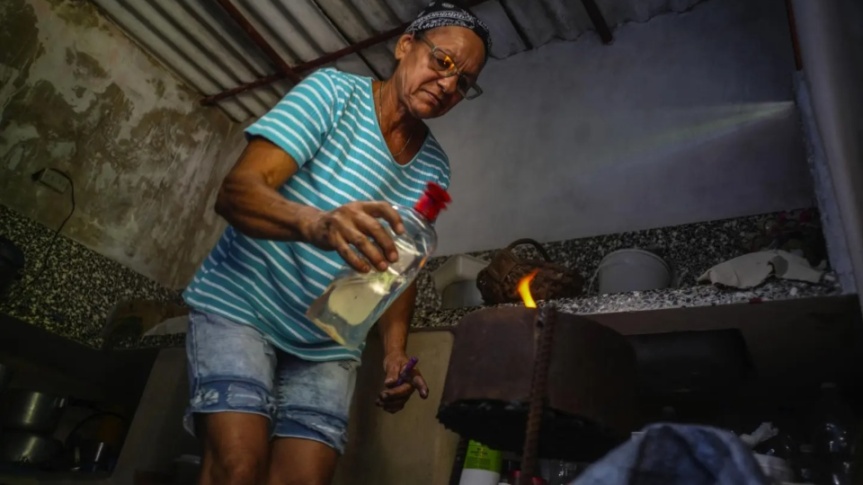
Teacher Graciela Lage gives an English lesson at the Cuban School of Foreign Languages in Havana. | Desmond Boylan / AP

Cuban education has long been ground zero for ending inequalities.

Schools on the island are places where doors opened up for all Cuban young people to learn and for students, even of oppressed classes, to prepare for one or another kind of work that would contribute to Cuba’s development as an independent nation.

Cuban literacy teachers, 123 of them, arrived in Honduras on Dec. 20. With Honduran colleagues, they will be utilizing Cuba’s special method, “Yo sí puedo” (Yes I can), to teach literacy. It’s a technique that has found worldwide application.

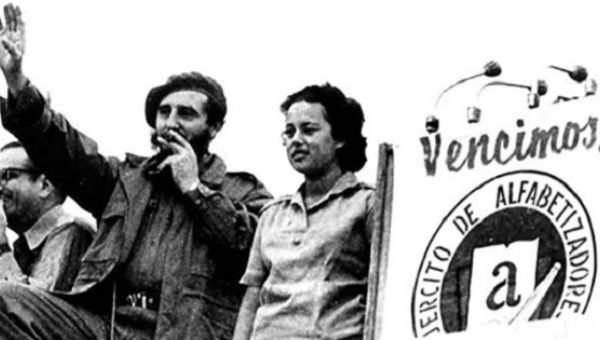
Dec. 22 in Cuba is Teacher’s Day. On that date in 1961—Cuba’s “Year of Education”—Fidel Castro, speaking before a large crowd in Havana, announced the end of Cuba’s literacy campaign of that year. He declared Cuba to be a “territory free of illiteracy.”

On hand were 100,000 young people who had volunteered to teach the rudiments of reading and writing to illiterate adults living in rural areas. These young people, mostly from Cuba’s cities, lived with families they were teaching and did farm work.

Joining them in the island-wide literacy campaign were tens of thousands of volunteer teachers, unionists, and other working people. In the end, 271,000 literacy volunteers enabled 707,000 Cubans (out of a population of 7,291,200) to learn how to read.

The figure of José Martí, Cuba’s national hero, epitomizes for Cubans the affinity of education and revolution. Introducing Martí’s book On Education (Monthly Review Press, 1978), editor Philip Foner observes that, “Basic to the foundation of liberty, in the eyes of José Martí, was the education of the people. Nothing guaranteed that a government was anxious to serve its citizens as much as the haste it displayed in educating its people.”

Fidel Castro waves at literacy teachers and students in Havana after declaring Cuba free of illiteracy, Dec. 22, 1961. | Cuba Debate

In comments in September 1961 about the literacy campaign, Castro updated Martí’s idea: “One does not conceive of a revolution without also a great revolution in the educational arena … revolution and education are almost two synonymous ideas … [The] Revolution will advance and be successful the more it works in the field of education, the more competent technicians there are, the more competent administrators, teachers, revolutionary cadre it has.”

Foner notes that in 1959, 23% of Cubans were illiterate, the “average school education was below third grade,” and “only a few thousand” children were attending secondary schools. By December 1961, according to Castro, the revolutionary government had created 15,000 schools while converting military installations into schools and building schools for handicapped children.

By 1973, literacy was all but universal. Some 1,898,000 children were attending primary school, and 470,000 were enrolled in secondary schools, according to Foner. By that time, a “second educational revolution” was in progress with the training of 20,000 additional teachers to handle waves of students now attending secondary and pre-university schools.

A third educational “revolution” was underway from 2000 on. Associated with what the Cuban state referred to as the “Battle of Ideas,” it called for teaching that emphasized social justice and equality and was accompanied by moral and social support for students. Education in the arts expanded, and there were new social-work schools. Visual, audio, and computer-based methods were newly available to teachers.

University enrollment increased as authorities extended instruction to students’ own localities while relying on computer-based and televised teaching aids. By 2015, 80% of university students were studying close to home.

Some problems emerged, however. Teaching programs in science and technology lost students to courses in the humanities and social sciences. University teaching was contributing less than before to the country’s economic development. Fewer students were preparing to be teachers, and 20,000 teachers had left their posts for the sake of better-paying jobs.

Reversing course, the government cut back on university teaching at the local level, made entrance exams more competitive, re-emphasized scientific and technical training, and shortened the university course of study. As of 2019, 241,000 students, or one in three Cubans between 18 and 24 years of age, were studying in 50 university centers. Almost 50% of them were taking medical-sciences courses; 8,542 were art students.

All along, the U.S. economic blockade was causing shortages and adding difficulties. A report presented by Cuba’s Education Ministry in early 2022 explains:

  • Under blockade rules, Cuba lacks access to the credit needed for buying goods abroad.
  • Importing is difficult due in part to price hikes resulting from high freight costs for importing goods from places other than the United States.
  • The inflated costs of goods purchased abroad from third-party intermediaries discourage imports.
  • Under blockade regulations, specific items manufactured anywhere with even tiny U.S. components are prohibited.

The list of necessary and often missing items is long: paper, books, notebooks, computers, audio-visual devices, laboratory supplies, laboratory equipment, writing materials, art supplies, sports equipment, special devices used by handicapped students, musical instruments, recording devices, English language texts and books, broadband internet connections, and replacement parts for equipment.

Nevertheless, as the result of sustained efforts over decades, students have been prepared to take on varied tasks aimed at developing Cuba’s economy and building socialism.

  • Between 1960 and 2017, Cuban universities graduated 1.2 million “professionals,” including 80,000 physicians. Women accounted for 64% of university graduates in 2010, up from 3% in 1959. University graduates in 2019 made up 2.2% of Cuban workers.
  • Spending on education in Cuba in 2012 represented 9% of the GDP. The comparable figure in the United States currently is 4.96% of GDP. Cuba in 2018 dedicated 13% of its national budget to education.

In Cuba in 1995, a Cuban woman hitched a ride on a small bus carrying Maine visitors, myself included, from Havana to Trinidad. “We Cubans want producers, not consumers,” we heard her say. Fidel Castro spoke similarly on that first Teachers Day in 1961.

He dismissed fellow University of Havana law students as “all those people with nothing to do but to study to be a lawyer.” At that time, “the ruling class was not teaching the children of workers.” That “half the population, the rural population, had no secondary school” he regarded as a “serious problem for any revolution in an underdeveloped country like ours. What few technical workers there are come from upper-income sectors … from the economically and politically dominant class, which, logically, is opposed to revolutionary change.”

Leftists in the United States and elsewhere often regard reform and revolution as separate projects. Cuba’s experience of preparing young citizens to work at what would become socialism may be relevant.

Small though they may be, certain reforms happening now within U.S. schools, rife with inequalities, could end up serving the revolution on the way, and in that way be revolutionary. Such reforms: the fostering of equality among students, the inculcation of real knowledge about societal problems, and students’ work projects that are oriented to the common good.


W.T. Whitney Jr. is a political journalist whose focus is on Latin America, health care, and anti-racism. A Cuba solidarity activist, he formerly worked as a pediatrician, lives in rural Maine. W.T. Whitney Jr. es un periodista político cuyo enfoque está en América Latina, la atención médica y el antirracismo. Activista solidario con Cuba, anteriormente trabajó como pediatra, vive en la zona rural de Maine.

People’s World, January 4, 2023, https://www.peoplesworld.org/

Cuba and China Exceed US in Life Expectancy, Send Message to the World – Socialism is the Difference / by W.T. Whitney Jr.


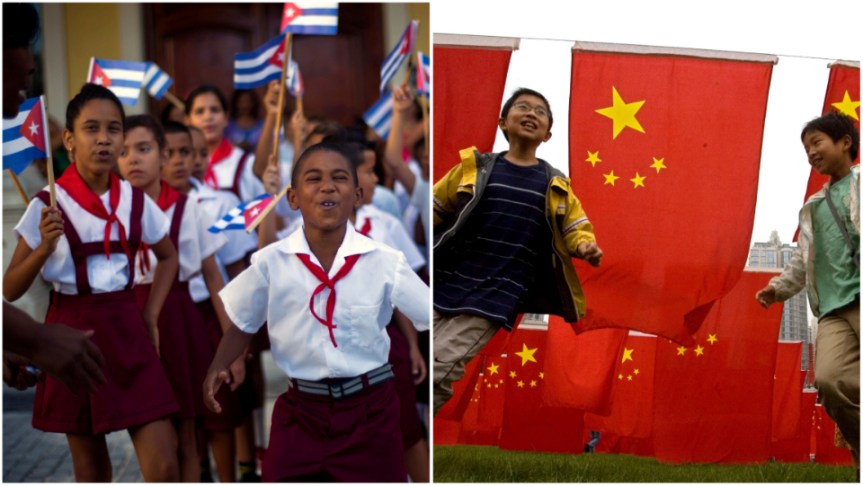
Children born in socialist Cuba and China can expect to live longer than children born in the capitalist United States. | AP photos

To extend a population’s life expectancy at birth (LEB) requires capabilities that are scarce in the United States. The U.S. LEB has fallen in the recent period, quite abruptly. Meanwhile, life expectancy in China and Cuba continues its long-term rise. To understand why we should explore nations’ varying capabilities to achieve social change and promote social gains.

Medical and sociological causes of death that relate to life expectancy and are specific to the United States will not be explored here. A subsequent report will cover that ground.

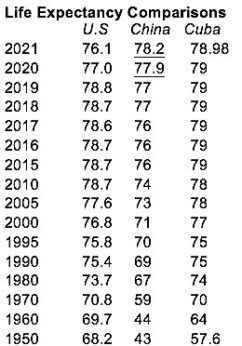
The U.S. National Center for Health Statistics on Aug. 31 set U.S. LEB for 2021 at 76.1 years, the same figure as in 1996. The decline from 77.0 years in 2020 and from 78.8 in 2019 was the greatest continuous U.S. fall in LEB in 100 years. Life expectancy for men in 2021, 73.2 years, represented an unprecedented male-female gap of almost six years (increased male mortality is routine).

Life expectancy for people in Cuba and for China now exceeds that for people born in the United States. Cuba’s LEB rose from 57.6 years in 1950 to 79 years in 2021—an advance of over 21 years. In those years, China’s LEB moved from 43 years to 78.2 years—a 35.2-year increase—and LEB for Americans rose by 7.9 years. The Cuban and Chinese achievements of drastically improving life expectancy in a few years and from very low levels are remarkable.

Policies put in place following the two countries’ socialist revolutions led to wide-ranging social initiatives that are protective of all people’s lives and, incidentally, crucial for long life expectancy. Capitalist governments, less oriented to social change, are prone to tolerating gaps in social development.

The two socialist countries pursued particular objectives to achieve social gains. Specifically, they have endeavored to establish working-class political power, promote decent and healthy lives for all working people, eradicate major economic inequalities, and build unity.

Some capitalist countries have also attempted to fulfill a few of these objectives when under left-wing governance, with mixed success. A look at how well they may have succeeded, and at some of the consequences when they have not, may shed light on the failings of capitalist states to support the lives of their people, particularly the U.S.’ failure to sustain a LEB that in 2020 was already lower than that of 53 other countries.

The subject of providing social support is, of course, vast. On that account, the discussion here pays more attention to health care and less to other areas. It draws on the insights of Vicente Navarro, professor of public health and public policy at universities in Baltimore and Barcelona.

As regards working-class political power, Navarro maintains that “countries with strong labor movements, with social democratic and socialist parties…have developed stronger redistribution policies and inequality-reducing measures…. These worker-friendly countries consequently have better health indicators [including LEB] than those countries where labor movements are very weak, as is the case in the United States.”

Navarro blames the lack of universal health care in the United States, unique among industrialized nations, on the lack there of a strong labor movement and/or a labor or socialist party. Political power exerted by the organized working class in industrialized nations may vary, but it almost always exceeds workers’ power in the United States, where statistical markers of health outcome are decidedly less favorable.

The political weakness of the organized workers’ movement in the United States is clear. “The working class,” Navarro writes in 2021, does not appear anywhere in the Cabinet nor the Senate, and only appears in the House with an extremely limited representation of 1.3 percent.” Most “members of these institutions belong to the corporate class, closely followed by upper-middle class.” He condemns the “privatization of the electoral process,” in which “there is no limit to how much money can go to the Democratic or Republican party or their candidates.”

Decent and healthy lives are far from routine in capitalist countries, where poor health is associated with low social-economic status. Navarro reports that, in the United States, the “blue-collar worker has a mortality rate from heart conditions double that of the professional class. Mortality differentials by social class are much larger in the United States than in Western Europe.”

He notes that “top level British civil servants live considerably longer than do lower level ones,” and that “members of the [Spanish] bourgeoisie…live an average of two years longer than the petit bourgeoisie…who live two years longer than the middle class, who live two years longer than the skilled working class, who live two years longer than members of the unskilled working class, who live two years longer than the unskilled [and unemployed] working class.”

Alienation under capitalism exacerbates health problems. According to Navarro, “the distance among social groups and individuals and the lack of social cohesion that this distance creates is bad for people’s health and quality of life.” The social isolation he describes adds to challenges faced by social support systems and detracts from the usefulness of interventions.

Attempts by capitalist countries to remove wealth inequalities, especially in the health care arena, show mixed success. As commercialization of healthcare advances, difficulties mount. As the result of profit-taking in that sector, society-wide inequalities are aggravated, and working people lose equal access to quality care.

And yet some form of public overview of, or support for, health care sectors is more or less routine in the various capitalist countries. In many, public authorities operate and pay for hospitals, nursing homes, staffing, drugs, equipment, and training. But the infiltration of market prerogatives and privatization in the health care systems of richer countries now threatens long established goals of accessible health care for all.

In Europe, austerity campaigns under neoliberal auspices have led to cutbacks in publicly provided care. Privatization inroads blunted the institutional response in Europe to the COVID-19 pandemic. Investor groups have been eyeing the hospital and nursing home sectors as profit-making opportunities. According to the Lancet medical journal, privatization within the British National Health Service contributed to an increase in preventable deaths from all causes between 2013 and 2020.

The United States is the poster child of war in defense of privilege. There are stories, from health care:

In 2020 salary and benefits for William J. Caron, Jr., CEO of MaineHealth, a major care provider in the author’s locality, were $1,992,044; for Richard W. Petersen, Maine Medical Center CEO, they were $1,822,185. A commentator notes that “Hospital CEOs are compensated primarily for the volume of patients that pass through their doors—so-called “heads in beds.” Average annual income for U.S. primary care physicians was $260,000 in 2021; for specialists, $368,000.

According to bain.com, “Medtech companies are among the most profitable in the healthcare industry, with margins averaging 22%…profit pools [will] grow to $72 billion in 2024.” And “HME (home medical equipment) retail companies average 45 percent gross profit margin (GPM).”

Researchers found that between 2000 and 2018, the “median annual gross profit margin” (gross profit is revenue minus costs) of 35 pharmaceutical companies was 39.1% higher than that of 357 non-pharmaceutical companies. The CEOs of three major pharmaceutical companies” increased their wealth by “a total of $90 million” in 2018. As for COVID-19 vaccine manufacturers: “Moderna’s and BioNTech’s 2021 net profit margins reached 66% and 54%, respectively.”

The matter of creating unity to establish socialism and arrange for the common good needs little comment. Unity within society is a near impossibility under capitalism, inasmuch as divisions there are inherent to a world of greed and individualism. Meanwhile, China, opting in favor of life, put on a magnificent display of socialist unity as its people grappled with the pandemic.

The government imposed strong preventative measures and accepted the inevitability of economic disruption and loss. China’s COVID-19 mortality rate is 1.07 deaths per 100,000 persons. Its U.S. counterpart never seemed to choose and, that way protected economic growth. The U.S. COVID-19 mortality rate is 319.59 deaths per 100,000 persons.

It is important, finally, to lay to rest any suggestion that the riches of the United States and other capitalist nations automatically enable them to offer long life expectancies. Individualized entitlement to wealth is basic to how they operate, and that’s a contradiction and an obstacle.

A society aiming to pursue social initiatives that are comprehensive and directed to all population groups equally is a society that has to redistribute wealth. Wealth redistribution is the necessary adjunct to the objectives already discussed. The message here is that capitalist-inspired measures don’t make the grade and that socialist programs, as in Cuba and China, do work and do offer the promise of decent and secure lives to entire populations.

As with all op-eds published by People’s World, this article reflects the opinions of its author.

W.T. Whitney Jr. is a political journalist whose focus is on Latin America, health care, and anti-racism. A Cuba solidarity activist, he formerly worked as a pediatrician, lives in rural Maine. W.T. Whitney Jr. es un periodista político cuyo enfoque está en América Latina, la atención médica y el antirracismo. Activista solidario con Cuba, anteriormente trabajó como pediatra, vive en la zona rural de Maine.

People’s World, September 21, 2022, https://www.peoplesworld.org/

Building the Communist Movement is Women’s Work (and Men’s Too) / by W. T. Whitney Jr.

Analyst Taryn Fivek, in her recent article on the CPUSA website, offers explanations for women’s frequent reluctance to take part in progressive politics. She calls for more involvement of women in the struggle for socialism. Here we review some of her conclusions and argue that women’s role in struggle must be large, one reason reason being the nature of socialist struggle and another, women’s experience and special qualifications.

Fivek points to barriers of male prejudice and of misplaced disparagement of women’s work, both in the workplace and in “social reproduction.” Not only do woman work for relatively low wages “in the productive sphere of the economy,” but, as she claims, “they are also working unpaid in the reproductive sphere” and, indeed, are “35% more likely than men to live in poverty.”

She points out that, [w]omen’s economic well-being is often tied to their role as primary laborer in a male-dominated household” and economic dependency may lead to “difficulty in leaving abusive relationships.” Fivek attributes women’s hesitancy to act politically to the assumption by most women, shared by society at large, that as care-givers “the major site of their oppression — the interpersonal or reproductive sphere … [is] ‘private’ and ‘personal.’”

The prevailing version of social reproduction alluded to by Fivek centers on home-based activities concerned with nurturing, protecting, and preparing workers for the future. In fact, as she points out, “social reproduction is not a private affair.” But she is also embracing a more far-reaching definition such as this one: social reproduction has to do with ways “by which a society maintains and transforms its social order, formations, and relations across time and space”.  

She insists that, “To say that the personal is not political is to accept the gender gap in our political work.” Women are to be accommodated and “included in all areas of political work.” She asks: “What can the [Communist] Party do to increase participation and leadership of women in the struggle for socialism?”

At issue are the characteristics of the kind of social reproduction operating in the public sphere. Women and men are already politically involved in that arena, but more women are needed.   

Some assumptions intrude. With its mechanistic overtones and utilitarian implications of supplying future workers, the unattractive term social reproduction needs replacing. And the customary linkage of social reproduction with women’s major role in family life must evolve, as a work in progress, into a larger role for men. Lastly, capitalists will not soon view any kind of social-reproduction work as other than a “free gift,” or as deserving merely of crumbs.

As envisioned here, the social-reproduction project is huge, so much so that working-class women and men will reject injustices impinging on their lives; will listen, learn, collaborate, and teach; care for people and nature; and manage affairs. Confronting governments, local ones not least, they will continue to agitate for livable incomes, roofs over heads; access to schooling from infant day-care to universities, lifelong education, sicknesses prevented and treated, no hunger, solidarity with workers abroad. – with no one left out.

The premise is that family-based tasks of taking-care-of and caring-for are expandable, and are important in society.  In conversation long ago with an American Communist and poet (Pulitzer Prize!) of provocative bent, that message was clear. Hearing about a male, myself, learning to be a doctor, he exclaimed in mock horror something like, “Why, that’s women’s work!”

Those whose work is that of perpetuating the generations have a name, not a laughably awkward one like “social reproducer,” but rather “socialist,” that is to say, socialist men and socialist women. 

Many or most women have the experience, predisposition, and – as it seems – the skills to take care of people and things – in other words, to be socialists. Today, socialist parties and socialist organizations badly need women as colleagues and comrades. Tasks ahead are momentous and recruits are needed who are prepared.

According to Psychology Today, “Girls and women … have advantages for many basic language-related skills … [and most] 12-year-old girls were more skilled than the average same-age boy at making inferences about the thoughts, feelings, and social perspective of their peers.”

It’s no surprise that, as reported recently by pewresearch.org, “Young women are more likely to be enrolled in college today than young men, and among those ages 25 and older, women are more likely than men to have a four-year college degree. The gap in college completion is even wider among younger adults ages 25 to 34.”

A University of Zurich study in 2018 claims that: “Demand for high-skilled workers who perform cognitive tasks has increased dramatically in the United States … [We find that] the probability that a college-educated man was employed in such a job fell, while the prospects for college-educated women improved. The key driver seems to be growing demand for social skills, such as empathy, communication, emotion recognition and verbal expression, in which evidence from psychological research indicates that women have a comparative advantage.”

Camila Vallego, Karol Cariola, and Marisela Santibáñez of the Communist Party of Chile

Reporting on a United Nations-organized conference in Chile in 2015 about women and political power, Winnie Byanyima, then the executive-director of Oxfam International, states that, “[W]hen you have more women in public decision-making, you get policies that benefit women, children and families in general …There is already enough evidence in the world to show the positive impact of women’s leadership. Women have successfully built and run countries and cities, economies and formidable institutions.” 

Caretaking means peacemaking. UN-sponsored research looking at 40 peace processes between 1989 and 2014 showed in 2015 that, women have managed to make substantial contributions to peacemaking and constitution-making negotiations.”  The study showed that, “where women were able to exercise strong influence on a negotiation process, the chances of agreements being reached and implemented were much higher than when women’s groups exercised moderate, weak, or no influence.”

Former Cuban president Raúl Castro has the last word.  Reporting to a Cuban Communist Party Congress in 2016, Castro noted with regret that women occupied only “38% of positions in state bodies, government agencies, national entities.”  This was despite women representing 49% of Cuba’s workforce and “66.8% of the best technically and professionally qualified workforce of the country.”

He continued: “I stand by the strictest truth when I affirm, based on my experience in many years of Revolution, that women, generally, are more mature and better managers than men. Therefore, although I recognize the progress made, I believe that under the leadership of the Party, the promotion of our combative females should continue rising, especially to decision-making positions nationwide.”

W.T. Whitney Jr. is a political journalist whose focus is on Latin America, health care, and anti-racism. A Cuba solidarity activist, he formerly worked as a pediatrician, lives in rural Maine. W.T. Whitney Jr. es un periodista político cuyo enfoque está en América Latina, la atención médica y el antirracismo. Activista solidario con Cuba, anteriormente trabajó como pediatra, vive en la zona rural de Maine.

Building the Communist Movement is Women’s Work (and Men’s Too) / by W. T. Whitney Jr.

Analyst Taryn Fivek, in her recent article on the CPUSA website, offers explanations for women’s frequent reluctance to take part in progressive politics. She calls for more involvement of women in the struggle for socialism. Here we review some of her conclusions and argue that women’s role in struggle must be large, one reason reason being the nature of socialist struggle and another, women’s experience and special qualifications.

Fivek points to barriers of male prejudice and of misplaced disparagement of women’s work, both in the workplace and in “social reproduction.” Not only do woman work for relatively low wages “in the productive sphere of the economy,” but, as she claims, “they are also working unpaid in the reproductive sphere” and, indeed, are “35% more likely than men to live in poverty.”

She points out that, [w]omen’s economic well-being is often tied to their role as primary laborer in a male-dominated household” and economic dependency may lead to “difficulty in leaving abusive relationships.” Fivek attributes women’s hesitancy to act politically to the assumption by most women, shared by society at large, that as care-givers “the major site of their oppression — the interpersonal or reproductive sphere … [is] ‘private’ and ‘personal.’”

The prevailing version of social reproduction alluded to by Fivek centers on home-based activities concerned with nurturing, protecting, and preparing workers for the future. In fact, as she points out, “social reproduction is not a private affair.” But she is also embracing a more far-reaching definition such as this one: social reproduction has to do with ways “by which a society maintains and transforms its social order, formations, and relations across time and space”.  

She insists that, “To say that the personal is not political is to accept the gender gap in our political work.” Women are to be accommodated and “included in all areas of political work.” She asks: “What can the [Communist] Party do to increase participation and leadership of women in the struggle for socialism?”

At issue are the characteristics of the kind of social reproduction operating in the public sphere. Women and men are already politically involved in that arena, but more women are needed.   

Some assumptions intrude. With its mechanistic overtones and utilitarian implications of supplying future workers, the unattractive term social reproduction needs replacing. And the customary linkage of social reproduction with women’s major role in family life must evolve, as a work in progress, into a larger role for men. Lastly, capitalists will not soon view any kind of social-reproduction work as other than a “free gift,” or as deserving merely of crumbs.

As envisioned here, the social-reproduction project is huge, so much so that working-class women and men will reject injustices impinging on their lives; will listen, learn, collaborate, and teach; care for people and nature; and manage affairs. Confronting governments, local ones not least, they will continue to agitate for livable incomes, roofs over heads; access to schooling from infant day-care to universities, lifelong education, sicknesses prevented and treated, no hunger, solidarity with workers abroad. – with no one left out.

The premise is that family-based tasks of taking-care-of and caring-for are expandable, and are important in society.  In conversation long ago with an American Communist and poet (Pulitzer Prize!) of provocative bent, that message was clear. Hearing about a male, myself, learning to be a doctor, he exclaimed in mock horror something like, “Why, that’s women’s work!”

Those whose work is that of perpetuating the generations have a name, not a laughably awkward one like “social reproducer,” but rather “socialist,” that is to say, socialist men and socialist women. 

Many or most women have the experience, predisposition, and – as it seems – the skills to take care of people and things – in other words, to be socialists. Today, socialist parties and socialist organizations badly need women as colleagues and comrades. Tasks ahead are momentous and recruits are needed who are prepared.

According to Psychology Today, “Girls and women … have advantages for many basic language-related skills … [and most] 12-year-old girls were more skilled than the average same-age boy at making inferences about the thoughts, feelings, and social perspective of their peers.”

It’s no surprise that, as reported recently by pewresearch.org, “Young women are more likely to be enrolled in college today than young men, and among those ages 25 and older, women are more likely than men to have a four-year college degree. The gap in college completion is even wider among younger adults ages 25 to 34.”

A University of Zurich study in 2018 claims that: “Demand for high-skilled workers who perform cognitive tasks has increased dramatically in the United States … [We find that] the probability that a college-educated man was employed in such a job fell, while the prospects for college-educated women improved. The key driver seems to be growing demand for social skills, such as empathy, communication, emotion recognition and verbal expression, in which evidence from psychological research indicates that women have a comparative advantage.”

Camila Vallego, Karol Cariola, and Marisela Santibáñez of the Communist Party of Chile

Reporting on a United Nations-organized conference in Chile in 2015 about women and political power, Winnie Byanyima, then the executive-director of Oxfam International, states that, “[W]hen you have more women in public decision-making, you get policies that benefit women, children and families in general …There is already enough evidence in the world to show the positive impact of women’s leadership. Women have successfully built and run countries and cities, economies and formidable institutions.” 

Caretaking means peacemaking. UN-sponsored research looking at 40 peace processes between 1989 and 2014 showed in 2015 that, women have managed to make substantial contributions to peacemaking and constitution-making negotiations.”  The study showed that, “where women were able to exercise strong influence on a negotiation process, the chances of agreements being reached and implemented were much higher than when women’s groups exercised moderate, weak, or no influence.”

Former Cuban president Raúl Castro has the last word.  Reporting to a Cuban Communist Party Congress in 2016, Castro noted with regret that women occupied only “38% of positions in state bodies, government agencies, national entities.”  This was despite women representing 49% of Cuba’s workforce and “66.8% of the best technically and professionally qualified workforce of the country.”

He continued: “I stand by the strictest truth when I affirm, based on my experience in many years of Revolution, that women, generally, are more mature and better managers than men. Therefore, although I recognize the progress made, I believe that under the leadership of the Party, the promotion of our combative females should continue rising, especially to decision-making positions nationwide.”

W.T. Whitney Jr. is a political journalist whose focus is on Latin America, health care, and anti-racism. A Cuba solidarity activist, he formerly worked as a pediatrician, lives in rural Maine. W.T. Whitney Jr. es un periodista político cuyo enfoque está en América Latina, la atención médica y el antirracismo. Activista solidario con Cuba, anteriormente trabajó como pediatra, vive en la zona rural de Maine.