
Why don’t the Haitian people rebel against non-stop oppression and distress? / By W.T. Whitney Jr.

Image via OWP

South Paris, Maine


Powerful forces weighing on the Haitian people keep rebellion in check. Predators armed with guns, and others with economic tools, have free rein. The U.S. government, recently rededicated to regional control – see the 2025 National Security Strategy – has long beat up on Haiti. All the while, Haitians’ lives and living are precarious.

U.S.-based Vectus Global is fighting gangs in Haiti. Its head is Eric Prince, well-positioned U.S. impresario of war-for-hire. His company’s drones killed 1,243 gang members and bystanders during a 10-month period. How can that be?

Haiti’s last elections took place in 2016. President Jovenel Moïse was murdered in 2021. Parliament closed down on 2023. The “Core Group” of nations appointed Ariel Henry as prime minister in early 2022, shortly after Moïse’s still unsolved murder. Escalating gang violence and delay in arranging for elections forced Henry’s resignation in 2024.

The U.S. government and the CARICOM group of nations replaced him with the Transitional Presidential Council (TPC), charging it with preparing for elections. Parliamentary elections projected for August 2026 probably won’t happen. Prime Minister Alix Didier Fils-Aime, a TPC appointee, had invited Vectus Global to Haiti.

A faction within the nine-person TPC defied U.S. pressure to seek Fils-Aime’s dismissal on grounds of corruption and weak response to gang violence. Three U.S. naval vessels arrived off Port-au-Prince four days before the TPC was scheduled to expire, on February 7. The TPC did go out of existence, and Prime Minister Fils-Aime did keep his job. He and his ministers constitute the entire Haitian government.

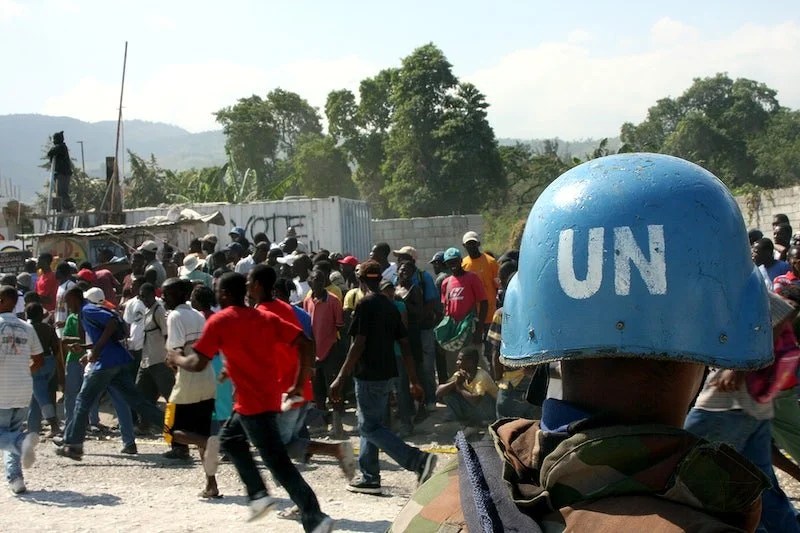
Gang violence had been expanding and, with UN Security Council endorsement, the U.S. government in 2024 arranged for, and partially funded, the Kenya-led Multinational Security Support (MSS) mission to Haiti. Funding and troop contributions lagged, and the Security Council in late 2025 approved a U.S-proposed resolution for transforming the MSS nto a 5,500 troop “Gang Suppression Force.” It will be collaborating with Haiti’s police.

The theme so far here has been foreign control of Haiti and her people, especially U.S. control. The U.S. government is well-versed in this, what with military occupation (1915-1934), backing of the father-and-son Duvalier dictatorship (1957-1986), and U.S.- inspired coups in 1991 and 2004.

Haitians’ interaction with the United States these days is mediated mostly through migration. As of March 2025, 330,735 undocumented Haitians were living legally in the United States by virtue of Temporary Protected Status (TPS). That program, established in 1990, provides relief for irregular migrants to the United States facing deportation to a dangerous homeland. The Trump administration determined that TPS for Haiti would end on February 3, 2016. A federal judge in February 2 ruled against that action. An appeals court agreed on March 6, and the Supreme Court will finally decide.

Dead end

If TPS ends, Haitians returning to their country will be in trouble. According to one report, “Many repatriated Haitians arrive with nowhere to go–nearly 20% were already internally displaced before leaving the country.” As of February 2025, 10% of Haiti’s population – 1,450,254 individuals – had already been displaced from their previous homes, and are living in make- shift housing and tents.”

Displacement has resulted from actual and/or threatened violence at the hands of gangs. Gangs now control large sections of Haiti’s cities – 90% of Port-au-Prince – and areas in rural Haiti, mostly in the North. Gangs killed nearly 6000 people in 2025 and more than 16,000 since 2022. They have unleashed a wave of sexual violence. Children, who are the primary victims, make up half of the gangs’ fighters.

Meanwhile, no sign appears of any moderate or left-leaning political movement or party actively pushing for democracy and social justice in Haiti. Although the social democratic Lavalas Party was the vehicle for Jean Bertrand Aristide serving as Haiti’s president off and on between 1990 and 2004 – and still surfaces on the Internet – its influence is nil. Our question is this: why are progressive resistance forces absent or inconsequential in circumstances of great danger for Haiti’s people?

Power plus

One determining element may be the fact of a political void. Opposition movements usually take aim at an objectionable government. Only a shell of government exists in Haiti. It so lacks substance as to hardly qualify as a target. On defeating Haiti’s powers-that-be, a progressive resistance movement would be charged with building entirely new governmental institutions and administrative components, not to speak of new vision and
commitment.

More fundamentally: realization of progressive aspirations would now entail confrontation with power so overwhelming as to render actual resistance as almost unthinkable. Part of that power is U.S. power, as examined above. But most certainly, power shows in Haiti too, specifically with gangs and with Haiti’s wealthy elite.

The gangs hold a near monopoly on lethal violence, as is evident in the numbers cited above. Gangs emerged during the presidencies of Michel Martelly (2011-2016) and Jovenel Moïse (2017-2021). Protesters intermittently filling the streets of Port-au-Prince were demanding relief from high prices, shortages, and governmental corruption. Haiti’s elite, seeking protection, paid the gangs and supplied weapons and ammunition.

The gangs multiplied, joined in competing alliances, and found their own generous sources of income. According to a United Nations report, “Gangs dominate supply chains and extort commerce and humanitarian transport routes, giving them huge power to siphon off Haiti’s resources and destabilize its economy.” They profit from “extortion, kidnapping, drug trafficking and arms sales … Firearms … are mostly trafficked to Haiti from the United States for local use.”

The Report says that money the gangs generate is “smuggled through bulk amounts of cash, unregulated money transfer services, or front companies – many of which are linked to politically-connected economic elites.”

Really big bourgeoisie

Wealthy oligarchs control Haiti’s commerce and industries. In a comprehensive report from 2025, journalist Eric Andrew-Gee refers to “the dozen or so families of European or Middle Eastern descent who largely control Haiti’s impoverished economy” and are known for “dodging taxes, financing politicians and funding gangs as private militias …[A] rapacious economic elite …own virtually everything of value in the country.” One powerful family’s wealth comes from “soap and oil,” another’s from “steel, telecom, banking, oil and food,” and another’s from “supermarkets, news outlets and agribusiness concerns.”

Victimization of Haiti’s workforce, and of all Haitians, by the rich and powerful complements oppression at the hands of gangs and U.S. interventionists. The scenario clearly is that of class against class. Struggle on that basis apparently has to wait. Prisonlike circumstances require that Haitians confine themselves to fighting for their own survival.

This combination of gang violence, U.S. intrusions, and exploitation by Haiti’s rich and powerful has to be crushing, especially for a people who are deprived and suffering. Two thirds of the population are poverty-stricken. More than half of the people require humanitarian assistance. According to the World Food Program, more than half of all Haitians suffered from “acute food insecurity” in mid-2025. Most Haitians are deprived of anything approaching adequate healthcare and housing.

Additionally, Haiti’s working people and certainly unionists play only a marginal role within Haiti’s overall economy. They are weak and ill-prepared for fight-back. Half of all workers labor in agriculture, fishing or forestry. Those occupations account for only 20% of the country’s GDP. Remittances produce another 20%. Industry in Haiti in 2023 did contribute
25% of the GDP. But only 12.4% of all workers had manufacturing jobs. And some of those are disappearing, notably in Haiti’s garment industry, source of 5% of the county’s GDP. Factories are closing. Haiti’s unemployment hovers around 15%.

Division

Haiti’s African-descended people, through the generations, have consistently harbored a big impediment to entering into struggle, one existing apart from current circumstances. From slavery times, through the period of rebellion and independence struggle (1791-1804), and subsequently into the present era, Haitians have splintered according to class and skin color. Throughout, a minority class of more privileged, lighter-skinned, and French-speaking mulattos have remained apart. Their antecedents collaborated with the French slave owners.

They gained dominance over Haiti’s Black working-class masses, as national life developed. The tension remains. In his writings, Communist leader Jacques Roumain (1907-44) put the population’s social-class divide ahead of color differences. Author Philippe-Richard Marius summarizes: “The Haitian Revolution defeated White supremacy and gave rise to a new ruling class divided into color categories but united in the subjugation, exclusion, denigration, and exploitation of the Black working classes.”


W.T. Whitney, Jr., is a political journalist whose focus is on Latin America, health care, and anti-racism. A Cuba solidarity activist, he formerly worked as a pediatrician and lives in rural Maine.

US General Hypes China as Threat in Latin America / By W.T. Whitney Jr.


The U.S. government has long intervened in Latin America and the Caribbean (LAC). Now the U.S. military is paying attention to China’s economic activities there. 

General Laura Richardson on March 8 reported to the Armed Services Committee of the U.S. House of Representatives on actions and needs of the Southern Command, which she heads. She has charge of all U.S. military operations in the region. 

Citing the 2022 National Security Strategy, Richardson declared that “no region impacts the United States more directly than the Western Hemisphere …. [There] autocrats are working overtime to undermine democracy.” And security there “is critical to homeland defense.”

Richardson stated that “the PRC (People’s Republic of China) has both the capability and intent to eschew international norms, advance its brand of authoritarianism, and amass power and influence at the expense of the existing and emerging democracies in our hemisphere.” The Southern Command’s “main priority … is to expose and mitigate PRC malign activity.”

She sees a “myriad of ways in which the PRC is spreading its malign influence, wielding its economic might, and conducting gray zone activities to expand its military and political access and influence.” A “grey zone,” according to the NATO-friendly Atlantic Council, is a “set of activities … [like] nefarious economic activities, influence operations, … cyberattacks, mercenary operations, assassinations, and disinformation campaigns.”

Richardson highlighted China’s trade with LAC that is heading toward “$700 billion [annually] by 2035.” The United States, in her view, will be facing intense competition and presently “its comparative trade advantage is eroding.”

She added that, “The PRC’s efforts to extract South America’s natural resources to support its own population … are conducted at the expense of our partner nations and their citizens.” And opportunities for “quality private sector investment” are disappearing.

Competition extends to space: “11 PRC-linked space facilities across five countries in this region [enable] space tracking and surveillance capabilities.” Richardson complained of “24 countries [that] have existing Chinese telecommunication infrastructure (3G/4G), increasing their potential to transition to Chinese 5G.” 

She expressed concern both about surveillance networks supplied by China that represent a “potential counterintelligence threat” and about Latin Americans going to China “to receive training on cybersecurity and military doctrine.” Richardson denounced China’s role in facilitating environmental crimes and pointed to “potential dual use for malign commercial and military activities.”

“Relationships absolutely matter,” she insisted, “and our partner democracies are desperate for assistance from the United States.” Plus, “if we’re not there in time, they … take what’s available, creating opportunities for the PRC.”

Moving beyond China, Richardson indicated that “many partner nations …  see TCOs (transnational criminal organizations) as their primary security challenge.” That’s because drug-cartel violence leads to deaths and poverty and “illicit funds exacerbate regionalcorruption, insecurity, and instability.”

Her report avoids mention of particular countries other than offering brief references to Haiti, Cuba, Nicaragua, and Venezuela. She criticized Russia for “military engagements with Venezuela and Nicaragua” and for spreading “false narratives.” Richardson praised Colombia for providing military training in other countries. 

The Southern Command gains “exponential return” on supplying various countries with U.S. weapons and supplies. It conducts joint military exercises, and “provides professional military education to personnel from 28 countries.”

Richardson reported at length on processes she sees as fostering useful relationships between her command and the various governments and military services. The tone of urgency characterizing her discussion on China was entirely lacking. 

Economic intervention

General Richardson’s view that China has greatly expanded its economic involvement with the LAC nations is on target.

Since 2005, China’s state-owned banks have arranged for 117 loans in the region worth, in all, more than $140 billion. They averaged over $10 billion annually. Since 2020, China has made fewer loans.

Chinese trade with Latin America grew from $12 billion in 2000 to $448 billion in 2021. China’s imports of “ores (42%), soybeans (16%), mineral fuels and oils (10%), meat (6%), and copper (5%)” totaled $221 billion in 2021. The value of exported manufactured goods that year was $227 billion. By 2022, China had become the biggest trading partner in four Latin American countries and the second-largest in many others.  

China’s foreign direct investment (FDI) has long represented China’s strongest economic tie to the region. FDI signifies funding of projects abroad directed at long-term impact. China’s FDI from 2005 to mid-2022 was $143 billion. Energy projects and “metals/mining” accounted for 59% and 24% of the total, respectively. Of that total, Brazil and Peru received 45% and 17%, respectively. 

The FDI flow since 2016 has averaged $4.5 billion annually; worldwide, China’s FDI has contracted.

Chinese banks and corporations have invested heavily in lithium production in Argentina, Bolivia, and Chile, which, together, account for 56% of the world’s lithium deposits. China is the largest investor in Peru’s mining sector, controlling seven large mines and owning two of Peru’s biggest copper mines. Brazil is the world’s largest recipient of Chinese investments.  

China’s government has linked FDI to its Belt and Road Initiative (BRI) that began in 2013. As of May 2022, 21 Latin American and Caribbean countries were cooperating with the BRI and 11 of them had formally joined.

On the ground

U.S. military intervention in LAC is far from new. Analyst Sergio Rodríguez Gelfenstein complements Richardson’s report with a three-part survey, accessible herehere, and here, of recent U.S. military activities in the region.

He indicates the United States now has “12 military bases in Panamá, 12 in Puerto Rico, 9 in Colombia, 8 in Perú, 3 in Honduras, 2 in Paraguay, as well as similar installations in Aruba, Costa Rica, El Salvador, Cuba (Guantánamo), and in other countries.”

Rodríguez maintains that, “levels of aggressive interference by Washington in the region have increased dramatically” and that U.S. embassies there are supplied with more military, Cuba, Nicaragua, and CIA personnel than ever before.

Rodríguez notes features of the LAC region that attract U.S. attention, among them: closeness to strategically-important Antarctica; reserves of fresh water and biodiversity in Amazonian regions; the Guarani Aquifer near the triple frontier of Brazil, Paraguay, and Argentina, the largest in the world; and huge reserves of valuable natural resources.

Among ongoing or recent U.S. military interventions are these:

·        The U.S. Army Corps of Engineers is implementing a “master plan” for navigability of the Paraguay River and Plata River Basin. The nearby Triple Frontier area supposedly harbors international terrorism and drug-trafficking.

·        The U.S. military facility in Neuquén, Argentina is turning from its alleged humanitarian mission to activities in line with local preparations for oil extraction.            

·        U.S. officials on October 13, 2022 announced that 95 military vehicles were being donated to Guatemala for drug-war activities.   

·        In Brazil in September 2022, General Richardson indicated that U.S. forces would join Brazilian counterparts to fight fires in the Amazon..

·        The Southern Command’s fostering of good relations with Peru’s military has borne fruit. Under consideration in Peru’s Congress is a proposal to authorize the entry of foreign military forces. To what nation would they belong? Hint: former CIA operative and U.S. Ambassador Lisa Kenna met with Peru’s Defense Minister the day before President Pedro Castillo was removed in a parliamentary coup on December 7, 2022.

·        In March 2023, two U.S. congresspersons proposed that U.S. troops enter Mexico to carry out drug-war operations.

·        Presently the United States is making great efforts to establish a naval base on Gorgona island off Colombia’s Pacific coast. It would be the ninth U.S. base in Colombia, a NATO “global partner.”

·        In Colombia, U.S. troops acting on behalf of NATO, are active in that country’s Amazon region supposedly to protect the environment and combat drug-trafficking.

·        The U.S. National Defense Authorization Act of December 2022 awarded the Southern Command $858 million for military operations in Ecuador.

·        In a second visit, the US Coast Guard Cutter Stone was plying Uruguayan waters in February ostensibly to train with local counterparts for search and rescue operations. The ship was also monitoring the nearby Chinese fishing fleet.

Rodríguez does not comment on U.S. interventions in Cuba, Nicaragua, and Venezuela. That’s because they’ve persisted for “more than 60, 40, and 20 years, respectively” and each requires a “special report.”

John Quincy Adams returns

Proclaiming the Monroe Doctrine 200 years ago, Secretary of State Adams informed European powers that the United States regarded “any attempt on their part to extend their system to any portion of this hemisphere as dangerous to our peace and safety.”

General Richardson would apply the warning of that era to the PRC. Yet signs of hegemonic aspirations from that quarter are absent.

Commenting recently, Argentinian economist and academician Claudio Katz notes that, “China concentrates its forces in the economic arena while avoiding confrontations at the political or military level … Investments are not accompanied by troops and bases, useful for guaranteeing return on investments.”

Besides, China “does business with all governments, without regard to their internal politics.” That tendency, Katz writes, stems from the PRC having “arisen from a socialist experience, having hybrid characteristics, and not completing a passage to capitalism.” He maintains that China, with its economic involvement, contributes nothing to advancing socialism in the region.   


W.T. Whitney Jr. is a political journalist whose focus is on Latin America, health care, and anti-racism. A Cuba solidarity activist, he formerly worked as a pediatrician, lives in rural Maine. W.T. Whitney Jr. es un periodista político cuyo enfoque está en América Latina, la atención médica y el antirracismo. Activista solidario con Cuba, anteriormente trabajó como pediatra, vive en la zona rural de Maine.