Cuba Scores Big Victory in the UN General Assembly / By W. T. Whitney

South Paris, Maine


The United Nations General Assembly on November 2 voted to approve
a Cuban resolution that, unchanged over 31 consecutive years, calls for
an end to the U.S. economic blockade of Cuba. Approval once more
was overwhelming: 187 nations voted in favor and two against, the
United States and Israel. Ukraine abstained.

Reacting to the vote, Cuban President Miguel Díaz-Canel proclaimed a
“new victory for the Cuban people and their Revolution!” He pointed to
“the triumph of dignity and the fearlessness of our people,” and
expressed gratitude for “the international community’s recognition of and
support for Cuba’s heroism and resistance.”

For over 20 years, the only nations opposing the Cuban resolution, apart
from the United States, have been Israel and, formerly, a few U.S.-
dependent Pacific island-nations. The blockade began in 1962, and now
80% of Cubans have lived under its sway.

Prior to the vote this year, dozens of delegates representing member
states spoke out against the blockade. Cuba’s Minister of Foreign
Relations Bruno Rodríguez addressed the General Assembly, insisting
that the U.S. blockade interferes with “the right to life, health, progress
and welfare of every Cuban family.”

He explained that Cuba’s financial losses from the blockade reflect
factors like the high cost of substituting for goods excluded under the
blockade with more expensive goods and/or those with higher
transportation costs. Losses take the form also of an overall lack of
necessary materials, goods, and services. And “barriers Cuba faces in
gaining access to advanced technology” lead to monetary loss.

The chancellor emphasized that “sectors like agriculture and energy face
serious obstacles to acquiring spare parts or machinery.” He cited
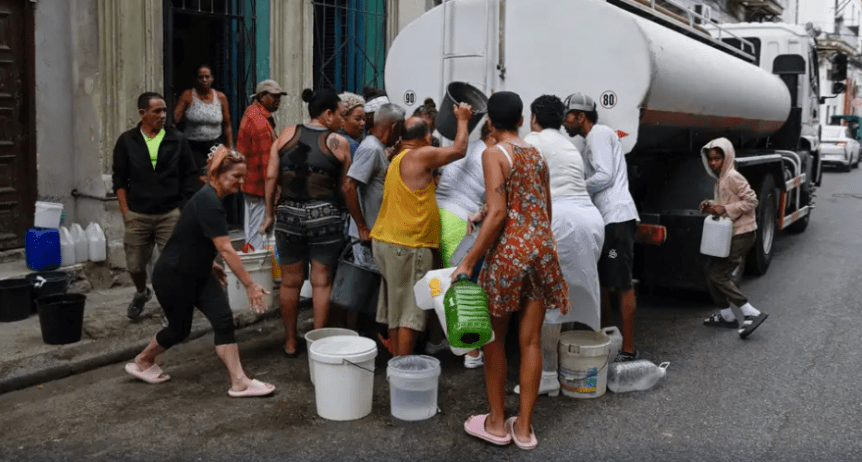
examples of blockade-related shortages such as extreme shortages of
gasoline and oil, cancer patients being denied “first line treatments and
drugs,” and healthcare providers and their patients lacking respiratory
ventilators and medicinal oxygen normally available from abroad.

The blockade’s assault against the Cuban people shows up clearly and
dramatically in money lost to Cuba’s economy. Rodríguez claimed that
Cuba’s GDP would have grown by 9% in 2022 without the blockade, and
that the $4.87 billion in losses occurring between March, 2023 and
February 2023 correlated with “pain and suffering.”

Cuba’s monetary loss in over 60 years of blockade now totals $159.8
billion, according to one account. What with inflationary change, that’s
$1.3 trillion.

Another report indicates that between August 2021 and February 2022,
losses in the energy and mining sectors added up to $185.5 million, in
the agricultural sector, $270.9 million; and in banking and finance,
$280.8 million. Between January and July in 2021, losses were $113.5
million in the healthcare sector; $30.6 million in education; and $31.3
million in the transport sector.

Cubans’ lives are affected:

* During the last school year, Cuba’s government lacked paper
sufficient to “print and assemble books and notebooks for students,”
in part because a Canadian paper manufacturer did not extend credit.

* Presently, according to Granma news service, no school books are
being produced due to a lack of supplies and spare parts.

* Lack of access to high-performance brands and equipment, as well
as spare parts, serves to handicap Cuba’s telecommunications
sector, thus easing the way for U.S. and European competitors to
reach Cuban users.

Laws authorizing the U.S. blockade include the 1917 Trading with the
Enemy Act, the 1992 Cuban Democracy Act (Torricelli Law), and the
1996 Cuban Liberty and Democratic Solidarity Act (Helms-Burton Law).
Executive actions taken to implement the blockade have been central to
how that policy affects Cuba. The Obama administration eased many
blockade regulations. President Trump added 243 new measures, with
disastrous effect. The Biden administration continues them.

The U.S. Treasury Department imposes large fines on third-country
exporters failing to comply with its rules and so they often do not sell to
Cuba. Because the Treasury Department forbids foreign banks from
using U.S. dollars, international financial institutions rarely make loans to
entities in Cuba and are reluctant to handle U.S. dollars in transactions
involving Cuba.

The U.S. government has recently been weaponizing its false
declarations that Cuba is a terrorist-sponsoring state. The enabling
legislation on the matter granted the U.S. government authority to
penalize any international financial and banking sectors bold enough to
have dealings with states so designated.

Conveniently enough, Cuban analyst Claudia Fonseca Sosa recently
provide President Biden with advice as to “substantive modifications” of
methods for carrying out his policy. He could authorize “the export of
U.S. products to key branches of Cuba’s economy” and of medical
supplies and equipment to the island to help with the manufacture of
biotechnical products. Biden could allow U.S. companies to invest in
Cuba and enable U.S. citizens to receive medical treatment there.

The prospects for changed policies toward Cuba perhaps have
improved; a recent report documented the major role of the blockade in
propelling Cuban emigration to the United States – and sending
Venezuelans and Nicaragua there too. Those three blockaded countries
presently supply most of the migrants crossing into the United States.

U.S. sanctions cause desperate living conditions, and so people leave.
End all three blockades. Relieve the pressure on people, and maybe
they’d stay home. Who could object?


W.T. Whitney Jr. is a political journalist whose focus is on Latin America, health care, and anti-racism. A Cuba solidarity activist, he formerly worked as a pediatrician, lives in rural Maine. W.T. Whitney Jr. es un periodista político cuyo enfoque está en América Latina, la atención médica y el antirracismo. Activista solidario con Cuba, anteriormente trabajó como pediatra, vive en la zona rural de Maine.

Potential disaster awaits Haiti as U.S. prepares for armed intervention / by William T. Whitney Jr

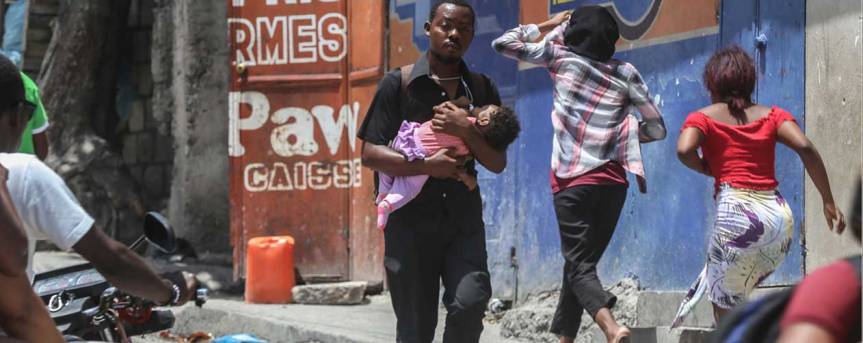
Residents flee their homes to escape clashes between armed gangs in the Carrefour-Feuilles district of Port-au-Prince, Haiti, Aug. 15, 2023. | Odelyn Joseph / AP

Reposted from People’s World


NEW YORK—On Monday, the United Nations Security Council voted to send a foreign “security mission” to Haiti—an armed intervention force. The body adopted a resolution, drafted by the United States and Ecuador, that authorizes the so-called Multinational Security Support mission—“to take all necessary measures”—code for the use of force.

Officials from Haiti, the U.N., and the U.S. say the intervention will be aimed at helping Haiti’s police suppress armed bands, or gangs, that cause deadly violence and have overrun the capital, Port-au-Prince. The U.N. reports that, as of Aug. 15, 2,439 Haitians had been killed this year.

“More than just a simple vote, this is in fact an expression of solidarity with a population in distress,” Haiti’s Foreign Minister Jean Victor Geneus told the council. “It’s a glimmer of hope for the people that have for too long been suffering.”

China and Russia, however, abstained from the vote, expressing reluctance about granting a blanket authorization for the use of force under Chapter 7 of the founding U.N. Charter. The remaining 13 members voted in favor.

Senior U.S. diplomat Jeffrey DeLaurentis justified the blank check for intervention, saying, “We have stepped up to create a new way of preserving global peace and security, answering the repeated calls of a member state facing a multi-dimensional crisis amid alarming spiraling gang violence.”

In mid-September, at the U.N. General Assembly, U.S. President Joe Biden and Ariel Henry, Haiti’s acting president, issued a call for a multinational militarized occupation of Haiti. U.N. Secretary-General António Guterres had already done so earlier. Secretary of State Antony Blinken promised “robust financial and logistical assistance” from the United States for a military intervention.

U.S. spokespersons say that $100 million is being sought from both Congress and the Pentagon to back the mission.

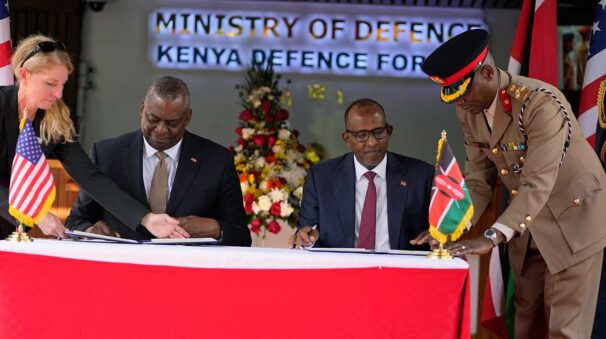
Meeting in Nairobi on Sept. 25, U.S. Defense Secretary Lloyd Austin and his Kenyan counterpart agreed that Kenya will provide 1000 “security officers” and will “lead a multi-national peacekeeping mission to Haiti.” According to the U.N., 12 countries have committed to being part of the mission.

The newly approved international intervention into Haiti will be officially ‘led’ by Kenya, providing some cover for the U.S. military, which will likely be calling the shots behind the scenes. Here, U.S. Secretary of Defense Lloyd J. Austin, left and Kenya Cabinet Secretary for Defense Aden Duale, sign a bilateral defense cooperation agreement in Nairobi on Sept. 25, 2023. The defense agreement will see Kenya get resources and support for security deployments in exchange for ‘leading’ the intervention in Haiti to combat gang violence. | Khalil Senosi / AP

The Communist Party of Kenya issued a statement condemning its government’s participation. It pointed out that U.S. power derives from “the enslavement of millions of African people, whose labor laid the foundation for [U.S.] economic prosperity.”

The United Nations itself is neither leading nor organizing the intervention, as the organization doesn’t exactly have a good reputation among the people of Haiti. For good reason: The U.N. force occupying Haiti in 2004-17 violated Haitians’ human rights, abused women and children, and introduced a cholera epidemic that killed 40,000 Haitians.

We offer four explanations for why the planned armed intervention will harm Haiti’s already beleaguered majority population.

One, previous foreign interventions have brought trouble. Nothing suggests this one will be different. Here’s the record:

  • The aforementioned U.N. occupation.
  • NGOs invaded after the 2010 earthquake. They wasted donated funds.
  • S.-assisted military coups in 1991 and 2004 removed the progressive Haitian President Jean-Bertrand Aristide.
  • The U.S. “Operation Uphold Democracy” reinserted Aristide in 1994 on the condition that he enforce neoliberal economic “reform.”
  • The U.S. government provided vital support to the father-and-son Duvalier dictatorship from 1957 to 1986
  • The U.S. military occupation of Haiti from 1915 to 1934 was brutal.
  • France, upon being kicked out of its Haitian colony, required payback with interest for slaves having gone free, in all, $560 million (in 2022 dollars) and up to $115 billion in lost development.
  • The U.S. responded to Haitian independence, proclaimed in 1804, with a trade embargo and diplomatic isolation, each lasting for decades.
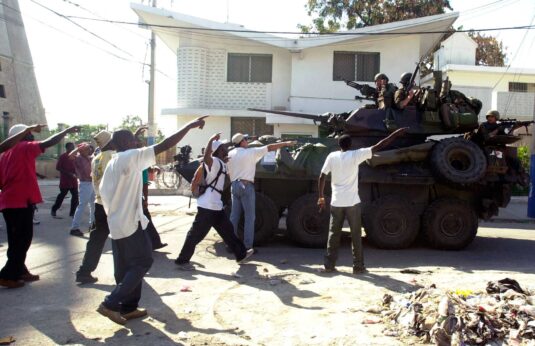
In this March 7, 2004, file photo, people demand that occupying U.S. Marines take action to protect them after shooting erupted during a march in Port-au-Prince, Haiti. In 2004, a coup d’état occurred after conflicts lasting for several weeks in Haiti. It resulted in the second removal from office of President Jean-Bertrand Aristide, preventing him from finishing his second term. Aristide claimed that his departure was a kidnapping, accusing the U.S. of orchestrating a coup d’état against him. Now, almost 20 years later, the country is still engulfed by violence. | Pablo Aneli / AP

Two, Haiti’s oppressed majority population needs a government, not a façade of one. A government in Haiti that served the people might provide a buffer between an imported, militarized foreign police and the Haitian people. Haiti has no functioning government today, much less one friendly to the people’s cause.

Michel Martelly became president in 2011, courtesy of U.S. manipulation. The last general election in Haiti, in 2016, allowed Jovenel Moïse to be president. The two wealthy politicians belonged to the rightwing PHTK political party. The elections they won were thoroughly corrupt and saw abysmally low-turnouts.

Moïse and others embezzled billions of dollars taken from the low-interest loans that President Hugo Chavez’s Venezuelan government made available to the Haitian state. The funds were supposed to have supported Haiti’s development and allowed the government to purchase low-cost oil under Chavez’s Petrocaribe program and to provide subsidized fuel and food for Haiti’s impoverished people. The U.S. government sanctioned Venezuela in 2015, and the loans and cheap oil stopped.

In response, massive protests erupted against government corruption and waste of the Petrocaribe funds. With increasing shortages and rising prices, they’ve continued since 2018. In a context of multifaceted conflict among Haiti’s oligarchs, Moïse was assassinated in July 2021.

There has been no president since, other than acting president Ariel Henry, whom the U.S., Canada, several European countries, and the EU—the so-called “Core Group” that oversees Haiti’s affairs—made prime minister shortly after the assassination. And as for the country’s parliament, it hasn’t functioned for over three years.

The distressed Haitian masses have no political party that reliably or effectively speaks for them. They have no say in foreign governments’ plans for them. They have no institutional resources or constitutional protections against potential abuse at the hands of foreign occupation forces.

Three, the gangs have ties with Haiti’s wealthy powerbrokers. It’s a relationship inconsistent with a simple story of interventionists taking on gangs. The association grew out of the recurring outbursts of social protest.

Haiti’s establishment sought protection from disorder and destruction triggered by the ongoing protests, primarily in Port-au-Prince. In the absence of an army, and with the police unable to cope, gangs came into existence.

They were supposedly going to bring order to city neighborhoods, even leading some protesters to join. Behind them, with funds the whole time, however, have been a number of wealthy Haitians. So of course, the gangs took on the additional role of blocking agitation for political change. Funds flowed from local oligarchs and from abroad for that specific purpose.

There’s a sea of contradictions. In suppressing the gangs, the interventionist forces would be defying the wealthy classes that pay them. But those same wealthy classes, as represented by their political boss Ariel Henry, are calling for a foreign security force to defeat them. The struggling people of Haiti may not readily follow such convoluted scheming, but they are familiar with the likely outcome.

Four, the timing of the intervention coincides with movement within the gangs toward a new kind of politics. One suspects that the proposed intervention represents a heavy-handed response to stirrings for political change.

Some leaders of some gangs appear to be disenchanted with inter-gang fighting and with dependence on the rich and powerful. They are making alliances and mouthing revolutionary sentiments.

Press reports center on veteran gang leader Jimmy Cherizier. They’ve latched onto his nickname “Barbecue,” assigned to him as a small boy; it evokes the specter of fiery violence. This former highly-regarded policeman brought other gangs into his “G9” alliance and now is reaching out to other gangs.

Cherizier, quoted by journalist Kim Ives, speaks his mind:

“We are a great people. Our national motto is ‘Union makes strength.’ Our objective is to once and for all overthrow the system that exists in Haiti and achieve the dream of [Haitian founding father Jean-Jacques] Dessalines, which is for the nation’s wealth to be shared by all its citizens…. Our battle isn’t just going to be to demonstrate with people in the streets. We have guns, and we will fight with them…. We took our independence with arms.”

Cherizier told Ives earlier, “This is a corrupt system; these people are using us to fight their political battles, and we do not want to be their cannon fodder anymore.”

Sabine Manigat, a sociologist at Haiti’s Quisqueya University, has the last word: The “image of Haiti portrayed in the foreign press, which highlights misery and insecurity, does not paint the full picture of a country where a social movement survives, people who are standing up and fighting and who require international solidarity, not intervention.”


W.T. Whitney Jr. is a political journalist whose focus is on Latin America, health care, and anti-racism. A Cuba solidarity activist, he formerly worked as a pediatrician, lives in rural Maine. W.T. Whitney Jr. es un periodista político cuyo enfoque está en América Latina, la atención médica y el antirracismo. Activista solidario con Cuba, anteriormente trabajó como pediatra, vive en la zona rural de Maine.

UN forcefully hits at US blockade of Cuba, at prison in Guantanamo / By W. T. Whitney Jr.

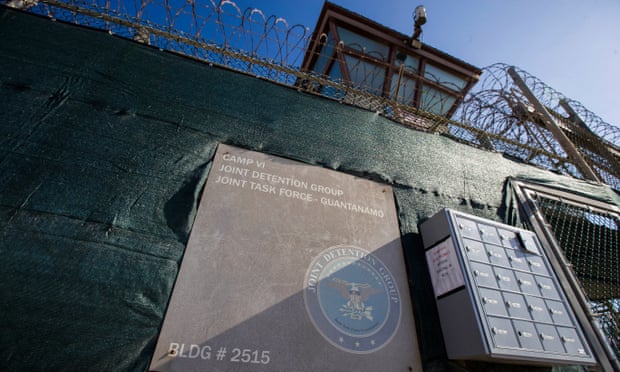
The control tower of Camp VI detention facility is seen in Guantánamo Bay in April 2019. Photograph: Alex Brandon/AP

South Paris, Maine


Nothing on the horizon now threatens the end of the U.S. economic
blockade of Cuba. Critical voices inside the United States and beyond
fall flat; nothing is in the works, it seems. Recently, however, the United
Nations put forth a denunciation that carries unusual force, mainly
because of the UN’s legal authority and its practical experience in Cuba.
Criticism of U.S. policies on Cuba from within the United States is
usually brushed aside due in large measure to the low priority
Washington officials assign to Cuban affairs. Coalitions of nations that
condemn the blockade may lack staying power and surely have no
means for enforcement. The anti-blockade opinions of nations or
individuals, alone or together, are useful mainly for consciousness-
raising.
The United Nations is different on account of its institutional capacity. It’s
on display when the UN General Assembly annually votes on a Cuban
resolution calling for an end to the blockade. Every year word of its
overwhelming and inevitable approval goes worldwide, because of the
UN connection.
The United Nations is unique on account of its Charter, which took effect
on October 24, 1945. This founding instrument outlines purposes as to
peace, no war, and human rights. It is legally binding on participating
nations, like a treaty. Additionally, the history and expectations
associated with the United Nations endow that organization with
institutional power. That’s something that neither NGOs operating in
Cuba or the time-limited projects of various governments on the scene
there can claim.
Another element emerges. The United Nations works within Cuba and
participates in Cuban affairs. On that account, UN complaints about
U.S. all-but-war against Cuba take on special authority.

On the ground

UN workers and technical specialists since 2015 have been
implementing the UN’s “National Plan[s] for Sustainable Economic and
Social Development” in dozens of countries since 2015, including Cuba.
Work is carried out inside countries and territories in order to fulfill a
“Development Agenda [for] 2030.” The main goals are: government
efficiency, transformation of production, protecting natural resources and
the environment, and human development with equity.
The Cuba section of the so-called “United Nations System” consists of
22 “agencies, funds, and programs,” 11 of which are physically present
on the island. That section recently issued a report on its activities in
2022.
Francisco Pichón is a Colombia native serving as the UN program’s
“resident coordinator.” In comments to the Cuban News Agency, Pichón
noted that in Cuba his teams participated with Cubans in dealing with
disaster situations and introducing developmental assistance.
Collaboration was impaired, he observed, by the “the economic,
commercial, and financial blockade imposed by the United States.”
Pichón testified to the constant necessity for making adjustments. What
with the impact of Covid-19; the increase of prices of food, sources of
energy, and more; and the war in Ukraine, his associates had to
“circumvent U.S. economic sanctions” and work around Cuba’s
exclusion from “international financing mechanisms”. UN personnel
found it necessary to divert funds in order to mount special assistance
programs after Hurricane Ian and in response to problems in Pinar del
Rio.
He indicated that “pre-positioning of essential resources for emergency
situations” was essential in order to mount quick and efficient responses.
That was helpful in reacting to the Hotel Santiago explosion in Havana
and the terrible fire at an oil storage facility in Matanzas.
Pichón highlighted the complexity of making any kind of payments,
especially because costs go up when resources are imported from far-
distant countries and because Cuba is excluded from international
lending agencies and banking services.

Guantanamo

The idea that the United Nations is a potentially capable partner in
warding off U.S. aggression against Cuba gains additional strength

following the recently concluded visit to Cuba of the UN Special
Rapporteur on Human Rights and Counterterrorism. Through her visit
and report, the United Nations was asserting legal norms.
Law professor Fionnuala Ni Aolain examined the plight of prisoners at
the U.S. naval base in Guantanamo in Cuba. The U.S. government
occupied land there as a condition of its approval in 1902 of a
constitution for newly-independent Cuba. Cuba’s government denounces
the occupation as violating international law.
Of the almost 800 men imprisoned there at one time or another since
2002, 30 prisoners remain, of whom 16 have been cleared for release
and represent no danger.
In an interview, Aolain testified to U.S. violation of human rights: “Men
are shackled as they move within the facility. They were shackled when
they met me.” She referred to “enormous deficits … in health care, in the
standard operating procedures … [Men] are called by numbers, not by
name.
She added that, “Those who tortured betrayed the rights of victims …
[W]hat they ensured is that you couldn’t have [a] fair trial … [And
therefore] it would be impossible for the victims of terrorism to redeem
their rights.” And, “let me be clear. Torture is the most egregious and
heinous of crimes.”
Quoted in a Cuban news report, Aolain referred to “cumulative
aggravating effects on the dignity, freedom and fundamental rights of
each detainee, which I think amounts to cruel, inhuman and degrading
treatment, according to international law.”


W.T. Whitney Jr. is a political journalist whose focus is on Latin America, health care, and anti-racism. A Cuba solidarity activist, he formerly worked as a pediatrician, lives in rural Maine. W.T. Whitney Jr. es un periodista político cuyo enfoque está en América Latina, la atención médica y el antirracismo. Activista solidario con Cuba, anteriormente trabajó como pediatra, vive en la zona rural de Maine.

Haiti’s Choice Is Social Revolution or Foreign Intervention / By W. T. Whitney Jr.

Photo: RICHARD PIERRIN/AFP via Getty Images

With long experience of chaos, violence, and dysfunctional governance, Haiti looks now to be on the verge of new crisis in the form of foreign military intervention. U.S. and United Nations decision-makers have held back, but now they look to be moving, again. 

The need all the while has been for change so that all Haitians might live decent lives. Whatever is in the works now offers little prospect for rearrangement of political and social hierarchies in Haiti. 

Haitians for several years have faced high prices, recurring shortages of essential supplies, and deadly gang violence in cities that has converted Haiti into a war zone and is the focus of media and political attention from abroad.   

Left-leaning political activist Camille Chalmers insists “there is a clear connection between these gangs and sectors of power, [which include] the far right” and the U.S. government. In an interview published on May 7, Henry Boisrolin agrees. This Haitian analyst living in Argentina states that: 

We have entered … a new phase in a spiral of violence characteristic of a crumbling neo- colonial system … The armed gangs are frankly death squads that are instruments in the hands of the Haitian oligarchy and the international community, mainly the United States. They want to subdue the popular movement in Haiti, sew terror, and put off an uprising.

The government headed by Prime Minister Ariel Henry, appointed by President Jovenel Moïse just days before his murder on July 7, 2021, is a façade. The U.S. government and the supervising “Core Group” of foreign nations put him in office and are backing him now. 

The last national elections were in 2016; the National Assembly has no legislators. Those elections, remarkable for minimal voter turn-out, gave the presidency to Moise, a wealthy businessman.  

Moïse overstayed his term of office, was accused of massive corruption, and was killed by paramilitaries who prepared in the United States. His predecessor, millionaire Michel Moise, became president in 2011 only after U.S. Secretary of State Hillary Clinton intruded in the elections.

Affecting Haiti’s situation now are: death and destruction from earthquakes and hurricanes; UN military occupation for 13 years that that introduced cholera, killing tens of thousands; and billions of dollars stolen that were set aside to pay for oil from Venezuela’s Petrocaribe program.

The distant background shows U.S diplomatic and commercial barriers during Haiti’s first 50 years, unjust and massive debt obligations to France for over a century, U.S. military occupation and U.S. support for the Duvalier dictatorships during the twentieth century, and subsequently a U.S. hand in two coups that removed the progressively-inclined President Jean-Bertrand Aristide. 

The United Nations Security Council  on October 21, 2022, “demanded an immediate cessation of gang violence and criminal activity” and declared itself ready “to take appropriate measures … against those engaged in or supporting gang violence.”  In January, 2023,U.N. Secretary General António Guterres called for “deployment of an international specialized armed force to Haiti.” 

On April 26 the Security Council deliberated on Haiti;19 speakers were heard. Maria Isabel Salvador, Head of the UN’s “Integrated Office in Haiti,” indicated that almost 50% of Haitians require humanitarian assistance. “The Haitian people cannot wait,” she declared; a “specialized international armed force” is needed. Jean Victor Geneus, Haiti’s Minister for Foreign Affairs, agreed.

The U.S. government is ready to act, it seems, with plans aimed at implementing the 2019 Global Fragility Act. That law would prevent and reduce violent conflict” abroad by means of “negotiating bilateral, 10-year-long “security assistance” arrangements with  “fragile states.”

The State Department on April 1, 2022, released a document explaining rationale and methods for implementing the GFA. A year later, on March 27, the State Department explained that the GFA would be implemented through 10-year plans … in partnership with Haiti, Libya, Mozambique, Papua New Guinea, and Coastal West Africa, including Benin, Côte d’Ivoire, Ghana, Guinea, and Togo.” 

An accessory document reveals that Haiti was being prioritized. It mentions a “sequenced approach for U.S. efforts” that will depend upon “political and security openings in the country.”

Kim Ives, veteran defender of Haiti’s sovereignty, commented that the plan “is essentially a new alliance of USAID ‘know-how’ with Pentagon muscle.” He foresees that the United States will be “returning the country from a neo-colony back into a virtual colony as it was from 1915 to 1934, when U.S. Marines occupied and ran it. Nonetheless, the U.S. would try to keep some Haitian window-dressing.” 

Vassily A. Nebenzia, the Russian Federation’s Permanent Representative on the UN Security Council, received a letter on April 24 from 58 individual Haitians and representatives of Haitian political organizations.  Russia is currently serving as the Security Council’s president.

The letter claims that U.S. plans for Haiti’s future would violate the United Nations Charter. It calls for an independent commission to evaluate U.S. interventions in Haiti since 1993. The authors fear “a grave attack on the sovereignty, independence, territorial integrity, and unity of Haiti.” 

They also object to U.S. occupation since 1856 of the Haitian island Navase, the U.S. government’s manipulations in the 2010 presidential elections, and U.S. failure to prevent the weapons being shipped to Haiti for use in killings and crimes. 

A month after President Moise’s murder in 2021, the “Montana group” of civic leaders proposed a two-year provisional government that would prepare for elections.  The results have been nil.  

De facto Prime Minister Ariel Henry in December 2022 announced a “High Transition Council” set up to arrange for elections. But eight political parties soon vetoed the project and very little has been achieved. Already in October, Henry had requested the U.S. government and/or United Nations to intervene militarily. 

Whatever happens in Haiti promises little help for a severely distressed underclass; 59 percent of Haitians live on less than $2 a day, the poverty rate is 60%, a quarter of the population has no access to electricity, 50% of Haitians are food insecure, 50% of Haitians must drink polluted water, 50% Haitian children do not attend school, and two thirds of adult Haitians are unemployed or informally employed. 

No social revolution is on the horizon and most Haitians, individually and collectively, are powerless. Power lies with Haiti’s business class whose impulse is for “invasion and occupation.” 

These would be the richest ten percent of Haitians who control 61.7% of the country’s wealth. The billionaires in that class are conglomerate owners Gregory Mevs and Gilbert Bigio, worth $1.0 billion and $1.2 Bіllіоn, respectively, and Irishman Denis O’Brien, who is worth $6.8 billion and controls Haiti’s telephone services.  

Henry Boisrolin, cited above, sees U.S. hypocrisy when he looks at U.S. sanctions against ten powerful families in Haiti that buy “tons of arms and munitions” for use in Haiti. This is a U.S. government that “does not allow a single syringe to make its way to Cuba” while claiming ignorance as to who sells those arms or that they come from the United States.


W.T. Whitney Jr. is a political journalist whose focus is on Latin America, health care, and anti-racism. A Cuba solidarity activist, he formerly worked as a pediatrician, lives in rural Maine. W.T. Whitney Jr. es un periodista político cuyo enfoque está en América Latina, la atención médica y el antirracismo. Activista solidario con Cuba, anteriormente trabajó como pediatra, vive en la zona rural de Maine.

Cuban Adjustment Act of US Still Privileges Cuban Migrants, Hurts Cuba / by W. T. Whitney Jr.

The Cuban Adjustment Act of 1966, the only one of its kind in the world, continues to encourage irregular emigration, the repeal of which will be essential to achieve normal migratory relations between the two countries | Credit: Granma – en.granma.cu

“Maybe if you had printed more about the operation, you would have saved us from a colossal mistake.” President John Kennedy was berating New York Times editor Turner Catledge. The Times and the U.S. media generally had glossed over widely-known preparations for the Bay of Pigs attack in April 1961. Catledge had removed the revealing substance of reporter Tad Szulc’s detailed news story 10 days beforehand.

Media silence has attended other Cuba -related developments over the years. Many U.S. progressives and liberals also tend to mention little about U.S-Cuban affairs, the U.S. economic blockade of Cuba being one example.

The Cuban Adjustment Act (CAA), which is about Cubans migrating to the United States, receives little attention, while fuss and fury grow over an unprecedented number of migrants, Cubans among them, crossing the U.S. southern border now. Officials there apprehended 1.8 million migrants between October 2021 and August 2022.

Most respondents to an NPR/Ipsos poll believe an “invasion” is taking place. Anti-migrant measures have led to political division and stalemate. Senators Lindsay Graham and Ted Cruz sent a letter to Department of Homeland Security Secretary Alejandro Mayorkas on October 5. The Biden administration’s migration policies, they claimed, represent “gross dereliction of duty … violation of your oath of office …[and] grounds for impeachment.”

Cubans, enabled by the CAA, find welcome in the United States. That 1966 law allows Cuban immigrants and their immediate families to become permanent U.S. residents. To be eligible, the Cuban migrant on arrival has to be “inspected, admitted or paroled.” He or she waits for one year, while receiving social services, and then applies for permanent residency, and gains a work permit. Other immigrants must wait five years to apply.

Why is Cuban immigration encouraged? The idea may have been that of displaying the failure of a Communist government through Cubans leaving, or of fracturing popular unity in Cuba through emigration, or of strengthening the Cuban-American voting bloc through new Cuban arrivals.

Numbers of Cuban migrants have increased recently. There were 9,822 “southwest border encounters” of border officials with Cubans in fiscal year 2020, 38,674 in FY 2021, and 174,674 Cubans in the FY ending on October 1, 2022. Between October 2021 and June border officials detained more than 1300 Cubans arriving by sea in Florida.

Cubans have been enduring shortages, high prices, and low income due mostly to the U.S. economic blockade and cut-backs on the remittances Cuban-Americans send to family members on the island. That’s one set of reasons for leaving Cuba.

Additionally, Nicaragua in November, 2021 began allowing Cubans to enter without an entry visa. Migrants can now start on their trip closer to the border than, as before, having to travel through South America.

And most of the 20,000 Cubans who would have entered the United States annually, as authorized by a 1994 bi-national agreement, have not done so. That’s because almost no processing of entry visas has taken place since 2017, when the State Department recalled most of its Embassy staff in Havana. That was in response to a mysterious neurological syndrome afflicting U.S. diplomats and staff.

Few Cubans have been able to afford travel to U.S. embassies in other countries to secure visas. Consequently, departing Cubans have resorted to irregular means. The State Department has recently begun to send diplomatic staff back to its Havana Embassy.

New rules are in place. The Obama administration in 2017 ended the government’s “wet foot, dry foot” policy, in force since 1995. During that period, Cubans apprehended at sea were returned to Cuba. Those who arrived and touched U.S. soil could stay and eventually gain permanent residency status.

Cuban migrants crossing at the U.S. southern border still receive preferential treatment. Unable to show the required evidence of “lawful entry,” they benefit from creative arrangements that convert an irregular entry into a legal one.

Presently, “nearly 98 %” of Cuban migrants entering the United States stay. Border officials apply public health (anti-Covid 19) regulations known as Title 42 to all would-be immigrants. They immediately exclude half of them, but not the Cubans. Excluded migrants wait in Mexico or elsewhere for immigration judges to decide on their applications for asylum.

Some of the entering Cubans receive “humanitarian parole.” Under CAA regulations, that status qualifies as “lawful entry” and the migrant is able to wait for a year in the United States and then apply for permanent residency – and usually receive it.

Other Cubans not receiving humanitarian parole also remain in the United States by means of a “bond” requiring them to appear before immigration judges “where they can launch a defense for staying.” Most migrants in this group whose appeals are successful can count on gaining permanent residency.

A few have been unsuccessful and that group received good news on February 23, 2022. The U.S. Citizenship and Immigration Services announced that Cuban migrants whose appeal for permanent residence had failed now may try again, with likely success. The agency was responding to an immigration court ruling in 2021 that any release of Cuban migrants from custody at the border, whatever the circumstances, actually does represent “lawful entry” or parole, as required by the CAA.

Most of the Cubans exiting from their country are young adults and children. They benefited from the high-quality education, healthcare, and social support that was their birthright. Their energy, talents, labor, and potential commitment would no longer be contributing to Cuba’s national project of development and recovery. Their departure, one supposes, weakens the bonds of family life in Cuba and thereby makes Cuban society less cohesive.

The U.S. leadership class likely has little regret. The U.S. intention, after all, is to cause distress in Cuba leading to regime change. Moreover, U.S. economic blockade of Cuba, occupation of territory in Guantanamo, destabilizing interventions inside Cuba, and the CAA, taken together, add up to attack on Cuba’s independence and national sovereignty. The silence of the media and of political activists on these matters takes on an ominous quality, that of complicity with crimes.

The community of nations enabled the United Nations to deal with international crimes. Under the United Nations Charter, the Security Council may confront “any threat to the peace, breach of the peace, or act of aggression” of one nation against another. The General Assembly in 1965 unanimously approved Resolution 2131 which states that, “No State has the right to intervene, directly or indirectly, for any reason whatever, in the internal or external affairs of any State.”

What situations would these authorizations be applied to, if not to the instances recited here of U.S. aggression against Cuba?


W.T. Whitney Jr. is a political journalist whose focus is on Latin America, health care, and anti-racism. A Cuba solidarity activist, he formerly worked as a pediatrician, lives in rural Maine. W.T. Whitney Jr. es un periodista político cuyo enfoque está en América Latina, la atención médica y el antirracismo. Activista solidario con Cuba, anteriormente trabajó como pediatra, vive en la zona rural de Maine.