War and Plunder in Eastern Congo and a US Hand / By W. T. Whitney

Congo’s borderlands with Rwanda have become one of the continent’s deadliest conflict zones | Credit: Guardian (UK)

South Paris, Maine


The United States Institute of Peace on February 27 awarded its “Women Building Peace” award to Pétronille Vaweka. She responded: “I weep because at this moment, in … Goma women and children are dying … [and] thousands of families are forced from their villages.”  Goma, population two million, is the capital of North Kivu province in eastern Democratic Republic of Congo (DRC).

For Guardian reporter Owen Jones, the DRC “is the site of the deadliest war since the fall of Adolf Hitler, and yet I doubt most people in the west are even aware of it.” Diminished U.S. and European press coverage of the region’s humanitarian crisis contributed to massive human suffering as, unwatched, lethal violence enabled the wholesale stealing of natural resources.

One million refugees entered eastern DRC from neighboring Ruanda during and after that country’s genocide in 1994. By early 2023 one million newly displaced people had arrived in the Goma region. Within months there would be half a million more. Of the 7.1 million displaced persons in the region now, 97% were displaced due to violent attacks by non-state military forces. The 1.1 million children and 605,000 women who are malnourished exemplify the suffering there.

The UN Refugee Agency describes “targeted attacks against civilians” with “killings, kidnappings, and the burning of homes.” The International Organization for Migration reports that “violence and brutal attacks …  loss of life, mass displacement, and increasing instability” are devastating and that “[a]cross the country, over 26 million people need humanitarian aid.”

War in the eastern DRC has killed six million people over 30 years, according to reporter James Rupert. He indicates that, “More than 250 local and 14 foreign armed groups are fighting for territory, mines or other resources in the DRC’s five easternmost provinces.” Troops fromUganda, Rwanda and Burundi are present. A United Nations peacekeeping contingent will be leaving soon.

The March 23 Movement (M23), formerly troops of the DRC army, figures prominently in the turmoil. This irregular military force, allegedly controlled by Ruanda, occupied Goma in late 2012 and was soon ejected by DRC and UN forces. Having broadened their operations after 2022, M23 detachments regularly execute civilians and force boys and men into their ranks. U.S. press coverage of this brutal war remains skimpy, and the U.S. public is largely uninformed.

The media also steers clear of humanitarian crises associated with war in Sudan and displacement of the Rohingya people from Myanma, in both instances perhaps because U.S. vital interests are not at risk. The U.S. approach toward Sudan apparently is one of watchful waiting, despite reports of growing Russian and Chinese influence and of combatants allying with extremists.

Israel’s war against Palestinians and humanitarian catastrophe in Gaza are different. The U.S. government and weapons manufacturers are unreservedly involved and the media and public pay close attention. Maybe there’s a correlation. As long as war, social catastrophe, and U.S. self-interest play out together, the U.S. public is informed. Drop the U.S. involvement, and they are not.

If that’s a rule, troubles in eastern DRC are an exception. U.S. powerbrokers are strongly attracted to the region, but even so, the U.S. public remains oblivious to the situation. James Rupert explains:

“The DRC is a treasury of minerals …, including an estimated 70 percent of the world’s known cobalt, a vital component of lithium-ion batteries for electric vehicles and other green energy products. …Since 2020, the U.S. Energy and Interior Departments have maintained a list of minerals, currently 50 of them, that they judge vital to America’s economy, energy grid or national defense. Many are difficult to access through reliable supply chains and many, including cobalt, copper, lithium, tantalum, tin and titanium, are mined in the DRC, often from illegal mines controlled by armed groups and smugglers, or in industrial mining that is significantly dominated by China.”

Rupert describes U.S. initiatives aimed at promoting mining in Africa, for example, securing investments for “building a $2.3 billion railroad to carry copper and cobalt from Congo and Zambia to Angola’s seaport of Lobito.”

He blames the multitude of “industrial and artisanal mines” in the DRC for human suffering. Paramilitary groups provide security and “hundreds of thousands … who are effectively enslaved” do the work. Importantly, “more than 250 local and 14 foreign armed groups are fighting for territory, mines or other resources in the DRC’s five easternmost provinces.”

With its cheery message of March 14, 2024, the International Trade Administration of the U.S. Department of Commerce wins points for salesmanship:

“The DRC offers opportunities large and small.  The DRC’s vast mining wealth attracts top mining companies from around the world … [and] is home to globally significant deposits of hard-rock lithium … Energy is another sector with huge potential for renewable energy, including hydropower and solar. The country has the potential to generate over 100,000 MW of hydropower, which is more than half of Africa’s total hydropower potential.”  

Continuing: “Oil and gas discoveries in the east of the country give the DRC the second largest crude oil reserves in Central and Southern Africa … The DRC has the highest agricultural potential in Africa … [and] the potential to feed over 2 billion people with appropriate investment …There are many infrastructure construction opportunities for U.S. companies, with most projects structured as public-private partnerships.” 

This U.S. presentation of opportunities for extraction and expropriation of resources does not explain how to pursue them.  A promotion piece, it is far removed from Pétronille Vaweka’s portrayal of, as she sees it, a system “based on brutal, illegal mining of these minerals from our soils and by people working in conditions of slavery.”

Wide dissemination of this grim news would likely shed light on the dark side of capitalism. Capitalism’s much-vaunted magic of the market and its autonomous mode of operating would turn out to be proxies for a kind of anarchy that, built on greed, assures that anything goes. This is a kind of insight that, for those in charge, is best avoided.    

To limit the flow of news on human suffering is offensive on other grounds.  Doing so violates “the commons,” items such as water, oxygen in the atmosphere, and knowledge that, essential to human living, must be accessible to everyone. The restriction also hits at the revolutionary notion of human solidarity, the idea that someone else’s pain is ours too.


W.T. Whitney is a political journalist whose focus is on Latin America, health care, and anti-racism. A Cuba solidarity activist, he formerly worked as a pediatrician, lives in rural Maine. W.T. Whitney Jr. es un periodista político cuyo enfoque está en América Latina, la atención médica y el antirracismo. Activista solidario con Cuba, anteriormente trabajó como pediatra, vive en la zona rural de Maine.

U.S. Drug War Arrives in Ecuador, with Baggage / By W. T. Whitney Jr.

Photo via People’s Dispatch

South Paris, Maine


Joined by other U.S. officials, Laura Richardson, commander of the U.S. Army’s Southern Command, was in Ecuador January 22-25 to confer with government leaders there about U.S. military assistance. They included recently elected, and very wealthy, President Daniel Noboa. She mentioned to reporters an “investment portfolio…worth $93.4 million including not only military equipment … [but also] humanitarian assistance and disaster response, [and] professional military education.”

Prompting the visit was recently intensifying crime and turmoil manifesting as prison riots, escapes from prisons, and assassinations of political figures. A homicide rate of 5.8 per 100,000 persons in 2017 increased to 43 murders per 1000 Ecuadorians in 2023.

In the “grip of drug gangs,” Ecuador has been receiving cocaine and other illicit drugs produced and processed in countries such as Colombia, Peru, Bolivia, and Brazil. From Guayaquil and Esmeraldas, ports in Ecuador, the goods move on to U.S. and European consumers. The cartels’ former routes, through Central America and the Caribbean, are less active.

Ecuador’s government recently decreed a state of “internal armed conflict.” Its Army now has charge of domestic security.  From 2017 to 2023, governments under presidents Lenin Moreno and Guillermo Lasso arranged for privatizations, fiscal austerity, and a reduced package of state services. Resources are lacking to deal with powerful region-wide drug cartels now operating in the country.  U.S. military intervention would fill the gap.

The U.S. so-called drug war, as waged in Latin America and the Caribbean, began during the Nixon administration. Notable examples are Plan Colombia from 1999 until 2015 and the Merida Initiative, applied to Mexico from 2007 until 2021. The U.S. media provocatively associates drug cartels with international terrorism.  U.S. drug war spending has reached $1 trillion over four decades, says a report.

Ecuador’s situation has special features. Analyst Pablo Dávalos sees “convergence among political power, organized crime, and narcotrafficking to allow [Ecuador’s] use of the dollar as its national currency to enable money laundering.” Organized crime “controls vast areas” and Ecuadorians “refusing to pay extorsions are being systematically eliminated.”

Eloy Osvaldo Proaño of the Latin American Center of Strategic Analysis points out that the “neoliberal recipe reduces institutional presence, which weakens control of borders and facilitates penetration of criminal gangs.” What President Noboa has proposed “is part of a regional plan of paramilitaries occupying wide areas to instill terror, tear apart the social fabric and subdue populations.”   

The “22 organizations declared [by Noboa] to be ‘terrorist groups’ … have a capacity of maneuver and omnipresence enabling them to control territories and prisons, even to penetrate the institutions [of the state].”

Ecuador recently became the leading recipient of U.S. military assistance in Latin America and the Caribbean area. More is on the way. Ecuador’s defense minister indicated the U.S. government will be “investing” $3.1 billion in military assistance over seven years.  

Planning has been elaborate:

·        The FBI in 2017 assisted the “lawfare” campaign of President Guillermo Lasso against President Rafael Correa, his progressive predecessor.

·        The U.S. Congress on December 15, 2022, approved the United States-Ecuador Partnership Act of 2022.

·        A memorandum of understanding was signed in Washington in July 2023. It covers U.S. efforts to strengthen Ecuador’s military capacities and combat the drug trade.

·        A binational agreement was signed on August 16, 2023 for cooperation in building the capacity of Ecuador’s military, police, and judiciary.

·        President Lasso in Washington on September 28, 2023 signed agreements allowing U.S. troops and naval personnel to deploy in Ecuador.

·        Ecuador’s foreign minister signed a status of forces agreement with the U.S. ambassador on October 6, 2023 relating to privileges, immunities, and guarantees for U.S. armed forces personnel.

·        Ecuador’s Constitutional Court on January 11, 2024 ratified the U.S.- Ecuador security agreement.

Colombian President Gustavo Petro in September, 2022 recalled an earlier conversation with General Richardson about “the failure of [U.S.] anti-drug policies.” He mentioned to her that, “It’s our obligation … to say that and also to propose alternatives that don’t allow a million more Latin Americans to die.”  

Petro has company. Many progressives in the United States and elsewhere also regard the U.S. drug war as a failure. Facts are on their side:

·        Narcotrafficking has increased despite drug war.

·        Moneys spent on drug war is money not spent on preventative programs and poverty reduction.

·        U.S.-assisted militarization of targeted countries undermines democratic renewal.

·        Drug war means profits to weapons suppliers, narco-traffickers, and money-laundering banks and businesses.

·        The United States, the great consumer of illicit drugs, bears responsibility for not reducing consumption.

This consensus resonated at the Latin American and Caribbean Conference on Drugs – for Life, Peace, and Development that took place September 7-9, 2023 in Cali, Colombia. President Petro and Mexican President Andrés Manuel López Obrador had called for the gathering. Attending were officials of 19 regional nations and representatives both of observer countries and international social organizations.  

The object was “to rethink drug policies in response to the failure of the punitive strategy imposed by the United States.” The most impactful recommendations emerging were these:

·        Change basic assumptions by recognizing the failure of the U.S. war on drugs.

·        Contain the drug problem internally by dealing with structural causes of poverty, inequalities, lack of opportunities, and violence.

·        Block drug trafficking through “principles of justice and through development.” Fight poverty by giving people opportunities, youth especially.

·        Explore legal modes of drug consumption.

·        Reduce demand through “universal prevention” and attending to mental health problems.

Why does the U.S. government fight narcotrafficking in Ecuador? Its agenda is full already. Its prohibitions on narcotics use at home are less than effective.

Here’s a hint. Indigenous peoples organized by Ecuador’s Confederation of Indigenous Nationalities (CONAIE) carried out week-long national strike in June 2022.  At issue were labor rights, rescuing the environment, poor families’ unmet needs, and support for small farmers. A people’s political resistance movement evidently exists there.

Leonidas Iza, the CONAIE leader, now speaks out in regard to General Richardson’s visit. He told an interviewer that, “We struggle for the Ecuadorian people” and that, “We are ceding not only military sovereignty, sovereignty over our country but even more: we are submitting to their desire to control our resources.”

All is revealed. What’s happening is nationwide political resistance striking at U.S. economic and political interests abroad. The U.S. government characteristically takes protective action in such circumstances.

Drug war serves as a cover for putting U.S. troops and U.S. proxies on the ground for preventative purposes. In Colombia, under Plan Colombia, the U.S. military joined up with Colombia’s Army to confront leftist insurgencies. A U.S. military presence would have been handy in Peru and Bolivia to ward off indigenous mobilizations led, respectively, by former presidents Pedro Castillo and Evo Morales.


W.T. Whitney Jr. is a political journalist whose focus is on Latin America, health care, and anti-racism. A Cuba solidarity activist, he formerly worked as a pediatrician, lives in rural Maine. W.T. Whitney Jr. es un periodista político cuyo enfoque está en América Latina, la atención médica y el antirracismo. Activista solidario con Cuba, anteriormente trabajó como pediatra, vive en la zona rural de Maine.
On US Hesitation, Guy Philippe, and Saving Haiti / By W. T. Whitney Jr.

Coup leader Guy Philippe repatriated to Haiti from the U.S. | AP Archive [Youtube]

South Paris, Maine


Reports have circulated of gang warfare in Port-au-Prince and other Haitian cities, and of killings, shortages, social catastrophe and a government gone AWOL.  Also entering the news cycle was the UN Security Council’s approval in October 2023 of plans for troops from nine nations, other than the United States, to jointly occupy Haiti

The U.S. Defense Department had arranged for 1000 Kenyan troops to lead the multi-national force. The international force did not arrive in Haiti pending a decision of Kenya’s High Court on Kenyan forces serving overseas. On January 26, that court prohibited the deployment, and plans for the international force are in disarray.

Less is known about U.S. planning on Haiti that takes into account the most acute of Haiti’s intractable problems. There are the well-known ones, but also political corruption, business-class financing of gangs, U.S. supply of weapons for the gangs, a government headed by the unelected and widely-reviled Aaron Henry, no workable plans for a transition government, and the murky circumstances of president Jovenel Moise’s murder in July, 2021.

Instructions

The U.S. government in April 2022 announced that a new relationship with Haiti was in the works. The description relies on generalities such as: “a long-term, holistic view,” “forward-thinking rather than reactive mindset,” “Seeking innovation while scaling success,” and “Prioritizing locally driven solutions.”

The statement offers ideas on ways to implement guidelines from the Global Fragility Act (GFA) of 2019. That legislation sets forth concepts informing a new U.S. strategy for dealing with nine troubled countries in the Global South. Haiti is the only one in the Western Hemisphere.

It’s a “comprehensive, integrated, ten-year strategy” for achieving “the stabilization of conflict-affected areas,” and with the purpose of “strengthen[ing] the capacity of the United States to be an effective leader of international efforts to prevent extremism and violent conflict.”

Another statement, also released in April 2022, is about overall GFA implementation, not specific to Haiti The GFA would “build peace across divided communities, leverage and enable societal resiliencies … anchor interventions in communities … [and be] informed by the insights of expert practitioners and academics.”  The United States is seeking “true mutual partners and [would] commit to multilateral solutions.”

The GFA represents for Haiti “a “repackaging” of U.S. interventionist policies.” Analyst Travis Ross also suggests that U.S. troops would encounter “fiercer resistance than they did in their 1915, 1994, and 2004 interventions.”

The package is new, but substance is scarce. Specific objectives and precise methods for influencing affairs inside Haiti are lacking. There’s no mention of military and/or police action. Policymakers’ hesitation may be due in part to the ill-defined, if tumultuous, nature of difficulties they anticipate.

Loose cannon

Guy Philippe may be a case in point. The former narco-trafficker, imprisoned in the United States for money laundering since 2017, finished his term and returned to Haiti in November 2023. He has been touring Haiti’s cities and towns.

He speaks to crowds about Haitians choosing their own government, building their economy, rejecting foreign oversight and intervention, removing de facto government head Ariel Henry, and restoring Haiti’s Army.

Heading a paramilitary force of hundreds, Guy Philippe’s destabilization campaign prepared the way for the coup in 2004 that removed the progressive and democratically-elected president Jean-Bertrand Aristide.

Trained by U.S. special forces in Ecuador, Philippe in the 1990s was a brutal police chief in two Haitian cities notable then for extra-judicial killings. In 2001 he organized a failed coup. Philippe ran for president in 2006, was elected senator in 2016, and heads his own political party.

Philippe has visited Haiti’s northeastern region, particularly Ouanaminthe, at least twice. This small city on the west side of the south-to-north flowing Massacre River, part of the boundary between Haiti and the Dominican Republic (DR), is a crossing point for binational commerce and for Haitians traveling to and from low-paying jobs in the DR.

The region is a display case for the hostility and racism experienced by Haitians in the DR. Dominican dictator Rafael Trujillo’s massacre of thousands of Haitians took place along the Massacre River in 1937. (The name derives from massacres in the 17th century.)

Guy Philippe has joined the fight local people are pursuing with Dominicans over a canal for diverting water from the Massacre River into Haiti for agricultural purposes. The process of building the Pittobert irrigationcanal has extended over years, but enthusiasm for completing it recently brought small farmers and agricultural workers together as voluntary work crews.

Although 10 diversion canals deliver water to the DR side, the government there denounces the Haitians’ canal as depriving DR farmers and nearby mines of needed water. The Dominican government, in protest, closed the border between September 15 and October 8, 2023.

Speaking “to a multitude” in Ouanaminthe on Jan 3, Philippe insisted that, “We can construct as many canals as we think are necessary. I come to salute the determination and the bravery of these men and women who say that we are independent and sovereign in our country.” Philippe was honoring canal workers and security officers who had stood up to Dominican troops entering Haitian territory on November 7.

The latter are members of the Brigade for Surveillance of Protected Spaces (BSAP), a police unit of 15,000 officers charged with protecting national parks.  Observer Kim Ives explains that, “Guy Philippe sees a future for [the BSAP] as a sort of popular militia that can be a surrogate or support for the PNH (Haitian National Police) and Haitian army.”

The incident [on November 7] didn’t happen by chance,” opined a pro-Haiti commentator; “it’s part of the US plan under the Global Fragility Act to set the DR against Haiti … to unite the entire island under a single government … [This] provocation by the United States, mediated by the racist government of the Dominican Republic, accompanies war and American imperialist domination in the Caribbean and Latin America.

On January 24, “Sympathizers of the revolution led by Guy Philippe” filled the streets of Ouanaminthe, according to a report. They attacked banks and public offices, and demanded protection for a BSAP leader.  

Taken as a whole, the account offered here is of a U.S. response to Haiti’s extreme difficulties that, apart from charitable sentiments, is directionless, lacking in specifics, and incomplete. As a dispensation from on high, it represents a kind of noblesse oblige.

Either the U.S. government is turning away from Haiti’s affairs – not bad news – or has other, unknown plans for Haiti, which is more likely. The U.S commercial and investing class will undoubtedly be weighing in.

From that quarter may come concern about lost opportunity in allowing  Haitians alone to decide what happens with deposits of gold and other minerals worth $20 billion. They lie in the mountainous areas of northern Haiti, not far from the Massacre River.


W.T. Whitney Jr. is a political journalist whose focus is on Latin America, health care, and anti-racism. A Cuba solidarity activist, he formerly worked as a pediatrician, lives in rural Maine. W.T. Whitney Jr. es un periodista político cuyo enfoque está en América Latina, la atención médica y el antirracismo. Activista solidario con Cuba, anteriormente trabajó como pediatra, vive en la zona rural de Maine.
Letter from Congress to Biden: Cuba is No Sponsor of Terrorism / by William T. Whitney Jr.

South Paris, Maine


The Massachusetts congressional delegation was irritated. The Biden administration, taking office, had promised to remove Cuba from the U.S. list of State Sponsors of Terrorism (SSOT). Massachusetts Representative Jim McGovern, favoring the change, took comfort from Congress having been informed at some point that the process was underway. However, in a closed-door congress briefing in early December, 2023, State Department official Eric Jacobstein indicated no action had been taken.

McGovern and Representatives Ayanna Pressley, Lori Trahan, Seth Moulton and Stephen Lynch and Senators Elizabeth Warren and Edward Markey, all Democrats, were indignant. That any removal of Cuba from the list would require a six-month long review process beforehand aggravated their displeasure.

They wrote a letter to President Joe Biden on December 14, 2023. Unaccountably, it did not become public knowledge until January 2.

The letter credited “President Obama and yourself after thorough review” for having removed Cuba from the list of SSOT nations in 2015, for declaring “the designation is without merit.” The authors decry “vindictive action taken by the Trump Administration in January 2021” in restoring the designation. They inform Biden that, “We believe the time to act and remove Cuba from the SSOT list is now – not months from now.”

The congresspersons note that, “In fact, Cuba and the United States have a functioning bilateral cooperation agreement on counterterrorism.” They mention that Colombian President Gustavo Petro had called for lifting of the designation, thus shattering one argument favoring the designation, the allegation that Cuba had hosted Colombian terrorists.

These, of course, were the representatives of the FARC and ELN insurgencies who were negotiating peace agreements, in Havana.

They pointed to mounting humanitarian disaster in Cuba now: “From the poorest and most vulnerable to the struggling private sector to religious, humanitarian and cultural actors, the Cuban people are enduring the most dire deprivations in recent memory – everyone is suffering.”

The letter identified placement of Cuba on the SSOT list as a “significant contributing factor” to the suffering. To explain: under U.S. law, the U.S. Treasury Department penalizes international banks and lending institutions that handle dollars on behalf of presumed terrorism-sponsoring nations.

To avoid fines, often immense, international financial institutions steer clear of transactions with Cuba, more specifically, the large universe of transactions involving dollars, the dollar being the dominant currency in international banking and commercial activities. Cubans suffer because of a great wall that prevents borrowing, buying supplies, and sometimes receiving payments for exported goods, and so money is short.

In their letter, the congresspersons cite hardship in Cuba as contributing to irregular Cuban migration into the United States, that now is massive. Their implied message is that removing Cuba from the SSOT list will alleviate humanitarian crisis in Cuba and so will reduce migration.

Mexican President Andrés Manuel López, conferring recently with Secretary of State Antony Blinken on migration, asked that Cuba be removed from the list. But Secretary of State Anthony Blinken, in a congressional hearing in March, 2023, indicated that Cuba had not met “the requirements to be removed from the list.”

The idea that Cubans are suffering so much that they are going to rebel has long circulated in official Washington circles. That approach to Cuban affairs dates from a memorandum on suffering in Cuba presented by State Department official Lestor Mallory in 1960.

Interviewed by Prensa Latina, Merri Ansara, board member of Massachusetts Peace Action, associated the letter with “a campaign initiated eight months ago to unify the state of Massachusetts in calling for Cuba to be removed from the SSOT” list. She indicated “We will now ask our elected representatives and senators in the state legislature to send a similar letter to Biden, and then we will ask our governor.”

By no means is this people’s campaign for removing Cuba from the SSOT list new. By mid-September in 2022, “[m]ore than 10,000 people and 100 progressive advocacy groups” had signed the Code Pink advocacy group’s open letter demanding that Biden do exactly that.

Calling for definitive action to remove Cuba from the U.S. list, Chris McKinnon, Chair of the Communist Party of Maine, urged Maine people, and progressive organizations, to register their backing for the Massachusetts congresspersons’ letter to Biden.

The time is now, he explained, “for everyone to update their information on U.S. – Cuban relations, think through their positions, reach out to unions, faith-based social justice committees, and others willing to listen, and meet with the Maine congressional delegation, and other elected officials, to insist upon this policy change.”


W.T. Whitney Jr. is a political journalist whose focus is on Latin America, health care, and anti-racism. A Cuba solidarity activist, he formerly worked as a pediatrician, lives in rural Maine. W.T. Whitney Jr. es un periodista político cuyo enfoque está en América Latina, la atención médica y el antirracismo. Activista solidario con Cuba, anteriormente trabajó como pediatra, vive en la zona rural de Maine.
Cuba’s Government Analyzes and Responds to Economic Woes / By W. T. Whitney Jr.

People look at food prices at a private business in Havana on December 20, 2023. Cuba’s economy will shrink by up to 2 percent this year, Finance Minister Alejandro Gil estimated on Wednesday, after acknowledging that the country will not be able to achieve the projected economic growth of 3 percent by 2023 | Yamil Lage / AFP / Getty

Reposted from Counterpunch


“Our joy is immense … We don’t deceive ourselves thinking that everything ahead will be easy, when perhaps everything is going to be more difficult.” That was Fidel Castro, hours after the victory of Cuba’s Revolution.

Difficulties were center stage 65 years later, at a plenary session of the Central Committee of Cuba’s Communist Party on December 15 and 16 and at the National Assembly of People’s Power, meeting on December 20-22.

The views of Cuban leaders on problems now enveloping Cuba shed light on realities of a nation under siege and a revolution in trouble. The information is pertinent to the solidarity efforts of Cuba’s friends abroad. Addressing the Central Committee’s plenary session, Cuban President Miguel Díaz-Canel noted that, “We have discussed efforts that have not
yielded solutions, measures that did not prosper, and goals that were not fulfilled …The scenario is that of a war economy … [We] are all here to reverse the present situation … with consensus as to decisions and with collective work, with passion and energy.”

Díaz-Canel called for “creative resistance” and “confidence in victory,” while insisting that dissatisfaction “is a motor that moves revolutionary energies. It provokes embarrassment that ends up activating people’s full participation, without which socialism is impossible.”

“We would be surrendering beforehand, if we see this war as an insuperable calamity. We must see it … as the opportunity to grow and to overcome our own selves, while the adversary is nakedly evil before the world … On the eve of the 65th anniversary of the Cuban Revolution … we are called to act together for a common objective: Save the
homeland, the Revolution, socialism, and overcome.”

The Assembly meets

Speaking to the National Assembly were: Alejandro Gil Fernández, minister of the economy and planning; Prime Minister Manuel Marrero Cruz; and President Miguel Díaz-Canel. Gil Fernández regards the U.S. economic, commercial and financial blockade of Cuba as the principal obstacle Cuba faces in restoring its economy.

He indicated that in 2023 Cuba’s GDP will have fallen almost two percent. Exports were $770,000 million below predictions. Food production was less than that of 2022. Tourism income increased by $400 million in 2023 but represented only 69% of the yield in 2019.
Overall production was down due mainly to state enterprises held back by shortages of supplies and fuels. Currency shortages and loss of workers to migration hampered the healthcare and education sectors. Electricity generation was up 32% in 2023, according to Gil Fernández. Cuba’s 30% inflation rate for 2023 was lower than the 77.3% rate in 2021.

State business entities showed “gradual recuperation.” They employ 1.3 million workers while accounting for 92% of goods and services produced in Cuba and 75% of exported products. He attributed price inflation to international price hikes, the government’s release of money to finance its budget deficit, fewer goods being produced, and an agriculture sector burdened by labor shortage, high costs, and low yields.

“What isn’t being produced cannot be imported,” Gil Fernández lamented. His message is that importing goods is almost impossible what with “the effect of high prices on the international market.” But, paradoxically, “a lack of production resources” forces Cuba to import over 70% of the food that is being consumed.

He proposed measures for increasing food production, including:

+ Creation of a financial mechanism for bolstering production based on farmers using Cuban currency derived from agricultural sales to buy supplies they need.
+ Build a farm labor force through moonlighting, employing students, and having young people do agricultural work as part of their military service.
+ Use food produced in Cuba, not imported food, to fill the “normal family food basket.”

Prime Minister Manuel Marrero Cruz critiqued the government’s lack of control over production and distribution which “adversely affects production by state entities and lets currency exchanges on the illegal market determine the pricing of products from the non-state sector.” e reported that social inequalities are growing, and that the tendency exists while state subsidies continue to nourish less distressed sectors of the economy. Equally worrisome: “The former state monopoly in production is now consolidating in the private sector.”

He was referring to the recent appearance of 9000 or so mostly private small-and-medium-sized businesses and to independent farmers and cooperatives that took over land from the state under long-term usage arrangements. They now control 80% of Cuba’s agricultural land. Marrero Cruz called for “stimulation of government-operated small-and-
medium-size business entities.”

Both private businesses and the farming sector sell products at highly inflated prices with prices being set by black market operatives. The prime minister condemned the state subsidies such entities receive in the form of low prices assigned to the fuel, water, transportation and electricity they buy from the state. Similarly, the government pays high
prices to farmers for food that, under the rationing system, is sold inexpensively to the population.

Henceforth, according to Marrero Cruz, the government will be subsidizing people, not products. According to one report, “The Ministry of Work and Social Security will be charged with undertaking a survey of ‘vulnerable’ social sectors.” “Nobody will be abandoned,” Marrero Cruz insisted.

The government, he indicated, will increase sales taxes on final products such as water, gas, electricity, transport and reduce import tariffs by 50% on the “intermediate products” used in food production and manufacturing. More tourist dollars will be harvested. Municipal assemblies will present budgets and in the case of deficits will generate more income and reduce administrative expenses.

For the prime minister, “food production needs to be prioritized and by all sectors. Many countries are saying to us: ‘We’ll put up the money, you provide the land and then pay back the money with production.’” He pointed out that, despite the non-availability of imported fertilizer and pesticides, “there are many instances of countries producing food; an
agricultural country must produce its food.”

Marrero Cruz sees “speculative prices … and intermediaries earning a lot more than producers” and non-state entities now controlling imports rather than the government, the result being “abusive and speculative pricing.” He called for paying for imports with income from exports: “[W]e prefer importing supplies and products essential to the economy and
paying for them by offering other countries certain products and/or services.”

Responding to inflation, the government, collaborating with the Central Bank of Cuba, will change the official exchange rate for the peso. According to Marrero Cruz, the government will be restricting prices for goods and services with a system of “maximum prices.”

President Miguel Díaz-Canel, addressing the National Assembly on December 22, focused on Cuba’s “war economy … [It’s] a political scenario of maximum asphyxia, designed and applied against a small country by the most powerful empire in history.” He also attributed
economic problems to “the crisis in international economic relations and our own errors.”

Economic war takes the form of economic blockade aimed at “reduced supplies of goods used by the population, inflated prices, and low purchasing power for most Cubans.” “Together with constant acts of subversion and disinformation against Cuba, the goal is to break the country, provoke social decomposition, and make for ungovernability.”

Díaz-Canel spoke of errors as “part of the complexity of making decisions in a context of extreme tension … [and of] commitment to preserving social conquests.” He mentioned mistakes, particularly in the “design and implementation of currency unification” and in “approving new economic actors without performance norms having been established.”

The effectiveness of new measures will “depend on generating more wealth, more work incentives, and more distribution of resources.” The president promised there will be no “neoliberal package … no crusade against small businesses, no elimination of the basic food allocation.” The president highlighted: “food production, localities taking care of
more of their needs, the revival of tourism, rescue of the sugar industry, state control of currency and the exchange market, redesign of the financial system, and guarantees for self-financing, and managing currency so as to serve those whose production generates income.”

Díaz-Canel took note of Cubans’ high regard for healthcare workers and teachers, promising that “they will be the first to benefit from additional pay, which the prime minister announced in his intervention.” Testifying earlier before the Economics Commission of the National Assembly, Díaz-Canel emphasized “taking advantage of the facilities of the municipalities and articulating strategies of local development.” Recalling that the “[f]oundation of government is the municipal assembly of people’s power,” he insisted on “mapping out actors in the municipalities and integrating them with state and private businesses.”

In the end

The information and opinions provided by Cuban leaders and reviewed here clarify difficult realities, among them: adverse effects of diminished tourism, inflation, and emigration; social inequalities based on varying access to resources; production stymied by shortages of resources; inadequate food production; lack of buying-power for most Cubans, and
for importing necessary goods; and the near impossibility of securing foreign investment.

Cuba is fashioning responses. They are: decentralization of political and economic administration; cut backs on expenditure of central government funds, reduced subsidies for the purchase of water, fuel, transport, and electricity by business entities; adjustment of import tariffs to favor the availability of resources for production, capturing more tourist dollars, protecting state-operated production entities, fixing prices, and producing more food.

These will be palliative remedies unless basic causes are dealt with. A prime goal of U.S. policy has been to deprive Cuba of money, and that has come to pass. Revolutionary Cuba’s very survival depends on U.S. citizen activists forcing their government to shed its blockade of Cuba. There, the great need now is for Cuba to be removed from the U.S. list of terrorist-sponsoring nations. That designation causes most international financial institutions to refuse handle dollars on Cuba’s behalf.

There is a larger context. The U.S. use of economic sanctions everywhere rests on planet-wide dollar dependency. That emerged out of the Bretton Woods Conference of 1944 and has coincided since with unrelenting U.S. assertion of worldwide power. That’s the basis for a global constituency on Cuba’s behalf. How it will be set in motion is the
big question.


W.T. Whitney Jr. is a political journalist whose focus is on Latin America, health care, and anti-racism. A Cuba solidarity activist, he formerly worked as a pediatrician, lives in rural Maine. W.T. Whitney Jr. es un periodista político cuyo enfoque está en América Latina, la atención médica y el antirracismo. Activista solidario con Cuba, anteriormente trabajó como pediatra, vive en la zona rural de Maine.

How Skewed Access to Land Has Fostered War in Gaza / By W.T. Whitney Jr.

This infographic is by visualizing Palestine. It is published under CC BY-NC-ND 4.0 DEED. Fair use.

South Paris, Maine


The humanitarian disaster of war in Gaza shows in both the wreckage of hospitals and the dying in and around hospitals. The need, said Dr. Hammam Alloh, an internist, is “First, we need this war to end, because we are real humans … We have the right to live freely.” 

Healthcare workers at Al-Shifa hospital buried over 180 dead patients. Norwegian physician Mads Gilbert reported that, “Twenty out of the 23 ICU patients had died. Seventeen other patients died because of lack of supplies, oxygen and water. And three, if not five, of the 38 premature newborns have died because of this slow suffocation.”

Asked why he remains at Al-Shifa Hospital, despite the invaders’ orders to leave, Dr. Alloh explained that he didn’t choose to be a physician “to think only about my life and not my patients.” And, “who treats my patients? We are not animals. We have the right to receive proper healthcare.”  Alloh subsequently died from a bomb attack on his living quarters.

Expressions of outrage have circulated widely in the independent media. World Health Organization head Tedros Adhanom Ghebreyesus told the UN General Assembly that, “You must act and you must act now … there are no words to describe the horror.”

The plight of Dr. Shadi Issam Radi is appalling. He is standing in a corridor of the hospital during his  interview. Two little children are at his side. “I have worked in the intensive care department for seven years,” he says. “My wife was killed while I was working. I am obliged to bring the children with me. I am still working. Thank God for everything.”

Condemnations and revulsion are not enough. Fixation on the dire situation of the Gaza doctors contributes little to ending the war, just as treating the symptoms of sick people doesn’t cure them.  But knowing about cause helps to achieve peace and to find curative treatments.

The plan here is to go scientific, to investigate a historical reality that, having fostered relations mired in lethal conflict, may someday usher in more promising realities.

The Palestinian people’s circumstances for living and for communal existence have long been unsustainable. Political prisoner Mumia Abu-Jamal recently explained why that is so:

“[W]ar between Palestine and Israel … is not a war around religion or between faiths or gods. It’s a war for that which is no longer being produced — land … The Palestinians are the Indigenous people of the region. They are thus equivalent to the Navajo, Apache and Seminoles of the West.”

Israeli military leader Moshe Dayan in 1956 spoke about land and the fight for land:

“What can we say against [the Palestinians’] terrible hatred of us? For eight years now, they have sat in the refugee camps of Gaza and have watched how, before their very eyes, we have turned their land and villages, where they and their forefathers previously dwelled, into our home … Without the steel helmet and the cannon’s maw, we will not be able to plant a tree and build a home.”

Immigrants who were part of the Zionist movement, whose mission was to form a Jewish state, began to arrive in Palestine in the earliest years of the 20th century, mostly from Europe. A burgeoning population needed land for sustenance, land with its topsoil, vegetation, crops, trees, space for living, and access to water in rivers, springs, and aquifers.

Israeli historian Ilan Pappe estimates that during the 400-year period of Ottoman rule, from 1517 on, Jewish people made up only two to five percent of the region’s population. A census in 1878 showed that 87% of inhabitants were Muslim, 10% Christian, and 3% Jewish.

Zionist publicists have portrayed pre-immigration Palestine as a “desert,” empty of people. However, Pappe indicates that in the 18th century, “[T]he coastal network of ports and towns boomed through its trade connections with Europe, while the inner plains traded inland with nearby regions.”  Palestine “was part of a rich and fertile eastern Mediterranean world that in the 19th century underwent processes of modernization and nationalization.  It … was a pastoral country on the verge of entering the 20th century as a modern society.” 

He adds that, “By 1945, Zionism had attracted more than half a million settlers to a country whose population was about 2 million …The settlers’ only way of expanding their hold on the land…and of ensuring an exclusive demographic majority was to remove the natives from their homeland.”

Antisemitism in Europe and elsewhere stimulated emigration to Palestine, more so after the Holocaust and Israel’s formation. That government in 1950 instituted its Law of Return which grants “every Jew in the world” the right to settle in Israel.

British rule over Palestine from 1920 to 1948, under a League of Nations “Mandate,” fit with imperialist ambitions, according to Pappe. The United States and France would be joining Britain in a joint venture with the new Israeli state to control the region and assure access to oil and gas. Likely expectations were that Israel would become powerful and its population would grow. Absorption of Palestinian land was part of the package.

In 1945, 84.7% of cultivatable land in Palestine was “Arab-owned.” The “newly established Israeli [military] forces in 1948 launched a major offensive” after Israel declared its independent statehood and after the surrounding Arab nations attacked. This was the setting for the “Nakba” (catastrophe); hundreds of thousands of Palestinians were forcibly displaced from homes and land.

According to one report (Journal of Palestine Studies,1979), “Israel thus began its life with a vast stock of abandoned farmland and in the early years of statehood, when immigrants were pouring in, this land was ‘reclaimed’ for agriculture at an impressive rate. In the four-year period from 1948-49 to 1952-53, the physical area under cultivation in Israel almost doubled.”

Moreover, “About 80 percent, and probably more, of the 2,185,000 dunums (539,925 acres) brought into cultivation since 1948 thus constitutes farmland belonging to the Palestinian refugees.”

A study appearing in 2000 reports on the shrinking of agricultural acreage due to Israeli occupations: “The loss of large stretches of agricultural land, after 1967, due to land confiscation and closures, and limitations on water supply and product markets, has led to a substantial decline in the production of this sector.”

Ultimately, the reality of reduced access to land has left Palestinians with precarious living conditions and has forced them into a toxic relationship with Israel. An accompanying reality is that the international community’s arrangements for the partition of Palestine in 1947, and for enforcement, were flawed.

Other troublesome real-life phenomena include: competing Palestinian claims to oil and gas deposits off-shore and in the West Bank, and the continuous, death-dealing  supply of U.S. weaponry to Israel. 

Meanwhile, appeals to international law, moral principles, human rights, and common decency don’t move the mountain. The conflict continues. Personal or collective grief at the suffering and deaths of the Gaza doctors and their patients has little impact.


W.T. Whitney Jr. is a political journalist whose focus is on Latin America, health care, and anti-racism. A Cuba solidarity activist, he formerly worked as a pediatrician, lives in rural Maine. W.T. Whitney Jr. es un periodista político cuyo enfoque está en América Latina, la atención médica y el antirracismo. Activista solidario con Cuba, anteriormente trabajó como pediatra, vive en la zona rural de Maine.
Cuba Scores Big Victory in the UN General Assembly / By W. T. Whitney

South Paris, Maine


The United Nations General Assembly on November 2 voted to approve
a Cuban resolution that, unchanged over 31 consecutive years, calls for
an end to the U.S. economic blockade of Cuba. Approval once more
was overwhelming: 187 nations voted in favor and two against, the
United States and Israel. Ukraine abstained.

Reacting to the vote, Cuban President Miguel Díaz-Canel proclaimed a
“new victory for the Cuban people and their Revolution!” He pointed to
“the triumph of dignity and the fearlessness of our people,” and
expressed gratitude for “the international community’s recognition of and
support for Cuba’s heroism and resistance.”

For over 20 years, the only nations opposing the Cuban resolution, apart
from the United States, have been Israel and, formerly, a few U.S.-
dependent Pacific island-nations. The blockade began in 1962, and now
80% of Cubans have lived under its sway.

Prior to the vote this year, dozens of delegates representing member
states spoke out against the blockade. Cuba’s Minister of Foreign
Relations Bruno Rodríguez addressed the General Assembly, insisting
that the U.S. blockade interferes with “the right to life, health, progress
and welfare of every Cuban family.”

He explained that Cuba’s financial losses from the blockade reflect
factors like the high cost of substituting for goods excluded under the
blockade with more expensive goods and/or those with higher
transportation costs. Losses take the form also of an overall lack of
necessary materials, goods, and services. And “barriers Cuba faces in
gaining access to advanced technology” lead to monetary loss.

The chancellor emphasized that “sectors like agriculture and energy face
serious obstacles to acquiring spare parts or machinery.” He cited
examples of blockade-related shortages such as extreme shortages of
gasoline and oil, cancer patients being denied “first line treatments and
drugs,” and healthcare providers and their patients lacking respiratory
ventilators and medicinal oxygen normally available from abroad.

The blockade’s assault against the Cuban people shows up clearly and
dramatically in money lost to Cuba’s economy. Rodríguez claimed that
Cuba’s GDP would have grown by 9% in 2022 without the blockade, and
that the $4.87 billion in losses occurring between March, 2023 and
February 2023 correlated with “pain and suffering.”

Cuba’s monetary loss in over 60 years of blockade now totals $159.8
billion, according to one account. What with inflationary change, that’s
$1.3 trillion.

Another report indicates that between August 2021 and February 2022,
losses in the energy and mining sectors added up to $185.5 million, in
the agricultural sector, $270.9 million; and in banking and finance,
$280.8 million. Between January and July in 2021, losses were $113.5
million in the healthcare sector; $30.6 million in education; and $31.3
million in the transport sector.

Cubans’ lives are affected:

* During the last school year, Cuba’s government lacked paper
sufficient to “print and assemble books and notebooks for students,”
in part because a Canadian paper manufacturer did not extend credit.

* Presently, according to Granma news service, no school books are
being produced due to a lack of supplies and spare parts.

* Lack of access to high-performance brands and equipment, as well
as spare parts, serves to handicap Cuba’s telecommunications
sector, thus easing the way for U.S. and European competitors to
reach Cuban users.

Laws authorizing the U.S. blockade include the 1917 Trading with the
Enemy Act, the 1992 Cuban Democracy Act (Torricelli Law), and the
1996 Cuban Liberty and Democratic Solidarity Act (Helms-Burton Law).
Executive actions taken to implement the blockade have been central to
how that policy affects Cuba. The Obama administration eased many
blockade regulations. President Trump added 243 new measures, with
disastrous effect. The Biden administration continues them.

The U.S. Treasury Department imposes large fines on third-country
exporters failing to comply with its rules and so they often do not sell to
Cuba. Because the Treasury Department forbids foreign banks from
using U.S. dollars, international financial institutions rarely make loans to
entities in Cuba and are reluctant to handle U.S. dollars in transactions
involving Cuba.

The U.S. government has recently been weaponizing its false
declarations that Cuba is a terrorist-sponsoring state. The enabling
legislation on the matter granted the U.S. government authority to
penalize any international financial and banking sectors bold enough to
have dealings with states so designated.

Conveniently enough, Cuban analyst Claudia Fonseca Sosa recently
provide President Biden with advice as to “substantive modifications” of
methods for carrying out his policy. He could authorize “the export of
U.S. products to key branches of Cuba’s economy” and of medical
supplies and equipment to the island to help with the manufacture of
biotechnical products. Biden could allow U.S. companies to invest in
Cuba and enable U.S. citizens to receive medical treatment there.

The prospects for changed policies toward Cuba perhaps have
improved; a recent report documented the major role of the blockade in
propelling Cuban emigration to the United States – and sending
Venezuelans and Nicaragua there too. Those three blockaded countries
presently supply most of the migrants crossing into the United States.

U.S. sanctions cause desperate living conditions, and so people leave.
End all three blockades. Relieve the pressure on people, and maybe
they’d stay home. Who could object?


W.T. Whitney Jr. is a political journalist whose focus is on Latin America, health care, and anti-racism. A Cuba solidarity activist, he formerly worked as a pediatrician, lives in rural Maine. W.T. Whitney Jr. es un periodista político cuyo enfoque está en América Latina, la atención médica y el antirracismo. Activista solidario con Cuba, anteriormente trabajó como pediatra, vive en la zona rural de Maine.
US Intervenes as Indigenous Guatemalans Back President-elect Arévalo / By W. T. Whitney Jr.

Image: Los Angeles Times

South Paris, Maine


Bernardo Arévalo’s victory in first round of presidential voting on June 25 surprised Guatemalans, as did the emergence of his Seed (Semilla) political party. Roadblocks engineered by established political forces threatened his candidacy in the second round of voting, on August 20, and now may keep him from taking office, on January 14, 2024.  

Arévalo and the Seed Party seek to remove corruption from Guatemalan politics. They and others oppose “the Pact of the Corrupt,” individuals with criminal associations that for decades, they say, have occupied all levels of government, national and local. They are, “former military people …sophisticated businessmen, judicial functionaries, legislators, mayors, communications people, bankers, and liberal professionals, the facilitators of business deals worth millions.”

From shortly after Arévalo’s first-round victory until now, their operatives in the government of outgoing President Alejandro Giamattei have alleged voter fraud. The attorney general, a couple of prosecutors, and a few judges of the Supreme Court of Justice and Constitutional Court have forced the Supreme Electoral Tribunal to take measures that would prevent Arévalo from becoming president.

It decreed that ballot boxes be seized and the Seed Party no longer qualify as a political party. It voided the election of congressional deputies.  President Giamattei has rejected widespread demands that Attorney General Consuelo Porras, the offending prosecutors, and a couple of judges be dismissed.

Another surprise was on the way. A national strike of indigenous peoples erupted on October 2. For one commentator, this represented “the discovery of a forgotten and marginalized country, that didn’t exist in the national imagination … [and].came from the provinces, where the Seed Party, with its basically urban and middle-class origins, did not exist.”

Sit-ins and blockades of highways spread nationwide, peaking at 130 or more. Up to 60% of Guatemala’s commerce halted. Schools, colleges, and some local government offices closed. The demands were: no more corruption, remove Attorney General Porras, and Arévalo will become president on January 14.

Indigenous leaders referred to as the “48 Cantons of Totonicapán” had called the strike. They and indigenous officials nationwide were in charge.  Guatemala’s European-descended leadership class had bestowed administrative authority on the “48 Cantons” in the 19th century. Now, somehow, they seem to set the course for indigenous authorities in municipalities nationwide. 

News reports cite the “Ancestral Indigenous Authorities” as representing indigenous participation in Guatemalan politics. The Accord on the Identity and Rights of Indigenous Peoples, formulated in 1995, had enabled such.  It was part of the Peace Agreement that ended decades of armed conflict during which some 200,000 people died, most of them indigenous.

Partisans of the current strike staged a rally in Guatemala City on October 20 to mark the 79th anniversary of Guatemala’s “October Revolution.” On that day in 1944, a three-person “revolutionary junta” replaced the long dictatorship of Jorge Ubico.  Voters in 1945 elected Juan José Arévalo, father of Bernardo, as president and Guatemala experienced its so-called “Democratic Spring,” which ended in 1954 thanks to a CIA-instigated coup.

Bernardo Arévalo spoke at the rally on October 20:

“The ancestral authorities have opened the way to students, community leaders, professionals, unions, … business leaders. … Look around. We are located in the center of citizens’ life in the country. The legacy of the October Revolution of 1944 is before our eyes. The Guatemalan Institute of Social Security is an instrument of solidarity… and source of tranquility for many families … [and the] Bank of Guatemala guarantees economic stability and supports … an economy whose benefits extend to everyone.”

In Guatemala, however, the poverty rate was 59% in 2020, 80% in rural areas; half of the population have limited access to food. That the average adult income in 2022 was $13,412 testifies to a well-resourced sector of the population. Indeed, 10% of Guatemalans owned 61.7% of the nation’s wealth in 2021.

Journalist Víctor Ferrigno points out the limited ambitions of the national strike: its indigenous leaders claim not to represent a political party but merely to be defending democracy and opposing corruption. Analyst  Ollantay Itzamná adds that Guatemala’s government will emerge unscathed and will “certainly continue being racist and lethal for indigenous peoples.”

He argues elsewhere that the Seed Party, attentive mostly to the urban middle class, is responding to concerns that the government, a big source of employment, might disintegrate because of corruption, racist though it may be.

The U.S. government backs Arévalo, the Seed Party, and the campaign against political corruption. Itzamná points out that USAID finances projects of the 48 Cantons and of NGOs siding with the Seed Party.  Indigenous leadership groups in Guatemala have gained U.S. trust, he indicates, by not “questioning the racist nature of the state or disputing the power of the rich.”

The U.S. government, he explains, is willing to “try out a progressive government in Guatemala as long as it is obedient to U.S. interests.” That government now gains U.S. favor by accepting an indigenous mobilization that serves to “hide the emergence of the pluri-national, anti-neoliberal, or anti-imperialist social subjects that do exist in Guatemala.” Radical indigenous movements, such as the ones active in Peru and especially Bolivia, are to be squelched.  

One would be Committee of Campesino Development (CODECA), formed in 1992 as a “class-based organization” defending farm workers. CODECA announced its own national strike to begin on September 19. Demands were those of the current strike with the addition of a “people’s and pluri-national constituent assembly.”

Calling for a constituent assembly and basic change, Thelma Cabrera, presidential candidate of CODECA’s political party,The Movement for Liberation of the Peoples, won 456,114 votes, or fourth place, in the 2019 elections.   She was ranking in fourth place in 2023, according to opinion polls, when the Supreme Electoral Tribunal rejected her candidacy.

In an interview on February 19, 2023, Mauro Vay Gonón, the CODECA founder, recalled that “state terrorism, mainly at the hands of Guatemala’s military, had cost the lives of 25 CODECA activists.”  Tereso Cárcamo, killed on December 5, 2022, had taken part “in different peasant struggles such as the Popular and Pluri-national Constituent Assembly process.”

Vay Gonón, a guerrilla insurgent during the armed conflict, lamented that, “The entire Peace Agreement” [of 1996] is for nothing. They are walking all over it. This is a sad truth for the Guatemalans, because we sincerely don’t want to go back to a war.”


W.T. Whitney Jr. is a political journalist whose focus is on Latin America, health care, and anti-racism. A Cuba solidarity activist, he formerly worked as a pediatrician, lives in rural Maine. W.T. Whitney Jr. es un periodista político cuyo enfoque está en América Latina, la atención médica y el antirracismo. Activista solidario con Cuba, anteriormente trabajó como pediatra, vive en la zona rural de Maine.

Libya Catastrophe is Double Whammy, Capitalism to Blame / By W. T. Whitney Jr.

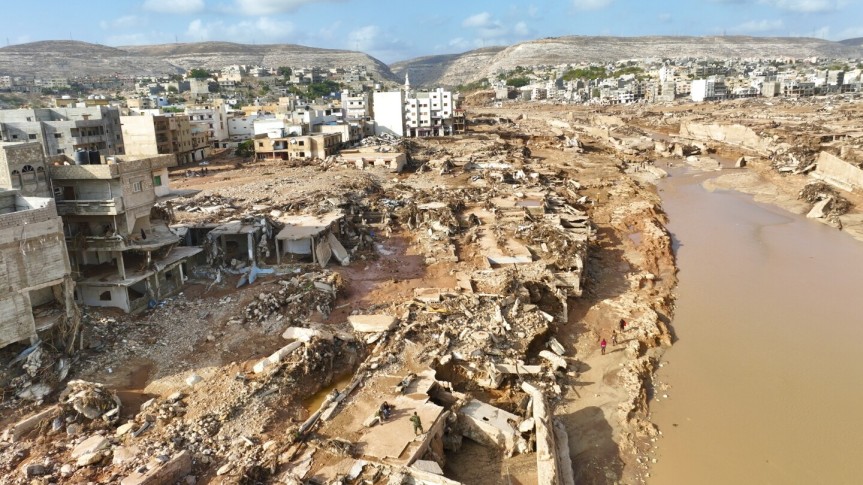
Darna, Libya after dams collapsed in the wake of storm Daniel. (Photo: AP/Jamal Alkomaty)

South Paris, Maine


Prodigious rainfall and the failure of long-deteriorated earthen dams caused a rush of waters through Derna, in Libya, on September 11.  Thousands of residents died, infrastructure was destroyed, and buildings ended up in the Mediterranean. Failure to protect residents, maintain the dams, and sustain the lives of all Libyans point to societal collapse.  

There is also the environmental crisis. Climate change provoked the enormity of storm Daniel that had drenched the eastern Mediterranean area ahead of the disaster. The association of climate change and terrible storms is known and so too is the role of human activities in causing great amounts of greenhouse gases to be released into the atmosphere.

The focus here is on the social disruption that transformed Libya. That’s because predisposing factors may not be clear. There are lessons to be learned.  The two crises are actually joined by virtue of both having developed out of a single impulse for domination.

Nationalist rebels led by Muammar Gaddafi deposed the embattled Libyan regime of King Idris on Sept. 1, 1969. Between 1973 and 1977, a Yugoslavian company contracted by the new government built two dams on the Wadi Derna River for the sake of flood control and irrigation. Maintenance of the dam would be lax.

A 1998 study revealed cracks and deterioration. After delays, a Turkish company began repairs on the dams in 2010. When the Gaddafi government was ousted in the following year, the work stopped.  Some $2.3 million was on hand for finishing the project. It disappeared.

Anti-government protests ─ the   Arab Spring ─ had broken out throughout the region in 2010. An anti-Gaddafi insurgency making headway in early 2011 prompted the military forces of the United States France, Great Britain, and a host of other countries to carry out a self-styled humanitarian intervention in March. Gaddafi’s murder seven months later ended the intrusion.  

U.S complaints had centered on an “opaque political and economic system,” widespread corruption, and Gaddafi’s autocratic proclivities. There had been mutual, and occasionally lethal, provocations.  Gaddafi’s increasing financial and banking influence in Africa raised eyebrows.

Gaddafi had offended by nationalizing 51% of oil companies’ assets in 1973.  According to one expert, “in 2006 the oil sector in Libya … made up ninety-five percent of export earnings, ninety-two percent of government revenue, and seventy-three percent of GDP.”  

The foreign assailants could not have overlooked the reality that a government with tight control over oil was in trouble with an insurgency.  It was no mean prize. Libya’s oil reserves now rank first in Africa and nineth in the world.  

Their forces carried out air operations, inflicted civilian casualties, assisted with the rebels’ ground actions, blockaded ports and embargoed weapons deliveries. They had a convenient tool.

Writer Eve Ottenberg a decade later accuses NATO, instrument for intervention, of fattening the wallets of war profiteers and weapons moguls and wreaking havoc in places like Yugoslavia, Afghanistan, Libya, now Ukraine.” Today France , Holland, and the United States are looking at French Guyana as a “forward-operating base for NATO” in Latin America, reports Guyanese activist Maurice Pindard. 

In its own review of “past and present” missions, NATO, with planetwide ambitions and unlimited potential for destruction, is, as expected, bereft of even a hint at repairing places left in chaos after its wars.

NATO departed from Libya, and ever since a government in the West of the country has been vying with a militarized counterpart in the East, where Derna is located. Cities have been bombed and occupied; Derna was subject to Islamic State rule from 2014 to 2016. Mercenaries, militias, and tribes jostle with one other. Milita groups control oil fields and extort vast sums. There’s “pillage on a vast scale,” plus drug-trafficking and exploitation of migrants heading to Europe.

Now one third of Libyans live in poverty; 13% of them require humanitarian aid, according to one estimate. By 2016, oil production, the source of social spending, had fallen to 75% below Gaddafi-era levels. It’s risen recently. 

The troubles experienced by Libya’s people were new. The Ghaddafi government had achieved much. The  2010 UN Human Development Index, a composite measure of health, education and income, ranked Libya 53rd in the world and first in Africa. By then, Libya was registering the highest per capita income in Africa, the lowest infant mortality, and the highest life expectancy. Schooling and healthcare were provided without Libyans having to pay.

Under Gaddafi, more than 95% of Libyans were adequately nourished; the government had abolished taxes on food. Literacy increased from 25% to 87% during the Gaddafi era. Almost 10% of Libya’s youth received scholarships for study abroad. Beginning in 1983 the government developed a massive water-delivery system with 1,100 new wells and 4,000 kilometers of pipelines.

Had the Gaddafi government not disappeared, the social advances and protection might have remained. Some of the progress might have continued under another government, if there had been no intervention. 

What’s certain is that previous arrangements for sustaining the population disappeared following NATO’s military action. Adverse conditions now allowed for the dams to disintegrate and for Libya’s people to not be rescued.

Pointing to a planetary “double crisis,” an ecological crisis and a social one, analyst Jason Hickle insisted recently that the two crises be dealt with simultaneously: “Attempting to address one without the other leaves fundamental contradictions entrenched.” He adds that, “the two dimensions are symptoms of the same underlying pathology … [which is] the capitalist system of production.”

Derner is witness to Hickle’s double crisis. The unprecedently heavy rainfall reflects climate crisis. A decade of turmoil and neglect of the dams attests to social crisis. The two share the same root cause. 

Capitalism requires perpetually increasing production of goods, which led to overuse of fossil fuels, which has translated into climate change. Under capitalism, natural resources in the world’s peripheral regions are plundered. Popular forces may be suppressed. Devices like NATO come into their own. If it had occurred a little earlier, Jason Hickle could have used the catastrophe to illustrate the main point of his article.


W.T. Whitney Jr. is a political journalist whose focus is on Latin America, health care, and anti-racism. A Cuba solidarity activist, he formerly worked as a pediatrician, lives in rural Maine. W.T. Whitney Jr. es un periodista político cuyo enfoque está en América Latina, la atención médica y el antirracismo. Activista solidario con Cuba, anteriormente trabajó como pediatra, vive en la zona rural de Maine.

Anticommunism in Ukraine as Gift to U.S. Interventionists / by W.T. Whitney Jr.

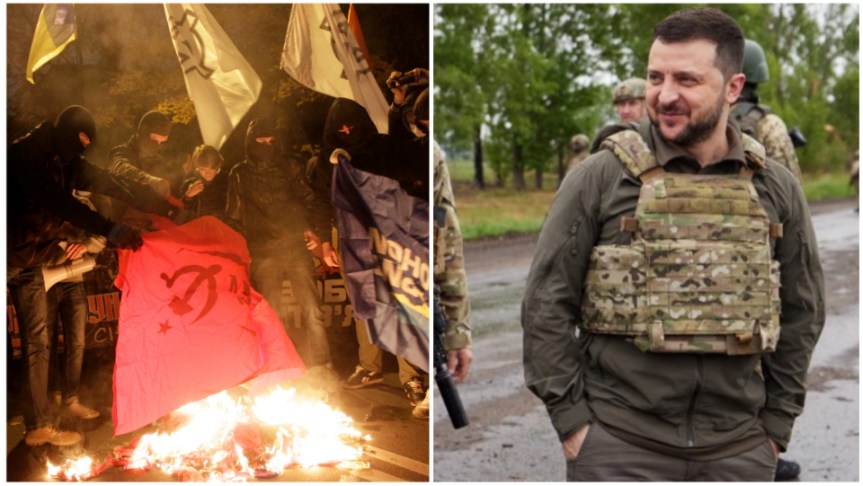
Left: Supporters of the neo-Nazi Svoboda (Freedom) Party burn the flags of the Communist Party of Ukraine and the Party of Regions of Ukraine. Right: Ukrainian President Vladimir Zelensky. | AP photos

South Paris, Maine. August 24, 2023


The arrest on August 16 of Georgi Buiko, a Communist leader, represents the latest and perhaps most significant action taken by Ukraine’s government to rid the country of the Communist Party of Ukraine (KPU). The charges, according to People’s Dispatch, referred to anti-Ukrainian activities and possession of pro-Russian and communist printed material.

Buiko, a key KPU leader, had been a youth leader within the Soviet Union’s Communist Party. Subsequently he was a Party and municipal leader in the Donbass area, secretary of the KPU’s Central Committee, member of the Ukrainian parliament, and a journalist.  Buiko heads the Anti-Fascist Committee of Ukraine.

The Communist Party of Spain condemned Buiko’s arrest and also other government attacks on the KPU. Its statement referred to the report in June from the UN’s High Commissioner for Human Rights which denounced violations of “international humanitarian law” in Ukraine along with arbitrary arrests, secret prisons, and torture.

Buiko’s arrest testifies to a definitive crackdown on Ukraine’s Communists. It began in tandem with an appeals court judgment on July 5, 2022 that confirmed a 2015 court decision declaring the KPU to be illegal. The appeals court ruling authorized the seizing of KPU properties and funds. That it quickly followed the onset of the Ukraine-Russia war on February 24, 2022 was probably not accidental.

The atmosphere turned toxic. Ukrainian President Zelensky on May 14, 2022 banned left-leaning political groups and parties and parties regarded as pro-Russian. The prohibitions did not apply to rightwing and neo-Nazi organizations.

In March of that year, the police in Kiev had already arrested the brothers Aleksander and Mikhail Kononovich on vague charges of pro-Russian attitudes. A court has been deliberating on their case intermittently ever since. The brothers have remained under house arrest for 17 months. They report having received death threats from the police.  

Mikhail Kononovich, addressing the General Assembly of the World Federation of Democratic Youth (WFDY) in Cyprus on December 3, 2019, identified and denounced a rightwing terror campaign against Communists and other opposition groups in Ukraine. Neo-Nazis had brutally attacked the Kononovich brothers a year earlier.

WFDY members have spearheaded demonstrations on their behalf in many countries, particularly in front of U.S. embassies. The Greek Communist Party has prominently defended the imprisoned brothers. 

The KPU’s impact had waned considerably even before wholesale persecution began.  Petro Symonenko, the Party’s former top leader and a prominent member of Ukraine’s Parliament, had been runner-up in presidential voting in 1999. Later, after the so-called Orange Revolution in 2004, the KPU lost most of its electoral appeal. Symonenko ended up supporting Russia in the burgeoning conflict between the two countries. In 2022, in the wake of police raids on his home, he left Ukraine for Russia.

Repression of the KPU manifested in the early stages of that conflict.  A stridently anti-Russian government took power in 2014, with U.S. assistance. Receiving U.S. material aid, Ukraine’s government initiated brutal military action against Russia-friendly separatist forces in southeastern Ukraine’s Donbass region.

Under those circumstances, KPU members experienced physical attacks and Party offices were ransacked. The government produced laws in 2015 requiring that symbols and reminders of Soviet-era Ukraine be removed and prohibiting communist advocacy. The teaching of history in schools would be altered and KGB archives would be newly accessible. 

The legislation promoted recognition of Ukrainian independence leaders extending back to World War II. The honored groups and individuals were predominately fascist in orientation, among them the nationalist leader Stephen Bandera.

Regulations announced in 2019 prohibited the KPU from participating in elections. A court that year banned the pro-communist Workers’ Newspaper (Rabochaya Gazeta), established in 1897.  The newspaper had offended by publishing articles with quotations from Marx and Lenin.

The confluence of vigorous anti-Communism showing up as Ukrainian state policy and U.S. participation in Ukraine’s war against Russia is no mere coincidence. Waging war against a powerful, well-resourced state, Ukraine needs U.S. assistance, and on that account would endeavor to please its essential ally. And the U.S. government sought to make use of Ukraine in order to cut Russia down to size for reasons presumably of global security. There was a meeting of the minds. 

It’s an arrangement that has Ukraine mounting a display of anti-communism for U.S. tastes and its ally relying on red-scare in order to shore up domestic support for its Ukrainian venture, as with past overseas interventions.

Surely Ukraine’s government was aware of its special gift on tap for the U.S. partner.  Anti-communism was the convenient pretext for the U.S. removal of Iran’s Mosaddegh government in 1953, for the CIA-staged coup in Guatemala in 1954, for discarding the Dominican Republic’s “constitutionalist” uprising in 1965, for removing Salvador Allende’s socialist government in Chile in 1973, and so on.

Foreign powerbrokers themselves have benefited from the anti-communist disposition of U.S. governments. The Cuban bourgeoisie and their heirs have relied on U.S. determination to relieve their island of a Communist revolution. Even a progressive Venezuelan government might appreciate the possible usefulness of its current assault on Venezuela’s Communist Party for persuading U.S. officials to ease their economic sanctions.


W.T. Whitney Jr. is a political journalist whose focus is on Latin America, health care, and anti-racism. A Cuba solidarity activist, he formerly worked as a pediatrician, lives in rural Maine. W.T. Whitney Jr. es un periodista político cuyo enfoque está en América Latina, la atención médica y el antirracismo. Activista solidario con Cuba, anteriormente trabajó como pediatra, vive en la zona rural de Maine.

US Has a Favorite in Tumultuous Elections in Guatemala / By W. T. Whitney Jr.

Sandra Torres of the center-right National Unity of Hope (UNE) party and Bernardo Arévalo of the center-left Semilla Movement party will face off in the second round of presidential elections in Guatemala on August 20. (Photo: Prensa Latina)

South Paris, Maine


Bernardo Arévalo scored a big surprise in first-round presidential voting in Guatemala on June 25. Prior to the vote, Arévalo, candidate of the Seed Movement political party had been lagging badly in opinion polls. But he went on to secure 11.8% of the vote, second place behind the 15.8% tally for Sandra Torres of the National Unity for Hope Party (UNE). Second-round voting takes place on August 20, possibly.

The Seed Party quadrupled its congressional delegation to become the third largest with 23 delegates. That party formed in 2015 with a mission of fighting corruption. Critics refer to political forces associated with Guatemala’s last three presidents, including incumbent President Alejandro Giammattei, as the “Pact of the Corrupt.”

Conservative politicians “together with the evangelical churches” campaigned vigorously against Arévalo, “presenting him as a leftist extremist.” Unnerved by his unexpected success, those forces took vigorous action.

The UNE and eight other political parties complained. On July 8 Guatemala’s Constitutional Court (CC), backed by the Supreme Judicial Court, ordered the country’s Supreme Electoral Tribunal (TSE) to suspend certification of the results pending a recount.

When it was completed on July 12, the CC authorized the TSE to certify. But Fredy Orellana, a judge with the so-called Seventh Instance Court, then authorized the Special Prosecutor against Corruption to invalidate the “judicial personhood” of the Seed Party, the effect being to prevent the Party from competing for votes.

Looking for evidence of alleged voter fraud, agents of various agencies carried out intrusive searches at the Seed Party headquarters and TSE offices.

The TSE on July 21 announced it was seeking CC protection from the “imminent threat” against democracy and the electoral process posed by various government ministries and particularly the Public Ministry, in charge of criminal investigations and prosecution.

Almost simultaneously, the CC reiterated that the Seed Party was provisionally protected and that the TSE must allow it to compete in the elections on August 20. Even so, “harassing, intimidating, pressuring and blocking of the electoral process” continued.

Condemning the shenanigans were the Catholic Church, social movements and even business sectors. Electoral observers from the European Union weighed in as did the Organization of American States and its Inter-American Commission on Human Rights. The OAS generally aligns with U.S. purposes. Indeed, Brian Nichols of the U.S. State Department twittered that we “look forward to the Aug 20 vote on the announced top two presidential candidates.”

Congresspersons Raúl Grijalva, Norma Torres, James McGovern and Eleonor Holmes Norton often oppose State Department positions on Latin America, but on July 21 they wrote to Secretary of State Blinken, urging him to pressure Guatemala’s government to allow second-round voting to proceed.

By implicitly supporting Bernardo Arévalo, the U.S. government seems to have reversed course to the extent that it was now speaking up for progressive political leadership ─ far from its usual practice as regards Latin America. Given its long immersion in Guatemalan affairs, however, U.S. actions there probably are coherent, if not always just or legal. The United States has recently applied economics sanctions to Guatemalans accused of political corruption. The Defense Department now and then supplies Guatemala’s security forces with military equipment. In October, 2022 military vehicles worth $4.4 million were donated, supposedly for use against drug-trafficking and for control of migrants. Over many years, the U.S. and Guatemalan militaries have carried out joint exercises.

Really, U.S. intervention is part of Guatemala’s DNA. Cuban investigator Hedelberto López Blanch states that: Before World War II, “Guatemala was in the hands of a few big landowners and U.S. companies… Workers were reduced to conditions of semi-slavery … The government of Jacobo Arbenz tried to change this political, economic and social system, but in June 1954 he was overthrown by the intervention of the CIA and large U.S. landowning companies.”

For 34 years ending in 1996, the U.S. government ─ the CIA in particular ─ was a constant presence. This was a time of rural insurgency, war against indigenous peoples, and 200,000 deaths. Analyst Marc Weisbrot explained in 1999: “[O]ur government had extensive and up-to-date knowledge of massacres and other atrocities, while they maintained a close working relationship with the Guatemalan military at all levels. The United States supplied weapons, training, and other aid to the military …  Through some of the worst periods of killings, our government provided crucial political support.”

Seed Party candidate Bernardo Arévalo has coexisted with U.S. interference for a lifetime. He was abroad during his youth after his father, President Juan José Arévalo, went into exile due to the U.S.- assisted 1954 coup. He served Guatemala’s government as a diplomat and mainstay in the Ministry of Foreign Affairs in the closing years of the civil war. He later taught in the United States and worked at the federally-funded United States Institute of Peace.

That the Seed Movement represents a new kind of rightwing politics for Guatemala, as suggested by commentator Félix Alvarado, may appeal to the U.S. government. In power, Arévalo supposedly would embrace business competition, be less corrupt, and not be beholden to rabid anti- communists and evangelicals.

In a recent interview Arévalo spoke about governing: to deal with corruption, one needs “a process of convergence of social forces” and “recuperation of institutions.” As regards poverty: “The government can’t help everyone but we can begin to create policies for the medium and long term.” As regards “backwardness, discrimination, and racism … we are setting the foundation for the beginning of a process in which institutions begin to function and serve the common good.”

For the U.S. government, Arévalo’s evident deliberation, caution, and limited expectations identify him as an entirely safe would-be Guatemalan president. But a time of testing, a social explosion, is at hand. Maybe for U.S. purposes, Arévalo would be the right president to ward it off, or deal with it.

Numbers speak: 260, number of millionaires; $95 billion GDP, highest in Central America; 47%, rate of undernutrition among under-age-five children (6th highest in the world); 61.6 %, rate of persons living in multidimensional poverty. Also, 2.5% of farms use 65% of the agricultural land, 45% of Guatemalans are indigenous, 79% of the indigenous live in poverty, 80% of rural people are indigenous and Guatemala’s human development index ranks 127th out of 189 counties.

In the recent first-round voting, 17% of the ballots were left blank, and 40% of eligible voters abstained. Non-participation surely points to social and political exclusion ─ of Guatemala’s indigenous people in particular. They don’t figure into current media reports on election difficulties, but they are the fuse for a potential social explosion.

The reflections of Silvel Elías appearing March 1, 2023 on debatesindigenas.org make this point: “The colonialist obsession of the Guatemalan State is evident in …setbacks in human rights and indigenous rights, denial of indigenous demands; violent repression … the granting of extractive licenses on ancestral territories, and practices of structural racism and social and political exclusion.

“Inequality continues to deepen … There are no laws, public policies or targeted programs that serve indigenous peoples. “Although indigenous Guatemalans represent 45 percent of the population, their representation in the Congress has never exceeded 10 percent. Indigenous people there don’t represent indigenous interests, but rather those of the traditional political parties that nominate them.”

U.S. government probably takes the region’s history into consideration as it deals with elections in Guatemala. The mix of extreme poverty, indigenous uprising and rebellion in Bolivia and Peru is a warning.


W.T. Whitney Jr. is a political journalist whose focus is on Latin America, health care, and anti-racism. A Cuba solidarity activist, he formerly worked as a pediatrician, lives in rural Maine. W.T. Whitney Jr. es un periodista político cuyo enfoque está en América Latina, la atención médica y el antirracismo. Activista solidario con Cuba, anteriormente trabajó como pediatra, vive en la zona rural de Maine.

Fighting for Land and Independence in Jujuy, Argentina / By W. T. Whitney Jr.

South Paris, Maine, June 27, 2023


In Jujuy province, in Argentina’s extreme Northeast, poor people’s discontent, the provincial government’s overreach, and popular resistance recently contributed to a crisis that portends grief and struggle ahead.  Setting the stage were: free rein for local reactionaries, indigenous peoples’ oppression, foreign plundering of natural resources, and a U.S. eye over the whole affair.

June was a month of turmoil.  Governor Gerardo Morales had proposed reforming the province’s Constitution. Teachers’ unions were agitating for higher salaries.

Discussion for 50 days that should have preceded the Constitutional Convention never happened. The Convention, presided over by Morales himself, played out over three weeks.  He had timed the electing of delegates to coincide with provincial government elections and thereby assure enough voter turnout to elect delegates who backed constitutional reform.

The proposed changes included new provisions for criminalizing public protests and new restrictions on “freedom of expression, petition, and association.” There would be revised legal mechanisms for regulating access to land, this so as to deliver land to lithium-producing multi-national companies. Indigenous peoples would face the probability that untitled plots of land crucial to their survival, for generations, would no longer be available. Jujuy province is the center of lithium extraction in Argentina, the world’s fourth largest lithium producer.  

Elected in 2015, Morales cut back governmental support for education, and teachers lost jobs. Teacher salaries in Jujuy are the lowest in Argentina. Teachers’ unions in nearby Salta province had recently carried out strikes and won pay increases.

On June 5, a Jujuy teachers’ union struck for better pay. On June 9, several teachers’ unions and the municipal employee union marched on Jujuy city, population 375,000. Soon healthcare workers and a miners’ union would join the mobilization. Morales decreed “increased penalties against individuals and organizations participating in any protests or social mobilization.” 

On June 14 indigenous people marched on the city “to demonstrate their rejection of the [constitutional] reforms … being devised behind closed doors.”  City streets were teeming with protesters on June 15 when word came that agreement was near on constitutional reforms. Soon indigenous groups and others were maintaining roadblocks on highways throughout the province. Police, assisted by unidentifiable enforcers using unmarked vehicles, stepped up arrests of demonstrators and journalists.  Calls went out for Morales’s resignation.

The Constitutional Convention on June 20 approved alterations of 66 of the provincial Constitution’s 212 articles. Street pressure had caused two reforms involving indigenous rights and access to land to be withdrawn temporarily.  Restrictions on protesting and free expression remained. The Constitution now provides for “automatic majority in the legislature for the governing party” and no longer requires that provincial elections be held every two years.

Massed demonstrators responded by assaulting the Government House with projectiles. Police turned them back using tear gas, rubber bullets and arrests.

The provincial government’s repressive methods elicited criticism from elsewhere in Argentina and from the Inter -American Commission on Human Rights, Amnesty International, and the United Nations High Commissioner for Human Rights. 

Governor Morales exceeds boundaries. Early in his first term, for example, he enlarged the top provincial court from five to nine judges. Consequently, provincial courts have endorsed illegal searches, illegal evictions, and persecution of social leaders. By 2018, 25 family members were serving as provincial government officeholders.

One presumes that the governor’s evident lack of restraint is bad news farther afield. He leads Argentina’s rightwing Radical Civic Union party and now is a vice-presidential candidate on one of two tickets aiming to represent the rightwing Unite for Change electoral coalition in upcoming elections.

It’s clear: he stops at nothing. Morales’s government in 2016 arrested Milagro Sala, leader of the Tupac Amaru Organization that at the time was assisting indigenous families as they looked for food, housing, basic education and more. The government was interfering and the Organization resisted. The police arrested Sala on flimsy pretexts and seven years later she is still detained.

Continuing his efforts to waylay indigenous independence, Gerado Morales took part in the November 2019 coup that deposed Bolivian President Evo Morales. That Morales was an indigenous president of a multi-national republic. Governor Morales was instrumental in arranging for U.S. assistance.

Around September 4, 2019, Gerardo Morales supposedly joined a meeting in Jujuy held to organize the coup against Evo Morales. Present was Luis Camacho who, based in Santa Cruz in Bolivia, was leading the coup in progress. Later on, Governor Morales himself traveled to Santa Cruz to confer with plotters. 

On that September 4, Ivanka Trump and State Department, CIA, and USAID personnel arrived in Jujuy ostensibly to support local women’s initiatives. Trump had brought $400 million.  A Hercules C 130 aircraft was deployed on the runway close to the recently arrived U.S. plane.  Almost at once that plane departed for Santa Cruz, without a flight plan. Camacho was on board. 

He may have been conveying the U.S. funds that would be used to bribe the senior Bolivian Army officers who pressured Evo Morales to resign. Later on, Gerardo Morales surely was not blind to that same airplane carrying weapons to plotters in Santa Cruz.

The governor’s zeal in serving U.S. interests shows up now as he cultivates U.S. official representatives for the sake of U.S. investment in the extraction and processing of lithium. He met with U.S. ambassador Marc Stanley in May 2022, and later Stanley was in Jujuy as Morales acquainted him with “a portfolio of projects in development.” Stanley and his family attended an indigenous festival.

Together with governors of other lithium-producing provinces, Morales in 2022 visited European countries and the United States. There he met with Washington officials, bankers, and industrial leaders, among them Elon Musk, owner of Tesla Corporation.

Morales’s friendship with Argentinian-government economic minister Sergio Massa is surprising – President Alberto Fernandez’s government is on the other side of the political divide – but understandable:  Massa is  a favorite in U.S. official circles, a lead promotor of foreign investment in Argentina’s natural resources, and a likely presidential candidate in elections later this year.

The story here centers on Morales’s doings as an individual. But people respond to circumstances collectively and engage collectively in social change. Morales is representative, it seems, of that class of well-paid intermediaries who have long arranged for the transfer of wealth from wherever to a waiting set of plunderers.

The history of the Americas has them freeing up land so as to get at wealth that is there. They must dispose of the set of people living on the land. Military force is made available. Morales becomes an updated conquistador.

Writing for the Argentinian Club of Journalist Friends of Cuba (capac-web.org), Alberto Mas provides specifics. In a report entitled “Jujuy is the North American Laboratory for Argentina,” he states that, “The visit of General Laura Richardson of the U.S. Southern Command [on April 17, 2023] did not in the least hide intentions of controlling the production and exportation of Argentina’s lithium. This is part of a strategic plan for the region which they have implemented over the course of time: the coup against Evo Morales in Bolivia had the smell of lithium.”


W.T. Whitney Jr. is a political journalist whose focus is on Latin America, health care, and anti-racism. A Cuba solidarity activist, he formerly worked as a pediatrician, lives in rural Maine. W.T. Whitney Jr. es un periodista político cuyo enfoque está en América Latina, la atención médica y el antirracismo. Activista solidario con Cuba, anteriormente trabajó como pediatra, vive en la zona rural de Maine.