
Cuba’s Government Analyzes and Responds to Economic Woes / By W. T. Whitney Jr.

People look at food prices at a private business in Havana on December 20, 2023. Cuba’s economy will shrink by up to 2 percent this year, Finance Minister Alejandro Gil estimated on Wednesday, after acknowledging that the country will not be able to achieve the projected economic growth of 3 percent by 2023 | Yamil Lage / AFP / Getty

Reposted from Counterpunch


“Our joy is immense … We don’t deceive ourselves thinking that everything ahead will be easy, when perhaps everything is going to be more difficult.” That was Fidel Castro, hours after the victory of Cuba’s Revolution.

Difficulties were center stage 65 years later, at a plenary session of the Central Committee of Cuba’s Communist Party on December 15 and 16 and at the National Assembly of People’s Power, meeting on December 20-22.

The views of Cuban leaders on problems now enveloping Cuba shed light on realities of a nation under siege and a revolution in trouble. The information is pertinent to the solidarity efforts of Cuba’s friends abroad. Addressing the Central Committee’s plenary session, Cuban President Miguel Díaz-Canel noted that, “We have discussed efforts that have not
yielded solutions, measures that did not prosper, and goals that were not fulfilled …The scenario is that of a war economy … [We] are all here to reverse the present situation … with consensus as to decisions and with collective work, with passion and energy.”

Díaz-Canel called for “creative resistance” and “confidence in victory,” while insisting that dissatisfaction “is a motor that moves revolutionary energies. It provokes embarrassment that ends up activating people’s full participation, without which socialism is impossible.”

“We would be surrendering beforehand, if we see this war as an insuperable calamity. We must see it … as the opportunity to grow and to overcome our own selves, while the adversary is nakedly evil before the world … On the eve of the 65th anniversary of the Cuban Revolution … we are called to act together for a common objective: Save the
homeland, the Revolution, socialism, and overcome.”

The Assembly meets

Speaking to the National Assembly were: Alejandro Gil Fernández, minister of the economy and planning; Prime Minister Manuel Marrero Cruz; and President Miguel Díaz-Canel. Gil Fernández regards the U.S. economic, commercial and financial blockade of Cuba as the principal obstacle Cuba faces in restoring its economy.

He indicated that in 2023 Cuba’s GDP will have fallen almost two percent. Exports were $770,000 million below predictions. Food production was less than that of 2022. Tourism income increased by $400 million in 2023 but represented only 69% of the yield in 2019.
Overall production was down due mainly to state enterprises held back by shortages of supplies and fuels. Currency shortages and loss of workers to migration hampered the healthcare and education sectors. Electricity generation was up 32% in 2023, according to Gil Fernández. Cuba’s 30% inflation rate for 2023 was lower than the 77.3% rate in 2021.

State business entities showed “gradual recuperation.” They employ 1.3 million workers while accounting for 92% of goods and services produced in Cuba and 75% of exported products. He attributed price inflation to international price hikes, the government’s release of money to finance its budget deficit, fewer goods being produced, and an agriculture sector burdened by labor shortage, high costs, and low yields.

“What isn’t being produced cannot be imported,” Gil Fernández lamented. His message is that importing goods is almost impossible what with “the effect of high prices on the international market.” But, paradoxically, “a lack of production resources” forces Cuba to import over 70% of the food that is being consumed.

He proposed measures for increasing food production, including:

+ Creation of a financial mechanism for bolstering production based on farmers using Cuban currency derived from agricultural sales to buy supplies they need.
+ Build a farm labor force through moonlighting, employing students, and having young people do agricultural work as part of their military service.
+ Use food produced in Cuba, not imported food, to fill the “normal family food basket.”

Prime Minister Manuel Marrero Cruz critiqued the government’s lack of control over production and distribution which “adversely affects production by state entities and lets currency exchanges on the illegal market determine the pricing of products from the non-state sector.” e reported that social inequalities are growing, and that the tendency exists while state subsidies continue to nourish less distressed sectors of the economy. Equally worrisome: “The former state monopoly in production is now consolidating in the private sector.”

He was referring to the recent appearance of 9000 or so mostly private small-and-medium-sized businesses and to independent farmers and cooperatives that took over land from the state under long-term usage arrangements. They now control 80% of Cuba’s agricultural land. Marrero Cruz called for “stimulation of government-operated small-and-
medium-size business entities.”

Both private businesses and the farming sector sell products at highly inflated prices with prices being set by black market operatives. The prime minister condemned the state subsidies such entities receive in the form of low prices assigned to the fuel, water, transportation and electricity they buy from the state. Similarly, the government pays high
prices to farmers for food that, under the rationing system, is sold inexpensively to the population.

Henceforth, according to Marrero Cruz, the government will be subsidizing people, not products. According to one report, “The Ministry of Work and Social Security will be charged with undertaking a survey of ‘vulnerable’ social sectors.” “Nobody will be abandoned,” Marrero Cruz insisted.

The government, he indicated, will increase sales taxes on final products such as water, gas, electricity, transport and reduce import tariffs by 50% on the “intermediate products” used in food production and manufacturing. More tourist dollars will be harvested. Municipal assemblies will present budgets and in the case of deficits will generate more income and reduce administrative expenses.

For the prime minister, “food production needs to be prioritized and by all sectors. Many countries are saying to us: ‘We’ll put up the money, you provide the land and then pay back the money with production.’” He pointed out that, despite the non-availability of imported fertilizer and pesticides, “there are many instances of countries producing food; an
agricultural country must produce its food.”

Marrero Cruz sees “speculative prices … and intermediaries earning a lot more than producers” and non-state entities now controlling imports rather than the government, the result being “abusive and speculative pricing.” He called for paying for imports with income from exports: “[W]e prefer importing supplies and products essential to the economy and
paying for them by offering other countries certain products and/or services.”

Responding to inflation, the government, collaborating with the Central Bank of Cuba, will change the official exchange rate for the peso. According to Marrero Cruz, the government will be restricting prices for goods and services with a system of “maximum prices.”

President Miguel Díaz-Canel, addressing the National Assembly on December 22, focused on Cuba’s “war economy … [It’s] a political scenario of maximum asphyxia, designed and applied against a small country by the most powerful empire in history.” He also attributed
economic problems to “the crisis in international economic relations and our own errors.”

Economic war takes the form of economic blockade aimed at “reduced supplies of goods used by the population, inflated prices, and low purchasing power for most Cubans.” “Together with constant acts of subversion and disinformation against Cuba, the goal is to break the country, provoke social decomposition, and make for ungovernability.”

Díaz-Canel spoke of errors as “part of the complexity of making decisions in a context of extreme tension … [and of] commitment to preserving social conquests.” He mentioned mistakes, particularly in the “design and implementation of currency unification” and in “approving new economic actors without performance norms having been established.”

The effectiveness of new measures will “depend on generating more wealth, more work incentives, and more distribution of resources.” The president promised there will be no “neoliberal package … no crusade against small businesses, no elimination of the basic food allocation.” The president highlighted: “food production, localities taking care of
more of their needs, the revival of tourism, rescue of the sugar industry, state control of currency and the exchange market, redesign of the financial system, and guarantees for self-financing, and managing currency so as to serve those whose production generates income.”

Díaz-Canel took note of Cubans’ high regard for healthcare workers and teachers, promising that “they will be the first to benefit from additional pay, which the prime minister announced in his intervention.” Testifying earlier before the Economics Commission of the National Assembly, Díaz-Canel emphasized “taking advantage of the facilities of the municipalities and articulating strategies of local development.” Recalling that the “[f]oundation of government is the municipal assembly of people’s power,” he insisted on “mapping out actors in the municipalities and integrating them with state and private businesses.”

In the end

The information and opinions provided by Cuban leaders and reviewed here clarify difficult realities, among them: adverse effects of diminished tourism, inflation, and emigration; social inequalities based on varying access to resources; production stymied by shortages of resources; inadequate food production; lack of buying-power for most Cubans, and
for importing necessary goods; and the near impossibility of securing foreign investment.

Cuba is fashioning responses. They are: decentralization of political and economic administration; cut backs on expenditure of central government funds, reduced subsidies for the purchase of water, fuel, transport, and electricity by business entities; adjustment of import tariffs to favor the availability of resources for production, capturing more tourist dollars, protecting state-operated production entities, fixing prices, and producing more food.

These will be palliative remedies unless basic causes are dealt with. A prime goal of U.S. policy has been to deprive Cuba of money, and that has come to pass. Revolutionary Cuba’s very survival depends on U.S. citizen activists forcing their government to shed its blockade of Cuba. There, the great need now is for Cuba to be removed from the U.S. list of terrorist-sponsoring nations. That designation causes most international financial institutions to refuse handle dollars on Cuba’s behalf.

There is a larger context. The U.S. use of economic sanctions everywhere rests on planet-wide dollar dependency. That emerged out of the Bretton Woods Conference of 1944 and has coincided since with unrelenting U.S. assertion of worldwide power. That’s the basis for a global constituency on Cuba’s behalf. How it will be set in motion is the
big question.


W.T. Whitney Jr. is a political journalist whose focus is on Latin America, health care, and anti-racism. A Cuba solidarity activist, he formerly worked as a pediatrician, lives in rural Maine. W.T. Whitney Jr. es un periodista político cuyo enfoque está en América Latina, la atención médica y el antirracismo. Activista solidario con Cuba, anteriormente trabajó como pediatra, vive en la zona rural de Maine.
U.S. military appears to favor Israeli plan for permanent Gaza occupation / By W.T. Whitney Jr.

Israeli soldiers eye their targets at the Israel-Gaza border on Monday, Dec. 18, 2023. | AP

Reposted from the People’s World


Nearly 20,000 Gaza civilians, mostly children and women, have died from bombs and gunfire in Israel’s war so far. Many more will be dying soon from lack of medical care, food, water, and the spread of infectious diseases. Healthcare and social service facilities—along with the homes of a million or more—have been reduced to rubble.

The U.S. government provides the support for all of this to happen, as it continues to financially and militarily back Israel in its war against Hamas in Gaza in retaliation for the latter’s attacks of Oct. 7.

Prospects for Gazans who survive the war are grim, or worse. The families of many are gone, and international aid agencies have mostly disappeared. Dire shortages of necessities are on the horizon.  Repairing the physical damage won’t happen anytime soon, and Israeli settlers are already eyeing prime Gaza lands.

With humanitarian disaster on full display, Human Rights Watch points out that, “by continuing to provide Israel with weapons and diplomatic cover as it commits atrocities…the U.S. risks complicity in war crimes.”

Either the charge or the fact of complicity will very likely bedevil the United States for as long as Gazan civilians are dying in large numbers or being removed to camps somewhere else and, all the while, the U.S. goes on supplying Israeli occupiers with weapons.

A recently released Israeli military analysis raises the possibility that the U.S. government courts very serious condemnation if it provides material support for a permanent Israeli occupation of Gaza.

Dr. Omer Dostri, the study’s author, is associated with the Jerusalem Institute for Strategy and Security and the Israel Defense and Security Forum. Each is oriented to Israel’s military establishment. His study appeared Nov. 7 in the Military Review, the self-described “Professional Journal of the U.S. Army.”

As reported by journalist Dan Cohen, Dostri declared on social media that, he “authored [the study] on behalf of the U.S. Department of Defense and the U.S. Army’s Military Review journal.” For the Military Review’s editors to have invited Dostri’s submission suggests they already knew about and were at least tolerant of, Dostri’s iron-fist approach toward Gaza.

The author and editors alike presumably expected their respective military superiors to accept some or all of the views expressed in the paper. Perhaps, then, the two military leaderships have common ground regarding Gaza. Publication of this Israeli analysis becomes a straw in the wind as to future U.S.-Israel military collaboration on Gaza, and, on that score, to U.S. war crimes.

The title of Dostri’s article reads in part, “The End of the Deterrence Strategy in Gaza.” He notes the failure of Israeli military intelligence, Israel’s lack of combat readiness, and Hamas’s “exceptional military and professional approach.” Referring to Israel’s “disregard for the fundamentalist religious dimension of Hamas as an extreme Islamic terrorist organization,” he diagnoses faulty “political perception”

Dostri reviews options for control of Gaza following the envisioned defeat of Hamas. They are: a local Gazan administration, the Palestinian Authority taking charge, a mandate exercised by another government or an international agency, or occupation and governance by Israel’s military. He favors the latter, “from a security perspective.”

The main reason for establishing Israeli settlements in Gaza, he states, is that “seizing and securing land constitutes a more substantial blow to radical Islamist terror groups than the elimination of terrorist operatives and high-ranking leaders.”

Summarizing, Dostri indicates that:

“[A] robust ground campaign in the Gaza Strip, encompassing the occupation of territories, the creation of new Israeli settlements, and the voluntary relocation of hundreds of thousands of Palestinians to Egypt with no option for return will greatly fortify Israeli deterrence and project influence throughout the entire Middle East.”

Dostri examines Israel’s conduct in the ongoing Gaza war. He calls for a military strategy aimed at securing “a swift surrender of the enemy” that would allow “political maneuverability to make decisions.” The goal “is to defeat Hamas and assume control of the Gaza Strip for the benefit of future generations.”

Israel, he says though, runs “the risk of a multifront war.” Planners are “in the process of altering…policy and military strategy, not only concerning Gaza but also across other fronts.” The Gaza experience is instructive: “Successive Israeli governments…regarded Hamas in the Gaza Strip as a legitimate governing entity that could be managed and engaged through diplomatic and economic means. Not anymore.”

Now “Israel should shift from a strategy of deterrence…[to a] strategy of unwavering decisiveness and victory.” In particular, “Israel will have no choice but to invade Lebanon and defeat Hezbollah.” In addition, “Israel cannot afford to allow the Houthis [in Yemen] to significantly bolster their military strength over time.”

U.S. political leaders for the most part have yet to weigh in on the fate of Gazan civilians in the post-war period. Dostri’s view of Gaza’s future, seemingly acceptable, more or less, to the militaries of the two countries, leaves no room for the niceties of civilians being abused and dying as part of the coming occupation.

By Dec. 1, the U.S. Congress was considering a proposal for assisting Israeli forces as they clear Gaza of Gazans:  Egypt, Turkey, Yemen, and Iraq would receive U.S. monetary support for taking in Gazans fleeing from Israeli attacks.

The next day, however, Vice President Kamala Harris indicated that “Under no circumstances will the United States permit the forced relocation of Palestinians from Gaza or the West Bank.”

At issue for U.S. policymakers are competing realities: the suffering of Gaza civilians, obligations to U.S. ally Israel, the prospect of a region-wide war, and the control of oil, whether Israeli or Palestinian.

Reporting on counterpunch.org, Charlotte Dennett cites “oil and natural gas, discovered off the coast of Gaza, Israel, and Lebanon in 2000 and 2010 and estimated to be worth $500 billion.” The Palestinians in 2000 claimed that the “gas fields…belonged to them.”

Yasser Arafat, the then-President of the Palestinian National Authority, “learned they could provide $1 billion in badly needed revenue. For him, this [was] a Gift of God for our people and a strong foundation for a Palestinian state.”

Dennett adds that “In December 2010, prospectors discovered a much larger gas field off the Israeli coast, dubbed Leviathan.” In addition, “work has already begun on…the so-called Ben Gurion Canal, from the tip of northern Gaza south into the Gulf of Aqaba, connecting Israel to the Red Sea and providing a competitor to Egypt’s Suez Canal.”

Israeli Prime Minister Benjamin Netanyahu wants to “convince international lenders to support his long-held scheme of turning Israel into an energy corridor.”

With such riches at stake, does anyone really believe that a truly free Palestinian state will be allowed to come into existence?


We hope you appreciated this article. At People’s World, we believe news and information should be free and accessible to all, but we need your help. Our journalism is free of corporate influence and paywalls because we are totally reader-supported. Only you, our readers and supporters, make this possible. If you enjoy reading People’s World and the stories we bring you, please support our work by donating or becoming a monthly sustainer today. Thank you!


W.T. Whitney Jr. is a political journalist whose focus is on Latin America, health care, and anti-racism. A Cuba solidarity activist, he formerly worked as a pediatrician, lives in rural Maine. W.T. Whitney Jr. es un periodista político cuyo enfoque está en América Latina, la atención médica y el antirracismo. Activista solidario con Cuba, anteriormente trabajó como pediatra, vive en la zona rural de Maine.

Oil Wealth, US Intervention Aggravate Venezuela – Guyana Border Conflict / By W. T. Whitney Jr.

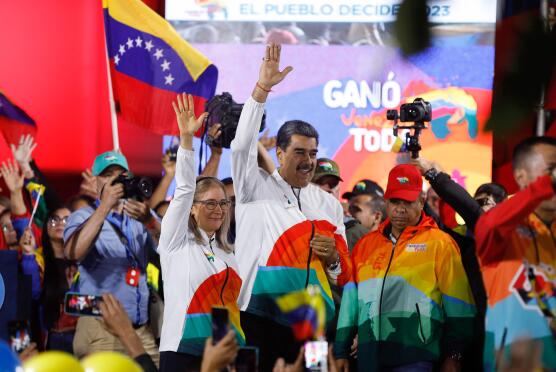
Venezuelan president Nicolas Maduro just before his speech celebrating the “Yes” vote in the Essequibo referendum, in Caracas, December 3, 2023 | Pedro Rances Mattey / AFP

South Paris, Maine


Venezuela’s National Assembly on December 6 began deliberation on President Nicolás Maduro’s plan for incorporating Essequibo into the Venezuelan nation.  The region lying between Guyana to the East and Venezuela to the West has long been claimed by both nations.

Maduro’s plan involves creation of a “Zone of Comprehensive Defense of Guyanese Essequibo,” the naming of General Alexis Rodríguez Cabello to direct the project, designation of state agencies for licensing the “exploration and exploitation of oil, gas, and minerals,” distribution of a revised map of Venezuela, and, importantly, creation of “an organic law for formation of Guyanese Essequibo and all the decisions [voted upon] last Sunday.”

Venezuelans on December 3 did approve a referendum calling upon their government to establish sovereignty over the contested territory. Over 95% of those voting backed each of the referendum’s five points;  50% of Venezuelans did not vote.  The upshot was a big majority in favor of Essequibo being a new Venezuelan state and of its 125,000 inhabitants becoming Venezuelan citizens and receiving social support.

An old border dispute is now a conflict impinging on the very fabric of the Venezuelan nation.  Prime responsibility lies with U.S.-based ExxonMobil Corporation, its activities and acquisitive purposes.

Guyana became a British colony after the Napoleonic wars. Britain was uncertain about the boundary between their new colony and newly independent Venezuela. A survey carried out under British auspices in 1835 put the colony’s western boundary close to or at Venezuela’s Orinoco River.

However, Venezuela’s eastern border during its colonial period extended beyond the Orinoco, to the East, to the Essequibo River, flowing from south to north. During the 19th century, Venezuela’s leaders adhered to that version of the border.

President Antonio Guzmán Blanco initiated negotiations with Great Britain. Assuming that the Monroe Doctrine represented a barrier against European designs, as advertised, Venezuela’s government allowed two U.S. diplomats to negotiate on Venezuela’s behalf.

They colluded with their British counterparts. The negotiations ended with an agreement signed in Paris in 1899 that assigned the disputed Essequibo region to Guyana, the British colony.

Essequibo’s gold-mining potential was evident at the time. Now, according to a recent report, “Gold mining generates Guyana’s main export product, and such mining is carried out mainly in the Essequibo.”

Britain granted independence to Guyana in 1966. Earlier that year representatives of the Venezuelan and British governments, meeting in Geneva, agreed to submit the continuing dispute over Essequibo to arbitration. Venezuela’s government subsequently presumed that the 1899 Paris agreement no longer applied.

With no resolution in sight, the two sides in 1987 submitted the issue to United Nations mediation. Nothing happened.  In 2018, in response to a request from Guyana, UN Secretary General Antonio Guterres referred the issue to the International Court of Justice located in The Hague.

Although Venezuela denies the Court’s jurisdiction, representatives of both nations appeared before the Court in November 2023. At issue was a Guyanese demand that Venezuela cancel the referendum that did take place on December 3.

The recent urgency of resolving the Essequibo quandary has everything to do with actions taken by ExxonMobil Corporation.

In 2015 ExxonMobil discovered copious off-shore oil reserves under Essequibo’s territorial waters. Guyana’s government expanded the bidding process for oil explorations. A previously humdrum territorial dispute had turned into a momentous contest with potentially far-reaching consequences.

ExxonMobil epitomizes power and wealth. Profits in 2022 were $56 billion. ExxonMobil revenues of $413.7 billion for 2022 were greater than the GDPs that year of all but 34 countries in the world; it ranked seventh for income-generating capacity among the world’s corporations.  ExxonMobil sees Guyana as its potentially most productive oil-producing region, a place accounting for more than 25% of ExxonMobil’s total hydrocarbon production.

According to analyst Vishay Prashad, “ExxonMobil … signed an agreement with the government of Guyana in 1999 to develop the Stabroek block, which is off the coast of the disputed Essequibo region.” He adds that, “ExxonMobil was given 75% of the oil revenue toward cost recovery, with the rest shared 50-50 with Guyana; the oil company, in turn, is exempt from any taxes.”


W.T. Whitney Jr. is a political journalist whose focus is on Latin America, health care, and anti-racism. A Cuba solidarity activist, he formerly worked as a pediatrician, lives in rural Maine. W.T. Whitney Jr. es un periodista político cuyo enfoque está en América Latina, la atención médica y el antirracismo. Activista solidario con Cuba, anteriormente trabajó como pediatra, vive en la zona rural de Maine.

How Skewed Access to Land Has Fostered War in Gaza / By W.T. Whitney Jr.

This infographic is by visualizing Palestine. It is published under CC BY-NC-ND 4.0 DEED. Fair use.

South Paris, Maine


The humanitarian disaster of war in Gaza shows in both the wreckage of hospitals and the dying in and around hospitals. The need, said Dr. Hammam Alloh, an internist, is “First, we need this war to end, because we are real humans … We have the right to live freely.” 

Healthcare workers at Al-Shifa hospital buried over 180 dead patients. Norwegian physician Mads Gilbert reported that, “Twenty out of the 23 ICU patients had died. Seventeen other patients died because of lack of supplies, oxygen and water. And three, if not five, of the 38 premature newborns have died because of this slow suffocation.”

Asked why he remains at Al-Shifa Hospital, despite the invaders’ orders to leave, Dr. Alloh explained that he didn’t choose to be a physician “to think only about my life and not my patients.” And, “who treats my patients? We are not animals. We have the right to receive proper healthcare.”  Alloh subsequently died from a bomb attack on his living quarters.

Expressions of outrage have circulated widely in the independent media. World Health Organization head Tedros Adhanom Ghebreyesus told the UN General Assembly that, “You must act and you must act now … there are no words to describe the horror.”

The plight of Dr. Shadi Issam Radi is appalling. He is standing in a corridor of the hospital during his  interview. Two little children are at his side. “I have worked in the intensive care department for seven years,” he says. “My wife was killed while I was working. I am obliged to bring the children with me. I am still working. Thank God for everything.”

Condemnations and revulsion are not enough. Fixation on the dire situation of the Gaza doctors contributes little to ending the war, just as treating the symptoms of sick people doesn’t cure them.  But knowing about cause helps to achieve peace and to find curative treatments.

The plan here is to go scientific, to investigate a historical reality that, having fostered relations mired in lethal conflict, may someday usher in more promising realities.

The Palestinian people’s circumstances for living and for communal existence have long been unsustainable. Political prisoner Mumia Abu-Jamal recently explained why that is so:

“[W]ar between Palestine and Israel … is not a war around religion or between faiths or gods. It’s a war for that which is no longer being produced — land … The Palestinians are the Indigenous people of the region. They are thus equivalent to the Navajo, Apache and Seminoles of the West.”

Israeli military leader Moshe Dayan in 1956 spoke about land and the fight for land:

“What can we say against [the Palestinians’] terrible hatred of us? For eight years now, they have sat in the refugee camps of Gaza and have watched how, before their very eyes, we have turned their land and villages, where they and their forefathers previously dwelled, into our home … Without the steel helmet and the cannon’s maw, we will not be able to plant a tree and build a home.”

Immigrants who were part of the Zionist movement, whose mission was to form a Jewish state, began to arrive in Palestine in the earliest years of the 20th century, mostly from Europe. A burgeoning population needed land for sustenance, land with its topsoil, vegetation, crops, trees, space for living, and access to water in rivers, springs, and aquifers.

Israeli historian Ilan Pappe estimates that during the 400-year period of Ottoman rule, from 1517 on, Jewish people made up only two to five percent of the region’s population. A census in 1878 showed that 87% of inhabitants were Muslim, 10% Christian, and 3% Jewish.

Zionist publicists have portrayed pre-immigration Palestine as a “desert,” empty of people. However, Pappe indicates that in the 18th century, “[T]he coastal network of ports and towns boomed through its trade connections with Europe, while the inner plains traded inland with nearby regions.”  Palestine “was part of a rich and fertile eastern Mediterranean world that in the 19th century underwent processes of modernization and nationalization.  It … was a pastoral country on the verge of entering the 20th century as a modern society.” 

He adds that, “By 1945, Zionism had attracted more than half a million settlers to a country whose population was about 2 million …The settlers’ only way of expanding their hold on the land…and of ensuring an exclusive demographic majority was to remove the natives from their homeland.”

Antisemitism in Europe and elsewhere stimulated emigration to Palestine, more so after the Holocaust and Israel’s formation. That government in 1950 instituted its Law of Return which grants “every Jew in the world” the right to settle in Israel.

British rule over Palestine from 1920 to 1948, under a League of Nations “Mandate,” fit with imperialist ambitions, according to Pappe. The United States and France would be joining Britain in a joint venture with the new Israeli state to control the region and assure access to oil and gas. Likely expectations were that Israel would become powerful and its population would grow. Absorption of Palestinian land was part of the package.

In 1945, 84.7% of cultivatable land in Palestine was “Arab-owned.” The “newly established Israeli [military] forces in 1948 launched a major offensive” after Israel declared its independent statehood and after the surrounding Arab nations attacked. This was the setting for the “Nakba” (catastrophe); hundreds of thousands of Palestinians were forcibly displaced from homes and land.

According to one report (Journal of Palestine Studies,1979), “Israel thus began its life with a vast stock of abandoned farmland and in the early years of statehood, when immigrants were pouring in, this land was ‘reclaimed’ for agriculture at an impressive rate. In the four-year period from 1948-49 to 1952-53, the physical area under cultivation in Israel almost doubled.”

Moreover, “About 80 percent, and probably more, of the 2,185,000 dunums (539,925 acres) brought into cultivation since 1948 thus constitutes farmland belonging to the Palestinian refugees.”

A study appearing in 2000 reports on the shrinking of agricultural acreage due to Israeli occupations: “The loss of large stretches of agricultural land, after 1967, due to land confiscation and closures, and limitations on water supply and product markets, has led to a substantial decline in the production of this sector.”

Ultimately, the reality of reduced access to land has left Palestinians with precarious living conditions and has forced them into a toxic relationship with Israel. An accompanying reality is that the international community’s arrangements for the partition of Palestine in 1947, and for enforcement, were flawed.

Other troublesome real-life phenomena include: competing Palestinian claims to oil and gas deposits off-shore and in the West Bank, and the continuous, death-dealing  supply of U.S. weaponry to Israel. 

Meanwhile, appeals to international law, moral principles, human rights, and common decency don’t move the mountain. The conflict continues. Personal or collective grief at the suffering and deaths of the Gaza doctors and their patients has little impact.


W.T. Whitney Jr. is a political journalist whose focus is on Latin America, health care, and anti-racism. A Cuba solidarity activist, he formerly worked as a pediatrician, lives in rural Maine. W.T. Whitney Jr. es un periodista político cuyo enfoque está en América Latina, la atención médica y el antirracismo. Activista solidario con Cuba, anteriormente trabajó como pediatra, vive en la zona rural de Maine.

‘Economic asphyxiation’: U.S. restricts food supplies in bid to strangle Cuban revolution / by W.T. Whitney Jr.

A portrait of Argentine born Cuban revolutionary hero Ernesto ‘Che’ Guevara hangs on a shelf at a food store in Havana with some of the few products for sale. | Ramon Espinosa / AP

Reposted from the People’s World


The civilian victims of U.S. war-making in Gaza—the U.S. government supplies the big weapons—are on full display right now, broadcast on television screens and Twitter feeds around the world.

There’s another group on the receiving end of U.S. imperialism whose plight is not being publicized very much at the moment, though, and that’s the resistance of the long-suffering people of Cuba against an unrelenting economic war.

Differences in scale and immediacy of course distinguish the assault they face due from the U.S. blockade and the bombardment and constant death being visited upon the Palestinians by Washington’s Israeli ally, but for the island nation to our south, the supply of food and other necessities is becoming ever more precarious by the day.

And despite the differences in the war against Palestinians and the economic war against Cubans, there is a common principle that governs in both instances: Subjecting non-combatant populations to potentially lethal danger, under conditions of war, is criminal. That’s reason enough to force an end to the U.S. economic blockade of Cuba.

The blockade promotes food shortages and is putting more and more lives at risk. The U.S. public needs to know about, understand, and reject this blockade, its operation, and its impact. Letting people in the U.S. know the full details of what’s being done in their name is, of course, no small task. The blockade proceeds automatically and quietly; the human suffering it causes is largely hidden.

Economic embargos are a form of war and the people whose government is dishing out such a strategy is often unaware of what’s happening, writes commentator Nicholas Mulder: “Voters in the sanction-imposing country are unlikely to observe or understand the full costs of sanctions on ordinary people abroad.”

Not by accident

The blockade promotes food shortages, and that’s its intention. New Jersey Congressman Robert Torricelli introduced the Cuban Democracy Act in 1992 in the wake of the Soviet Bloc’s collapse. Cuba had just lost 80% of its trade and was vulnerable, which provided what the U.S. government saw as a chance to finish off Cuba’s Revolution.

The law prohibits those exporters abroad who are affiliated with U.S. companies from shipping food and other goods to Cuba under threat of penalties and fines. Torricelli explained the rationale, saying you mus “keep your foot on the snake, don’t let up.”

Companies around the globe had previously been exporting almost $500 million worth of food to Cuba annually, but Torricelli’s law put a stop to that. The legislation, which is still in effect, prohibits ships from entering U.S. harbors for six months after they visit a Cuban port.

The effect has been to raise shipping prices for Cuba and severely limit the number of international companies willing to risk their access to the giant U.S. market in order to sell to a much smaller customer like Cuba.

U.S legislation in 2000, provided some small relief, authorizing exports of U.S. farm products to Cuba. Payments are in cash only—no loans. Shipping costs remain high, though, because the food products must be carried in U.S. ships, and they return empty. Cuba has to pay for a two-way trip to get only one boatload of goods. U.S. food exports to Cuba peaked in 2008 and have fallen since.

The U.S. blockade also restricts financial services provided by international banks and lenders. Under U.S. pressure, they don’t lend money to Cuba and can’t handle U.S. dollars in transactions involving Cuba. The legislation that authorized U.S. presidents to designate other nations as sponsors of terrorism incorporated these prohibitions, along with penalties.

Cuba, as an alleged—falsely so—terrorist-sponsoring nation, lacks the credit and often the cash to pay for food imports and to develop the island’s own domestic agricultural potential. Cuba must spend $4 billion annually to import 80% of the food it consumes.

The U.S. blockade causes other shortages that also hobble food production. Fuel shortages impede the transport of goods and the operation of machinery. Fertilizer, herbicides, pesticides, seeds, spare parts, new equipment, veterinary supplies, irrigation equipment, new breeding stock, and grains used to make animal feed are all constantly in short supply. U.S. limitations on the remittances Cuban-Americans send to their families in Cuba further interfere with food purchases and spending on agricultural projects.

A comparison of agricultural production in Cuba and in the Dominican Republic suggests food shortages are due mostly to the U.S. blockade. The two are neighbors with essentially identical climates. The total of food produced in the unblockaded DR in 2021 exceeded Cuba’s “best historical average” yield by 35.7%, even though agricultural acreage in the Dominican Republic is only 25% of Cuba’s total.

Some difficulties affecting agricultural production result from non-blockade causes, to be sure: mounting inflation, domestic corruption, theft, currency speculation, and shortages of foreign currency due to reduced tourism during the COVID-19 pandemic and subsequently. Higher food prices generally around the globe recently and climate-change effects are also phenomena bearing on food availability in Cuba.

Policy failures also factor into the equation, as Cuba’s government has fallen short in converting the island’s many idle fields into productive farm land. And relatively few Cuban young people are attracted to farming; only 15% of Cubans live in the countryside.

Empty shelves

Agricultural minister Ydael Jesús Pérez Brito, interviewed recently, noted that the agriculture sector has secured only 40% of the diesel fuel it needs, 4% of required fertilizers, and 20% of feed needed for livestock.

He reported that pork production fell from almost 200,000 tons in 2017 to 16,500 tons in 2022, due in part to only 14% of necessary fuel being available. Rice farmers are producing 10% of recently achieved levels of production. Current production of beans and corn amounts to 9% and 30%, respectively, of yields in 2016.

Manuel Sobrino Martínez, the food industry minister, indicated last month that food processing generally and milk processing in particular is down over three years to 50% of capacity. He described a 46% drop over one year of milk received for processing to powdered milk, and reported that a ton of milk costs $4,508 now, up from $3,150 in 2019.

The availability of cooking oil is down 44% in a year; its cost is up from $880 per ton in 2019 to $1,606 now. Wheat processing is at half capacity. Fishing activity has fallen by 23% since 2022; 60 boats are not operating because motors are expensive and suppliers refuse to sell, or demand hard currency up-front. The minister said he must choose between “powdered milk, or wheat, or motors.”

The essence, according to an observer, is that, “owing to low agricultural yields, total food production in 2022 fell to 26% [of food produced] in 2019.”

Cuban President Miguel Díaz-Canel told a reporter recently that, “They have put us in a situation of maximum pressure, of economic asphyxiation to provoke the collapse of the Revolution, to fracture the unity between the leadership and the people, to obliterate the work of the Revolution.”

Production is low, he pointed out, and “the country’s fundamental problem is low availability of foreign currency.” Díaz-Canel said the government would “take advantage of the possibilities we have as a socialist state to plan and distribute available resources to prioritize the production that … could give us more possibilities, and also to protect people who may be in a situation of social disadvantage.”

Grim reality, of which food insufficiency is one aspect, demonstrates that now is the time for action and messaging strong enough to finally end the U.S. blockade. Suffering and distress at U.S. hands should provoke revulsion, just as does U.S. complicity with attacks on hospitals in Gaza, and killings of non-combatants.

A key element of Cubans’ distress is lack of currency and credit. President Joe Biden has only to remove Cuba from the U.S. list of terrorist-sponsoring nations to provide immediate humanitarian relief and restore Cuba’s government some room to maneuver the food crisis. An easing of current living conditions would surely result in fewer Cuban migrants heading to the United States, too.

For the U.S. government to be at peace with Cuba would hardly violate baseline presumptions for war-making, which would indeed be the case if the United States opposed Israel’s war in Gaza. Doing so would disturb respect for ally Israel’s historical memory, profiteering by U.S. weapons manufacturers, and backing for Israel as U.S. beachhead for regional control.

In dropping the blockade, U.S. power-brokers would lose little more than gratification and political reward for fighting communism and opposing Cuba’s efforts to rearrange their U.S. Latin American and Caribbean backyard.


We hope you appreciated this article. At People’s World, we believe news and information should be free and accessible to all, but we need your help. Our journalism is free of corporate influence and paywalls because we are totally reader-supported. Only you, our readers and supporters, make this possible. If you enjoy reading People’s World and the stories we bring you, please support our work by donating or becoming a monthly sustainer today. Thank you!


W.T. Whitney Jr. is a political journalist whose focus is on Latin America, health care, and anti-racism. A Cuba solidarity activist, he formerly worked as a pediatrician, lives in rural Maine. W.T. Whitney Jr. es un periodista político cuyo enfoque está en América Latina, la atención médica y el antirracismo. Activista solidario con Cuba, anteriormente trabajó como pediatra, vive en la zona rural de Maine.
Cuba Scores Big Victory in the UN General Assembly / By W. T. Whitney

South Paris, Maine


The United Nations General Assembly on November 2 voted to approve
a Cuban resolution that, unchanged over 31 consecutive years, calls for
an end to the U.S. economic blockade of Cuba. Approval once more
was overwhelming: 187 nations voted in favor and two against, the
United States and Israel. Ukraine abstained.

Reacting to the vote, Cuban President Miguel Díaz-Canel proclaimed a
“new victory for the Cuban people and their Revolution!” He pointed to
“the triumph of dignity and the fearlessness of our people,” and
expressed gratitude for “the international community’s recognition of and
support for Cuba’s heroism and resistance.”

For over 20 years, the only nations opposing the Cuban resolution, apart
from the United States, have been Israel and, formerly, a few U.S.-
dependent Pacific island-nations. The blockade began in 1962, and now
80% of Cubans have lived under its sway.

Prior to the vote this year, dozens of delegates representing member
states spoke out against the blockade. Cuba’s Minister of Foreign
Relations Bruno Rodríguez addressed the General Assembly, insisting
that the U.S. blockade interferes with “the right to life, health, progress
and welfare of every Cuban family.”

He explained that Cuba’s financial losses from the blockade reflect
factors like the high cost of substituting for goods excluded under the
blockade with more expensive goods and/or those with higher
transportation costs. Losses take the form also of an overall lack of
necessary materials, goods, and services. And “barriers Cuba faces in
gaining access to advanced technology” lead to monetary loss.

The chancellor emphasized that “sectors like agriculture and energy face
serious obstacles to acquiring spare parts or machinery.” He cited
examples of blockade-related shortages such as extreme shortages of
gasoline and oil, cancer patients being denied “first line treatments and
drugs,” and healthcare providers and their patients lacking respiratory
ventilators and medicinal oxygen normally available from abroad.

The blockade’s assault against the Cuban people shows up clearly and
dramatically in money lost to Cuba’s economy. Rodríguez claimed that
Cuba’s GDP would have grown by 9% in 2022 without the blockade, and
that the $4.87 billion in losses occurring between March, 2023 and
February 2023 correlated with “pain and suffering.”

Cuba’s monetary loss in over 60 years of blockade now totals $159.8
billion, according to one account. What with inflationary change, that’s
$1.3 trillion.

Another report indicates that between August 2021 and February 2022,
losses in the energy and mining sectors added up to $185.5 million, in
the agricultural sector, $270.9 million; and in banking and finance,
$280.8 million. Between January and July in 2021, losses were $113.5
million in the healthcare sector; $30.6 million in education; and $31.3
million in the transport sector.

Cubans’ lives are affected:

* During the last school year, Cuba’s government lacked paper
sufficient to “print and assemble books and notebooks for students,”
in part because a Canadian paper manufacturer did not extend credit.

* Presently, according to Granma news service, no school books are
being produced due to a lack of supplies and spare parts.

* Lack of access to high-performance brands and equipment, as well
as spare parts, serves to handicap Cuba’s telecommunications
sector, thus easing the way for U.S. and European competitors to
reach Cuban users.

Laws authorizing the U.S. blockade include the 1917 Trading with the
Enemy Act, the 1992 Cuban Democracy Act (Torricelli Law), and the
1996 Cuban Liberty and Democratic Solidarity Act (Helms-Burton Law).
Executive actions taken to implement the blockade have been central to
how that policy affects Cuba. The Obama administration eased many
blockade regulations. President Trump added 243 new measures, with
disastrous effect. The Biden administration continues them.

The U.S. Treasury Department imposes large fines on third-country
exporters failing to comply with its rules and so they often do not sell to
Cuba. Because the Treasury Department forbids foreign banks from
using U.S. dollars, international financial institutions rarely make loans to
entities in Cuba and are reluctant to handle U.S. dollars in transactions
involving Cuba.

The U.S. government has recently been weaponizing its false
declarations that Cuba is a terrorist-sponsoring state. The enabling
legislation on the matter granted the U.S. government authority to
penalize any international financial and banking sectors bold enough to
have dealings with states so designated.

Conveniently enough, Cuban analyst Claudia Fonseca Sosa recently
provide President Biden with advice as to “substantive modifications” of
methods for carrying out his policy. He could authorize “the export of
U.S. products to key branches of Cuba’s economy” and of medical
supplies and equipment to the island to help with the manufacture of
biotechnical products. Biden could allow U.S. companies to invest in
Cuba and enable U.S. citizens to receive medical treatment there.

The prospects for changed policies toward Cuba perhaps have
improved; a recent report documented the major role of the blockade in
propelling Cuban emigration to the United States – and sending
Venezuelans and Nicaragua there too. Those three blockaded countries
presently supply most of the migrants crossing into the United States.

U.S. sanctions cause desperate living conditions, and so people leave.
End all three blockades. Relieve the pressure on people, and maybe
they’d stay home. Who could object?


W.T. Whitney Jr. is a political journalist whose focus is on Latin America, health care, and anti-racism. A Cuba solidarity activist, he formerly worked as a pediatrician, lives in rural Maine. W.T. Whitney Jr. es un periodista político cuyo enfoque está en América Latina, la atención médica y el antirracismo. Activista solidario con Cuba, anteriormente trabajó como pediatra, vive en la zona rural de Maine.

How to Ease the Migration Crisis: End US Economic Sanctions / by W.T. Whitney Jr.

Migrants wait to be processed by US Border Patrol after crossing the US-Mexico border in Yuma, Arizona, July 2022. (Allison Dinner / AFP via Getty Images)

South Paris, Maine


Top officials of 11 Latin American and Caribbean governments met October 22 in Chiapas, Mexico to deal with the flood of migrants heading to the United States. There was agreement that U. S. interventions in their region fuel migration.  A report from Chicago, released two days earlier and discussed here, concluded similarly.  

The goal of the meeting called by Mexican president Andrés Manuel López Obrador was to form a regional block tasked with finding solutions. Presidents on hand, besides AMLO, were Xiomara Castro of Honduras, Miguel Díaz-Canel of Cuba, Gustavo Petro of Colombia, and Nicolás Maduro of Venezuela.

The joint statement emerging from the meeting outlined baseline assumptions: 

  • “The main structural causes of migration have political, economic, and social origins, to which the negative effects of climate change are added.” 
  • “Unilateral, coercive policies from the outside are by nature indiscriminate; they affect entire populations adversely.”

The statement concluded with an agreement covering 14 points, among them: further development of an action plan, mutual cooperation, attention to commercial relationships, demands put on destination countries, respect for human rights, protection of vulnerable populations, the special case of Haiti, and a plea that the Cuban and U.S. governments “comprehensively discuss their bilateral relations.”  

AMLO declared that “unilateral measures and sanctions imposed against countries in the region, particularly Venezuela and Cuba, contribute to instigating migration,” also that the U.S. government has to “dialogue with us.”  

The Great Cities Institute, a research center at the University of Illinois at Chicago, on Oct 20 released a report prepared by journalist Juan González. It analyzes recently-imposed economic sanctions and U.S. assaults over many years against regional governments.

The report concludes that “U.S. foreign policy toward Latin America …[and] sanctions directed at Venezuela, Cuba and Nicaragua, have played a major role in crippling theeconomies of those three nations, thus fueling for the past two years an unprecedented wave of migrants and asylum seekers from those countries that have appeared at our borders.”

Undocumented Mexican immigrants are shown to have represented 70% of all undocumented immigrants in 2008 but only 46 % in 2021. It appears that, later on, most unauthorized migrants entering the United States came from Honduras, Guatemala, and El Salvador.

Then Venezuelans “apprehended at the border” increased from 4,500 in 2020 to “more than 265,000 in the first 11 months FY 2023.” There were 3,164 undocumented Nicaraguans crossing the border in 2020 and 131,831 two years later. 14,000 Cubans crossed in 2020; 184,00 did so in 2023. In fact, “more Cubans have sought to enter the U.S. during the past two years than at any time in U.S. history.”

The report indicates that the three countries supplying these migrants “have been targeted by Washington for regime change through economic sanctions, a form of financial warfare that has only made life worse for their citizens.”

Note is taken of Venezuela’s GDP falling 74% over eight years and of $31 billion in oil revenues lost between 2017 and 2020. Venezuela must import most of the pharmaceuticals, medical supplies, and food it needs, according to the report. Funds for importing goods and for maintaining oil production derives from oil exports, which are blocked by U.S. sanctions. Shortages mounted, people suffered, and even died. Venezuelans reacted by leaving.

The Obama administration instituted sanctions in 2015 and President Trump added more afterwards. The sanctions block access to international credit, punish owners of foreign ships entering Venezuelan ports, and prevent income generated in the United States by Venezuela’s Citgo oil company from being repatriated.

The U.S government, according to the report, “is virtually alone in the world” in having unilaterally pursued such a lengthy economic blockade against Cuba. The U.S government punishes “an entire population for a political purpose.”  

The report notes that, “Cubans have garnered far less nationwide attention [than Venezuelan migrants] because they tend to settle in just one part of the country.” The real reason is that the Cuban Adjustment Act of 1966 provides undocumented Cubans with permanent residence a year after their arrival, and until then with work permits. The legislation, magnet-like, draws Cubans to the United States.

Cuban President Miguel Diaz-Canel, speaking at the Chiapas meeting denounced U.S. “coercive measures aimed, by definition, at depressing the standard of living of the Cuban population, reducing their real income and making them suffer hunger and misery.”

One learns that in Nicaragua after 2006, when the socialist-oriented Sandinistas returned to power, poverty diminished and food supplies increased.  Migration to the United States remained very low. Then, in 2018, protests erupted, with violence and deaths.

The report points out that “investigative journalists” viewed the uprising as “an attempted violent coup organized by U.S.- funded dissident groups.” But the U.S. government saw the Sandinista government as violating human rights and instituted sanctions, strengthening them in 2021.  International loans were now off limits and countries assisting Nicaragua would be punished. Emigration skyrocketed.

Juan González, who prepared the report, recalls having “documented in a previous study, [that] the largest migrations from Latin America over the past sixty years have come precisely from those countries the U.S. has repeatedly occupied and most controlled.”

The report catalogues U.S. interventions, among them: Guatemala, 1954; Cuba, Bay of Pigs, 1961; Dominican Republic, 1965; Chile, coup, 1973; Nicaragua, Contra war, 1980s; Panama, 1989; Venezuela, failed coup, 2002; Honduras, rightwing coup, 2009.

The report offers recommendations for easing the migration crisis. One is to end “economic warfare against Venezuela, Cuba and Nicaragua.” Another is to provide “expedited work permits” to recently arrived migrants and to long-term undocumented immigrants. The report asks that, “our government listen to the rest of the world community and end its destructive embargo against Cuba.”

The United Nations General Assembly will soon vote on a Cuban resolution calling for no more blockade. It has approved the resolution annually for 30 years, overwhelmingly so in recent years. The U.S. government does not listen.

Discussing his report on Democracy Now, Juan González provided a rationale for ending the various economic blockades that, based on cost-benefit analysis, ought to resonant with capitalists in charge of our national affairs.

He pointed to U.S. government spending of $333 billion between 2003 and 2021 “for immigration enforcement and for ICE and Border Patrol and fences.” It makes sense: ending U.S. economic sanctions would result in far fewer migrants at the southern border and, potentially, a big cost saving. 


W.T. Whitney Jr. is a political journalist whose focus is on Latin America, health care, and anti-racism. A Cuba solidarity activist, he formerly worked as a pediatrician, lives in rural Maine. W.T. Whitney Jr. es un periodista político cuyo enfoque está en América Latina, la atención médica y el antirracismo. Activista solidario con Cuba, anteriormente trabajó como pediatra, vive en la zona rural de Maine.

US Intervenes as Indigenous Guatemalans Back President-elect Arévalo / By W. T. Whitney Jr.

Image: Los Angeles Times

South Paris, Maine


Bernardo Arévalo’s victory in first round of presidential voting on June 25 surprised Guatemalans, as did the emergence of his Seed (Semilla) political party. Roadblocks engineered by established political forces threatened his candidacy in the second round of voting, on August 20, and now may keep him from taking office, on January 14, 2024.  

Arévalo and the Seed Party seek to remove corruption from Guatemalan politics. They and others oppose “the Pact of the Corrupt,” individuals with criminal associations that for decades, they say, have occupied all levels of government, national and local. They are, “former military people …sophisticated businessmen, judicial functionaries, legislators, mayors, communications people, bankers, and liberal professionals, the facilitators of business deals worth millions.”

From shortly after Arévalo’s first-round victory until now, their operatives in the government of outgoing President Alejandro Giamattei have alleged voter fraud. The attorney general, a couple of prosecutors, and a few judges of the Supreme Court of Justice and Constitutional Court have forced the Supreme Electoral Tribunal to take measures that would prevent Arévalo from becoming president.

It decreed that ballot boxes be seized and the Seed Party no longer qualify as a political party. It voided the election of congressional deputies.  President Giamattei has rejected widespread demands that Attorney General Consuelo Porras, the offending prosecutors, and a couple of judges be dismissed.

Another surprise was on the way. A national strike of indigenous peoples erupted on October 2. For one commentator, this represented “the discovery of a forgotten and marginalized country, that didn’t exist in the national imagination … [and].came from the provinces, where the Seed Party, with its basically urban and middle-class origins, did not exist.”

Sit-ins and blockades of highways spread nationwide, peaking at 130 or more. Up to 60% of Guatemala’s commerce halted. Schools, colleges, and some local government offices closed. The demands were: no more corruption, remove Attorney General Porras, and Arévalo will become president on January 14.

Indigenous leaders referred to as the “48 Cantons of Totonicapán” had called the strike. They and indigenous officials nationwide were in charge.  Guatemala’s European-descended leadership class had bestowed administrative authority on the “48 Cantons” in the 19th century. Now, somehow, they seem to set the course for indigenous authorities in municipalities nationwide. 

News reports cite the “Ancestral Indigenous Authorities” as representing indigenous participation in Guatemalan politics. The Accord on the Identity and Rights of Indigenous Peoples, formulated in 1995, had enabled such.  It was part of the Peace Agreement that ended decades of armed conflict during which some 200,000 people died, most of them indigenous.

Partisans of the current strike staged a rally in Guatemala City on October 20 to mark the 79th anniversary of Guatemala’s “October Revolution.” On that day in 1944, a three-person “revolutionary junta” replaced the long dictatorship of Jorge Ubico.  Voters in 1945 elected Juan José Arévalo, father of Bernardo, as president and Guatemala experienced its so-called “Democratic Spring,” which ended in 1954 thanks to a CIA-instigated coup.

Bernardo Arévalo spoke at the rally on October 20:

“The ancestral authorities have opened the way to students, community leaders, professionals, unions, … business leaders. … Look around. We are located in the center of citizens’ life in the country. The legacy of the October Revolution of 1944 is before our eyes. The Guatemalan Institute of Social Security is an instrument of solidarity… and source of tranquility for many families … [and the] Bank of Guatemala guarantees economic stability and supports … an economy whose benefits extend to everyone.”

In Guatemala, however, the poverty rate was 59% in 2020, 80% in rural areas; half of the population have limited access to food. That the average adult income in 2022 was $13,412 testifies to a well-resourced sector of the population. Indeed, 10% of Guatemalans owned 61.7% of the nation’s wealth in 2021.

Journalist Víctor Ferrigno points out the limited ambitions of the national strike: its indigenous leaders claim not to represent a political party but merely to be defending democracy and opposing corruption. Analyst  Ollantay Itzamná adds that Guatemala’s government will emerge unscathed and will “certainly continue being racist and lethal for indigenous peoples.”

He argues elsewhere that the Seed Party, attentive mostly to the urban middle class, is responding to concerns that the government, a big source of employment, might disintegrate because of corruption, racist though it may be.

The U.S. government backs Arévalo, the Seed Party, and the campaign against political corruption. Itzamná points out that USAID finances projects of the 48 Cantons and of NGOs siding with the Seed Party.  Indigenous leadership groups in Guatemala have gained U.S. trust, he indicates, by not “questioning the racist nature of the state or disputing the power of the rich.”

The U.S. government, he explains, is willing to “try out a progressive government in Guatemala as long as it is obedient to U.S. interests.” That government now gains U.S. favor by accepting an indigenous mobilization that serves to “hide the emergence of the pluri-national, anti-neoliberal, or anti-imperialist social subjects that do exist in Guatemala.” Radical indigenous movements, such as the ones active in Peru and especially Bolivia, are to be squelched.  

One would be Committee of Campesino Development (CODECA), formed in 1992 as a “class-based organization” defending farm workers. CODECA announced its own national strike to begin on September 19. Demands were those of the current strike with the addition of a “people’s and pluri-national constituent assembly.”

Calling for a constituent assembly and basic change, Thelma Cabrera, presidential candidate of CODECA’s political party,The Movement for Liberation of the Peoples, won 456,114 votes, or fourth place, in the 2019 elections.   She was ranking in fourth place in 2023, according to opinion polls, when the Supreme Electoral Tribunal rejected her candidacy.

In an interview on February 19, 2023, Mauro Vay Gonón, the CODECA founder, recalled that “state terrorism, mainly at the hands of Guatemala’s military, had cost the lives of 25 CODECA activists.”  Tereso Cárcamo, killed on December 5, 2022, had taken part “in different peasant struggles such as the Popular and Pluri-national Constituent Assembly process.”

Vay Gonón, a guerrilla insurgent during the armed conflict, lamented that, “The entire Peace Agreement” [of 1996] is for nothing. They are walking all over it. This is a sad truth for the Guatemalans, because we sincerely don’t want to go back to a war.”


W.T. Whitney Jr. is a political journalist whose focus is on Latin America, health care, and anti-racism. A Cuba solidarity activist, he formerly worked as a pediatrician, lives in rural Maine. W.T. Whitney Jr. es un periodista político cuyo enfoque está en América Latina, la atención médica y el antirracismo. Activista solidario con Cuba, anteriormente trabajó como pediatra, vive en la zona rural de Maine.

Gaza Healthcare Workers Refuse Israeli Orders to Evacuate Hospitals / By W. T. Whitney Jr.

Photo credit: Ministry of Health, Occupied Palestinian territory

South Paris, Maine


Imagine there’s war where you live. A week of bombing has killed thousands. The enemy has ordered evacuation of all civilians in anticipation of more bombing and possibly an invasion. Everyone has to leave the hospital where you provide care – patients, nurses, doctors, even intensive care patients, babies in incubators, and bodies in the morgue. You may leave or else join fellow nurses and doctors who are determined to stay.

This is how it is at the Al Awda Hospital in Jabalia in northern Gaza. On Saturday, Oct 14, calls arrived from the Israeli Defense Force (IDF) saying that the hospital must be vacated by 10 AM the next day, that it was going to be bombed.

The day before, day seven of the Israeli-Hamas war, the IDF had ordered that the entire population of northern Gaza, 1.1 million people, head to southern Gaza within 24 hours. Observers say an Israeli ground offensive is imminent. 

Al Awda Hospital, established in 1997, is a general hospital and the main provider of maternity services in the northern part of Gaza. It’s a training hospital for nurses. An Israeli assault damaged the hospital in 2015.

Dr Nisreen al-Shorafa, who heads the emergency room at the hospital, received a call from the IDF.  She told the official of the “inhumanity and impossibility” of moving people out of the hospital and sending them elsewhere. “We decided not to leave,” she told Aljazeera,  indicating also that she had slept only ten hours in seven days. In all, 35 nurses and doctors are staying.

According to CNN, Palestinian Health Minister Mai Al-Kaila “blamed Israel for killing 28 health care workers and damaging medical centers.”  He indicated that a general hospital and a children’s hospital have been closed, the latter having been hit by “internationally prohibited white phosphorus bombs.”

Dr. Abdullah Al-Qishawi, head of renal diseases at the Al-Shifa Hospital, warned that some 1200 patients with kidney failure may die soon due to the lack of medications and electricity. 

The Israeli military also on October 13 ordered that the Palestine Red Crescent Society’s Al Quds Hospital in Gaza City be evacuated. The deadline of 6:00AM on October 14 was later extended to 4:00 PM. Hospital officials insist that the facility will not be emptied.   


W.T. Whitney Jr. is a political journalist whose focus is on Latin America, health care, and anti-racism. A Cuba solidarity activist, he formerly worked as a pediatrician, lives in rural Maine. W.T. Whitney Jr. es un periodista político cuyo enfoque está en América Latina, la atención médica y el antirracismo. Activista solidario con Cuba, anteriormente trabajó como pediatra, vive en la zona rural de Maine.

Colombia Opts for Peace in Rural areas, No More Drug-trafficking / by William T. Whitney Jr.

Surrounded by supporters, Colombia’s President Gustavo Petro, center, holds a sign that reads in Spanish, ‘The Agrarian Reform is Unstoppable,’ during a rally to show support for his proposed reforms, in Bogota, Colombia, Sept. 27, 2023. | Fernando Vergara / AP

South Paris, Maine


Colombian president Gustavo Petro on October 3 attended a big meeting of mostly small farmers in El Tambo, in Cauca, where “the coca economy is the main way of life for thousands of peasants.” Colombia’s first progressive president ever was presenting his government’s National Drug Policy for 2023. Petro had insisted earlier that “war on drugs has failed.” He recently expressed support for “phased decriminalization.”

His government is evidently prioritizing the present initiative, which is part of its far-reaching program for social and political reforms, now stumbling due to strong right-wing political opposition. The drug plan attends to main features of Colombian’s longstanding social disaster. They include:  dispossession leading to consolidation of large land holdings, agricultural underdevelopment, migrations leading to precarious lives often in cities, widespread lethal violence; and great wealth accumulated by top-level distributers and their financial backers.

The government’s new plan promises much, especially to working people both in Colombia and abroad. Freed of the monopolization of illegal drug production and commercialization, rural areas might shift to diversified agricultural production and expanded support systems. Prospects for community-development programs might improve and those rural Colombians forced into cities might return.  

By reducing that fraction of the domestic and international economy represented by drug production and marketing, the government would, in effect, be redistributing wealth, to a degree. And any success the new plan achieves in cutting back on drug commercialization might translate into reduced visibility abroad and, consequently, into lessened appeal to U.S. interventionists who have often justified military intrusions on that basis.

The plan calls for 27 “territorial spaces” in 16 departments and in Bogota, along with 51 “inter-institutional or bilateral technical working-groups.” Each one would hold three conferences with strategic allies, five with sectors drawn from the Joint Committee on Coordination and Follow-up. Other gatherings would involve women, young people, and prevention specialists.

Government spokespersons focused on the program’s two pillars. One of them, called “oxygenation,” supports those “territories, communities, people and ecosystems” adversely affected by drug-trafficking. It would support the transition to legal economies and reduce “vulnerabilities of regions and populations.” Measures would be taken that advance “environmental management and climate action toward … restoring regions” adversely affected by the narco-economy. The personal use of “psychoactive substances” will be dealt with on the basis of public health and human rights.

The other pillar, called “asphyxiation,” targets “the strategic nodes of the criminal system that generates violence” and “profits most from this illegal economy.”  The object would be to interfere with the “capacities and income” of the strongest drug-trafficking organizations and to do so so “systematically” and with consideration “of their complexity and relation with other economies both legal and illegal.”  Persons involved in production and trafficking would benefit from destigmatization and social justice.

The new plan has a slogan: “sewing life and burying narco-trafficking.” The aim is to remove 222,400 acres from coca and marihuana cultivation, reduce cocaine production by 43%, and block at least $55 billion in illegal financial gains. The plan would interfere with irregular banking and financial maneuvers and reduce both deforestation and greenhouse gas emissions.

Colombia’s illegal drug industry remains well entrenched, despite the drug war waged from 2000 on under the auspices of US Plan Colombia, a venture that absorbed billions of U.S. taxpayer dollars. A United Nations report cites a 13% one-year increase in land given over to illegal crops, as of 2022. It takes note of a recent “summit meeting [in Bogota] of narcotrafficking capos from Albania, Poland, Spain and Colombia.” 

The relentlessness of cocaine and marihuana production in Colombia may have led the U.S. government to recently stop monitoring the acreage of illegal crop cultivation. Indeed, after four decades of involvement, the U.S. government has abandoned its war against narco-trafficking in Colombia, according to analyst Aram Aharonian. Still, he reports, “weapons manufacturers” are benefiting, along with workers whose livelihood depends on narco-trafficking.

Petro’s new drug policy is significant mostly because it pursues objectives of the 2016 Peace Agreement which ended armed conflict between Colombia’s government and the FARC insurgency. Important parts of the new drug plan coincide with major provisions of that Agreement that were never implemented.

Agrarian reform matches with improving rural life generally. Solving the illicit drug problem was a goal of the Peace Agreement and now is the essence of Petro’s plan. The guarantee under the Peace Agreement of safety for former combatants never took root. The attacks against them are largely related to drug-trafficking, and now that will be dealt with.

Violence has been, and remains, pervasive. During just 13 months of the Petro government, assassins took the lives of 198 community and human-rights leaders and 43 former combatants.

A comprehensive report on the Petro government’s shepherding of  the peace process highlights the association of continuing violence with narco-trafficking. Indeed, “broad regions of the country” see persisting collusion of the police and military with paramilitaries and with “smaller narco-trafficking gangs and narco-trafficking structures.”  

Affirmation of the Petro government’s new campaign against drug trafficking comes from the report in June of the United Nations Mission to Verify the Peace Agreement. It emphasizes “the importance of peace initiatives and of efforts being made to expand the presence of the state so that vulnerable communities may be protected, especially in rural areas.”

Much is at stake as a government undertakes to control and end the production and marketing of illegal drugs. According to the UN’s Economic Commission for Latin America, “Problems associated with the production, trafficking, and consumption of drugs in Latin America affect the population’s quality of life, contribute to forms of social exclusion and institutional weakness, generate much insecurity and violence, and corrode governance in some countries.”  


W.T. Whitney Jr. is a political journalist whose focus is on Latin America, health care, and anti-racism. A Cuba solidarity activist, he formerly worked as a pediatrician, lives in rural Maine. W.T. Whitney Jr. es un periodista político cuyo enfoque está en América Latina, la atención médica y el antirracismo. Activista solidario con Cuba, anteriormente trabajó como pediatra, vive en la zona rural de Maine.

Potential disaster awaits Haiti as U.S. prepares for armed intervention / by William T. Whitney Jr

Residents flee their homes to escape clashes between armed gangs in the Carrefour-Feuilles district of Port-au-Prince, Haiti, Aug. 15, 2023. | Odelyn Joseph / AP

Reposted from People’s World


NEW YORK—On Monday, the United Nations Security Council voted to send a foreign “security mission” to Haiti—an armed intervention force. The body adopted a resolution, drafted by the United States and Ecuador, that authorizes the so-called Multinational Security Support mission—“to take all necessary measures”—code for the use of force.

Officials from Haiti, the U.N., and the U.S. say the intervention will be aimed at helping Haiti’s police suppress armed bands, or gangs, that cause deadly violence and have overrun the capital, Port-au-Prince. The U.N. reports that, as of Aug. 15, 2,439 Haitians had been killed this year.

“More than just a simple vote, this is in fact an expression of solidarity with a population in distress,” Haiti’s Foreign Minister Jean Victor Geneus told the council. “It’s a glimmer of hope for the people that have for too long been suffering.”

China and Russia, however, abstained from the vote, expressing reluctance about granting a blanket authorization for the use of force under Chapter 7 of the founding U.N. Charter. The remaining 13 members voted in favor.

Senior U.S. diplomat Jeffrey DeLaurentis justified the blank check for intervention, saying, “We have stepped up to create a new way of preserving global peace and security, answering the repeated calls of a member state facing a multi-dimensional crisis amid alarming spiraling gang violence.”

In mid-September, at the U.N. General Assembly, U.S. President Joe Biden and Ariel Henry, Haiti’s acting president, issued a call for a multinational militarized occupation of Haiti. U.N. Secretary-General António Guterres had already done so earlier. Secretary of State Antony Blinken promised “robust financial and logistical assistance” from the United States for a military intervention.

U.S. spokespersons say that $100 million is being sought from both Congress and the Pentagon to back the mission.

Meeting in Nairobi on Sept. 25, U.S. Defense Secretary Lloyd Austin and his Kenyan counterpart agreed that Kenya will provide 1000 “security officers” and will “lead a multi-national peacekeeping mission to Haiti.” According to the U.N., 12 countries have committed to being part of the mission.

The newly approved international intervention into Haiti will be officially ‘led’ by Kenya, providing some cover for the U.S. military, which will likely be calling the shots behind the scenes. Here, U.S. Secretary of Defense Lloyd J. Austin, left and Kenya Cabinet Secretary for Defense Aden Duale, sign a bilateral defense cooperation agreement in Nairobi on Sept. 25, 2023. The defense agreement will see Kenya get resources and support for security deployments in exchange for ‘leading’ the intervention in Haiti to combat gang violence. | Khalil Senosi / AP

The Communist Party of Kenya issued a statement condemning its government’s participation. It pointed out that U.S. power derives from “the enslavement of millions of African people, whose labor laid the foundation for [U.S.] economic prosperity.”

The United Nations itself is neither leading nor organizing the intervention, as the organization doesn’t exactly have a good reputation among the people of Haiti. For good reason: The U.N. force occupying Haiti in 2004-17 violated Haitians’ human rights, abused women and children, and introduced a cholera epidemic that killed 40,000 Haitians.

We offer four explanations for why the planned armed intervention will harm Haiti’s already beleaguered majority population.

One, previous foreign interventions have brought trouble. Nothing suggests this one will be different. Here’s the record:

  • The aforementioned U.N. occupation.
  • NGOs invaded after the 2010 earthquake. They wasted donated funds.
  • S.-assisted military coups in 1991 and 2004 removed the progressive Haitian President Jean-Bertrand Aristide.
  • The U.S. “Operation Uphold Democracy” reinserted Aristide in 1994 on the condition that he enforce neoliberal economic “reform.”
  • The U.S. government provided vital support to the father-and-son Duvalier dictatorship from 1957 to 1986
  • The U.S. military occupation of Haiti from 1915 to 1934 was brutal.
  • France, upon being kicked out of its Haitian colony, required payback with interest for slaves having gone free, in all, $560 million (in 2022 dollars) and up to $115 billion in lost development.
  • The U.S. responded to Haitian independence, proclaimed in 1804, with a trade embargo and diplomatic isolation, each lasting for decades.
In this March 7, 2004, file photo, people demand that occupying U.S. Marines take action to protect them after shooting erupted during a march in Port-au-Prince, Haiti. In 2004, a coup d’état occurred after conflicts lasting for several weeks in Haiti. It resulted in the second removal from office of President Jean-Bertrand Aristide, preventing him from finishing his second term. Aristide claimed that his departure was a kidnapping, accusing the U.S. of orchestrating a coup d’état against him. Now, almost 20 years later, the country is still engulfed by violence. | Pablo Aneli / AP

Two, Haiti’s oppressed majority population needs a government, not a façade of one. A government in Haiti that served the people might provide a buffer between an imported, militarized foreign police and the Haitian people. Haiti has no functioning government today, much less one friendly to the people’s cause.

Michel Martelly became president in 2011, courtesy of U.S. manipulation. The last general election in Haiti, in 2016, allowed Jovenel Moïse to be president. The two wealthy politicians belonged to the rightwing PHTK political party. The elections they won were thoroughly corrupt and saw abysmally low-turnouts.

Moïse and others embezzled billions of dollars taken from the low-interest loans that President Hugo Chavez’s Venezuelan government made available to the Haitian state. The funds were supposed to have supported Haiti’s development and allowed the government to purchase low-cost oil under Chavez’s Petrocaribe program and to provide subsidized fuel and food for Haiti’s impoverished people. The U.S. government sanctioned Venezuela in 2015, and the loans and cheap oil stopped.

In response, massive protests erupted against government corruption and waste of the Petrocaribe funds. With increasing shortages and rising prices, they’ve continued since 2018. In a context of multifaceted conflict among Haiti’s oligarchs, Moïse was assassinated in July 2021.

There has been no president since, other than acting president Ariel Henry, whom the U.S., Canada, several European countries, and the EU—the so-called “Core Group” that oversees Haiti’s affairs—made prime minister shortly after the assassination. And as for the country’s parliament, it hasn’t functioned for over three years.

The distressed Haitian masses have no political party that reliably or effectively speaks for them. They have no say in foreign governments’ plans for them. They have no institutional resources or constitutional protections against potential abuse at the hands of foreign occupation forces.

Three, the gangs have ties with Haiti’s wealthy powerbrokers. It’s a relationship inconsistent with a simple story of interventionists taking on gangs. The association grew out of the recurring outbursts of social protest.

Haiti’s establishment sought protection from disorder and destruction triggered by the ongoing protests, primarily in Port-au-Prince. In the absence of an army, and with the police unable to cope, gangs came into existence.

They were supposedly going to bring order to city neighborhoods, even leading some protesters to join. Behind them, with funds the whole time, however, have been a number of wealthy Haitians. So of course, the gangs took on the additional role of blocking agitation for political change. Funds flowed from local oligarchs and from abroad for that specific purpose.

There’s a sea of contradictions. In suppressing the gangs, the interventionist forces would be defying the wealthy classes that pay them. But those same wealthy classes, as represented by their political boss Ariel Henry, are calling for a foreign security force to defeat them. The struggling people of Haiti may not readily follow such convoluted scheming, but they are familiar with the likely outcome.

Four, the timing of the intervention coincides with movement within the gangs toward a new kind of politics. One suspects that the proposed intervention represents a heavy-handed response to stirrings for political change.

Some leaders of some gangs appear to be disenchanted with inter-gang fighting and with dependence on the rich and powerful. They are making alliances and mouthing revolutionary sentiments.

Press reports center on veteran gang leader Jimmy Cherizier. They’ve latched onto his nickname “Barbecue,” assigned to him as a small boy; it evokes the specter of fiery violence. This former highly-regarded policeman brought other gangs into his “G9” alliance and now is reaching out to other gangs.

Cherizier, quoted by journalist Kim Ives, speaks his mind:

“We are a great people. Our national motto is ‘Union makes strength.’ Our objective is to once and for all overthrow the system that exists in Haiti and achieve the dream of [Haitian founding father Jean-Jacques] Dessalines, which is for the nation’s wealth to be shared by all its citizens…. Our battle isn’t just going to be to demonstrate with people in the streets. We have guns, and we will fight with them…. We took our independence with arms.”

Cherizier told Ives earlier, “This is a corrupt system; these people are using us to fight their political battles, and we do not want to be their cannon fodder anymore.”

Sabine Manigat, a sociologist at Haiti’s Quisqueya University, has the last word: The “image of Haiti portrayed in the foreign press, which highlights misery and insecurity, does not paint the full picture of a country where a social movement survives, people who are standing up and fighting and who require international solidarity, not intervention.”


W.T. Whitney Jr. is a political journalist whose focus is on Latin America, health care, and anti-racism. A Cuba solidarity activist, he formerly worked as a pediatrician, lives in rural Maine. W.T. Whitney Jr. es un periodista político cuyo enfoque está en América Latina, la atención médica y el antirracismo. Activista solidario con Cuba, anteriormente trabajó como pediatra, vive en la zona rural de Maine.

New Anti-Cuba Terror Attack Hits at Cuban Embassy in Washington / by William T. Whitney Jr.

Embassy of Cuba, Washington, D.C | Photo: Wikimedia Commons

South Paris, Maine


Cuban Foreign Minister Bruno Rodriguez on Monday, September 25, indicated on social media that late the previous day, someone threw two Molotov cocktails at Cuba’s embassy building in Washington. Referring to “At least one Molotov cocktail,” an AP report indicated no one was injured and no damage occurred, also that “U.S. law enforcement officials were investigating.”

Condemnation of the attacks quickly emerged, in the United States from the Puentes de Amor (Bridges of Love) group, the People’s Forum in New York, Madea Benjamin, co-founder of CODEPINK, and the Washington DC chapter of the CPUSA. The governments of Mexico and Venezuela joined in denouncing the attack.

The National Network on Cuba issued a call for a protest demonstration in front of the Cuban Embassy at 5PM on September 25.

Within hours, President Díaz-Canel “expressed his firm condemnation of the act, attributing it to hate and underlining the possible consequences if forceful measures are not taken to deal with these acts of terrorism,” according to cubadebate.cu.

Outrage at the recent attack recalls national and global abhorrence to the assault-rifle attack on Cuba’s Embassy on April 30, 2020, which caused much damage.  The 42-year-old suspect Alexander Alazo, a 42-year-old undocumented immigrant from Cuba, was arrested, imprisoned, and, three months later, indicted by a federal grand jury on multiple charges relating to the attack. An Internet search reveals no subsequent disposition of Alazo’s case. 

Such incidents in Washington understandably are of the utmost concern to Cubans. Their experience is joining their country’s diplomatic missions abroad has too often put them in the way of U.S.-inspired terror attacks against their government.

Hostile parties used “petrol bombs” in causing damage to Cuba’s Embassy in Paris on July 27, 2021. As of 2020, “various Cuba representatives located abroad” between 1959 and 2018 experienced 581 incidents leading to 365 of them being killed and 721 wounded, according to Cuba’s Foreign Ministry.  This toll includes non-Cubans associated with the diplomatic facilities.

The timing of September 25 attack may relate to recent developments in U.S. Cuban Relations. One in particular was the high-profile visit to New York of Cuban President Miguel Díaz-Canel who addressed the United Nations General Assembly. He was speaking for the G77+China bloc of nations, which he currently serves as chairperson, and for his own country.

Díaz-Canel in New York reached out. He attended a solidarity event on behalf of Cuba and Venezuela, met with Cubans living in the United States, talked with New Yorkers on the street, visited Harlem to honor Malcom X, appeared at a gathering at the People’s Forum, and joined Catholic leaders to remember Cuban independence leader Father Félix Varela.

Perhaps the hatred on display with the attack on the Cuban Embassy represents a twisted attempt to counter any assumption that Cuba is on the side of decency, solidarity, and peace in a troubled world. What with the Cuban President’s visit in New York, U.S. Americans, reasonably enough, may have latched onto that idea.

Possibly the attack was also a signaling that no let-up in counter-revolutionary maneuvering was likely in the United States, despite the federal prosecution and political opprobrium now aimed at Bob Menendez. The New Jersey Senator, an anti-Cuba heavy hitter, faces charges of bribery and corruption on a massive scale. 


W.T. Whitney Jr. is a political journalist whose focus is on Latin America, health care, and anti-racism. A Cuba solidarity activist, he formerly worked as a pediatrician, lives in rural Maine. W.T. Whitney Jr. es un periodista político cuyo enfoque está en América Latina, la atención médica y el antirracismo. Activista solidario con Cuba, anteriormente trabajó como pediatra, vive en la zona rural de Maine.