
U.S. imperialism arranges Black-majority occupation force for Haiti intervention / by W.T. Whitney Jr.

Residents walk past a burnt car as they evacuate the Delmas 22 neighborhood the morning after an attack amid gang violence in Port-au-Prince, Haiti, May 2, 2024. | Ramon Espinosa / AP

Reposted from Peoples World


Under U.S. arrangements, a so-called Multinational Security Support (MSS) force will soon be descending on Haiti. Its mission is suppressing gang violence. With their experience of earlier U.S. interventions, however, beleaguered Haitians can likely expect an aggravation of oppression, social disaster, and dependency.

Supplies will arrive from the United States, and a U.S. military base is taking shape near the Port-au-Prince airport for the task. Joining the 2,500-member police force on the way will be another 1,000 troops from Kenya and others from Benin, Chad, Jamaica, Barbados, Bahamas, and Bangladesh. Kenyan officers will provide leadership.

The United Nations Security Council approved the occupation force in October 2023, but U.N. organizational responsibility is lacking. The U.S. government is providing $300 million in financing plus administrative capabilities and supplies. During a three-day state visit to Washington by Kenyan President William Ruto in mid-May, Kenya was declared officially a non-NATO U.S. ally. There are 18 other such nations.

Haiti’s government barely functions. Authority centered on Prime Minister Ariel Henry from July 2021 until his forced resignation in April. The “Core Group” of nations appointed him to that office immediately after President Juvenal Moïse was assassinated. The Core Group has supervised Haiti’s affairs since 2004. It consists of the United States, France, Canada, other European states, and an EU representative.

With U.S. encouragement, the CARICOM alliance of Caribbean nations in April established the Temporary Presidential Council to provide Haiti with governance and prepare for elections in early 2026. National elections last took place in 2017.

Presidents Michel Martelly and Jovenel Moïse held office between 2011 and 2021. They took advantage of low turnout, corrupt elections, and, in Martelly’s case, help from U.S. Secretary of State Hillary Clinton. They presided over the massive plundering of the PetroCaribe oil funds.

The upcoming multinational intervention has antecedents: occupation by the U.S. Army from 1915 to 1934; U.S. military occupation from mid-1994 until March 1995, and a U.S.-endorsed U.N. multinational occupation force occupying Haiti between 2004 and 2017.  A militarized United Nations mission with U.S. participation remained there from 1995 until 2000.

The police personnel from Black-majority nations making up the new occupation force will be racially similar to the cruel security force serving Haiti’s Duvalier father-and-son dictatorship, in power from 1957 to 1986. The deadly Tonton Macoute paramilitary repressors operated with funds presumably taken from the $900 million the regime received from Washington in the name of anti-communism.

In Haiti, the U.S. government is again relying on proxy enforcers who are African-descended.

The rationale for the MSS occupation may go beyond gang violence. That some gang members are thinking about justice and new arrangements for Haitian society suggests stirrings of resistance.

Haitians carried out large street protests in 2018 and 2019 against high prices, fuel and food shortages, and governmental corruption. The rich and powerful, concerned about disarray and threats to their privileges, recruited gangs of impoverished, alienated young men to clear the streets. Arms arrived from the United States.

According to analyst Jemima Pierre, “The Haitian oligarchs have always used armed groups to settle business and political scores.” Some gangs later took up drug trafficking and now receive arms from Latin American cartels.

Critical thinking shows in at least one gang member. High-profile leader Jimmy Cherizier warned that Ariel Henry before he resigned, “will plunge Haiti into chaos.… We are making a bloody revolution in the country because this system is an apartheid system, a wicked system.”

Cherizier had already insisted that the gangs are seeking “stability in our communities, … stability for businesses to function without fear so that people in our community can live without fear and feel secure, potable water for everyone in the poor neighborhoods, good healthcare, and good schools for everybody in the poor neighborhoods.”

Aspirations for social change, worrisome to authorities, rate scant coverage in the Haitian and U.S. media. That’s no surprise, given the U.S. treatment of Jean-Bertrand Aristide.

An opening for democratically-elected political leadership culminated in Aristide’s inauguration as president of Haiti on Feb. 7, 1991. His social-democratic political movement took power. The Heritage Foundation four days later mentioned that “The new government in Port-au-Prince may be steering Haiti toward a communist dictatorship, hostile to the United States.”

U.S. intelligence operatives and other agents engineered successful coups against Aristide and his governments in 1991, 1994, and in 2004. Then came the 13-year-long United Nations military occupation.

An enduring theme resurfaces, that of repetition of occupations and coups and no end in sight. U.S. interventions usually do not resolve the social and political problems of either country. In Haiti, they firm up a terrible status quo. U.S. relations with other Western Hemisphere nations are different.

In dealings with many of those nations, the region’s self-appointed boss often succeeds in accomplishing its political and economic purposes. The U.S. government even adjusts to mildly progressive political changes in a few countries. In others, it suppresses social and political ferment through reliance on psychological war, undercover actions, and/or intervention, either directly or with proxies. Some sort of resolution results in most instances.

Relations with Haiti are stuck, and for good reason. Interventions don’t prosper because potential allies naturally aligned with the United States may be reluctant. For one thing, their other transnational allegiances tend to distract Haiti’s business owners and wealthy class from building U.S. relationships.  Many have family, investments, and enterprises elsewhere overseas.

The population’s division by mulatto and Black identity has historically weakened ruling-class integrity. U.S. decision-makers might have found allies among Haiti’s mulattos, a minority like themselves that is associated with political power and wealth. But recruitment may have stumbled because, as in the past, mulatto attachment to the white establishment gets push-back from Haiti’s impoverished, restive Black majority.

U.S. interventionists may not warm to Haiti’s business and political class because of supposed corruption tendencies. Anti-Black prejudice infecting U.S. society also causes trouble. Stories linger of anti-white violence accompanying slave rebellion in Haiti.

By contrast, the existence in Latin America of a well-established, institutionally-attached, self-sustaining, and culturally-aligned wealthy elite encourages collaboration. That sector can lean upon U.S. counterparts for rescue from their own dispossessed, aroused, and rebellious compatriots. Similar possibilities in Haiti are stymied. U.S. intrusions are blundering, and society itself is hurt.


W.T. Whitney Jr. is a political journalist whose focus is on Latin America, health care, and anti-racism. A Cuba solidarity activist, he formerly worked as a pediatrician, lives in rural Maine. W.T. Whitney Jr. es un periodista político cuyo enfoque está en América Latina, la atención médica y el antirracismo. Activista solidario con Cuba, anteriormente trabajó como pediatra, vive en la zona rural de Maine.

US Interventionists Busy in Bolivia as Political Crisis Looms / by W.T. Whitney Jr.

Photograph Source: José Fuertes – https://creativecommons.org/licenses/by-sa/4.0/

Reposted from Counterpunch


Delegates loyal to President Luis Arce dominated the 10th Congress of Bolivia’s Movement toward Socialism (MAS) Party held in El Alto in early May. They selected Grover García, chief of a governmental agency and formerly of a farmworkers’ union, to be MAS’s new leader, replacing former president Evo Morales in that capacity.

Another MAS gathering on June 10 takes place in Cochabamba to elect other Party leaders. One more, a “unity congress,” happens there on July 10, in territory friendly to Morales. He conditions his participation on the MAS Party and his own presidential candidacy for 2025 not being eliminated.

Division within the MAS Party is good news for the U.S. government. It had opposed MAS political power from the beginning of Morales’ progressive rule in 2006 until a U.S.-backed coup ousted him in 2019.

Morales, Bolivia’s first indigenous president, retained popular support throughout his tenure. His government overcame repeated attacks from oligarchic, racist, separatist, and U.S.-allied political forces based largely in Bolivia’s eastern departments, notable for rich oil and gas deposits and industrial-scale agriculture. MAS governments, with Luis Arce as minister of economy and public finance, achieved social advances, reduced poverty, nationalized oil and gas extraction and production, carried out land reform, and elevated the status of Bolivia’s majority indigenous population.

The U.S. government has eyed immense lithium deposits in Bolivia and expressed concern about Chinese economic inroads; a commentator notes that, as of 2017, “China has become the principal contractor and financing source for Bolivia’s state-led national development project.”

That President Luis Arce’s secured a 55% majority vote on October 19, 2020 to restore the MAS Party to power is also worrisome to Washington officials. His government in October 2022 mobilized popular support to defeat an opposition uprising led by reactionary politicians in Santa Cruz and other eastern departments. The victory elevated Arce’s appeal to government officials and MAS activists alike.

Division between the Party’s two wings, widening over two years, is highly visible. Highway blockades, strikes and demonstrations carried out by “radical factions of the MAS movement led by former President Evo Morales” played out between January and March. Rising inflation, reduced gas and oil production, falling currency reserves, and shortages of fuel and food add to MAS’s vulnerability.

One goal of the 10th MAS Party Congress was that of meeting constitutional requirements of orderly party function. Observers were on hand whose reports to the Supreme Electoral Tribunal (TSE in Spanish) would allow the Tribunal to certify the “resolutions of the Arcista conclave.” But an adverse ruling now and two more in the future would deprive the MAS Party of its “judicial personhood,” and rule out future election participation.

Democracy is at risk. Journalist Tatiana Castro claims social movements, “pillars that sustain the MAS in power,” are “fundamental for guaranteeing governability … [and] part of the democratic dynamics.”  Within the MAS Party itself, social movements are divided.

Those made up of urban residents and indigenous Aymara people of Bolivia’s high plateau region lean towards President Arce. Others supportive of Morales consist of federations of indigenous peoples in Bolivia’s tropical regions. Castro sees the two factions competing within the state apparatus not about ideology but over “perks, advantages, benefits, and nominations.”

President Luis Arce on May 18 warned that “the right is sharpening up for next year’s elections.” He denounced as “economic blockade” the Bolivian Senate’s recent refusal to authorize foreign loans. Meeting recently in the United States, extreme right-wing opposition politicians were “unifying against MAS,” he claims.

Morales warned that TSE recognition of the Arce-inclined El Alto Congress would signify “genocide against the indigenous movement.” He urged followers to “have patience,” to no longer resort to blocking highways, and to expect legal struggles.

Interviewed, Morales referred to an audio-recording of statements of U.S. chargé d’affaires in Bolivia, Debra Hevia. Her remarks, supposedly leaked on April 27, may be head here. They include mention that, “We have been working for a long time to achieve change in Bolivia, time is vital for us, but for it to be a real change, Evo and Arce have to leave power and close that chapter.”  A subsequent report attributes Hevia’s voice to artificial intelligence.

Weeks earlier, an inflammatory article from the same leaking platform, El Radar, had already reverberated across Latin America. It explains that, “Information leaked from the U.S. Embassy in Bolivia, systematized… by the Center for Multidisciplinary Geopolitical Studies (CEGM) reveals a new U.S. plan.” The article includes a document titled: “Latin America in the Eye of the Storm. Possible Victory of the United States and Recolonization of Latin America (Plan Simón Bolívar).”

The origin of the Plan is unclear. Our Internet search for the CEGM provided no information. Article and document cite serious threats to U.S. worldwide hegemony posed by China, India, the BRICS alliance itself, and by “economic power [for Latin America] through trade with the two Asiatic giants, China and India.”

As regards the article’s recommendations for Bolivia: “the strategy would be focused on its natural resources and on consolidation of a servile, rightwing government,” and on break-up of the MAS political movement. It mentions “Debra Hevia, the new U.S. chargé d’affaires, who has been meeting with different parties and organizations throughout the country.”

A report elsewhere on the supposed Simón Bolívar Plan accuses Hevia of “having initiated a new phase of hybrid war whose politics are those of ‘regime change’ within the framework of the presidential elections of 2025.” Diplomat Hevia serves in place of a U.S. ambassador, absent in Bolivia since 2008. Evo Morales expelled the last ambassador Philip Goldberg, alleging interventionist activities.

Among revealing aspects of Hevia’s work and history are these:

  • She worked at the State Department Operations Center that handles intelligence and counter-insurgency work.
  • Stationed in Nicaragua, she helped arrange for opposition groups to join the failed coup attempt against the Daniel Ortega government in 2018.
  • During an earlier stay in Bolivia she “sought to reconstruct the armed wing of the [fascist-inclined] Santa Cruz Youth organization” and arranged for funding the activities of Svonko Matkovik, “formerly jailed for anti-Morales terrorist activities.”
  • Hevia’s husband, a Bolivian, is a former DEA agent.  He must have “reunited with his contacts and old acquaintances” on return to Bolivia,speculates reporter Martin Agüero. Morales expelled the DEA from Bolivia for interventionist activities in 2008.

Uncertainties prevail. The origin of revealing leaks attributed to the U.S. Embassy is obscure. With elections approaching, the two wings of the MAS Party are far apart.

Declaring the recently-completed MAS Congress to be invalid, the TSE on May 23 rejected the election of Grover García as party leader, leaving Morales in charge. The TSE had previously invalidated the Congress held by the Morales faction in October 2023.

García told a reporter that Evo Morales afterwards had been urged to join the more recent Congress. Morales reiterates that the gathering set for July 10 in Cochabamba will be a “unity congress,” although the TSE is unlikely to rule in its favor. Understating the matter, La Razón news service sees the MAS as “caught up in a vicious cycle.”


W.T. Whitney Jr. is a retired pediatrician and political journalist living in Maine.

US Labor Must Weigh in on Cuba / By W.T. Whitney

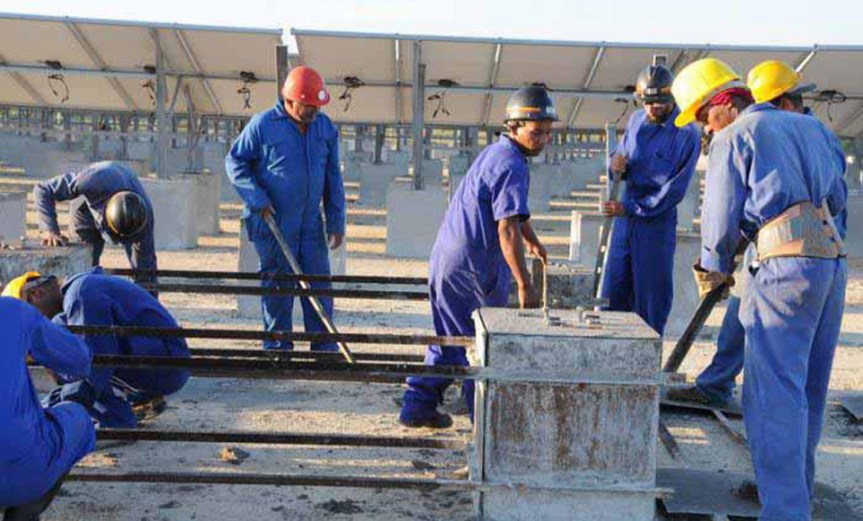
Photo credit: Juan Carlos Dorado

South Paris, Maine


Taking note of International Workers’ Day, several Latin American news sources this year cited José Martí’s 1886 essay “A Terrible Drama;” two of them republished it, here and here.  There Martí reports on events in Chicago in 1886 and the fate of the so-called Haymarket Martyrs – seven labor journalists and agitators railroaded to prison and given death sentences.  Another received a 15-year prison term.

Martí, who would become Cuba’s national hero, was living in exile in the United States. He relates how strikes for the eight-hour day were underway on May 1, 1886 in Chicago and nationwide, how the Chicago police killed one striker and wounded others on May 3, and how a mass protest against police violence took place the next day in the Haymarket area. There, a bomb exploded, seven policemen and four workers were killed, and dozens were wounded. 

The court lacked evidence that the defendants, anarchist by inclination, were involved in the violence of May 4. Martí describes the execution of four of them and the suicide of another. An appeals court judge commuted the sentences of two defendants to life in prison. In 1893, Illinois Governor John Altgeld pardoned those two and the remaining prisoner.

The Socialist International in 1889 declared May Day to be an annual celebration of labor militancy.

José Martí’account, “A Terrible Drama,” is a foundational contribution to the history of the U.S. labor movement. Martí defended working people – U.S. workers in his writings, and Cuban workers in words and deeds, from 1886 on. The combination of author and story points to a connection between U.S. labor activism and workers’ struggles in Cuba. Its time has come.

The U.S. economic blockade of Cuba, lasting decades, has led to shortages, misery, and despair. Nations of the world voting annually in the United Nations General Assembly overwhelmingly condemn the blockade. It violates international law.

Domestic opposition to U.S. policies on Cuba, while persistent, vigorous at times, principled, on-target, and diverse, has fallen short. U.S. government measures aimed at destabilization remain in force.  Upping power of the people with labor combativeness would make a difference.

Unions and labor activists know how to organize and how to confront recalcitrant political and economic leaders. They will be active on Cuba’s side, once they realize that working people’s struggles in the two countries are linked, or so our theory goes. In addition:

·        Labor unionists involved in struggle count on unity, the power of numbers, and sometimes solidarity from counterparts, often from abroad.

·        The current Cuban Revolution is the product of a revolutionary tradition. U.S. workers confronting their own government on Cuba would be expressing solidarity with a revolution whose progenitor, Jose Martí, defended U.S. workers fighting for the eight-hour day.  They would be paying back. 

·        Social revolution and ordinary labor struggles are battles of ideas. The writings of Martí, maximum leader of Cuba’s early revolution, speak to Cuban and U.S. workers alike. In that way they are connected.

Martí wrote about working people and their lives.  He contributed greatly to the ideas and substance of revolutionary struggle in Cuba and also defended African-descended and poverty-stricken Cubans with a seemingly unqualified egalitarianism. For example:

·        “And let us place around the star of our new flag this formula of love triumphant: ‘With all, and for the good of all.’”

·        “A nation having a few wealthy men is not rich, only the one where each of its inhabitants shares a little of the common wealth. In political economy and in good government, distribution is the key to prosperity.”

·        “In Cuba there is no fear whatever of racial conflict. A man is more than white, black, or mulatto. A Cuban is more than mulatto, black, or white … True men, black or white, will treat each other with loyalty and tenderness for the sake of merit alone.”

Workers are oppressed

Responding to the Haymarket affair in his “A Terrible Drama,” Martí reflects upon the situation of U.S. working people:

“The nation is terrified by the increased organization among the lower classes … Therefore the Republic decided … to use a crime born of its own transgressions as much as the fanaticism of the criminal in order to strike terror by holding them up as an example …. Because of its unconscionable cult of wealth, and lacking any of the shackles of tradition, this Republic has fallen into monarchical inequality, injustice, and violence …

“In the recently emerging West … where the same astounding rapidity of growth, accumulating mansions and factories on the one hand, and wretched masses of people on the other, clearly reveals the evil of a system that punishes the most industrious with hunger, the most generous with persecution, the useful father with the misery of his children – there the unhappy working man has been making his voice heard.”

Martí’s “A Terrible Drama” appeared in La Nación newspaper in Buenos Aires in January 1888, some 19 months after the Haymarket events. The delay may have stemmed from Martí’s ambivalence about the anarchist leanings of the accused. Previously published segments of his report do appear under the title “The First of May, 1886” in historian Philip Foner’s anthology of Martí’s writings published in 1977. Excerpts follow:

“Enormous events took place in Chicago, but rebellion exists throughout the nation. In the United States … a firm and active struggle has been in preparation for years … …[T]hings are not right when an honest and intelligent man who has worked tenaciously and humbly all his life does not have at the end of it a loaf of bread … or a dollar put away, or the right to take a tranquil stroll in the sunlight… Things are not right when the one who in the cities … lives a contemplative life of leisure so exasperating to the miner, the stevedore, the switchman, the mechanic, and to every wretched person who must be content with seventy-five cents day, in raw winter weather …Things are not right if shabby women and their pallid children must live in tenement cubicles in foul-smelling neighborhoods. …The reasons are the same. The rapid and evident concentration of public wealth, lands, communication lines, enterprises in the hands of the well-to-do caste that rules and governs has given rise to a rapid concentration of workers. Merely by being gathered together in a formidable community which can, at one stroke, extinguish the fires in the boiler and let the grass grow under the wheels of the machinery, the workers are able successfully to defend their own rights against the arrogance and indifference with which they are regarded by those who derive all their wealth from the products of the labor they abuse.”

Deeds and words

Martí acted on behalf of working people. He organized Cuba’s independence struggle that culminated in war with Spain in early 1895. Under his leadership, the process became a social revolution.

From exile in New York, Martí outlined goals, strategies, and methods. Traveling widely, he arranged for Cuban exiles in the United States, Central America, and the Caribbean – many of them workers, many African-descended – to select the revolution’s leadership, provide funding and supplies, and approve goals and proposals. Martí persuaded the military heads to accept civilian leadership. He created and edited the independence movement’s newspaper Patria.

Aware of U.S. aspirations to dominate Cuba and the entire region, Martí led in confronting U.S. imperialism – never good for workers. In 1891 he wrote “Our America,” an essay demonstrating commonalities among diverse peoples inhabiting all the land extending from the Rio Bravo (the Rio Grande) south to Patagonia. Martí highlighted their shared cultural and political orientations that set them apart from U.S. and European societies.

In a letter to a friend shortly before he was killed in battle on May 19, 1895, Martí insisted that: “It is my duty … to prevent, by the independence of Cuba, the United States from spreading over the West Indies and falling, with that added weight, upon the other lands of Our America.”

Attacking military installations of the Batista regime on July 26, 1953, revolutionaries led by Fidel Castro were honoring José Martí, born 100 years earlier. For Castro, Martí was “the Apostle of Independence … whose ideas inspired the Centennial Generation and today inspire and will continue to inspire all of our people more and more.”

For the sake of justice and in view of connections with Cuban workers, U.S. working people would do well to press upon their government the necessity to end the blockade of Cuba. Labor unions, the principal means for expression of workers’ sentiment and power, have prime responsibility in this regard.

They would be acting as did West Coast dockworkers who blocked arms shipments to Chile under the Pinochet dictatorship, cargo arriving from apartheid-ridden South Africa, and, recently, arms shipments bound for Israel. U.S. unionists actively opposed their government’s support for authoritarian El Salvador in the 1980s and supported Iraqi workers after the U.S. invasion there. They collaborated with Mexican miners and other workers over many years. Recently U.S. unions issued statements and approved resolutions calling for a ceasefire in Gaza.  


W.T. Whitney is a political journalist whose focus is on Latin America, health care, and anti-racism. A Cuba solidarity activist, he formerly worked as a pediatrician, lives in rural Maine. W.T. Whitney Jr. es un periodista político cuyo enfoque está en América Latina, la atención médica y el antirracismo. Activista solidario con Cuba, anteriormente trabajó como pediatra, vive en la zona rural de Maine.

Reactionaries and US Military Backers Prevail in Latin America – for Now / By W. T. Whitney

The commander of U.S. Southern Command, Army Gen. Laura Richardson, and Argentine Armed Forces Joint Command Chief Lt. Gen. Juan Martín Paleo, arrive at the Argentine Ministry of Defense. During her visit April 25-27, Richardson met with leaders, including Vice President Cristina Fernández de Kirchner. Richardson is a repeat visitor to Argentina since the election of right-wing President Milei. | Photo via U.S. Embassy Argentina

South Paris, Maine


U.S. Southern Command Chief Laura Richardson was visiting Argentina for the third time. On April 4 in Ushuaia, Tierra del Fuego – the world’s southernmost city – she and U. S. Ambassador Marc Stanley were received by President Javier Milei, his chief-of-staff, his cabinet chief, the defense minister, the interior minister, a military band, and an honor guard – at midnight.

Richardson announced her government would build an “integrated naval base” in Ushuaia that, close to the Strait of Magellan, looks to Antarctica. Both are strategically important. She “warned about China’s intention to build a multi-purpose port in Rio Grande, [Tierra del Fuego’s capitol city].”

Richardson, the U.S. military’s top leader for the region, had previously noted its attractions. She explained to the House Armed Services Committee in 2022 that Latin American and Caribbean area “accounts for $740 billion in annual trade with the U.S.; contains 60% of the world’s lithium and 31% of the world’s fresh water; has the world’s largest oil reserves” She insisted later that, “This region matters. It has a lot to do with national security, and we have to step up our game.”  

Testifying before a congressional committee on March 14, she remarked that, “The PRC (People’s Republic of China) is America’s pacing threat; countering their aggression and malign influence requires a whole-of-society approach.”

Information from an alleged leak from the U.S. Embassy in Bolivia suggests the U.S. government seeks to isolate non-aligned countries like Colombia, Bolivia, Venezuela and collaborate with “three bastions of U.S. support,” namely Peru, Ecuador and Argentina.

Analyst Sergio Rodríguez Gelfenstein claims U.S. “policies [in the region] are in the hands of the Pentagon … with the  State Department playing a secondary role…. The emphasis is on penetrating extreme rightwing governments.” 

U.S. troops and military advisors collaborate with regional military forces to confront narco-trafficking and other transnational crimes. Stories of good works have propaganda use in gaining support for their presence and for partnership with governments pushing back against popular protests. The survey below shows that U.S. military activities in the region are far-reaching and that long-term objectives and short-term needs are served.

Moving parts

The stated mission of the U.S. military installation in Argentina’s Neuquén province is to respond to humanitarian crises. That a Chinese satellite launch and tracking facility is nearby is no coincidence. The area has immense oil deposits.

U.S. troops based in Misiones, near Argentina’s borders with Brazil and Uruguay, ostensibly deals with narco-trafficking and other cross-border crimes. The U.S. government recently provided credit for Argentina to buy 24 F-16 fighter planes from Denmark.  

The largest U.S. bases in the region are the Guantanamo base in Cuba, with 6100 military and civilian personnel, and the one at Soto Cano in Honduras, with 500 U.S. troops and 500 civilian employees.TheU.S. Naval Medical Research Unit, active in several locations in Peru and overseen by the Southern Command, conducts “health science research” with Peruvian partners. It also serves to “build the capacity of special forces to survive in tropical forests.”

The U.S. Navy patrols South Atlantic waters and conducts joint training exercises with Argentina, Brazil, Chile, Colombia, Ecuador, Peru and Uruguay. The U.S. Coast Guard confronts illegal – read Chinese – fishing off South America’s Pacific coast.

The U.S. Army Corps of Engineers operates in 17 countries, fulltime in eight of them. It advises on river and estuary projects, notably on maintaining commercial flow from the Río de la Platabasin to the Atlantic.  

Ecuador and Peru each agreed recently to accept U.S. troop deployments. Colombia (2009) enabled the U.S. Air Force to utilize seven of its bases. Brazil and the United States (2019) cooperate in launching rockets, spacecraft, and satellites at Brazil’s Alcántara space center. The U.S. military cooperates with Brazil and Chile in conducting defense-related research.

The Southern Command annually holds CENTAM exercises with participation by U.S. National Guard troops and those of several Central American nations. They prepare for humanitarian crises and natural disasters.  The National Guards of 18 U.S. states carry out joint training exercises with the troops of 24 Latin American nations.

The United States supplies 94.9% of Argentina’s weapons, 93.4% of Colombia’s, 90.7% of México’s, and 82.7% of Brazil’s. Bolivia is the outlier, obtaining 66.2 % of its weapons from China.

The U.S. government authorized arms sales to Mexico in 2018 worth $1.3 million, to Argentina in 2022 worth $73 million, to Chile in 2020 worth $634 million, and to Brazil in 2022 worth $4 million.

The Southern Command operates schools for the region’s military and police forces. The Western Hemisphere Institute for Security Cooperation and the School of the Americas, its predecessor from 1946 on, account for almost 100,000 military graduates. The El Salvador-based International Law Enforcement Academy, “purposed to combat transnational crime,” trains police and other security personnel.

The Command in December 2023 undertook joint aerial training exercises with Guyana, where Exxon Mobil is preparing to extract offshore oil from huge deposits in Guyana’s Essequibo province.  Venezuela claims ownership of that area. Venezuelan President Maduro recently accused the U.S. government of establishing secret bases there.  

The story here is of installations and institutions, supply and support systems, and military interrelationships. The complexity of this U.S. undertaking signals fragility. The make-up of allied governments does likewise.

With friends like these

Raised in the United States and buoyed by his family’s great wealth, Ecuadorian president Daniel Noboa is inexperienced. The country faces environmental catastrophe and widespread violence. Indigenous peoples are politically mobilized and security forces cruelly repressive.

Raiding the residence of unelected Peruvian President Dina Boluarte, police on March 29 found jewelry worth $502,700. Establishment politicians appointed her as president after they railroaded progressive President Pedro Castillo, her predecessor, to prison.  Oligarchic rule and occasional dictatorships are customary in Peru, as is indigenous resistance.

Presidential rule in Argentina is bizarre. Eric Calcagno, distinguished sociologist, journalist, and diplomat, told an interviewer recently that President Milei is “asking to be part of NATO, which is the organization that occupied part of our territory, the Malvinas (Falkland Islands).” For Milei, “war is necessary.” The “regime … [is] “the figurehead of local and international monopolies [and] is taking Argentina to the point of no return.”

Argentina is “governed by a gentleman who decides things in consultation with a dead dog, or much worse, with General Richardson of the Southern Command.”  (A news report attributes to Milei devices “allowing him to enter into the spirit of Conan and calm his anxiety.” Conan, a dog, is dead.)

Meanwhile, 800,000 students, workers, unionists, the unemployed, and popular assemblies marched in Buenos Aires on April 23. Joined by 200,000 Argentinians demonstrating elsewhere in the country, they were protesting governmental attacks on public universities.

With popular resistance continuing in Argentina and elsewhere in the region, the precariousness of U.S. military intervention will show. Investigator Jason Hickel points to “imperial arrangement on which Western capitalism has always relied (cheap labor, cheap resources, control over productive capacities, markets on tap).”

He refers to the “Western ruling classes” and the “violence they perpetrate, the instability, the constant wars against a long historical procession of peoples and movements in the global South.” And yet: “[a]fter political decolonization, a wide range of movements and states across the South … sought economic liberation and sovereign industrial development.”

These are national liberation struggles that presumably will continue. Resistance under that banner may someday overwhelm military intrusions like the ones surveyed here.   


W.T. Whitney is a political journalist whose focus is on Latin America, health care, and anti-racism. A Cuba solidarity activist, he formerly worked as a pediatrician, lives in rural Maine. W.T. Whitney Jr. es un periodista político cuyo enfoque está en América Latina, la atención médica y el antirracismo. Activista solidario con Cuba, anteriormente trabajó como pediatra, vive en la zona rural de Maine.

War and Plunder in Eastern Congo and a US Hand / By W. T. Whitney

Congo’s borderlands with Rwanda have become one of the continent’s deadliest conflict zones | Credit: Guardian (UK)

South Paris, Maine


The United States Institute of Peace on February 27 awarded its “Women Building Peace” award to Pétronille Vaweka. She responded: “I weep because at this moment, in … Goma women and children are dying … [and] thousands of families are forced from their villages.”  Goma, population two million, is the capital of North Kivu province in eastern Democratic Republic of Congo (DRC).

For Guardian reporter Owen Jones, the DRC “is the site of the deadliest war since the fall of Adolf Hitler, and yet I doubt most people in the west are even aware of it.” Diminished U.S. and European press coverage of the region’s humanitarian crisis contributed to massive human suffering as, unwatched, lethal violence enabled the wholesale stealing of natural resources.

One million refugees entered eastern DRC from neighboring Ruanda during and after that country’s genocide in 1994. By early 2023 one million newly displaced people had arrived in the Goma region. Within months there would be half a million more. Of the 7.1 million displaced persons in the region now, 97% were displaced due to violent attacks by non-state military forces. The 1.1 million children and 605,000 women who are malnourished exemplify the suffering there.

The UN Refugee Agency describes “targeted attacks against civilians” with “killings, kidnappings, and the burning of homes.” The International Organization for Migration reports that “violence and brutal attacks …  loss of life, mass displacement, and increasing instability” are devastating and that “[a]cross the country, over 26 million people need humanitarian aid.”

War in the eastern DRC has killed six million people over 30 years, according to reporter James Rupert. He indicates that, “More than 250 local and 14 foreign armed groups are fighting for territory, mines or other resources in the DRC’s five easternmost provinces.” Troops fromUganda, Rwanda and Burundi are present. A United Nations peacekeeping contingent will be leaving soon.

The March 23 Movement (M23), formerly troops of the DRC army, figures prominently in the turmoil. This irregular military force, allegedly controlled by Ruanda, occupied Goma in late 2012 and was soon ejected by DRC and UN forces. Having broadened their operations after 2022, M23 detachments regularly execute civilians and force boys and men into their ranks. U.S. press coverage of this brutal war remains skimpy, and the U.S. public is largely uninformed.

The media also steers clear of humanitarian crises associated with war in Sudan and displacement of the Rohingya people from Myanma, in both instances perhaps because U.S. vital interests are not at risk. The U.S. approach toward Sudan apparently is one of watchful waiting, despite reports of growing Russian and Chinese influence and of combatants allying with extremists.

Israel’s war against Palestinians and humanitarian catastrophe in Gaza are different. The U.S. government and weapons manufacturers are unreservedly involved and the media and public pay close attention. Maybe there’s a correlation. As long as war, social catastrophe, and U.S. self-interest play out together, the U.S. public is informed. Drop the U.S. involvement, and they are not.

If that’s a rule, troubles in eastern DRC are an exception. U.S. powerbrokers are strongly attracted to the region, but even so, the U.S. public remains oblivious to the situation. James Rupert explains:

“The DRC is a treasury of minerals …, including an estimated 70 percent of the world’s known cobalt, a vital component of lithium-ion batteries for electric vehicles and other green energy products. …Since 2020, the U.S. Energy and Interior Departments have maintained a list of minerals, currently 50 of them, that they judge vital to America’s economy, energy grid or national defense. Many are difficult to access through reliable supply chains and many, including cobalt, copper, lithium, tantalum, tin and titanium, are mined in the DRC, often from illegal mines controlled by armed groups and smugglers, or in industrial mining that is significantly dominated by China.”

Rupert describes U.S. initiatives aimed at promoting mining in Africa, for example, securing investments for “building a $2.3 billion railroad to carry copper and cobalt from Congo and Zambia to Angola’s seaport of Lobito.”

He blames the multitude of “industrial and artisanal mines” in the DRC for human suffering. Paramilitary groups provide security and “hundreds of thousands … who are effectively enslaved” do the work. Importantly, “more than 250 local and 14 foreign armed groups are fighting for territory, mines or other resources in the DRC’s five easternmost provinces.”

With its cheery message of March 14, 2024, the International Trade Administration of the U.S. Department of Commerce wins points for salesmanship:

“The DRC offers opportunities large and small.  The DRC’s vast mining wealth attracts top mining companies from around the world … [and] is home to globally significant deposits of hard-rock lithium … Energy is another sector with huge potential for renewable energy, including hydropower and solar. The country has the potential to generate over 100,000 MW of hydropower, which is more than half of Africa’s total hydropower potential.”  

Continuing: “Oil and gas discoveries in the east of the country give the DRC the second largest crude oil reserves in Central and Southern Africa … The DRC has the highest agricultural potential in Africa … [and] the potential to feed over 2 billion people with appropriate investment …There are many infrastructure construction opportunities for U.S. companies, with most projects structured as public-private partnerships.” 

This U.S. presentation of opportunities for extraction and expropriation of resources does not explain how to pursue them.  A promotion piece, it is far removed from Pétronille Vaweka’s portrayal of, as she sees it, a system “based on brutal, illegal mining of these minerals from our soils and by people working in conditions of slavery.”

Wide dissemination of this grim news would likely shed light on the dark side of capitalism. Capitalism’s much-vaunted magic of the market and its autonomous mode of operating would turn out to be proxies for a kind of anarchy that, built on greed, assures that anything goes. This is a kind of insight that, for those in charge, is best avoided.    

To limit the flow of news on human suffering is offensive on other grounds.  Doing so violates “the commons,” items such as water, oxygen in the atmosphere, and knowledge that, essential to human living, must be accessible to everyone. The restriction also hits at the revolutionary notion of human solidarity, the idea that someone else’s pain is ours too.


W.T. Whitney is a political journalist whose focus is on Latin America, health care, and anti-racism. A Cuba solidarity activist, he formerly worked as a pediatrician, lives in rural Maine. W.T. Whitney Jr. es un periodista político cuyo enfoque está en América Latina, la atención médica y el antirracismo. Activista solidario con Cuba, anteriormente trabajó como pediatra, vive en la zona rural de Maine.

President Biden Must Remove the Designation of Cuba as Terrorist-Sponsoring Nation / By W. T. Whitney

Via Cuba Solidarity Campaign UK

South Paris, Maine


President Obama in 2015 removed Cuba from the U.S. list of state sponsors of terrorism (SSOT). President Trump reversed that action in January 2020, thereby aggravating economic difficulties for Cuba. President Joe Biden needs to end the designation. The time is now for representatives, senators, and other elected officials to pressure him.

Cuba is no terrorist-sponsoring nation. In accusing Cuba of hosting terrorists, the Trump administration disregarded Cuba’s invitation to Colombian guerrillas to join representatives of Colombia’s government on the island to negotiate peace.

The SSOT designation requires that targeted nations not use dollars in international transactions. The U.S. Treasury Department punishes institutional offenders. Dollars are the world’s dominant currency, and in normal circumstances, banks would use them in transactions involving Cuba. Now, however, foreign lenders steer clear of Cuba. Payments for exported goods and services may not arrive. Cuba is financially paralyzed.

Cubans are suffering. Food is short, as are spare parts, raw materials for domestic production, school and healthcare supplies, spare parts, consumer goods, and cash.  The aim of U.S. policy, as specified by a State Department memo of April 1960, is to cause shortages, despair and suffering serious enough to induce Cubans to overthrow their government.

The labeling of Cuba as a terrorist-sponsoring nation is part of the decades-long U.S. policy of embargo, which is more accurately characterized as an economic blockade, this in recognition of its worldwide reach. Reasons for removing the SSOT designation are the same ones for ending the blockade.

After all, ending the blockade is the Cuba solidarity movement’s prime goal. The campaign to persuade congresspersons to pressure the president to remove Cuba from the SSOT list must refer to the blockade, even as it pursues the more limited goal.

Congresspersons know that, as per the Helms-Burton Law of 1996 congressional action is required for the blockade’s end. They know that current political realities are unfavorable for such action.  Were they to agitate for presidential action on the SSOT matter, they would, in effect, be preparing for a fight against the whole blockade. That’s why it makes sense to use the one rationale to back up each fight.

Ending the blockade (and SSOT designation) has its uses

·        Producers and manufacturers would sell goods in Cuba.

·        With despair and discouragement having diminished, fewer Cubans would be heading to the United States; 425,000 Cuban migrants arrived in 2022 and 2023.

·        U.S. citizens could visit Cuba for recreation, cultural enrichment, and education. Their exposure to Cuban artists, scientists, and educators visiting in the United States would be gratifying.

·        For the blockade to end would disappoint proponents.  They should have been disappointed by the results of the decades-long experiment showing that the blockade did not work. Regime change did not happen. Blockade apologists could reasonably enough move on to something else.

·        An end to the U.S. blockade (and SSOT designation) would gratify nations in the UN General Assembly that annually, and all but unanimously, vote to approve a resolution calling for the blockade’s end. Critics of U.S. interventionist tendencies, wherever they are, would be pleased. The U.S. government would earn some love.

Ideals and values

·        The blockade is cruel. It causes human suffering.

·        It violates international law: “Whatever view is adopted, either that of coercion or aggression, it is quite evident that the imposition of the U.S. economic blockade of Cuba constituted an illegal act … the blockade is a fragrant violation of the contemporary standard which is founded on … sovereign equality between states.” (Paul A. Shneyer and Virginia Barta, The Legality of the U.S. Economic Blockade of Cuba under International Law, 13 Case W. Res. J. Int’l L. 451 (1981)

·        The blockade is immoral. It contributes to sickness and deaths: “By reducing access to medicines and medical supplies from other countries and preventing their purchase from US firms, the embargo contributes to this rise in morbidity and mortality.” (Richard Garfield, DrPH, RN, commenting on Cuba’s “Special Period” of shortages following the fall of the Soviet Bloc – Am. J. Public Health 1997, 877, 15-20.)

·        The blockade exposes certain failings of U.S. democracy. U.S. political leaders remain oblivious to polling data showing strong support for normal U.S.-Cuba relations and for ending the blockade. Leaders of the Cuban exile community have long exerted undue influence in determining U.S. policies toward Cuba. The appearance is that of an important aspect of foreign policy having been farmed out to a strident minority. 

Contradictions

The U.S. government claims the blockade serves as punishment of Cuba for allegedly violating human rights. But the United States has easily co-existed with governments famous for disregarding human rights, like Nicaragua’s Somoza regime, Chile under Pinochet, Haiti ruled by the Duvaliers, and the Kingdom of Saudi Arabia.

U.S. policymakers see Cuba as a Communist dictatorship and, on that account, as deserving of economic blockade. Even so, the United States trades with Vietnam and China, where Communist parties are in power.

Vice President Joe Biden presumably backed President Obama’s action in removing Cuba from the SSOT list. Contradicting himself, he refuses to reverse former President Trump’s placement of Cuba back on the list.

Contradictions point to Cuba as special case in the history of U.S. relations with other countries. Only Cubans find an open door on arrival in the United States as irregular migrants. Such red-carpet treatment stands alone in the record of how the U.S. government handles immigration. 

The Cuban Adjustment Act of 1966 ensured that Cubans arriving in the United States without documents would at once receive social services and a work permit and a year later be granted permanent residence and the opportunity for citizenship.

The fact of U.S. hegemonic intent and actions regarding Cuba for 200 years must be extraordinary in the history of international relations. From Thomas Jefferson’s time until the 20th century, leaders in Washington sought to own or annex Cuba. They would later on find other modalities.

U.S.- Cuba relations have long been on automatic pilot. Pursuing justice and fairness, elected officials in Washington would be moving beyond that history. They would go against the grain as they pressure a U.S. president to no longer designate Cuba as a state sponsor of terrorism. Persevering, they would fight to relieve Cuba of all U.S. harassment.


W.T. Whitney is a political journalist whose focus is on Latin America, health care, and anti-racism. A Cuba solidarity activist, he formerly worked as a pediatrician, lives in rural Maine. W.T. Whitney Jr. es un periodista político cuyo enfoque está en América Latina, la atención médica y el antirracismo. Activista solidario con Cuba, anteriormente trabajó como pediatra, vive en la zona rural de Maine.

In Distress, Niger Expels US Military, Resurrects Hope / By W. T. Whitney

Supporters of Niger’s governing military council, gather for a protest called to fight for the country’s freedom and push back against foreign interference, in Niamey, Niger, Aug. 3, 2023. A top Pentagon official says that the U.S. has not yet received a formal request from Niger’s rulers to depart the country. | Sam Mednick / AP

Reposted from the People’s World


On March 16, Amadou Abdramane, spokesperson for Niger’s governing military council, announced that Niger was dropping its 12-year-old military-cooperation agreement with the United States. Niger’s military council had assumed power following the coup in July, 2023 that removed Mohamed Bazoum, the elected president.

U.S. military intervention in Niger is now a poor fit with grim realities in the western Sahel region of Africa and with the Nigerien people’s needs and aspirations.

The U.S. military presence there co-exists with danger posed by Islamic extremist military groups. These expanded after 2011 when NATO destroyed the Libyan government, a stabilizing force in the region. Niger faces a humanitarian crisis worsened by environmental disaster. The military council is seeking alternative arrangements for security cooperation and looking to China for help with societal development.

Abdramane denounced “the attitude of the [recently visiting] U.S. delegation in denying the sovereign right of Niger’s people to choose partners and allies capable of really helping them fight terrorism.” General Michael Langley, delegation member and head of the U.S. Africa Command (AFRICOM), “expressed concerns” that Niger was pursuing close ties with Russia and Iran.

AFRICOM, headquartered in Stuttgart, Germany, operates 20 bases in Africa. The two largest are air bases in Djibouti, in East Africa, and Agadez, in central Niger. Niger hosts two other U.S. bases, an airbase nearNiamey, the capital city, and a CIA base in the northeast.

According to a report, the Agadez base cost $110 million to build and costs $30 million annually to maintain. It is “the largest Air Force-led construction project in history.” By means of these two large bases, the United States conducts air war, with drones, over a significant portion of the earth’s surface.

In moving to end U.S. military involvement, the coup government had backing “from the trade unions and the protest movement against French presence.”  The new government had already pressured France, Niger’s colonizer, to remove its military units from the country; the last of them departed in January, 2024. Coup governments in Mali and Burkina Faso expelled French troops in February 2022 and February 2023, respectively.

Also in January 2024, the three countries abandoned the Economic Community of West African States (ECOWAS). France had led in forming this trade bloc in 1975; it would include 15 African nations. Critics cited by the BBC claim that France, through ECOWAS, was able to “meddle … in the politics and economics of its former territories after independence.”

The French government failed in an attempt to mobilize an ECOWAS military force to punish Niger for leaving the trade bloc. Mali, Burkina Faso, and Niger reacted by forming their Alliance of Sahel States. They “are exploring alternative security relations, including with Russia.” Niger also looks to Iran for security assistance.  

Investigator Nick Turse points to U.S. failures to explain why Niger is looking elsewhere for military assistance. He documents the vast number of deaths in the western Sahel region at the hands of extremist Islamist groups over the course of 20 years. The killings skyrocketed despite the U.S. military presence in Niger.

Niger may have given up on the United States also on considering that U.S. and NATO military action in Libya in 2011 contributed to worsening living conditions in the region now. A commentator notes that, “The toppling of Gaddafi created a power vacuum that fostered civil war and terrorist infiltration, with disastrous regional ramifications.”

Additionally, in a Niger unable on its own to adequately fulfill human needs, U.S. focus on military advantage without attention to human suffering would have been disheartening. The scale of suffering is the Sahel region is immense, as evidenced by diminished food production and migration, with climate-change contributing to both.

The International Rescue Committee reports that, “The Central Sahel region of Africa, which includes Burkina FasoMali and Niger, is facing an unprecedented humanitarian crisis. Over 16 million people need assistance and protection, marking a 172 percent increase from 2016.”

China responded and Washington officials are perturbed. A report from Mali indicates that, “In Niger, the main areas of [Chinese] investment are energy ($5.12 million); mining ($620 million) and real estate ($140 million), other aspects of cooperation include: the construction of stadiums and schools, medical missions, military cooperation, infrastructure (roads, bridges, rolling stock, thermal power plants).”

A “Nigerien security analyst” told investigator Nick Turse that “the trappings of paternalism and neocolonialism” have marred Niger’s military-cooperation agreement with the United States. 

Expanding upon these polite words while commenting on Niger’s current situation, Casablanca academician Alex Anfruns observes that, “international capitalism has destroyed the hopes of entire generations of Africans while inflicting its policies like a thug with white gloves. Actors like the International Monetary Fund and World Bank are complicit as key functionaries of the neocolonial system.”

U.S. policy-makers, enablers of world capitalism, look longingly at Africa. Africa claims “98% of the world’s chromium, 90% of its cobalt, 90% of its platinum, 70% of its coltan, 70% of its tantalite, 64% of its manganese, 50% of its gold, and 33% of its uranium.” Even more: “The continent holds 30% of all mineral reserves, 12% of known oil reserves, 8% of known natural gas, and 65% of the world’s arable land.”

Alex Anfruns sees hope: the leaders of Niger, Mali, and Burkina Faso,  with their Alliance of Sahel States, “have sent a powerful message of solidarity to millions of Africans who share a vision and an emancipatory project, that of pan-African unity.” Indeed, “From now on neither the United States or France under the flag of NATO can destroy an isolated African country, as happened in Libya in 2011.” 

Burkina Faso president Thomas Sankara expressed a far-ranging kind of hope in 1984, at the United Nations: “We refuse simple survival. We want to ease the pressures, to free our countryside from medieval stagnation or regression. We want to democratize our society, to open up our minds to a universe of collective responsibility.”


We hope you appreciated this article. At People’s World, we believe news and information should be free and accessible to all, but we need your help. Our journalism is free of corporate influence and paywalls because we are totally reader-supported. Only you, our readers and supporters, make this possible. If you enjoy reading People’s World and the stories we bring you, please support our work by donating or becoming a monthly sustainer today. Thank you!


W.T. Whitney Jr. is a political journalist whose focus is on Latin America, health care, and anti-racism. A Cuba solidarity activist, he formerly worked as a pediatrician, lives in rural Maine. W.T. Whitney Jr. es un periodista político cuyo enfoque está en América Latina, la atención médica y el antirracismo. Activista solidario con Cuba, anteriormente trabajó como pediatra, vive en la zona rural de Maine.
U.S. policy implicated in the economic crisis driving Cuban protests / by W.T. Whitney Jr.

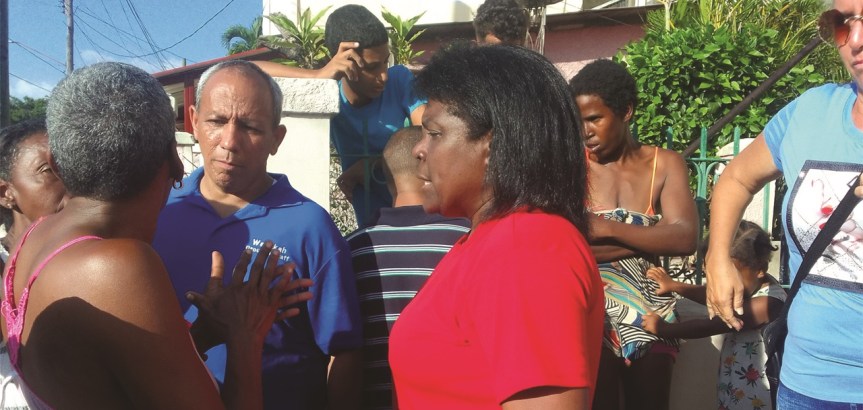
Beatriz Johnson Urrutia (center), the First Secretary of the Provincial Committee of the Communist Party in Santiago de Cuba, speaks directly with people demonstrating against food and electricity shortages on Sunday. | Photo via Juventud Rebelde

Reposted from the People’s World


This report takes advantage of the cogent observations (see below) of Professor Isaac Saney, former co-chairperson of the Canadian Network on Cuba and Coordinator at Dalhousie University for Black and African Diaspora Studies.

Hundreds of Cubans demonstrated peacefully in Santiago de Cuba and other cities across the island on March 17. Portrayed in some U.S. corporate media outlets as “anti-government” protests, the demonstrations were focused on electrical power outages and food shortages.

The protests were reacting to an accumulation of great economic difficulties that have assaulted Cubans and their government alike for decades.

Cuba is in the midst of a sharp economic crisis. Surging inflation is battering the economy, which shrank by almost 2% last year. Fuel prices rose by more than 500% just this month, while electricity rates climbed 25%.

Exports for 2023 were far below predictions, food production was less than 2022, and tourism income has only recovered to 69% of pre-COVID levels. Shortages of fuel and other supplies—largely because of the U.S. blockade—continues to hamper production in most sectors.

The dire circumstances are driving a mass exodus of Cubans; 425,000 migrants arrived in the United States in 2022 and 2023. Among those leaving are 9% of Cuba’s healthcare workers and thousands of educators. These departures have further aggravated the economic situation.

Responding to the Sunday demonstrations, Cuban President Miguel Díaz-Canel pointed out on social media that “enemies of the Revolution are trying to take advantage of a context [of shortages] for destabilizing purposes.” He noted, “In the last hours we have seen how terrorists based in the United States…are encouraging actions against the country’s internal order.”

On March 18, Cuba’s Foreign Ministry summoned U.S. chargé d’affaires Benjamin Ziff—there’s been no U.S. ambassador to Cuba since 1960—where he received a formal note of protest that referred to “interventionist behavior and slanderous messaging by the U.S. government and its embassy.”

While communicating the urgency of the situation, Díaz-Canel explained that his government’s approach would be “to attend to the complaints of our people, listen, dialogue, explain the numerous efforts that are being carried out to improve the situation, always in an atmosphere of tranquility and peace.”

In this screenshot from video circulating on social media, Cubans in the city of Santiago de Cuba protest food and electricity shortages on Sunday. | via X

The predicament for Cuba is evolving. It’s apparent that upcoming reactions from Cuba’s government, the international solidarity community, and by Cubans themselves will unfold according to economic and historical imperatives that are by no means new.

For insight, we turn to Isaac Saney’s analysis that was released on March 18. Excerpts follow:

Recent events in Cuba illustrate how intense the imperial pressures on the island nation are. It always bears underscoring that every effort to defy imperialism’s dictate and build a new society has faced unrelenting Western destabilization and sabotage: from the Haitian Revolution to numerous African, Asian, and Latin American national liberation projects. …

There is no doubt that Washington will spare no efforts to manipulate the current situation in Cuba through the use of various social media and digital platforms in order to further destabilize the situation. Moreover, it was recently revealed that U.S. intelligence agencies have been directly intervening in the Cuban economy to artificially inflate prices, stimulate inflation, and cause greater shortages of already scarce goods.

Cuba has faced—and is facing—the longest economic siege in history from the most powerful military and economic imperial power that has ever existed. Like the Haitian Revolution, the Cuban Revolution is the unforgivable example that must be destroyed. Washington’s overarching strategy aims at denying and eradicating Cuba’s right to self-determination, sovereignty, and independence.

The empire has never accepted the verdict of the Cuban people. It has waged an unceasing economic war and campaign of destabilization aimed at restoring U.S. imperialism’s domination and tutelage.

Cuba has repeatedly repelled the unceasing all-sided, military, economic, financial, and propagandistic assault by U.S imperialism.

Since the triumph of the Cuban Revolution in 1959, the United States has relentlessly pursued an ongoing assault on the Cuban people, employing both military and economic, including orchestrating invasions, assassinations, and terrorist attacks against civilians, as well as engaging in systematic economic sabotage. …

The sinister goal is to coerce the Cuban people into submission by strangling the economy, creating shortages, hardships, and exacerbating social inequalities—the very issues the Cuban Revolution has tirelessly worked to eliminate. This strategy seeks to instigate massive social unrest that would then serve as a pretext for U.S. intervention.

…The U.S. economic war against Cuba extends beyond U.S. borders, affecting businesses from other countries engaged in or seeking trade with Cuba. It stands as the primary impediment to Cuba’s social and economic progress, representing a blatant violation of the human rights of the Cuban people, costing the island nation more than $1 trillion U.S., underscoring its profound and detrimental effects.

A poignant testament on the criminality and immorality of the U.S. economic blockade was the Nov. 2, 2023, United Nations vote, when for the 31st time—with a vote of 187 to 2—the international community resoundingly rejected and condemned Washington’s economic war against Cuba.

Cuba faces significant—and what, for many, may seem overwhelming—challenges. However, the Cuban people have repeatedly shown themselves capable of meeting the challenges they take up.


We hope you appreciated this article. At People’s World, we believe news and information should be free and accessible to all, but we need your help. Our journalism is free of corporate influence and paywalls because we are totally reader-supported. Only you, our readers and supporters, make this possible. If you enjoy reading People’s World and the stories we bring you, please support our work by donating or becoming a monthly sustainer today. Thank you!


W.T. Whitney Jr. is a political journalist whose focus is on Latin America, health care, and anti-racism. A Cuba solidarity activist, he formerly worked as a pediatrician, lives in rural Maine. W.T. Whitney Jr. es un periodista político cuyo enfoque está en América Latina, la atención médica y el antirracismo. Activista solidario con Cuba, anteriormente trabajó como pediatra, vive en la zona rural de Maine.

U.S. migration policy change eases border rules but hurts Cuba / by W. T. Whitney Jr.

Migrants line up for processing in Eagle Pass, Texas. President Biden’s immigration policy allows a limited number of Cubans to enter the U.S. on so-called “humanitarian” grounds. The real aim is to hurt Cuba by decreasing its population of skilled workers. | Eric Gay/AP

Reposted from the People’s World


Undocumented Migrants crossing into the United States disturb U.S. politics. Cuban migrants, part of the mix, hard-pressed like the others, but privileged, are provocative in their own way.

For many years and even now displaced Cubans are portrayed as victims of a brutal dictatorship and as recipients of “rescue” by freedom-loving Americans. Cubans who have special skills are often lured out of the country with promises of “the good life” in the U.S. and with the intent of hurting Cuba as it loses people with skills needed their at home.

Changing U.S. regulations and new migration patterns highlight the anomaly of special U.S. dispensation for migrating Cubans.

U.S. district judge Drew Tipton on March 8 ruled that migrants from Cuba, Venezuela, Nicaragua, and Haiti may enter the United States via humanitarian parole. The plaintiffs had been 21 Republican-governed states that had unsuccessfully claimed that immigrants enabled by humanitarian parole required services they could not pay for.

Under humanitarian parole, a program the Biden administration announced on January 6, 2023, migrants entering from those four countries are assured of legal residence for two years – renewable at that point – and a work permit.

Humanitarian parole is limited to 30,000 immigrants arriving every month from the four countries. Migrants need sponsors in the United States.

Instituted under the Immigration and Nationality Act of 1952, the program allowed entry into the United States of refugees from the former Soviet Union, Afghanistan, Ukraine, and other countries. This time, 138,000 Haitians, 86,000 Venezuelans, 58,000 Nicaraguans, and 74,000 Cubans – a total 357,000 migrants –entered via humanitarian parole as of February, 2024.

The would-be migrants from the four countries travel by air to ports of entry inside the United States, pass quickly through immigration screening, and proceed to new homes. Before leaving their home country or a third country, they had found sponsors, presented documentation to U.S. immigration officials, and been approved– all via the Internet.

An analyst claims that, “Combined with the other parole process at the U.S.-Mexican border …, parole has transformed most migration from [the four] countries from mostly illegal to mostly legal in less than a year.” And, “This policy has transformed migration to the United States. By July 2023, parole had already redirected about 316,000 people away from long, perilous treks through Mexico.”

The Biden administration adopted the parole system in part because of difficulties associated with repatriating migrants from the four countries. They stemmed from a U.S. lack of full diplomatic relations and repatriation agreements with those countries. Normal relations with Mexico and the northern Central American countries allow for more convenient U.S. handling of refugees from those countries.

Humanitarian parole came into effect after the administration’s repeal of Title 42, its role having been to exclude migrants because of health risk. Many migrants saw an opening and attempted a border crossing. But many of those from the four countries opted for humanitarian parole.

Scoring political points

By diverting migrants to other locations and relieving pressures along the southern border, the administration might have scored political points, had not administrative delays with humanitarian parole led to big backlogs of migrants waiting to enter.

Cuban migrants to the United States are a special case. Immigration officials on the southern border have long used an “Order of Release on Recognizance,” the so-called “Form I-220A,” to release border-crossers from custody.  Officials dealing with Cubans being released ended up accommodating Form I-22A with the objectives of the Cuban Adjustment Act (CAA).

The aim of that legislation passed in 1966 was to legalize the already large population of Cubans who had arrived in the United States after Cuba’s Revolution in 1959 and the many who would follow, all presumed to be enemies of the Revolution. The CAA enables newly arrived Cubans immediately to receive social services and a work permit and, after a year, to be granted permanent-resident status, a pathway to citizenship.

No other migrant from any other country is so favored. The displaced Cubans are portrayed as victims of a brutal dictatorship, and the U.S. government and people as their rescuer.

To apply the CAA to the fate of those Cuban migrants released from custody according to Form I-220A is now off limits, as per a ruling by a U.S. immigration court in September 2023. But now they can make use of humanitarian parole.

Curiously, the governments of three of the countries whose migrants benefit from humanitarian parole – Cuba, Venezuela, and Nicaragua – are socialist in nature, and the U.S. government regularly harasses them.

Humanitarian parole entices migrants to the extent that great numbers of citizens depart for the United States. As a result, the human resources of Cuba and the other countries are depleted so much so as to impinge upon the countries’ future development.

The U.S. government with its humanitarian-parole policy, at the very least, has stumbled upon a tool that contributes to destabilizing three governments that variably represent the threat of a good example – Cuba’s government more than the others.

The 425.000 Cuban migrants who arrived in the United States in 2022 and 2023 constituted the greatest exodus since the one following the victory of the Revolution in 1959. Factors pushing Cubans to emigrate are low pay, inflation, and shortages of food, electrical power, medical supplies and drugs. These factors reflect the impact of the U.S. economic blockade, as aggravated by effects of the COVID pandemic and declining tourist income.

Emblematic of the great challenges to Cuba’s future development are the nine percent of  Cuba’s healthcare workers who departed in 2021 and 2022, and the loss of teachers at all levels of education – 17,278 posts being unfilled in October 2023.

Speaking at a multi-national meeting on migration taking place in Chiapas, Mexico in October, 2023, Cuban president Miguel Díaz-Canel declared that, “The hostile policy of the United States is what stimulates the potential of Cuban migration in a very significant way.” U.S. hostility is expressed, he indicated, primarily through “the economic blockade that, reinforced in recent years in a criminal manner, … is by definition aimed at depressing the standard of living of the Cuban population.”

He might have mentioned U.S. economic and political interventions in most of the region’s countries that leave their governments unable to serve and protect their people; their option is to leave home and head north.


We hope you appreciated this article. At People’s World, we believe news and information should be free and accessible to all, but we need your help. Our journalism is free of corporate influence and paywalls because we are totally reader-supported. Only you, our readers and supporters, make this possible. If you enjoy reading People’s World and the stories we bring you, please support our work by donating or becoming a monthly sustainer today. Thank you!


W.T. Whitney Jr. is a political journalist whose focus is on Latin America, health care, and anti-racism. A Cuba solidarity activist, he formerly worked as a pediatrician, lives in rural Maine. W.T. Whitney Jr. es un periodista político cuyo enfoque está en América Latina, la atención médica y el antirracismo. Activista solidario con Cuba, anteriormente trabajó como pediatra, vive en la zona rural de Maine.

Enlightened Working People Expect a Lot from Their Political Party: Reply to Brooks / by W.T. Whitney Jr.

Photo via CPUSA

South Paris, Maine


White working-class voters who recently switched to the Republicans have not yet returned to the Democratic Party. They should do that, New York Times columnist David Brooks points out. After all, the Biden administration has “pursued an ambitious agenda to support the working class … [and] economic results have been fantastic.”

He outlines a divide between Republican voters, who mostly lack college degrees and may live in rural areas and small towns, and Democrats, whom he reports as being urban-based, college-educated, and snobby. He mentions a “seismic political realignment,” which “is more about culture and identity than it is about economics.”

Brooks suggests that, if the Biden administration matched the commitment shown by the New Deal, a Democratic Party legacy, many former Democrats voting Republican would return home. Those less attentive to working-class interests and more susceptible to demagoguery and myth-making would presumably remain where they are.

Brooks doesn’t explain why cultural phenomena and the political use of people’s identity led to voters moving to another party. These played out in a way that encouraged a kind of politics that overwhelmed political undertakings crucial to various sectors of the working class.

The object here is to examine some of these political projects and thereby identify certain causes that are off limits to working people who vote Republican. Whether they are compelling enough to persuade errant Democrats to return to the fold is uncertain. So too is the Biden Administration’s dedication to pursuing such struggles.

In any case aspirations inspiring the kinds of activism described below are not far removed from urgings toward a coherent and consistent working-people’s political movement or political party.

Culture and its variations

Brooks’s use of the term “culture” seemingly embraces religious beliefs, persisting racial prejudice, views on abortion and gender nonconformity, rural distrust of city life, and support for gun ownership.

Working-class history is about another kind of culture. The French and American Revolutions of the late 18th century left behind a culture of democracy. It involved popular elections, expanded legislative power, and guarantees of political rights. Royalty and feudal remnants mostly disappeared. Political newspapers and public debate flourished.    

Some of the founders thought George Washington ought to be king. Fearful of democracy, they provided for indirect presidential and Senate elections, gave big and little states equal representation in the Senate and Electoral College, counted enslaved people as three-fifths of a person, and denied women the vote.

Democratic malaise manifests now as: disappearing consensus that elections decide who becomes president, gerrymandered congressional districts, elections given over to money-power, and the Electoral College’s disregard of the idea of one person-one vote.

But democratic forces return. Even as the Constitution took effect, struggling farmers and backwoodsmen rebelled against wealthy politicians in charge of new state governments. Agitation for democracy would resurface in fights for women’s suffrage, voting for the racially excluded and propertyless, economic justice for small farmers (in the progressive era), better wages and working conditions, and civil rights – and fights also to abolish corporate monopolies, slavery, child labor, and police violence.

Working people, socialists included, have long defended democracy. Socialists have realized that the democratic rights achieved by early revolutionists enabled struggles later on for social and economic change.

Presently, working-class voters allied to the Democratic Party most certainly prioritize renewed struggle for democratic guarantees aimed at shoring up a U.S. democracy in trouble.

Hazards of identity politics

Brooks doesn’t explore exactly how misuse of people’s identity disturbs U.S. politics. He implies that working people are somehow hurt.

The identity of being a woman often leads to trouble. Their political struggles have provoked anti-women biases and stereotypes. The origins and evolution of these are so nebulous as to not provide a basis for criticism that would actually end them. They recur, as with current fight over abortion. No end is in sight.

There is another way. Many women struggle now to overcome remnants of the dependency and obligation visited upon them at the beginning of industrialization. It’s an unfinished battle.

Men, and even women and children, were working in the new factories as independent contractors. The state and employers were oblivious to their domestic circumstances. Families were on their own to raise children, find and prepare food, and seek protection. Women were the ones who were responsible.

Factory owners and other capitalists even now regard women’s work at home as a “free gift.” Although less onerous, women’s state of dependency verging on oppression remains.

The manufacturing and service industries today cannot do without women’s work; it has long served them well in quality and quantity. That factor, and women’s struggle too, have induced power-brokers reluctantly to attend to women’s collective demands for fairness and basic equality. Women’s fight continues, but on the basis of realities in their lives, not on their identity.

As women and their families gain access to the social and economic resources needed for preparing new generations, women work toward a new independence freeing them from governmental intrusions in their private affairs, notably their freedom to choose an abortion.

Racial identity

The idea of affirmative action was to open up access to higher education and jobs for previously excluded persons. Racial and gender identity has been the marker of such exclusion. That’s what admissions officers and employers pay attention to. 

The process of expanding admissions to colleges and universities is unfair. Large numbers of U.S. young people eligible for affirmative action through their racial identity can’t aspire towards higher education. Their families are poor and vulnerable to social catastrophe. Their schools likely are inadequate. 

The families of most students benefiting from affirmative action have economic resources. Those students usually have originated from the middle and upper strata of the various minority groupings.  Most have attended good schools. They thrived from encouragement and high expectations at home.

A fix is at hand in the form of economic security for all, better schools, and universal availability of decent jobs. Capable young people of the working class would understand that they are due high-quality education from start to finish. It would be a kind of affirmative action that leads to hope and overcomes division.

David Brooks credits the Biden administration for creating new jobs, including jobs for workers without a college degree. Wondering why working-class people don’t return to the Democrats, he could have produced a more direct answer than one based on speculation about effects of culture and identity. 

Working people’s needs other than jobs go unrecognized. Brooks might have mentioned good schools, healthcare for all, housing for all, and guaranteed income. He would then have been entering territory of the unspeakable, which is redistribution of wealth.


W.T. Whitney Jr. is a political journalist whose focus is on Latin America, health care, and anti-racism. A Cuba solidarity activist, he formerly worked as a pediatrician, lives in rural Maine. W.T. Whitney Jr. es un periodista político cuyo enfoque está en América Latina, la atención médica y el antirracismo. Activista solidario con Cuba, anteriormente trabajó como pediatra, vive en la zona rural de Maine.

Maine Activists Meet with Cuban Ambassador in South Portland / W.T. Whitney Jr.

Chargé d’Affaires Lianys Torres Rivera, Ambassador of Cuba | Credit: July 26.org

South Paris, Maine


Word came to the Let Cuba Live Committee of Maine that Cuba’s ambassador to the United States, Lianys Torres Rivera, would be in Portland on other business and wanted to meet with Mainers working for decent U.S. relations with Cuba.

Accordingly, on February 13, in the evening, 40 or so activists from throughout Maine gathered at the hall of Teamsters Local 340 in South Portland to dialogue with the ambassador. Ms. Torres Rivera previously served as Cuba’s ambassador in Vietnam.

She began with a brief survey of Cuba’s current situation, emphasizing that while the country’s economic situation is very difficult, her government’s priorities are unchanged. All citizens’ basic needs are being met, education and healthcare receive maximum support, and Cuba’s solidarity extends throughout the world, to the Global South in particular.

Citing Cuba’s great need for economic development, the ambassador critiqued the U.S. economic blockade as causing shortages that affect every aspect of life in Cuba. She mentioned the false U.S. designation of Cuba as a terrorist-sponsoring nation. That’s the mechanism the U.S. government uses to block the flow of money to Cuba from international financial institutions.

She and her audience agreed that President Biden could remove that misplaced label “with the stoke of a pen.” 

Questions and answers occupied most of the session with Ms. Torres Rivera.  Questions touched on: education in Cuba, increased Cuban migration to the United States, Cuban medical solidarity with the rest of the world, visits of U.S. delegations to Cuba, and U.S. promotion of social media as a device for broadcasting U.S. anti-Cuba propaganda.  

In a comment that particularly resonated with her listeners, Torres Rivera recalled that it was through Cuba’s revolution that she, a daughter of a poor farming family, gained an education preparing her to be an ambassador.

Two members of the Portland City Council were on hand. Great enthusiasm was evident as discussion turned to the prospect of the Portland Council joining other city councils in the United States in passing a resolution condemning the U.S. economic blockade of Cuba.

Facilitating the meeting was Barbara West of Let Cuba Live. Other organizations represented at the encounter were Maine Veterans for Peace, Peace Action Maine, a couple of labor unions, Women’s International League for Peace and Freedom, Democratic Socialists of America, and the Communist Party of Maine – that had made arrangements for the meeting.

To conclude: Anyone wanting to work toward ending the U.S. blockade of Cuba and/or learn more about Cuba might contact Let Cuba Live. Call Barbara at (207) 841-2917 or Tom at (207) 743-2183.


W.T. Whitney Jr. is a political journalist whose focus is on Latin America, health care, and anti-racism. A Cuba solidarity activist, he formerly worked as a pediatrician, lives in rural Maine. W.T. Whitney Jr. es un periodista político cuyo enfoque está en América Latina, la atención médica y el antirracismo. Activista solidario con Cuba, anteriormente trabajó como pediatra, vive en la zona rural de Maine.
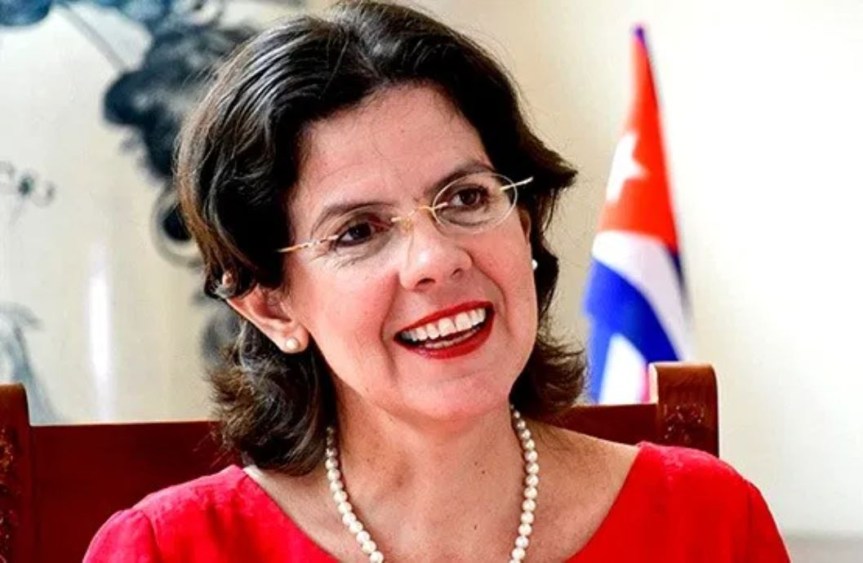
Anti-Petro Coup Imperils Historic Pact Government in Colombia / by W.T. Whitney Jr.

Colombians protest outside the Attorney General’s Office in Bogota, Feb. 8, 2024. | Photo: X/ @hugomilenio

South Paris, Maine


President Gustavo Petro, head of the left-leaning Historic Pact coalition, took office on August 8, 2022. He is Colombia’s most progressive president ever. Now he faces a coup. The fate of Petro’s government connects with prospects for peace in Colombia

On social media Petro indicated that, “Unions have been raided and witnesses have been tortured and otherwise pressured so as to accuse the president (himself)  …  Narcotrafficking sectors, perpetrators of crimes against humanity, corrupt politicians and sections of the attorney general’s office are desperately looking to remove him from … office.”  

The lead coup-plotters have been former Attorney General Francisco Barbosa and Vice-Attorney General Martha Mancera, hold-overs from previous administrations.  Peculiarities of Colombian governmental arrangements have officials installed in the top levels of government whom the president did not select and does not control.  

Barbosa is the public face of the opposition. He ended his four-year term of office on February 12. The Supreme Court of Justice, charged with replacing him, failed to choose one of the three candidates Petro offered for the post. The Court named Mancera as temporary attorney general.

According to one commentator, Mancera has long had actual charge of the attorney general’s office; Francisco Barbosa was “a façade.” She is accused of protecting corrupt officials and drug traffickers.

Provocateur

Barbosa charged the Colombian Federation of Educators with illegally providing Petro’s presidential campaign with funds amounting to the equivalent of $128,000. Searching for evidence on January 22, his agents trashed the union’s headquarters.

Barbosa announced December 1, 2023 he would detain young people whom Petro had released from prison, praising their dedication to peace.  The release would occur long after they had been jailed originally following participation in protest rallies in mid-2021.

Barbosa in January visited the Justice Department in Washington. He reported on “his stewardship [as attorney general] and sought U.S. support for Martha Mancera to become Colombia’s new attorney-general.”

Inspector general Margarita Cabello on February 2 ordered a three-month suspension of Chancellor Álvaro Leyva Duran. His ministry, she charged, had illegally contracted the preparation of passports to a new company. A defender claimed he was breaking a monopoly in passport preparation held by an “old Bogota family.”

In street demonstrations taking place throughout Colombia on February 8, unionists, students, and teachers demanded that the Supreme Court name a Petro nominee as Colombia’s new attorney general.

Military intelligence reports revealed plans for expanded use of social media to broadcast news of destabilizing activities. Reserve and retired army officers, a powerful sector, have held anti-government protests.

Commentators liken Colombia’s evolving coup to the other “soft coups,” or exercise of “lawfare,” that removed Paraguayan President Fernando Lugo (2012), Brazilian President Dilma Rousseff (2016), Bolivian President Evo Morales (2019), and Peruvian President Pedro Castillo (2023).

Distant dream

For the Petro government to disappear would deliver a major blow to Colombians who for decades have sought and struggled for peace in their country. Petro had campaigned for “total peace.” It was a signature cause for him.

The signing of a Peace Agreement between the Revolutionary Armed Forces of Colombia (FARC) and the Colombian government in 2014 came close to satisfying the longings of peace advocates. From then on, however, it was downhill. In that very year, rightwing political forces engineered a watered-down version of the Agreement reached months earlier. Subsequently, the governments of Presidents Juan Manuel Santos and Iván Duque, Petro’s predecessor as president, failed to implement crucial parts of the Agreement.  

Beginning in 2015, 419 former FARC combatants and 1596 social and community leaders have been assassinated – 188 of them in 2023, while Petro was president.  Continuing armed conflict has led to 154 instances of “massive forced displacement” affecting 56,665 persons.

Dissident FARC groups, the National Army of Liberation, and paramilitaries – often in the service of narco-traffickers – account for most of the killings and turmoil.  The current government is negotiating with the remaining insurgencies.

Information from the historical record, recent and remote, suggests that causative factors accounting for violent conflict and the incipient coup are identical.

September 26, 2016 saw a revealing moment. The Peace Agreement was being signed in Cartegena, Colombia. “Timochenko,” the FARC leader, was speaking to notables assembled from several continents. At precisely that point, fighter planes of the Colombian Air Force zoomed by overhead. As noted by an observer: “The face of ‘Timo’ gave the impression of being under a bombardment.” 

Colombia’s U.S.-supported military was weighing in. The nation’s military forces have long been at the disposal of the established sectors of Colombian society. A well-to-do landowning, religious, and commercial elite has charge of Colombia, now and ever since the Europeans’ arrival. That sector is not happy with either Petro or with peace in the countryside.

Analyst Carlos Rangel Cárdenas sees Petro’s “total peace” as “constructing peace by involving civil society in binding dialogues.” He points out that violence in the countryside increased so much during the presidency of Iván Duque as to approach the excesses of earlier eras.  Dialogues do not thrive in conditions of war, presumably. The coup plotters and their soulmates who tolerate war in the countryside are linked.

An urban-based oligarchy, with cooperation from big landowners, controls the financial, commercial, business and media entities in Colombia that shepherd economic development in rural areas. The heavy hitters there, economically, are industrial-scale agriculture, mining operations, energy production, and narcotrafficking. These activities attract investment and enable wealth accumulation.

Colombia’s majority population is different. They are marginalized urban inhabitants, often refugees from an inhospitable countryside.  They are rural people, overwhelmingly poverty-stricken and poorly-educated, who, most of them, have limited access to social services and to land that would allow for subsistence farming.

Defenders of the Historic Pact government confront a set of rulers equipped with money power, a big army, ample police, and ready access to U.S. military resources. They have been on the losing side of struggle between one social class and another. They are quite unable to project the appearance or reality of the kind of political power that matters.

Social movements have more of a hold on Colombians, especially in rural areas, than do political parties. Writer Sidney Tarrow concludes that parties “seek to gain or retain power” while “Movements are more ideological.” The latter, he implies, are weaker. 

In a 2021 interview, Petro suggested that, “The necessities of Colombian society are not based on building socialism, but on building democracy and peace, period.” He is pondering the matter, evidently. On February 9, he indicated that, “We believe and desire that the means of production are in the hands of the people and not the state.”

In any event, an opinion survey shows young Colombians turning increasingly to “rightwing ideological views,” from “7% in May, 2021 to 37% in October, 2023.” 


W.T. Whitney Jr. is a political journalist whose focus is on Latin America, health care, and anti-racism. A Cuba solidarity activist, he formerly worked as a pediatrician, lives in rural Maine. W.T. Whitney Jr. es un periodista político cuyo enfoque está en América Latina, la atención médica y el antirracismo. Activista solidario con Cuba, anteriormente trabajó como pediatra, vive en la zona rural de Maine.