Ecuador vote shows contrasting roles of political parties and social movements / By W.T. Whitney, Jr.

An electoral official shows the ballot for a presidential election in Ayora, Ecuador, Sunday, Aug. 20, 2023. The election was called after President Guillermo Lasso dissolved the National Assembly by decree in May to avoid being impeached. | Dolores Ochoa / AP

Originally posted in People’s World on August 31, 2023


On Aug. 20 in Ecuador, 45-year-old lawyer Luisa González of the Citizen’s Revolution movement political party (RC) gained 33.6% of the votes in first-round balloting for eight presidential candidates. Second-place candidate Daniel Noboa of the National Democratic Action, a 35-year-old business man and political neophyte, took 23.4% of the vote. González and Noboa will be competing in second round voting on Oct. 15.

As for the elections to the National Assembly, the RC accounted for 39.4% of the votes, three other parties for 45% of those votes, and five smaller parties for the remaining ballots.

The voters also considered referendums, one on halting oil extraction from Ecuador’s huge Yasuní National Park and the other on prohibiting mining activities in a biosphere region northeast of Quito. The referendums were approved by 59% and 68% of the voters, respectively.

The circumstances were unusual. Two processes played out on parallel tracks and culminated together. These were political parties taking part in elections and social movements pursuing referendums. Contradictions emerged along with the promise of troubles ahead and signs of commitment and hope.

The new president will serve only the 18 months that remain in the term of Guillermo Lasso, elected in 2021 for a five-year term. When confronted with impeachment proceedings in May 2023 on corruption charges, Lasso dissolved the National Assembly and thereby, as provided by the Constitution, set in motion preparations for a new election and his own departure.

Nationwide Indigenous protests in 2022 accelerated the transition now taking place amidst violence attributed to narco-trafficking that took 4,671 lives during the past year. The election campaign itself provoked killings, those of presidential candidate Fernando Villavicencio, a legislator, journalist, and labor leader; the mayor of Manta, Agustín Intriago, and others.

The Citizen’s Revolution movement political party, represented by presidential candidate Luisa González, defends policies of social assistance and national development introduced under the leadership of former President Rafael Correa during his tenure from 2007 to 2017. The CR took shape in reaction to the neoliberal turn taken by the government of Lenin Moreno, Correa’s former vice president and successor.

Its predecessor party, under Correa’s democratic-socialist leadership, managed the national economy so as to preserve funds for social programs through reliance on petroleum exports and foreign credit. The RC led left-leaning forces in opposing the neoliberal government of Guillermo Lasso, in power since 2021.

With his second-place finish in the recent voting, candidate Daniel Noboa surpassed expectations, due in part to a stellar TV debate performance. He represents wealth and power. His father, a five-time presidential candidate, and his uncle preside over an agro-export and real estate conglomerate made up of 200 business entities. They owe the government $1 billion in back taxes.

Now campaigning for the second round of presidential elections, RC candidate González would seem to differ greatly from the prince of such an empire. “We are going to deal with the basic causes of violence and criminality which are hunger, poverty, lack of education, and the absence of opportunity,” she noted as she was accepting her party’s nomination.

But all is not as it appears. The positions taken by the various presidential candidates on the referendums were revealing. Only four of the eight candidates unambiguously supported the Yasuní referendum; three of them represented right-wing parties. Noboa justified leaving oil underground based on his conclusion that the financial yield is low and that over-reliance on oil exports impedes diversification of the economy.

The Correa-inspired RC movement and its candidate Gonzalez rejected the Yasuní referendum. Previous governments, governments headed by Correa in particular, took the position that income from oil exports is crucial to continued funding of social advances.

The contrast between approval at the polls shown for the candidates of political parties and for approval of the referendums was striking─33.6% and 23.4%, respectively, versus 68% and 59%, respectively. One set of the voting results testified to activists’ enthusiasm and commitment.

Approval of the two referendums reflects the advocacy and hard work of environmentalists, Indigenous activists, and supporters of women’s rights. According to NACLA.org: “The vote marks a triumph for the country’s grassroots anti-extractivist, ecological, and Indigenous movements, whose road to victory comes from a decade of social and political conflicts over extractive industry policies.”

Journalist Gabriela Barzallo surveys collective efforts toward restraining oil extraction. Highlighting the persistent participation of social movements, she quotes Ecuadorian sociologist Gregorio Páez:

“This upcoming referendum … serves as an inspiration for all Ecuadorians to have the agency to decide over our natural resources, and to empower people to see that grassroots activism really can have changes in policies.”

Páez sees activism in Ecuador as “inspiring social movements on a global scale.”

Analyst Santiago Kingman explores the impact of social movements on the elections:

“The triumph of the social movements is understood as a positive response from cities and areas far removed from the oil-producing world. At least 59% of Ecuador’s citizens…are alienated from the electoral system and political parties and say they have another way of doing politics. Those who voted for Noboa [who favored the referendum’s approval] are against politics, but they are not anti-capitalists. The social organizations behind the referendums are anti-capitalists and are anti-political parties.” 

Social movements have shaped political resistance throughout Latin America, in some countries more than others. They flourish, it seems, in situations of grief at the hands of international capitalism. Resonating there is contention over control of land and sub-soil resources, provision of energy, debt owed to foreign creditors, and prescriptions for domestic economies from abroad.

Capitalist-oriented political parties, often enablers of foreign predators, offer little resistance. Social movements active in Peru, Chile, Bolivia, Colombia, and now Ecuador have partially filled the void. Social movements operating in conjunction with anti-capitalist governments have different job descriptions.

Imaginings lead to speculation about an expanded role for social movements in the capitalist powerhouse nations. One recalls U.S. labor uprisings in the 1930s and the civil rights movement that peaked a few decades later.


We hope you appreciated this article. At People’s World, we believe news and information should be free and accessible to all, but we need your help. Our journalism is free of corporate influence and paywalls because we are totally reader-supported. Only you, our readers and supporters, make this possible. If you enjoy reading People’s World and the stories we bring you, please support our work by donating or becoming a monthly sustainer today. Thank you!

W. T. Whitney Jr.

W.T. Whitney Jr. is a political journalist whose focus is on Latin America, health care, and anti-racism. A Cuba solidarity activist, he formerly worked as a pediatrician, lives in rural Maine. W.T. Whitney Jr. es un periodista político cuyo enfoque está en América Latina, la atención médica y el antirracismo. Activista solidario con Cuba, anteriormente trabajó como pediatra, vive en la zona rural de Maine.
Anticommunism in Ukraine as Gift to U.S. Interventionists / by W.T. Whitney Jr.

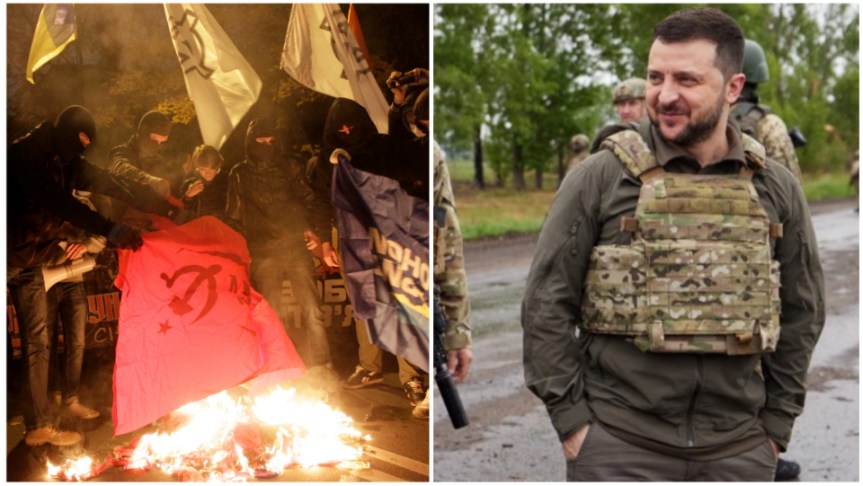
Left: Supporters of the neo-Nazi Svoboda (Freedom) Party burn the flags of the Communist Party of Ukraine and the Party of Regions of Ukraine. Right: Ukrainian President Vladimir Zelensky. | AP photos

South Paris, Maine. August 24, 2023


The arrest on August 16 of Georgi Buiko, a Communist leader, represents the latest and perhaps most significant action taken by Ukraine’s government to rid the country of the Communist Party of Ukraine (KPU). The charges, according to People’s Dispatch, referred to anti-Ukrainian activities and possession of pro-Russian and communist printed material.

Buiko, a key KPU leader, had been a youth leader within the Soviet Union’s Communist Party. Subsequently he was a Party and municipal leader in the Donbass area, secretary of the KPU’s Central Committee, member of the Ukrainian parliament, and a journalist.  Buiko heads the Anti-Fascist Committee of Ukraine.

The Communist Party of Spain condemned Buiko’s arrest and also other government attacks on the KPU. Its statement referred to the report in June from the UN’s High Commissioner for Human Rights which denounced violations of “international humanitarian law” in Ukraine along with arbitrary arrests, secret prisons, and torture.

Buiko’s arrest testifies to a definitive crackdown on Ukraine’s Communists. It began in tandem with an appeals court judgment on July 5, 2022 that confirmed a 2015 court decision declaring the KPU to be illegal. The appeals court ruling authorized the seizing of KPU properties and funds. That it quickly followed the onset of the Ukraine-Russia war on February 24, 2022 was probably not accidental.

The atmosphere turned toxic. Ukrainian President Zelensky on May 14, 2022 banned left-leaning political groups and parties and parties regarded as pro-Russian. The prohibitions did not apply to rightwing and neo-Nazi organizations.

In March of that year, the police in Kiev had already arrested the brothers Aleksander and Mikhail Kononovich on vague charges of pro-Russian attitudes. A court has been deliberating on their case intermittently ever since. The brothers have remained under house arrest for 17 months. They report having received death threats from the police.  

Mikhail Kononovich, addressing the General Assembly of the World Federation of Democratic Youth (WFDY) in Cyprus on December 3, 2019, identified and denounced a rightwing terror campaign against Communists and other opposition groups in Ukraine. Neo-Nazis had brutally attacked the Kononovich brothers a year earlier.

WFDY members have spearheaded demonstrations on their behalf in many countries, particularly in front of U.S. embassies. The Greek Communist Party has prominently defended the imprisoned brothers. 

The KPU’s impact had waned considerably even before wholesale persecution began.  Petro Symonenko, the Party’s former top leader and a prominent member of Ukraine’s Parliament, had been runner-up in presidential voting in 1999. Later, after the so-called Orange Revolution in 2004, the KPU lost most of its electoral appeal. Symonenko ended up supporting Russia in the burgeoning conflict between the two countries. In 2022, in the wake of police raids on his home, he left Ukraine for Russia.

Repression of the KPU manifested in the early stages of that conflict.  A stridently anti-Russian government took power in 2014, with U.S. assistance. Receiving U.S. material aid, Ukraine’s government initiated brutal military action against Russia-friendly separatist forces in southeastern Ukraine’s Donbass region.

Under those circumstances, KPU members experienced physical attacks and Party offices were ransacked. The government produced laws in 2015 requiring that symbols and reminders of Soviet-era Ukraine be removed and prohibiting communist advocacy. The teaching of history in schools would be altered and KGB archives would be newly accessible. 

The legislation promoted recognition of Ukrainian independence leaders extending back to World War II. The honored groups and individuals were predominately fascist in orientation, among them the nationalist leader Stephen Bandera.

Regulations announced in 2019 prohibited the KPU from participating in elections. A court that year banned the pro-communist Workers’ Newspaper (Rabochaya Gazeta), established in 1897.  The newspaper had offended by publishing articles with quotations from Marx and Lenin.

The confluence of vigorous anti-Communism showing up as Ukrainian state policy and U.S. participation in Ukraine’s war against Russia is no mere coincidence. Waging war against a powerful, well-resourced state, Ukraine needs U.S. assistance, and on that account would endeavor to please its essential ally. And the U.S. government sought to make use of Ukraine in order to cut Russia down to size for reasons presumably of global security. There was a meeting of the minds. 

It’s an arrangement that has Ukraine mounting a display of anti-communism for U.S. tastes and its ally relying on red-scare in order to shore up domestic support for its Ukrainian venture, as with past overseas interventions.

Surely Ukraine’s government was aware of its special gift on tap for the U.S. partner.  Anti-communism was the convenient pretext for the U.S. removal of Iran’s Mosaddegh government in 1953, for the CIA-staged coup in Guatemala in 1954, for discarding the Dominican Republic’s “constitutionalist” uprising in 1965, for removing Salvador Allende’s socialist government in Chile in 1973, and so on.

Foreign powerbrokers themselves have benefited from the anti-communist disposition of U.S. governments. The Cuban bourgeoisie and their heirs have relied on U.S. determination to relieve their island of a Communist revolution. Even a progressive Venezuelan government might appreciate the possible usefulness of its current assault on Venezuela’s Communist Party for persuading U.S. officials to ease their economic sanctions.


W.T. Whitney Jr. is a political journalist whose focus is on Latin America, health care, and anti-racism. A Cuba solidarity activist, he formerly worked as a pediatrician, lives in rural Maine. W.T. Whitney Jr. es un periodista político cuyo enfoque está en América Latina, la atención médica y el antirracismo. Activista solidario con Cuba, anteriormente trabajó como pediatra, vive en la zona rural de Maine.

‘Worse than the Special Period’: Cuba’s food situation more desperate by the day / By W.T. Whitney Jr.

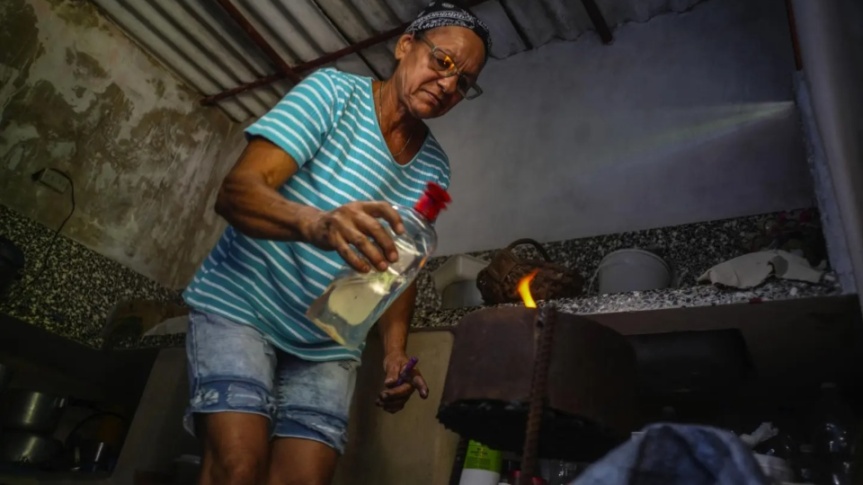
Mariel resident Rosa Lopez lights a charcoal stove to boil sweet potatoes and prepare scrambled eggs with tomatoes for her grandchildren on May 18, 2023. She had just returned from picking up her food rations from a government-run market. At the time, it had been more than a month since any cooking gas had been delivered to the city, so Lopez cooks using charcoal and a wood burning oven. Low agricultural yields, exploding inflation, a lack of gasoline for transportation, and the U.S. blockade have all contributed to soaring food prices. | Ramon Espinosa / AP

Originally posted in People’s World on August 16, 2023


Addressing a meeting of government ministers and the press in Havana on Aug. 11, Cuba’s Vice Prime Minister Jorge Luis Tapia Fonseca exploded when discussing the food crisis gripping the nation.

“It takes work to produce food. Everyone wants food deliveries, but we do nothing to produce it. We lack a culture of production … We don’t need all these papers, or words. When do we begin to plant? Who will do it?”

He was reporting on implementation of Cuba’s 2022 law on Food Sovereignty and Food and Nutritional Security. He noted that food self-sufficiency in local areas is disastrously lagging. Crop yields are low; plant diseases and the lack of inputs has hampered grain production.

The food situation in Cuba is growing more desperate by the day. Residents of the island individually consumed only 438 grams of animal protein per month in 2022, and in May 2023, only 347 grams; recommendations call for ingestion of 5 kg monthly. Not enough chickens were raised last year; poultry meat and eggs remain scarce.

Yields of corn, soy, sorghum and other crops have dropped, and animal feed is mostly unavailable. Therefore, pork production is also down, milk is unavailable to adults, and fewer cattle are being raised. Pasturage is poor, due to drought and no fertilizer.

Farm workers carry a tank of fresh milk to deliver it to a government-run food store in San Nicolas, Cuba, May 19, 2023. Milk is in short supply and reserved for children these days. | Ramon Espinosa / AP

Failures mount

Tapia pointed to the many failures exacerbating the situation. The output of state-controlled food producers is low. Producers, distributers, and institutional consumers don’t regularly contract with one another to facilitate food distribution. Producers aren’t being paid, because credit isn’t available. Cattle-stealing has reached new heights, 44,318 head so far this year.

The Ministry of Finances and Prices issued a report prior to the National Assembly session that recognized high inflation, widespread popular dissatisfaction, and the need for “concrete solutions.” Minister Vladimir Regueiro Ale indicated prices skyrocketed by 39% during 2022 and 18% more so far in 2023.

Inflation, he explained, varies from province to province and may manifest as abusive price-fixing, especially when agricultural supplies and products are in short supply.

Commenting on the report, National Assembly President Esteban Lazo, reminded delegates that diminished production and inflation were connected: “If there is no production and supply, we will not achieve effective control of prices.” He complained that “practically 100% of the food basket is being imported.”

The Assembly’s Food and Agricultural Commission analyzed organizational and management problems and reported that only 68% of expected diesel fuel has arrived so far in 2023, 14,700 tons less than in the similar period a year before; 28,900 tons of imported fertilizer were ordered, but only 168 tons arrived. Cuba’s fertilizer production has been nil this year in contrast to 9,600 tons produced in the same months in 2022.

Lazo communicated a message to Cuba’s Minister of Agriculture from the Assembly, whose recent session ended on July 22. The ministry, he said, would be “transforming and strengthening the country’s agricultural production,” to initiate “a political and participatory movement that would unleash a productive revolution in the agricultural sector.”

Nothing less than a revolution will do

A revolution appears to be exactly what’s needed. The recent National Assembly session dealt almost entirely with Cuba’s present food disaster. The lives of many Cubans are becoming more precarious due to unending food shortages, high prices, and low incomes.

Information emerging from the Assembly’s deliberations attests to the reality of crisis in Cuba, and it means that urgency is building for Cuba’s friends in the United States to resist U.S. policies in new ways, strongly and assertively. Their own government accounts for new suffering and destitution in Cuba.

President Miguel Díaz-Canel emphasized resistance when addressing the National Assembly. He dedicated his remarks to two revolutionary heroes who were present. Admiring how they kept “their foot in the stirrup of difficulties” and their “rifle pointed at mistakes,” he may have been thinking of hard work ahead.

He mentioned “problems of our difficult daily life, such as food production, electricity generation, water availability, crime, rising inflation, abusive prices.”

The president criticized behaviors “that reinforce the omnipresent blockade through inaction, apathy, insensitivity, incapacity, or simple tiredness and lack of faith.”

Díaz-Canel noted approvingly that delegates discussed “closer ties between deputies and the population,” “better management and allocation of the currency,” “greater direct participation of the non-state sector in national production,” “municipal autonomy,” and “downward pressure on prices.”

But it’s not enough. “Above all,” he said, “we must devote ourselves to creating wealth, first of all, by producing food.”

Trouble in the countryside

Cuba’s rural communities are troubled—and shrinking. Soon, “we won’t have any people left in the countryside,” one delegate said. Another called for improved “roadways, housing, and connectivity.”

No fuel means most people in rural areas are resorting to bicycles or horse carts to travel short distances. | Ramon Espinosa / AP

Regarding the low level of agricultural skills among the rural population, someone called for teaching in “agroecological techniques” and “good practices for the producing, processing, and commercialization of food.”

The idea has been circulating for a while now that greater local autonomy might help spur food production, but efforts at prompting that devolution of initiative have seen a slow uptake. As of April 2023, aspiring farmers had not yet taken possession of 258,388 hectares of idle land made available to them without cost under land-tenure reforms in 2008.

Frei Betto, Brazilian friend of revolutionary Cuba and adviser to Cuba’s Food Sovereignty and Nutritional Education Plan, visited Cuba in June. In his assessment, the “current shortages are more severe than in the Special Period (1990-95),” when Cuba’s economy nearly collapsed following the withdrawal of Soviet aid and the contraction of trade with the socialist bloc of nations.

He indicated that Cuba now imports 80% of the food it consumes, up from 70% five or so years ago, and that it costs $4 billion annually, up from $2 billion. For corn, soy, and rice alone, the outlay now is $1.5 billion annually.

He indicated, too, that a ton of imported chicken meat now costs $1.3 million, up from $900,000 a year ago, that “the wheat supply has worsened,” that milk production is down 38 million liters in one year, and that less oil from Venezuela, thanks to U.S. sanctions there, means further reduced food production in Cuba.

Blame the blockade, but not only

The origins of food shortages in Cuba and the mode of U.S. intervention are highly relevant in understanding the current situation, as every Cuban knows.

To be sure, the shortages plaguing the people are not solely due to U.S. policies. Drought, hurricane damage, marabou shrub infestation, soil erosion, high soil acidity, poor drainage, and lack of organic material soil have all contributed.

The still-prevailing bureaucratic and centralizing tendencies of the Cuban government’s economic management also play a role.

The U.S. economic blockade, however, remains central to understanding what’s happening. The creation of a food crisis was among the original proposals put forward by State Department official Lestor Mallory in 1960 for how to overthrow Cuba’s revolutionary government. The program: Use “hunger and desperation” to spark the “overthrow of government.”

Aid from and trade with the socialist world frustrated U.S. efforts and kept disaster at bay for decades, but eventually the Soviet Union and socialist Eastern Europe fell. The U.S. government seized the moment and passed legislation tightening the economic blockade in 1992 and 1996 and, later, designated Cuba a terrorist-sponsoring nation.

Beyond bans on products manufactured or sold by U.S. companies, proscribed categories soon included products manufactured by foreign companies associated with U.S. ones and products containing 10% or more components of U.S. origin. Now, foreign enterprises active in Cuba faced possible U.S. court action.

International loans and international transactions in dollars are usually off-limits. Payments abroad don’t reach destinations. Income from exports doesn’t arrive.

Think imports of seeds, fertilizers, herbicides, pesticides, breeding stock, veterinary supplies and drugs, new equipment, spare parts, exports of coffee, rum, and nickel. Think loans for purchasing food and more, loans for agricultural development. Think impediments to restoring rural infrastructure.

Farm workers wait in line to refuel their tractors on the highway to Pinar del Rio, Guanajay, Cuba, May 18, 2023. Cuba is in the midst of a major fuel shortage that has drivers and farmers waiting in line for days or even weeks to gas up their vehicles and tractors. | Ramon Espinosa / AP

The blockade, the U.S. tool of choice, has hit food production in Cuba hard. It is far along in achieving its ultimate purpose. Cuba needs a new order of support from friends in the United States─Marti’s “belly of the beast.”

Cuba needs friends more than ever

Many have so admired Cuba’s brand of socialism as to assume that Cuba’s social gains and exuberant international solidarity would fire up such enthusiasm that, along with considerations of fairness, legality, neighborliness, and revulsion against U.S. cruelty, would make U.S. policymakers think anew about Cuba. It never happened.

Now at a watershed moment in Cuba, a new direction is necessary, one all about persuading, organizing, and unifying left-leaning political groups and anti-war, anti-empire activists of all stripes. Leadership is needed.

Frei Betto says that, “It is time for all of us, in solidarity with the Cuban Revolution, to intensify the struggle against the U.S. blockade and mobilize international cooperation with the island that dared to conquer its independence and sovereignty against the most powerful and genocidal empire in the history of mankind.”


We hope you appreciated this article. At People’s World, we believe news and information should be free and accessible to all, but we need your help. Our journalism is free of corporate influence and paywalls because we are totally reader-supported. Only you, our readers and supporters, make this possible. If you enjoy reading People’s World and the stories we bring you, please support our work by donating or becoming a monthly sustainer today. Thank you!


W.T. Whitney Jr. is a political journalist whose focus is on Latin America, health care, and anti-racism. A Cuba solidarity activist, he formerly worked as a pediatrician, lives in rural Maine. W.T. Whitney Jr. es un periodista político cuyo enfoque está en América Latina, la atención médica y el antirracismo. Activista solidario con Cuba, anteriormente trabajó como pediatra, vive en la zona rural de Maine.

A Plea for Simón Trinidad / By W. T. Whitney Jr.

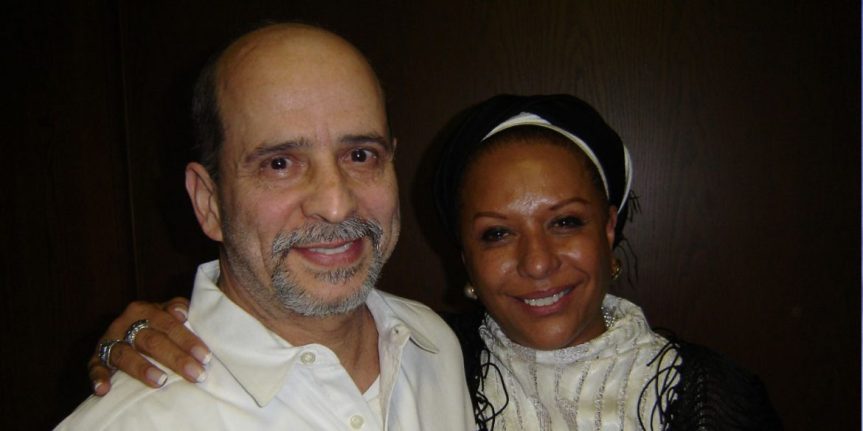
“Simon Trinidad” and Piedad Cordoba (Image: Piedad Cordoba)

South Paris, Maine


The title recalls the title of Henry David Thoreau’s essay “A Plea for Captain John Brown.” Trinidad, like John Brown, is remarkable for his implacable resolve and regard for justice.

Trinidad was 58 years of age when a U.S. court in 2008 sentenced him to 60 years in prison. His alleged crime was that of conspiracy to hold hostage three U.S. drug-war contractors operating in Colombia. In effect, he is serving a life sentence. He had nothing to do with the hostage-taking.

The contractors, captured in 2003, went free in 2008. U.S. drug war in Colombia has obscured the big U.S. role in Colombia’s war against leftist insurgents, primarily the Revolutionary Armed Forces of Colombia (FARC).

Simon Trinidad

Simón Trinidad was a FARC leader. The FARC and Colombia’s government signed a peace agreement in 2016 and Trinidad and other ex-combatants expected to be part of a peace process. Now he is a prisoner in a super-max prison in the United States and is confined to his cell for all but two hours per day, receives no mail, and is allowed very few visitors.

On July 27, Simón Trinidad unexpectedly was a featured item in the news in Colombia. An undated letter he had written to Colombian chancellor Álvaro Leyva requesting repatriation to Colombia had appeared on social media. News reports were reproducing it.

Observers associated Trinidad’s letter with the U.S. government’s announcement the day before that the bloodthirsty former paramilitary chieftain Salvatore Mancuso, also jailed in the United States, soon would be extradited to Colombia. President Gustavo Petro designated Mancuso as a “promotor of peace.”

Trinidad, not so favored as this, in his letter wrote of his determination to testify before the Special Jurisdiction for Peace, as other former FARC combatants have done, and Mancuso too, virtually. This court, established under the Peace Agreement of 2016, offers former combatants an opportunity to tell the truth about crimes they may have committed during the civil war and, having done so, to be pardoned or punished.

Trinidad apparently hopes not only that that Chancellor Leyva will inform the U.S. Secretary of State of his request to be repatriated but also that his message will be passed on to President Biden, who has the power to release him from prison.

Progressive Colombian Senator Iván Cepeda, “one of the people who speaks of peace on behalf of President Gustavo Petro,” welcomed “Simón Trinidad’s proposal [and] sent it directly to Chancellor Álvaro Leyva.”

Trinidad had joined the left-leaning Patriotic Union (UP) electoral coalition after it formed in 1985. A year later, paramilitaries began their massacre of UP adherents that, with impunity from Colombia’s government, lasted for years. In response, Trinidad in 1987 joined the FARC and, in the process, dropped his name Ricardo Palmera Pineda. For the FARC, Trinidad was responsible for political education and propaganda and was a negotiator.

The U.S. government in 2000 introduced its “Plan Colombia” through which Colombia’s military secured U.S. weapons and training assistance; U.S. troops and military contractors were deployed in Colombia. The appearance of Plan Colombia doomed peace negotiations between the FARC and Colombia’s government that were in progress at the time.

As a lead FARC negotiator in those talks, Simón Trinidad became known to international observers. His course with the FARC ended abruptly on January 2, 2004, when Colombian military personnel and the CIA seized him in Quito. Trinidad was there seeking UN assistance for a proposed prisoner exchange.

Colombia’s government extradited Trinidad to the United States on New Year’s Eve, 2004. According to his U.S. lawyer Mark Burton, Trinidad’s U.S. captors regarded him as a “trophy prisoner.”

Trinidad’s U.S. handlers had to stage four trials for them to finally gain a conviction. His capture and his multiple appearances in U.S. courtrooms from 2005 to 2008 served as real-time advertising that testified to U.S. commitment to anti-insurgency war and drug war in Colombia.

Trinidad’s misfortune was to have fallen into the clutches of a nation whose record on prisoners is horrific. After all, “The United States stands alone as the only nation that sentences people to life without parole for crimes committed before turning 18.” (No wonder: of 196 countries, only the United States has yet to ratify the UN’s Convention on the Rights of the Child.)

As a U.S. political prisoner, Simón Trinidad harks back to the Scottsboro Boys, who in Alabama faced death penalties in the 1930s; to Communist Party members jailed under the Smith Act; to Black Panther Party members caught up in the U.S. government’s COINTELPRO project. Simón Trinidad is also representative of prisoners gathered up in U.S. wars and other interventions abroad. They include: Ricardo Flores Magón, Mexican revolutionary who died in Leavenworth Federal Prison in 1922; the “Cuban Five” prisoners who resisted U.S. hostilities against Cuba; and the unfortunates ending up in the U.S. prison in Guantanamo during and after the Iraq War.

Despite the Peace Agreement, paramilitaries or other thugs have since killed almost 400 former FARC fighters; 300 FARC prisoners of war are still in prison almost seven years later.

Violence in the countryside persists. Colombia’s military is unable or unwilling to suppress a new breed of paramilitaries. One report highlights the paramilitaries’ “symbiotic relationship with Colombian state actors.” Declassified State Department and CIA documents from George Washington University’s National Security Archives say the same. The plot thickens: the tight relationship between the U.S. and Colombian militaries and the U.S. alliance with Colombia’s government together suggest U.S. complicity with a violence that Colombia’s Army and state are unable or unwilling to control.

The bad news for Simón Trinidad is that the U.S. government is betting not on peace in Colombia, but on continuing war. For that reason, Simón Trinidad confronts formidable barriers in satisfying his need to join Colombia’s peace process. Mark Burton’s words end this report: “Simón Trinidad is a man with a clear vision for a new Colombia, a Colombia in peace and with social justice. Colombia needs to listen to his voice, his vision, his proposals for peace. His continued imprisonment in the United States on false charges is an insult to Colombia, its history, and its people.”

Burton’s comments appear in a remarkable new eBook, accessible here. It contains commentary, in Spanish, from activists, writers, and intellectuals seeking Trinidad’s repatriation. The announcement of this book offers a video presentation, here, of reflections and documentary material.


W.T. Whitney Jr. is a political journalist whose focus is on Latin America, health care, and anti-racism. A Cuba solidarity activist, he formerly worked as a pediatrician, lives in rural Maine. W.T. Whitney Jr. es un periodista político cuyo enfoque está en América Latina, la atención médica y el antirracismo. Activista solidario con Cuba, anteriormente trabajó como pediatra, vive en la zona rural de Maine.

US Has a Favorite in Tumultuous Elections in Guatemala / By W. T. Whitney Jr.

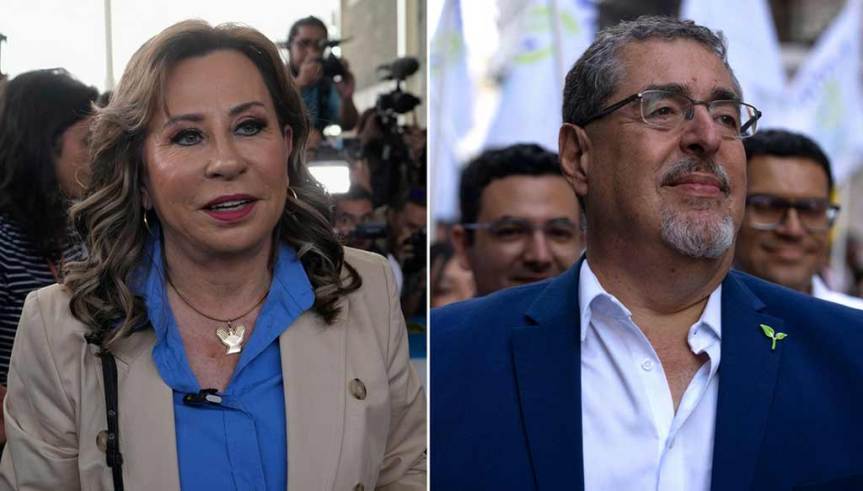
Sandra Torres of the center-right National Unity of Hope (UNE) party and Bernardo Arévalo of the center-left Semilla Movement party will face off in the second round of presidential elections in Guatemala on August 20. (Photo: Prensa Latina)

South Paris, Maine


Bernardo Arévalo scored a big surprise in first-round presidential voting in Guatemala on June 25. Prior to the vote, Arévalo, candidate of the Seed Movement political party had been lagging badly in opinion polls. But he went on to secure 11.8% of the vote, second place behind the 15.8% tally for Sandra Torres of the National Unity for Hope Party (UNE). Second-round voting takes place on August 20, possibly.

The Seed Party quadrupled its congressional delegation to become the third largest with 23 delegates. That party formed in 2015 with a mission of fighting corruption. Critics refer to political forces associated with Guatemala’s last three presidents, including incumbent President Alejandro Giammattei, as the “Pact of the Corrupt.”

Conservative politicians “together with the evangelical churches” campaigned vigorously against Arévalo, “presenting him as a leftist extremist.” Unnerved by his unexpected success, those forces took vigorous action.

The UNE and eight other political parties complained. On July 8 Guatemala’s Constitutional Court (CC), backed by the Supreme Judicial Court, ordered the country’s Supreme Electoral Tribunal (TSE) to suspend certification of the results pending a recount.

When it was completed on July 12, the CC authorized the TSE to certify. But Fredy Orellana, a judge with the so-called Seventh Instance Court, then authorized the Special Prosecutor against Corruption to invalidate the “judicial personhood” of the Seed Party, the effect being to prevent the Party from competing for votes.

Looking for evidence of alleged voter fraud, agents of various agencies carried out intrusive searches at the Seed Party headquarters and TSE offices.

The TSE on July 21 announced it was seeking CC protection from the “imminent threat” against democracy and the electoral process posed by various government ministries and particularly the Public Ministry, in charge of criminal investigations and prosecution.

Almost simultaneously, the CC reiterated that the Seed Party was provisionally protected and that the TSE must allow it to compete in the elections on August 20. Even so, “harassing, intimidating, pressuring and blocking of the electoral process” continued.

Condemning the shenanigans were the Catholic Church, social movements and even business sectors. Electoral observers from the European Union weighed in as did the Organization of American States and its Inter-American Commission on Human Rights. The OAS generally aligns with U.S. purposes. Indeed, Brian Nichols of the U.S. State Department twittered that we “look forward to the Aug 20 vote on the announced top two presidential candidates.”

Congresspersons Raúl Grijalva, Norma Torres, James McGovern and Eleonor Holmes Norton often oppose State Department positions on Latin America, but on July 21 they wrote to Secretary of State Blinken, urging him to pressure Guatemala’s government to allow second-round voting to proceed.

By implicitly supporting Bernardo Arévalo, the U.S. government seems to have reversed course to the extent that it was now speaking up for progressive political leadership ─ far from its usual practice as regards Latin America. Given its long immersion in Guatemalan affairs, however, U.S. actions there probably are coherent, if not always just or legal. The United States has recently applied economics sanctions to Guatemalans accused of political corruption. The Defense Department now and then supplies Guatemala’s security forces with military equipment. In October, 2022 military vehicles worth $4.4 million were donated, supposedly for use against drug-trafficking and for control of migrants. Over many years, the U.S. and Guatemalan militaries have carried out joint exercises.

Really, U.S. intervention is part of Guatemala’s DNA. Cuban investigator Hedelberto López Blanch states that: Before World War II, “Guatemala was in the hands of a few big landowners and U.S. companies… Workers were reduced to conditions of semi-slavery … The government of Jacobo Arbenz tried to change this political, economic and social system, but in June 1954 he was overthrown by the intervention of the CIA and large U.S. landowning companies.”

For 34 years ending in 1996, the U.S. government ─ the CIA in particular ─ was a constant presence. This was a time of rural insurgency, war against indigenous peoples, and 200,000 deaths. Analyst Marc Weisbrot explained in 1999: “[O]ur government had extensive and up-to-date knowledge of massacres and other atrocities, while they maintained a close working relationship with the Guatemalan military at all levels. The United States supplied weapons, training, and other aid to the military …  Through some of the worst periods of killings, our government provided crucial political support.”

Seed Party candidate Bernardo Arévalo has coexisted with U.S. interference for a lifetime. He was abroad during his youth after his father, President Juan José Arévalo, went into exile due to the U.S.- assisted 1954 coup. He served Guatemala’s government as a diplomat and mainstay in the Ministry of Foreign Affairs in the closing years of the civil war. He later taught in the United States and worked at the federally-funded United States Institute of Peace.

That the Seed Movement represents a new kind of rightwing politics for Guatemala, as suggested by commentator Félix Alvarado, may appeal to the U.S. government. In power, Arévalo supposedly would embrace business competition, be less corrupt, and not be beholden to rabid anti- communists and evangelicals.

In a recent interview Arévalo spoke about governing: to deal with corruption, one needs “a process of convergence of social forces” and “recuperation of institutions.” As regards poverty: “The government can’t help everyone but we can begin to create policies for the medium and long term.” As regards “backwardness, discrimination, and racism … we are setting the foundation for the beginning of a process in which institutions begin to function and serve the common good.”

For the U.S. government, Arévalo’s evident deliberation, caution, and limited expectations identify him as an entirely safe would-be Guatemalan president. But a time of testing, a social explosion, is at hand. Maybe for U.S. purposes, Arévalo would be the right president to ward it off, or deal with it.

Numbers speak: 260, number of millionaires; $95 billion GDP, highest in Central America; 47%, rate of undernutrition among under-age-five children (6th highest in the world); 61.6 %, rate of persons living in multidimensional poverty. Also, 2.5% of farms use 65% of the agricultural land, 45% of Guatemalans are indigenous, 79% of the indigenous live in poverty, 80% of rural people are indigenous and Guatemala’s human development index ranks 127th out of 189 counties.

In the recent first-round voting, 17% of the ballots were left blank, and 40% of eligible voters abstained. Non-participation surely points to social and political exclusion ─ of Guatemala’s indigenous people in particular. They don’t figure into current media reports on election difficulties, but they are the fuse for a potential social explosion.

The reflections of Silvel Elías appearing March 1, 2023 on debatesindigenas.org make this point: “The colonialist obsession of the Guatemalan State is evident in …setbacks in human rights and indigenous rights, denial of indigenous demands; violent repression … the granting of extractive licenses on ancestral territories, and practices of structural racism and social and political exclusion.

“Inequality continues to deepen … There are no laws, public policies or targeted programs that serve indigenous peoples. “Although indigenous Guatemalans represent 45 percent of the population, their representation in the Congress has never exceeded 10 percent. Indigenous people there don’t represent indigenous interests, but rather those of the traditional political parties that nominate them.”

U.S. government probably takes the region’s history into consideration as it deals with elections in Guatemala. The mix of extreme poverty, indigenous uprising and rebellion in Bolivia and Peru is a warning.


W.T. Whitney Jr. is a political journalist whose focus is on Latin America, health care, and anti-racism. A Cuba solidarity activist, he formerly worked as a pediatrician, lives in rural Maine. W.T. Whitney Jr. es un periodista político cuyo enfoque está en América Latina, la atención médica y el antirracismo. Activista solidario con Cuba, anteriormente trabajó como pediatra, vive en la zona rural de Maine.

Right-wing forces in European Parliament torpedo EU-Cuba relations / W.T. Whitney Jr.

The fascist and anti-communist VOX Party of Spain is leading the effort to sink EU-Cuba relations in the European Parliament. Here, VOX leader Santiago Abascal makes a speech in Madrid, March 19, 2022. Repeating typical right-wing falsehoods, party banners at the rally allege the media and the government are controlled by communists. | Paul White / AP

Originally published in the People’s World on July 20, 2023


The Cuban musical duo Buena Fe (Good Faith) toured Spain in May. Thugs disrupted their concerts, forcing the cancelation of a few.  A month later in Paris, protests orchestrated by a Cuban émigré university professor forced a prestigious poetry festival to take away the honorary presidency it had bestowed upon Cuban poet Nancy Morejón.

On July 12, Cuba’s relations with European governments went from unstable to possibly disastrous. The European Parliament (EP) approved a “Resolution on the State of the EU-Cuba PDCA.” The vote was 359 in favor, 226 against, and 50 abstentions—signaling trouble ahead for Cuba.

The PDCA is the Political Dialogue and Cooperation Agreement that, signed in 2016, committed individual European countries to rely upon consensus and “constructive engagement” in their dealings with Cuba. It replaced the EU’s “Common Position” that, from 1998 on, promoted “interventionist, selective, and discriminatory” relations with Cuba.

Josep Borrell, the top EU diplomatic representative, visited Cuba in May. He was advocating for the PDCA as a means of “support for the increasingly important Cuban private sector” and for “the expanding economic reform taking place” in Cuba.

With its 60 items, the resolution’s scope was vast. False allegations of human rights violations appeared throughout. The resolution “condemn[ed] the Cuban regime’s support for the Russian war of aggression against Ukraine and its defense of Russia and Belarus.” It called for sanctions by the European Council “against those responsible for the persistent human rights violations in Cuba, starting by sanctioning [President] Miguel Díaz-Canel.”

If the resolution is any indication, EU-Cuba relations are going to be stormy. That was the whole point, surely, for those parliamentarians linked up, says one observer, “with CIA officers and diplomats stationed at the U.S. embassy in Brussels and Luxembourg.”

Spanish EP delegate and Communist Party member Manuel Pineda claimed that the EP “has become a loudspeaker for the most reactionary and extreme right-wing positions, contaminating and clouding what should be the house of Europe’s sovereignty.”

The resolution had been the project of the “Euroskeptic and anti-federalist” European Conservatives and Reformists Group (ECR) within the EP. ECR member Herman Tertsch, belonging to Spain’s fascist-leaning Vox Party, explained that, “The resolution is a further step towards ending the EU’s intolerable complicity with the Cuban dictatorship and that of its High Representative, Josep Borrell.”

He denounced Cuba’s Communists, “communists all over the world,” and “their accomplices in the democracies of America and Europe.”

Meanwhile, the European Union is Cuba’s biggest trading partner and EU countries account for most foreign investment in Cuba and one-third of all tourists visiting there. The EU has donated most of the developmental assistance received by Cuba over many years ─ €100 million as of 2021.

The timing was significant. The vote missed by one day the two-year anniversary of large anti-government protests occurring in Cuba on July 11, 2021. U.S. Secretary of State Blinken used that anniversary to insist that “the United States stands in solidarity with those in Cuba who continue to desire a free democracy.”

Additionally, a heads-of-state summit meeting between the EU and the Community of Latin American and Caribbean States (CELAC) took place soon after the vote, on July 17-18 in Brussels. CELAC includes all Western Hemisphere nations except the United States and Canada,

Preceding this summit were EU meetings with pre-CELAC regional alliances and CELAC-EU summit meetings in 2013 and 2015. The recent hiatus resulted from EU displeasure with “popularly elected governments and leaders” in Latin America. Now the object is to foster “respectful interchange” and to “acknowledge mutual interests.”

Chinese competition with Europe in Latin America and the Caribbean over trade, access to natural resources, and investment opportunities may have provided encouragement.

Reflecting official Cuban sentiment ahead of the summit, journalist Claudia Fonseca Sosa stated, “For Cuba, it’s important that … dialogue in Brussels be serious, participative, and diverse.” However, the EP’s resolution was aimed directly at aspirations of “consensus and bridge-building.”

The Foreign Relations Commission of Cuba’s National Assembly charged that “The EP Resolution represents harassment of European businesses investing in Cuba or seeking to do so. It also expresses the will of extreme right-wing political forces to deprive the EU of its own independent policy toward Cuba.”

As new grief falls on Cuba, the role of a newly evolving version of counterrevolution, fully evident elsewhere in the world, is hitting at the island. For Cuban political analyst Iramís Rosique Cárdenas, that kind of conservative politics with “known liberal discourse of private property, market fundamentals, a minimum state…and with social democratic cooperation” is disappearing.

He describes “a series of movements and organizations of the right and extreme right” with ideas of national chauvinism, reliance on strong states, economic protectionism, provincialism instead of multi-culturalism, xenophobia, “centrality of the traditional family,” exclusion of minorities, nationalism, and religious fundamentalism.

He adds, “The right-wing extremism active in the West displays virulent hostility against Latin American progressivism, especially the Bolivarian process, and against movements and states…like China and Cuba, [that resist] European and North American centers of power.


We hope you appreciated this article. At People’s World, we believe news and information should be free and accessible to all, but we need your help. Our journalism is free of corporate influence and paywalls because we are totally reader-supported. Only you, our readers and supporters, make this possible. If you enjoy reading People’s World and the stories we bring you, please support our work by donating or becoming a monthly sustainer today. Thank you!


W.T. Whitney Jr. is a political journalist whose focus is on Latin America, health care, and anti-racism. A Cuba solidarity activist, he formerly worked as a pediatrician, lives in rural Maine. W.T. Whitney Jr. es un periodista político cuyo enfoque está en América Latina, la atención médica y el antirracismo. Activista solidario con Cuba, anteriormente trabajó como pediatra, vive en la zona rural de Maine.

Ocasio-Cortez Would Block US Military Intervention in Peru / By W. T. Whitney Jr.

Rep. Alexandria Ocasio-Cortez, D-N.Y., is proposing a halt to Defense Department funding over intervention in Peru. | AP

Originally published in the People’s World on July 11, 2023


According to a report appearing July 8 on a Peruvian website—and apparently not yet in any English-language internet news source—Rep. Alexandria Ocasio-Cortez, D-N.Y., introduced an amendment to the National Defense Authorization Act requiring that, until conditions are met, a hold be put on Defense Department funding for its activities in Peru during fiscal year 2024.

Ocasio-Cortez introduced her amendment on June 29; the House Rules Committee will take it up on July 11.

As long as any suspension of funding remains, the U.S. military would not be permitted to “provide, authorize, or assist in any way in the transfer of defense articles, defense services, crowd-control supplies, or any other supplies, to [Peru’s] Government, or to coordinate joint exercises with the military or police forces of [Peru’s] Government.”

Ocasio-Cortez introduced her amendment six weeks after additional U.S. troops with weapons began to arrive in Peru. That was two months after Peru’s military and police reached a crescendo of violence marking repressive actions for weeks against mostly Indigenous peoples. They were demanding elections, a new constitution, and the removal of President Dina Boluarte.

The protests were in response to the parliamentary coup that deposed President Pedro Castillo on Dec. 7, replacing him with Boluarte, vice president at the time. Castillo remains in prison.

Elected in July 2021 on the strength of rural and Indigenous votes, the inexperienced and often isolated Castillo tried to bring about progressive change. Opposing him was a well-entrenched oligarchy accustomed to holding political power and benefiting from foreign investments in Peru’s plentiful natural resources.

Ocasio-Cortez’s amendment calls for no funding until “the Secretary of Defense submits to the appropriate congressional committees the certification…that each of the following criteria has been met.” These include free elections in Peru, no repression of “peaceful protesters and indigenous communities,” investigation of “the killings of protesters in Peru on Dec. 14, 2022,” prosecution of those responsible, the return of free speech, respect for civil liberties, and more.

The ‘‘appropriate congressional committees’’ are the Armed Services and Foreign Affairs Committees of the House and the same two committees in the Senate.

Peru’s Congress on May 19 authorized the entry of U.S. troops who will undertake “training activities” throughout the country and stay until Dec. 31, 2023. On May 26, Peru’s Congress approved additional authorization for 1,172 U.S. troops, who will be collaborating with Peruvian counterparts in an exercise called “Resolute Sentinel 2023” that will end on Aug. 29.

Legislation is on the books: the particular Leahy Law that applies to the Defense Department “requires that [funds appropriated to the Defense Department] may not be used for any training, equipment, or other assistance for a foreign security force unit if the Secretary of Defense has credible information that such unit has committed a gross violation of human rights.”

With 19 other congresspersons, Ocasio-Cortez signed a letter to President Joe Biden on Jan. 30 expressing “alarm regarding the human rights violations committed by Peruvian state security forces.” The letter called upon the Biden administration to halt “security assistance funding from the United States” to Peru until this “pattern of repression has ended.”

That Ocasio-Cortez signed this letter and introduced her amendment suggests an attitude on her part that is unusual among her progressively inclined congressional colleagues and even among her progressively-inclined fellow citizens. She is apparently one of the relatively few in both categories who take upon themselves the obligation to stand up against U.S. interventions abroad serving the high and mighty.

The time required for mobilizing support for Ocasio-Cortez’s amendment before it was presented to the Rules Committee was entirely lacking.  The appearance on that account has been one of low expectations and of hopes for the future, maybe.

The consciousness-raising effect of the effort is important. But the evident lack of supporters mobilized on behalf of the amendment has meaning, too. Clearly, there’s much work ahead for the anti-imperialist cause in the United States, and recruits are badly needed.


W.T. Whitney Jr. is a political journalist whose focus is on Latin America, health care, and anti-racism. A Cuba solidarity activist, he formerly worked as a pediatrician, lives in rural Maine. W.T. Whitney Jr. es un periodista político cuyo enfoque está en América Latina, la atención médica y el antirracismo. Activista solidario con Cuba, anteriormente trabajó como pediatra, vive en la zona rural de Maine.

UN forcefully hits at US blockade of Cuba, at prison in Guantanamo / By W. T. Whitney Jr.

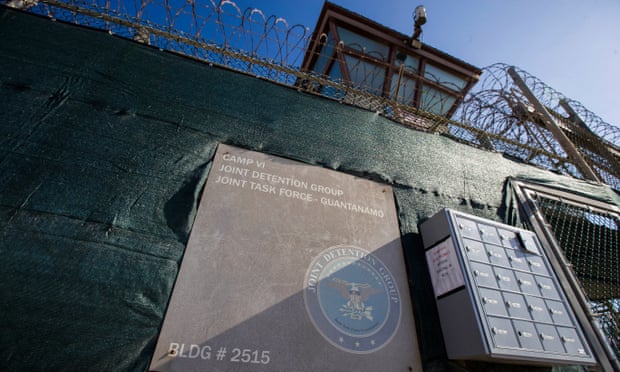
The control tower of Camp VI detention facility is seen in Guantánamo Bay in April 2019. Photograph: Alex Brandon/AP

South Paris, Maine


Nothing on the horizon now threatens the end of the U.S. economic
blockade of Cuba. Critical voices inside the United States and beyond
fall flat; nothing is in the works, it seems. Recently, however, the United
Nations put forth a denunciation that carries unusual force, mainly
because of the UN’s legal authority and its practical experience in Cuba.
Criticism of U.S. policies on Cuba from within the United States is
usually brushed aside due in large measure to the low priority
Washington officials assign to Cuban affairs. Coalitions of nations that
condemn the blockade may lack staying power and surely have no
means for enforcement. The anti-blockade opinions of nations or
individuals, alone or together, are useful mainly for consciousness-
raising.
The United Nations is different on account of its institutional capacity. It’s
on display when the UN General Assembly annually votes on a Cuban
resolution calling for an end to the blockade. Every year word of its
overwhelming and inevitable approval goes worldwide, because of the
UN connection.
The United Nations is unique on account of its Charter, which took effect
on October 24, 1945. This founding instrument outlines purposes as to
peace, no war, and human rights. It is legally binding on participating
nations, like a treaty. Additionally, the history and expectations
associated with the United Nations endow that organization with
institutional power. That’s something that neither NGOs operating in
Cuba or the time-limited projects of various governments on the scene
there can claim.
Another element emerges. The United Nations works within Cuba and
participates in Cuban affairs. On that account, UN complaints about
U.S. all-but-war against Cuba take on special authority.

On the ground

UN workers and technical specialists since 2015 have been
implementing the UN’s “National Plan[s] for Sustainable Economic and
Social Development” in dozens of countries since 2015, including Cuba.
Work is carried out inside countries and territories in order to fulfill a
“Development Agenda [for] 2030.” The main goals are: government
efficiency, transformation of production, protecting natural resources and
the environment, and human development with equity.
The Cuba section of the so-called “United Nations System” consists of
22 “agencies, funds, and programs,” 11 of which are physically present
on the island. That section recently issued a report on its activities in
2022.
Francisco Pichón is a Colombia native serving as the UN program’s
“resident coordinator.” In comments to the Cuban News Agency, Pichón
noted that in Cuba his teams participated with Cubans in dealing with
disaster situations and introducing developmental assistance.
Collaboration was impaired, he observed, by the “the economic,
commercial, and financial blockade imposed by the United States.”
Pichón testified to the constant necessity for making adjustments. What
with the impact of Covid-19; the increase of prices of food, sources of
energy, and more; and the war in Ukraine, his associates had to
“circumvent U.S. economic sanctions” and work around Cuba’s
exclusion from “international financing mechanisms”. UN personnel
found it necessary to divert funds in order to mount special assistance
programs after Hurricane Ian and in response to problems in Pinar del
Rio.
He indicated that “pre-positioning of essential resources for emergency
situations” was essential in order to mount quick and efficient responses.
That was helpful in reacting to the Hotel Santiago explosion in Havana
and the terrible fire at an oil storage facility in Matanzas.
Pichón highlighted the complexity of making any kind of payments,
especially because costs go up when resources are imported from far-
distant countries and because Cuba is excluded from international
lending agencies and banking services.

Guantanamo

The idea that the United Nations is a potentially capable partner in
warding off U.S. aggression against Cuba gains additional strength

following the recently concluded visit to Cuba of the UN Special
Rapporteur on Human Rights and Counterterrorism. Through her visit
and report, the United Nations was asserting legal norms.
Law professor Fionnuala Ni Aolain examined the plight of prisoners at
the U.S. naval base in Guantanamo in Cuba. The U.S. government
occupied land there as a condition of its approval in 1902 of a
constitution for newly-independent Cuba. Cuba’s government denounces
the occupation as violating international law.
Of the almost 800 men imprisoned there at one time or another since
2002, 30 prisoners remain, of whom 16 have been cleared for release
and represent no danger.
In an interview, Aolain testified to U.S. violation of human rights: “Men
are shackled as they move within the facility. They were shackled when
they met me.” She referred to “enormous deficits … in health care, in the
standard operating procedures … [Men] are called by numbers, not by
name.
She added that, “Those who tortured betrayed the rights of victims …
[W]hat they ensured is that you couldn’t have [a] fair trial … [And
therefore] it would be impossible for the victims of terrorism to redeem
their rights.” And, “let me be clear. Torture is the most egregious and
heinous of crimes.”
Quoted in a Cuban news report, Aolain referred to “cumulative
aggravating effects on the dignity, freedom and fundamental rights of
each detainee, which I think amounts to cruel, inhuman and degrading
treatment, according to international law.”


W.T. Whitney Jr. is a political journalist whose focus is on Latin America, health care, and anti-racism. A Cuba solidarity activist, he formerly worked as a pediatrician, lives in rural Maine. W.T. Whitney Jr. es un periodista político cuyo enfoque está en América Latina, la atención médica y el antirracismo. Activista solidario con Cuba, anteriormente trabajó como pediatra, vive en la zona rural de Maine.

Fighting for Land and Independence in Jujuy, Argentina / By W. T. Whitney Jr.

South Paris, Maine, June 27, 2023


In Jujuy province, in Argentina’s extreme Northeast, poor people’s discontent, the provincial government’s overreach, and popular resistance recently contributed to a crisis that portends grief and struggle ahead.  Setting the stage were: free rein for local reactionaries, indigenous peoples’ oppression, foreign plundering of natural resources, and a U.S. eye over the whole affair.

June was a month of turmoil.  Governor Gerardo Morales had proposed reforming the province’s Constitution. Teachers’ unions were agitating for higher salaries.

Discussion for 50 days that should have preceded the Constitutional Convention never happened. The Convention, presided over by Morales himself, played out over three weeks.  He had timed the electing of delegates to coincide with provincial government elections and thereby assure enough voter turnout to elect delegates who backed constitutional reform.

The proposed changes included new provisions for criminalizing public protests and new restrictions on “freedom of expression, petition, and association.” There would be revised legal mechanisms for regulating access to land, this so as to deliver land to lithium-producing multi-national companies. Indigenous peoples would face the probability that untitled plots of land crucial to their survival, for generations, would no longer be available. Jujuy province is the center of lithium extraction in Argentina, the world’s fourth largest lithium producer.  

Elected in 2015, Morales cut back governmental support for education, and teachers lost jobs. Teacher salaries in Jujuy are the lowest in Argentina. Teachers’ unions in nearby Salta province had recently carried out strikes and won pay increases.

On June 5, a Jujuy teachers’ union struck for better pay. On June 9, several teachers’ unions and the municipal employee union marched on Jujuy city, population 375,000. Soon healthcare workers and a miners’ union would join the mobilization. Morales decreed “increased penalties against individuals and organizations participating in any protests or social mobilization.” 

On June 14 indigenous people marched on the city “to demonstrate their rejection of the [constitutional] reforms … being devised behind closed doors.”  City streets were teeming with protesters on June 15 when word came that agreement was near on constitutional reforms. Soon indigenous groups and others were maintaining roadblocks on highways throughout the province. Police, assisted by unidentifiable enforcers using unmarked vehicles, stepped up arrests of demonstrators and journalists.  Calls went out for Morales’s resignation.

The Constitutional Convention on June 20 approved alterations of 66 of the provincial Constitution’s 212 articles. Street pressure had caused two reforms involving indigenous rights and access to land to be withdrawn temporarily.  Restrictions on protesting and free expression remained. The Constitution now provides for “automatic majority in the legislature for the governing party” and no longer requires that provincial elections be held every two years.

Massed demonstrators responded by assaulting the Government House with projectiles. Police turned them back using tear gas, rubber bullets and arrests.

The provincial government’s repressive methods elicited criticism from elsewhere in Argentina and from the Inter -American Commission on Human Rights, Amnesty International, and the United Nations High Commissioner for Human Rights. 

Governor Morales exceeds boundaries. Early in his first term, for example, he enlarged the top provincial court from five to nine judges. Consequently, provincial courts have endorsed illegal searches, illegal evictions, and persecution of social leaders. By 2018, 25 family members were serving as provincial government officeholders.

One presumes that the governor’s evident lack of restraint is bad news farther afield. He leads Argentina’s rightwing Radical Civic Union party and now is a vice-presidential candidate on one of two tickets aiming to represent the rightwing Unite for Change electoral coalition in upcoming elections.

It’s clear: he stops at nothing. Morales’s government in 2016 arrested Milagro Sala, leader of the Tupac Amaru Organization that at the time was assisting indigenous families as they looked for food, housing, basic education and more. The government was interfering and the Organization resisted. The police arrested Sala on flimsy pretexts and seven years later she is still detained.

Continuing his efforts to waylay indigenous independence, Gerado Morales took part in the November 2019 coup that deposed Bolivian President Evo Morales. That Morales was an indigenous president of a multi-national republic. Governor Morales was instrumental in arranging for U.S. assistance.

Around September 4, 2019, Gerardo Morales supposedly joined a meeting in Jujuy held to organize the coup against Evo Morales. Present was Luis Camacho who, based in Santa Cruz in Bolivia, was leading the coup in progress. Later on, Governor Morales himself traveled to Santa Cruz to confer with plotters. 

On that September 4, Ivanka Trump and State Department, CIA, and USAID personnel arrived in Jujuy ostensibly to support local women’s initiatives. Trump had brought $400 million.  A Hercules C 130 aircraft was deployed on the runway close to the recently arrived U.S. plane.  Almost at once that plane departed for Santa Cruz, without a flight plan. Camacho was on board. 

He may have been conveying the U.S. funds that would be used to bribe the senior Bolivian Army officers who pressured Evo Morales to resign. Later on, Gerardo Morales surely was not blind to that same airplane carrying weapons to plotters in Santa Cruz.

The governor’s zeal in serving U.S. interests shows up now as he cultivates U.S. official representatives for the sake of U.S. investment in the extraction and processing of lithium. He met with U.S. ambassador Marc Stanley in May 2022, and later Stanley was in Jujuy as Morales acquainted him with “a portfolio of projects in development.” Stanley and his family attended an indigenous festival.

Together with governors of other lithium-producing provinces, Morales in 2022 visited European countries and the United States. There he met with Washington officials, bankers, and industrial leaders, among them Elon Musk, owner of Tesla Corporation.

Morales’s friendship with Argentinian-government economic minister Sergio Massa is surprising – President Alberto Fernandez’s government is on the other side of the political divide – but understandable:  Massa is  a favorite in U.S. official circles, a lead promotor of foreign investment in Argentina’s natural resources, and a likely presidential candidate in elections later this year.

The story here centers on Morales’s doings as an individual. But people respond to circumstances collectively and engage collectively in social change. Morales is representative, it seems, of that class of well-paid intermediaries who have long arranged for the transfer of wealth from wherever to a waiting set of plunderers.

The history of the Americas has them freeing up land so as to get at wealth that is there. They must dispose of the set of people living on the land. Military force is made available. Morales becomes an updated conquistador.

Writing for the Argentinian Club of Journalist Friends of Cuba (capac-web.org), Alberto Mas provides specifics. In a report entitled “Jujuy is the North American Laboratory for Argentina,” he states that, “The visit of General Laura Richardson of the U.S. Southern Command [on April 17, 2023] did not in the least hide intentions of controlling the production and exportation of Argentina’s lithium. This is part of a strategic plan for the region which they have implemented over the course of time: the coup against Evo Morales in Bolivia had the smell of lithium.”


W.T. Whitney Jr. is a political journalist whose focus is on Latin America, health care, and anti-racism. A Cuba solidarity activist, he formerly worked as a pediatrician, lives in rural Maine. W.T. Whitney Jr. es un periodista político cuyo enfoque está en América Latina, la atención médica y el antirracismo. Activista solidario con Cuba, anteriormente trabajó como pediatra, vive en la zona rural de Maine.


Reports on a Possible Spy Base in Cuba Miss the Main Point / By W.T. Whitney Jr.

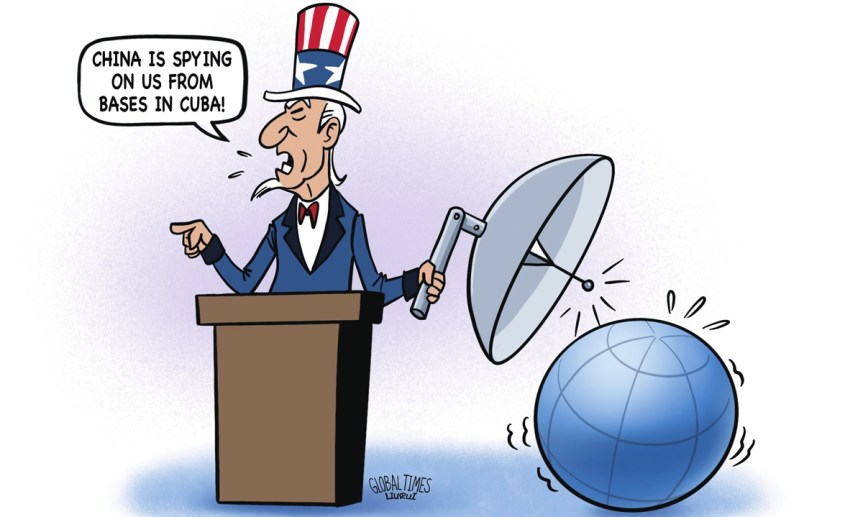
Illustration: Liu Rui/GT


The Wall Street Journal reported on June 8 that Cuba would receive “several billion” dollars in return for China building a “spy base” in Cuba. The story mentions an “electronic eavesdropping” facility that would represent “a brash new geopolitical challenge by Beijing to the US.” Other news platforms offered their own versions of the story.

Chinese, Cuban and U.S.  spokespersons took exception to the report, but none of them specifically denied the existence of such an installation on the island.  The spokesperson for the U.S. National Security Council indicated merely that the reports were “not accurate.”

Asked about a “Chinese espionage facility” in Cuba, Chinese Foreign Ministry spokesperson Wang Wenbin stated that he “was not aware of what you mentioned.” He quickly moved on to U.S. interventionist activities throughout the world. Cuban Foreign Ministry official Carlos Fernández de Cossío recalled his familiarity with “this kind of slander” having been employed to justify anti-Cuban aggression and to manipulate public opinion.

However, a U.S. Defense Department spokesperson on June 8  declared that, “we are not aware of China and Cuba developing a new type of spy station.” He was introducing the possibility that a spy station already existed.

The New York Times two days later indicated that, indeed, such a facility had been “up and running since or before 2019.” The Associated Press reported the same. 

U.S. anti-Cuban counter-revolutionaries pounced, specifically Senate Intelligence Committee Chairman Mark Warner, Vice Chairman Marco Rubio and Senator Bob Menendez, chairperson of the Senate foreign relations committee. Menendez condemned the alleged spying facility as “a direct assault upon the United States.”  A constant theme in their complaints was Chinese influence expanding in Latin America.

Florida Congresspersons Debbie Wasserman Schultz and Mario Diaz-Balart sent a letter to Secretary of State Blinken and Defense Secretary Austin.  They requested a briefing for Members of Congress. “This escalation,” they insisted, was “the latest step in a long series of Chinese interventions in the Western Hemisphere.” They mentioned an “increasingly symbiotic relationship between Cuba and China.”

Fallout from the report may adversely affect U.S. solidarity efforts on behalf of Cuba. The possibility of Chinese spying on the United States from a base in Cuba, reminiscent of the Cuban Missile crisis of 1962, may end up discouraging any intentions of the Biden administration to deal with anti-Cuban measures in force now. Solidarity activists are demanding an end to the U.S. designation of Cuba as a state sponsor of terrorism and the easing of regulations imposed under the U.S. economic blockade.

The possibility of a spy station in Cuba somewhat darkens the atmosphere ahead of solidarity demonstrations set for Washington and nationwide on June 24.

The timing of the news report on a Chinese spy base in Cuba may have been calculated. Bad news about China can be useful to the U.S. government. The spy-base story represents an opportunity for corroborating supposed Chinese perversity evident recently in fruitless contacts between officials of the two countries.

Exploration of the possibility of arms-control talks apparently yielded very little.  Recently the two countries’ defense ministers were unable to agree on meeting on the sidelines of a security conference in Singapore. A proposal for talks on regulating artificial intelligence is going nowhere. And a report surfaced recently on Chinese attempts to gather public information on U.S. military affairs.

Additionally, speculation is flourishing that news about a Chinese spy base in Cuba may irretrievably complicate Secretary of State Andrew Blinken’s plans to visit Beijing on June 18. He had canceled a trip there in February in the wake of the Chinese balloon sailing across North America. Elements of the U.S. government may, in fact, have little enthusiasm for improved U.S. relations with China. They may prefer that Blinken’s visit not take place.

The New York Times reports that “the Biden administration … has been trying to normalize relations with China after a protracted period of heightened tensions.” Even so, “several diplomatic, military and climate engagements between the two countries were frozen” in the wake of Speaker Nancy Pelosi’s visit to Taiwan in 2022.

As reported, the fuss over possible Chinese spying in Cuba looks to be a kind of replay of familiar themes. One is the myth about Cuba as failed state and oppressive society. The other has the United States and China jostling over Taiwan and for regional control.  One looks in vain for reporting that deals with those aspects of U.S. relations with Cuba and China that are of immense concern worldwide.

Masses of people everywhere know something, or a lot, about U. S. determination to control the world’s political and economic affairs. Many admire Cuba for resisting for so long.  The agenda of media bosses and U.S. powerbrokers is otherwise.

More immediately, peoples of the world don’t want world war. That prospect, associated as it is with nuclear war, hovers over potential U.S. conflict with China. It’s acceptable, surely, to subscribe to the truism that working people everywhere, and multitudes who are abandoned and marginalized, do want peace. 

The main message to be taken from the China-spy-base story is that readers of news reports deserve more than they are often getting. Reports they encounter ought, at least, to touch upon those aspects of a story that matter most.  Questions of war and peace amply qualify.


W.T. Whitney Jr. is a political journalist whose focus is on Latin America, health care, and anti-racism. A Cuba solidarity activist, he formerly worked as a pediatrician, lives in rural Maine. W.T. Whitney Jr. es un periodista político cuyo enfoque está en América Latina, la atención médica y el antirracismo. Activista solidario con Cuba, anteriormente trabajó como pediatra, vive en la zona rural de Maine.

The Implications of New US Troop Arrivals in Peru / By W. T. Whitney Jr.

Starting from June 1, the United States will deploy its regular military units in Peru | Photo:gestion.pe. / https://orinocotribune.com/


Beginning in June, detachments of U.S. troops will be arriving in Peru and staying until December 31, 2023. Peru’s Congress, supported by only 6% of Peruvians, on May 26 approved a resolution introduced in January that “authorized the entry of naval units and foreign military personnel with weapons of war.”

U.S. military personnel are heading for Peru on a training and advisory mission.  U.S. Army, Navy and Air Force troops will be active throughout that country. Most of them apparently will stay for less than the allotted seven months. They are bringing weapons and equipment. The U.S. Southern Command appointed a Peruvian general as “deputy commanding general-interoperability.”

They arrive following massive popular protests that erupted in reaction to Peru’s rightwing Congress on December 7, 2022 having ordered the arrest of the democratically-elected President Pedro Castillo. His politics were progressive. The protests provoked violent military and police repression; over 70 Peruvians were killed. Demonstrations peaked in February, but will revive in July, according to reports.

Castillo remains in prison, and his replacement, former Vice-President President Dina Boluarte, is widely reviled. The Inter-American Commission on Human Rights recently issued a report documenting “serious violations by the police and military” that took place shortly after she became president.  Peru’s Public Ministry, investigating “the presumed crime of genocide,” required that Boluarte testify on June 6.   

The U.S. troops will be arriving amid an upsurge of Peru’s underclass. Peru’s mostly rural, poor, and indigenous majority did elect the inexperienced Castillo as president in July 2021. They are now calling for Boluarte’s removal, new presidential elections, and a Constituent Assembly. Six of ten Peruvians regard the current political crisis as stemming from “racism and anti-indigenous discrimination,” according to a recent poll.

Resumen Latinoamericano reports that the U.S. forces heading to Peru will include 25 Special Forces troops arriving with weapons and equipment and 42 other Special Forces troops charged with preparing Peru’s intelligence command for “joint special operations;” 160 additional U.S. troops will be utilizing nine U.S. airplanes.

Eventually, 970 U.S. Air Force and Special Forces personnel will have taken part in the U.S. Southern Command’s so-called “Resolute Sentinel 23.” Previous U.S. military interventions in Latin America have been similarly named. The phrasing of this intervention’s official purpose is odd: “to “integrate combat interoperability and disaster response training in addition to medical exchanges, training and aid and construction projects.”

The coup government, under whose auspices the U.S. troops will be operating, is a creature of conservative political parties and the business establishment. In April it announced plans to privatize lithium mining, thus reversing President Castillo’s efforts to nationalize the processing of lithium. The government is easing the authorization procedures that enable foreign corporations to extract copper. Lawyer and former Castillo advisor Raúl Noblecilla cites control over Peru’s mineral wealth as to why U.S. troops are in Peru; their presence there indicates “how lackey and sell-out governments function.”   

Academician Jorge Lora Cam states that “the usurper government” seeks to “deepen extractive plunder with blood and fire … unify the right with left-leaning elements infected by neoliberalism … and prepare for permanent political power.”  He adds that under the auspices of “political criminals,” the country’s economy is newly “at risk because Peru’s foreign debt now amounts to $100 billion dollars.”

The imminent arrival of U.S. military forces provoked other criticism. Former foreign Minister Héctor Béjar insisted that, “the spurious government was using the presence of these troops to intimidate the Peruvian people who have announced new protests for July.” 

A spokesperson for the Communist Party of Peru – “Patria Roja” explained that, “the entry of U.S. troops in Peru is an affront to our sovereignty and represents explicit backing by the U.S. government of the nefarious Boluarte regime, which is responsible for repression against the Peruvian people.” 

The U.S. military, of course, has long interacted with its Peruvian counterpart. Instances include: military exercises in 2017, “Regional Emergency Operations Centers” in 2018, a “naval mission in 1920,” U.S. Army involvement “from 1946 to 1969,” and U.S. training of thousands of Peruvian military personnel from the 1940s on.  TeleSur in 2015 reported that, “Hundreds of Peruvians protested Wednesday … against the [anticipated] arrival of 3,200 [U.S.]soldiers with ships, airplanes, and various kinds of weapons.”

Peruvians are hardly alone as a targeted people.  Some 800 U.S. bases are distributed throughout the world, and “173,000 troops [were] deployed in 159 countries as of 2020.” The setting is of military intrusion extending over decades in Peru and now across the world.  What’s the cost and how are payments arranged for?

The projected U.S. military budget for FY 2024 exceeds $1.5 trillion, according to a recent analysis. There are two sets of military activities and each requires its own funding approach. The U.S. government has to pay for potential war against enemies like China and Russia and for military operations elsewhere.

To portray China and Russia as threats to the U.S. status quo garners so much attention as to spark fellow-feeling for the military- industrial complex, and the funding flows.  Rationales for the other kinds of involvement may lack crowd appeal. They are: shoring up the worldwide capitalist economy, serving corporate interests, and countering leftist insurgencies. 

We conclude that congressional and tax-payer generosity in response to exaggerated threats to the U.S. status quo and to the worldwide capitalist system may translate into so much funding that enough is left over to pay for U.S. meddling in the other countries.

Panama may be one of them: The Biden administration may be on the verge of sending U.S. troops to the Darién region of Panama “to counter illicit drug trafficking, human trafficking, and irregular immigration.”  


W.T. Whitney Jr. is a political journalist whose focus is on Latin America, health care, and anti-racism. A Cuba solidarity activist, he formerly worked as a pediatrician, lives in rural Maine. W.T. Whitney Jr. es un periodista político cuyo enfoque está en América Latina, la atención médica y el antirracismo. Activista solidario con Cuba, anteriormente trabajó como pediatra, vive en la zona rural de Maine.

Worker Empowerment Stalls in Venezuela as Left Unity Fractures / By W. T. Whitney Jr.

Indigenous spokespeople, Venezuela (archive) | venezuelanalysis.com/


Hugo Chavez, Venezuela’s president from 1999 until 2013, inspired and led a “Bolivarian Revolution” that sought independence from U.S. domination, regional integration and so-called socialism of the 21st century. Obstacles are many: capitalism in control of the national economy, unrelenting rightwing political opposition, U.S. intervention – and longstanding political divisions among left forces.

Worker empowerment languishes in such a context. We offer an explanation, and doing so, attribute the divisions to differing approaches to the predicament of Venezuelan workers.

Several months ago, union workers in many sectors were vigorously protesting low wages and demanding that wages be paid in dollars, to counter inflation. Nicolas Maduro, Venezuela’s president after Chavez’s death in 2013, reprimanded them for not “understanding the effects of the blockade and the oligarchy’s economic war.”

The government faces terrible challenges. Contributing to economic disaster are U.S. sanctions and depressed oil prices over ten years or so. Oil exports have accounted for most of Venezuela’s export income. Economic crisis surely diminishes prospects for worker empowerment.

Impact of economic crisis

Recent developments tell much of that story. The U.S. Justice Department on May 4 lifted restraints on the sale of Citgo company’s assets to the creditors of the Venezuelan state and of Venezuela’s state -owned oil company, PDVSA. Citgo is PDVSA’s U.S.-based oil company. Worth $13 billion, it owns three oil refineries and 4000 gasoline stations.

U.S. authorities confiscated Citgo in 2019. It gave Citgo to those rightwing opponents of the Maduro government who between 2015 and 2021 constituted a majority in Venezuela’s National Assembly. This group will be managing the sales of Citgo shares to the company’s high-rolling creditors worldwide.

Rather than retrieve annual Citgo profits of a billion dollars or so, the government has lost them. Income from the sales of oil products had enabled the government to pay for healthcare, schools, housing, and more. The larger picture is that $30 billion in Venezuelan assets have been “blocked, retained, or confiscated.”

The U.S. State Department on May 3 announced that $347 million in Venezuelan funds now frozen in U.S. banks will be returned, not to Venezuela’s government, but to that former opposition bench in the National Assembly. For the United States, that’s Venezuela’s government.

Meanwhile, Venezuelan workers are struggling to survive; worker empowerment is a distant dream.  Presently, one third of Venezuelan children are undernourished. The poverty rate has fallen a little but remains at 50%. In one of the world’s most unequal societies, wealthy Venezuelans have access to imported goods, dollars, and the proceeds from illegal businesses. The latter make up 20% of the national economy.

The economic crisis hurts Venezuela’s working class. It impedes efforts to strengthen it. We must know the extent to which Venezuela’s government supports workers.

Shifting alliances and labor rights

President Maduro in February 2018 was seeking support in presidential elections that year from the Communist Party of Venezuela (PCV).  He appeared at the PCV headquarters and declared the PCV “to be the principal party in founding and defending democracy in the 20th century.”

The government’s political party, the United Socialist Party of Venezuela (PSUV) and the PCV signed a “Unitary Framework Agreement,” which backed “the rights of the working class and the working people.”  The PCV did support Maduro in elections in May 2018.

Within months, however, the government introduced its “Program of Recuperation, Growth, and Economic Prosperity,” which, according to labor historian Omar Vázquez Heredia, provided for “major devaluation of the official exchange rate, elimination of price controls and import tariffs …[and] regressive labor reforms … [such as] elimination of the right to strike.”  He adds that dollars had already been disappearing through smuggling, hoarding, import fraud, and governmental corruption.

The new anti-worker measures showed up in the government’s “Memorandum 2792” of October 2018. ThePCV critiqued the government’s ready support for business interests and questioned its delivery of scarce dollars to foreign creditors and to Venezuela’s business sectors to help them import and distribute foreign goods.

Analyst Héctor Alejo Rodríguez notes that the government, through its October memorandum, “flattened the wages for all sectors and unilaterally cancelled all the collective bargaining agreements of the workers.” Workers, he points out, were already dealing with “acute shortages, loss of social gains, deterioration of public services and the systematic destruction of [their] incomes and rights.”

At a May Day rally in 2023, former labor leader Maduro told workers that funds were unavailable for salary increases, also that their “economic war bonus” would continue and their monthly food bonuses increase. The minimum wage would be equivalent to $5.25 per month – and lose value due to inflation.    

President Chavez created the “Great Patriotic Pole” electoral coalition. The PCV joined, and backed Chavez in the 2006 and 2012 elections, and Maduro in the 2013 elections. Chavez created the United Socialist Party of Venezuela (PSUV) in 2007. He counted on smaller leftist parties to relinquish their identity and join the PSUV.

The PCV and other parties refused, provoking Chavez in 2008 to threaten the PCV’s destruction.  PCV leader Oscar Figuera declared that his Party would still affiliate with the Patriotic Pole, but would remain independent. After all, as he noted, “We have just completed 77 years struggling for socialism in Venezuela.”

The PCV broke with the PSUV in 2020 and formed a new electoral coalition, the People’s Revolutionary Alternative (APR). Party leaders say they are “Chavista” and anti-imperialist, but want oil monies used more for industrial development and rural productivity and less for paying on foreign debt or for capitalists to use as they wish.  

Meanwhile, the government stepped up “criminalization of labor protests” and forced the retirement of many labor leaders. APR candidates have been dismissed from jobs, or jailed. The PSUV presented speakers who denounce the PCV and at the same time falsely claim to have been PCV members or to have been expelled by the PCV.

Some clarity

Mostly tellingly, a flurry of killings has recently taken the lives of PCV activists. In Apure state alone, in 2023, thugs murdered Communist journalist José Urbina and Communist community leader Juan de Dios Hernández.

In Venezuela presently the prospects for worker empowerment, not to speak of working-class political power, are dismal. A distant observer lacks full knowledge of local realities and is ill-equipped to assign blame. In any case caution is the watchword in passing judgment that might detract from unity in the broader political movement.

Now a neighbor weighs in.  Writing May 8 in Seminario Voz, the Colombian Communist Party’s newspaper, Ricardo Arenalescriticizes the PSUV. He cites the killings and false PSUV accusations.

Arenales cites a communication from the PCV Political Bureau to Colombian President Gustavo Petro, who on April 1 met with   

representatives of Venezuela’s rightwing political opposition and who was about to meet with regional foreign ministers. Petro is seeking to ease political conflict within Venezuela and somehow to end U.S. economic sanctions against Venezuela.

The PCV letter calls for negotiators to attend to “the political and social forces that are on the fringes of the polarizing diatribe.” The PCV rejects “a pact among the elites … [which] is built on the ruin of the popular majorities” and which represents “the interference of foreign powers in the solution of conflicts that exclusively concern Venezuelans.”

Arenales implies that rightwing powerbrokers in Venezuela and abroad use negotiations to incapacitate the PCV. He mentions that, “under the heading of sovereign resolution of conflicts in the brother country, … the right of the Venezuelan Communists to exist and struggle cannot be denied. For that to happen would be a serious contradiction in the building of democracy.”

Arenales reports that “parties and intellectuals of the world” and regional groupings in Latin America like the Sao Paulo Forum are proposing mediation processes for the sake of “rapprochement among the PCV, PSUV and Venezuelan government.”


W.T. Whitney Jr. is a political journalist whose focus is on Latin America, health care, and anti-racism. A Cuba solidarity activist, he formerly worked as a pediatrician, lives in rural Maine. W.T. Whitney Jr. es un periodista político cuyo enfoque está en América Latina, la atención médica y el antirracismo. Activista solidario con Cuba, anteriormente trabajó como pediatra, vive en la zona rural de Maine.