Daniel Jadue, the acclaimed mayor of Recoleta in Chile, is victim of lawfare / by W.T. Whitney Jr.

Recoleta Mayor Daniel Jadue, at a 2022 May Day march in Chile. | People’s World

South Paris, Maine

Reposted from Peoples World


“After more than 10 years of corruption, crimes, and destroying the Rocoleta commune, finally the justice system begins to act and will make arrangements for the Communist mayor Daniel Jadue. I hope he goes to jail soon.” That was Richard Kast, speaking in April. Kast was the right-wing presidential candidate defeated by Chile’s President Gabriel Boric in December 2021. The food- manufacturing magnate is the son of a World War II German Army officer.

On June 3 Judge Paulina Moya ruled that Jadue would be imprisoned “preventively” on charges of bribery, mal-administration, tax fraud, and bankruptcy. Moya declared that “for Jadue to go free would endanger the safety of society.” The police in April had prevented him from boarding a flight to Caracas. She decreed “120 days of investigation” prior to Jadue’s appearance before an appeals court.  

Jadue, a former professor of architecture and urban sociology, has been mayor of Recoleta municipality in the northern part of Santiago since 2012. Responding on social media, he insisted that, “They are judging me for our transformative government. I don’t have a peso in my pocket, but they are handing out the maximum restriction.”  

The court’s decision had to do with the “people’s pharmacy” that Jadue devised for Recoleta in 2015. It also involves the spread of people’s pharmacies throughout Chile.Jadue is a national figure. His legal troubles take on added significance on that account.

Jadue is renowned for the reforms he inspired in Recoleta. In addition to the consumer-cooperative pharmacy project, Recoleta offers an “optician program,” a people’s dentistry program, an “open university,” and a “people’s bookstore.” The municipality invests $500,000 a year in 10 public libraries. It recruited physicians and constructed two medical office buildings. It builds architecturally-sophisticated apartment buildings with low-cost rentals. 

Jadue is the unusual Communist Party leader who participated in national elections at the highest level.  As presidential candidate of a left-leaning coalition in 2021, he almost defeated current president Gabriel Boric, head of a center-left coalition competing in the primary elections.

Jadue provokes the wrath of apologists of Israel.  He has participated  in pro-Palestine demonstrations outside Israel’s embassy and made public  statements interpreted by some as antisemitic. The grandson of Palestinian immigrants, he was president of Chile’s General Union of Palestinian Students and a top organizer for Latin America’s Palestinian Youth Organization.

Jadue’s bookPalestine: Chronicle of a Siege, appeared in 2013. HispanTV recently presented his 12-part documentary presentation “Window on Palestine.” Chile is home to half a million Palestinians, the largest concentration outside of the Middle East.

The prosecutor announced criminal charges against Jadue in November 2023.The people’s pharmacies, on which the prosecution of Jadue is based, are a phenomenon. Now there are 212 of them in 170 localities. Average savings on individuals’ drug purchases are between “64% and 68%.”

Recoleta and the other municipalities together formed a purchasing cooperative known as Chilean Association of Municipalities with People’s Pharmacies (Spanish initials are ACHIFARP). Jadue has been its head. At the time of the Covid-19 pandemic, ACHIFARP was under pressure to distribute healthcare supplies reliably and inexpensively.

In 2021 the Best Quality supply company complained to national g authorities that it was approaching bankruptcy, also that ACHIFARP had neither used or paid for large quantities of supplies it had ordered. A Best Quality salesman reported that Jadue had solicited a bribe. The terms were: donate to the Communist Party headquarters in Recoleta and ACHIFARP would give assurances that Best Quality would be called upon to restock the people’s supermarkets, initiated by the government.

Barbara Figueroa, secretary general of the Communist Party released a statement saying merely that, “the precautionary measure against comrade Daniel Jadue is regrettable and disproportionate, and we believe that it should be appealed. … we respect the Courts of Justice and we hope that this public stage of the investigation and trial will end up proving Daniel’s innocence”.

Some 1000 Chileans signed a letter of support for Jadue. They were “national prize winners, legislators, trade unions leaders, heads of social organizations, academics, human rights leaders, political party leaders, city councilors, jurists, and cultural personalities.” According to the letter, “This case represents not only a political and judicial persecution of a public figure, but also a potential threat to the fundamental principles of the rule of law in Chile.” 

As explained by analyst Ricardo Candia Cares,“The people’s pharmacies represent a real contribution to the health of the dispossessed who now have an alternative to the infamous pharmacy chains that collude in gouging the people … … [They] have caused the big pharmacies, or really the powerful forces powerful behind these deals, to lose huge amounts of money.”

Latin American political leaders, Daniel Jadue among them, discovered they can be removed from office or barred from electoral participation through judicial processes. In that regard, he joins presidents Fernando Lugo in Paraguay (2012), Lula da Silva in Brasil (2017), Cristina Fernández de Kirchner in Argentina (2022), Rafael Correa in Ecuador (2018), Evo Morales in Bolivia (2019), and Peru’s President Pedro Castillo (2022).  

They are victims of lawfare, described by Le Monde diplomatique in Spanish as “a new format of persecution and repression, but executed through the perverted use of the norm, mainly by using judges and prosecutors against opponents.”


We hope you appreciated this article. At People’s World, we believe news and information should be free and accessible to all, but we need your help. Our journalism is free of corporate influence and paywalls because we are totally reader-supported. Only you, our readers and supporters, make this possible. If you enjoy reading People’s World and the stories we bring you, please support our work by donating or becoming a monthly sustainer today. Thank you!


W.T. Whitney Jr. is a political journalist whose focus is on Latin America, health care, and anti-racism. A Cuba solidarity activist, he formerly worked as a pediatrician, lives in rural Maine. W.T. Whitney Jr. es un periodista político cuyo enfoque está en América Latina, la atención médica y el antirracismo. Activista solidario con Cuba, anteriormente trabajó como pediatra, vive en la zona rural de Maine.

US Interventionists Busy in Bolivia as Political Crisis Looms / by W.T. Whitney Jr.

Photograph Source: José Fuertes – https://creativecommons.org/licenses/by-sa/4.0/

Reposted from Counterpunch


Delegates loyal to President Luis Arce dominated the 10th Congress of Bolivia’s Movement toward Socialism (MAS) Party held in El Alto in early May. They selected Grover García, chief of a governmental agency and formerly of a farmworkers’ union, to be MAS’s new leader, replacing former president Evo Morales in that capacity.

Another MAS gathering on June 10 takes place in Cochabamba to elect other Party leaders. One more, a “unity congress,” happens there on July 10, in territory friendly to Morales. He conditions his participation on the MAS Party and his own presidential candidacy for 2025 not being eliminated.

Division within the MAS Party is good news for the U.S. government. It had opposed MAS political power from the beginning of Morales’ progressive rule in 2006 until a U.S.-backed coup ousted him in 2019.

Morales, Bolivia’s first indigenous president, retained popular support throughout his tenure. His government overcame repeated attacks from oligarchic, racist, separatist, and U.S.-allied political forces based largely in Bolivia’s eastern departments, notable for rich oil and gas deposits and industrial-scale agriculture. MAS governments, with Luis Arce as minister of economy and public finance, achieved social advances, reduced poverty, nationalized oil and gas extraction and production, carried out land reform, and elevated the status of Bolivia’s majority indigenous population.

The U.S. government has eyed immense lithium deposits in Bolivia and expressed concern about Chinese economic inroads; a commentator notes that, as of 2017, “China has become the principal contractor and financing source for Bolivia’s state-led national development project.”

That President Luis Arce’s secured a 55% majority vote on October 19, 2020 to restore the MAS Party to power is also worrisome to Washington officials. His government in October 2022 mobilized popular support to defeat an opposition uprising led by reactionary politicians in Santa Cruz and other eastern departments. The victory elevated Arce’s appeal to government officials and MAS activists alike.

Division between the Party’s two wings, widening over two years, is highly visible. Highway blockades, strikes and demonstrations carried out by “radical factions of the MAS movement led by former President Evo Morales” played out between January and March. Rising inflation, reduced gas and oil production, falling currency reserves, and shortages of fuel and food add to MAS’s vulnerability.

One goal of the 10th MAS Party Congress was that of meeting constitutional requirements of orderly party function. Observers were on hand whose reports to the Supreme Electoral Tribunal (TSE in Spanish) would allow the Tribunal to certify the “resolutions of the Arcista conclave.” But an adverse ruling now and two more in the future would deprive the MAS Party of its “judicial personhood,” and rule out future election participation.

Democracy is at risk. Journalist Tatiana Castro claims social movements, “pillars that sustain the MAS in power,” are “fundamental for guaranteeing governability … [and] part of the democratic dynamics.”  Within the MAS Party itself, social movements are divided.

Those made up of urban residents and indigenous Aymara people of Bolivia’s high plateau region lean towards President Arce. Others supportive of Morales consist of federations of indigenous peoples in Bolivia’s tropical regions. Castro sees the two factions competing within the state apparatus not about ideology but over “perks, advantages, benefits, and nominations.”

President Luis Arce on May 18 warned that “the right is sharpening up for next year’s elections.” He denounced as “economic blockade” the Bolivian Senate’s recent refusal to authorize foreign loans. Meeting recently in the United States, extreme right-wing opposition politicians were “unifying against MAS,” he claims.

Morales warned that TSE recognition of the Arce-inclined El Alto Congress would signify “genocide against the indigenous movement.” He urged followers to “have patience,” to no longer resort to blocking highways, and to expect legal struggles.

Interviewed, Morales referred to an audio-recording of statements of U.S. chargé d’affaires in Bolivia, Debra Hevia. Her remarks, supposedly leaked on April 27, may be head here. They include mention that, “We have been working for a long time to achieve change in Bolivia, time is vital for us, but for it to be a real change, Evo and Arce have to leave power and close that chapter.”  A subsequent report attributes Hevia’s voice to artificial intelligence.

Weeks earlier, an inflammatory article from the same leaking platform, El Radar, had already reverberated across Latin America. It explains that, “Information leaked from the U.S. Embassy in Bolivia, systematized… by the Center for Multidisciplinary Geopolitical Studies (CEGM) reveals a new U.S. plan.” The article includes a document titled: “Latin America in the Eye of the Storm. Possible Victory of the United States and Recolonization of Latin America (Plan Simón Bolívar).”

The origin of the Plan is unclear. Our Internet search for the CEGM provided no information. Article and document cite serious threats to U.S. worldwide hegemony posed by China, India, the BRICS alliance itself, and by “economic power [for Latin America] through trade with the two Asiatic giants, China and India.”

As regards the article’s recommendations for Bolivia: “the strategy would be focused on its natural resources and on consolidation of a servile, rightwing government,” and on break-up of the MAS political movement. It mentions “Debra Hevia, the new U.S. chargé d’affaires, who has been meeting with different parties and organizations throughout the country.”

A report elsewhere on the supposed Simón Bolívar Plan accuses Hevia of “having initiated a new phase of hybrid war whose politics are those of ‘regime change’ within the framework of the presidential elections of 2025.” Diplomat Hevia serves in place of a U.S. ambassador, absent in Bolivia since 2008. Evo Morales expelled the last ambassador Philip Goldberg, alleging interventionist activities.

Among revealing aspects of Hevia’s work and history are these:

  • She worked at the State Department Operations Center that handles intelligence and counter-insurgency work.
  • Stationed in Nicaragua, she helped arrange for opposition groups to join the failed coup attempt against the Daniel Ortega government in 2018.
  • During an earlier stay in Bolivia she “sought to reconstruct the armed wing of the [fascist-inclined] Santa Cruz Youth organization” and arranged for funding the activities of Svonko Matkovik, “formerly jailed for anti-Morales terrorist activities.”
  • Hevia’s husband, a Bolivian, is a former DEA agent.  He must have “reunited with his contacts and old acquaintances” on return to Bolivia,speculates reporter Martin Agüero. Morales expelled the DEA from Bolivia for interventionist activities in 2008.

Uncertainties prevail. The origin of revealing leaks attributed to the U.S. Embassy is obscure. With elections approaching, the two wings of the MAS Party are far apart.

Declaring the recently-completed MAS Congress to be invalid, the TSE on May 23 rejected the election of Grover García as party leader, leaving Morales in charge. The TSE had previously invalidated the Congress held by the Morales faction in October 2023.

García told a reporter that Evo Morales afterwards had been urged to join the more recent Congress. Morales reiterates that the gathering set for July 10 in Cochabamba will be a “unity congress,” although the TSE is unlikely to rule in its favor. Understating the matter, La Razón news service sees the MAS as “caught up in a vicious cycle.”


W.T. Whitney Jr. is a retired pediatrician and political journalist living in Maine.

Reactionaries and US Military Backers Prevail in Latin America – for Now / By W. T. Whitney

The commander of U.S. Southern Command, Army Gen. Laura Richardson, and Argentine Armed Forces Joint Command Chief Lt. Gen. Juan Martín Paleo, arrive at the Argentine Ministry of Defense. During her visit April 25-27, Richardson met with leaders, including Vice President Cristina Fernández de Kirchner. Richardson is a repeat visitor to Argentina since the election of right-wing President Milei. | Photo via U.S. Embassy Argentina

South Paris, Maine


U.S. Southern Command Chief Laura Richardson was visiting Argentina for the third time. On April 4 in Ushuaia, Tierra del Fuego – the world’s southernmost city – she and U. S. Ambassador Marc Stanley were received by President Javier Milei, his chief-of-staff, his cabinet chief, the defense minister, the interior minister, a military band, and an honor guard – at midnight.

Richardson announced her government would build an “integrated naval base” in Ushuaia that, close to the Strait of Magellan, looks to Antarctica. Both are strategically important. She “warned about China’s intention to build a multi-purpose port in Rio Grande, [Tierra del Fuego’s capitol city].”

Richardson, the U.S. military’s top leader for the region, had previously noted its attractions. She explained to the House Armed Services Committee in 2022 that Latin American and Caribbean area “accounts for $740 billion in annual trade with the U.S.; contains 60% of the world’s lithium and 31% of the world’s fresh water; has the world’s largest oil reserves” She insisted later that, “This region matters. It has a lot to do with national security, and we have to step up our game.”  

Testifying before a congressional committee on March 14, she remarked that, “The PRC (People’s Republic of China) is America’s pacing threat; countering their aggression and malign influence requires a whole-of-society approach.”

Information from an alleged leak from the U.S. Embassy in Bolivia suggests the U.S. government seeks to isolate non-aligned countries like Colombia, Bolivia, Venezuela and collaborate with “three bastions of U.S. support,” namely Peru, Ecuador and Argentina.

Analyst Sergio Rodríguez Gelfenstein claims U.S. “policies [in the region] are in the hands of the Pentagon … with the  State Department playing a secondary role…. The emphasis is on penetrating extreme rightwing governments.” 

U.S. troops and military advisors collaborate with regional military forces to confront narco-trafficking and other transnational crimes. Stories of good works have propaganda use in gaining support for their presence and for partnership with governments pushing back against popular protests. The survey below shows that U.S. military activities in the region are far-reaching and that long-term objectives and short-term needs are served.

Moving parts

The stated mission of the U.S. military installation in Argentina’s Neuquén province is to respond to humanitarian crises. That a Chinese satellite launch and tracking facility is nearby is no coincidence. The area has immense oil deposits.

U.S. troops based in Misiones, near Argentina’s borders with Brazil and Uruguay, ostensibly deals with narco-trafficking and other cross-border crimes. The U.S. government recently provided credit for Argentina to buy 24 F-16 fighter planes from Denmark.  

The largest U.S. bases in the region are the Guantanamo base in Cuba, with 6100 military and civilian personnel, and the one at Soto Cano in Honduras, with 500 U.S. troops and 500 civilian employees.TheU.S. Naval Medical Research Unit, active in several locations in Peru and overseen by the Southern Command, conducts “health science research” with Peruvian partners. It also serves to “build the capacity of special forces to survive in tropical forests.”

The U.S. Navy patrols South Atlantic waters and conducts joint training exercises with Argentina, Brazil, Chile, Colombia, Ecuador, Peru and Uruguay. The U.S. Coast Guard confronts illegal – read Chinese – fishing off South America’s Pacific coast.

The U.S. Army Corps of Engineers operates in 17 countries, fulltime in eight of them. It advises on river and estuary projects, notably on maintaining commercial flow from the Río de la Platabasin to the Atlantic.  

Ecuador and Peru each agreed recently to accept U.S. troop deployments. Colombia (2009) enabled the U.S. Air Force to utilize seven of its bases. Brazil and the United States (2019) cooperate in launching rockets, spacecraft, and satellites at Brazil’s Alcántara space center. The U.S. military cooperates with Brazil and Chile in conducting defense-related research.

The Southern Command annually holds CENTAM exercises with participation by U.S. National Guard troops and those of several Central American nations. They prepare for humanitarian crises and natural disasters.  The National Guards of 18 U.S. states carry out joint training exercises with the troops of 24 Latin American nations.

The United States supplies 94.9% of Argentina’s weapons, 93.4% of Colombia’s, 90.7% of México’s, and 82.7% of Brazil’s. Bolivia is the outlier, obtaining 66.2 % of its weapons from China.

The U.S. government authorized arms sales to Mexico in 2018 worth $1.3 million, to Argentina in 2022 worth $73 million, to Chile in 2020 worth $634 million, and to Brazil in 2022 worth $4 million.

The Southern Command operates schools for the region’s military and police forces. The Western Hemisphere Institute for Security Cooperation and the School of the Americas, its predecessor from 1946 on, account for almost 100,000 military graduates. The El Salvador-based International Law Enforcement Academy, “purposed to combat transnational crime,” trains police and other security personnel.

The Command in December 2023 undertook joint aerial training exercises with Guyana, where Exxon Mobil is preparing to extract offshore oil from huge deposits in Guyana’s Essequibo province.  Venezuela claims ownership of that area. Venezuelan President Maduro recently accused the U.S. government of establishing secret bases there.  

The story here is of installations and institutions, supply and support systems, and military interrelationships. The complexity of this U.S. undertaking signals fragility. The make-up of allied governments does likewise.

With friends like these

Raised in the United States and buoyed by his family’s great wealth, Ecuadorian president Daniel Noboa is inexperienced. The country faces environmental catastrophe and widespread violence. Indigenous peoples are politically mobilized and security forces cruelly repressive.

Raiding the residence of unelected Peruvian President Dina Boluarte, police on March 29 found jewelry worth $502,700. Establishment politicians appointed her as president after they railroaded progressive President Pedro Castillo, her predecessor, to prison.  Oligarchic rule and occasional dictatorships are customary in Peru, as is indigenous resistance.

Presidential rule in Argentina is bizarre. Eric Calcagno, distinguished sociologist, journalist, and diplomat, told an interviewer recently that President Milei is “asking to be part of NATO, which is the organization that occupied part of our territory, the Malvinas (Falkland Islands).” For Milei, “war is necessary.” The “regime … [is] “the figurehead of local and international monopolies [and] is taking Argentina to the point of no return.”

Argentina is “governed by a gentleman who decides things in consultation with a dead dog, or much worse, with General Richardson of the Southern Command.”  (A news report attributes to Milei devices “allowing him to enter into the spirit of Conan and calm his anxiety.” Conan, a dog, is dead.)

Meanwhile, 800,000 students, workers, unionists, the unemployed, and popular assemblies marched in Buenos Aires on April 23. Joined by 200,000 Argentinians demonstrating elsewhere in the country, they were protesting governmental attacks on public universities.

With popular resistance continuing in Argentina and elsewhere in the region, the precariousness of U.S. military intervention will show. Investigator Jason Hickel points to “imperial arrangement on which Western capitalism has always relied (cheap labor, cheap resources, control over productive capacities, markets on tap).”

He refers to the “Western ruling classes” and the “violence they perpetrate, the instability, the constant wars against a long historical procession of peoples and movements in the global South.” And yet: “[a]fter political decolonization, a wide range of movements and states across the South … sought economic liberation and sovereign industrial development.”

These are national liberation struggles that presumably will continue. Resistance under that banner may someday overwhelm military intrusions like the ones surveyed here.   


W.T. Whitney is a political journalist whose focus is on Latin America, health care, and anti-racism. A Cuba solidarity activist, he formerly worked as a pediatrician, lives in rural Maine. W.T. Whitney Jr. es un periodista político cuyo enfoque está en América Latina, la atención médica y el antirracismo. Activista solidario con Cuba, anteriormente trabajó como pediatra, vive en la zona rural de Maine.

Fighting for Land and Independence in Jujuy, Argentina / By W. T. Whitney Jr.

South Paris, Maine, June 27, 2023


In Jujuy province, in Argentina’s extreme Northeast, poor people’s discontent, the provincial government’s overreach, and popular resistance recently contributed to a crisis that portends grief and struggle ahead.  Setting the stage were: free rein for local reactionaries, indigenous peoples’ oppression, foreign plundering of natural resources, and a U.S. eye over the whole affair.

June was a month of turmoil.  Governor Gerardo Morales had proposed reforming the province’s Constitution. Teachers’ unions were agitating for higher salaries.

Discussion for 50 days that should have preceded the Constitutional Convention never happened. The Convention, presided over by Morales himself, played out over three weeks.  He had timed the electing of delegates to coincide with provincial government elections and thereby assure enough voter turnout to elect delegates who backed constitutional reform.

The proposed changes included new provisions for criminalizing public protests and new restrictions on “freedom of expression, petition, and association.” There would be revised legal mechanisms for regulating access to land, this so as to deliver land to lithium-producing multi-national companies. Indigenous peoples would face the probability that untitled plots of land crucial to their survival, for generations, would no longer be available. Jujuy province is the center of lithium extraction in Argentina, the world’s fourth largest lithium producer.  

Elected in 2015, Morales cut back governmental support for education, and teachers lost jobs. Teacher salaries in Jujuy are the lowest in Argentina. Teachers’ unions in nearby Salta province had recently carried out strikes and won pay increases.

On June 5, a Jujuy teachers’ union struck for better pay. On June 9, several teachers’ unions and the municipal employee union marched on Jujuy city, population 375,000. Soon healthcare workers and a miners’ union would join the mobilization. Morales decreed “increased penalties against individuals and organizations participating in any protests or social mobilization.” 

On June 14 indigenous people marched on the city “to demonstrate their rejection of the [constitutional] reforms … being devised behind closed doors.”  City streets were teeming with protesters on June 15 when word came that agreement was near on constitutional reforms. Soon indigenous groups and others were maintaining roadblocks on highways throughout the province. Police, assisted by unidentifiable enforcers using unmarked vehicles, stepped up arrests of demonstrators and journalists.  Calls went out for Morales’s resignation.

The Constitutional Convention on June 20 approved alterations of 66 of the provincial Constitution’s 212 articles. Street pressure had caused two reforms involving indigenous rights and access to land to be withdrawn temporarily.  Restrictions on protesting and free expression remained. The Constitution now provides for “automatic majority in the legislature for the governing party” and no longer requires that provincial elections be held every two years.

Massed demonstrators responded by assaulting the Government House with projectiles. Police turned them back using tear gas, rubber bullets and arrests.

The provincial government’s repressive methods elicited criticism from elsewhere in Argentina and from the Inter -American Commission on Human Rights, Amnesty International, and the United Nations High Commissioner for Human Rights. 

Governor Morales exceeds boundaries. Early in his first term, for example, he enlarged the top provincial court from five to nine judges. Consequently, provincial courts have endorsed illegal searches, illegal evictions, and persecution of social leaders. By 2018, 25 family members were serving as provincial government officeholders.

One presumes that the governor’s evident lack of restraint is bad news farther afield. He leads Argentina’s rightwing Radical Civic Union party and now is a vice-presidential candidate on one of two tickets aiming to represent the rightwing Unite for Change electoral coalition in upcoming elections.

It’s clear: he stops at nothing. Morales’s government in 2016 arrested Milagro Sala, leader of the Tupac Amaru Organization that at the time was assisting indigenous families as they looked for food, housing, basic education and more. The government was interfering and the Organization resisted. The police arrested Sala on flimsy pretexts and seven years later she is still detained.

Continuing his efforts to waylay indigenous independence, Gerado Morales took part in the November 2019 coup that deposed Bolivian President Evo Morales. That Morales was an indigenous president of a multi-national republic. Governor Morales was instrumental in arranging for U.S. assistance.

Around September 4, 2019, Gerardo Morales supposedly joined a meeting in Jujuy held to organize the coup against Evo Morales. Present was Luis Camacho who, based in Santa Cruz in Bolivia, was leading the coup in progress. Later on, Governor Morales himself traveled to Santa Cruz to confer with plotters. 

On that September 4, Ivanka Trump and State Department, CIA, and USAID personnel arrived in Jujuy ostensibly to support local women’s initiatives. Trump had brought $400 million.  A Hercules C 130 aircraft was deployed on the runway close to the recently arrived U.S. plane.  Almost at once that plane departed for Santa Cruz, without a flight plan. Camacho was on board. 

He may have been conveying the U.S. funds that would be used to bribe the senior Bolivian Army officers who pressured Evo Morales to resign. Later on, Gerardo Morales surely was not blind to that same airplane carrying weapons to plotters in Santa Cruz.

The governor’s zeal in serving U.S. interests shows up now as he cultivates U.S. official representatives for the sake of U.S. investment in the extraction and processing of lithium. He met with U.S. ambassador Marc Stanley in May 2022, and later Stanley was in Jujuy as Morales acquainted him with “a portfolio of projects in development.” Stanley and his family attended an indigenous festival.

Together with governors of other lithium-producing provinces, Morales in 2022 visited European countries and the United States. There he met with Washington officials, bankers, and industrial leaders, among them Elon Musk, owner of Tesla Corporation.

Morales’s friendship with Argentinian-government economic minister Sergio Massa is surprising – President Alberto Fernandez’s government is on the other side of the political divide – but understandable:  Massa is  a favorite in U.S. official circles, a lead promotor of foreign investment in Argentina’s natural resources, and a likely presidential candidate in elections later this year.

The story here centers on Morales’s doings as an individual. But people respond to circumstances collectively and engage collectively in social change. Morales is representative, it seems, of that class of well-paid intermediaries who have long arranged for the transfer of wealth from wherever to a waiting set of plunderers.

The history of the Americas has them freeing up land so as to get at wealth that is there. They must dispose of the set of people living on the land. Military force is made available. Morales becomes an updated conquistador.

Writing for the Argentinian Club of Journalist Friends of Cuba (capac-web.org), Alberto Mas provides specifics. In a report entitled “Jujuy is the North American Laboratory for Argentina,” he states that, “The visit of General Laura Richardson of the U.S. Southern Command [on April 17, 2023] did not in the least hide intentions of controlling the production and exportation of Argentina’s lithium. This is part of a strategic plan for the region which they have implemented over the course of time: the coup against Evo Morales in Bolivia had the smell of lithium.”


W.T. Whitney Jr. is a political journalist whose focus is on Latin America, health care, and anti-racism. A Cuba solidarity activist, he formerly worked as a pediatrician, lives in rural Maine. W.T. Whitney Jr. es un periodista político cuyo enfoque está en América Latina, la atención médica y el antirracismo. Activista solidario con Cuba, anteriormente trabajó como pediatra, vive en la zona rural de Maine.


CELAC Summit Offers Proposals, amid Divisions and Dissent / By W. T. Whitney Jr.

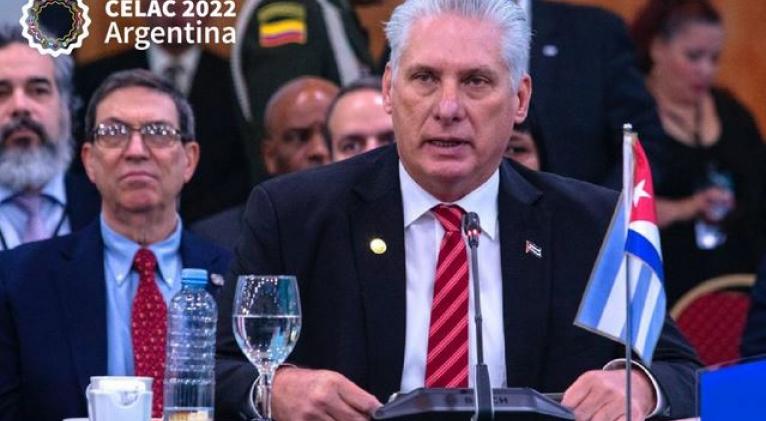
Cuban president denounces US interference at Celac Summit | Prensa Latina, 01.24.23

The 7th Summit Meeting of the Community of Latin and America States (CELAC) took place in Buenos Aires, Argentina on January 23. In their Declaration, representatives of 33 member nations, including 14 presidents, paid  homage to integration, unity, and  “political economic, social, and cultural diversity among member states.” They agreed “by consensus” to an all-embracing set of proposals and statements, 100 in all, and to 11 “special statements” on the situations of particular countries.

As is usual, host-country president Alberto Fernández made arrangements and set the agenda. The one-day meeting included closed- door discussions and brief presentations by representatives of the various country.

Participants at CELAC’s founding meeting in Caracas in 2013 declared  the region to be a “zone of peace.”  CELAC, it was hoped, would be promoting regional cooperation on social and economic development, agreement on common political goals, and progress toward integration and unity.

Preparations had begun in 2010 after U.S. interventions in Venezuela, Bolivia, Ecuador, Cuba, and other countries had intensified. CELAC would differ from Organization of American States (OAS), the regional organization serving U.S. interests since 1948. The United States and Canada are not members of CELAC. 

A gap separated the fifth CELAC Summit in 2017, in the Dominican Republic, from the sixth one, on September 16-18, 2021 in Mexico City. Instability in Venezuela, Bolivia, and Brazil was a likely factor.  Mexican President Andres Manuel Lopez Obrador (AMLO), presiding over CELAC VI, spoke of CELAC as the regional equivalent of the European Union. There was speculation about CELAC replacing the OAS. 

Brazilian President Luiz Inácio “Lula” Da Silva’s arrival at CELAC VII generated excitement. Brazil had rejoined CELEC after being removed by Former President Jair Bolsonaro in 2020. Lula supports closer ties of both CELAC and the Mercosur economic organization with the European Union.

In Buenos Aires, rightwing demonstrators from Argentina and elsewhere were noisily protesting against CELAC. They objected to the presence of leftist countries like Venezuela, Cuba, and Nicaragua. To avoid confrontation, Venezuelan President Nicolas Maduro and President Daniel Ortega of Nicaragua stayed away. AMLO also did not attend, claiming he was busy.

Crisis in Peru provoked divisions.  The Declaration was silent on the coup there and on repression of popular resistance. Colombian president Gustavo Petro, President Xiomara Castro of Honduras, and AMLO, in a video presentation, called for deposed President Pedro Castillo’s release from prison. Presidents Fernández of Argentina and Boric of Chile said nothing on that score. 

CELAC did not respond to Prime Minister Ariel Henry’s requests for  member states to “participate in a specialized multinational force requested by Haiti” to deal with gang warfare.

President Fernández, surprisingly, had invited U.S. President Biden, who sent former Senator Chris Dodd in his stead. Dodd spoke at the plenary session, as did European Council President Charles Michel.  President Droupadi Murmu of India participated virtually. Chinese President Xi Jinping sent a message of solidarity.

The Summit Declaration says little about implementing proposals and realization of earlier plans.  It refers to expected actions by United Nations agencies and by regional organizations with special experience and expertise.

The only CELAC actions mentioned are recent meetings of ministers of CELAC countries with international agencies dealing with healthcare and food-supply issues. The only CELAC initiatives underway soon are meetings of CELAC representatives with officials of the European Union, China, the African Union, and the ASEAN nations.

The website celacinternational.org mentions far-reaching plans as of 2013 for transportation, healthcare, and hunger-alleviation projects. A subsequent lack of follow-up information and references to other projects suggests flawed implementation.

Speaking at the Summit, Colombian President Gustavo Petro called for “building integration through concrete projects” and for action on the climate crisis, revitalizing the Amazonian forests particularly. He denounced “U.S. deficiencies in moving toward a carbon-free economy.” 

President Miguel Díaz-Canel of Cuba reminded his listeners of U.S. “efforts to divide us, stigmatize us and subordinate us to its interests.” The United States is isolated, he suggested, in its “strategy of hegemony and domination.”  And Cuba’s inclusion on the U.S. list of states that sponsor terrorism greatly impedes “our aspirations for development.

On video, President Maduro of Venezuela called upon CELAC to demand that the United States no longer intervene in the affairs of “free and sovereign nations” and “No more coup-plotting, no more sanctions against sovereign nations.” 

Uruguayan President Luis Lacalle, dissenting, charged that, “there are clearly countries here … that do not respect institutions, democracy or human rights.” He has drawn criticism for his push for a regional free trade zone and a Uruguayan -Chinese trade agreement. 

Speaking for El Salvador, Vice President Félix Ulloa urged CELAC to take on an executive secretary to preserve the alliance’s “institutional memory.” 

A CELAC “social summit” took place in Buenos Aires on the day prior to CELAC VII. Present were Argentinian trade unionists and leftist political parties and political leaders and activists from many countries. Former Bolivian President Evo Morales headed a panel of speakers.

Participants demonstrated outside the actual Summit against the rightwing protesters and “in support of our anti-imperialist presidents.”  Returning later, they demanded support for Peruvians’ resistance and called for non-recognition of the coup government. 

U.S. imperialism remained the perennial CELAC theme. Asked about U.S. designs on the region’s natural resources, Bolivian President Luis Arce was forthright: “[T]hese are our natural resources … We are not going to accept any imposition by anybody nor let anyone regard our natural resources as if it were theirs.”   

General Laura Richardson’s remarks before the Atlantic Council on January 19 had prompted the question. She is head of the U.S. Southern Command.

The next CELAC summit meeting will occur in Saint Vincent and the Grenadines, population 104,000 and the first Anglophone site for a CELAC meeting. Prime Minister Ralph Gon­salves will be presiding.


W.T. Whitney Jr. is a political journalist whose focus is on Latin America, health care, and anti-racism. A Cuba solidarity activist, he formerly worked as a pediatrician, lives in rural Maine. W.T. Whitney Jr. es un periodista político cuyo enfoque está en América Latina, la atención médica y el antirracismo. Activista solidario con Cuba, anteriormente trabajó como pediatra, vive en la zona rural de Maine.