
Fixing Healthcare Failures in the US and in Lewiston, Maine / By W. T. Whitney Jr.

Photo credit: Tim Wheeler/People’s World

South Paris, Maine


Efforts to reform U.S. healthcare fall short. Preventable deaths are excessive, access to care is often impossible, costs are high, and profiteering thrives. Individual solutions replace common purpose. Hope lies with an activated working class fighting for equitable, accessible, humane, and effective healthcare.

Maine people are now collecting signatures for a petition on the 2026 ballot demanding that the state promote universal healthcare. The campaign coincides with costs of Medicare insurance premiums increasing after January 1, 2026. That’s when subsidies provided under the Affordable Care Act are reduced. The campaign will react also to recent federal legislation that removed a million or so low-income Americans from Medicaid coverage.

The precariousness of current healthcare arrangements is evident to Maine voters who are aware of a painful transition taking place in Lewiston, Maine’s second largest city, population 39,187. Lewiston’s Central Maine Healthcare corporation (CMH) has been losing $32.5 million annually over five years. California-based Prime Healthcare, the fifth largest U.S. profit-making health system and owner of 51 hospitals in 14 states, is buying CMH.

Takeover

Serving almost half a million people in its region, CMH operates Central Maine Medical Center (CMMC), two smaller hospitals in the area, and also physicians’ practices, urgent care offices, nursing homes, and counselling centers in 40 locations. CMMC, established in 1891, has 250 beds and employs 300 physicians representing most specialties. The agreement to change ownership, announced in January 2025, is about to be finalized.

Prime Healthcare will invest $150 million in CMH over 10 years, while assigning CMH to its Prime Healthcare Foundation, a supposedly non-profit entity with $2.1 billion in assets. Prime Healthcare has a record

The corporation has periodically faced charges of overcharging, services dropped and safety standards ignored. After 2008, accusations surfaced in California of underfeeding hospital patients, allowing for post-surgery infections, and hospitalizing emergency room patients to increase revenues. Prime Healthcare in 2018 paid $65million in fines to settle accusations of Medicare fraud, over $35 million in 2021 for kickbacks and overcharging, and $1.25 million for false Medicare claims submitted by two Pennsylvania hospitals.

The Center for American Progress, a left-leaning think tank, recently warned against private equity companies owning health centers and controlling practitioners. It cited “unmanageable debt”, “increased costs for patients and payers,” poor patient care, and distressed healthcare workers.

Maine’s legislature on June 22 enacted  legislation establishing a one-year moratorium on private equity companies (and real estate investment trusts) owning or operating hospitals in the state.

Troubles in city and state

Other Maine health systems are also experiencing big financial troubles. Northern Light Health, with debt of $620 million, recently closed an acute-care hospital in Waterville and announced a new partnership with the Harvard Pilgram system in Massachusetts. Lewiston’s St. Mary’s Health System closed its obstetrical services, sold off properties, and is laying off employees. The New England-wide Covenant Health system, owner of St. Mary’s since 1990, indicates covering the hospital’s unpaid bills amounting to $88 million is not “sustainable.”

One media report suggests Maine people aware of layoffs, health institutions’ financial troubles and diminishing services are “wondering about the future of their health care.”  Medicaid funding reductions, shortages of primary care providers, and trimmed-down health centers have led to lengthy wait-times for appointments, long travel distances to new providers, and no care for many.

Lewiston, once a textile and shoe manufacturing center with a large population of French-speaking workers, migrants from Quebec, is “the poorest city in Maine.” Fallout from CMMC’s financial problems and reduced federal funding threaten the healthcare of people whose lives are already precarious.

Eleven percent of Lewiston residents are migrants from Africa, mostly from Somalia. The 2023 poverty rate for the city’s Somali people was 32%. For Lewiston it was 17.7% and for Maine  10.4%. Poverty for Androscoggin County, which includes Lewiston, was 13% in 2023; child poverty was 16.6%.  Life expectancy in Lewiston was 75.5 years in 2020, in Maine, 77.8 years.

Neither Maine or Lewiston is bereft of resources. Apart from remote rural and forested areas, Maine has well-functioning hospitals and competent practitioners.  Experienced and concerned agencies and organizations provide social services and support for health-impaired Mainers.

Maine ranks 17th  among the states in “cost, access, and quality of Medicaid and CHIP (Children’s Health Insurance Program) coverage for low-income individuals.” Another survey has Maine in 23rd place in “per person state public health funding” for 2023. A ranking of “states most supportive of people in poverty” puts Maine in 12th place.

Maine with its healthcare difficulties is not an outlier within the United States. Nevertheless, uncertainties prevail statewide, and Lewiston is in low-grade crisis mode. Planning is incremental, limited to localities, and accepting of the status quo. Collective action is not a consideration for those dealing with the crisis –providers, hospitals, recipients of care, and the general public. Individual initiative is the rule, as per U.S. habits.  

Wider perspective

Those healthcare flaws and difficulties evident in Maine exist throughout the United States. Awareness of the consequences is crucial to building support for necessary change.  

Too many people die. US infant mortality in 2021 ranked 33rd among 38 countries belonging to the Organization of Economic Cooperation and Development, the world’s wealthiest countries. U.S. life expectancy in 2025 ranked 48th in the world. U.S. maternal mortality rate in 2023 was in 59th..

Inequalities are pervasive, as reflected in the poverty and life-expectancy variations in Maine. The huge flow of money through the system highlights inequality; it takes place at levels far removed from the depths of U.S. society. U.S. health expenditures per person in 2023 were $14,885; the average in other countries comparable by wealth was $7,371. Health expenditure as percent of GDP in US was 17.6% in 2023; the figure for all other wealthy countries was lower than Switzerland’s 12.0%.

Incentives for profiteering are many. While administrative costs represented only 3.9% of total Medicaid spending in 2023 and only 1.3% of all traditional Medicarespending in 2021, they accounted for “about 30%” of the cost of private health insurance in 2023. Presumably, profit-taking is embedded within those high administrative costs.

Critics of US healthcare, writing recently in Britain’s Lancet medical journal, assert that “profit-seeking has become preeminent.” They add that:

“Health resources of enormous worth … have come under the control of firms obligated to prioritize shareholders’ interests … The potential for profits has attracted new, even more aggressive corporate players—private equity firms … [These have] a single-minded focus on short-term profit” … The US health-care financing system makes profitability a mandatory condition for survival, even for non-profit hospitals.” 

Realization dawns that adverse social and economic factors are tearing apart the benevolent purposes of healthcare. They make people sick. A report of the American Academy of Actuaries issued in 2020 says that, “30% to 50% of health outcomes are attributable to SDOH (social determinants of health), while only 10% to 20% are attributable to medical care.” A public health study shows that, “Nearly 45,000 annual deaths are associated with lack of health insurance.”

There is a way

That which has led to a floundering care system belongs to no one and weighs upon everyone, more so on the dispossessed and marginalized. It’s an epidemic, in the original Greek meaning of that word, “upon the people.”  Corrective action would therefore derive from and apply to all people all together. Healthcare itself supplies the model.

For many, physician John Snow is the “father of public health.” In London in 1854, Snow investigated an outbreak of cholera, a water-borne infectious disease. Suspecting that water from the Broad Street pump was the culprit, he removed the handle. The epidemic stopped. He had acted preventatively on behalf of the many, not for individuals.

Comes the Cuban Revolution and preventative and curative medical care are joined in one public health system. Political change allowed for that.

Rudolf Virchow (1821-1902), pathology giant and one of the founders of scientific medicine, was on the case almost two centuries earlier.  This leader of the Berlin Revolutionary Committee was behind the barricades in the revolutionary year of 1848. In 1847-1847, Virchow studies a typhus epidemic killing inhabitants of Upper Silesia. He notes in his report that:  

“A devastating epidemic and a terrible famine simultaneously ravaged a poor, ignorant and apathetic population. … No one would have thought such a state of affairs possible in a state such as Prussia, … we must not hesitate to draw all those conclusions that can be drawn. . . I myself …  was determined, … to help in the demolition of the old edifice of our state. [The conclusions] can be summarized briefly in three words: Full unlimited democracy.”

Virchow writes that, “Medicine is a social science, and politics is nothing else but medicine on a large scale… The physicians are the natural attorneys of the poor.”

If democracy was the fix then for an epidemic, it’s the fix now for the current epidemic of disordered healthcare. The people themselves would rise to the occasion. And how are they going to do that?

The role of profiteering in U.S. healthcare is a reminder of the capitalist surroundings of the struggle at hand. Aroused working and marginalized people are on one side and the rich and powerful on the other.

Does capitalism need to go in order that healthcare changes? Not yet, suggests international health analyst Vicente Navarro. In explaining U.S. failure to achieve universal healthcare, he observes that, “The U.S. is the only major capitalist developed country without a national health program, and without a mass-based socialist party. It is also one of the countries with weaker unions, which is to a large degree responsible for the lack of a mass-based working-class party.”

That clarifies. The working class is crucial to repairing a dismal situation. Its partisans will work on strengthening the labor movement in size and militancy. Working class political formations will have their day.

Martin Luther King has the last word. Speaking to health workers in 1966 King remarked that, “Of all the forms of inequality, injustice in health care is the most shocking and inhumane because it often results in physical death.”  His reference to “forms of inequality” implies the existence of the capitalist system giving rise to such forms. Capitalism fosters early deaths as well as racism.


W.T. Whitney, Jr., is a political journalist whose focus is on Latin America, health care, and anti-racism. A Cuba solidarity activist, he formerly worked as a pediatrician and lives in rural Maine.

The United Arab Emirates Enables Human Catastrophe in Sudan, with the US in Tow / By W. T. Whitney, Jr.

Photo credit Z

South Paris, Maine


Beginning in April 2023, war between Sudan’s army and the paramilitary Rapid Support Forces (RSF) has caused humanitarian disaster of epic proportions. Some 150,000 people have died and 14 million Sudanese – Sudan’s population is 51 million – are displaced internally or in neighboring countries. Over 24 million suffer acute food insecurity. Famine is rampant in Darfur, the district in northwestern Sudan most afflicted by war and hunger.

We look at causes, foreign intervention in particular. The Sudanese people are victims of top-down oppression inflicted by big imperialists, lesser ones, and Sudan’s elite.  

The Bashir government in 2013 created the Rapid Support Forces from the Janjaweed formations and installed General Mohamed Hamdan Dagalo, known as “Hemedti,” as leader.

Protests by democratic forces beginning in December 2018 led to joint civilian-military rule. A coup in April 2019 removed Bashir from power. Subsequently, General Abdel Fattah al-Burhan, head of the armed forces and now the country’s president, and deputy military commander Hemedti became co-leaders of a transitional military council.

Turmoil continued, as did agitation for democratic change. In October, 2021, the two generals, having instigated another coup, established themselves as the country’s sole rulers. Al-Burhan and Hemedti subsequently disagreed on how to incorporate the RSF into Sudan’s army and on who would command the RSF. Reacting, Hemedti in April, 2023 provoked yet another coup. The RSF was soon occupying Khartoum, Sudan’s capitol city.

The Sudanese army recaptured a devastated Khartoum in March 2025. The RSF, having laid siege to El Fasher for 18 months and defeated the Sudanese army, took over that city of 700,000 inhabitants in October, 2025. Killings skyrocketed.

As of November 6, the Rapid Support Forces have agreed to a “humanitarian ceasefire” for three months proposed by the U.S., Egypt, the UAE and Saudi Arabia. The Sudanese army rejected the truce, demanding  that the RSF withdraw from civilian areas and surrender their weapons.

Origins

African nations emerging from colonialism endured varying degrees of continuing oppression and differing kinds of instability. Even so, humanitarian catastrophe in Sudan and the killings seem to be unprecedented.

The country’s vulnerability shows in a destitute, divided population, military rule, and societal collapse. It stems from a long history of autocratic rulers and recurring coups before independence and afterwards, division between an Arab-oriented North and non-Arab South (leading to an independent South Sudan in 2011), and susceptibility to manipulation by outside actors.

The United Arab Emirates (UAE) has interests in Sudan. Mohammad Khansa, writing for al-akhbar.commentions that, “Sudanese gold fuels the RSF, and the UAE.” Newly discovered gold deposits account for 60% of the country’s exports. The UAE imported $2.29 billion worth of Sudanese gold in 2022. Ninety percent of the gold Sudan produces goes to the UAE.

Sudan, the “leading agricultural producer in both Africa and the Middle East” is the “breadbasket of the Arab world.” The UAE imports 90% of its food. UAE investors have fostered land grabs in Sudan and industrialized Sudan’s agricultural production.

Other UAE interests are:  management of key Sudanese ports on the Red Sea, UAE control of many Sudanese banks and the UAE’s use of the RSF as its proxy in competing with Saudi Arabian influence in Africa.

UAE intrusion

Explaining the UAE’s relationship with Sudan and the RSF, Husam Mahjoub, writing in Spectre Journal, states that, “The UAE’s role in Sudan is … part of a coherent, well-financed, and regionally expansive project: a sub-imperialist agenda that combines economic extraction, authoritarian alliance-building, and counterrevolutionary politics.” The UAE “viewed the Arab Spring [of 2011] as an existential threat to both the authoritarian regimes in the region and its own model of governance. …[The] UAE became an active counterrevolutionary force.”

The Sudanese people’s uprising in December 2018, prior to Bashir’s removal, continued “even after the October 2021 coup.” It was “democratic, civilian-led, and explicitly antimilitary.” Demands were “freedom, peace, social justice, civilian governance, and accountability.” According to Mahjoub, this “grassroots resistance posed a threat to both Sudan’s own elites and regional powers like the UAE.”  

The RSF has helped the UAE in two ways: its “capacity for violence—that is, a force willing to suppress protests, fight wars, and eliminate rivals” and “economic access, especially to Sudan’s lucrative gold trade, which the RSF increasingly controlled.”

“[N]ow the regional leader in the defense sector,” according to the Simpson Center, the UAE imports weapons and makes its own. UAE support for the RSF shows in weapons transferred to the paramilitaries.  Gold from the RSF allows the UAE to buy weapons from many countries, with a portion of them ending up with the RSF.

The weapons enter Sudan by irregular means across several borders, and the gold arrives in the UAE the same way.

The UK’s Campaign against Arms Trade points out that, although the UAE allows the RSF to commit genocide by providing weapons, “there have been no efforts to pressure the UAE or hold it to account, and massive US and French arms supplies to the Gulf dictatorship continue unabated.”

Back in the US

The Biden administration in January 2025 accused the Rapid Support Forces of genocide. In March, New York Representative Gregory Meeks introduced legislation prohibiting arms sales to countries supplying arms to the RSF or the Sudanese Army. The bill has 27 co-sponsors.

Maryland Senator Chris Van Hollen and California Representative Sara Jacobs reintroduced legislation in March prohibiting U.S. arms sales to the UAE for as long as that country sends arms to the RSF. There are no co-sponsors.

The Trump administration in May announced a $1.4 billion sale of weapons and military equipment to the UAE. In 2024, the UAE received U.S. weapons worth $1.2 billion.

Husam Mahjoub explains that the UAE, as a “strategic partner of the West, … a buyer of arms, a major collaborator with Israel’s genocidal regime, a conduit for intelligence, and a financial hub, … is too useful to punish.”

Useful indeed! Reporter Dan Alexander claims the UAE “has become a hub for the Trump Organization’s international expansion. …[The] president and his family have entered into at least nine agreements with ties to the gulf nation. Together, the ventures … will provide an estimated $500 million in 2025—and about $50 million annually for years into the future …The president’s offspring are plotting novel ways to use crypto mania to squeeze more money from their real-estate assets.”

Alexander quotes Eric Trump: “The UAE is the developers’ greatest dream because they never say ‘no’ to anything, …. There’s no place that has been more fun to work in than the UAE. I mean, if you want to build it, if you can dream it up, they allow you to do it.” Alexander’s article is titled “This Gulf Nation Is Powering Trump’s Moneymaking Machine.”

The Sudanese Communist Party issued a statement on October 29. Speaking for the victims, it says in part:

“Our Party stands clearly and decisively against the horrifying massacres being committed against civilians in the cities of El Fasher and Bara … [We] always affirm that what is happening is not merely a military struggle for power; rather, it represents a complex scene of conflict between the parasitic wings of capitalism within the country over power and resources …  The war is, at the same time, a regional/international/imperialist scheme aimed at weakening the Sudanese state and creating conditions for disintegration and division to deplete the capabilities of the people, the wealth of the country, and violate national sovereignty.” 


W.T. Whitney, Jr., is a political journalist whose focus is on Latin America, health care, and anti-racism. A Cuba solidarity activist, he formerly worked as a pediatrician and lives in rural Maine.

US imperialist war against Haiti / By W. T. Whitney Jr.

South Paris, Maine


The Trump administration on June 27 announced that Temporary Protected Status (TPS) applying to half a million Haitians living in the United States will end on September 2. That total includes 300,000 people who, having fled unrest and violence, gained TPS in June 2024 under the Biden administration; 200,000 other Haitians who entered following a terrible earthquake in 2010 received TPS during Obama’s presidency.

Haitians not voluntarily returning to their country or not qualifying for legal immigration status otherwise face deportation. A spokesperson for the Department of Homeland Security was reassuring: “The environmental situation in Haiti has improved enough that it is safe for Haitian citizens to return home.” That is not so.

A State Department travel advisory on Haiti in September 2024 tells U.S. citizens, “Do not travel to Haiti due to kidnapping, crime, civil unrest … Crimes involving firearms are common in Haiti …” Lawyer Aaron Reichlin-Melnick of the American Immigration Council insists that, “This is NOT a safe place to send people. It’s a death sentence.”

Desperation

In truth, chaos and devastation are going to speed the deaths of many Haitians. According to a recent report from the International Organization for Migration of the United Nations, “Nearly 1.3 million people have been forced to flee gang violence in Haiti and seek refuge elsewhere within the Caribbean country … This represents a 24 per cent increase from December 2024.”

The report adds that, “Behind these numbers are so many individual people whose suffering is immeasurable; children, mothers, the elderly, many of them forced to flee their homes multiple times.” The gangs, unified under the name Viv Ansanm, engage in stealing, killing, extorsion, and destruction.

For a decade and more, Haitians have repeatedly protested and mobilized in the streets against high prices and shortages. Business owners and the wealthy have funded the gangs in order to protect their properties and interests against popular mobilizations. The U.S. government turns a blind eye to weapons entering Haiti from the U.S. Analyst Seth Donnelly speaks of “Death squads … financed by members of Haiti’s upper class and heavily armed by major weapons flowing into Haiti from Florida.”

This account of Haitians in distress and of the U.S. government covering up the truth points to U.S. domination there that that differs from the targeting of Gaza and Iran. However, each of these situations as varied as they are, have characteristics defining them as imperialist interventions.

Important here is the connection between imperialism and capitalism. It looks like this: at a certain stage in history, imperialism came to represent a way for nations to be able to improve the capabilities of corporations to generate wealth. Therefore, fight against imperialism is fight against capitalism, because imperialism derives from capitalism. It follows that opposition to the excesses of U.S. imperialism in Haiti fits within customary anti-capitalist struggle. But one needs to appreciate the imperialist nature of U.S. interventions in Haiti. That’s the object of what follows here.

Rule from afar

President Jovenel Moïse, wealthy and a major embezzler of public funds, was assassinated for uncertain reasons by US -organized mercenaries in 2021. Subsequently, a governing body appointed by the so-called Core Group has supervised Haiti’s affairs. The Core Group represents key North American and European governments.

Garry Conille, Haiti’s de facto prime minister, in June 2024 welcomed to Haiti 400 Kenyan troops who were the first contingent of the UN-authorized and partially-U.S.-funded Multinational Security Support Mission. They would be fighting the gangs.  Full funding and the full complement of 2500 troops sent by participating nations have fallen short. Meanwhile, killings and internal displacement continue.

According to the New York Times, Eric Prince has recently sent weapons to Haiti and will soon dispatch 150 mercenary troops there. He has introduced drones that have killed at least 200 people. Prince was a big donor to President Trumps’s 2016 campaign and is by far the lead U.S. empresario of mercenary warfare. Who pays Prince is unspecified.

As if Haiti’s government is the prime actor in this drama, the Times report portrays that government as “turning to private military contractors equipped with high-powered weapons, helicopters and sophisticated surveillance and attack drones to take on the well-armed gangs.” Haiti’s government, in fact, is on leave – is AOL.

History with a logic

Nothing about this train of grief is by chance. Powerful forces – imperialists abroad and oligarchs within – remain determined, it seems, that a people-centered government will never take root in Haiti. Once, there had been an opportunity.

Cooperating with Canada and France, the U.S. government in 2004 backed the paramilitaries who removed President Jean-Bertram Aristide from power, along with his progressive Lavalas political party. Earlier in 1991, CIA-affiliated paramilitaries did likewise.

President Aristide’s overwhelming electoral victory in 1990 and Lavalas presidential candidate René Préval’s victory in 1995 represented the first and second democratic elections, respectively, in Haiti’s history. They were the last ones, so far. U.S. Secretary of State Hilary Clinton engineered Michel Martelly’s election as president in 2010. Jovenel Moïse’s election in 2016 was marked by electoral corruption.  No elections of any kind have taken place since that year.

Following the U.S. coup against Aristide in 2004, the U.S. government, United Nations officials and the Core Group (of imperialist countries) together installed, the “United Nations Stabilization Mission in Haiti” (MINUSTAH).  Under Core Group supervision, MINUSTAH imposed a military occupation from 2004 until 2017.  Reports abounded of destruction, dying, disease – particularly cholera – and sexual violence on the part of occupying troops. The Haitian people’s real needs went begging.  

Enslaved workers in what would become Haiti rebelled in 1791 and established national independence in 1804. Between then and 1991, when Aristide first became president, Haiti was under steady assault from foreign powers. The result was foreclosure on the country’s political and social development.

France pressured independent Haiti into providing reimbursement for French plantation owners’ loss of enslaved labor. Haiti borrowed money to pay. Vast debt obligations continued into the 20th century. The U.S. government refused for decades to trade with Haiti or recognize her independence. It carried out a brutal military occupation from 1915 until 1934 and fully backed the Duvalier dictatorship (1957-1986).

A flexible imperialism

U.S. oppression of Haiti takes place in ways other than the devices imperialists usually rely on. Intent upon accumulating wealth, they go abroad to capture natural resources like oil and try to control strategically placed geographic locations. U.S. imperialists, partnering with Israel, are pursuing both of these objectives in Palestine and Iran.

Haiti offers nothing to compare. Low-wage industry beckons but garment manufacturing, active in Haiti, is only a weak draw. However, Haiti presents other attractions for imperialists that are very much in line with goals of extending control and generating wealth.

Haiti’s achievement of national independence surely represented a great upset of colonial trade arrangements, and these had prepared the way toward capitalist industrialization. Early U.S. capitalists condemned happenings in Haiti. That attitude undoubtedly assured Haiti a place on the U.S. blacklist.  Maybe the stigma remains.  

Karl Marx explains that, “direct slavery is as much the pivot of bourgeois industry as are machinery, credit, etc. Without slavery you would have no cotton; without cotton you have no modern industry. It is slavery that gave the colonies their value, it is the colonies that created world trade, and world trade is the precondition for large-scale industry.”

One reason why U.S. imperialists make Haitians miserable is that, in doing so, they create a model image of massed people of color desperate to survive. That image, widely accepted, has possible use in projecting social precariousness as a constant in the underdeveloped world. The object would be to persuade northern exploiters that workers in such regions are so cowed as to accept poor working conditions and stay away from social revolution.

Additionally, the image of black people in great distress may be pleasing to the imperialists for its power of persuading non-Black victims of oppression living precarious lives to value what little remains of their self-regard and worldly possessions and to go it alone, and not join peoples of African heritage in common struggle. 

Lastly, old habits die slowly. The successful rebellion of enslaved people in Haiti stoked fear within U.S. political life and the wider community, both being under the sway of slave-owning interests. Fear persisted and Haiti’s image surely gained no favor during the Jim Crow era. And even now, crucially, racists and their ideas have their place within official Washington circles.


W.T. Whitney Jr. is a political journalist whose focus is on Latin America, health care, and anti-racism. A Cuba solidarity activist, he formerly worked as a pediatrician, and lives in rural Maine.

The Trump circus has a logic and it’s dangerous / By W.T. Whitney Jr

South Paris, Maine


As startling and far-reaching as they are, actions taken by the Trump administration are most impressive at first glance for their circus-like quality of no central purpose. Realization dawns, however, that measures hitting at the rule of law and democracy itself and promoting war and turmoil in the wider world are so politically disastrous that by no means would they have appeared accidentally.

The idea here is that present situation reflects the U.S. government’s last-ditch response to a crisis of capitalism. If so, any useful defense against unfolding catastrophe has to center, it seems here, on what needs to be done about capitalism.

The term signifies arrangements in effect since feudalism that give full rein to ruling classes everywhere to organize economic and political affairs to their advantage. Capitalism is an evolving process that, stumbling now and then, requires adjustments to its functioning. Presently, the masters of U.S. capitalism seem to be carrying out a major fix of old and new problems that impede profit-taking. The measures being employed are disruptive.

To get the job done, capitalist decision-makers recruited the MAGA crew as agents to take on the unpleasant job, among other, of removing protections against exploitation and abuse of U.S. working people. Lower-order capitalists having reservations will probably join the project, while holding their nose.

Some basic assumptions introduce the discussion here:

· To fix what’s wrong, you look for the cause.

· Focus on impaired personalities running the show does not fully explain the turmoil triggered by the Trump government’s recent actions.

· Preexisting political rules and arrangements for how to govern did nothing to prevent the present catastrophe.

· Wide sectors of the U.S. population are silent, stunned, and without hope. They are generally unconvinced that an alternative way of doing politics exists or is possible.

· The Trump administration regards political opposition as inconvenient, irrelevant, and disposable.

· Actions of his government result from rational decision-making. They are not the products of random impulses.

Beginnings

Capitalists cross established boundaries. Beginning centuries ago in Europe, they have been plundering distant parts of the world. Along the way, they added an exploitative factory system, great industrial monopolies, and, lastly, a world system of markets, cheap labor, and plunder of natural resources.

Overcoming challenges and contradictions, capitalists took charge of faraway peoples, fought wars against rival capitalist powers, confronted socialist governments and suppressed resistance movements at home and abroad. Periodically, they had to recover from economic crashes prompted by the impossibility of impoverished workers buying goods that were produced. The point here is that capitalists are used to dealing with challenges.

Capitalists after World War I were experiencing unprecedented difficulties, and fixing them was fraught with uncertainty. European and the U.S. economies were highly unstable even before the Great Depression arrived. Plus, the Soviet Union was attending to people’s social needs, was industrializing, and was little affected by the Great Depression. A socialist alternative to the capitalists’ faltering system had abruptly asserted itself.

Many capitalists in Germany and Italy reacted by tolerating or actively supporting the fascist political parties fighting for power in each of those countries. They claimed to offer protection for capitalist economies and fightback against the Soviet menace. Their restrained U.S. counterparts accepted palliative reforms mediated through New Deal social democracy.

U.S. capitalism took on new life after World War II when the United States took charge of inserting free trade and other neoliberal policies into the world economy, over which it presided. The system allowed rich nations and their capitalists to exploit low-wage workers abroad, take advantage of poor nations’ debt dependency, and profitably extract their underground resources.

New Troubles

The good times were not so good. Beginning in the 1970s, worldwide economic growth lagged and inflationary tendencies persisted. The U.S. economy was experiencing “long-term stagnation and deindustrialization.” Financial activities and financial assets now loom larger in the U.S. economy than do commodity production and trade.

Manipulation of debt instruments misfired in 2008 leading to serious economic crisis. These adverse, long-developing realities represent one impetus for capitalist leaders to move toward extraordinary corrective measures. The Trump administration is carrying them out.

The other big element marking the current disruption of national politics would be the expected unpredictability of the Trump administration’s conduct of foreign affairs. On the theory that the administration’s major task is to shore up capitalism, it will surely be acting so as to align U.S. overseas activities with capitalist norms.

Lenin and other authorities had a lot to say about these, mainly the notion that aggressive foreign interventions are crucial for capitalism to be able to function.

U.S. imperialism, a bipartisan project, expanded after post-World War II. U.S. imperialists have carried out interventions, wars, proxy wars, and devastating economic sanctions in country after country, mostly in the Global South. These activities will undoubtedly continue under the Trump administration in order to further capitalist purposes. Random remarks on Trump’s part suggestive of easing up on this or that foreign adversary contribute only to the current volatility of political affairs.

Anti-communism had long inspired U.S. overseas adventures, but U.S. warmaking continued even after the Soviet Bloc was no more. The U.S. government and its capitalist junior partners, for example, engineered devastating regime-change operations against Yugoslavia (1999), Iraq (2003), and Libya (2011) The cover of anti-communism was gone, and antiterrorism as justification barely sufficed. Subsequent U.S. foreign interventions have represented imperialism, pure and simple.

China and a few other underdeveloped nations are now major manufacturing centers. China continues to attract significant foreign investment and is investing, building infrastructure, and extracting subsoil resources throughout the Global South, in the process outstripping the United States. The BRICS+ nations, competitive with the Global North in banking, manufacturing and science, are seeking to replace the U.S. dollar as the main international currency.

What to do

U.S. capitalists, seemingly worried about uncertainties surrounding foreign interventions and about weaknesses of the faltering neoliberal free-trade system, are on the way to building something new. The suggestion here is that Trump circus riling U.S. politics is no accident and that a new kind of capitalism is on the horizon.

Under Trump the government is assertive, aggressively nationalistic, and insulated from progressive social and political currents from abroad. The U.S. has disconnected from international agreements and international organizations, notably the 2015 Paris Climate Accord and the World Health Organization. High import tariffs are landing on goods arriving from almost everywhere, with the highest ones reserved for Chinese products.

U.S. working people are, or soon will be, coping with price hikes stemming from high tariffs; assaults on labor organizing, healthcare, schools, and universities; selective food shortages; aggravated racism; and cruel and illegal deportation proceedings. New grief is compounding earlier unmet social and economic needs.

The changes are so far-reaching that progressive reforms introduced by President Franklin Roosevelt in the 1930s are at risk of disappearing. Breakdown of the New Deal consensus would be the crown jewel of the upcoming capitalist reformation.

Almost incidentally, war preparations are a major element of the new kind of capitalism. According to Monthly Review, “[R]earmament of U.S. allies, along with a massive increase in Pentagon spending and bellicose threats directed at designated enemies, could lead to the further proliferation of conflicts, heightening the chance of a Third World War.” A “Trump nationalist imperial policy” envisions a “New Cold War on China” involving a “limited nuclear war.”

Call in the specialists

A government embarking upon such far-reaching initiatives can expect troubles ahead. Vast numbers of U.S. Americans will be experiencing grief and abuse. They may rise up, prompting the need for their suppression and for maintenance of order. A major war would require the home front to be stabilized and controlled with vigor. A special brand of governance would come into play. Specialists are available for this kind of work.

They are MAGA crew, already on the job. Following a script, they hit at the rule of law, politicize the military, prepare for war, scapegoat immigrants and the racially oppressed as internal enemies, assault institutional centers of thought –universities, government research centers, and the independent press – and rip apart the fabric of democracy. Lying and disregard for the truth are nonstop.

You may have already made the association. Another bunch of fascists thugs almost a century ago in Germany and Italy did their reordering in ways similar to those adopted by the Trump administration in our era. Measures taken in both situations are similar, as are overall purposes.

The way out

Working-class resistance becomes important. Turning back the fascists – or protofascists, call them what you will – rests on alliances created between working people and other oppressed and marginalized sectors, especially in rural areas and among the lower ranks of the middle class, the so-called petit bourgeoisie. The MAGA movement’s electoral strength depends on support from both sectors and also, crucially, from elements of the working class.

The record shows that to defeat 20th century fascism, major elements of the Communist movement pursued the popular front strategy, the idea of worldwide alliance involving all democratic forces. That recipe fits today and, besides, no alternative political formation or remedy is waiting in the wings for rescue.

Communists are familiar through study and practice with the linkage between capitalism gone awry and the origins of fascism. Giving voice to that reality may be a first step in bringing unhappy, confused malcontents into political activism, and from there into mass mobilization, which is the essential tool for defeating fascism.

Communists and socialists will be educating and organizing, and asserting their places in public life. They would interact primarily, but not exclusively, with members of the working class. Their educational message would begin with the premise that capitalists unable to solve their big problems turn to fascism for rescue. They would highlight the connection between wars and imperialism.

Loose ends remain. First, U.S. capitalists’ reliance on the fascists is old hat for their kind. Business mogul Henry Ford and Charles Lindbergh of America First fame greatly admired the Nazis. Senator Harry S. Truman in 1941, commenting on war in Europe, stated that, “If we see that Germany is winning, we ought to help Russia, and if Russia is winning, we ought to help Germany, and that way let them kill as many as possible.” His message was that in the right circumstances Nazis are OK.

Secondly, U.S. capitalists, bent upon overcoming failures in how capitalism works, easily dismiss one of the greatest failures of worldwide capitalism, that of weak response to environmental crisis that threatens to destroy humankind and the natural world.


W.T. Whitney Jr. is a political journalist whose focus is on Latin America, health care, and anti-racism. A Cuba solidarity activist, he formerly worked as a pediatrician, and lives in rural Maine.

Haiti has disturbed U.S. ruling class for two centuries; Springfield is latest flare-up / By W. T. Whitney Jr.

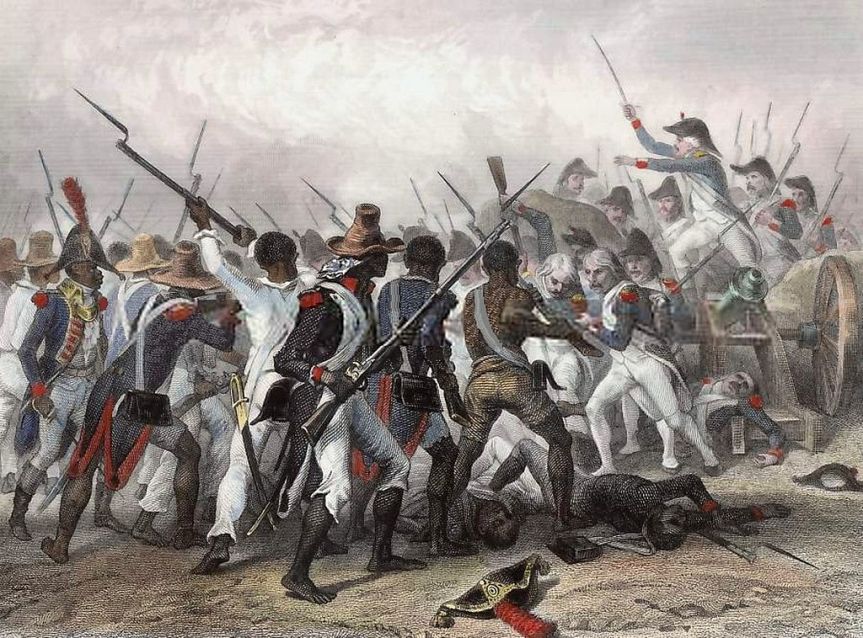
Haitian Revolution: Attack and take of the Crête-à-Pierrot (March 24, 1802). Original illustration by Auguste Raffet, engraving by Ernst Hébert. | Public Domain

Reposted from Peoples World


Republican presidential and vice-presidential candidates expressed horror a couple of weeks ago on apparently learning from social media that Haitian migrants in Springfield, Ohio, were eating dogs and cats, “eating people’s pets,” as Trump put it. The reports, as we all know now, were false, but their fallout was quite real. Bomb threats followed, schools and public buildings closed down, and longtime African-American residents felt threatened.

A bit of backstory: Springfield’s economy lost jobs and industries over the years. Some 15,000 Haitians arrived, eager to work. Industry expanded, but social service providers were stressed. Most of the Haitians in Springfield are there under Temporary Protected Status. That governmental designation enables migrants forced out of their counties by serious crises to enter the United States legally.

The bizarre twist of political behavior stems in part from the migrants being Haitian. Haitians and their nation have been problematic for the United States’ ruling class for more than two centuries.

The fact of migration itself does not account for the exaggerated hostility, though. Almost nothing of that order happens to the one-third of New York state residents and 40.9% of Miamians who are immigrants, or to the foreign-born residents of nine other urban areas in the United States who comprise from 21.1% to 39.1% of the several populations.

Stresses and frustrations associated with Springfield’s economic decline logically enough could have stimulated hostility toward migrants, if we look at what has happened historically in other communities. But economist Franklin J. James rejects the idea “that immigration hurts U.S. natives by reducing job opportunities …[and] that immigrants displace natives from jobs or reduce earnings of the average worker.”

Being Black may indeed invite hostility in a racist society, however. But the disconnect is sharp between the rarity of unbounded disparagement at high political levels and the large numbers of African-descended people who never experience the like from anybody. Opportunities abound. In 2019 Black people made up from 21.6% to 48.5% of the populations of 20 U.S. cities. That year nine Ohio cities, not including Springfield, claimed between 32.0% and 11.2% Black people. In 2024, 17.4% of Springfield residents are Black.

The scenario in Springfield may itself have been toxic: A large number of Black people from abroad arrived together on an economically depressed small city. But Somali migrants arrived in Lewiston, Maine under similar circumstances, and their reception was different.

They showed up in 2001, and a year later numbered 2,000 or so. In January 2003, an Illinois-based Nazi group staged a tiny anti-Black rally; 4,500 Mainers joined in a counter-demonstration.

As of 2019, according to writer Cynthia Anderson, “Lewiston … has one of the highest per capita Muslim populations in the United States, most of it Somali along with rising numbers of refugees and asylum-seekers from other African nations.” Of Lewiston’s 38,404 inhabitants, 10.9% presently are “Black or African American.” Blacks are 1.4% of Maine’s population.

Anderson reports that with the influx of migrants, Lewiston “has struggled financially, especially early on as the needs for social services and education intensified. Joblessness remains high among the older generation of refugees.”

Lewiston is Maine’s poorest city. For generations, massive factories along the Androscoggin River produced textiles and shoes, but they are gone. The city’s poverty rate is 18.1%; for Blacks it’s 51.5%. In 2016, 50% of Lewiston’s children under the age of five lived in poverty.

Citing school superintendent Bill Webster, an AP report indicates “immigrant children are doing better than native-born kids” in school, and are “going off to college to get degrees, as teachers, doctors, engineers.”

Analyst Anna Chase Hogeland concludes: “The Lewiston community’s reaction to the Somalis demonstrated both their hostility and reservations, as well as the great efforts of many to accommodate and welcome the refugees.” Voters in Lewiston are conservative; the majority of them backed Donald Trump in the 2016 and 2020 presidential elections.

The circumstances under which the two cities received Black immigrants differed in two ways. A nationwide upsurge in racist rhetoric and anti-immigrant hostility worsened conditions for migrants in Springfield. Lewiston’s experience had played out earlier.

Additionally, immigrants arriving in Springfield qualified for special attention. The aforementioned political candidates could have exercised their anti-migrant belligerence in many cities. They chose Springfield, presumably because the migrants there, objects of their wrath, are Haitian. Why are Haitians vulnerable?

A mural painted on an alley wall this month in Springfield, Ohio. | Carolyn Kaster / AP

Black people in what is now Haiti boldly rebelled against enslavement on French-owned plantations. Remarkably, they expelled the French and in 1804 established the independent nation they called Haiti.

Ever since, the United States has spelled trouble for Haiti. Pre-eminent abolitionist Frederick Douglas pointed out in 1893 that, “Haiti is black and we [the United States] have not yet forgiven Haiti for being black.” Long after “Haiti had shaken off the fetters of bondage…we continued to refuse to acknowledge the fact and treated her as outside the sisterhood of nations.”

Scholar and activist W.E.B DuBois, biographer of abolitionist John Brown, explains that “there was hell in Hayti (sic) in the red waning of the eighteenth century, in the days when John Brown was born … [At that time] the shudder of Hayti was running through all the Americas, and from his earliest boyhood he saw and felt the price of repression—the fearful cost that the western world was paying for slavery.”

DuBois’s reference was to the U.S. slavocracy and its encouragement of collective fear among many white people that Black workers—bought, owned, and sold—might rise up in rebellion. They did look to the example of Haiti and did rebel—see Herbert Aptheker, American Negro Slave Revolts.

In the United States, from the Civil War on, the prospect of resistance and rebellion on the part of Black people has had government circles and segments of U.S. society on high alert.

That attitude, applied to Haiti, shows in:

  • S. instigation of multi-national military occupations intermittently since 2004.
  • Coups in 1991 and 2004 involving the CIA and/or U.S.-friendly paramilitaries.
  • Backing of the Duvalier family dictatorship between 1957 and 1986.
  • The brutal U.S. military occupation of Haiti between 1915 and 1934.
  • S. control of Haiti’s finances and government departments until 1947.
  • No diplomatic recognition of Haiti from its beginning nationhood in 1804 until 1862.
  • S. economic sanctions against Haiti for decades, until 1863.

Says activist lawyer Bill Quigley: “U.S.-based corporations have for years been teaming up with Haitian elite to run sweatshops teeming with tens of thousands of Haitians who earn less than $2 a day.”

Ultimately, it seems, threads of governmental callousness, societal disregard for basic human needs, and outright demagoguery coalesced to thrust Springfield and Haitian migrants into the national spotlight. Molelike, the anomalous and little-acknowledged presence of Haiti asserts itself in the unfolding of U.S. history.

As with all op-eds and news-analysis articles published by People’s World, this article reflects the views of its author.


We hope you appreciated this article. At People’s World, we believe news and information should be free and accessible to all, but we need your help. Our journalism is free of corporate influence and paywalls because we are totally reader-supported. Only you, our readers and supporters, make this possible. If you enjoy reading People’s World and the stories we bring you, please support our work by donating or becoming a monthly sustainer today. Thank you!


W.T. Whitney Jr. is a political journalist whose focus is on Latin America, health care, and anti-racism. A Cuba solidarity activist, he formerly worked as a pediatrician, lives in rural Maine. W.T. Whitney Jr. es un periodista político cuyo enfoque está en América Latina, la atención médica y el antirracismo. Activista solidario con Cuba, anteriormente trabajó como pediatra, vive en la zona rural de Maine.

Awareness of capitalists’ use of colonialism invites rethinking of solidarity commitment / By W. T. Whitney Jr. 

Mural by Dan Manrique Arias | Photo by Terence Faircloth, CC BY-SA 4.0

South Paris, Maine


Studying capitalism, Karl Marx examined the Industrial Revolution in Europe. He explored conflict between worker and employer. In their book Capital and Imperialism (Monthly Review Press, 2021), authors Utsa Patnaik and Prabhat Patnaik emphasize that Marx’s followers believed that, with the onset of capitalism, “accumulation [has] occurred only on the basis of the generation of surplus value.” (Surplus value signifies that part of a product’s commercial yield which labor generates and employers keep.)

Many U.S. political activists oppose the overseas wars and interventions their government uses to maintain worldwide political and economic domination. More than a few know about stealing in the peripheral regions of the world at the hands of capitalism. They are aware of U.S. imperialism.

The stolen goods include: land, bodies, raw materials, food crops, forests, water, extractable underground resources, exorbitant interest on debt, and funding owed the world’s poor for subsistence. Non-payment for social reproduction is a kind of stealing.

The more these activists learn that capitalism from its start did call for oppression in the undeveloped regions of the world, the more likely might be their inclination to build an anti-capitalist international solidarity movement. The book authored by the Patnaiks contributes to this end by documenting that colonialism and, implicitly, imperialism have been essential to the development of capitalism.

In describing India’s colonial experience, their book – by no means reviewed here in its entirety – provides an explanation taken from Marx as to why capitalism needed colonialism. It details the workings of capitalist-inspired colonialism in India.      

The Patnaiks declare that, “not only has capitalism always been historically ensconced within a pre-capitalist setting from which it emerged, with which it interacted, and which it modified for its own purposes, but additionally that its very existence and expansion is conditioned upon such interaction.” Capitalists sought “appropriation of surplus by the metropolis, under colonialism.” (“Metropolis” is defined as “the city or state of origin of a colony.”)

They explain that “Marx’s basic concept of capitalism [as expressed] in Capital is of an isolated capitalist sector … consisting only of workers and capitalists,” also that an isolated sector implies a capitalism “stuck forever in a stationary state or a state of simple reproduction … [and] with zero growth.” They insist that “a closed self-contained capitalism in the metropolis is a logical impossibility.”

There is “nothing within the system to pull it out of that state.” The economy “will necessarily get to that state in the absence of exogenous stimuli.” 

The Patnaiks envision three kinds of exogenous stimuli: “pre-capitalist markets, state expenditure, and innovations.” The first of these represents the colonialism that would be essential to capitalists as they built the economies of European industrial centers. 

Inflation a concern

Outlining how British capitalism dealt with colonial India, the authors highlight money as a device for holding and transferring wealth. The object has been to preserve its value. The system had these features:  

·        Officials in London used the surplus derived from Indian exports of primary commodities to finance the export of capital to other capitalist countries.

·        British officials taxed the land of small producers in India, using the revenue to pay the colony’s administrative expenses and purchase commodities for export to Britain; some were re-exported to other countries.

·        Britain exported manufactured goods. The flood of them arriving in India led to “deindustrialization of the colonial economy.” Displaced artisan manufacturers became “petty producers” of commodities.

·        British officials dealing with “increasing supply prices” for commodities exported from the colonies, faced “metropolitan money-wage or profit margin increases.” Seeking to “stabilize the value of money,” they imposed “income deflation … [on Indian] suppliers of wage goods and inputs to the capitalist sector.”

·        The claims of heavily-taxed agricultural producers in India were “compressible” especially because they were located “in the midst of vast labor reserves.”  

Colonialism provided British capitalists the option of cutting pay or jobs in India so as to carry out the currency exchanges the system required and to “accommodate increases in money wages” in Britain, both “without jeopardizing the value of money.”

Global economy

The book outlines post-colonial developments. Colonial arrangements persisted throughout the 19th century and collapsed after World War I, due in part, say the authors, to a worldwide agricultural crisis that peaked in 1926. The circumstances gave rise to the Great Depression. Spending for World War II led to recovery, mostly in the United States.

These were “boom years” for capitalism. The United States, confronted with increasing military expenses, turned to deficit financing. Western European countries took up social democracy and the welfare state. Some former colonies, now independent nations, sponsored agricultural and industrial initiatives aimed at relieving economic inequalities.

At that point, the centers could no longer impose income deflation on working people in the periphery to ward off loss of monetary value. Bank holdings increased and lending pressures mounted. In 1973 “the Bretton Woods system collapsed because of the emergence of inflation.” “The capitalist world of the stable medium of holding wealth …[through] the gold-dollar link” took a hit.

Next came worldwide take-over by global finance capital and neoliberalism. The Patnaiks explain that, with “barriers to capital flows” down, “state intervention in demand management becomes impossible.” “[A] regime of income deflation on the working people of the periphery” returned in order to “control inflation and stabilize the value of money.” 

Concluding

This story is of continuities. One is capitalism at its start taking up with colonialism. Another is capitalism using colonialism to preserve the value of money in cross-border commercial and financial dealings. One more is the oppression and beggaring of the world’s working people to prevent inflation.

Karl Marx may have found data and other information on colonialism scarce as he studied capitalism. Additionally, his life of research and political activism may have been so full as to distract him from investigation of the colonial connection. Even so he championed international worker solidarity.  

He and Engels supported India’s independence struggle. Marx defended “heroic Poland” beset by Czarist Russia. He writes to Engels that, “In my view, the most momentous thing happening in the world today is, on the one hand, the movement among the slaves in America, started by the death of [John] Brown and on the other the movement of the serfs in Russia.”

Addressing the International Working Men’s Association – the First International – in 1864, Marx reported that events “have taught the working classes the duty to master themselves the mysteries of international politics; to watch the diplomatic acts of their respective governments.”

The wreckage of people’s lives caused by capitalism now extends widely. The venue of capitalism is global, by its nature. Political support for workers and their political formations in the Global South hits at the essence of capitalist power. The promise of basic change lies in that direction, and that’s so too with alternatives to the capitalist system.

Those struggles for social justice and equality that are confined to the world’s industrial centers do target aspects of capitalism, but without far-reaching expectations. The full effort consists of: pushing for reforms that ease burdens placed upon working people, building mass opposition, and – crucially – advancing the international solidarity movement.


W.T. Whitney Jr. is a political journalist whose focus is on Latin America, health care, and anti-racism. A Cuba solidarity activist, he formerly worked as a pediatrician, lives in rural Maine. W.T. Whitney Jr. es un periodista político cuyo enfoque está en América Latina, la atención médica y el antirracismo. Activista solidario con Cuba, anteriormente trabajó como pediatra, vive en la zona rural de Maine.

Vietnam Is Precedent as US Prepares for War with China / By W. T. Whitney

Near Da Nang, South Vietnam, Marines move through ankle-deep mud carry their poncho-covered comrade towards higher ground were, when the weather permits, he will be air-lifted to the rear areas, Jan. 16, 1968. (AP Photo/John T. Wheeler)

South Paris, Maine


Popular struggle for national independence under socialism has regularly provoked U.S. war or hostile interventions, as with Cuba, North Korea, China, Vietnam and other nations. We explore both the extreme danger of possible U.S. war with China and also the changing U.S rationale for fighting wars. This shows in the difference between why the U.S. war in Vietnam was fought and why U.S. war with China may be on the way.   

Vietnam recently commemorated agreements reached 70 years ago in Geneva that on July 21, 1954 ended war between Vietnamese revolutionary forces and the French military, defeated two months earlier at Dien Bien Phu. According to official media, the object of a “scientific conference” held on July 19 was “to emphasize the historical importance of the agreements for the struggle for national liberation of the Vietnamese people and the peoples of the world.”

Nguyen Phu Trong | Photo: Anadolu Ajnsi

Also on July 19, Nguyen Phu Trong died. Once chairperson of the National Assembly and president of Vietnam, this paramount leader, a student and teacher of Marxist theory, had long served as general secretary of the Communist Party of Vietnam. His death is a reminder, if such is needed, that for Vietnam revolutionary socialism and national liberation were kindred struggles.

To prevent the unification of Vietnam as a socialist nation, the U.S. government went the last mile, first diplomatically and then militarily – from the 1954 Geneva agreements that established Vietnam’s national independence to the departure of defeated U.S. troops on April 30, 1975. The U.S. leadership class, involved in spreading U.S. power and influence across the globe, created and then defended South Vietnam, while attempting to defeat Vietnam’s Revolution, all at enormous human and material cost.

The enclave remaining after a U.S. victory might have ended up as a beachhead for counter-revolution and U.S. control in Southeast Asia. In their various situations, that’s the role performed by South Korea, Taiwan, and even Ukraine in relation to Russia, and Israel vis-a-vis the rest of the Middle East.

U.S. planners, in thinking about what to do about Vietnam, were not entirely devoid of reason. For U.S. imperialists, to beat back Vietnamese Communists – think “domino theory” – and heat up the Cold War against the Soviet Union had a certain logic, according to their own lights.

After the Vietnam disaster, official U.S. planning for war has built upon a variety of ostensible reasons for fighting. Having emerged from World War II well-resourced and strong, the U.S. government consistently demonstrated limited tolerance for the risings of oppressed, colonialized peoples. However, once newly formed independent states showed signs of strength, regional prominence, or even strategic rivalry, U.S. strategists turned to action.

War materialized as the ultimate U.S. fix, no matter the circumstances and under a variety of pretexts, as shown with U.S. war-making in Libya, Afghanistan, and Iraq. The rationales for fighting were more diffuse. The threat of U.S. war now looms over Iran and, more ominously, over China. Each is under the gun because they are strong, assertive states.  

Anti-communism was a safer kind of rationale. Vietnam won its “American War,” and the U.S. government backed off. That’s the story. Incidentally, the Vietnamese people scored a clear win. They live according to plans and socialist purpose in a free and independent nation.  

Vietnam has established diplomatic relations with 190 countries. A Vietnamese writer cites “important achievements with infrastructure gradually meeting the needs of industrialization and modernization.”  Since reforms in the 1980s, an economy resting mainly on foreign direct investment in manufacturing and tourism has expanded. Economic growth ranged between 9.5 and 5.5 percent between 1993 and 2022, save for sharp drops in 2020 and 2021. GDP rose 5.05 percent in 2023. By 2022, the poverty rate was down to 4.3%.

Vietnam’s government since 2008 has spent 20 percent of its budget on education. The same report mentions “high primary school completion rates, strong gender parity, low student/teacher ratios,” and school attendance rates that are high.  The British medical journal Lancet indicates that, “Along with the economic growth, the health of the Vietnamese people has significantly improved between 1990 and 2020, whereby the life expectancy grew from 69 to 75 years, and the under-five child mortality rate decreased from 30 to 21 per 1000 live births.” 

Socialist China restored dignity to the vast majority of its citizens, has afforded them decent lives, and created a well-functioning state that responds effectively to the climate crisis and other challenges. It too warrants a pass from the U.S. government.

That’s not happening: the U.S. government, in the hands of a divided leadership class, deals only haphazardly with major problems afflicting U.S. society. It satisfies the material wants of the upper echelons, and presides over war preparations as part of what is, in effect, a new Cold War.

Indeed, the USA has accumulated over 750 bases in 80 countries and posted 173,000 troops in 159 counties. The U.S. share of global arms exports in 2019-23 was 42 percent, up from 34 percent during the previous four-year period, according to sipri.org.

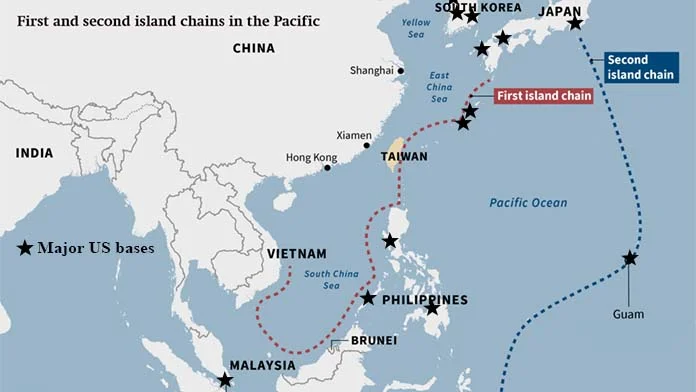
The US has two island chains around the coast of China. The stars indicate major US bases | via solidarity.net.au

In the Pacific waters surrounding China, the United States has expanded the capabilities of its bases; it operates nuclear-equipped naval vessels, arranges for multi-national naval exercises, has vessels engaging in provocative “freedom of navigation exercises,” and will be introducing nuclear-powered submarines.

The idea of multiple and varied reasons for fighting wars, presented above, folds neatly into the overarching notion of a new Cold War, something that by nature is ambitious, far-reaching, and long term.  Where is the justification for that?

Here is a guess: The United States decades ago turned to a great variety of activities related to military preparation, financing, and recovery. These now intrude massively in the U.S.  economy and in society itself, so much so that, in theory, something has to happen to explain and justify such a state of affairs. War provides meaning, without which the whole apparatus might disappear. What then of the economy and of the collective experience of a U.S population variously oriented to the military?

The Costs of War Project of the Watson Institute of Brown University weighs in. Author Heidi Peltier points out that:

Federal spending on the military and on veterans makes up more than half of the federal discretionary budget. Employment in the federal government is dominated by civilian defense workers and uniformed military personnel. Because the majority of taxpayer dollars and federal resources are devoted to the military and military industries, and most government jobs are in the defense sector, the political power of this sector has become more deeply entrenched and other alternatives have become harder to pursue. Instead of having a federal government that addresses various national priorities … the U.S. has a government that is largely devoted to war and militarism.

Illustration: Liu Rui/GT

Unfortunately, protecting both the U.S. economy and habituation to the military has its downside, specifically extreme danger to humanity itself. Writing in the most recent issue of Monthly Review magazine, John Bellamy Foster and Brett Clark explain, pointing to China. Discussing “Imperialism in the Indo-Pacific,” they state that:

“Most U.S. strategies for winning the New Cold War directed at China are aimed at a strategic-geopolitical defeat of the latter that would bring down Chinese President Xi Jinping and destroy the enormous prestige of the Communist Party of China, leading to regime change from within and the subordination of China to the U.S. imperium from without … (It) is the United States, which sees China’s rise as a threat to its own global preeminence, with the Indo-Pacific super-region increasingly being viewed as the pivotal site in the New Cold War, that is propelling all of humanity toward a Third World War.”


W.T. Whitney Jr. is a political journalist whose focus is on Latin America, health care, and anti-racism. A Cuba solidarity activist, he formerly worked as a pediatrician, lives in rural Maine. W.T. Whitney Jr. es un periodista político cuyo enfoque está en América Latina, la atención médica y el antirracismo. Activista solidario con Cuba, anteriormente trabajó como pediatra, vive en la zona rural de Maine.

Libya Catastrophe is Double Whammy, Capitalism to Blame / By W. T. Whitney Jr.

Darna, Libya after dams collapsed in the wake of storm Daniel. (Photo: AP/Jamal Alkomaty)

South Paris, Maine


Prodigious rainfall and the failure of long-deteriorated earthen dams caused a rush of waters through Derna, in Libya, on September 11.  Thousands of residents died, infrastructure was destroyed, and buildings ended up in the Mediterranean. Failure to protect residents, maintain the dams, and sustain the lives of all Libyans point to societal collapse.  

There is also the environmental crisis. Climate change provoked the enormity of storm Daniel that had drenched the eastern Mediterranean area ahead of the disaster. The association of climate change and terrible storms is known and so too is the role of human activities in causing great amounts of greenhouse gases to be released into the atmosphere.

The focus here is on the social disruption that transformed Libya. That’s because predisposing factors may not be clear. There are lessons to be learned.  The two crises are actually joined by virtue of both having developed out of a single impulse for domination.

Nationalist rebels led by Muammar Gaddafi deposed the embattled Libyan regime of King Idris on Sept. 1, 1969. Between 1973 and 1977, a Yugoslavian company contracted by the new government built two dams on the Wadi Derna River for the sake of flood control and irrigation. Maintenance of the dam would be lax.

A 1998 study revealed cracks and deterioration. After delays, a Turkish company began repairs on the dams in 2010. When the Gaddafi government was ousted in the following year, the work stopped.  Some $2.3 million was on hand for finishing the project. It disappeared.

Anti-government protests ─ the   Arab Spring ─ had broken out throughout the region in 2010. An anti-Gaddafi insurgency making headway in early 2011 prompted the military forces of the United States France, Great Britain, and a host of other countries to carry out a self-styled humanitarian intervention in March. Gaddafi’s murder seven months later ended the intrusion.  

U.S complaints had centered on an “opaque political and economic system,” widespread corruption, and Gaddafi’s autocratic proclivities. There had been mutual, and occasionally lethal, provocations.  Gaddafi’s increasing financial and banking influence in Africa raised eyebrows.

Gaddafi had offended by nationalizing 51% of oil companies’ assets in 1973.  According to one expert, “in 2006 the oil sector in Libya … made up ninety-five percent of export earnings, ninety-two percent of government revenue, and seventy-three percent of GDP.”  

The foreign assailants could not have overlooked the reality that a government with tight control over oil was in trouble with an insurgency.  It was no mean prize. Libya’s oil reserves now rank first in Africa and nineth in the world.  

Their forces carried out air operations, inflicted civilian casualties, assisted with the rebels’ ground actions, blockaded ports and embargoed weapons deliveries. They had a convenient tool.

Writer Eve Ottenberg a decade later accuses NATO, instrument for intervention, of fattening the wallets of war profiteers and weapons moguls and wreaking havoc in places like Yugoslavia, Afghanistan, Libya, now Ukraine.” Today France , Holland, and the United States are looking at French Guyana as a “forward-operating base for NATO” in Latin America, reports Guyanese activist Maurice Pindard. 

In its own review of “past and present” missions, NATO, with planetwide ambitions and unlimited potential for destruction, is, as expected, bereft of even a hint at repairing places left in chaos after its wars.

NATO departed from Libya, and ever since a government in the West of the country has been vying with a militarized counterpart in the East, where Derna is located. Cities have been bombed and occupied; Derna was subject to Islamic State rule from 2014 to 2016. Mercenaries, militias, and tribes jostle with one other. Milita groups control oil fields and extort vast sums. There’s “pillage on a vast scale,” plus drug-trafficking and exploitation of migrants heading to Europe.

Now one third of Libyans live in poverty; 13% of them require humanitarian aid, according to one estimate. By 2016, oil production, the source of social spending, had fallen to 75% below Gaddafi-era levels. It’s risen recently. 

The troubles experienced by Libya’s people were new. The Ghaddafi government had achieved much. The  2010 UN Human Development Index, a composite measure of health, education and income, ranked Libya 53rd in the world and first in Africa. By then, Libya was registering the highest per capita income in Africa, the lowest infant mortality, and the highest life expectancy. Schooling and healthcare were provided without Libyans having to pay.

Under Gaddafi, more than 95% of Libyans were adequately nourished; the government had abolished taxes on food. Literacy increased from 25% to 87% during the Gaddafi era. Almost 10% of Libya’s youth received scholarships for study abroad. Beginning in 1983 the government developed a massive water-delivery system with 1,100 new wells and 4,000 kilometers of pipelines.

Had the Gaddafi government not disappeared, the social advances and protection might have remained. Some of the progress might have continued under another government, if there had been no intervention. 

What’s certain is that previous arrangements for sustaining the population disappeared following NATO’s military action. Adverse conditions now allowed for the dams to disintegrate and for Libya’s people to not be rescued.

Pointing to a planetary “double crisis,” an ecological crisis and a social one, analyst Jason Hickle insisted recently that the two crises be dealt with simultaneously: “Attempting to address one without the other leaves fundamental contradictions entrenched.” He adds that, “the two dimensions are symptoms of the same underlying pathology … [which is] the capitalist system of production.”

Derner is witness to Hickle’s double crisis. The unprecedently heavy rainfall reflects climate crisis. A decade of turmoil and neglect of the dams attests to social crisis. The two share the same root cause. 

Capitalism requires perpetually increasing production of goods, which led to overuse of fossil fuels, which has translated into climate change. Under capitalism, natural resources in the world’s peripheral regions are plundered. Popular forces may be suppressed. Devices like NATO come into their own. If it had occurred a little earlier, Jason Hickle could have used the catastrophe to illustrate the main point of his article.


W.T. Whitney Jr. is a political journalist whose focus is on Latin America, health care, and anti-racism. A Cuba solidarity activist, he formerly worked as a pediatrician, lives in rural Maine. W.T. Whitney Jr. es un periodista político cuyo enfoque está en América Latina, la atención médica y el antirracismo. Activista solidario con Cuba, anteriormente trabajó como pediatra, vive en la zona rural de Maine.

Martin’s Point Joined in on Big Scam of Privatized Healthcare / By W.T. Whitney Jr.

Medical Bill (Getty Images/everydayplus)

South Paris, Maine, 09.11.2023


The U.S. Justice Department accused Martin’s Point Health Center in Portland, Maine, of Medicare fraud. According to a settlement announced on July 31, the Center will return $22.5 million to federal authorities while not admitting to wrong-doing. 

Revelations from whistle-blower Alicia Wilbur, once a Martin’s Point manager, prompted an investigation. She will receive $3.8 million for her pains, as per the False Claims Act

Martin’s Point received extra Medicare funding by means of exaggerating the seriousness of illnesses of older patients in its care. Other health centers and big insurance companies across the nation have done likewise. Many have been investigated and punished.

The Medicare Modernization Act (MMA) of 2003 launched Medicare Advantage (MA) plans. Multi-specialty medical centers, hospital networks, and insurers made use of MA plans as they delivered care or provided health insurance. Doing so, they took advantage of a section of the MMA that authorized extra Medicare funds being released for the care of sicker patients.

To receive funds, the insurers and healthcare centers, Martin’s Point among them, inflated their numbers of sick patients by assigning additional diagnoses to them. Old and even inconsequential diagnoses became active problems. Complicated clinical situations seemed to emerge. So-called “upcoding,” the adding-on of new diagnostic codes, tapped into extra Medicare funding. The money became general-purpose largesse.

The New York Times cites an insurance company that “mine[d] old medical records for more illnesses.” Insurers sent “doctors or nurses to patients’ homes” to find diagnoses. Medical records often lacked documentation of new diagnostic codes. 

Martin’s Point, originally a public health hospital for sailors, became a group medical practice caring mostly for military families. It expanded its patient population and after 2007 enrolled older people into its Medical Advantage plan. Soon the organization was operating six multi-specialty centers in Maine and New Hampshire, and caring for 60,000 MA beneficiaries.

This ostensibly non-profit organization took in revenue of $472,119,641 in 2020. It registered $40,107,975 as net income. Former CEO David Howe’s salary in 2020 was $937,418.

Reporter Joe Lawlor ─ who did much to expose the Martin’s Point scandal ─ cites lawyer David Lipschutz of the Connecticut-based Center for Medicare Advocacy: “These Medicare Advantage plans are getting grossly overpaid” and “incentives are in place for Medicare Advantage plans to maximize profits.”

According to one study, MA plans offered by insurance companies yield an excess of money coming in over payments going out that is “about double” the spread shown by other kinds of health insurance.

It’s no surprise. The legislation that created Medicare in 1965 tied the funding of older people’s healthcare to social security and payroll deductions. It created the Centers for Medicare & Medicaid Services to deliver federal funds directly to hospitals and care providers. The MMA of 2003 upset these arrangements.

Medicare funds began flowing to healthcare centers and big insurance companies. These became intermediaries as they provided care or paid for it, while attending to their business interests. The door opened up to profiteering and chicanery.

The purveyors of healthcare plans or health insurance use MA plans as bait for institutional consumers looking for a bargain.  They target companies, governmental agencies, and public service employers. Many of these entities, through union contracts, have to provide healthcare benefits for current and retired employees. They want to hold back on spending.

Healthcare activist and analyst Kay Tillow explains how MA plans accomplished that. They shifted Medicare benefits to the privatized Medicare Part D prescription-drug plan. They also implemented the Employer Group Waiver Plans authorized by the enabling legislation. The so-called “egg-whip” (EGWP), allows MA plans to skirt traditional Medicare guidelines. They “impose conditions on the promised benefits.”

These include limiting, delaying, and/or denying care, plus subjecting decisions of physicians and other care-givers to “prior authorization.”  Approved providers are rationed through geographical limitations. And “co-payments will escalate with the gravity of the illness.” MA plans offer ways to cut back on care and, on that account, costs go down.  

By moving retired former employees into the privatized MA plans, employers can register savings of 50% or more, one analyst reports. The plans appeal to working-age people nearing retirement and to the already-retired through coverage they offer for prescription drugs and often for dental, eye, and hearing care. The insurance companies and healthcare networks vigorously market their MA plans.

The packaging of MA plans for retirees with health plans for workers works to reduce employer costs. Active workers usually healthier than their elders; their care is less costly.  And funds pocketed from MA plans may be shifted to paying for workers’ care.

The more the [MA] plans are overpaid by Medicare, the more generous to customers they can afford to be,” according to the New York Times. Generosity comes easily: overpayments of Medicare funds to Medicare Advantage plans presently exceed $75 billion annually.

Conclusions are in order. Medicare’s entry into the profit-making realm undermined its goal of better access to care for older citizens. Now it forecloses on the possibility of equitable healthcare for all. Proposals for Medicare-for-All legislation would get rid of profiteering in healthcare. Here is information about Senator Bernie Sanders’s proposal and about one put forth by the group Physicians for a National Health Program.

To imagine that profit-making might be removed from healthcare, and from no other sector, is magical thinking. The reality is that cutbacks on capitalism are required. 

The U.S. connection between paying for healthcare and employment status stymies efforts at universalizing healthcare. Plans fashioned to satisfy employee demands alone are divisive. The healthcare aspirations of other working people are unfulfilled. 

Meanwhile, enrollment in the privatized MA plans has grown, now to the point of at least equaling the population of retirees depending on traditional Medicare. More federal spending on MA plans is “accelerating the rate at which the Medicare trust fund is being exhausted.” Maintaining the quality and quantity of care provided under traditional Medicare will be no easy task. 


W.T. Whitney Jr. is a political journalist whose focus is on Latin America, health care, and anti-racism. A Cuba solidarity activist, he formerly worked as a pediatrician, lives in rural Maine. W.T. Whitney Jr. es un periodista político cuyo enfoque está en América Latina, la atención médica y el antirracismo. Activista solidario con Cuba, anteriormente trabajó como pediatra, vive en la zona rural de Maine.

U.S. Deaths Highlight Need for Far-Reaching Change / By W. T. Whitney Jr.

Demonstrators carry a coffin over Brooklyn Bridge during a march against gun violence, 06.02.18, in NY. | Mary Altaffer – AP

Under U.S. capitalism, industrial production and consumerism expand. Greenhouse gases increase, the climate changes, and people die. U.S. imperialism leads to wars and potentially nuclear war.

U.S. life expectancy has fallen. According to government statistics released in December, 2022, life expectancy at birth (LEB) for 2021 was 76.4 years. LEB was 77.0 years in 2020 and 78.8 years in 2019. Public health officials claimed this “was the biggest two-year decline in life expectancy since 1921-1923.”

Mothers fare badly. In 2020,19.1 mothers in general and 55.3 Black mothers died per 100,000 live births. They died from illnesses related to childbearing, most of them preventable. In the Netherlands that year, the maternal mortality rate was 1.2 mothers per 100,000 live births. In 2018, 55 nations showed a rate more favorable than that of the United States. 

Americans, mostly working-age adults, die from “diseases of despair” – substance abuse, accidental drug overdose, alcoholism, and suicide. They also died of Covid 19 infection, the U.S. rate of 332.81 Covid deaths per 100,000 population being the 16th highest in the world.

During most of the pandemic, Black people died at two or more times the rate of infected white people. Now the cumulative death rates of each group are similar, with 355 deaths of whites and 369 deaths of Blacks per 100,000 population. Cumulative Covid deaths for American indigenous peoples register at 478 deaths per 100,000 population. Vaccine skepticism may account for increased vulnerability of whites. 

The pandemic aside, Blacks and American Indians live far shorter lives than white people do. As of October 2022, LEB for Hispanics was 77.7 years; white people, 76.6 years; Blacks, 70.8 years; and American Indians, 65.2 years. In 2020, 65 nations showed longer LEB than did the United States.

Healthcare failings may have contributed to the high U.S death rates. Proposals for reform, especially for universal healthcare, center on its financing. The United States is the top healthcare spender among all nations.

Paying  $12,914 per capita for healthcare in 2021, the United States outspent second-place spender Germany whose outlay was $7383 per capita. Total spending on health that year amounted to $4.3 trillion –18.3% of the U.S. GDP. The United States accounted for 42% of healthcare spending in the world in 2018.

Healthcare in the United States is a profit center. The pricing of drugs, medical equipment, medical insurance, and services provided by hospitals and outpatient facilities in general is exorbitant.  Executives of medical supply and pharmaceutical companies, specialty physicians, and administrators of hospitals and healthcare networks receive enormous salaries.

Profitmaking hospital chains, health insurance companies, and pharmaceutical companies generate enough revenue to allow for stock buybacks and dividend payments. Over nine recent years 14 pharmaceutical companies spent $747 billion on stock buybacks. Payments to private insurance companies and private hospital networks are large enough to cover astronomically high administrative costs and profit-taking.

Some healthcare and health-promotion activities produce no revenue, or very little. They tend to receive relatively little support and skimpy funding.

  • The U.S. public health sector, charged with health education and illness prevention, is a low-priority item. Inadequate preparation and preventative measures largely accounted for the U.S. Covid-19 debacle. 
  • Insurance companies dedicate effort to denying coverage for particular diagnostic and therapeutic interventions.
  • Multi-hospital, multi-service conglomerates are cutting back on health services in rural and economical depressed areas because of decreased “productivity.” 
  • Many hospitals have recently dropped children’s hospital services as being less remunerative than care for hospitalized adults.
  • Small rural hospitals unable to pay bills have been closing down in droves throughout the nation, depriving area residents of care.
  • Specialty practitioners and hospitals often prioritize expensive medical procedures and high-technology diagnostic modes over care centering on provider – patient interaction and communication.
  • Many physicians during training opt for a specialty rather than a primary-care career, often because of income considerations. Primary care physicians now comprise only 20% of all U.S. physicians.
  • Diminished emphasis on a “medical home,” that hallmark of primary care, opens the door to inefficient, low-quality care.

Other capitalist countries have achieved long life expectancies.  The average life expectancy for 2021 in eight European countries plus Australia and Japan was 82.4 years. Their average per- capita health spending was $6,003. Japan spent $4,666 per capita on healthcare; LEB was 84.5 years.

Those countries protect healthcare as a public good, mainly because labor unions and social democratic or labor political parties apply pressure. Universal access to care is the norm. 

Universal care in the United States is but a dream. U.S. unions are weak and there is no working people’s political party. Some 25 million working age adults had no health insurance in 2021; insurance for 23% of them was inadequate. Too many have no care or fragmented care.

Reform efforts will continue in the United States, propelled perhaps by worsening life expectancy. But healthcare has its limitations. Steven Woolf, retired director of Virginia Commonwealth University’s Center on Society and Health, told an interviewer recently that better healthcare is “only a partial answer” to extending life expectancy, accounting “for about 10 to 20 percent of health outcomes.”

He explained: “Our health is really shaped by our living conditions, jobs, the wages we earn, our wealth accumulation, the education that enables us to get those jobs … The country that we live in is the richest in the world, but we have the highest level of income inequality. So, much of the resources that we need for a healthy population are not available to most of the population.”

Woolf is saying, in effect, that people die early because of inequalities, oppression, and organized greed. The United States appears as different from other rich capitalist counties. Social guarantees are fragile. The wealthy have few restraints on satisfying their wants. A besieged working class lacks voice and agency.

The prospect that reforms, alone, will restore justice and decent lives for working people is nil. They confront a voracious, extreme kind of capitalism.  Its rulers tolerate, promote, and seek out collaborators for actions and policies leading to die-offs. Think climate catastrophe, wars, and nuclear war.

In response to impending disaster, Americans desiring better and more secure lives for everyone would adjust their forward vision. Working for reforms, they would aim at something new, which is top-to-bottom social and political change. New motivation, determination and hope would be a shot in the arm.

Revolutionary change is a worldwide project, and not to be left to one people – except in special circumstances. One such was pre-1917 Czarist Russia and another would be that anomaly among capitalist nations which is the death-dealing U.S. nation.


W.T. Whitney Jr. is a political journalist whose focus is on Latin America, health care, and anti-racism. A Cuba solidarity activist, he formerly worked as a pediatrician, lives in rural Maine. W.T. Whitney Jr. es un periodista político cuyo enfoque está en América Latina, la atención médica y el antirracismo. Activista solidario con Cuba, anteriormente trabajó como pediatra, vive en la zona rural de Maine.

Press Coverage of Declining US Life Expectancy Evades the Truth / by W.T. Whitney Jr.

Photograph by Nathaniel St. Clair

Reporting by the U.S. news services frequently takes China to task for its strict preventative measures imposed to prevent Covid-19 infection. Reports point to economic instability and people’s distress supposedly generated by this uncompromising attitude. The slant of New York Times reporting, which skirts over Chinese lives saved, earned a sharp rebuke on September 9 from the fair.org website, a self-styled “national media watch group.”

Reporter Jim Naureckas imagines the lament of Times writers that, “China has had theenormous misfortune of avoiding mass death.” He is sarcastically contrasting lives saved in China with lives unnecessarily lost in the United States, where Covid-19 deaths now exceed one million. He reminds us that China now exceeds the United States in life expectancy.

U.S. reporting on the downhill turn of U.S. life expectancy is

fertile ground for the emergence of press bias that agrees with establishment leanings. 

The U.S. government recently released statistics indicating that U.S. life expectancy at birth is now 76.1 years That’s a return to the life expectancy level of 1996.  The 2021 figures, down from 77.0 years in 2020 and from 78.8 in 2019 represented the greatest multi-year life expectancy decline in 100 years. Life expectancy for men in 2021 was 73.2 years. That level signified an unprecedented male-female gap of almost six years.

U.S. press coverage of bad news on life expectancy barely mentions international comparisons and neglects the political and economic context of the drop in life expectancy.

Reports in the Washington Post, New York Times, and elsewhere have identified adverse biological or medical phenomena. They point to suicides, alcoholism and drug- overdose victims – “diseases of despair” – and spotty distribution of healthcare services. The reporting attributes the life-expectancy decline mostly to excess deaths from Covid-19 infection. 

In explaining deaths during the pandemic, The New York Times and Washington Post focus on disaster befalling indigenous peoples in the United States. The combined male-female life expectancy of indigenous peoples as of 2021 registers at 65.2 years. Indigenous deaths rates have recently exceeded those of white people by a factor of 10.  

These articles, and others throughout the period of the pandemic, have pointed to the particular risk Covid 19 infection poses for non-white populations. Press reports have cited Black and Hispanic mortality rates that are from two to four times higher than those for white people. Reports have leaned on public health data showing that “communities of color” had suffered from much chronic illness beforehand that compound difficulties in recovering from Covid-19 infection. 

Reporters have described medical care for these chronic diseases as poorly accessible or of low-quality. They imply that racism is the factor that largely accounts for the increased Covid-19 death rates among ethnic minorities. If so, getting rid of racial oppression would be the best way to reduce human loss from the pandemic and restore decent life-expectancy figures.

The reports also cast blame for Covid-19 deaths on unhealthy living habits, environmental pollution, and access to guns. Recent articles attribute now deceasing death rates from Covid-19 among Black people to protective actions taken by people themselves (not government action). The Times article, seemingly alone, does mention “a fragmented, profit-driven health care system.”

Otherwise, inquiry into the nature of U.S. healthcare is missing. Unsurprisingly, there are no calls for universal access to healthcare, improved preventative care, additional first-contact care providers, removal of financial barriers, and higher quality of care.  Lacking too is discussion of steps taken on behalf of education, housing, adequate nutrition, and safe retirement; all of these, taken together, promote good health.

Not much appears about the disjointed, inaccessible, unavailable care for illnesses, chronic or otherwise, that white people may experience together with Black people. The overall emphasis in the reporting is the special vulnerably of non-white people and, recently, the apparent role of racism in accounting for lowered life expectancy.

There is silence on social class. Seemingly alone among the major U.S. media, Newsweek highlighted the contrast between reduced U.S. life expectancy and Chinese and Cuban gains. The 2021 life expectancy of both countries, 78.2 years and 79 years, respectively, was higher that year than that of the United States

China and Cuba are socialist countries that redistributed wealth and opted for working-class political power. U.S. media and elected officials are reluctant to acknowledge successes of socialist countries, that by nature are oriented toward the good of working people.

Writing in 1991, Vicente Navarro, public policy and public health expert, notes that “class is rarely discussed in the scientific and mainstream media in the United States.” He adds that, “even if blacks and whites died at the same rates, most blacks would still have higher mortality rates.”

He elaborated in 2004:

“The United States is one of the very few countries that do not include class in its national health and vital statistics. It collects health and vital statistics by race and gender but not by class, even though, as I have shown, class mortality differentials are far larger than race or gender differentials. Class discrimination is the most frequent and least spoken of type of discrimination in the United States.”

Navarro’s remarks provide perspective to the biases in press coverage that are described here. Presumably press silence on developments in which working people have a stake does suit opinion-shapers for whom red-scare is a time-tested tool. Anti-Cuban sentiment and China bashing may play a role, but those postures too may stem from red-scare.  Navarro has the last word: “The capitalist class is extremely powerful.”

The heroic journalist John Pilger once explained that, “Journalists can help people by telling the truth, or by as much truth as they can find, and acting not as agents of governments, of power, but of people.” He asked recently: “do we live in a Media Society where brainwashing is insidious and relentless, and perception is filtered according to the needs and lies of state and corporate power?”


W.T. Whitney Jr. is a political journalist whose focus is on Latin America, health care, and anti-racism. A Cuba solidarity activist, he formerly worked as a pediatrician, lives in rural Maine. W.T. Whitney Jr. es un periodista político cuyo enfoque está en América Latina, la atención médica y el antirracismo. Activista solidario con Cuba, anteriormente trabajó como pediatra, vive en la zona rural de Maine.

Cuba and China Exceed US in Life Expectancy, Send Message to the World – Socialism is the Difference / by W.T. Whitney Jr.


Children born in socialist Cuba and China can expect to live longer than children born in the capitalist United States. | AP photos

To extend a population’s life expectancy at birth (LEB) requires capabilities that are scarce in the United States. The U.S. LEB has fallen in the recent period, quite abruptly. Meanwhile, life expectancy in China and Cuba continues its long-term rise. To understand why we should explore nations’ varying capabilities to achieve social change and promote social gains.

Medical and sociological causes of death that relate to life expectancy and are specific to the United States will not be explored here. A subsequent report will cover that ground.

The U.S. National Center for Health Statistics on Aug. 31 set U.S. LEB for 2021 at 76.1 years, the same figure as in 1996. The decline from 77.0 years in 2020 and from 78.8 in 2019 was the greatest continuous U.S. fall in LEB in 100 years. Life expectancy for men in 2021, 73.2 years, represented an unprecedented male-female gap of almost six years (increased male mortality is routine).

Life expectancy for people in Cuba and for China now exceeds that for people born in the United States. Cuba’s LEB rose from 57.6 years in 1950 to 79 years in 2021—an advance of over 21 years. In those years, China’s LEB moved from 43 years to 78.2 years—a 35.2-year increase—and LEB for Americans rose by 7.9 years. The Cuban and Chinese achievements of drastically improving life expectancy in a few years and from very low levels are remarkable.

Policies put in place following the two countries’ socialist revolutions led to wide-ranging social initiatives that are protective of all people’s lives and, incidentally, crucial for long life expectancy. Capitalist governments, less oriented to social change, are prone to tolerating gaps in social development.

The two socialist countries pursued particular objectives to achieve social gains. Specifically, they have endeavored to establish working-class political power, promote decent and healthy lives for all working people, eradicate major economic inequalities, and build unity.

Some capitalist countries have also attempted to fulfill a few of these objectives when under left-wing governance, with mixed success. A look at how well they may have succeeded, and at some of the consequences when they have not, may shed light on the failings of capitalist states to support the lives of their people, particularly the U.S.’ failure to sustain a LEB that in 2020 was already lower than that of 53 other countries.

The subject of providing social support is, of course, vast. On that account, the discussion here pays more attention to health care and less to other areas. It draws on the insights of Vicente Navarro, professor of public health and public policy at universities in Baltimore and Barcelona.

As regards working-class political power, Navarro maintains that “countries with strong labor movements, with social democratic and socialist parties…have developed stronger redistribution policies and inequality-reducing measures…. These worker-friendly countries consequently have better health indicators [including LEB] than those countries where labor movements are very weak, as is the case in the United States.”

Navarro blames the lack of universal health care in the United States, unique among industrialized nations, on the lack there of a strong labor movement and/or a labor or socialist party. Political power exerted by the organized working class in industrialized nations may vary, but it almost always exceeds workers’ power in the United States, where statistical markers of health outcome are decidedly less favorable.

The political weakness of the organized workers’ movement in the United States is clear. “The working class,” Navarro writes in 2021, does not appear anywhere in the Cabinet nor the Senate, and only appears in the House with an extremely limited representation of 1.3 percent.” Most “members of these institutions belong to the corporate class, closely followed by upper-middle class.” He condemns the “privatization of the electoral process,” in which “there is no limit to how much money can go to the Democratic or Republican party or their candidates.”

Decent and healthy lives are far from routine in capitalist countries, where poor health is associated with low social-economic status. Navarro reports that, in the United States, the “blue-collar worker has a mortality rate from heart conditions double that of the professional class. Mortality differentials by social class are much larger in the United States than in Western Europe.”

He notes that “top level British civil servants live considerably longer than do lower level ones,” and that “members of the [Spanish] bourgeoisie…live an average of two years longer than the petit bourgeoisie…who live two years longer than the middle class, who live two years longer than the skilled working class, who live two years longer than members of the unskilled working class, who live two years longer than the unskilled [and unemployed] working class.”

Alienation under capitalism exacerbates health problems. According to Navarro, “the distance among social groups and individuals and the lack of social cohesion that this distance creates is bad for people’s health and quality of life.” The social isolation he describes adds to challenges faced by social support systems and detracts from the usefulness of interventions.

Attempts by capitalist countries to remove wealth inequalities, especially in the health care arena, show mixed success. As commercialization of healthcare advances, difficulties mount. As the result of profit-taking in that sector, society-wide inequalities are aggravated, and working people lose equal access to quality care.

And yet some form of public overview of, or support for, health care sectors is more or less routine in the various capitalist countries. In many, public authorities operate and pay for hospitals, nursing homes, staffing, drugs, equipment, and training. But the infiltration of market prerogatives and privatization in the health care systems of richer countries now threatens long established goals of accessible health care for all.

In Europe, austerity campaigns under neoliberal auspices have led to cutbacks in publicly provided care. Privatization inroads blunted the institutional response in Europe to the COVID-19 pandemic. Investor groups have been eyeing the hospital and nursing home sectors as profit-making opportunities. According to the Lancet medical journal, privatization within the British National Health Service contributed to an increase in preventable deaths from all causes between 2013 and 2020.

The United States is the poster child of war in defense of privilege. There are stories, from health care:

In 2020 salary and benefits for William J. Caron, Jr., CEO of MaineHealth, a major care provider in the author’s locality, were $1,992,044; for Richard W. Petersen, Maine Medical Center CEO, they were $1,822,185. A commentator notes that “Hospital CEOs are compensated primarily for the volume of patients that pass through their doors—so-called “heads in beds.” Average annual income for U.S. primary care physicians was $260,000 in 2021; for specialists, $368,000.

According to bain.com, “Medtech companies are among the most profitable in the healthcare industry, with margins averaging 22%…profit pools [will] grow to $72 billion in 2024.” And “HME (home medical equipment) retail companies average 45 percent gross profit margin (GPM).”

Researchers found that between 2000 and 2018, the “median annual gross profit margin” (gross profit is revenue minus costs) of 35 pharmaceutical companies was 39.1% higher than that of 357 non-pharmaceutical companies. The CEOs of three major pharmaceutical companies” increased their wealth by “a total of $90 million” in 2018. As for COVID-19 vaccine manufacturers: “Moderna’s and BioNTech’s 2021 net profit margins reached 66% and 54%, respectively.”

The matter of creating unity to establish socialism and arrange for the common good needs little comment. Unity within society is a near impossibility under capitalism, inasmuch as divisions there are inherent to a world of greed and individualism. Meanwhile, China, opting in favor of life, put on a magnificent display of socialist unity as its people grappled with the pandemic.

The government imposed strong preventative measures and accepted the inevitability of economic disruption and loss. China’s COVID-19 mortality rate is 1.07 deaths per 100,000 persons. Its U.S. counterpart never seemed to choose and, that way protected economic growth. The U.S. COVID-19 mortality rate is 319.59 deaths per 100,000 persons.

It is important, finally, to lay to rest any suggestion that the riches of the United States and other capitalist nations automatically enable them to offer long life expectancies. Individualized entitlement to wealth is basic to how they operate, and that’s a contradiction and an obstacle.

A society aiming to pursue social initiatives that are comprehensive and directed to all population groups equally is a society that has to redistribute wealth. Wealth redistribution is the necessary adjunct to the objectives already discussed. The message here is that capitalist-inspired measures don’t make the grade and that socialist programs, as in Cuba and China, do work and do offer the promise of decent and secure lives to entire populations.

As with all op-eds published by People’s World, this article reflects the opinions of its author.

W.T. Whitney Jr. is a political journalist whose focus is on Latin America, health care, and anti-racism. A Cuba solidarity activist, he formerly worked as a pediatrician, lives in rural Maine. W.T. Whitney Jr. es un periodista político cuyo enfoque está en América Latina, la atención médica y el antirracismo. Activista solidario con Cuba, anteriormente trabajó como pediatra, vive en la zona rural de Maine.

People’s World, September 21, 2022, https://www.peoplesworld.org/