US imperialist war against Haiti / By W. T. Whitney Jr.

South Paris, Maine


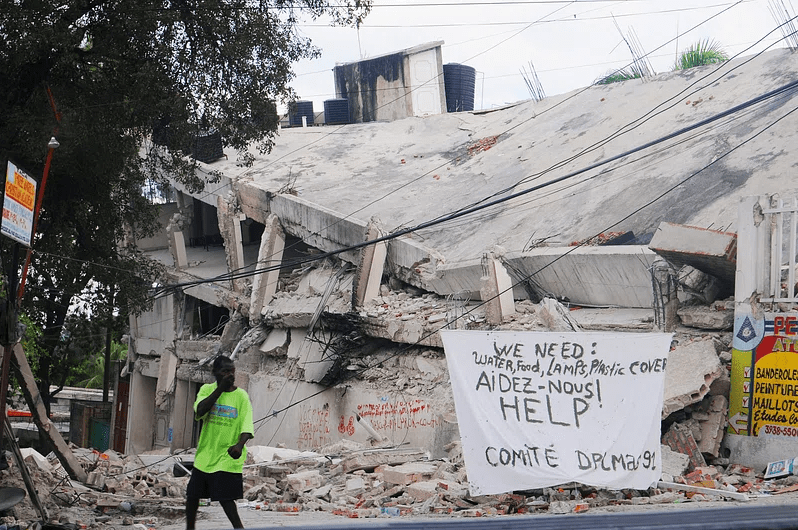
The Trump administration on June 27 announced that Temporary Protected Status (TPS) applying to half a million Haitians living in the United States will end on September 2. That total includes 300,000 people who, having fled unrest and violence, gained TPS in June 2024 under the Biden administration; 200,000 other Haitians who entered following a terrible earthquake in 2010 received TPS during Obama’s presidency.

Haitians not voluntarily returning to their country or not qualifying for legal immigration status otherwise face deportation. A spokesperson for the Department of Homeland Security was reassuring: “The environmental situation in Haiti has improved enough that it is safe for Haitian citizens to return home.” That is not so.

A State Department travel advisory on Haiti in September 2024 tells U.S. citizens, “Do not travel to Haiti due to kidnapping, crime, civil unrest … Crimes involving firearms are common in Haiti …” Lawyer Aaron Reichlin-Melnick of the American Immigration Council insists that, “This is NOT a safe place to send people. It’s a death sentence.”

Desperation

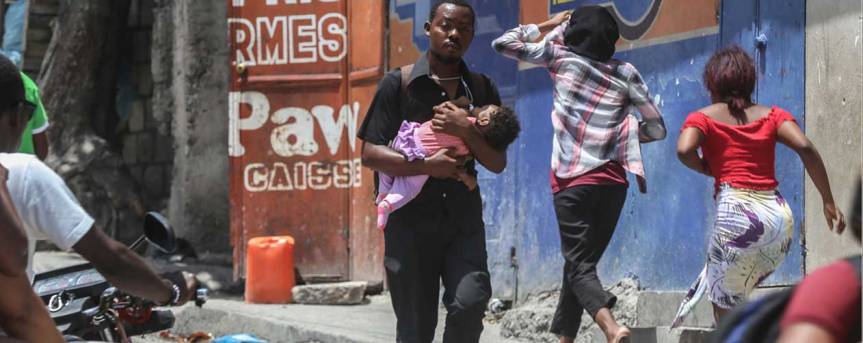
In truth, chaos and devastation are going to speed the deaths of many Haitians. According to a recent report from the International Organization for Migration of the United Nations, “Nearly 1.3 million people have been forced to flee gang violence in Haiti and seek refuge elsewhere within the Caribbean country … This represents a 24 per cent increase from December 2024.”

The report adds that, “Behind these numbers are so many individual people whose suffering is immeasurable; children, mothers, the elderly, many of them forced to flee their homes multiple times.” The gangs, unified under the name Viv Ansanm, engage in stealing, killing, extorsion, and destruction.

For a decade and more, Haitians have repeatedly protested and mobilized in the streets against high prices and shortages. Business owners and the wealthy have funded the gangs in order to protect their properties and interests against popular mobilizations. The U.S. government turns a blind eye to weapons entering Haiti from the U.S. Analyst Seth Donnelly speaks of “Death squads … financed by members of Haiti’s upper class and heavily armed by major weapons flowing into Haiti from Florida.”

This account of Haitians in distress and of the U.S. government covering up the truth points to U.S. domination there that that differs from the targeting of Gaza and Iran. However, each of these situations as varied as they are, have characteristics defining them as imperialist interventions.

Important here is the connection between imperialism and capitalism. It looks like this: at a certain stage in history, imperialism came to represent a way for nations to be able to improve the capabilities of corporations to generate wealth. Therefore, fight against imperialism is fight against capitalism, because imperialism derives from capitalism. It follows that opposition to the excesses of U.S. imperialism in Haiti fits within customary anti-capitalist struggle. But one needs to appreciate the imperialist nature of U.S. interventions in Haiti. That’s the object of what follows here.

Rule from afar

President Jovenel Moïse, wealthy and a major embezzler of public funds, was assassinated for uncertain reasons by US -organized mercenaries in 2021. Subsequently, a governing body appointed by the so-called Core Group has supervised Haiti’s affairs. The Core Group represents key North American and European governments.

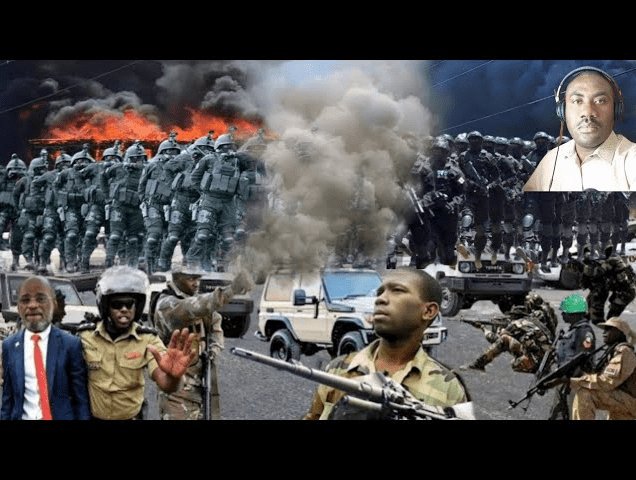
Garry Conille, Haiti’s de facto prime minister, in June 2024 welcomed to Haiti 400 Kenyan troops who were the first contingent of the UN-authorized and partially-U.S.-funded Multinational Security Support Mission. They would be fighting the gangs.  Full funding and the full complement of 2500 troops sent by participating nations have fallen short. Meanwhile, killings and internal displacement continue.

According to the New York Times, Eric Prince has recently sent weapons to Haiti and will soon dispatch 150 mercenary troops there. He has introduced drones that have killed at least 200 people. Prince was a big donor to President Trumps’s 2016 campaign and is by far the lead U.S. empresario of mercenary warfare. Who pays Prince is unspecified.

As if Haiti’s government is the prime actor in this drama, the Times report portrays that government as “turning to private military contractors equipped with high-powered weapons, helicopters and sophisticated surveillance and attack drones to take on the well-armed gangs.” Haiti’s government, in fact, is on leave – is AOL.

History with a logic

Nothing about this train of grief is by chance. Powerful forces – imperialists abroad and oligarchs within – remain determined, it seems, that a people-centered government will never take root in Haiti. Once, there had been an opportunity.

Cooperating with Canada and France, the U.S. government in 2004 backed the paramilitaries who removed President Jean-Bertram Aristide from power, along with his progressive Lavalas political party. Earlier in 1991, CIA-affiliated paramilitaries did likewise.

President Aristide’s overwhelming electoral victory in 1990 and Lavalas presidential candidate René Préval’s victory in 1995 represented the first and second democratic elections, respectively, in Haiti’s history. They were the last ones, so far. U.S. Secretary of State Hilary Clinton engineered Michel Martelly’s election as president in 2010. Jovenel Moïse’s election in 2016 was marked by electoral corruption.  No elections of any kind have taken place since that year.

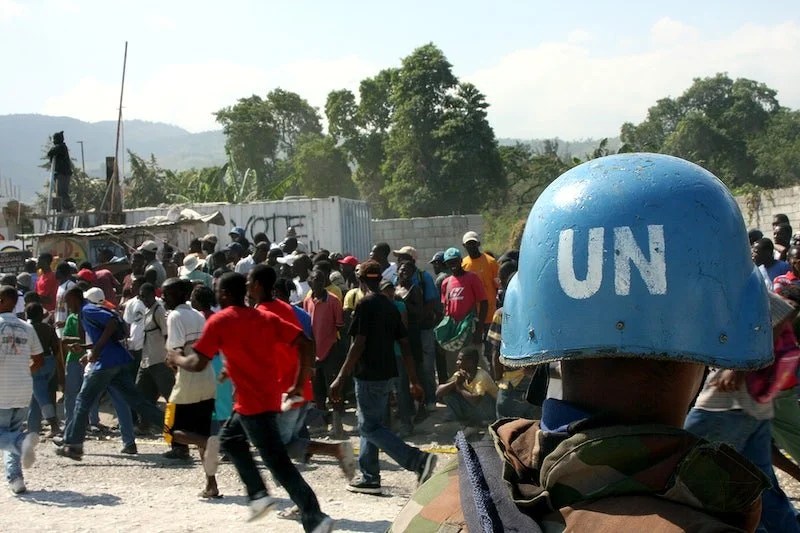
Following the U.S. coup against Aristide in 2004, the U.S. government, United Nations officials and the Core Group (of imperialist countries) together installed, the “United Nations Stabilization Mission in Haiti” (MINUSTAH).  Under Core Group supervision, MINUSTAH imposed a military occupation from 2004 until 2017.  Reports abounded of destruction, dying, disease – particularly cholera – and sexual violence on the part of occupying troops. The Haitian people’s real needs went begging.  

Enslaved workers in what would become Haiti rebelled in 1791 and established national independence in 1804. Between then and 1991, when Aristide first became president, Haiti was under steady assault from foreign powers. The result was foreclosure on the country’s political and social development.

France pressured independent Haiti into providing reimbursement for French plantation owners’ loss of enslaved labor. Haiti borrowed money to pay. Vast debt obligations continued into the 20th century. The U.S. government refused for decades to trade with Haiti or recognize her independence. It carried out a brutal military occupation from 1915 until 1934 and fully backed the Duvalier dictatorship (1957-1986).

A flexible imperialism

U.S. oppression of Haiti takes place in ways other than the devices imperialists usually rely on. Intent upon accumulating wealth, they go abroad to capture natural resources like oil and try to control strategically placed geographic locations. U.S. imperialists, partnering with Israel, are pursuing both of these objectives in Palestine and Iran.

Haiti offers nothing to compare. Low-wage industry beckons but garment manufacturing, active in Haiti, is only a weak draw. However, Haiti presents other attractions for imperialists that are very much in line with goals of extending control and generating wealth.

Haiti’s achievement of national independence surely represented a great upset of colonial trade arrangements, and these had prepared the way toward capitalist industrialization. Early U.S. capitalists condemned happenings in Haiti. That attitude undoubtedly assured Haiti a place on the U.S. blacklist.  Maybe the stigma remains.  

Karl Marx explains that, “direct slavery is as much the pivot of bourgeois industry as are machinery, credit, etc. Without slavery you would have no cotton; without cotton you have no modern industry. It is slavery that gave the colonies their value, it is the colonies that created world trade, and world trade is the precondition for large-scale industry.”

One reason why U.S. imperialists make Haitians miserable is that, in doing so, they create a model image of massed people of color desperate to survive. That image, widely accepted, has possible use in projecting social precariousness as a constant in the underdeveloped world. The object would be to persuade northern exploiters that workers in such regions are so cowed as to accept poor working conditions and stay away from social revolution.

Additionally, the image of black people in great distress may be pleasing to the imperialists for its power of persuading non-Black victims of oppression living precarious lives to value what little remains of their self-regard and worldly possessions and to go it alone, and not join peoples of African heritage in common struggle. 

Lastly, old habits die slowly. The successful rebellion of enslaved people in Haiti stoked fear within U.S. political life and the wider community, both being under the sway of slave-owning interests. Fear persisted and Haiti’s image surely gained no favor during the Jim Crow era. And even now, crucially, racists and their ideas have their place within official Washington circles.


W.T. Whitney Jr. is a political journalist whose focus is on Latin America, health care, and anti-racism. A Cuba solidarity activist, he formerly worked as a pediatrician, and lives in rural Maine.

Haiti has disturbed U.S. ruling class for two centuries; Springfield is latest flare-up / By W. T. Whitney Jr.

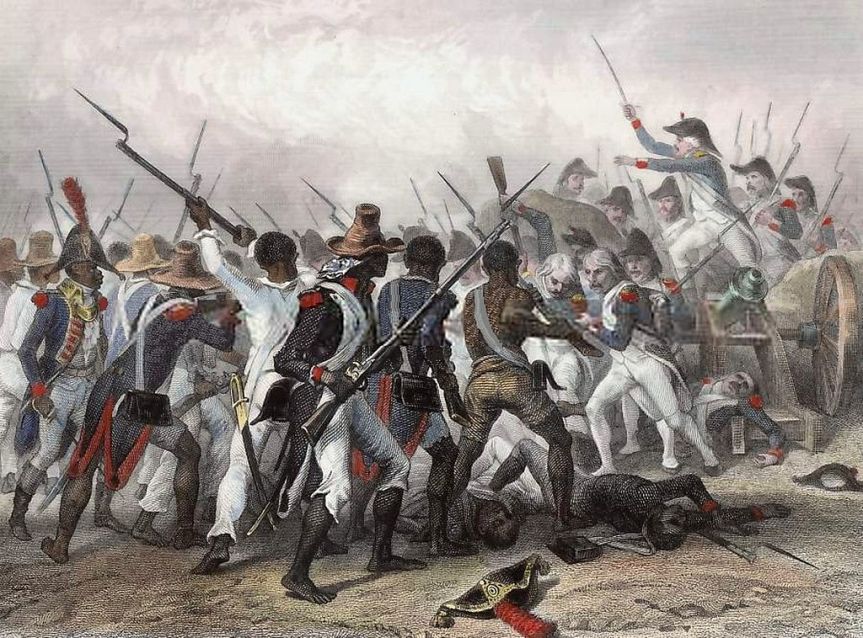
Haitian Revolution: Attack and take of the Crête-à-Pierrot (March 24, 1802). Original illustration by Auguste Raffet, engraving by Ernst Hébert. | Public Domain

Reposted from Peoples World


Republican presidential and vice-presidential candidates expressed horror a couple of weeks ago on apparently learning from social media that Haitian migrants in Springfield, Ohio, were eating dogs and cats, “eating people’s pets,” as Trump put it. The reports, as we all know now, were false, but their fallout was quite real. Bomb threats followed, schools and public buildings closed down, and longtime African-American residents felt threatened.

A bit of backstory: Springfield’s economy lost jobs and industries over the years. Some 15,000 Haitians arrived, eager to work. Industry expanded, but social service providers were stressed. Most of the Haitians in Springfield are there under Temporary Protected Status. That governmental designation enables migrants forced out of their counties by serious crises to enter the United States legally.

The bizarre twist of political behavior stems in part from the migrants being Haitian. Haitians and their nation have been problematic for the United States’ ruling class for more than two centuries.

The fact of migration itself does not account for the exaggerated hostility, though. Almost nothing of that order happens to the one-third of New York state residents and 40.9% of Miamians who are immigrants, or to the foreign-born residents of nine other urban areas in the United States who comprise from 21.1% to 39.1% of the several populations.

Stresses and frustrations associated with Springfield’s economic decline logically enough could have stimulated hostility toward migrants, if we look at what has happened historically in other communities. But economist Franklin J. James rejects the idea “that immigration hurts U.S. natives by reducing job opportunities …[and] that immigrants displace natives from jobs or reduce earnings of the average worker.”

Being Black may indeed invite hostility in a racist society, however. But the disconnect is sharp between the rarity of unbounded disparagement at high political levels and the large numbers of African-descended people who never experience the like from anybody. Opportunities abound. In 2019 Black people made up from 21.6% to 48.5% of the populations of 20 U.S. cities. That year nine Ohio cities, not including Springfield, claimed between 32.0% and 11.2% Black people. In 2024, 17.4% of Springfield residents are Black.

The scenario in Springfield may itself have been toxic: A large number of Black people from abroad arrived together on an economically depressed small city. But Somali migrants arrived in Lewiston, Maine under similar circumstances, and their reception was different.

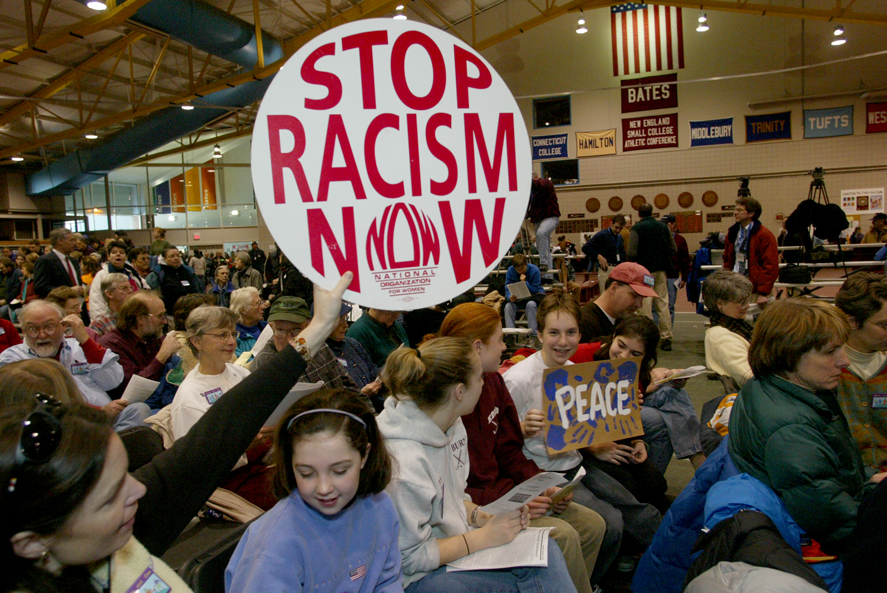
They showed up in 2001, and a year later numbered 2,000 or so. In January 2003, an Illinois-based Nazi group staged a tiny anti-Black rally; 4,500 Mainers joined in a counter-demonstration.

As of 2019, according to writer Cynthia Anderson, “Lewiston … has one of the highest per capita Muslim populations in the United States, most of it Somali along with rising numbers of refugees and asylum-seekers from other African nations.” Of Lewiston’s 38,404 inhabitants, 10.9% presently are “Black or African American.” Blacks are 1.4% of Maine’s population.

Anderson reports that with the influx of migrants, Lewiston “has struggled financially, especially early on as the needs for social services and education intensified. Joblessness remains high among the older generation of refugees.”

Lewiston is Maine’s poorest city. For generations, massive factories along the Androscoggin River produced textiles and shoes, but they are gone. The city’s poverty rate is 18.1%; for Blacks it’s 51.5%. In 2016, 50% of Lewiston’s children under the age of five lived in poverty.

Citing school superintendent Bill Webster, an AP report indicates “immigrant children are doing better than native-born kids” in school, and are “going off to college to get degrees, as teachers, doctors, engineers.”

Analyst Anna Chase Hogeland concludes: “The Lewiston community’s reaction to the Somalis demonstrated both their hostility and reservations, as well as the great efforts of many to accommodate and welcome the refugees.” Voters in Lewiston are conservative; the majority of them backed Donald Trump in the 2016 and 2020 presidential elections.

The circumstances under which the two cities received Black immigrants differed in two ways. A nationwide upsurge in racist rhetoric and anti-immigrant hostility worsened conditions for migrants in Springfield. Lewiston’s experience had played out earlier.

Additionally, immigrants arriving in Springfield qualified for special attention. The aforementioned political candidates could have exercised their anti-migrant belligerence in many cities. They chose Springfield, presumably because the migrants there, objects of their wrath, are Haitian. Why are Haitians vulnerable?

A mural painted on an alley wall this month in Springfield, Ohio. | Carolyn Kaster / AP

Black people in what is now Haiti boldly rebelled against enslavement on French-owned plantations. Remarkably, they expelled the French and in 1804 established the independent nation they called Haiti.

Ever since, the United States has spelled trouble for Haiti. Pre-eminent abolitionist Frederick Douglas pointed out in 1893 that, “Haiti is black and we [the United States] have not yet forgiven Haiti for being black.” Long after “Haiti had shaken off the fetters of bondage…we continued to refuse to acknowledge the fact and treated her as outside the sisterhood of nations.”

Scholar and activist W.E.B DuBois, biographer of abolitionist John Brown, explains that “there was hell in Hayti (sic) in the red waning of the eighteenth century, in the days when John Brown was born … [At that time] the shudder of Hayti was running through all the Americas, and from his earliest boyhood he saw and felt the price of repression—the fearful cost that the western world was paying for slavery.”

DuBois’s reference was to the U.S. slavocracy and its encouragement of collective fear among many white people that Black workers—bought, owned, and sold—might rise up in rebellion. They did look to the example of Haiti and did rebel—see Herbert Aptheker, American Negro Slave Revolts.

In the United States, from the Civil War on, the prospect of resistance and rebellion on the part of Black people has had government circles and segments of U.S. society on high alert.

That attitude, applied to Haiti, shows in:

  • S. instigation of multi-national military occupations intermittently since 2004.
  • Coups in 1991 and 2004 involving the CIA and/or U.S.-friendly paramilitaries.
  • Backing of the Duvalier family dictatorship between 1957 and 1986.
  • The brutal U.S. military occupation of Haiti between 1915 and 1934.
  • S. control of Haiti’s finances and government departments until 1947.
  • No diplomatic recognition of Haiti from its beginning nationhood in 1804 until 1862.
  • S. economic sanctions against Haiti for decades, until 1863.

Says activist lawyer Bill Quigley: “U.S.-based corporations have for years been teaming up with Haitian elite to run sweatshops teeming with tens of thousands of Haitians who earn less than $2 a day.”

Ultimately, it seems, threads of governmental callousness, societal disregard for basic human needs, and outright demagoguery coalesced to thrust Springfield and Haitian migrants into the national spotlight. Molelike, the anomalous and little-acknowledged presence of Haiti asserts itself in the unfolding of U.S. history.

As with all op-eds and news-analysis articles published by People’s World, this article reflects the views of its author.


We hope you appreciated this article. At People’s World, we believe news and information should be free and accessible to all, but we need your help. Our journalism is free of corporate influence and paywalls because we are totally reader-supported. Only you, our readers and supporters, make this possible. If you enjoy reading People’s World and the stories we bring you, please support our work by donating or becoming a monthly sustainer today. Thank you!


W.T. Whitney Jr. is a political journalist whose focus is on Latin America, health care, and anti-racism. A Cuba solidarity activist, he formerly worked as a pediatrician, lives in rural Maine. W.T. Whitney Jr. es un periodista político cuyo enfoque está en América Latina, la atención médica y el antirracismo. Activista solidario con Cuba, anteriormente trabajó como pediatra, vive en la zona rural de Maine.

Abuse against Haitians in Ohio: examined with reference to Lewiston, Maine / By W.T. Whitney

Members of the Haitian community in Springfield, Ohio, from left, Lindsay Aime, James Fleurijean, Viles Dorsainvil, and Rose-Thamar Joseph, stand for worship at Central Christian Church, on Sunday, Sept. 15, 2024.Jessie Wardarski/AP/AP

South Paris, Maine


Republican presidential and vice-presidential candidates expressed horror on learning from social media that Haitian migrants in Springfield, Ohio were eating dogs and cats, their pets. The reports were false. Bomb threats followed, schools and public buildings closed down. Longtime African-American residents felt threatened.

Springfield’s economy had lost jobs and industries. Some 15,000 Haitians arrived, eager to work. Industry expanded but social service providers were stressed. The Haitians are in Springfield mostly under Temporary Protected Status. That governmental designation enables those migrants forced out of their counties by serious crises to enter the United States legally.  

The bizarre twist of political behavior stems in part from the migrants being Haitian. Haitians and their nation have been problematic for the United States.

The fact of migration itself does not account for the exaggerated hostility. Almost nothing of that order happens to the one third of New York state residents and 40.9% of Miamians who are immigrants, or to the foreign-born residents of nine other urban areas in the United States who comprise from 21.1% to 39.1% of the several populations.

Stresses and frustrations associated with Springfield’s economic decline logically enough could have stimulated hostility toward migrants. But economist Franklin J. James rejects the idea “that immigration hurts U.S. natives by reducing job opportunities …[and] that immigrants displace natives from jobs or reduce earnings of the average worker.”

Being Black may indeed invite hostility in a racist society. But the disconnect is sharp between the rarity of unbounded disparagement at high political levels and the large numbers of African-descended people who never experience the like from anybody. Opportunities abound. In 2019 Black people made up from 21.6% to 48.5% of the populations of 20 U.S. cities. That year nine Ohio cities, not including Springfield, claimed between 32.0% and 11.2% Black people. In 2024, 17.4% of Springfield residents are Black.They showed up in 2001 and a year later numbered 2000 or so. In January 2003, an Illinois-based Nazi group staged a tiny anti-Black rally; 4500 Mainers joined in a counter-demonstration.

The Many and One rally in Merrill Gym on Jan. 11, 2003, sent a strong, unified message far and wide. Photograph by Phyllis Graber Jensen/Bates College, Lewiston, Maine.

The scenario in Springfield may itself have been toxic: a large number of Black people from abroad descended together on an economically depressed small city. But Somali migrants arrived in Lewiston, Maine under similar circumstances, and their reception was different.

As of 2019, according to writer Cynthia Anderson, “Lewiston … has one of the highest per capita Muslim populations in the United States, most of it Somali along with rising numbers of refugees and asylum-seekers from other African nations.” Of Lewiston’s38,404 inhabitants, 10.9% presently are “Black or African American.” Blacks are 1.4% of Maine’s population.

Anderson reports that with the influx of migrants, Lewiston “has struggled financially, especially early on as the needs for social services and education intensified. Joblessness remains high among the older generation of refugees.” 

Lewiston is Maine’s poorest city. For generations massive factories along the Androscoggin River produced textiles and shoes, but no more. The city’s poverty rate is 18.1%; for Blacks it’s 51.5%. In 2016, 50.0% of Lewiston’s children under five lived in poverty.

Citing school superintendent Bill Webster, an AP report indicates “immigrant children are doing better than native-born kids” in school, and are “going off to college to get degrees, as teachers, doctors, engineers.”

Analyst Anna Chase Hogeland concludes that, “The Lewiston community’s reaction to the Somalis demonstrated both their hostility and reservations, as well as the great efforts of many to accommodate and welcome the refugees.” Voters in Lewiston are conservative; they backed Donald Trump in the 2016 and 2020 presidential elections.

The circumstances under which the two cities received Black immigrants differed in two ways.  A nationwide upsurge in racist rhetoric and anti-immigrant hostility worsened conditions for migrants in Springfield.  Lewiston’s experience had played out earlier.

Additionally, immigrants arriving in Springfield qualified for special attention. The aforementioned political candidates could have exercised their anti-migrant belligerence in many cities. They chose Springfield, presumably because Haitians are there. Why are Haitians vulnerable?

Black people in what is now Haiti boldly rebelled against enslavement on French-owned plantations. Remarkably, they expelled the French and in 1804 established the independent nation they called Haiti.  

Ever since, the United States has spelled trouble for Haiti. Preeminent abolitionist Frederick Douglas pointed out in 1893 that, “Haiti is black and we [the United States] have not yet forgiven Haiti for being black.” Long after “Haiti had shaken off the fetters of bondage … we continued to refuse to acknowledge the fact and treated her as outside the sisterhood of nations.”

Scholar and activist W.E.B DuBois, biographer of abolitionist John Brown, explains that “There was hell in Hayti (sic) in the red waning of the eighteenth century, in the days when John Brown was born … [At that time] the shudder of Hayti was running through all the Americas, and from his earliest boyhood he saw and felt the price of repression —the fearful cost that the western world was paying for slavery.”

DuBois’s reference was to the U.S. slavocracy and its encouragement of collective fear among many white people that Black workers – bought, owned and sold – might rise up in rebellion. They did look to the example of Haiti and did rebel – see Herbert Aptheker, American Negro Slave Revolts. In the United States, from the Civil War on, the prospect of resistance and rebellion on the part of Black people has had government circles and segments of U.S. society on high alert.

That attitude, applied to Haiti, shows in:

·        U.S. instigation of multi-national military occupations intermittently since 2004.

·        Coups in 1991and 2004 involving the CIA and/or U.S.-friendly paramilitaries.

·        Backing of the Duvalier family dictatorship between 1957 and 1986.

·        The brutal U.S. military occupation of Haiti between 1915 and 1934.

·        U.S. control of Haiti’s finances and government departments until 1947.

·        No diplomatic recognition of Haiti from its beginning nationhood in 1804 until 1862.

·        U.S. economic sanctions against Haiti for decades, until 1863.

Says activist lawyer Bill Quigley: “US based corporations have for years been teaming up with Haitian elite to run sweatshops teeming with tens of thousands of Haitians who earn less than $2 a day.”

Ultimately, it seems, threads of governmental callousness, societal disregard for basic human needs, and outright demagoguery coalesced to thrust Springfield and Haitian migrants into the national spotlight. Molelike, the anomalous and little-acknowledged presence of Haiti asserts itself in the unfolding of U.S. history.       


W.T. Whitney Jr. is a political journalist whose focus is on Latin America, health care, and anti-racism. A Cuba solidarity activist, he formerly worked as a pediatrician, lives in rural Maine. W.T. Whitney Jr. es un periodista político cuyo enfoque está en América Latina, la atención médica y el antirracismo. Activista solidario con Cuba, anteriormente trabajó como pediatra, vive en la zona rural de Maine.

U.S. imperialism arranges Black-majority occupation force for Haiti intervention / by W.T. Whitney Jr.

Residents walk past a burnt car as they evacuate the Delmas 22 neighborhood the morning after an attack amid gang violence in Port-au-Prince, Haiti, May 2, 2024. | Ramon Espinosa / AP

Reposted from Peoples World


Under U.S. arrangements, a so-called Multinational Security Support (MSS) force will soon be descending on Haiti. Its mission is suppressing gang violence. With their experience of earlier U.S. interventions, however, beleaguered Haitians can likely expect an aggravation of oppression, social disaster, and dependency.

Supplies will arrive from the United States, and a U.S. military base is taking shape near the Port-au-Prince airport for the task. Joining the 2,500-member police force on the way will be another 1,000 troops from Kenya and others from Benin, Chad, Jamaica, Barbados, Bahamas, and Bangladesh. Kenyan officers will provide leadership.

The United Nations Security Council approved the occupation force in October 2023, but U.N. organizational responsibility is lacking. The U.S. government is providing $300 million in financing plus administrative capabilities and supplies. During a three-day state visit to Washington by Kenyan President William Ruto in mid-May, Kenya was declared officially a non-NATO U.S. ally. There are 18 other such nations.

Haiti’s government barely functions. Authority centered on Prime Minister Ariel Henry from July 2021 until his forced resignation in April. The “Core Group” of nations appointed him to that office immediately after President Juvenal Moïse was assassinated. The Core Group has supervised Haiti’s affairs since 2004. It consists of the United States, France, Canada, other European states, and an EU representative.

With U.S. encouragement, the CARICOM alliance of Caribbean nations in April established the Temporary Presidential Council to provide Haiti with governance and prepare for elections in early 2026. National elections last took place in 2017.

Presidents Michel Martelly and Jovenel Moïse held office between 2011 and 2021. They took advantage of low turnout, corrupt elections, and, in Martelly’s case, help from U.S. Secretary of State Hillary Clinton. They presided over the massive plundering of the PetroCaribe oil funds.

The upcoming multinational intervention has antecedents: occupation by the U.S. Army from 1915 to 1934; U.S. military occupation from mid-1994 until March 1995, and a U.S.-endorsed U.N. multinational occupation force occupying Haiti between 2004 and 2017.  A militarized United Nations mission with U.S. participation remained there from 1995 until 2000.

The police personnel from Black-majority nations making up the new occupation force will be racially similar to the cruel security force serving Haiti’s Duvalier father-and-son dictatorship, in power from 1957 to 1986. The deadly Tonton Macoute paramilitary repressors operated with funds presumably taken from the $900 million the regime received from Washington in the name of anti-communism.

In Haiti, the U.S. government is again relying on proxy enforcers who are African-descended.

The rationale for the MSS occupation may go beyond gang violence. That some gang members are thinking about justice and new arrangements for Haitian society suggests stirrings of resistance.

Haitians carried out large street protests in 2018 and 2019 against high prices, fuel and food shortages, and governmental corruption. The rich and powerful, concerned about disarray and threats to their privileges, recruited gangs of impoverished, alienated young men to clear the streets. Arms arrived from the United States.

According to analyst Jemima Pierre, “The Haitian oligarchs have always used armed groups to settle business and political scores.” Some gangs later took up drug trafficking and now receive arms from Latin American cartels.

Critical thinking shows in at least one gang member. High-profile leader Jimmy Cherizier warned that Ariel Henry before he resigned, “will plunge Haiti into chaos.… We are making a bloody revolution in the country because this system is an apartheid system, a wicked system.”

Cherizier had already insisted that the gangs are seeking “stability in our communities, … stability for businesses to function without fear so that people in our community can live without fear and feel secure, potable water for everyone in the poor neighborhoods, good healthcare, and good schools for everybody in the poor neighborhoods.”

Aspirations for social change, worrisome to authorities, rate scant coverage in the Haitian and U.S. media. That’s no surprise, given the U.S. treatment of Jean-Bertrand Aristide.

An opening for democratically-elected political leadership culminated in Aristide’s inauguration as president of Haiti on Feb. 7, 1991. His social-democratic political movement took power. The Heritage Foundation four days later mentioned that “The new government in Port-au-Prince may be steering Haiti toward a communist dictatorship, hostile to the United States.”

U.S. intelligence operatives and other agents engineered successful coups against Aristide and his governments in 1991, 1994, and in 2004. Then came the 13-year-long United Nations military occupation.

An enduring theme resurfaces, that of repetition of occupations and coups and no end in sight. U.S. interventions usually do not resolve the social and political problems of either country. In Haiti, they firm up a terrible status quo. U.S. relations with other Western Hemisphere nations are different.

In dealings with many of those nations, the region’s self-appointed boss often succeeds in accomplishing its political and economic purposes. The U.S. government even adjusts to mildly progressive political changes in a few countries. In others, it suppresses social and political ferment through reliance on psychological war, undercover actions, and/or intervention, either directly or with proxies. Some sort of resolution results in most instances.

Relations with Haiti are stuck, and for good reason. Interventions don’t prosper because potential allies naturally aligned with the United States may be reluctant. For one thing, their other transnational allegiances tend to distract Haiti’s business owners and wealthy class from building U.S. relationships.  Many have family, investments, and enterprises elsewhere overseas.

The population’s division by mulatto and Black identity has historically weakened ruling-class integrity. U.S. decision-makers might have found allies among Haiti’s mulattos, a minority like themselves that is associated with political power and wealth. But recruitment may have stumbled because, as in the past, mulatto attachment to the white establishment gets push-back from Haiti’s impoverished, restive Black majority.

U.S. interventionists may not warm to Haiti’s business and political class because of supposed corruption tendencies. Anti-Black prejudice infecting U.S. society also causes trouble. Stories linger of anti-white violence accompanying slave rebellion in Haiti.

By contrast, the existence in Latin America of a well-established, institutionally-attached, self-sustaining, and culturally-aligned wealthy elite encourages collaboration. That sector can lean upon U.S. counterparts for rescue from their own dispossessed, aroused, and rebellious compatriots. Similar possibilities in Haiti are stymied. U.S. intrusions are blundering, and society itself is hurt.


W.T. Whitney Jr. is a political journalist whose focus is on Latin America, health care, and anti-racism. A Cuba solidarity activist, he formerly worked as a pediatrician, lives in rural Maine. W.T. Whitney Jr. es un periodista político cuyo enfoque está en América Latina, la atención médica y el antirracismo. Activista solidario con Cuba, anteriormente trabajó como pediatra, vive en la zona rural de Maine.

On US Hesitation, Guy Philippe, and Saving Haiti / By W. T. Whitney Jr.

Coup leader Guy Philippe repatriated to Haiti from the U.S. | AP Archive [Youtube]

South Paris, Maine


Reports have circulated of gang warfare in Port-au-Prince and other Haitian cities, and of killings, shortages, social catastrophe and a government gone AWOL.  Also entering the news cycle was the UN Security Council’s approval in October 2023 of plans for troops from nine nations, other than the United States, to jointly occupy Haiti

The U.S. Defense Department had arranged for 1000 Kenyan troops to lead the multi-national force. The international force did not arrive in Haiti pending a decision of Kenya’s High Court on Kenyan forces serving overseas. On January 26, that court prohibited the deployment, and plans for the international force are in disarray.

Less is known about U.S. planning on Haiti that takes into account the most acute of Haiti’s intractable problems. There are the well-known ones, but also political corruption, business-class financing of gangs, U.S. supply of weapons for the gangs, a government headed by the unelected and widely-reviled Aaron Henry, no workable plans for a transition government, and the murky circumstances of president Jovenel Moise’s murder in July, 2021.

Instructions

The U.S. government in April 2022 announced that a new relationship with Haiti was in the works. The description relies on generalities such as: “a long-term, holistic view,” “forward-thinking rather than reactive mindset,” “Seeking innovation while scaling success,” and “Prioritizing locally driven solutions.”

The statement offers ideas on ways to implement guidelines from the Global Fragility Act (GFA) of 2019. That legislation sets forth concepts informing a new U.S. strategy for dealing with nine troubled countries in the Global South. Haiti is the only one in the Western Hemisphere.

It’s a “comprehensive, integrated, ten-year strategy” for achieving “the stabilization of conflict-affected areas,” and with the purpose of “strengthen[ing] the capacity of the United States to be an effective leader of international efforts to prevent extremism and violent conflict.”

Another statement, also released in April 2022, is about overall GFA implementation, not specific to Haiti The GFA would “build peace across divided communities, leverage and enable societal resiliencies … anchor interventions in communities … [and be] informed by the insights of expert practitioners and academics.”  The United States is seeking “true mutual partners and [would] commit to multilateral solutions.”

The GFA represents for Haiti “a “repackaging” of U.S. interventionist policies.” Analyst Travis Ross also suggests that U.S. troops would encounter “fiercer resistance than they did in their 1915, 1994, and 2004 interventions.”

The package is new, but substance is scarce. Specific objectives and precise methods for influencing affairs inside Haiti are lacking. There’s no mention of military and/or police action. Policymakers’ hesitation may be due in part to the ill-defined, if tumultuous, nature of difficulties they anticipate.

Loose cannon

Guy Philippe may be a case in point. The former narco-trafficker, imprisoned in the United States for money laundering since 2017, finished his term and returned to Haiti in November 2023. He has been touring Haiti’s cities and towns.

He speaks to crowds about Haitians choosing their own government, building their economy, rejecting foreign oversight and intervention, removing de facto government head Ariel Henry, and restoring Haiti’s Army.

Heading a paramilitary force of hundreds, Guy Philippe’s destabilization campaign prepared the way for the coup in 2004 that removed the progressive and democratically-elected president Jean-Bertrand Aristide.

Trained by U.S. special forces in Ecuador, Philippe in the 1990s was a brutal police chief in two Haitian cities notable then for extra-judicial killings. In 2001 he organized a failed coup. Philippe ran for president in 2006, was elected senator in 2016, and heads his own political party.

Philippe has visited Haiti’s northeastern region, particularly Ouanaminthe, at least twice. This small city on the west side of the south-to-north flowing Massacre River, part of the boundary between Haiti and the Dominican Republic (DR), is a crossing point for binational commerce and for Haitians traveling to and from low-paying jobs in the DR.

The region is a display case for the hostility and racism experienced by Haitians in the DR. Dominican dictator Rafael Trujillo’s massacre of thousands of Haitians took place along the Massacre River in 1937. (The name derives from massacres in the 17th century.)

Guy Philippe has joined the fight local people are pursuing with Dominicans over a canal for diverting water from the Massacre River into Haiti for agricultural purposes. The process of building the Pittobert irrigationcanal has extended over years, but enthusiasm for completing it recently brought small farmers and agricultural workers together as voluntary work crews.

Although 10 diversion canals deliver water to the DR side, the government there denounces the Haitians’ canal as depriving DR farmers and nearby mines of needed water. The Dominican government, in protest, closed the border between September 15 and October 8, 2023.

Speaking “to a multitude” in Ouanaminthe on Jan 3, Philippe insisted that, “We can construct as many canals as we think are necessary. I come to salute the determination and the bravery of these men and women who say that we are independent and sovereign in our country.” Philippe was honoring canal workers and security officers who had stood up to Dominican troops entering Haitian territory on November 7.

The latter are members of the Brigade for Surveillance of Protected Spaces (BSAP), a police unit of 15,000 officers charged with protecting national parks.  Observer Kim Ives explains that, “Guy Philippe sees a future for [the BSAP] as a sort of popular militia that can be a surrogate or support for the PNH (Haitian National Police) and Haitian army.”

The incident [on November 7] didn’t happen by chance,” opined a pro-Haiti commentator; “it’s part of the US plan under the Global Fragility Act to set the DR against Haiti … to unite the entire island under a single government … [This] provocation by the United States, mediated by the racist government of the Dominican Republic, accompanies war and American imperialist domination in the Caribbean and Latin America.

On January 24, “Sympathizers of the revolution led by Guy Philippe” filled the streets of Ouanaminthe, according to a report. They attacked banks and public offices, and demanded protection for a BSAP leader.  

Taken as a whole, the account offered here is of a U.S. response to Haiti’s extreme difficulties that, apart from charitable sentiments, is directionless, lacking in specifics, and incomplete. As a dispensation from on high, it represents a kind of noblesse oblige.

Either the U.S. government is turning away from Haiti’s affairs – not bad news – or has other, unknown plans for Haiti, which is more likely. The U.S commercial and investing class will undoubtedly be weighing in.

From that quarter may come concern about lost opportunity in allowing  Haitians alone to decide what happens with deposits of gold and other minerals worth $20 billion. They lie in the mountainous areas of northern Haiti, not far from the Massacre River.


W.T. Whitney Jr. is a political journalist whose focus is on Latin America, health care, and anti-racism. A Cuba solidarity activist, he formerly worked as a pediatrician, lives in rural Maine. W.T. Whitney Jr. es un periodista político cuyo enfoque está en América Latina, la atención médica y el antirracismo. Activista solidario con Cuba, anteriormente trabajó como pediatra, vive en la zona rural de Maine.

Potential disaster awaits Haiti as U.S. prepares for armed intervention / by William T. Whitney Jr

Residents flee their homes to escape clashes between armed gangs in the Carrefour-Feuilles district of Port-au-Prince, Haiti, Aug. 15, 2023. | Odelyn Joseph / AP

Reposted from People’s World


NEW YORK—On Monday, the United Nations Security Council voted to send a foreign “security mission” to Haiti—an armed intervention force. The body adopted a resolution, drafted by the United States and Ecuador, that authorizes the so-called Multinational Security Support mission—“to take all necessary measures”—code for the use of force.

Officials from Haiti, the U.N., and the U.S. say the intervention will be aimed at helping Haiti’s police suppress armed bands, or gangs, that cause deadly violence and have overrun the capital, Port-au-Prince. The U.N. reports that, as of Aug. 15, 2,439 Haitians had been killed this year.

“More than just a simple vote, this is in fact an expression of solidarity with a population in distress,” Haiti’s Foreign Minister Jean Victor Geneus told the council. “It’s a glimmer of hope for the people that have for too long been suffering.”

China and Russia, however, abstained from the vote, expressing reluctance about granting a blanket authorization for the use of force under Chapter 7 of the founding U.N. Charter. The remaining 13 members voted in favor.

Senior U.S. diplomat Jeffrey DeLaurentis justified the blank check for intervention, saying, “We have stepped up to create a new way of preserving global peace and security, answering the repeated calls of a member state facing a multi-dimensional crisis amid alarming spiraling gang violence.”

In mid-September, at the U.N. General Assembly, U.S. President Joe Biden and Ariel Henry, Haiti’s acting president, issued a call for a multinational militarized occupation of Haiti. U.N. Secretary-General António Guterres had already done so earlier. Secretary of State Antony Blinken promised “robust financial and logistical assistance” from the United States for a military intervention.

U.S. spokespersons say that $100 million is being sought from both Congress and the Pentagon to back the mission.

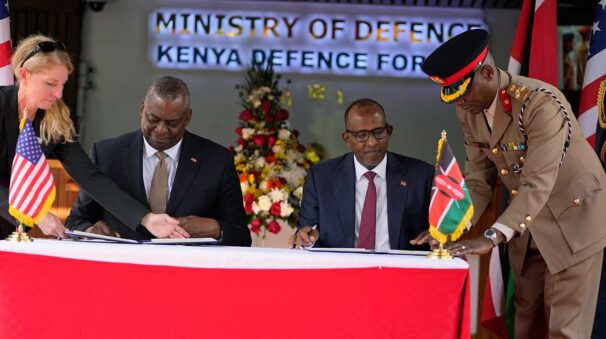
Meeting in Nairobi on Sept. 25, U.S. Defense Secretary Lloyd Austin and his Kenyan counterpart agreed that Kenya will provide 1000 “security officers” and will “lead a multi-national peacekeeping mission to Haiti.” According to the U.N., 12 countries have committed to being part of the mission.

The newly approved international intervention into Haiti will be officially ‘led’ by Kenya, providing some cover for the U.S. military, which will likely be calling the shots behind the scenes. Here, U.S. Secretary of Defense Lloyd J. Austin, left and Kenya Cabinet Secretary for Defense Aden Duale, sign a bilateral defense cooperation agreement in Nairobi on Sept. 25, 2023. The defense agreement will see Kenya get resources and support for security deployments in exchange for ‘leading’ the intervention in Haiti to combat gang violence. | Khalil Senosi / AP

The Communist Party of Kenya issued a statement condemning its government’s participation. It pointed out that U.S. power derives from “the enslavement of millions of African people, whose labor laid the foundation for [U.S.] economic prosperity.”

The United Nations itself is neither leading nor organizing the intervention, as the organization doesn’t exactly have a good reputation among the people of Haiti. For good reason: The U.N. force occupying Haiti in 2004-17 violated Haitians’ human rights, abused women and children, and introduced a cholera epidemic that killed 40,000 Haitians.

We offer four explanations for why the planned armed intervention will harm Haiti’s already beleaguered majority population.

One, previous foreign interventions have brought trouble. Nothing suggests this one will be different. Here’s the record:

  • The aforementioned U.N. occupation.
  • NGOs invaded after the 2010 earthquake. They wasted donated funds.
  • S.-assisted military coups in 1991 and 2004 removed the progressive Haitian President Jean-Bertrand Aristide.
  • The U.S. “Operation Uphold Democracy” reinserted Aristide in 1994 on the condition that he enforce neoliberal economic “reform.”
  • The U.S. government provided vital support to the father-and-son Duvalier dictatorship from 1957 to 1986
  • The U.S. military occupation of Haiti from 1915 to 1934 was brutal.
  • France, upon being kicked out of its Haitian colony, required payback with interest for slaves having gone free, in all, $560 million (in 2022 dollars) and up to $115 billion in lost development.
  • The U.S. responded to Haitian independence, proclaimed in 1804, with a trade embargo and diplomatic isolation, each lasting for decades.
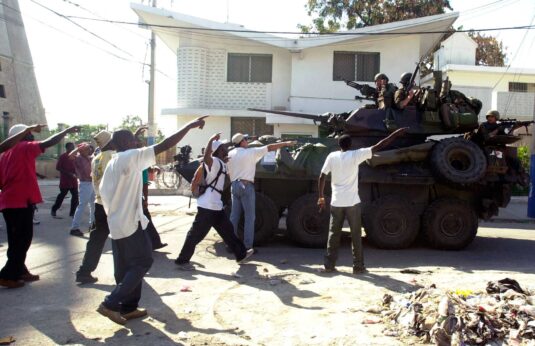
In this March 7, 2004, file photo, people demand that occupying U.S. Marines take action to protect them after shooting erupted during a march in Port-au-Prince, Haiti. In 2004, a coup d’état occurred after conflicts lasting for several weeks in Haiti. It resulted in the second removal from office of President Jean-Bertrand Aristide, preventing him from finishing his second term. Aristide claimed that his departure was a kidnapping, accusing the U.S. of orchestrating a coup d’état against him. Now, almost 20 years later, the country is still engulfed by violence. | Pablo Aneli / AP

Two, Haiti’s oppressed majority population needs a government, not a façade of one. A government in Haiti that served the people might provide a buffer between an imported, militarized foreign police and the Haitian people. Haiti has no functioning government today, much less one friendly to the people’s cause.

Michel Martelly became president in 2011, courtesy of U.S. manipulation. The last general election in Haiti, in 2016, allowed Jovenel Moïse to be president. The two wealthy politicians belonged to the rightwing PHTK political party. The elections they won were thoroughly corrupt and saw abysmally low-turnouts.

Moïse and others embezzled billions of dollars taken from the low-interest loans that President Hugo Chavez’s Venezuelan government made available to the Haitian state. The funds were supposed to have supported Haiti’s development and allowed the government to purchase low-cost oil under Chavez’s Petrocaribe program and to provide subsidized fuel and food for Haiti’s impoverished people. The U.S. government sanctioned Venezuela in 2015, and the loans and cheap oil stopped.

In response, massive protests erupted against government corruption and waste of the Petrocaribe funds. With increasing shortages and rising prices, they’ve continued since 2018. In a context of multifaceted conflict among Haiti’s oligarchs, Moïse was assassinated in July 2021.

There has been no president since, other than acting president Ariel Henry, whom the U.S., Canada, several European countries, and the EU—the so-called “Core Group” that oversees Haiti’s affairs—made prime minister shortly after the assassination. And as for the country’s parliament, it hasn’t functioned for over three years.

The distressed Haitian masses have no political party that reliably or effectively speaks for them. They have no say in foreign governments’ plans for them. They have no institutional resources or constitutional protections against potential abuse at the hands of foreign occupation forces.

Three, the gangs have ties with Haiti’s wealthy powerbrokers. It’s a relationship inconsistent with a simple story of interventionists taking on gangs. The association grew out of the recurring outbursts of social protest.

Haiti’s establishment sought protection from disorder and destruction triggered by the ongoing protests, primarily in Port-au-Prince. In the absence of an army, and with the police unable to cope, gangs came into existence.

They were supposedly going to bring order to city neighborhoods, even leading some protesters to join. Behind them, with funds the whole time, however, have been a number of wealthy Haitians. So of course, the gangs took on the additional role of blocking agitation for political change. Funds flowed from local oligarchs and from abroad for that specific purpose.

There’s a sea of contradictions. In suppressing the gangs, the interventionist forces would be defying the wealthy classes that pay them. But those same wealthy classes, as represented by their political boss Ariel Henry, are calling for a foreign security force to defeat them. The struggling people of Haiti may not readily follow such convoluted scheming, but they are familiar with the likely outcome.

Four, the timing of the intervention coincides with movement within the gangs toward a new kind of politics. One suspects that the proposed intervention represents a heavy-handed response to stirrings for political change.

Some leaders of some gangs appear to be disenchanted with inter-gang fighting and with dependence on the rich and powerful. They are making alliances and mouthing revolutionary sentiments.

Press reports center on veteran gang leader Jimmy Cherizier. They’ve latched onto his nickname “Barbecue,” assigned to him as a small boy; it evokes the specter of fiery violence. This former highly-regarded policeman brought other gangs into his “G9” alliance and now is reaching out to other gangs.

Cherizier, quoted by journalist Kim Ives, speaks his mind:

“We are a great people. Our national motto is ‘Union makes strength.’ Our objective is to once and for all overthrow the system that exists in Haiti and achieve the dream of [Haitian founding father Jean-Jacques] Dessalines, which is for the nation’s wealth to be shared by all its citizens…. Our battle isn’t just going to be to demonstrate with people in the streets. We have guns, and we will fight with them…. We took our independence with arms.”

Cherizier told Ives earlier, “This is a corrupt system; these people are using us to fight their political battles, and we do not want to be their cannon fodder anymore.”

Sabine Manigat, a sociologist at Haiti’s Quisqueya University, has the last word: The “image of Haiti portrayed in the foreign press, which highlights misery and insecurity, does not paint the full picture of a country where a social movement survives, people who are standing up and fighting and who require international solidarity, not intervention.”


W.T. Whitney Jr. is a political journalist whose focus is on Latin America, health care, and anti-racism. A Cuba solidarity activist, he formerly worked as a pediatrician, lives in rural Maine. W.T. Whitney Jr. es un periodista político cuyo enfoque está en América Latina, la atención médica y el antirracismo. Activista solidario con Cuba, anteriormente trabajó como pediatra, vive en la zona rural de Maine.

Haiti’s Choice Is Social Revolution or Foreign Intervention / By W. T. Whitney Jr.

Photo: RICHARD PIERRIN/AFP via Getty Images

With long experience of chaos, violence, and dysfunctional governance, Haiti looks now to be on the verge of new crisis in the form of foreign military intervention. U.S. and United Nations decision-makers have held back, but now they look to be moving, again. 

The need all the while has been for change so that all Haitians might live decent lives. Whatever is in the works now offers little prospect for rearrangement of political and social hierarchies in Haiti. 

Haitians for several years have faced high prices, recurring shortages of essential supplies, and deadly gang violence in cities that has converted Haiti into a war zone and is the focus of media and political attention from abroad.   

Left-leaning political activist Camille Chalmers insists “there is a clear connection between these gangs and sectors of power, [which include] the far right” and the U.S. government. In an interview published on May 7, Henry Boisrolin agrees. This Haitian analyst living in Argentina states that: 

We have entered … a new phase in a spiral of violence characteristic of a crumbling neo- colonial system … The armed gangs are frankly death squads that are instruments in the hands of the Haitian oligarchy and the international community, mainly the United States. They want to subdue the popular movement in Haiti, sew terror, and put off an uprising.

The government headed by Prime Minister Ariel Henry, appointed by President Jovenel Moïse just days before his murder on July 7, 2021, is a façade. The U.S. government and the supervising “Core Group” of foreign nations put him in office and are backing him now. 

The last national elections were in 2016; the National Assembly has no legislators. Those elections, remarkable for minimal voter turn-out, gave the presidency to Moise, a wealthy businessman.  

Moïse overstayed his term of office, was accused of massive corruption, and was killed by paramilitaries who prepared in the United States. His predecessor, millionaire Michel Moise, became president in 2011 only after U.S. Secretary of State Hillary Clinton intruded in the elections.

Affecting Haiti’s situation now are: death and destruction from earthquakes and hurricanes; UN military occupation for 13 years that that introduced cholera, killing tens of thousands; and billions of dollars stolen that were set aside to pay for oil from Venezuela’s Petrocaribe program.

The distant background shows U.S diplomatic and commercial barriers during Haiti’s first 50 years, unjust and massive debt obligations to France for over a century, U.S. military occupation and U.S. support for the Duvalier dictatorships during the twentieth century, and subsequently a U.S. hand in two coups that removed the progressively-inclined President Jean-Bertrand Aristide. 

The United Nations Security Council  on October 21, 2022, “demanded an immediate cessation of gang violence and criminal activity” and declared itself ready “to take appropriate measures … against those engaged in or supporting gang violence.”  In January, 2023,U.N. Secretary General António Guterres called for “deployment of an international specialized armed force to Haiti.” 

On April 26 the Security Council deliberated on Haiti;19 speakers were heard. Maria Isabel Salvador, Head of the UN’s “Integrated Office in Haiti,” indicated that almost 50% of Haitians require humanitarian assistance. “The Haitian people cannot wait,” she declared; a “specialized international armed force” is needed. Jean Victor Geneus, Haiti’s Minister for Foreign Affairs, agreed.

The U.S. government is ready to act, it seems, with plans aimed at implementing the 2019 Global Fragility Act. That law would prevent and reduce violent conflict” abroad by means of “negotiating bilateral, 10-year-long “security assistance” arrangements with  “fragile states.”

The State Department on April 1, 2022, released a document explaining rationale and methods for implementing the GFA. A year later, on March 27, the State Department explained that the GFA would be implemented through 10-year plans … in partnership with Haiti, Libya, Mozambique, Papua New Guinea, and Coastal West Africa, including Benin, Côte d’Ivoire, Ghana, Guinea, and Togo.” 

An accessory document reveals that Haiti was being prioritized. It mentions a “sequenced approach for U.S. efforts” that will depend upon “political and security openings in the country.”

Kim Ives, veteran defender of Haiti’s sovereignty, commented that the plan “is essentially a new alliance of USAID ‘know-how’ with Pentagon muscle.” He foresees that the United States will be “returning the country from a neo-colony back into a virtual colony as it was from 1915 to 1934, when U.S. Marines occupied and ran it. Nonetheless, the U.S. would try to keep some Haitian window-dressing.” 

Vassily A. Nebenzia, the Russian Federation’s Permanent Representative on the UN Security Council, received a letter on April 24 from 58 individual Haitians and representatives of Haitian political organizations.  Russia is currently serving as the Security Council’s president.

The letter claims that U.S. plans for Haiti’s future would violate the United Nations Charter. It calls for an independent commission to evaluate U.S. interventions in Haiti since 1993. The authors fear “a grave attack on the sovereignty, independence, territorial integrity, and unity of Haiti.” 

They also object to U.S. occupation since 1856 of the Haitian island Navase, the U.S. government’s manipulations in the 2010 presidential elections, and U.S. failure to prevent the weapons being shipped to Haiti for use in killings and crimes. 

A month after President Moise’s murder in 2021, the “Montana group” of civic leaders proposed a two-year provisional government that would prepare for elections.  The results have been nil.  

De facto Prime Minister Ariel Henry in December 2022 announced a “High Transition Council” set up to arrange for elections. But eight political parties soon vetoed the project and very little has been achieved. Already in October, Henry had requested the U.S. government and/or United Nations to intervene militarily. 

Whatever happens in Haiti promises little help for a severely distressed underclass; 59 percent of Haitians live on less than $2 a day, the poverty rate is 60%, a quarter of the population has no access to electricity, 50% of Haitians are food insecure, 50% of Haitians must drink polluted water, 50% Haitian children do not attend school, and two thirds of adult Haitians are unemployed or informally employed. 

No social revolution is on the horizon and most Haitians, individually and collectively, are powerless. Power lies with Haiti’s business class whose impulse is for “invasion and occupation.” 

These would be the richest ten percent of Haitians who control 61.7% of the country’s wealth. The billionaires in that class are conglomerate owners Gregory Mevs and Gilbert Bigio, worth $1.0 billion and $1.2 Bіllіоn, respectively, and Irishman Denis O’Brien, who is worth $6.8 billion and controls Haiti’s telephone services.  

Henry Boisrolin, cited above, sees U.S. hypocrisy when he looks at U.S. sanctions against ten powerful families in Haiti that buy “tons of arms and munitions” for use in Haiti. This is a U.S. government that “does not allow a single syringe to make its way to Cuba” while claiming ignorance as to who sells those arms or that they come from the United States.


W.T. Whitney Jr. is a political journalist whose focus is on Latin America, health care, and anti-racism. A Cuba solidarity activist, he formerly worked as a pediatrician, lives in rural Maine. W.T. Whitney Jr. es un periodista político cuyo enfoque está en América Latina, la atención médica y el antirracismo. Activista solidario con Cuba, anteriormente trabajó como pediatra, vive en la zona rural de Maine.

U.S. eyes military intervention in Haiti, again / by W.T. Whitney Jr.

Protesters calling for the resignation of Haitian Prime Minister Ariel Henry run after police fired tear gas to disperse them in the Delmas area of Port-au-Prince, Haiti, Monday, Oct. 10, 2022. | Odelyn Joseph / AP

The news story begins: “The Council of Ministers [on October 8 in Haiti] authorized the prime minister to seek the presence in the country of a specialized military force in order to end the humanitarian crisis provoked by insecurity caused by gangs and their sponsors.”

The circumstances are these:

Masses of Haitians have been in the streets protesting intermittently since August. Their grievances are high costs—thanks to the International Monetary Fund—and shortages of food and fuel. Banks and stores are closed. Students are demonstrating. Labor unions have been on strike.

The pattern has continued intermittently for ten years. Pointing to corruption, demonstrators have called for the removal, in succession, of Presidents Michel Martelly and Jovenel Moïse, and now de facto prime minister Ariel Henry.

Recently, violence has aggravated the situation, and foreign powers, including the United States, have paid attention. That’s significant because U.S military interventions and other kinds of U.S. intrusions have worked to trash Haiti’s national sovereignty, and, with an assist from Haiti’s elite, deprive ordinary people of control of their lives.

Presently, 40% of Haitians are food insecure. Some 4.9 million of them (43%) need humanitarian assistance. Life expectancy at birth is 63.7 years. Haiti’s poverty rate is 58.5%, with 73.5% of adult Haitians living on less than $5.50 per day.

Electoral politics is fractured. It was Secretary of State Hillary Clinton who arranged for Martelly to be a presidential candidate in 2011. Moïse in 2017 was the choice of 600,000 voters—out of six million eligible citizens. He illegally extended his presidential term by a year. As of now, there have been no presidential elections for six years, no elected mayors or legislators in office for over a year, and no scheduled elections ahead.

Washington’s man: De facto Haitian Prime Minister Ariel Henry holds power, even though he wasn’t elected. Some believe he may have been involved in the murder of the previous president and now he’s seeking U.S. troops to stem protests against his government. | Odelyn Joseph / AP

Gangs mushroomed in recent years, and violence has worsened. Moïse’s election in 2017 prompted turf wars, competing appeals to politicians, narcotrafficking, kidnappings, and deadly violence in most cities, predominately in the capital, Port-au-Prince. Violence escalated further after Moise’s murder in July 2021. Hundreds have been killed and thousands displaced, wounded, or kidnapped.

The U.S. Global Fragility Act of 2019 authorizes multi-agency intervention in “fragile” countries like Haiti, the U.S. military being one such agency designated to do the intervening. The influential Council of Foreign Relations (CFR) wants U.S. soldiers instructing Haitian police on handling gangs. Luis Almagro, head of the Organization of American States, calls for military occupation. U.N. Secretary General Antonio Guterres wants international support for training Haitian police.

Former U.S. Special Envoy to Haiti Daniel Foote weighs in with a choice: Either “send a company of special forces trainers to teach the police and set up an anti-gang task force, or send 25,000 troops at some undetermined but imminent period in the future.” The Dominican Republic has stationed troops at its border with Haiti and calls for international military intervention.

Meanwhile, foreign actors intrude as Haitians try to reconstruct a government. Their tool is the Core Group, formed in 2004 following the U.S.-led coup against progressive Haitian President Jean-Bertrand Aristide. The Core Group consists of the ambassadors of Brazil, Canada, France, Germany, Spain, the United States, and representatives of the United Nations and Organization of American States.

Haiti’s government is now in the hands of Ariel Henry, whom the Core Group approved as acting prime minister, overruling Moïse’s choice made before he died. Some believe Henry, a U.S. government favorite, may even be complicit in Moïse’s murder.

Henry insists he will arrange for presidential elections at some point in the future. Prevailing opinion, however, holds that conditions don’t favor elections any time soon.

The Core Group backs an important agreement announced by the so-called Montana Group on Aug. 30, 2021. It provides for a National Transition Council that would prepare for national elections in two years and govern the country in the meantime. The Council in January 2022 chose banker Fritz Jean as transitional president and former senator Steven Benoit as prime minister. They have still not assumed those jobs.

The Montana Group consists of “civil society organizations and powerful political figures,” plus representatives of political parties in Haiti. One leader of the Group is Magali Comeau Denis, who allegedly participated in the U.S-organized coup that removed Aristide in 2004. Henry also has a connection to coup-plotting, having worked with the Democratic Convergence that in 2000 was already planning the overthrow of Aristide.

The CFR wants the U.S. government to persuade Henry to join the Montana Group’s transition process. U.S. Envoy Foote supports the Montana agreement because it shows off Haitians acting on their own. Recently, some member organizations have defected, among them the right-wing PHTK Party of Henry and of Presidents Martelly and Moïse.

The weakness of Haiti’s government in the face of dictates from abroad was on display during Moïse’s era. The perpetrators of his murder, who had been recruited by a Florida-based military contractor, were 26 Colombian paramilitaries and two Haitian-Americans. Their motives remain unclear, and there is no apparent movement toward a trial.

Moïse, the wealthy head of an industrial-scale agricultural operation, became president through fraudulent elections in 2017. He was the target of massive protests a year later. Prompting them were fuel and food shortages and revelations that the president and others had stolen billions of dollars from the fund created through the Venezuela’s PetroCaribe program of cheap oil for Caribbean nations.

Foreign governments, the United States in particular, may now be on the verge of intervening in Haiti. But the ostensible pretext—gang violence—turns out to be muddled. Progressive Haitian academic and economist Camille Chalmers makes the point. He claims that “gangsterism” in Haiti actually serves U.S. purposes.

Interviewed in May 2022, Chalmers explains that the “principal [U.S.] objective is to block the process of social mobilization, to impede all real political participation … through these antidemocratic methods, through force using the police … and above all these paramilitary bands.” Terror is useful for “breaking the social fabric, ties of trust, and any possible resistance process.”

By means of gang violence, the Haitian people “are removed from any political role, and the economic project of plundering resources from the country is facilitated.” Also, Haiti becomes “an appendage of the interests of the North Americans and Europeans.” Chalmers refers to gold deposits on Haiti’s border with the Dominican Republic and big investments by multinational corporations.

He sees a bond between reactionary elements in Haiti and the gangs. The gangs “have financing and weapons that come from the United States. Many of their leaders are Haitians who have been repatriated by the United States.”

A U.S. Army soldier arrests a Haitian man during the U.S. military occupation following the overthrow of President Jean-Bertrand Aristide, Port-au-Prince, Haiti, Oct. 3, 1994. | John Gaps III / AP

Within this framework, Haiti’s police must be ready and able to fight the gangs in order to achieve maximum turmoil. The U.S. government provided Haiti’s police with $312 million in weapons and training between 2010 and 2020, and with $20 million in 2021. The State Department contributed $28 million for SWAT training in July. As of 2019, there were illegal arms in Haiti worth half-a-million dollars, mostly from the United States.

In view of U.S. tolerance or even support of the gangs, the zeal to suppress them now is a mystery. Perhaps some gangs have changed their colors and now really do pose danger to U.S. interests.

The so-called “G-9 Family and Allies,” an alliance of armed neighborhood groups led by former policeman Jimmy Cherizier, may qualify. Not only has it emerged as the Haitian gang most capable of destabilization, but the words “Revolutionary Forces” are a new part of its name.

Cherizier observed in 2021 that, “the country has been controlled by a small group of people who decide everything …They put guns into the poor neighborhoods for us to fight with one another for their benefit.” He noted that, “We have to overturn the whole system, where 12 families have taken the nation hostage.” That system “is not good, stinks, and is corrupt.”

Referring to a mural depicting Che Guevara, Cherizier declared, “we made that mural, and we intend to make murals of other figures like … Thomas Sankara and … Fidel Castro, to depict people who have engaged in struggle.”

These are words of social revolution suggestive of the kind of political turn that repeatedly has prompted serious U.S. reaction. Beyond that, the words of Haitian journalist Jean Waltès Bien-Aimé represent for Washington officials the worst kind of nightmare.

He told People’s Dispatch: “Activation of gangs is part of a strategy to prevent Haitian people from taking to the streets.” He scorns Ariel Henry “as a present from the U.S. embassy,” adding that the “Haitian people do not need a leader at the moment. Haitian people need a socialist state … We have a bourgeois state. What we need now is a people’s state.”

In the background are U.S. racist attitudes. They flourished initially as a consequence of the slavery system’s central role in developing the U.S. economy. They still show up, it seems, as discomfort with the ideas of formerly enslaved Haitians gaining autonomy and securing independence for their own nation.

W.T. Whitney Jr. is a political journalist whose focus is on Latin America, health care, and anti-racism. A Cuba solidarity activist, he formerly worked as a pediatrician, lives in rural Maine. W.T. Whitney Jr. es un periodista político cuyo enfoque está en América Latina, la atención médica y el antirracismo. Activista solidario con Cuba, anteriormente trabajó como pediatra, vive en la zona rural de Maine.

Peoples World, October 12, 2022, https://peoplesworld.org/