US Pirate Attacks in the Caribbean Will Aggravate Emergency in Cuba / By W. T. Whitney Jr.

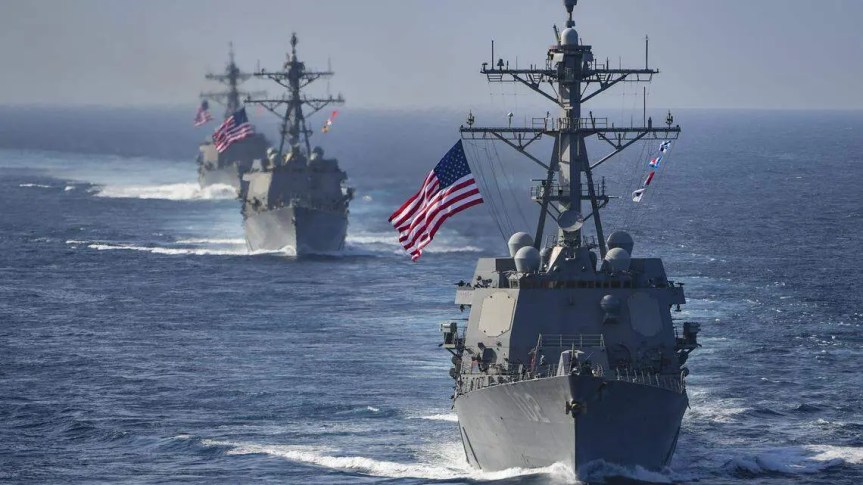
At least eight US warships have been deployed to the Caribbean Sea | Source: venezuelanalysis.com

South Paris, Maine


Hitting two birds with one stone, the U.S. government, top-level disturber of the peace now brandishing a Caribbean armada, strikes out against Venezuela – and Cuba too, indirectly. The U.S. military on December 10 seized a large oil tanker in the Caribbean bound for China. The ship carrying Venezuelan oil had previously offloaded 50,000 barrels of oil to a smaller ship for delivery to Cuba.

Cuba depends on oil supplied by Venezuela. High U.S. officials want to cut off Cuba’s access to oil from Venezuela and thereby deliver a decisive blow against Cuba’s government. Presently six other tankers sanctioned by the U.S. government and carrying Venezuelan oil are at high risk of being seized.

Cuba’s Foreign Relations Ministry issued a statement saying in part that, This act of piracy and maritime terrorism … represents U.S. escalation against Venezuela’s legitimate right freely to use and to trade its natural resources with other nations, including hydrocarbon supplies to Cuba …[Such] actions have a negative impact on Cuba and intensify the United States’ policy of maximum pressure and economic suffocation, with a direct impact on the national energy system and, consequently, on the daily lives  our people.”

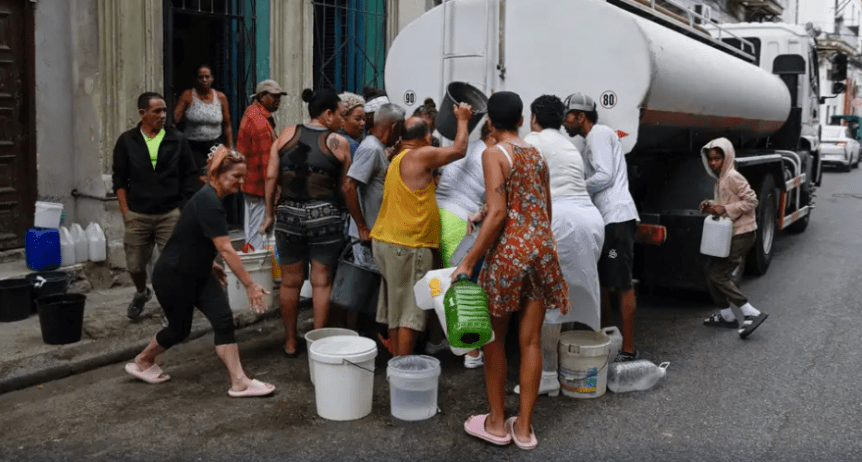
This reference to a “policy of maximum pressure” invites a look at ominous developments unfolding in Cuba as the maritime drama plays out.  Cuba’s government has recently resorted to measures that are extraordinary enough as to indicate worsening crisis in Cuba. The U.S economic blockade has led to shortages of supplies, food, and income. The impact over the course of decades has been wearing and cumulative. Now death rates are up and newer generations are decimated by migration.

Recent measures taken by Cuba’s government, explored below, strongly suggest Cubans face an emergency. U.S. activists responding to their government’s warlike preparations in the Caribbean – another emergency – have good reason to urgently build their solidarity not only with Venezuela but with Cuba too.  What follows here is a report on extreme measures recently taken by Cuba’s government. The object is to portray these measures as so unusual as to confirm the existence of Cuba’s last-ditch situation and, that way, motivate Cuba’s U.S. supporters toward action.

Dollarization

Cuba’s government recently introduced monetary regulations allowing citizens to buy and sell some goods and services using the U.S. dollar.  A report published by a government-oriented news service refers to a “pragmatic recognition of today’s reality” and to “a partial and controlled dollarization of [Cuba’s] economy.” The government will be “allowing certain economic actors to trade in foreign currencies under specific circumstances.”

The new regulations apply to transactions with foreign manufacturers, investors, traders, shippers, financial institutions – and to families abroad sending remittances. The immediate goal is “to directly incentivize the generation of foreign exchange earnings, allowing those who contribute to this generation to keep a significant portion of their earnings in hard currency.” 

The broader purpose is “to increase national production, improve the availability of goods and services, and create conditions for a future return to the strengthened Cuban peso.” Policy-makers want to stimulate exports, augment the supply of goods available in Cuba, and increase both national production and foreign investment. Another goal, referred to as “[r]eduction of distortions,” is elimination of informal or illegal foreign currency markets.

The new regulations allow “authorized commercial establishments … [and those] domestic suppliers supporting export or import substitution activities to use dollars and other foreign currencies in international transactions.” Parties permitted to use dollars are authorized self-employed workers, privately owned businesses, cooperatives, and state enterprises.

These parties have permission to deposit dollars in Cuban banks – dollars accumulated from exports of goods and services, from on-line sales and from sales realized through the Mariel Special Development Zone. Banks will accept dollars purchased from foreign currency traders and dollars sent as remittances from families abroad.

The government’s new authorization of the U.S. dollar as a national currency may well be unsettling to Cubans perceiving implications of a dependency relationship with the northern neighbor. The necessity to have done so reflects the urgency of Cuba’s current situation.     

Pressing needs

Overtones of a new situation entered into the decision of the Cuban Communist Party’s Central Committee at its meeting on December 13 to postpone the 9th Party Congress set for April 2026. Party Congresses have taken place every five years.

Making the announcement, Leader of the Revolution Raul Castro emphasized the need to “dedicate all the country’s resources, as well as the effort and energy of the Party, Government, and State cadres, to resolving current problems, and to dedicate 2026 to recovering as much as possible.” 

Likewise, Cuba’s Council of State announced on December 10 that the upcoming session of the National Assembly of People’s Power set to begin on December 18 would be meeting for that day only, by video conference. In 2024, Assembly delegates met in person for two sessions for a total of  24 days.

A spokesperson explaining the shift stated that, as is “known by all, the electricity situation and the current state of the economy, and also difficulties with the [multi-virus] pandemic and the health situation … create a complex situation for carrying out the Assembly. There is the problem too of the rational use of resources.” 

The 11th plenum of the Communist Party’s Central Committee taking place on December 13 was also a one-day session; video conferencing provided access for members living outside Havana. Concluding the meeting, First Secretary Miguel Díaz-Canel, president of Cuba, mentioned particularly that:

At the end of the third quarter, GDP has fallen by more than 4%, inflation is skyrocketing, the economy is partially paralyzed, thermal power generation is critical, prices remain high, deliveries of rationed food are not being met, and agricultural and food industry production is not meeting the needs of the population. There are also the costly losses caused by the devastating passage of Hurricane Melissa …

Donald Trump has just launched his pirates onto a Venezuelan oil tanker, shamelessly seizing the cargo like a common thief. This was the latest episode in an alarming series of attacks on small boats and extrajudicial executions of more than eighty people, based on unproven accusations and amid an unprecedented and threatening military deployment in a declared Zone of Peace …

[However,] we are the children of a people who carried out a revolution 90 miles from the greatest imperial power on the planet and who have successfully defended it for more than six decades … Only a heroic people who defend a Revolution, who have the example of the history of that Revolution, are capable of enduring what we have been living through all these years.”

Henry Lowendorf of the U.S. Peace Council, queried for this article, highlights the central role of the U.S. government. He states via email that, “The U.S. has been trying to crush the Cuban revolution for over 60 years. So far it has failed. But with new intensity and the newly accelerated war on Venezuela, the U.S. is desperately working to cut off all life support to Cuba.”

A dark setting brightens a bit with good news out of California, as reported in the Cuban press. The Los Angeles Hands off Cuba Committee led in organizing a shipment from Los Angeles to Cuba by way of Jacksonville, Florida of a 40-foot container with medical supplies worth $1 million.  Participating were members of the International Longshore and Warehouse Union and International Association of Machinists, along with Global Health Partners and the PanAmerican Medical Association.


W.T. Whitney Jr. is a retired pediatrician and political journalist living in Maine.

Electoral Coup Surfaces in Honduras amid Signs of US Intervention / By W.T. Whitney Jr.

Photo: Xiomara Castro de Zelaya/X

South Paris, Maine


Elections taking place November 30 in Honduras will decide the country’s next president and make-up of the national assembly. Current President Xiomara Castro of the democratic socialist Party of Liberty and Refoundation (Libre), in office since 2022, is limited to one term. Libre Party presidential candidate Rixi Moncada was finance minister and then defense minister in Castro’s government.

The mantra circulates that ten families rule in Honduras and hold most of its wealth. Their influence is such that left-leaning opposition forces can count on the most forceful kind of pushback.

Businessman Manuel Zelaya turned progressive politician was Honduras’ president from 2006 until June 2009, when a military coup deposed him, with U.S. help. He had called for a minimum wage, mild agrarian reform and a constituent assembly. Zelaya is now general coordinator of the Libre Party, founded in 2011 in reaction to the coup. He is President Xiomara Castro’s husband.

Xiomara Castro’s unsuccessful candidacies for president in 2013 and 2017 encountered electoral fraud and violent attacks orchestrated by the well-ensconced National and Liberal Parties. Her overwhelming electoral victory in 2021 resulted from the association of incumbent president Juan Orlando Hernández and his National Party with corruption and narcotrafficking. Hernández and his brother, convicted on narcotics and weapons charges, are serving long prison terms in the United States.Hernández’s second term was constitutionally illegal.

Current polls give the Libre Party candidate Rixi Moncada an even chance for victory, or a small majority. A plot emerged a month ahead of the voting.

On October 29, Attorney General Johel Zelaya reported he had transferred leaked audio recordings, with transcriptions, to the Public Minister for investigation. Libre Party’s Marlon Ochoa, one of three members of Honduras’ National Electoral Council, discovered them. Each councilor represents a political party. Voices on the recordings allegedly are those of Councilor Cossette López of the National Party; Tomas Zambrano, head of the National Party’s congressional bench; and an unnamed military officer.

According to Johel Zelaya, the conversations told of plans for hiring transportation companies and personnel to transfer voting results on election day, inserting agents among election observers, interrupting data transmission, prematurely announcing rightwing Liberal Party candidate Salvador Nasralla as the winner, sowing suspicion in the media about voting processes, and announcing favorable partial results as a potential “alibi for impugning and suspending the process.”

According to an observer, “The recordings revealed … a plan to pressure external actors, notably the US Embassy in Tegucigalpa, not to recognize any victories by Libre. This would turn an internal dispute into an international recognition crisis.” The report has councilor Cossette López-Osorio exclaiming, “We’ll use the tools that the people at the Embassy gave us.”

One Honduran observer says Salvador Nasralla is the “choice of the most reactionary spheres in Washington,” another that he has promised to “implement a security plan” similar to that of dictatorial Salvadoran president Nayib Bukele. Nasralla spent one third of the pre-election period traveling in the United States and Spain, presumably seeking support.

The Libre party on October 13 announced a “permanent mobilization … [against] the bipartisan plan to manipulate the coming elections.” The Party’s general coordinator Manuel Zelaya declared, “We must prepare ourselves to defeat the electoral coup … They know that we already reversed the coup in 2009 and that we will never go back!”

Rixi Moncada, speaking at a rally on November 9, reviewed gains achieved during Castro’s presidency, described her own program for governing, and highlighted a new twist in the coup saga. The National Election Council that day had carried out a nationwide simulation of election day processes. Only 1556 of 4362 voting locations actually transmitted voting records to a central location. Only 23.7% of biometric devices functioned. The results mirror the scenario presented by the recordings.  

Moncada outlined plans; 12 Libre Party activists from each of Honduras’s 18 departments would remain in Tegucigalpa until election day. They would constitute a “commission … our battlefront in defense of victory.” Party activists on that day would transfer voting records to the various Party headquarters where votes would be counted.

Context is important.  The U.S. government has long maintained hundreds of troops and several military units at Honduras’ Soto Cano airfield. They constitute the largest U.S. base in Central America, which facilitates U.S. interventions in regional affairs, as when the U.S. government in the 1980s sent supplies to Contra paramilitaries fighting in Nicaragua.

U.S. economic interests center on the mining, tourism, and agricultural export sectors. Honduras, regional center for narcotics transfer to the United States, qualifies as a target of U.S. drug war activities, but also as staging area for military interventions, for which drug war is a frequent pretext.  

President Castro has irritated U.S. officials. She cut ties with Taiwan in favor of the People’s Republic of China and supported Venezuelan President Maduro against U.S. accusations that his 2024 election victory was fraudulent.  Accusing the U.S. ambassador of meddling with Honduras’ military forces in August 2024, she mentioned cancelation of the binational extradition treaty.  Reacting to U.S. plans for massive deportation of migrants from Central America, Castro in January 2025 threatened to expel U.S. troops.

Her Libre Party government scored successes:  new highways, new hospitals, reforestation, subsidized electrical power, electricity for rural households, educational scholarships, loans for thousands of farmers, seeds and fertilizers for 450,000 of them, community orchards, 5000 refurbished education centers, and land redistribution.

Honduras’ murder rate per 100,000 inhabitants dropped from an average of 41.7 during President Hernández last term to 27.2 under Castro. Families living in poverty dropped from 73.6% to 62.9%. The previous government had promoted so-called “zones for employment and economic development.” Castro ended the scheme that gave control of municipalities to foreign investors and deprived residents of self-government and legal rights.

Candidate Rixi Moncada, 60 years old, came from a working-class family, taught in rural and city schools, studied law and became a practitioner and teacher of criminal law. She served the government of President Manuel Zelaya (2006-2009) as secretary of labor and social security. She managed the government-owned electric company.

Moncada indicated that, as president, she will “defend workers and state sovereignty and democratize the economic system.” She would “transform the justice system, combat impunity, reform the public ministry and strengthen the courts … [and revive] “strategic state enterprises.” She would support public healthcare and education – “without privatization.”

On November 12, Deputy Secretary of State Christopher Landau indicated  the U.S. government “will respond rapidly and firmly to any attack on the integrity of the electoral process in Honduras.” At once the U.S. Embassy broadly disseminated Landau’s message.

Interviewed on television that day, Salvador Nasralla asked “What would happen if these people (from the Libre Party) tried to steal votes?” His response: “Those ships that are soon going to take over Venezuela are going to come and target Honduras.”

U.S. interference in Honduras’ electoral processes is nothing new,” says veteran reporter Giorgio Trucchi. Quoting activist Luis Méndez, he adds that, “We are facing the old traditional politics, allied with US interference, large corporations, and business sectors attached to the neoliberal agenda with its project of dispossession and dismantling of the public sector …For Libre to continue governing is a setback for the geostrategic goals of U.S. domination in Latin America. We will somehow see this reflected in the elections.”


W.T. Whitney, Jr., is a political journalist whose focus is on Latin America, health care, and anti-racism. A Cuba solidarity activist, he formerly worked as a pediatrician and lives in rural Maine.

The United Arab Emirates Enables Human Catastrophe in Sudan, with the US in Tow / By W. T. Whitney, Jr.

Photo credit Z

South Paris, Maine


Beginning in April 2023, war between Sudan’s army and the paramilitary Rapid Support Forces (RSF) has caused humanitarian disaster of epic proportions. Some 150,000 people have died and 14 million Sudanese – Sudan’s population is 51 million – are displaced internally or in neighboring countries. Over 24 million suffer acute food insecurity. Famine is rampant in Darfur, the district in northwestern Sudan most afflicted by war and hunger.

We look at causes, foreign intervention in particular. The Sudanese people are victims of top-down oppression inflicted by big imperialists, lesser ones, and Sudan’s elite.  

The Bashir government in 2013 created the Rapid Support Forces from the Janjaweed formations and installed General Mohamed Hamdan Dagalo, known as “Hemedti,” as leader.

Protests by democratic forces beginning in December 2018 led to joint civilian-military rule. A coup in April 2019 removed Bashir from power. Subsequently, General Abdel Fattah al-Burhan, head of the armed forces and now the country’s president, and deputy military commander Hemedti became co-leaders of a transitional military council.

Turmoil continued, as did agitation for democratic change. In October, 2021, the two generals, having instigated another coup, established themselves as the country’s sole rulers. Al-Burhan and Hemedti subsequently disagreed on how to incorporate the RSF into Sudan’s army and on who would command the RSF. Reacting, Hemedti in April, 2023 provoked yet another coup. The RSF was soon occupying Khartoum, Sudan’s capitol city.

The Sudanese army recaptured a devastated Khartoum in March 2025. The RSF, having laid siege to El Fasher for 18 months and defeated the Sudanese army, took over that city of 700,000 inhabitants in October, 2025. Killings skyrocketed.

As of November 6, the Rapid Support Forces have agreed to a “humanitarian ceasefire” for three months proposed by the U.S., Egypt, the UAE and Saudi Arabia. The Sudanese army rejected the truce, demanding  that the RSF withdraw from civilian areas and surrender their weapons.

Origins

African nations emerging from colonialism endured varying degrees of continuing oppression and differing kinds of instability. Even so, humanitarian catastrophe in Sudan and the killings seem to be unprecedented.

The country’s vulnerability shows in a destitute, divided population, military rule, and societal collapse. It stems from a long history of autocratic rulers and recurring coups before independence and afterwards, division between an Arab-oriented North and non-Arab South (leading to an independent South Sudan in 2011), and susceptibility to manipulation by outside actors.

The United Arab Emirates (UAE) has interests in Sudan. Mohammad Khansa, writing for al-akhbar.commentions that, “Sudanese gold fuels the RSF, and the UAE.” Newly discovered gold deposits account for 60% of the country’s exports. The UAE imported $2.29 billion worth of Sudanese gold in 2022. Ninety percent of the gold Sudan produces goes to the UAE.

Sudan, the “leading agricultural producer in both Africa and the Middle East” is the “breadbasket of the Arab world.” The UAE imports 90% of its food. UAE investors have fostered land grabs in Sudan and industrialized Sudan’s agricultural production.

Other UAE interests are:  management of key Sudanese ports on the Red Sea, UAE control of many Sudanese banks and the UAE’s use of the RSF as its proxy in competing with Saudi Arabian influence in Africa.

UAE intrusion

Explaining the UAE’s relationship with Sudan and the RSF, Husam Mahjoub, writing in Spectre Journal, states that, “The UAE’s role in Sudan is … part of a coherent, well-financed, and regionally expansive project: a sub-imperialist agenda that combines economic extraction, authoritarian alliance-building, and counterrevolutionary politics.” The UAE “viewed the Arab Spring [of 2011] as an existential threat to both the authoritarian regimes in the region and its own model of governance. …[The] UAE became an active counterrevolutionary force.”

The Sudanese people’s uprising in December 2018, prior to Bashir’s removal, continued “even after the October 2021 coup.” It was “democratic, civilian-led, and explicitly antimilitary.” Demands were “freedom, peace, social justice, civilian governance, and accountability.” According to Mahjoub, this “grassroots resistance posed a threat to both Sudan’s own elites and regional powers like the UAE.”  

The RSF has helped the UAE in two ways: its “capacity for violence—that is, a force willing to suppress protests, fight wars, and eliminate rivals” and “economic access, especially to Sudan’s lucrative gold trade, which the RSF increasingly controlled.”

“[N]ow the regional leader in the defense sector,” according to the Simpson Center, the UAE imports weapons and makes its own. UAE support for the RSF shows in weapons transferred to the paramilitaries.  Gold from the RSF allows the UAE to buy weapons from many countries, with a portion of them ending up with the RSF.

The weapons enter Sudan by irregular means across several borders, and the gold arrives in the UAE the same way.

The UK’s Campaign against Arms Trade points out that, although the UAE allows the RSF to commit genocide by providing weapons, “there have been no efforts to pressure the UAE or hold it to account, and massive US and French arms supplies to the Gulf dictatorship continue unabated.”

Back in the US

The Biden administration in January 2025 accused the Rapid Support Forces of genocide. In March, New York Representative Gregory Meeks introduced legislation prohibiting arms sales to countries supplying arms to the RSF or the Sudanese Army. The bill has 27 co-sponsors.

Maryland Senator Chris Van Hollen and California Representative Sara Jacobs reintroduced legislation in March prohibiting U.S. arms sales to the UAE for as long as that country sends arms to the RSF. There are no co-sponsors.

The Trump administration in May announced a $1.4 billion sale of weapons and military equipment to the UAE. In 2024, the UAE received U.S. weapons worth $1.2 billion.

Husam Mahjoub explains that the UAE, as a “strategic partner of the West, … a buyer of arms, a major collaborator with Israel’s genocidal regime, a conduit for intelligence, and a financial hub, … is too useful to punish.”

Useful indeed! Reporter Dan Alexander claims the UAE “has become a hub for the Trump Organization’s international expansion. …[The] president and his family have entered into at least nine agreements with ties to the gulf nation. Together, the ventures … will provide an estimated $500 million in 2025—and about $50 million annually for years into the future …The president’s offspring are plotting novel ways to use crypto mania to squeeze more money from their real-estate assets.”

Alexander quotes Eric Trump: “The UAE is the developers’ greatest dream because they never say ‘no’ to anything, …. There’s no place that has been more fun to work in than the UAE. I mean, if you want to build it, if you can dream it up, they allow you to do it.” Alexander’s article is titled “This Gulf Nation Is Powering Trump’s Moneymaking Machine.”

The Sudanese Communist Party issued a statement on October 29. Speaking for the victims, it says in part:

“Our Party stands clearly and decisively against the horrifying massacres being committed against civilians in the cities of El Fasher and Bara … [We] always affirm that what is happening is not merely a military struggle for power; rather, it represents a complex scene of conflict between the parasitic wings of capitalism within the country over power and resources …  The war is, at the same time, a regional/international/imperialist scheme aimed at weakening the Sudanese state and creating conditions for disintegration and division to deplete the capabilities of the people, the wealth of the country, and violate national sovereignty.” 


W.T. Whitney, Jr., is a political journalist whose focus is on Latin America, health care, and anti-racism. A Cuba solidarity activist, he formerly worked as a pediatrician and lives in rural Maine.

US imperialist war against Haiti / By W. T. Whitney Jr.

South Paris, Maine


The Trump administration on June 27 announced that Temporary Protected Status (TPS) applying to half a million Haitians living in the United States will end on September 2. That total includes 300,000 people who, having fled unrest and violence, gained TPS in June 2024 under the Biden administration; 200,000 other Haitians who entered following a terrible earthquake in 2010 received TPS during Obama’s presidency.

Haitians not voluntarily returning to their country or not qualifying for legal immigration status otherwise face deportation. A spokesperson for the Department of Homeland Security was reassuring: “The environmental situation in Haiti has improved enough that it is safe for Haitian citizens to return home.” That is not so.

A State Department travel advisory on Haiti in September 2024 tells U.S. citizens, “Do not travel to Haiti due to kidnapping, crime, civil unrest … Crimes involving firearms are common in Haiti …” Lawyer Aaron Reichlin-Melnick of the American Immigration Council insists that, “This is NOT a safe place to send people. It’s a death sentence.”

Desperation

In truth, chaos and devastation are going to speed the deaths of many Haitians. According to a recent report from the International Organization for Migration of the United Nations, “Nearly 1.3 million people have been forced to flee gang violence in Haiti and seek refuge elsewhere within the Caribbean country … This represents a 24 per cent increase from December 2024.”

The report adds that, “Behind these numbers are so many individual people whose suffering is immeasurable; children, mothers, the elderly, many of them forced to flee their homes multiple times.” The gangs, unified under the name Viv Ansanm, engage in stealing, killing, extorsion, and destruction.

For a decade and more, Haitians have repeatedly protested and mobilized in the streets against high prices and shortages. Business owners and the wealthy have funded the gangs in order to protect their properties and interests against popular mobilizations. The U.S. government turns a blind eye to weapons entering Haiti from the U.S. Analyst Seth Donnelly speaks of “Death squads … financed by members of Haiti’s upper class and heavily armed by major weapons flowing into Haiti from Florida.”

This account of Haitians in distress and of the U.S. government covering up the truth points to U.S. domination there that that differs from the targeting of Gaza and Iran. However, each of these situations as varied as they are, have characteristics defining them as imperialist interventions.

Important here is the connection between imperialism and capitalism. It looks like this: at a certain stage in history, imperialism came to represent a way for nations to be able to improve the capabilities of corporations to generate wealth. Therefore, fight against imperialism is fight against capitalism, because imperialism derives from capitalism. It follows that opposition to the excesses of U.S. imperialism in Haiti fits within customary anti-capitalist struggle. But one needs to appreciate the imperialist nature of U.S. interventions in Haiti. That’s the object of what follows here.

Rule from afar

President Jovenel Moïse, wealthy and a major embezzler of public funds, was assassinated for uncertain reasons by US -organized mercenaries in 2021. Subsequently, a governing body appointed by the so-called Core Group has supervised Haiti’s affairs. The Core Group represents key North American and European governments.

Garry Conille, Haiti’s de facto prime minister, in June 2024 welcomed to Haiti 400 Kenyan troops who were the first contingent of the UN-authorized and partially-U.S.-funded Multinational Security Support Mission. They would be fighting the gangs.  Full funding and the full complement of 2500 troops sent by participating nations have fallen short. Meanwhile, killings and internal displacement continue.

According to the New York Times, Eric Prince has recently sent weapons to Haiti and will soon dispatch 150 mercenary troops there. He has introduced drones that have killed at least 200 people. Prince was a big donor to President Trumps’s 2016 campaign and is by far the lead U.S. empresario of mercenary warfare. Who pays Prince is unspecified.

As if Haiti’s government is the prime actor in this drama, the Times report portrays that government as “turning to private military contractors equipped with high-powered weapons, helicopters and sophisticated surveillance and attack drones to take on the well-armed gangs.” Haiti’s government, in fact, is on leave – is AOL.

History with a logic

Nothing about this train of grief is by chance. Powerful forces – imperialists abroad and oligarchs within – remain determined, it seems, that a people-centered government will never take root in Haiti. Once, there had been an opportunity.

Cooperating with Canada and France, the U.S. government in 2004 backed the paramilitaries who removed President Jean-Bertram Aristide from power, along with his progressive Lavalas political party. Earlier in 1991, CIA-affiliated paramilitaries did likewise.

President Aristide’s overwhelming electoral victory in 1990 and Lavalas presidential candidate René Préval’s victory in 1995 represented the first and second democratic elections, respectively, in Haiti’s history. They were the last ones, so far. U.S. Secretary of State Hilary Clinton engineered Michel Martelly’s election as president in 2010. Jovenel Moïse’s election in 2016 was marked by electoral corruption.  No elections of any kind have taken place since that year.

Following the U.S. coup against Aristide in 2004, the U.S. government, United Nations officials and the Core Group (of imperialist countries) together installed, the “United Nations Stabilization Mission in Haiti” (MINUSTAH).  Under Core Group supervision, MINUSTAH imposed a military occupation from 2004 until 2017.  Reports abounded of destruction, dying, disease – particularly cholera – and sexual violence on the part of occupying troops. The Haitian people’s real needs went begging.  

Enslaved workers in what would become Haiti rebelled in 1791 and established national independence in 1804. Between then and 1991, when Aristide first became president, Haiti was under steady assault from foreign powers. The result was foreclosure on the country’s political and social development.

France pressured independent Haiti into providing reimbursement for French plantation owners’ loss of enslaved labor. Haiti borrowed money to pay. Vast debt obligations continued into the 20th century. The U.S. government refused for decades to trade with Haiti or recognize her independence. It carried out a brutal military occupation from 1915 until 1934 and fully backed the Duvalier dictatorship (1957-1986).

A flexible imperialism

U.S. oppression of Haiti takes place in ways other than the devices imperialists usually rely on. Intent upon accumulating wealth, they go abroad to capture natural resources like oil and try to control strategically placed geographic locations. U.S. imperialists, partnering with Israel, are pursuing both of these objectives in Palestine and Iran.

Haiti offers nothing to compare. Low-wage industry beckons but garment manufacturing, active in Haiti, is only a weak draw. However, Haiti presents other attractions for imperialists that are very much in line with goals of extending control and generating wealth.

Haiti’s achievement of national independence surely represented a great upset of colonial trade arrangements, and these had prepared the way toward capitalist industrialization. Early U.S. capitalists condemned happenings in Haiti. That attitude undoubtedly assured Haiti a place on the U.S. blacklist.  Maybe the stigma remains.  

Karl Marx explains that, “direct slavery is as much the pivot of bourgeois industry as are machinery, credit, etc. Without slavery you would have no cotton; without cotton you have no modern industry. It is slavery that gave the colonies their value, it is the colonies that created world trade, and world trade is the precondition for large-scale industry.”

One reason why U.S. imperialists make Haitians miserable is that, in doing so, they create a model image of massed people of color desperate to survive. That image, widely accepted, has possible use in projecting social precariousness as a constant in the underdeveloped world. The object would be to persuade northern exploiters that workers in such regions are so cowed as to accept poor working conditions and stay away from social revolution.

Additionally, the image of black people in great distress may be pleasing to the imperialists for its power of persuading non-Black victims of oppression living precarious lives to value what little remains of their self-regard and worldly possessions and to go it alone, and not join peoples of African heritage in common struggle. 

Lastly, old habits die slowly. The successful rebellion of enslaved people in Haiti stoked fear within U.S. political life and the wider community, both being under the sway of slave-owning interests. Fear persisted and Haiti’s image surely gained no favor during the Jim Crow era. And even now, crucially, racists and their ideas have their place within official Washington circles.


W.T. Whitney Jr. is a political journalist whose focus is on Latin America, health care, and anti-racism. A Cuba solidarity activist, he formerly worked as a pediatrician, and lives in rural Maine.

U.S. war on China, a long time coming / By W. T. Whitney Jr.

A still image from John Pilger’s documentary, “The Coming War on China”

South Paris, Maine


Movement toward war with China accelerates. The public, focused on troubles currently upending U.S. politics, does not pay much attention to a war on the way for decades. The watershed moment came in 1949 with the victory of China’s socialist revolution. Amid resurgent anticommunism in the United States, accusations flourished of “Who “lost” China.”

Loss in U.S. eyes was in China the dawning of national independence and promise of social change. In 1946, a year after the Japanese war ended, U.S. Marines, allied with Chinese Nationalist forces, the Kuomintang, were fighting the People’s Liberation Army in Northeast China.

The U.S. government that year was delaying the return home of troops who fought against Japan. Soldier Erwin Marquit, participant in “mutinies” opposing the delay, explained that the U.S. wanted to “keep open the option of intervention by U.S. troops … [to support] the determination of imperialist powers to hold on to their colonies and neocolonies,” China being one of these.

These modest intrusions previewed a long era of not-always muted hostility and, eventually, trade relations based on mutual advantage. The defeated Kuomintang and their leader, the opportunistic General Chiang Kai-shek, had decamped to Taiwan, an island China’s government views as a “breakaway province.”

Armed conflict in 1954 and 1958 over small Nationalist-held islands in the Taiwan Strait prompted U.S. military backing for the Nationalist government that in 1958 included the threat of nuclear weapons.

Preparations

U.S. allies in the Western Pacific – Japan and South Korea in the North, Australia and Indonesia in the South, and The Philippines and various islands in between – have long hosted U.S. military installations and/or troop deployments. Nuclear-capable planes and vessels are at the ready.  U.S. naval and air force units regularly carry out joint training exercises with the militaries of other nations.

The late journalist and documentarian John Pilger in 2016 commented on evolving U.S. strategies:

“When the United States, the world’s biggest military power, decided that China, the second largest economic power, was a threat to its imperial dominance, two-thirds of US naval forces were transferred to Asia and the Pacific. This was the ‘pivot to Asia’, announced by President Barack Obama in 2011. China, which in the space of a generation had risen from the chaos of Mao Zedong’s ‘Cultural Revolution’ to an economic prosperity that has seen more than 500 million people lifted out of poverty, was suddenly the United States’s new enemy…. [Presently] 400 American bases surround China with ships, missiles and troops.”

Analyst Ben Norton pointed out recently that, “the U.S. military is setting the stage for war on China. … The Pentagon is concentrating its resources in the Asia-Pacific region as it anticipates fighting China in an attempt to exert U.S. control over Taiwan.” Norton was reacting to a leaked Pentagon memo indicating, according to Washington Post, that “potential invasion of Taiwan” would be the “exclusive animating scenario” taking precedence over other potential threats elsewhere, including in Europe.  

New reality

Norton suggests that the aggressive trade war launched against China by the two Trump administrations, and backed by President Biden during his tenure in office, represents a major U.S. provocation. According to Jake Werner, director of the East Asia Program at the Quincy Institute, “Trump’s top military and economic advisers are almost without exception committed to confrontation with China.”

He adds that, “In a context of mounting economic pain on both sides, with surging nationalism in both countries becoming a binding force on leaders, both governments are likely to choose more destructive responses to what they regard as provocations from the other side. A single misstep around Taiwan or in the South China Sea could end in catastrophe.

Economic confrontation is only one sign of drift to a war situation. Spending on weapons accelerates. U.S. attitudes shift toward normalization of war. Ideological wanderings produce old and new takes on anticommunism.

Money for weapons

The annual report of the Stockholm International Peace Research Institute, released in April, says that in 2024 the world’s military spending increased by 9.4% in one year to a $2718 billion; it increased 37% between 2015 and 2024.

U.S. military spending in 2024 was $997 billion, up 5.9% in a year and 19% since 2015. For China, the comparable figures are $314 billion, 7.0%, and 59%, respectively; for Russia, $149 billion, 38%, and 100%; for Germany, $88.5 billion, 29% and 89%. The U.S. accounts for 37% of the world’s total military spending; China,12 %; Russia, 5.5%; and Germany, 3.3%. They are the world’s top spenders on arms.

In the United States,competition from new weapons manufacturers threatens the monopoly long enjoyed by five major defense contractors. These receive most of the $311 billion provided in the last U.S. defense budget for research, development, and production of weapons. That amount exceeds all the defense spending of all other countries in the world.

A new species of weapons manufacturer appears with origins in the high-tech industry. Important products are unmanned aircraft and surveillance equipment, each enabled by artificial intelligence.

Professor Michael Klare highlights one of them, California’s Anduril Industries, as providing the “advanced technologies … needed to overpower China and Russia in some future conflict.” Venture capital firms are investing massively.  The valuation of Anduril, formed in 2017, now approaches $4.5 billion.

Palmer Luckey, the Anduril head, claims the older defense contractors lack “the software expertise or business model to build the technology we need.” Multi-billionaire Peter Thiel, investor in Anduril and other companies, funded the political campaigns of Vice President J.D. Vance and other MAGA politicians. Klare implies that Theil and his kind exert sufficient influence over government decision-making as to ensure happy times for the new breed of weapon-producers.

Giving up

Waging war looks like a fixture within U.S. politics. Support for war and the military comes easily. Criticism that wars do harm is turned aside. Broadening tolerance of war is now a blight on prospects for meaningful resistance to war against China.    

Recent history is not encouraging. After the trauma of the Vietnam War subsided, anti-war resistance in the United States has been unsuccessful in curtailing wars in Yugoslavia, Iraq, Afghanistan, and Libya – and proxy wars in Ukraine and Gaza –despite massive destruction in all of them and more dead and wounded than can be accounted for.

Official language testifies to routinization of U.S. military aggression. Defense Secretary Hegseth, visiting at the Army War College in Pennsylvania, started with, “Well, good morning warriors. …We’re doing the work of the American people and the American warfighter. [And] the president said to me, I want you to restore the warrior ethos of our military.”

Hegseth traveled recently in the Pacific region, presumably with war against China on his mind. In the Philippines, he remarked, “I defer to Admiral Paparo and his war plans. Real war plans.” In Guam, he insists, “We are not here to debate or talk about climate change, we are here to prepare for war.” In Tokyo, he spoke of “reorganizing U.S. Forces Japan into a war-fighting headquarters.”

Ben Norton writes that, “In his 2020 book American Crusade: Our Fight to Stay Free, Hegseth vowed that, if Trump could return to the White House and Republicans could take power, “Communist China will fall—and lick its wounds for another two hundred years.”

Ideas as weapons

Proponents and publicists of off-beat ideas have long disturbed U.S. politics. Brandishing fantasies and myths, the Trump administrations have fashioned a new brand of resentment-inspired politics. Even so, familiar ideas continue as motivators, notably anticommunism.

Writing in Monthly Review, John Bellamy Foster recently explored ideology contributing to Donald Trump’s hold on to power. Much of it, he reports, derives from California’s Claremont Institute, its office in Washington, and Hillsdale College in Michigan. A leading feature is a kind of anticommunism that targets so-called cultural Marxism. But China and its Communist Party are not immune from condemnation.

Michael Anton is a “senior researcher” at the Claremont Institute and director of policy planning at the State Department. According to Foster, Anton suggested that “China was the primary enemy, while peace should be made with Russia [which] belonged to the same ‘civilizational sect’ as the United States and Europe, ‘in ways that China would never be.’”

Former Claremont Institute president Brian Kennedy, quoted by Foster, notes that, “We are at risk of losing a war today because too few of us know that we are engaged with an enemy, the Chinese Communist Party … that means to destroy us.”

The matter of no ideas comes to the fore. Recognized international law authority Richard Falk, writing on May 6, states that, “I am appalled that the Democratic establishment continues to adopt a posture of total silence with regard to US foreign policy.” Viewing the Democrats as “crudely reducing electoral politics to matters of raising money for electoral campaigns,” he adds that, I find this turn from ideas to money deeply distressing.”

The Democrats’ posture recalls a 1948 message from Michigan Senator Arthur Vandenburg, a Republican. During congressional debate on President Truman’s Marshall Plan, Vandenburg stated that, “Politics stops at the water’s edge.” This U.S. tradition lapses only occasionally.

Will resistance to war against China end up stronger and more effective than earlier anti-war mobilizations in the post-Vietnam War era?  A first step toward resisting would be to build awareness of the reality that war with China may come soon. General knowledge of relevant history would be broadened, with emphasis on how U.S. imperialism works and on its capitalist origins. Anyone standing up for peace and no war ought to be reaching out in solidarity with socialist China.  

John Pilger, moralist and exemplary documentarian and reporter, died on December 23, 2023. His 60th documentary film, The Coming War on China, first appeared in 2016. Pilger’s website states that, “the film investigates the manufacture of a ‘threat’ and the beckoning of a nuclear confrontation.” Please view the film on his website.


W.T. Whitney Jr. is a political journalist whose focus is on Latin America, health care, and anti-racism. A Cuba solidarity activist, he formerly worked as a pediatrician, and lives in rural Maine.

U.S. military meddles in Venezuela-Guyana dispute, on behalf of imperialism / By  W. T. Whitney Jr.

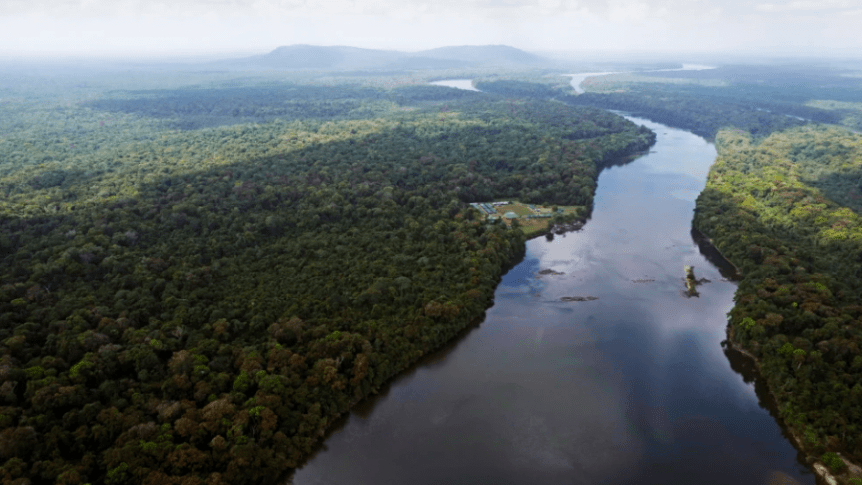
The Essequibo River flows through Kurupukari crossing in Guyana. The boundary was drawn by an international commission back in 1899, which Guyana argues is legal and binding, while Venezuela is disputing it. The U.S., meanwhile, is interfering on behalf of oil interests. | Juan Pablo Arraez / AP

Reposted from Peoples World


Venezuelan President Nicolás Maduro warned recently that “the Southern Command is provoking our region…[as it]  tries to set up U.S. military bases in our Essequibo Guyana.” Venezuelan diplomat José Silva Aponte earlier had observed that, “the United States is intent upon both countries arriving at confrontation.”

Dispute between Venezuela and Guyana over the Essequibo district originated in the early 19th century as Venezuela defied British Guinea in claiming jurisdiction over Essequibo. That territory borders on Venezuela’ eastern frontier and accounts for two thirds of Guyana’s land mass. British Guinea became Guyana in 1966 with the end of Britiah colonialism.

An arbitration tribunal in Paris rejected Venezuela’s claim in 1899. Venezuela and newly independent Guyana agreed in 1966 that the earlier decision was unfounded and that negotiations would continue. The case remains in limbo; the International Court of Justice is involved.

The U.S. government has taken Guyana’s side—no surprise in that Exxon Mobil Corporation is well ensconced there. Oil discovered in 2015 has Guyana, including Essequibo, on track to soon become the world’s fourth largest offshore oil producer.

Venezuela’s government in 2023 created a “Zone of Comprehensive Defense of Guyanese Essequibo.” It’s made plans for the “exploration and exploitation of oil, gas, and minerals” in the region.  Venezuelans voting on Dec. 3, 2023 overwhelmingly approved a referendum allowing their government to establish sovereignty over the contested territory. Essequibo would become a new Venezuelan state.

CIA head William Burns visited Guyana in March 2024. Reacting, Venezuela’s vice president Delcy Rodríguez explained that, “In the history of this U.S. intelligence agency, there is not a single positive milestone; but only death, violence and destruction.” Foreign minister Yvan Gil condemned the visit as “an escalation of provocations against our country and meddling, together with the U.S. Southern Command.”

U.S. resort to military power via the Southern Command suggests that powerbrokers in Washington see the possibility of accomplishing two missions with the same stroke. They want Essequibo to remain within the orbit of Guyana and Exxon Mobil. And, having found a pretext for introducing military power, they would be moving toward the forced removal of a despised left-leaning government.

The Southern Command is responsible for U.S. military operations and “security cooperation” throughout Latin America and the Caribbean.

The Guyana media follows local U.S. military activities. Reporting on December 1, Bernardo de la Fuente detailed Southern Command assistance to the Guyanese Defense Force (GDF). It includes:

  • The upgrading of four Coast Guard River stations, plus additions to the port structure at the Ramp Road Ruimveldt Naval Station in Georgetown.
  • Constructing an outboard motor boat launching ramp and interceptor boat storage yard at a naval facility.
  • Supplying U.S.- constructed “Metal Shark Defiant” patrol boats.
  • Refurbishing a naval headquarters, constructing a new hangar and “expanding the existing facilities of the Air Wing of the Defense Force”
  • Developing “a network of radio repeater stations and a Jungle Amphibious Training School.”

The Southern Command is “helping the GDF strengthen its technological capabilities, as well as directly supporting strategic planning, policy development and coordination of military and security cooperation to strengthen the interoperability of its services in the face of new threats.”

Rehabilitation of a jungle airstrip in Essequibo is icing on the cake. At a cost of $688 million, the now fully-fledged airfield has been extended to 2,100 feet; it will “withstand all weather conditions and ensure 24-hour accessibility.”  According to reporter Sharda Bacchus, the GDF provided $214.5 million. The U.S. taxpayer presumably supplies the rest.

Bernardo de la Fuente notes the airfield’s location adjacent to the west-to-east running Cuyuni River. For Guyana, but not for Venezuelans, that river marks the northern border of both Guyana and Essequibo and the southern border of eastern Venezuela.

Immediate across the river, on the Venezuela side, construction is underway of a jungle command school, ambulatory medical center, training field, and more. Venezuelan General Elio Estrada Paredes and colleagues arrived on Dec. 6 for an inspection visit. A refurbished airstrip provides access to the area.

Officials in Washington have long sought to destroy a Venezuelan government that offends in two ways. It exerts control over huge oil reserves and has aspired to be a model for people-centered political change. Governments led by Presidents Chávez and Maduro, after Chávez’s death in 2013, have had to contend with multiple U.S. intrusions.

They include: an unsuccessful coup in 2002 facilitated by the State Department, tens of millions of dollars delivered to dissident groups, painful economic sanctions from 2015 on, U.S. backing for a puppet Venezuelan president, and the stealing of Venezuelan assets located abroad. U.S. military interventions have been trivial. There was the tiny, U.S.- led seaborn invasion in 2020 (“Operation Gideon”). U.S.-allied Colombian paramilitaries cause mischief inside Venezuela. The U.S. Navy’s Fourth Fleet monitors air and sea approaches to Venezuela.

A U.S. turn to military force directed at Venezuela may not elicit the criticism from U.S. progressives that might have obtained during the Chávez era. Their attachment to Venezuela’s Bolivarian project appears to have weakened.

President Maduro shows less charisma than did President Chávez; he does not match Chávez’s personification of the cause of regional unity, of “Our America.” According to Venezuela’s Communist Party, his government in 2018 “flattened the wages for all sectors and unilaterally canceled all the collective bargaining agreements of…workers.” It later “strengthened its alliance with sectors of big capital, particularly the new bourgeoisie.”

Controversy surrounding Maduro’s re-election to office on July 28, 2024 centers on incomplete reporting of voting tallies. Gustavo Petro, Colombia’s first-ever progressive president, expressed skepticism at the election results.  Alleging over-dependence on oil exports for the financing of development, Petro claimed on Dec. 5 that “Venezuelans now don’t know if they are a democracy, or if they have a revolution.”

The Maduro government recently excluded Venezuela’s Communist Party (PCV) from effective electoral participation, perhaps in order to gain favor in Washington.

Some U.S. progressives disenchanted with the Maduro government may be unaware of its achievement of having built urban and rural communes. They may not have adequately factored in heavy U.S. funding of a divided opposition or recent destabilization inside Venezuela caused by Colombian paramilitaries.

Anti-imperialists may find that assessing the virtues and shortcomings of U.S.-targeted governments doesn’t work well as guidance for action. They might recall their primary vocation of opposition to capitalism.

They would surely derive ample inspiration from there to oppose maneuvering in defense of Exxon Mobil in Essequibo—and enough too to reject U.S. military meddling, whether in a dispute between two nations or against Venezuela itself.


We hope you appreciated this article. At People’s World, we believe news and information should be free and accessible to all, but we need your help. Our journalism is free of corporate influence and paywalls because we are totally reader-supported. Only you, our readers and supporters, make this possible. If you enjoy reading People’s World and the stories we bring you, please support our work by donating or becoming a monthly sustainer today. Thank you!


W.T. Whitney Jr. is a political journalist whose focus is on Latin America, health care, and anti-racism. A Cuba solidarity activist, he formerly worked as a pediatrician, and lives in rural Maine.

Honduras – next in line for US-imposed coup / By W.T. Whitney

Image: Honduras: Background and U.S. Relations | CRS Report

South Paris, Maine


After narrowly losing elections in 2013 and 2017, Xiomara Castro and her social democratic Freedom and Refoundation Party (Libre) won the next set of elections such that, as of January 2022, she was Honduras’s new president. The defeated National Party had presided over worsening corruption, electoral fraud, poverty, and violent repression for 12 years – President Juan Orlando Hernández (JOH), for eight of them.

The U.S. government played a part in the military coup that in June 2009 removed President José Manuel Zelaya. He is President Casto’s husband and longtime “coordinator” of the Libre Party. Now the United States is promoting another coup.

Interviewed by media outlet HCH TV on August 28, U.S Ambassador in Honduras Laura Dogu stated that, “We are very concerned about what has happened in Venezuela. It was quite surprising for me to see the Minister of Defense (José Manuel Zelaya) and the head of the Joint Chiefs of Staff (General Roosevelt Hernández) sitting next to a drug trafficker in Venezuela.”

The seat-mate was Venezuela’s Minister of Defense Vladimir Padrino López. The occasion was the World Cadet Games of the International Council of Military Sports taking place in Caracas from August 16 on. The U.S. government had charged Padrino López with “conspiring with others to distribute cocaine” and on March 26, 2020 announced bounties for his capture and that of 14 other Venezuelan officials facing drug-related charges.

Responding, Castro immediately declared that “Interference and interventionism by the United States … is intolerable.” Denouncing “U.S. violation of international law,” she canceled Honduras’s 114- year-old extradition treaty with the United States. Honduras has extradited 40 or so individuals to the United States over 10 years for prosecution on drug-related causes. JOH, the best-known of them, was recently sentenced to a 45-year prison term.

Slippery slope

On August 29, President Castro told reporters, “I will not allow extradition be used as an instrument for blackmailing the armed forces …  Yesterday they attacked the head of the armed forces and the minister of defense in our country… [such an] attack weakens the Armed Forces as an institution and makes the upcoming process of elections [in 2025] very precarious.”

In a television interview , Foreign Minister Eduardo Enrique Reina indicated Dogu’s comments could set off a “barracks coup” aimed at removing General Roosevelt Hernández. Schisms do exist. A year ago, for example, General Staff head José Jorge Fortín Aguilar’s warned four retired military chiefs to desist from their anti-government activities. 

Reina claimed that the extradition treaty, long used as a “political tool to influence the country internal affairs,” could be used “to bring Roosevelt Hernández or Secretary of National Defense José Manuel Zelaya Rosales to trial in the United States, in order to disrupt the Libre Party’s electoral plans.”

Primary elections take place in April 2025 and elections for president and Congress on November 30, 2025. The Libre Party is vulnerable.

The attorney general is investigating secretary of Parliament and Libre Party deputy Carlos Zelaya following his recent acknowledgement that two narco-traffickers in 2013 offered him money for the Libre Party’s election campaign that year.

Implicated in other drug-related crimes, Carlos is the brother of former President José Manuel Zelaya and brother-in-law of President Castro. On August 31, Carlos Zelaya and Defense Minister José Manuel Zelaya each resigned. The latter is Carlos’s son; he and the former president share the same name.

President Castro replaced the resigned defense minister with lawyer Rixi Moncada. She is running for president in the 2025 elections. As such, she would “continue reshaping Honduras’s economic and financial apparatus to fit with the people’s revolution,” according to an admirer.

The situation for Castro and the Libre Party deteriorated even more after September 3 with wide publicity given to a video showing Carlos Zelaya conferring in 2013 with the narco-traffickers. Obtained by InSight Crime and allegedly leaked by the U.S. government, the video is accessible here. It shows the drug-traffickers “offering to give over half a million dollars” to the Libre Party. They mention “previous contributions” to former President José Manuel Zelaya. 
On September 6, President Castro condemned Carlos Zelaya’s meeting with narco-traffickers where they “discussed bribes” as a “deplorable error.”  That day opposition politicians demanded her resignation. They were leading “more than a thousand Hondurans” in a march through Tegucigalpa.

Fallout and implications

The Libre Party’s loss of political power would jeopardize the already precarious lives of most Hondurans. Government data show a poverty rate of 73.6% in 2021 that fell to 64.1% in 2023. According to UNICEF, “Deprivations are highest in nutrition, followed by deprivations in sanitation, education, water, and overcrowding, respectively.” UNICEF reports that, “The homicide rate was 38.1 per 100,000 inhabitants in 2022, the highest in Central America and the second highest in Latin America.”

Honduran writer, lawyer, political commentator, and Libre Party partisan Milson Salgado outlines programs introduced by the Xiomara Castro government that promote national development and social rescue.

He cites these: public enterprises recovered from privatization; “high social investment … in the construction of hospitals, repair of educational centers, construction and reconstruction of recreation centers;” extension of the electricity network; and new highways.

The Castro government has funded rural development, provided “educational scholarships at all school levels,” “support[ed] the agricultural sector with loans at the lowest interest rates in history,” provided financial relief for small farmers, “recovered “65,000 hectares of forest,” and provided support for the elderly and disabled.

The U.S. – assisted coup in progress in Honduras is remarkable in two ways. First, it illustrates U.S. reliance on drug war as justifying military and other interventions in targeted Latin American countries. Salgado notes that the United States has “no interest in the fight against narco-trafficking other than to use it selectively as a weapon for blackmailing governments, countries, and people.”

As regards Colombia, the U.S. government invoked the pretext of narco-trafficking as cover for its direct role in combating leftist insurgents. In Peru, a burgeoning drug trade recently prompted the United States to send in troops, most likely out of solicitude for natural resources on tap there. Exaggerated concern about narco-trafficking in Venezuela has rationalized various kinds of U.S. intervention directed at regime change.

Secondly, U.S. strategists altered the device called lawfare that Latin American coup-plotters rely on these days to remove governments not to their liking. That happened in ParaguayBrazilPeru, and Ecuador  through perverse manipulation of legal norms.

The U.S. gets credit for innovation. Treaties of extradition are legal instruments that, under international law, enable one country to ensure that its criminals staying in another country can be returned for prosecution. It’s a regular legal process that the United States has adapted for Honduras to bring about regime change there.

In any event, government supporters are planning a “big national mobilization” in Tegucigalpa on September 15 “in support of Honduras’s leader, in defense of the homeland’s independence and the building of democratic socialism, and in condemnation of interventionist activities.”


W.T. Whitney Jr. is a political journalist whose focus is on Latin America, health care, and anti-racism. A Cuba solidarity activist, he formerly worked as a pediatrician, lives in rural Maine. W.T. Whitney Jr. es un periodista político cuyo enfoque está en América Latina, la atención médica y el antirracismo. Activista solidario con Cuba, anteriormente trabajó como pediatra, vive en la zona rural de Maine.

US Intervention and Neoliberalism Aggravate Political Upheaval inBangladesh / By W. T. Whitney Jr.

Anti-government protestors march towards Prime Minister Sheikh Hasina’s palace as army personnel (C) stand guard in Shahbag area, near Dhaka university in Dhaka on August 5, 2024. Protests in Bangladesh that began as student-led demonstrations against government hiring rules in July culminated on August 5, in the prime minister fleeing and the military announcing it would form an interim government | Photo by Munir Uz Zuman/AFP via Getty Images

South Paris, Maine


Weeks of student-led and often violent protests forced the resignation and exile on August 5 of Bangladesh’s prime minister Sheikh Hasina. Demonstrators were reacting to inflation, unemployment, governmental and banking corruption and a quota system that preferentially opens up government jobs to descendants of people participating in the national liberation struggle. Brutal police repression and killings recalled Bangladesh’s long history of recurring coups, protests, and lethal violence.

Sheikh Hasina’s Awami alliance won a large parliamentary majority in elections taking place in January 2024, and she remained as prime minister. She had served as such from 1996 to 2001 and again from 2008 on. Sheikh Hasina faced little opposition in the low-turnout election. The large Bangladesh Nationalist Party (BNP) did not participate.

Her political party harks back to the Awami League, the central protagonist to the liberation struggle that in 1971 turned the former East Pakistan into an independent nation. Sheikh Hasina’s father, Sheikh Mujibur Rahman, was an Awami leader and Bangladesh’s first president. He and most of his family were killed in a coup in 1975.

Here we consider economic factors contributing to people’s distress and dissent and the U.S. role in the country’s difficulties.

Indian economist Prabhat Patnaik suggests that Sheikh Hasina’s government was oblivious to both the country’s changing economic situation and deterioration of living conditions. He points out that until recently, “growth in Bangladesh’s garment exports [had been] so rapid that it was even suggested that within a very short time Bangladesh would be meeting as much as 10 per cent of the world’s garment demand.” In 2022-2023 that industry provided Bangladesh with 84.58% of its export earnings.

Now production and export are reduced. Patnaik points to “the rise in imported fuel prices after the start of the Russo-Ukraine war [that] has contributed to a serious foreign exchange shortage, given rise toprolonged power cuts, and also caused a rise in the price of power that has had a cost-push effect on the economy as a whole.”

Factors contributing to inflation include “depreciation in the exchange rate vis-à-vis the dollar” and “the growing fiscal squeeze that the government is compelled to enforce within a neoliberal setting.” The government is unable “to insulate the people from the effects of inflation.” Additionally, “A rise in the minimum wage, as a means of compensating workers in the face of inflation, is…[impossible] within the neoliberal setting;” “export markets” would suffer.

Patniak’s report appears in People’s Democracy, the website of the Communist Party of India (M). He suggests that, “The transcendence of neoliberalism requires the mobilization of people around an alternative economic strategy that gives a greater role to the State, focuses on the home market, and on national control over mineral and other natural resources.”

Nobel Peace Prize laureate Muhammad Yunus now heads a make-shift government backed by Bangladesh’s military. The army chief and representatives of three political parties are meeting to form an interim government made up of “advisors.” Preparations for elections are underway.

The Awami League is not participating. Patnaik observes that, “if the Awami League is not allowed to contest the elections that are to be held, then the right-wing parties would emerge as the main beneficiaries of the political upheaval; Bangladesh would be pushed to the right to the delight of imperialism and the domestic corporate oligarchy.”

The U.S. government is paying attention. Assistant Secretary of State Donald Lu visited Bangladesh on May 17. Interviewed, he indicated that discussions covered Bangladesh’s role in U.S. strategy for the Indo-Pacific region. He denied reports that the United States wants to build anairbase in Bangladesh.

The US Department of State on May 20 announced sanctions against retired Army General Aziz Ahmed on grounds of “significant corruption.” Its statement testified to “U.S. commitment to strengthening democratic institutions and rule of law in Bangladesh.”

Prime Minister Sheikh Hasina spoke at a meeting May 23 of leaders of political parties making up the Awami League. She reported that a foreign country, unnamed, was seeking her approval for an airbase to be built in Bangladesh and would reward her by protecting her tenure in office. The proposal, she said, came from a “white skin country.” She insisted that, “I do not want to gain power by renting or giving certain parts of my country to anyone.”

Hasina’s hold on power was insecure. At a follow-up meeting on June 4 independent Awami League candidates and heads of political parties associated with the League joined in vigorously disputing the results of the January, 2024 elections.

Hasina had earlier predicted that, “if the (opposition) BNP came to power, it would sell the island to the US.” She was referring to St. Martin’s Island, located in the Bay of Bengal at the southernmost tip of Bangladesh. It sits eight km west of the Myanmar coast.

In 2003, American ambassador to Bangladesh Mary Ann Peters rejected speculation about a U.S. airbase in the country. In Parliament on June 14, 2023. Deputy Rashed Khan Menon, president of the Workers Party –Bangladesh’s largest Communist Party– asserted that, “The US wants Saint Martin’s Island and they want Bangladesh in the Quadrilateral Security Dialogue (Quad). They are doing everything to destabilize the current government.”

The Bay of Bengal is crucial to marine commerce in the entire region. An Indian observer notes that, “The island is ideally positioned to facilitate surveillance in the Bay of Bengal which has gained strategic significance due to China’s assertive push in the Indian Ocean region.” A Myanmar analyst refers to China as “the most influential foreign actor in Myanmar [and] the biggest investor” there.

The U.S.-promoted “Quad” alliance, aimed at China, includes India, Japan, Australia and the United States. The U.S. government has long pressured Bangladesh to join, while China has urged Bangladesh to maintain its non-aligned status.

In his remarks, Menon condemned the visa policy announced by the U.S. State Department on May 24, 2023 as “part of their ‘regime change’ strategy.” The U.S. government would withhold visas from Bangladeshis (family members too) viewed as “undermining the democratic election process in Bangladesh.”

Menon had more to say: “”During our Liberation War, [the United States] dispatched the Seventh Fleet, aiming to strip us of our hard-won victory. Amidst a severe famine, they rerouted a grain ship from the Indian Ocean, a calculated move to disrupt Bangabandhu’s administration.

Their clandestine influence was also involved in the assassination of Bangabandhu. Now, they are repeating such tactics, doing all within their power to undermine the existing government.” (“Bangabandhu” is the honorific of Sheikh Mujibur Rahman, Sheikh Hasina’s father.)

Under Sheikh Hasani’s leadership, U.S-Bangladesh relations have cooled, mostly in response to U.S. accusations of human rights abuses and U.S. economic sanctions. Visiting China on July 10 and seeking $20 billion in new loans, Hasani signed 28 bilateral agreements centering on trade and investments. Through its Belt and Road Initiative, China has upgraded the country’s infrastructure.

Bangladesh, it seems, is a small country attached to a worldwide economic system serving big powers but always close to social and economic catastrophe. Its plight is not unique.

Patnaik elaborates upon the theme: “Because of the world capitalist crisis, many third world countries pursuing neoliberal policies are being pushed into economic stagnation, acute unemployment and burgeoning/ external debt, which are going to make their prevailing centrist regimes that maintain a degree of autonomy vis-à-vis imperialism, unpopular; but this creates the condition for right-wing regimes supported by imperialism to topple these centrist regimes and come to power.”

In an authoritarian turn, security forces of the new government on August 22 arrested and detained Workers Party president Rashed Khan Menon, along with other cabinet ministers of the Sheikh Hasina government. They were blamed for deaths resulting from street protests prior to August 5. His defenders see a “political vendetta” on the way.


W.T. Whitney Jr. is a political journalist whose focus is on Latin America, health care, and anti-racism. A Cuba solidarity activist, he formerly worked as a pediatrician, lives in rural Maine. W.T. Whitney Jr. es un periodista político cuyo enfoque está en América Latina, la atención médica y el antirracismo. Activista solidario con Cuba, anteriormente trabajó como pediatra, vive en la zona rural de Maine.

U.S. imperialism arranges Black-majority occupation force for Haiti intervention / by W.T. Whitney Jr.

Residents walk past a burnt car as they evacuate the Delmas 22 neighborhood the morning after an attack amid gang violence in Port-au-Prince, Haiti, May 2, 2024. | Ramon Espinosa / AP

Reposted from Peoples World


Under U.S. arrangements, a so-called Multinational Security Support (MSS) force will soon be descending on Haiti. Its mission is suppressing gang violence. With their experience of earlier U.S. interventions, however, beleaguered Haitians can likely expect an aggravation of oppression, social disaster, and dependency.

Supplies will arrive from the United States, and a U.S. military base is taking shape near the Port-au-Prince airport for the task. Joining the 2,500-member police force on the way will be another 1,000 troops from Kenya and others from Benin, Chad, Jamaica, Barbados, Bahamas, and Bangladesh. Kenyan officers will provide leadership.

The United Nations Security Council approved the occupation force in October 2023, but U.N. organizational responsibility is lacking. The U.S. government is providing $300 million in financing plus administrative capabilities and supplies. During a three-day state visit to Washington by Kenyan President William Ruto in mid-May, Kenya was declared officially a non-NATO U.S. ally. There are 18 other such nations.

Haiti’s government barely functions. Authority centered on Prime Minister Ariel Henry from July 2021 until his forced resignation in April. The “Core Group” of nations appointed him to that office immediately after President Juvenal Moïse was assassinated. The Core Group has supervised Haiti’s affairs since 2004. It consists of the United States, France, Canada, other European states, and an EU representative.

With U.S. encouragement, the CARICOM alliance of Caribbean nations in April established the Temporary Presidential Council to provide Haiti with governance and prepare for elections in early 2026. National elections last took place in 2017.

Presidents Michel Martelly and Jovenel Moïse held office between 2011 and 2021. They took advantage of low turnout, corrupt elections, and, in Martelly’s case, help from U.S. Secretary of State Hillary Clinton. They presided over the massive plundering of the PetroCaribe oil funds.

The upcoming multinational intervention has antecedents: occupation by the U.S. Army from 1915 to 1934; U.S. military occupation from mid-1994 until March 1995, and a U.S.-endorsed U.N. multinational occupation force occupying Haiti between 2004 and 2017.  A militarized United Nations mission with U.S. participation remained there from 1995 until 2000.

The police personnel from Black-majority nations making up the new occupation force will be racially similar to the cruel security force serving Haiti’s Duvalier father-and-son dictatorship, in power from 1957 to 1986. The deadly Tonton Macoute paramilitary repressors operated with funds presumably taken from the $900 million the regime received from Washington in the name of anti-communism.

In Haiti, the U.S. government is again relying on proxy enforcers who are African-descended.

The rationale for the MSS occupation may go beyond gang violence. That some gang members are thinking about justice and new arrangements for Haitian society suggests stirrings of resistance.

Haitians carried out large street protests in 2018 and 2019 against high prices, fuel and food shortages, and governmental corruption. The rich and powerful, concerned about disarray and threats to their privileges, recruited gangs of impoverished, alienated young men to clear the streets. Arms arrived from the United States.

According to analyst Jemima Pierre, “The Haitian oligarchs have always used armed groups to settle business and political scores.” Some gangs later took up drug trafficking and now receive arms from Latin American cartels.

Critical thinking shows in at least one gang member. High-profile leader Jimmy Cherizier warned that Ariel Henry before he resigned, “will plunge Haiti into chaos.… We are making a bloody revolution in the country because this system is an apartheid system, a wicked system.”

Cherizier had already insisted that the gangs are seeking “stability in our communities, … stability for businesses to function without fear so that people in our community can live without fear and feel secure, potable water for everyone in the poor neighborhoods, good healthcare, and good schools for everybody in the poor neighborhoods.”

Aspirations for social change, worrisome to authorities, rate scant coverage in the Haitian and U.S. media. That’s no surprise, given the U.S. treatment of Jean-Bertrand Aristide.

An opening for democratically-elected political leadership culminated in Aristide’s inauguration as president of Haiti on Feb. 7, 1991. His social-democratic political movement took power. The Heritage Foundation four days later mentioned that “The new government in Port-au-Prince may be steering Haiti toward a communist dictatorship, hostile to the United States.”

U.S. intelligence operatives and other agents engineered successful coups against Aristide and his governments in 1991, 1994, and in 2004. Then came the 13-year-long United Nations military occupation.

An enduring theme resurfaces, that of repetition of occupations and coups and no end in sight. U.S. interventions usually do not resolve the social and political problems of either country. In Haiti, they firm up a terrible status quo. U.S. relations with other Western Hemisphere nations are different.

In dealings with many of those nations, the region’s self-appointed boss often succeeds in accomplishing its political and economic purposes. The U.S. government even adjusts to mildly progressive political changes in a few countries. In others, it suppresses social and political ferment through reliance on psychological war, undercover actions, and/or intervention, either directly or with proxies. Some sort of resolution results in most instances.

Relations with Haiti are stuck, and for good reason. Interventions don’t prosper because potential allies naturally aligned with the United States may be reluctant. For one thing, their other transnational allegiances tend to distract Haiti’s business owners and wealthy class from building U.S. relationships.  Many have family, investments, and enterprises elsewhere overseas.

The population’s division by mulatto and Black identity has historically weakened ruling-class integrity. U.S. decision-makers might have found allies among Haiti’s mulattos, a minority like themselves that is associated with political power and wealth. But recruitment may have stumbled because, as in the past, mulatto attachment to the white establishment gets push-back from Haiti’s impoverished, restive Black majority.

U.S. interventionists may not warm to Haiti’s business and political class because of supposed corruption tendencies. Anti-Black prejudice infecting U.S. society also causes trouble. Stories linger of anti-white violence accompanying slave rebellion in Haiti.

By contrast, the existence in Latin America of a well-established, institutionally-attached, self-sustaining, and culturally-aligned wealthy elite encourages collaboration. That sector can lean upon U.S. counterparts for rescue from their own dispossessed, aroused, and rebellious compatriots. Similar possibilities in Haiti are stymied. U.S. intrusions are blundering, and society itself is hurt.


W.T. Whitney Jr. is a political journalist whose focus is on Latin America, health care, and anti-racism. A Cuba solidarity activist, he formerly worked as a pediatrician, lives in rural Maine. W.T. Whitney Jr. es un periodista político cuyo enfoque está en América Latina, la atención médica y el antirracismo. Activista solidario con Cuba, anteriormente trabajó como pediatra, vive en la zona rural de Maine.

U.S. policy implicated in the economic crisis driving Cuban protests / by W.T. Whitney Jr.

Beatriz Johnson Urrutia (center), the First Secretary of the Provincial Committee of the Communist Party in Santiago de Cuba, speaks directly with people demonstrating against food and electricity shortages on Sunday. | Photo via Juventud Rebelde

Reposted from the People’s World


This report takes advantage of the cogent observations (see below) of Professor Isaac Saney, former co-chairperson of the Canadian Network on Cuba and Coordinator at Dalhousie University for Black and African Diaspora Studies.

Hundreds of Cubans demonstrated peacefully in Santiago de Cuba and other cities across the island on March 17. Portrayed in some U.S. corporate media outlets as “anti-government” protests, the demonstrations were focused on electrical power outages and food shortages.

The protests were reacting to an accumulation of great economic difficulties that have assaulted Cubans and their government alike for decades.

Cuba is in the midst of a sharp economic crisis. Surging inflation is battering the economy, which shrank by almost 2% last year. Fuel prices rose by more than 500% just this month, while electricity rates climbed 25%.

Exports for 2023 were far below predictions, food production was less than 2022, and tourism income has only recovered to 69% of pre-COVID levels. Shortages of fuel and other supplies—largely because of the U.S. blockade—continues to hamper production in most sectors.

The dire circumstances are driving a mass exodus of Cubans; 425,000 migrants arrived in the United States in 2022 and 2023. Among those leaving are 9% of Cuba’s healthcare workers and thousands of educators. These departures have further aggravated the economic situation.

Responding to the Sunday demonstrations, Cuban President Miguel Díaz-Canel pointed out on social media that “enemies of the Revolution are trying to take advantage of a context [of shortages] for destabilizing purposes.” He noted, “In the last hours we have seen how terrorists based in the United States…are encouraging actions against the country’s internal order.”

On March 18, Cuba’s Foreign Ministry summoned U.S. chargé d’affaires Benjamin Ziff—there’s been no U.S. ambassador to Cuba since 1960—where he received a formal note of protest that referred to “interventionist behavior and slanderous messaging by the U.S. government and its embassy.”

While communicating the urgency of the situation, Díaz-Canel explained that his government’s approach would be “to attend to the complaints of our people, listen, dialogue, explain the numerous efforts that are being carried out to improve the situation, always in an atmosphere of tranquility and peace.”

In this screenshot from video circulating on social media, Cubans in the city of Santiago de Cuba protest food and electricity shortages on Sunday. | via X

The predicament for Cuba is evolving. It’s apparent that upcoming reactions from Cuba’s government, the international solidarity community, and by Cubans themselves will unfold according to economic and historical imperatives that are by no means new.

For insight, we turn to Isaac Saney’s analysis that was released on March 18. Excerpts follow:

Recent events in Cuba illustrate how intense the imperial pressures on the island nation are. It always bears underscoring that every effort to defy imperialism’s dictate and build a new society has faced unrelenting Western destabilization and sabotage: from the Haitian Revolution to numerous African, Asian, and Latin American national liberation projects. …

There is no doubt that Washington will spare no efforts to manipulate the current situation in Cuba through the use of various social media and digital platforms in order to further destabilize the situation. Moreover, it was recently revealed that U.S. intelligence agencies have been directly intervening in the Cuban economy to artificially inflate prices, stimulate inflation, and cause greater shortages of already scarce goods.

Cuba has faced—and is facing—the longest economic siege in history from the most powerful military and economic imperial power that has ever existed. Like the Haitian Revolution, the Cuban Revolution is the unforgivable example that must be destroyed. Washington’s overarching strategy aims at denying and eradicating Cuba’s right to self-determination, sovereignty, and independence.

The empire has never accepted the verdict of the Cuban people. It has waged an unceasing economic war and campaign of destabilization aimed at restoring U.S. imperialism’s domination and tutelage.

Cuba has repeatedly repelled the unceasing all-sided, military, economic, financial, and propagandistic assault by U.S imperialism.

Since the triumph of the Cuban Revolution in 1959, the United States has relentlessly pursued an ongoing assault on the Cuban people, employing both military and economic, including orchestrating invasions, assassinations, and terrorist attacks against civilians, as well as engaging in systematic economic sabotage. …

The sinister goal is to coerce the Cuban people into submission by strangling the economy, creating shortages, hardships, and exacerbating social inequalities—the very issues the Cuban Revolution has tirelessly worked to eliminate. This strategy seeks to instigate massive social unrest that would then serve as a pretext for U.S. intervention.

…The U.S. economic war against Cuba extends beyond U.S. borders, affecting businesses from other countries engaged in or seeking trade with Cuba. It stands as the primary impediment to Cuba’s social and economic progress, representing a blatant violation of the human rights of the Cuban people, costing the island nation more than $1 trillion U.S., underscoring its profound and detrimental effects.

A poignant testament on the criminality and immorality of the U.S. economic blockade was the Nov. 2, 2023, United Nations vote, when for the 31st time—with a vote of 187 to 2—the international community resoundingly rejected and condemned Washington’s economic war against Cuba.

Cuba faces significant—and what, for many, may seem overwhelming—challenges. However, the Cuban people have repeatedly shown themselves capable of meeting the challenges they take up.


We hope you appreciated this article. At People’s World, we believe news and information should be free and accessible to all, but we need your help. Our journalism is free of corporate influence and paywalls because we are totally reader-supported. Only you, our readers and supporters, make this possible. If you enjoy reading People’s World and the stories we bring you, please support our work by donating or becoming a monthly sustainer today. Thank you!


W.T. Whitney Jr. is a political journalist whose focus is on Latin America, health care, and anti-racism. A Cuba solidarity activist, he formerly worked as a pediatrician, lives in rural Maine. W.T. Whitney Jr. es un periodista político cuyo enfoque está en América Latina, la atención médica y el antirracismo. Activista solidario con Cuba, anteriormente trabajó como pediatra, vive en la zona rural de Maine.

On US Hesitation, Guy Philippe, and Saving Haiti / By W. T. Whitney Jr.

Coup leader Guy Philippe repatriated to Haiti from the U.S. | AP Archive [Youtube]

South Paris, Maine


Reports have circulated of gang warfare in Port-au-Prince and other Haitian cities, and of killings, shortages, social catastrophe and a government gone AWOL.  Also entering the news cycle was the UN Security Council’s approval in October 2023 of plans for troops from nine nations, other than the United States, to jointly occupy Haiti

The U.S. Defense Department had arranged for 1000 Kenyan troops to lead the multi-national force. The international force did not arrive in Haiti pending a decision of Kenya’s High Court on Kenyan forces serving overseas. On January 26, that court prohibited the deployment, and plans for the international force are in disarray.

Less is known about U.S. planning on Haiti that takes into account the most acute of Haiti’s intractable problems. There are the well-known ones, but also political corruption, business-class financing of gangs, U.S. supply of weapons for the gangs, a government headed by the unelected and widely-reviled Aaron Henry, no workable plans for a transition government, and the murky circumstances of president Jovenel Moise’s murder in July, 2021.

Instructions

The U.S. government in April 2022 announced that a new relationship with Haiti was in the works. The description relies on generalities such as: “a long-term, holistic view,” “forward-thinking rather than reactive mindset,” “Seeking innovation while scaling success,” and “Prioritizing locally driven solutions.”

The statement offers ideas on ways to implement guidelines from the Global Fragility Act (GFA) of 2019. That legislation sets forth concepts informing a new U.S. strategy for dealing with nine troubled countries in the Global South. Haiti is the only one in the Western Hemisphere.

It’s a “comprehensive, integrated, ten-year strategy” for achieving “the stabilization of conflict-affected areas,” and with the purpose of “strengthen[ing] the capacity of the United States to be an effective leader of international efforts to prevent extremism and violent conflict.”

Another statement, also released in April 2022, is about overall GFA implementation, not specific to Haiti The GFA would “build peace across divided communities, leverage and enable societal resiliencies … anchor interventions in communities … [and be] informed by the insights of expert practitioners and academics.”  The United States is seeking “true mutual partners and [would] commit to multilateral solutions.”

The GFA represents for Haiti “a “repackaging” of U.S. interventionist policies.” Analyst Travis Ross also suggests that U.S. troops would encounter “fiercer resistance than they did in their 1915, 1994, and 2004 interventions.”

The package is new, but substance is scarce. Specific objectives and precise methods for influencing affairs inside Haiti are lacking. There’s no mention of military and/or police action. Policymakers’ hesitation may be due in part to the ill-defined, if tumultuous, nature of difficulties they anticipate.

Loose cannon

Guy Philippe may be a case in point. The former narco-trafficker, imprisoned in the United States for money laundering since 2017, finished his term and returned to Haiti in November 2023. He has been touring Haiti’s cities and towns.

He speaks to crowds about Haitians choosing their own government, building their economy, rejecting foreign oversight and intervention, removing de facto government head Ariel Henry, and restoring Haiti’s Army.

Heading a paramilitary force of hundreds, Guy Philippe’s destabilization campaign prepared the way for the coup in 2004 that removed the progressive and democratically-elected president Jean-Bertrand Aristide.

Trained by U.S. special forces in Ecuador, Philippe in the 1990s was a brutal police chief in two Haitian cities notable then for extra-judicial killings. In 2001 he organized a failed coup. Philippe ran for president in 2006, was elected senator in 2016, and heads his own political party.

Philippe has visited Haiti’s northeastern region, particularly Ouanaminthe, at least twice. This small city on the west side of the south-to-north flowing Massacre River, part of the boundary between Haiti and the Dominican Republic (DR), is a crossing point for binational commerce and for Haitians traveling to and from low-paying jobs in the DR.

The region is a display case for the hostility and racism experienced by Haitians in the DR. Dominican dictator Rafael Trujillo’s massacre of thousands of Haitians took place along the Massacre River in 1937. (The name derives from massacres in the 17th century.)

Guy Philippe has joined the fight local people are pursuing with Dominicans over a canal for diverting water from the Massacre River into Haiti for agricultural purposes. The process of building the Pittobert irrigationcanal has extended over years, but enthusiasm for completing it recently brought small farmers and agricultural workers together as voluntary work crews.

Although 10 diversion canals deliver water to the DR side, the government there denounces the Haitians’ canal as depriving DR farmers and nearby mines of needed water. The Dominican government, in protest, closed the border between September 15 and October 8, 2023.

Speaking “to a multitude” in Ouanaminthe on Jan 3, Philippe insisted that, “We can construct as many canals as we think are necessary. I come to salute the determination and the bravery of these men and women who say that we are independent and sovereign in our country.” Philippe was honoring canal workers and security officers who had stood up to Dominican troops entering Haitian territory on November 7.

The latter are members of the Brigade for Surveillance of Protected Spaces (BSAP), a police unit of 15,000 officers charged with protecting national parks.  Observer Kim Ives explains that, “Guy Philippe sees a future for [the BSAP] as a sort of popular militia that can be a surrogate or support for the PNH (Haitian National Police) and Haitian army.”

The incident [on November 7] didn’t happen by chance,” opined a pro-Haiti commentator; “it’s part of the US plan under the Global Fragility Act to set the DR against Haiti … to unite the entire island under a single government … [This] provocation by the United States, mediated by the racist government of the Dominican Republic, accompanies war and American imperialist domination in the Caribbean and Latin America.

On January 24, “Sympathizers of the revolution led by Guy Philippe” filled the streets of Ouanaminthe, according to a report. They attacked banks and public offices, and demanded protection for a BSAP leader.  

Taken as a whole, the account offered here is of a U.S. response to Haiti’s extreme difficulties that, apart from charitable sentiments, is directionless, lacking in specifics, and incomplete. As a dispensation from on high, it represents a kind of noblesse oblige.

Either the U.S. government is turning away from Haiti’s affairs – not bad news – or has other, unknown plans for Haiti, which is more likely. The U.S commercial and investing class will undoubtedly be weighing in.

From that quarter may come concern about lost opportunity in allowing  Haitians alone to decide what happens with deposits of gold and other minerals worth $20 billion. They lie in the mountainous areas of northern Haiti, not far from the Massacre River.


W.T. Whitney Jr. is a political journalist whose focus is on Latin America, health care, and anti-racism. A Cuba solidarity activist, he formerly worked as a pediatrician, lives in rural Maine. W.T. Whitney Jr. es un periodista político cuyo enfoque está en América Latina, la atención médica y el antirracismo. Activista solidario con Cuba, anteriormente trabajó como pediatra, vive en la zona rural de Maine.

The terror returns: Cuba discloses latest attacks by the U.S. / by W. T. Whitney Jr.

Some of the weapons seized from a Florida-based terrorist captured on Cuban soil after he snuck onto the island via jet ski. | Photo courtesy of Granma

Reposted from the People’s World


When the U.S. government launched its so-called “Global War on Terror” after the al Qaeda attacks of Sept. 11, 2001, U.S.-led terror attacks against Cuba had already been ongoing for over 40 years.

They included: military invasion (1961), CIA-sponsored counter-revolutionary paramilitaries in the countryside (1960s), a fully loaded Cuban airliner brought down by U.S. agents (1976), attacks on coastal towns and fishing boats, biowarfare, hundreds of killings in Cuba and abroad, sabotage, and bombings of hotels and tourist facilities (1997).

With the new century, however, violence and terror seemed to be on vacation. The Cuban media and sympathetic international media were reporting little or nothing about U.S.-based terror attacks that had been their stock in trade.

On Dec. 17, 2023, Cuban Chancellor Bruno Rodríguez released a statement harking back to the violent past. He insisted that the “U.S. government is very aware of the official, public, and repeated denunciations by the Cuban government of the assistance, protection, and tolerance that promotors and perpetrators of terrorist acts against Cuba enjoy in the United States.”

He added that, “Recently Cuba’s Interior Ministry has reported on the dismantling of destabilization plans developed in the United States by terrorists of Cuban origin in a security operation that led to the detention of several persons tied to this conspiracy.”

Rodríguez’s statement followed a report appearing on the Communist Party’s Granma newspaper on Dec. 9, 2023. A Florida resident, traveling on a jet ski, came ashore near Matanzas on Cuba’s northern coast in late 2023; no date was specified. Carrying pistols, ammunition, and loading clips, the individual headed for Cienfuegos, his province of origin, and was arrested.

The unnamed man “contacted several people in order to recruit them.” He allegedly had ties in South Florida with “terrorists who publicly promote violent actions against Cuba … [and who] have received military training with weapons, have the physical equipment … and other resources to carry out their plans.”

Granma stated that, “the terrorists, with their plans for actions aimed at undermining internal order, go beyond a virtual setting; they concentrated on promoting violence so as to cause pain, suffering, and death at the year’s end.”

These “instigators of hate and death … appear on [Cuba’s] National List … [Cuban security officials] have investigated actions they’ve taken in the national territory or in other countries.”

report on Jan. 4 from Mexican journalist Beto Rodríguez discusses the Interior Ministry’s “National List of persons and entities … associated with terrorism against Cuba.” Since 1999, they “have planned, carried out, and plotted acts of extreme violence in Cuban territory.’’

The List first appeared on Dec. 7 in Cuba’s Official Gazette as  Resolution 19/2023. It names 61 individuals and 19 terrorist organizations, all based in the United States, presumably most of them in South Florida. One of the names on the List belongs to the jet skier, but which one is unspecified.

According to Beto Rodríguez, criminal investigations in Cuba revealed that some of the listed persons targeted “governmental and tourist installations and carrying out sabotage, illegal incursions, human trafficking, and preparations for war.” They “made plans for assassinating leaders of the revolution.”

He also reported that the arrested jet skier “intended to recruit Cubans for burning sugarcane plantations, provoke disturbances, disturb tourist centers, and hand out propaganda.” “[C]itizen denunciation” led to his arrest.

Appearing on the List is Alexander Alazo Baró, who shot at Cuba’s embassy in Washington with a semiautomatic weapon on April 30, 2020. He is still “under investigation.” Two Molotov cocktails exploded at the embassy on Sept. 24, 2023. The perpetrator is unknown.

Beto Rodríguez notes that on Nov. 24, 2023, the U.S. State Department, warning prospective travelers to Cuba of “potential terrorist actions … against the United States,” advised them to avoid “sites commonly used for demonstrations.”

A day earlier, a large pro-Palestinian march headed by Cuban President Miguel Díaz-Canel passed by the U.S. embassy in Havana. Journalist Rodríguez surmises that, “Washington already knew beforehand that anti-Cuban groups were planning to enter onto the island to commit acts of terrorism.”

Hernando Calvo Ospina, veteran analyst of U.S. terror against Cuba, reported on Jan. 10 that Cuba’s government referred the National List to the International Criminal Police Organization (Interpol), which deals with crime extending across borders.

Describing activities of the listed persons, Calvo Ospina highlights their new use of social media to communicate propaganda and to “incite internal violence, the assassination of State personalities, the destruction of common goods and all kinds of sabotage.”

Ospina states that, “the objectives now being pursued are similar to those of the so-called ‘historical exile group.’ Only the method has changed. Both have one thing in common: they use terrorist methods.” Some of those whose names appear were carrying out terrorist activities in the 1990s.

He indicates that, “Many received direct funding from the U.S. State Department, and also from the CIA, which uses various entities and NGOs to deliver it.”

According to the Congressional Research Service, the government’s so-called “democracy and human rights funding” for Cuba, a reference to support provided for interventionist programming, amounted to $20 million annually from 2014 to 2022. In July 2023, Rep. Mario Diaz-Balart, R-Fla., chairman of the House Appropriations Subcommittee, sought “to boost funding by 50% for democracy promotion efforts in Cuba.”

What looks like a revival of the U.S. government’s former anti-Cuba terror campaign may point to one or more of several possibilities:

  • Terror attacks had actually continued during the past two decades, but Cuba’s government, for unknown reasons, opted not to publicize them.
  • Terror attacks did continue, but at a low ebb, and now the Cuban government, at a difficult time, seeks to inform world opinion of illegal and dangerous U.S. actions, the object being to promote multi-national mobilization against prolonged U.S. all-but-war against Cuba.
  • The U.S. government, taking advantage of Cubans’ discouragement aggravated by a terrible economic crisis, has successfully recruited dissidents and once more is capable of mounting terror attacks.
  • The U.S. government, true to its ideologic core, to its imperialist self, stops at nothing while dominating or beating up on lesser peoples of the world.

We hope you appreciated this article. At People’s World, we believe news and information should be free and accessible to all, but we need your help. Our journalism is free of corporate influence and paywalls because we are totally reader-supported. Only you, our readers and supporters, make this possible. If you enjoy reading People’s World and the stories we bring you, please support our work by donating or becoming a monthly sustainer today. Thank you!


W.T. Whitney Jr. is a political journalist whose focus is on Latin America, health care, and anti-racism. A Cuba solidarity activist, he formerly worked as a pediatrician, lives in rural Maine. W.T. Whitney Jr. es un periodista político cuyo enfoque está en América Latina, la atención médica y el antirracismo. Activista solidario con Cuba, anteriormente trabajó como pediatra, vive en la zona rural de Maine.