The terror returns: Cuba discloses latest attacks by the U.S. / by W. T. Whitney Jr.

Some of the weapons seized from a Florida-based terrorist captured on Cuban soil after he snuck onto the island via jet ski. | Photo courtesy of Granma

Reposted from the People’s World


When the U.S. government launched its so-called “Global War on Terror” after the al Qaeda attacks of Sept. 11, 2001, U.S.-led terror attacks against Cuba had already been ongoing for over 40 years.

They included: military invasion (1961), CIA-sponsored counter-revolutionary paramilitaries in the countryside (1960s), a fully loaded Cuban airliner brought down by U.S. agents (1976), attacks on coastal towns and fishing boats, biowarfare, hundreds of killings in Cuba and abroad, sabotage, and bombings of hotels and tourist facilities (1997).

With the new century, however, violence and terror seemed to be on vacation. The Cuban media and sympathetic international media were reporting little or nothing about U.S.-based terror attacks that had been their stock in trade.

On Dec. 17, 2023, Cuban Chancellor Bruno Rodríguez released a statement harking back to the violent past. He insisted that the “U.S. government is very aware of the official, public, and repeated denunciations by the Cuban government of the assistance, protection, and tolerance that promotors and perpetrators of terrorist acts against Cuba enjoy in the United States.”

He added that, “Recently Cuba’s Interior Ministry has reported on the dismantling of destabilization plans developed in the United States by terrorists of Cuban origin in a security operation that led to the detention of several persons tied to this conspiracy.”

Rodríguez’s statement followed a report appearing on the Communist Party’s Granma newspaper on Dec. 9, 2023. A Florida resident, traveling on a jet ski, came ashore near Matanzas on Cuba’s northern coast in late 2023; no date was specified. Carrying pistols, ammunition, and loading clips, the individual headed for Cienfuegos, his province of origin, and was arrested.

The unnamed man “contacted several people in order to recruit them.” He allegedly had ties in South Florida with “terrorists who publicly promote violent actions against Cuba … [and who] have received military training with weapons, have the physical equipment … and other resources to carry out their plans.”

Granma stated that, “the terrorists, with their plans for actions aimed at undermining internal order, go beyond a virtual setting; they concentrated on promoting violence so as to cause pain, suffering, and death at the year’s end.”

These “instigators of hate and death … appear on [Cuba’s] National List … [Cuban security officials] have investigated actions they’ve taken in the national territory or in other countries.”

report on Jan. 4 from Mexican journalist Beto Rodríguez discusses the Interior Ministry’s “National List of persons and entities … associated with terrorism against Cuba.” Since 1999, they “have planned, carried out, and plotted acts of extreme violence in Cuban territory.’’

The List first appeared on Dec. 7 in Cuba’s Official Gazette as  Resolution 19/2023. It names 61 individuals and 19 terrorist organizations, all based in the United States, presumably most of them in South Florida. One of the names on the List belongs to the jet skier, but which one is unspecified.

According to Beto Rodríguez, criminal investigations in Cuba revealed that some of the listed persons targeted “governmental and tourist installations and carrying out sabotage, illegal incursions, human trafficking, and preparations for war.” They “made plans for assassinating leaders of the revolution.”

He also reported that the arrested jet skier “intended to recruit Cubans for burning sugarcane plantations, provoke disturbances, disturb tourist centers, and hand out propaganda.” “[C]itizen denunciation” led to his arrest.

Appearing on the List is Alexander Alazo Baró, who shot at Cuba’s embassy in Washington with a semiautomatic weapon on April 30, 2020. He is still “under investigation.” Two Molotov cocktails exploded at the embassy on Sept. 24, 2023. The perpetrator is unknown.

Beto Rodríguez notes that on Nov. 24, 2023, the U.S. State Department, warning prospective travelers to Cuba of “potential terrorist actions … against the United States,” advised them to avoid “sites commonly used for demonstrations.”

A day earlier, a large pro-Palestinian march headed by Cuban President Miguel Díaz-Canel passed by the U.S. embassy in Havana. Journalist Rodríguez surmises that, “Washington already knew beforehand that anti-Cuban groups were planning to enter onto the island to commit acts of terrorism.”

Hernando Calvo Ospina, veteran analyst of U.S. terror against Cuba, reported on Jan. 10 that Cuba’s government referred the National List to the International Criminal Police Organization (Interpol), which deals with crime extending across borders.

Describing activities of the listed persons, Calvo Ospina highlights their new use of social media to communicate propaganda and to “incite internal violence, the assassination of State personalities, the destruction of common goods and all kinds of sabotage.”

Ospina states that, “the objectives now being pursued are similar to those of the so-called ‘historical exile group.’ Only the method has changed. Both have one thing in common: they use terrorist methods.” Some of those whose names appear were carrying out terrorist activities in the 1990s.

He indicates that, “Many received direct funding from the U.S. State Department, and also from the CIA, which uses various entities and NGOs to deliver it.”

According to the Congressional Research Service, the government’s so-called “democracy and human rights funding” for Cuba, a reference to support provided for interventionist programming, amounted to $20 million annually from 2014 to 2022. In July 2023, Rep. Mario Diaz-Balart, R-Fla., chairman of the House Appropriations Subcommittee, sought “to boost funding by 50% for democracy promotion efforts in Cuba.”

What looks like a revival of the U.S. government’s former anti-Cuba terror campaign may point to one or more of several possibilities:

  • Terror attacks had actually continued during the past two decades, but Cuba’s government, for unknown reasons, opted not to publicize them.
  • Terror attacks did continue, but at a low ebb, and now the Cuban government, at a difficult time, seeks to inform world opinion of illegal and dangerous U.S. actions, the object being to promote multi-national mobilization against prolonged U.S. all-but-war against Cuba.
  • The U.S. government, taking advantage of Cubans’ discouragement aggravated by a terrible economic crisis, has successfully recruited dissidents and once more is capable of mounting terror attacks.
  • The U.S. government, true to its ideologic core, to its imperialist self, stops at nothing while dominating or beating up on lesser peoples of the world.

We hope you appreciated this article. At People’s World, we believe news and information should be free and accessible to all, but we need your help. Our journalism is free of corporate influence and paywalls because we are totally reader-supported. Only you, our readers and supporters, make this possible. If you enjoy reading People’s World and the stories we bring you, please support our work by donating or becoming a monthly sustainer today. Thank you!


W.T. Whitney Jr. is a political journalist whose focus is on Latin America, health care, and anti-racism. A Cuba solidarity activist, he formerly worked as a pediatrician, lives in rural Maine. W.T. Whitney Jr. es un periodista político cuyo enfoque está en América Latina, la atención médica y el antirracismo. Activista solidario con Cuba, anteriormente trabajó como pediatra, vive en la zona rural de Maine.
U.S. military appears to favor Israeli plan for permanent Gaza occupation / By W.T. Whitney Jr.

Israeli soldiers eye their targets at the Israel-Gaza border on Monday, Dec. 18, 2023. | AP

Reposted from the People’s World


Nearly 20,000 Gaza civilians, mostly children and women, have died from bombs and gunfire in Israel’s war so far. Many more will be dying soon from lack of medical care, food, water, and the spread of infectious diseases. Healthcare and social service facilities—along with the homes of a million or more—have been reduced to rubble.

The U.S. government provides the support for all of this to happen, as it continues to financially and militarily back Israel in its war against Hamas in Gaza in retaliation for the latter’s attacks of Oct. 7.

Prospects for Gazans who survive the war are grim, or worse. The families of many are gone, and international aid agencies have mostly disappeared. Dire shortages of necessities are on the horizon.  Repairing the physical damage won’t happen anytime soon, and Israeli settlers are already eyeing prime Gaza lands.

With humanitarian disaster on full display, Human Rights Watch points out that, “by continuing to provide Israel with weapons and diplomatic cover as it commits atrocities…the U.S. risks complicity in war crimes.”

Either the charge or the fact of complicity will very likely bedevil the United States for as long as Gazan civilians are dying in large numbers or being removed to camps somewhere else and, all the while, the U.S. goes on supplying Israeli occupiers with weapons.

A recently released Israeli military analysis raises the possibility that the U.S. government courts very serious condemnation if it provides material support for a permanent Israeli occupation of Gaza.

Dr. Omer Dostri, the study’s author, is associated with the Jerusalem Institute for Strategy and Security and the Israel Defense and Security Forum. Each is oriented to Israel’s military establishment. His study appeared Nov. 7 in the Military Review, the self-described “Professional Journal of the U.S. Army.”

As reported by journalist Dan Cohen, Dostri declared on social media that, he “authored [the study] on behalf of the U.S. Department of Defense and the U.S. Army’s Military Review journal.” For the Military Review’s editors to have invited Dostri’s submission suggests they already knew about and were at least tolerant of, Dostri’s iron-fist approach toward Gaza.

The author and editors alike presumably expected their respective military superiors to accept some or all of the views expressed in the paper. Perhaps, then, the two military leaderships have common ground regarding Gaza. Publication of this Israeli analysis becomes a straw in the wind as to future U.S.-Israel military collaboration on Gaza, and, on that score, to U.S. war crimes.

The title of Dostri’s article reads in part, “The End of the Deterrence Strategy in Gaza.” He notes the failure of Israeli military intelligence, Israel’s lack of combat readiness, and Hamas’s “exceptional military and professional approach.” Referring to Israel’s “disregard for the fundamentalist religious dimension of Hamas as an extreme Islamic terrorist organization,” he diagnoses faulty “political perception”

Dostri reviews options for control of Gaza following the envisioned defeat of Hamas. They are: a local Gazan administration, the Palestinian Authority taking charge, a mandate exercised by another government or an international agency, or occupation and governance by Israel’s military. He favors the latter, “from a security perspective.”

The main reason for establishing Israeli settlements in Gaza, he states, is that “seizing and securing land constitutes a more substantial blow to radical Islamist terror groups than the elimination of terrorist operatives and high-ranking leaders.”

Summarizing, Dostri indicates that:

“[A] robust ground campaign in the Gaza Strip, encompassing the occupation of territories, the creation of new Israeli settlements, and the voluntary relocation of hundreds of thousands of Palestinians to Egypt with no option for return will greatly fortify Israeli deterrence and project influence throughout the entire Middle East.”

Dostri examines Israel’s conduct in the ongoing Gaza war. He calls for a military strategy aimed at securing “a swift surrender of the enemy” that would allow “political maneuverability to make decisions.” The goal “is to defeat Hamas and assume control of the Gaza Strip for the benefit of future generations.”

Israel, he says though, runs “the risk of a multifront war.” Planners are “in the process of altering…policy and military strategy, not only concerning Gaza but also across other fronts.” The Gaza experience is instructive: “Successive Israeli governments…regarded Hamas in the Gaza Strip as a legitimate governing entity that could be managed and engaged through diplomatic and economic means. Not anymore.”

Now “Israel should shift from a strategy of deterrence…[to a] strategy of unwavering decisiveness and victory.” In particular, “Israel will have no choice but to invade Lebanon and defeat Hezbollah.” In addition, “Israel cannot afford to allow the Houthis [in Yemen] to significantly bolster their military strength over time.”

U.S. political leaders for the most part have yet to weigh in on the fate of Gazan civilians in the post-war period. Dostri’s view of Gaza’s future, seemingly acceptable, more or less, to the militaries of the two countries, leaves no room for the niceties of civilians being abused and dying as part of the coming occupation.

By Dec. 1, the U.S. Congress was considering a proposal for assisting Israeli forces as they clear Gaza of Gazans:  Egypt, Turkey, Yemen, and Iraq would receive U.S. monetary support for taking in Gazans fleeing from Israeli attacks.

The next day, however, Vice President Kamala Harris indicated that “Under no circumstances will the United States permit the forced relocation of Palestinians from Gaza or the West Bank.”

At issue for U.S. policymakers are competing realities: the suffering of Gaza civilians, obligations to U.S. ally Israel, the prospect of a region-wide war, and the control of oil, whether Israeli or Palestinian.

Reporting on counterpunch.org, Charlotte Dennett cites “oil and natural gas, discovered off the coast of Gaza, Israel, and Lebanon in 2000 and 2010 and estimated to be worth $500 billion.” The Palestinians in 2000 claimed that the “gas fields…belonged to them.”

Yasser Arafat, the then-President of the Palestinian National Authority, “learned they could provide $1 billion in badly needed revenue. For him, this [was] a Gift of God for our people and a strong foundation for a Palestinian state.”

Dennett adds that “In December 2010, prospectors discovered a much larger gas field off the Israeli coast, dubbed Leviathan.” In addition, “work has already begun on…the so-called Ben Gurion Canal, from the tip of northern Gaza south into the Gulf of Aqaba, connecting Israel to the Red Sea and providing a competitor to Egypt’s Suez Canal.”

Israeli Prime Minister Benjamin Netanyahu wants to “convince international lenders to support his long-held scheme of turning Israel into an energy corridor.”

With such riches at stake, does anyone really believe that a truly free Palestinian state will be allowed to come into existence?


We hope you appreciated this article. At People’s World, we believe news and information should be free and accessible to all, but we need your help. Our journalism is free of corporate influence and paywalls because we are totally reader-supported. Only you, our readers and supporters, make this possible. If you enjoy reading People’s World and the stories we bring you, please support our work by donating or becoming a monthly sustainer today. Thank you!


W.T. Whitney Jr. is a political journalist whose focus is on Latin America, health care, and anti-racism. A Cuba solidarity activist, he formerly worked as a pediatrician, lives in rural Maine. W.T. Whitney Jr. es un periodista político cuyo enfoque está en América Latina, la atención médica y el antirracismo. Activista solidario con Cuba, anteriormente trabajó como pediatra, vive en la zona rural de Maine.

‘Economic asphyxiation’: U.S. restricts food supplies in bid to strangle Cuban revolution / by W.T. Whitney Jr.

A portrait of Argentine born Cuban revolutionary hero Ernesto ‘Che’ Guevara hangs on a shelf at a food store in Havana with some of the few products for sale. | Ramon Espinosa / AP

Reposted from the People’s World


The civilian victims of U.S. war-making in Gaza—the U.S. government supplies the big weapons—are on full display right now, broadcast on television screens and Twitter feeds around the world.

There’s another group on the receiving end of U.S. imperialism whose plight is not being publicized very much at the moment, though, and that’s the resistance of the long-suffering people of Cuba against an unrelenting economic war.

Differences in scale and immediacy of course distinguish the assault they face due from the U.S. blockade and the bombardment and constant death being visited upon the Palestinians by Washington’s Israeli ally, but for the island nation to our south, the supply of food and other necessities is becoming ever more precarious by the day.

And despite the differences in the war against Palestinians and the economic war against Cubans, there is a common principle that governs in both instances: Subjecting non-combatant populations to potentially lethal danger, under conditions of war, is criminal. That’s reason enough to force an end to the U.S. economic blockade of Cuba.

The blockade promotes food shortages and is putting more and more lives at risk. The U.S. public needs to know about, understand, and reject this blockade, its operation, and its impact. Letting people in the U.S. know the full details of what’s being done in their name is, of course, no small task. The blockade proceeds automatically and quietly; the human suffering it causes is largely hidden.

Economic embargos are a form of war and the people whose government is dishing out such a strategy is often unaware of what’s happening, writes commentator Nicholas Mulder: “Voters in the sanction-imposing country are unlikely to observe or understand the full costs of sanctions on ordinary people abroad.”

Not by accident

The blockade promotes food shortages, and that’s its intention. New Jersey Congressman Robert Torricelli introduced the Cuban Democracy Act in 1992 in the wake of the Soviet Bloc’s collapse. Cuba had just lost 80% of its trade and was vulnerable, which provided what the U.S. government saw as a chance to finish off Cuba’s Revolution.

The law prohibits those exporters abroad who are affiliated with U.S. companies from shipping food and other goods to Cuba under threat of penalties and fines. Torricelli explained the rationale, saying you mus “keep your foot on the snake, don’t let up.”

Companies around the globe had previously been exporting almost $500 million worth of food to Cuba annually, but Torricelli’s law put a stop to that. The legislation, which is still in effect, prohibits ships from entering U.S. harbors for six months after they visit a Cuban port.

The effect has been to raise shipping prices for Cuba and severely limit the number of international companies willing to risk their access to the giant U.S. market in order to sell to a much smaller customer like Cuba.

U.S legislation in 2000, provided some small relief, authorizing exports of U.S. farm products to Cuba. Payments are in cash only—no loans. Shipping costs remain high, though, because the food products must be carried in U.S. ships, and they return empty. Cuba has to pay for a two-way trip to get only one boatload of goods. U.S. food exports to Cuba peaked in 2008 and have fallen since.

The U.S. blockade also restricts financial services provided by international banks and lenders. Under U.S. pressure, they don’t lend money to Cuba and can’t handle U.S. dollars in transactions involving Cuba. The legislation that authorized U.S. presidents to designate other nations as sponsors of terrorism incorporated these prohibitions, along with penalties.

Cuba, as an alleged—falsely so—terrorist-sponsoring nation, lacks the credit and often the cash to pay for food imports and to develop the island’s own domestic agricultural potential. Cuba must spend $4 billion annually to import 80% of the food it consumes.

The U.S. blockade causes other shortages that also hobble food production. Fuel shortages impede the transport of goods and the operation of machinery. Fertilizer, herbicides, pesticides, seeds, spare parts, new equipment, veterinary supplies, irrigation equipment, new breeding stock, and grains used to make animal feed are all constantly in short supply. U.S. limitations on the remittances Cuban-Americans send to their families in Cuba further interfere with food purchases and spending on agricultural projects.

A comparison of agricultural production in Cuba and in the Dominican Republic suggests food shortages are due mostly to the U.S. blockade. The two are neighbors with essentially identical climates. The total of food produced in the unblockaded DR in 2021 exceeded Cuba’s “best historical average” yield by 35.7%, even though agricultural acreage in the Dominican Republic is only 25% of Cuba’s total.

Some difficulties affecting agricultural production result from non-blockade causes, to be sure: mounting inflation, domestic corruption, theft, currency speculation, and shortages of foreign currency due to reduced tourism during the COVID-19 pandemic and subsequently. Higher food prices generally around the globe recently and climate-change effects are also phenomena bearing on food availability in Cuba.

Policy failures also factor into the equation, as Cuba’s government has fallen short in converting the island’s many idle fields into productive farm land. And relatively few Cuban young people are attracted to farming; only 15% of Cubans live in the countryside.

Empty shelves

Agricultural minister Ydael Jesús Pérez Brito, interviewed recently, noted that the agriculture sector has secured only 40% of the diesel fuel it needs, 4% of required fertilizers, and 20% of feed needed for livestock.

He reported that pork production fell from almost 200,000 tons in 2017 to 16,500 tons in 2022, due in part to only 14% of necessary fuel being available. Rice farmers are producing 10% of recently achieved levels of production. Current production of beans and corn amounts to 9% and 30%, respectively, of yields in 2016.

Manuel Sobrino Martínez, the food industry minister, indicated last month that food processing generally and milk processing in particular is down over three years to 50% of capacity. He described a 46% drop over one year of milk received for processing to powdered milk, and reported that a ton of milk costs $4,508 now, up from $3,150 in 2019.

The availability of cooking oil is down 44% in a year; its cost is up from $880 per ton in 2019 to $1,606 now. Wheat processing is at half capacity. Fishing activity has fallen by 23% since 2022; 60 boats are not operating because motors are expensive and suppliers refuse to sell, or demand hard currency up-front. The minister said he must choose between “powdered milk, or wheat, or motors.”

The essence, according to an observer, is that, “owing to low agricultural yields, total food production in 2022 fell to 26% [of food produced] in 2019.”

Cuban President Miguel Díaz-Canel told a reporter recently that, “They have put us in a situation of maximum pressure, of economic asphyxiation to provoke the collapse of the Revolution, to fracture the unity between the leadership and the people, to obliterate the work of the Revolution.”

Production is low, he pointed out, and “the country’s fundamental problem is low availability of foreign currency.” Díaz-Canel said the government would “take advantage of the possibilities we have as a socialist state to plan and distribute available resources to prioritize the production that … could give us more possibilities, and also to protect people who may be in a situation of social disadvantage.”

Grim reality, of which food insufficiency is one aspect, demonstrates that now is the time for action and messaging strong enough to finally end the U.S. blockade. Suffering and distress at U.S. hands should provoke revulsion, just as does U.S. complicity with attacks on hospitals in Gaza, and killings of non-combatants.

A key element of Cubans’ distress is lack of currency and credit. President Joe Biden has only to remove Cuba from the U.S. list of terrorist-sponsoring nations to provide immediate humanitarian relief and restore Cuba’s government some room to maneuver the food crisis. An easing of current living conditions would surely result in fewer Cuban migrants heading to the United States, too.

For the U.S. government to be at peace with Cuba would hardly violate baseline presumptions for war-making, which would indeed be the case if the United States opposed Israel’s war in Gaza. Doing so would disturb respect for ally Israel’s historical memory, profiteering by U.S. weapons manufacturers, and backing for Israel as U.S. beachhead for regional control.

In dropping the blockade, U.S. power-brokers would lose little more than gratification and political reward for fighting communism and opposing Cuba’s efforts to rearrange their U.S. Latin American and Caribbean backyard.


We hope you appreciated this article. At People’s World, we believe news and information should be free and accessible to all, but we need your help. Our journalism is free of corporate influence and paywalls because we are totally reader-supported. Only you, our readers and supporters, make this possible. If you enjoy reading People’s World and the stories we bring you, please support our work by donating or becoming a monthly sustainer today. Thank you!


W.T. Whitney Jr. is a political journalist whose focus is on Latin America, health care, and anti-racism. A Cuba solidarity activist, he formerly worked as a pediatrician, lives in rural Maine. W.T. Whitney Jr. es un periodista político cuyo enfoque está en América Latina, la atención médica y el antirracismo. Activista solidario con Cuba, anteriormente trabajó como pediatra, vive en la zona rural de Maine.

Cuba Scores Big Victory in the UN General Assembly / By W. T. Whitney

South Paris, Maine


The United Nations General Assembly on November 2 voted to approve
a Cuban resolution that, unchanged over 31 consecutive years, calls for
an end to the U.S. economic blockade of Cuba. Approval once more
was overwhelming: 187 nations voted in favor and two against, the
United States and Israel. Ukraine abstained.

Reacting to the vote, Cuban President Miguel Díaz-Canel proclaimed a
“new victory for the Cuban people and their Revolution!” He pointed to
“the triumph of dignity and the fearlessness of our people,” and
expressed gratitude for “the international community’s recognition of and
support for Cuba’s heroism and resistance.”

For over 20 years, the only nations opposing the Cuban resolution, apart
from the United States, have been Israel and, formerly, a few U.S.-
dependent Pacific island-nations. The blockade began in 1962, and now
80% of Cubans have lived under its sway.

Prior to the vote this year, dozens of delegates representing member
states spoke out against the blockade. Cuba’s Minister of Foreign
Relations Bruno Rodríguez addressed the General Assembly, insisting
that the U.S. blockade interferes with “the right to life, health, progress
and welfare of every Cuban family.”

He explained that Cuba’s financial losses from the blockade reflect
factors like the high cost of substituting for goods excluded under the
blockade with more expensive goods and/or those with higher
transportation costs. Losses take the form also of an overall lack of
necessary materials, goods, and services. And “barriers Cuba faces in
gaining access to advanced technology” lead to monetary loss.

The chancellor emphasized that “sectors like agriculture and energy face
serious obstacles to acquiring spare parts or machinery.” He cited
examples of blockade-related shortages such as extreme shortages of
gasoline and oil, cancer patients being denied “first line treatments and
drugs,” and healthcare providers and their patients lacking respiratory
ventilators and medicinal oxygen normally available from abroad.

The blockade’s assault against the Cuban people shows up clearly and
dramatically in money lost to Cuba’s economy. Rodríguez claimed that
Cuba’s GDP would have grown by 9% in 2022 without the blockade, and
that the $4.87 billion in losses occurring between March, 2023 and
February 2023 correlated with “pain and suffering.”

Cuba’s monetary loss in over 60 years of blockade now totals $159.8
billion, according to one account. What with inflationary change, that’s
$1.3 trillion.

Another report indicates that between August 2021 and February 2022,
losses in the energy and mining sectors added up to $185.5 million, in
the agricultural sector, $270.9 million; and in banking and finance,
$280.8 million. Between January and July in 2021, losses were $113.5
million in the healthcare sector; $30.6 million in education; and $31.3
million in the transport sector.

Cubans’ lives are affected:

* During the last school year, Cuba’s government lacked paper
sufficient to “print and assemble books and notebooks for students,”
in part because a Canadian paper manufacturer did not extend credit.

* Presently, according to Granma news service, no school books are
being produced due to a lack of supplies and spare parts.

* Lack of access to high-performance brands and equipment, as well
as spare parts, serves to handicap Cuba’s telecommunications
sector, thus easing the way for U.S. and European competitors to
reach Cuban users.

Laws authorizing the U.S. blockade include the 1917 Trading with the
Enemy Act, the 1992 Cuban Democracy Act (Torricelli Law), and the
1996 Cuban Liberty and Democratic Solidarity Act (Helms-Burton Law).
Executive actions taken to implement the blockade have been central to
how that policy affects Cuba. The Obama administration eased many
blockade regulations. President Trump added 243 new measures, with
disastrous effect. The Biden administration continues them.

The U.S. Treasury Department imposes large fines on third-country
exporters failing to comply with its rules and so they often do not sell to
Cuba. Because the Treasury Department forbids foreign banks from
using U.S. dollars, international financial institutions rarely make loans to
entities in Cuba and are reluctant to handle U.S. dollars in transactions
involving Cuba.

The U.S. government has recently been weaponizing its false
declarations that Cuba is a terrorist-sponsoring state. The enabling
legislation on the matter granted the U.S. government authority to
penalize any international financial and banking sectors bold enough to
have dealings with states so designated.

Conveniently enough, Cuban analyst Claudia Fonseca Sosa recently
provide President Biden with advice as to “substantive modifications” of
methods for carrying out his policy. He could authorize “the export of
U.S. products to key branches of Cuba’s economy” and of medical
supplies and equipment to the island to help with the manufacture of
biotechnical products. Biden could allow U.S. companies to invest in
Cuba and enable U.S. citizens to receive medical treatment there.

The prospects for changed policies toward Cuba perhaps have
improved; a recent report documented the major role of the blockade in
propelling Cuban emigration to the United States – and sending
Venezuelans and Nicaragua there too. Those three blockaded countries
presently supply most of the migrants crossing into the United States.

U.S. sanctions cause desperate living conditions, and so people leave.
End all three blockades. Relieve the pressure on people, and maybe
they’d stay home. Who could object?


W.T. Whitney Jr. is a political journalist whose focus is on Latin America, health care, and anti-racism. A Cuba solidarity activist, he formerly worked as a pediatrician, lives in rural Maine. W.T. Whitney Jr. es un periodista político cuyo enfoque está en América Latina, la atención médica y el antirracismo. Activista solidario con Cuba, anteriormente trabajó como pediatra, vive en la zona rural de Maine.

Colombia Opts for Peace in Rural areas, No More Drug-trafficking / by William T. Whitney Jr.

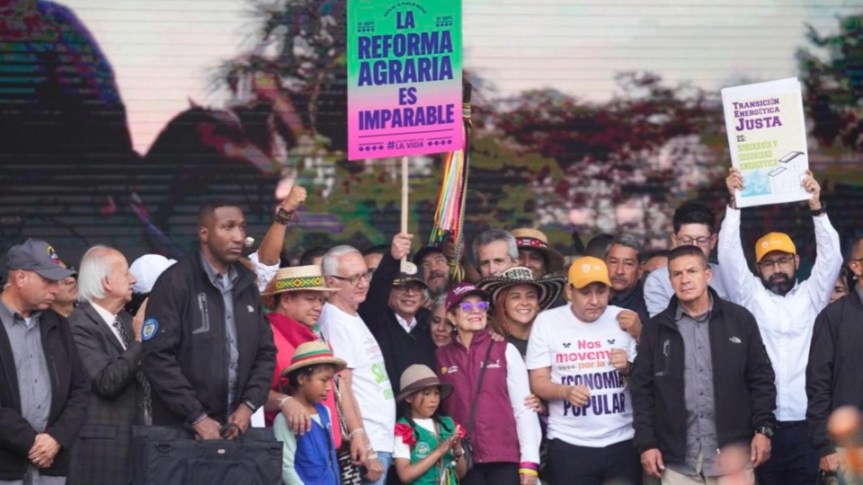
Surrounded by supporters, Colombia’s President Gustavo Petro, center, holds a sign that reads in Spanish, ‘The Agrarian Reform is Unstoppable,’ during a rally to show support for his proposed reforms, in Bogota, Colombia, Sept. 27, 2023. | Fernando Vergara / AP

South Paris, Maine


Colombian president Gustavo Petro on October 3 attended a big meeting of mostly small farmers in El Tambo, in Cauca, where “the coca economy is the main way of life for thousands of peasants.” Colombia’s first progressive president ever was presenting his government’s National Drug Policy for 2023. Petro had insisted earlier that “war on drugs has failed.” He recently expressed support for “phased decriminalization.”

His government is evidently prioritizing the present initiative, which is part of its far-reaching program for social and political reforms, now stumbling due to strong right-wing political opposition. The drug plan attends to main features of Colombian’s longstanding social disaster. They include:  dispossession leading to consolidation of large land holdings, agricultural underdevelopment, migrations leading to precarious lives often in cities, widespread lethal violence; and great wealth accumulated by top-level distributers and their financial backers.

The government’s new plan promises much, especially to working people both in Colombia and abroad. Freed of the monopolization of illegal drug production and commercialization, rural areas might shift to diversified agricultural production and expanded support systems. Prospects for community-development programs might improve and those rural Colombians forced into cities might return.  

By reducing that fraction of the domestic and international economy represented by drug production and marketing, the government would, in effect, be redistributing wealth, to a degree. And any success the new plan achieves in cutting back on drug commercialization might translate into reduced visibility abroad and, consequently, into lessened appeal to U.S. interventionists who have often justified military intrusions on that basis.

The plan calls for 27 “territorial spaces” in 16 departments and in Bogota, along with 51 “inter-institutional or bilateral technical working-groups.” Each one would hold three conferences with strategic allies, five with sectors drawn from the Joint Committee on Coordination and Follow-up. Other gatherings would involve women, young people, and prevention specialists.

Government spokespersons focused on the program’s two pillars. One of them, called “oxygenation,” supports those “territories, communities, people and ecosystems” adversely affected by drug-trafficking. It would support the transition to legal economies and reduce “vulnerabilities of regions and populations.” Measures would be taken that advance “environmental management and climate action toward … restoring regions” adversely affected by the narco-economy. The personal use of “psychoactive substances” will be dealt with on the basis of public health and human rights.

The other pillar, called “asphyxiation,” targets “the strategic nodes of the criminal system that generates violence” and “profits most from this illegal economy.”  The object would be to interfere with the “capacities and income” of the strongest drug-trafficking organizations and to do so so “systematically” and with consideration “of their complexity and relation with other economies both legal and illegal.”  Persons involved in production and trafficking would benefit from destigmatization and social justice.

The new plan has a slogan: “sewing life and burying narco-trafficking.” The aim is to remove 222,400 acres from coca and marihuana cultivation, reduce cocaine production by 43%, and block at least $55 billion in illegal financial gains. The plan would interfere with irregular banking and financial maneuvers and reduce both deforestation and greenhouse gas emissions.

Colombia’s illegal drug industry remains well entrenched, despite the drug war waged from 2000 on under the auspices of US Plan Colombia, a venture that absorbed billions of U.S. taxpayer dollars. A United Nations report cites a 13% one-year increase in land given over to illegal crops, as of 2022. It takes note of a recent “summit meeting [in Bogota] of narcotrafficking capos from Albania, Poland, Spain and Colombia.” 

The relentlessness of cocaine and marihuana production in Colombia may have led the U.S. government to recently stop monitoring the acreage of illegal crop cultivation. Indeed, after four decades of involvement, the U.S. government has abandoned its war against narco-trafficking in Colombia, according to analyst Aram Aharonian. Still, he reports, “weapons manufacturers” are benefiting, along with workers whose livelihood depends on narco-trafficking.

Petro’s new drug policy is significant mostly because it pursues objectives of the 2016 Peace Agreement which ended armed conflict between Colombia’s government and the FARC insurgency. Important parts of the new drug plan coincide with major provisions of that Agreement that were never implemented.

Agrarian reform matches with improving rural life generally. Solving the illicit drug problem was a goal of the Peace Agreement and now is the essence of Petro’s plan. The guarantee under the Peace Agreement of safety for former combatants never took root. The attacks against them are largely related to drug-trafficking, and now that will be dealt with.

Violence has been, and remains, pervasive. During just 13 months of the Petro government, assassins took the lives of 198 community and human-rights leaders and 43 former combatants.

A comprehensive report on the Petro government’s shepherding of  the peace process highlights the association of continuing violence with narco-trafficking. Indeed, “broad regions of the country” see persisting collusion of the police and military with paramilitaries and with “smaller narco-trafficking gangs and narco-trafficking structures.”  

Affirmation of the Petro government’s new campaign against drug trafficking comes from the report in June of the United Nations Mission to Verify the Peace Agreement. It emphasizes “the importance of peace initiatives and of efforts being made to expand the presence of the state so that vulnerable communities may be protected, especially in rural areas.”

Much is at stake as a government undertakes to control and end the production and marketing of illegal drugs. According to the UN’s Economic Commission for Latin America, “Problems associated with the production, trafficking, and consumption of drugs in Latin America affect the population’s quality of life, contribute to forms of social exclusion and institutional weakness, generate much insecurity and violence, and corrode governance in some countries.”  


W.T. Whitney Jr. is a political journalist whose focus is on Latin America, health care, and anti-racism. A Cuba solidarity activist, he formerly worked as a pediatrician, lives in rural Maine. W.T. Whitney Jr. es un periodista político cuyo enfoque está en América Latina, la atención médica y el antirracismo. Activista solidario con Cuba, anteriormente trabajó como pediatra, vive en la zona rural de Maine.

Potential disaster awaits Haiti as U.S. prepares for armed intervention / by William T. Whitney Jr

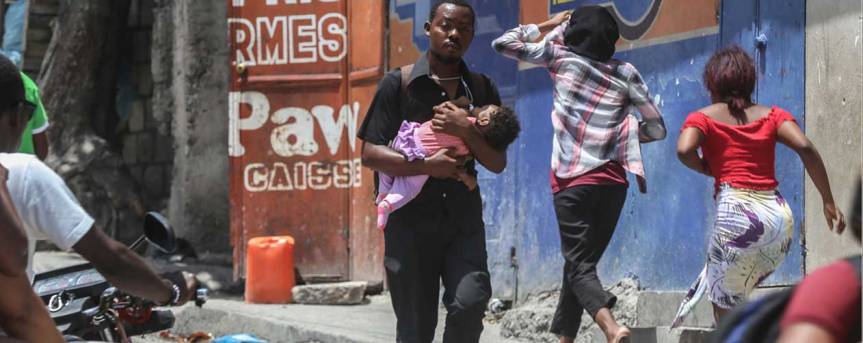
Residents flee their homes to escape clashes between armed gangs in the Carrefour-Feuilles district of Port-au-Prince, Haiti, Aug. 15, 2023. | Odelyn Joseph / AP

Reposted from People’s World


NEW YORK—On Monday, the United Nations Security Council voted to send a foreign “security mission” to Haiti—an armed intervention force. The body adopted a resolution, drafted by the United States and Ecuador, that authorizes the so-called Multinational Security Support mission—“to take all necessary measures”—code for the use of force.

Officials from Haiti, the U.N., and the U.S. say the intervention will be aimed at helping Haiti’s police suppress armed bands, or gangs, that cause deadly violence and have overrun the capital, Port-au-Prince. The U.N. reports that, as of Aug. 15, 2,439 Haitians had been killed this year.

“More than just a simple vote, this is in fact an expression of solidarity with a population in distress,” Haiti’s Foreign Minister Jean Victor Geneus told the council. “It’s a glimmer of hope for the people that have for too long been suffering.”

China and Russia, however, abstained from the vote, expressing reluctance about granting a blanket authorization for the use of force under Chapter 7 of the founding U.N. Charter. The remaining 13 members voted in favor.

Senior U.S. diplomat Jeffrey DeLaurentis justified the blank check for intervention, saying, “We have stepped up to create a new way of preserving global peace and security, answering the repeated calls of a member state facing a multi-dimensional crisis amid alarming spiraling gang violence.”

In mid-September, at the U.N. General Assembly, U.S. President Joe Biden and Ariel Henry, Haiti’s acting president, issued a call for a multinational militarized occupation of Haiti. U.N. Secretary-General António Guterres had already done so earlier. Secretary of State Antony Blinken promised “robust financial and logistical assistance” from the United States for a military intervention.

U.S. spokespersons say that $100 million is being sought from both Congress and the Pentagon to back the mission.

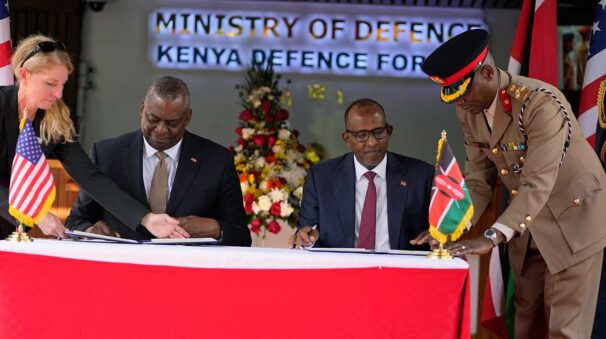
Meeting in Nairobi on Sept. 25, U.S. Defense Secretary Lloyd Austin and his Kenyan counterpart agreed that Kenya will provide 1000 “security officers” and will “lead a multi-national peacekeeping mission to Haiti.” According to the U.N., 12 countries have committed to being part of the mission.

The newly approved international intervention into Haiti will be officially ‘led’ by Kenya, providing some cover for the U.S. military, which will likely be calling the shots behind the scenes. Here, U.S. Secretary of Defense Lloyd J. Austin, left and Kenya Cabinet Secretary for Defense Aden Duale, sign a bilateral defense cooperation agreement in Nairobi on Sept. 25, 2023. The defense agreement will see Kenya get resources and support for security deployments in exchange for ‘leading’ the intervention in Haiti to combat gang violence. | Khalil Senosi / AP

The Communist Party of Kenya issued a statement condemning its government’s participation. It pointed out that U.S. power derives from “the enslavement of millions of African people, whose labor laid the foundation for [U.S.] economic prosperity.”

The United Nations itself is neither leading nor organizing the intervention, as the organization doesn’t exactly have a good reputation among the people of Haiti. For good reason: The U.N. force occupying Haiti in 2004-17 violated Haitians’ human rights, abused women and children, and introduced a cholera epidemic that killed 40,000 Haitians.

We offer four explanations for why the planned armed intervention will harm Haiti’s already beleaguered majority population.

One, previous foreign interventions have brought trouble. Nothing suggests this one will be different. Here’s the record:

  • The aforementioned U.N. occupation.
  • NGOs invaded after the 2010 earthquake. They wasted donated funds.
  • S.-assisted military coups in 1991 and 2004 removed the progressive Haitian President Jean-Bertrand Aristide.
  • The U.S. “Operation Uphold Democracy” reinserted Aristide in 1994 on the condition that he enforce neoliberal economic “reform.”
  • The U.S. government provided vital support to the father-and-son Duvalier dictatorship from 1957 to 1986
  • The U.S. military occupation of Haiti from 1915 to 1934 was brutal.
  • France, upon being kicked out of its Haitian colony, required payback with interest for slaves having gone free, in all, $560 million (in 2022 dollars) and up to $115 billion in lost development.
  • The U.S. responded to Haitian independence, proclaimed in 1804, with a trade embargo and diplomatic isolation, each lasting for decades.
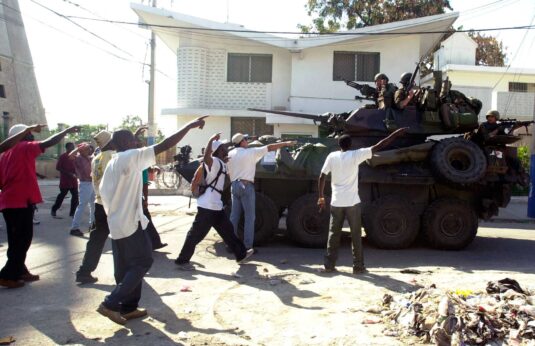
In this March 7, 2004, file photo, people demand that occupying U.S. Marines take action to protect them after shooting erupted during a march in Port-au-Prince, Haiti. In 2004, a coup d’état occurred after conflicts lasting for several weeks in Haiti. It resulted in the second removal from office of President Jean-Bertrand Aristide, preventing him from finishing his second term. Aristide claimed that his departure was a kidnapping, accusing the U.S. of orchestrating a coup d’état against him. Now, almost 20 years later, the country is still engulfed by violence. | Pablo Aneli / AP

Two, Haiti’s oppressed majority population needs a government, not a façade of one. A government in Haiti that served the people might provide a buffer between an imported, militarized foreign police and the Haitian people. Haiti has no functioning government today, much less one friendly to the people’s cause.

Michel Martelly became president in 2011, courtesy of U.S. manipulation. The last general election in Haiti, in 2016, allowed Jovenel Moïse to be president. The two wealthy politicians belonged to the rightwing PHTK political party. The elections they won were thoroughly corrupt and saw abysmally low-turnouts.

Moïse and others embezzled billions of dollars taken from the low-interest loans that President Hugo Chavez’s Venezuelan government made available to the Haitian state. The funds were supposed to have supported Haiti’s development and allowed the government to purchase low-cost oil under Chavez’s Petrocaribe program and to provide subsidized fuel and food for Haiti’s impoverished people. The U.S. government sanctioned Venezuela in 2015, and the loans and cheap oil stopped.

In response, massive protests erupted against government corruption and waste of the Petrocaribe funds. With increasing shortages and rising prices, they’ve continued since 2018. In a context of multifaceted conflict among Haiti’s oligarchs, Moïse was assassinated in July 2021.

There has been no president since, other than acting president Ariel Henry, whom the U.S., Canada, several European countries, and the EU—the so-called “Core Group” that oversees Haiti’s affairs—made prime minister shortly after the assassination. And as for the country’s parliament, it hasn’t functioned for over three years.

The distressed Haitian masses have no political party that reliably or effectively speaks for them. They have no say in foreign governments’ plans for them. They have no institutional resources or constitutional protections against potential abuse at the hands of foreign occupation forces.

Three, the gangs have ties with Haiti’s wealthy powerbrokers. It’s a relationship inconsistent with a simple story of interventionists taking on gangs. The association grew out of the recurring outbursts of social protest.

Haiti’s establishment sought protection from disorder and destruction triggered by the ongoing protests, primarily in Port-au-Prince. In the absence of an army, and with the police unable to cope, gangs came into existence.

They were supposedly going to bring order to city neighborhoods, even leading some protesters to join. Behind them, with funds the whole time, however, have been a number of wealthy Haitians. So of course, the gangs took on the additional role of blocking agitation for political change. Funds flowed from local oligarchs and from abroad for that specific purpose.

There’s a sea of contradictions. In suppressing the gangs, the interventionist forces would be defying the wealthy classes that pay them. But those same wealthy classes, as represented by their political boss Ariel Henry, are calling for a foreign security force to defeat them. The struggling people of Haiti may not readily follow such convoluted scheming, but they are familiar with the likely outcome.

Four, the timing of the intervention coincides with movement within the gangs toward a new kind of politics. One suspects that the proposed intervention represents a heavy-handed response to stirrings for political change.

Some leaders of some gangs appear to be disenchanted with inter-gang fighting and with dependence on the rich and powerful. They are making alliances and mouthing revolutionary sentiments.

Press reports center on veteran gang leader Jimmy Cherizier. They’ve latched onto his nickname “Barbecue,” assigned to him as a small boy; it evokes the specter of fiery violence. This former highly-regarded policeman brought other gangs into his “G9” alliance and now is reaching out to other gangs.

Cherizier, quoted by journalist Kim Ives, speaks his mind:

“We are a great people. Our national motto is ‘Union makes strength.’ Our objective is to once and for all overthrow the system that exists in Haiti and achieve the dream of [Haitian founding father Jean-Jacques] Dessalines, which is for the nation’s wealth to be shared by all its citizens…. Our battle isn’t just going to be to demonstrate with people in the streets. We have guns, and we will fight with them…. We took our independence with arms.”

Cherizier told Ives earlier, “This is a corrupt system; these people are using us to fight their political battles, and we do not want to be their cannon fodder anymore.”

Sabine Manigat, a sociologist at Haiti’s Quisqueya University, has the last word: The “image of Haiti portrayed in the foreign press, which highlights misery and insecurity, does not paint the full picture of a country where a social movement survives, people who are standing up and fighting and who require international solidarity, not intervention.”


W.T. Whitney Jr. is a political journalist whose focus is on Latin America, health care, and anti-racism. A Cuba solidarity activist, he formerly worked as a pediatrician, lives in rural Maine. W.T. Whitney Jr. es un periodista político cuyo enfoque está en América Latina, la atención médica y el antirracismo. Activista solidario con Cuba, anteriormente trabajó como pediatra, vive en la zona rural de Maine.

Libya Catastrophe is Double Whammy, Capitalism to Blame / By W. T. Whitney Jr.

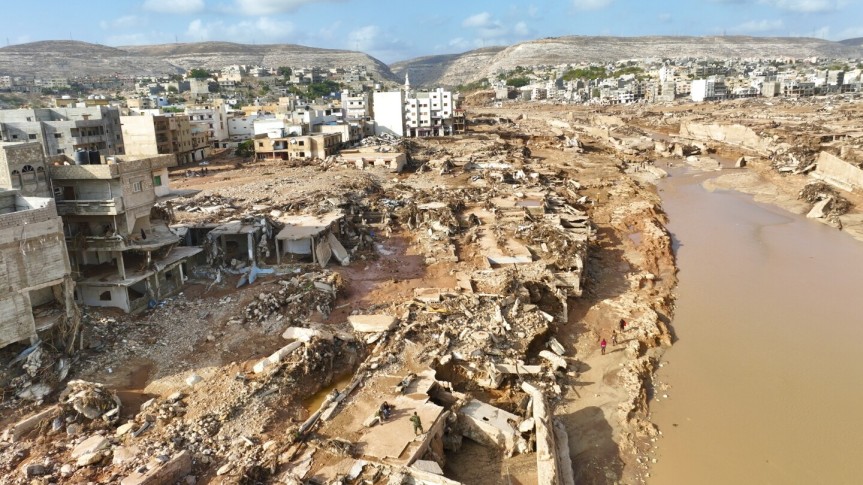
Darna, Libya after dams collapsed in the wake of storm Daniel. (Photo: AP/Jamal Alkomaty)

South Paris, Maine


Prodigious rainfall and the failure of long-deteriorated earthen dams caused a rush of waters through Derna, in Libya, on September 11.  Thousands of residents died, infrastructure was destroyed, and buildings ended up in the Mediterranean. Failure to protect residents, maintain the dams, and sustain the lives of all Libyans point to societal collapse.  

There is also the environmental crisis. Climate change provoked the enormity of storm Daniel that had drenched the eastern Mediterranean area ahead of the disaster. The association of climate change and terrible storms is known and so too is the role of human activities in causing great amounts of greenhouse gases to be released into the atmosphere.

The focus here is on the social disruption that transformed Libya. That’s because predisposing factors may not be clear. There are lessons to be learned.  The two crises are actually joined by virtue of both having developed out of a single impulse for domination.

Nationalist rebels led by Muammar Gaddafi deposed the embattled Libyan regime of King Idris on Sept. 1, 1969. Between 1973 and 1977, a Yugoslavian company contracted by the new government built two dams on the Wadi Derna River for the sake of flood control and irrigation. Maintenance of the dam would be lax.

A 1998 study revealed cracks and deterioration. After delays, a Turkish company began repairs on the dams in 2010. When the Gaddafi government was ousted in the following year, the work stopped.  Some $2.3 million was on hand for finishing the project. It disappeared.

Anti-government protests ─ the   Arab Spring ─ had broken out throughout the region in 2010. An anti-Gaddafi insurgency making headway in early 2011 prompted the military forces of the United States France, Great Britain, and a host of other countries to carry out a self-styled humanitarian intervention in March. Gaddafi’s murder seven months later ended the intrusion.  

U.S complaints had centered on an “opaque political and economic system,” widespread corruption, and Gaddafi’s autocratic proclivities. There had been mutual, and occasionally lethal, provocations.  Gaddafi’s increasing financial and banking influence in Africa raised eyebrows.

Gaddafi had offended by nationalizing 51% of oil companies’ assets in 1973.  According to one expert, “in 2006 the oil sector in Libya … made up ninety-five percent of export earnings, ninety-two percent of government revenue, and seventy-three percent of GDP.”  

The foreign assailants could not have overlooked the reality that a government with tight control over oil was in trouble with an insurgency.  It was no mean prize. Libya’s oil reserves now rank first in Africa and nineth in the world.  

Their forces carried out air operations, inflicted civilian casualties, assisted with the rebels’ ground actions, blockaded ports and embargoed weapons deliveries. They had a convenient tool.

Writer Eve Ottenberg a decade later accuses NATO, instrument for intervention, of fattening the wallets of war profiteers and weapons moguls and wreaking havoc in places like Yugoslavia, Afghanistan, Libya, now Ukraine.” Today France , Holland, and the United States are looking at French Guyana as a “forward-operating base for NATO” in Latin America, reports Guyanese activist Maurice Pindard. 

In its own review of “past and present” missions, NATO, with planetwide ambitions and unlimited potential for destruction, is, as expected, bereft of even a hint at repairing places left in chaos after its wars.

NATO departed from Libya, and ever since a government in the West of the country has been vying with a militarized counterpart in the East, where Derna is located. Cities have been bombed and occupied; Derna was subject to Islamic State rule from 2014 to 2016. Mercenaries, militias, and tribes jostle with one other. Milita groups control oil fields and extort vast sums. There’s “pillage on a vast scale,” plus drug-trafficking and exploitation of migrants heading to Europe.

Now one third of Libyans live in poverty; 13% of them require humanitarian aid, according to one estimate. By 2016, oil production, the source of social spending, had fallen to 75% below Gaddafi-era levels. It’s risen recently. 

The troubles experienced by Libya’s people were new. The Ghaddafi government had achieved much. The  2010 UN Human Development Index, a composite measure of health, education and income, ranked Libya 53rd in the world and first in Africa. By then, Libya was registering the highest per capita income in Africa, the lowest infant mortality, and the highest life expectancy. Schooling and healthcare were provided without Libyans having to pay.

Under Gaddafi, more than 95% of Libyans were adequately nourished; the government had abolished taxes on food. Literacy increased from 25% to 87% during the Gaddafi era. Almost 10% of Libya’s youth received scholarships for study abroad. Beginning in 1983 the government developed a massive water-delivery system with 1,100 new wells and 4,000 kilometers of pipelines.

Had the Gaddafi government not disappeared, the social advances and protection might have remained. Some of the progress might have continued under another government, if there had been no intervention. 

What’s certain is that previous arrangements for sustaining the population disappeared following NATO’s military action. Adverse conditions now allowed for the dams to disintegrate and for Libya’s people to not be rescued.

Pointing to a planetary “double crisis,” an ecological crisis and a social one, analyst Jason Hickle insisted recently that the two crises be dealt with simultaneously: “Attempting to address one without the other leaves fundamental contradictions entrenched.” He adds that, “the two dimensions are symptoms of the same underlying pathology … [which is] the capitalist system of production.”

Derner is witness to Hickle’s double crisis. The unprecedently heavy rainfall reflects climate crisis. A decade of turmoil and neglect of the dams attests to social crisis. The two share the same root cause. 

Capitalism requires perpetually increasing production of goods, which led to overuse of fossil fuels, which has translated into climate change. Under capitalism, natural resources in the world’s peripheral regions are plundered. Popular forces may be suppressed. Devices like NATO come into their own. If it had occurred a little earlier, Jason Hickle could have used the catastrophe to illustrate the main point of his article.


W.T. Whitney Jr. is a political journalist whose focus is on Latin America, health care, and anti-racism. A Cuba solidarity activist, he formerly worked as a pediatrician, lives in rural Maine. W.T. Whitney Jr. es un periodista político cuyo enfoque está en América Latina, la atención médica y el antirracismo. Activista solidario con Cuba, anteriormente trabajó como pediatra, vive en la zona rural de Maine.

‘Worse than the Special Period’: Cuba’s food situation more desperate by the day / By W.T. Whitney Jr.

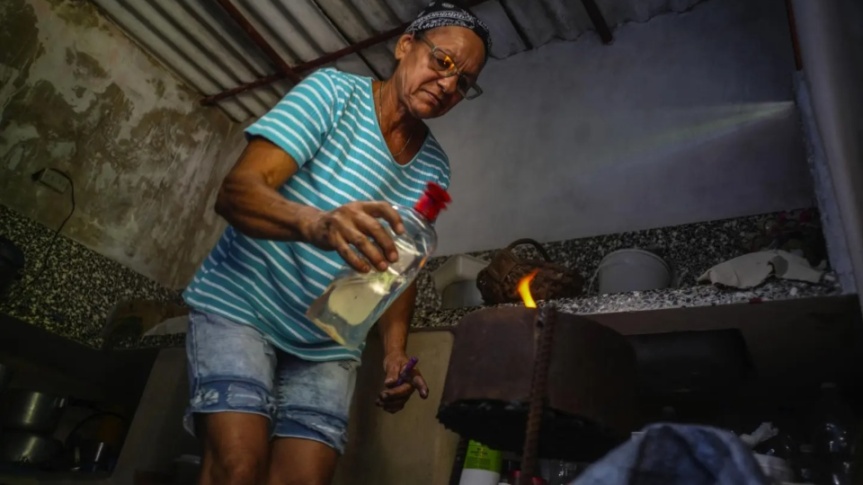
Mariel resident Rosa Lopez lights a charcoal stove to boil sweet potatoes and prepare scrambled eggs with tomatoes for her grandchildren on May 18, 2023. She had just returned from picking up her food rations from a government-run market. At the time, it had been more than a month since any cooking gas had been delivered to the city, so Lopez cooks using charcoal and a wood burning oven. Low agricultural yields, exploding inflation, a lack of gasoline for transportation, and the U.S. blockade have all contributed to soaring food prices. | Ramon Espinosa / AP

Originally posted in People’s World on August 16, 2023


Addressing a meeting of government ministers and the press in Havana on Aug. 11, Cuba’s Vice Prime Minister Jorge Luis Tapia Fonseca exploded when discussing the food crisis gripping the nation.

“It takes work to produce food. Everyone wants food deliveries, but we do nothing to produce it. We lack a culture of production … We don’t need all these papers, or words. When do we begin to plant? Who will do it?”

He was reporting on implementation of Cuba’s 2022 law on Food Sovereignty and Food and Nutritional Security. He noted that food self-sufficiency in local areas is disastrously lagging. Crop yields are low; plant diseases and the lack of inputs has hampered grain production.

The food situation in Cuba is growing more desperate by the day. Residents of the island individually consumed only 438 grams of animal protein per month in 2022, and in May 2023, only 347 grams; recommendations call for ingestion of 5 kg monthly. Not enough chickens were raised last year; poultry meat and eggs remain scarce.

Yields of corn, soy, sorghum and other crops have dropped, and animal feed is mostly unavailable. Therefore, pork production is also down, milk is unavailable to adults, and fewer cattle are being raised. Pasturage is poor, due to drought and no fertilizer.

Farm workers carry a tank of fresh milk to deliver it to a government-run food store in San Nicolas, Cuba, May 19, 2023. Milk is in short supply and reserved for children these days. | Ramon Espinosa / AP

Failures mount

Tapia pointed to the many failures exacerbating the situation. The output of state-controlled food producers is low. Producers, distributers, and institutional consumers don’t regularly contract with one another to facilitate food distribution. Producers aren’t being paid, because credit isn’t available. Cattle-stealing has reached new heights, 44,318 head so far this year.

The Ministry of Finances and Prices issued a report prior to the National Assembly session that recognized high inflation, widespread popular dissatisfaction, and the need for “concrete solutions.” Minister Vladimir Regueiro Ale indicated prices skyrocketed by 39% during 2022 and 18% more so far in 2023.

Inflation, he explained, varies from province to province and may manifest as abusive price-fixing, especially when agricultural supplies and products are in short supply.

Commenting on the report, National Assembly President Esteban Lazo, reminded delegates that diminished production and inflation were connected: “If there is no production and supply, we will not achieve effective control of prices.” He complained that “practically 100% of the food basket is being imported.”

The Assembly’s Food and Agricultural Commission analyzed organizational and management problems and reported that only 68% of expected diesel fuel has arrived so far in 2023, 14,700 tons less than in the similar period a year before; 28,900 tons of imported fertilizer were ordered, but only 168 tons arrived. Cuba’s fertilizer production has been nil this year in contrast to 9,600 tons produced in the same months in 2022.

Lazo communicated a message to Cuba’s Minister of Agriculture from the Assembly, whose recent session ended on July 22. The ministry, he said, would be “transforming and strengthening the country’s agricultural production,” to initiate “a political and participatory movement that would unleash a productive revolution in the agricultural sector.”

Nothing less than a revolution will do

A revolution appears to be exactly what’s needed. The recent National Assembly session dealt almost entirely with Cuba’s present food disaster. The lives of many Cubans are becoming more precarious due to unending food shortages, high prices, and low incomes.

Information emerging from the Assembly’s deliberations attests to the reality of crisis in Cuba, and it means that urgency is building for Cuba’s friends in the United States to resist U.S. policies in new ways, strongly and assertively. Their own government accounts for new suffering and destitution in Cuba.

President Miguel Díaz-Canel emphasized resistance when addressing the National Assembly. He dedicated his remarks to two revolutionary heroes who were present. Admiring how they kept “their foot in the stirrup of difficulties” and their “rifle pointed at mistakes,” he may have been thinking of hard work ahead.

He mentioned “problems of our difficult daily life, such as food production, electricity generation, water availability, crime, rising inflation, abusive prices.”

The president criticized behaviors “that reinforce the omnipresent blockade through inaction, apathy, insensitivity, incapacity, or simple tiredness and lack of faith.”

Díaz-Canel noted approvingly that delegates discussed “closer ties between deputies and the population,” “better management and allocation of the currency,” “greater direct participation of the non-state sector in national production,” “municipal autonomy,” and “downward pressure on prices.”

But it’s not enough. “Above all,” he said, “we must devote ourselves to creating wealth, first of all, by producing food.”

Trouble in the countryside

Cuba’s rural communities are troubled—and shrinking. Soon, “we won’t have any people left in the countryside,” one delegate said. Another called for improved “roadways, housing, and connectivity.”

No fuel means most people in rural areas are resorting to bicycles or horse carts to travel short distances. | Ramon Espinosa / AP

Regarding the low level of agricultural skills among the rural population, someone called for teaching in “agroecological techniques” and “good practices for the producing, processing, and commercialization of food.”

The idea has been circulating for a while now that greater local autonomy might help spur food production, but efforts at prompting that devolution of initiative have seen a slow uptake. As of April 2023, aspiring farmers had not yet taken possession of 258,388 hectares of idle land made available to them without cost under land-tenure reforms in 2008.

Frei Betto, Brazilian friend of revolutionary Cuba and adviser to Cuba’s Food Sovereignty and Nutritional Education Plan, visited Cuba in June. In his assessment, the “current shortages are more severe than in the Special Period (1990-95),” when Cuba’s economy nearly collapsed following the withdrawal of Soviet aid and the contraction of trade with the socialist bloc of nations.

He indicated that Cuba now imports 80% of the food it consumes, up from 70% five or so years ago, and that it costs $4 billion annually, up from $2 billion. For corn, soy, and rice alone, the outlay now is $1.5 billion annually.

He indicated, too, that a ton of imported chicken meat now costs $1.3 million, up from $900,000 a year ago, that “the wheat supply has worsened,” that milk production is down 38 million liters in one year, and that less oil from Venezuela, thanks to U.S. sanctions there, means further reduced food production in Cuba.

Blame the blockade, but not only

The origins of food shortages in Cuba and the mode of U.S. intervention are highly relevant in understanding the current situation, as every Cuban knows.

To be sure, the shortages plaguing the people are not solely due to U.S. policies. Drought, hurricane damage, marabou shrub infestation, soil erosion, high soil acidity, poor drainage, and lack of organic material soil have all contributed.

The still-prevailing bureaucratic and centralizing tendencies of the Cuban government’s economic management also play a role.

The U.S. economic blockade, however, remains central to understanding what’s happening. The creation of a food crisis was among the original proposals put forward by State Department official Lestor Mallory in 1960 for how to overthrow Cuba’s revolutionary government. The program: Use “hunger and desperation” to spark the “overthrow of government.”

Aid from and trade with the socialist world frustrated U.S. efforts and kept disaster at bay for decades, but eventually the Soviet Union and socialist Eastern Europe fell. The U.S. government seized the moment and passed legislation tightening the economic blockade in 1992 and 1996 and, later, designated Cuba a terrorist-sponsoring nation.

Beyond bans on products manufactured or sold by U.S. companies, proscribed categories soon included products manufactured by foreign companies associated with U.S. ones and products containing 10% or more components of U.S. origin. Now, foreign enterprises active in Cuba faced possible U.S. court action.

International loans and international transactions in dollars are usually off-limits. Payments abroad don’t reach destinations. Income from exports doesn’t arrive.

Think imports of seeds, fertilizers, herbicides, pesticides, breeding stock, veterinary supplies and drugs, new equipment, spare parts, exports of coffee, rum, and nickel. Think loans for purchasing food and more, loans for agricultural development. Think impediments to restoring rural infrastructure.

Farm workers wait in line to refuel their tractors on the highway to Pinar del Rio, Guanajay, Cuba, May 18, 2023. Cuba is in the midst of a major fuel shortage that has drivers and farmers waiting in line for days or even weeks to gas up their vehicles and tractors. | Ramon Espinosa / AP

The blockade, the U.S. tool of choice, has hit food production in Cuba hard. It is far along in achieving its ultimate purpose. Cuba needs a new order of support from friends in the United States─Marti’s “belly of the beast.”

Cuba needs friends more than ever

Many have so admired Cuba’s brand of socialism as to assume that Cuba’s social gains and exuberant international solidarity would fire up such enthusiasm that, along with considerations of fairness, legality, neighborliness, and revulsion against U.S. cruelty, would make U.S. policymakers think anew about Cuba. It never happened.

Now at a watershed moment in Cuba, a new direction is necessary, one all about persuading, organizing, and unifying left-leaning political groups and anti-war, anti-empire activists of all stripes. Leadership is needed.

Frei Betto says that, “It is time for all of us, in solidarity with the Cuban Revolution, to intensify the struggle against the U.S. blockade and mobilize international cooperation with the island that dared to conquer its independence and sovereignty against the most powerful and genocidal empire in the history of mankind.”


We hope you appreciated this article. At People’s World, we believe news and information should be free and accessible to all, but we need your help. Our journalism is free of corporate influence and paywalls because we are totally reader-supported. Only you, our readers and supporters, make this possible. If you enjoy reading People’s World and the stories we bring you, please support our work by donating or becoming a monthly sustainer today. Thank you!


W.T. Whitney Jr. is a political journalist whose focus is on Latin America, health care, and anti-racism. A Cuba solidarity activist, he formerly worked as a pediatrician, lives in rural Maine. W.T. Whitney Jr. es un periodista político cuyo enfoque está en América Latina, la atención médica y el antirracismo. Activista solidario con Cuba, anteriormente trabajó como pediatra, vive en la zona rural de Maine.

Right-wing forces in European Parliament torpedo EU-Cuba relations / W.T. Whitney Jr.

The fascist and anti-communist VOX Party of Spain is leading the effort to sink EU-Cuba relations in the European Parliament. Here, VOX leader Santiago Abascal makes a speech in Madrid, March 19, 2022. Repeating typical right-wing falsehoods, party banners at the rally allege the media and the government are controlled by communists. | Paul White / AP

Originally published in the People’s World on July 20, 2023


The Cuban musical duo Buena Fe (Good Faith) toured Spain in May. Thugs disrupted their concerts, forcing the cancelation of a few.  A month later in Paris, protests orchestrated by a Cuban émigré university professor forced a prestigious poetry festival to take away the honorary presidency it had bestowed upon Cuban poet Nancy Morejón.

On July 12, Cuba’s relations with European governments went from unstable to possibly disastrous. The European Parliament (EP) approved a “Resolution on the State of the EU-Cuba PDCA.” The vote was 359 in favor, 226 against, and 50 abstentions—signaling trouble ahead for Cuba.

The PDCA is the Political Dialogue and Cooperation Agreement that, signed in 2016, committed individual European countries to rely upon consensus and “constructive engagement” in their dealings with Cuba. It replaced the EU’s “Common Position” that, from 1998 on, promoted “interventionist, selective, and discriminatory” relations with Cuba.

Josep Borrell, the top EU diplomatic representative, visited Cuba in May. He was advocating for the PDCA as a means of “support for the increasingly important Cuban private sector” and for “the expanding economic reform taking place” in Cuba.

With its 60 items, the resolution’s scope was vast. False allegations of human rights violations appeared throughout. The resolution “condemn[ed] the Cuban regime’s support for the Russian war of aggression against Ukraine and its defense of Russia and Belarus.” It called for sanctions by the European Council “against those responsible for the persistent human rights violations in Cuba, starting by sanctioning [President] Miguel Díaz-Canel.”

If the resolution is any indication, EU-Cuba relations are going to be stormy. That was the whole point, surely, for those parliamentarians linked up, says one observer, “with CIA officers and diplomats stationed at the U.S. embassy in Brussels and Luxembourg.”

Spanish EP delegate and Communist Party member Manuel Pineda claimed that the EP “has become a loudspeaker for the most reactionary and extreme right-wing positions, contaminating and clouding what should be the house of Europe’s sovereignty.”

The resolution had been the project of the “Euroskeptic and anti-federalist” European Conservatives and Reformists Group (ECR) within the EP. ECR member Herman Tertsch, belonging to Spain’s fascist-leaning Vox Party, explained that, “The resolution is a further step towards ending the EU’s intolerable complicity with the Cuban dictatorship and that of its High Representative, Josep Borrell.”

He denounced Cuba’s Communists, “communists all over the world,” and “their accomplices in the democracies of America and Europe.”

Meanwhile, the European Union is Cuba’s biggest trading partner and EU countries account for most foreign investment in Cuba and one-third of all tourists visiting there. The EU has donated most of the developmental assistance received by Cuba over many years ─ €100 million as of 2021.

The timing was significant. The vote missed by one day the two-year anniversary of large anti-government protests occurring in Cuba on July 11, 2021. U.S. Secretary of State Blinken used that anniversary to insist that “the United States stands in solidarity with those in Cuba who continue to desire a free democracy.”

Additionally, a heads-of-state summit meeting between the EU and the Community of Latin American and Caribbean States (CELAC) took place soon after the vote, on July 17-18 in Brussels. CELAC includes all Western Hemisphere nations except the United States and Canada,

Preceding this summit were EU meetings with pre-CELAC regional alliances and CELAC-EU summit meetings in 2013 and 2015. The recent hiatus resulted from EU displeasure with “popularly elected governments and leaders” in Latin America. Now the object is to foster “respectful interchange” and to “acknowledge mutual interests.”

Chinese competition with Europe in Latin America and the Caribbean over trade, access to natural resources, and investment opportunities may have provided encouragement.

Reflecting official Cuban sentiment ahead of the summit, journalist Claudia Fonseca Sosa stated, “For Cuba, it’s important that … dialogue in Brussels be serious, participative, and diverse.” However, the EP’s resolution was aimed directly at aspirations of “consensus and bridge-building.”

The Foreign Relations Commission of Cuba’s National Assembly charged that “The EP Resolution represents harassment of European businesses investing in Cuba or seeking to do so. It also expresses the will of extreme right-wing political forces to deprive the EU of its own independent policy toward Cuba.”

As new grief falls on Cuba, the role of a newly evolving version of counterrevolution, fully evident elsewhere in the world, is hitting at the island. For Cuban political analyst Iramís Rosique Cárdenas, that kind of conservative politics with “known liberal discourse of private property, market fundamentals, a minimum state…and with social democratic cooperation” is disappearing.

He describes “a series of movements and organizations of the right and extreme right” with ideas of national chauvinism, reliance on strong states, economic protectionism, provincialism instead of multi-culturalism, xenophobia, “centrality of the traditional family,” exclusion of minorities, nationalism, and religious fundamentalism.

He adds, “The right-wing extremism active in the West displays virulent hostility against Latin American progressivism, especially the Bolivarian process, and against movements and states…like China and Cuba, [that resist] European and North American centers of power.


We hope you appreciated this article. At People’s World, we believe news and information should be free and accessible to all, but we need your help. Our journalism is free of corporate influence and paywalls because we are totally reader-supported. Only you, our readers and supporters, make this possible. If you enjoy reading People’s World and the stories we bring you, please support our work by donating or becoming a monthly sustainer today. Thank you!


W.T. Whitney Jr. is a political journalist whose focus is on Latin America, health care, and anti-racism. A Cuba solidarity activist, he formerly worked as a pediatrician, lives in rural Maine. W.T. Whitney Jr. es un periodista político cuyo enfoque está en América Latina, la atención médica y el antirracismo. Activista solidario con Cuba, anteriormente trabajó como pediatra, vive en la zona rural de Maine.

Ocasio-Cortez Would Block US Military Intervention in Peru / By W. T. Whitney Jr.

Rep. Alexandria Ocasio-Cortez, D-N.Y., is proposing a halt to Defense Department funding over intervention in Peru. | AP

Originally published in the People’s World on July 11, 2023


According to a report appearing July 8 on a Peruvian website—and apparently not yet in any English-language internet news source—Rep. Alexandria Ocasio-Cortez, D-N.Y., introduced an amendment to the National Defense Authorization Act requiring that, until conditions are met, a hold be put on Defense Department funding for its activities in Peru during fiscal year 2024.

Ocasio-Cortez introduced her amendment on June 29; the House Rules Committee will take it up on July 11.

As long as any suspension of funding remains, the U.S. military would not be permitted to “provide, authorize, or assist in any way in the transfer of defense articles, defense services, crowd-control supplies, or any other supplies, to [Peru’s] Government, or to coordinate joint exercises with the military or police forces of [Peru’s] Government.”

Ocasio-Cortez introduced her amendment six weeks after additional U.S. troops with weapons began to arrive in Peru. That was two months after Peru’s military and police reached a crescendo of violence marking repressive actions for weeks against mostly Indigenous peoples. They were demanding elections, a new constitution, and the removal of President Dina Boluarte.

The protests were in response to the parliamentary coup that deposed President Pedro Castillo on Dec. 7, replacing him with Boluarte, vice president at the time. Castillo remains in prison.

Elected in July 2021 on the strength of rural and Indigenous votes, the inexperienced and often isolated Castillo tried to bring about progressive change. Opposing him was a well-entrenched oligarchy accustomed to holding political power and benefiting from foreign investments in Peru’s plentiful natural resources.

Ocasio-Cortez’s amendment calls for no funding until “the Secretary of Defense submits to the appropriate congressional committees the certification…that each of the following criteria has been met.” These include free elections in Peru, no repression of “peaceful protesters and indigenous communities,” investigation of “the killings of protesters in Peru on Dec. 14, 2022,” prosecution of those responsible, the return of free speech, respect for civil liberties, and more.

The ‘‘appropriate congressional committees’’ are the Armed Services and Foreign Affairs Committees of the House and the same two committees in the Senate.

Peru’s Congress on May 19 authorized the entry of U.S. troops who will undertake “training activities” throughout the country and stay until Dec. 31, 2023. On May 26, Peru’s Congress approved additional authorization for 1,172 U.S. troops, who will be collaborating with Peruvian counterparts in an exercise called “Resolute Sentinel 2023” that will end on Aug. 29.

Legislation is on the books: the particular Leahy Law that applies to the Defense Department “requires that [funds appropriated to the Defense Department] may not be used for any training, equipment, or other assistance for a foreign security force unit if the Secretary of Defense has credible information that such unit has committed a gross violation of human rights.”

With 19 other congresspersons, Ocasio-Cortez signed a letter to President Joe Biden on Jan. 30 expressing “alarm regarding the human rights violations committed by Peruvian state security forces.” The letter called upon the Biden administration to halt “security assistance funding from the United States” to Peru until this “pattern of repression has ended.”

That Ocasio-Cortez signed this letter and introduced her amendment suggests an attitude on her part that is unusual among her progressively inclined congressional colleagues and even among her progressively-inclined fellow citizens. She is apparently one of the relatively few in both categories who take upon themselves the obligation to stand up against U.S. interventions abroad serving the high and mighty.

The time required for mobilizing support for Ocasio-Cortez’s amendment before it was presented to the Rules Committee was entirely lacking.  The appearance on that account has been one of low expectations and of hopes for the future, maybe.

The consciousness-raising effect of the effort is important. But the evident lack of supporters mobilized on behalf of the amendment has meaning, too. Clearly, there’s much work ahead for the anti-imperialist cause in the United States, and recruits are badly needed.


W.T. Whitney Jr. is a political journalist whose focus is on Latin America, health care, and anti-racism. A Cuba solidarity activist, he formerly worked as a pediatrician, lives in rural Maine. W.T. Whitney Jr. es un periodista político cuyo enfoque está en América Latina, la atención médica y el antirracismo. Activista solidario con Cuba, anteriormente trabajó como pediatra, vive en la zona rural de Maine.

Fighting for Land and Independence in Jujuy, Argentina / By W. T. Whitney Jr.

South Paris, Maine, June 27, 2023


In Jujuy province, in Argentina’s extreme Northeast, poor people’s discontent, the provincial government’s overreach, and popular resistance recently contributed to a crisis that portends grief and struggle ahead.  Setting the stage were: free rein for local reactionaries, indigenous peoples’ oppression, foreign plundering of natural resources, and a U.S. eye over the whole affair.

June was a month of turmoil.  Governor Gerardo Morales had proposed reforming the province’s Constitution. Teachers’ unions were agitating for higher salaries.

Discussion for 50 days that should have preceded the Constitutional Convention never happened. The Convention, presided over by Morales himself, played out over three weeks.  He had timed the electing of delegates to coincide with provincial government elections and thereby assure enough voter turnout to elect delegates who backed constitutional reform.

The proposed changes included new provisions for criminalizing public protests and new restrictions on “freedom of expression, petition, and association.” There would be revised legal mechanisms for regulating access to land, this so as to deliver land to lithium-producing multi-national companies. Indigenous peoples would face the probability that untitled plots of land crucial to their survival, for generations, would no longer be available. Jujuy province is the center of lithium extraction in Argentina, the world’s fourth largest lithium producer.  

Elected in 2015, Morales cut back governmental support for education, and teachers lost jobs. Teacher salaries in Jujuy are the lowest in Argentina. Teachers’ unions in nearby Salta province had recently carried out strikes and won pay increases.

On June 5, a Jujuy teachers’ union struck for better pay. On June 9, several teachers’ unions and the municipal employee union marched on Jujuy city, population 375,000. Soon healthcare workers and a miners’ union would join the mobilization. Morales decreed “increased penalties against individuals and organizations participating in any protests or social mobilization.” 

On June 14 indigenous people marched on the city “to demonstrate their rejection of the [constitutional] reforms … being devised behind closed doors.”  City streets were teeming with protesters on June 15 when word came that agreement was near on constitutional reforms. Soon indigenous groups and others were maintaining roadblocks on highways throughout the province. Police, assisted by unidentifiable enforcers using unmarked vehicles, stepped up arrests of demonstrators and journalists.  Calls went out for Morales’s resignation.

The Constitutional Convention on June 20 approved alterations of 66 of the provincial Constitution’s 212 articles. Street pressure had caused two reforms involving indigenous rights and access to land to be withdrawn temporarily.  Restrictions on protesting and free expression remained. The Constitution now provides for “automatic majority in the legislature for the governing party” and no longer requires that provincial elections be held every two years.

Massed demonstrators responded by assaulting the Government House with projectiles. Police turned them back using tear gas, rubber bullets and arrests.

The provincial government’s repressive methods elicited criticism from elsewhere in Argentina and from the Inter -American Commission on Human Rights, Amnesty International, and the United Nations High Commissioner for Human Rights. 

Governor Morales exceeds boundaries. Early in his first term, for example, he enlarged the top provincial court from five to nine judges. Consequently, provincial courts have endorsed illegal searches, illegal evictions, and persecution of social leaders. By 2018, 25 family members were serving as provincial government officeholders.

One presumes that the governor’s evident lack of restraint is bad news farther afield. He leads Argentina’s rightwing Radical Civic Union party and now is a vice-presidential candidate on one of two tickets aiming to represent the rightwing Unite for Change electoral coalition in upcoming elections.

It’s clear: he stops at nothing. Morales’s government in 2016 arrested Milagro Sala, leader of the Tupac Amaru Organization that at the time was assisting indigenous families as they looked for food, housing, basic education and more. The government was interfering and the Organization resisted. The police arrested Sala on flimsy pretexts and seven years later she is still detained.

Continuing his efforts to waylay indigenous independence, Gerado Morales took part in the November 2019 coup that deposed Bolivian President Evo Morales. That Morales was an indigenous president of a multi-national republic. Governor Morales was instrumental in arranging for U.S. assistance.

Around September 4, 2019, Gerardo Morales supposedly joined a meeting in Jujuy held to organize the coup against Evo Morales. Present was Luis Camacho who, based in Santa Cruz in Bolivia, was leading the coup in progress. Later on, Governor Morales himself traveled to Santa Cruz to confer with plotters. 

On that September 4, Ivanka Trump and State Department, CIA, and USAID personnel arrived in Jujuy ostensibly to support local women’s initiatives. Trump had brought $400 million.  A Hercules C 130 aircraft was deployed on the runway close to the recently arrived U.S. plane.  Almost at once that plane departed for Santa Cruz, without a flight plan. Camacho was on board. 

He may have been conveying the U.S. funds that would be used to bribe the senior Bolivian Army officers who pressured Evo Morales to resign. Later on, Gerardo Morales surely was not blind to that same airplane carrying weapons to plotters in Santa Cruz.

The governor’s zeal in serving U.S. interests shows up now as he cultivates U.S. official representatives for the sake of U.S. investment in the extraction and processing of lithium. He met with U.S. ambassador Marc Stanley in May 2022, and later Stanley was in Jujuy as Morales acquainted him with “a portfolio of projects in development.” Stanley and his family attended an indigenous festival.

Together with governors of other lithium-producing provinces, Morales in 2022 visited European countries and the United States. There he met with Washington officials, bankers, and industrial leaders, among them Elon Musk, owner of Tesla Corporation.

Morales’s friendship with Argentinian-government economic minister Sergio Massa is surprising – President Alberto Fernandez’s government is on the other side of the political divide – but understandable:  Massa is  a favorite in U.S. official circles, a lead promotor of foreign investment in Argentina’s natural resources, and a likely presidential candidate in elections later this year.

The story here centers on Morales’s doings as an individual. But people respond to circumstances collectively and engage collectively in social change. Morales is representative, it seems, of that class of well-paid intermediaries who have long arranged for the transfer of wealth from wherever to a waiting set of plunderers.

The history of the Americas has them freeing up land so as to get at wealth that is there. They must dispose of the set of people living on the land. Military force is made available. Morales becomes an updated conquistador.

Writing for the Argentinian Club of Journalist Friends of Cuba (capac-web.org), Alberto Mas provides specifics. In a report entitled “Jujuy is the North American Laboratory for Argentina,” he states that, “The visit of General Laura Richardson of the U.S. Southern Command [on April 17, 2023] did not in the least hide intentions of controlling the production and exportation of Argentina’s lithium. This is part of a strategic plan for the region which they have implemented over the course of time: the coup against Evo Morales in Bolivia had the smell of lithium.”


W.T. Whitney Jr. is a political journalist whose focus is on Latin America, health care, and anti-racism. A Cuba solidarity activist, he formerly worked as a pediatrician, lives in rural Maine. W.T. Whitney Jr. es un periodista político cuyo enfoque está en América Latina, la atención médica y el antirracismo. Activista solidario con Cuba, anteriormente trabajó como pediatra, vive en la zona rural de Maine.


Cuba’s President Extolls the Cuban People, Discusses Problems / By W.T. Whitney Jr.

President of the Republic of Cuba, Miguel Díaz-Canel Bermúdez | Photo: Estudios Revolución


Addressing Cuba’s recently-convened National Assembly on April 19, President Miguel Díaz-Canel expressed confidence that the Cuban People would overcome warlike measures imposed by the United States.

“Congratulations to everyone on the Day of Victory!” he proclaimed. “On April 19 in 1961 on the sands of Playa Girón (Girón Beach) Cuba won the right to celebrate this day in providing for the first great defeat of imperialism in America. It was the triumph of the just against the unjust, of little David against the giant Goliath, of a socialist Revolution under the nose of the empire.”

“Thanks to this victory we today, on the tenth such occasion, install the People’s Assembly.” He declared that each of the 470 deputies “defends the interests of the majority,” that none of them won their seat through money or from the backing of an electoral party.

Referring to the Cuban Revolutionary Party founded by José Martíhe extolled “the single party that is the guarantee of unity” and through which, “the forces of a little nation do not disintegrate or fight each other.”

Díaz-Canel catalogued manifestations of U.S. all-but-war: invaders “working out of their caves on social networks,” and the “perennial cruelty of a blockade reinforced during the pandemic,” and “millions of dollars offered to those preparing to subvert Cuba’s internal order,” and “inclusion of Cuba on a list of supposed sponsors of terrorism that blocks access to financing.”

He stated that, “someday, earlier than later, the politics of hegemony will have to cease; multilateralism will take its place, and Cuba will be able to show how far a noble creative and talented people can go if they are united around clear objectives and if they are freed from pressures and blockades.”

Offering praise, Díaz-Canel maintained that “elections to the National Assembly are aimed at choosing the best people. That’s difficult … [because] there are many more good Cubans than there are seats in parliament.”

He expressed “certainty that no simulation of artificial intelligence could match the Cuban people’s achievements in recent years and their creative resistance. Their resilience exceeds the limits of any simulation or prediction. There is no algorithm capable of reflecting what we have lived through.”

Díaz-Canel highlighted the transparency of recent election campaigns, noting that voter participation was ample enough to waylay “hate-inspired” foreign-media expectations of low voter turnout indicative of a failed Cuban state. The recent elections included the Family Code referendum on September 25, 2022, elections for delegates to municipal assemblies on November 27, 2022, and voting for National Assembly deputies on March 27.

The Cuban president noted that the 75.8% of Cubans who voted on the last occasion was “above average for the other models of democracy in the world and [represented] “a show of citizenship, … patriotism, and above all, of political consciousness.”

The recently elected National Assembly overwhelmingly approved new terms for the Council of Ministers, the Council of State, and for Díaz-Canel, who will be serving his second and last five-year presidential term, as prescribed by recent constitutional changes.

Díaz-Canel outlined difficulties and unfinished tasks, observing that:

The world economy, uncertain and unstable in all latitudes, poses the first and greatest challenge for the new Council of Ministers … Leadership should focus on food production, the use of idle productive capacities, increased reliance on foreign-currency income, transformations required by the socialist state enterprise, enhanced efficiency of the investment process, and synergy of our economic actions and foreign investment. We do all this to increase the supply of goods and services and control inflation, which is the main priority in the economic battle. 

Even as he acknowledged “obstacles external to our economy that present profound difficulties,” the President “condemned bureaucratism, indifference, and corruption” in Cuba. He expressed confidence in the deputies’ “commitment and dedication,” while insisting that, “we will overcome the blockade without waiting for them to lift it.”

Díaz-Canel extolled Cuban youth “as the best revolutionaries because, dealing with every-day difficulties, they confront, try to fix, and achieve much. Despite adversity, they keep on smiling, loving, and believing in the possibility of a better country.” In fact, “socialism is closest to youth because it too is unfinished work.”

A persisting undertone of Díaz-Canel’s presentation was that of values, particularly those of solidarity and revolutionary service. Coinciding with the April 20 presentation of Díaz-Canel’s speech on resumenlatinoamericano.org were two news reports that exhibited diverse Cuban and U.S. purposes as regards Ukraine and expressed values.

report from Argentina announced a public television showing on April 23 of the Cuban film “Sacha, a child of Chernobyl,” first viewed in 2021. Living in Ukraine, Sacha was one year old and living in Ukraine on April 28, 1986 when the Chernobyl nuclear power installation exploded and radioactivity and radiation-caused diseases spread far and wide.

Sacha, un niño de Chernobyl, película completa

He was one of 26,000 children in Ukraine, Belarus, and Russia who received sophisticated medical care and rehabilitation in Cuba for their illnesses between 1990 and 2011, at no cost to families or governments. In the 1990s, Cuba was suffering the economic disaster of its “Special Period.” The film may be viewed here; Spanish language subtitles are provided.

Also on that day, a report appeared indicating that “The United States announced … the sending of another package of military aid worth $325 million for the fight against Russian forces. The U.S. Defense Department highlighted through a communique that this aid ‘will allow Ukraine to continue bravely defending itself in a brutal war against Russia, unprovoked and unjustified.’”

During another April, 200 years ago, an early warning sign cropped of a reality that would from then on plague Cuba, provoke revolution and bolster counter-revolution.  In his speech, Díaz-Canel recalled that John Quincy Adams, as secretary of state, statedon April 28,1823 that, “if an apple severed by the tempest from its native tree cannot choose but to fall to the ground, Cuba, forcibly disjoined from its own unnatural connection with Spain, and incapable of self-support, can gravitate only to the North American Union.”


W.T. Whitney Jr. is a political journalist whose focus is on Latin America, health care, and anti-racism. A Cuba solidarity activist, he formerly worked as a pediatrician, lives in rural Maine. W.T. Whitney Jr. es un periodista político cuyo enfoque está en América Latina, la atención médica y el antirracismo. Activista solidario con Cuba, anteriormente trabajó como pediatra, vive en la zona rural de Maine.