
The United States Uses and Abuses Migration from Cuba and Elsewhere / by W. T. Whitney Jr.

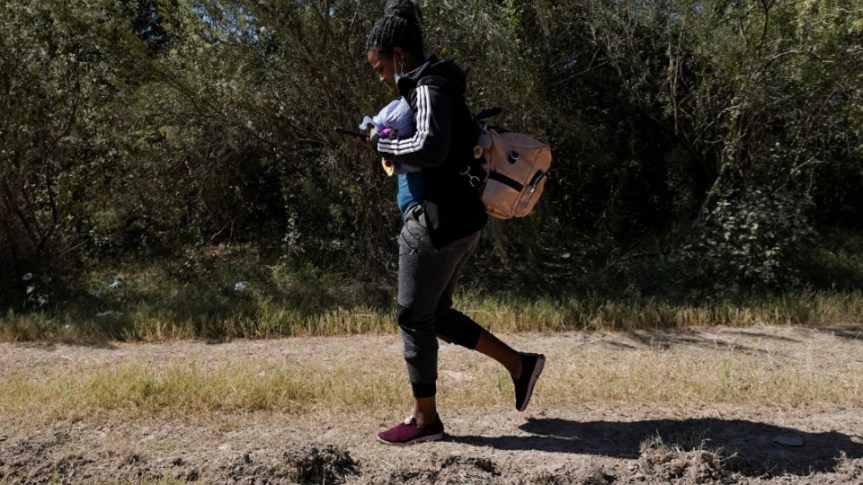
A Cuban national walks along a road after crossing the Mexico-Texas border at the Rio Grande, Sept. 23, 2021, in Del Rio, Texas. | Julio Cortez / AP

Presently 3.6% of the world’s people live in a country other than their own. They move to escape wars, oppression, poverty, hunger, climate-change effects, or to find new work, or because they were forced to move. The story is also about nations weaponizing or exploiting migration. 

After a decade or so of relatively few Cubans arriving in the United States, their numbers are up. Between 2018 and 2021, some 2,000 Cubans emigrated to the United States. But in January almost 15,000 Cubans crossed the U.S. southern border; the daily average in February was 1500. U.S. border officials are seeing “a twelvefold increase over 2020,” according to the Washington Post.

Contributing to migration is the increasingly dismal state of Cuba’s economy. At work has been U.S. economic blockade, fallout from the Covid-19 pandemic, and unresolved domestic issues including: inflation, corruption, cumbersome implementation of reforms, shortfalls in domestic food production, and fallout from converting two currencies into one. 

U.S. officials deported only 20 arriving Cubans in the past five months, and only 95 during 2021. That’s because Cuban immigrants arriving without papers are privileged, thanks to the 1966 Cuban Adjustment Act (CAA).  That law enables unauthorized Cuban migrants automatically to gain permanent residence after a stay of two years, which in 1976 became one year. By contrast, non-Cuban arrivals have to apply for permanent residence and then wait. 

President Obama in January 2017 repealed an administrative regulation allowing those Cuban migrants who entered the United States after sea-travel to stay, while sending Cubans apprehended at sea back to Cuba. No longer could Cubans arriving by water remain. Migrants reacted by resorting to the arduous Central American land route to the U.S. border. 

When the migrants of other countries travel that route, cross the border, and are apprehended, they are either quickly deported, allowed to wait in Mexico or in immigration prisons for asylum decisions, or are released to await court appointments.  By contrast, Cubans crossing the border usually gain so-called “humanitarian parole” and are released. Or they are released after brief detentions to await immigration-court rulings on asylum requests. After a year they become eligible for permanent residence, as per the CAA. 

The CAA-mediated enticement of early permanent residence has served the U.S. purpose of encouraging a flood of Cuban immigrants who, by fleeing, are living proof of alleged Communist oppression. Maybe the purpose of a relatively relaxed treatment of a new generation of Cuban migrants, who also arrive after great travail, is to revive that salutary example of escape from Communism. 

But paradoxically, the U.S. government acts also as if to impede travel by Cubans to the United States, as if to keep them away.   For example, the U.S. government in 2017 removed personnel from its Embassy in Havana. This was in response to the neurologic syndrome, still unexplained, that afflicted diplomats stationed there. Doing so, the State Department deprived Cubans of consular services needed for legal travel to the United States.

They’ve been forced to visit U.S. embassies elsewhere to obtain entry visas, in Bogota, Colombia and in Guyana.  The travel costs are prohibitive for most travelers. The U.S. government indicated in March that its Havana Embassy would soon be processing visas for entry into the United States, but only for parents of U.S. citizens.  

The two governments agreed in 1994 on a mechanism for legal emigration of Cubans to the United States. The U.S. government would authorize at least 20,000 lottery-chosen Cubans every year to move permanently to the United States.  But U.S. immigration officials almost never issue the required number of entry visas. 

Cubans without papers who want to reach the U.S. border via the Central American land route must start their trek in a country not requiring an entry visa. Now Nicaragua remains as the only visa-free country for Cubans. That’s because Panama, Colombia, and Costa Rica recently began demanding them, possibly at the behest of the U.S. government. 

Why does the U.S. government try to keep Cubans away from the United States even as it encourages them to establish permanent residence? Maybe officials want to show off the difficulties Cubans put up with so as to highlight Cubans’ ardor to leave a country that, in the official U.S. version, is troubled and oppressive.  Or maybe they want distressed Cubans to remain at home so they will end up joining destabilization campaigns there.  

But U.S. unease does prevail over the possibility of large numbers of Cuban migrants arriving and overwhelming U.S. abilities to absorb them.  Tens of thousands of Cubans did present that still-remembered threat as they departed for the United States via the “Mariel boatlift” (1980) and the “Cuban rafter crisis” (1994).  

One aspect of Cuban migration is shared with worldwide migration patterns, as explained by Cuban scientist and close political observer Agustín Lage.  In regard to increasing Cuban emigration to the United States, Lage emphasizes “the emigration of young people with university education.” 

That phenomenon reflects “changing migratory processes during the twentieth century” that affect economies and jeopardize “states with compromised social and economic development.” He is alluding to underdeveloped societies in the Global South and presumably to the legions of scientists and physicians Cuba has prepared over many years. They are “human capital” and are a major resource for Cuba’s economy.

Lage points out that immigrants of the “professional” classes entering the United States have increased from 3% in 1930 to 40% now, at which point most have been educated in Asia and Latin America. One third of all scientists prepared in the under-developed world now live in developed nations.  What’s crucial is that “the segment of migrants with a university education grows more rapidly than the quantity of migrants in general.”

The United States is the “principal beneficiary of this migratory flow.”  Of all scientists who emigrated from under-developed countries, 76% are in the United States. Lage cites U.S. legislation favoring migrants with “academic degrees” as indicative of U.S. purpose. 

“The countries of the South invest in the formation of human capital. But part of that human capital emigrates.” Economies in the North gain “value-added” benefit. Underdeveloped countries lose twice. They pay the cost of educating qualified people who leave and pay for “high-technology products they must import,” and which represent “an undeniable contribution from those same migrants.”  

For Lage, the United States shapes immigration policies according to economic self-interest and readily subjects the needs of lesser countries to its own requirements. Clearly, U.S. manipulation of Cuban migration for counter-revolutionary purposes is in the same vein.  

Lage concludes: “Against us has been operating economic aggression for more than six decades that has affected the population’s material living conditions. In any historical moment and in any place on the planet, prolonged economic difficulties have given rise to migratory pressures. And Cuba is on this planet. “But our history and our culture are in our favor. The Cuban national consciousness is the basis for our capacity of resistance. Our culture and our history are deeply rooted here and also in the consciousness of Cubans who don’t live here.”  Nevertheless, “our project of a socialist society, one ‘with all and for the good of all’ (Jose Marti’s words), is at real risk.  We must not underestimate that.”

W.T. Whitney Jr. is a political journalist whose focus is on Latin America, health care, and anti-racism. A Cuba solidarity activist, he formerly worked as a pediatrician, lives in rural Maine. W.T. Whitney Jr. es un periodista político cuyo enfoque está en América Latina, la atención médica y el antirracismo. Activista solidario con Cuba, anteriormente trabajó como pediatra, vive en la zona rural de Maine.

People’s World, April 12, 2022, https://www.peoplesworld.org/

Book Review: The Struggles and Travail of Anti-Colonialist W. Alphaeus Hunton / by W. T. Whitney Jr.

Alphaeus Hunton, second from left in the foreground, along with Petitioners Julian Mayfield, Alice Windom, W.A. Jeanpierre, and Maya Angelou Make, deliver a petition to the U.S. Embassy in Accra, Ghana, in 1963. | New York Public Library

Tony Pecinovsky, Edited by and Introduction by; The Cancer of Colonialism – “W. Alphaeus Hunton, Black Liberation, and the Daily Worker, 1944-1946;” (International Publishers, New York, 2021); https://www.intpubnyc.com; ISBN- 9780717808816, pp 355, $19.99

Political movements and activists seeking to serve the people move toward unity of purpose and action. Separate struggles come together. Beginning in the mid-1930s, W. Alphaeus Hunton was constantly widening the scope of his work and teaching. From a grounding in labor activism and fight for racial and economic equality, he embraced national liberation in Africa and peace and cooperation among nations.

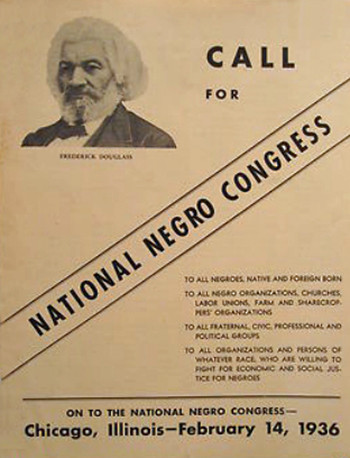
Hunton grew up in Brooklyn, his family’s refuge from racist violence in Atlanta. As professor of English literature at Howard University, he organized a faculty labor union. Anticipating the National Negro Congress (NNC), Hunton arranged for a large meeting at Howard. Anti-communists attacked him. That was in 1935.

Alphaeus Hunton addressing four thousand people at Abyssinian Baptist Church to open the famine relief campaign. Josh Lawrence, Paul Robeson, Rev. Shelton Bishop, and Adam C. Powell Sr. are seated behind the cans and bags of food. | Photographs and Prints Division, Schomburg Center for Research in Black Culture, The New York Public Library, Astor, Lenox and Tilden Foundations.

Hunton joined the U.S. Communist Party (CPUSA) in 1936. That year he organized the first national conference of the NNC, an offshoot of the Party. As suggested by historian and labor educator Tony Pecinovsky, “The CPUSA was the only organization on the left to make Africa -American equality a centerpiece of its work.” 

The central theme of Pecinovsky’s new book is Hunton’s contribution, now mostly forgotten, to ongoing resistance against economic and political oppression of Africans and African Americans alike. His internationalist perspective was exemplary.  The book, The Cancer of Colonialism, is clearly written, well-organized, and full of information. Detailed footnotes are a side-benefit. 

The book’s first section, modestly labeled “Introduction,” is a stand-alone resource. It covers intersecting historical features of the inter-war, wartime, and post-World War II periods. Figuring prominently are national liberation struggles playing out in Africa, and also in Vietnam, Indonesia, the Philippines, and Korea. The author traces the twists and turns of U.S. Communists in dealing with racism at home and independence struggles abroad.

The reader learns how the Communist International, and later the Soviet Union, stimulated, prodded, facilitated, and provided material support for national liberation struggles. The author cites the complicity of U.S. imperialism with mass murders, take-downs of newly independent governments, harassment of liberation movements, and anti-communist provocations. He touches upon the prolonged debate within the CPUSA as to whether African Americans constitute an oppressed nation.

Spreading the word  

The second section of Pecinovsky’s book tells about Hunton’s political life. From 1936 on, he organized national conventions for the NNC, edited its publications, and planned education programs. Hunton gained recognition nationwide and in Washington as a leader in opposing racial discrimination and police violence against Black people. 

With chapters in 26 cities, the NNC established the Southern Negro Youth Congress that would set up chapters in 11 southern states and recruit more than 10,000 members. Both organizations were typical of “popular front” groups promoted by the CPUSA. Joining were Communists and, according to the author, “anyone willing to fight for workers’ rights and African American equality.”  The Communist International had launched its popular-front strategy in 1935 in order to fight fascism.

Under fire from anti-communists, Hunton in 1941 was forced to testify before the House Un-American Activities (“Dies”) Committee. He resigned his professorship at Howard in 1943. The NNC merged with the CPUSA-backed Civil Rights Congress (CRC) in 1947, and disappeared. 

Alphaeus Hunton was “the administrative and intellectual mainstay” of the Council on African Affairs (CAA) between 1942, when it began, until its demise in 1955. Paul Robeson was the organization’s co-founder and chairperson and W.E.B DuBois, its vice-chairperson. According to Pecinovsky, The CAA “brought together African Americans fighting for equality with Black liberation movements in Africa while both sought allies within ascendent socialism.” Historian Gerald Horne regards the CAA as “the vanguard organization in the U.S. campaigning against colonialism.” 

Hunton was the CAA’s education director. He edited and wrote for its publications, organized events, mentored young activists, arranged for humanitarian aid deliveries to Africa, and, with Paul Robeson, was a “fixture” at the United Nations. Time and again, he returned to South Africa’s freedom movement. 

International Publishers, 2021

Anti-communist harassment was a constant. Having refused to provide federal investigators the names of donors to the CRC bail fund, Hunton went to prison for six months in 1951. Rather than turn over CAA correspondence to the government in 1955, Hunton dissolved the organization. 

Hunton in 1957 published his book Decision in Africa. He traveled to Ghana, to the Soviet Union, and to Guinea, where he taught and wrote. He moved to Ghana in 1962 to work on DuBois’s Encyclopedia Africana. A CIA-assisted coup forced Hunton to leave Ghana in 1966 for Zambia. He died there in 1970 at the age of 67.

Daily Worker

“The Cancer of Colonialism” concludes with a collection of columns Hunton wrote for the Daily Worker from July 20,1944 to January 19, 1946. A present-day reader of the columns becomes his or her own historian in tracing a transition from optimism to frustration.   

Vice President Henry Wallace is quoted as anticipating “freedom everywhere … under just and democratic principles.” Hunton applies the example of the Soviet Union to the problem of colonies. What Britain failed to do in 100 years, he notes, the USSR did in 25 years. 

Hunton expects that the United States, Britain and Soviet Union would collaborate in shaping a new world and the new United Nations. The worldwide labor movement in the works would help out.

He praises Churchill and Roosevelt’s Atlantic Charter agreement (1941) and the outcome of the Teheran and Yalta conferences in 1943 and 1945, when Stalin joined the other two.  He assumes that agreements on the right of all nations to self-government and on collaboration in securing world peace would last.

Hunton lauds conferences in 1944 at Dunbarton Oaks and Bretton Woods where new trade and financial arrangements were fashioned that, as he expected, would assure the development even of small nations. 

International Publishers, ©1965

He reports on the 1945 San Francisco conference and the agreement there on a United Nations Charter. He offers several columns on South Africa, where the job remained of “liquidating fascism.”

Now Hunton is uncertain. He sees colonialism returning to Korea, Indonesia, Malaya, and Indochina (think Vietnam). He critiques U.S. aggressiveness in demanding to exercise UN-sanctioned trusteeship over Japanese islands and the Pacific islands that had hosted allied bases. Signs crop up of U.S. anti-Soviet hostility. The Cold War is beginning.

Finally, Hunton comments on a Daily Worker article on “Leninism” by William Z. Foster. Having returned to head the CPUSA, Foster, as quoted by Hunton, mentions “dangerous illusions as to exaggerated possibilities” associated with “New Dealism” (Hunton’s term). Hunton cites “reformist illusions [that] act as, [in Foster’s words], a ‘barrier to the movement to socialism.’” 

Hunton’s world had shifted. CPUSA leaders had shared his optimism, so much so that they had taken the CPUSA out of commission – which Foster’s return had remedied. And Hunton’s expectation of continuing amity between the capitalist powers and the Soviet Union was splintering. 

Ultimately, Pecinovsky’s narrative testifies to the commanding role of anti-communism in Hunton’s political life. Pecinovsky borrows from analyst Michael Parenti to say that anti-communism is “the most powerful political force in the world.”

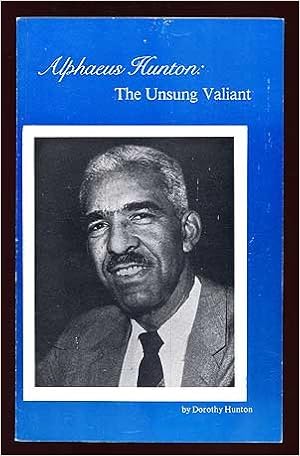
Concluding, we recognize the contribution of International Publishers for not only having presented The Cancer of Colonialism, but also for having republished Alphaeus Hunton’s 1957 book Decision in Africa and Alphaeus Hunton: The Unsung Valiant, Dorothy Hunton’s 1986 biography of her husband.

W.T. Whitney Jr. is a political journalist whose focus is on Latin America, health care, and anti-racism. A Cuba solidarity activist, he formerly worked as a pediatrician, lives in rural Maine.

Progressive Coalition Campaigning in Colombia Promises Real Change / by W. T. Whitney Jr.

Historic Pact confirms Gustavo Petro and Francia Márquez presidential ticket in Colombia | Peoples Dispatch

In Colombia Gustavo Petro and Francia Márquez on March 24 registered as presidential and vice-presidential candidates, respectively, for elections taking place on May 29. On behalf of the Historic Pact coalition, Petro stated that, “today is the first day of a campaign that promises to actually change the history of Colombia.”

He was, in effect, proposing that someday killings, disappearances and dispossessions would be gone. And no longer would elections be the exclusive province of oligarchs.  Real democracy would replace the hollow version of Colombian democracy regularly proclaimed by U.S. officials.

The Historic Pact campaign scored well in primary elections held on March 13. Of 5.6 million Colombians voting in the coalition’s primary, 4.5 million of them chose Petro as presidential candidate. Significantly, 783,160 of them opted for Francia Márquez for the same office. Later, of course, Petro selected her as his vice-presidential running mate.

Other primary results were: of the 4.0 million people voting for the rightwing Team Colombia coalition, 2.2 million (54.2%) selected Federico Gutierrez as that coalition’s presidential candidate. Colombians loyal to the centrist Center of Hope coalition, 2.2 million in all, picked Sergio Fajardo as presidential candidate with 723,084 votes (33.5%).  Results were reported also on many other presidential candidates running either as individuals or as candidates of other coalitions.

Voters also cast ballots on March 13 to fill 108 seats in the Senate and 187 in the House of Representatives. In Senate voting, the Historic Pact led with 2.7 million votes and 21 seats.  The Conservative Party followed with 2.2 million votes and 15 seats. The Liberal Party with 2.1 million votes and 15 seats was in third place. Voting for delegates to the House of Representatives gave 33 seats to Liberal Party candidates, 29 to the Historic Pact, and 27 to Conservative Party candidates.

Because most legislators joining the new Congress represent many political groupings.  For the Historic Pact legislators to do their work, they will have to form alliances.  

Petro, a former M-19 urban guerrilla and mayor of Bogota, served in Colombia’s Senate. There he established himself as an implacable foe of two-term former president Alvaro Uribe, who personifies and has led the extreme right-wing sector of Colombian politics.  In 2018, Iván Duque, an Uribe protegee and now the outgoing president, defeated Petro in second-round voting, gaining 10.3 million votes to the latter’s 8.0 million votes. Petro’s first presidential campaign was the first outing for the brand-new Historic Pact, whose formation Petro had engineered.

For progressives, the Historic Pact this year has star-power. Francia Márquez herself gathered more votes for a presidential run than did Sergio Fajardo, the candidate of the third largest electoral coalition. Márquez is a 39-year-old African-descended lawyer and environmentalist, whose activism has centered on the environment harm caused by mining activities in Cauca Department – from where she was forced to leave because of threats.

Márquez won the National Prize for the Defense of Human Rights in 2015 and the prestigious Goldman Environmental Prize in 2018. The BBC named her as one the 100 most influential women in the world.

On announcing Márquez’s vice-presidential candidacy, Petro asserted that Márquez would represent “three pillars [of] the first people’s government of Colombia,” specifically “the women of Colombia, the excluded territories, and peoples excluded by the color of their skin.”

Márquez responded, dedicating her words to Colombia’s youth: “Our job will be to close gaps arising from inequity and inequality in those regions where people are excluded and silenced.” Reports suggest that in a Petro government she would serve as environmental minister and fill a newly created Ministry of Equality.

Troubles emerged after the March 13 elections. At issue were voting irregularities marking the elections for the Senate and House of Representatives. The Election Observation Mission on March 18 reported that not one of more than 28,000 polling booths produced a ballot showing a vote for a candidate supported by the Historic Pact or by other left-leaning groups.

Former President Uribe reacted: “These elections leave mistrust everywhere. To these inconsistences must be added the overwhelming vote for Petro in the narco-trafficking regions. This result cannot be accepted.” His Democratic Center Party called for a total recount, insisting that otherwise “the new Congress would be illegitimate.”

Petro on March 20 called upon “all political parties to reject [Uribe’s] invitation to a coup d’état. It’s time for everyone to defend democracy.”  In a recount, almost 400,00 additional votes were discovered. The Historic Pact gained three more Senate seats at the expense of three other parties.

Obstacles remain. According to  an observer, “Voting for the Historic Pact took shape in spite of and against massive buying of votes by the Mafias of the traditional parties and the new parties of the oligarchy …[and] against the multimillion dollar machinery of the establishment’s electoral businesses.”   

Two recent opinion polls have Gustavo Petro winning the first round of elections on May 29. One points to 37% of likely voters favoring Petro. Next in line, Federico Gutiérrez, candidate of the Team Colombia coalition, polled at 19%. Another poll gives Petro a 32% favorability rating, with Gutiérrez at 23%.

Analysts say that the Historic Pact must win a first-round victory, that a “second-round election would be very dangerous.” Coalition strategists envision a broad-front approach aimed at opening up “political space beyond the Historic Pact.”

Youth activism and popular resistance beyond the orbit of left-leaning political parties did fuel the growth of the Historic Pact – as exemplified by the vice-presidential candidacy of Francia Márquez.  As part of the political uprisings of 2021 in Colombia, these sectors recalled the upsurge of social movements in Chile that helped to install the new progressive government there headed by President Gabriel Boric

Alexander Escobar is a senator whose political party, the Democratic Pole, is part of the Historic Pact; he was a presidential candidate within that coalition. His advice for Petro now is for the Historic Pact to be cautious in assimilating social movements into the campaign.

Escobar insists that electoral success must precede efforts at fostering mobilizations outside regular politics. While admiring activists who “have big dreams, that are so strong and have so many roots,” he relies on “real organizing and decision-making spaces.”

W.T. Whitney Jr. is a political journalist whose focus is on Latin America, health care, and anti-racism. A Cuba solidarity activist, he formerly worked as a pediatrician, lives in rural Maine. W.T. Whitney Jr. es un periodista político cuyo enfoque está en América Latina, la atención médica y el antirracismo. Activista solidario con Cuba, anteriormente trabajó como pediatra, vive en la zona rural de Maine.

Nepal accepts U.S. aid despite protests, Chinese objections / by W.T. Whitney, Jr.

Police moved in to disperse protesters who are against the U.S. infrastructure grant. AP

Nepal’s Parliament on February 27 ratified an aid package provided through the Millennium Challenge Corporation (MCC), an “independent agency” located in the United States. The $500 million to be dispensed, plus $130 million from Nepal, will pay for roadway improvements and transmission lines conveying hydro-generated electricity to India and to domestic users.

Nepal’s acceptance process was long and tortuous due to the country’s layered, fractured, and unwieldy political system. China’s government opposed the MMC funding.

Massive protests unfolded outside the parliament building in Kathmandu prior to parliamentary approval. Joining the demonstrators were those representing student and peasant groups and sections of Nepal’s two Communist Parties. They were protesting the government’s alleged disrespect for Nepal’s sovereignty.

The U.S. Congress passed legislation creating the MCC in January 2004. The intention was that of providing economic aid to low and middle-income countries via “threshold programs” and “compacts” lasting five years. The MMC website highlights “cost-effective projects, a lean staff, an evidence-based approach …[and] a good investment for the American people.”

The aid is tailored to reducing investment risk and promoting “growth …[and] economic freedom.” MMC officials look for “good economic policies in recipient countries, such as free markets and low corruption.”

After first awarding a threshold grant, the MMC in 2014 offered Nepal a compact. The agreement signed in 2017 represented the largest foreign assistance grant ever received by Nepal, and the first MMC compact with a South Asia nation.

The MMC has offered 83 compacts and threshold programs to 51 countries in Africa, Asia, Eastern Europe, Latin America, and the Pacific. Some MMC agreements have ended abruptly – with Madagascar in 2009, Tanzania in 2016, and Sri Lanka in 2020. The MMC complained of election irregularities in the first two situations, while Sri Lanka objected to violations of sovereignty.

The almost six-year hiatus between the agreement being signed and Nepal’s ratification of the compact stems from governance problems in Nepal. Two factors contribute. One is institutional immaturity, the result of decades of political turmoil prior to 2015 when Nepal’s present Constitution took effect. The other is parliamentary dysfunction associated with wrangling over disparate caste, ethnic, and regional interests.

A constitutional monarchy, in place between 1990 and 2006, had succeeded decades of absolutist minority rule. A 10-year-old armed Maoist insurgency ended in 2006, coincident with the king’s departure. From then until 2015, strife over the dissolution of the Maoists’ army, regional demands, and the shape of a new constitution weakened the Maoist political party as it tried to exercise political power. All the while, it was contending with internal schisms, another Communist party, and Nepal’s Congress Party.

Following the institution of the new Constitution in 2015 and the general elections two years later, the Communist Party of Nepal–Unified Marxist-Leninist (CPN-UML) and the Communist Party of Nepal–Maoist Centre were positioned to jointly form a government. They did so, and, having united in May 2018, they established the Nepal Communist Party.

The Supreme Court nullified the unification. Afterwards, the CPN-UML headed a shaky government amid continuing factionalism. It exited in early 2021 after a no-confidence vote. The Supreme Court named Congress Party head Sher Bahadur Deuba as prime minister, and he remains.

The picture is of a government that is precarious and rudderless. In particular, according to The Statesman news service in New Delhi, “With the leadership of the executive practically non-functional … the onus of making the system work lay upon Parliament. Sadly, the legislature has become almost dysfunctional.” Adding to the chaos is the matter of corruption.

Reports the Kathmandu Post: “Nepal’s position on the latest Corruption Perception Index remained unchanged at 117th out of 180 countries … Nepal’s score also remained unchanged at 33 …[and a] score below 50 is considered as having a relatively higher level of corruption.”

Once more The Statesman: “The biggest “achievement” of Parliament is that it had succeeded in ratifying the Millennium Challenge Corporation … Compact in the face of considerable resistance from the constituent political parties in government itself.”

It would be miraculous, so it seems, if mechanisms of accountability are in place as to where and to whom the money goes, and if the 28% of rural Nepalese who were poor in 2019 find that, with the money, their lives improve. Only through wishful thinking might one expect China to rest easy with Nepal’s half-billion-dollar bonanza. Perhaps that’s the U.S. purpose: to provoke and to intrude.

Chinese Foreign Minister Wang Yi will visit Nepal on March 25 to deal with Nepal’s ratification of the MMC compact. According to a Chinese official quoted by India’s ANI news: “Implementation of the BRI projects in Nepal is important for Beijing … But this time Beijing is more worried about the security challenges emanating from the compact’s approval.”

Nepal’s government in 2017 had signed an agreement with China’s Belt and Road Initiative (BRI) for a railway project linking Kathmandu to Central Asia.

“We tried hard to stop the MCC compact’s parliamentary approval,” declared another Chinese official, who remarked also that, “[Nepalese] leaders who had earlier assured us of the compact’s failure started shaking under US pressure.”

W.T. Whitney Jr. is a political journalist whose focus is on Latin America, health care, and anti-racism. A Cuba solidarity activist, he formerly worked as a pediatrician, lives in rural Maine. W.T. Whitney Jr. es un periodista político cuyo enfoque está en América Latina, la atención médica y el antirracismo. Activista solidario con Cuba, anteriormente trabajó como pediatra, vive en la zona rural de Maine.

People’s World, March 23, 2022, https://www.peoplesworld.org/article/nepal-accepts-u-s-aid-despite-protests-chinese-objections/

Ukraine War Unveils US Preparations for Biological Warfare / by W. T. Whitney Jr.

Biological warfare | Image: Wikipedia

War in Ukraine is turning people’s lives and affairs upside down. Governmental functioning is confounded. Unsurprisingly, dirty laundry, previously hidden, is on display. A Russian communication March 6 mentions “evidence of an emergency clean-up performed by the Kiev regime was found – aimed at eradicating traces of the military-biological program in Ukraine, financed by @DeptofDefense.” 

A Chinese Foreign ministry spokesperson two days later spoke of “26 [U.S.] bio-labs and other related facilities in Ukraine.”  

WASHINGTON, DC – MARCH 08: Undersecretary of State for Political Affairs Victoria Nuland testifies before a Senate Foreign Relation Committee hearing on Ukraine on March 08, 2022 in Washington, DC. (Photo by Kevin Dietsch/Getty Images)

White House press secretary Jen Psaki responded, saying that that the United States “does not develop or possess such weapons anywhere.” Undersecretary of State Victoria Nuland indicated “Ukraine has biological research facilities …[and] so we are working with the Ukrainians [to] prevent any of those research materials from falling into the hands of Russian forces.” 

The Bulletin of Atomic Scientists reported that, as of February 25, “a network of US-linked labs [existed] in Ukraine that work with dangerous pathogens.” Those 26 such facilities are “public and animal health labs.” 

The gist of the Chinese and Russian communications is their claim that the U.S. Government is doing biowarfare. In that regard, the large “Richard Lugar Center for Public Health Research” in Tbilisi, Georgia, comes into view. The U.S. Defense Department’s Defense Threat Reduction Agency (DTRA) paid for the Center’s construction and for its operation, between 2011 and 2018.

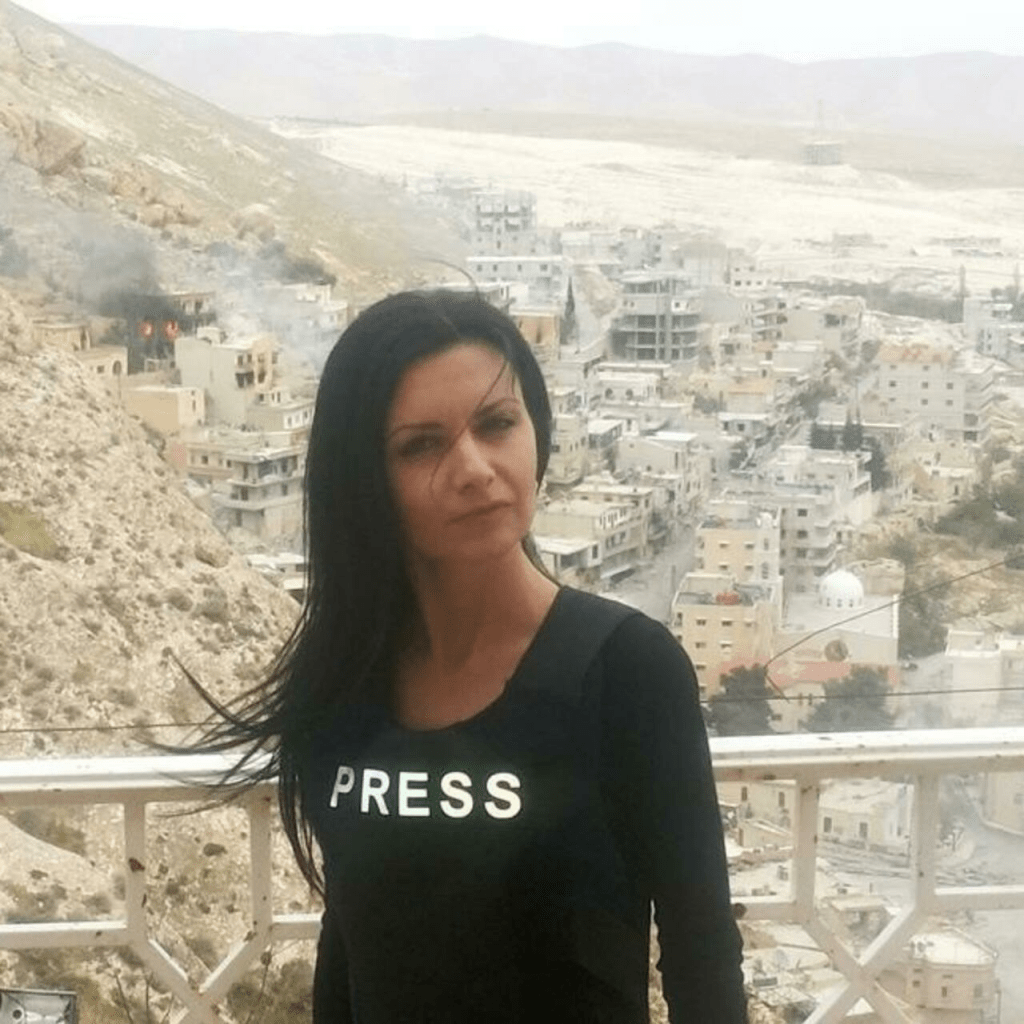
Bulgarian investigative journalist Dilyana Gaytandzhieva produced a report in 2018 alleging the Center had bioweapons capabilities. She claimed that most of the Center’s staff were U.S. citizens enjoying diplomatic immunity and that at least three U.S. companies were doing bio-weapons research there. She indicates elsewhere that biologic specimens arrive by diplomatic pouch

Richard G. Lugar Center for Public Health Research

Gaytandzhieva’s extraordinarily detailed report displays dozens of official U.S. documents and graphics. She points out that DTRA-funded private companies carry out bio-weapons research and testing in laboratories and facilities located in Georgia, Ukraine, in the Middle East, South East Asia, Africa, and at Fort Detrick, Maryland, and the Dugway Proving Ground in Utah. U.S. government apologists have dismissed the report as Russian-inspired propaganda.

The distinction between offense and defensive preparations has been clear as regards Fort Detrick. A “biological weapons program” existed there until 1969, when, as ordered by President Richard Nixon, it became a “biological defense program.” U.S. research installations elsewhere in the world lack clear demarcation between offensive and defensive purposes. 

One of the U.S. bio-laboratories abroad is Battelle Corporation, “a $59 million subcontractor at Lugar Center,” that, according to Gaytandzhieva, operates laboratories in eight countries across the globe and, as of 2018 “has been awarded some $2 billion [in] federal contracts” and ranks 23rd among US government contractors. 

As of that year, the Southern Research Institute, Black & Veatch, and Metabiota company were operating one or more of the 11 Defense Department-funded bio-laboratories in Ukraine. In a report published in January, 2022, Gaytandzhieva mentions the “US Federal contracts registry” as documenting that “DTRA allocated $80 million [to Black & Veatch company] for biological research in Ukraine as of 30 July 2020.” 

Dilyana Gaytandzhieva

She charges that the contractor did more than merely fund the labs – as suggested by Victoria Nuland – but instead has been responsible for their day-to-day operation. Cited as evidence are “internal documents” showing that “independent experts were denied even a visit” to the laboratories. 

Ominously, scientists funded by the Defense Department have developed a new way of transmitting viruses to plants. According to a Science magazine article in 2018, the Defense Department initiated a program named “Insect Allies” in 2017 and would continue it for four years. Biting insects are being studied at the Luger Center in Georgia and presumably in other laboratories included in the multi-national U.S. bio-weapons network, such as those in Ukraine.  

The scientists have arranged for genetically-modified viruses to infect insects that then go on to transmit the fixed-up viruses to plants where they alter the plants’ properties.  Critics, mainly in Europe, doubt the peaceful purposes of the new methodology.  They fear that the technique of “lab-modified self-spreading viruses” will soon be applied to humans and animals.  

Commentary from the Max-Planck Institute interprets the Science magazine article as arguing “that the findings of the Insect Allies Program could be more easily used for biological warfare than for routine agricultural use.” It cites a legal opinion saying that, “The Insect Allies Program could be seen to violate the Biological Weapons Convention” (BWC),” which took effect in 1975. 

This photo shows corn leaf aphids used in a study to modify crop plants through engineered viruses. | Meena Haribal – Boyce Thompson Institute via AP

Information presented here suggests it’s at least possible that the United States really has been developing bio-weapons for offensive use at facilities throughout the world and particularly in countries along Russia’s western periphery. 

But questions crop up of mission overlap. Bio-medical and bio-industrial products are developed for both peaceful and war-making uses. In the latter case, a given product may be used for offensive or defensive purposes. A representative statement from officials in The Netherlands in 2013 testifies to a merging of purposes:

“On the one hand, many pathogenic organisms are very important to research and development in the fields of medicine, biology and agriculture. However, some of these organisms can also be used to develop biological weapons that may pose a threat to public health and the environment. The term ‘dual-use research’ can be extended … ‘Dual-use research of concern’ is the type of research that could be misused directly and whereby such misuse would have major consequences.”

Ambiguity cries out.  That ambiguity demands that, in regard to Ukraine, and elsewhere, we view the likelihood of the United States preparing for biowarfare as probable, not as possible. 

One more set of circumstances now boosts that likelihood up to near certainty. In furtherance of its goals, the U.S. government easily accepts the reality that masses of humans are going to suffer and die. We recall:

  • The nuclear bombing of Hiroshima and Nagasaki and the conventional bombing of Dresden that sickened and killed hundreds of thousands.
  • Pursuit of wars, in Korea and Vietnam, in which millions died, plus wars and occupation in Iraq and Afghanistan that took the lives of hundreds of thousands.
  • Complicity in massacres in Indonesia and Latin America. 
  • Institution of economic sanctions that killed or incapacitated hundreds of thousands in Iraq, Cuba and Venezuela.
  • Support for repressive regimes like apartheid South Africa and Saudi Arabia that killed and maimed.    

W.T. Whitney Jr. is a political journalist whose focus is on Latin America, health care, and anti-racism. A Cuba solidarity activist, he formerly worked as a pediatrician, lives in rural Maine. 

Arming Scientists and Society for the Climate Crisis / by W. T. Whitney Jr.

Photo by Jeff J. Mitchell | The Boston Globe via Getty Images

“[O]ur obligation as scientists [is] to make sure we fight the good fight and ensure the fruits of science are not monopolized by the powerful and the elite.” — Richard Levins

Three scientists associated with the United Nations Intergovernmental Panel on Climate Change (IPCC) are discouraged. New Zealanders  Bruce C. Glavovic and Timothy F. Smith and Australian Iain White criticize governments for not doing enough about climate change. They are calling upon fellow IPCC scientists to no longer conduct research on climate change. “More scientific reports, another set of charts,” Glavovic exclaims; “I mean, seriously, what difference is that going to make?”

Hundreds of IPCC scientists provide the United Nations periodically with reports on adverse impacts of climate change. The most recent report, issued in February, details rising seas, terrible droughts, atypical weather events, thawing permafrost, dying forests, and massive displacement of populations. 

Once atmospheric warming exceeds 1.5 degrees Celsius over 19th century levels, changes will be irreversible. The increase so far is 1.1 degrees Celsius. Surveyed, 60 percent of scientists working on an earlier IPCC report agreed that temperatures would rise almost three percent by the end of the present century.

Dr. Richard Levins (1930-2016) | Harvard T.H. Chan School of Public Health

The three scientists published a statement in Climate and Development in December, 2021They pointed out that“indicators of adverse global change rise year upon year. …[T]he time has come for scientists to agree to a moratorium on climate change research as a means to first expose, then renegotiate, the broken science-society contract.” 

Climate scientists have contributed to people’s general awareness of the issues. Lots of people understand that fossil fuels, when burned, generate gaseous emissions which, in excess, cause atmospheric warming. Many people are more or less aware that as consumption and industrial production increase, emissions rise too. In their appeal, the three protesting scientists are, in effect, be reaching out to the public and politicians, as if to spark a resistance movement within society.

There is a side story that hasn’t resonated yet. Capital requires new wealth to be created in order to survive. That only happens as long as production and consumption are increasing. Therefore, with capitalism in charge, rising emissions are a secondary matter. 

That’s why those three scientists seeking to renegotiate a science-society contract are spoiling for a fight that, in essence, is anti-capitalist.  Unsurprisingly, the prospect is slim of allies flocking to their cause from either the scientific community or the public sector. But of the two, the scientists may be more receptive. What follows here is a look at the potential for collaboration among scientists. 

Normally scientists don’t need a supporting cast. They often generate information that is applauded – for example, research findings that contribute to high technology consumer items. Even the science behind weapons manufacture gets a pass.

The public praises most scientific investigation involving natural and biologic processes, notably vaccine research, novel therapies for cancer or inherited illnesses, and the development of antibiotics. For instance, advances leading to antibiotic treatment of streptococcal infection led directly to the eradication of terrible afflictions of heart values, joints, and/or the brain. Everyone benefited.

But something went wrong in other healthcare situations. Scientific findings were not implemented, or only partially so. Population groups were excluded, as per decision-making at the highest levels of government and society. As regards the climate crisis, everyone is excluded.

Scientists found that ingested lead interferes with enzyme activities and thereby injures the brains of children, and causes other disastrous ailments.  In 2014, the majority Black population of Flint, Michigan learned that their drinking water contained high levels of lead. Eight years later, lead levels are down, but still potentially toxic. Epidemiologists say there is no safe level of lead in a child’s blood.

Ariana Hawk, with her sons Aiden Hawk, left, and Sincere Smith. Thousands of children required to eat additional nutritional foods to help limit the effects of lead exposure from Flint’s poisoned water | Ryan Garza – Detroit Free Press via AP

The high death rates of African-American infants are an abomination. Specialists of many disciplines long ago showed how babies stay healthy. Their mothers have to be healthy, well-educated and well-nourished.  Ready access to competent healthcare for mothers and babies is essential. But African American babies have long died at rates two to three times higher than those of white babies. 

Maybe scientists investigating natural and biologic processes – our climate scientists, for example – and scientists concerned with how society works can join forces. Both sets of scientists study realities involving either matter, natural and biological processes, or collective human aspirations and actions. They study the interaction of real things, and how things change.

Similarities in methodological approach are one basis for scientists to collaborate in developing joint projects, enabling the general population to understand the role of science in society, and firming up implementation of research findings.

“Sheehan’s book remains the single best secondary analysis of the debates over Marxist philosophy of science from its creation in the late nineteenth century … until the close of World War II.”– Marx & Philosophy

Scientists within the Marxist tradition look for linkages and commonalities. According to historian Helena Sheehan, “The history of marxism in relation to science is extraordinarily dense and dramatic. From the beginning, marxism took science extremely seriously, not only for its economic promise in building a socialist society, but for its revelatory power in understanding the world. Marxism has made the strongest claims of any intellectual tradition before or since about the socio-historical character of science.”

Karl Marx and Frederick Engels incorporated findings from the physical and biological sciences into their political analyses. Here is Marx:

Capitalist production, by collecting the population in great centers, and causing an ever-increasing preponderance of town population, on the one hand concentrates the historical motive power of society; on the other hand, it disturbs the circulation of matter between man and the soil, i.e., prevents the return to the soil of its elements consumed by man in the form of food and clothing; it therefore violates the conditions necessary to lasting fertility of the soil”.

Here Marx is discussing political power, changing modes of production, human migration from country to city, and the lack of organic waste material formerly produced by animals and people – which accounts for reduced soil fertility. His reference point is the enclosure movement in 19th century England. Wealthy bourgeoisie bought land, created large parcels, and surrounded them with walls to allow for grazing. Villagers and country people, now deprived of animals and land and unable to feed themselves, moved to cities and became factory workers.

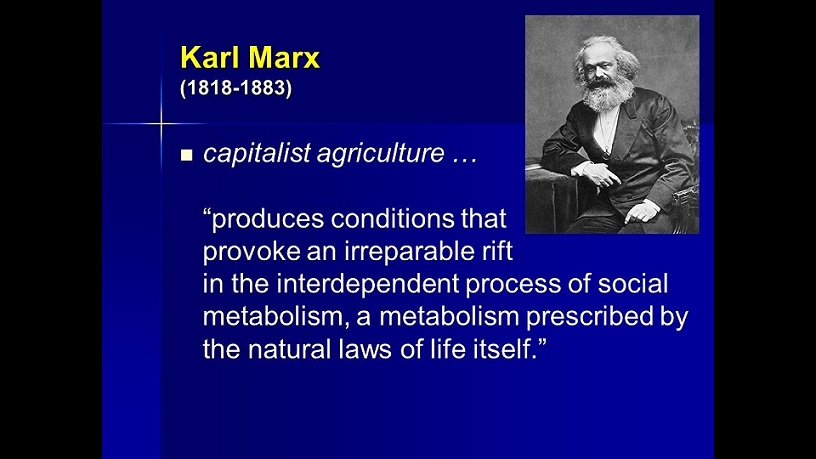
This sequence of developments Marx characterized as a “metabolic rift.”  In developing his analysis, Marx gained an assist from scientist Justus von Liebig who studied agricultural chemistry and plant growth.

The Discovery and Rediscovery of Metabolic Rift | Climate & Capitalism

Marx declared that, “Humans live from nature, i.e.: nature is our body, and we must maintain a continuing dialogue with it if we are not to die. And “man’s physical and spiritual life is linked to nature … man is a part of nature.”

Frederick Engels was a kindred spirit. He asks:

What did the Spanish planters in Cuba, who burned down forests the slopes of the mountains and obtained from the ashes sufficient fertilizer for one generation of very highly profitable coffee trees, care that the tropical rainfall afterwards washed away the now unprotected upper stratum of the soil, leaving behind only bare rock? In relation to nature, as to society, the present mode of production is predominantly concerned only about the first, tangible success …Thus at every step we are reminded that … [we], belong to nature, and exist in its midst.”

We propose that scientists studying natural phenomena and processes are ripe for collaborative relations with social scientists, including Marxist investigators. As noted, they share similar methodologies and most of them a dedication to human well-being.  Growing numbers of scientists, both kinds, are very likely primed to accept that a linkage runs from wealth accumulation, to perennially increasing production, to rising emissions, to atmospheric warming.

Together with the public, scientists need to realize that capital is bound to make its peace with planetary warming, no matter the disaster ahead. Aware that their research impinges on human lives, a few scientists, maybe, will turn to political activism. 

Influenced by the worsening climate crisis, those social scientists receptive to Marxist analysis would increasingly familiarize themselves with issues involving the biologic and natural sciences. One envisions collaboration among the different kinds of scientists and even common struggle in the political arena. Anticipating the new society, revolutionaries within the ranks of scientists, acting together now, would gain a head start in building scientific institutions that serve the people.

Discussion here touching upon social transformation is incomplete without defining the political role of working people. They are the protagonists of the change to come and of rescue during the climate crisis.  The desperate situation now has an urgency and sweep extending far beyond burdens falling specifically upon the working class, like economic exploitation and plunder. Now, the world’s entire population may be heading to ruin.

Yet in times past, the working class has shown itself capable of carrying out social revolutions amid other circumstances of generalized disaster. This time the working class, organized and motivated, could take the lead in the climate crisis while brandishing, as before, some sort of an all-encompassing demand. In the Cuban and Chinese revolutions, the working class called for national liberation; in the Russian revolutions of 1917, for “peace, land, and bread.” 

W.T. Whitney Jr. is a political journalist whose focus is on Latin America, health care, and anti-racism. A Cuba solidarity activist, he formerly worked as a pediatrician, lives in rural Maine.

Puerto Rican union workers strike against austerity, point to U.S. responsibility / by W.T. Whitney Jr.

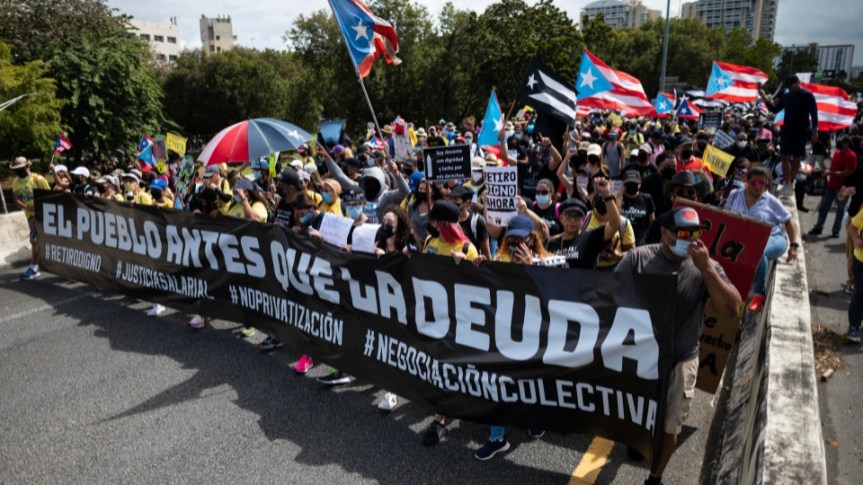
Public employees march to demand better salaries, adequate pensions, and better employment conditions, in San Juan, Puerto Rico, Feb. 18, 2022. | Carlos Giusti – AP

In Puerto Rico on Feb. 18, thousands of publicly-employed union workers, retired workers, and university students took part in a national strike and march that spread throughout the island. The largest contingent filled streets in San Juan. Demonstrators made noise and marched behind a long banner saying, “People before Debt – Salary Justice – Dignified Retirement – Collective Bargaining – No Privatization.”

Their demands grew out of actions of the U.S. government’s Fiscal Oversight and Management Board (FOMB), which was created under the authority of the U.S. Congress’s PROMESA Act of 2016. The island’s government was bankrupt at the time, and the FOMB was charged with negotiating with creditors and implementing austerity in Puerto Rico.

Labor unions participating in this most recent national strike included the Puerto Rican Workers’ Union, the Central Workers’ Federation, the United Auto Workers (for Treasury Department workers), the Electrical Workers’ Union, several teachers’ unions, the University Professors’ Union, and health workers’ unions. Unionized employees of the Highways and Transportation Authority also took part.

Students and teachers have sparked the recent protests. They’ve had no pay raises for 12 years. School closures have skyrocketed as the FOMB has denied funding to public schools while approving them for charter schools. Says one observer: “They are paying investors who are gaining profits from the country’s bankruptcy, and that is immoral.”

The FOMB recently approved public-employee salary hikes. But they were minimal and would only take effect in 2023. Beginning on Feb. 4, 70% of teachers stayed away from classes for six days, as thousands were demonstrating in San Juan and elsewhere on the island. Firefighters and police joined them. Those protests ended with Gov. Pedro Pierluisi promising the teachers an extra $1,000 per month, and firefighters a $500 raise. Funding sources are uncertain.

Puerto Ricans are in distress; 52% of them live below the poverty line, as do almost 60% of their children. Electricity and water bills are almost 60% higher than they are in the United States; food costs are 18% higher. The median family income is $20,500. The salary base for teachers—most are women—is $21,000 annually.

Privatization of the island’s electrical distribution system is emblematic of the FOMB’s brand of austerity. Since June 2021, Luma company has been in charge. It’s a subsidiary of the ATCO and Quanta Corporations, that together provide electrical services in more than 100 countries. Luma’s record is one of frequent blackouts and scant attention paid to damage left-over from Hurricane Maria in 2016 and earthquakes in 2020.

The workings of PROMESA and the FOMB had aroused Puerto Ricans to the point in July 2019 of forcing Gov. Ricardo Rosselló’s resignation, a process made easier through the corruption of some of his appointees. In recent weeks, protesting unionists called upon current Gov. Pedro Pierluisi to resign.

But the island’s government may lack tools for putting the people’s will into effect. Law professor and author José Nicolás Medina Fuentes, for example, regards the current prohibition on political parties forming electoral coalitions as undemocratic. He wants an “alternative to elites holding on to power through a two-party system that bypasses governance by a majority of the people.”

Medina Fuentes points out that in the elections of 2012, the Popular Democratic Party (supporting commonwealth status) and the New Progressive Party (supporting statehood) together gained 96% of the vote, leaving only 4% for the Puerto Rican Independence Party (PIP) and the Working People’s Party.

In 2020, the two major parties accounted for 64.5% of the vote, and the “emerging parties” now attracted 35.5% of the vote. These included the Citizens Victory Movement with 14.3%, the PIP with 13.7%, and Project Dignity with 6.9%. Effectively, he says, 67% of Puerto Ricans “do not govern.” He calls for either of the two major parties to be able to form coalitions with minor parties. A coalition with the PIP, for example, would give visibility to the independence vote.

A major sign of popular rejection of both government and major political parties is Puerto Rico’s increasingly high rate of voter abstention, really of electoral boycott. Voter turn-out for the general elections in 2020 was 50.02%.

Nevertheless, the island’s government by no means bears the main responsibility for difficulties confronting Puerto Ricans in the wake of PROMESA. The underlying, but not always explicit, theme of the recent protests is a call for the island’s association with the United States to be radically altered.

Reporter Monica Cruz cites Jocelyn Velazquez Rodriguez, who is an organizer of the ongoing campaign of demonstrations and strikes. Cruz refers to that campaign as “Jornada Se Acabaron Las Promesas,” which means “On this day we are done with promises!”

Velazquez Rodriguez emphasizes “the impact PROMESA has had on the political consciousness of the Puerto Rican people …[The]  PROMESA [law] has been a mechanism that has revealed the true face of US imperialism. It is a law created for a colony, to serve of the imperial interests of the United States. [And for] many Puerto Ricans there has never been a contract, nor an agreement, nor a convention on this.”

She sees “the popular demonstrations…[as] a sample of an awakening of a people that are tired of imperialism, the colonialism, the persecution and the suffering that it has caused us for so many years.”

The existence of colonial rule is not imaginary. The U.S Army invaded and occupied Puerto Rico in 1898. An “Organic Charter” two years later put the U.S. Congress in charge of the island. In 1950, Congress declared Puerto Rico to be a “Free Associated State,” authorized a constitution, and subjected the resulting document to U.S. laws and regulations. Also, there would be no protection from bankruptcy.

The U.S. Internal Revenue Service ruled in 1976 that U.S. companies operating in Puerto Rico would not pay taxes on income or capital gains. U.S. investors would pay no taxes on dividends paid by those companies. Nor were taxes due on U.S. investments deposited in Puerto Rican banks.

Previously, exploiters had counted on low-wage textile jobs and agricultural work for their profits. U.S. chemical and electronic manufacturers rushed to a Puerto Rico converted into a tax-free haven. A tax attorney quoted by The New York Times referred to the IRS tax leniency as “nothing but a welfare program for the Fortune 500.”

Meanwhile, Puerto Rico’s government had to rely on “multi-million” dollar loans to compensate for reduced tax collections. After 1990, U.S. authorities gradually restored taxation, and the manufacturers departed. To cover expenses, Puerto Rico’s government issued bonds held by U.S. banks, hedge funds, and corporations. Indebtedness mounted. Bankruptcy required rescue, of sorts—and thus came the PROMESA law of 2016.

W.T. Whitney Jr. is a political journalist whose focus is on Latin America, health care, and anti-racism. A Cuba solidarity activist, he formerly worked as a pediatrician, lives in rural Maine. 

People’s World, February 24, 2022, https://www.peoplesworld.org/article/puerto-rican-union-workers-strike-against-austerity-point-to-u-s-responsibility/

The Capitalist Roots of U.S. Racial Oppression  / by W. T. Whitney Jr.

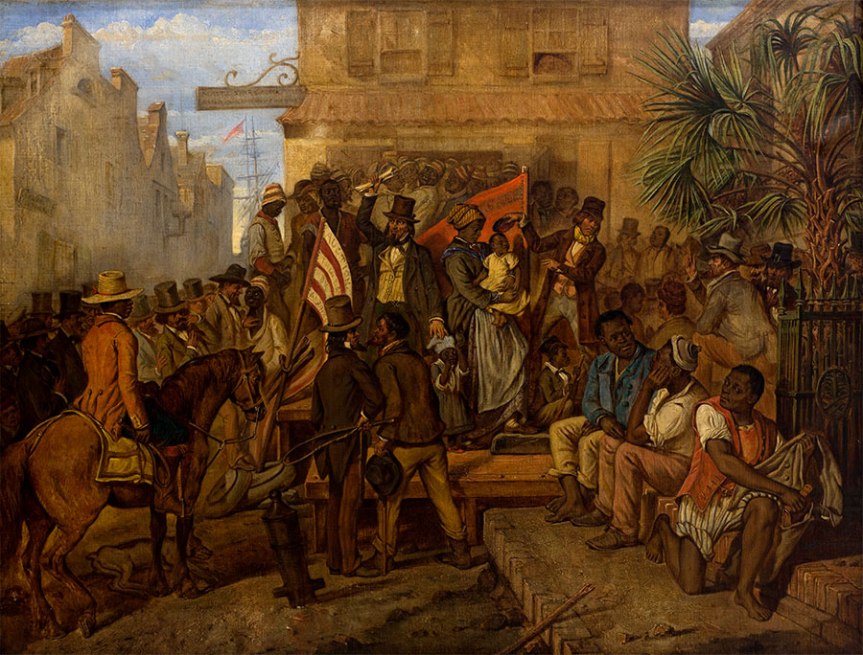
Painting by Eyre Crowe, A Slave Sale in Charleston, South Carolina, 1854

A recent BBC report attributes climate-change damage in Africa to “racialized capitalism.” That confusing term reflects a new understanding of U.S. slavery on the part of many historians. Here the term signifies the commanding role of capitalism in the oppression of Africans and of African-descended peoples in the United States. Racial hatred, by implication, takes on a secondary role as a tool useful for enforcing oppression.

What follows is an attempt to highlight the contribution of capitalism to racial oppression in the United States.

W.E.B. DuBois describes Europeans “scurrying down the hot, mysterious coasts of Africa to the Good Hope of Gain until for the first time a real commerce was born […] That sinister traffic, on which the British Empire and the American Republic were largely built cost black Africa no less than 100,000,000 souls, the wreckage of its political and social life, and left the continent in precisely that state of helplessness which invites aggression and exploitation.” (“The African Roots of War,” 1915).

Basic Books, 2021
9781541616592

In his recently published book The Ledger and the Chain, historian Joshua Rothman studies three wealthy U.S. slave traders. He points out that, “By 1860, four million enslaved people in the United States were a pillar of American prosperity, cumulatively worth more than the whole country had invested in manufacturing, railroads, and banks put together.” Slave traders “helped define the financial, political, legal, cultural, and demographic contours of a growing nation.”

Profit rules

Reflecting on Rothman’s observations, New York Times columnist Jamelle Bouie suggests that, “we should not think of the slave system or the slave trade as somehow about racism and hatred. It was about profit. That’s why — and how — it lasted so long.” He regards “chattel slavery … as part of a larger class system.” That characteristic, claims Bouie, accounts for “the ideas, ideologies and institutions” produced by slavery. 

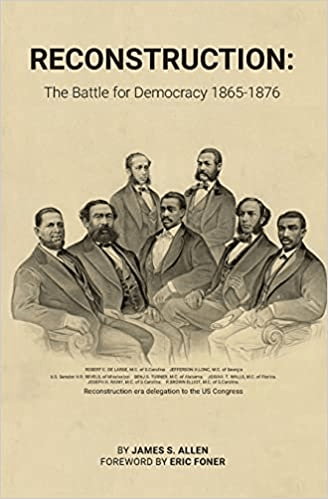
The northern side in the Civil War freed enslaved workers in the South. Reconstruction followed; it shocked the southern political establishment. Formerly enslaved people proved to be adept at organizing, articulating demands, and making politics work. Even the new National Labor Union briefly extended its organizing into the South. As described by Communist author James S. Allen in his 1937 book Reconstruction, “A strong tendency for solidarity with Negro workers and for alliance with the Negro people made itself felt early.”

International Publishers, 1937
978-0717801695

The old order took charge again after congressional shenanigans over the presidential elections of 1876 finished off Reconstruction. The freedmen were fodder for the profitable convict-leasing system. As tenant farmers, they provided a lifeline for the survival of plantations. Although some of them slowly and tenaciously gained land ownership, over time local oligarchs and lending agencies cut back on their acreage; the U.S. Department of Agriculture would be complicit.

Oppression continued through institutional means. That’s significant in that public institutions in the United States by and large reflect capitalist priorities.

Local and state governments and the courts sharply restricted voting rights and managed police, judicial, and prison affairs in oppressive ways. Local authorities provided low-quality and scanty education for the descendants of enslaved people. Poor schooling confined already marginalized workers to a future of diminished hopes and low wages.

The U.S. Supreme Court legitimized exclusionary legislation and administrative actions, especially in regard to higher education. African-Americans missed out on important benefits provided under the New Deal.  Until the mid-twentieth century, their military service was debasing and discriminatory. 

Variations

Oppression came from directions other than governmental action, or inaction. In the post-Civil War period, a trade-off arranged by higher-ups saw northerners tolerating continued abuse of African-descended workers in the South in return for the appearance of North-South harmony, viewed as essential for growing the nation’s capitalist economy.

Theirs was a bargain similar to the one struck by European workers in the early 20th century. As recounted by DuBois, “the laborer at home is demanding and beginning to receive a part of his share” on condition that the labor movement and other progressive forces go along with the imperialists’ plundering of “the darker nations of the world.” 

Racial oppression rested on the same social and political attitudes that allowed U.S. capitalism to flourish. Historian Frederick Jackson Turner, explains that the frontier experience itself instilled “anti-social” attitudes in the European settler, who manifested “antipathy to control.” Indeed, “democracy born of free land, strong in selfishness and individualism, intolerant of administrative experience and education, and pressing individual liberty beyond its proper bounds, has its dangers as well as benefits. Individualism in America has allowed a laxity in regard to governmental affairs.”

Since then, capitalist enforcers have taken advantage of the precariousness of workers’ lives. They’ve used poverty-stricken African-Americans as strike breakers to weaken labor unity. And very poor European-descended workers, mainly in the South and resentful of their own desperate economic conditions, have colluded in oppressing African-Americans. Intent upon preserving a modicum of status, they curry favor with the upper echelons

Some miscellaneous observations: first, the Thirteenth Amendment in 1965 abolished slavery, but it also legalized “involuntary servitude” as punishment for crime. It led to the convict leasing system that would continue for the next half century. It contributed to the profitable prison-industrial system of today.

Some miscellaneous observations: first, the Thirteenth Amendment in 1965 abolished slavery, but it also legalized “involuntary servitude” as punishment for crime. It led to the convict leasing system that would continue for the next half century. It contributed to the profitable prison-industrial system of today.

Secondly, the purpose of the Fourteenth Amendment of 1868 was to assure “due process of law [and] equal protection of the laws” for formerly enslaved people. Instead, according to historian Eric Foner, it became “a vehicle for protecting corporate rights rather than those of the former slaves.”

Thirdly, members of one’s own family in the U.S. South, no stranger to social-class distinctions, formerly employed that stock regional term “uppity.” They were referring to African-descended neighbors deemed to be rising above their “station in life.”

A clear message

In pursuing their own economic interests, the upper orders of society arranged for the enslavement of Africans in the United States and, later on, for the oppression of their descendants. That’s clear, as is the fact that race-based hatred persists because it’s useful as an enforcement mechanism and can be readily applied to victims identifiable through their physical appearance.

Hatred has many applications. Inciting fear, it theoretically inhibits open rebellion among the oppressed. Hatred in the form of organized terror – the lynchings, massacres, and police violence – maybe assures quiescence, or maybe not. Hatred frequently leads to divisions within racially-diverse political coalitions, and to their demise.

Protest mobilizations against hatred and its manifestations are necessary. But unless they are directed against the class-based origins of the oppression, they won’t do much to end it. Jamelle Bouie, the New Times columnist, agrees.

Citing the 1944 book Capitalism and Slavery, authored by Trinidadian historian and political leader Eric Williams, Bouie describes the settlers’ reliance first on Native Americans to provide forced labor and then on indentured white servants. The former did not survive long, and the latter were in short supply, independent-minded, and desirous of land once they were free.   Plantation owners turned to enslaved Africans.

Penguin Classics, 2022
3rd edition
9780241548165

Bouie quotes Williams: “The Negro, in a strange environment, conspicuous by his color and features, and ignorant of the white man’s language and ways, could be kept permanently divorced from the land.” Williams adds that, “Racial differences made it easier to justify and rationalize Negro slavery … to demand that resignation and that complete moral and intellectual subjection which alone make slave labor possible.

Moreover, “The features of the man, his hair, color and dentifrice, his ‘subhuman’ characteristics so widely pleaded, were only the later rationalizations to justify a simple economic fact that the colonies needed labor and resorted to Negro labor because it was cheapest and best.”

Bouie concludes: “One thing I’d like you to consider […] is the extent to which racial distinctions and racial divisions are rooted in relationships of class, labor and property, even when they take on a life and logic of their own. And if that’s true, I would like you to think about what that means for unraveling those divisions and distinctions, and consigning the ideology of ‘race’ to the ash heap of history.”

Author: W.T. Whitney Jr. is a political journalist whose focus is on Latin America, health care, and anti-racism. A Cuba solidarity activist, he formerly worked as a pediatrician, lives in rural Maine.

FEATURED ARTICLE: UN SCIENTISTS BLAME CLIMATE CHANGE ON CAPITALISM – IMPLICATIONS FOR MARXISTS / by W.T. WHITNEY, JR.

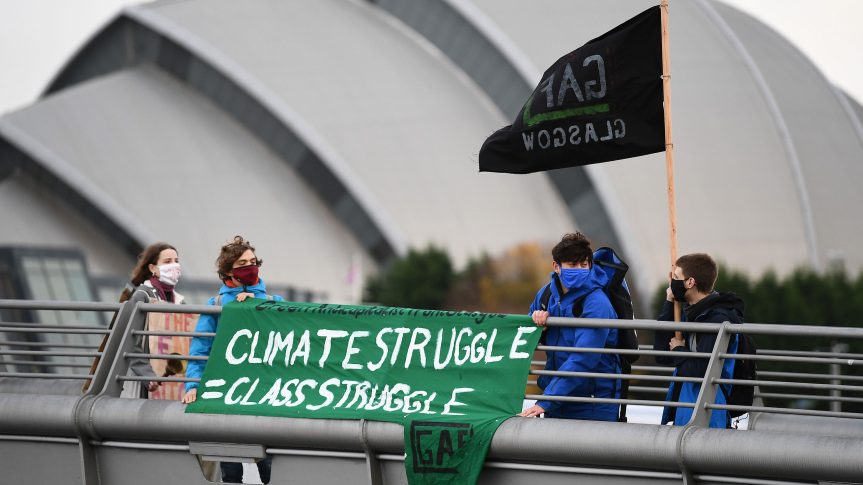
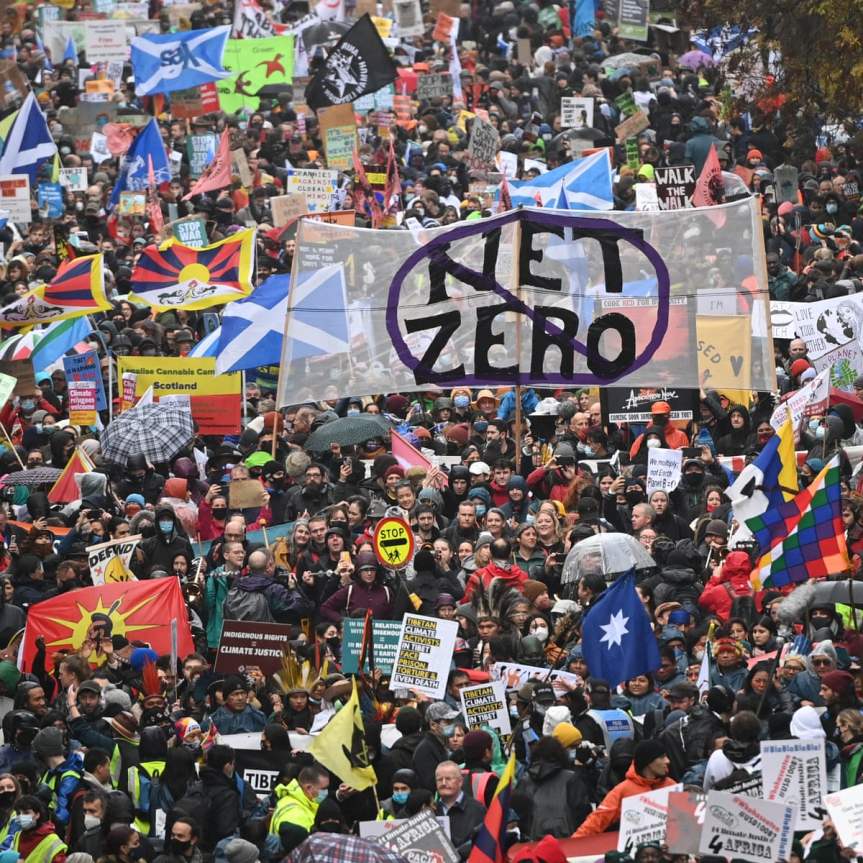
Protesters took to the streets of Glasgow near the COP26 conference to urge world leaders to take immediate action to combat the climate crisis. More than 100,000 marched in the city, organizers said. Credit: Kieran Dodds, The New York Times

Capitalism’s role in causing climate change now gains new visibility. Scientists advising world leaders present at the 26th Conference of the Parties (COP26) on November 1-12 in Glasgow affirmed the association. To slow down climate change and mitigate its effects, they want action taken to reduce capitalism’s impact on the climate.

The climate crisis is worsening.  For Monthly Review magazine, the COP26 gathering represents “a last-ditch effort to achieve a global solution on behalf of humanity as a whole.” The COP is the decision-making body of the 1995 UN Framework Convention on Climate Change.

The UN-sponsored Intergovernmental Panel on Climate Change (IPCC), made up of 230 climate scientists from 66 countries, monitors climate-change trends and effects. Their observations, analyses, and recommendations appear in the IPCC’s Assessment Reports, which are issued periodically. IPCC scientists, who “have spent the last 3 years reviewing over 14000 studies,” are in the process now of releasing their Sixth Assessment Report, with 4000 pages.

On August 9, 2021 they released the Report’s Part I on the “physical science basis of climate change.”  The IPCC will not release Part II, about impacts, and Part III, about mitigation, until early 2022, after all UN member states have reviewed the two sections. Key portions of the two have been leaked and, widely disseminated, they are the basis for this report.

Earlier Assessment Reports attributed climate change to human activity, unspecified.  What with IPCC scientists linking expanded industrial production and consumerism with rising greenhouse gas emissions, capitalism enters the picture.

As summarized by the Monthly Review editors, Part II asserts that “Life on Earth can recover from a drastic climate shift by evolving into new species and creating new ecosystems. Humans cannot… We need transformational change operating on processes and behaviors at all levels: individual, communities, business, institutions and governments. We must redefine our way of life and consumption.”

An important finding of Part III, according to the editors, is that, “technological improvements that allow for relative decarbonization are not enough. Rather, what is required … ‘is fundamental structural changes at the global level’ … in production and consumption systems. Accelerated climate-change transitions require a shift to entirely new systems of sustainable development. ‘Transformative change’ must replace incremental changes favored by the status quo.”

Monthly Review indicated also that “for the first time in the IPCC process,” Part III called for a “turn to demand-side strategies, exploring cutbacks in energy use and across all economic sectors, as well as aggressively pursuing conservation and low-energy paths.”

Part III, crucially, “indicates at one point, referring to the analysis of Malm and others that: ‘The character of social and economic development produced by the nature of capitalist society [is] …ultimately unsustainable.’”

UN Scientists Blame Climate Change on Capitalism; Implications for Marxists

This is not a new idea. Advocates for environmental sustainability – Marxists, academic socialists, eco-socialists, environmentalists – have long concerned themselves with capitalism’s impact on the environment. Visionary Marxist scholar Kenneth Neill Cameron called for action almost 30 years ago. Concluding his book Marxism, a Living Science (International Publishers, 1993), he discusses global warming.

“Most Marxists write as though … social advance will take place in a social bubble shut off from nature. The scientific evidence, however, points to an era of environmental stress. The evidence was already strong in 1984 when this book first went to press … [It’s] a perspective beyond anything Marx and Engels had to confront … Clearly then the struggle for socialism will take place in a world racked by natural disasters of social origin.”

Cameron explores the curbing of fossil-based fuel and reliance on alternative energy. He suggests that, “there is only one way known to slow down and then eliminate these disasters, namely by phasing out the gases that cause them.” He declares that:

“[T]o fully replace the fossil-fuel-based corporate structure is beyond the capacity of capitalism and requires a socialist planned economy … As this struggle progresses it will become apparent that human survival will depend not just on clean energy but on a socio-economic system run by the people in their own interest. In short, a new dimension has been added to the struggle for socialism, which no longer aims only at universal “social justice” but at assuring human survival.”

Marxists like Cameron, however, realize that words and theory are not enough. From Marx, they know that merely to interpret the world falls short; “The point … is tochange it.”

Marxists are able to frame climate-change action in a straightforward way. Inasmuch as their primary object is fighting capitalism, and capitalism causes climate change, and climate change endangers humanity, Marxists are duty-bound to involve themselves in the climate fight as learners, teachers and activists.

How would they do this, and what might the prospects be?

The opinions of the IPCC scientists, having circulated, constitute a kind of UN endorsement of fight-back against capitalism. To the extent that the UN position gains respect, capitalism becomes fair game for wider criticism within society as a whole. That’s helpful.

Marxists, self-described “scientific socialists” and prone to theorizing, analyzing problems, and strategizing, are prepared. As materialists, they embrace scientific inquiry and study of the natural world. The intersection of science and politics is familiar territory.

Marx himself modeled that approach. For example, he made the association between diminished productivity of soil in Britain and burgeoning industrialization. Having consulted with German scientists, he concluded that the movement of small farmers away from the land and into British factories, as industrial workers, had led to crops being under-fertilized. Because farmers had left the land, fertilizer in the form of animal and human excreta was in short supply.

Marxists are versatile. Having theorized, strategized, and acted in widely varying situations, they’ve shown that they probably would be able to confront the climate crisis. They’ve studied and defended waged labor laid low by the extraction of surplus value, small farmers displaced or oppressed by landlords, women (mostly) laboring in social reproduction for no pay, and those whose bodies, land, or subsoil resources have been plundered.

But capitalism won’t disappear quickly. After all, preparation for the way capitalism looked in the 1800s required a couple of centuries. As long as capitalism lasts, formation of a mass movement ready to defend environmental sustainability, and the climate, won’t happen soon, especially in the industrialized world.

For the sake of their jobs, wages and salaries, working people employed by entities dependent directly or indirectly on the market economy require economic stability and predictability. Under capitalism, that means an economy that produces and grows, always – one that, along the way, aggravates climate change. Working people, therefore, may find it more compelling to preserve the status quo than to pursue goals realizable only in the future, virtuous though they may be.

Relatedly, many wage workers, unemployed people, unionists, and seniors are leery of the environmental movement. They may resent the seemingly disproportionate involvement there of activists with comfortable life styles or object to the scarcity of black and brown people in such campaigns. It’s not yet clear how these twin projects, replacing capitalism and coping with climate change, are ultimately going to come together.

The possibility does emerge, however, that crisis-ridden capitalism, loaded with contradictions, will face some sort of a collapse.  Waiting in the wings are disasters like pandemics, wars, massive default on debt, underproduction due to climate-caused catastrophes, oil shortage, and more. In chaotic situations like these, the building of a mass response to the climate crisis, one that is collective, anti-capitalist, and necessary, might come about.

The stimulus would derive from fears and perplexity. These, of course, could also lead to the authoritarian solutions of fascists and their like. Such a potential outcome adds to the urgency of preparing for the great mobilization of a socialist nature that we need.

Meanwhile, socialists and Marxists have promoted programs directed at protecting the environment and climate. These are the multifaceted programs often referred to as Green New Deals, as outlined in Mark Brodine’s book Green Strategy, in John Molyneux’s article in Climate & Capitalism, and by Sean Sweeney writing in New Economic Forum.  As envisioned, they would accompany far-reaching proposals for progressive social and political change. Such undertakings are at risk of cooptation by corporations and other capitalist forces.

As the fight to ameliorate climate change proceeds, Marxists should take advantage of the teachability of their message. The idea that phenomena are connected – capitalism, expanding production, and rising emissions – is fact-based and logical. Lesser explanations blame the perversity of individuals. Exclusive focus on short-sightedness, disregard for the truth, ignorance, heartlessness, and/or immorality distracts from societal factors at work.

Class struggle will undoubtedly intensify in the years ahead. Faced with climate chaos, the upper classes, with their money, properties, and connections, will seek to wall themselves off from turmoil and victims, perhaps even hire enforcers to protect their remaining privileges.

Undone by climate change and its fallout – desertification, drought, floods, no homes, no livelihoods – people on the run worldwide become the rejects of resourced societies. Easily stigmatized, they serve as pawns for dividing and immobilizing the working class. And like nothing else, their plight calls for redistribution of wealth and resources, that is, if notions of the common good mean anything at all.

The object of this report has been to raise the consciousness of Marxists, socialists, and anyone else. Marxists ought to realize that they can contribute to and even lead collective efforts to head off climate change and to mitigate adverse effects. They have two major resources: the chain of causation from capitalism to climate change and anti-capitalism, which is their foundational tenet.

We are facing “the tragedy of our times;” and countries are “now so perilously close to the edge.” (Barbados prime minister Mia Mottley) Time is up; revolutionary socialists of all kinds need to set priorities. Let the discussion and work begin.

Author: W.T. Whitney Jr. is a political journalist whose focus is on Latin America, health care, and anti-racism. A Cuba solidarity activist, he formerly worked as a pediatrician, lives in rural Maine.

Source: Marxism-Leninism Today: The Electronic Journal of Marxist Leninist Thought, November 7, 2021, https://mltoday.com/un-scientists-blame-climate-change-on-capitalism-implications-for-marxists/

Report from Maine: End the US Blockade against Cuba Now!

By W. T. Whitney Jr

The two struggles have continued for decades, even centuries. Cubans fight to end slavery; gain independence from Spain and the United States; and, for 60 years, protect their socialist revolution. Ruling classes in the United States sought to annex Cuba, then to control Cuba’s economy, and for those 60 years have clamped down on the audacity of Cubans who struggle for independence and socialism.

Justice-seeking peoples in the United States have joined in struggle to defend Cuban independence and/or Cuba’s revolution. This report from Maine takes note of two rainy day rallies on July 25, each of 25 or so people and each one held in protest of the U.S. blockade of Cuba. One was in Bangor, the other in Brunswick.

These protesters and other Maine people know that the blockade is purposed to overthrow of Cuba’s socialist government.  The author of a 1960 State Department memo – born in Houlton, Maine – made that perfectly clear.

These Mainers were joining in solidarity with demonstrations carried out on July 25 throughout the United States, for example, in Washington, Seattle, San Francisco, Fresno, Los Angeles, Phoenix, Albuquerque, Dallas, Milwaukee, and Pittsburgh. In Washington, Cuban-Americans calling for Puentes de Amor (Bridges of Love) gathered with supporters in Lafayette Park to protest the blockade. They had walked from Miami to Washington.

Lots of Maine people know that Cuba is at another watershed moment. Many recall the onset in the early 1990s of Cuba’s “Special Period,” which was resulted from the fall of the Soviet Bloc. The powers in Washington at that time sought to finish off Cuba’s revolution. The “Cuba Democracy Act” of 1992 was their big tool.

Similarly, the Biden presidency now takes advantage of three phenomena: economic and healthcare havoc wrought by the Covid 19 pandemic, the Trump administration’s intensified blockade restrictions, and mounting shortages in Cuba of money and goods essential for human survival.

Now Biden inveighs against supposed autocracy in Cuba. His administration remains silent when elected officials viciously threaten Cuban leaders. He and they follow a script fitted out for anti-government demonstrations like the ones playing out in Cuba on July 11. These surely reflected U.S. financial support provided over decades for internal subversion in Cuba. Accompanying them was a massive social-media assault against Cuba’s government orchestrated from abroad.

U.S. media have long cast a blind eye to the political movements in the United States mobilized on behalf of Cuban independence and Cuba’s revolution. Those rallying in Maine on July 25 were testifying to their relevance now.

In 1992, at the beginning of Cuba’s Special Period, veteran Maine activists traveled to the island. Sensing big troubles ahead for Cuba at the hands of the U.S. government, they formed the Let Cuba Live Committee of Maine. The new organization undertook to educate and activate fellow Mainers.

Let Cuba Live arranged for the Pastors for Peace leader Rev. Lucius Walker Jr, to speak before a large crowd in Monument Square, in Portland, Maine on July 21, 2001 – 20 years and four days prior to the protests reported here.

“In issue after issue, in area after area, Cuba lights the way,” Lucius Walker insisted; “Cuba has established the fact that it is the leader in the world community in the affirming of and guaranteeing the rights of the poor people of this world.”

That was not news for the ruling classes in the United States for whom revolutionary Cuba was a threat. Therefore, as pointed out by Lucius Walker: “if we really want to see the world continue to have hope and possibility for the creation of a new society, we must support Cuba.”

Let Cuba Live of Maine – see www.letcubelive.org – admits to gratification.  The slogan that is the group’s name now resonates widely. It’s the title of an appeal to President Biden that, endorsed by 400 prominent activists, may be viewed in a full-page advertisement appearing in the July 23 New York Times. To see the open letter to Biden, go to www.LetCubaLive.com.

The twin rallies putting forth the demand of no more blockade broke new ground in Maine.  They gained support from multiple statewide organizations that oppose U.S. imperialism and war-making and/or try to make good on socialist aspirations.

What follows are excerpts from remarks offered by some of the rally participants at talk-sessions that concluded the two affairs.  A listing appears below of the organizations claiming commentators and many participants as members.

Here’s Barbara West: “We are not gathered today simply to demand a reduction in the criminal measures the US has taken against Cuba for 61 years.  We are here to insist on respect for Cuba as a sovereign country … We insist that land in Guantanamo occupied in defiance of the Cuban people be vacated. … Our respect for Cuba as a sovereign nation, with its people fully able to chart their own path without any US interference, is really our agenda today.”

And Michael Mosely: “I do not believe that there is a difference between a Hispanic family in Maine and a Hispanic family in Cuba. Just like there is no difference between a Black family in Maine and a Black family in Africa. We are all under the same system fighting the same fight.”

And Daniel Carson: “In the over six decades that the United States has enforced such a cruel blockade, the Cuban government has reported that economic losses resulting directly from the blockade total $144.4 billion dollars. These figures are those of 2020. Excluded is an additional $5.4 billion in economic losses this year. When adjusted for dollar depreciation over the life of the blockade the number becomes $1.098 trillion … So when [U. S. leaders] proclaim Cuba to be a failed state or that the Cuban revolution has failed: this is a bold-faced lie. The truth lies in those numbers. That’s why we are here today to say, “End the blockade!”

And Bruce Gagnon: “The US has an MO (modus operandi), a way of repeating its regime change behavior as it desperately attempts to hang-on to its place as ‘king of the hill’. But due to $27 trillion in debt, more than 800 costly military bases around the world, and long-time disinvestment in our own nation, America’s ‘imperial project’ is destined to collapse. US efforts to force regime change in Cuba – like in Nicaragua, Venezuela, Bolivia and other nations – are destined to fail.”

And Ed Jurenas: “When the U.S. talks about democracy, it is hypocritical. It does not support the most basic democratic right to self-determination, but viciously opposes it. And in regard to the economic democracy championed by Cuba – free health care, free education, a right to housing, the just distribution of food – the U.S. is silent in its shame. Cuba ascribes to economic democracy, something the U.S. is incapable of practicing.”

Most of the participants in the Maine rallies belonged to one or more of these organizations: the Let Cuba Live Committee of Maine, The Global Network Against Weapons & Nuclear Power in Space, Maine Veterans for Peace, Maine Socialist Action, Maine Democratic Socialists of America, and the Maine Communist Party. The latter group had responsibility for organizing the rallies.

Lucius Walker has the last word (July 21, 2001): “We must name the powers. We must stand against the powers. And we must realize that in the course of doing so, we wrestle not just with flesh and blood, but with principalities and powers, against spiritual wickedness in high places. We cannot be deterred because they say evil things about us, because they revile us, because they put us in jail. We must continue to march, to work, to struggle, to be in solidarity no matter what obstacles they put in our way, because we are the future hope of the world! “

Report from Maine: End the US Blockade against Cuba Now!

By W. T. Whitney Jr

The two struggles have continued for decades, even centuries. Cubans fight to end slavery; gain independence from Spain and the United States; and, for 60 years, protect their socialist revolution. Ruling classes in the United States sought to annex Cuba, then to control Cuba’s economy, and for those 60 years have clamped down on the audacity of Cubans who struggle for independence and socialism.

Justice-seeking peoples in the United States have joined in struggle to defend Cuban independence and/or Cuba’s revolution. This report from Maine takes note of two rainy day rallies on July 25, each of 25 or so people and each one held in protest of the U.S. blockade of Cuba. One was in Bangor, the other in Brunswick.

These protesters and other Maine people know that the blockade is purposed to overthrow of Cuba’s socialist government.  The author of a 1960 State Department memo – born in Houlton, Maine – made that perfectly clear.

These Mainers were joining in solidarity with demonstrations carried out on July 25 throughout the United States, for example, in Washington, Seattle, San Francisco, Fresno, Los Angeles, Phoenix, Albuquerque, Dallas, Milwaukee, and Pittsburgh. In Washington, Cuban-Americans calling for Puentes de Amor (Bridges of Love) gathered with supporters in Lafayette Park to protest the blockade. They had walked from Miami to Washington.

Lots of Maine people know that Cuba is at another watershed moment. Many recall the onset in the early 1990s of Cuba’s “Special Period,” which was resulted from the fall of the Soviet Bloc. The powers in Washington at that time sought to finish off Cuba’s revolution. The “Cuba Democracy Act” of 1992 was their big tool.

Similarly, the Biden presidency now takes advantage of three phenomena: economic and healthcare havoc wrought by the Covid 19 pandemic, the Trump administration’s intensified blockade restrictions, and mounting shortages in Cuba of money and goods essential for human survival.

Now Biden inveighs against supposed autocracy in Cuba. His administration remains silent when elected officials viciously threaten Cuban leaders. He and they follow a script fitted out for anti-government demonstrations like the ones playing out in Cuba on July 11. These surely reflected U.S. financial support provided over decades for internal subversion in Cuba. Accompanying them was a massive social-media assault against Cuba’s government orchestrated from abroad.

U.S. media have long cast a blind eye to the political movements in the United States mobilized on behalf of Cuban independence and Cuba’s revolution. Those rallying in Maine on July 25 were testifying to their relevance now.

In 1992, at the beginning of Cuba’s Special Period, veteran Maine activists traveled to the island. Sensing big troubles ahead for Cuba at the hands of the U.S. government, they formed the Let Cuba Live Committee of Maine. The new organization undertook to educate and activate fellow Mainers.

Let Cuba Live arranged for the Pastors for Peace leader Rev. Lucius Walker Jr, to speak before a large crowd in Monument Square, in Portland, Maine on July 21, 2001 – 20 years and four days prior to the protests reported here.

“In issue after issue, in area after area, Cuba lights the way,” Lucius Walker insisted; “Cuba has established the fact that it is the leader in the world community in the affirming of and guaranteeing the rights of the poor people of this world.”

That was not news for the ruling classes in the United States for whom revolutionary Cuba was a threat. Therefore, as pointed out by Lucius Walker: “if we really want to see the world continue to have hope and possibility for the creation of a new society, we must support Cuba.”

Let Cuba Live of Maine – see www.letcubelive.org – admits to gratification.  The slogan that is the group’s name now resonates widely. It’s the title of an appeal to President Biden that, endorsed by 400 prominent activists, may be viewed in a full-page advertisement appearing in the July 23 New York Times. To see the open letter to Biden, go to www.LetCubaLive.com.

The twin rallies putting forth the demand of no more blockade broke new ground in Maine.  They gained support from multiple statewide organizations that oppose U.S. imperialism and war-making and/or try to make good on socialist aspirations.

What follows are excerpts from remarks offered by some of the rally participants at talk-sessions that concluded the two affairs.  A listing appears below of the organizations claiming commentators and many participants as members.

Here’s Barbara West: “We are not gathered today simply to demand a reduction in the criminal measures the US has taken against Cuba for 61 years.  We are here to insist on respect for Cuba as a sovereign country … We insist that land in Guantanamo occupied in defiance of the Cuban people be vacated. … Our respect for Cuba as a sovereign nation, with its people fully able to chart their own path without any US interference, is really our agenda today.”

And Michael Mosely: “I do not believe that there is a difference between a Hispanic family in Maine and a Hispanic family in Cuba. Just like there is no difference between a Black family in Maine and a Black family in Africa. We are all under the same system fighting the same fight.”

And Daniel Carson: “In the over six decades that the United States has enforced such a cruel blockade, the Cuban government has reported that economic losses resulting directly from the blockade total $144.4 billion dollars. These figures are those of 2020. Excluded is an additional $5.4 billion in economic losses this year. When adjusted for dollar depreciation over the life of the blockade the number becomes $1.098 trillion … So when [U. S. leaders] proclaim Cuba to be a failed state or that the Cuban revolution has failed: this is a bold-faced lie. The truth lies in those numbers. That’s why we are here today to say, “End the blockade!”

And Bruce Gagnon: “The US has an MO (modus operandi), a way of repeating its regime change behavior as it desperately attempts to hang-on to its place as ‘king of the hill’. But due to $27 trillion in debt, more than 800 costly military bases around the world, and long-time disinvestment in our own nation, America’s ‘imperial project’ is destined to collapse. US efforts to force regime change in Cuba – like in Nicaragua, Venezuela, Bolivia and other nations – are destined to fail.”

And Ed Jurenas: “When the U.S. talks about democracy, it is hypocritical. It does not support the most basic democratic right to self-determination, but viciously opposes it. And in regard to the economic democracy championed by Cuba – free health care, free education, a right to housing, the just distribution of food – the U.S. is silent in its shame. Cuba ascribes to economic democracy, something the U.S. is incapable of practicing.”

Most of the participants in the Maine rallies belonged to one or more of these organizations: the Let Cuba Live Committee of Maine, The Global Network Against Weapons & Nuclear Power in Space, Maine Veterans for Peace, Maine Socialist Action, Maine Democratic Socialists of America, and the Maine Communist Party. The latter group had responsibility for organizing the rallies.

Lucius Walker has the last word (July 21, 2001): “We must name the powers. We must stand against the powers. And we must realize that in the course of doing so, we wrestle not just with flesh and blood, but with principalities and powers, against spiritual wickedness in high places. We cannot be deterred because they say evil things about us, because they revile us, because they put us in jail. We must continue to march, to work, to struggle, to be in solidarity no matter what obstacles they put in our way, because we are the future hope of the world! “

U.S. Imperialists Deprive Cuba of Syringes That Are Needed Now, by Tom Whitney

Editorial note

US stubbornness in hanging on to its economic blockade against Cuba annoys us. Sixty years is enough, don’t you think? We are joining the Let Cuba Live Committee of Maine as it collaborates with IFCO/Pastors for Peace of New York in the project of that group heading to Cuba this Fall.

Pastors for Peace will be taking aid material to Cuba and visiting there, both against US rules for its blockade. We want some Maine people once more to be on this trip.

Every year, for 30 years, these two groups undertake civil disobedience in order to mobilize wider support for ending a policy that, by any definition, is cruel, immoral, and illegal.

Go to these websites to learn more: www.letcubalive.org and   https://ifconews.org/.

The article below reviews aspects of this grim situation and reports on a new horror. We also post the CPUSA’s recent condemnation of President Biden’s failure to remove Cuba from the US list of terrorist sponsoring nations. Your dog presents as much national threat as does Cuba.

Cuba, the first Latin America country to develop its own COVID-19 vaccines, presently is short of syringes for immunizing its population against the virus. It’s not feasible for Cuba to make its own syringes. The U.S. blockade prevents Cuba from importing them from abroad.

Syringes are lacking all over. The New York Times estimates an overall need of between “eight billion and 10 billion syringes for Covid-19 vaccinations alone.” Manufacturing capabilities are increasing, but that’s of no use to Cuba. 

According to Global Health Partners,Cuba needs roughly 30 million syringes for their mass Covid vaccination campaign and they’re short 20 million.” Solidarity organizations are seeking donated funds to buy syringes and ship them to Cuba. (Readers may donate by contacting Global Health Partners or visiting here.) 

The shortage of syringes poses great hardship for the Cuban people. That’s not new. Calling for economic blockade in 1960, State Department official Lester Mallory was confident that making Cubans suffer would push them toward overthrowing their government.

The U.S. blockade causes shortages of basic materials. Buses lack fuel and spare parts; bus routes have been dropped. Food supplies are precarious. Cuban laboratories and production facilities have developed five kinds of COVID-19 vaccines despite short supplies of reagents and laboratory materials. 

Cuba can’t buy ventilators needed for critically ill COVID-19 patients. Two Swiss manufacturers stopped selling ventilators to Cuba after a U. S. company purchased them. But Cuban technicians devised their own ventilator model which is in production now.

The impact of the blockade is by no means haphazard. Institutionalized processes aimed at asserting U.S. domination involve laws, administrative decrees, regulations, officials’ interpretations of regulations, and caution on the part of third-country traders and financiers.

Authority for the ban on U.S. sales of goods to Cuba stems from legislation accumulating over many years. Then the Cuba Democracy Act of 1992 ensnared foreign companies into the blockade system. That law authorized the Treasury Department to license the foreign subsidiaries of U.S. corporations to export goods to Cuba. It actually created an opening for almost all applications for licensure to be denied.

Since then, the Treasury Department’s Office of Foreign Assets Control (OFAC), enforcer of the blockade, has found leeway to regulate the foreign corporations themselves. Foreign corporations contemplating sales to Cuba contend with U.S. sanctions if they have branches in the United States, partner with U.S. corporations, or handle U.S. dollars.

Most of the world’s syringes are manufactured by three U.S. companies and five companies elsewhere. Each of the latter has ties with a U.S. entity and is prohibited from exporting syringes to Cuba

For example, Germany’s B. Braun Melsungen Corporation partners with Concordance Healthcare Solutions, “one of the largest independent, healthcare distributors in the U.S.” Tokyo-based Terumo Corporation has a headquarters in New Jersey. Osaka-based Nipro Corporation recently “announce[d] the creation of a Vascular Division in the U.S.” “Healthcare heavyweight Cardinal Health” is headquartered in both Ireland and the United States.

Hindustan Syringes and Medical Devices, in India, came under OFAC purview  in January 2021 by virtue of associating with Envigo Global Products as its “digital marketing partner.” Envigo is headquartered in Indianapolis.

Officers of foreign companies presumably seek legal advice. One lawyers’ group maintains that, “OFAC has long held that if a non-U.S. company engages in business transactions in U.S. dollars, the foreign party is availing itself of the U.S. financial system and hence becomes subject to the U.S. sanctions laws.”

Another indicates sanctions are likely, if “the foreign party has a requisite level of contacts with the U.S., such as engaging [with] U.S. products, software or technology.” The National Law Review recommends that, “Foreign companies … need to be aware of board members, directors, or employees who hold U.S. citizenship or U.S. green cards.”

President Barack Obama eased many blockade regulations and re-established U. S. diplomatic relations with Cuba. He never pushed to end the blockade. The Biden Administration chooses not to prioritize improved relations with Cuba. Biden recently upheld the Trump Administration’s reassignment of Cuba to the U.S. list of terrorist-sponsoring nations.

The Helms-Burton Law of 1996 required, for the first time, that Congress determine the fate of the blockade. Except for legislation in 2000 allowing U.S. food products to be exported to Cuba, Congress has protected that policy. 

In February Oregon Senator Ron Wyden introduced his “United States-Cuba Trade Act of 2021,” which would end the blockade. The bill has four co-sponsors. SenatorsAmy Klobuchar of Minnesota, Jerry Moran of Kansas, and Patrick Leahy of Vermont on May 20 reintroduced the “Freedom to Export to Cuba Act.” That bill would facilitate U.S. exports to Cuba, especially agricultural products; allow some Cuban goods to enter the United States; and would retain sanctions imposed because of alleged human rights violations.

In March, 80 congresspersons sent a letter to President Biden urging him to use executive action to reverse restrictions imposed by President Trump.

The U.S. economic blockade of Cuba is calculated, systematic, all-encompassing, and savage. Opponents offer varying pleas. For some, the blockade is cruel and illegal. Others call for defending Cuba, because it’s a model both of human solidarity and of how to provide health care and education. Many insist on respect for Cuba’s sovereignty.

These arguments are disconnected, one from the other.  Blockade critics appear to lack a central focus on root causes. Having such would be essential, it seems, for fashioning a cohesive strategy. Were that in place, new possibilities might exist for recruitment and unity. Anti-racism struggle in the United States displays similar dynamics, and maybe offers lessons.

Reacting to various symptoms of oppression, defenders of racial equality have gone from pillar to post opposing police killings, an unjust criminal justice system, and Black people’s high poverty and death rates. Now, increasingly, analysts link manifestations of racial oppression with durable systems of repression involving capitalism. Writing about a notorious slave-trading firm, historian Joshua Rothman captures that association in the title of his new book, The Ledger and the Chain.

Similarly, if the campaign against the blockade paid more attention to the long history of U. S. ambition to dominate Cuba, it might gain strength by going to the heart of the matter. The premise would be that the European powers and the United States have long sought to draw Cuba and other dependent Latin American territories into their capitalist orbit.

The syringe story reflects U.S schemes in the 19th century to absorb Cuba, U.S. control of Cuba after Spain’s departure in 1902, and U.S. determination after 1959 to restore hegemony lost to the Revolution.