US Pirate Attacks in the Caribbean Will Aggravate Emergency in Cuba / By W. T. Whitney Jr.

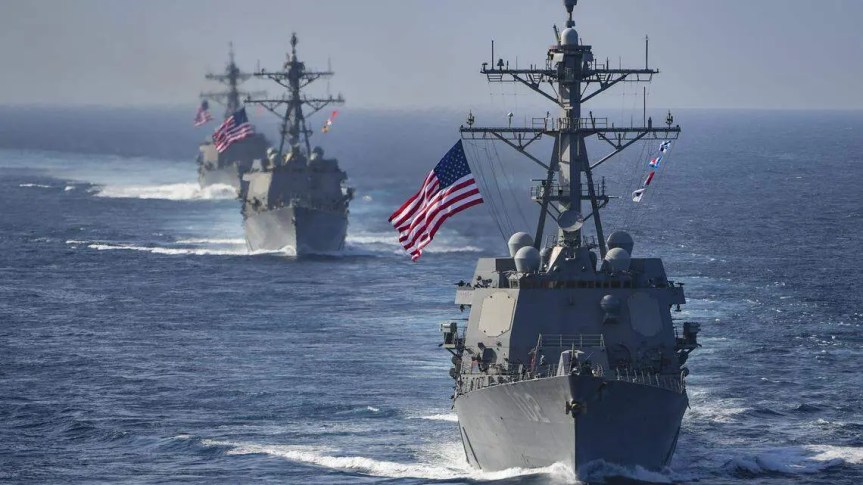
At least eight US warships have been deployed to the Caribbean Sea | Source: venezuelanalysis.com

South Paris, Maine


Hitting two birds with one stone, the U.S. government, top-level disturber of the peace now brandishing a Caribbean armada, strikes out against Venezuela – and Cuba too, indirectly. The U.S. military on December 10 seized a large oil tanker in the Caribbean bound for China. The ship carrying Venezuelan oil had previously offloaded 50,000 barrels of oil to a smaller ship for delivery to Cuba.

Cuba depends on oil supplied by Venezuela. High U.S. officials want to cut off Cuba’s access to oil from Venezuela and thereby deliver a decisive blow against Cuba’s government. Presently six other tankers sanctioned by the U.S. government and carrying Venezuelan oil are at high risk of being seized.

Cuba’s Foreign Relations Ministry issued a statement saying in part that, This act of piracy and maritime terrorism … represents U.S. escalation against Venezuela’s legitimate right freely to use and to trade its natural resources with other nations, including hydrocarbon supplies to Cuba …[Such] actions have a negative impact on Cuba and intensify the United States’ policy of maximum pressure and economic suffocation, with a direct impact on the national energy system and, consequently, on the daily lives  our people.”

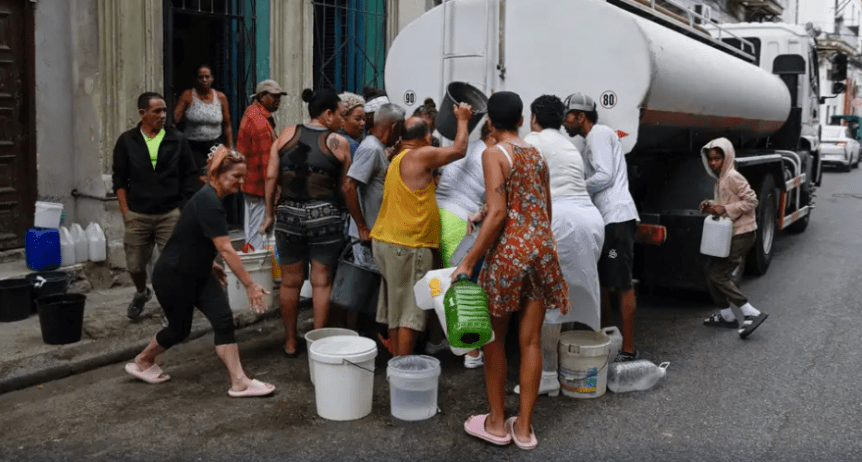
This reference to a “policy of maximum pressure” invites a look at ominous developments unfolding in Cuba as the maritime drama plays out.  Cuba’s government has recently resorted to measures that are extraordinary enough as to indicate worsening crisis in Cuba. The U.S economic blockade has led to shortages of supplies, food, and income. The impact over the course of decades has been wearing and cumulative. Now death rates are up and newer generations are decimated by migration.

Recent measures taken by Cuba’s government, explored below, strongly suggest Cubans face an emergency. U.S. activists responding to their government’s warlike preparations in the Caribbean – another emergency – have good reason to urgently build their solidarity not only with Venezuela but with Cuba too.  What follows here is a report on extreme measures recently taken by Cuba’s government. The object is to portray these measures as so unusual as to confirm the existence of Cuba’s last-ditch situation and, that way, motivate Cuba’s U.S. supporters toward action.

Dollarization

Cuba’s government recently introduced monetary regulations allowing citizens to buy and sell some goods and services using the U.S. dollar.  A report published by a government-oriented news service refers to a “pragmatic recognition of today’s reality” and to “a partial and controlled dollarization of [Cuba’s] economy.” The government will be “allowing certain economic actors to trade in foreign currencies under specific circumstances.”

The new regulations apply to transactions with foreign manufacturers, investors, traders, shippers, financial institutions – and to families abroad sending remittances. The immediate goal is “to directly incentivize the generation of foreign exchange earnings, allowing those who contribute to this generation to keep a significant portion of their earnings in hard currency.” 

The broader purpose is “to increase national production, improve the availability of goods and services, and create conditions for a future return to the strengthened Cuban peso.” Policy-makers want to stimulate exports, augment the supply of goods available in Cuba, and increase both national production and foreign investment. Another goal, referred to as “[r]eduction of distortions,” is elimination of informal or illegal foreign currency markets.

The new regulations allow “authorized commercial establishments … [and those] domestic suppliers supporting export or import substitution activities to use dollars and other foreign currencies in international transactions.” Parties permitted to use dollars are authorized self-employed workers, privately owned businesses, cooperatives, and state enterprises.

These parties have permission to deposit dollars in Cuban banks – dollars accumulated from exports of goods and services, from on-line sales and from sales realized through the Mariel Special Development Zone. Banks will accept dollars purchased from foreign currency traders and dollars sent as remittances from families abroad.

The government’s new authorization of the U.S. dollar as a national currency may well be unsettling to Cubans perceiving implications of a dependency relationship with the northern neighbor. The necessity to have done so reflects the urgency of Cuba’s current situation.     

Pressing needs

Overtones of a new situation entered into the decision of the Cuban Communist Party’s Central Committee at its meeting on December 13 to postpone the 9th Party Congress set for April 2026. Party Congresses have taken place every five years.

Making the announcement, Leader of the Revolution Raul Castro emphasized the need to “dedicate all the country’s resources, as well as the effort and energy of the Party, Government, and State cadres, to resolving current problems, and to dedicate 2026 to recovering as much as possible.” 

Likewise, Cuba’s Council of State announced on December 10 that the upcoming session of the National Assembly of People’s Power set to begin on December 18 would be meeting for that day only, by video conference. In 2024, Assembly delegates met in person for two sessions for a total of  24 days.

A spokesperson explaining the shift stated that, as is “known by all, the electricity situation and the current state of the economy, and also difficulties with the [multi-virus] pandemic and the health situation … create a complex situation for carrying out the Assembly. There is the problem too of the rational use of resources.” 

The 11th plenum of the Communist Party’s Central Committee taking place on December 13 was also a one-day session; video conferencing provided access for members living outside Havana. Concluding the meeting, First Secretary Miguel Díaz-Canel, president of Cuba, mentioned particularly that:

At the end of the third quarter, GDP has fallen by more than 4%, inflation is skyrocketing, the economy is partially paralyzed, thermal power generation is critical, prices remain high, deliveries of rationed food are not being met, and agricultural and food industry production is not meeting the needs of the population. There are also the costly losses caused by the devastating passage of Hurricane Melissa …

Donald Trump has just launched his pirates onto a Venezuelan oil tanker, shamelessly seizing the cargo like a common thief. This was the latest episode in an alarming series of attacks on small boats and extrajudicial executions of more than eighty people, based on unproven accusations and amid an unprecedented and threatening military deployment in a declared Zone of Peace …

[However,] we are the children of a people who carried out a revolution 90 miles from the greatest imperial power on the planet and who have successfully defended it for more than six decades … Only a heroic people who defend a Revolution, who have the example of the history of that Revolution, are capable of enduring what we have been living through all these years.”

Henry Lowendorf of the U.S. Peace Council, queried for this article, highlights the central role of the U.S. government. He states via email that, “The U.S. has been trying to crush the Cuban revolution for over 60 years. So far it has failed. But with new intensity and the newly accelerated war on Venezuela, the U.S. is desperately working to cut off all life support to Cuba.”

A dark setting brightens a bit with good news out of California, as reported in the Cuban press. The Los Angeles Hands off Cuba Committee led in organizing a shipment from Los Angeles to Cuba by way of Jacksonville, Florida of a 40-foot container with medical supplies worth $1 million.  Participating were members of the International Longshore and Warehouse Union and International Association of Machinists, along with Global Health Partners and the PanAmerican Medical Association.


W.T. Whitney Jr. is a retired pediatrician and political journalist living in Maine.

Electoral Coup Surfaces in Honduras amid Signs of US Intervention / By W.T. Whitney Jr.

Photo: Xiomara Castro de Zelaya/X

South Paris, Maine


Elections taking place November 30 in Honduras will decide the country’s next president and make-up of the national assembly. Current President Xiomara Castro of the democratic socialist Party of Liberty and Refoundation (Libre), in office since 2022, is limited to one term. Libre Party presidential candidate Rixi Moncada was finance minister and then defense minister in Castro’s government.

The mantra circulates that ten families rule in Honduras and hold most of its wealth. Their influence is such that left-leaning opposition forces can count on the most forceful kind of pushback.

Businessman Manuel Zelaya turned progressive politician was Honduras’ president from 2006 until June 2009, when a military coup deposed him, with U.S. help. He had called for a minimum wage, mild agrarian reform and a constituent assembly. Zelaya is now general coordinator of the Libre Party, founded in 2011 in reaction to the coup. He is President Xiomara Castro’s husband.

Xiomara Castro’s unsuccessful candidacies for president in 2013 and 2017 encountered electoral fraud and violent attacks orchestrated by the well-ensconced National and Liberal Parties. Her overwhelming electoral victory in 2021 resulted from the association of incumbent president Juan Orlando Hernández and his National Party with corruption and narcotrafficking. Hernández and his brother, convicted on narcotics and weapons charges, are serving long prison terms in the United States.Hernández’s second term was constitutionally illegal.

Current polls give the Libre Party candidate Rixi Moncada an even chance for victory, or a small majority. A plot emerged a month ahead of the voting.

On October 29, Attorney General Johel Zelaya reported he had transferred leaked audio recordings, with transcriptions, to the Public Minister for investigation. Libre Party’s Marlon Ochoa, one of three members of Honduras’ National Electoral Council, discovered them. Each councilor represents a political party. Voices on the recordings allegedly are those of Councilor Cossette López of the National Party; Tomas Zambrano, head of the National Party’s congressional bench; and an unnamed military officer.

According to Johel Zelaya, the conversations told of plans for hiring transportation companies and personnel to transfer voting results on election day, inserting agents among election observers, interrupting data transmission, prematurely announcing rightwing Liberal Party candidate Salvador Nasralla as the winner, sowing suspicion in the media about voting processes, and announcing favorable partial results as a potential “alibi for impugning and suspending the process.”

According to an observer, “The recordings revealed … a plan to pressure external actors, notably the US Embassy in Tegucigalpa, not to recognize any victories by Libre. This would turn an internal dispute into an international recognition crisis.” The report has councilor Cossette López-Osorio exclaiming, “We’ll use the tools that the people at the Embassy gave us.”

One Honduran observer says Salvador Nasralla is the “choice of the most reactionary spheres in Washington,” another that he has promised to “implement a security plan” similar to that of dictatorial Salvadoran president Nayib Bukele. Nasralla spent one third of the pre-election period traveling in the United States and Spain, presumably seeking support.

The Libre party on October 13 announced a “permanent mobilization … [against] the bipartisan plan to manipulate the coming elections.” The Party’s general coordinator Manuel Zelaya declared, “We must prepare ourselves to defeat the electoral coup … They know that we already reversed the coup in 2009 and that we will never go back!”

Rixi Moncada, speaking at a rally on November 9, reviewed gains achieved during Castro’s presidency, described her own program for governing, and highlighted a new twist in the coup saga. The National Election Council that day had carried out a nationwide simulation of election day processes. Only 1556 of 4362 voting locations actually transmitted voting records to a central location. Only 23.7% of biometric devices functioned. The results mirror the scenario presented by the recordings.  

Moncada outlined plans; 12 Libre Party activists from each of Honduras’s 18 departments would remain in Tegucigalpa until election day. They would constitute a “commission … our battlefront in defense of victory.” Party activists on that day would transfer voting records to the various Party headquarters where votes would be counted.

Context is important.  The U.S. government has long maintained hundreds of troops and several military units at Honduras’ Soto Cano airfield. They constitute the largest U.S. base in Central America, which facilitates U.S. interventions in regional affairs, as when the U.S. government in the 1980s sent supplies to Contra paramilitaries fighting in Nicaragua.

U.S. economic interests center on the mining, tourism, and agricultural export sectors. Honduras, regional center for narcotics transfer to the United States, qualifies as a target of U.S. drug war activities, but also as staging area for military interventions, for which drug war is a frequent pretext.  

President Castro has irritated U.S. officials. She cut ties with Taiwan in favor of the People’s Republic of China and supported Venezuelan President Maduro against U.S. accusations that his 2024 election victory was fraudulent.  Accusing the U.S. ambassador of meddling with Honduras’ military forces in August 2024, she mentioned cancelation of the binational extradition treaty.  Reacting to U.S. plans for massive deportation of migrants from Central America, Castro in January 2025 threatened to expel U.S. troops.

Her Libre Party government scored successes:  new highways, new hospitals, reforestation, subsidized electrical power, electricity for rural households, educational scholarships, loans for thousands of farmers, seeds and fertilizers for 450,000 of them, community orchards, 5000 refurbished education centers, and land redistribution.

Honduras’ murder rate per 100,000 inhabitants dropped from an average of 41.7 during President Hernández last term to 27.2 under Castro. Families living in poverty dropped from 73.6% to 62.9%. The previous government had promoted so-called “zones for employment and economic development.” Castro ended the scheme that gave control of municipalities to foreign investors and deprived residents of self-government and legal rights.

Candidate Rixi Moncada, 60 years old, came from a working-class family, taught in rural and city schools, studied law and became a practitioner and teacher of criminal law. She served the government of President Manuel Zelaya (2006-2009) as secretary of labor and social security. She managed the government-owned electric company.

Moncada indicated that, as president, she will “defend workers and state sovereignty and democratize the economic system.” She would “transform the justice system, combat impunity, reform the public ministry and strengthen the courts … [and revive] “strategic state enterprises.” She would support public healthcare and education – “without privatization.”

On November 12, Deputy Secretary of State Christopher Landau indicated  the U.S. government “will respond rapidly and firmly to any attack on the integrity of the electoral process in Honduras.” At once the U.S. Embassy broadly disseminated Landau’s message.

Interviewed on television that day, Salvador Nasralla asked “What would happen if these people (from the Libre Party) tried to steal votes?” His response: “Those ships that are soon going to take over Venezuela are going to come and target Honduras.”

U.S. interference in Honduras’ electoral processes is nothing new,” says veteran reporter Giorgio Trucchi. Quoting activist Luis Méndez, he adds that, “We are facing the old traditional politics, allied with US interference, large corporations, and business sectors attached to the neoliberal agenda with its project of dispossession and dismantling of the public sector …For Libre to continue governing is a setback for the geostrategic goals of U.S. domination in Latin America. We will somehow see this reflected in the elections.”


W.T. Whitney, Jr., is a political journalist whose focus is on Latin America, health care, and anti-racism. A Cuba solidarity activist, he formerly worked as a pediatrician and lives in rural Maine.

The United Arab Emirates Enables Human Catastrophe in Sudan, with the US in Tow / By W. T. Whitney, Jr.

Photo credit Z

South Paris, Maine


Beginning in April 2023, war between Sudan’s army and the paramilitary Rapid Support Forces (RSF) has caused humanitarian disaster of epic proportions. Some 150,000 people have died and 14 million Sudanese – Sudan’s population is 51 million – are displaced internally or in neighboring countries. Over 24 million suffer acute food insecurity. Famine is rampant in Darfur, the district in northwestern Sudan most afflicted by war and hunger.

We look at causes, foreign intervention in particular. The Sudanese people are victims of top-down oppression inflicted by big imperialists, lesser ones, and Sudan’s elite.  

The Bashir government in 2013 created the Rapid Support Forces from the Janjaweed formations and installed General Mohamed Hamdan Dagalo, known as “Hemedti,” as leader.

Protests by democratic forces beginning in December 2018 led to joint civilian-military rule. A coup in April 2019 removed Bashir from power. Subsequently, General Abdel Fattah al-Burhan, head of the armed forces and now the country’s president, and deputy military commander Hemedti became co-leaders of a transitional military council.

Turmoil continued, as did agitation for democratic change. In October, 2021, the two generals, having instigated another coup, established themselves as the country’s sole rulers. Al-Burhan and Hemedti subsequently disagreed on how to incorporate the RSF into Sudan’s army and on who would command the RSF. Reacting, Hemedti in April, 2023 provoked yet another coup. The RSF was soon occupying Khartoum, Sudan’s capitol city.

The Sudanese army recaptured a devastated Khartoum in March 2025. The RSF, having laid siege to El Fasher for 18 months and defeated the Sudanese army, took over that city of 700,000 inhabitants in October, 2025. Killings skyrocketed.

As of November 6, the Rapid Support Forces have agreed to a “humanitarian ceasefire” for three months proposed by the U.S., Egypt, the UAE and Saudi Arabia. The Sudanese army rejected the truce, demanding  that the RSF withdraw from civilian areas and surrender their weapons.

Origins

African nations emerging from colonialism endured varying degrees of continuing oppression and differing kinds of instability. Even so, humanitarian catastrophe in Sudan and the killings seem to be unprecedented.

The country’s vulnerability shows in a destitute, divided population, military rule, and societal collapse. It stems from a long history of autocratic rulers and recurring coups before independence and afterwards, division between an Arab-oriented North and non-Arab South (leading to an independent South Sudan in 2011), and susceptibility to manipulation by outside actors.

The United Arab Emirates (UAE) has interests in Sudan. Mohammad Khansa, writing for al-akhbar.commentions that, “Sudanese gold fuels the RSF, and the UAE.” Newly discovered gold deposits account for 60% of the country’s exports. The UAE imported $2.29 billion worth of Sudanese gold in 2022. Ninety percent of the gold Sudan produces goes to the UAE.

Sudan, the “leading agricultural producer in both Africa and the Middle East” is the “breadbasket of the Arab world.” The UAE imports 90% of its food. UAE investors have fostered land grabs in Sudan and industrialized Sudan’s agricultural production.

Other UAE interests are:  management of key Sudanese ports on the Red Sea, UAE control of many Sudanese banks and the UAE’s use of the RSF as its proxy in competing with Saudi Arabian influence in Africa.

UAE intrusion

Explaining the UAE’s relationship with Sudan and the RSF, Husam Mahjoub, writing in Spectre Journal, states that, “The UAE’s role in Sudan is … part of a coherent, well-financed, and regionally expansive project: a sub-imperialist agenda that combines economic extraction, authoritarian alliance-building, and counterrevolutionary politics.” The UAE “viewed the Arab Spring [of 2011] as an existential threat to both the authoritarian regimes in the region and its own model of governance. …[The] UAE became an active counterrevolutionary force.”

The Sudanese people’s uprising in December 2018, prior to Bashir’s removal, continued “even after the October 2021 coup.” It was “democratic, civilian-led, and explicitly antimilitary.” Demands were “freedom, peace, social justice, civilian governance, and accountability.” According to Mahjoub, this “grassroots resistance posed a threat to both Sudan’s own elites and regional powers like the UAE.”  

The RSF has helped the UAE in two ways: its “capacity for violence—that is, a force willing to suppress protests, fight wars, and eliminate rivals” and “economic access, especially to Sudan’s lucrative gold trade, which the RSF increasingly controlled.”

“[N]ow the regional leader in the defense sector,” according to the Simpson Center, the UAE imports weapons and makes its own. UAE support for the RSF shows in weapons transferred to the paramilitaries.  Gold from the RSF allows the UAE to buy weapons from many countries, with a portion of them ending up with the RSF.

The weapons enter Sudan by irregular means across several borders, and the gold arrives in the UAE the same way.

The UK’s Campaign against Arms Trade points out that, although the UAE allows the RSF to commit genocide by providing weapons, “there have been no efforts to pressure the UAE or hold it to account, and massive US and French arms supplies to the Gulf dictatorship continue unabated.”

Back in the US

The Biden administration in January 2025 accused the Rapid Support Forces of genocide. In March, New York Representative Gregory Meeks introduced legislation prohibiting arms sales to countries supplying arms to the RSF or the Sudanese Army. The bill has 27 co-sponsors.

Maryland Senator Chris Van Hollen and California Representative Sara Jacobs reintroduced legislation in March prohibiting U.S. arms sales to the UAE for as long as that country sends arms to the RSF. There are no co-sponsors.

The Trump administration in May announced a $1.4 billion sale of weapons and military equipment to the UAE. In 2024, the UAE received U.S. weapons worth $1.2 billion.

Husam Mahjoub explains that the UAE, as a “strategic partner of the West, … a buyer of arms, a major collaborator with Israel’s genocidal regime, a conduit for intelligence, and a financial hub, … is too useful to punish.”

Useful indeed! Reporter Dan Alexander claims the UAE “has become a hub for the Trump Organization’s international expansion. …[The] president and his family have entered into at least nine agreements with ties to the gulf nation. Together, the ventures … will provide an estimated $500 million in 2025—and about $50 million annually for years into the future …The president’s offspring are plotting novel ways to use crypto mania to squeeze more money from their real-estate assets.”

Alexander quotes Eric Trump: “The UAE is the developers’ greatest dream because they never say ‘no’ to anything, …. There’s no place that has been more fun to work in than the UAE. I mean, if you want to build it, if you can dream it up, they allow you to do it.” Alexander’s article is titled “This Gulf Nation Is Powering Trump’s Moneymaking Machine.”

The Sudanese Communist Party issued a statement on October 29. Speaking for the victims, it says in part:

“Our Party stands clearly and decisively against the horrifying massacres being committed against civilians in the cities of El Fasher and Bara … [We] always affirm that what is happening is not merely a military struggle for power; rather, it represents a complex scene of conflict between the parasitic wings of capitalism within the country over power and resources …  The war is, at the same time, a regional/international/imperialist scheme aimed at weakening the Sudanese state and creating conditions for disintegration and division to deplete the capabilities of the people, the wealth of the country, and violate national sovereignty.” 


W.T. Whitney, Jr., is a political journalist whose focus is on Latin America, health care, and anti-racism. A Cuba solidarity activist, he formerly worked as a pediatrician and lives in rural Maine.

Brazilian Workers Lead in Offering Solidarity to Venezuelans under US Attack / By W.T. Whitney Jr.

The leader of Brazil’s Landless Rural Workers’ Movement (MST), João Pedro Stédile, declares solidarity with the Venezualan government and people as they are threantened by a U.S. military intervention | Photo credit: brasildefato.com

South Paris, Maine


Since August, U.S. warships, fighter planes, and troops have deployed in Caribbean waters off Venezuela and in Puerto Rico. Venezuela’s neighboring countries in Latin America and the Caribbean area are reacting variously. Many oppose U.S. aggression, but at a distance.  Others are either non-committal or accepting.

Colombia and Brazil are backing Venezuela – or soon will be –  in very different ways. Recent remarks of João Pedro Stédile, co-founder and a director of Brazil’s Landless Workers’ Movement (MST), warrant special attention.

U.S. attacks from the air have killed dozens of crew members of boats alleged to be carrying illicit drugs. U.S. accusations against Venezuelan President Nicolás Maduro that he is a top-level drug dealer, serve as pretext. The U.S. government now offers a $50 million reward for his capture. The allegation that he heads the drug-dealing Cartel de los Soles is false. The cartel doesn’t exist, according to a United Nations report. A U.S. coup plotter recently claimed the CIA created the cartel.

President Trump recently indicated the CIA would be operating inside Venezuela. It’s widely assumed that the U.S. government wants control of Venezuela’s oil and other resources and is contriving to remove a government heading towards socialism.

Venezuela’s government is training militia troops by the millions. Venezuelan defense minister Vladimir Padrino López announced on October 21 that Venezuela’s’ military will cooperate with Colombian counterparts to fight narcotrafficking. Relations between the two nations are quickly improving.

They had deteriorated after Colombia’s government backed accusations that Venezuela’s 2024 presidential elections were fraudulent. But on August 10, Colombian President Gustavo Petro stated on social media that, “Colombia and Venezuela are the same people, the same flag, the same history. Any military operation that does not have the approval of our sister countries is an act of aggression against Latin America and the Caribbean.” Petro recently announced the Colombian military will be sharing military intelligence with Venezuela.

U.S. vilification extends to Petro who, speaking at the United Nations General Assembly on September 23, condemned U.S. support of Israel’s war on Gaza and U.S. imperialism generally. He railed against the U.S. at a rally outside the UN Headquarters. In response, the U.S. government revoked his visa.  Petro had previously refused to accept Colombian deportees sent handcuffed from the United States in a military plane.

International solidarity

On October 18, Petro accused the United States of killing a Colombian fisherman and violating Colombian sovereignty. Responding, President Trump called Petro “an illegal drug dealer … [who] does nothing to stop” drug production. He imposed import tariffs and suspended subsidies granted Colombia for drug-war activities. Petro recalled Colombia’s ambassador in Washington.

Colombia may be on Venezuela’s side, but that’s not clear with other countries in the region. Colombia, president pro tempore of the CELAC group of nations, arranged for a virtual meeting of CELAC foreign ministers to reach a common position. In 2014, the Community of Latin American and Caribbean States – CELAC –had declared the entire region to be a “zone of peace.”  

At the meeting taking place on September 1, representatives of the 23 CELAC nations present (out of 33) considered a general statement that filed to mention the U.S. -Venezuela confrontation. It expressed support for “principles such as: the abolition of the threat or use of force, the peaceful resolution of disputes, the promotion of dialogue and multilateralism, and unrestricted respect for sovereignty and territorial integrity.”

Most of the countries voting approved, but Argentina, Ecuador, Paraguay, Perú, Costa Rica, El Salvador, Guyana, Jamaica, and Trinidad and Tobago did not.

Member nations of the Bolivarian Alliance for the Peoples of Our America–Peoples’ Trade Treaty (ALBA-TCP) did condemn US military action in the Caribbean. The CARICOM group of Caribbean nations, meeting in late October, expressed support “for the sovereignty and territorial integrity of countries in the region,” again without reference to  the United States and Venezuela. Trinidad and Tobago was an outlier: Prime Minister Kamla Persad-Bissessar insisted that, “I have no sympathy for traffickers; the US military should kill them all violently.”

Regional presidents spoke out against U.S. intervention, specifically: Mexican president Claudia Sheinbaum; Honduras’s president  Xiomara Castro, Daniel Ortega, co-president of Nicaragua, and Brazilian president Luiz Inácio Lula da Silva.

Brazilian workers, especially those associated with Brazil’s Landless Workers’ Movement (MST) are taking matters into their own hands. Their leader João Pedro Stédile was interviewed October 16 on Rádio Brasil de Fato. (The interview is accessible here.)  He points out that:

“The United States has been threatening Venezuela for quite some time. The process was accelerated by the Trump administration, a mixture of madness and fascism. He thinks that, with brute force, he can overthrow the Maduro government and hand it over to María Corina [Machado] on a silver platter. Part of this tactic was awarding her the Nobel Prize …The United States is making a tragic mistake because it is basing its actions solely on information from the far right….

“Never before has the Maduro government had so much popular support … It is time for Lula’s government to take more decisive action and show more active solidarity with Venezuela.

“If the United States is exerting all this military pressure to try to recover Venezuela’s oil, and … [if] María Corina … comes to power after the invasion, her first act will be to privatize PDVSA [Petróleos de Venezuela] and hand over other Venezuelan resources—I imagine iron, aluminum, gold, which they have a lot of—to American companies for exploitation. …

“At this event I attended in Venezuela, the World Congress in Defense of Mother Earth, … we agreed … to organize, as soon as possible, internationalist brigades of activists from each of our countries to go to Venezuela and place ourselves at the disposal of the Venezuelan government and people.

“We want to repeat that historic epic that the global left achieved during the Spanish Civil War of 1936, when thousands of militants from around the world went to Spain to defend the Republic and the Spanish people.”

The MST webpage testifies to the class consciousness and anti-imperialism inspiring MST solidarity with the Venezuelans:

“Brazil’s Landless Worker’s Movement was born from the concrete, isolated struggles for land that rural workers were developing in southern Brazil at the end of the 1970’s. … Brazilian capitalism was not able to alleviate the existing contradictions that blocked progress in the countryside … Little by little, the MST began to understand that winning land was important, but not enough. They also need access to credit, housing, technical assistance, schools, healthcare and other needs that a landless family must have met…. the MST discovered that the struggle was not just against the Brazilian latifundio (big landowners), but also against the neoliberal economic model.”

The MST “is the largest social movement in Latin America with an estimated 1.5 million landless members organized in 23 out 27 states.”

Stédile himself articulates a rationale for calling the U.S. government to account. In a recent New Year’s greeting, he noted that, The world and Brazil are experiencing serious crises, such as the structural crisis of capitalism, the environmental crisis and the crisis of the bankruptcy of states that are unable to solve the problems of the majority … A good 2024 to all Brazilian people!”

His recent interview with Monthly Review is revealing:

“The MST has drawn on two key concepts from the historical experience of the working class in general and campesinos in particular: mass struggle and solidarity.

“Our strength does not come from our arguments or ideas; it comes from the number of people we can mobilize … I believe there has been a process of integration and mutual learning among Venezuelans, Brazilians, and Latin Americans in general. … The MST … has promoted brigades in various countries … and a permanent brigade here in Venezuela.”


W.T. Whitney, Jr., is a political journalist whose focus is on Latin America, health care, and anti-racism. A Cuba solidarity activist, he formerly worked as a pediatrician and lives in rural Maine.

José Martí Exposes U.S. Designs on Cuba / Prepared by W.T. Whitney

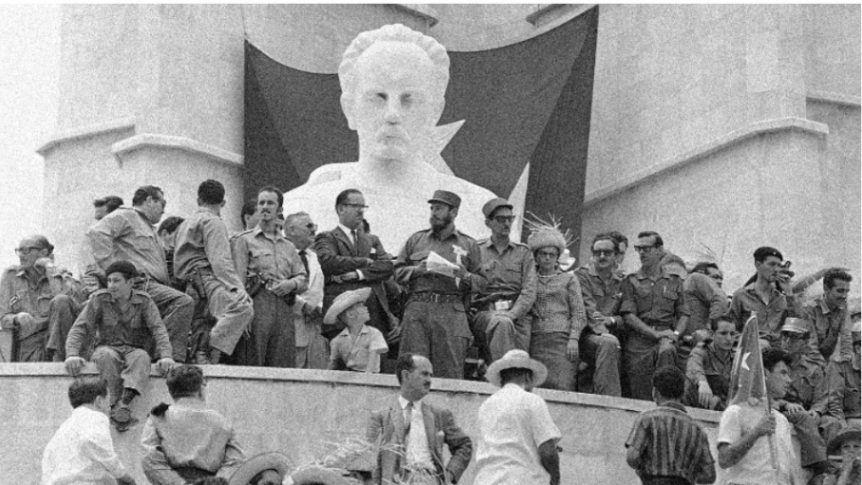
Photo: Fidel Castro, center, at the May Day 1960 parade in Havana at the Jose Marti Monument. | AP

South Paris, Maine


Introduction

While living in exile in the United States, José Martí dedicated the time between 1880 and 1895 to preparations for Cuba’s Second War for Independence from Spain, which ran from 1895 to 1898. Martí died as a martyr in Cuba on May 18, 1895. Our interest here is in Marti’s ideas on Cuba’s independence from the United States.

His writings are full of criticisms of the United States and U.S. pretentions for control of Cuba. Our object in presenting Martí’s ideas on the United States is to show that U.S. assault on Cuba, ongoing now for six decades as economic blockade, is hardly new. The U.S. has in fact sought domination over Cuba since the beginning of the 19 th century.

What follows is a sampling of Martí’s observation on the United States, written while he was living in New York between 1880 and early 1895. Martí, born in 1893, traveled frequently to Florida and even to Central America and the West Indies to educate, recruit, and raise funds for the coming independence struggle. In 1892, he founded the Cuban
Revolutionary Party and its newspaper Patria.

The Spanish colonial government arrested Martí for his writings in 1869 early in the course of Cuba’s First War for Independence (1868-1878). After one year in prison, Martí in 1871 left for exile in Spain where he remained for three years. Subsequently he was teaching and writing in Mexico and Guatemala until he returned to Cuba in 1878, only to be
exiled again to Spain. He moved on to New York, where, except for a six-month stay in Venezuela in 1881, he would remain until he left for Cuba in 1895.

Two themes dominate in his writings about the United States. He projected the idea of the idea of “our America,” which for him was all the territory lying between the Rio Bravo (Rio Grande) and Tierra del Fuego. That region had its own cultures, traditions, and history rather than those of North America and Europe. His essay “Our America” was published in
New York in 1991.

Warning about the U.S. threat to Cuban independence, Martí also mentioned the terms annexationism and annexationists to signify longings by U.S. Americans and by Cubans for U.S. possession of the island.

Excerpts of Martí’s writings follow:

José Martí’s letter to NY Evening Post, March 25, 1889 –

“It is probable that no self-respecting Cuban would like to see his country annexed to a nation where the leaders of opinion share towards him the prejudices excusable only to vulgar jingoism or rampant ignorance. There are some Cubans who … would like to see the island annexed to the United States. But those who have fought in war and learned in exile
… do not desire the annexation of Cuba to the United States. They do not need it; …they cannot honestly believe that excessive individualism, reverence for wealth, and the protracted exultation of a terrible victory are preparing the United States to be the typical nation of liberty.

José Martí’s letter to Gonzalo de Quesada on December 14, 1889 mentions this:

“On our land, Gonzalo, there is another [U.S.] plan even more sinister than what we have seen so far, and that is the wicked plan to force the island into war, to precipitate it, in order to have a pretext to intervene in it, and with the credit of mediator and guarantor, to take it over. There is nothing more cowardly in the annals of free peoples: nor any more cold- blooded evil.

The Washington Pan-American Congress — José Martí provided La Nación newspaper in Buenos Aires with a report (December 19-20, 1889) on the First International Conference of American States that took place in Washington from October,1889 to April,1890. Marti attended as consul for Uruguay. On the agenda were U.S. plans for bolstering commercial ties to the region and establishing a customs union.

“The parade of delegates is ending and the sessions of the Pan-American Congress are about to begin. Never in America, from its independence to the present, has there been a matter requiring more good judgment or more vigilance … than the invitation which the
powerful United States (glutted with unsaleable merchandise and determined to extend its dominions in America) is sending to the less powerful American nations (bound by free and useful commerce to the European nations) for purposes of arranging an alliance against Europe and cutting off transactions with the rest of the world. Spanish America
learned how to save itself from the tyranny of Spain; and now, after viewing with judicial eyes the antecedents, motives, and ingredients of the invitation, it is essential to say, for it is true, that the time has come for Spanish America to declare its second independence.”

The Inter-American Monetary Commission convened in Washington between January 7 and April 8, 1891. Its object was to fulfill instructions from the recent Pan-American International Conference to form an international monetary union and adopt a common silver currency. The Latin American delegates chose Martí, attending as Uruguay’s
representative, to present a report on their views.

“In every invitation among nations, one must look for hidden motives. No nation does anything against its interest; … Lesser nations, which are still in the throes of gestation, cannot safely join forces with those who seek a union with weaker nations as a solution for the excessive production of a compact and aggressive population, and a vent for their restless masses … They believe in the incontrovertible superiority of “the Anglo-Saxon
race over the Latin race”. They believe in the inferiority of the Black race, which they enslaved yesterday and continue to oppress today, and of the Indian race, which they are exterminating. They also believe that the peoples of Spanish America are composed principally of Indians and Blacks. … Does a political and economic alliance with the United States benefit Spanish America?

“Whoever says economic union, says political union. The nation that buys, rules. The nation that sells, serves.….

The Truth about the United States – Martí published this article in Patria, newspaper of the Cuban Revolutionary Party on March 23, 1894. “But it is certainly true that … in the United States, the reasons for unity are weakening, not solidifying; [that] the various localities are dividing and irritating national politics, not uniting with it; [that] democracy is
being corrupted and diminished, not strengthened and not saved from the hatred and wretchedness of monarchies … From the standpoint of justice and a legitimate social science it should be recognized that … the North American character has gone downhill since the winning of independence, and is today less human and virile; whereas the Spanish- American character today is in all ways superior, in spite of its confusion
and fatigue, to what it was when it began to emerge from the disorganized mass of grasping clergy, unskilled ideologists and ignorant or savage Indians.”

José Martí’s article “The Third Year of the Cuban Revolutionary Party” appeared in Patria on April 17, 1994. It contains this segment:
“Glory does not belong to those who look back, but to those who look forward. It is not merely two flower-covered islands (Cuba and Puerto Rico) … that we are going to bring forth, but we will save and serve them in such a way that the skills and vigor of their peoples, less isolated than those of the resentful and hungry European societies, ensures the independence of the happy archipelago that nature placed at the center of the world – despite the greed of a strong and unequal neighbor. … On the side of America are the Antilles, which, if enslaved, would be a mere pontoon in the war of an imperial republic against a jealous and superior world that is already preparing to deny it power—a mere fort of American Rome. If they were free … they would be the guarantee of balance between the continents, of independence for Spanish America, now under threat, and of honor for the great republic of the North.”

Martí’s article “Honduras and the Outsiders” appeared in Patria onDecember 15, 1894. There he explains that, “In America there are two peoples, and no more than two, with very
different souls due to their origins, backgrounds, and customs, and similar only in their fundamental human identity. On one side is our America, and all its peoples are of a similar or identical nature and background, and of an identical prevailing mix; on the other side is the America that is not ours, whose enmity it is neither sensible nor viable to foster, and with which it is not impossible, and indeed useful, to be friends, with firm decorum and shrewd independence. But we must live from our soul, cleansed of the evil church and the habits of mastery and undeserved luxury.”

José Martí’s letter to Manuel Mercado of May 18,1895
Mercado, living in Mexico, was Martí’s friend of many years. Martí, General Maximo Gomez and four others came ashore in eastern Cuba on April 11 1895. They had traveled from the Dominican Republic. Accompanied by rebel troops, they proceeded westward. Mari died in
battle on May 18, 1895, a day after writing this unfinished letter.

My dearest brother: Now I can write, now I can tell you how tenderly and gratefully and respectfully I love you and that home which I consider my pride and responsibility. I am in daily danger of giving my life for my country and duty. For I understand that duty and have the courage to carry it out – the duty of preventing the United States from spreading
through the Antilles as Cuba gains its independence and from overpowering our lands of America with that additional strength. All I have done so far, and all I will do, is for this purpose. … I have lived in the monster and I know its entrails; my sling is David’s. …

I am doing my duty here. The war in Cuba to prevent … the annexation of Cuba to the United States has come at the right time in America. It’s a reality greater than the vague and scattered desires of the annexationists among the Cubans and Spaniards, whose alliance with the Spanish government would only give them relative power.

Unless otherwise noted, Martí’s writings are taken from “Our America”, José Martí and Philip S. Foner, Monthly Review Press, 1977.


W.T. Whitney, Jr., is a political journalist whose focus is on Latin America, health care, and anti-racism. A Cuba solidarity activist, he formerly worked as a pediatrician and lives in rural Maine.


US imperialist war against Haiti / By W. T. Whitney Jr.

South Paris, Maine


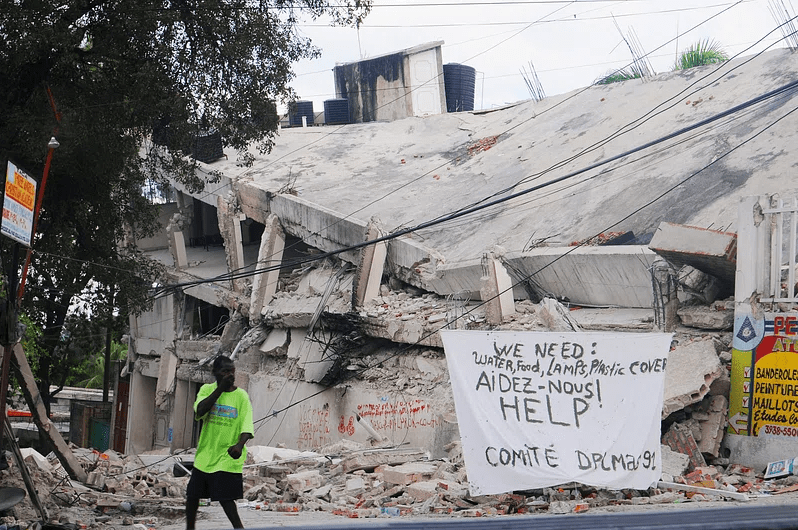
The Trump administration on June 27 announced that Temporary Protected Status (TPS) applying to half a million Haitians living in the United States will end on September 2. That total includes 300,000 people who, having fled unrest and violence, gained TPS in June 2024 under the Biden administration; 200,000 other Haitians who entered following a terrible earthquake in 2010 received TPS during Obama’s presidency.

Haitians not voluntarily returning to their country or not qualifying for legal immigration status otherwise face deportation. A spokesperson for the Department of Homeland Security was reassuring: “The environmental situation in Haiti has improved enough that it is safe for Haitian citizens to return home.” That is not so.

A State Department travel advisory on Haiti in September 2024 tells U.S. citizens, “Do not travel to Haiti due to kidnapping, crime, civil unrest … Crimes involving firearms are common in Haiti …” Lawyer Aaron Reichlin-Melnick of the American Immigration Council insists that, “This is NOT a safe place to send people. It’s a death sentence.”

Desperation

In truth, chaos and devastation are going to speed the deaths of many Haitians. According to a recent report from the International Organization for Migration of the United Nations, “Nearly 1.3 million people have been forced to flee gang violence in Haiti and seek refuge elsewhere within the Caribbean country … This represents a 24 per cent increase from December 2024.”

The report adds that, “Behind these numbers are so many individual people whose suffering is immeasurable; children, mothers, the elderly, many of them forced to flee their homes multiple times.” The gangs, unified under the name Viv Ansanm, engage in stealing, killing, extorsion, and destruction.

For a decade and more, Haitians have repeatedly protested and mobilized in the streets against high prices and shortages. Business owners and the wealthy have funded the gangs in order to protect their properties and interests against popular mobilizations. The U.S. government turns a blind eye to weapons entering Haiti from the U.S. Analyst Seth Donnelly speaks of “Death squads … financed by members of Haiti’s upper class and heavily armed by major weapons flowing into Haiti from Florida.”

This account of Haitians in distress and of the U.S. government covering up the truth points to U.S. domination there that that differs from the targeting of Gaza and Iran. However, each of these situations as varied as they are, have characteristics defining them as imperialist interventions.

Important here is the connection between imperialism and capitalism. It looks like this: at a certain stage in history, imperialism came to represent a way for nations to be able to improve the capabilities of corporations to generate wealth. Therefore, fight against imperialism is fight against capitalism, because imperialism derives from capitalism. It follows that opposition to the excesses of U.S. imperialism in Haiti fits within customary anti-capitalist struggle. But one needs to appreciate the imperialist nature of U.S. interventions in Haiti. That’s the object of what follows here.

Rule from afar

President Jovenel Moïse, wealthy and a major embezzler of public funds, was assassinated for uncertain reasons by US -organized mercenaries in 2021. Subsequently, a governing body appointed by the so-called Core Group has supervised Haiti’s affairs. The Core Group represents key North American and European governments.

Garry Conille, Haiti’s de facto prime minister, in June 2024 welcomed to Haiti 400 Kenyan troops who were the first contingent of the UN-authorized and partially-U.S.-funded Multinational Security Support Mission. They would be fighting the gangs.  Full funding and the full complement of 2500 troops sent by participating nations have fallen short. Meanwhile, killings and internal displacement continue.

According to the New York Times, Eric Prince has recently sent weapons to Haiti and will soon dispatch 150 mercenary troops there. He has introduced drones that have killed at least 200 people. Prince was a big donor to President Trumps’s 2016 campaign and is by far the lead U.S. empresario of mercenary warfare. Who pays Prince is unspecified.

As if Haiti’s government is the prime actor in this drama, the Times report portrays that government as “turning to private military contractors equipped with high-powered weapons, helicopters and sophisticated surveillance and attack drones to take on the well-armed gangs.” Haiti’s government, in fact, is on leave – is AOL.

History with a logic

Nothing about this train of grief is by chance. Powerful forces – imperialists abroad and oligarchs within – remain determined, it seems, that a people-centered government will never take root in Haiti. Once, there had been an opportunity.

Cooperating with Canada and France, the U.S. government in 2004 backed the paramilitaries who removed President Jean-Bertram Aristide from power, along with his progressive Lavalas political party. Earlier in 1991, CIA-affiliated paramilitaries did likewise.

President Aristide’s overwhelming electoral victory in 1990 and Lavalas presidential candidate René Préval’s victory in 1995 represented the first and second democratic elections, respectively, in Haiti’s history. They were the last ones, so far. U.S. Secretary of State Hilary Clinton engineered Michel Martelly’s election as president in 2010. Jovenel Moïse’s election in 2016 was marked by electoral corruption.  No elections of any kind have taken place since that year.

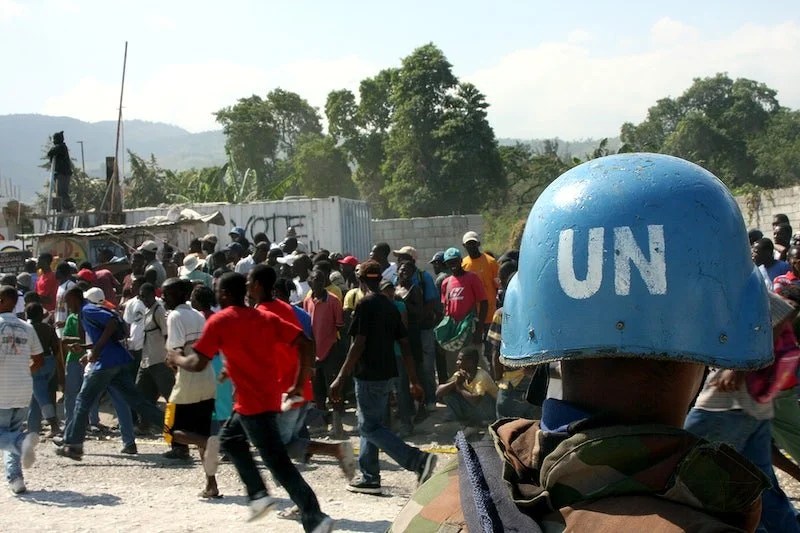
Following the U.S. coup against Aristide in 2004, the U.S. government, United Nations officials and the Core Group (of imperialist countries) together installed, the “United Nations Stabilization Mission in Haiti” (MINUSTAH).  Under Core Group supervision, MINUSTAH imposed a military occupation from 2004 until 2017.  Reports abounded of destruction, dying, disease – particularly cholera – and sexual violence on the part of occupying troops. The Haitian people’s real needs went begging.  

Enslaved workers in what would become Haiti rebelled in 1791 and established national independence in 1804. Between then and 1991, when Aristide first became president, Haiti was under steady assault from foreign powers. The result was foreclosure on the country’s political and social development.

France pressured independent Haiti into providing reimbursement for French plantation owners’ loss of enslaved labor. Haiti borrowed money to pay. Vast debt obligations continued into the 20th century. The U.S. government refused for decades to trade with Haiti or recognize her independence. It carried out a brutal military occupation from 1915 until 1934 and fully backed the Duvalier dictatorship (1957-1986).

A flexible imperialism

U.S. oppression of Haiti takes place in ways other than the devices imperialists usually rely on. Intent upon accumulating wealth, they go abroad to capture natural resources like oil and try to control strategically placed geographic locations. U.S. imperialists, partnering with Israel, are pursuing both of these objectives in Palestine and Iran.

Haiti offers nothing to compare. Low-wage industry beckons but garment manufacturing, active in Haiti, is only a weak draw. However, Haiti presents other attractions for imperialists that are very much in line with goals of extending control and generating wealth.

Haiti’s achievement of national independence surely represented a great upset of colonial trade arrangements, and these had prepared the way toward capitalist industrialization. Early U.S. capitalists condemned happenings in Haiti. That attitude undoubtedly assured Haiti a place on the U.S. blacklist.  Maybe the stigma remains.  

Karl Marx explains that, “direct slavery is as much the pivot of bourgeois industry as are machinery, credit, etc. Without slavery you would have no cotton; without cotton you have no modern industry. It is slavery that gave the colonies their value, it is the colonies that created world trade, and world trade is the precondition for large-scale industry.”

One reason why U.S. imperialists make Haitians miserable is that, in doing so, they create a model image of massed people of color desperate to survive. That image, widely accepted, has possible use in projecting social precariousness as a constant in the underdeveloped world. The object would be to persuade northern exploiters that workers in such regions are so cowed as to accept poor working conditions and stay away from social revolution.

Additionally, the image of black people in great distress may be pleasing to the imperialists for its power of persuading non-Black victims of oppression living precarious lives to value what little remains of their self-regard and worldly possessions and to go it alone, and not join peoples of African heritage in common struggle. 

Lastly, old habits die slowly. The successful rebellion of enslaved people in Haiti stoked fear within U.S. political life and the wider community, both being under the sway of slave-owning interests. Fear persisted and Haiti’s image surely gained no favor during the Jim Crow era. And even now, crucially, racists and their ideas have their place within official Washington circles.


W.T. Whitney Jr. is a political journalist whose focus is on Latin America, health care, and anti-racism. A Cuba solidarity activist, he formerly worked as a pediatrician, and lives in rural Maine.

U.S. war on China, a long time coming / By W. T. Whitney Jr.

A still image from John Pilger’s documentary, “The Coming War on China”

South Paris, Maine


Movement toward war with China accelerates. The public, focused on troubles currently upending U.S. politics, does not pay much attention to a war on the way for decades. The watershed moment came in 1949 with the victory of China’s socialist revolution. Amid resurgent anticommunism in the United States, accusations flourished of “Who “lost” China.”

Loss in U.S. eyes was in China the dawning of national independence and promise of social change. In 1946, a year after the Japanese war ended, U.S. Marines, allied with Chinese Nationalist forces, the Kuomintang, were fighting the People’s Liberation Army in Northeast China.

The U.S. government that year was delaying the return home of troops who fought against Japan. Soldier Erwin Marquit, participant in “mutinies” opposing the delay, explained that the U.S. wanted to “keep open the option of intervention by U.S. troops … [to support] the determination of imperialist powers to hold on to their colonies and neocolonies,” China being one of these.

These modest intrusions previewed a long era of not-always muted hostility and, eventually, trade relations based on mutual advantage. The defeated Kuomintang and their leader, the opportunistic General Chiang Kai-shek, had decamped to Taiwan, an island China’s government views as a “breakaway province.”

Armed conflict in 1954 and 1958 over small Nationalist-held islands in the Taiwan Strait prompted U.S. military backing for the Nationalist government that in 1958 included the threat of nuclear weapons.

Preparations

U.S. allies in the Western Pacific – Japan and South Korea in the North, Australia and Indonesia in the South, and The Philippines and various islands in between – have long hosted U.S. military installations and/or troop deployments. Nuclear-capable planes and vessels are at the ready.  U.S. naval and air force units regularly carry out joint training exercises with the militaries of other nations.

The late journalist and documentarian John Pilger in 2016 commented on evolving U.S. strategies:

“When the United States, the world’s biggest military power, decided that China, the second largest economic power, was a threat to its imperial dominance, two-thirds of US naval forces were transferred to Asia and the Pacific. This was the ‘pivot to Asia’, announced by President Barack Obama in 2011. China, which in the space of a generation had risen from the chaos of Mao Zedong’s ‘Cultural Revolution’ to an economic prosperity that has seen more than 500 million people lifted out of poverty, was suddenly the United States’s new enemy…. [Presently] 400 American bases surround China with ships, missiles and troops.”

Analyst Ben Norton pointed out recently that, “the U.S. military is setting the stage for war on China. … The Pentagon is concentrating its resources in the Asia-Pacific region as it anticipates fighting China in an attempt to exert U.S. control over Taiwan.” Norton was reacting to a leaked Pentagon memo indicating, according to Washington Post, that “potential invasion of Taiwan” would be the “exclusive animating scenario” taking precedence over other potential threats elsewhere, including in Europe.  

New reality

Norton suggests that the aggressive trade war launched against China by the two Trump administrations, and backed by President Biden during his tenure in office, represents a major U.S. provocation. According to Jake Werner, director of the East Asia Program at the Quincy Institute, “Trump’s top military and economic advisers are almost without exception committed to confrontation with China.”

He adds that, “In a context of mounting economic pain on both sides, with surging nationalism in both countries becoming a binding force on leaders, both governments are likely to choose more destructive responses to what they regard as provocations from the other side. A single misstep around Taiwan or in the South China Sea could end in catastrophe.

Economic confrontation is only one sign of drift to a war situation. Spending on weapons accelerates. U.S. attitudes shift toward normalization of war. Ideological wanderings produce old and new takes on anticommunism.

Money for weapons

The annual report of the Stockholm International Peace Research Institute, released in April, says that in 2024 the world’s military spending increased by 9.4% in one year to a $2718 billion; it increased 37% between 2015 and 2024.

U.S. military spending in 2024 was $997 billion, up 5.9% in a year and 19% since 2015. For China, the comparable figures are $314 billion, 7.0%, and 59%, respectively; for Russia, $149 billion, 38%, and 100%; for Germany, $88.5 billion, 29% and 89%. The U.S. accounts for 37% of the world’s total military spending; China,12 %; Russia, 5.5%; and Germany, 3.3%. They are the world’s top spenders on arms.

In the United States,competition from new weapons manufacturers threatens the monopoly long enjoyed by five major defense contractors. These receive most of the $311 billion provided in the last U.S. defense budget for research, development, and production of weapons. That amount exceeds all the defense spending of all other countries in the world.

A new species of weapons manufacturer appears with origins in the high-tech industry. Important products are unmanned aircraft and surveillance equipment, each enabled by artificial intelligence.

Professor Michael Klare highlights one of them, California’s Anduril Industries, as providing the “advanced technologies … needed to overpower China and Russia in some future conflict.” Venture capital firms are investing massively.  The valuation of Anduril, formed in 2017, now approaches $4.5 billion.

Palmer Luckey, the Anduril head, claims the older defense contractors lack “the software expertise or business model to build the technology we need.” Multi-billionaire Peter Thiel, investor in Anduril and other companies, funded the political campaigns of Vice President J.D. Vance and other MAGA politicians. Klare implies that Theil and his kind exert sufficient influence over government decision-making as to ensure happy times for the new breed of weapon-producers.

Giving up

Waging war looks like a fixture within U.S. politics. Support for war and the military comes easily. Criticism that wars do harm is turned aside. Broadening tolerance of war is now a blight on prospects for meaningful resistance to war against China.    

Recent history is not encouraging. After the trauma of the Vietnam War subsided, anti-war resistance in the United States has been unsuccessful in curtailing wars in Yugoslavia, Iraq, Afghanistan, and Libya – and proxy wars in Ukraine and Gaza –despite massive destruction in all of them and more dead and wounded than can be accounted for.

Official language testifies to routinization of U.S. military aggression. Defense Secretary Hegseth, visiting at the Army War College in Pennsylvania, started with, “Well, good morning warriors. …We’re doing the work of the American people and the American warfighter. [And] the president said to me, I want you to restore the warrior ethos of our military.”

Hegseth traveled recently in the Pacific region, presumably with war against China on his mind. In the Philippines, he remarked, “I defer to Admiral Paparo and his war plans. Real war plans.” In Guam, he insists, “We are not here to debate or talk about climate change, we are here to prepare for war.” In Tokyo, he spoke of “reorganizing U.S. Forces Japan into a war-fighting headquarters.”

Ben Norton writes that, “In his 2020 book American Crusade: Our Fight to Stay Free, Hegseth vowed that, if Trump could return to the White House and Republicans could take power, “Communist China will fall—and lick its wounds for another two hundred years.”

Ideas as weapons

Proponents and publicists of off-beat ideas have long disturbed U.S. politics. Brandishing fantasies and myths, the Trump administrations have fashioned a new brand of resentment-inspired politics. Even so, familiar ideas continue as motivators, notably anticommunism.

Writing in Monthly Review, John Bellamy Foster recently explored ideology contributing to Donald Trump’s hold on to power. Much of it, he reports, derives from California’s Claremont Institute, its office in Washington, and Hillsdale College in Michigan. A leading feature is a kind of anticommunism that targets so-called cultural Marxism. But China and its Communist Party are not immune from condemnation.

Michael Anton is a “senior researcher” at the Claremont Institute and director of policy planning at the State Department. According to Foster, Anton suggested that “China was the primary enemy, while peace should be made with Russia [which] belonged to the same ‘civilizational sect’ as the United States and Europe, ‘in ways that China would never be.’”

Former Claremont Institute president Brian Kennedy, quoted by Foster, notes that, “We are at risk of losing a war today because too few of us know that we are engaged with an enemy, the Chinese Communist Party … that means to destroy us.”

The matter of no ideas comes to the fore. Recognized international law authority Richard Falk, writing on May 6, states that, “I am appalled that the Democratic establishment continues to adopt a posture of total silence with regard to US foreign policy.” Viewing the Democrats as “crudely reducing electoral politics to matters of raising money for electoral campaigns,” he adds that, I find this turn from ideas to money deeply distressing.”

The Democrats’ posture recalls a 1948 message from Michigan Senator Arthur Vandenburg, a Republican. During congressional debate on President Truman’s Marshall Plan, Vandenburg stated that, “Politics stops at the water’s edge.” This U.S. tradition lapses only occasionally.

Will resistance to war against China end up stronger and more effective than earlier anti-war mobilizations in the post-Vietnam War era?  A first step toward resisting would be to build awareness of the reality that war with China may come soon. General knowledge of relevant history would be broadened, with emphasis on how U.S. imperialism works and on its capitalist origins. Anyone standing up for peace and no war ought to be reaching out in solidarity with socialist China.  

John Pilger, moralist and exemplary documentarian and reporter, died on December 23, 2023. His 60th documentary film, The Coming War on China, first appeared in 2016. Pilger’s website states that, “the film investigates the manufacture of a ‘threat’ and the beckoning of a nuclear confrontation.” Please view the film on his website.


W.T. Whitney Jr. is a political journalist whose focus is on Latin America, health care, and anti-racism. A Cuba solidarity activist, he formerly worked as a pediatrician, and lives in rural Maine.

Pre-election turmoil in Bolivia ─ is US ready to pounce? / By W. T. Whitney Jr.

Evo Morales March, 2025. Photo: Evo Morales/X

South Paris, Maine


In advance of presidential elections on August 17,2025, Bolivia’s Supreme Electoral Council on April 17 registered 11 political parties and five electoral coalitions. It will soon announce the final list of presidential candidates. Incumbent President Luis Arce, elected in 2020, candidate for the Movement to Socialism Party (MAS) and former economics minister under President Evo Morales, (2006-2019) will head the list.

Longtime MAS leader Morales is a presidential candidate too. The new “Evo, the People” (Evo Pueblo) party held a three-day gathering in Chapare state, Morales’s home base, in late March; attendance topped 70,000.

Here we look at divisions in Bolivia and various social and political instabilities. Clearly, socialist beginnings in Bolivia are vulnerable, most Bolivians may be returning to lives of misery, and U.S. intervention is waiting in the wings.

Downhill course

Morales’s presidency achieved much. A new Constitution established the pluri-national state and gave political rights to indigenous peoples. By nationalizing oil and gas production, the government gained funding for expanded education, healthcare, and support for mothers, children, and the elderly. The GDP tripled, poverty fell, wealth inequalities diminished, and international currency reserves accumulated. Morales became symbol and spokesperson for environmental sustainability.

Then came troubles. They’ve worsened amid political divisions and destabilization episodes. The selling price for exported natural gas fell. Deposits turned out to be limited. (However, discovery of a huge natural gas field was announced in July, 2024.) Funding for social programs and for imports of gasoline, diesel fuel, and food went downhill.  

Government agencies borrowed from the central bank to maintain programs and access to supplies. The bank drew upon the nation’s currency reserves, which have almost disappeared. Dollars, in demand to pay for everyday items, are scarce. Inflation, shortages, and discontent continue. 

Old political divisions took on new life. Having accused U.S. ambassador Philip Goldberg of conspiring with the opposition, Morales expelled him in 2008, along with the U.S. Drug Enforcement Administration. He expelled USAID in 2013.

Big landowners, oil and gas producers, and their proxies in Bolivia’s four eastern states, particularly in Santa Cruz, in 2008 mounted a rebellion with separatist and racist overtones. It failed. Sections of the Bolivian Workers Confederation opposed certain government initiatives. Indigenous groups fought against a new government highway passing through a large preserve.

Morales had faced controversy over the legitimacy of his third presidential term and the fourth one that would have followed his electoral victory in October 2019.  But a coup led by rightwing conspirators, including the Santa Cruz rebels of 2008, took down his government in November, 2019. Morales escaped to Mexico. U.S. support enabled the coup.

Schism and new instabilities

The coup government named Jeanine Áñez as president and arranged for elections. From exile in Argentina, Morales nominated former economics minister Luis Arce as the MAS presidential candidate in elections set for October 18, 2020. Arce took 55% of the vote. His new government jailed Áñez and the other plotters.  

Returning from exile, Morales retained administrative control of the MAS Party. He urged his loyalists serving in Parliament to oppose Arce’s policies. He is said to have “pressure[d] Arce by influencing government nominees to reaffirm his political … authority.” Morales led a march in 2021 that defended Arce against far-right attacks.

By 2023 Morales was actively seeking re-election, even though a Constitutional Court ruled against another Morales term. He was facing charges of sexual abuse of a minor.  Morales abandoned the MAS party in 2024 after Arce-supporting Grover Garcia replaced him as party president.

By late 2024, the split between the two former MAS colleagues was profound. In September, Morales marched with supporters from Caracollo in Oruro Department to La Paz, led protests and vigils against Arce’s policies, encouraged highway blockades, and carried out a five-day hunger strike. Ethnic division may be playing a role, with Arce supposedly speaking for Bolivia’s mestizo population and Morales, Bolivia’s first indigenous president, representing indigenous peoples. 

Destabilization returned. In June 2024 Gen. Juan José Zúñiga sought to arrest Morales for his presidential ambitions. He later led troops and armored vehicles in attacking government office buildings in La Paz, in the process demanding freedom for the jailed 2019 coup leaders. In doing so, according to one report, he revealed his rightwing political orientation and longing for U.S. intervention.

Stirrring the pot of mutual accusations, the now-imprisoned General Zúñiga recently told an interviewer that, in attacking the government, he and his associates had been following President Arce’s instructions to carry out a “self-coup” that would promote discontent in military ranks and ultimately an armed uprising. Zúñiga accused Arce of manipulating the list of potential voters ahead of the upcoming elections.

The overflow of complaints on social media about shortages of basic supplies is also destabilizing. The apparent object is to create panic and generate demand for black-market dollars.

Plot thickens

Observer Pablo Meriguet notes refusal by the strongest center-right opposition candidates to unite in a single campaign, specifically veteran politicians Samuel Doria, Manfred Reyes, and Jorge Quiroga. He sees an effect of improvement of the electoral prospects of either Arce or Morales. The young senate president and former MAS politician Andrónico Rodrigues, also running for president, has confusedly made overtures to rightwing business leaders.

U.S. government officials have long categorized the ascendency of the MAS government in Bolivia with dangers they perceive from Cuba, Venezuela, and Nicaragua. They may regard the upcoming contest as a watershed moment marking disaster for the MAS party and/or worsening chaos; in any case they would be ready to assist in re-ordering the situation. 

Their minds would have turned to lithium. According to analyst José A. Amesty Rivera, the “big agro-industrial capitalists and other powerful sectors [in Bolivia] allied with the United States” want Bolivia to control its own lithium deposits. That’s because “internal divisions favor easy access to the sought-after mineral.” He perceives a quickening of U.S. interest once the Bolivian government contracted with two Chinese companies and a Russian one to develop production facilities in the Uyuni salt flats. 

Amesty Rivera observes that, “the Bolivian lithium contracts are being obstructed by local NGOs, financed by international NGOs. These respond to economic and political interests related to the United States and also to European countries opposing the Chinese and Russian governments.” He adds that “the contracts stipulate that 51% % of the income obtained through lithium sales will go to the Bolivian state.”


W.T. Whitney Jr. is a political journalist whose focus is on Latin America, health care, and anti-racism. A Cuba solidarity activist, he formerly worked as a pediatrician, and lives in rural Maine.

Promise and contradictions emerge from celebration of Cuba’s Latin American School of Medicine / By W. T. Whitney Jr

Photo credit: Prensa Latina

South Paris, Maine


The Latin American School of Medicine (ELAM for its Spanish language initials) is a masterpiece of Cuba’s remarkable healthcare system. A conference of ELAM graduates took place in Havana from November 11 to November 15; two sets of them attended. The gathering marked the 25th anniversary of ELAM’s founding in 1999.

What happened and what was said reflect Cuba’s healthcare achievements and ELAM’s special contribution. A focus on ELAM demonstrates for us the paradox, cruelty, and injustice of U.S. aggression against a people capable of producing such an unprecedented achievement as ELAM.

To be aware that ELAM exists and that its creation falls within the range of human capacity is to be reassured that, in fact, possibilities do exist other than U.S. warmaking, militarization, and complicity in anti-Palestine genocide.

ELAM evolved out of Cuba’s response in 1999 to the ravages of Hurricanes George and Mitch in the Caribbean area and in parts of Central America. Cuban physicians carrying out rescue missions discovered that local healthcare workers were overwhelmed by the catastrophe. Within weeks, Cuba’s political leaders opted to prepare young people to be physicians in their own countries and be ready for future disasters and much more 

Soon prospective medical students were heading to ELAM from hurricane-affected regions. Later they came from throughout Latin America, and eventually from Africa and farther afield, including from the United States.  They were motivated by idealism – enrollees dedicate themselves to serving the underserved – and the fact that no personal outlay is required.

ELAM has now prepared  31,180 physicians for service in 120 countries. Some 1800 medical students from many countries are presently studying there. ELAM provides the first two years of pre-clinical courses at a converted naval base immediately to the west of Havana. Clinical training over the next four years takes place at teaching hospitals throughout Cuba.

On hand in Havana 25 years after ELAM’s initiation were more than 300 ELAM graduates and students plus 250 guests, physicians and students, from 30 countries. The occasion combined the 1st International Congress of ELAM graduates and the 2nd International Assembly of the International Medical Society of Graduates of ELAM (SMI-ELAM).

Organizers assigned the theme “Guardians of life, creators of a better world.” They projected the assembly as “a space for scientific interchange … and a concrete step toward creation of an international medical and scientific organization whose members [are] ELAM graduates.” 

The gathering featured plenary sessions, round tables, panels, and presentations by clinical and research specialists. These took place in Havana’s teaching hospitals and Conventions Center. Topics were: primary health care, medical care during emergencies and natural disasters, postgraduate medical training, and higher education in the medical sciences. Presenters linked medical education, social impact, and international solidarity. Experts from abroad and from international organizations were participating.

Welcoming the delegates, ELAM’s rector Yoandra Muro insisted that, “Commander Fidel is here, standing up, fighting with the example he instilled in his children, the graduates of this project of love.” Here, “we have a space for [ELAM] graduates to continue strengthening our kind of work and projecting training programs for the guardians of the present and future.” She identified graduates as “invincible standard-bearers in the field of health, who from their quality preparation are steeped in the work of solidarity.”

Luther Castillo Harry, currently minister of science, technology, and innovation in the Honduran government, graduated from ELAM in 2007. He declared at the conference that, “We are looking at the possibility of building the greatest scientific organization in the world … Each one of us has to be an ambassador of the Cuban Revolution.” And, “We will only gain the possible, through struggle against the impossible.”

Cuban President Miguel Díaz-Canel sent a message welcoming graduates back to their “second homeland.” He indicated he would not attend the sessions because of duties with post-hurricane recovery efforts. Díaz-Canel cited Fidel Castro’s “deep conviction that a better world is possible if we fight tirelessly for that ideal.”  He speculated on “Fidel’s happiness had he been able to see you become guardians of the life and health of your people.”

Presiding over a plenary session, public health minister José Ángel Portal Miranda discussed healthcare in Cuba. The report has him outlining a system based on primary care that involves 69 medical specialties and three levels of care. Cuba’s medical network, he explained, consists of 451 polyclinics, 11,315 community health centers, 149 hospitals, and a work force of 400,000 people. There are eight physicians serving each cohort of 1000 Cubans, 80,000 in all. Maternity homes and homes for elders are part of the system.

The minister indicated that 40 different faculties or their affiliates are responsible for training physicians; medical sciences are taught in 13 universities. He identified “the development of science and technology as the fundamental pillar of the health system.” Presently 2,767 research projects and 82 clinical trials are underway.  

Portal highlighted Cuba’s international medical solidarity, mentioning the Comprehensive Health Program mediated through international missions, the Barrio Adentro program for Venezuela, Operation Miracle (for eye care), and the Henry Reeve Brigades. He cited some 600,000 Cuban health workers having cared for people in more than 160 countries over many years.

Concluding his remarks, he stated that, “Out of ELAM have emerged and will emerge galenos who will save humanity from the barbarism. Or, as leader of the Revolution Fidel Castro said – ‘Doctors, not bombs!’” (Claudius Galen was a Greek physician and researcher in the classical era. Spanish speakers often refer to physicians as “galenos.”)

Here is Castro speaking in Buenos Aires in 2003:

“Our country does not drop bombs on other peoples, nor does it send thousands of planes to bomb cities; Our country has no nuclear, chemical or biological weapons. The tens of thousands of scientists and doctors in our country have been educated in the idea of saving lives. It would be absolutely contradictory to their conception to put a scientist or a doctor to produce substances, bacteria or viruses capable of killing other human beings.”


W.T. Whitney Jr. is a political journalist whose focus is on Latin America, health care, and anti-racism. A Cuba solidarity activist, he formerly worked as a pediatrician, lives in rural Maine. W.T. Whitney Jr. es un periodista político cuyo enfoque está en América Latina, la atención médica y el antirracismo. Activista solidario con Cuba, anteriormente trabajó como pediatra, vive en la zona rural de Maine.

Honduras – next in line for US-imposed coup / By W.T. Whitney

Image: Honduras: Background and U.S. Relations | CRS Report

South Paris, Maine


After narrowly losing elections in 2013 and 2017, Xiomara Castro and her social democratic Freedom and Refoundation Party (Libre) won the next set of elections such that, as of January 2022, she was Honduras’s new president. The defeated National Party had presided over worsening corruption, electoral fraud, poverty, and violent repression for 12 years – President Juan Orlando Hernández (JOH), for eight of them.

The U.S. government played a part in the military coup that in June 2009 removed President José Manuel Zelaya. He is President Casto’s husband and longtime “coordinator” of the Libre Party. Now the United States is promoting another coup.

Interviewed by media outlet HCH TV on August 28, U.S Ambassador in Honduras Laura Dogu stated that, “We are very concerned about what has happened in Venezuela. It was quite surprising for me to see the Minister of Defense (José Manuel Zelaya) and the head of the Joint Chiefs of Staff (General Roosevelt Hernández) sitting next to a drug trafficker in Venezuela.”

The seat-mate was Venezuela’s Minister of Defense Vladimir Padrino López. The occasion was the World Cadet Games of the International Council of Military Sports taking place in Caracas from August 16 on. The U.S. government had charged Padrino López with “conspiring with others to distribute cocaine” and on March 26, 2020 announced bounties for his capture and that of 14 other Venezuelan officials facing drug-related charges.

Responding, Castro immediately declared that “Interference and interventionism by the United States … is intolerable.” Denouncing “U.S. violation of international law,” she canceled Honduras’s 114- year-old extradition treaty with the United States. Honduras has extradited 40 or so individuals to the United States over 10 years for prosecution on drug-related causes. JOH, the best-known of them, was recently sentenced to a 45-year prison term.

Slippery slope

On August 29, President Castro told reporters, “I will not allow extradition be used as an instrument for blackmailing the armed forces …  Yesterday they attacked the head of the armed forces and the minister of defense in our country… [such an] attack weakens the Armed Forces as an institution and makes the upcoming process of elections [in 2025] very precarious.”

In a television interview , Foreign Minister Eduardo Enrique Reina indicated Dogu’s comments could set off a “barracks coup” aimed at removing General Roosevelt Hernández. Schisms do exist. A year ago, for example, General Staff head José Jorge Fortín Aguilar’s warned four retired military chiefs to desist from their anti-government activities. 

Reina claimed that the extradition treaty, long used as a “political tool to influence the country internal affairs,” could be used “to bring Roosevelt Hernández or Secretary of National Defense José Manuel Zelaya Rosales to trial in the United States, in order to disrupt the Libre Party’s electoral plans.”

Primary elections take place in April 2025 and elections for president and Congress on November 30, 2025. The Libre Party is vulnerable.

The attorney general is investigating secretary of Parliament and Libre Party deputy Carlos Zelaya following his recent acknowledgement that two narco-traffickers in 2013 offered him money for the Libre Party’s election campaign that year.

Implicated in other drug-related crimes, Carlos is the brother of former President José Manuel Zelaya and brother-in-law of President Castro. On August 31, Carlos Zelaya and Defense Minister José Manuel Zelaya each resigned. The latter is Carlos’s son; he and the former president share the same name.

President Castro replaced the resigned defense minister with lawyer Rixi Moncada. She is running for president in the 2025 elections. As such, she would “continue reshaping Honduras’s economic and financial apparatus to fit with the people’s revolution,” according to an admirer.

The situation for Castro and the Libre Party deteriorated even more after September 3 with wide publicity given to a video showing Carlos Zelaya conferring in 2013 with the narco-traffickers. Obtained by InSight Crime and allegedly leaked by the U.S. government, the video is accessible here. It shows the drug-traffickers “offering to give over half a million dollars” to the Libre Party. They mention “previous contributions” to former President José Manuel Zelaya. 
On September 6, President Castro condemned Carlos Zelaya’s meeting with narco-traffickers where they “discussed bribes” as a “deplorable error.”  That day opposition politicians demanded her resignation. They were leading “more than a thousand Hondurans” in a march through Tegucigalpa.

Fallout and implications

The Libre Party’s loss of political power would jeopardize the already precarious lives of most Hondurans. Government data show a poverty rate of 73.6% in 2021 that fell to 64.1% in 2023. According to UNICEF, “Deprivations are highest in nutrition, followed by deprivations in sanitation, education, water, and overcrowding, respectively.” UNICEF reports that, “The homicide rate was 38.1 per 100,000 inhabitants in 2022, the highest in Central America and the second highest in Latin America.”

Honduran writer, lawyer, political commentator, and Libre Party partisan Milson Salgado outlines programs introduced by the Xiomara Castro government that promote national development and social rescue.

He cites these: public enterprises recovered from privatization; “high social investment … in the construction of hospitals, repair of educational centers, construction and reconstruction of recreation centers;” extension of the electricity network; and new highways.

The Castro government has funded rural development, provided “educational scholarships at all school levels,” “support[ed] the agricultural sector with loans at the lowest interest rates in history,” provided financial relief for small farmers, “recovered “65,000 hectares of forest,” and provided support for the elderly and disabled.

The U.S. – assisted coup in progress in Honduras is remarkable in two ways. First, it illustrates U.S. reliance on drug war as justifying military and other interventions in targeted Latin American countries. Salgado notes that the United States has “no interest in the fight against narco-trafficking other than to use it selectively as a weapon for blackmailing governments, countries, and people.”

As regards Colombia, the U.S. government invoked the pretext of narco-trafficking as cover for its direct role in combating leftist insurgents. In Peru, a burgeoning drug trade recently prompted the United States to send in troops, most likely out of solicitude for natural resources on tap there. Exaggerated concern about narco-trafficking in Venezuela has rationalized various kinds of U.S. intervention directed at regime change.

Secondly, U.S. strategists altered the device called lawfare that Latin American coup-plotters rely on these days to remove governments not to their liking. That happened in ParaguayBrazilPeru, and Ecuador  through perverse manipulation of legal norms.

The U.S. gets credit for innovation. Treaties of extradition are legal instruments that, under international law, enable one country to ensure that its criminals staying in another country can be returned for prosecution. It’s a regular legal process that the United States has adapted for Honduras to bring about regime change there.

In any event, government supporters are planning a “big national mobilization” in Tegucigalpa on September 15 “in support of Honduras’s leader, in defense of the homeland’s independence and the building of democratic socialism, and in condemnation of interventionist activities.”


W.T. Whitney Jr. is a political journalist whose focus is on Latin America, health care, and anti-racism. A Cuba solidarity activist, he formerly worked as a pediatrician, lives in rural Maine. W.T. Whitney Jr. es un periodista político cuyo enfoque está en América Latina, la atención médica y el antirracismo. Activista solidario con Cuba, anteriormente trabajó como pediatra, vive en la zona rural de Maine.

Awareness of capitalists’ use of colonialism invites rethinking of solidarity commitment / By W. T. Whitney Jr. 

Mural by Dan Manrique Arias | Photo by Terence Faircloth, CC BY-SA 4.0

South Paris, Maine


Studying capitalism, Karl Marx examined the Industrial Revolution in Europe. He explored conflict between worker and employer. In their book Capital and Imperialism (Monthly Review Press, 2021), authors Utsa Patnaik and Prabhat Patnaik emphasize that Marx’s followers believed that, with the onset of capitalism, “accumulation [has] occurred only on the basis of the generation of surplus value.” (Surplus value signifies that part of a product’s commercial yield which labor generates and employers keep.)

Many U.S. political activists oppose the overseas wars and interventions their government uses to maintain worldwide political and economic domination. More than a few know about stealing in the peripheral regions of the world at the hands of capitalism. They are aware of U.S. imperialism.

The stolen goods include: land, bodies, raw materials, food crops, forests, water, extractable underground resources, exorbitant interest on debt, and funding owed the world’s poor for subsistence. Non-payment for social reproduction is a kind of stealing.

The more these activists learn that capitalism from its start did call for oppression in the undeveloped regions of the world, the more likely might be their inclination to build an anti-capitalist international solidarity movement. The book authored by the Patnaiks contributes to this end by documenting that colonialism and, implicitly, imperialism have been essential to the development of capitalism.

In describing India’s colonial experience, their book – by no means reviewed here in its entirety – provides an explanation taken from Marx as to why capitalism needed colonialism. It details the workings of capitalist-inspired colonialism in India.      

The Patnaiks declare that, “not only has capitalism always been historically ensconced within a pre-capitalist setting from which it emerged, with which it interacted, and which it modified for its own purposes, but additionally that its very existence and expansion is conditioned upon such interaction.” Capitalists sought “appropriation of surplus by the metropolis, under colonialism.” (“Metropolis” is defined as “the city or state of origin of a colony.”)

They explain that “Marx’s basic concept of capitalism [as expressed] in Capital is of an isolated capitalist sector … consisting only of workers and capitalists,” also that an isolated sector implies a capitalism “stuck forever in a stationary state or a state of simple reproduction … [and] with zero growth.” They insist that “a closed self-contained capitalism in the metropolis is a logical impossibility.”

There is “nothing within the system to pull it out of that state.” The economy “will necessarily get to that state in the absence of exogenous stimuli.” 

The Patnaiks envision three kinds of exogenous stimuli: “pre-capitalist markets, state expenditure, and innovations.” The first of these represents the colonialism that would be essential to capitalists as they built the economies of European industrial centers. 

Inflation a concern

Outlining how British capitalism dealt with colonial India, the authors highlight money as a device for holding and transferring wealth. The object has been to preserve its value. The system had these features:  

·        Officials in London used the surplus derived from Indian exports of primary commodities to finance the export of capital to other capitalist countries.

·        British officials taxed the land of small producers in India, using the revenue to pay the colony’s administrative expenses and purchase commodities for export to Britain; some were re-exported to other countries.

·        Britain exported manufactured goods. The flood of them arriving in India led to “deindustrialization of the colonial economy.” Displaced artisan manufacturers became “petty producers” of commodities.

·        British officials dealing with “increasing supply prices” for commodities exported from the colonies, faced “metropolitan money-wage or profit margin increases.” Seeking to “stabilize the value of money,” they imposed “income deflation … [on Indian] suppliers of wage goods and inputs to the capitalist sector.”

·        The claims of heavily-taxed agricultural producers in India were “compressible” especially because they were located “in the midst of vast labor reserves.”  

Colonialism provided British capitalists the option of cutting pay or jobs in India so as to carry out the currency exchanges the system required and to “accommodate increases in money wages” in Britain, both “without jeopardizing the value of money.”

Global economy

The book outlines post-colonial developments. Colonial arrangements persisted throughout the 19th century and collapsed after World War I, due in part, say the authors, to a worldwide agricultural crisis that peaked in 1926. The circumstances gave rise to the Great Depression. Spending for World War II led to recovery, mostly in the United States.

These were “boom years” for capitalism. The United States, confronted with increasing military expenses, turned to deficit financing. Western European countries took up social democracy and the welfare state. Some former colonies, now independent nations, sponsored agricultural and industrial initiatives aimed at relieving economic inequalities.

At that point, the centers could no longer impose income deflation on working people in the periphery to ward off loss of monetary value. Bank holdings increased and lending pressures mounted. In 1973 “the Bretton Woods system collapsed because of the emergence of inflation.” “The capitalist world of the stable medium of holding wealth …[through] the gold-dollar link” took a hit.

Next came worldwide take-over by global finance capital and neoliberalism. The Patnaiks explain that, with “barriers to capital flows” down, “state intervention in demand management becomes impossible.” “[A] regime of income deflation on the working people of the periphery” returned in order to “control inflation and stabilize the value of money.” 

Concluding

This story is of continuities. One is capitalism at its start taking up with colonialism. Another is capitalism using colonialism to preserve the value of money in cross-border commercial and financial dealings. One more is the oppression and beggaring of the world’s working people to prevent inflation.

Karl Marx may have found data and other information on colonialism scarce as he studied capitalism. Additionally, his life of research and political activism may have been so full as to distract him from investigation of the colonial connection. Even so he championed international worker solidarity.  

He and Engels supported India’s independence struggle. Marx defended “heroic Poland” beset by Czarist Russia. He writes to Engels that, “In my view, the most momentous thing happening in the world today is, on the one hand, the movement among the slaves in America, started by the death of [John] Brown and on the other the movement of the serfs in Russia.”

Addressing the International Working Men’s Association – the First International – in 1864, Marx reported that events “have taught the working classes the duty to master themselves the mysteries of international politics; to watch the diplomatic acts of their respective governments.”

The wreckage of people’s lives caused by capitalism now extends widely. The venue of capitalism is global, by its nature. Political support for workers and their political formations in the Global South hits at the essence of capitalist power. The promise of basic change lies in that direction, and that’s so too with alternatives to the capitalist system.

Those struggles for social justice and equality that are confined to the world’s industrial centers do target aspects of capitalism, but without far-reaching expectations. The full effort consists of: pushing for reforms that ease burdens placed upon working people, building mass opposition, and – crucially – advancing the international solidarity movement.


W.T. Whitney Jr. is a political journalist whose focus is on Latin America, health care, and anti-racism. A Cuba solidarity activist, he formerly worked as a pediatrician, lives in rural Maine. W.T. Whitney Jr. es un periodista político cuyo enfoque está en América Latina, la atención médica y el antirracismo. Activista solidario con Cuba, anteriormente trabajó como pediatra, vive en la zona rural de Maine.

Vietnam Is Precedent as US Prepares for War with China / By W. T. Whitney

Near Da Nang, South Vietnam, Marines move through ankle-deep mud carry their poncho-covered comrade towards higher ground were, when the weather permits, he will be air-lifted to the rear areas, Jan. 16, 1968. (AP Photo/John T. Wheeler)

South Paris, Maine


Popular struggle for national independence under socialism has regularly provoked U.S. war or hostile interventions, as with Cuba, North Korea, China, Vietnam and other nations. We explore both the extreme danger of possible U.S. war with China and also the changing U.S rationale for fighting wars. This shows in the difference between why the U.S. war in Vietnam was fought and why U.S. war with China may be on the way.   

Vietnam recently commemorated agreements reached 70 years ago in Geneva that on July 21, 1954 ended war between Vietnamese revolutionary forces and the French military, defeated two months earlier at Dien Bien Phu. According to official media, the object of a “scientific conference” held on July 19 was “to emphasize the historical importance of the agreements for the struggle for national liberation of the Vietnamese people and the peoples of the world.”

Nguyen Phu Trong | Photo: Anadolu Ajnsi

Also on July 19, Nguyen Phu Trong died. Once chairperson of the National Assembly and president of Vietnam, this paramount leader, a student and teacher of Marxist theory, had long served as general secretary of the Communist Party of Vietnam. His death is a reminder, if such is needed, that for Vietnam revolutionary socialism and national liberation were kindred struggles.

To prevent the unification of Vietnam as a socialist nation, the U.S. government went the last mile, first diplomatically and then militarily – from the 1954 Geneva agreements that established Vietnam’s national independence to the departure of defeated U.S. troops on April 30, 1975. The U.S. leadership class, involved in spreading U.S. power and influence across the globe, created and then defended South Vietnam, while attempting to defeat Vietnam’s Revolution, all at enormous human and material cost.

The enclave remaining after a U.S. victory might have ended up as a beachhead for counter-revolution and U.S. control in Southeast Asia. In their various situations, that’s the role performed by South Korea, Taiwan, and even Ukraine in relation to Russia, and Israel vis-a-vis the rest of the Middle East.

U.S. planners, in thinking about what to do about Vietnam, were not entirely devoid of reason. For U.S. imperialists, to beat back Vietnamese Communists – think “domino theory” – and heat up the Cold War against the Soviet Union had a certain logic, according to their own lights.

After the Vietnam disaster, official U.S. planning for war has built upon a variety of ostensible reasons for fighting. Having emerged from World War II well-resourced and strong, the U.S. government consistently demonstrated limited tolerance for the risings of oppressed, colonialized peoples. However, once newly formed independent states showed signs of strength, regional prominence, or even strategic rivalry, U.S. strategists turned to action.

War materialized as the ultimate U.S. fix, no matter the circumstances and under a variety of pretexts, as shown with U.S. war-making in Libya, Afghanistan, and Iraq. The rationales for fighting were more diffuse. The threat of U.S. war now looms over Iran and, more ominously, over China. Each is under the gun because they are strong, assertive states.  

Anti-communism was a safer kind of rationale. Vietnam won its “American War,” and the U.S. government backed off. That’s the story. Incidentally, the Vietnamese people scored a clear win. They live according to plans and socialist purpose in a free and independent nation.  

Vietnam has established diplomatic relations with 190 countries. A Vietnamese writer cites “important achievements with infrastructure gradually meeting the needs of industrialization and modernization.”  Since reforms in the 1980s, an economy resting mainly on foreign direct investment in manufacturing and tourism has expanded. Economic growth ranged between 9.5 and 5.5 percent between 1993 and 2022, save for sharp drops in 2020 and 2021. GDP rose 5.05 percent in 2023. By 2022, the poverty rate was down to 4.3%.

Vietnam’s government since 2008 has spent 20 percent of its budget on education. The same report mentions “high primary school completion rates, strong gender parity, low student/teacher ratios,” and school attendance rates that are high.  The British medical journal Lancet indicates that, “Along with the economic growth, the health of the Vietnamese people has significantly improved between 1990 and 2020, whereby the life expectancy grew from 69 to 75 years, and the under-five child mortality rate decreased from 30 to 21 per 1000 live births.” 

Socialist China restored dignity to the vast majority of its citizens, has afforded them decent lives, and created a well-functioning state that responds effectively to the climate crisis and other challenges. It too warrants a pass from the U.S. government.

That’s not happening: the U.S. government, in the hands of a divided leadership class, deals only haphazardly with major problems afflicting U.S. society. It satisfies the material wants of the upper echelons, and presides over war preparations as part of what is, in effect, a new Cold War.

Indeed, the USA has accumulated over 750 bases in 80 countries and posted 173,000 troops in 159 counties. The U.S. share of global arms exports in 2019-23 was 42 percent, up from 34 percent during the previous four-year period, according to sipri.org.

The US has two island chains around the coast of China. The stars indicate major US bases | via solidarity.net.au

In the Pacific waters surrounding China, the United States has expanded the capabilities of its bases; it operates nuclear-equipped naval vessels, arranges for multi-national naval exercises, has vessels engaging in provocative “freedom of navigation exercises,” and will be introducing nuclear-powered submarines.

The idea of multiple and varied reasons for fighting wars, presented above, folds neatly into the overarching notion of a new Cold War, something that by nature is ambitious, far-reaching, and long term.  Where is the justification for that?

Here is a guess: The United States decades ago turned to a great variety of activities related to military preparation, financing, and recovery. These now intrude massively in the U.S.  economy and in society itself, so much so that, in theory, something has to happen to explain and justify such a state of affairs. War provides meaning, without which the whole apparatus might disappear. What then of the economy and of the collective experience of a U.S population variously oriented to the military?

The Costs of War Project of the Watson Institute of Brown University weighs in. Author Heidi Peltier points out that:

Federal spending on the military and on veterans makes up more than half of the federal discretionary budget. Employment in the federal government is dominated by civilian defense workers and uniformed military personnel. Because the majority of taxpayer dollars and federal resources are devoted to the military and military industries, and most government jobs are in the defense sector, the political power of this sector has become more deeply entrenched and other alternatives have become harder to pursue. Instead of having a federal government that addresses various national priorities … the U.S. has a government that is largely devoted to war and militarism.

Illustration: Liu Rui/GT

Unfortunately, protecting both the U.S. economy and habituation to the military has its downside, specifically extreme danger to humanity itself. Writing in the most recent issue of Monthly Review magazine, John Bellamy Foster and Brett Clark explain, pointing to China. Discussing “Imperialism in the Indo-Pacific,” they state that:

“Most U.S. strategies for winning the New Cold War directed at China are aimed at a strategic-geopolitical defeat of the latter that would bring down Chinese President Xi Jinping and destroy the enormous prestige of the Communist Party of China, leading to regime change from within and the subordination of China to the U.S. imperium from without … (It) is the United States, which sees China’s rise as a threat to its own global preeminence, with the Indo-Pacific super-region increasingly being viewed as the pivotal site in the New Cold War, that is propelling all of humanity toward a Third World War.”


W.T. Whitney Jr. is a political journalist whose focus is on Latin America, health care, and anti-racism. A Cuba solidarity activist, he formerly worked as a pediatrician, lives in rural Maine. W.T. Whitney Jr. es un periodista político cuyo enfoque está en América Latina, la atención médica y el antirracismo. Activista solidario con Cuba, anteriormente trabajó como pediatra, vive en la zona rural de Maine.